
If the depth of a fluid is doubled, the pressure at the bottom of the fluid will:
- double
- halve
- remain the same
- become four times.
Answer
double
Reason — The pressure exerted by a liquid column at a depth h is P = hρg. For a given liquid, ρ and g are constant, so the pressure is directly proportional to the depth. Hence, if the depth is doubled, the pressure at the bottom also becomes double.
The pressure at a point inside a liquid depends on:
- the depth below the surface
- the shape of the container
- the surface area of the liquid
- the volume of liquid.
Answer
the depth below the surface
Reason — The pressure exerted by a liquid at a point is P = hρg, so it depends only on the vertical depth of the point below the free surface and on the density of the liquid. It depends neither upon the shape of the container nor upon the amount of liquid in it. This is the reason for the hydrostatic paradox, in which vessels of different shapes filled with the same liquid up to the same height show the same pressure at their bases.
In a hydraulic brake system, the force applied on the brake pedal is transmitted to the brake pads by:
- mechanical advantage
- electromagnetic forces
- hydraulic fluid pressure
- air pressure.
Answer
hydraulic fluid pressure
Reason — Hydraulic brakes work on Pascal's law. When the brake pedal is pressed, a piston moves into the master cylinder containing brake oil. The increase in pressure is transmitted equally and undiminished through the brake oil to the pistons of the wheel cylinder, which move outwards and press the brake-shoes against the rim of the wheel.
The advantage of hydraulic brakes over mechanical brakes is that they:
- provide greater force multiplication
- require less maintenance
- have fewer parts
- work in all directions.
Answer
provide greater force multiplication
Reason — In a hydraulic system a small force applied on a piston of small area produces a pressure which is transmitted undiminished to a piston of large area, where a much larger force appears. Since the brake oil is practically incompressible, the pressure is transmitted without loss. Hence, hydraulic brakes can multiply the force far more effectively than a purely mechanical linkage.
In a streamline flow, the velocity of fluid particles at any point:
- changes continuously
- is the same at all points
- is constant in magnitude and direction
- decreases with time.
Answer
is constant in magnitude and direction
Reason — In stream-lined flow every particle passing a given point follows exactly the same path as the particle that passed earlier, so the velocity of the fluid at any fixed point remains constant with time in both magnitude and direction. The velocity may, however, be different at different points of the tube.
If the cross-sectional area of a pipe decreases, the velocity of the fluid in the pipe:
- decreases
- increases
- remains the same
- becomes zero.
Answer
increases
Reason — By the principle of continuity, A × v = constant at every section of the tube. Hence the velocity of the liquid is smaller in the wider parts of the tube and larger in the narrower parts. So, if the area of cross-section decreases, the velocity of the fluid increases.
Which of the following fluids has the highest viscosity?
- Water
- Honey
- Air
- Alcohol.
Answer
Honey
Reason — Thicker liquids like honey, coaltar and glycerine have a larger viscosity than thinner ones like water. If water and honey are poured into separate funnels, water comes out readily from the hole while honey takes a long time, because the relative motion between the layers of honey is opposed much more strongly. The viscosity of air is very small compared with that of any of these liquids.
Bernoulli's theorem is based on the conservation of:
- mass
- energy
- momentum
- pressure.
Answer
energy
Reason — Bernoulli's theorem states that when an incompressible and non-viscous liquid flows in stream-lined motion, the total energy per unit volume (pressure energy + kinetic energy + potential energy) is constant at every point of its path, that is,
It is therefore in one way the principle of conservation of energy applied to a flowing liquid. The conservation of mass gives the equation of continuity, not Bernoulli's theorem.
According to Bernoulli's principle, when the speed of a fluid increases, its pressure:
- increases
- decreases
- remains constant
- becomes zero.
Answer
decreases
Reason — For a horizontal flow, Bernoulli's equation reduces to . Since the sum is constant, an increase in the velocity v must be accompanied by a decrease in the pressure P. Thus, in a flowing liquid where the velocity of flow is less the pressure is larger and vice-versa.
The terminal velocity of a spherical object falling in a fluid is determined by:
- the mass of the object
- the fluid density only
- the object's size, fluid viscosity, and density
- the shape of the container.
Answer
the object's size, fluid viscosity, and density
Reason — By Stokes' law, the terminal velocity of a sphere of radius r and density ρ falling through a liquid of density σ and coefficient of viscosity η is
Hence the terminal velocity is decided by the radius (size) of the object, the coefficient of viscosity of the fluid and the difference in the densities of the object and the fluid. It does not depend upon the shape of the container.
Droplets of water tend to be spherical due to:
- gravity
- surface tension
- air resistance
- viscosity.
Answer
surface tension
Reason — Surface tension makes the free surface of a liquid contract to the minimum possible area. For a given volume, a sphere has the minimum surface area and hence the minimum potential energy, which is the condition of stable equilibrium. Hence, small water droplets, on which the effect of gravity is insignificant compared with that of surface tension, assume a spherical shape.
Capillary action occurs due to:
- high fluid pressure
- viscosity
- surface tension and adhesive forces
- gravitational pull.
Answer
surface tension and adhesive forces
Reason — When a capillary tube is dipped in water, the adhesive force between water and glass being greater than the cohesive force, the meniscus becomes concave. The pressure just below a concave meniscus is less than that just above it by 2T/R. To make up this deficiency of pressure, water flows into the tube from outside and rises until hρg = 2T/R. Hence capillarity is the combined result of surface tension and the adhesive forces between the liquid and the tube.
In a capillary tube, the rise or fall of a liquid column is higher in tubes with:
- larger diameter
- smaller diameter
- higher temperature
- lower surface tension.
Answer
smaller diameter
Reason — By the ascent formula, the height to which a liquid rises in a capillary tube is
Thus, as r decreases h increases, that is, the narrower the tube, the greater is the height to which the liquid rises in it.
The coefficient of viscosity of a liquid depends on:
- the size of the container
- the pressure applied
- the temperature of the liquid
- the amount of liquid.
Answer
the temperature of the liquid
Reason — The coefficient of viscosity of a fluid depends only upon the nature of the fluid and not upon the area of the layer or the velocity gradient between the layers. The viscosity of liquids decreases sharply with a rise in temperature and becomes zero at the boiling temperature, whereas the viscosity of gases increases with rise in temperature.
Surface tension tends to :
- maximize the surface area of a liquid
- minimize the surface area of a liquid
- decrease the mass of the liquid
- increase the volume of the liquid.
Answer
minimize the surface area of a liquid
Reason — The molecules lying in the surface of a liquid have a greater potential energy than those in the interior, because work has to be done against the cohesive force in bringing them to the surface. A system is in stable equilibrium when its potential energy is minimum. Hence the liquid surface tends to have the minimum number of molecules in it, that is, it contracts to a minimum possible area. This tendency is exhibited as surface tension.
In a hydraulic lift, the output force is increased because:
- the fluid is compressible
- the input force is reduced
- the area of output piston is more than the input piston
- the fluid flows faster.
Answer
the area of output piston is more than the input piston
Reason — In a hydraulic lift, the pressure produced by the force F1 on the smaller piston of area A1 is . By Pascal's law this pressure is transmitted unchanged to the larger piston of area A2, so the force on it is
Since A2 >> A1, therefore F2 >> F1.
The capillary rise in a liquid depends on:
- the viscosity of the liquid
- the density of the liquid
- both viscosity and density
- the surface tension of the liquid.
Answer
the surface tension of the liquid
Reason — The ascent formula for the rise of a liquid in a capillary tube is
so the capillary rise is directly proportional to the surface tension T of the liquid. Viscosity does not enter this relation at all, since capillary rise is a static effect arising from surface tension.
Note: The density ρ also occurs in the ascent formula, so option 2 is not wholly wrong. The intended answer is option 4, since the capillary rise is caused by surface tension and the given options ask for the property responsible for the rise.
Viscosity of a fluid is directly proportional to:
- temperature
- volume
- surface area
- resistance to flow.
Answer
resistance to flow
Reason — Viscosity is the property of a liquid by virtue of which it opposes the relative motion between its adjacent layers. The coefficient of viscosity is a measure of this internal resistance to flow — the greater the viscosity, the greater is the resistance offered by the fluid to flow. For example, glycerine offers more resistance than water when it flows through a pipe.
Surface tension is responsible for:
- the shape of raindrops
- the buoyancy of ships
- the speed of flowing rivers
- the viscosity of fluids.
Answer
the shape of raindrops
Reason — Surface tension causes the free surface of a liquid to contract to the minimum possible area, and for a given volume a sphere has the least surface area. Hence, raindrops assume a spherical shape. The buoyancy of ships is explained by Archimedes' principle and has nothing to do with surface tension.
Pascal's law states that the pressure applied at any point in a confined fluid:
- acts only in the direction of the applied force
- decreases with distance
- is transmitted equally in all directions
- depends on the density of the fluid.
Answer
is transmitted equally in all directions
Reason — Pascal's law states that if a pressure change is applied to a fluid that is completely confined, incompressible and at rest, that pressure is transmitted equally and undiminished in all directions and also acts on the walls of the container. It is this law that forms the basis of the hydraulic lift, hydraulic brakes and the hydraulic press.
Turbulent flow is characterized by:
- smooth and orderly fluid layers
- random and chaotic fluid motion
- uniform velocity distribution
- no energy loss.
Answer
random and chaotic fluid motion
Reason — Turbulent flow is a type of fluid motion in which the particles move in a highly irregular and unpredictable manner. The velocity of the fluid particles changes continuously in both magnitude and direction, the paths of the particles cross each other and swirling regions called eddies are formed. Smooth and orderly layered motion is the characteristic of laminar flow, not of turbulent flow.
The equation of continuity is based on the principle of:
- conservation of mass
- conservation of energy
- conservation of momentum
- conservation of volume.
Answer
conservation of mass
Reason — The equation of continuity, A1v1 = A2v2, is obtained by equating the mass of liquid entering one end of the tube per second, ρA1v1, to the mass of liquid leaving the other end per second, ρA2v2. It therefore expresses the conservation of mass in the steady flow of an incompressible fluid.
Viscosity is a measure of:
- fluid density
- fluid resistance to flow
- fluid velocity
- fluid temperature.
Answer
fluid resistance to flow
Reason — When one layer of a liquid slides over another layer of the same liquid, an internal frictional force acts between them which opposes their relative motion. This property of the liquid by virtue of which it opposes the relative motion between its adjacent layers is called viscosity. The coefficient of viscosity is thus a measure of the internal resistance of the fluid to flow.
Stokes' law is applicable to:
- turbulent flow
- streamline flow of large particles
- streamline flow of small, spherical particles
- ideal fluids.
Answer
streamline flow of small, spherical particles
Reason — Stokes showed that if a small sphere of radius r moves with terminal velocity v through a homogeneous medium of infinite extension, the viscous force acting on it is F = 6πηrv. The law is valid only for very small spherical bodies and assumes laminar flow; for irregular shapes or for higher speeds turbulence develops and Stokes' law fails.
Which phenomenon is a direct consequence of surface tension?
- Capillary rise
- Sinking of heavy objects
- Boiling of water
- Formation of waves.
Answer
Capillary rise
Reason — The rise or fall of a liquid in a capillary tube arises because the meniscus formed in the tube is curved, and the pressure on the concave side of a curved surface differs from that on the convex side by 2T/R, where T is the surface tension. Hence, capillarity is a direct consequence of the surface tension of the liquid.
In turbulent flow, the flow is:
- ordered and parallel
- random and chaotic
- smooth and regular
- laminar.
Answer
random and chaotic
Reason — In turbulent flow the fluid particles move in a highly irregular and unpredictable manner, their paths crossing one another and forming eddies. This type of flow occurs when the velocity of the fluid is very high, that is, when the Reynold's number exceeds about 3000. Ordered, smooth, layered motion is characteristic of laminar flow.
Bernoulli's theorem can be applied to:
- turbulent flow
- non-viscous flow
- compressible fluids
- viscous flow.
Answer
non-viscous flow
Reason — Bernoulli's theorem is derived for an incompressible and non-viscous liquid flowing in stream-lined motion. Its limitations are that viscosity and friction losses are ignored, the density must be constant, the flow must be irrotational and steady, and there must be no heat exchange. Hence it cannot be applied to turbulent or viscous flows.
According to Pascal's law, if a force of 100 N is applied to a piston of area 0.01 m2, the pressure transmitted in the fluid will be:
- 10 Pa
- 100 Pa
- 1000 Pa
- 10,000 Pa.
Answer
10,000 Pa
Reason — Given, F = 100 N and A = 0.01 m2. The pressure transmitted in the fluid is
A hydraulic press has a large piston with an area 50 times that of a smaller piston. If a force of 10 N is applied to the smaller piston, the force exerted by the larger piston is:
- 10 N
- 50 N
- 500 N
- 2500 N.
Answer
500 N
Reason — Given, F1 = 10 N and A2 = 50 A1.
The mechanical advantage of a hydraulic press is the ratio of the areas of the two pistons,
By Pascal's law, the force exerted by the larger piston is
The terminal velocity of a sphere falling through a viscous fluid is proportional to:
- the square of the sphere's radius
- the viscosity of the fluid
- the density of the sphere
- the height from which it is dropped.
Answer
the square of the sphere's radius
Reason — By Stokes' law the terminal velocity is
Thus, the terminal velocity of the ball is directly proportional to the square of its radius. It is inversely proportional to the coefficient of viscosity, and it does not depend on the height from which the sphere is dropped.
Surface tension is the result of:
- adhesive forces
- cohesive forces among liquid molecules
- gravitational forces
- pressure differences.
Answer
cohesive forces among liquid molecules
Reason — A molecule well inside the liquid is attracted equally in all directions by the neighbouring molecules, so the resultant force on it is zero. But a molecule in the surface has its sphere of molecular activity half outside the liquid, so it experiences a resultant inward cohesive force. On account of this the surface behaves like a stretched elastic membrane and tends to contract to a minimum area. Hence, surface tension arises from the cohesive forces among the liquid molecules.
In detergents, surface tension:
- increases
- decreases
- remains the same
- becomes zero.
Answer
decreases
Reason — Soap and detergents are sparingly soluble impurities, and such impurities lower the surface tension of water. Because of its lower surface tension, a drop of soap solution wets a larger area of the cloth than a drop of pure water and enters the fine pores of the cloth, bringing out the dirt particles with it.
In a fluid flow, as the cross-sectional area decreases, the fluid speed increases and the pressure:
- increases
- decreases
- remains constant
- becomes zero.
Answer
decreases
Reason — By the principle of continuity, a decrease in the area of cross-section increases the velocity of flow. By Bernoulli's theorem for a horizontal flow, , so where the velocity is greater the pressure must be smaller. Hence the pressure decreases at the constriction.
In streamline flow, the flow of fluid is:
- disordered
- ordered and smooth
- chaotic
- completely random.
Answer
ordered and smooth
Reason — In stream-lined flow every particle of the fluid follows a smooth, well-defined path called a streamline, and these streamlines never intersect one another. Each particle passing a given point follows exactly the same path as the particles that passed earlier, so the motion is ordered and smooth. In one line, "streamline flow shows order, laminar flow shows layered smoothness and turbulent flow shows disorder and mixing".
Assertion (A): The pressure at the bottom of a liquid column increases linearly with depth.
Reason (R): Pressure in a fluid at rest is independent of the density of the fluid.
- If both assertion and reason are true and reason is the correct explanation of assertion.
- If both assertion and reason are true but reason is not the correct explanation of assertion.
- If assertion is true but reason is false.
- If assertion is false but reason is true.
Answer
If assertion is true but reason is false.
Explanation
Assertion (A) is correct: The pressure exerted by a liquid column is P = hρg. For a given liquid, ρ and g are constant, so P is directly proportional to h, that is, the pressure increases linearly with depth.
Reason (R) is false: The same relation P = hρg shows that the pressure at a point in a fluid at rest depends directly on the density ρ of the fluid. Denser fluids exert more pressure at a given depth; for example, seawater exerts more pressure than freshwater at the same depth.
Therefore, assertion is true but reason is false.
Assertion (A): Hydraulic presses operate based on Pascal's law.
Reason (R): Pascal's law states that pressure applied to a confined fluid decreases exponentially with depth.
- If both assertion and reason are true and reason is the correct explanation of assertion.
- If both assertion and reason are true but reason is not the correct explanation of assertion.
- If assertion is true but reason is false.
- If assertion is false but reason is true.
Answer
If assertion is true but reason is false.
Explanation
Assertion (A) is correct: A hydraulic press works on Pascal's law. The pressure produced by a small force on a piston of small cross-sectional area is transmitted through the enclosed liquid to a piston of large cross-sectional area, where a much larger force appears.
Reason (R) is false: Pascal's law states that the pressure applied to a completely confined, incompressible fluid at rest is transmitted equally and undiminished in all directions, and not that it decreases exponentially with depth.
Therefore, assertion is true but reason is false.
Assertion (A): In hydraulic brake systems, increasing the area of the brake pedal increases the braking force.
Reason (R): According to Pascal's law, pressure applied to a confined fluid is transmitted undiminished throughout the fluid.
- Both (A) and (R) are true, and (R) is the correct explanation of (A).
- Both (A) and (R) are true, but (R) is not the correct explanation of (A).
- (A) is true, but (R) is false.
- (A) is false, but (R) is true.
Answer
(A) is false, but (R) is true.
Explanation
Assertion (A) is false: In a hydraulic brake the pedal pushes the input piston of the master cylinder, of area A1, and the pressure so produced is transmitted to the output piston of the wheel cylinder, of area A2. The pressure produced is
and the braking force obtained at the output piston is
If the area A1 of the input piston is increased, then for the same force F1 applied by the foot the pressure produced decreases, and the ratio also decreases. Hence the braking force F2 decreases and does not increase. To increase the braking force the output piston must be made larger, or the input piston smaller, which is the opposite of what the assertion states.
Reason (R) is true: Pascal's law is correctly stated. The pressure applied to a confined fluid is transmitted equally and undiminished throughout the fluid, and it is this law which transmits the pressure from the master cylinder to the wheel cylinder.
Therefore, assertion is false and reason is true.
Note: The printed answer gives option 2, which is not correct. The foot supplies a fixed force, not a fixed pressure, so a larger input piston gives a smaller braking force. The correct answer is option 4.
Assertion (A): Turbulent flow occurs at high velocities and with high Reynolds numbers.
Reason (R): Turbulent flow is characterized by smooth and orderly fluid motion.
- If both assertion and reason are true and reason is the correct explanation of assertion.
- If both assertion and reason are true but reason is not the correct explanation of assertion.
- If assertion is true but reason is false.
- If assertion is false but reason is true.
Answer
If assertion is true but reason is false.
Explanation
Assertion (A) is correct: Turbulent flow sets in when the velocity of the fluid becomes very high. In terms of Reynold's number, the flow becomes turbulent when Re > 3000.
Reason (R) is false: Turbulent flow is characterized by highly irregular and chaotic motion in which the paths of the particles cross each other and eddies are formed. Smooth and orderly motion is the characteristic of stream-lined or laminar flow.
Therefore, assertion is true but reason is false.
Assertion (A): The equation of continuity states that the mass flow rate of a fluid is constant in a steady flow.
Reason (R): The product of cross-sectional area and fluid velocity remains constant along a streamline for incompressible fluids.
- If both assertion and reason are true and reason is the correct explanation of assertion.
- If both assertion and reason are true but reason is not the correct explanation of assertion.
- If assertion is true but reason is false.
- If assertion is false but reason is true.
Answer
If both assertion and reason are true and reason is the correct explanation of assertion.
Explanation
Assertion (A) is correct: The equation of continuity is obtained from the conservation of mass. Since the liquid entering one end of the tube must leave at the other, the mass flowing per second is the same at every section, that is, the mass flow rate is constant in a steady flow.
Reason (R) is also correct: For an incompressible fluid the density ρ is constant, so equating ρA1v1 = ρA2v2 gives A1v1 = A2v2, that is, A v = constant.
The constancy of the product A v is precisely the mathematical form which the constancy of the mass flow rate takes for an incompressible fluid. The Reason therefore explains the Assertion.
Therefore, both assertion and reason are true and reason is the correct explanation of assertion.
Assertion (A): The viscosity of gases decreases with an increase in temperature.
Reason (R): Higher temperatures cause gas molecules to move faster, reducing internal friction.
- If both assertion and reason are true and reason is the correct explanation of assertion.
- If both assertion and reason are true but reason is not the correct explanation of assertion.
- If assertion is true but reason is false.
- If assertion is false but reason is true.
Answer
If assertion is false but reason is true.
Explanation
Assertion (A) is false: The viscosity of gases increases with a rise in temperature. It is the viscosity of liquids which decreases sharply with rise in temperature.
Reason (R) is correct: At a higher temperature the gas molecules do move faster. However, in gases the viscosity is due to the transfer of momentum between adjacent layers, and faster molecules make more frequent collisions, so the momentum transfer and hence the viscosity increases.
Therefore, assertion is false and reason is true.
Assertion (A): Bernoulli's theorem is applicable to all types of fluid flows, including turbulent and compressible flows.
Reason (R): Bernoulli's theorem is derived under the assumption of incompressible, non-viscous, steady flow.
- If both assertion and reason are true and reason is the correct explanation of assertion.
- If both assertion and reason are true but reason is not the correct explanation of assertion.
- If assertion is true but reason is false.
- If assertion is false but reason is true.
Answer
If assertion is false but reason is true.
Explanation
Assertion (A) is false: Bernoulli's theorem is not applicable to turbulent or compressible flows. Among its limitations are that it is valid only for non-viscous fluids, assumes constant density, requires irrotational and steady flow, and ignores losses due to friction.
Reason (R) is correct: Bernoulli's theorem is indeed derived for an incompressible and non-viscous liquid flowing in stream-lined motion.
It is precisely because of these restrictive assumptions that the theorem has the limitations which make the Assertion false.
Therefore, assertion is false and reason is true.
Assertion (A): Small spherical objects falling through a viscous fluid reach a constant terminal velocity.
Reason (R): The net force acting on the object becomes zero when the upward drag force equals the downward gravitational force.
- If both assertion and reason are true and reason is the correct explanation of assertion.
- If both assertion and reason are true but reason is not the correct explanation of assertion.
- If assertion is true but reason is false.
- If assertion is false but reason is true.
Answer
If both assertion and reason are true and reason is the correct explanation of assertion.
Explanation
Assertion (A) is correct: When a small ball is dropped in a viscous liquid, its velocity goes on increasing and the viscous force also increases with the velocity. A stage is reached when the ball moves with a constant velocity called the terminal velocity.
Reason (R) is also correct: The terminal stage is reached when the upward viscous force 6πηrv together with the upthrust becomes equal to the downward weight of the ball, so that the net force on the ball is zero.
Since a body moves with constant velocity only when the net force on it is zero, the Reason correctly explains the Assertion.
Therefore, both assertion and reason are true and reason is the correct explanation of assertion.
Assertion (A): Surface tension of a liquid decreases with an increase in temperature.
Reason (R): Increased temperature reduces the cohesive forces between liquid molecules.
- If both assertion and reason are true and reason is the correct explanation of assertion.
- If both assertion and reason are true but reason is not the correct explanation of assertion.
- If assertion is true but reason is false.
- If assertion is false but reason is true.
Answer
If both assertion and reason are true and reason is the correct explanation of assertion.
Explanation
Assertion (A) is correct: The surface tension of a liquid decreases with rise in temperature and becomes zero at the critical temperature.
Reason (R) is also correct: On heating, the molecules of the liquid gain kinetic energy and move farther apart, which weakens the cohesive forces between them.
Since surface tension itself arises from the cohesive forces between the liquid molecules, any weakening of these forces lowers the surface tension. The Reason therefore explains the Assertion.
Therefore, both assertion and reason are true and reason is the correct explanation of assertion.
Assertion (A): Water rises in a glass capillary tube due to capillary action.
Reason (R): The adhesive forces between water molecules and glass are stronger than the cohesive forces among water molecules.
- If both assertion and reason are true and reason is the correct explanation of assertion.
- If both assertion and reason are true but reason is not the correct explanation of assertion.
- If assertion is true but reason is false.
- If assertion is false but reason is true.
Answer
If both assertion and reason are true and reason is the correct explanation of assertion.
Explanation
Assertion (A) is correct: When a glass capillary tube is dipped vertically in water, the water rises in the tube above the level outside. This phenomenon is called capillarity.
Reason (R) is also correct: The adhesive force between water molecules and glass molecules is greater than the cohesive force between the water molecules themselves.
Because adhesion exceeds cohesion, the angle of contact is acute and the meniscus in the tube is concave. The pressure just below a concave meniscus is less than that just above it by 2T/R, and to make up this deficiency water flows into the tube and rises. The Reason therefore explains the Assertion.
Therefore, both assertion and reason are true and reason is the correct explanation of assertion.
Assertion (A): Soap bubbles expand when exposed to heat.
Reason (R): Heating reduces the surface tension of the soap solution, allowing the bubble to expand.
- If both assertion and reason are true and reason is the correct explanation of assertion.
- If both assertion and reason are true but reason is not the correct explanation of assertion.
- If assertion is true but reason is false.
- If assertion is false but reason is true.
Answer
If both assertion and reason are true and reason is the correct explanation of assertion.
Explanation
Assertion (A) is correct: On heating, a soap bubble expands in size.
Reason (R) is also correct: The surface tension of a liquid decreases with rise in temperature, so heating lowers the surface tension of the soap solution.
The excess pressure inside a soap bubble is , which is the pressure holding the bubble in equilibrium. When T is reduced, the inward pull of the surface is weakened and the gas inside pushes the surface outward until a new equilibrium radius is reached. The Reason therefore explains the Assertion.
Therefore, both assertion and reason are true and reason is the correct explanation of assertion.
Assertion (A): In a U-shaped tube containing two different liquids that do not mix, the liquid levels will be the same on both sides.
Reason (R): Pressure at the same horizontal level in a static fluid is the same throughout.
- If both assertion and reason are true and reason is the correct explanation of assertion.
- If both assertion and reason are true but reason is not the correct explanation of assertion.
- If assertion is true but reason is false.
- If assertion is false but reason is true.
Answer
If assertion is false but reason is true.
Explanation
Assertion (A) is false: Two liquids which do not mix have different densities. Since the pressure at the common level must be the same, h1ρ1g = h2ρ2g, so the heights of the two columns must be different — the lighter liquid stands higher.
Reason (R) is correct: In the presence of gravity, the pressure is the same at all points at the same level inside a continuous fluid at rest.
Therefore, assertion is false and reason is true.
Assertion (A): Pascal's law is valid only for incompressible fluids.
Reason (R): Incompressible fluids do not change volume under pressure, ensuring pressure transmission is uniform.
- If both assertion and reason are true and reason is the correct explanation of assertion.
- If both assertion and reason are true but reason is not the correct explanation of assertion.
- If assertion is true but reason is false.
- If assertion is false but reason is true.
Answer
If both assertion and reason are true and reason is the correct explanation of assertion.
Explanation
Assertion (A) is correct: Pascal's law strictly applies to incompressible and static fluids, that is, to liquids at rest. Gases are compressible, so unless they are tightly confined so that their volume cannot change, they do not follow Pascal's law exactly.
Reason (R) is also correct: An incompressible fluid does not change its volume under pressure.
Because the volume does not change, the whole of the applied pressure is passed on to every part of the liquid instead of being partly used up in compressing it. The Reason therefore explains the Assertion.
Therefore, both assertion and reason are true and reason is the correct explanation of assertion.
Assertion (A): Air bubbles in hydraulic brake lines enhance the performance of the braking system.
Reason (R): Air is compressible, which allows for better transmission of pressure in the hydraulic system.
- If both assertion and reason are true and reason is the correct explanation of assertion.
- If both assertion and reason are true but reason is not the correct explanation of assertion.
- If assertion is true but reason is false.
- If assertion is false but reason is true.
Answer
If assertion is false but reason is true.
Explanation
Assertion (A) is false: Air bubbles reduce the effectiveness of hydraulic brakes. The fluid used in a hydraulic system must be incompressible to ensure effective transmission of pressure; any air bubbles in the system compress under pressure, making the brakes spongy and causing a loss of pressure transmission.
Reason (R) is correct in so far as it states that air is compressible. However, it is precisely this compressibility that makes the transmission of pressure worse, not better.
Therefore, assertion is false and reason is true.
Note: The Reason as worded contains two parts — that air is compressible (which is true) and that this allows better transmission of pressure (which is false). Taking the Reason as a whole, both statements would be false, but since no such option is provided, option 4 is the answer intended by the textbook.
Assertion (A): In a narrowing pipe, the velocity of an incompressible fluid decreases.
Reason (R): The equation of continuity states that the product of cross-sectional area and velocity is constant.
- If both assertion and reason are true and reason is the correct explanation of assertion.
- If both assertion and reason are true but reason is not the correct explanation of assertion.
- If assertion is true but reason is false.
- If assertion is false but reason is true.
Answer
If assertion is false but reason is true.
Explanation
Assertion (A) is false: In a narrowing pipe the velocity of an incompressible fluid increases, so that the same mass of liquid crosses every section per second.
Reason (R) is correct: The equation of continuity, A v = constant, is a true statement.
In fact the Reason contradicts the Assertion — since A v is constant, a decrease in A must produce an increase in v.
Therefore, assertion is false and reason is true.
Assertion (A): Honey flows more slowly than water because it has a higher viscosity.
Reason (R): Viscosity is the property of a fluid that opposes relative motion between its layers.
- If both assertion and reason are true and reason is the correct explanation of assertion.
- If both assertion and reason are true but reason is not the correct explanation of assertion.
- If assertion is true but reason is false.
- If assertion is false but reason is true.
Answer
If both assertion and reason are true and reason is the correct explanation of assertion.
Explanation
Assertion (A) is correct: If water and honey are poured into separate funnels, water comes out readily from the hole while honey takes much longer, because honey is far more viscous than water.
Reason (R) is also correct: Viscosity is the property of a liquid by virtue of which it opposes the relative motion between its adjacent layers.
Since honey has a large coefficient of viscosity, the relative motion between its layers is opposed strongly and it flows slowly. The Reason therefore explains the Assertion.
Therefore, both assertion and reason are true and reason is the correct explanation of assertion.
Assertion (A): Airplanes achieve lift because the air pressure above the wings is higher than below.
Reason (R): According to Bernoulli's principle, faster-moving air has lower pressure.
- If both assertion and reason are true and reason is the correct explanation of assertion.
- If both assertion and reason are true but reason is not the correct explanation of assertion.
- If assertion is true but reason is false.
- If assertion is false but reason is true.
Answer
If assertion is false but reason is true.
Explanation
Assertion (A) is false: The air pressure above the wing is lower than that below it. The wing is so shaped that the curvature of its upper surface is greater than that of the lower surface, so the air above has to travel a larger distance and its velocity is greater. It is this excess of pressure below the wing (P2 − P1) that provides the necessary lifting force.
Reason (R) is correct: By Bernoulli's theorem, where the velocity of a flowing fluid is larger the pressure is smaller.
Therefore, assertion is false and reason is true.
Assertion (A): The drag force experienced by a sphere moving through a fluid is independent of the sphere's radius.
Reason (R): According to Stokes' law, drag force is proportional to the fluid's viscosity and the sphere's radius.
- If both assertion and reason are true and reason is the correct explanation of assertion.
- If both assertion and reason are true but reason is not the correct explanation of assertion.
- If assertion is true but reason is false.
- If assertion is false but reason is true.
Answer
If assertion is false but reason is true.
Explanation
Assertion (A) is false: By Stokes' law the viscous drag force is F = 6πηrv, which depends directly on the radius r of the sphere.
Reason (R) is correct: The same relation shows that the drag force is proportional to the coefficient of viscosity η of the fluid and to the radius r of the sphere.
The Reason directly contradicts the Assertion.
Therefore, assertion is false and reason is true.
Assertion (A): Adding detergents to water increases its surface tension.
Reason (R): Detergents reduce the cohesive forces between water molecules.
- If both assertion and reason are true and reason is the correct explanation of assertion.
- If both assertion and reason are true but reason is not the correct explanation of assertion.
- If assertion is true but reason is false.
- If assertion is false but reason is true.
Answer
If assertion is false but reason is true.
Explanation
Assertion (A) is false: Detergents and soap are sparingly soluble impurities, and such impurities decrease the surface tension of water.
Reason (R) is correct: Detergents do reduce the cohesive forces between the water molecules.
Since surface tension arises from the cohesive forces, reducing these forces lowers the surface tension, which is exactly opposite to what the Assertion states.
Therefore, assertion is false and reason is true.
Assertion (A): Mercury shows capillary rise in a glass tube.
Reason (R): The cohesive forces in mercury are stronger than the adhesive forces between mercury and glass.
- If both assertion and reason are true and reason is the correct explanation of assertion.
- If both assertion and reason are true but reason is not the correct explanation of assertion.
- If assertion is true but reason is false.
- If assertion is false but reason is true.
Answer
If assertion is false but reason is true.
Explanation
Assertion (A) is false: Mercury shows capillary depression, not rise, in a glass tube. Its angle of contact with glass is obtuse (about 135°), so the level of mercury inside the capillary falls below the level outside.
Reason (R) is correct: The cohesive force between mercury molecules is far greater than the adhesive force between mercury and glass.
Because cohesion exceeds adhesion, the meniscus of mercury is convex and the mercury is depressed in the capillary — again the opposite of what the Assertion states.
Therefore, assertion is false and reason is true.
Assertion (A): Pressure in a fluid at a given depth is the same in all directions.
Reason (R): Pressure in a fluid acts perpendicular to any surface in contact with the fluid.
- If both assertion and reason are true and reason is the correct explanation of assertion.
- If both assertion and reason are true but reason is not the correct explanation of assertion.
- If assertion is true but reason is false.
- If assertion is false but reason is true.
Answer
If both assertion and reason are true and reason is the correct explanation of assertion.
Explanation
Assertion (A) is correct: By Pascal's law, the pressure at a point in a static fluid is equal in all directions, that is, P1 = P2 = P3 for the faces of a small prismatic element.
Reason (R) is also correct: A fluid at rest cannot sustain a tangential or shearing stress, so the force exerted by the fluid on any surface in contact with it must be purely normal to that surface.
Since the force is always normal to whichever surface is placed at the point, no direction is singled out and the pressure comes out the same for every orientation. The Reason therefore explains the Assertion.
Therefore, both assertion and reason are true and reason is the correct explanation of assertion.
Assertion (A): In a hydraulic lift, the force applied to the smaller piston is less than the force exerted by the larger piston.
Reason (R): Pressure on smaller area piston is more than that of larger area piston.
- If both assertion and reason are true and reason is the correct explanation of assertion.
- If both assertion and reason are true but reason is not the correct explanation of assertion.
- If assertion is true but reason is false.
- If assertion is false but reason is true.
Answer
If assertion is true but reason is false.
Explanation
Assertion (A) is correct: In a hydraulic lift , and since A2 >> A1, the force on the larger piston is much greater than that applied on the smaller piston.
Reason (R) is false: By Pascal's law the pressure is transmitted undiminished, so the pressure on both the pistons is the same. The larger force on the bigger piston arises from its larger area, not from any difference of pressure.
Therefore, assertion is true but reason is false.
Assertion (A): The pressure at the bottom of a vessel depends only on the height of the liquid column and not on the shape of the vessel.
Reason (R): The pressure in a fluid is directly proportional to the depth of the fluid.
- If both assertion and reason are true and reason is the correct explanation of assertion.
- If both assertion and reason are true but reason is not the correct explanation of assertion.
- If assertion is true but reason is false.
- If assertion is false but reason is true.
Answer
If both assertion and reason are true and reason is the correct explanation of assertion.
Explanation
Assertion (A) is correct: The pressure at the bottom of a container does not depend upon the shape or size of the container. Three vessels of different shapes filled with the same liquid up to the same height show the same pressure at their bases — the hydrostatic paradox.
Reason (R) is also correct: The pressure exerted by a liquid column is P = hρg, so for a given liquid it is directly proportional to the depth h.
Since the pressure is determined entirely by the depth and the density, the shape of the vessel cannot enter into it. The Reason therefore explains the Assertion.
Therefore, both assertion and reason are true and reason is the correct explanation of assertion.
Assertion (A): A fluid in a container open to the atmosphere exerts pressure at the base of the container.
Reason (R): The pressure exerted by the fluid is due to the weight of the fluid column above that point.
- If both assertion and reason are true and reason is the correct explanation of assertion.
- If both assertion and reason are true but reason is not the correct explanation of assertion.
- If assertion is true but reason is false.
- If assertion is false but reason is true.
Answer
If both assertion and reason are true and reason is the correct explanation of assertion.
Explanation
Assertion (A) is correct: A liquid always exerts a force normal to the walls and the bottom of its container at every point, so it exerts pressure at the base.
Reason (R) is also correct: In deriving P = hρg, the weight of the imaginary liquid cylinder standing above the point, mg = A h ρ g, is balanced by the forces on its upper and lower faces. Hence the pressure at a point arises from the weight of the liquid column above it.
Since the pressure at the base is produced by the weight of the liquid standing over it, the Reason correctly explains the Assertion.
Therefore, both assertion and reason are true and reason is the correct explanation of assertion.
Assertion (A): Surface tension causes liquid droplets to be spherical.
Reason (R): A sphere has the minimum surface area for a given volume.
- If both assertion and reason are true and reason is the correct explanation of assertion.
- If both assertion and reason are true but reason is not the correct explanation of assertion.
- If assertion is true but reason is false.
- If assertion is false but reason is true.
Answer
If both assertion and reason are true and reason is the correct explanation of assertion.
Explanation
Assertion (A) is correct: Under no external force, the shape of a liquid drop is decided by surface tension alone, and the drop becomes spherical.
Reason (R) is also correct: For a given volume, a sphere has the minimum surface area.
Surface tension makes the liquid surface contract to the minimum possible area so that its potential energy is minimum, and this condition is satisfied by the spherical shape. The Reason therefore explains the Assertion.
Therefore, both assertion and reason are true and reason is the correct explanation of assertion.
Assertion (A): According to Bernoulli's theorem, in a steady flow, the sum of pressure energy, kinetic energy, and potential energy per unit volume is constant.
Reason (R): Bernoulli's theorem is derived from the conservation of energy principle.
- If both assertion and reason are true and reason is the correct explanation of assertion.
- If both assertion and reason are true but reason is not the correct explanation of assertion.
- If assertion is true but reason is false.
- If assertion is false but reason is true.
Answer
If both assertion and reason are true and reason is the correct explanation of assertion.
Explanation
Assertion (A) is correct: Bernoulli's theorem states that for an incompressible and non-viscous liquid in stream-lined motion, the total energy per unit volume is constant at every point,
Reason (R) is also correct: In the proof of the theorem, the net work done on the liquid is equated to the net increase in its kinetic and potential energies, which is an application of the conservation of energy.
Since the total energy of the flowing liquid is conserved, the sum of the three terms must remain constant. The Reason therefore explains the Assertion.
Therefore, both assertion and reason are true and reason is the correct explanation of assertion.
Assertion (A): The height of a liquid column in a capillary tube is independent of the diameter of the tube.
Reason (R): Capillarity is due to surface tension and the adhesive forces between the liquid and the tube's surface.
- If both assertion and reason are true and reason is the correct explanation of assertion.
- If both assertion and reason are true but reason is not the correct explanation of assertion.
- If assertion is true but reason is false.
- If assertion is false but reason is true.
Answer
If assertion is false but reason is true.
Explanation
Assertion (A) is false: By the ascent formula,
so the height of the liquid column is inversely proportional to the radius, and hence to the diameter, of the tube.
Reason (R) is correct: Capillarity does arise from the surface tension of the liquid together with the adhesive forces between the liquid and the material of the tube, which decide the angle of contact.
Therefore, assertion is false and reason is true.
Assertion (A): Hydraulic brakes are more effective than mechanical brakes.
Reason (R): Hydraulic systems can transmit force with minimal loss due to fluid incompressibility.
- If both assertion and reason are true and reason is the correct explanation of assertion.
- If both assertion and reason are true but reason is not the correct explanation of assertion.
- If assertion is true but reason is false.
- If assertion is false but reason is true.
Answer
If both assertion and reason are true and reason is the correct explanation of assertion.
Explanation
Assertion (A) is correct: Hydraulic brakes are more effective than purely mechanical brakes, since a small force on the brake pedal produces a large force on the brake-shoes.
Reason (R) is also correct: The brake oil used is practically incompressible, so by Pascal's law the pressure is transmitted equally and undiminished to the wheel cylinder with minimal loss.
Because the fluid transmits the applied pressure without loss and the wheel-cylinder pistons have a larger area, a greatly multiplied force is available at the brake-shoes. The Reason therefore explains the Assertion.
Therefore, both assertion and reason are true and reason is the correct explanation of assertion.
What is meant by 1 torr of pressure?
Answer
The pressure exerted by a column of mercury 1 mm high is called 1 torr.
It is a practical unit of pressure and is popular in vacuum science, for measuring low pressures.
Write SI equivalent of 1 atmospheric pressure.
Answer
One atmosphere is approximately equal to the average atmospheric pressure at sea level,
What is 1 bar of pressure?
Answer
The bar is a unit of pressure equal to 100,000 Pa, that is,
It is slightly less than 1 atmosphere and is commonly used in meteorology and in engineering.
What is meant by stream-line motion?
Answer
Stream-line motion is the motion of a fluid in which every particle follows a smooth, well-defined path called a streamline, and these streamlines never intersect one another.
Each particle passing a given point follows exactly the same path as the particles that passed earlier, and the properties of the fluid such as velocity, pressure, density and discharge at a given point remain constant with time.
What is velocity gradient? Write its unit and dimensions.
Answer
Velocity gradient is the rate of change of velocity with distance measured perpendicular to the direction of flow. If the velocity changes by Δv over a perpendicular distance Δz, the velocity gradient is .
Unit : s-1
Dimensions :
Define coefficient of viscosity of a liquid and write its dimensions and unit.
Answer
The coefficient of viscosity of a fluid is numerically equal to the viscous force per unit area which maintains a unit velocity gradient between its two parallel layers. From Newton's law of viscosity,
Dimensions : [M L-1 T-1]
Unit : kg m-1 s-1
Write down SI unit of the coefficient of viscosity.
Answer
The SI unit of the coefficient of viscosity is kg m-1 s-1, that is, kg/(m-s).
Another unit is the poise, where , so that 1 kg m-1 s-1 = 10 poise = 1 decapoise or poiseuille.
What is meant by terminal velocity?
Answer
When a small ball falls through a viscous liquid, the opposing viscous force goes on increasing with its increasing velocity, until a stage is reached when this viscous force becomes equal to the effective force driving the ball. The net force on the ball then becomes zero and it moves with a constant velocity.
This constant velocity attained by the ball falling in a viscous medium is called its terminal velocity.
Write down the formula for the terminal velocity of a small ball falling freely in a viscous liquid.
Answer
where r is the radius of the ball, ρ the density of the material of the ball, σ the density of the liquid and η the coefficient of viscosity of the liquid.
State the principle of continuity for stream-lined flow of an ideal liquid.
Answer
The principle of continuity states that when an incompressible and non-viscous liquid flows in stream-lined motion through a tube of non-uniform cross-section, then the product of the area of cross-section and the velocity of flow is the same at every point in the tube.
Hence the velocity of the liquid is smaller in the wider parts of the tube and larger in the narrower parts.
Write the SI unit of surface tension.
Answer
The SI unit of surface tension is N m-1 (newton/metre).
Since surface tension is also equal to the work done in increasing the surface area by unity, it may equally be expressed in J m-2 (joule/metre2).
What are the factors which affect surface tension?
Answer
The surface tension of a liquid is affected by the following factors :
(i) Temperature : It decreases with a rise in temperature and becomes zero at the critical temperature.
(ii) Impurities (solute) : A highly soluble impurity, such as sodium chloride in water, increases the surface tension, while a sparingly soluble impurity, such as soap or phenol, decreases it.
(iii) Contamination : Dust, grease or oil on the water surface reduces its surface tension.
(iv) Nature of the liquid and the medium present on the other side of the surface.
What is meant by surface energy?
Answer
When the surface area of a liquid is increased, molecules from the interior rise to the surface, doing work against the cohesive force. This work is stored in the newly formed surface in the form of potential energy.
This additional energy per unit area of the surface is called the surface energy of the liquid.
Define surface tension of a liquid in terms of surface energy.
Answer
The surface tension of a liquid is equal to the work required to increase the surface area of the liquid film by unity at constant temperature, that is,
Numerically, therefore, the surface tension of a liquid is equal to its surface energy per unit area.
Define angle of contact between surface of a solid and that of a liquid.
Answer
When the free surface of a liquid comes in contact with a solid, it becomes curved near the place of contact.
The angle inside the liquid between the tangent to the solid surface and the tangent to the liquid surface at the point of contact is called the 'angle of contact' for that pair of solid and liquid.
For pure water and clean glass it is zero, while for mercury and glass it is about 135°.
Write the formula of the excess pressure inside an air bubble of radius R formed in a liquid.
Answer
An air bubble formed inside a liquid has only one surface in contact with the liquid, so the excess pressure inside it is
where T is the surface tension of the liquid.
What is the meaning of capillarity? Write down the formula for the rise of water in a capillary tube.
Answer
Capillarity : When a glass capillary tube open at both ends is dipped vertically in a liquid, the liquid rises or falls in the capillary as compared to the liquid level outside it. This phenomenon of rising or depressing of liquid in very fine bored tubes is called capillarity.
Formula (ascent formula) :
where T is the surface tension, θ the angle of contact, r the radius of the capillary tube and ρ the density of the liquid.
Storage tanks are made thicker near the bottom. Why?
Answer
The pressure due to a liquid column of height h is P = hρg, so it increases with depth.
Hence the pressure is greatest near the bottom of a storage tank, and the walls there have to withstand the largest outward thrust. For this reason the bottom and the walls near the bottom of a storage tank are made thicker.
A cork is floating in water. What is its apparent weight?
Answer
The apparent weight of the cork is zero.
Since the cork is floating, by the law of floatation its weight is exactly balanced by the upthrust of the water on it. Hence the apparent weight, which is the true weight minus the upthrust, becomes zero.
What is the fractional volume submerged of an ice cube in a pail of water placed in an enclosure falling freely under gravity?
Answer
Any fractional volume may remain submerged.
For a body in free fall the effective value of g is zero. Hence both the weight of the ice cube and the upthrust of the water on it become zero. Since neither force acts, the ice cube can float with any fraction of its volume submerged.
On what factors does the critical velocity of a liquid depend?
Answer
The critical velocity of a liquid flowing through a tube is
Hence it depends upon :
(i) the coefficient of viscosity η of the liquid,
(ii) the density ρ of the liquid, and
(iii) the diameter D of the tube,
Re being Reynold's number.
Why is the velocity of water in a river less on the bank and larger in the middle?
Answer
The layer of water in contact with the stationary bank of the river is at rest, on account of the viscosity of water. As we move away from the bank, each successive layer is dragged less by the layer below it and the velocity of the layers goes on increasing.
Hence, the velocity of the water is least at the bank and greatest in the middle of the river, which is farthest from the stationary surfaces.
Write Stokes' formula for the motion of a small solid sphere in a viscous medium and explain the symbols used.
Answer
Stokes showed that if a small sphere of radius r moves with a terminal velocity v through a perfectly homogeneous medium of infinite extension, the viscous force acting on the sphere is
where,
- F = viscous force acting on the sphere,
- η = coefficient of viscosity of the medium,
- r = radius of the sphere,
- v = terminal velocity of the sphere.
When does the acceleration of a ball falling in a viscous medium become zero?
Answer
The acceleration becomes zero when the net force acting on the ball becomes zero.
This happens when the upward viscous force together with the upthrust becomes equal to the downward weight of the ball. The ball then falls with a constant velocity, called its terminal velocity.
On what factors does the terminal velocity of a small ball falling through a viscous liquid depend?
Answer
From the expression , the terminal velocity depends upon :
(i) the radius r of the ball, being directly proportional to its square,
(ii) the density ρ of the material of the ball,
(iii) the density σ of the liquid, and
(iv) the coefficient of viscosity η of the liquid, being inversely proportional to it.
Two small balls of the same material have radii r1 and r2. They are falling through a viscous liquid. What will be the ratio of their terminal velocities?
Answer
The balls are of the same material and are falling through the same liquid, so ρ, σ and η are the same for both. Hence the terminal velocity is proportional to the square of the radius,
Therefore,
Hence, the ratio of their terminal velocities is r12 : r22.
Does the velocity of falling rain drops increase continously? Do the large and small drops reach the ground with the same velocity?
Answer
No, the velocity does not increase continuously. As a rain drop falls, the viscous drag of the air on it increases with its velocity and finally becomes equal to the effective force of gravity. The drop then falls with a constant terminal velocity.
No, the large and the small drops do not reach the ground with the same velocity. Since the terminal velocity is directly proportional to the square of the radius of the drop, the larger drops reach the ground with a greater velocity.
Why do clouds appear floating in the sky?
Answer
Clouds are made up of extremely small water droplets. Since the terminal velocity is directly proportional to the square of the radius, these very small droplets fall with an exceedingly small terminal velocity through air.
Hence, they descend so slowly that they appear to be floating in the sky.
The velocity of fall of a man jumping with a parachute first increases and then becomes constant. Explain.
Answer
In the beginning the parachute is not fully opened, the viscous drag of the air is small and the man falls with nearly the acceleration due to gravity, so his velocity increases.
As the velocity increases the viscous drag of the air also increases, and as the parachute opens fully the effective acceleration is reduced greatly. A stage is soon reached when the upward viscous force becomes equal to the effective weight, so the acceleration becomes zero.
Hence, the man thereafter falls with a constant terminal speed.
Write down Bernoulli's equation for a non-viscous liquid. Discuss the velocity head in it.
Answer
For an incompressible and non-viscous liquid flowing in stream-lined motion, Bernoulli's equation is
Dividing throughout by ρ g,
Velocity head : The term is called the velocity head. It has the dimension of height and represents the kinetic energy of the liquid per unit weight, that is, the height through which the liquid would have to fall freely in order to acquire the velocity v.
Why are the wings of an aeroplane rounded at the front and flat at the back?
Answer
The wing is so shaped that the curvature of its upper surface is greater than that of the lower surface, the front end being rounded and the back end flattened. During flight, the air flowing above the wing has to travel a larger distance than the air below it, so the velocity of air v1 at the upper surface is larger than the velocity v2 at the lower surface.
By Bernoulli's theorem the pressure P1 at the upper surface is therefore less than the pressure P2 at the lower surface.
Hence, because of this pressure difference (P2 − P1), the aeroplane receives the necessary lifting force.
In wind-storm tin shades are blown off. Give reason.
Answer
When wind blows with a high velocity above a tin roof, it causes a lowering of pressure above the roof, in accordance with Bernoulli's theorem. The pressure below the roof, however, remains atmospheric.
Hence, due to this pressure-difference the tin shade is lifted up and blown off.
When a train passes the platform of a railway station at a very fast speed, then people are prevented from going near the edge of the platform. Which law, or theorem, of physics is applied in this ? State that rule, or theorem, and discuss on its basis why above mentioned precaution is taken.
Answer
Bernoulli's theorem is applied here.
Statement : When an incompressible and non-viscous liquid (or gas) flows in stream-lined motion from one place to another, then at every point of its path the total energy per unit volume (pressure energy + kinetic energy + potential energy) is constant, that is,
Explanation : As the train comes in at high speed, the air between the person and the train moves with a large velocity, so by Bernoulli's theorem the pressure in that region decreases. The air behind the person is still at atmospheric pressure, which is now greater.
Hence, this pressure difference pushes the person towards the train, and for this reason people are prevented from standing near the edge of the platform. Small pieces of straw and paper are seen to fly towards the train for the same reason.
A light ball may stay in the vertical stream of water. Write the name of its principle.
Answer
Bernoulli's theorem.
The water rising from the fountain has a very large velocity, so the air-pressure within the stream is lowered. Whenever the ball tends to move out of the stream, the outer air at the larger atmospheric pressure pushes it back into the region of low pressure. Hence the ball remains in stable equilibrium on the fountain.
In the game of cricket and tennis, the spining ball gets turned away from its path. On the basis of which principle or theorem it can be explained?
Answer
Bernoulli's theorem, the effect being known as the Magnus effect.
When the ball spins, the layer of air near its surface is dragged along with it. On one side the velocity of the air relative to the ball becomes (v + u) and on the other side (v − u). By Bernoulli's theorem, the pressure is smaller on the side where the velocity is larger, and this pressure difference exerts a sideways force on the ball. Hence, the spinning ball moves along a curved path.
Give reason why deep water remains calm.
Answer
By the principle of continuity, A × v = constant. In deep water the area of cross-section available for the flow is much larger than in shallow water, so to maintain the same volume flow rate the velocity of flow must be smaller.
Hence, deep water flows slowly and appears calm.
How the surface tension of water can be decreased?
Answer
The surface tension of water can be decreased :
(i) By heating it, since surface tension decreases with a rise in temperature.
(ii) By adding a sparingly soluble impurity to it, such as soap, oil or phenol.
What is the cause of surface tension in a liquid? Write the relation between surface tension and the work required to increase surface area of the liquid.
Answer
Cause : Surface tension is caused by the intermolecular cohesive forces between the liquid molecules. A molecule well inside the liquid is attracted equally in all directions, but a molecule in the surface has its sphere of molecular activity half outside the liquid and so experiences a resultant inward pull. Hence the surface tends to contract to a minimum possible area.
Relation : If W is the work done in increasing the surface area of the liquid by ΔA at constant temperature, then
A drop of oil placed on the surface of water spreads out, but water drops droped in oil are compressed. Explain both the phenomena.
Answer
Oil on water : The adhesive force between the oil molecules and the water molecules is greater than the cohesive force between the oil molecules themselves. Hence the oil drop is pulled apart by the water and spreads out in the form of a thin film.
Water in oil : The cohesive force between the water molecules is greater than the adhesive force between the water and the oil molecules. Hence the water drop is pulled inwards by its own molecules and contracts to take the form of a globule.
A thin needle of steel floats on water; but on dissolving soap in water the needle sinks. Why?
Answer
A thin steel needle placed gently on water floats because the vertical components of the forces of surface tension acting on either side of it balance the weight of the needle.
When soap is dissolved in the water, the surface tension of water is lowered. The upward force of surface tension is then no longer sufficient to balance the weight of the needle.
Hence, the weight of the needle exceeds the force of surface tension acting vertically upward and the needle sinks.
Explain why do small pieces of camphor when dropped in water are found to run to and fro.
Answer
When small pieces of camphor are floated on a clean surface of water, they dissolve in it. The surface tension of the camphor solution is less than that of pure water.
Since the pieces are irregular in shape, one part of the camphor dissolves more than the other, so the surface tension on one side becomes less than that on the other. The piece is therefore dragged towards the region of higher surface tension. Wherever it goes the same thing happens again.
Hence, the camphor pieces dance to and fro on the surface of water.
The hot soup is tastier than the cold one, why?
Answer
The surface tension of a liquid decreases with a rise in temperature. Hence the surface tension of hot soup is less than that of cold soup.
Because of its lower surface tension, the hot soup spreads over a larger area of the tongue and comes in contact with a greater number of taste buds.
Hence, the hot soup is tastier than the cold one.
Why does water rise up in the capillary tube open at both ends on dipping in water?
Answer
When the capillary tube open at both ends is dipped in water, the water meniscus formed inside the tube is concave, since water wets glass.
The pressure just below a concave meniscus is less than the pressure just above it by 2T/R. To make up this deficiency of pressure, water flows into the tube from outside and rises until the pressure of the water column of height h becomes equal to 2T/R, that is,
When wax is rubbed on cloth, the cloth becomes water-proof; why?
Answer
The fine capillaries formed in between the threads of the cloth disappear when wax is rubbed on it.
Moreover, wax increases the angle of contact between the cloth and water to an obtuse value, so that cos θ becomes negative and water is not drawn into the pores.
Hence, water cannot penetrate into the cloth and the cloth becomes water-proof.
How does kerosene oil keep on rising in the wick of the lantern?
Answer
The cotton threads of the wick have a large number of very fine pores between them, which act as fine capillaries.
By capillary action the kerosene oil rises continuously through these capillaries against gravity and reaches the top of the wick, where it burns.
The moisture in a field is retained on ploughing. Explain it on physical principle.
Answer
The soil contains a large number of fine capillaries. If the field is not ploughed, the water of the lower layers of the soil rises up through these capillaries to the surface and evaporates.
On ploughing, the capillaries formed in the soil are broken, so the water can no longer rise to the surface.
Hence, the moisture remains in the lower layers of the soil and is available to the plants.
Water rises higher in a capillary of smaller diameter than in a capillary of larger diameter; why?
Answer
By the ascent formula, the height to which water rises in a capillary tube is
For a given liquid and a given tube material, T, θ, ρ and g are constant, so h is inversely proportional to the radius of the tube.
Hence, the narrower the tube, the greater is the height to which the water rises in it.
How do the temperature and contamination affect the surface tension?
Answer
Effect of temperature : The surface tension of a liquid decreases with a rise in temperature and becomes zero at the critical temperature.
Effect of contamination : If the liquid surface has dust, grease or oil on it, the surface tension is reduced. Similarly, a highly soluble impurity (such as common salt in water) increases the surface tension, while a sparingly soluble impurity (such as soap or phenol) decreases it.
Deduce the dimensional equation of coefficient of viscosity with the help of Stokes' law equation.
Answer
By Stokes' law, the viscous force on a small sphere is F = 6πηrv, so
Writing the dimensions of each quantity,
Simplifying,
Hence, the dimensional formula of the coefficient of viscosity is [M L-1 T-1].
The surface tension of soap solution is 3.0 × 10⁻² N/m. What is the meaning of this?
Answer
Since the surface tension of a liquid is equal to the work required to increase its surface area by unity, the given value means that
the work required to increase the surface area of the soap solution by 1.0 m2 is 3.0 × 10⁻² J.
Equivalently, a force of 3.0 × 10⁻² N acts on either side of an imaginary line of length 1 m drawn in the surface of the soap solution.
A small needle of iron floats on the surface of water. Which forces balance the needle? Show them by a diagram.
Answer
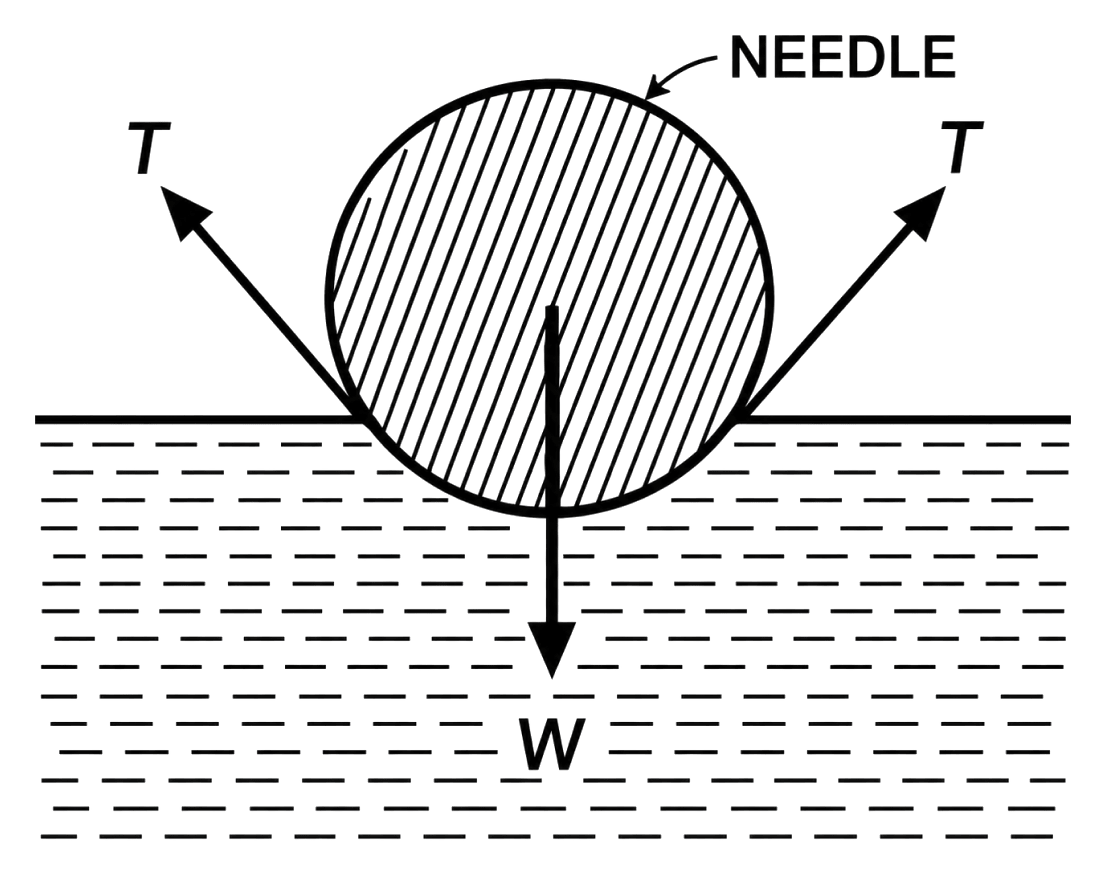
Two forces act on the floating needle :
(i) The forces of surface tension T, T acting along the water surface on either side of the needle, and
(ii) The weight W of the needle acting vertically downwards.
On resolving the tension forces into horizontal and vertical components, the horizontal components cancel each other, while the vertical components are added up and balance the weight of the needle.
Hence, the needle floats on the surface of water.
The ratio of radii of two soap bubbles is 1 : 4. What will be the ratio of excess pressures in them?
Answer
The excess pressure inside a soap bubble of radius R is
Therefore,
Hence, the ratio of the excess pressures in the two bubbles is 4 : 1.
What is pressure ? Give its unit and dimensions. Is it a scalar quantity or a vector ?
Answer
Pressure is the normal force exerted per unit area. Mathematically,
where F is the component of the force acting normal to the surface and A is the area over which the force is distributed.
Unit : The SI unit is N m-2, which is also termed the pascal (Pa), so that 1 Pa = 1 N/m2. In the CGS system it is measured in dyne/cm2.
Dimensions :
Nature : Pressure is a scalar quantity. Although it arises from a vector force, it gives only the magnitude of the normal force per unit area and conveys no particular direction of its own, since the direction of the force is always perpendicular to the surface.
Write angle of contact : (i) between pure water and glass, (ii) between mercury and glass, (iii) between pure water and silver.
Answer
(i) Between pure water and clean glass, the angle of contact is 0°.
(ii) Between mercury and glass, the angle of contact is 135°, which is obtuse because mercury does not wet glass.
(iii) Between pure water and silver, the angle of contact is 90°. Hence, in a silver vessel the surface of water at the edges remains horizontal.
To empty an oil tin, two holes are made. Why?
Answer
If only one hole is made in the tin, the oil does not come out freely. As the oil flows out, the pressure of the air enclosed inside the tin falls below the outside atmospheric pressure, and this excess outside pressure holds the oil back.
When two holes are made, air continuously enters the tin through the second hole. The pressure inside the tin then becomes greater than the atmospheric pressure at the lower hole.
Hence, the oil comes out steadily.
Why is mercury preferred over all other liquids for a barometer?
Answer
(i) Mercury is the densest common liquid, so only a column of about 0.76 m of mercury is needed to balance the atmospheric pressure. With a lighter liquid such as water the required height would be
Such a long barometer tube would be extremely inconvenient to use.
(ii) The vapour pressure of mercury is negligible, so the space above the mercury column is almost a perfect vacuum (the Torricellian vacuum) and the reading is not disturbed by the vapour of the liquid.
A balloon filled with helium does not rise in air indefinitely, but halts after a certain height. Why ?
Answer
Initially the balloon rises because the weight of the air displaced by it, that is, the upthrust of the air on the balloon, is greater than the weight of the helium-filled balloon.
As the balloon rises up, the density of the air decreases with height, and so the upthrust on the balloon also decreases.
Hence, the balloon halts at that height where the upthrust of the air becomes equal to the weight of the helium-filled balloon.
The force required by a person to move his limbs in water is smaller than the force for the same movement in air. Why?
Answer
The density of water is much greater than that of air, so by Archimedes' principle the upthrust of the water on the limbs is much greater than the upthrust of the air.
As a result, the net weight of the limbs in water is much less than that in air, and a smaller force is required to move them.
For the same reason it is easier to swim in sea water, which is heavier, than in river water.
Why is pressure of water reduced when it comes to narrow pipe from broader pipe while flowing ?
Answer
By the principle of continuity, A v = constant, so the velocity of water in the narrower pipe is larger than that in the broader pipe.
By Bernoulli's theorem for a horizontal flow,
Hence, at the point where the velocity is large, the pressure is small, and so the pressure of water is reduced in the narrow pipe.
According to Bernoulli's theorem, the pressure of water should remain uniform in a pipe of uniform radius. But actually it goes on decreasing, why is it so?
Answer
Bernoulli's theorem is derived for a non-viscous liquid, in which no energy is lost during flow.
Real water, however, is viscous. As the water flows through the pipe, work has to be done against the viscous force between its layers, and this work is taken from the pressure energy of the water.
Hence, the pressure of the water goes on decreasing along a pipe of uniform radius.
Height of a tank is H. There is a small hole in the wall of the tank at height h from the bottom. With what velocity will the water come out from this hole and at what horizontal distance will the water fall when the tank is completely filled with water ?
Answer
The hole is at a height h from the bottom, so the depth of the hole below the free surface is (H − h).
Velocity of efflux : By Torricelli's theorem, the velocity of efflux of a liquid from an orifice at a depth d below the free surface is . Here d = (H − h), so
Horizontal range : After emerging, the water adopts a parabolic path. If it takes t second to fall through the vertical distance h, then from ,
Since there is no acceleration in the horizontal direction, the horizontal distance covered is
Hence, the velocity of efflux is and the horizontal range is .
What would be the change in surface energy, when a big drop of water is broken into large number of small drops?
Answer
The surface energy will increase.
When a big drop is broken into a large number of small drops, the total volume remains the same but the total surface area increases considerably.
Since the surface energy is the product of the surface tension and the surface area, W = T × ΔA, an increase in the surface area means an increase in the surface energy. This energy is supplied by the external work done in breaking the drop, and if no work is done, the temperature of the drops falls.
An oil drop is perfectly spherical in water-alcohol mixture (whose density is exactly equal to the density of oil); why?
Answer
Since the density of the water-alcohol mixture is exactly equal to the density of the oil, the weight of the drop is exactly balanced by the upthrust of the mixture on it. Hence there is no effect of gravity on the drop.
The shape of the drop is then controlled by surface tension alone, which makes the surface contract to the minimum possible area. For a given volume the sphere has the minimum surface area.
Hence, the oil drop becomes perfectly spherical.
Oil is sprinkled on sea waves to calm them. Why?
Answer
On sprinkling oil, the breeze spreads the oil over the sea-water in its own direction, so that one part of the surface is covered with oil and the other is not.
The surface tension of pure sea-water is greater than that of the oily water. Hence the water without oil pulls the oily water against the direction of the breeze.
Hence, the sea waves become calm.
Some straw are spread on the surface of pure water filled in a vessel. On dropping a piece of sugar in water, the straw come nearer to the piece, but on dropping a piece of soap they go away from it. Explain it with reason.
Answer
Sugar : Sugar is a highly soluble impurity, so the surface tension of the sugar solution is greater than that of pure water. The surface therefore contracts near the piece of sugar, and the straw come nearer to it.
Soap : Soap is a sparingly soluble impurity, so the surface tension of the soap solution is less than that of pure water. The surface near the soap therefore spreads out, and the straw go away from it.
In both cases the straw move towards the region of higher surface tension.
The angle of contact for a solid and a liquid is less than 90°. Will the liquid wet the solid? Will it rise in the capillary made of that solid?
Answer
Yes, the liquid will wet the solid, and it will rise in the capillary.
An acute angle of contact means that the adhesive force between the liquid and the solid is greater than the cohesive force between the liquid molecules, so the liquid clings to the solid and wets it.
Further, from the ascent formula , when θ < 90° the value of cos θ is positive, so h is positive and the liquid rises in the capillary.
A bigger soap bubble is formed at one end, and a smaller soap bubble at the other end of a bent tube. Which of the bubbles will expand?
Answer
The bigger bubble will expand at the cost of the smaller one.
The excess pressure inside a soap bubble is , which is inversely proportional to the radius of the bubble.
Hence the pressure inside the smaller bubble is greater than that inside the bigger bubble. Air therefore flows from the smaller bubble to the bigger one through the tube, so the smaller bubble shrinks and the bigger bubble expands.
Why is it difficult to fill mercury in the (glass) tube of a thermometer?
Answer
The angle of contact for mercury and glass is obtuse (about 135°), so mercury does not wet glass and its meniscus in a glass tube is convex.
Consequently, from the ascent formula, cos θ is negative and h becomes negative, that is, mercury is depressed in a fine glass tube instead of rising in it.
Hence, when one end of the thermometer tube is dipped in mercury, the mercury descends and it becomes difficult to fill the tube.
At what temperature the surface tension of a liquid is zero?
Answer
At the critical temperature.
The surface tension of a liquid decreases with a rise in temperature and becomes zero at the critical temperature, at which the distinction between the liquid and its vapour disappears and the liquid no longer has a free surface.
The diameter of ball A is half of that of ball B. What will be the ratio of their terminal velocities in water ?
Answer
Given, , so .
The terminal velocity of a ball falling in a viscous liquid is directly proportional to the square of its radius,
Therefore,
Hence, the ratio of the terminal velocities of the balls A and B is 1 : 4.
Water is flowing in a pipe of non-uniform cross-section. The velocity of water at a point A is four times the velocity at another point B. What is the diameter of the pipe at the point A as compared to the point B?
Answer
Given, vA = 4 vB.
By the principle of continuity,
Writing the areas in terms of the diameters,
Substituting vA/vB = 4,
Hence, the diameter of the pipe at A is half of that at B.
The velocity of a small ball of mass m and density ρ1 when dropped in a container filled with glycerine becomes constant after some time. If the density of glycerine is ρ2, what is the ratio of viscous force acting on the ball and true weight of the ball?
Answer
Given,
- Mass of the ball = m
- Density of the ball = ρ1
- Density of glycerine = ρ2
The true weight of the ball is mg, and the volume of the ball is .
By Archimedes' principle, the buoyant force on the ball is the weight of the glycerine displaced,
Since the velocity has become constant, the net force on the ball is zero. Hence the viscous force acting on the ball is equal to the net weight of the ball,
Therefore,
Hence, the required ratio is .
A liquid drop of diameter D breaks up into 27 equal tiny drops. If T is the surface tension of liquid then show that increase in potential energy is 2πD2T.
Answer
Let r be the radius of each tiny drop. Since the total volume remains unchanged,
The increase in potential energy is the work done against surface tension, W = T × ΔA, where ΔA is the increase in the total surface area,
Substituting ,
Hence, the increase in potential energy is 2πD2T.
A big drop is broken into n3 droplets. What is the work done in doing so?
Answer
Let a big drop of radius R be broken into n3 droplets each of radius r. Since the total volume remains unchanged,
The work done is equal to the surface tension multiplied by the increase in the surface area,
Substituting R = n r,
Hence, the work done in breaking the drop is .
The excess pressure inside a soap bubble is thrice the excess pressure inside a second soap-bubble. What is the ratio between the volume of the first and the second bubble?
Answer
For a soap bubble the excess pressure is .
For the first bubble, , and for the second bubble, .
Given that p1 = 3 p2,
The ratio of the volumes is therefore
Hence, the ratio of the volumes of the first and the second bubble is 1 : 27.
A soap bubble of radius R is blown up to form a soap bubble of radius 3R under isothermal conditions. What is the energy spent in doing so if the surface tension of soap solution is T ?
Answer
A soap bubble has two free surfaces, so its total surface area is 2 × 4πR2.
The increase in the surface area when the radius increases from R to 3R is
The energy spent is the work done against surface tension,
Hence, the energy spent in blowing the bubble is 64πR2T.
Can Bernoulli's equation be used to describe the flow of water through a rapid in a river ? Explain.
Answer
No, it cannot be used.
Bernoulli's equation holds good only for the stream-lined flow of an incompressible and non-viscous liquid, in which the total energy per unit volume remains constant.
The flow of water through a rapid in a river is turbulent — eddies are formed and a considerable amount of energy is lost against viscous forces. Since the conditions assumed in deriving the theorem are not satisfied, Bernoulli's equation cannot be applied to such a flow.
If a capillary tube is dipped in water in a state of weightlessness, how will the rise of water in it be different to that observed in normal conditions.
Answer
Under normal conditions, water rises in a capillary tube until the upward force due to surface tension becomes equal to the weight of the water column raised, that is, until
In a state of weightlessness the effective value of g is zero, so the weight of the water column raised in the tube becomes zero. The rising of water therefore never stops on account of its weight.
Hence, the water will rise right up to the other end of the capillary, however long the capillary may be.
If the surface tension of soap solution in water is T, how much work will be done in the formation of a soap bubble of radius r ?
Answer
A soap bubble has two free surfaces, an inner one and an outer one. Hence the total increase in the surface area in forming a bubble of radius r is
The work done is the surface tension multiplied by the increase in surface area,
Hence, the work done in forming the soap bubble is 8πr2T.
For pure water and clean silver the angle of contact is 90°. (i) For silver and water draw diagram as Fig. 34 of text matter, showing forces P, Q, R. What will be the direction of the resultant force R? (ii) What will be the ratio of the cohesive force Q and adhesive force P for water-silver interface? (iii) A capillary tube of silver is held vertically in water. Will the water rise up or fall down?
Answer
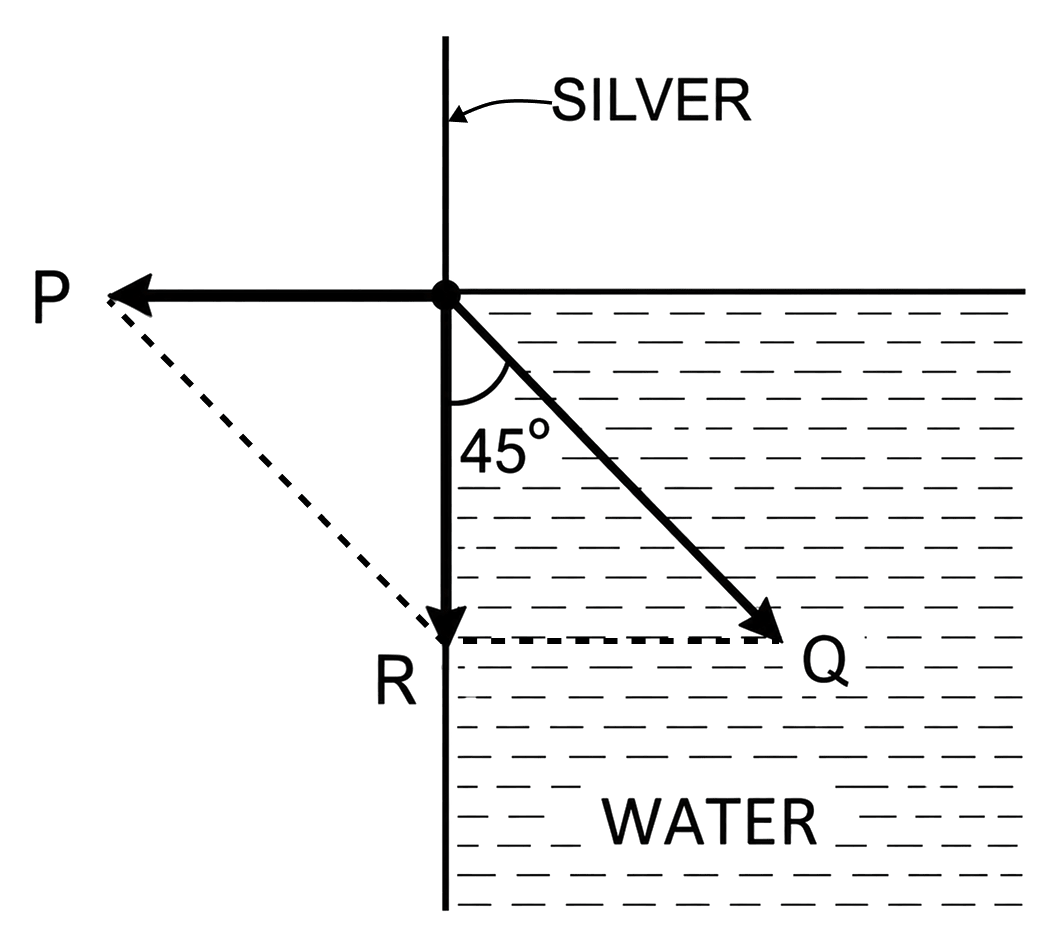
(i) For a molecule on the water surface near the silver wall, P is the resultant adhesive force acting perpendicular to the silver surface and Q is the resultant cohesive force acting towards the interior of the water at 45° to the wall. Since the angle of contact is 90°, the liquid surface must be horizontal there, and the resultant R, which is always perpendicular to the liquid surface, is therefore directed vertically downward.
(ii) For the resultant R to be vertical, the horizontal components of P and Q must cancel. From the geometry of the figure, this requires
Hence, the ratio of the cohesive force to the adhesive force is .
(iii) From the ascent formula, . Here θ = 90°, so cos 90° = 0 and hence h = 0.
Hence, the water will neither rise up nor fall down in the silver capillary.
Two capillary tubes of equal lengths and inner radii 2r and 4r respectively are connected in series and a liquid flows through it. If the pressure difference of between the ends of the whole system is 8.5 cm of Hg then find the pressure difference between the ends of the first capillary tube.
Answer
Given,
- Radius of the first tube = 2r, radius of the second tube = 4r
- Length of each tube = l
- Pressure difference across the whole system, P − P2 = 8.5 cm of Hg
Let P, P1 and P2 be the pressures at the beginning of the first tube, at the joint of the two tubes and at the end of the second tube respectively.
Since the tubes are connected in series, the rate of flow through both is the same. By Poiseuille's formula,
Also, it is given that
Writing equation (i) as P = 17P1 − 16P2 and substituting P from equation (ii), that is, P = P2 + 8.5,
Therefore the pressure difference between the ends of the first tube is
Hence, the pressure difference between the ends of the first capillary tube is 8.0 cm of Hg.
Teacher explains the topic 'Fluid pressure' and to evaluate the understanding of the students, he asks some questions. State whether the response of students in each case are correct or incorrect. Give the reason for your answer.
(i) TEACHER : When an object is submerged in a fluid at rest, then in which direction liquid exerts a force on the surface of the object?
STUDENT : This force is always 'normal' to the surface of object.
(ii) TEACHER : A bottle full of a liquid is fitted with a tight cork. Explain why a slight blow on the cork may be sufficient to break the bottle?
STUDENT : The blow that is given to the cork exerts a pressure on the liquid, which is communicated undiminished to each part of the liquid and the bottle. As the surface of the bottle is much larger than the cross-section area of the cork, force F may be large enough to break the bottle.
(iii) TEACHER : The atmospheric pressure at a height of about 6 km decreases to nearly half its value at the sea level, though the height of atmosphere is more than 100 km. Why?
STUDENT : The density of air is minimum near the surface of earth and increases rapidly with height. At a height of about 6 km, the air density increases twice its value at sea level. Beyond 6 km height, the density of air decreases slowly with height. Hence, the atmosphere continues to exist up to several hundred kilometres height.
Answer
(i) The student's response is correct.
A fluid at rest cannot sustain a tangential (shearing) stress. If the force were not normal to the surface, it would have a tangential component, and since a liquid begins to flow the moment a tangential force is applied to it, the liquid could not remain at rest. Hence the tangential component of the force must necessarily be zero, that is, the force exerted by a fluid at rest is always perpendicular to the surface in contact.
(ii) The student's response is correct.
The blow given to the cork exerts a pressure on the liquid, where f is the force and a is the cross-section area of the cork. By Pascal's law this pressure is transmitted undiminished to each part of the liquid and the bottle.
If A is the area of the surface of the bottle, the force on the bottle's surface is
Since A >> a, therefore F >> f, and this large force may be enough to break the bottle.
(iii) The student's response is incorrect.
The density of air is maximum near the surface of the earth and decreases rapidly with height, not the other way round. At a height of about 6 km the air density decreases to half its value at sea level, and accordingly the atmospheric pressure at 6 km decreases to nearly half its sea-level value. Beyond 6 km the density of air decreases slowly with height, so the atmosphere continues to exist up to several hundred kilometres height.
Pascal's Law and Hydraulic Systems
Pascal's Law states that when pressure is applied to an enclosed fluid, it is transmitted equally in all directions throughout the fluid. This principle is used extensively in hydraulic systems, where a small force applied to a small piston is transmitted through a fluid to generate a much larger force on a larger piston. The force multiplication is due to the difference in the areas of the pistons. Mathematically, the pressure (P) applied on a piston is: P = F/A, where F is the applied force, and A is the area of the piston.
Pascal's Law finds applications in hydraulic lifts, hydraulic brakes, and hydraulic presses. In hydraulic lifts, a small force applied to a small-area piston is transmitted through a fluid to lift heavy objects by applying a larger force on a larger-area piston. Similarly, in hydraulic brakes, pressing the brake pedal exerts pressure on the brake fluid, which is transmitted to brake pads, slowing down the wheels.
In these systems, the fluid used must be incompressible to ensure effective pressure transmission. Any air bubbles in the system can reduce efficiency, as gases can compress, unlike liquids. Pascal's Law is a key principle in engineering systems that require force multiplication and precise control.
(i) Pascal's Law is applicable to which type of fluid?
- Compressible fluids only
- Incompressible fluids only
- Both compressible and incompressible fluids
- Ideal gases only.
(ii) Which of the following devices operates on the principle of Pascal's Law?
- Barometer
- Hydraulic lift
- Venturi meter
- Manometer.
(iii) In a hydraulic system, if the area of the smaller piston is 0.01 m2 and the larger piston is 0.1 m2, what is the mechanical advantage?
- 10
- 0.1
- 100
(iv) In a hydraulic lift, the force applied on a small piston is 100 N, and the area of the large piston is 10 times the area of the small piston. What is the force on the large piston?
- 100 N
- 10 N
- 1000 N
- 10,000 N.
(v) In hydraulic brakes, what happens when air bubbles are present in the brake fluid?
- The brakes become more efficient
- The brakes may fail to work properly
- The brake fluid will solidify
- The system will overheat.
Answer
(i) Incompressible fluids only
Pascal's law applies strictly to incompressible and static fluids, that is, to liquids at rest, since they transmit pressure without any significant change of volume. Gases are compressible, so unless they are tightly confined they do not follow Pascal's law exactly.
(ii) Hydraulic lift
A hydraulic lift works on the transmission of pressure through an enclosed liquid, which is Pascal's law. The barometer and the manometer are based on the pressure exerted by a liquid column, while the Venturi meter is based on Bernoulli's theorem.
(iii) 10
The mechanical advantage of a hydraulic system is the ratio of the areas of the two pistons,
(iv) 1000 N
Since the area of the larger piston is 10 times that of the smaller piston, the mechanical advantage is 10. Hence the force on the larger piston is
(v) The brakes may fail to work properly
Air is compressible, so the air bubbles compress under pressure instead of transmitting it. This reduces the effective transmission of pressure to the brake-shoes, makes the brakes spongy and may cause brake failure.
Bernoulli's Theorem and Fluid Flow Applications
Bernoulli's theorem is a fundamental principle in fluid mechanics, describing the behaviour of an ideal, incompressible, and non-viscous fluid in streamline flow. It states that for a fluid flowing along a streamline, the total mechanical energy per unit volume (the sum of pressure energy, kinetic energy and potential energy) remains constant. Mathematically, Bernoulli's equation is expressed as:
where, P is the pressure energy, ρ is the fluid density, v is the velocity of the fluid, g is the acceleration due to gravity, and h is the height above a reference level (potential energy).
This principle explains how pressure decreases as the velocity of a fluid increases, and it is crucial for understanding various phenomena in both natural and engineered systems. For example, the lift generated by airplane wings is a direct consequence of Bernoulli's theorem. As air flows over the curved upper surface of a wing, its velocity increases, resulting in a decrease in pressure above the wing compared to the pressure below. This pressure difference creates lift, allowing the plane to rise.
Bernoulli's theorem is also used in the design of Venturi meters, devices that measure the flow rate of fluids. By constricting the flow in a section of pipe, the fluid velocity increases, and the pressure decreases. The difference in pressure between the wider and narrower sections of the pipe can be used to calculate the fluid's flow rate.
However, Bernoulli's theorem applies under specific conditions: the fluid must be incompressible, have negligible viscosity and flow steadily along a streamline. It does not account for energy losses due to friction or turbulence, which are significant in real-world fluid flows, particularly at high velocities or in rough pipes.
In addition to its applications in engineering, Bernoulli's theorem helps explain natural phenomena like the formation of water currents and the flow of air around buildings. Understanding the relationship between fluid velocity and pressure is crucial in areas such as meteorology, aviation, and civil engineering.
(i) Bernoulli's theorem primarily applies to which type of fluid flow?
- Compressible and viscous fluids
- Incompressible and viscous fluids
- Compressible and non-viscous fluids
- Incompressible and non-viscous fluids.
(ii) According to Bernoulli's theorem, what happens to the pressure of a fluid when its velocity increases?
- Pressure increases
- Pressure decreases
- Pressure remains constant
- Pressure doubles.
(iii) The working principle of a Venturi meter is based on:
- Newton's law of cooling
- Bernoulli's theorem
- Archimedes' principle
- Pascal's law.
(iv) Which of the following devices or phenomena can be explained by Bernoulli's theorem?
- Hydraulic brakes
- Barometers
- Lift on airplane wings
- Thermal expansion of fluids.
(v) In Bernoulli's equation, which term represents the potential energy per unit volume of the fluid?
P
ρgh
Vρgh.
Answer
(i) Incompressible and non-viscous fluids
Bernoulli's theorem is valid for an ideal fluid that is incompressible and has negligible viscosity, since the theorem assumes no energy loss due to internal friction or turbulence.
(ii) Pressure decreases
For a horizontal flow, , so an increase in the velocity of the fluid must be accompanied by a decrease in its pressure.
(iii) Bernoulli's theorem
A Venturi meter measures the rate of flow of a fluid by creating a constriction where the velocity of the fluid increases and the pressure decreases. This inverse relation between pressure and velocity is exactly what Bernoulli's theorem expresses.
(iv) Lift on airplane wings
The velocity of air above the curved upper surface of a wing is larger than that below it, so the pressure above is smaller. This pressure difference provides the lift, which is a direct consequence of Bernoulli's theorem. Hydraulic brakes work on Pascal's law and barometers on the pressure of a liquid column.
(v) ρgh
In Bernoulli's equation the three terms represent the energy per unit volume — P is the pressure energy, is the kinetic energy and ρgh is the potential energy per unit volume, due to the height h of the fluid above a reference level.
Viscosity and Stokes' Law
Viscosity is a measure of a fluid's resistance to flow. Highly viscous fluids, like honey, flow more slowly compared to less viscous fluids like water. Viscosity is due to the internal friction between fluid layers as they move relative to one another. The viscosity of a fluid plays a crucial role in many natural and industrial processes, such as the flow of oil through pipelines, blood circulation and lubrication systems in machinery.
Stokes' Law describes the force of viscosity acting on a small spherical object moving through a viscous fluid. According to Stokes' Law, the drag force (F) experienced by the object is proportional to the velocity of the object (v), the fluid's viscosity (η), and the radius of the sphere (r) : F = 6πηrv.
This equation is critical in understanding sedimentation, raindrop formation and the movement of tiny particles through a fluid. For example, larger and heavier particles settle faster in water due to lower drag forces, while smaller particles experience higher resistance and settle more slowly.
Stokes' Law is also used to measure viscosity experimentally by observing the terminal velocity of a falling sphere in a fluid. The terminal velocity occurs when the drag force balances the gravitational force, and the object moves at a constant speed. Terminal velocity is given by the relation;
(i) Which physical quantity does viscosity directly affect?
- Pressure
- Fluid flow resistance
- Temperature
- Surface tension.
(ii) According to Stokes' Law, the drag force on a spherical object moving through a fluid is directly proportional to the object's:
- Radius
- Mass
- Density
- Acceleration.
(iii) What happens to the terminal velocity of a raindrop as its size increases?
- Terminal velocity decreases
- Terminal velocity increases
- Terminal velocity remains constant
- Terminal velocity becomes zero.
(iv) Which of the following fluids is likely to have the highest viscosity?
- Water
- Olive oil
- Honey
- Air.
(v) When a spherical object reaches terminal velocity in a viscous fluid, what can be said about the forces acting on it?
- The drag force is zero
- The drag force is greater than the gravitational force
- The gravitational force is greater than the drag force
- The drag force equals the gravitational force.
Answer
(i) Fluid flow resistance
Viscosity is the property of a liquid by virtue of which it opposes the relative motion between its adjacent layers. It is therefore a measure of the internal resistance which the fluid offers to flow.
(ii) Radius
By Stokes' law, F = 6πηrv, so the drag force is directly proportional to the radius r of the sphere, to the coefficient of viscosity η and to the velocity v. It does not involve the mass, density or acceleration of the object.
(iii) Terminal velocity increases
Since , a larger raindrop has a greater terminal velocity. Although the drag force also increases with size, it increases less rapidly than the gravitational force acting on the larger drop.
(iv) Honey
Honey has a much higher coefficient of viscosity than water, olive oil or air, which is why it flows slowly and resists motion more strongly.
(v) The drag force equals the gravitational force
At the terminal velocity the object moves with a constant speed, so the net force on it is zero. This happens when the sum of buoyant force and drag force equals the gravitational force.
When an object is submerged in a liquid, a normal force is exerted by the liquid on the surface of the object. This force is called thrust of the liquid. The thrust exerted by a fluid at rest per unit area of the surface in contact with it is called pressure. Pressure in a fluid in equilibrium is the same everywhere. In an enclosed liquid, if pressure is increased in any part of the liquid, then it is transmitted equally to all parts of the liquid.
(i) The blood pressure in human is greater at the feet than that at the brain. Why?
(ii) A force of 120 N is applied on a nail, whose tip has a cross-sectional area of 0.02 m2. Calculate the pressure on the tip.
(iii) A hydraulic lift can lift a maximum mass of 3000 kg. The area of cross-section of the piston carrying the load is 425 cm2. What maximum pressure would the smaller piston have to bear? (g = 9.8 m/s2)
Answer
(i) The pressure exerted by a liquid column is P = hρg, so it increases with the height of the column standing above the point. In the human body the height of the blood column above the feet is much greater than that above the brain.
Hence, the blood pressure is greater at the feet than at the brain.
(ii) Given, F = 120 N and A = 0.02 m2.
The pressure on the tip of the nail is
Hence, the pressure on the tip is 6000 N m-2.
(iii) Given, m = 3000 kg, A = 425 cm2 = 425 × 10-4 m2 and g = 9.8 m s-2.
The pressure on the piston carrying the load is
By Pascal's law this pressure is transmitted undiminished to the smaller piston.
Hence, the smaller piston would have to bear a maximum pressure of 6.92 × 10⁵ N m-2.
Each liquid flows in the form of layers. Internal tangential forces act between these layers which try to decrease the relative motion of the layers. These forces are called viscous forces. If a ball is gently dropped in a liquid column, the velocity of the ball goes on increasing. The layer of water in contact with the ball tends to move with the velocity of the ball. Hence, there is a relative motion between adjacent layers of water. Viscous force acting between these layers opposes the motion of the ball. When this force becomes equal to the effective force driving the ball, then ball attains a constant velocity called 'terminal velocity'.
(i) What is meant by terminal velocity?
(ii) Do the large and small raindrops reach the ground with the same velocity?
(iii) Write the formula for the terminal velocity of a small ball falling freely in a viscous liquid.
Answer
(i) When a ball is gently dropped in a liquid column, its velocity increases gradually. Due to the viscous force acting between the adjacent layers of the liquid, a force acts on the ball which increases with the increase in the velocity of the ball. When this force becomes equal to the effective force driving the ball, the net force on the ball becomes zero.
The constant velocity which the ball then attains is called its terminal velocity.
(ii) No, they do not reach the ground with the same velocity.
The terminal velocity is directly proportional to the square of the radius of the drop, . Hence the large raindrops, having a greater terminal velocity, reach the ground with a greater velocity than the small ones.
(iii) The terminal velocity of a small ball falling freely in a viscous liquid is
where,
- r = radius of the ball,
- ρ = density of the material of the ball,
- σ = density of the liquid,
- η = coefficient of viscosity of the liquid.
The property of liquid by virtue of which its free surface has a tendency to have minimum possible area, is called surface tension. The molecules of the liquid in the surface of any drop experience a resultant force due to surface tension acting normally inwards. Therefore, the pressure inside the drop is greater than the pressure outside it. If R is the radius of the drop of a liquid of surface tension T, then excess pressure inside the drop is given by p = 2T/R.
(i) Why a drop of liquid under no external force is always spherical in shape?
(ii) What is the excess pressure inside a mercury drop of radius 3.0 mm at room temperature. The surface tension of mercury at room temperature is 4.65 × 10⁻¹ Nm-1.
(iii) What is the excess pressure inside a soap bubble of radius 6.0 mm at room temperature. The surface tension of soap solution at room temperature is 3.3 × 10⁻² Nm-1.
Answer
(i) Under no external force, the shape of a liquid drop is decided by surface tension alone. Surface tension makes the free surface contract so that the drop attains the minimum potential energy, and for this the liquid drop has a tendency to occupy the minimum surface area. For a given volume of liquid, the minimum surface area is that of a sphere.
Hence, a drop of liquid under no external force is always spherical in shape.
(ii) Given, R = 3.0 mm = 3.0 × 10⁻³ m and T = 4.65 × 10⁻¹ N m-1.
A liquid drop has only one free surface, so the excess pressure inside it is
Hence, the excess pressure inside the mercury drop is 3.10 × 10² N m-2.
(iii) Given, R = 6.0 mm = 6.0 × 10⁻³ m and T = 3.3 × 10⁻² N m-1.
A soap bubble has two free surfaces, so the excess pressure inside it is
Hence, the excess pressure inside the soap bubble is 22 N m-2.
Note: In part (iii) the phrase "surface temperature of soap solution" appears to be a misprint for "surface tension of soap solution", since the value 3.3 × 10⁻² Nm-1 is given in the unit of surface tension. The solution has been worked out accordingly.
What is a fluid ? Show that fluid exerts pressure. Prove that if a liquid is in equilibrium then the force acting on it is perpendicular to its surface.
Answer
Fluid : Liquids and gases together are called fluids. Unlike solids, a fluid cannot resist a shear stress and continuously deforms or flows under its influence. A liquid has no shape of its own and always takes the shape of its container, though it has a definite volume; a gas has neither a definite shape nor a definite volume.
A fluid exerts pressure : Consider a liquid of density ρ contained in a vessel. Let C and D be two points inside the liquid at a vertical distance h apart. Imagine a cylindrical column of the liquid of cross-sectional area A, with C and D at the centres of its upper and lower faces.
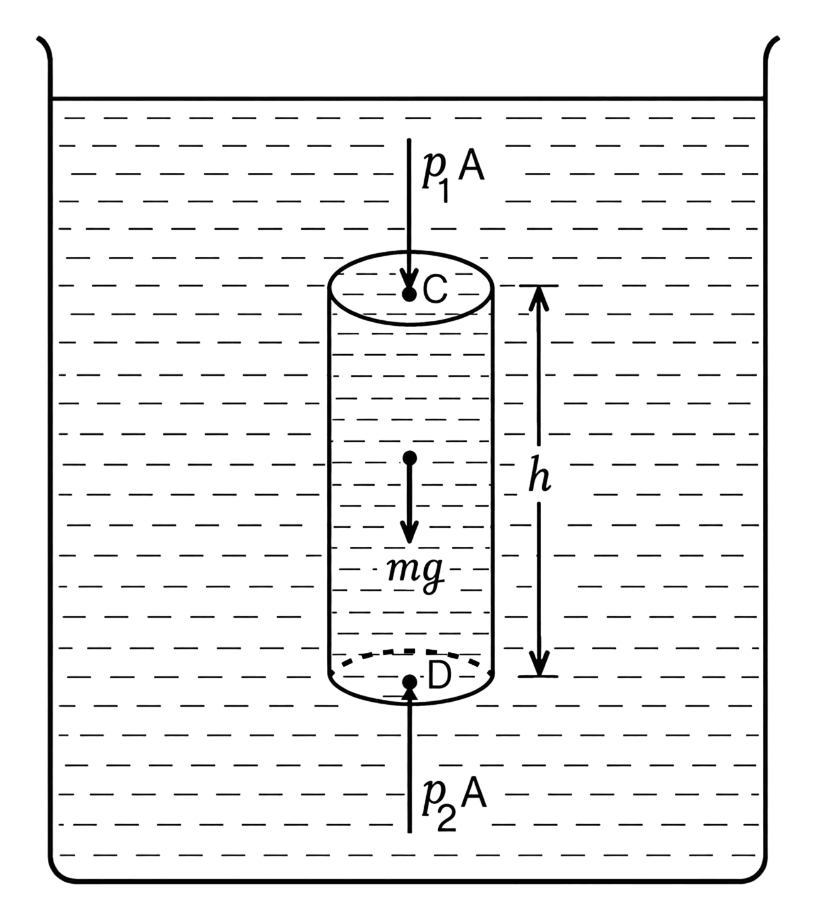
The weight of the liquid in this imaginary cylinder is
which acts vertically downwards. If p1 and p2 are the pressures at C and D, the force on the upper face is p1A acting downwards and that on the lower face is p2A acting upwards. The horizontal forces on the curved surface balance each other.
Since the cylinder is in equilibrium, the net force on it is zero,
This shows that the liquid exerts a pressure which increases with the depth h. Hence, a fluid exerts pressure.
Force on a liquid in equilibrium is normal to its surface : Consider a liquid contained in a vessel in equilibrium at rest. Suppose the liquid exerts a force F on the bottom surface in an inclined direction OD. By Newton's third law, the surface exerts an equal and opposite reaction R on the liquid along OC.
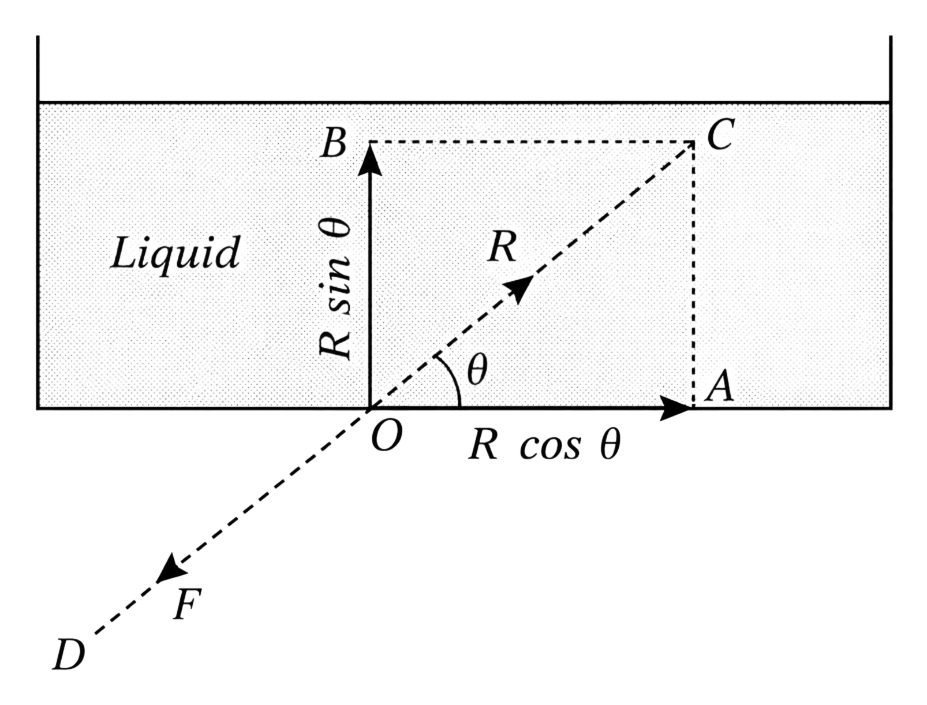
This reaction R can be resolved into two components :
(i) the horizontal (tangential) component, OA = R cos θ, which acts parallel to the liquid surface, and
(ii) the vertical (normal) component, OB = R sin θ.
A liquid at rest cannot resist a tangential (shear) stress. If the tangential component R cos θ were present, the liquid particles near the point O would begin to flow and continuously change shape. But the liquid is observed to be at rest, so the tangential force must be zero,
Since R ≠ 0, we must have
Hence, a liquid in equilibrium always exerts force normal to the walls or bottom of its container at every point.
Water stands at a height H in a tank whose side walls are vertical. A hole is made in one of the walls at a depth h below the water surface. Find at what distance from the foot of the wall does the emerging stream of water strike the floor and for what value of h this range is maximum ?
Answer
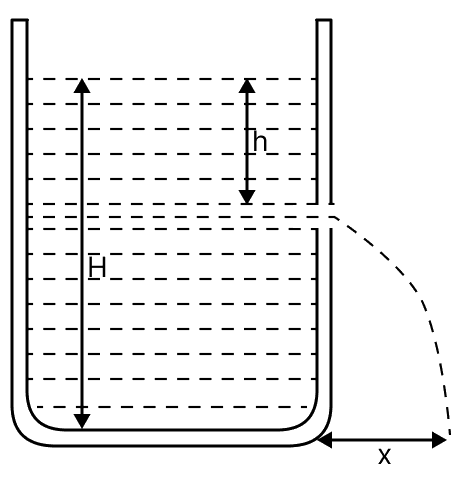
Let the hole be at a depth h below the free surface of the water, so that the height of the hole above the floor is (H − h).
Velocity of efflux : By Torricelli's theorem, the velocity with which the water emerges from the hole is
Time of fall : After emerging, the water adopts a parabolic path. If it takes t second to fall through the vertical distance (H − h), then from ,
Range : Since there is no acceleration in the horizontal direction, the horizontal velocity remains constant. The horizontal distance covered is
Condition for maximum range : The range x will be maximum when h(H − h) is maximum. Differentiating with respect to h and equating to zero,
Substituting this value of h, the maximum range is
Hence, the stream strikes the floor at a distance from the foot of the wall, and the range is maximum, equal to H, when the hole is exactly in the middle of the wall, that is, h = H/2.
Explain the Poiseuille's concept for the volume of the liquid flowing per second through a pipe of length l, radius r and pressure difference P is developed across the ends of a tube in which liquid of coefficient of viscosity η flows. Derive the relation where symbols have their usual meanings.
Answer
Poiseuille's concept : Experimentally it can be shown that the volume of a liquid flowing per second, that is, the rate of discharge Q through a pipe, depends upon
(i) the coefficient of viscosity η of the liquid,
(ii) the radius r of the pipe, and
(iii) the pressure gradient, that is, the change of pressure per unit length, P/l.
Derivation by the method of dimensions : We may therefore write
where k is a constant of proportionality.
Writing the dimensions of the quantities involved,
Equating the dimensions on both sides,
On solving these, we get a = − 1, b = 4 and c = 1.
Substituting these values in equation (i), the rate of discharge through the pipe is
By experiment the value of the constant k is found to be . Hence,
This relation is known as Poiseuille's relation, and with the help of this formula the viscosity of a liquid can be determined.
State and prove Pascal's law of fluid pressure. Illustrate it by two examples.
Answer
Statement : Pascal's law states that, "if a pressure change is applied to a fluid that is completely confined, incompressible and at rest, that pressure is transmitted equally and undiminished in all directions and also acts on the walls of the container."
Proof : Consider a tiny right-angled prismatic fluid element ABCDEF completely immersed in a liquid at rest. The element is so small that every point in it lies at essentially the same depth, so the pressure due to gravity is the same over all its faces and its own weight is negligible compared with the pressure forces.
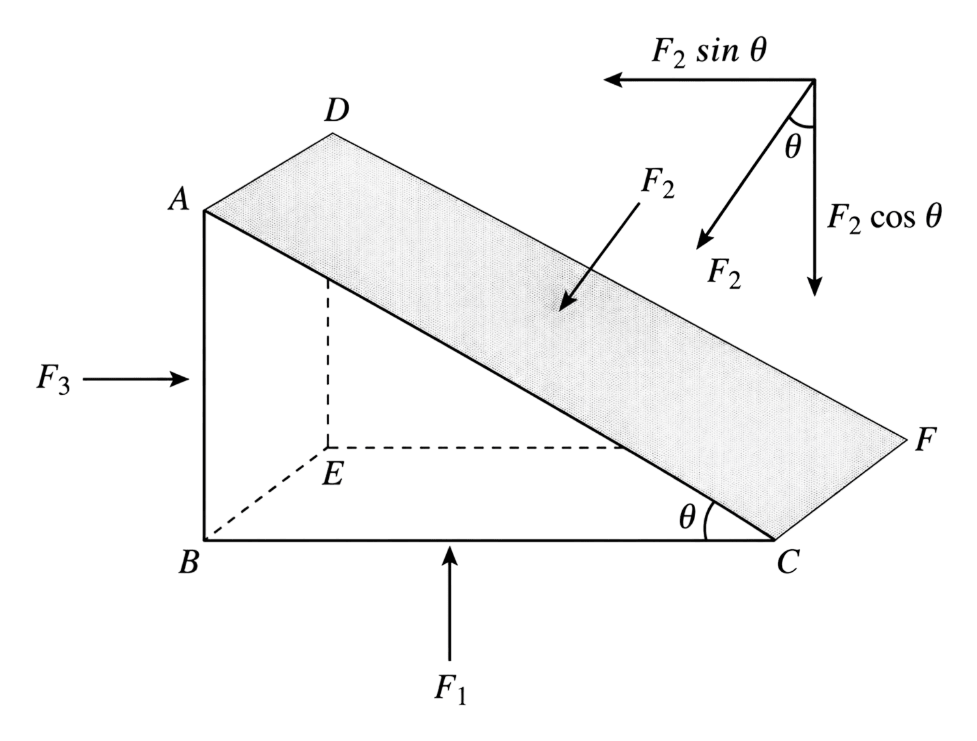
Let the three mutually perpendicular faces be the horizontal face BEFC of area A1, the inclined face ADFC of area A2 and the vertical face ADEB of area A3. If P1, P2 and P3 are the fluid pressures normal to these faces, the normal forces are
Let θ be the angle between the normal to the inclined face and the vertical, so that the vertical component of F2 is F2 cos θ and its horizontal component is F2 sin θ.
Since the element is in static equilibrium, the sum of the forces in the vertical and the horizontal directions must vanish.
Vertical equilibrium :
Horizontal equilibrium :
From the geometry of the prism, the projected areas satisfy
Substituting (iii) into (i) and (ii), we get
Hence, the pressure at a point in a static fluid is equal in all directions and acts normally to any surface, which is Pascal's law.
Examples :
(i) Hydraulic lift : A force applied on a piston of small cross-sectional area produces a pressure which is transmitted undiminished to a piston of large cross-sectional area, where a much larger force appears. This is used to lift heavy loads such as cars at a service station.
(ii) Hydraulic brakes : When the brake pedal is pressed, the increase in pressure in the brake oil of the master cylinder is transmitted undiminished to the pistons of the wheel cylinder, which press the brake-shoes against the rim of the wheel.
Write Stokes' law and derive the expression for the terminal velocity of a spherical solid falling in a viscous liquid.
Answer
Stokes' law : If a small sphere of radius r is moving with a terminal velocity v through a perfectly homogeneous medium (liquid or gas) of infinite extension, then the viscous force acting on the sphere is
where η is the coefficient of viscosity of that medium.
Derivation of terminal velocity : Consider a small ball of radius r and density ρ falling freely in a liquid of density σ and coefficient of viscosity η. When it attains the terminal velocity v, it is subjected to two forces :
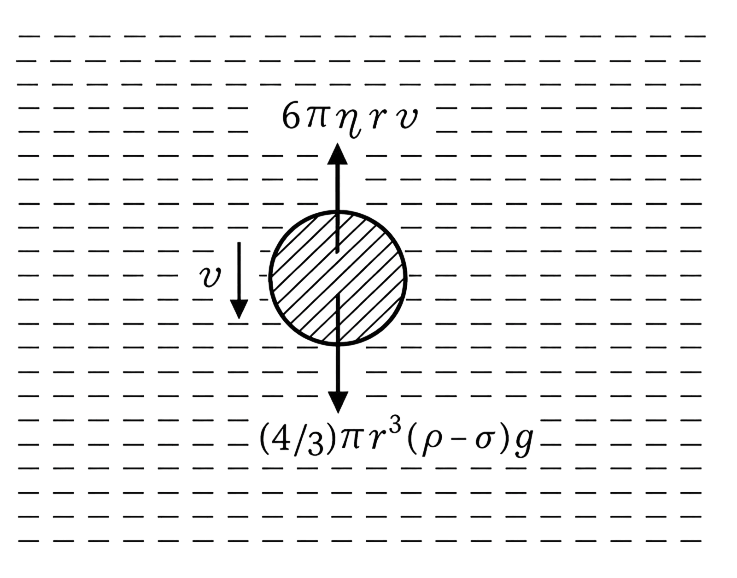
(i) Effective downward force = weight of the ball − upthrust
(ii) Viscous force acting upward = 6πηrv
Since the ball is moving with a constant velocity v, there is no acceleration in it, so the net force acting on it must be zero. Therefore,
Hence, the terminal velocity of the ball is directly proportional to the square of its radius.
What are the various forms of energy possessed by a flowing liquid ? Show that in a frictionless stream-line flow, the total mechanical energy of a liquid remains constant at every point.
Answer
Forms of energy of a flowing liquid : There are three types of energies in a flowing liquid.
(i) Pressure energy : If P is the pressure on an area A of a liquid and the liquid moves through a distance l due to this pressure, then
Since the volume of the liquid is A × l,
(ii) Kinetic energy : If a liquid of mass m and volume V is flowing with velocity v, its kinetic energy is , so
(iii) Potential energy : If a liquid of mass m is at a height h from the surface of the earth, its potential energy is mgh, so
Proof that the total energy remains constant : Consider an incompressible and non-viscous liquid flowing in stream-lined motion through a tube XY of non-uniform cross-section. Let A1 and A2 be the areas of cross-section at the ends X and Y, at heights h1 and h2 from the surface of the earth. Let P1, v1 and P2, v2 be the pressures and velocities at X and Y.
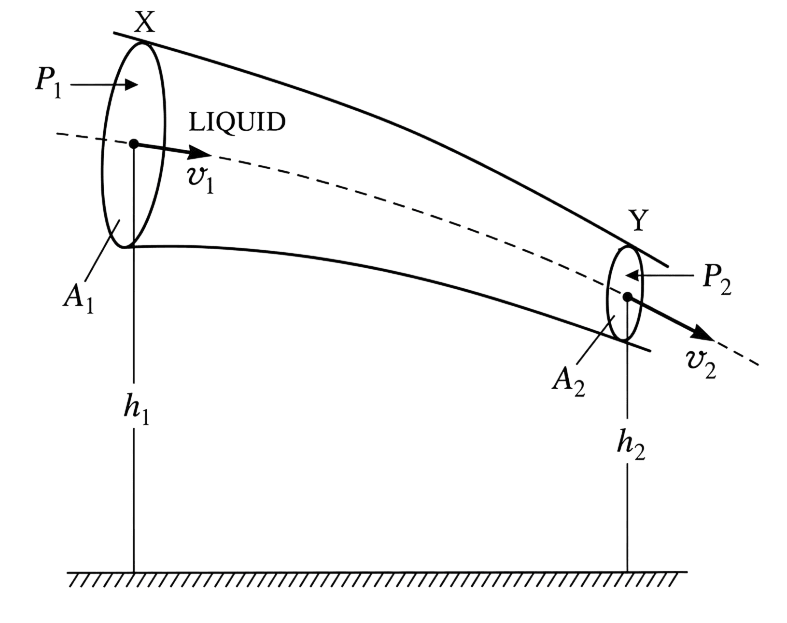
The work done per second on the liquid entering at X is
and the work done per second against the force at Y is P2 × A2 × v2. Hence,
But A1v1 and A2v2 are the volumes entering at X and leaving at Y per second, which must be equal, so
Substituting in equation (i),
The increase in the kinetic energy of the liquid is and the decrease in its potential energy is m g (h1 − h2). Hence,
This increase in energy is due to the net work done on the liquid. Equating (ii) and (iii),
Rearranging,
Hence, in a frictionless stream-lined flow, the total energy per unit volume of the liquid remains constant at every point.
Write Bernoulli's theorem for the flow of an ideal liquid. Use it to prove that the velocity of efflux of a liquid emerging from a hole in the wall of a vessel is , where h is the height of the liquid level above the hole.
Answer
Bernoulli's theorem : When an incompressible and non-viscous liquid (or gas) flows in stream-lined motion from one place to another, then at every point of its path the total energy per unit volume (pressure energy + kinetic energy + potential energy) is constant, that is,
Velocity of efflux (Torricelli's theorem) : Let a vessel be filled with a liquid up to a height H and let there be an orifice at a depth h below the free surface of the liquid.
The pressure at the free surface of the liquid and also at the orifice is atmospheric, say P, so there is no effect of atmospheric pressure on the flow of the liquid from the orifice.
The liquid on the free surface has no kinetic energy but only potential energy, while the liquid coming out of the orifice has both kinetic and potential energies.
Applying Bernoulli's theorem, the total energy per unit volume at the free surface must equal that at the orifice,
Cancelling P from both sides and simplifying,
Hence, the velocity of efflux of a liquid from an orifice is equal to that velocity which the liquid would acquire in falling freely from the free surface of the liquid up to the orifice. This result was first established by Torricelli in 1644 and is called Torricelli's theorem.
What is meant by surface energy? Find the work done in blowing slowly a soap bubble to a radius R from a solution of surface tension T.
Answer
Surface energy : When the surface area of a liquid is increased, the molecules from the interior rise to the surface. This requires work to be done against the force of attraction of the molecules just below the surface. This work is stored in the form of potential energy in the newly formed surface.
Thus, the molecules in the surface have some additional energy due to their position, and this additional energy per unit area of the surface is called the 'surface energy of the liquid'.
Work done in blowing a soap bubble : A soap bubble has two free surfaces — one inside the bubble in contact with air and the other outside it.
The total surface area of a soap bubble of radius R is therefore
Since the bubble is blown from the soap solution, the initial surface area may be taken as zero. Hence the increase in the surface area is
The work done in increasing the surface area at constant temperature is
Hence, the work done in blowing the soap bubble is 8πR2T.
Define the term 'angle of contact'. Draw labelled diagrams to show angle of contact between (i) water and glass, (ii) mercury and glass. What is the value of the angle of contact between water and clean glass?
Answer
Angle of contact : When the free surface of a liquid comes in contact with a solid, it becomes curved near the place of contact. The angle inside the liquid between the tangent to the solid surface and the tangent to the liquid surface at the point of contact is called the 'angle of contact' for that pair of solid and liquid.
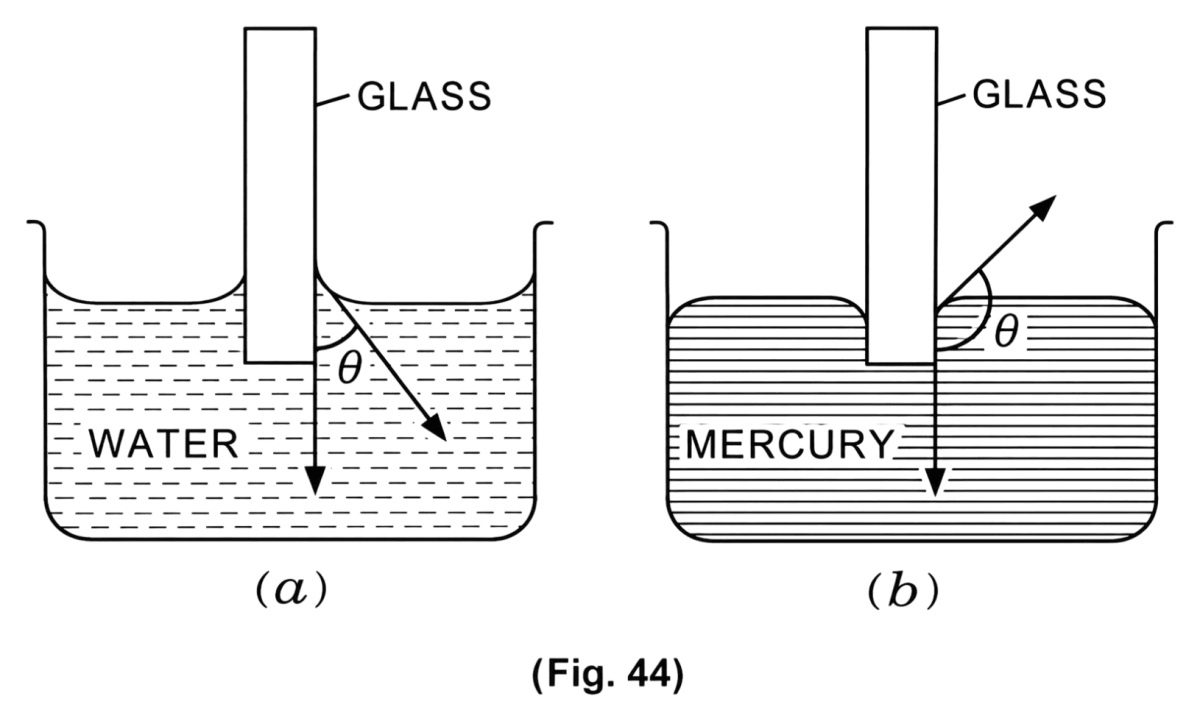
(i) Water and glass : The adhesive force between water and glass molecules is greater than the cohesive force between water molecules. Hence water wets glass, the meniscus is concave and the angle of contact θ is acute.
(ii) Mercury and glass : The cohesive force between mercury molecules is far greater than the adhesive force between mercury and glass. Hence mercury does not wet glass, the meniscus is convex and the angle of contact θ is obtuse, being about 135°.
Value for water and clean glass : The angle of contact between pure water and clean glass is zero. For ordinary water and glass it is about 8°.
Obtain an expression for the pressure exerted by a liquid column.
Answer
Consider a liquid of density ρ contained in a vessel. Let C and D be two points inside the liquid at a vertical distance h apart. Imagine a cylindrical column of the liquid of cross-sectional area A such that the points C and D lie at the centres of the upper and the lower faces of the cylinder.
The weight of the liquid in this imaginary cylindrical column is
which acts vertically downwards. Here it is assumed that the density of the liquid is uniform and does not depend upon pressure, which is very nearly true for liquids.
Let p1 and p2 be the pressures at the points C and D respectively. Then,
- force on the upper face = p1A, acting vertically downwards,
- force on the lower face = p2A, acting vertically upwards.
The horizontal forces on the curved surface of the cylinder are mutually balanced. Since the cylinder of the liquid is in equilibrium, the net force on it must be zero,
This is the modified Pascal's law in the presence of gravity.
If the point C is shifted to the liquid surface which is open to the atmosphere, then p1 may be replaced by the atmospheric pressure P0 and p2 by P. Hence,
Hence, the pressure exerted by a liquid column of height h is hρg, and it depends only upon the vertical depth of the point and the density of the liquid. It depends neither upon the shape of the container nor upon the amount of liquid in it.
Using Bernoulli's theorem, prove the following formula for an ideal fluid :
where P1 and P2 are the pressures and v1, v2 are the velocities of flow of a liquid of density ρ at the ends of a horizontal tube. There is no friction in the tube.
Answer
Consider an ideal (incompressible and non-viscous) liquid of density ρ flowing in stream-lined motion through a horizontal tube of non-uniform cross-section.
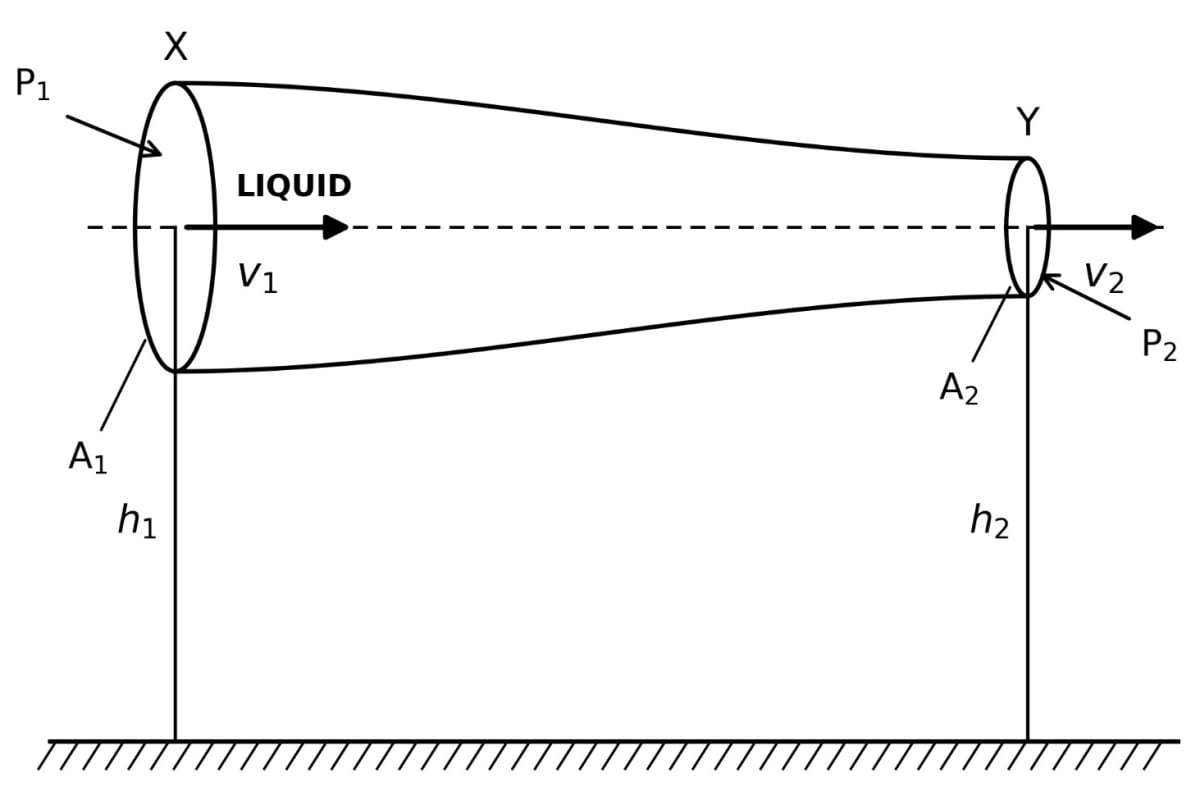
Let P1 and v1 be the pressure and the velocity of flow at one end of the tube, and P2 and v2 the corresponding quantities at the other end.
By Bernoulli's theorem, the total energy per unit volume is constant at every point of the flow,
Since the tube is horizontal, both the ends lie at the same height above the surface of the earth, that is,
Hence, the potential energy terms ρgh1 and ρgh2 are equal and cancel out from both sides,
Transposing the terms,
Hence proved.
This shows that in a horizontal flow, wherever the velocity of the liquid is greater the pressure is smaller, and vice-versa.
At two places in a venturimeter the cross-sectional areas of the tube are A1, A2 and the pressure difference is equal to the height h of the liquid column. Deduce a formula for the volume of the liquid flowing per second through the tube.
Answer
A venturimeter is a device based on Bernoulli's theorem by which the rate of flow of water in a tube can be determined. It consists of a tube XY whose middle part Z is narrow, with two vertical tubes joined at X and Z.
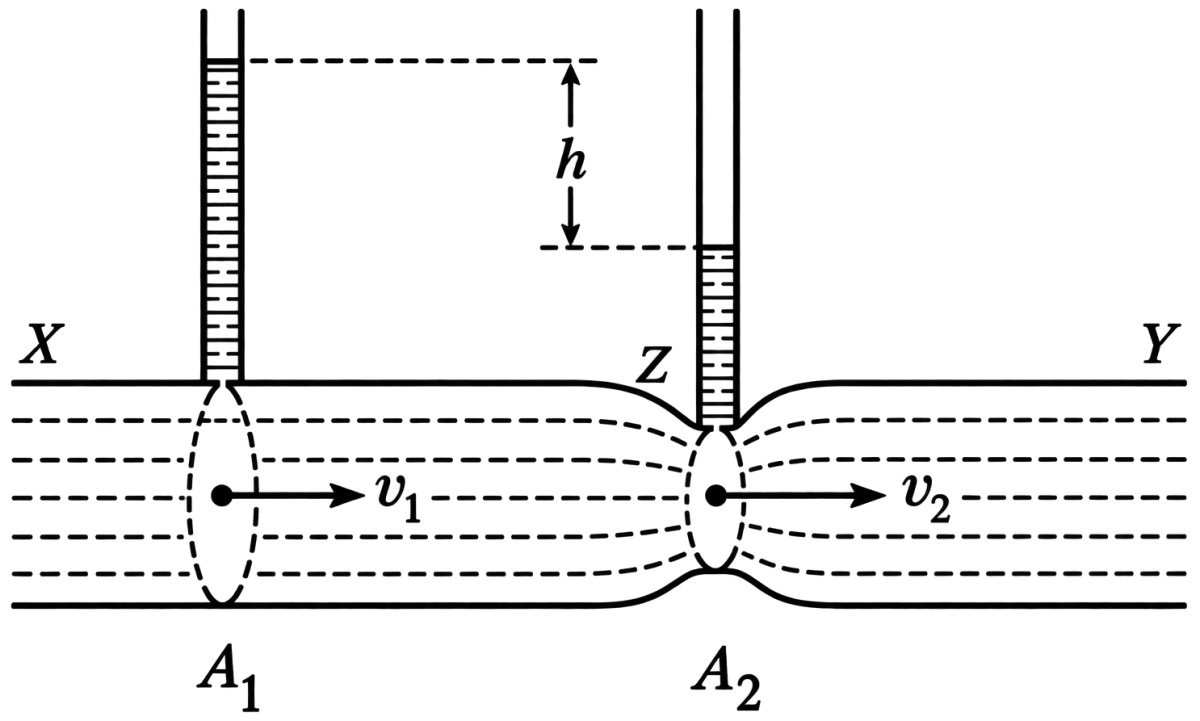
Let A1 and A2 be the areas of cross-section of the tube at the wider and the narrower parts, v1 and v2 the corresponding velocities of flow, and P1 and P2 the pressures there.
Assuming the flow to be stream-lined, by the principle of continuity,
Since the tube is horizontal, by Bernoulli's theorem,
Substituting the value of from equation (i),
If h is the difference in the levels of the liquid in the two vertical tubes, then P1 − P2 = h ρ g. Therefore,
If Q is the volume of the liquid flowing per second through the tube, then
Hence, by measuring h and knowing the areas of cross-section A1 and A2, the rate of flow Q can be determined.
Deduce expressions for the excess pressure inside a (i) liquid drop, (ii) air bubble in a liquid and (iii) soap bubble.
Answer
(i) Excess pressure inside a liquid drop : Consider a liquid drop of radius R of a liquid of surface tension T. The molecules in the surface of the drop experience a resultant force due to surface tension acting normally inwards. Therefore, the pressure inside the drop must be greater than the pressure outside it.
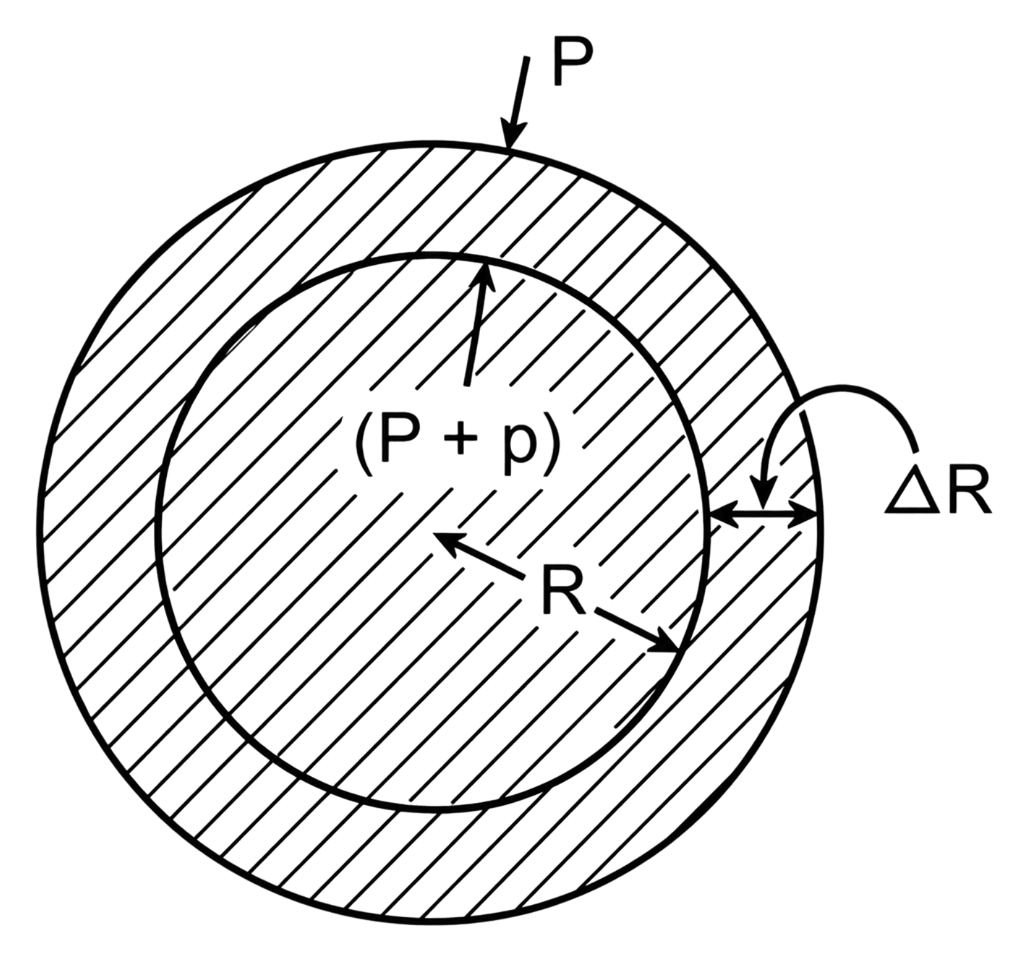
Let P be the pressure outside the drop and (P + p) that inside it, so that p is the excess pressure. Let this excess pressure push the surface outwards through a small distance ΔR. The work done by the excess pressure is
The increase in the surface area of the drop is
neglecting the smaller term (ΔR)2. Hence, the increase in free surface energy is
This increase in energy is at the cost of the work done by the excess pressure. Equating (i) and (ii),
(ii) Excess pressure inside an air bubble in a liquid : An air bubble of radius R formed in a liquid of surface tension T has, like a liquid drop, only one surface in contact with the liquid. Proceeding exactly as in the case of the liquid drop, the excess pressure inside the air bubble is
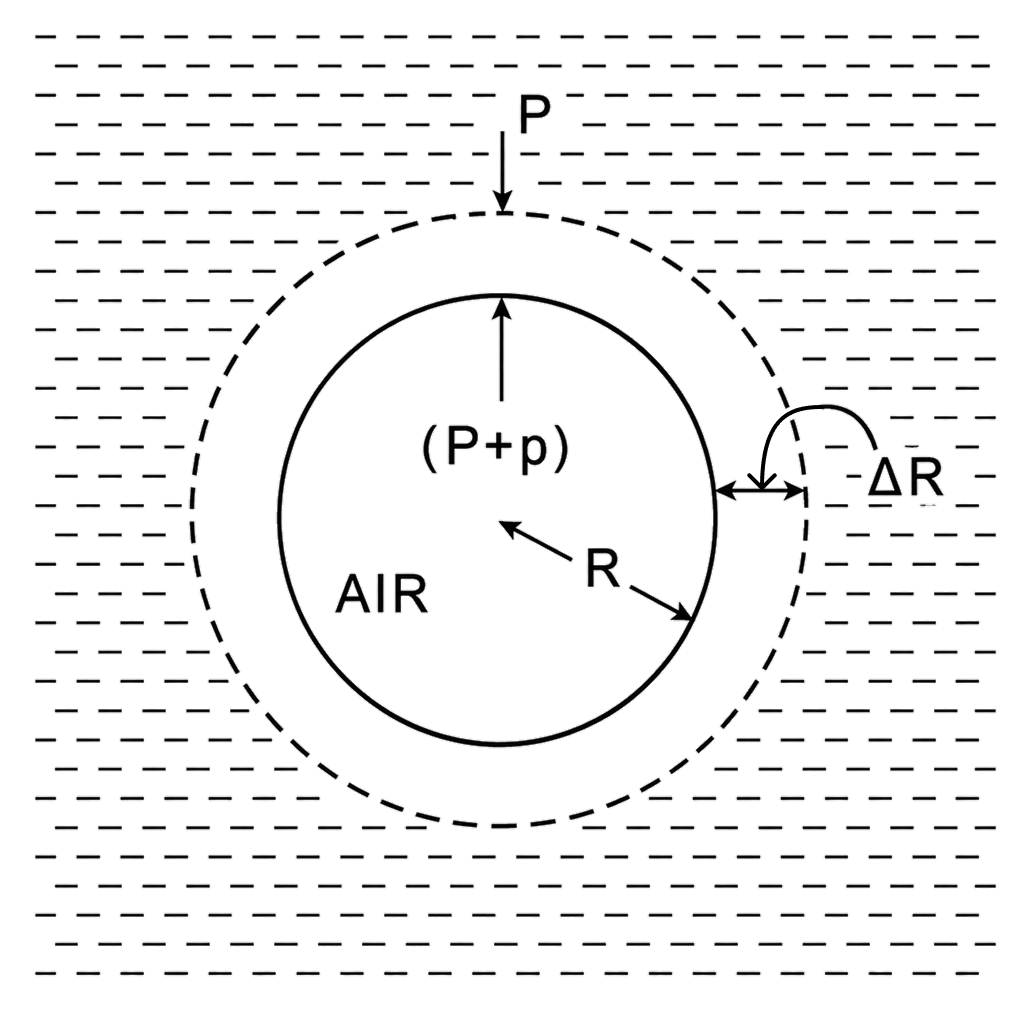
(iii) Excess pressure inside a soap bubble : A thin soap bubble of radius R has two liquid surfaces in contact with air, one inside the bubble and the other outside it.
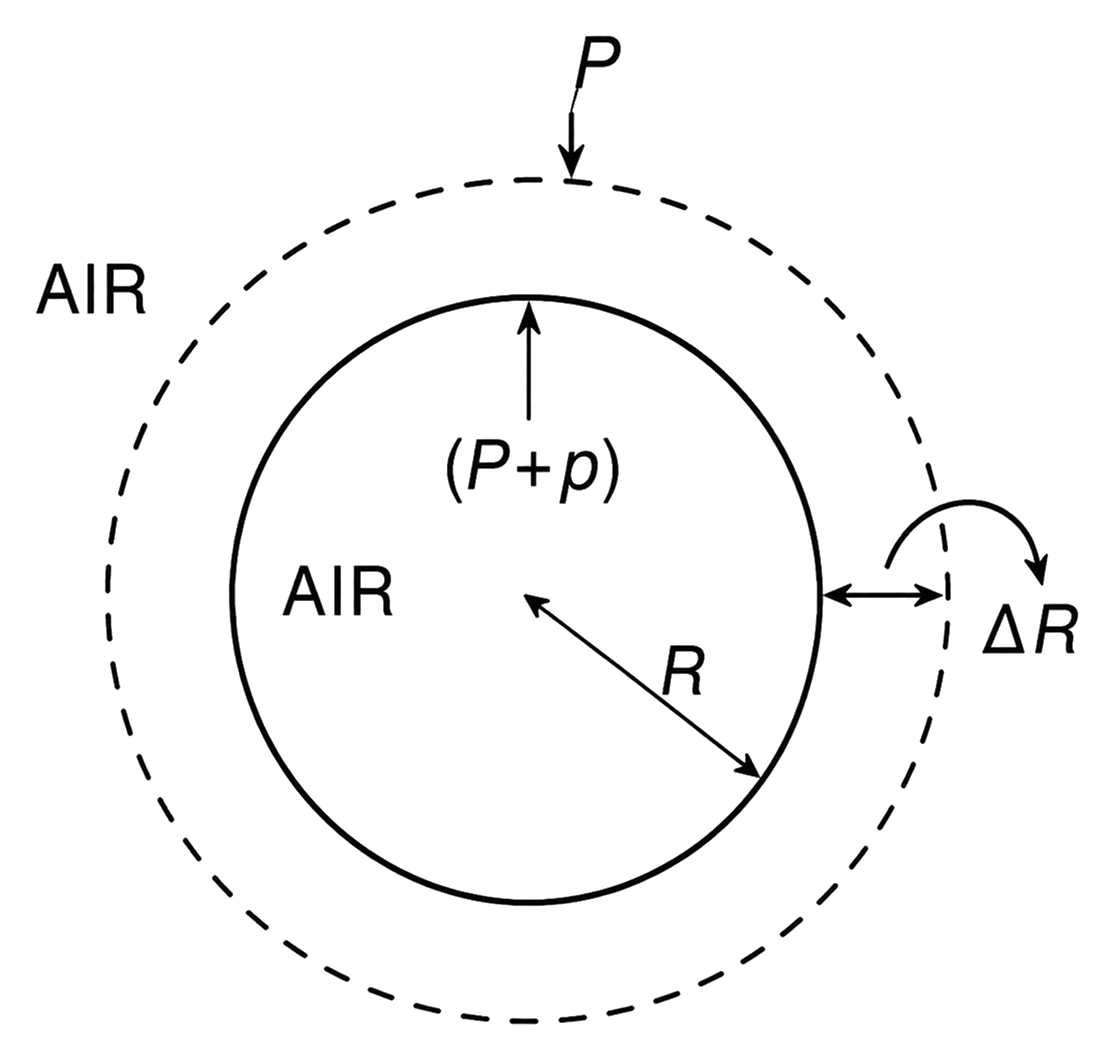
The work done by the excess pressure in pushing the surface outwards through ΔR is
The total increase in the surface area, counting both the surfaces, is
so the increase in free surface energy is
Equating (i) and (ii),
Hence, the excess pressure inside a liquid drop and an air bubble is 2T/R, while that inside a soap bubble is 4T/R.
Derive the formula for the rise of water in a capillary tube.
Answer
Suppose a cleaned capillary tube of glass having a uniform bore of radius r is dipped in a liquid (say water) which rises to a height h above the level outside the tube. The liquid meniscus AEB in the tube is concave upward. Let T be the surface tension of the liquid.
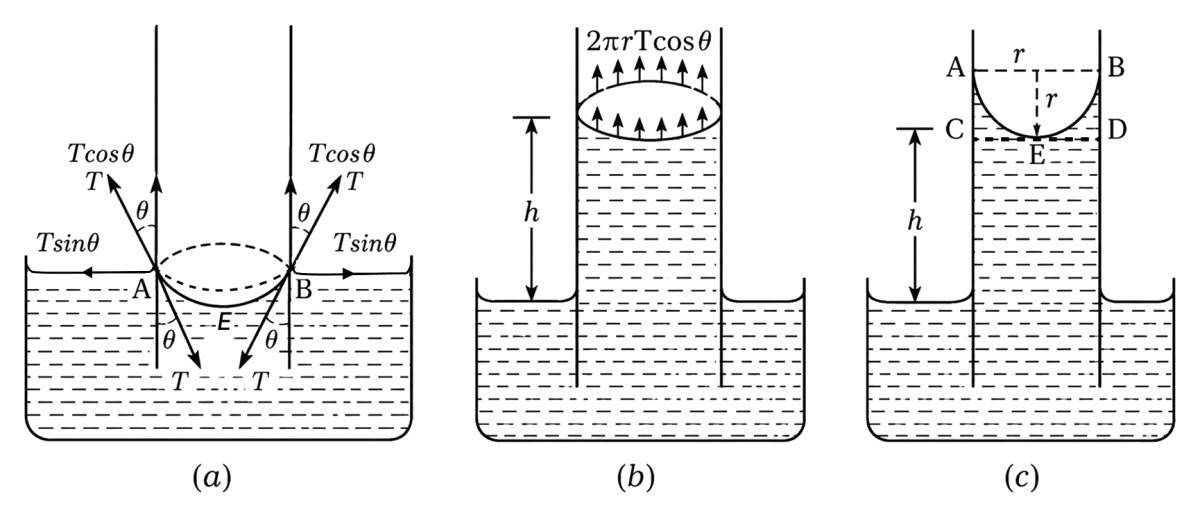
The liquid meniscus in the tube is along a circle of circumference 2πr which is in contact with the glass. Due to the surface tension of the liquid, a force equal to T per unit length acts at all points of this circle. If the angle of contact for liquid-glass be θ, then this force is directed inward at an angle θ from the wall of the tube.
The wall of the tube also exerts an equal (reactionary) force T per unit length on the circumference of the liquid meniscus, directed outward. This force can be resolved into two components :
(i) T cos θ per unit length acting vertically upward, and
(ii) T sin θ per unit length acting horizontally outward.
Considering the entire circumference 2πr, for each horizontal component T sin θ there is an equal and opposite component, so the two neutralise each other. The vertical components, being in the same direction, are added up to give a total upward force
It is this force which supports the weight of the liquid column so raised.
Weight of the liquid column : The curved surface AEB may be assumed hemispherical, whose radius may be taken equal to the radius r of the capillary tube. The volume of the liquid raised in the tube is
Hence, the weight of the liquid column raised in the tube is
where ρ is the density of the liquid.
In equilibrium, the upward force due to surface tension balances this weight,
Since h >> r/3, the term r/3 may be neglected in comparison to h. Then,
Hence, the height to which the liquid rises in a capillary tube is , which shows that the narrower the tube, the greater is the height to which the liquid rises in it.
For pure water and clean glass θ may be taken zero, and then .
(a) What is meant by stream-line and turbulent flow of a liquid? What is the difference between them?
(b) Explain Reynold's number and critical velocity. How a flow is characterised as stream-lined or turbulent on the basis of Reynold's number?
Answer
(a) Stream-line flow : Stream-line flow is the motion of a fluid in which every particle follows a smooth, well-defined path called a streamline, and these streamlines never intersect one another. Each particle passing a given point follows exactly the same path as the particles that passed earlier.
Turbulent flow : Turbulent flow is a type of fluid motion in which the particles move in a highly irregular and unpredictable manner. The velocity of the fluid particles changes continuously in both magnitude and direction, and swirling regions called eddies are formed.
Difference between them :
| Stream-line flow | Turbulent flow |
|---|---|
| The particles follow smooth, well-defined paths called streamlines. | The paths of the particles are irregular and cross each other. |
| The streamlines never intersect one another. | Eddies or whirlpools are formed. |
| The velocity at a given point remains constant in magnitude and direction. | The velocity at a point changes continuously in both magnitude and direction. |
| It occurs when the velocity of flow is below the critical velocity. | It occurs when the velocity of flow exceeds the critical velocity. |
| There is practically no loss of energy. | A considerable amount of energy is lost. |
(b) Reynold's number : Reynold's number is a dimensionless number which predicts the nature of flow of a fluid. It is given by
where ρ is the density of the fluid, η its viscosity, L the characteristic length (for a pipe, L = D, the diameter) and v the velocity of flow.
Physically, Reynold's number gives the ratio of the inertial forces to the viscous forces in a fluid.
Critical velocity : There exists a certain maximum velocity up to which the flow of a liquid through a tube remains stream-lined. If the velocity exceeds this limit, the flow becomes turbulent. This maximum velocity is called the critical velocity (vc). In terms of Reynold's number,
Characterisation of the flow : For flow in a cylindrical pipe,
(i) if Re < 2000, the flow is laminar (stream-lined),
(ii) if 2000 < Re < 3000, the flow is in a transition region and is unstable,
(iii) if Re > 3000, the flow becomes turbulent.
Thus, if the viscous forces dominate (low Re) the flow remains smooth and laminar, and if the inertial forces dominate (high Re) the flow becomes turbulent.
What is viscous force ? On what factors does it depend ? Define coefficient of viscosity and write down its dimensional formula and MKS unit.
Answer
Viscous force : When a liquid flows in stream-lined motion, the layer in contact with a fixed surface is at rest while the velocity of the other layers increases with distance from that surface. In between any two layers of the liquid, internal tangential forces act which try to destroy the relative motion between them. These forces are called 'viscous forces'.
The property of the liquid by virtue of which it opposes the relative motion between its adjacent layers is known as viscosity.
Factors on which it depends : According to Newton, the viscous force F acting between two layers of a liquid flowing in stream-lined motion depends upon two factors :
(i) It is directly proportional to the contact-area A of the layers (F ∝ A).
(ii) It is directly proportional to the velocity-gradient dv/dz in a direction normal to the layer (F ∝ dv/dz).
Combining these two factors,
where η is a constant called the coefficient of viscosity, the negative sign showing that the viscous force on a layer opposes its velocity relative to the adjacent layers. This is Newton's law of viscosity.
Coefficient of viscosity : The coefficient of viscosity of a fluid is numerically equal to the viscous force per unit area which maintains a unit velocity gradient between its two parallel layers. From the above formula,
If A = 1 unit and dv/dz = 1 unit, then η = F numerically.
Dimensional formula :
MKS (SI) unit : kg m-1 s-1. Another unit is the poise, where 1 kg m-1 s-1 = 10 poise = 1 decapoise or poiseuille.
State Bernoulli's theorem and explain what do you understand by pressure head, velocity head and gravitational head? Mention an application of the theorem.
Answer
Bernoulli's theorem : When an incompressible and non-viscous liquid (or gas) flows in stream-lined motion from one place to another, then at every point of its path the total energy per unit volume (pressure energy + kinetic energy + potential energy) is constant, that is,
Pressure head, velocity head and gravitational head : Dividing the above equation throughout by ρ g, we get
(i) Pressure head : The term is called the pressure head. It represents the pressure energy of the liquid per unit weight.
(ii) Velocity head : The term is called the velocity head. It represents the kinetic energy of the liquid per unit weight.
(iii) Gravitational head : The term h is called the gravitational head. It represents the potential energy of the liquid per unit weight.
The dimension of each of these three terms is the dimension of height, and their sum is called the total head. Hence Bernoulli's theorem may also be stated as : in the stream-lined motion of an ideal liquid, the sum of pressure head, velocity head and gravitational head at any point is always constant.
Application — Venturimeter : A venturimeter is a device based on Bernoulli's theorem by which the rate of flow of water in a tube is measured. Its middle part is made narrow, where the velocity of flow becomes larger and so the pressure becomes smaller. This pressure difference is measured by two vertical tubes, and from it the rate of flow of water is calculated.
In a flowing liquid, = a constant. Explain each term of this equation and write the unit of the constant.
Answer
The given equation is Bernoulli's equation for the stream-lined flow of an incompressible and non-viscous liquid. Each of its three terms represents an energy per unit volume of the liquid.
(i) P — the pressure energy per unit volume : If P is the pressure on an area A of the liquid and the liquid moves through a distance l due to this pressure, the pressure energy is P × A × l. Since the volume of the liquid is A × l, the pressure energy per unit volume is P itself. It is also called the static pressure.
(ii) — the kinetic energy per unit volume : If a liquid of mass m and volume V flows with velocity v, its kinetic energy is , so the kinetic energy per unit volume is , where ρ is the density of the liquid. It is also called the dynamic pressure.
(iii) ρ g h — the potential energy per unit volume : If a liquid of mass m is at a height h above the surface of the earth, its potential energy is m g h, so the potential energy per unit volume is .
Unit of the constant : Since the dimension of each term in this equation is the same as that of pressure, the constant also has the dimensions of pressure.
Hence, the SI unit of the constant is N m-2 (or pascal).
What are cohesive and adhesive forces? Give one example of each. Explain the difference between them.
Answer
Cohesive force : The force of attraction between the molecules of the same substance is called the cohesive force.
Example : The force of attraction between two water molecules. It is due to the cohesive force that two drops of a liquid, when brought in mutual contact, coalesce into one.
Adhesive force : The force of attraction between the molecules of different substances is called the adhesive force.
Example : The force of attraction between water molecules and glass molecules. It is due to the adhesive force that a glass plate becomes wet when water is poured on it.
Difference between them :
| Cohesive force | Adhesive force |
|---|---|
| It acts between the molecules of the same substance. | It acts between the molecules of different substances. |
| Example : attraction between two water molecules. | Example : attraction between water and glass molecules. |
| It is responsible for surface tension and for the definite shape of solids. | It is responsible for the wetting of a solid by a liquid and for capillary rise. |
Both these forces are different from the gravitational force and do not obey the inverse-square law. They act only within the molecular range c (≈ 10-9 metre); beyond this distance the attraction between two molecules becomes negligible.
The relative magnitudes of these two forces decide whether a liquid wets a solid or not. If the adhesive force is greater than the cohesive force, the liquid wets the solid surface, as water wets glass. If the adhesive force is less than the cohesive force, the liquid does not wet the solid surface, as mercury does not wet glass.
Explain the cause of surface tension. What is angle of contact? What are the units of surface tension?
Answer
Cause of surface tension : Laplace explained surface tension on the basis of intermolecular cohesive forces. If the distance between two molecules is less than the molecular range c (≈ 10-9 metre), they attract each other; beyond this the attraction is negligible. Hence, if we draw a sphere of radius c with a molecule as centre, called its sphere of molecular activity, only the molecules enclosed within this sphere can attract the molecule at the centre.
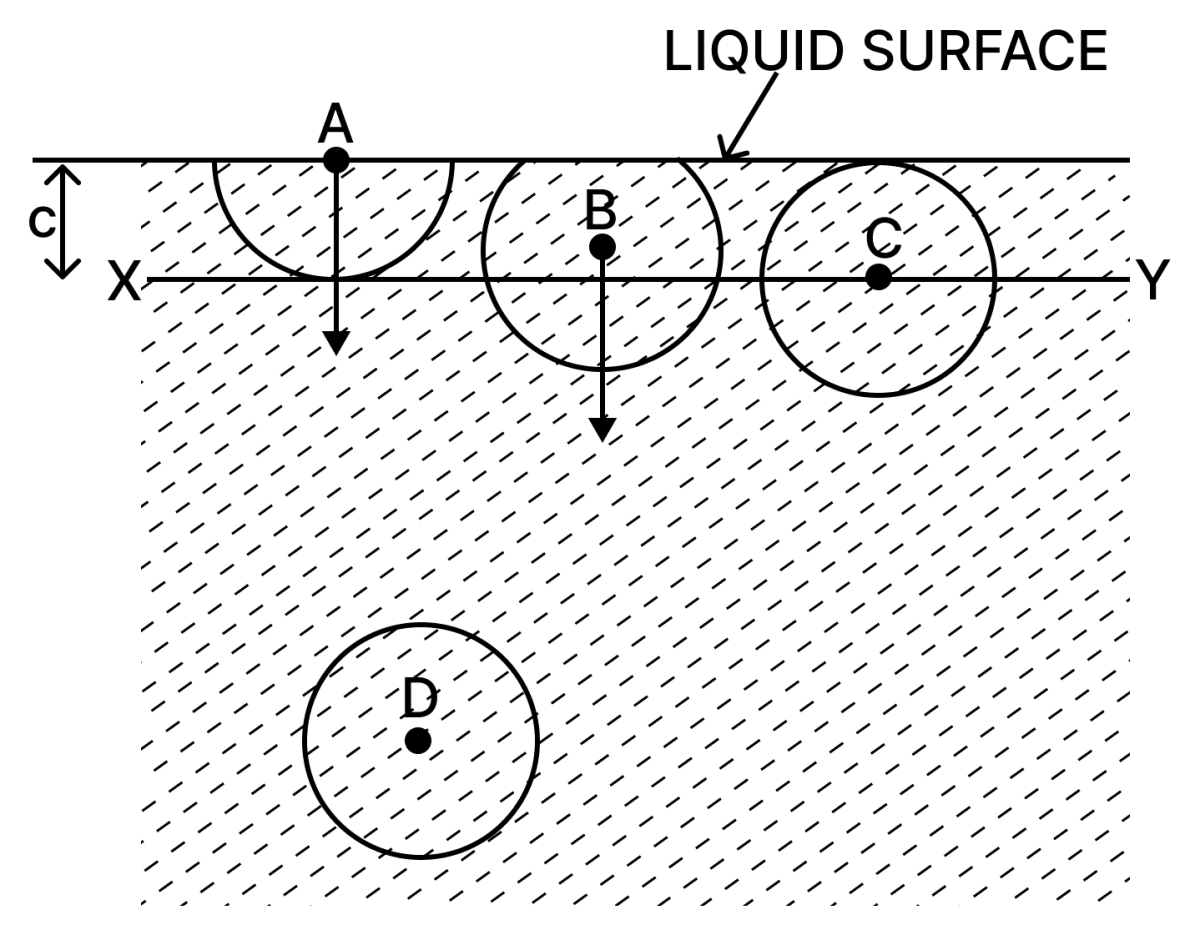
A molecule D well inside the liquid is attracted equally in all directions, so the resultant force on it is zero. A molecule B a little below the surface has its sphere of molecular activity partly outside the liquid, so the number of molecules in its upper half is less than that in its lower half, and it experiences a resultant downward force. A molecule A lying in the surface has half of its sphere outside the liquid, so it experiences the maximum downward force.
When the surface area of a liquid is increased, molecules from the interior rise to the surface, doing work against this downward cohesive force. This work is stored in them as potential energy. Since a system is in stable equilibrium when its potential energy is minimum, the liquid surface tends to have the minimum number of molecules in it, that is, the surface contracts to a minimum possible area. This tendency is exhibited as surface tension.
Angle of contact : When the free surface of a liquid comes in contact with a solid, it becomes curved near the place of contact. The angle inside the liquid between the tangent to the solid surface and the tangent to the liquid surface at the point of contact is called the 'angle of contact' for that pair of solid and liquid. It is zero for pure water and clean glass, and about 135° for mercury and glass.
Units of surface tension : The SI unit of surface tension is N m-1 (newton/metre). Since surface tension is also equal to the work done in increasing the surface area by unity, it may equally be expressed in J m-2 (joule/metre2). Its dimensions are [M T-2].
Write the expression for the work done in increasing the free surface area of a liquid. On its basis, define surface tension and give its unit. What is the effect of temperature on the surface tension?
Answer
Expression for the work done : Let a liquid film be formed between a bent wire ABC and a straight wire PQ which can slide on the bent wire without friction.
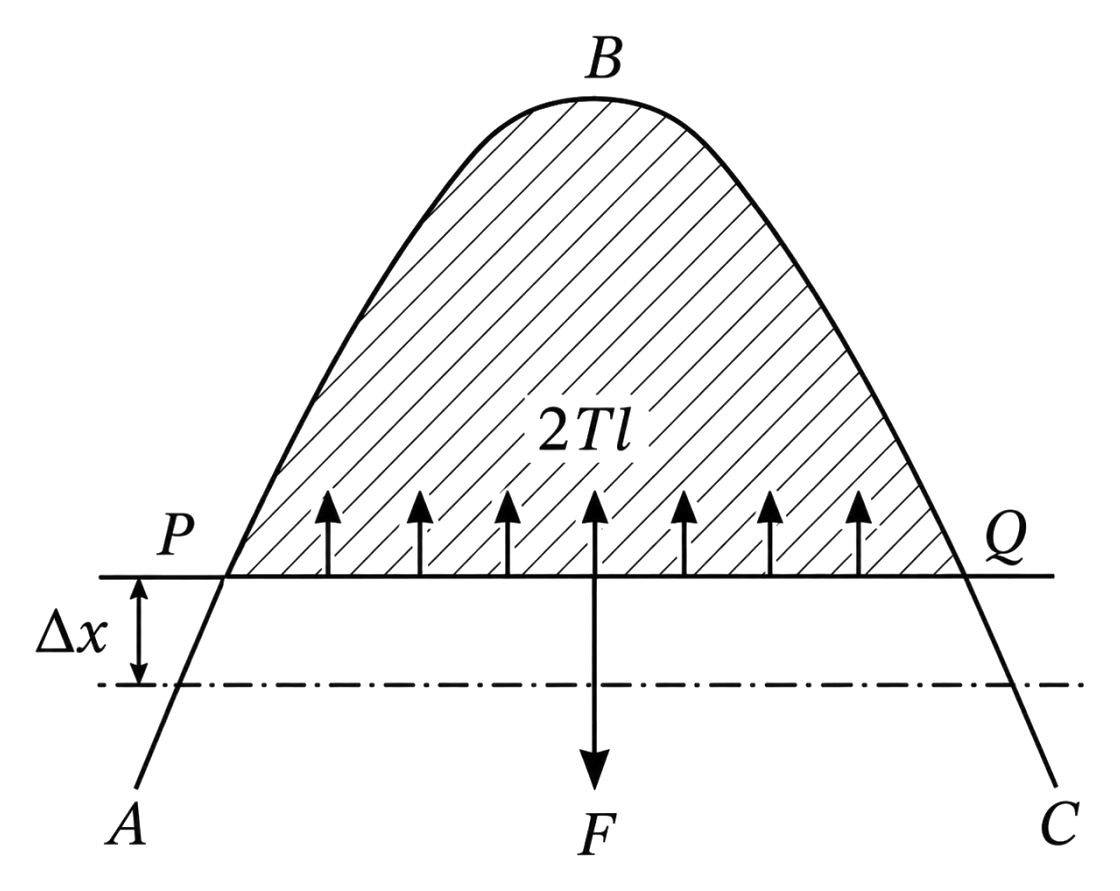
As the film surface tends to contract, the wire PQ moves upward. To keep PQ in equilibrium, a uniform force F (which includes the weight of the wire) has to be applied in the downward direction. This force F is found to be directly proportional to the length l of the film in contact with the wire PQ. Since there are two free surfaces of the film,
where T is a constant called the surface tension of the liquid.
Now, suppose the wire is moved downward through a small distance Δx. This results in an increase in the surface area of the film. The work done by the force F is
But 2 l × Δx is the total increase in the area of both the surfaces of the film. Let it be ΔA. Then,
Definition of surface tension on this basis : If ΔA = 1, then T = W. Hence, the surface tension of a liquid is equal to the work required to increase the surface area of the liquid film by unity at constant temperature.
Unit : Since T = W/ΔA, surface tension may be expressed in joule/metre2 (J m-2), which is the same as N m-1.
Effect of temperature : The surface tension of a liquid decreases with an increase in temperature and becomes zero at the critical temperature. On heating, the molecules gain kinetic energy and move farther apart, which weakens the cohesive forces between them and hence lowers the surface tension.
Explain surface energy of a liquid. What is the relation between surface tension and surface energy?
Answer
Surface energy : When the surface area of a liquid is increased, the molecules from the interior of the liquid rise to the surface. In doing so, work has to be done against the force of attraction of the molecules just below the surface. This work is stored in the newly formed surface in the form of potential energy.
Thus, the molecules lying in the surface of a liquid possess some additional energy on account of their position. This additional energy per unit area of the surface is called the 'surface energy of the liquid'.
Relation between surface tension and surface energy : Consider a liquid film formed on a wire frame having a movable wire of length l. Since the film has two free surfaces, the force acting on the wire due to surface tension is
If the wire is now moved through a small distance Δx, the work done is
But 2 l × Δx is the total increase ΔA in the surface area of the film. Therefore,
If ΔA = 1, then T = W.
Hence, the surface tension of a liquid is numerically equal to its surface energy per unit area. For this reason surface tension may be expressed either in N m-1 or in J m-2.
Explain with the help of Bernoulli's equation that for water flowing in a tube of non-uniform cross-section the pressure in the wider part of the tube is larger than in the narrower part.
Answer
Consider water flowing in stream-lined motion through a horizontal tube of non-uniform cross-section. Let A1 and A2 be the areas of cross-section of the wider and the narrower parts, v1 and v2 the velocities of flow there, and P1 and P2 the corresponding pressures.
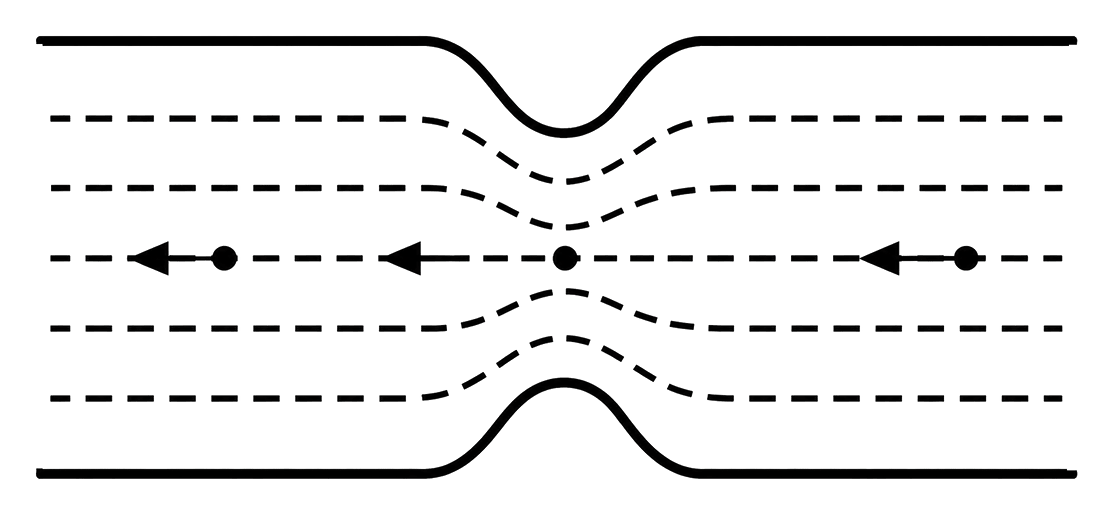
Step 1 — Applying the principle of continuity :
Since A1 > A2, therefore v2 > v1, that is, the velocity of water in the narrower part is greater than that in the wider part.
Step 2 — Applying Bernoulli's equation : As the tube is horizontal, h1 = h2 and the potential energy terms cancel out, so
Step 3 — Conclusion : Since v2 > v1, the quantity is positive, and therefore
Hence, the pressure in the wider part of the tube is larger than that in the narrower part. In other words, in a flowing liquid, where the velocity of flow is less the pressure is larger and vice-versa.
Explain the working of (i) atomizer (ii) filter pump on the basis of Bernoulli's theorem.
Answer
(i) Atomizer : An atomizer is an instrument used to spray a liquid in the form of small droplets.
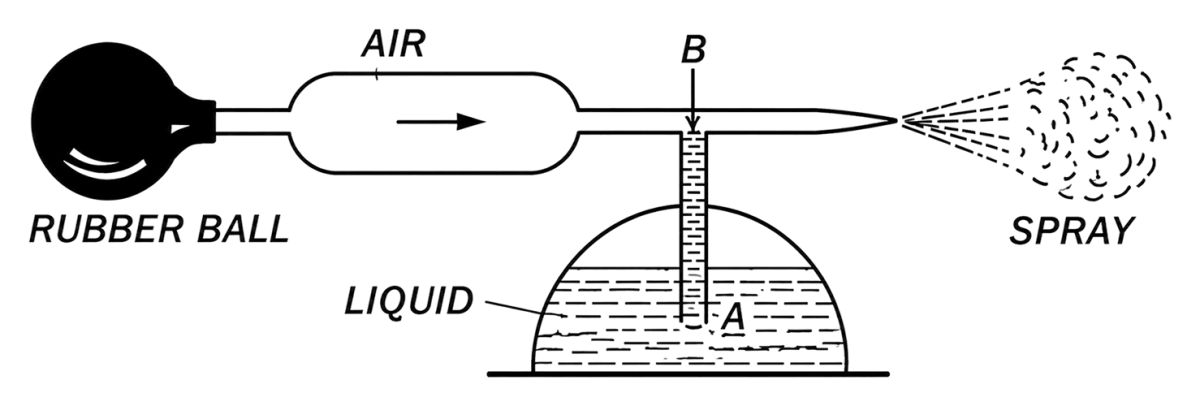
It consists of a vertical tube AB whose lower end A is immersed in a liquid filled in a vessel, while its upper end B opens in the narrower part of a horizontal tube. At one end of this tube there is a rubber ball, and at the other end there is a fine bore.
When the rubber ball is squeezed, it sends a stream of air which passes through the tube. The velocity of the air is very large in the constricted part of the tube, so by Bernoulli's theorem the pressure in that part is lowered.
Consequently, the liquid rises up in the tube AB due to the larger atmospheric pressure acting on the liquid surface in the vessel, and on reaching B it is mixed with air and comes out in the form of a fine spray.
The atomizer is used to spray colours and perfumes, to colour motors and to spray water on hairs and to wash nose, ear, etc.
(ii) Filter pump : A filter pump is an instrument used to produce vacuum in vessels.
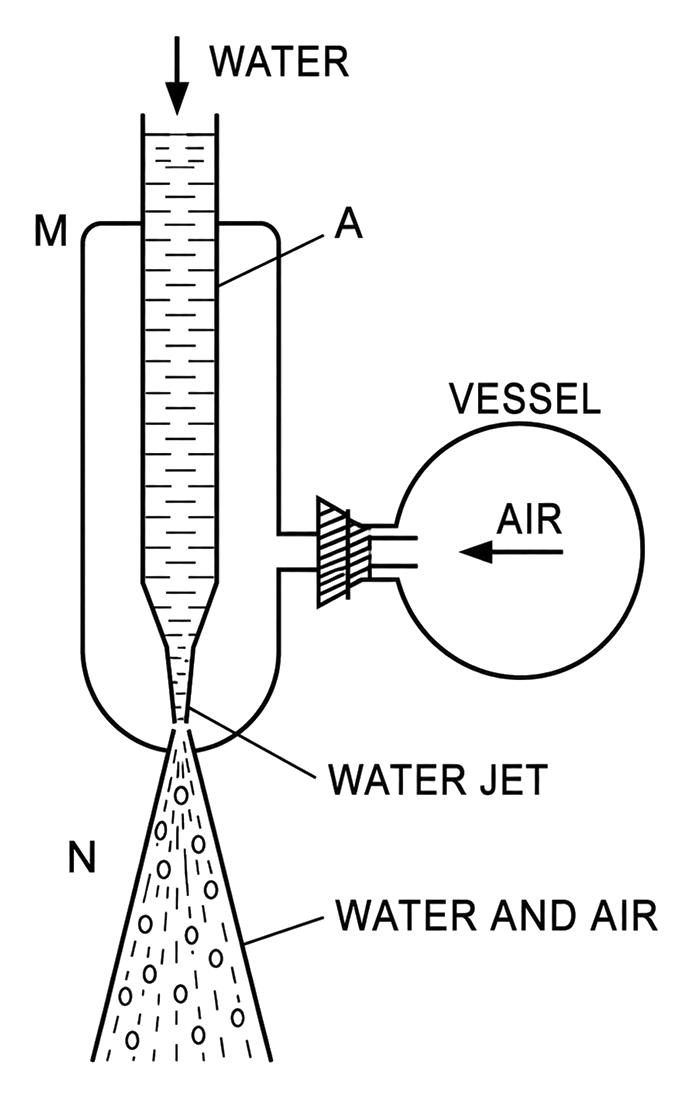
It consists of a wide tube M N, in the upper part of which there is another tube A. The upper end of A is connected to a water tank, while its lower end has a fine bore through which water comes out in the form of a jet.
The vessel which is to be evacuated is connected to the tube M N. The velocity of the emerging water jet is very large, so by Bernoulli's theorem the pressure of the air near the jet becomes less than the pressure inside the vessel.
Hence, air from the vessel rushes into the tube M N and is carried out along with the water jet. Thus a partial vacuum is created in the vessel.
Water sticks to the walls in a glass tube, but mercury does not. Explain the reason.
Answer
Whether a liquid sticks to a solid surface or not is decided by the relative magnitudes of the adhesive force between the liquid and the solid and the cohesive force between the molecules of the liquid itself.
Water and glass : The adhesive force between water molecules and glass molecules is greater than the cohesive force between the water molecules themselves. Hence, when water is poured on glass, the water molecules cling to the glass molecules and the glass surface is wetted. The meniscus formed is concave and the angle of contact is acute (zero for pure water and clean glass).
Mercury and glass : The adhesive force between mercury molecules and glass molecules is less than the cohesive force between the mercury molecules themselves. Hence the mercury molecules do not cling to the glass molecules, that is, mercury does not wet the glass. The meniscus formed is convex and the angle of contact is obtuse, being about 135°.
Hence, water sticks to the walls of a glass tube while mercury does not.
If, however, the glass surface is greasy, then water also does not wet the glass, because the adhesive force between water and grease is less than the cohesive force between the water molecules themselves.
Explain that there is an excess pressure on the concave side relative to the convex side of a curved liquid surface.
Answer
A molecule lying in the surface of a liquid is attracted by the other molecules in the surface in all directions. The resultant force on it depends upon the shape of the surface.
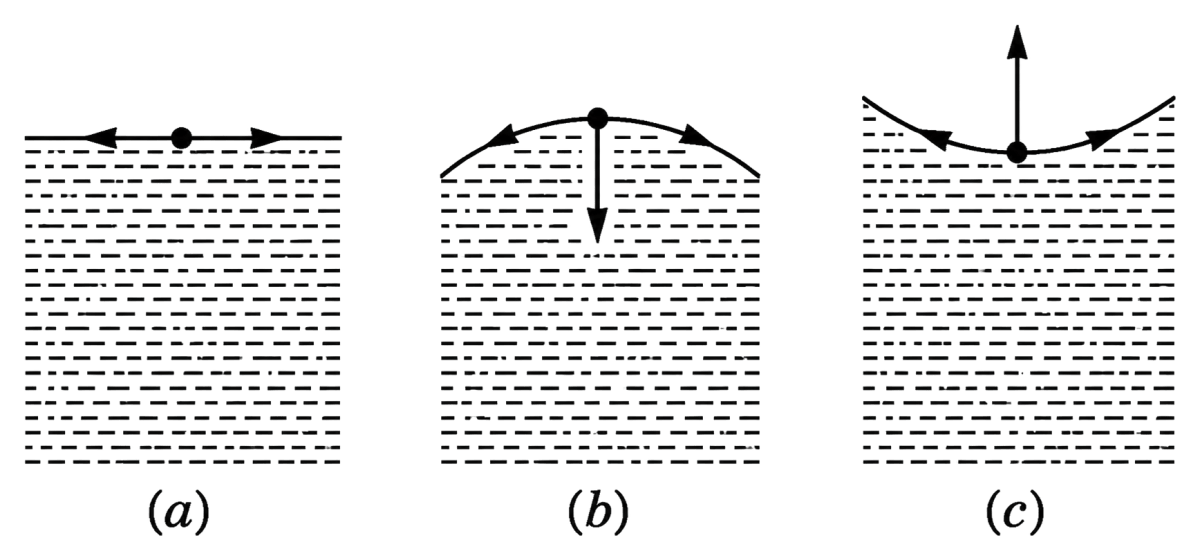
(i) Plane surface : If the surface is plane, the molecule is attracted equally in all directions. Hence the resultant force on the molecule due to surface tension is zero, and there is no pressure difference between the two sides.
(ii) Convex surface : If the surface is convex, then the resultant of all the forces of attraction acting on every molecule acts normal to the surface and is directed inward.
(iii) Concave surface : If the surface is concave, then every molecule experiences a resultant force due to surface tension acting normally outward.
Obviously, for the equilibrium of a curved surface there must be a difference of pressure between its two sides, so that the excess pressure force may balance the resultant force due to surface tension.
In the case of a convex surface, the resultant force of surface tension acts inward, so the pressure on the concave side must be greater to balance it. In the case of a concave surface, the resultant force of surface tension acts outward, so again the pressure on the concave side must be greater.
Hence, in either case the pressure on the concave side of a curved liquid surface is greater than the pressure on its convex side.
This difference of pressure is equal to , where T is the surface tension and R is the radius of curvature of the surface.
A force of 80 N is applied on a nail, whose tip has a cross-sectional area of 0.002 cm2. Calculate the pressure on the tip.
Answer
Given,
- Force applied, F = 80 N
- Area of cross-section of the tip, A = 0.002 cm2 = 0.002 × 10⁻⁴ m2 = 2 × 10⁻⁷ m2
Pressure is the normal force exerted per unit area,
Substituting the values,
Hence, the pressure on the tip of the nail is 4 × 10⁸ Pa.
The air-pressure is equal to 75 cm column of mercury. Express it in N m-2. Given g = 10 m s-2, density of mercury = 13.6 × 10³ kg m-3.
Answer
Given,
- Height of the mercury column, h = 75 cm = 0.75 m
- Density of mercury, ρ = 13.6 × 10³ kg m-3
- g = 10 m s-2
The pressure exerted by a liquid column of height h is
Substituting the values,
Hence, the air-pressure is 1.02 × 10⁵ N m-2.
Calculate the pressure of sea water at a depth of 200 m, when the average density of sea water is 1.032 × 10³ kg m-3 (g = 9.8 m s-2).
Answer
Given,
- Depth, h = 200 m
- Average density of sea water, ρ = 1.032 × 10³ kg m-3
- g = 9.8 m s-2
The pressure exerted by a liquid column of height h is
Substituting the values,
Hence, the pressure of sea water at a depth of 200 m is 2.023 × 10⁶ N m-2.
There is a 1 mm thick layer of oil between a flat plate of area 10-2 m2 and a big plate. How much force is required to move the plate with a velocity of 1.5 cm/s ? The coefficient of viscosity of oil is 1 poise.
Answer
Given,
- Thickness of the oil layer, dz = 1 mm = 10-3 m
- Area of the plate, A = 10-2 m2
- Velocity of the plate, dv = 1.5 cm/s = 1.5 × 10⁻² m s-1
- Coefficient of viscosity of oil, η = 1 poise = 0.1 kg m-1 s-1
The velocity gradient between the plates is
By Newton's formula of viscosity, the viscous force is
Substituting the values,
Hence, the force required to move the plate is 1.5 × 10⁻² N.
A steel ball of 3 mm radius is falling in glycerine. Find the terminal velocity of the ball. Take g = 10 m/s2.
Answer
Given,
- Radius of the ball, r = 3 mm = 3 × 10⁻³ m
- Density of steel, ρ = 8.0 × 10³ kg m-3
- Density of glycerine, σ = 1.2 × 10³ kg m-3
- Coefficient of viscosity of glycerine, η = 0.85 kg m-1 s-1
- g = 10 m s-2
By Stokes' law, the terminal velocity of the ball is
Substituting the values,
Hence, the terminal velocity of the ball is 0.16 m s-1, that is, 16 cm s-1.
Note: The answer printed in the textbook is "16 m/s", which appears to be a misprint for 16 cm/s. The correct value in SI units is 0.16 m s-1.
A steel shot of diameter 2 mm is dropped in a viscous liquid filled in a drum. Find the terminal speed of the shot. Density of the material of the shot = 8.0 × 10³ kg/m3, density of liquid = 1.0 × 10³ kg/m3. Coefficient of viscosity of liquid = 1.0 kg/(m-s), g = 10 m/s2.
Answer
Given,
- Diameter of the shot = 2 mm, so radius r = 1 mm = 1 × 10⁻³ m
- Density of the material of the shot, ρ = 8.0 × 10³ kg m-3
- Density of the liquid, σ = 1.0 × 10³ kg m-3
- Coefficient of viscosity of the liquid, η = 1.0 kg m-1 s-1
- g = 10 m s-2
By Stokes' law, the terminal velocity is
Substituting the values,
Hence, the terminal speed of the shot is 1.55 × 10⁻² m s-1, that is, 1.55 cm s-1.
A drop of radius 1.0 cm falls with a uniform speed 1.0 cm/s inside a fluid. If coefficient of viscosity of the fluid is 1.0 × 10² kg/m-s, then find the value of viscous force acting on the drop.
Answer
Given,
- Radius of the drop, r = 1.0 cm = 1.0 × 10⁻² m
- Uniform (terminal) speed, v = 1.0 cm/s = 1.0 × 10⁻² m s-1
- Coefficient of viscosity of the fluid, η = 1.0 × 10² kg m-1 s-1
By Stokes' law, the viscous force acting on the drop is
Substituting the values,
Hence, the viscous force acting on the drop is 0.06 π N, that is, about 0.188 N.
The velocity of flow of an ideal liquid in a horizontal pipe is 8.0 m s-1. Determine the 'velocity-head' of the liquid. (g = 10 m/s-2)
Answer
Given,
- Velocity of flow, v = 8.0 m s-1
- g = 10 m s-2
On dividing Bernoulli's equation throughout by ρ g, the term is obtained, which is called the velocity head. Thus,
Substituting the values,
Hence, the velocity-head of the liquid is 3.2 m.
Water enters with a velocity of 0.4 m/s from one side of horizontal pipe, having asymmetrical cross-section area, and emerges out from another side with velocity of 0.6 m/s. The water pressure at the first side of the pipe is 1500 N/m2. Find the water pressure at the other side of the pipe.
Answer
Given,
- Velocity at the first side, v1 = 0.4 m s-1
- Velocity at the other side, v2 = 0.6 m s-1
- Pressure at the first side, P1 = 1500 N m-2
- Density of water, ρ = 1.0 × 10³ kg m-3
Since the pipe is horizontal, by Bernoulli's theorem,
Substituting the values,
Hence, the water pressure at the other side of the pipe is 1400 N m-2.
Find out the work done in increasing the surface area of a soap bubble by 1.0 cm2. Surface tension of soap solution is 1.8 × 10⁻² N/m.
Answer
Given,
- Increase in the surface area of one surface, ΔA = 1.0 cm2 = 1.0 × 10⁻⁴ m2
- Surface tension of soap solution, T = 1.8 × 10⁻² N m-1
A soap bubble has two free surfaces, so the total increase in the surface area is 2 × ΔA.
The work done in increasing the surface area at constant temperature is
Substituting the values,
Hence, the work done is 3.6 × 10⁻⁶ J.
The surface tension of a soap solution is 2.1 × 10⁻² N/m. How much work will have to be done in forming a bubble of diameter 1.0 cm by blowing.
Answer
Given,
- Surface tension of the soap solution, T = 2.1 × 10⁻² N m-1
- Diameter of the bubble = 1.0 cm, so radius r = 0.5 cm = 0.5 × 10⁻² m
A soap bubble has two free surfaces, so the total surface area formed is
The work done is
Substituting the values,
Hence, the work done in forming the bubble is 1.32 × 10⁻⁵ J.
In increasing the area of a film of soap solution from 50 cm2 to 100 cm2, 3.0 × 10⁻⁴ J of work is done. Calculate the value of surface tension of the soap solution.
Answer
Given,
- Initial area of one surface of the film = 50 cm2
- Final area of one surface of the film = 100 cm2
- Work done, W = 3.0 × 10⁻⁴ J
A soap film has two free surfaces. The increase in the area of one surface is
Hence, the total increase in the surface area is
Since W = T × ΔA,
Hence, the surface tension of the soap solution is 3.0 × 10⁻² N m-1.
The surface area of a soap-bubble is 2.0 × 10⁻³ m2. How much work will be done in blowing the bubble to twice its surface area?
Answer
Given,
- Initial surface area of the bubble, A = 2.0 × 10⁻³ m2
- Final surface area = 2A = 4.0 × 10⁻³ m2
- Surface tension of soap solution, T = 3.0 × 10⁻² N m-1
The increase in the area of one surface is
Since a soap bubble has two free surfaces, the total increase in the surface area is
The work done is
Hence, the work done in blowing the bubble is 1.2 × 10⁻⁴ J.
How much work will be done in increasing the diameter of a soap bubble from 2 cm to 5 cm?
Answer
Given,
- Initial diameter = 2 cm, so r1 = 1 cm = 1 × 10⁻² m
- Final diameter = 5 cm, so r2 = 2.5 cm = 2.5 × 10⁻² m
- Surface tension of soap solution, T = 3.0 × 10⁻² N m-1
A soap bubble has two free surfaces, so the increase in the total surface area is
Substituting the values,
The work done is
Hence, the work done is 3.96 × 10⁻⁴ J.
Calculate the excess pressure inside a drop of water of radius 2.0 mm. Surface tension of water is 0.075 N m-1.
Answer
Given,
- Radius of the water drop, R = 2.0 mm = 2.0 × 10⁻³ m
- Surface tension of water, T = 0.075 N m-1
A liquid drop has only one free surface, so the excess pressure inside it is
Substituting the values,
Hence, the excess pressure inside the drop of water is 75 N m-2.
A capillary tube is held vertical in a beaker full of a liquid. If the height of the vertical column of the liquid in the capillary tube is 12.0 cm, radius of the capillary tube is 0.02 cm, surface tension of the liquid is 9.0 × 10⁻² N/m and g is 10.0 m/s2, calculate the density of the liquid.
Answer
Given,
- Height of the liquid column, h = 12.0 cm = 0.12 m
- Radius of the capillary tube, r = 0.02 cm = 2 × 10⁻⁴ m
- Surface tension of the liquid, T = 9.0 × 10⁻² N m-1
- g = 10.0 m s-2
- Angle of contact, θ = 0 (so cos θ = 1)
By the ascent formula, the rise of a liquid in a capillary tube is
Substituting the values,
Hence, the density of the liquid is 7.5 × 10² kg m-3.
Water rises to height h in a capillary tube. Find the radius of the capillary if the surface tension of water is 9.8 × 10⁻² N/m (g = 9.8 m/s2 and density of water = 103 kg/m3).
Answer
Given,
- Height of the water column = h
- Surface tension of water, T = 9.8 × 10⁻² N m-1
- Density of water, ρ = 103 kg m-3
- g = 9.8 m s-2
- Angle of contact, θ = 0 (so cos θ = 1)
By the ascent formula,
Substituting the values,
Hence, the radius of the capillary is metre.
A liquid rises to a height of 7.0 cm in a capillary tube of radius 0.1 mm. The density of the liquid is 0.8 × 10³ kg/m3. If the angle of contact between the liquid and the surface of the tube be zero, calculate the surface tension of the liquid. (g = 10 m/s2).
Answer
Given,
- Height of the liquid column, h = 7.0 cm = 0.07 m
- Radius of the capillary tube, r = 0.1 mm = 1 × 10⁻⁴ m
- Density of the liquid, ρ = 0.8 × 10³ kg m-3
- Angle of contact, θ = 0, so cos θ = 1
- g = 10 m s-2
By the ascent formula,
Substituting the values,
Hence, the surface tension of the liquid is 2.8 × 10⁻² N m-1.
The radius of a capillary tube is 0.2 × 10⁻³ m. It is held vertically in a liquid whose density is 0.8 × 10³ kg/m3 and the surface tension is 0.08 Nm-1. Determine the height to which the liquid will rise in the tube. Angle of contact is zero. (g = 10 m/s2).
Answer
Given,
- Radius of the capillary tube, r = 0.2 × 10⁻³ m
- Density of the liquid, ρ = 0.8 × 10³ kg m-3
- Surface tension, T = 0.08 N m-1
- Angle of contact, θ = 0, so cos θ = 1
- g = 10 m s-2
By the ascent formula,
Substituting the values,
Hence, the liquid will rise to a height of 10 cm in the tube.
A glass capillary of diameter 0.1 mm, open at both ends is dipped vertically in water. Calculate the rise of water column in the capillary. (Surface tension of water T = 0.072 N/m, ρ = 103 kg/m3, g = 9.8 m/s2)
Answer
Given,
- Diameter of the capillary = 0.1 mm, so radius r = 0.05 mm = 5 × 10⁻⁵ m
- Surface tension of water, T = 0.072 N m-1
- Density of water, ρ = 103 kg m-3
- g = 9.8 m s-2
- Angle of contact, θ = 0, so cos θ = 1
By the ascent formula,
Substituting the values,
Hence, the rise of the water column in the capillary is 29.38 cm.
An ideal fluid flows in the pipe as shown in the figure. The pressure in the fluid at the bottom P2 is the same as it is at the top P1. If the velocity at A1 is v1 = 2 ms-1 then find the ratio A1/A2. (g = 10 m/s2)
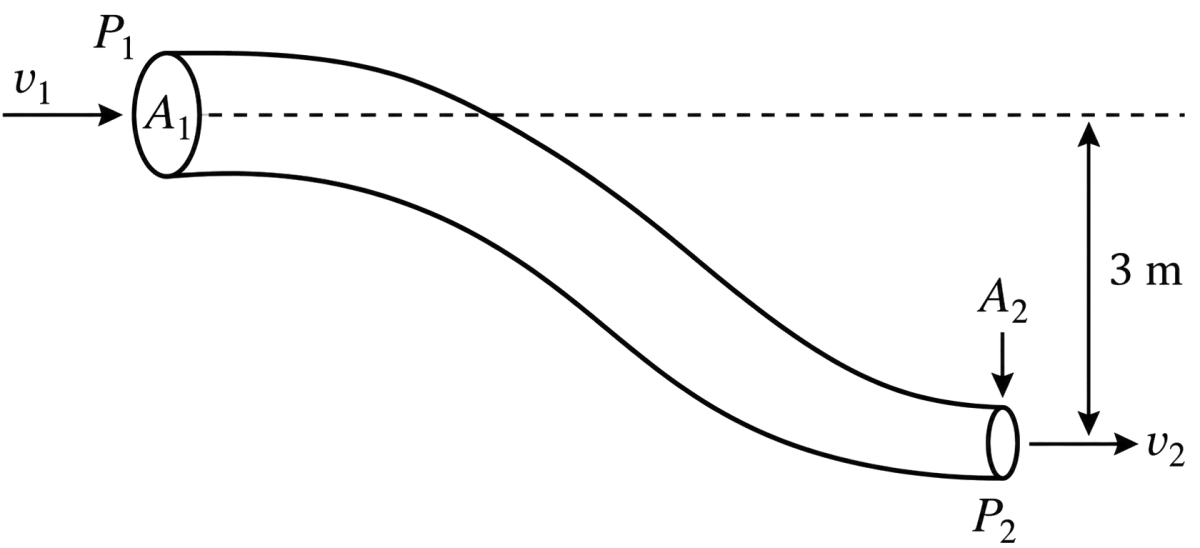
Answer
Given,
- Velocity at the top, v1 = 2 m s-1
- Pressures are equal, P1 = P2
- Difference in height, h1 = 3 m
- g = 10 m s-2
Applying Bernoulli's theorem between the top and the bottom of the pipe, taking the bottom as the reference level,
Since P1 = P2, these terms cancel out, and dividing throughout by ρ,
Substituting the values,
By the principle of continuity,
Hence, the ratio A1 : A2 is 4 : 1.
The weight of a person is 80 kgf. How much pressure is exerted by him on the ground, when (i) he is lying, (ii) he is standing on both his feet ? Given : area of the body of the person 1.2 m2 and that of a foot is 60 cm2 (g = 9.8 m s-2).
Answer
Given,
- Weight of the person = 80 kgf, so F = 80 × 9.8 = 784 N
- Area of the body, A1 = 1.2 m2
- Area of one foot = 60 cm2
- g = 9.8 m s-2
(i) When he is lying : The whole area of the body is in contact with the ground, so
(ii) When he is standing on both his feet : The area in contact is that of the two feet,
Hence, the pressure exerted is 6.53 × 10² Pa when he is lying and 6.53 × 10⁴ Pa when he is standing on both his feet.
The pressure while standing is a hundred times greater, because the same force is distributed over a much smaller area.
An air bubble (radius 0.4 mm) rises up in water. If the coefficient of viscosity of water be 1 × 10⁻³ kg/(m-s), then determine the terminal speed of the bubble. Density of air is negligible.
Answer
Given,
- Radius of the air bubble, r = 0.4 mm = 4 × 10⁻⁴ m
- Coefficient of viscosity of water, η = 1 × 10⁻³ kg m-1 s-1
- Density of water, σ = 1.0 × 10³ kg m-3
- Density of air is negligible, so ρ = 0
- g = 9.8 m s-2
By Stokes' law, the terminal velocity is
Since ρ < σ, the terminal velocity is negative, which means that the bubble moves upward. Taking the magnitude,
Substituting the values,
Hence, the terminal speed of the bubble is 0.348 m s-1, directed vertically upward.
Water is flowing through a cylindrical pipe of cross-sectional area 0.09 π m2 at a speed of 1.0 m/s. If the diameter of the pipe is halved, then find the speed of flow of water through it.
Answer
Given,
- Initial area of cross-section, A1 = 0.09 π m2
- Initial speed of flow, v1 = 1.0 m s-1
- The diameter is halved, so
Since the area of cross-section is proportional to the square of the diameter,
that is, .
By the principle of continuity,
Substituting,
Hence, the speed of flow of water through the pipe becomes 4.0 m s-1.
Water is flowing through a horizontal pipe of non-uniform cross-section. The speed of water is 30 cm/s at a place where pressure is 10 cm (of water). Calculate the speed of water at the other place where the pressure is half of that at the first place.
Answer
Given,
- Speed at the first place, v1 = 30 cm/s = 0.30 m s-1
- Pressure at the first place = 10 cm of water = 0.10 m of water
- Pressure at the other place = 5 cm of water = 0.05 m of water
- Density of water, ρ = 1.0 × 10³ kg m-3, g = 9.8 m s-2
The pressure difference between the two places is
Since the pipe is horizontal, by Bernoulli's theorem,
Substituting the values,
Hence, the speed of water at the other place is 1.034 m s-1, that is, 103.4 cm s-1.
Water flows through a horizontal pipe of varying cross-section. The pressure of water equals to 0.1 m of mercury at a place where the velocity of flow is 0.4 m/s. What will be the pressure at another place where the velocity of flow is 0.5 m/s ?
Answer
Given,
- Pressure at the first place, P1 = 0.1 m of mercury
- Velocity at the first place, v1 = 0.4 m s-1
- Velocity at the other place, v2 = 0.5 m s-1
- Density of water, ρ = 1.0 × 10³ kg m-3
- Density of mercury = 13.6 × 10³ kg m-3, g = 9.8 m s-2
Since the pipe is horizontal, by Bernoulli's theorem,
Substituting the values,
Expressing this pressure difference as a height of mercury column,
Therefore, the pressure at the other place is
Hence, the pressure at the other place is 0.09966 m of mercury column.
Water is flowing through a horizontal pipe of varying cross-section. At any two places, the diameter of the tube is 4 cm and 2 cm. If the pressure difference between these two places be equal to 4.5 cm (water), then determine the rate of flow of water in the tube.
Answer
Given,
- Diameter at the wider place = 4 cm, so radius = 2 cm = 2 × 10⁻² m
- Diameter at the narrower place = 2 cm, so radius = 1 cm = 1 × 10⁻² m
- Pressure difference, h = 4.5 cm of water = 0.045 m of water
- g = 9.8 m s-2
The areas of cross-section are
Treating the pipe as a venturimeter, the rate of flow of water is
Substituting the values,
Hence, the rate of flow of water in the tube is 3.047 × 10⁻⁴ m3 s-1, that is, about 304.7 cm3 s-1.
A water tank has a hole in its wall at a distance of 40 m below the free surface of water. Compute the velocity of efflux of water from the hole. If the radius of the hole be 1 mm, find the rate of flow of water.
Answer
Given,
- Depth of the hole below the free surface, h = 40 m
- Radius of the hole, r = 1 mm = 1 × 10⁻³ m
- g = 9.8 m s-2
By Torricelli's theorem, the velocity of efflux is
Substituting the values,
The area of cross-section of the hole is
The rate of flow of water is
Hence, the velocity of efflux is 28 m s-1 and the rate of flow of water is 8.8 × 10⁻⁵ m3 s-1.
A water film is formed between two straight parallel wires each of length 10 cm separated by 0.5 cm. If the distance between the wires is increased by 1 mm, how much work will be done ? (Surface tension of water = 7.2 × 10⁻² N/m).
Answer
Given,
- Length of each wire, l = 10 cm = 0.10 m
- Increase in the separation, Δx = 1 mm = 1 × 10⁻³ m
- Surface tension of water, T = 7.2 × 10⁻² N m-1
A liquid film has two free surfaces, so the total increase in the surface area is
The work done is
Hence, the work done is 1.44 × 10⁻⁵ J.
A thin wire is bent in the form of a ring of diameter 3.0 cm. The ring is placed horizontally on the surface of soap solution and then raised up slowly. How much upward force is necessary to break the vertical film formed between the ring and the solution?
Answer
Given,
- Diameter of the ring = 3.0 cm, so radius r = 1.5 cm = 1.5 × 10⁻² m
- Surface tension of soap solution, T = 3.0 × 10⁻² N m-1
The film formed between the ring and the solution has two free surfaces, so the length of the film in contact with the ring is
The force required to break the film is
Substituting the values,
Hence, an upward force of 5.652 × 10⁻³ N is necessary to break the film.
The air pressure inside a soap bubble of diameter 3.5 mm is 8.0 mm of water columm above the atmospheric pressure. Calculate the surface tension of soap solution.
Answer
Given,
- Diameter of the bubble = 3.5 mm, so radius R = 1.75 mm = 1.75 × 10⁻³ m
- Excess pressure inside the bubble = 8.0 mm of water column
- Density of water, ρ = 1.0 × 10³ kg m-3, g = 9.8 m s-2
The excess pressure expressed in N m-2 is
A soap bubble has two free surfaces, so the excess pressure inside it is
Substituting the values,
Hence, the surface tension of the soap solution is 3.43 × 10⁻² N m-1.
The diameters of the two vertical limbs of a U-shaped tube containing water are 5.0 mm and 2.0 mm. What is the difference in the heights of the water columns in the tube?
Answer
Given,
- Diameter of the wider limb = 5.0 mm, so r1 = 2.5 mm = 2.5 × 10⁻³ m
- Diameter of the narrower limb = 2.0 mm, so r2 = 1.0 mm = 1.0 × 10⁻³ m
- Surface tension of water, T = 7.3 × 10⁻² N m-1
- Density of water, ρ = 1.0 × 10³ kg m-3, g = 9.8 m s-2
- Angle of contact, θ = 0, so cos θ = 1
The water rises to a different height in each limb, and the difference in the two heights is
Substituting the values,
Hence, the difference in the heights of the water columns is 8.94 mm.
A large vessel is filled with water upto a height of 35 m. There is a hole of radius 1 cm in the vessel wall at 7 m below the free surface of water. Compute : (i) velocity of efflux of water, (ii) rate of flow of water, (iii) range of water flow, (iv) the distance below the water surface where the flow of water through a hole will have the same range as at 7 m, (v) the distance below the water surface where the flow of water through a hole will have maximum range, (vi) maximum range.
Answer
Given,
- Height of water in the vessel, H = 35 m
- Depth of the hole below the free surface, h = 7 m
- Radius of the hole, r = 1 cm = 1 × 10⁻² m
- g = 9.8 m s-2
(i) Velocity of efflux : By Torricelli's theorem,
(ii) Rate of flow of water :
(iii) Range of water flow : The horizontal range is
(iv) Distance where the range is the same : From the range formula, the range remains the same whether the orifice is at a depth h or at a depth (H − h). Hence the required depth is
(v) Distance for maximum range : The range is maximum when h(H − h) is maximum, which on differentiating gives
(vi) Maximum range :
Hence, (i) 11.7 m s-1, (ii) 3.67 × 10⁻³ m3 s-1, (iii) 28 m, (iv) 28 m, (v) 17.5 m and (vi) 35 m.
A mercury drop of radius 1.0 mm is broken into 1000 droplets of equal volume. Calculate the work done in this process. The surface tension of mercury is 0.465 N/m.
Answer
Given,
- Radius of the big drop, R = 1.0 mm = 1 × 10⁻³ m
- Number of droplets, n = 1000
- Surface tension of mercury, T = 0.465 N m-1
Since the total volume remains unchanged,
The work done is equal to the surface tension multiplied by the increase in the surface area,
Substituting the values,
Hence, the work done in the process is 5.26 × 10⁻⁵ J.
How much work is done against surface tension in spraying a drop of water of diameter 0.2 cm into 27000 droplets of equal volume? (Surface tension of water T = 7.0 × 10⁻² N/m).
Answer
Given,
- Diameter of the drop = 0.2 cm, so R = 0.1 cm = 1 × 10⁻³ m
- Number of droplets, n = 27000
- Surface tension of water, T = 7.0 × 10⁻² N m-1
Since the total volume remains unchanged,
The work done against surface tension is
Substituting the values,
Hence, the work done against surface tension is 2.55 × 10⁻⁵ J.
Calculate the energy required to break up a soap solution drop of radius 1 mm into 27 droplets of equal volume. (Surface tension of soap solution = 0.032 N/m).
Answer
Given,
- Radius of the drop, R = 1 mm = 1 × 10⁻³ m
- Number of droplets, n = 27
- Surface tension of soap solution, T = 0.032 N m-1
Since the total volume remains unchanged,
A liquid drop has only one free surface, so the energy required is
Substituting the values,
Hence, the energy required is 0.80 × 10⁻⁶ J.
1000 droplets of water have radius of 0.01 mm each. Calculate the energy liberated in the formation of one large drop by combining them. Surface tension of water = 7 × 10⁻² N/m.
Answer
Given,
- Radius of each droplet, r = 0.01 mm = 1 × 10⁻⁵ m
- Number of droplets, n = 1000
- Surface tension of water, T = 7 × 10⁻² N m-1
Since the total volume remains unchanged,
Here the total surface area decreases, so energy is liberated. The energy liberated is
Substituting the values,
Hence, the energy liberated in the formation of the large drop is 7.92 × 10⁻⁸ J.
A metal block of base area 0.20 m2 is placed on a table, as shown in the figure. A liquid film of thickness 0.25 mm is inserted between the block and the table. The block is pushed by a horizontal force of 0.1 N and moves with a constant speed. If the viscosity of the liquid is 5.0 × 10⁻³ Pl, the speed of the block is v × 10-3 m/s. What is the value of v?
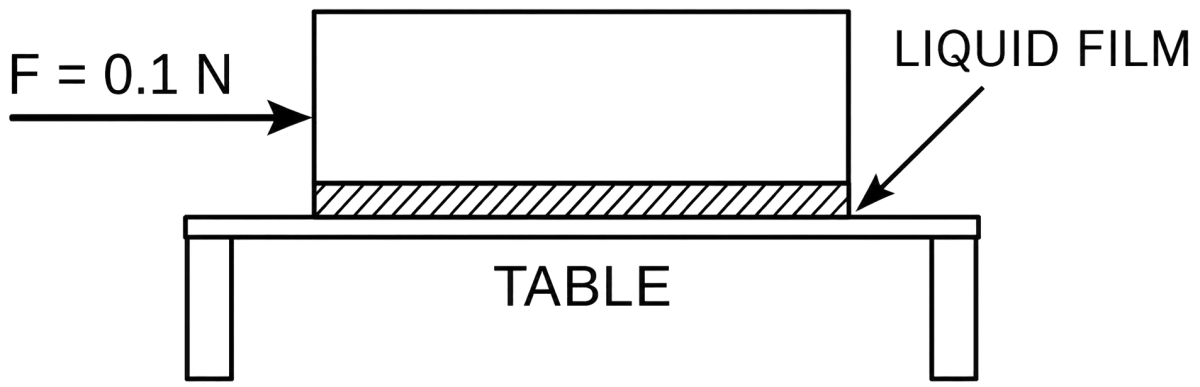
Answer
Given,
- Base area of the block, A = 0.20 m2
- Thickness of the liquid film, dy = 0.25 mm = 0.25 × 10⁻³ m
- Horizontal force applied, F = 0.1 N
- Coefficient of viscosity of the liquid, η = 5.0 × 10⁻³ Pl (poiseuille)
Since the block moves with a constant speed, the applied force is exactly balanced by the viscous force of the liquid film. By Newton's formula of viscosity,
Substituting the values,
Comparing with v × 10-3 m/s,
Hence, the value of v is 25.
A big drop is formed by combining 27 small droplets of water. What will be the change in the surface energy? What will be the ratio of the surface energy of big drop to the surface energy of 27 small droplets?
Answer
Let r be the radius of each small droplet and R the radius of the big drop. Since the total volume remains unchanged,
Change in surface energy : The surface energy is proportional to the total surface area.
Since the total surface area decreases on combining, the surface energy decreases, and the energy so released appears as heat, raising the temperature of the drop.
Ratio of the surface energies :
Hence, the surface energy decreases, and the ratio of the surface energy of the big drop to that of the 27 small droplets is 1 : 3.
The length of a needle floating on water is 2.5 cm. How much minimum force, in addition to the weight of the needle, will be needed to lift the needle above the surface of water? Surface tension of water = 7.2 × 10⁻⁴ N/cm.
Answer
Given,
- Length of the needle, l = 2.5 cm
- Surface tension of water, T = 7.2 × 10⁻⁴ N cm-1
The water surface is in contact with the needle along both its sides, so the effective length is 2l.
The minimum additional force needed to lift the needle is equal to the force of surface tension,
Substituting the values,
Hence, a minimum additional force of 36 × 10-4 N is needed to lift the needle.
What would be the excess pressure above the atmosphere inside an air bubble of 0.2 mm radius situated just below the surface of water. The surface tension of water is 0.07 Nm-1. Express this excess pressure in terms of the height of mercury column.
Answer
Given,
- Radius of the air bubble, r = 0.2 mm = 2 × 10⁻⁴ m
- Surface tension of water, T = 0.07 N m-1
- Density of mercury, ρ = 13.6 × 10³ kg m-3, g = 9.8 m s-2
An air bubble formed inside a liquid has only one free surface, so the excess pressure inside it is
Substituting the values,
Expressing this excess pressure as the height of a mercury column, p = h ρ g, so
Hence, the excess pressure is 700 N m-2, which is equivalent to 5.25 mm of mercury column.
(a) The radius of a capillary tube is 0.025 mm. It is held vertically in a liquid whose density is 0.8 × 10³ kg/m3, surface tension is 3.0 × 10⁻² N/m and for which the cosine of the angle of contact is 0.3. Determine the height upto which the liquid will rise in the tube. (g = 10 m/s2).
(b) If the capillary is taken down in water slowly until its upper end comes in level of water, will the water come out from this end?
Answer
Given,
- Radius of the capillary tube, r = 0.025 mm = 2.5 × 10⁻⁵ m
- Density of the liquid, ρ = 0.8 × 10³ kg m-3
- Surface tension, T = 3.0 × 10⁻² N m-1
- cos θ = 0.3
- g = 10 m s-2
(a) By the ascent formula,
Substituting the values,
Hence, the liquid rises to a height of 9.0 cm in the tube.
(b) No, the water will not come out from the upper end.
From the ascent formula, for a given liquid the product h R = constant, where R is the radius of curvature of the meniscus. If the length of the tube is less than h, the liquid rises up to the top of the tube and then the radius of curvature of the meniscus increases to a new value R', such that
The meniscus simply becomes flatter and adjusts itself so that the liquid remains in equilibrium. Hence, the liquid cannot emerge in the form of a fountain from the upper end of a short capillary tube.
Water rises up in a glass capillary upto a height of 9.0 cm, while mercury falls down by 3.4 cm in the same capillary. Assume angles of contact for water-glass and mercury-glass 0° and 135° respectively. Determine the ratio of surface tensions of mercury and water (cos 135° = − 0.71).
Answer
Given,
- Rise of water, hw = 9.0 cm, with θw = 0°, so cos θw = 1
- Fall of mercury, hHg = − 3.4 cm, with θHg = 135°, so cos θHg = − 0.71
- Relative density of mercury = 13.6, so ρHg = 13.6 ρw
- The same capillary is used, so r is the same for both
From the ascent formula, the surface tension is
Therefore, the ratio of the surface tensions is
Substituting the values,
Hence, the ratio of the surface tensions of mercury and water is 7.2 : 1.
A capillary tube of diameter 1.0 mm is held vertical in mercury, with its lower end 1.0 cm below the mercury surface. What should be the air pressure in the tube in order to form a hemispherical air bubble at the lower end of the tube? The surface tension of mercury is 0.465 N/m. Take diameter of the bubble equal to the diameter of the tube.
Answer
Given,
- Diameter of the tube = 1.0 mm, so radius R = 0.5 mm = 5 × 10⁻⁴ m
- Depth of the lower end below the mercury surface, h = 1.0 cm = 1 × 10⁻² m
- Surface tension of mercury, T = 0.465 N m-1
- Density of mercury, ρ = 13.6 × 10³ kg m-3, g = 9.8 m s-2
The air pressure in the tube must exceed the atmospheric pressure by an amount equal to the sum of
(i) the pressure of the mercury column of height h, and
(ii) the excess pressure needed to maintain the hemispherical bubble surface of radius R.
Therefore,
Substituting the values,
Hence, the air pressure in the tube must be 3193 N m-2 above the atmospheric pressure.
The radius of a capillary tube is 0.4 mm. It is immersed vertically in water. Determine the height to which the water will rise in the tube. If the capillary tube is inclined at an angle of 45° with the vertical line, calculate at what length the water will rise in the tube. Surface-tension of water is 7.0 × 10⁻² newton/metre.
Answer
Given,
- Radius of the capillary tube, r = 0.4 mm = 4 × 10⁻⁴ m
- Surface tension of water, T = 7.0 × 10⁻² N m-1
- Density of water, ρ = 1.0 × 10³ kg m-3, g = 9.8 m s-2
- Angle of contact, θ = 0, so cos θ = 1
Height of rise when the tube is vertical : By the ascent formula,
Substituting the values,
Length of the water column when the tube is inclined at 45° : When the capillary is inclined at an angle α to the vertical, the vertical height h of the liquid column remains the same. If h' is the length of the water in the tube, then
Substituting the values,
Hence, the water rises to a vertical height of 3.57 cm, and when the tube is inclined at 45° the length of the water column in the tube is 5.03 cm.
Water rises in a capillary upto a height of 8.0 cm. If the capillary is inclined at an angle of 45° with the vertical, then determine the vertical height of water. How much length of the capillary will be occupied by water? If the length of the capillary is reduced to 4.0 cm and it is held vertically in water, then what will be the position of water?
Answer
Given,
- Height of rise when the capillary is vertical, h = 8.0 cm
- Angle of inclination with the vertical, α = 45°
Vertical height when inclined : When the capillary is inclined, the upward force due to surface tension is unchanged, so it can support a liquid column of the same weight. Hence the vertical height of the water remains the same,
Length of the capillary occupied by water : If h' is the length of water in the inclined tube, then
When the length of the capillary is reduced to 4.0 cm : Here the length of the tube (4.0 cm) is less than the height h (8.0 cm) to which the water would normally rise.
From the ascent formula, for a given liquid , where R is the radius of curvature of the meniscus. Since h is now reduced to 4.0 cm, the radius of curvature R' increases so that h'R' = h R.
The water therefore rises up to the top of the tube and the meniscus simply becomes flatter, so that the water remains in equilibrium.
Hence, the water will rise to the top of the capillary but will not come out of it in the form of a fountain.