
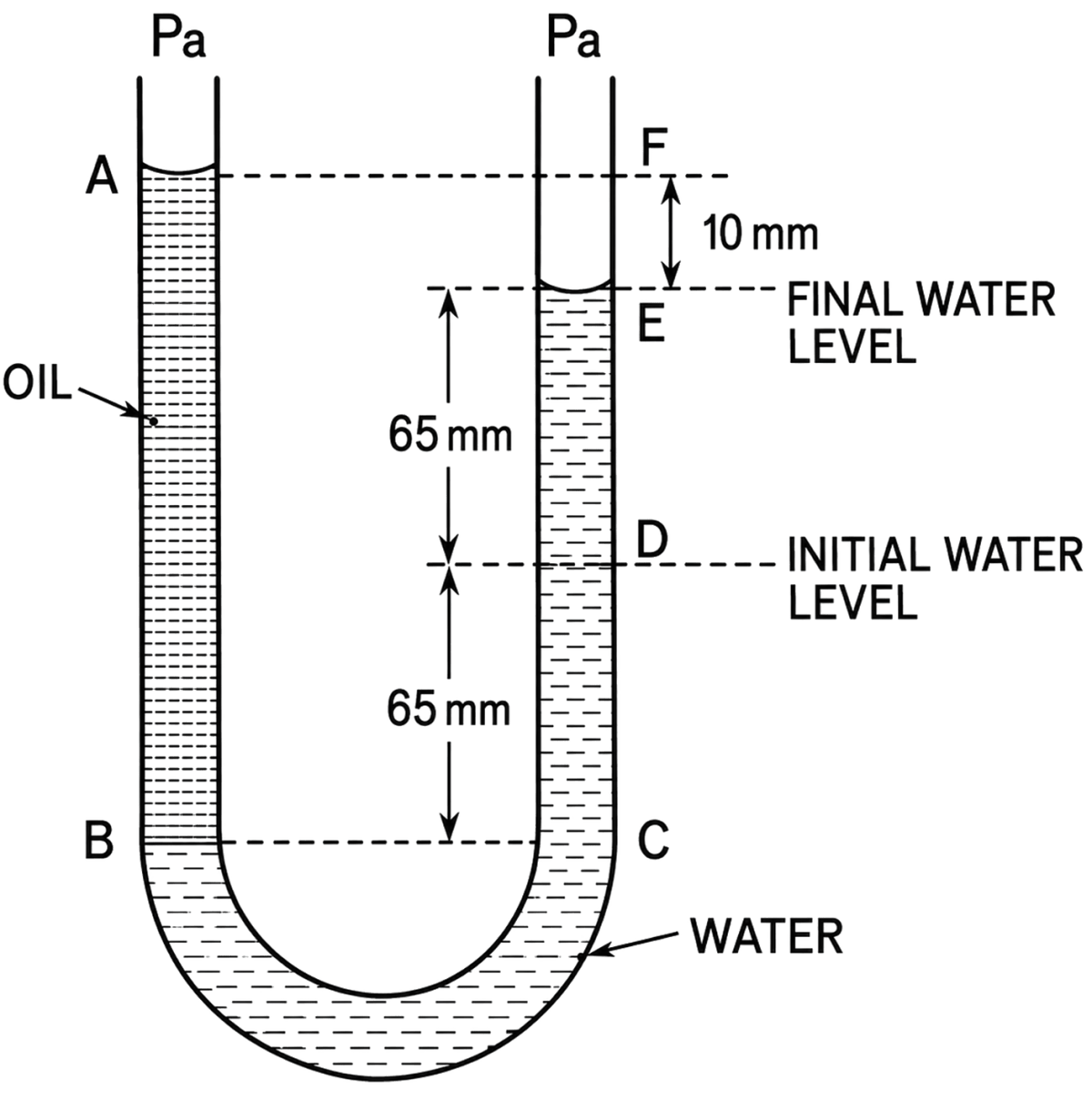
A U-shaped tube with both ends open to the atmosphere, is partially filled with water. Oil, which is immiscible with water, is poured into one side until it stands at a distance of 10 mm above the water level on the other side. Meanwhile the water rises by 65 mm from its original level (see diagram). The density of the oil is:
- 650 kg m-3
- 425 kg m-3
- 800 kg m-3
- 928 kg m-3.
Answer
928 kg m-3
Reason — Given,
- Water rises by 65 mm from its original level
- The oil stands 10 mm above the water level on the other side
- Density of water, ρw = 1000 kg m-3
Since the water in one limb rises by 65 mm, the water in the other limb falls by 65 mm. Hence, measured from the lowest common level of the two liquids,
The pressures at the common level in the two limbs must be equal,
Substituting the values,
The mass of a hydrogen molecule is 3.32 × 10⁻²⁷ kg. If 1023 hydrogen molecules strike, per second, a fixed wall of area 2 cm2 at an angle of 45° to the normal, and rebound elastically with a speed of 103 m/s, then the pressure on the wall is nearly:
- 2.35 × 10² N/m2
- 4.70 × 10² N/m2
- 2.35 × 10³ N/m2
- 4.70 × 10³ N/m2.
Answer
2.35 × 10³ N/m2
Reason — Given,
- Mass of a hydrogen molecule, m = 3.32 × 10⁻²⁷ kg
- Number of molecules striking per second, n = 1023
- Area of the wall, A = 2 cm2 = 2 × 10⁻⁴ m2
- Speed of the molecules, v = 103 m s-1
- Angle with the normal, θ = 45°
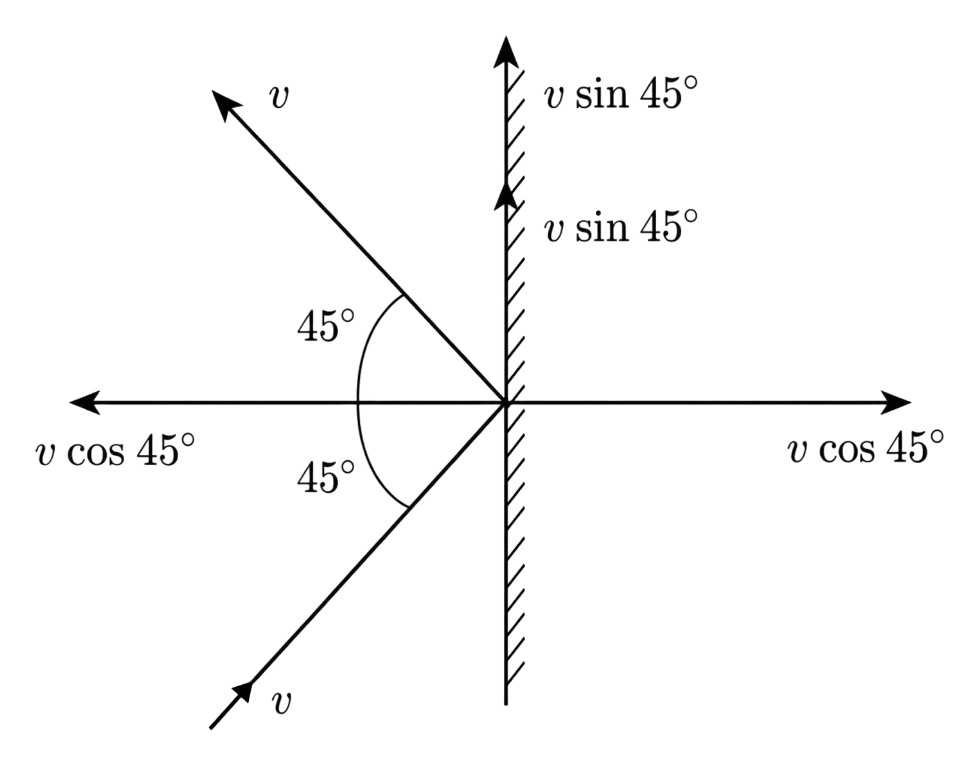
Since the collision is elastic, the component of velocity parallel to the wall is unchanged, while the component normal to the wall (v cos 45°) is reversed. Hence the change in momentum of each molecule is
The force on the wall is the rate of change of momentum of all the n molecules striking per second,
Therefore, the pressure on the wall is
Substituting the values,
A submarine experiences a pressure of 5.05 × 10⁶ Pa at a depth of d1 in a sea. When it goes further to a depth of d2, it experiences a pressure of 8.08 × 10⁶ Pa, then d2 − d1 is approximately (density of water = 103 kg m-3 and g = 10 m/s2) :
- 500 m
- 400 m
- 600 m
- 300 m.
Answer
300 m
Reason — Given,
- Pressure at depth d1, p1 = 5.05 × 10⁶ Pa
- Pressure at depth d2, p2 = 8.08 × 10⁶ Pa
- Density of water, ρ = 103 kg m-3
- g = 10 m s-2
The pressure at a depth d below the free surface is
where p0 is the atmospheric pressure. Hence,
Subtracting,
Substituting the values,
A wooden block floating in a bucket of water has 4/5 of its volume submerged. When certain amount of an oil is poured into the bucket, it is found that the block is just under the oil surface with half of its volume under water and half in oil. The density of oil relative to that of water is:
- 0.6
- 0.8
- 0.7
- 0.5.
Answer
0.6
Reason — Given,
- In the first case, the volume submerged in water is V
- In the second case, half the volume is in water and half in oil
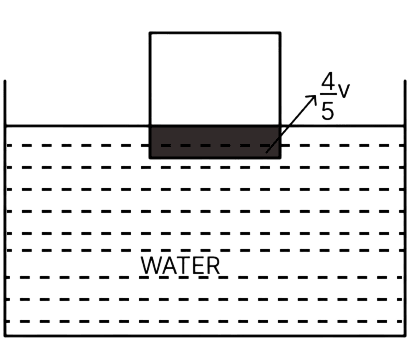
First condition : By the law of floatation, the weight of the block equals the weight of the water displaced,
Second condition : The weight of the block is now balanced by the weight of the oil displaced together with the weight of the water displaced,
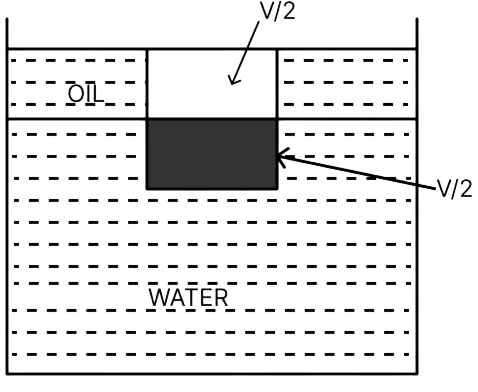
Dividing throughout by ρw,
Substituting from equation (i),
The area of cross section of the rope used to lift a load by a crane is 2.5 × 10⁻⁴ m2. The maximum lifting capacity of the crane is 10 metric tons. To increase the lifting capacity of the crane to 25 metric tons. The required area of cross section of the rope should be : (Take g = 10 ms-2)
- 6.25 × 10⁻⁴ m2
- 10 × 10-4 m2
- 1 × 10⁻⁴ m2
- 1.67 × 10⁻⁴ m2.
Answer
6.25 × 10⁻⁴ m2
Reason — Given,
- Initial area of cross-section, A1 = 2.5 × 10⁻⁴ m2
- Initial lifting capacity, W1 = 10 metric tons
- Final lifting capacity, W2 = 25 metric tons
The rope can bear only a fixed maximum stress, that is, a fixed force per unit area. Hence the load which can be lifted is directly proportional to the area of cross-section of the rope,
Substituting the values,
A small sphere of radius 'r' falls from rest in a viscous liquid. As a result, heat is produced due to viscous force. The rate of production of heat when the sphere attains its terminal velocity, is proportional to:
- r3
- r4
- r5
- r2.
Answer
r5
Reason — The rate of production of heat is equal to the power lost against the viscous force,
By Stokes' law, Fv = 6πηrv, so
At the terminal velocity,
Therefore,
A solid sphere of radius R acquires a terminal velocity v1 when falling (due to gravity) through a viscous fluid having co-efficient of viscosity η. The sphere is broken into 27 identical solid spheres. If each of these spheres acquires a terminal velocity v2, when falling through the same fluid, the ratio (v1/v2) equals:
9
Answer
9
Reason — Let r be the radius of each of the 27 small spheres. Since the total volume remains unchanged,
By Stokes' law, the terminal velocity is
Since the material of the sphere and the fluid remain the same, all the other parameters are constant and
Therefore,
Water from a tap emerges vertically downwards with an initial speed of 1.0 m/s. The cross-sectional area of the tap is 10-4 m2. Assume that the pressure is constant throughout the stream of water and that the flow is stream-lined. The cross-sectional area of the stream, 0.15 m below the tap would be : [Take g = 10 m/s2]
- 2 × 10⁻⁵ m2
- 1 × 10⁻⁵ m2
- 5 × 10⁻⁴ m2
- 5 × 10⁻⁵ m2.
Answer
5 × 10⁻⁵ m2
Reason — Given,
- Initial speed of water, v1 = 1.0 m s-1
- Area of cross-section of the tap, A1 = 10-4 m2
- Vertical distance fallen, h = 0.15 m
- g = 10 m s-2
![Water from a tap emerges vertically downwards with an initial speed of 1.0 m/s. The cross-sectional area of the tap is 10 -4 m 2. Assume that the pressure is constant throughout the stream of water and that the flow is stream-lined. The cross-sectional area of the stream, 0.15 m below the tap would be: [Take g = 10 m/s 2 ]. Mechanical Properties of Fluids, Solutions for Class 11 ISC Nootan Physics Kumar Mittal Nageen Prakashan](https://cdn1.knowledgeboat.com/img/np11/q8-competition-zone-mcq-one-ans-1-nootan-physics-icse-class-11-mechanical-properties-of-fluids-202609091043-987x605.png)
Since the pressure is constant throughout the stream, the water falls freely under gravity. Using the equation of motion v2 = u2 + 2gh, the speed at a depth of 0.15 m is
By the equation of continuity, at the two points P and Q,
Substituting the values,
A liquid of density ρ is coming out of a hose pipe of radius a with horizontal speed v and hits a mesh. 50% of the liquid passes through the mesh unaffected. 25% loses all of its momentum and 25% comes back with the same speed. The resultant pressure on the mesh will be:
.
Answer
Reason — The mass of liquid flowing per unit time through a pipe of area of cross-section A is
For the 25% which loses all its momentum : the change of velocity is v, so the rate of change of momentum is
For the 25% which comes back with the same speed : the net change of velocity is 2v, so
The 50% which passes through unaffected contributes nothing. Hence the net force on the mesh is the sum of the two rates of change of momentum, and the resultant pressure is
Water flows into a large tank with flat bottom at the rate of 10-4 m3/s. Water is also leaking out of a hole of area 1 cm2 at its bottom. If the height of the water in the tank remains steady, then this height is:
- 4 cm
- 2.9 cm
- 5.1 cm
- 1.7 cm.
Answer
5.1 cm
Reason — Given,
- Rate of inflow of water = 10-4 m3 s-1
- Area of the hole, A = 1 cm2 = 10-4 m2
- g = 9.8 m s-2
Since the water level in the tank remains steady, the rate of inflow of water must be equal to the rate of outflow of water,
By Torricelli's theorem, the velocity of efflux is , where h is the height of water above the orifice. Therefore,
Water from a pipe is coming at a rate of 100 litres per minute. If the radius of the pipe is 5 cm then the Reynold's number for the flow is of the order of : (Density of water = 1000 kg/m3, co-efficient of viscosity of water = 1 Pa-s)
- 103
- 104
- 102
- 106.
Answer
104
Reason — Given,
- Volume flow rate, litres/min m3 s-1
- Radius of the pipe, r = 5 cm = 5 × 10⁻² m
- Density of water, ρ = 1000 kg m-3
- Coefficient of viscosity of water, η = 1 × 10⁻³ Pa-s
Reynold's number is given by
The velocity of flow is the volume flow rate divided by the area of cross-section,
Substituting D = 2r,
Substituting the values,
Hence, the Reynold's number is of the order of 104.
Note: The value of the coefficient of viscosity of water printed in the question, 1 Pa-s, is not the correct value for water. The textbook's own solution uses η = 1 × 10⁻³ Pa-s, which is the standard value for water, and this has been used here.
A small hole of area of cross-section 2 mm2 is present near the bottom of a fully filled open tank of height 2 m. Taking g = 10 m/s2, the rate of flow of water through the open hole would be nearly:
- 8.9 × 10⁻⁶ m3/s
- 2.23 × 10⁻⁶ m3/s
- 6.4 × 10⁻⁶ m3/s
- 12.6 × 10⁻⁶ m3/s.
Answer
12.6 × 10⁻⁶ m3/s
Reason — Given,
- Area of the hole, A = 2 mm2 = 2 × 10⁻⁶ m2
- Height of the tank, h = 2 m
- g = 10 m s-2
Since the hole is near the bottom of a fully filled tank, the height of water above it is 2 m. By Torricelli's theorem, the velocity of efflux is
The rate of flow of water is
Substituting the values,
A spherical ball is dropped in a long column of a highly viscous liquid. The curve in the graph shown, which represents the speed of the ball (v) as a function of time (t) is:
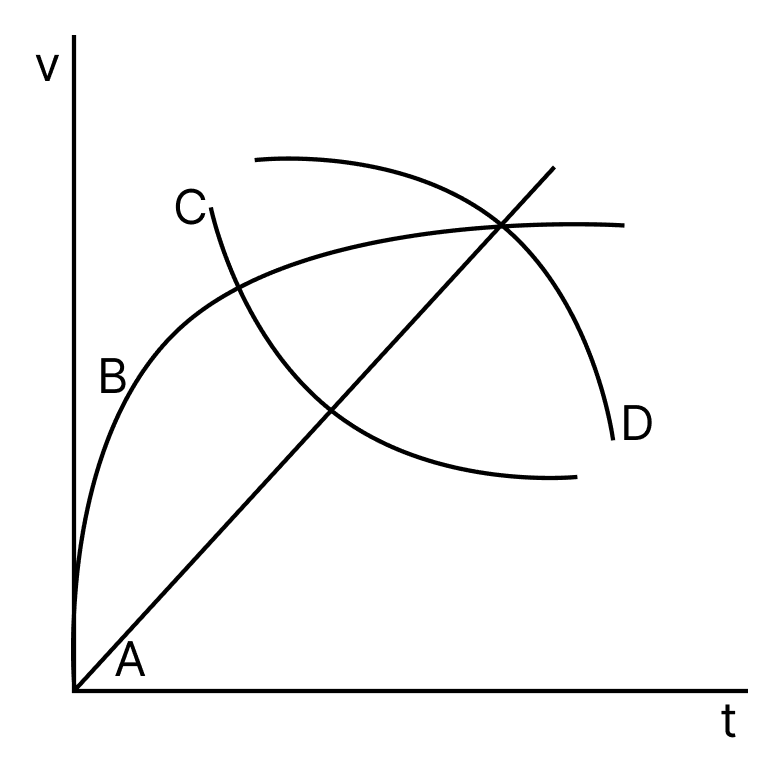
- C
- D
- A
- B.
Answer
B
Reason — When the ball is dropped in a viscous liquid, its speed is initially small, so the viscous force on it is small and the ball falls with a nearly uniform acceleration. Hence the speed increases in the beginning.
As time passes, the viscous drag acting on the ball increases with its increasing speed. The effective driving force is thereby reduced, so the rate of increase of speed becomes smaller and smaller.
Finally a stage comes when the upward viscous force becomes equal to the effective downward force. The net force then becomes zero and the ball moves with a constant speed, called the terminal velocity.
Hence, the required graph is the one in which the speed first increases and then becomes constant, which is the curve B.
The ratio of surface tensions of mercury and water is given as 7.5 while the ratio of their densities is 13.6. Their contact angles with glass are close to 135° and 0° respectively. It is observed that mercury gets depressed by an amount h in a capillary tube of radius r1, while water rises by the same amount h in a capillary tube of radius r2. The ratio (r1/r2) is then close to:
.
Answer
Reason — Given,
- ,
- θHg = 135°, θw = 0°, and hHg = hw = h in magnitude
By the ascent formula, the height of the liquid column in a capillary tube is
Since the magnitudes of the two heights are the same,
Rearranging,
Substituting the values, with cos 135° = and cos 0° = 1,
The negative sign only indicates that the mercury gets depressed while water rises. Taking the magnitude,
If m is the mass of water that rises in a capillary tube of radius r, then mass of water which will rise in a capillary tube of radius 2r is:
2m
4m
m.
Answer
2m
Reason — By the ascent formula, the height of the liquid column in a capillary tube is
So, when the radius is doubled, the height of rise becomes half, that is, .
The mass of the liquid inside the capillary is
Therefore, for the tube of radius 2r,
A soap bubble, having radius of 1 mm, is blown from a detergent solution having a surface tension of 2.5 × 10⁻² N/m. The pressure inside the bubble equals at a point Z0 below the free surface of water in a container. Taking g = 10 m/s2, density of water = 103 kg/m3, the value of Z0 is:
- 10 cm
- 1 cm
- 0.5 cm
- 100 cm.
Answer
1 cm
Reason — Given,
- Radius of the soap bubble, R = 1 mm = 1 × 10⁻³ m
- Surface tension of the detergent solution, T = 2.5 × 10⁻² N m-1
- Density of water, ρ = 103 kg m-3
- g = 10 m s-2
A soap bubble has two free surfaces, so the pressure inside it is
The pressure at a depth Z0 below the free surface of water is
Since the two pressures are equal,
Substituting the values,
A water drop of radius 1 cm is broken into 729 equal droplets. If surface tension of water is 75 dyne/cm, then the gain in surface energy upto first decimal place will be : (Given π = 3.14)
- 8.5 × 10⁻⁴ J
- 8.2 × 10⁻⁴ J
- 7.5 × 10⁻⁴ J
- 5.3 × 10⁻⁴ J.
Answer
7.5 × 10⁻⁴ J
Reason — Given,
- Radius of the drop, R = 1 cm = 1 × 10⁻² m
- Number of droplets, n = 729
- Surface tension of water, T = 75 dyne/cm = 0.075 N m-1
Since the total volume remains unchanged,
The gain in surface energy is the surface tension multiplied by the increase in the total surface area,
Substituting from equation (i),
Substituting the values,
If a soap bubble expands, the pressure inside the bubble:
- remains the same
- is equal to the atmospheric pressure
- decreases
- increases.
Answer
decreases
Reason — For a soap bubble, the excess pressure inside it is
When the bubble expands, its radius R increases, so the quantity decreases.
Since the pressure outside the bubble is the atmospheric pressure and remains constant, the pressure inside the bubble must also decrease.
A thin flat circular disc of radius 4.5 cm is placed gently over the surface of water. If the surface tension of water is 0.07 Nm-1, then the excess force required to take it away from the surface is:
- 19.8 N
- 198 N
- 19.8 mN
- 99 N.
Answer
19.8 mN
Reason — Given,
- Radius of the disc, R = 4.5 cm = 4.5 × 10⁻² m
- Surface tension of water, T = 0.07 N m-1
The surface tension acts along the circumference of the circular disc which is in contact with the water surface. Hence the length of the line of contact is
The excess force required to take the disc away from the surface is
Substituting the values, with ,
Consider a water tank shown in the figure. It has one wall at x = L and can be taken to be very wide in the Z-direction. When filled with a liquid of surface tension S and density ρ, the liquid surface makes angle θ0 (θ0 << 1) with the X-axis at x = L. If y(x) is the height of the surface then the equation for y(x) is:
[take θ(x) = sin θ(x) = tan θ(x), g is the acceleration due to gravity]
![Consider a water tank shown in the figure. It has one wall at x = L and can be taken to be very wide in the Z-direction. When filled with a liquid of surface tension S and density ρ, the liquid surface makes angle θ 0 (θ 0 << 1) with the X-axis at x = L. If y(x) is the height of the surface then the equation for y(x) is: theta(x) = sin theta(x) = tan theta(x) = dy/dx [take θ(x) = sin θ(x) = tan θ(x), g is the acceleration due to gravity]. Mechanical Properties of Fluids, Solutions for Class 11 ISC Nootan Physics Kumar Mittal Nageen Prakashan](https://cdn1.knowledgeboat.com/img/np11/q20-competition-zone-mcq-one-1-nootan-physics-icse-class-11-mechanical-properties-of-fluids-202609091043-1200x979.png)
Answer
Reason — Consider a small element of the liquid surface of width dx, taking unit length d in the Z-direction.
![Consider a water tank shown in the figure. It has one wall at x = L and can be taken to be very wide in the Z-direction. When filled with a liquid of surface tension S and density ρ, the liquid surface makes angle θ 0 (θ 0 << 1) with the X-axis at x = L. If y(x) is the height of the surface then the equation for y(x) is: theta(x) = sin theta(x) = tan theta(x) = dy/dx [take θ(x) = sin θ(x) = tan θ(x), g is the acceleration due to gravity]. Mechanical Properties of Fluids, Solutions for Class 11 ISC Nootan Physics Kumar Mittal Nageen Prakashan](https://cdn1.knowledgeboat.com/img/np11/q20-competition-zone-mcq-one-ans-1-nootan-physics-icse-class-11-mechanical-properties-of-fluids-202609091043-1051x769.png)
The forces of surface tension acting on the two edges of this element make angles θ and (θ + dθ) with the horizontal. The net upward force due to surface tension is
This net upward force supports the weight of the liquid element, whose height is y and width dx, so
Since the angle is small, sin θ ≈ θ, and therefore
Also, taking and differentiating with respect to x,
Since θ is small, cos θ ≈ 1 and hence sec2θ ≈ 1. Substituting the value of from equation (i) into equation (ii),
Consider a thin square plate floating on a viscous liquid in a large tank. The height h of the liquid in the tank is much less than the width of the tank. The floating plate is pulled horizontally with a constant velocity u0. Which of the following statements is (are) true?
- The resistive force of liquid on the plate is inversely proportional to h
- The resistive force of liquid on the plate is independent of the area of the plate
- The tangential (shear) stress on the floor of the tank increases with u0
- The tangential (shear) stress on the plate varies linearly with the viscosity η of the liquid.
Answer
The resistive force of liquid on the plate is inversely proportional to h
The tangential (shear) stress on the floor of the tank increases with u0
The tangential (shear) stress on the plate varies linearly with the viscosity η of the liquid.
Reason — Given,
- Height of the liquid in the tank = h
- Velocity with which the plate is pulled = u0
- Coefficient of viscosity of the liquid = η
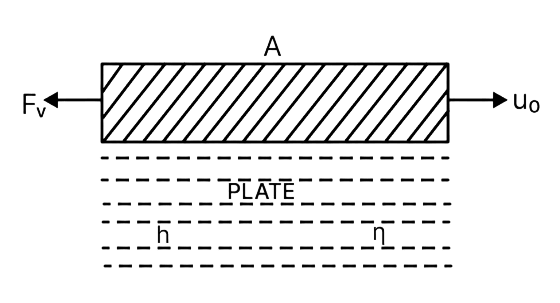
By Newton's law of viscosity, the viscous force on the plate of area A is
Since the height h of the liquid in the tank is very small, the velocity gradient may be taken as uniform,
Therefore,
Option 1 : From the above relation, . Hence option 1 is correct.
Option 2 : The relation also shows that Fv ∝ A, so the resistive force is not independent of the area of the plate. Hence option 2 is incorrect.
Option 3 : The tangential (shear) stress is
so the shear stress is directly proportional to u0 and increases with it. Hence option 3 is correct.
Option 4 : The same relation shows that , that is, the shear stress varies linearly with the viscosity of the liquid. Hence option 4 is correct.
An ideal gas of density ρ = 0.2 kg m-3 enters a chimney of height h at the rate of α = 0.8 kg s-1 from its lower end, and escapes through the upper end as shown in the figure. The cross-sectional area of the lower end is A1 = 0.1 m2 and the upper end is A2 = 0.4 m2. The pressure and the temperature of the gas at the lower end are 600 Pa and 300 K, respectively, while its temperature at the upper end is 150 K. The chimney is heat insulated so that the gas undergoes adiabatic expansion. Take g = 10 ms-2 and the ratio of specific heats of the gas γ = 2. Ignore atmospheric pressure.
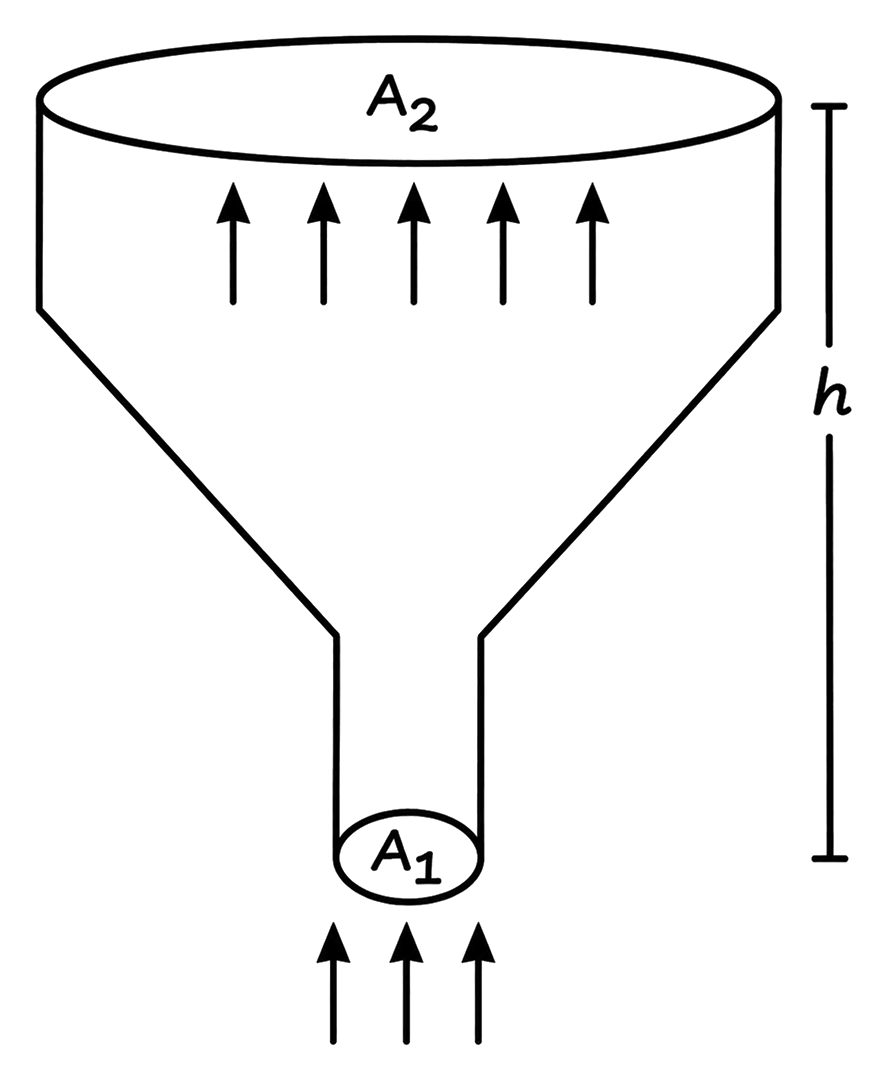
Which of the following statement(s) is(are) correct?
- The pressure of the gas at the upper end of the chimney is 300 Pa.
- The velocity of the gas at the lower end of the chimney is 40 ms-1 and at the upper end is 20 ms-1.
- The height of the chimney is 590 m.
- The density of the gas at the upper end is 0.05 kg m-3.
Answer
The velocity of the gas at the lower end of the chimney is 40 ms-1 and at the upper end is 20 ms-1.
The height of the chimney is 590 m.
Reason — Given,
- Density of the gas at the lower end, ρ1 = 0.2 kg m-3
- Rate of mass flow, α = 0.8 kg s-1
- A1 = 0.1 m2, A2 = 0.4 m2
- P1 = 600 Pa, T1 = 300 K, T2 = 150 K
- γ = 2, g = 10 m s-2
Density at the upper end : For an adiabatic process, , so
Since this is 0.1 kg m-3 and not 0.05 kg m-3, option 4 is incorrect.
Pressure at the upper end : For an adiabatic process,
Since this is 150 Pa and not 300 Pa, option 1 is incorrect.
Velocities : The rate of mass flow is α = ρ A v, so the volume flow rate at the lower end is
At the upper end,
Hence option 2 is correct.
Height of the chimney : Applying Bernoulli's theorem between the two ends,
Substituting the values,
Hence option 3 is correct.
A uniform capillary tube of inner radius r is dipped vertically into a beaker filled with water. The water rises to a height h in the capillary tube above the water surface in the beaker. The surface tension of water is T. The angle of contact between water and the wall of the capillary tube is θ. Ignore the mass of water in the meniscus. Which of the following statements is (are) true?
- For a given material of the capillary tube, h decreases with increase in r
- For a given material of the capillary tube, h is independent of T
- If this experiment is performed in a lift going up with a constant acceleration, then h decreases
- h is proportional to contact angle θ.
Answer
For a given material of the capillary tube, h decreases with increase in r
If this experiment is performed in a lift going up with a constant acceleration, then h decreases
Reason — By the ascent formula, the height to which water rises in a capillary tube is
Option 1 : From the above relation, , so for a given material of the tube (θ fixed), h decreases as r increases. Hence option 1 is correct.
Option 2 : The same relation gives h ∝ T, so h is not independent of the surface tension. Hence option 2 is incorrect.
Option 3 : When the lift moves up with a constant acceleration a, the effective acceleration due to gravity becomes (g + a). Hence,
Since the denominator increases, h decreases. Hence option 3 is correct.
Option 4 : The relation shows that h ∝ cos θ, and not h ∝ θ. Hence option 4 is incorrect.
A cylindrical capillary tube of 0.2 mm radius is made by joining two capillaries T1 and T2 of different materials having water contact angles of 0° and 60°, respectively. The capillary tube is dipped vertically in water in two different configurations, case I and II as shown in figure. Which of the following option(s) is(are) correct? [Surface tension of water = 0.075 N/m, density of water = 1000 kg/m3, take g = 10 m/s2]
![A cylindrical capillary tube of 0.2 mm radius is made by joining two capillaries T 1 and T 2 of different materials having water contact angles of 0° and 60°, respectively. The capillary tube is dipped vertically in water in two different configurations, case I and II as shown in figure. Which of the following option(s) is(are) correct? [Surface tension of water = 0.075 N/m, density of water = 1000 kg/m 3, take g = 10 m/s 2 ]. Mechanical Properties of Fluids, Solutions for Class 11 ISC Nootan Physics Kumar Mittal Nageen Prakashan](https://cdn1.knowledgeboat.com/img/np11/q4-competition-zone-mcq-more-than-1-nootan-physics-icse-class-11-mechanical-properties-of-fluids-202609091043-1200x785.png)
- For case I, if the joint is kept at 8 cm above the water surface, the height of water column in the tube will be 7.5 cm. (Neglect the weight of the water in the meniscus).
- For case I, if the capillary joint is 5 cm above the water surface, the height of water column raised in the tube will be more than 8.75 cm. (Neglect the weight of the water in the meniscus).
- The correction in the height of water column raised in the tube, due to weight of water contained in the meniscus, will be different for both cases.
- For case II, if the capillary joint is 5 cm above the water surface, the height of water column raised in the tube will be 3.75 cm. (Neglect the weight of the water in the meniscus).
Answer
For case I, if the joint is kept at 8 cm above the water surface, the height of water column in the tube will be 7.5 cm. (Neglect the weight of the water in the meniscus).
The correction in the height of water column raised in the tube, due to weight of water contained in the meniscus, will be different for both cases.
For case II, if the capillary joint is 5 cm above the water surface, the height of water column raised in the tube will be 3.75 cm. (Neglect the weight of the water in the meniscus).
Reason — Given,
- Radius of the capillary tube, r = 0.2 mm = 0.2 × 10⁻³ m
- Contact angle for T1, θ1 = 0°, and for T2, θ2 = 60°
- Surface tension of water, T = 0.075 N m-1
- Density of water, ρ = 1000 kg m-3, g = 10 m s-2
If only a single material were used for the whole tube, the height of rise would be
For θ1 = 0° :
For θ2 = 60° :
Option 1 : In case I the lower capillary is T2 and the joint is at 8 cm, which is above 7.5 cm. Hence the water rises only to 7.5 cm, which is within the lower tube. Option 1 is correct.
Option 2 : If the joint is at 5 cm, the water rises up to the joint and then enters the upper tube, where the meniscus changes its radius of curvature. Since the tube above cannot support a column higher than the value fixed by its own contact angle, the height cannot be more than 8.75 cm. Hence option 2 is incorrect.
Option 3 : The weight of water contained in the meniscus depends upon the shape of the meniscus, which is decided by the angle of contact. Since the angles of contact are different in the two cases, the correction will also be different. Option 3 is correct.
Option 4 : In case II the lower capillary is T1 and the joint is at 5 cm. The water would rise to 7.5 cm in T1 alone, so it reaches the joint and enters T2, which can support a column of only 3.75 cm. Option 4 is correct.
A bubble has surface tension S. The ideal gas inside the bubble has ratio of specific heats . The bubble is exposed to the atmosphere and it always retains its spherical shape. When the atmospheric pressure is Pa1, the radius of the bubble is found to be r1 and the temperature of the enclosed gas is T1. When the atmospheric pressure is Pa2, the radius of the bubble and the temperature of the enclosed gas are r2 and T2, respectively. Which of the following statement(s) is(are) correct?
- If the surface of the bubble is a perfect heat insulator, then
If the surface of the bubble is a perfect heat insulator, then the total internal energy of the bubble including its surface energy does not change with the external atmospheric pressure.
If the surface of the bubble is a perfect heat conductor and the change in atmospheric temperature is negligible, then
- If the surface of the bubble is a perfect heat insulator, then
Answer
- If the surface of the bubble is a perfect heat conductor and the change in atmospheric temperature is negligible, then
- If the surface of the bubble is a perfect heat insulator, then
Reason — Since it is a soap bubble, it has two free surfaces, so the pressure of the gas inside the bubble is
Options 1 and 4 (perfect heat insulator) : The process is adiabatic, so . Since ,
Option 1 has 2S/r instead of 4S/r in the excess-pressure terms, so option 1 is incorrect.
Further, for an adiabatic process , which gives
Therefore,
Hence option 4 is correct.
Option 2 : If the surface of the bubble is a perfect heat insulator, the gas still does work on the surroundings as the bubble expands or contracts. Hence the total internal energy including the surface energy does not remain unchanged. Option 2 is incorrect.
Option 3 (perfect heat conductor) : Here the temperature remains constant, so the process is isothermal and Boyle's law applies, P1V1 = P2V2,
Hence option 3 is correct.
A table tennis ball has radius m and mass kg. It is slowly pushed down into a swimming pool to a depth of d = 0.7 m below the water surface and then released from rest. It emerges from the water surface at speed v, without getting wet and rises up to a height H. Which of the following option(s) is(are) correct? [Given: , g = 10 ms-2, density of water = 1 × 10³ kg m-3, viscosity of water = 1 × 10⁻³ Pa-s.]
The work done in pushing the ball to the depth d is 0.077 J.
If we neglect the viscous force in water, then the speed v = 7 m/s.
If we neglect the viscous force in water, then the height H = 1.4 m.
The ratio of the magnitudes of the net force excluding the viscous force to the maximum viscous force in water is .
Answer
The work done in pushing the ball to the depth d is 0.077 J.
If we neglect the viscous force in water, then the speed v = 7 m/s.
Reason — Given,
- Radius of the ball, r = m
- Mass of the ball, m = kg
- Depth, d = 0.7 m; g = 10 m s-2; ρw = 1 × 10³ kg m-3
The volume of the ball is
Option 1 : The ball is pushed down slowly, so its kinetic energy remains zero and the total work done on it is zero,
Hence the external work done is the difference between the work done against the buoyant force and the work done by gravity,
Substituting the values,
Hence option 1 is correct.
Option 2 : Neglecting the viscous force, the work done by gravity and by the buoyant force appears as the kinetic energy of the ball as it emerges,
Since this is numerically equal to the external work already calculated,
Hence option 2 is correct.
Option 3 : After emerging with speed v, the ball rises as a body thrown vertically upward,
Since this is 2.45 m and not 1.4 m, option 3 is incorrect.
Option 4 : On working out the maximum viscous force from Stokes' law and comparing it with the net force (buoyant force − weight), the ratio does not come out to be . Hence option 4 is incorrect.
A drop of liquid of radius R = 10-2 m having surface tension Nm-1 divides itself into k identical drops. In this process the total change in the surface energy ΔU = 10-3 J. If k = 10α then the value of α is ............... .
Answer
Given,
- Radius of the drop, R = 10-2 m
- Surface tension, N m-1
- Change in surface energy, ΔU = 10-3 J
- Number of identical drops, k = 10α
Let r be the radius of each small drop. Since the total volume remains unchanged,
The change in the surface energy is the surface tension multiplied by the increase in the total surface area,
Substituting the value of r2,
Substituting the values,
Comparing with k = 10α,
Hence, the value of α is 6.
Two large, identical water tanks, 1 and 2, kept on the top of a building of height H, are filled with water up to height h in each tank. Both the tanks contain an identical hole of small radius on their sides, close to their bottom. A pipe of the same internal radius as that of the hole is connected to tank 2, and the pipe ends at the ground level. When the water flows from the tanks 1 and 2 through the holes, the times taken to empty the tanks are t1 and t2, respectively. If then ratio is ............... .
Answer
Given,
- Height of water in each tank = h
- Height of the building = H, with
- Let A be the area of cross-section of each tank and a that of the hole
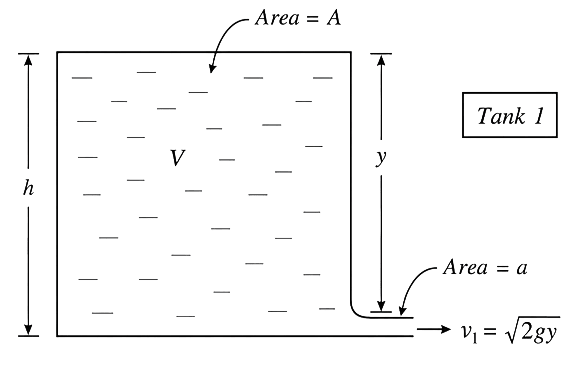
For tank 1 : The water flows out directly from the hole, so by Torricelli's theorem the velocity of efflux when the water level is at a height y is .
By the equation of continuity,
Integrating from y = h to y = 0,
For tank 2 : The pipe carries the water down to the ground level, so the effective height driving the efflux is (y + H). Hence , and
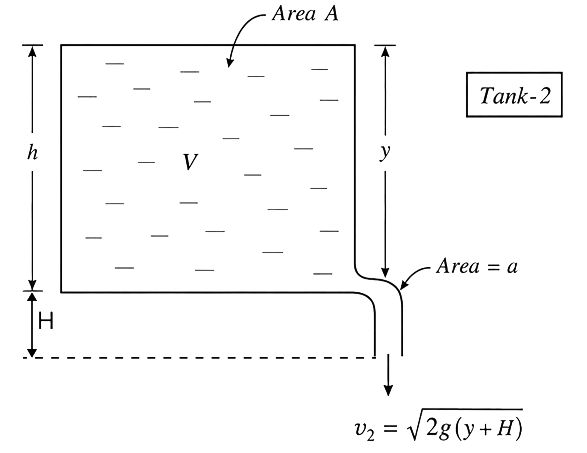
Integrating from y = h to y = 0,
Substituting ,
Dividing equation (i) by equation (ii),
Hence, the ratio is 3.
A spherical soap bubble inside an air chamber at pressure P0 = 105 Pa has a certain radius so that the excess pressure inside the bubble is ΔP = 144 Pa. Now, the chamber pressure is reduced to so that bubble radius and its excess pressure change. In this process, all the temperatures remain unchanged. Assume air to be an ideal gas and the excess pressure ΔP in both the cases to be much smaller than the chamber pressure. The new excess pressure ΔP in Pa is ............... .
Answer
Given,
- Chamber pressure in the first case, P0 = 105 Pa
- Excess pressure in the first case, ΔP = 144 Pa
- Chamber pressure in the second case =
- The temperature remains unchanged
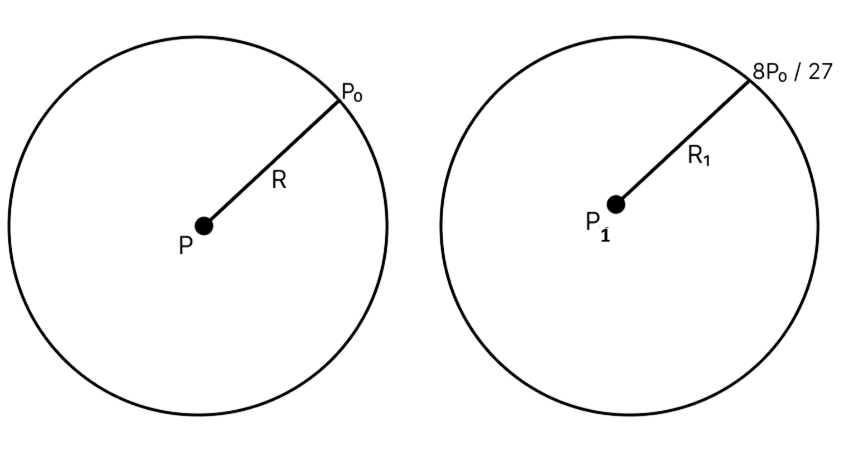
Let R and R1 be the radii of the bubble in the two cases, and P, P1 the corresponding pressures of the air inside it.
Case 1 :
Case 2 :
Since the temperature remains unchanged, the process is isothermal and Boyle's law applies, P V = P1V1,
Since the excess pressure is much smaller than the chamber pressure, the terms and may be neglected in comparison with the chamber pressures. Then equation (iii) becomes
The new excess pressure is therefore
Substituting ΔP = 144 Pa,
Hence, the new excess pressure is 96 Pa.
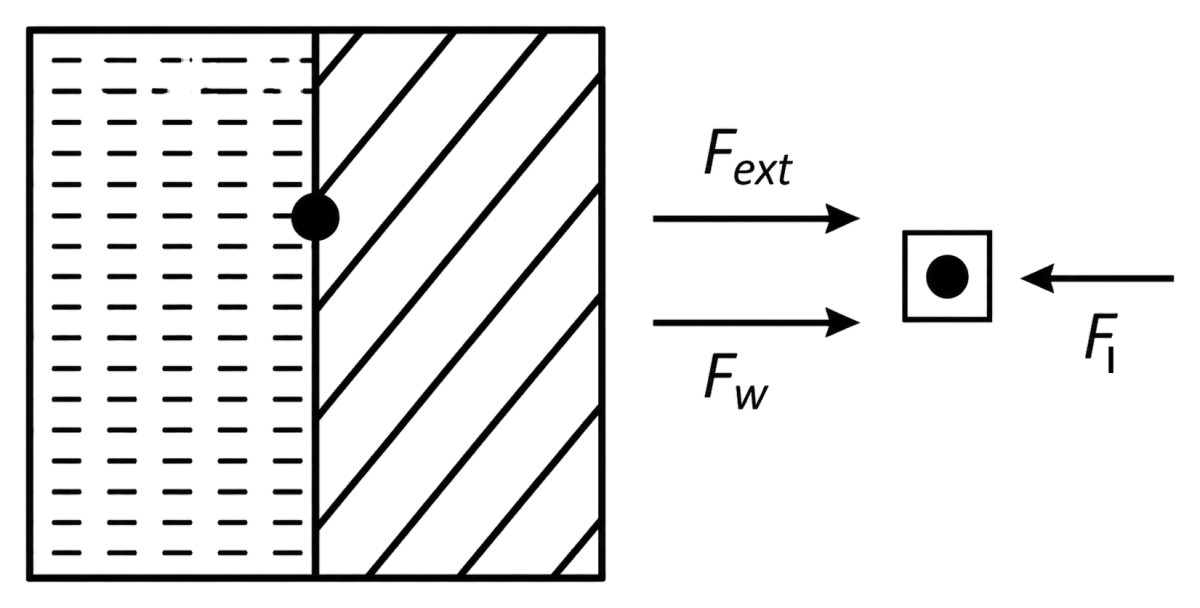
A vessel with square cross-section and height of 6 m is vertically partitioned. A small window of 100 cm2 with hinged door is fitted at a depth of 3 m in the partition wall. One part of the vessel is filled completely with water and the other side is filled with the liquid having density 1.5 × 10³ kg/m3. What force one needs to apply on the hinged door so that it does not get opened? (Acceleration due to gravity = 10 m/s2)
Answer
Given,
- Area of the window, A = 100 cm2 = 100 × 10-4 m2
- Depth of the window, h = 3 m
- Density of water, ρw = 1 × 10³ kg m-3
- Density of the liquid, ρl = 1.5 × 10³ kg m-3
- g = 10 m s-2
The pressure at the depth h on the liquid side is (P0 + ρlgh) and that on the water side is (P0 + ρwgh), where P0 is the atmospheric pressure.
For the door to remain closed, the externally applied force together with the force due to water must balance the force due to the liquid,
The atmospheric pressure terms cancel out, so
Substituting the values,
Hence, a force of 150 N must be applied on the hinged door so that it does not get opened.
Statement (I): Viscosity of gases is greater than that of liquids.
Statement (II): Surface tension of a liquid decreases due to the presence of insoluble impurities.
In the light of the above statements, choose the most appropriate answer from the given options :
- Statement I is correct but statement II is incorrect
- Statement I is incorrect but Statement II is correct
- Both Statement I and Statement II are incorrect
- Both Statement I and Statement II are correct
Answer
Statement I is incorrect but Statement II is correct
Reason — Statement (I) is incorrect : Gases have a much smaller viscosity than liquids. At 20°C the coefficient of viscosity of water is 1.00 × 10⁻² poise, while that of air is only 1.81 × 10⁻⁴ poise. This is why we can walk fast in air but not in water.
Statement (II) is correct : The surface tension of a liquid is affected by the presence of impurities. Sparingly soluble or insoluble impurities, such as detergent, oil or grease, decrease the surface tension of water. Only a highly soluble impurity, such as common salt, increases it.
Hence, Statement I is incorrect but Statement II is correct.
Statement (I): When speed of liquid is zero everywhere, pressure difference at any two points depends on equation P1 − P2 = ρg(h1 − h2).
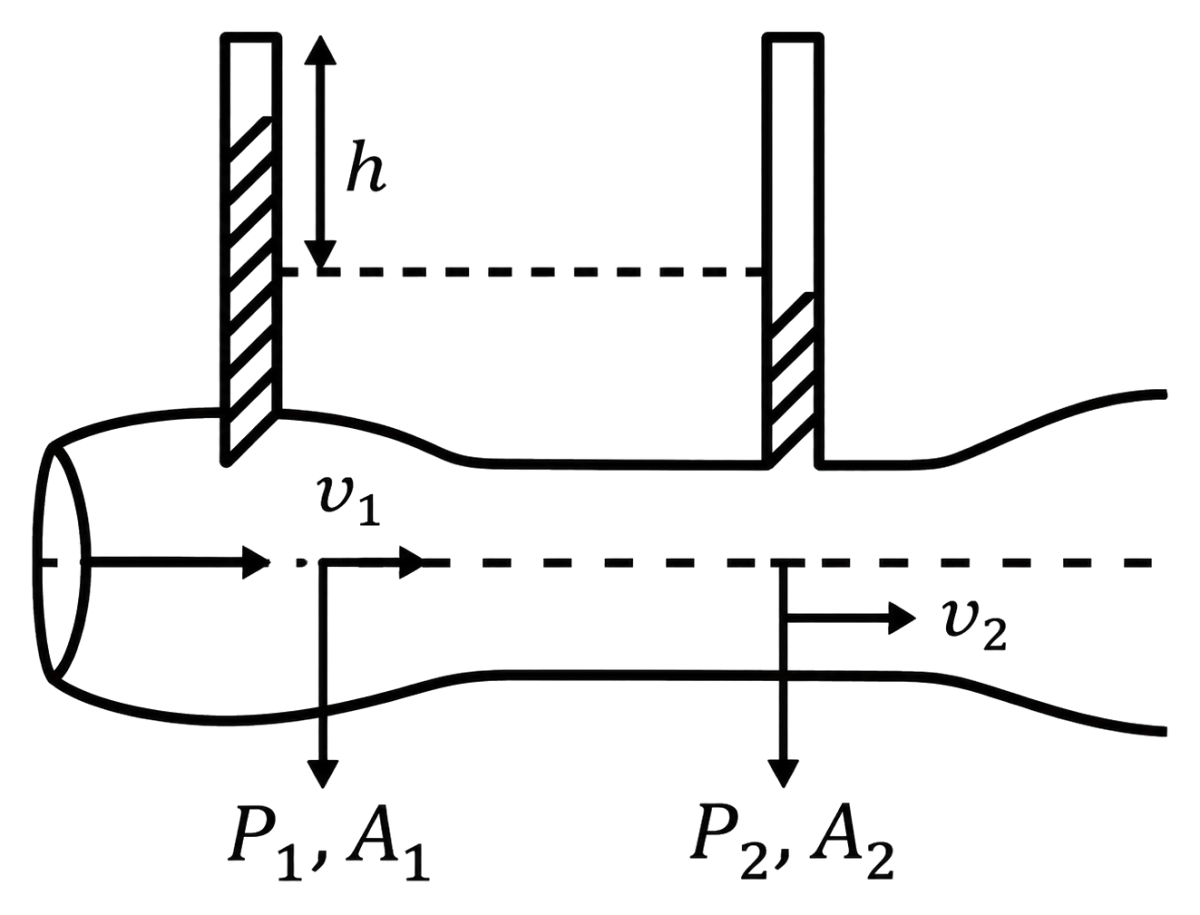
Statement (II): In ventury tube shown 2gh = v12 − v22.
In the light of the above statements, choose the most appropriate answer from the given options.
- Both Statement I and Statement II are correct.
- Statement I is incorrect but Statement II is correct.
- Both Statement I and Statement II are incorrect.
- Statement I is correct but Statement II is incorrect.
Answer
Statement I is correct but Statement II is incorrect.
Reason — Applying Bernoulli's equation between the two points,
where h1 and h2 are the heights of the points from any reference level.
Statement (I) is correct : When the speed of the liquid is zero everywhere, v1 = v2 = 0, and the above equation reduces to
Statement (II) is incorrect : In the venturi tube shown, the two points lie at the same horizontal level, so h1 = h2 and Bernoulli's equation gives
But the pressure difference is measured by the liquid column of height h, so P1 − P2 = ρgh. Therefore,
This is the opposite of what Statement II claims, since Statement II gives 2gh = v12 − v22.
Hence, Statement I is correct but Statement II is incorrect.