
A body travels 102.5 m in nth second and 115.0 m in (n + 2)th second. The acceleration is :
- 9 ms-2
- 6.25 ms-2
- 12.5 ms-2
- 5 ms-2.
Answer
6.25 ms-2
Reason — The distance covered in a particular second is given by
Applying it to the nth second,
and to the (n + 2)th second,
Subtracting (i) from (ii) cancels u and n :
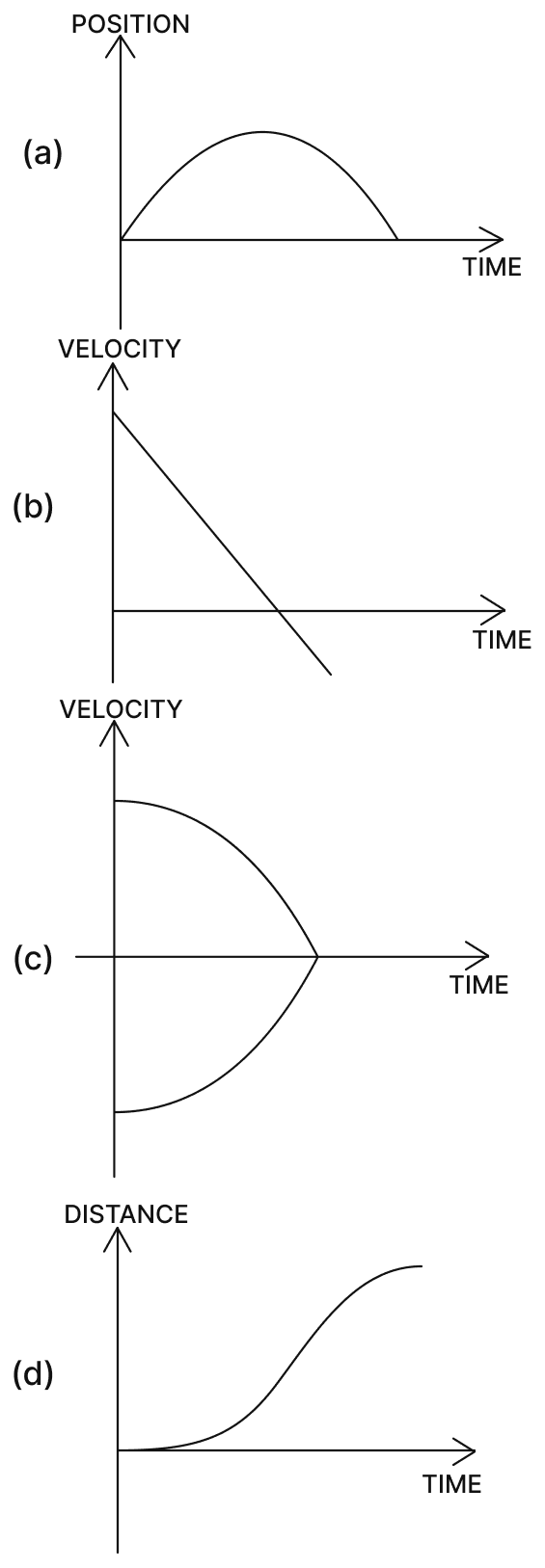
All the graphs ahead are intended to represent the same motion. One of them does it incorrectly. Pick it up.
Answer
Reason —
(a) Position-time graph (correct). The curve is a downward-opening parabola: the position first grows, tops out, and then falls. Since the slope of an x-t graph is the velocity, that slope is positive at first, eases to zero at the peak, and then turns negative — exactly what a body under a steady negative acceleration does as it slows, halts for an instant, and reverses.
(b) Velocity-time graph (correct). This is a straight line of constant negative slope, i.e. uniform negative acceleration. The velocity falls off linearly, hits zero once, and then changes sign — the body moves forward, decelerates, stops briefly, and then speeds up the other way. A constant-acceleration motion is faithfully shown.
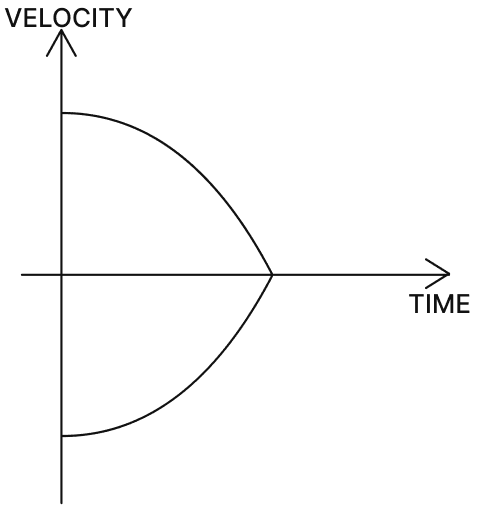
(c) Velocity-time graph (incorrect). Here the curve is drawn as a sideways parabola that loops back toward the time axis, so it is not single-valued in time: a vertical line at most instants meets it at two points, assigning two velocities to the same moment. A body can hold only one velocity at any instant, so this graph is invalid — which is why (c) is the odd one out.
(d) Distance-time graph (correct). Distance is a scalar that can only build up, and the graph rises throughout. Its slope shrinks as the body slows, flattens near the turning instant, and then steepens again once the body moves off in the reverse direction — consistent with the other correct graphs.
The position of a particle as a function of time t, is given by x(t) = at + bt2 - ct3, where a, b and c are constants. When the particle attains zero acceleration, then its velocity will be :
Answer
Reason — The position is x(t) = at + bt2 - ct3.
Differentiating once gives the velocity :
Differentiating again gives the acceleration :
Setting the acceleration to zero to find the required instant :
Putting this t back into the velocity :
The position vector of a particle changes with time according to the relation . What is the magnitude of the acceleration at t = 1?
- 40
- 100
- 25
- 50
Answer
50
Reason — The position vector is .
Differentiating once gives the velocity :
Differentiating again gives the acceleration :
This acceleration is the same at all times, so its magnitude at t = 1 is
A particle is moving with speed along positive X-axis. The speed of the particle at time t = τ will be :
- .
Answer
Reason — The speed is given as .
To get the acceleration, write it using the chain rule :
Differentiating v with respect to x :
So the acceleration is
which is a constant. The particle starts at x = 0 where v = 0, so applying v = u + at with u = 0 and t = τ :
A particle moves from the point m at t = 0 with an initial velocity m/s. It is acted upon by a constant force which produces a constant acceleration m/s2. What is the distance of the particle from the origin at time 2 s?
- 5 m
- m
- m
- 15 m.
Answer
m
Reason —
Given,
- Initial position, m
- Initial velocity, m s-1
- Acceleration, m s-2
- Time, t = 2 s
The position at time t follows from . Substituting at t = 2 s :
The distance from the origin is the magnitude of this vector :
The ratio of the distances travelled by a freely falling body in the 1st, 2nd, 3rd and 4th second :
- 1 : 3 : 5 : 7
- 1 : 1 : 1 : 1
- 1 : 2 : 3 : 4
- 1 : 4 : 9 : 16.
Answer
1 : 3 : 5 : 7
Reason — For a body dropped from rest, the distance in the nth second is
With u = 0, putting n = 1, 2, 3, 4 in turn :
Dropping the common factor g/2, the ratio is
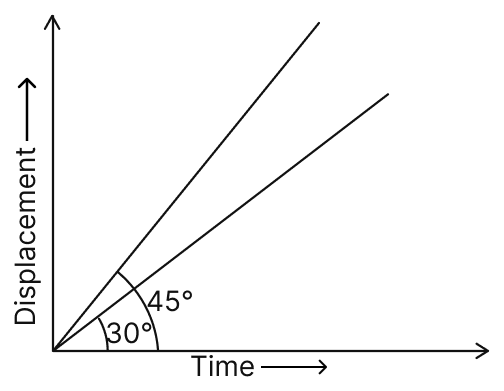
The displacement-time graphs of two moving particles make angles of 30° and 45° with the x-axis as shown in the figure. The ratio of their respective velocity is :
- 1 : 2
- 1 :
- : 1
- 1 : 1.
Answer
1 :
Reason — On a displacement-time graph the velocity equals the slope, i.e. the tangent of the angle with the axis :
Taking the ratio :
So the velocities are in the ratio 1 : .
The co-ordinates of a particle moving in X-Y plane are given by x = 2 + 4t and y = 3t + 4t2. The motion of the particle is :
- non-uniformly accelerated
- uniformly accelerated having motion along a straight line
- uniform motion along a straight line
- uniformly accelerated having motion along a parabolic path.
Answer
uniformly accelerated having motion along a parabolic path.
Reason — The coordinates are x = 2 + 4t and y = 3t + 4t2.
Along x :
Along y :
There is acceleration only along y, and it is constant (independent of time), while x has none — so the motion is uniformly accelerated.
To find the path, express t from x = 2 + 4t as and put it into y :
This has the form y = αx + βx2, the equation of a parabola.
Hence the motion is uniformly accelerated along a parabolic path.
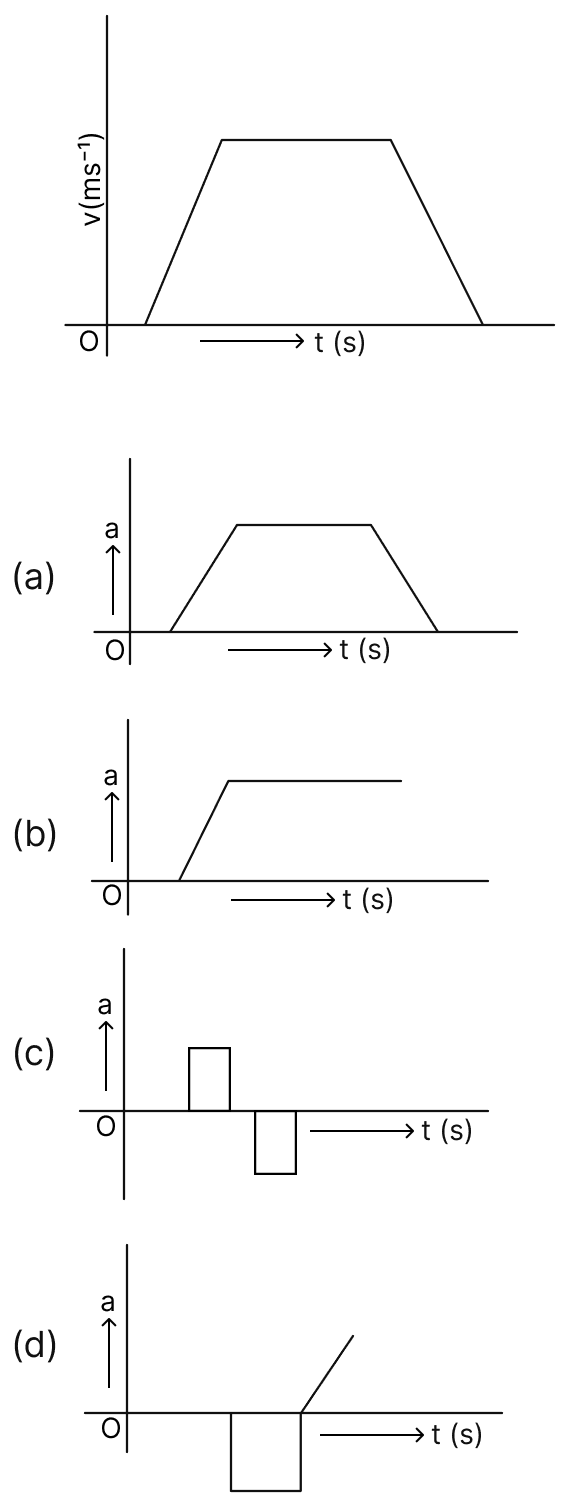
The velocity (v)-time (t) plot of the motion of body is shown below. The acceleration (a)-time graph that best suits the motion is :
Answer
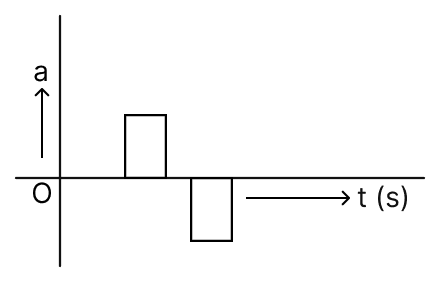
Reason — On a v-t plot the acceleration at any moment is the slope, so we read the slope over each stretch and match it to the a-t graph.
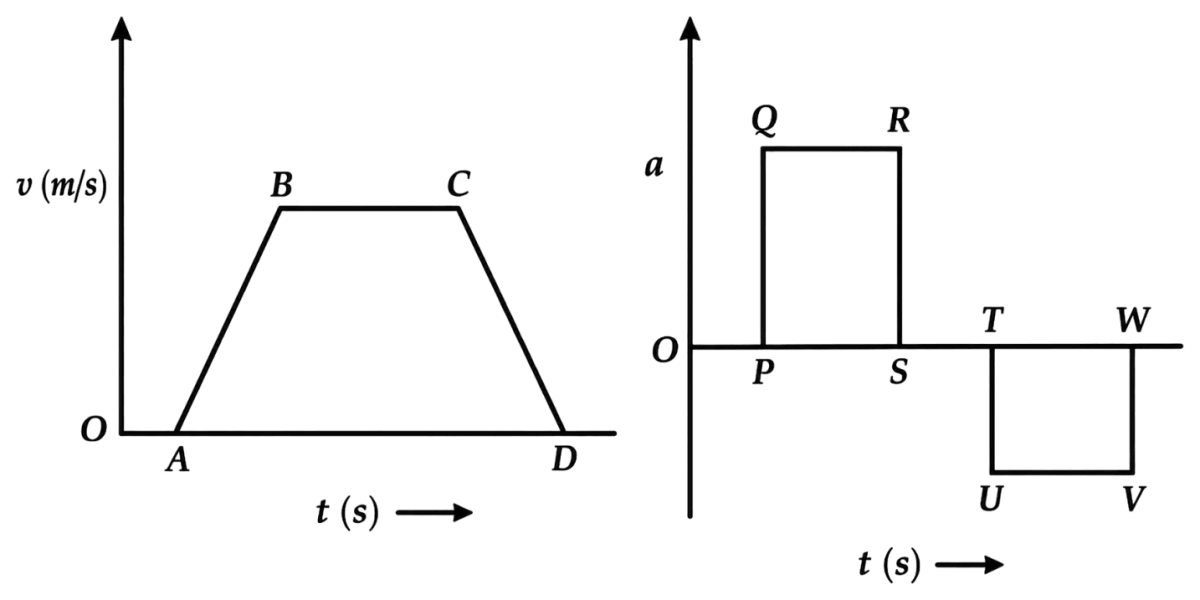
- O to A : the velocity is constant, so the acceleration is zero — the segment OP of the a-t graph.
- A to B : the velocity rises at a steady rate, so the acceleration is constant and positive — the segment QR.
- B to C : the velocity is constant again (uniform motion, v ≠ f(t)), so the acceleration is zero — the segment ST.
- C to D : the velocity falls at a steady rate, so there is a constant deceleration — the portion UV.
- At D the body comes to rest, marked by W on the a-t graph.
The a-t graph carrying these features (OP, QR, ST, UV and W) is graph (c).
In some appropriate units, time (t) and position (x) relation of a moving particle is given by t = x2 + x. The acceleration of the particle is :
- .
Answer
Reason — Starting from the given relation and differentiating with respect to x to reach the velocity :
Now differentiate the velocity to get the acceleration, using the chain rule :
Note: The question incorrectly gives the relation as t2 = x2 + x, while the textbook’s solution is based on t = x2 + x. If the printed relation is used, the result is , which does not match any of the given options. Therefore, t2 appears to be a printing error, and the intended relation t = x2 + x has been used in the solution.
Two cities X and Y are connected by a regular bus service with a bus leaving in either direction every T min. A girl is driving scooty with a speed of 60 km/h in the direction X to Y notices that a bus goes past her every 30 minutes in the direction of her motion and every 10 minutes in the opposite direction. Choose the correct option for the period T of the bus service and the speed (assumed constant) of the buses.
- 9 min, 40 km/h
- 25 min, 100 km/h
- 10 min, 90 km/h
- 15 min, 120 km/h.
Answer
15 min, 120 km/h
Reason —
Given,
- Speed of the scooty, vs = 60 km h-1
- Same-direction interval, t1 = 30 min = h
- Opposite-direction interval, t2 = 10 min = h
Let the bus speed be vB. The distance a following bus covers to catch the scooty is (vB - vs)t1, and the distance an oncoming bus covers to reach her is (vB + vs)t2. Since the buses leave at the same interval, both these distances are equal.
The spacing between two consecutive buses is
So the service interval is
Hence T = 15 min and the buses run at 120 km h-1.
A particle starts from origin at t = 0 with a velocity ms-1 and moves in X-Y plane under action of a force which produces a constant acceleration of ms-2. If the x-co-ordinate of the particle at that instant is 84 m, then the speed of the particle at this time is ms-1. The value of α is ............... .
Answer
The value of α is 673.
Reason —
Given,
- Initial velocity components, ux = 5 m s-1, uy = 0
- Acceleration components, ax = 3 m s-2, ay = 2 m s-2
- x-coordinate at the instant, sx = 84 m
Velocity along x. Using vx2 = ux2 + 2axsx :
Time to this instant. From vx = ux + axt :
Velocity along y. From vy = uy + ayt :
Resultant speed. Combining the two components :
Comparing with , we get α = 673.
A person travelling on a straight line moves with a uniform velocity v1 for a distance x and with a uniform velocity v2 for the next distance. The average velocity in this motion is m/s. If v1 is 5 m/s then v2 = ............... m/s.
Answer
v2 = 10 m/s
Reason —
Given,
- Velocity over the first stretch, v1 = 5 m s-1, covering a distance x
- Velocity over the next stretch, v2, covering a distance x
- Average velocity for the whole run = m s-1
The total distance is
and the total time is the sum of the two leg-times :
Average velocity is total distance over total time :
Cancelling x throughout :
Rearranging for the bracket :
Hence v2 = 10 m s-1.