
Which of the following is a correct statement about reference frames?
- A reference frame is only necessary in accelerated motion.
- A reference frame can be stationary or in motion.
- The laws of physics are different in different inertial reference frames.
- A reference frame is always moving at a constant velocity.
Answer
A reference frame can be stationary or in motion.
Reason — A frame of reference is a chosen set of axes together with a clock, used as a viewpoint for describing motion. Nothing forces this viewpoint to be at rest, so it may be either stationary or moving.
In an inertial reference frame, which of the following is true?
- Objects can accelerate without any force acting on them.
- Newton's first law of motion does not apply.
- The velocity of objects remains constant unless acted upon by a force.
- The concept of acceleration is meaningless.
Answer
The velocity of objects remains constant unless acted upon by a force.
Reason — An inertial frame is one in which Newton's first law holds. That law states a body keeps its state of rest or of uniform motion until some external force changes it — so velocity stays constant unless a force acts.
The slope of the distance-time graph of a body gives :
- Instantaneous speed
- Instantaneous velocity
- Average speed
- Displacement
Answer
Instantaneous speed
Reason — The steepness of the distance-time graph at a single point measures how fast distance is changing right there, which is exactly the instantaneous speed.
The area under a velocity-time graph represents :
- Displacement
- Speed
- Acceleration
- Velocity.
Answer
Displacement
Reason — Multiplying velocity by time gives displacement, and that product is precisely the area trapped between the velocity-time line and the time-axis.
For a body moving with uniform velocity, the slope of the velocity-time graph is :
- Zero
- Positive
- Negative
- Infinite.
Answer
Zero
Reason — The slope of a velocity-time graph equals the acceleration. With uniform velocity there is no change in velocity, so the acceleration and hence the slope are both zero.
A body is said to be in uniform acceleration if its velocity-time graph is :
- A horizontal straight line
- A straight line passing through the origin
- A curve
- A vertical straight line.
Answer
A straight line passing through the origin
Reason — Uniform acceleration means the velocity grows by equal amounts in equal times, tracing a straight line; starting from rest it passes through the origin.
Which of the following equations correctly represents the first equation of motion?
- s = ut + at2
- v2 = u2 + 2as
- v = u + at
- v = at.
Answer
v = u + at
Reason — The first equation of motion relates the final velocity (v), initial velocity (u), acceleration (a), and time (t):
v = u + at
The other options represent different equations of motion:
- s = ut + at2 — Second equation of motion
- v2 = u2 + 2as — Third equation of motion
- v = at — Valid only when the initial velocity u = 0, so it is not the general first equation of motion.
Which of the following equations represents the third equation of motion?
- s = ut + at2
- v2 = u2 + 2as
- v = u + at
- v = at.
Answer
v2 = u2 + 2as
Reason — The third equation of motion links the two velocities with the acceleration and the displacement, without any reference to time, and is written v2 = u2 + 2as.
Which of the following is not a kinematic equation?
- s = ut + at2
- v2 = u2 + 2as
- v = u + at
- F = ma.
Answer
F = ma
Reason — The other three relations tie together displacement, velocity, acceleration and time, so they are kinematic. F = ma expresses Newton's second law and belongs to dynamics, not kinematics.
A stone is thrown vertically upwards with an initial velocity of 15 m/s. What will be its velocity at the highest point?
- 15 m/s
- 10 m/s
- 5 m/s
- 0 m/s.
Answer
0 m/s
Reason — At the top of its rise the stone reverses direction, and for that brief instant it is neither going up nor coming down, so its velocity there is zero.
Which of the following is true if a body is in free fall under gravity?
- The acceleration is zero.
- The acceleration is constant and equals g.
- The velocity is constant.
- The displacement is always zero.
Answer
The acceleration is constant and equals g.
Reason — A freely falling body is acted on by gravity alone, which imparts a steady downward acceleration equal to g throughout the fall.
Which of the following quantities does not change in uniform circular motion?
- Velocity
- Acceleration
- Speed
- Direction
Answer
Speed
Reason — In uniform circular motion the body moves at a fixed speed, but its direction — and therefore its velocity and acceleration — keeps changing. Only the speed stays constant.
If a particle moves in a straight line with a constant speed, its acceleration is :
- Positive
- Negative
- Zero
- Cannot be determined.
Answer
Zero
Reason — A particle moving in a straight line with a constant speed has no change in the magnitude or direction of its velocity. Since the velocity remains constant, its acceleration is zero.
Which of the following is not a characteristic of instantaneous velocity?
- It is a vector quantity.
- It is always directed along the tangent to the path.
- It is the same as average velocity over a time interval.
- It represents the velocity at a specific instant.
Answer
It is the same as average velocity over a time interval.
Reason — Instantaneous velocity is the velocity at a particular instant, whereas average velocity is measured over a time interval. The two are generally not equal, so this is not a characteristic of instantaneous velocity.
The area under a velocity-time graph represents :
- Acceleration
- Displacement
- Speed
- Distance.
Answer
Displacement
Reason — The region enclosed between the velocity-time graph and the time-axis represents the displacement covered by the object.
Which of the following statements is correct about displacement?
- It is a scalar quantity
- It depends on the path taken
- It can be zero even if the distance is non-zero
- It is always positive.
Answer
It can be zero even if the distance is non-zero
Reason — Displacement depends only on the start and end points. If a body returns to where it began, its displacement is zero even though it has travelled a non-zero distance.
What is the average speed of a car that travels 150 km in 3 hours?
- 50 km/h
- 45 km/h
- 55 km/h
- 60 km/h
Answer
50 km/h
Reason —
Given,
- Distance travelled, s = 150 km
- Time taken, t = 3 h
If a particle's instantaneous speed is always equal to its average speed, what can be said about its motion?
- The particle is accelerating
- The particle is moving with uniform speed
- The particle is at rest
- The particle is moving in a straight line with varying speed.
Answer
The particle is moving with uniform speed
Reason — If the instantaneous speed never differs from the average speed, the speed is not changing at all, which is the sign of uniform-speed motion.
Which of the following is true about instantaneous acceleration?
- It is always constant.
- It is the rate of change of velocity with respect to time at a specific instant.
- It is the same as average acceleration over a time interval.
- It is independent of time.
Answer
It is the rate of change of velocity with respect to time at a specific instant.
Reason — Instantaneous acceleration is defined as how fast the velocity is changing at one particular moment in time.
A car accelerates uniformly from rest to a velocity of 25 m/s in 5 seconds. What is the acceleration of the car?
- 10 m/s2
- 5 m/s2
- 25 m/s2
- 15 m/s2.
Answer
5 m/s2
Reason —
Given,
- Initial velocity, u = 0 (starts from rest)
- Final velocity, v = 25 m s-1
- Time, t = 5 s
From v = u + at, the acceleration is
A ball is dropped from a height of 20 m. How long will it take to reach the ground? (Take g = 10 m/s2)
- 2 s
- 4 s
- 6 s
- 8 s.
Answer
2 s
Reason —
Given,
- Height, h = 20 m
- Initial velocity, u = 0
- g = 10 m s-2
From h = ut + gt2, the time of fall is
If a body moves with a uniform velocity, which of the following statements is true?
- Its acceleration is non-zero.
- It covers equal distances in equal intervals of time.
- Its displacement is always zero.
- Its speed increases with time.
Answer
It covers equal distances in equal intervals of time.
Reason — Uniform velocity means the body advances the same distance in every equal interval of time, along an unchanging direction.
A particle covers 20 m in the first 2 seconds and 40 m in the next 2 seconds. The motion of the particle is :
- Uniformly accelerated
- Uniformly decelerated
- Uniform
- Non-uniform.
Answer
Uniformly accelerated
Reason — The particle covers 20 m in the first 2 seconds and 40 m in the next 2 seconds. Since the distance covered increases by equal amounts in equal intervals of time, the velocity increases uniformly, so the motion is uniformly accelerated.
A train moves with a uniform velocity of 40 m/s for 5 minutes. What is the distance covered by the train?
- 10 km
- 12 km
- 14 km
- 15 km.
Answer
12 km
Reason —
Given,
- Uniform velocity, v = 40 m s-1
- Time, t = 5 min = 300 s
Note: The textbook’s printed answer key gives option 1, which is 10 km. However, the book’s own solution hint calculates the distance as 40 m s−1 × 300 s = 12,000 m = 12 km. Therefore, option 2 is correct, and option 1 in the printed answer key is a misprint.
A particle starts from rest and moves with a uniform acceleration a. The distance covered by the particle 's' in time t is proportional to :
- t2
- t
- t3.
Answer
t2
Reason — Starting from rest, the distance is s = . With the acceleration held constant, varies as the square of the time, so s ∝ t2.
If a car's speed doubles, what happens to the time taken to cover the same distance?
- It remains the same
- It doubles
- It halves
- It triples.
Answer
It halves
Reason — For a fixed distance, the time taken is inversely proportional to the speed. Hence, if the speed of the car doubles, the time taken to cover the same distance becomes half.
The displacement 'y' of a body is given by the equation y = kt2, where, k is a positive constant and t is time. The body is moving with :
- Constant velocity
- Constant and positive acceleration
- Negative velocity
- Constant and negative acceleration.
Answer
Constant and positive acceleration
Reason —
Given the displacement y = kt2 with k a positive constant, differentiate once to get the velocity :
Since v depends on t and k is positive, the velocity is positive and time-dependent (not constant). Differentiating again gives the acceleration :
This is a positive constant, so the body has a constant, positive acceleration.
The position 'x' (in m) of an object moving along a straight line is given by the equation, x = 5t + 6t2 where t is time and measured in second (s), the initial velocity of the body is :
- 5 m/s
- 10 m/s
- 11 m/s
Answer
5 m/s
Reason —
Given the position x = 5t + 6t2, the velocity at any instant is
The initial velocity is the value at t = 0 :
If a car increases its velocity from 20 m/s to 50 m/s in 10 seconds, what is its average acceleration?
- 3 m/s2
- 2 m/s2
- 5 m/s2
- 6 m/s2.
Answer
3 m/s2
Reason —
Given,
- Initial velocity, u = 20 m s-1
- Final velocity, v = 50 m s-1
- Time, t = 10 s
A particle is moving along a straight line with a constant acceleration of 2 m/s2. If its initial velocity is 10 m/s, what is its velocity after 5 seconds?
- 20 m/s
- 30 m/s
- 15 m/s
- 25 m/s.
Answer
20 m/s
Reason —
Given,
- Initial velocity, u = 10 m s-1
- Acceleration, a = 2 m s-2
- Time, t = 5 s
From v = u + at,
Note: The textbook’s printed answer key gives option 4, which is 25 m s−1. However, using the formula , we get m s−1. Therefore, option 1 is correct, and option 4 in the printed answer key is a misprint.
What is the displacement of a body after 10 seconds if it starts from rest with an acceleration of 3 m/s2?
- 300 m
- 150 m
- 200 m
- 100 m.
Answer
150 m
Reason —
Given,
- Initial velocity, u = 0 (starts from rest)
- Acceleration, a = 3 m s-2
- Time, t = 10 s
From s = ut + at2,
If a body moves with constant acceleration, its displacement is given by which equation?
- s = ut + at2
- v2 = u2 + 2as
- v = u + at
- v = at.
Answer
s = ut + at2
Reason — For motion at constant acceleration, the displacement in time t is given by the second equation of motion, s = ut + at2.
The slope of a displacement-time graph for a body moving with uniform velocity is :
- Decreasing
- Increasing
- Constant
- Zero.
Answer
Constant
Reason — The slope of a displacement-time graph is the velocity. When the velocity is uniform, that slope does not change, so it stays constant.
Which of the following is true for a body moving with constant acceleration?
- Its velocity changes at a uniform rate.
- Its displacement is directly proportional to the time taken.
- Its velocity remains constant.
- Its speed decreases with time.
Answer
Its velocity changes at a uniform rate.
Reason — Constant acceleration means the velocity gains (or loses) the same amount every second, that is, it changes at a uniform rate.
The slope of a velocity-time graph for a uniformly accelerated body is :
- Zero
- Positive
- Negative
- Constant.
Answer
Constant
Reason — Uniform acceleration gives a straight-line velocity-time graph, and a straight line has the same slope everywhere, so the slope is constant.
In a velocity-time graph, a horizontal line indicates :
- Constant acceleration
- Constant velocity
- Zero acceleration
- Both (2) and (3).
Answer
Both (2) and (3).
Reason — A horizontal line on a velocity-time graph shows that the velocity is constant. The slope of this line is zero, and since the slope of a velocity-time graph gives the acceleration, the acceleration is zero. Hence both constant velocity and zero acceleration are represented.
Which of the following is an example of a non-inertial reference frame?
- A car moving at constant speed on a straight road
- A satellite orbiting the Earth
- A rotating merry-go-round
- A stationary train.
Answer
A rotating merry-go-round
Reason — A spinning merry-go-round is constantly changing the direction of motion of everything on it, so it is accelerating. A frame that accelerates is non-inertial.
Which of the following correctly represents the relation between average speed and average velocity?
- Average speed is always greater than or equal to average velocity.
- Average speed is always equal to average velocity.
- Average speed is always less than average velocity.
- Average speed and average velocity are unrelated.
Answer
Average speed is always greater than or equal to average velocity.
Reason — Average speed is the total distance divided by the total time, while average velocity is the total displacement divided by the total time. Since the distance is always greater than or equal to the magnitude of displacement, the average speed is always greater than or equal to the magnitude of average velocity.
If the displacement-time graph is a straight line inclined to the time axis, the motion is :
- Uniformly accelerated
- Uniform
- Non-uniform
- Stationary.
Answer
Uniform
Reason — A displacement-time graph that is a straight line tilted to the time-axis has a fixed slope, which means a constant velocity, that is, uniform motion.
Assertion (A): The displacement of an object in one-dimensional motion can be zero even if the distance traveled is non-zero.
Reason (R): Displacement is a vector quantity that depends only on the initial and final positions of the object, not on the path taken.
- If both assertion and reason are true and reason is the correct explanation of assertion.
- If both assertion and reason are true but reason is not the correct explanation of assertion.
- If assertion is true but reason is false.
- If both assertion and reason are false.
Answer
If both assertion and reason are true and reason is the correct explanation of assertion.
Explanation
Assertion (A) is correct: When an object returns to its initial position, its displacement is zero, even though the distance travelled by it along the path is not zero.
Reason (R) is also correct: Displacement is a vector quantity that depends only on the initial and final positions of the object and not on the path taken, whereas distance is a scalar quantity that depends on the actual path covered. This is why the displacement can be zero while the distance is non-zero, so the reason correctly explains the assertion.
Therefore, both assertion and reason are true and reason is the correct explanation of assertion.
Assertion (A): The velocity of an object can be zero even if the acceleration is non-zero.
Reason (R): Acceleration is the rate of change of velocity with respect to time.
- If both assertion and reason are true and reason is the correct explanation of assertion.
- If both assertion and reason are true but reason is not the correct explanation of assertion.
- If assertion is true but reason is false.
- If both assertion and reason are false.
Answer
If both assertion and reason are true and reason is the correct explanation of assertion.
Explanation
Assertion (A) is correct: The velocity of an object can be zero at an instant while its acceleration is non-zero. For example, a ball thrown vertically upward has zero velocity at the highest point but still has a non-zero acceleration due to gravity.
Reason (R) is also correct: Acceleration is the rate of change of velocity with respect to time, and a changing velocity can become zero at a particular instant. Hence the velocity can be zero while the acceleration is non-zero, so the reason correctly explains the assertion.
Therefore, both assertion and reason are true and reason is the correct explanation of assertion.
Assertion (A): In uniform motion, the velocity-time graph of an object is a straight line parallel to the time axis.
Reason (R): Uniform motion means that the object travels equal distances in equal intervals of time, leading to constant velocity.
- If both assertion and reason are true and reason is the correct explanation of assertion.
- If both assertion and reason are true but reason is not the correct explanation of assertion.
- If assertion is true but reason is false.
- If both assertion and reason are false.
Answer
If both assertion and reason are true and reason is the correct explanation of assertion.
Explanation
Assertion (A) is correct: Uniform motion keeps the velocity fixed, and a fixed velocity plots as a horizontal line — one that runs parallel to the time axis.
Reason (R) is also correct: Covering equal distances in equal times is precisely what holds the velocity constant, which produces that horizontal graph. So the Reason explains the Assertion.
Therefore, both assertion and reason are true and reason is the correct explanation of assertion.
Assertion (A): The relative velocity of two objects moving in the same direction with the same speed is zero.
Reason (R): Relative velocity is the velocity of one object as observed from another.
- If both assertion and reason are true and reason is the correct explanation of assertion.
- If both assertion and reason are true but reason is not the correct explanation of assertion.
- If assertion is true but reason is false.
- If both assertion and reason are false.
Answer
If both assertion and reason are true and reason is the correct explanation of assertion.
Explanation
Assertion (A) is correct: Two bodies going the same way at matching speeds keep a fixed separation, so neither sees the other move — their relative velocity is zero.
Reason (R) is also correct: Relative velocity is what one body's motion looks like from the other, obtained as the difference of their velocities; for equal, same-direction velocities that difference is zero. So the Reason explains the Assertion.
Therefore, both assertion and reason are true and reason is the correct explanation of assertion.
Assertion (A): The area under a velocity-time graph represents the acceleration of the object.
Reason (R): The slope of the velocity-time graph represents the displacement.
- If both assertion and reason are true and reason is the correct explanation of assertion.
- If both assertion and reason are true but reason is not the correct explanation of assertion.
- If assertion is true but reason is false.
- If both assertion and reason are false.
Answer
If both assertion and reason are false.
Explanation
Assertion (A) is false: The area beneath a velocity-time graph gives the displacement, not the acceleration.
Reason (R) is also false: It is the slope of a velocity-time graph that gives the acceleration, not the displacement.
Therefore, both assertion and reason are false.
Assertion (A): An object thrown vertically upwards has a constant acceleration throughout its motion.
Reason (R): The only force acting on the object in free fall is gravity, which provides a constant acceleration.
- If both assertion and reason are true and reason is the correct explanation of assertion.
- If both assertion and reason are true but reason is not the correct explanation of assertion.
- If assertion is true but reason is false.
- If both assertion and reason are false.
Answer
If both assertion and reason are true and reason is the correct explanation of assertion.
Explanation
Assertion (A) is correct: From launch to landing the ball is governed by gravity alone, so its acceleration keeps the same value g the whole time.
Reason (R) is also correct: In free fall the only force is gravity, and it delivers a steady downward acceleration of about 9.8 m s-2. This is why the acceleration stays constant, so the Reason explains the Assertion.
Therefore, both assertion and reason are true and reason is the correct explanation of assertion.
Assertion (A): The displacement of an object in non-uniform motion cannot be calculated using the equation s = ut + at2.
Reason (R): The equation s = ut + at2 is derived under the assumption of uniform acceleration.
- If both assertion and reason are true and reason is the correct explanation of assertion.
- If both assertion and reason are true but reason is not the correct explanation of assertion.
- If assertion is true but reason is false.
- If both assertion and reason are false.
Answer
If both assertion and reason are true and reason is the correct explanation of assertion.
Explanation
Assertion (A) is correct: In non-uniform motion the acceleration is not constant, so the equation s = ut + at2 cannot be used, and other methods such as calculus are required to calculate the displacement.
Reason (R) is also correct: The equation s = ut + at2 is derived under the assumption of uniform acceleration. This assumption is the reason it cannot be applied to non-uniform motion, so the reason correctly explains the assertion.
Therefore, both assertion and reason are true and reason is the correct explanation of assertion.
Assertion (A): When an object is moving with uniform velocity, its instantaneous velocity is equal to its average velocity.
Reason (R): In uniform velocity, the object covers equal distances in equal intervals of time.
- If both assertion and reason are true and reason is the correct explanation of assertion.
- If both assertion and reason are true but reason is not the correct explanation of assertion.
- If assertion is true but reason is false.
- If both assertion and reason are false.
Answer
If both assertion and reason are true and reason is the correct explanation of assertion.
Explanation
Assertion (A) is correct: When an object moves with uniform velocity, its velocity remains constant in both magnitude and direction. Therefore, the instantaneous velocity at any instant is equal to the average velocity over any time interval.
Reason (R) is also correct: In uniform velocity, the object covers equal displacements in equal intervals of time (not just equal distances), and its direction of motion remains unchanged. Since the velocity remains constant throughout the motion, the average velocity over any interval is the same as the instantaneous velocity at every instant. Thus, the reason correctly explains the assertion.
Therefore, both assertion and reason are true and reason is the correct explanation of assertion.
Assertion (A): The distance-time graph of an object moving with non-uniform velocity can be a curve.
Reason (R): Non-uniform velocity means that the object's speed changes with time.
- If both assertion and reason are true and reason is the correct explanation of assertion.
- If both assertion and reason are true but reason is not the correct explanation of assertion.
- If assertion is true but reason is false.
- If both assertion and reason are false.
Answer
If both assertion and reason are true and reason is the correct explanation of assertion.
Explanation
Assertion (A) is correct: When the velocity is non-uniform the slope of the distance-time graph keeps changing, and a graph of continuously changing slope is a curve.
Reason (R) is also correct: Non-uniform velocity is defined by a speed that changes over time, which is what bends the graph. So the Reason explains the Assertion.
Therefore, both assertion and reason are true and reason is the correct explanation of assertion.
Assertion (A): When two cars are moving towards each other, their relative velocity is the sum of their individual velocities.
Reason (R): Relative velocity is calculated by considering the velocity of one object as observed from the other.
- If both assertion and reason are true and reason is the correct explanation of assertion.
- If both assertion and reason are true but reason is not the correct explanation of assertion.
- If assertion is true but reason is false.
- If both assertion and reason are false.
Answer
If both assertion and reason are true and reason is the correct explanation of assertion.
Explanation
Assertion (A) is correct: When two cars head toward each other, each sees the other approach at the combined rate, so their relative velocity is the sum of their speeds.
Reason (R) is also correct: Relative velocity is the vector difference of the two velocities; for oppositely directed motions that difference works out to the sum of the magnitudes. So the Reason explains the Assertion.
Therefore, both assertion and reason are true and reason is the correct explanation of assertion.
Assertion (A): A ball dropped from a certain height hits the ground with an increasing speed.
Reason (R): The acceleration due to gravity acts downward, causing the velocity of the ball to increase uniformly as it falls.
- If both assertion and reason are true and reason is the correct explanation of assertion.
- If both assertion and reason are true but reason is not the correct explanation of assertion.
- If assertion is true but reason is false.
- If both assertion and reason are false.
Answer
If both assertion and reason are true and reason is the correct explanation of assertion.
Explanation
Assertion (A) is correct: When a ball is dropped, it moves under the acceleration due to gravity, so its speed increases continuously until it hits the ground.
Reason (R) is also correct: The acceleration due to gravity acts vertically downward and is constant, so the velocity of the ball increases uniformly as it falls. Hence the reason correctly explains the assertion.
Therefore, both assertion and reason are true and reason is the correct explanation of assertion.
Assertion (A): A ball thrown upwards eventually stops and comes back down.
Reason (R): The ball experiences a constant downward acceleration due to gravity.
- If both assertion and reason are true and reason is the correct explanation of assertion.
- If both assertion and reason are true but reason is not the correct explanation of assertion.
- If assertion is true but reason is false.
- If both assertion and reason are false.
Answer
If both assertion and reason are true and reason is the correct explanation of assertion.
Explanation
Assertion (A) is correct: A ball thrown up loses speed, halts for an instant at the top, and then falls back down.
Reason (R) is also correct: The steady downward pull of gravity is what slows the rising ball, stops it, and drives it back. So the Reason explains the Assertion.
Therefore, both assertion and reason are true and reason is the correct explanation of assertion.
Assertion (A): A cyclist moving in a straight line at constant speed does not experience any acceleration.
Reason (R): Acceleration occurs only when there is a change in speed or direction of motion.
- If both assertion and reason are true and reason is the correct explanation of assertion.
- If both assertion and reason are true but reason is not the correct explanation of assertion.
- If assertion is true but reason is false.
- If both assertion and reason are false.
Answer
If both assertion and reason are true and reason is the correct explanation of assertion.
Explanation
Assertion (A) is correct: A cyclist moving in a straight line at constant speed has no change in the magnitude or direction of the velocity, so there is no acceleration.
Reason (R) is also correct: Acceleration occurs only when there is a change in the speed or the direction of motion, and here neither changes. Hence the reason correctly explains the assertion.
Therefore, both assertion and reason are true and reason is the correct explanation of assertion.
Assertion (A): The speedometer of a car measures the instantaneous speed of the car.
Reason (R): Instantaneous speed is the speed of an object at a specific moment in time.
- If both assertion and reason are true and reason is the correct explanation of assertion.
- If both assertion and reason are true but reason is not the correct explanation of assertion.
- If assertion is true but reason is false.
- If both assertion and reason are false.
Answer
If both assertion and reason are true and reason is the correct explanation of assertion.
Explanation
Assertion (A) is correct: A speedometer displays the car's speed at the present moment, which is its instantaneous speed.
Reason (R) is also correct: Instantaneous speed is by definition the speed at one specific moment, matching what the speedometer reads. So the Reason explains the Assertion.
Therefore, both assertion and reason are true and reason is the correct explanation of assertion.
Assertion (A): When a pin and a ball are dropped from the same height, they reach the ground simultaneously.
Reason (R): Time of fall is independent of mass of the bodies.
- If both assertion and reason are true and reason is the correct explanation of assertion.
- If both assertion and reason are true but reason is not the correct explanation of assertion.
- If assertion is true but reason is false.
- If both assertion and reason are false.
Answer
If both assertion and reason are true and reason is the correct explanation of assertion.
Explanation
Assertion (A) is correct: Falling freely from the same height, the pin and the ball descend alike and touch down together.
Reason (R) is also correct: The time of fall, , has no mass term, so it is the same for both bodies. This is why they land together, and the Reason explains the Assertion.
Therefore, both assertion and reason are true and reason is the correct explanation of assertion.
Assertion (A): If a person walks from one end of a room to the other and returns to the starting point, their displacement is zero.
Reason (R): Displacement depends only on the initial and final positions, not on the path taken.
- If both assertion and reason are true and reason is the correct explanation of assertion.
- If both assertion and reason are true but reason is not the correct explanation of assertion.
- If assertion is true but reason is false.
- If both assertion and reason are false.
Answer
If both assertion and reason are true and reason is the correct explanation of assertion.
Explanation
Assertion (A) is correct: When a person returns to the starting point, the initial and final positions are the same, so the displacement is zero.
Reason (R) is also correct: Displacement depends only on the initial and final positions and not on the path taken, which is why the displacement is zero for the return journey. Hence the reason correctly explains the assertion.
Therefore, both assertion and reason are true and reason is the correct explanation of assertion.
Assertion (A): A car moving on a straight road with a constant speed has zero acceleration.
Reason (R): Acceleration is the rate of change of velocity, and constant speed implies no change in velocity.
- If both assertion and reason are true and reason is the correct explanation of assertion.
- If both assertion and reason are true but reason is not the correct explanation of assertion.
- If assertion is true but reason is false.
- If both assertion and reason are false.
Answer
If both assertion and reason are true and reason is the correct explanation of assertion.
Explanation
Assertion (A) is correct: Constant speed along a straight road means the velocity does not change, so the car has no acceleration.
Reason (R) is also correct: Acceleration is the rate at which velocity changes, and an unchanging velocity gives zero acceleration. So the Reason explains the Assertion.
Therefore, both assertion and reason are true and reason is the correct explanation of assertion.
Assertion (A): A person sitting in a moving bus sees a stationary tree moving backward.
Reason (R): The tree appears to move due to the relative motion between the person and the tree.
- If both assertion and reason are true and reason is the correct explanation of assertion.
- If both assertion and reason are true but reason is not the correct explanation of assertion.
- If assertion is true but reason is false.
- If both assertion and reason are false.
Answer
If both assertion and reason are true and reason is the correct explanation of assertion.
Explanation
Assertion (A) is correct: To a passenger in a moving bus, a fixed tree appears to slide backward.
Reason (R) is also correct: This apparent backward drift arises from the relative motion between the passenger and the tree. So the Reason explains the Assertion.
Therefore, both assertion and reason are true and reason is the correct explanation of assertion.
Assertion (A): A car decelerating to a stop has negative acceleration.
Reason (R): Negative acceleration indicates that the velocity of the car is decreasing.
- If both assertion and reason are true and reason is the correct explanation of assertion.
- If both assertion and reason are true but reason is not the correct explanation of assertion.
- If assertion is true but reason is false.
- If both assertion and reason are false.
Answer
If both assertion and reason are true and reason is the correct explanation of assertion.
Explanation
Assertion (A) is correct: A car braking to a halt is losing speed, and slowing down corresponds to a negative acceleration.
Reason (R) is also correct: A negative acceleration is one that reduces the velocity with time, which is just what happens as the car decelerates. So the Reason explains the Assertion.
Therefore, both assertion and reason are true and reason is the correct explanation of assertion.
Assertion (A): If two cars are moving in opposite directions with the same speed, their relative velocity is twice the speed of one car.
Reason (R): Relative velocity is the vector difference between the velocities of two objects.
- If both assertion and reason are true and reason is the correct explanation of assertion.
- If both assertion and reason are true but reason is not the correct explanation of assertion.
- If assertion is true but reason is false.
- If both assertion and reason are false.
Answer
If both assertion and reason are true and reason is the correct explanation of assertion.
Explanation
Assertion (A) is correct: Moving in opposite directions, each car sees the other approach at the combined rate, so the relative velocity is twice one car's speed.
Reason (R) is also correct: Relative velocity is the vector difference of the two velocities, and for opposite directions that difference adds the magnitudes together. So the Reason explains the Assertion.
Therefore, both assertion and reason are true and reason is the correct explanation of assertion.
Assertion (A): A body can have acceleration even if its velocity is zero at a given instant of time.
Reason (R): A body is momentarily at rest when it reverses its direction.
- If both assertion and reason are true and reason is the correct explanation of assertion.
- If both assertion and reason are true but reason is not the correct explanation of assertion.
- If assertion is true but reason is false.
- If both assertion and reason are false.
Answer
If both assertion and reason are true and reason is the correct explanation of assertion.
Explanation
Assertion (A) is correct: A body's velocity can be zero at an instant while it is still accelerating — a ball at the top of its flight has zero velocity yet keeps the acceleration due to gravity.
Reason (R) is also correct: When a body reverses its direction it does come momentarily to rest, and at that instant gravity (or whatever force is present) still acts, so it can hold a non-zero acceleration with zero velocity. So the Reason explains the Assertion.
Therefore, both assertion and reason are true and reason is the correct explanation of assertion.
Assertion (A): When a body is dropped or thrown horizontally from the same height, it would reach the ground at the same time.
Reason (R): Horizontal velocity has no role in vertical direction.
- If both assertion and reason are true and reason is the correct explanation of assertion.
- If both assertion and reason are true but reason is not the correct explanation of assertion.
- If assertion is true but reason is false.
- If both assertion and reason are false.
Answer
If both assertion and reason are true and reason is the correct explanation of assertion.
Explanation
Assertion (A) is correct: Whether a body is dropped or thrown horizontally from the same height, its initial vertical velocity is zero in both cases, so it takes the same time to reach the ground.
Reason (R) is also correct: The horizontal velocity has no effect on the vertical motion, which is governed only by the acceleration due to gravity. Hence the reason correctly explains the assertion.
Therefore, both assertion and reason are true and reason is the correct explanation of assertion.
Assertion (A): A stone and a feather dropped from the same height take different amounts of time to strike the ground in the presence of air resistance.
Reason (R): Force of friction due to air decreases with the weight of the body.
- If both assertion and reason are true and reason is the correct explanation of assertion.
- If both assertion and reason are true but reason is not the correct explanation of assertion.
- If assertion is true but reason is false.
- If both assertion and reason are false.
Answer
If assertion is true but reason is false.
Explanation
Assertion (A) is correct: In the presence of air resistance, the feather is retarded much more than the stone, so the two take different amounts of time to strike the ground.
Reason (R) is false: The force of friction due to air does not depend on the weight of the body. It depends on the shape, size and surface area of the body and on its speed through the air.
Therefore, assertion is true but reason is false.
Assertion (A): Two bodies of different masses dropped simultaneously from the top of a tower hit the ground simultaneously.
Reason (R): Time taken by a body to fall through certain height is independent of mass of body.
- If both assertion and reason are true and reason is the correct explanation of assertion.
- If both assertion and reason are true but reason is not the correct explanation of assertion.
- If assertion is true but reason is false.
- If both assertion and reason are false.
Answer
If both assertion and reason are true and reason is the correct explanation of assertion.
Explanation
Assertion (A) is correct: Falling freely through the same height, the two masses descend identically and hit the ground at the same moment.
Reason (R) is also correct: The fall time contains no mass, so it is the same regardless of how heavy the body is. So the Reason explains the Assertion.
Therefore, both assertion and reason are true and reason is the correct explanation of assertion.
Assertion (A): The position time (s-t) graph of a stationary object is a straight line parallel to time axis.
Reason (R): For a stationary object position s ≠ f (t).
- If both assertion and reason are true and reason is the correct explanation of assertion.
- If both assertion and reason are true but reason is not the correct explanation of assertion.
- If assertion is true but reason is false.
- If both assertion and reason are false.
Answer
If both assertion and reason are true and reason is the correct explanation of assertion.
Explanation
Assertion (A) is correct: A stationary object keeps the same position at all times, so its position-time graph runs flat, parallel to the time axis.
Reason (R) is also correct: For something that never moves, position does not depend on time, that is, s ≠ f(t), which is exactly what makes the graph horizontal. So the Reason explains the Assertion.
Therefore, both assertion and reason are true and reason is the correct explanation of assertion.
Assertion (A): If the speed of body is constant the body cannot have a path other than a circular or straight line path.
Reason (R): It is not possible for a body to have a constant speed in accelerated motion.
- If both assertion and reason are true and reason is the correct explanation of assertion.
- If both assertion and reason are true but reason is not the correct explanation of assertion.
- If assertion is true but reason is false.
- If both assertion and reason are false.
Answer
If both assertion and reason are false.
Explanation
Assertion (A) is false: A constant speed allows any curved path whatsoever, not merely a circle or a straight line.
Reason (R) is also false: A body can indeed keep a constant speed while accelerating — uniform circular motion is the standard example, where the speed is fixed but the constantly changing direction produces an acceleration.
Therefore, both assertion and reason are false.
Assertion (A): Displacement of a body may be zero, when distance travelled by it is not zero.
Reason (R): The displacement is the longer distance between initial and final points.
- If both assertion and reason are true and reason is the correct explanation of assertion.
- If both assertion and reason are true but reason is not the correct explanation of assertion.
- If assertion is true but reason is false.
- If both assertion and reason are false.
Answer
If assertion is true but reason is false.
Explanation
Assertion (A) is correct: When a body returns to its starting point its displacement is zero even though the distance it covered is not zero.
Reason (R) is false: Displacement is the shortest straight-line gap between the initial and final points, not the longer distance.
Therefore, assertion is true but reason is false.
The distance travelled by a body is found to be directly proportional to the square of time. Is the body moving with uniform velocity or with uniform acceleration? If the distance travelled be directly proportional to time, then?
Answer
When the distance travelled is directly proportional to the square of time, s ∝ t2, the motion follows s = at2 (starting from rest), which holds only when the acceleration is constant. So the body is moving with uniform acceleration.
When the distance travelled is directly proportional to time, s ∝ t, the body covers equal distances in equal intervals of time, which means the body is moving with uniform velocity.
Both, the magnitude and the direction of the acceleration of a body are constant. Will the path of the body be necessarily a straight line?
Answer
No. Even when the acceleration is constant in both magnitude and direction, the path of the body is not necessarily a straight line, because the velocity can still change in both magnitude and direction.
For example, a projectile moves under the constant acceleration due to gravity g, yet its path is a parabola, not a straight line.
A person standing on a tower throws a stone vertically upward with a velocity u and drops another stone downward with the same initial velocity. Which stone will strike the earth with a larger velocity?
Answer
Both stones strike the ground with the same speed.
The stone thrown up first rises, then falls back through the point of projection, and by the time it returns to that point it is again moving with speed u — now directed downward (air resistance ignored). From that level onward its situation is identical to the stone that was thrown straight down: same downward speed u, same acceleration g, and the same remaining height to fall. With everything matched, they arrive at the earth with equal speed.
If time-velocity graph is a straight line parallel to the time-axis, then what would you say about the acceleration of the moving object?
Answer
The acceleration is zero.
A line running parallel to the time-axis shows a velocity that never changes. Since the acceleration is the slope of that line, and the slope here is zero, the body has no acceleration.
A body is dropped down from the window of a train. Will its time of fall remain the same if the train is stationary, moving with uniform speed v or moving with acceleration a?
Answer
The time of fall depends only on the vertical motion of the body. When the body is dropped, its initial vertical velocity is zero, regardless of whether the train is:
- Stationary
- Moving with a uniform speed v
- Moving with a horizontal acceleration a
The horizontal motion (or horizontal acceleration) of the train does not affect the body's vertical motion. The time of fall is given by
which depends only on the height h and the acceleration due to gravity g.
The time of fall is the same whether the train is stationary, moving with uniform speed v, or moving with horizontal acceleration a.
A body is thrown vertically upward with a definite velocity from different places on the earth. Prove that the time of return of the body at a place will be inversely proportional to the acceleration of gravity at that place.
Answer
Let the body be projected upward with speed u at a place where gravity is g.
The rise ends where the velocity falls to zero. From v = u - gt with v = 0,
The descent takes an equal time, so the total time for the body to come back is
Because the launch speed u is the same everywhere, the numerator 2u is a fixed number, leaving
Hence the time of return varies inversely with the acceleration due to gravity at that place.
Time-displacement graphs for two objects A and B are drawn on the same scale. These are straight lines which make angles 30° and 60° respectively with the time-axis. Which one has a greater velocity? What is the ratio of their velocities?
Answer
B has the greater velocity.
On a time-displacement graph the velocity equals the slope, that is, the tangent of the angle with the time-axis.
Taking the ratio,
So vA : vB = 1 : 3, and B is the faster of the two.
A body is thrown horizontally with a velocity v from a tower H metre high. After how much time and at what distance from the base of the tower will the body strike the ground?
Hint : H = g t2.
Answer
In the vertical direction the body simply drops from rest through the height H, so from H = gt2,
Meanwhile it keeps its horizontal velocity v unchanged, so the horizontal distance from the foot of the tower is this velocity times the fall time,
Hence the body lands after a time , at a distance from the base of the tower.
What is the difference in the following? Explain with example.
(i) Distance and displacement, (ii) velocity and speed, (iii) velocity-change and acceleration.
Is it possible that displacement be zero but distance may not be zero? Vice-versa?
Answer
(i) Distance and displacement
| Distance | Displacement |
|---|---|
| It is the total length of the path covered by a body. | It is the shortest distance between the initial and final positions of the body. |
| It is a scalar quantity. | It is a vector quantity. |
| It is always positive for a moving body. | It may be positive, negative or zero. |
Example : If a body moves from A (0 m) to B (4 m) and then returns to C (2 m), the distance covered is 4 + 2 = 6 m, whereas the displacement is 2 m.
(ii) Velocity and speed
| Speed | Velocity |
|---|---|
| It is the rate of change of distance with time. | It is the rate of change of displacement with time. |
| It is a scalar quantity. | It is a vector quantity. |
| It is always positive. | It may be positive or negative. |
Example : A car covering 6 m of road in 3 s has a speed of 2 m s-1, but if its displacement in that time is 2 m, its velocity is 0.67 m s-1.
(iii) Velocity-change and acceleration
| Velocity-change | Acceleration |
|---|---|
| It is the difference between the final and the initial velocity. | It is the rate of change of velocity with time. |
| Its S.I. unit is m s-1. | Its S.I. unit is m s-2. |
Example : If the velocity of a body changes from 10 m s-1 to 20 m s-1 in 5 s, the velocity-change is 10 m s-1, whereas the acceleration is 2 m s-2.
Yes, the displacement can be zero while the distance is not zero. This happens when a body returns to its initial position, for example a body completing one round of a circular track.
No, the reverse is not possible. If the distance covered is zero, the body has not moved at all, so its displacement must also be zero.
Is it possible that the average velocity of a body be zero but its average speed not be zero? If yes, explain giving example. Is contrary to it also possible?
Answer
Yes, this is possible.
Average velocity divides net displacement by time, whereas average speed divides total path length by time. Whenever a body ends its journey back at the starting point, the displacement — and hence the average velocity — is zero, even though the path length is not.
Example : A man walks 2.5 km from home to the market and comes straight back in 50 min. His displacement is zero, so his average velocity is zero, but he has actually covered 5 km, giving an average speed of 6 km h-1.
No, the reverse cannot happen. A zero average speed means zero path length, so the body has not moved at all, and then its displacement — and its average velocity — must also be zero.
Explain with reason if there can be an acceleration in the motion of a body when (i) the velocity of the body is zero, (ii) the speed of the body is uniform, (iii) the velocity of the body is uniform, (iv) the displacement of the body is same in the same interval of time, (v) the distance travelled by the body is same in the same interval of time.
Answer
(i) Yes. A body can have acceleration when its velocity is zero, if it is reversing its direction of motion. For example, in simple harmonic motion the velocity is zero at the extreme position but the acceleration is maximum there; similarly, at the highest point of a body thrown vertically upward the velocity is zero but the body has a downward acceleration.
(ii) Yes. If only the direction of the velocity changes while its magnitude remains constant, the body is accelerated. Uniform circular motion is an example.
(iii) No. If the velocity is uniform, its magnitude and direction both remain unchanged, so the acceleration is zero.
(iv) No. If the displacement is the same in equal intervals of time, the velocity is uniform, and a uniform velocity gives zero acceleration.
(v) Yes. Equal distances in equal intervals of time mean only that the speed is uniform; the direction may still change, as in uniform circular motion, so the body can be accelerated.
Some examples of motion are given below. State, in each case if the motion is one-, two- or three-dimensional.
(a) A kite flying in the sky on a 'windy' day, (b) an aeroplane flying in the sky, (c) a speeding train on a long, straight track, (d) a fired bullet, (e) a carrom coin rebounding smoothly from the side of the board, (f) earth revolving around sun, (g) a boat in a rough sea, (h) a ball dropped vertically and rebounding from a horizontal floor on a 'calm' day.
Answer
(a) Three-dimensional — a kite on a windy day drifts sideways, up and down all at once.
(b) Three-dimensional — the aeroplane can turn and can also climb or descend during its flight.
(c) One-dimensional — the train runs along a single straight track.
(d) Two-dimensional — a fired bullet follows a projectile path in a vertical plane.
(e) Two-dimensional — the coin slides about on the flat board.
(f) Two-dimensional — the earth's orbit lies in a single fixed plane.
(g) Three-dimensional — a boat on a rough sea pitches and rolls in every direction.
(h) One-dimensional — the ball moves straight up and down along one vertical line.
Can the graph given below be a time-displacement graph of a car going from one place to another and then returning back?
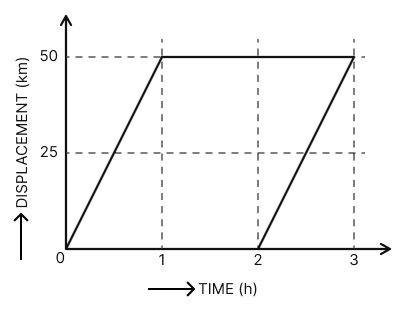
Answer
No.
Reading the graph, at the stretch between 2 and 3 hours it would place the car at two different positions for the same instant of time. A single body cannot be in two places at once, and a genuine time-displacement graph can never show two displacement values for one value of time. So this graph cannot represent such a journey.
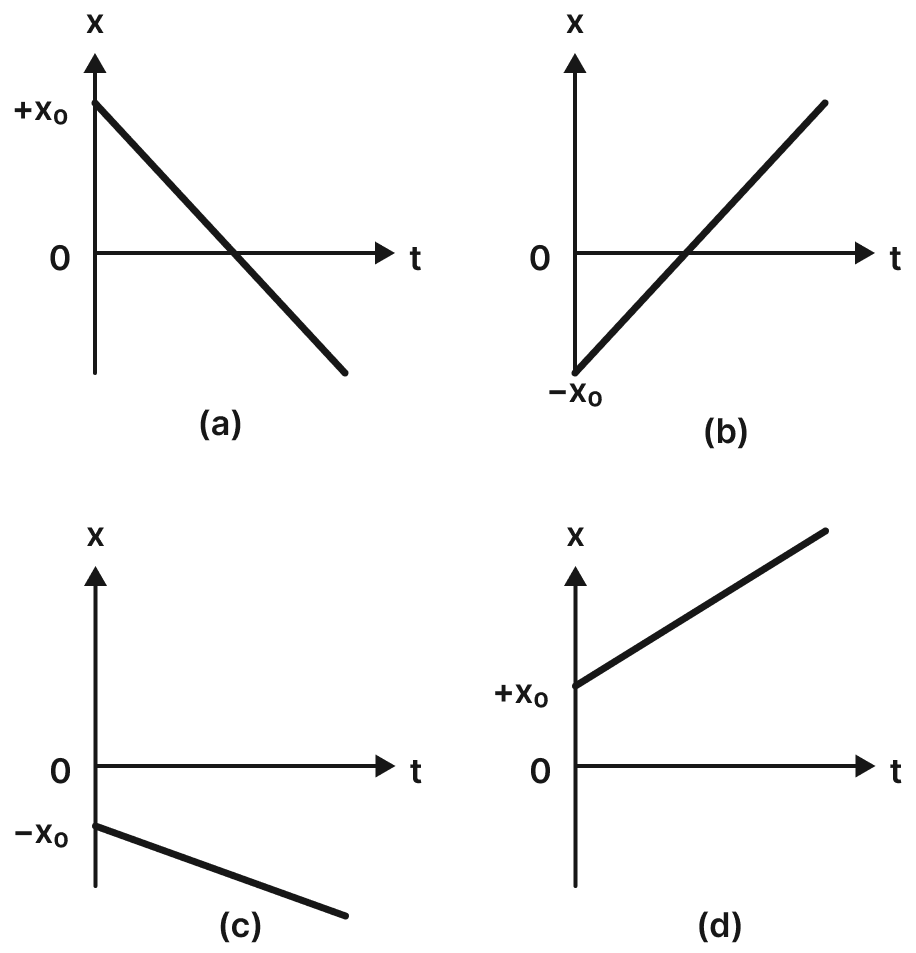
x0 represents the position of an object at time t = 0, and represents its uniform velocity. The object is in uniform motion along a straight line. Draw its position-time (x-t) graph when (a) x0 is positive and is negative, (b) x0 is negative and is positive, (c) both are negative, (d) both are positive.
Answer
The velocity of uniform motion equals the slope of the straight x-t line, and the point where the line meets the position axis gives x0. A positive velocity tilts the line so it makes an acute angle with the time-axis; a negative velocity tilts it the other way, giving an obtuse angle.
Using these rules for the four cases (a), (b), (c) and (d) — with the sign of x0 fixing the starting intercept and the sign of the velocity fixing the tilt — the graphs come out as shown below.
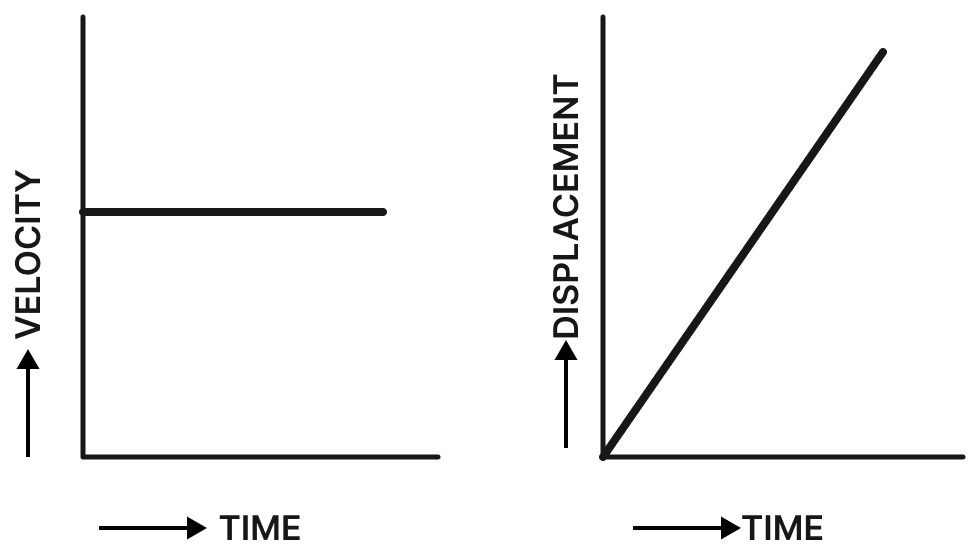
An object is moving in a given direction with a definite velocity. What is its acceleration? Draw time-velocity and time-displacement graphs for the object.
Answer
Because the object keeps a definite, unchanging velocity in one direction, nothing about its velocity varies, so its acceleration is zero.
Accordingly, the time-velocity graph is a horizontal line parallel to the time-axis, while the time-displacement graph is a straight line slanting up from the origin, as shown.
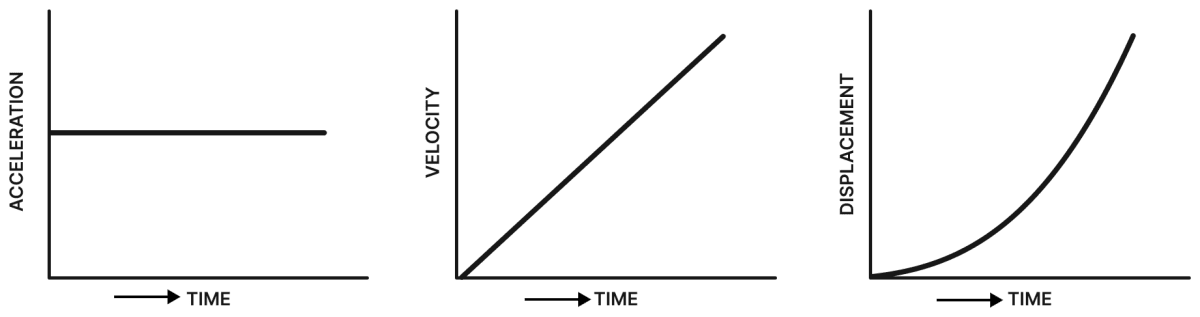
An object is moving with a constant acceleration. Draw time-acceleration, time-velocity and time-displacement graphs for the object.
Answer
With the acceleration held constant :
- the time-acceleration graph is a horizontal line parallel to the time-axis, since a does not change;
- the time-velocity graph is a slanting straight line, since v = u + at grows steadily;
- the time-displacement graph is a parabola, since s = ut + at2 is quadratic in time.
These graphs are drawn as shown.
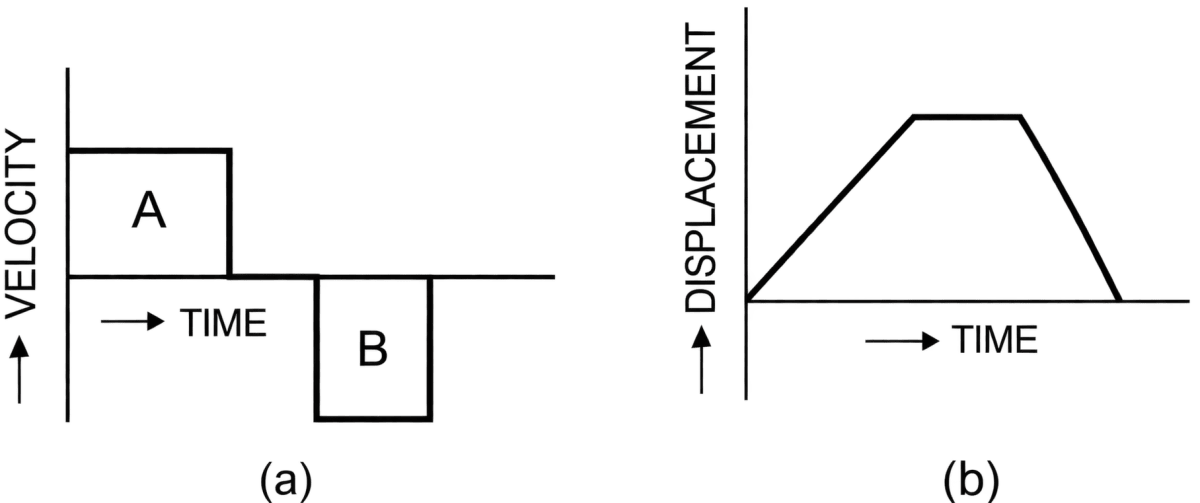
A person goes to post-office slowly and purchases postcards. Then he comes back speedily. Draw time-velocity and time-displacement graphs for the person.
Answer
While going to the post-office the person moves slowly, so his velocity is small and positive; while purchasing the postcards he is at rest, so his velocity is zero; while coming back speedily in the opposite direction his velocity is large and negative.
The two graphs are drawn in figures (a) and (b). In figure (a) the areas A and B are equal, because the net displacement of the person is zero.
The passage of a particle through a certain point in space at a certain time can be represented by three space-coordinates x, y, z and a time-coordinate t. The set of coordinate axes along with a watch is called a space-time frame of reference. If Newton's first law correctly describes the motion of a body in a frame of reference, then it is called inertial frame of reference, if not then it is called non-inertial frame of reference.
(i) What do you mean by a frame of reference?
(ii) What is an inertial frame of reference?
(iii) A rotating body is taken as a frame of reference. It will be inertial or non-inertial frame of reference.
Answer
(i) A frame of reference is a chosen set of coordinate axes together with a clock, used as the standpoint from which motion is described.
(ii) A frame in which Newton's first law correctly describes how a body moves is called an inertial frame of reference.
(iii) A rotating body is always accelerating (its direction of motion keeps turning), so a frame fixed to it does not obey Newton's first law. It is therefore a non-inertial frame of reference.
If we draw a graph taking time along the X-axis and velocity along the positive Y-axis, then the obtained graph is called time-velocity graph. The area enclosed by the time-velocity graph and the time-axis is equal to the displacement of the object. The slope of time-velocity graph is equal to the acceleration of the object. The time-velocity graph of an object is shown in figure.
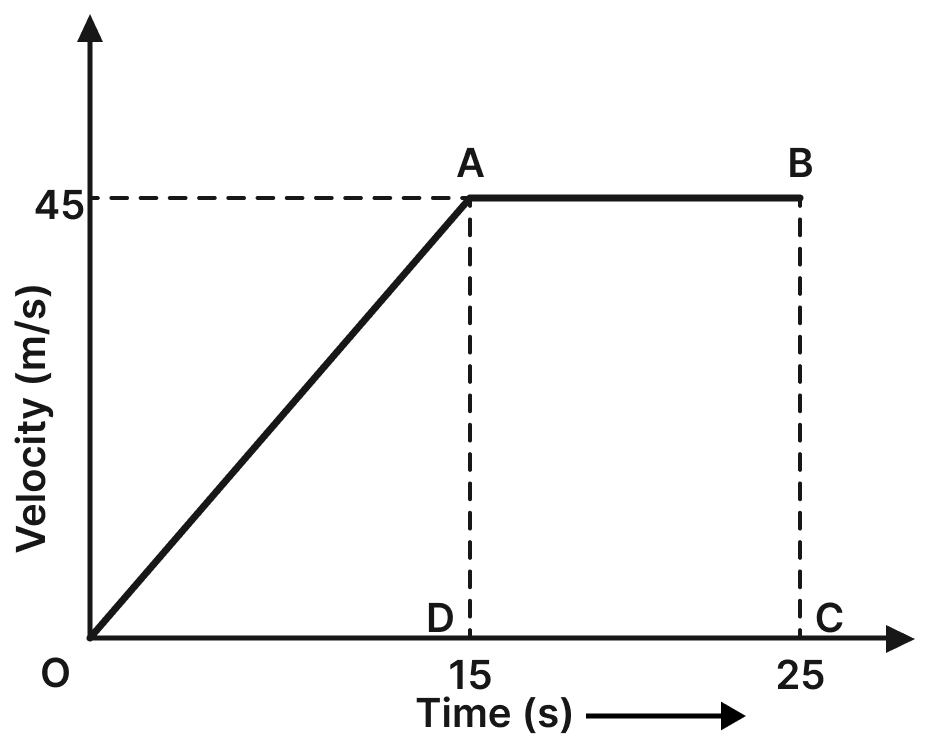
(i) Find the acceleration of the object from 0 to 15 s.
(ii) Find the acceleration of the object from 15 to 25 s.
(iii) Find the displacement of the object from 0 to 25 s.
Answer
(i) Between 0 and 15 s the velocity climbs steadily from 0 to 45 m s-1. The acceleration is the slope of this rising line :
(ii) Between 15 and 25 s the velocity holds steady at 45 m s-1. With no change in velocity,
acceleration (a) = 0
(iii) The displacement over 0 to 25 s is the whole area under the graph, made of the triangle ODA (the rising part) plus the rectangle ABCD (the flat part) :
Assume a body is moving along a straight line path in + X-axis direction with a uniform acceleration.
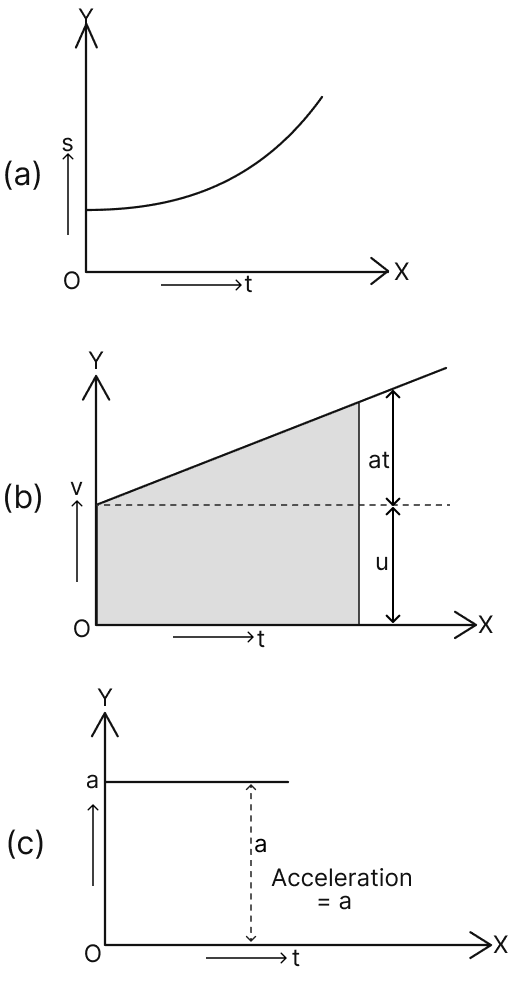
If position time (s-t) graph in compliance with relation s = ut + at2 is represented by [Fig. 1 (a)], which is a parabola. Its velocity time (v-t) graph in compliance with relation v = u + at with non-zero initial velocity is represented by [Fig. 1 (b)]. The slope of velocity-time graph gives the acceleration. And the area under v-t graph equals to the displacement of the object in the given time interval. The acceleration time graph for the same scenario will be a straight line parallel to time axis as shown in [Fig. 1 (c)].
(i) A body is thrown straight up, the correct v-t graph will be :
![Assume a body is moving along a straight line path in + X-axis direction with a uniform acceleration. If position time (s-t) graph in compliance with relation s = ut + 1/2 at 2 is represented by [Fig. 1 (a)], which is a parabola. Its velocity time (v-t) graph in compliance with relation v = u + at with non-zero initial velocity is represented by [Fig. 1 (b)]. The slope of velocity-time graph gives the acceleration. And the area under v-t graph equals to the displacement of the object in the given time interval. The acceleration time graph for the same scenario will be a straight line parallel to time axis as shown in [Fig. 1 (c)]. Motion, Solutions for Class 11 ISC Nootan Physics Kumar Mittal Nageen Prakashan](https://cdn1.knowledgeboat.com/img/np11/q3-case-study-based-questions-2-nootan-physics-icse-class-11-chapter-2-202609031237-555x1441.png)
(ii) The acceleration-time graph of a body is shown in figure (Fig. 2). The corresponding velocity time graph of the same body is :
![Assume a body is moving along a straight line path in + X-axis direction with a uniform acceleration. If position time (s-t) graph in compliance with relation s = ut + 1/2 at 2 is represented by [Fig. 1 (a)], which is a parabola. Its velocity time (v-t) graph in compliance with relation v = u + at with non-zero initial velocity is represented by [Fig. 1 (b)]. The slope of velocity-time graph gives the acceleration. And the area under v-t graph equals to the displacement of the object in the given time interval. The acceleration time graph for the same scenario will be a straight line parallel to time axis as shown in [Fig. 1 (c)]. Motion, Solutions for Class 11 ISC Nootan Physics Kumar Mittal Nageen Prakashan](https://cdn1.knowledgeboat.com/img/np11/q3-case-study-based-questions-3-nootan-physics-icse-class-11-chapter-2-202609031237-896x1225.png)
(iii) What will be the ratio of speeds in first two seconds to the speed in next 4 s in the s-t graph shown in (Fig. 3)?
![Assume a body is moving along a straight line path in + X-axis direction with a uniform acceleration. If position time (s-t) graph in compliance with relation s = ut + 1/2 at 2 is represented by [Fig. 1 (a)], which is a parabola. Its velocity time (v-t) graph in compliance with relation v = u + at with non-zero initial velocity is represented by [Fig. 1 (b)]. The slope of velocity-time graph gives the acceleration. And the area under v-t graph equals to the displacement of the object in the given time interval. The acceleration time graph for the same scenario will be a straight line parallel to time axis as shown in [Fig. 1 (c)]. Motion, Solutions for Class 11 ISC Nootan Physics Kumar Mittal Nageen Prakashan](https://cdn1.knowledgeboat.com/img/np11/q3-case-study-based-questions-4-nootan-physics-icse-class-11-chapter-2-202609031237-686x482.png)
- : 1
- 2 : 1
- 1 : 2
- 3 : 1
(iv) A body starts from state of rest, moves along a straight line with uniform acceleration the variation of velocity with time is best represented by the graph :
![Assume a body is moving along a straight line path in + X-axis direction with a uniform acceleration. If position time (s-t) graph in compliance with relation s = ut + 1/2 at 2 is represented by [Fig. 1 (a)], which is a parabola. Its velocity time (v-t) graph in compliance with relation v = u + at with non-zero initial velocity is represented by [Fig. 1 (b)]. The slope of velocity-time graph gives the acceleration. And the area under v-t graph equals to the displacement of the object in the given time interval. The acceleration time graph for the same scenario will be a straight line parallel to time axis as shown in [Fig. 1 (c)]. Motion, Solutions for Class 11 ISC Nootan Physics Kumar Mittal Nageen Prakashan](https://cdn1.knowledgeboat.com/img/np11/q3-case-study-based-questions-5-nootan-physics-icse-class-11-chapter-2-202609031237-473x1302.png)
(v) A body starts from rest moves along a straight line with constant acceleration. The variation of speed with distance (s) is best represented by :
![Assume a body is moving along a straight line path in + X-axis direction with a uniform acceleration. If position time (s-t) graph in compliance with relation s = ut + 1/2 at 2 is represented by [Fig. 1 (a)], which is a parabola. Its velocity time (v-t) graph in compliance with relation v = u + at with non-zero initial velocity is represented by [Fig. 1 (b)]. The slope of velocity-time graph gives the acceleration. And the area under v-t graph equals to the displacement of the object in the given time interval. The acceleration time graph for the same scenario will be a straight line parallel to time axis as shown in [Fig. 1 (c)]. Motion, Solutions for Class 11 ISC Nootan Physics Kumar Mittal Nageen Prakashan](https://cdn1.knowledgeboat.com/img/np11/q3-case-study-based-questions-6-nootan-physics-icse-class-11-chapter-2-202609031237-532x1427.png)
Answer
(i) Graph (a)
Reason — For a body rising under gravity the velocity obeys
v = u - gt ...(i)
which has the straight-line form. So the curved options (b) and (d) are ruled out. Matching (i) with the line y = mx + c, the intercept is u and the slope is - g; that is, the graph must start at a positive value u at t = 0 and then slope downward. Graph (a) is the only one meeting both conditions.
(ii) Graph (c)
Reason — Figure 2 shows the acceleration starting constant and positive, then dropping to zero, and finally turning constant and positive again. The matching velocity graph must therefore rise uniformly (constant acceleration), then stay flat (zero acceleration), then rise uniformly once more. Graph (c) behaves in exactly this way.
(iii) 2 : 1
Reason — On an s-t graph the speed is the slope.
In the first 2 s the slope is
Over the next 4 s (from 2 s to 6 s) the slope is
Their ratio is
(iv) Graph (c)
Reason — For uniformly accelerated motion,
v = u + at
Starting from rest makes u = 0, so v = at. This is of the form y = mx with zero intercept and positive slope . A straight line rising from the origin. Graph (c) shows exactly this.
(v) Graph (b)
Reason — Linking speed to distance for a body starting from rest,
v2 = u2 + 2as
with u = 0 gives v2 = 2as. This matches the parabola y2 = 4ax opening along the X-axis, so the speed-distance curve is a parabola. Option (b) is correct.
Show that for the motion of uniform velocity, the slope of the time-displacement graph is equal to the velocity of the object. What do you understand by negative value of velocity? Explain it by an example.
Answer
Consider an object travelling in a straight line at a uniform velocity. Let its position be s1 at time t1 and s2 at time t2. Because the velocity does not change, plotting position against time gives a straight line, as shown.
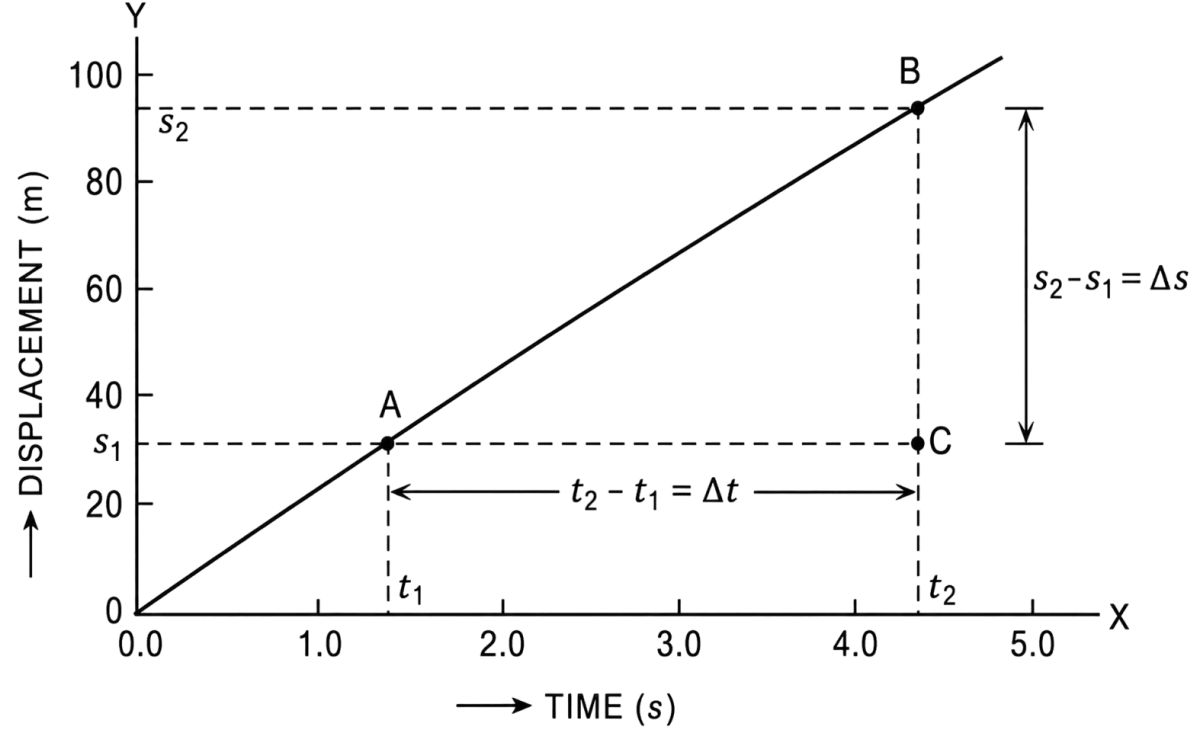
By its very definition,
But the ratio is nothing other than the slope of the straight line — the tangent of the angle θ it makes with the time-axis.
So the slope of the time-displacement graph equals the velocity of the object.
Negative velocity : A velocity that comes out negative simply means the object is heading opposite to the direction we have called positive. On the graph the line then leans the other way, making an obtuse angle with the time-axis, so its slope is negative.
Example : If a car going east is taken to have positive velocity, then an identical car going west along the same road has a negative velocity.
Show that the area enclosed by time-velocity graph and time-axis of an object moving with a constant acceleration in a straight line for a certain interval of time is equal to the distance travelled by the object in that time-interval.
Answer
Consider an object moving straight with a constant acceleration a. Let its velocity be u at t = 0 and v at time t. A constant acceleration makes the velocity rise linearly, so the time-velocity graph is the straight line AB shown below.
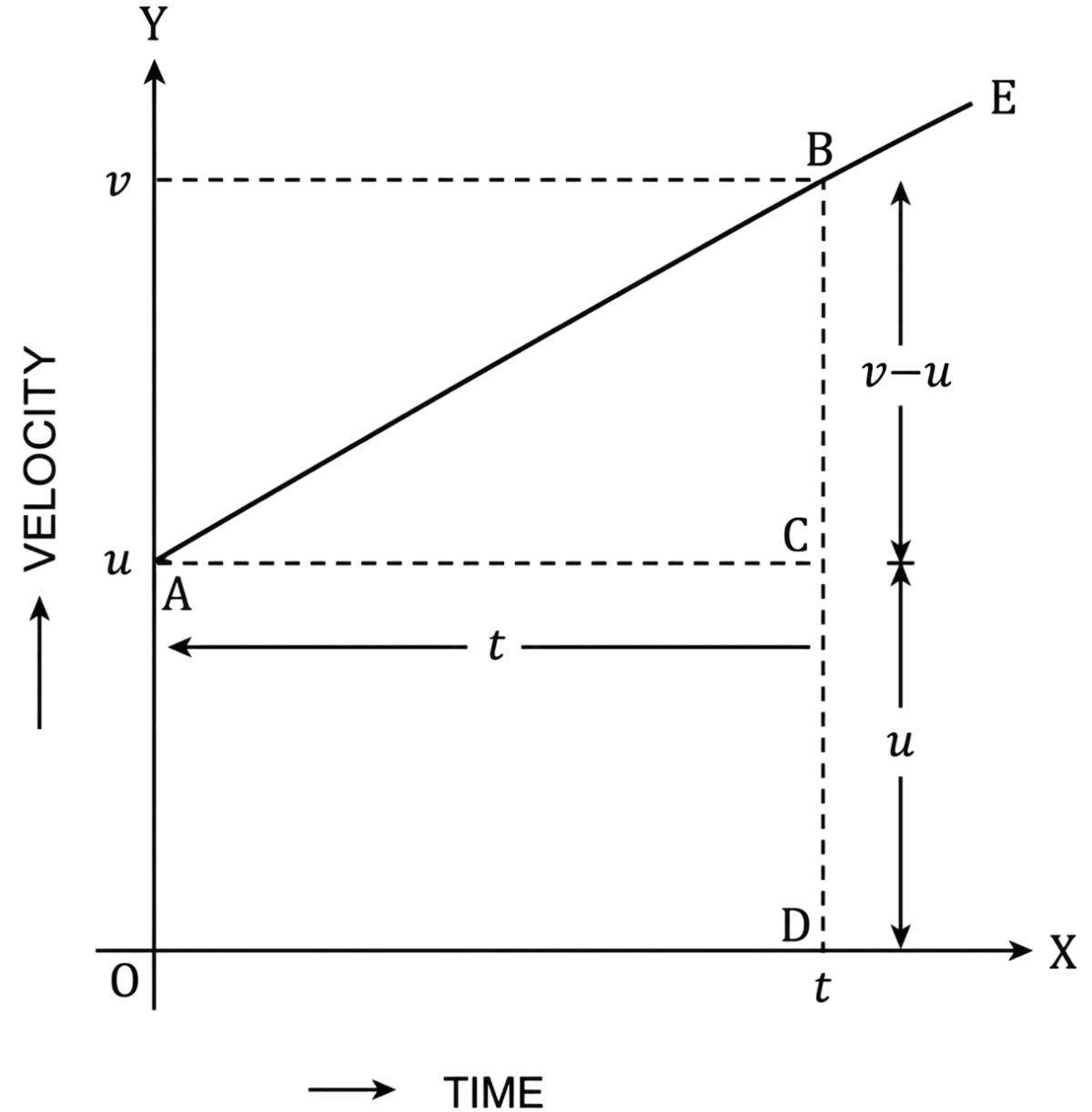
The distance covered is the area between this line and the time-axis, that is, the area of the trapezium OABD, which we split into a rectangle and a triangle :
For constant acceleration, v - u = at, so
This is exactly the formula for the distance s covered in time t.
Hence the area enclosed by the time-velocity graph and the time-axis equals the distance travelled in that interval.
Show that the area enclosed by time-acceleration graph and time-axis of an object for a certain interval of time is equal to the velocity-change for that time-interval.
Answer
Consider an object with a constant acceleration acting over a time-interval Δt. Since does not change, the time-acceleration graph is a horizontal line parallel to the time-axis, as shown.
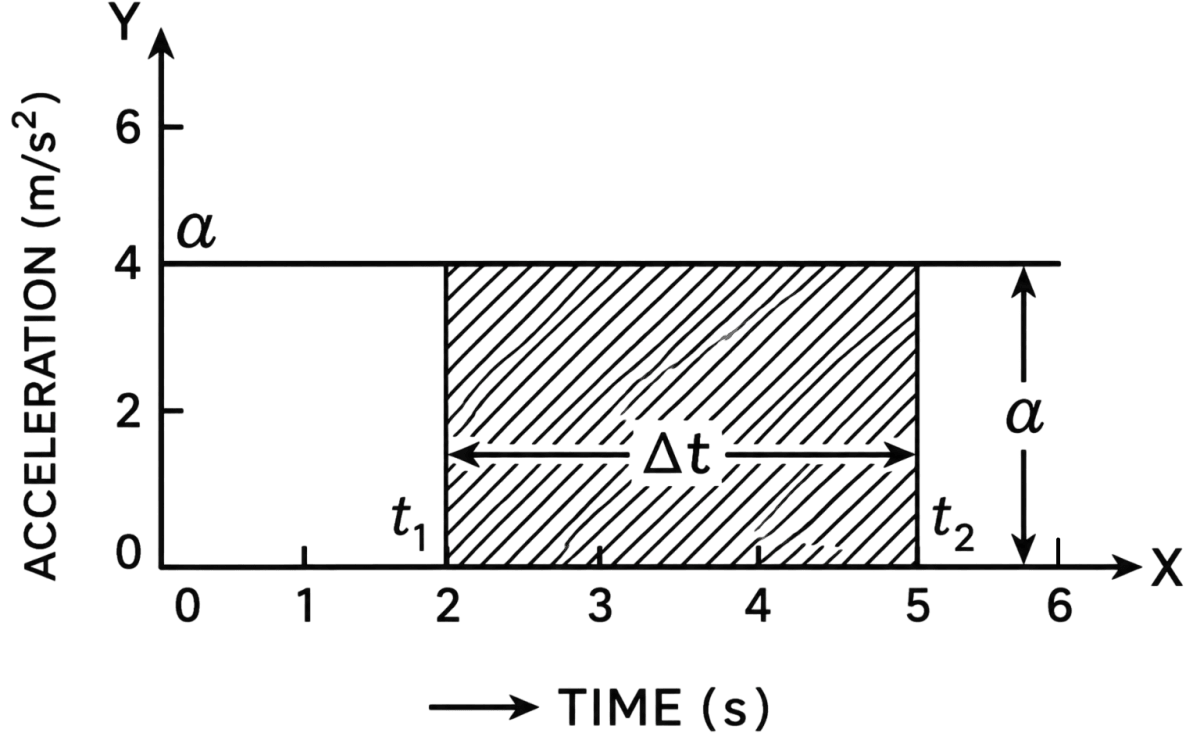
The area shut in between this line and the time-axis is simply the area of a rectangle :
Area = a x (t2 - t1) = aΔt
Now, from the definition of acceleration,
where u and v are the velocities at the start and end of the interval.
So the rectangular area aΔt is precisely (v - u), the change in velocity over that interval.
Hence the area enclosed by the time-acceleration graph and the time-axis equals the velocity-change for that interval.
Derive the following relations either graphically or mathematically :
(a) v = u + a t
(b) s = u t + a t2
(c) v2 = u2 + 2 a s.
Answer
Consider an object moving straight with a constant acceleration . Let be its velocity at = 0 and its velocity at time , and let be the distance it covers in that time. Since is constant, the time-velocity graph is the straight line AB shown below.
(a) Deriving v = u + at
Acceleration is the rate of change of velocity, which is the slope of the line AB :
(b) Deriving s = ut + at2
The distance is the area under the graph, that is, the trapezium OABD split as a rectangle plus a triangle :
Substituting v - u = at from part (a),
(c) Deriving v2 = u2 + 2as
The same area of the trapezium OABD can be written using the two parallel sides :
From part (a), . Substituting,
What is meant by relative velocity? Write an expression for the velocity of one particle relative to the other moving with velocities v1 and v2 along a straight line.
Answer
Relative velocity : The relative velocity of one body with respect to another is the rate at which the first body's position changes as judged from the second body. In other words, it is how the first body's motion looks to an observer riding on the second body.
Suppose two particles, 1 and 2, travel along a straight line (the X-axis) with uniform velocities v1 and v2 measured from the ground. Then the velocity of particle 2 as seen from particle 1 is
and the velocity of particle 1 as seen from particle 2 is
Special cases :
- If both the particles move in the same direction, the magnitude of the relative velocity is the difference of their speeds, that is, v1 - v2. If v1 = v2, the relative velocity is zero and the two particles stay at a constant distance apart.
- If the two particles move in opposite directions, the magnitude of the relative velocity is the sum of their speeds, that is, v1 + v2.
The figure shows the time-distance (t-s) graph of a cyclist. Find out from the graph : (i) maximum speed of the cyclist, (ii) average speed in the whole journey.
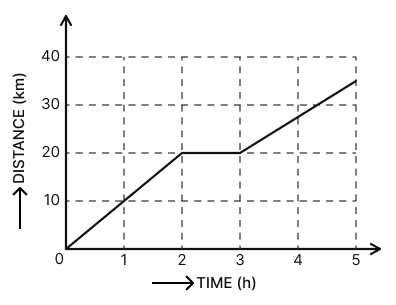
Answer
(i) The speed is given by the slope of the t-s graph. The slope is maximum for the steepest portion of the graph, in which the cyclist covers 20 km in 2 h.
(ii) Over the entire ride the cyclist travels 35 km in a total of 5 h, so
In the Fig. (a), the time-displacement graph of a moving body is given. Draw its time-velocity graph and state : (i) When was the body going fastest? (ii) How much total distance the body has travelled? (iii) What is total displacement in the position of the body? (iv) What was the acceleration of the body from the beginning up to A?
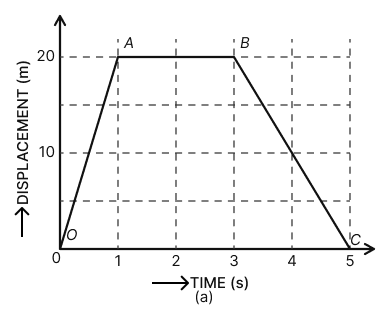
Answer
The time-velocity graph is drawn as shown.
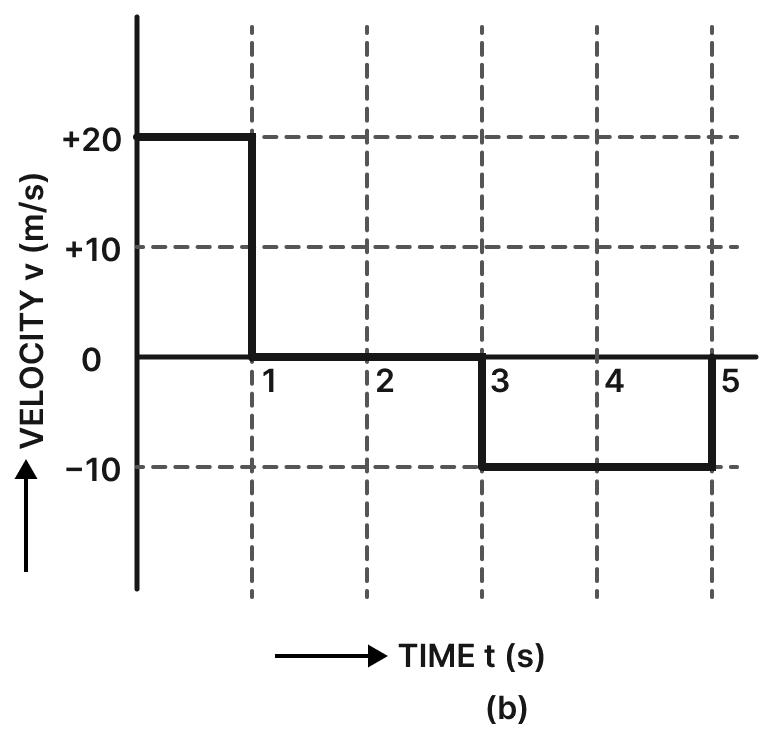
(i) The body moves fastest between 0 and 1 second, since the time-displacement graph is steepest there and a steeper slope means a larger velocity.
(ii) Adding up the motion, the body goes 20 m forward and 20 m backward, so the total distance travelled is 40 metre.
(iii) As the body finishes exactly where it began, its net displacement is zero.
(iv) Up to A the graph is a straight line, so the velocity is unchanging over that stretch. An unchanging velocity means the acceleration from the beginning up to A is zero.
A car moves first for 0.1 h with a velocity of 20 km/h, then for 0.4 h with a velocity of 60 km/h and in the last for 0.2 h with a velocity of 20 km/h. Draw time-velocity graph for the car and use it to find : (i) How much distance the car moves in the first time-interval? (ii) How much distance the car moves in the whole journey? (iii) How much time the car takes in first 14 km? Indicate that area in your graph which indicates the journey of first 14 km.
Answer
Given,
- First leg : velocity v1 = 20 km h-1 for time t1 = 0.1 h
- Second leg : velocity v2 = 60 km h-1 for time t2 = 0.4 h
- Third leg : velocity v3 = 20 km h-1 for time t3 = 0.2 h
The time-velocity graph for the car is drawn as shown.
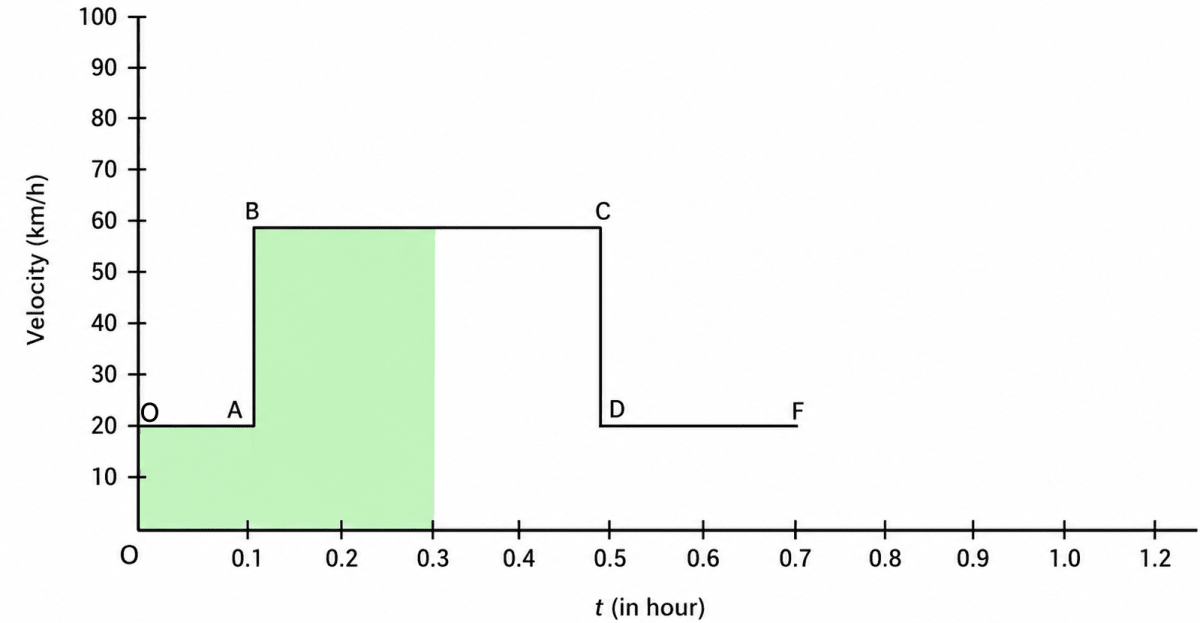
(i) On a velocity-time graph the distance is the area beneath it. For the first leg this is the rectangle of height v1 and width t1 :
(ii) The whole journey is the sum of the three rectangular areas :
(iii) In the first leg the car covers 2 km, so the car still needs 14 - 2 = 12 km, which it covers in the second leg at 60 km h-1 :
Adding the first leg's 0.1 h,
On the graph, the area up to t = 0.3 h (shaded) represents this first 14 km.
A body starts from rest in a straight line with an acceleration of 8.0 m/s2. Draw its time-velocity graph and determine : (i) Velocity of the body after 5 s, (ii) How much distance the body has moved in first 5 s? (iii) What average velocity of the body is during this time?
Answer
Given,
- Initial velocity, u = 0 (starts from rest)
- Acceleration, a = 8.0 m s-2
- Time, t = 5 s
Since the velocity grows steadily from zero, the time-velocity graph is a straight line through the origin, as shown.
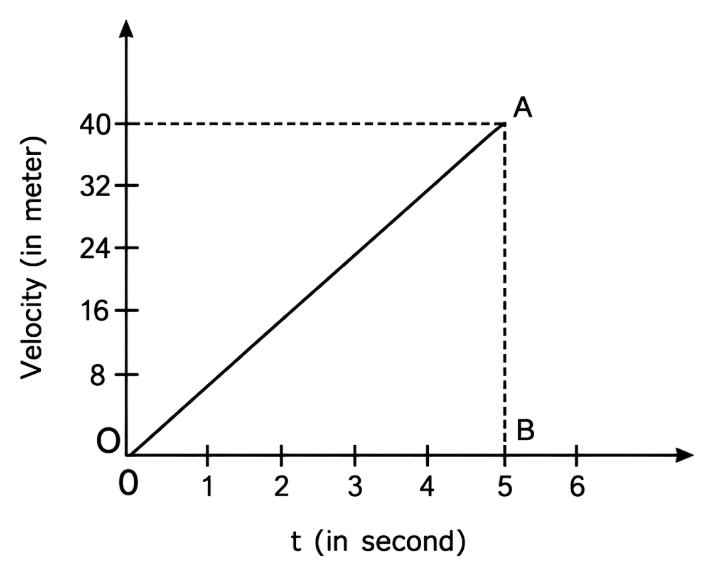
(i) Using v = u + at,
(ii) The distance is the area under the line — a triangle of base OB and height BA :
(iii) The average velocity is the displacement divided by the time :
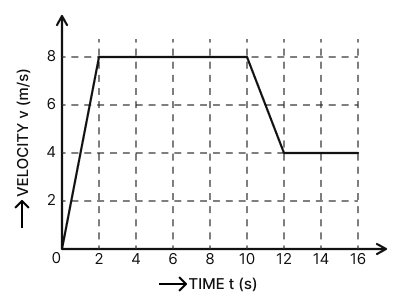
How far does the runner whose time-velocity graph is shown in the figure travel in 16 s? What is the acceleration of the runner at t = 11 s?
Answer
Given (read from the time-velocity graph),
- The speed climbs from 0 to 8 m s-1 between t = 0 and t = 2 s, stays at 8 m s-1 up to t = 10 s, drops to 4 m s-1 between t = 10 s and t = 12 s, and holds at 4 m s-1 up to t = 16 s.
Distance in 16 s. The distance is the whole area beneath the graph :
Acceleration at t = 11 s. At this instant the graph is on its downward slope from 8 m s-1 (at 10 s) to 4 m s-1 (at 12 s). The acceleration is the slope at 11 sec :
The minus sign shows the runner is slowing down at that moment.
A rocket, when fired, rises up with an acceleration of 20 m/s2 for the first 1.0 min. After this its fuel is finished and it goes on rising up just like a free body. Up to what maximum height will it rise? How much total time will it take before falling on earth? (g = 10 m/s2)
Answer
Given,
- Acceleration during powered flight, a = 20 m s-2
- Duration of powered flight, t1 = 1.0 min = 60 s
- Initial velocity, u = 0
- g = 10 m s-2
Powered stage. The velocity gained by the time the fuel runs out, from v = u + at1 :
The height climbed in this stage, from h1 = ut1 + at12 :
Free rise after the fuel ends. Now the rocket coasts upward with initial velocity 1200 m s-1 against gravity (retardation g = 10 m s-2), stopping at the top. From v22 = u22 - 2gh2 with v2 = 0 :
So the greatest height is
Time for this coasting rise, from v2 = u2 - gt2 with v2 = 0 :
Falling stage. From the peak the rocket drops freely through 108000 m, starting from rest. From h = gt32 :
Total time before landing :
The figure shows the time-velocity graph for a body thrown vertically up. Calculate from the graph : (i) the type of motion, (ii) the initial velocity and acceleration, (iii) maximum height attained by the body, (iv) after how much time the body will return?
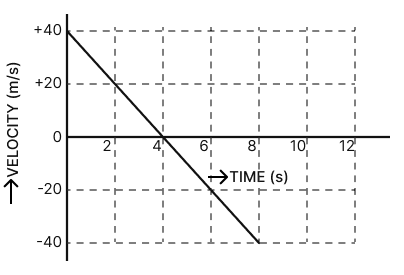
Answer
(i) Reading the graph, the speed falls steadily to zero in the first 4 s and then rises steadily again — so the motion is uniformly retarded while going up (first 4 s) and uniformly accelerated while coming down.
(ii) The graph meets the velocity-axis at 40, so the initial velocity is
The acceleration is the slope of the line :
(iii) The greatest height is the area under the graph during the upward phase (the triangle over the first 4 s) :
(iv) The graph shows the body back at the launch level at t = 8 s, so it returns after 8 s.
From towns A and B two cars start simultaneously towards each other. The two towns are 480 km apart. The first car takes 8 h to travel from A to B, while second car takes 12 h to travel from B to A. Calculate when and where the two cars meet each other.
Answer
Given,
- Distance between the towns, D = 480 km
- Time for the first car (A to B), tA = 8 h
- Time for the second car (B to A), tB = 12 h
Speed of the first car :
Speed of the second car :
The cars head toward each other, so they close the gap at their combined speed :
∴ time taken to meet:
Distance of the meeting point from town A (using the first car's speed) :
Hence the two cars meet after 4.8 h, 288 km from town A.
The time-velocity graph of a car is shown in the figure. Calculate : (i) acceleration from A to B, (ii) distance travelled in the last 4 s.
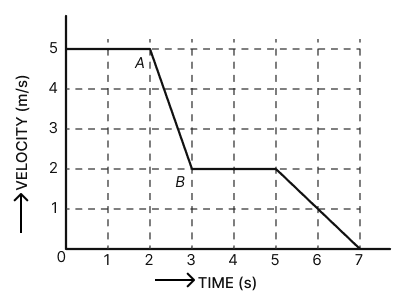
Answer
(i) The acceleration between A and B is the slope of that segment. Reading the co-ordinates of A and B from the graph,
The minus sign tells us the car is slowing down over this portion.
(ii) The distance in the last 4 s is the area under the graph there. That region is a trapezium with parallel sides (7 - 3) and (5 - 3) and width 2 :
Hence the acceleration from A to B is - 3 m s-2 and the distance in the last 4 s is 6 m.
A car accelerates uniformly on a straight road from rest to a speed of 180 kmh-1 in 25 s. Find the distance covered by the car in this time-interval.
Answer
Given,
- Initial velocity, u = 0 (starts from rest)
- Final velocity, v = 180 km h-1 = = 50 m s-1
- Time, t = 25 s
The acceleration is uniform, so the average velocity is the mean of the start and end speeds, and distance = average velocity × time :
Hence the car covers 625 m in this interval.
A ball is thrown vertically upwards from the top of a tower with a velocity of 20 m/s. The ball strikes the earth after 5 s of its throwing. What is the height of the tower? What will be the velocity of the ball while striking the earth? (g = 9.8 m/s2)
Answer
Given,
- Initial velocity, u = 20 m s-1 (upward)
- Total time of flight, t = 5 s
- g = 9.8 m s-2
Take upward as positive. The ball's displacement when it lands (measured from the top of the tower) follows from s = ut - gt2 :
The negative result means the landing point is 22.5 m below the launch point, so the tower is 22.5 m high.
Velocity on striking the ground, from v = u - gt :
The minus sign shows it is moving downward.
Hence the tower is 22.5 m high and the ball hits the ground at 29 m s-1 (downward).
A person standing on the roof of a building 30 m high drops a ball vertically downwards with an initial velocity of 500 cm/s. Acceleration due to gravity is 9.8 m/s2. (a) What will be the velocity of the ball after 0.5 s? (b) Where will be the ball after 1.5 s? (c) What will be the velocity of the ball while striking the earth?
Answer
Given,
- Initial velocity, u = 500 cm s-1 = 5 m s-1 (downward)
- Height of the building, h = 30 m
- g = 9.8 m s-2
Take downward as positive.
(a) Velocity after 0.5 s, from v = u + gt :
(b) Position after 1.5 s, from s = ut + gt2 :
So the ball is 18.525 m below the roof at this instant.
(c) Speed on striking the ground, from v2 = u2 + 2gh :
Hence the ball hits the earth at 24.76 m s-1.
A person swims in a river with and against its stream of water at the rate 25 kmh-1 and 15 kmh-1. Determine the speed of the person in still water and speed of river water.
Answer
Given,
- Speed downstream (with the current), swimming with the stream = 25 km h-1
- Speed upstream (against the current), swimming against the stream = 15 km h-1
Let the swimmer's speed in still water be vp and the river's speed be vr.
Going with the stream, the current helps, so the two speeds add :
Going against the stream, the current hinders, so they subtract :
Adding (i) and (ii) removes vr :
Subtracting (ii) from (i) removes vp :
Hence the swimmer's still-water speed is 20 km h-1 and the river flows at 5 km h-1.
Two trains A and B are travelling on parallel tracks with speeds 60 km/h and 45 km/h respectively. Calculate the relative velocity of A with respect to B, if
(i) both are travelling in the same direction,
(ii) both are travelling in opposite directions.
Answer
Given,
- Speed of train A, vA = 60 km h-1
- Speed of train B, vB = 45 km h-1
(i) Both moving the same way — take that direction as positive :
(ii) Moving in opposite directions — now vB is negative, vB = - 45 km h-1 :
Hence A moves at 15 km h-1 relative to B when they travel the same way, and at 105 km h-1 when they travel opposite ways.
The figure shows the time-distance (t-s) graphs of two cars which start simultaneously in the same direction. Calculate from the graph: (i) By how much distance the car A was ahead of car B initially? (ii) Which car is moving faster? What their speeds are? (iii) After how much time and at which place the car B will catch the car A?
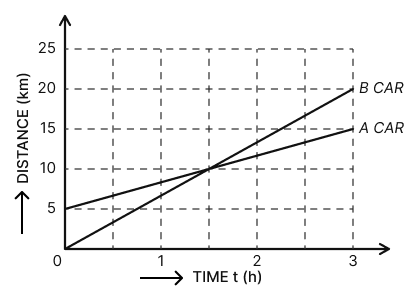
Answer
(i) At t = 0, car A's graph starts at 5 km while car B's starts from the origin, so A begins 5 km ahead of B.
(ii) On a distance-time graph the speed is the slope. Reading the graphs,
Because B's line is steeper, car B is the faster one.
(iii) The two lines cross where B overtakes A. From the graph this intersection is at t = 1.5 h and s = 10 km.
Hence car B catches car A after 1.5 h, at a point 10 km from the start.
The figure (a) shows the time-acceleration graph of a body. Draw the corresponding time-velocity graph. At time t = 0, the velocity v = 0.
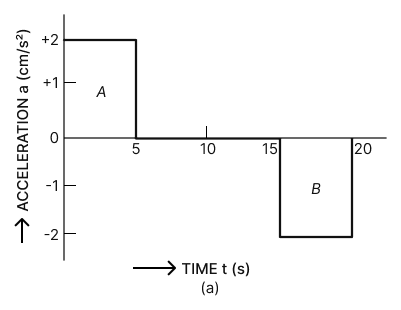
Answer
On a time-acceleration graph, the change in velocity across any interval equals the area under the graph for that interval. Building up the velocity from v = 0 at t = 0 :
- Where the acceleration is constant and positive, the velocity climbs steadily, so the v-t graph is a straight line sloping upward.
- Where the acceleration is zero, the velocity holds steady, so the v-t graph runs flat (parallel to the time-axis).
- Where the acceleration is constant and negative, the velocity falls steadily, so the v-t graph is a straight line sloping downward.
Joining these points gives the time-velocity graph shown in Fig. (b).
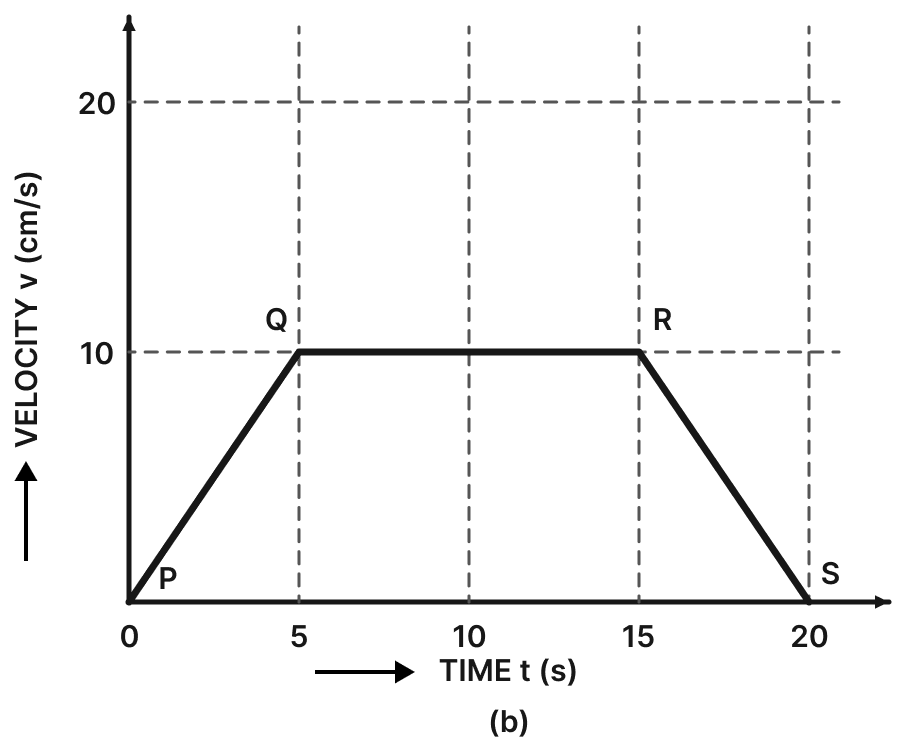
A ball which is thrown vertically upwards reaches the roof of a house 100 m high. At the moment this ball is thrown vertically upward, another ball is dropped from rest vertically downwards from the roof of the house. At which height will the balls pass each other? (g = 9.8 m/s2)
Answer
Given,
- Height of the house, h = 100 m
- g = 9.8 m s-2
The upward-thrown ball only just reaches the roof, so its velocity there is zero. From v2 = u2 - 2gh with v = 0, its launch speed is
Let the balls meet after time t, with heights measured from the ground.
Height of the ball thrown up :
Height of the ball dropped from the roof :
At the meeting point x1 = x2. The gt2 terms cancel :
Substituting this time into the height of the dropped ball,
Hence the two balls cross each other 75 m above the ground.
Two balls A and B are thrown simultaneously, A vertically upwards with a speed of 20 ms-1 from the ground, and B vertically downwards from a height of 40 m with the same speed and along the same line of motion. At what point do the balls collide? (g = 9.8 ms-2)
Answer
Given,
- Launch speed of ball A, uA = 20 m s-1 (upward, from the ground)
- Launch speed of ball B, uB = 20 m s-1 (downward, from a height of 40 m)
- g = 9.8 m s-2
- Initial separation = 40 m
Both balls share the same downward acceleration g, so relative to each other there is no acceleration. Their relative velocity therefore stays fixed at the sum of the launch speeds :
Time to cover the 40 m gap :
So, both balls will collide after 1 second.
Now find where they are at t = 1 s. Height of ball A above the ground, x = uAt - gt2 :
Hence the balls collide 1 s after launch, 15.1 m above the ground.
A boy standing on the top of a 40 m high building projects a stone vertically upwards with an initial velocity of 10 ms-1. The stone eventually falls to the ground. (a) After how long will the stone strike the ground? (b) After how long will the stone pass through the point from where it was projected? (c) With what velocity will it strike the ground?
Answer
Given,
- Initial velocity, u = 10 m s-1 (upward)
- Height of the building, h = 40 m
- g = 10 m s-2
Take upward as positive. On reaching the ground the stone's displacement from the top is s = - 40 m.
(a) Time to hit the ground, from s = ut - gt2 :
(the negative root being rejected).
(b) It returns to the launch point when its displacement is again zero. Setting s = 0 in s = ut1 - gt12 :
(c) Velocity just before hitting the ground, from v = u - gt with t = 4 s :
The minus sign marks it as downward.
Hence the stone lands after 4 s at 30 m s-1 (downward), having passed the launch point after 2 s.
An astronaut jumps from an aeroplane. After he had fallen 40 m, then his parachute opens. Now he falls with a retardation of 2.0 m/s2 and reaches the earth with a velocity of 3.0 m/s. What was the height of the aeroplane? For how long astronaut remained in air? (g = 9.8 m/s2)
Answer
Given,
- Free-fall distance before the parachute opens, h = 40 m
- Initial velocity, u = 0
- Retardation after the parachute opens, a = 2.0 m s-2
- Landing velocity, v1 = 3.0 m s-1
- g = 9.8 m s-2
Stage 1 — free fall through 40 m. Speed at the end, from v2 = u2 + 2gh :
Time for this fall, from v = u + gt1 :
Stage 2 — after the parachute opens. Here the initial speed is u1 = 28 m s-1, the final speed is v1 = 3.0 m s-1, and the retardation is a = 2.0 m s-2. Distance covered, from v12 = u12 - 2as :
Time for this stage, from v1 = u1 - at2 :
Combining the two stages.
Height of the aeroplane = 40 + 193.75 = 233.75 ≈ 234 m
Total time in the air = t1 + t2 = 2.86 + 12.5 = 15.4 s
When a balloon rising vertically upwards at a velocity of 10 ms-1 is at a height of 45 m from the ground, a parachutist bails out from the balloon. After 3 s, he opens the parachute and decelerates at a constant rate of 5 ms-2. (a) What is the height of the parachutist above the ground when he opens the parachute? (b) How far is he from the balloon at this instant? (c) With what velocity does he strike the ground? (d) What time does he take in striking the ground after his exit from the balloon? (g = 10 m/s2)
Answer
Given,
- Initial velocity of the parachutist, u1 = 10 m s-1 (upward, sharing the balloon's motion)
- Starting height = 45 m
- Free-fall time before the parachute opens = 3 s
- Retardation after the parachute opens = 5 m s-2
- g = 10 m s-2
Take upward as positive.
(a) Displacement during the first 3 s, from s = u1t1 - gt12 :
So he drops 15 m below his exit point, and his height above the ground is
(b) In those same 3 s the balloon keeps rising at 10 m s-1, reaching
So the parachutist is now
below the balloon.
(c) His velocity when the parachute opens, from v1 = u1 - gt1 :
that is, 20 m s-1 downward. He then covers the remaining 30 m with a 5 m s-2 retardation. From v22 = u22 - 2as (taking downward magnitudes, u2 = 20 m s-1) :
(d) Time for this final 30 m, from v2 = u2 - at2 :
So the total time from leaving the balloon to landing is
Hence: (a) 30 m above the ground, (b) 45 m below the balloon, (c) 10 m s-1, (d) 5 s.
A rocket is fired vertically up from the ground with a resultant vertical acceleration of 10 m/s2. The fuel is finished in 1 min and the rocket continues to move up. After how much time from then will the maximum height be reached? Give calculations. (g = 10 m/s2)
Answer
Given,
- Acceleration during powered flight, a = 10 m s-2
- Initial velocity, u = 0
- Duration of powered flight, t1 = 1 min = 60 s
- g = 10 m s-2
Velocity of the rocket when the fuel runs out, from v = u + at1 :
After that the rocket coasts upward against gravity, so it is retarded at 10 m s-2 until its velocity reaches zero at the top. From v' = v - gt2 with v' = 0 :
Hence the highest point is reached 1 min after the fuel is exhausted.
Two trains A and B each of length 200 m are running on parallel tracks. One train overtakes the other in 40 s and one crosses the other in 20 s. Calculate the speeds of each train.
Answer
Given,
- Length of each train = 200 m
- Time to overtake (same direction) = 40 s
- Time to cross (opposite directions) = 20 s
Let the speeds be vA and vB, with vA > vB. In either case one train must clear a total length of
Overtaking (same direction). The relative velocity is vA - vB, and it clears 400 m in 40 s :
Crossing (opposite directions). The relative velocity is vA + vB, clearing 400 m in 20 s :
Adding (i) and (ii),
Then from (ii),
Hence the trains travel at 15 m s-1 and 5 m s-1.
A balloon, going upwards with a velocity of 12 m/s, is at a height of 65 m from the earth at any instant. Exactly at this instant a packet drops from it. How much time will the packet take in reaching the earth? (g = 10 m/s2)
Answer
Given,
- Initial velocity of the packet, u = 12 m s-1 (upward, sharing the balloon's motion)
- Height above the earth, h = 65 m
- g = 10 m s-2
Take upward as positive. When the packet reaches the earth its displacement is s = - 65 m. From s = ut - gt2 :
Solving this quadratic,
Taking the positive root,
Hence the packet reaches the earth after 5 s.