
A jet plane travelling at a speed of 500 km h-1 ejects its products of combustion at a speed of 1500 km h-1 relative to the plane. Find the speed of the latter with respect to an observer on the ground.
Answer
Given,
- Speed of the jet plane relative to the ground, magnitude = 500 km h-1
- Speed of the combustion products relative to the plane, vCJ = 1500 km h-1
Let us fix a sign convention : take the direction pointing toward the ground observer as positive, and assume the jet is flying away from that observer.
With this choice, the jet's ground velocity points away from the observer :
The exhaust is thrown out backwards, that is, toward the observer, so relative to the plane
The velocity of the combustion products relative to the plane is, by definition,
Substituting the values,
Hence the combustion products move at 1000 km h-1 with respect to the ground observer.
Two trains A and B, each of length 400 m, are moving on two parallel tracks with a uniform speed of 72 km h-1 in the same direction, A being ahead of B. The driver of B decides to overtake A and accelerates by 1 m s-2. After 50 s, the guard (end-point) of B just moves past the driver (front-point) of A. What was the original distance between the two trains?
Answer
Given,
- Length of each train = 400 m, so lA = lB = 400 m
- Initial speed of both trains, uA = uB = 72 km h-1 = 20 m s-1
- Acceleration of train B, aB = 1 m s-2
- Acceleration of train A, aA = 0
- Time, t = 50 s
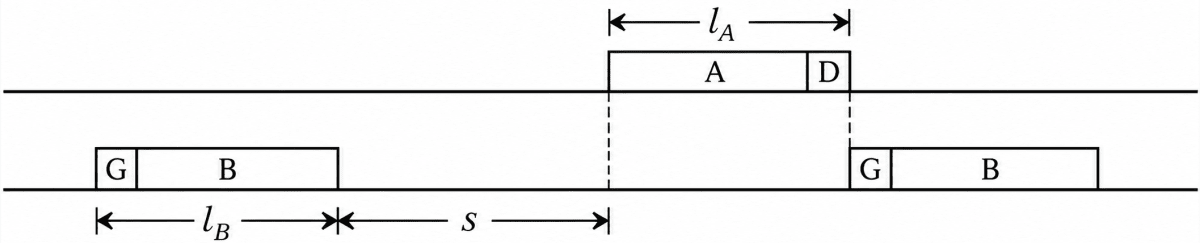
Let d be the original distance between the front of train B and the rear of train A.
Since both trains have the same initial speed, the initial relative velocity of B with respect to A is
and the relative acceleration of B with respect to A is
The distance travelled by train B relative to train A is obtained by using the equation s = ut + at2 for the relative motion,
So train B gains 1250 m on train A in 50 s.
For the guard (rear end) of train B to just move past the driver (front end) of train A, this relative distance must be equal to the original distance between the trains plus the length of both the trains :
Hence, the original distance between the two trains was 450 m.
Two towns A and B are connected by a regular bus service with a bus leaving in either direction every T minutes. A man cycling with a speed of 20 km h-1 in the direction A to B notices that a bus goes past him every 18 min in the direction of his motion, and every 6 min in the opposite direction. What is the period T of the bus service and with what speed (assumed constant) do the buses ply on the road?
Answer
Given,
- Cyclist's speed, vC = 20 km h-1 (from A toward B)
- A bus overtakes him from behind every 18 min
- A bus meets him head-on every 6 min
- Buses leave each terminus every T min
Let vB be the constant speed of the buses. The spacing between two consecutive buses on the road is the distance one bus covers in T minutes, that is,
Buses coming from behind (same direction as the cyclist). A following bus approaches the cyclist at the relative speed (vB - vC), and it takes 18 min to complete the spacing between two buses :
Buses coming head-on (opposite direction). An oncoming bus approaches at the relative speed (vB + vC), taking only 6 min to cover the same spacing :
Solving for vB. Dividing (ii) by (i) cancels the unknown T :
Solving for T. Putting vB = 40 and vC = 20 into (ii) :
Hence the buses run at 40 km h-1 and one leaves each terminus every 9 min.
A boy standing on a stationary lift (open from above) throws a ball upwards with the maximum initial speed he can, equal to 49 ms-1. How much time does the ball take to return to his hands? If the lift starts moving up with a uniform speed of 5 ms-1, and the boy again throws the ball up with the same maximum speed he can, how long does the ball take to return to his hands? (g = 9.8 ms-2)
Answer
Given,
- Maximum launch speed of the ball, u = 49 m s-1 (upward)
- Uniform speed of the lift in the second case, vlift = 5 m s-1 (upward)
- Acceleration due to gravity, g = 9.8 m s-2
Case 1 — the lift is stationary. Let t be the time to reach the top of the flight, where the ball's velocity is zero. Taking upward as positive, from v = u - gt with v = 0 :
The descent takes just as long, so the total time back to the hand is
Case 2 — the lift rises at a steady 5 m s-1. What matters for catching the ball is the motion of the ball relative to the boy. Because the lift moves at a constant velocity (no acceleration of its own), the boy's frame is still an inertial one. In that frame the ball again leaves at 49 m s-1 and feels the same gravity, so its up-and-down journey relative to the boy is unchanged.
Hence the ball comes back to the boy's hands after 10 s in both cases.
On a long horizontal moving belt, a child runs to and fro with a speed 9 kmh-1 (with respect to the belt) between his father and mother located 50 m apart on the moving belt. The belt moves with a speed of 4 kmh-1. For an observer on a stationary platform outside, what is the (a) speed of child running in the direction of motion of the belt, (b) speed of child running opposite to the direction of motion of the belt and (c) time taken by the child in (a) and (b)?
Which of the answers alter if motion is viewed by one of the parents?
Answer
Given,
- Speed of the child relative to the belt, vCB = 9 km h-1
- Speed of the belt relative to the ground, vB = 4 km h-1
- Separation between the parents on the belt = 50 m
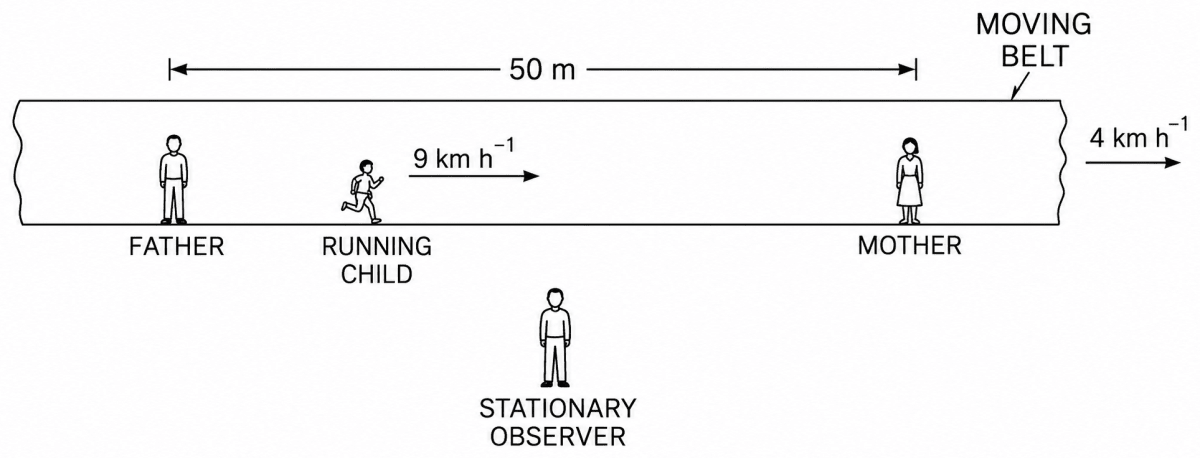
Take the belt's direction of travel (left to right) as positive.
(a) Child running the same way as the belt. For a ground observer, the child's velocity is the sum of the child's velocity relative to the belt and the belt's own velocity :
(b) Child running against the belt. Now the child's velocity relative to the belt is negative, vCB = - 9 km h-1 :
The negative sign means the child is seen moving right to left.
(c) Time for each run. The parents stand on the same belt as the child, so relative to them the child always moves at 9 km h-1 whichever way he runs. The 50 m separation is a belt distance, so we use the child's belt speed :
So each crossing takes 20 s in either direction.
Effect of viewing from a parent. A parent shares the belt's motion, so the belt's speed no longer enters. From a parent's viewpoint the child moves at 9 km h-1 both ways, so the answers to (a) and (b) change (both become 9 km h-1), while the time found in (c) stays the same.
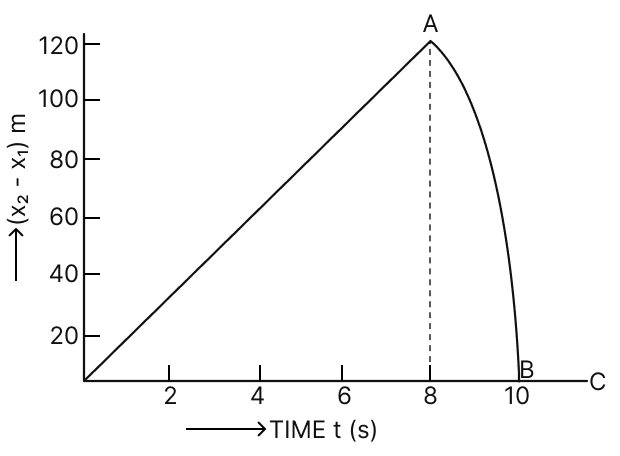
Two stones are thrown up simultaneously from the edge of a cliff 200 m high with initial speeds of 15 ms-1 and 30 ms-1. Verify that the following graph correctly represents the time variation of the relative position of the second stone with respect to the first. Neglect air resistance and assume that the stones do not rebound after hitting the ground. Take g = 10 ms-2. Give the equations for the linear and curved parts of the plot.
Answer
Given,
- Height of the cliff, x0 = 200 m
- Initial speed of stone 1, u1 = 15 m s-1 (upward)
- Initial speed of stone 2, u2 = 30 m s-1 (upward)
- Acceleration due to gravity, g = 10 m s-2
Take upward as positive and measure heights from the ground.
When does stone 1 land? Its height at time t is
Setting x1 = 0 for the ground :
So stone 1 reaches the ground at t = 8 s.
When does stone 2 land? Its height at time t is
Setting x2 = 0 :
So stone 2 reaches the ground at t = 10 s.
Relative position, 0 to 8 s. While both stones are airborne, subtract (i) from (ii). The gravity terms cancel :
This is a straight line, so from t = 0 to t = 8 s the separation grows linearly — the segment OA of the graph. At t = 8 s it reaches 15 × 8 = 120 m.
Relative position, 8 s to 10 s. After 8 s, stone 1 is lying on the ground (x1 = 0) while stone 2 is still falling. The separation is now just x2 itself :
Being quadratic, this is the curved part AB of the graph, and it falls back to zero when stone 2 lands at t = 10 s.
After 10 s. Both stones rest on the ground, so their separation stays zero — the flat part BC.
The described straight line (0 to 8 s), curve (8 to 10 s) and flat line (beyond 10 s) match the given graph, verifying it. The equations are x2 - x1 = 15 t for the linear part and x2 - x1 = 200 + 30 t - 5 t2 for the curved part.
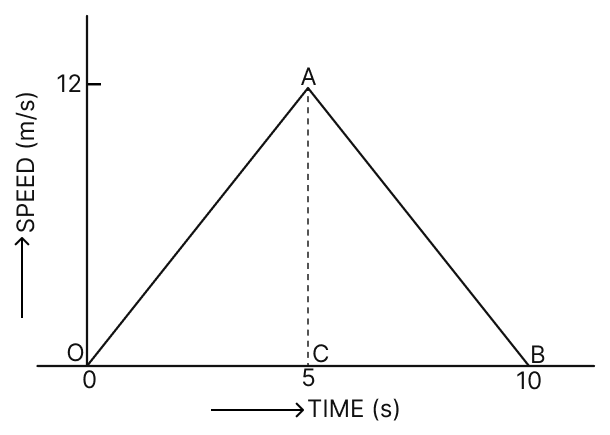
The speed-time graph of a particle moving along a fixed direction is shown in figure. Obtain the distance travelled by the particle between (a) t = 0 to 10 s, (b) t = 2 s to 6 s. What is the average speed of the particle over the intervals in (a) and (b)?
Answer
Given (read from the speed-time graph),
- The speed rises from 0 at t = 0 to a peak of 12 m s-1 at t = 5 s, then falls back to 0 at t = 10 s.
(a) Distance from t = 0 to t = 10 s. On a speed-time graph the distance equals the area beneath the curve, here the triangle OAB with base OB = 10 s and height AC = 12 m s-1 :
Average speed over this interval :
(b) Distance from t = 2 s to t = 6 s. This interval straddles the peak, so we split it at t = 5 s into a rising part (2 s to 5 s) and a falling part (5 s to 6 s).
Rising part. The acceleration on OA is the slope :
Speed at t = 2 s :
Distance from t = 2 s to t = 5 s (duration 3 s) :
Falling part. The acceleration on AB is
Starting from the peak speed 12 m s-1, distance from t = 5 s to t = 6 s (duration 1 s) :
Total distance from t = 2 s to t = 6 s :
Average speed over this interval :
The 'velocity-time' graph of a particle in one-dimensional motion is shown in the figure. Which of the following formulae are correct for describing the motion of the particle over the time-interval t1 and t2?
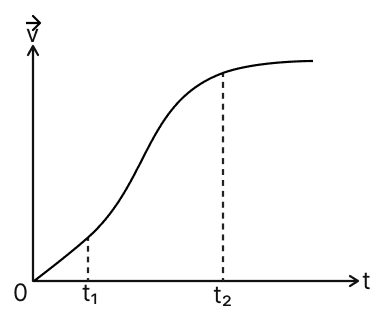
- x (t2) = x (t1) + v (t1) (t2 - t1) + a (t2 - t1)2
- v (t2) = v (t1) + a (t2 - t1)
- vaverage =
- aaverage =
- x (t2) = x (t1) + vaverage (t2 - t1) + aaverage (t2 - t1)2
- x (t2) - x (t1) = area under the v-t curve bounded by the t-axis and the dotted lines shown.
Answer
Formulae 3, 4 and 6 are correct; formulae 1, 2 and 5 are wrong.
Reason —
The v-t graph shown is curved, which means the acceleration is not constant between t1 and t2.
Wrong. The term a(t2 - t1)2 comes from the equation of motion for uniform acceleration. As the acceleration varies here, this relation does not apply.
Wrong. v = u + a(t2 - t1) again assumes a single fixed acceleration, which is not the case for this curved graph.
Correct. This is simply the definition of average velocity — total displacement over total time — and holds no matter how the acceleration behaves.
Correct. This is the definition of average acceleration — total change in velocity over total time — and is always valid.
Wrong. Slotting the average acceleration into a uniform-acceleration formula is not legitimate, so this expression does not describe the motion.
Correct. The area enclosed by the v-t curve and the time-axis always equals the displacement, whether or not the acceleration is uniform.
An aircraft is flying at a height of 3400 m above the ground with uniform speed. If the angle subtended at an observation point on the ground by two positions of the aircraft 10 s apart is 30°, what is the speed of the aircraft?
Answer
Given,
- Height of the aircraft above the observer, OC = 3400 m
- Angle subtended at the observer by the two positions = 30°
- Time between the two positions = 10 s
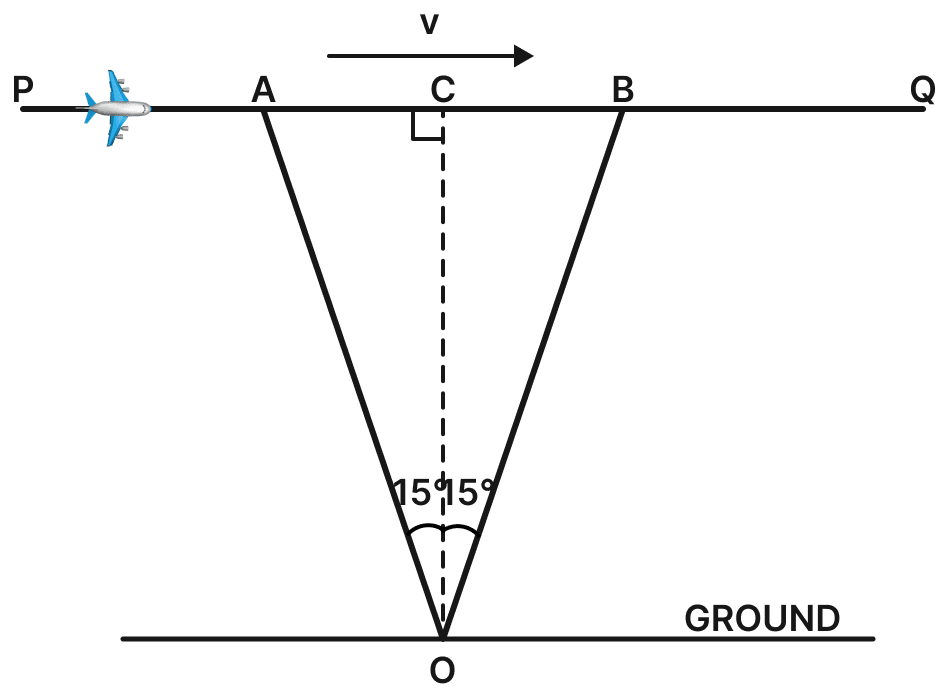
Let O be the observation point on the ground and let the aircraft fly horizontally along PQ, passing positions A and B that are 10 s apart. C is the foot of the perpendicular from O to the flight line, so OC = 3400 m.
By symmetry the line OC bisects the 30° angle, giving
and the aircraft covers AC in half of 10 s, that is, 5 s.
Finding AC. In the right-angled triangle ACO,
Finding the speed. The aircraft travels this 911 m in 5 s, so
Hence the aircraft is flying at about 182.2 m s-1.