
A block of mass m moves on a rough horizontal plane with velocity v at point 'O'. The resistive frictional force varies as F = ar + br2, where a and b are constants and r, the distance from point 'O' (As shown in the figure) Find the total distance covered by the block before it comes to rest.

Answer
Given,
- Mass of the block = m
- Velocity of the block at O = v
- Resistive frictional force, F = ar + br2
The block is brought to rest by the resistive frictional force. Let the total distance covered before it stops be R.
Since the frictional force varies with the distance r, it is a variable force. The work done by a variable force is obtained by integration,
the negative sign appearing because the frictional force is opposite to the displacement.
Integrating,
By the work-kinetic energy theorem, the work done by the net force equals the change in kinetic energy. The block finally comes to rest, so its final kinetic energy is zero,
Therefore,
Multiplying throughout by 6,
Hence, the total distance R covered by the block before coming to rest is given by 2bR3 + 3aR2 = 3mv2.
An object is displaced from position vector m to m under the action of a force N. Find the work done by this force.
Answer
Given,
- Initial position, m
- Final position, m
- Force, N
The force is a variable force, since it depends on the coordinates x and y. The work done by a variable force is
Writing ,
From the position vectors, x changes from 2 m to 4 m and y changes from 3 m to 6 m. Therefore,
Integrating each term separately,
and
Adding the two,
Hence, the work done by the force is 83 J.
A simple pendulum of length l has a maximum angular displacement θ. What would be the maximum kinetic energy of its bob ?
Answer
Given,
- Length of the simple pendulum = l
- Maximum angular displacement = θ
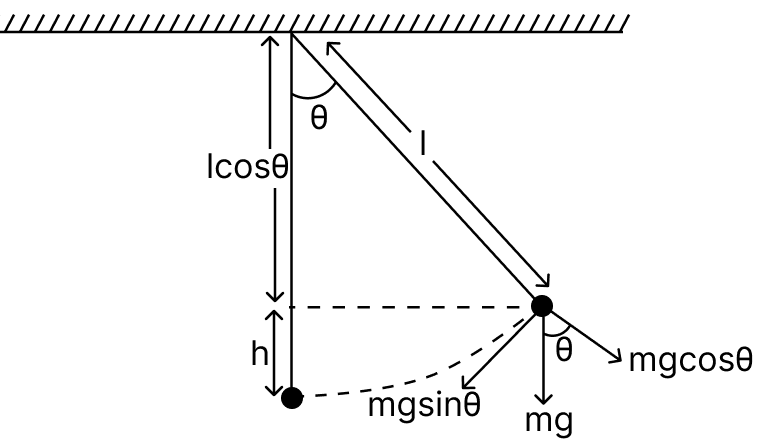
Let m be the mass of the bob. When the string makes an angle θ with the vertical, the bob is at its extreme position, where its velocity is zero and it possesses only potential energy.
If the bob is raised through a height h above its lowest position, then from the geometry of the figure,
The potential energy of the bob at the extreme position is
As the bob swings down towards the lowest position, this potential energy is gradually converted into kinetic energy. At the lowest point the height is zero, so the whole of the potential energy appears as kinetic energy. By the principle of conservation of mechanical energy, the maximum kinetic energy of the bob is
Hence, the maximum kinetic energy of the bob is mgl (1 − cos θ), which occurs at the lowest point of the swing.
A bullet of mass m moving with a horizontal velocity v, strikes a stationary block of mass M suspended by a string of length l. The bullet gets embedded in the block. What is the maximum angle made by the string after impact?
Answer
Given,
- Mass of the bullet = m, moving with horizontal velocity v
- Mass of the block = M, initially at rest
- Length of the string = l
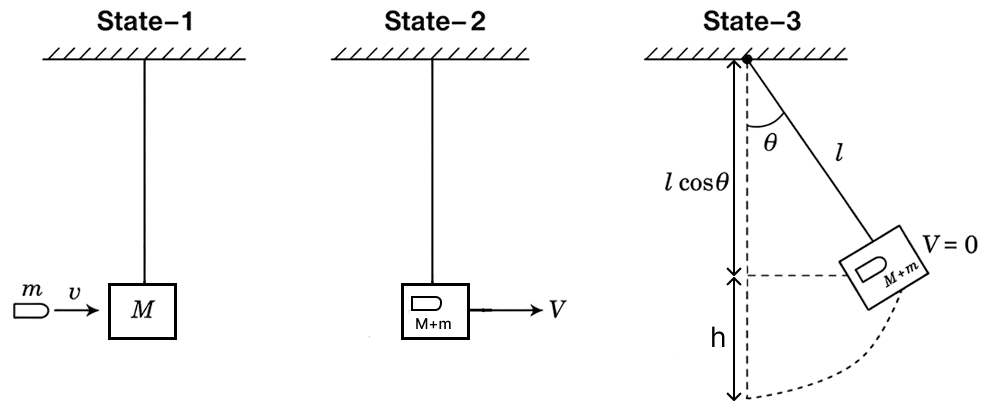
Step 1 : The collision. The bullet gets embedded in the block, so the collision is perfectly inelastic. By the principle of conservation of linear momentum, if V is the common velocity of the bullet and the block just after the impact,
Step 2 : The rise of the block. After the collision the combined mass swings up on the string. If it rises through a height h before momentarily coming to rest, then by the conservation of mechanical energy,
Step 3 : The angle of the string. If θ is the maximum angle made by the string with the vertical, then from the geometry,
Substituting the value of h,
Hence, the maximum angle made by the string after the impact is
A pendulum bob of mass 10-2 kg is raised to a height 5 × 10⁻² m and then released. At the bottom of its swing, it picks up a mass 10-3 kg. To what height will the combined mass rise ? (g = 10 m s-2)
Answer
Given,
- Mass of the pendulum bob, m1 = 10-2 kg
- Height through which it is raised, h1 = 5 × 10⁻² m
- Mass picked up at the bottom, m2 = 10-3 kg
- g = 10 m s-2
Step 1 : Velocity of the bob at the bottom of the swing. As the bob falls through the height h1, its potential energy is converted into kinetic energy. By the conservation of mechanical energy,
Substituting the values,
Step 2 : Picking up the extra mass. The bob picks up the mass m2, so the process is a perfectly inelastic collision. By the conservation of linear momentum, if V is the common velocity,
Step 3 : Rise of the combined mass. The kinetic energy of the combined mass is now converted into potential energy as it rises through a height h2,
Substituting the values,
Hence, the combined mass rises to a height of about 4.13 × 10⁻² m, that is, nearly 4.1 cm.
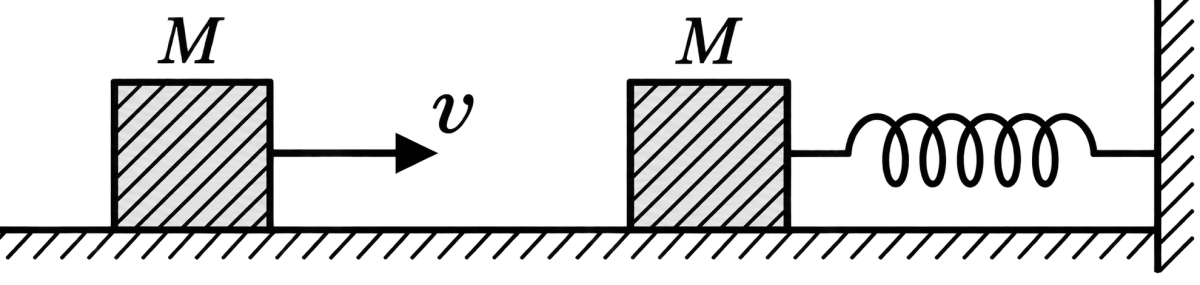
A spring of force-constant 10 N m-1 is lying along the x-axis on a horizontal frictionless table. One of its ends is fixed. A piece of mass 0.1 kg is attached to the other end. Another piece of mass 0.1 kg is now sent with a velocity of 1.0 m s-1 along the x-axis towards the attached mass. After head-on collision it returns back with velocity 0.6 m s-1. Calculate the maximum displacement of the attached piece and the amplitude of S.H.M. set in.
Answer
Given,
- Force constant of the spring, k = 10 N m-1
- Mass of the attached piece, M = 0.1 kg
- Mass of the striking piece = 0.1 kg
- Velocity of the striking piece, v = 1.0 m s-1
- Velocity with which it returns back, v′ = 0.6 m s-1
Maximum displacement of the attached piece : At the collision the whole of the kinetic energy of the striking mass is used in displacing the attached mass, that is, in compressing the spring of force-constant k.
At the position of maximum compression the attached piece is momentarily at rest, so the whole of this energy is stored as the elastic potential energy of the spring. Thus, if the maximum compression of the spring be x, then
Substituting the values,
Amplitude of the S.H.M. set in : After the head-on collision the striking piece returns back with the velocity v′, and the attached mass performs S.H.M. during which the spring undergoes extension and compression alternately.
The energy left with the spring-mass system is the difference between the initial kinetic energy of the striking piece and the kinetic energy it carries away on returning. If a is the amplitude of elongation of the spring, then by the conservation of energy,
Substituting the values,
Hence, the maximum displacement of the attached piece is 0.1 m and the amplitude of the S.H.M. set in is 0.08 m.
A block of mass 4.0 kg strikes a spring with a speed of 3.0 m s-1 on a frictionless horizontal surface. When the block compresses the spring, it exerts a constant force of 120 N on the spring, and the same force is exerted by the spring on the block when the block returns to its initial position.
(a) Is this collision elastic?
(b) What is the kinetic energy of the block in the beginning?
(c) What is the maximum compression of the spring?
(d) What is the ratio between kinetic energy and potential energy when the spring is compressed through 10 cm ?
Answer
Given,
- Mass of the block, m = 4.0 kg
- Speed of the block, v = 3.0 m s-1
- Constant force exerted on the spring, F = 120 N
(a) The block exerts a constant force of 120 N on the spring while compressing it, and the spring exerts the same force of 120 N on the block while returning it to its initial position. This means that the whole of the energy stored in the spring during compression is returned to the block, and no energy is lost.
Hence, the collision is elastic.
(b) The kinetic energy of the block in the beginning is
(c) At the position of maximum compression the block momentarily comes to rest, so the whole of its kinetic energy has been used in doing work against the constant force of the spring. If x is the maximum compression,
Hence, the maximum compression of the spring is 0.15 m.
(d) When the spring is compressed through 10 cm = 0.1 m, the potential energy stored in the spring is equal to the work done against the constant force,
The kinetic energy left with the block at this instant is
Therefore the required ratio is
Hence, the ratio of the kinetic energy to the potential energy is 1 : 2.
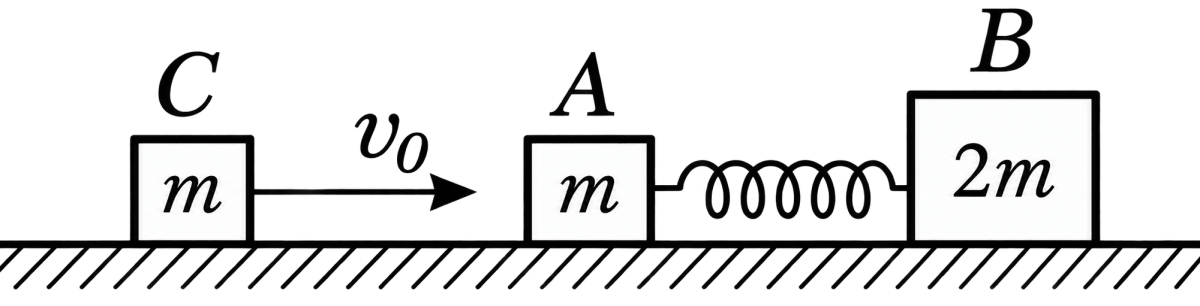
Two bodies A and B of masses m and 2 m respectively are placed on a smooth floor. They are connected by a spring. A third body C of mass m moves with a velocity v0 along the line joining A and B and collides elastically with A, as shown in the figure. At a time t0 after the collision, it is found that the instantaneous velocities of A and B are the same and the compression of the spring is x0. Determine :
(a) the common velocity of A and B at time t0,
(b) the spring-constant.
Answer
Given,
- Mass of body A = m, mass of body B = 2m
- Mass of body C = m, moving with velocity v0
- Compression of the spring at time t0 = x0
(a) The body C of mass m collides elastically with the body A of mass m. In a one-dimensional elastic collision between two bodies of equal masses, the bodies merely exchange their velocities. Since A is initially at rest, after the collision C comes to rest and A moves with the velocity v0.
After this, A compresses the spring and pushes B forward. The system of A and B is now free from any external horizontal force, so its linear momentum is conserved. At the time t0 the two bodies have the same instantaneous velocity, say V. Therefore,
Hence, the common velocity of A and B at time t0 is .
(b) By the conservation of mechanical energy for the system of A, B and the spring, the initial kinetic energy of A is shared as the kinetic energy of the two bodies and the elastic potential energy of the spring,
Substituting ,
Therefore,
Hence, the spring-constant is .
A body of mass 5 kg moves along the x-axis with a velocity of 2 m s-1. A second body of mass 10 kg moves along the y-axis with a velocity of m s-1. They collide at the origin and stick together. Calculate (a) the final velocity of the combined mass after collision and (b) the amount of heat liberated in the collision.
Answer
Given,
- Mass of the first body, m1 = 5 kg moving along the x-axis with v1 = 2 m s-1
- Mass of the second body, m2 = 10 kg moving along the y-axis with m s-1
- The bodies stick together after the collision
(a) Since the bodies stick together, the collision is perfectly inelastic and the linear momentum is conserved separately along the x- and the y-directions.
The momentum along the x-axis before the collision is
The momentum along the y-axis before the collision is
The magnitude of the total momentum after the collision is
The combined mass is m1 + m2 = 15 kg, so its velocity is
If θ is the angle made by this velocity with the x-axis,
Hence, the combined mass moves with a velocity of 1.33 m s-1 at 60° with the x-axis.
(b) The kinetic energy before the collision is
The kinetic energy after the collision is
The loss in kinetic energy appears as heat,
Hence, about 11.7 J of heat is liberated in the collision.
Consider a one-dimensional elastic collision between a given incoming body A and a body B initially at rest. How would you choose the mass of B in comparison to the mass of A in order that B should recoil with
(a) greatest speed,
(b) greatest momentum,
(c) greatest kinetic energy?
Answer
Let the body A of mass m1 move with velocity u1 and strike the body B of mass m2, which is initially at rest (u2 = 0). For a one-dimensional elastic collision, the velocity of B after the collision is
(a) Greatest speed : Rewriting the expression by dividing the numerator and the denominator by m1,
The speed v2 is greatest when the denominator is least, that is, when is as small as possible. In the limit m2 << m1, we get v2 = 2u1.
Hence, for the greatest speed the mass of B should be much less than the mass of A.
(b) Greatest momentum : The momentum of B after the collision is
This is greatest when is as small as possible, that is, when m2 is very large. In the limit m2 >> m1, the momentum approaches 2m1u1.
Hence, for the greatest momentum the mass of B should be much greater than the mass of A.
(c) Greatest kinetic energy : The kinetic energy transferred to B is greatest when the transfer of energy is complete. In a one-dimensional elastic collision the whole of the kinetic energy is transferred from A to B only when the two masses are equal, for then the bodies merely exchange their velocities, A comes to rest and B moves off with the velocity u1.
Hence, for the greatest kinetic energy the mass of B should be equal to the mass of A.
A particle of mass m0 moves with a speed c/2. Calculate its mass, momentum, total energy and kinetic energy.
Answer
Given,
- Rest mass of the particle = m0
- Speed of the particle,
Mass : According to the theory of relativity, the mass of a particle moving with a speed v is
Substituting ,
Momentum : The momentum of the particle is
Total energy : By the mass-energy equivalence relation, the total energy is
Kinetic energy : The kinetic energy is the difference between the total energy and the rest mass energy,
Hence, the mass is 1.155 m0, the momentum is 0.577 m0c, the total energy is 1.155 m0c2 and the kinetic energy is 0.155 m0c2.
A vehicle of mass m is driven by a constant power P. Express the instantaneous velocity v of the vehicle as a function of displacement 's' assuming the vehicle to start from rest.
Answer
Given,
- Mass of the vehicle = m
- Constant power of the engine = P
- The vehicle starts from rest
The power delivered to the vehicle is
To express the velocity in terms of the displacement s, we write the acceleration as
Substituting this,
Separating the variables,
Integrating, with v = 0 at s = 0,
Therefore,
Hence, the instantaneous velocity of the vehicle as a function of the displacement s is , that is, .
A shell is fired from a cannon with a velocity of 50 ms-1 at an angle 60° to the horizontal. At the highest point of its path, it splits up into three equal parts; one part retraces its path; the other falls down vertically. What is the velocity of the third part ?
Answer
Given,
- Velocity of projection of the shell, u = 50 m s-1
- Angle of projection, θ = 60°
- The shell splits into three equal parts at the highest point
At the highest point of the path, the vertical component of the velocity becomes zero and only the horizontal component remains. Therefore the velocity of the shell at the highest point is
Let the mass of the shell be 3m, so that each of the three equal parts has mass m.
The momentum of the shell just before the explosion, in the horizontal direction, is
After the explosion :
- The first part retraces its path, so it moves backward with a velocity of 25 m s-1, that is, its momentum is − 25m.
- The second part falls down vertically, so its horizontal momentum is zero.
- Let the third part move with velocity v in the horizontal direction, so its momentum is m v.
By the principle of conservation of linear momentum in the horizontal direction,
Hence, the third part moves horizontally with a velocity of 100 m s-1 in the original direction of motion of the shell.
A 40-kg sphere suspended by a thread of length l is oscillating in a vertical plane, the angular amplitude being θ0. What is the tension in the thread when it makes an angle θ with the vertical during oscillations? If the thread can support a maximum tension of 80 kg, then what can be the maximum angular amplitude of oscillation of the sphere?
Answer
Given,
- Mass of the sphere, m = 40 kg
- Length of the thread = l
- Angular amplitude = θ0
- Maximum tension the thread can support = 80 kg f
- g = 9.8 m s-2 (not given in the question; taken as its standard value)
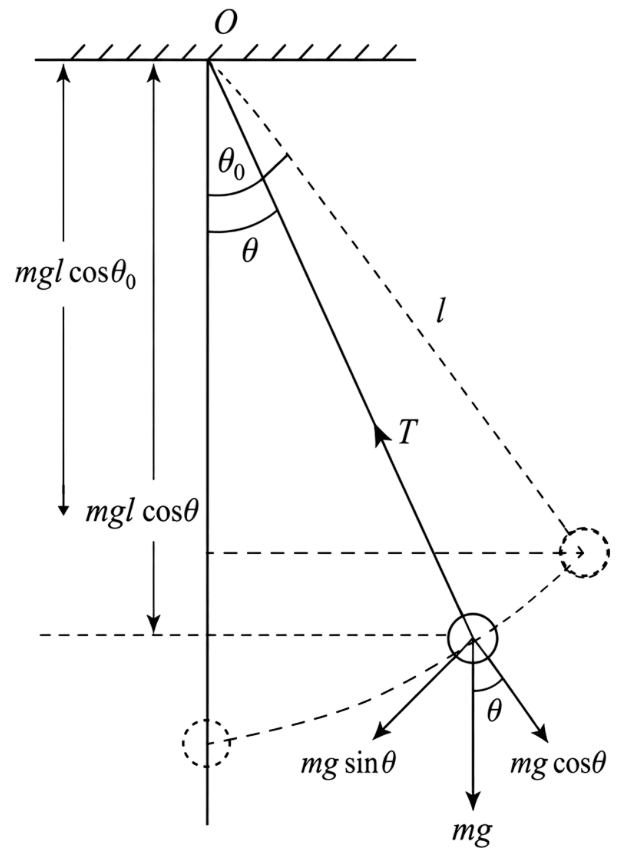
Converting the given quantities into the absolute unit of force,
Tension at an angle θ : Let v be the velocity of the sphere when the thread makes an angle θ with the vertical. Taking the extreme position (angular amplitude θ0) as the position of zero velocity and applying the conservation of mechanical energy between the two positions,
At the position θ, the net radial force towards the centre provides the necessary centripetal force,
Substituting the value of v2,
Substituting mg = 392 N,
Maximum angular amplitude : The tension is greatest at the lowest point, where θ = 0 and cos θ = 1,
The thread can support a maximum tension of 784 N, while the weight of the sphere is 392 N. Therefore,
Hence, the tension in the thread at an angle θ is 392 (3 cos θ − 2 cos θ0) N, and the maximum angular amplitude of oscillation is 60°.
A 500-g sphere suspended by a string of 1.0 m length is oscillating in a vertical plane, and its angular amplitude is 60°. During oscillations, when the string is at 30° with vertical, then calculate the tension in the string. (g = 10 ms-2)
Answer
Given,
- Mass of the sphere, m = 500 g = 0.5 kg
- Length of the string, l = 1.0 m
- Angular amplitude, θ0 = 60°
- Angle at which the tension is required, θ = 30°
- g = 10 m s-2
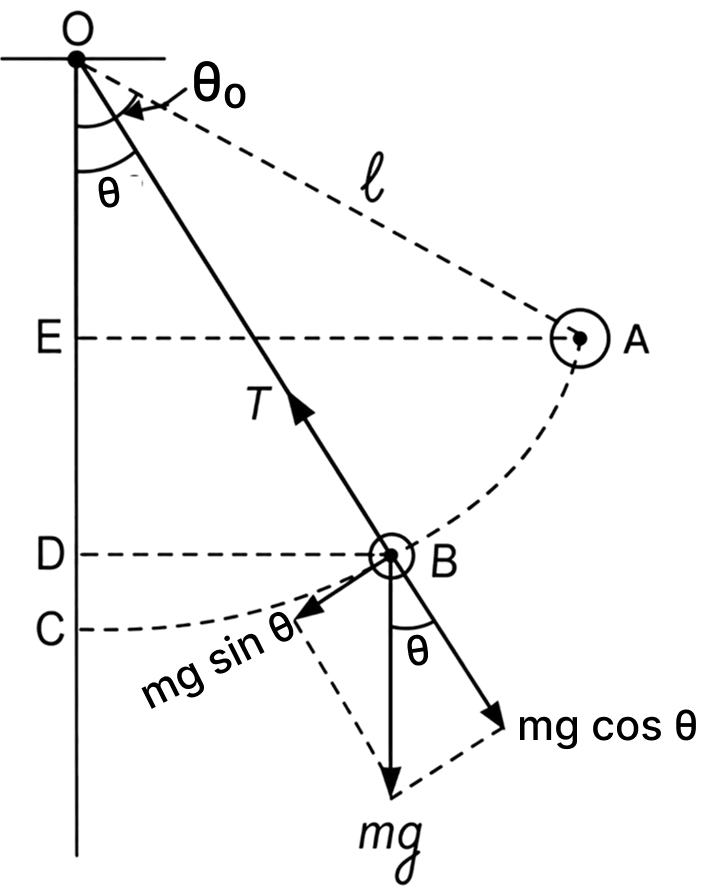
Tension at an angle θ : Let v be the velocity of the sphere when the thread makes an angle θ with the vertical. Taking the extreme position (angular amplitude θ0) as the position of zero velocity and applying the conservation of mechanical energy between the two positions,
At the position θ, the net radial force towards the centre provides the necessary centripetal force,
Substituting the value of v2,
Substituting the given values, with cos 30° = = 0.866 and cos 60° = 0.5,
Hence, the tension in the string is about 8 N.
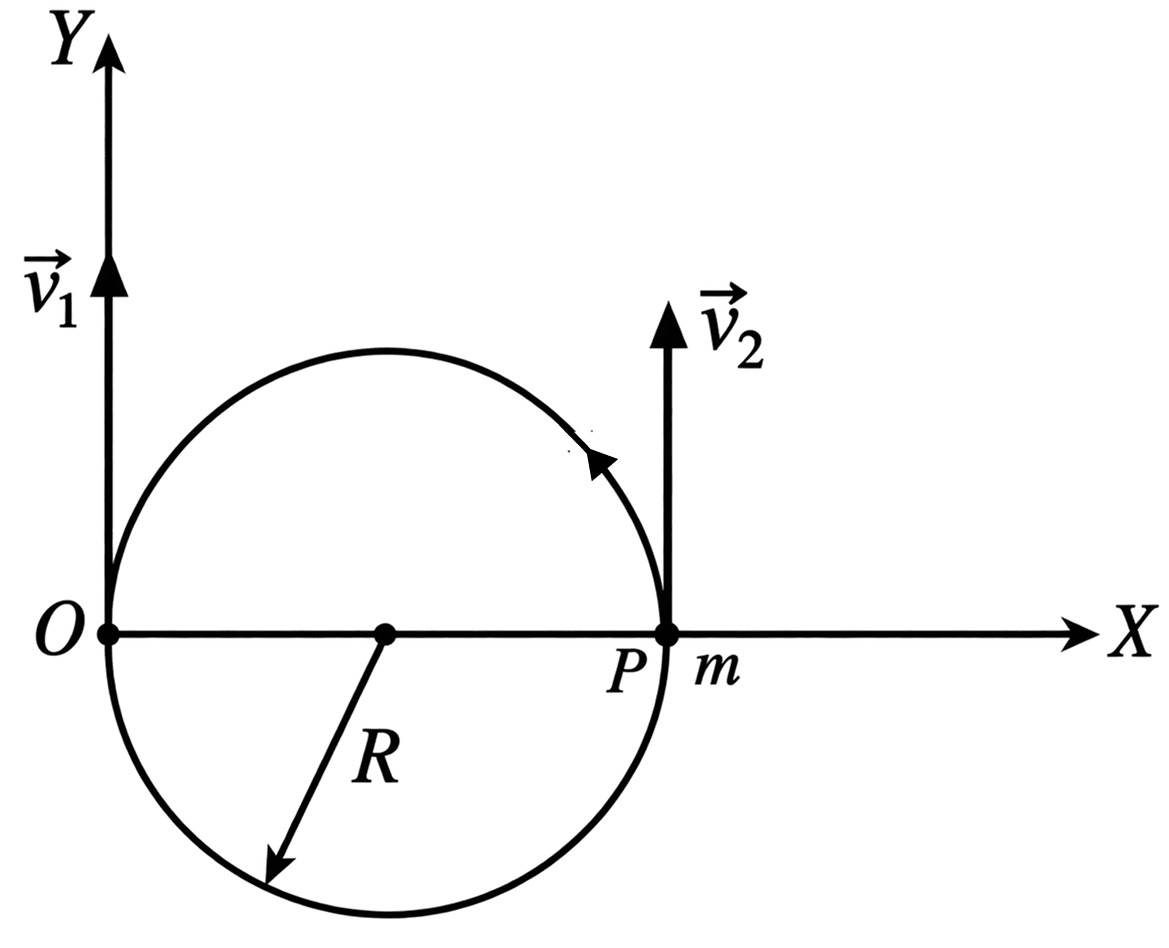
A man at the origin O starts moving with a constant velocity along + Y-axis. At the same instant, a particle of mass m starts moving from point P with a uniform velocity along a circle of radius R, as shown. Find the linear momentum of the particle with respect to the man as a function of time t.
Answer
Given,
- The man starts from the origin O with constant velocity along the + Y-axis
- A particle of mass m starts from the point P with uniform velocity along a circle of radius R
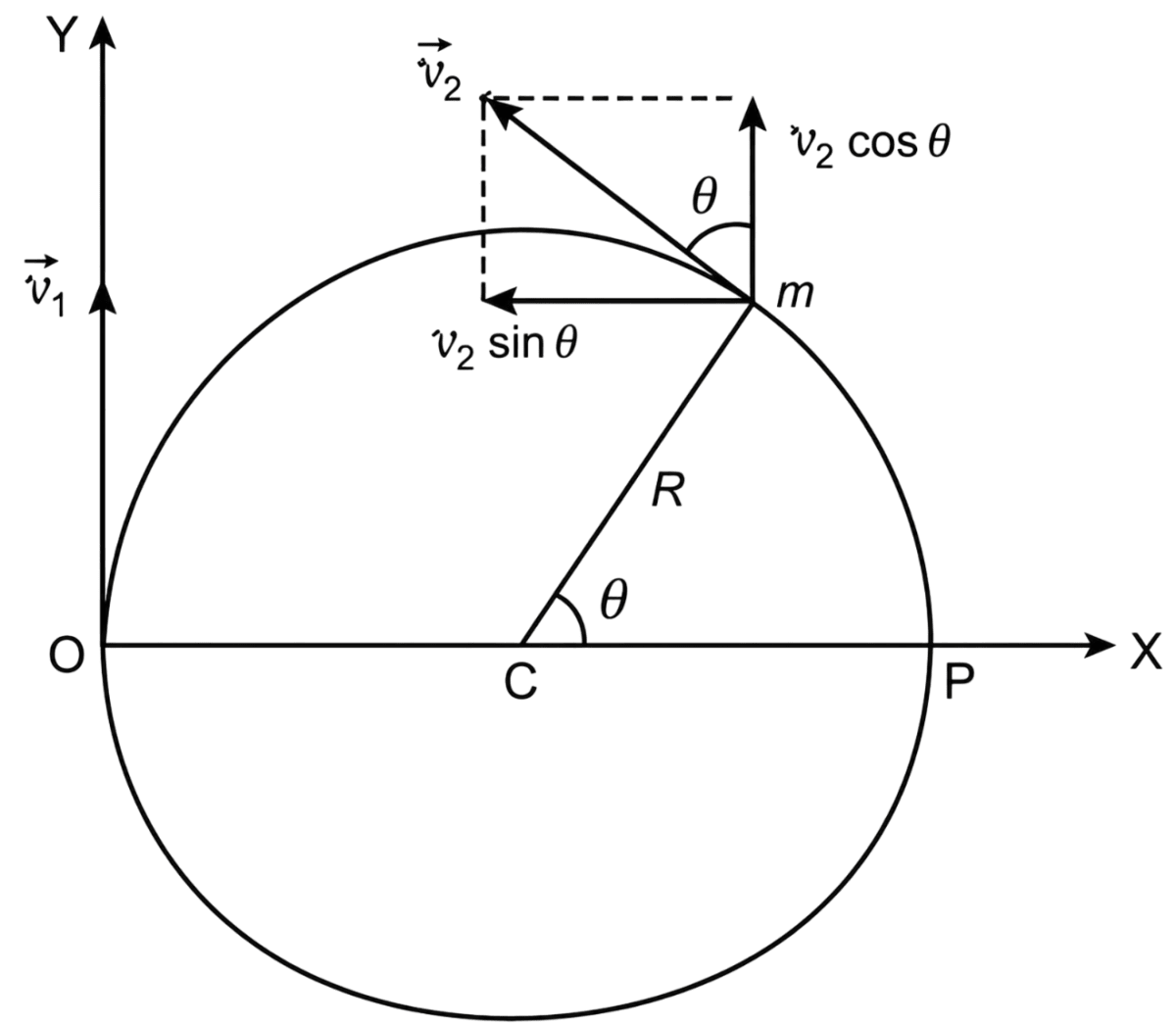
The particle moves along a circle of radius R with a uniform speed v2, so its angular velocity is
At the instant t = 0 the particle is at P, where its velocity is along the + Y-direction. After a time t the radius vector has turned through an angle = = ωt, so the velocity of the particle, which is always along the tangent, is
The velocity of the man is constant,
The velocity of the particle with respect to the man is
Therefore the linear momentum of the particle with respect to the man is
Hence, the linear momentum of the particle with respect to the man varies with time as given above, its magnitude being
A particle at rest starts sliding down from the top of a large frictionless sphere of radius R. The sphere is fixed on the ground. Calculate the height from the ground at which the particle leaves the surface of the sphere.
Answer
Given,
- Radius of the frictionless sphere = R
- The particle starts sliding from rest from the top
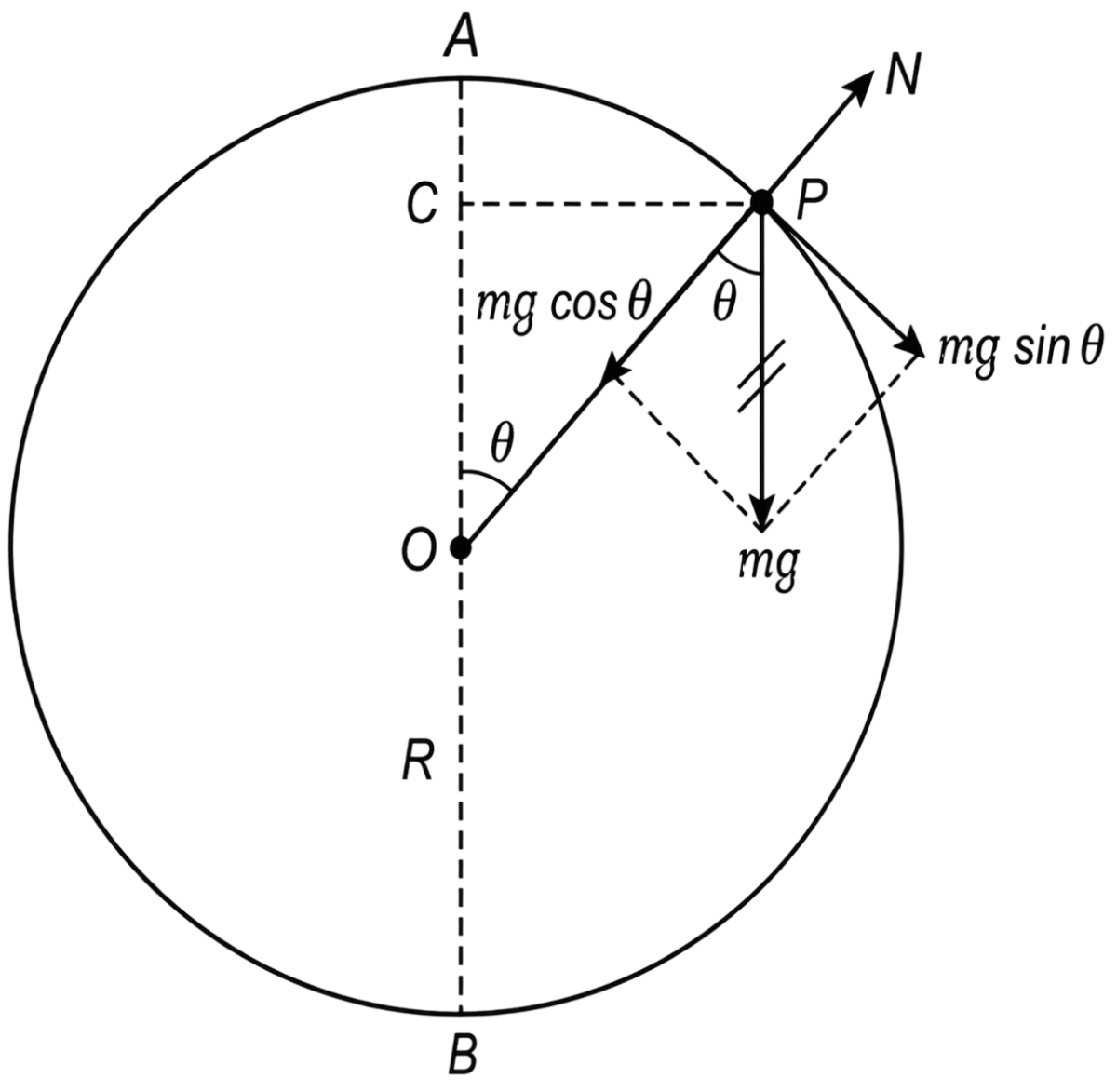
Let O be the centre of the sphere, A its topmost point and B the point where it touches the ground. Let P be the instantaneous position of the particle of mass m during its sliding, such that ∠POA = θ. Let v be the velocity of the particle at P.
Step 1 : Condition for leaving the surface. At the point P the net radially inward force on the particle is mg cos θ − N, where N is the normal reaction at the surface of the sphere. This supplies the necessary centripetal force, and thus
The particle will fly off the surface at that angle θ for which N = 0, that is,
Step 2 : Conservation of mechanical energy. The fall in the height of the particle in sliding down from A to P is
Since the sphere is smooth, the loss in potential energy due to this fall appears as the kinetic energy of the particle at P,
Step 3 : Solving. Equating (i) and (ii),
Step 4 : Height above the ground. The sphere is fixed on the ground, so the centre O is at a height R above the ground. Hence the height of the point P at which the particle flies off the surface is
Hence, the particle leaves the surface of the sphere at a height above the ground.
A ball of mass 0.5 kg tied at one end of a cord of length 50 cm is revolved in a vertical circle. If the speed of the ball at the lowest point of the circle is 8 m/s, then will the ball be able to complete one round? If yes, then what will be the speed of the ball at the highest point of the circle? What will be the tensions in the cord at the highest and the lowest points? (g = 10 m/s2)
Answer
Given,
- Mass of the ball, m = 0.5 kg
- Length of the cord (radius), l = 50 cm = 0.5 m
- Speed at the lowest point, vB = 8 m/s
- g = 10 m/s2
Step 1 : Will the ball complete the circle? For a body to just complete a vertical circle, the minimum speed required at the lowest point is
Since the actual speed at the lowest point (8 m/s) is greater than 5 m/s, the ball is able to complete one round.
Step 2 : Speed at the highest point. Applying the conservation of mechanical energy between the lowest point B and the highest point A, which are separated by a vertical height 2l,
Substituting the values,
Step 3 : Tension at the highest point. At the highest point the tension and the weight both act towards the centre,
Step 4 : Tension at the lowest point. At the lowest point the tension acts upwards and the weight downwards,
Hence, the ball completes the round, its speed at the highest point is 6.63 m/s, and the tensions in the cord are 39 N at the highest point and 69 N at the lowest point.
A bullet of mass 0.012 kg and horizontal speed 70 m s-1 strikes a block of wood of mass 0.4 kg and instantly comes to rest with respect to the block. The block is suspended from the ceiling by means of thin wires. Calculate the height to which the block rises. Also, estimate the amount of heat produced in the block. (g = 9.8 m s-2)
Answer
Given,
- Mass of the bullet, m = 0.012 kg
- Horizontal speed of the bullet, v = 70 m s-1
- Mass of the block, M = 0.4 kg
- g = 9.8 m s-2
Step 1 : Common velocity after the impact. The bullet comes to rest with respect to the block, so the collision is perfectly inelastic. By the conservation of linear momentum,
Step 2 : Height to which the block rises. After the impact the combined mass swings up, and by the conservation of mechanical energy its kinetic energy is converted into potential energy,
Step 3 : Heat produced. The heat produced is equal to the loss in the kinetic energy during the collision. The kinetic energy before the collision is
The kinetic energy just after the collision is
Therefore the heat produced is
Hence, the block rises to a height of about 0.212 m and nearly 28.5 J of heat is produced in the block.
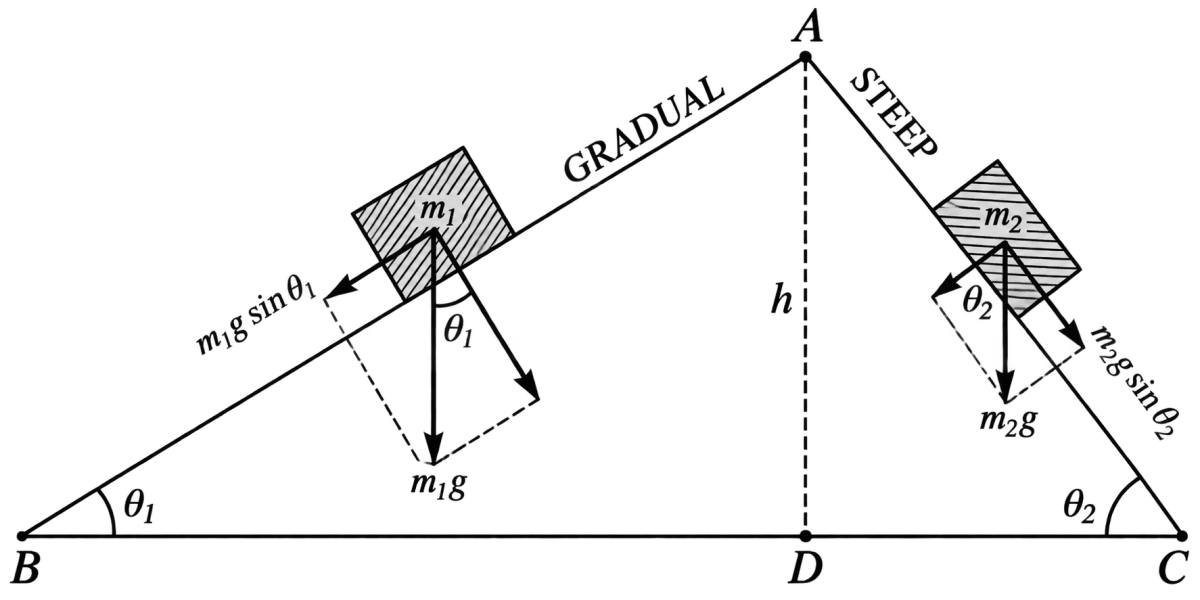
Two inclined frictionless tracks, one gradual and the other steep meet at A from where two stones are allowed to slide down from rest, one on each track, as shown in the figure. Will the stones reach the bottom at the same time? Will they reach there with the same speed? Explain. Given : θ1 = 30°, θ2 = 60°, and h = 10 m. What are the speeds and times taken by the two stones? (g = 10 m s-2)
Answer
Given,
- Angle of the gradual track, θ1 = 30°
- Angle of the steep track, θ2 = 60°
- Common height, h = 10 m
- g = 10 m s-2
Speeds at the bottom : Both the tracks are frictionless, so for each stone the loss in potential energy is completely converted into kinetic energy. By the conservation of mechanical energy,
This result does not contain the angle of the incline, so both the stones reach the bottom with the same speed,
Hence, the two stones reach the bottom with the same speed of 14.1 m s-1.
Times taken : The acceleration of a stone sliding down a frictionless incline of angle θ is a = g sin θ, and the length of the incline is . Starting from rest, using ,
Here s.
For the gradual track (θ1 = 30°, sin 30° = 0.5),
For the steep track (θ2 = 60°, sin 60° = 0.866),
Hence, the stones do not reach the bottom at the same time. The stone on the steep track takes 1.63 s while that on the gradual track takes 2.83 s, since the steeper incline gives a larger acceleration along a shorter path.
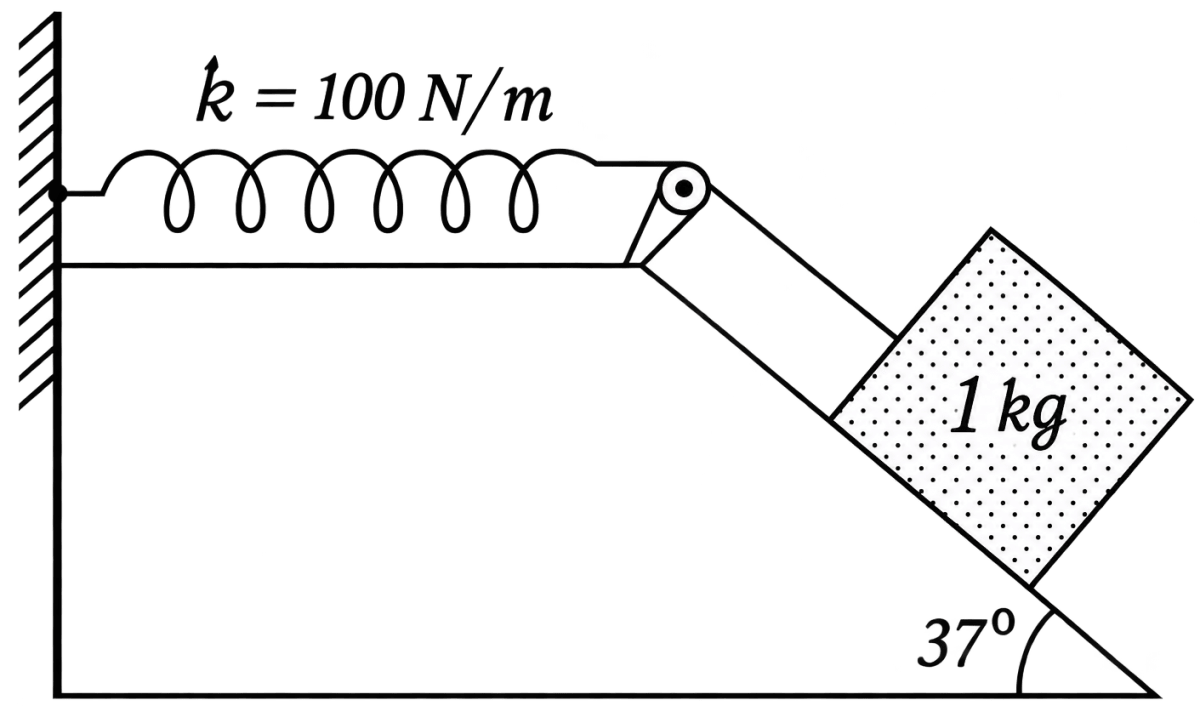
A 1 kg block situated on a rough inclined plane is connected to a spring of spring-constant 100 N m-1, as shown in the figure. The block is released from rest with the spring in the unstretched position. The block moves 10 cm down the inclined plane before coming to rest. Find the coefficient of friction between the block and the inclined plane. Assume that the spring has a negligible mass and the pulley is frictionless. (Given : g = 10 N/kg, sin 37° = 3/5, cos 37° = 4/5)
Answer
Given,
- Mass of the block, m = 1 kg
- Spring constant, k = 100 N m-1
- Distance moved down the incline, x = 10 cm = 0.1 m
- Angle of the incline, θ = 37°
- g = 10 N/kg, sin 37° = 3/5 = 0.6, cos 37° = 4/5 = 0.8
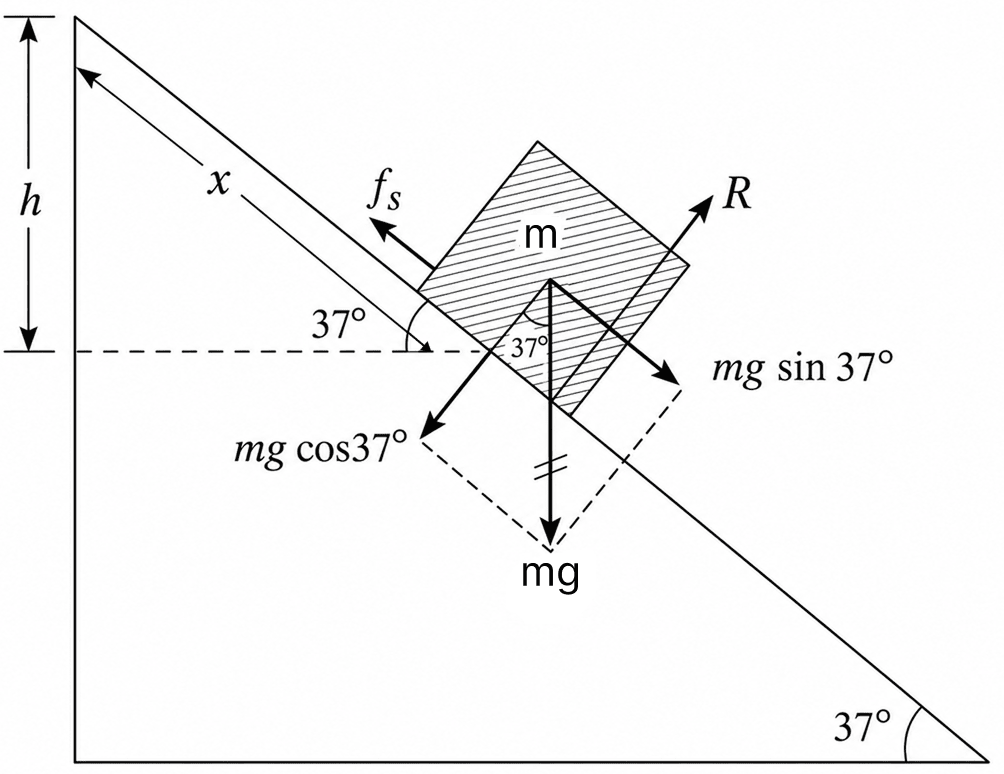
The block is released from rest with the spring unstretched, and it again comes to rest after moving 10 cm down the incline. Since the block is at rest at both the ends of this displacement, its change in kinetic energy is zero.
Therefore, by the conservation of energy, the loss in the gravitational potential energy of the block is used up in doing work against friction and in storing elastic potential energy in the spring,
where the frictional force is f = μ R = μ mg cos 37°. Thus,
Substituting the values,
Hence, the coefficient of friction between the block and the inclined plane is 0.125.
A bolt of mass 0.3 kg falls from the ceiling of an elevator moving down with a uniform speed of 7 ms-1. It hits the floor of the elevator (length of the elevator = 3 m) and does not rebound. What is the heat produced by the impact? Would your answer be different if the elevator were stationary? (g = 9.8 ms-2)
Answer
Given,
- Mass of the bolt, m = 0.3 kg
- Uniform speed of the elevator = 7 m s-1 (downward)
- Length of the elevator (distance of fall), h = 3 m
- g = 9.8 m s-2
The elevator moves with a uniform speed, so it is a non-accelerated frame and the relative motion of the bolt with respect to the elevator is exactly the same as it would be in a stationary elevator. With respect to the elevator, the bolt starts from rest and falls freely through 3 m.
The loss in the potential energy of the bolt relative to the floor of the elevator is
The bolt does not rebound after hitting the floor, so the whole of this energy is converted into heat,
Hence, the heat produced by the impact is 8.82 J.
No, the answer would not be different if the elevator were stationary. Since the elevator moves with a uniform velocity, it is not an accelerated frame; the relative velocity with which the bolt strikes the floor and hence the heat produced remain the same as in a stationary elevator.
A trolley of mass 200 kg moves with a uniform speed of 36 km / h on a frictionless track. A child of mass 20 kg runs on the trolley from one end to the other (10 m away) with a speed of 4 m s-1 relative to the trolley in a direction opposite to its motion, and jumps out of the trolley. What is the final speed of the trolley? How much has the trolley moved from the time the child begins to run?
Answer
Given,
- Mass of the trolley, M = 200 kg
- Speed of the trolley, v = 36 km/h = 10 m s-1
- Mass of the child, m = 20 kg
- Speed of the child relative to the trolley, u = 4 m s-1 (opposite to the motion)
- Distance run by the child on the trolley, l = 10 m
Step 1 : Final speed of the trolley. The track is frictionless, so no external horizontal force acts on the system of the trolley and the child. Hence the total linear momentum is conserved.
The initial momentum of the system is
Let v' be the final speed of the trolley. The child runs with a speed of 4 m s-1 relative to the trolley, in a direction opposite to its motion, so the velocity of the child with respect to the ground is (v' − 4).
By the conservation of linear momentum,
Hence, the final speed of the trolley is 10.36 m s-1.
Step 2 : Distance moved by the trolley. The child covers 10 m along the trolley with a relative speed of 4 m s-1, so the time taken is
During this time the trolley moves with the speed v' = 10.36 m s-1, so the distance moved by the trolley is
Hence, the trolley moves through about 25.9 m from the time the child begins to run.
A thin circular loop of radius R rotates about its vertical diameter with an angular frequency ω. Show that a small bead on the wire loop remains at its lowermost point for . What is the angle made by the radius vector joining the centre to the bead with the vertical downward direction for ? Neglect friction.
Answer
Given,
- Radius of the circular loop = R
- Angular frequency of rotation = ω
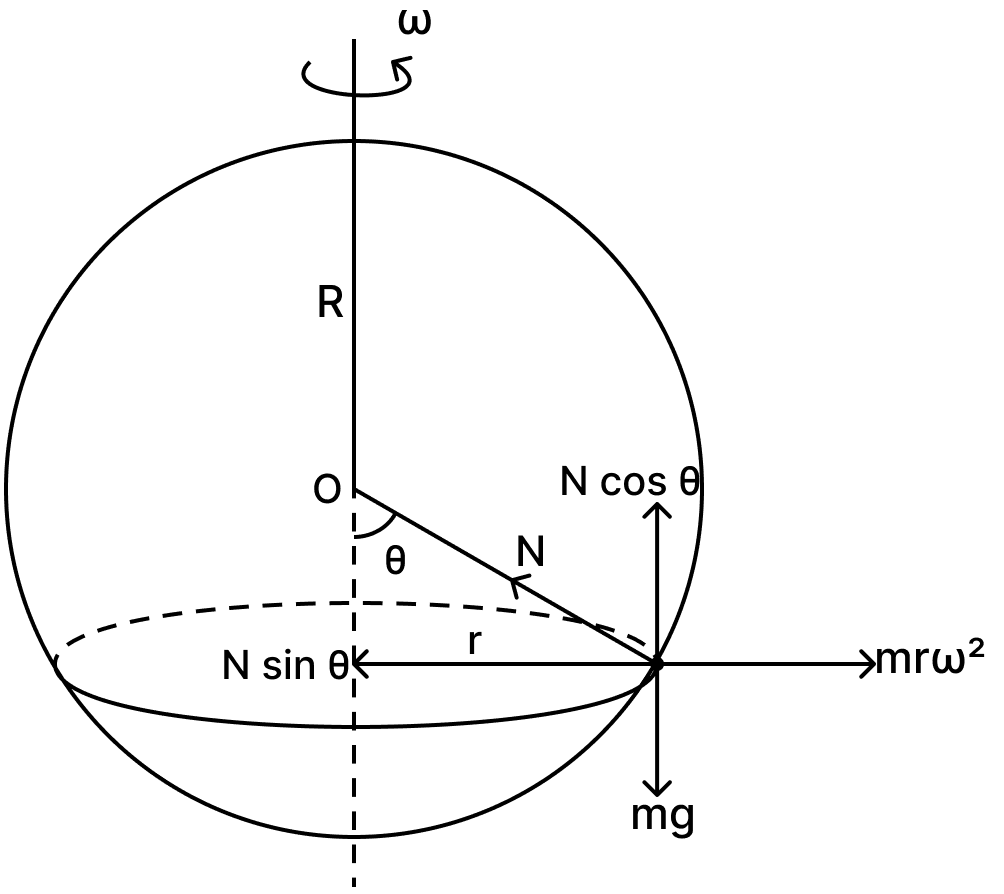
Let m be the mass of the bead and let the radius vector joining the centre of the loop to the bead make an angle θ with the vertical downward direction. The bead moves in a horizontal circle of radius R sin θ.
Two forces act on the bead : its weight mg vertically downwards and the normal reaction N exerted by the wire along the radius, towards the centre of the loop.
Resolving the normal reaction, the vertical component balances the weight,
and the horizontal component provides the centripetal force for the horizontal circle of radius R sin θ,
From equation (ii), provided sin θ ≠ 0,
Substituting this in equation (i),
Condition for the bead to stay at the lowermost point : Since cos θ cannot exceed 1, a solution with θ ≠ 0 is possible only when
Therefore, when , no such angle exists and the only possible position of the bead is θ = 0, that is, the bead remains at its lowermost point.
Angle for : Here . Substituting in equation (iii),
Hence, the bead remains at its lowermost point for , and for the radius vector makes an angle of 60° with the vertical downward direction.