
Which of the following is the correct unit of work?
- Joule
- Watt
- Newton
- Pascal
Answer
Joule
Reason — Work is the product of force and the displacement in the direction of the force, W = F s cos θ. The S.I. absolute unit of work is the joule (J). If a force of 1 newton produces a displacement of 1 metre in the direction of the force, the work done is 1 joule, that is, 1 joule = 1 newton × 1 metre. The watt is the unit of power, the newton is the unit of force and the pascal is the unit of pressure.
Power is defined as:
- work done per unit time
- force per unit time
- energy per unit force
- distance per unit time
Answer
work done per unit time
Reason — The rate of doing work by an agent, or a machine, is called the power of the agent, or the machine. Thus,
The average power is and the instantaneous power is .
Which of the following is the unit of power?
- Joule
- Watt
- Newton
- Pascal
Answer
Watt
Reason — Since power is work divided by time, its S.I. unit is joule/second (J s-1), which is called the watt (W). If 1 joule of work is done in 1 second, the power is 1 watt. The joule is the unit of work or energy, the newton is the unit of force and the pascal is the unit of pressure.
The unit of energy in the SI system is:
- Joule
- Calorie
- Erg
- Kilowatt-hour
Answer
Joule
Reason — Energy is the capacity to do work, so energy is measured in terms of the work done by a body. Its unit is therefore the same as that of work, that is, the joule (J) in the S.I. system. The calorie, the erg and the kilowatt-hour are also units of energy, but they belong to other systems of units and are not the S.I. unit.
A collision in which kinetic energy is conserved is called:
- elastic collision
- inelastic collision
- perfectly inelastic
- partial collision
Answer
elastic collision
Reason — An elastic collision is one in which both momentum and total kinetic energy are conserved. The forces involved are conservative in nature and the mechanical energy is not converted into other forms like heat, sound or light. In an inelastic collision the momentum is conserved but the total kinetic energy is not.
The coefficient of restitution for a perfectly elastic collision is:
- 0
- 1
- greater than 1
- less than 1 but greater than 0
Answer
1
Reason — The degree of elasticity of a collision is measured by the coefficient of restitution e, defined as the ratio of the relative speed of separation after collision to the relative speed of approach before collision. For a perfectly elastic collision the relative speed of separation is equal to the relative speed of approach, so e = 1. For a perfectly inelastic collision e = 0.
The product of force and displacement in the direction of force is:
- work
- power
- energy
- momentum
Answer
work
Reason — Work is measured by the product of the applied force and the displacement of the body in the direction of the force, that is, W = F s cos θ where F cos θ is the component of the force in the direction of displacement. Power is the rate of doing work, energy is the capacity to do work and momentum is the product of mass and velocity.
The unit of momentum in the SI system is:
- kg m s-1
- Newton
- Joule
- Pascal
Answer
kg m s-1
Reason — Momentum is the product of the mass and the velocity of a body, p = m v. In the S.I. system mass is measured in kilogram and velocity in metre per second, so the unit of momentum is kg m s-1. The newton is the unit of force, the joule of work and the pascal of pressure.
Which of the following is a scalar quantity?
- Potential energy gradient
- Force
- Kinetic energy
- Momentum
Answer
Kinetic energy
Reason — Kinetic energy is given by . Since mass is a scalar and the scalar product of a vector with itself is a scalar, kinetic energy is a scalar quantity. Force and momentum are vectors, and the potential energy gradient is equal to force and is therefore also a vector.
Work-energy theorem states that :
- work done is equal to the change in kinetic energy
- work done is equal to the change in potential energy
- work done is equal to the change in total mechanical energy
- work done is equal to the power change in kinetic energy
Answer
work done is equal to the change in kinetic energy
Reason — The work-kinetic energy theorem states that the work done by the net force acting on a system is equal to the change in its kinetic energy,
The theorem holds for constant as well as variable forces.
The energy possessed by a body due to its motion is called:
- kinetic energy
- potential energy
- thermal energy
- chemical energy
Answer
kinetic energy
Reason — The energy possessed by a body by virtue of its state of motion is known as kinetic energy. For a body of mass m moving with velocity v, it is given by . Potential energy is due to the position or configuration of a body, and is not due to its motion.
What is the work done when a force of 10 N moves an object 5 m in the direction of the force?
- 2 J
- 50 J
- 5 J
- 0 J
Answer
50 J
Reason — Given, F = 10 N and s = 5 m, the displacement being in the direction of the force so that θ = 0°.
If 300 J of work is done in 10 s, what is the power?
- 30 W
- 3 W
- 3000 W
- 300 W
Answer
30 W
Reason — Given, W = 300 J and t = 10 s. Power is the rate of doing work,
The work done by a force of 50 N to move an object 2 m is:
- 100 J
- 25 J
- 50 J
- 10 J
Answer
100 J
Reason — Given, F = 50 N and s = 2 m, the displacement being along the direction of the force.
The kinetic energy of an object with a mass of 2 kg moving at a velocity of 3 m/s is:
- 3 J
- 9 J
- 18 J
- 27 J
Answer
9 J
Reason — Given, m = 2 kg and v = 3 m/s. The kinetic energy is
The potential energy of an object with a mass of 10 kg at a height of 5 m (g = 9.8 m/s2) is:
- 50 J
- 98 J
- 490 J
- 980 J
Answer
490 J
Reason — Given, m = 10 kg, h = 5 m and g = 9.8 m/s2. The gravitational potential energy is
What is the coefficient of restitution if the relative speed of separation is 4 m/s and the relative speed of approach is 6 m/s?
- 0.33
- 0.5
- 0.67
- 1
Answer
0.67
Reason — The coefficient of restitution is the ratio of the relative speed of separation after collision to the relative speed of approach before collision,
What is the tension in the string at the top of a vertical circular motion if the mass of the particle is 2 kg, radius of the circle is 1 m, and speed at the top is 3 m/s (g = 9.8 m/s2)?
- 6.6 N
- 3.2 N
- 2 N
- 0 N
Answer
0 N
Reason — Given, m = 2 kg, r = 1 m, v = 3 m/s and g = 9.8 m/s2. At the top of a vertical circle both the tension and the weight act towards the centre, and together they provide the centripetal force,
Substituting the values,
A string can only pull and never push, so the tension in it cannot be negative. The negative value shows that the given speed is less than the critical velocity at the top,
At a speed below vc the weight of the particle is already greater than the centripetal force required, so the string slackens and the particle leaves the circular path. The tension in the string is therefore zero.
Note: The printed explanation states that the particle would still maintain its circular motion under gravity alone. That holds only at the critical velocity m s-1; at the given speed of 3 m s-1 the particle cannot stay on the circular path.
What is the tension in the string at the bottom of a vertical circular motion if the mass of the particle is 2 kg, radius of the circle is 1 m, and speed at the bottom is 5 m/s (g = 9.8 m/s2)?
- 4.8 N
- 98 N
- 69.6 N
- 2 N
Answer
69.6 N
Reason — Given, m = 2 kg, r = 1 m, v = 5 m/s and g = 9.8 m/s2. At the lowest point of a vertical circle the tension acts upwards and the weight downwards, and their difference provides the centripetal force,
The minimum speed required at the top of a vertical circular motion for a particle of mass 1 kg and radius 2 m (g = 9.8 m/s2) is :
- 4.4 m/s
- 6.3 m/s
- 2.8 m/s
- 3.1 m/s
Answer
4.4 m/s
Reason — Given, r = 2 m and g = 9.8 m/s2. At the highest point of a vertical circle the tension becomes zero for the minimum speed, and the weight alone provides the centripetal force,
Substituting the values,
The minimum speed at the top does not depend on the mass of the particle.
Note: The printed answer key gives option 4 (3.1 m/s), but the textbook's own explanation for this question obtains 4.4 m s-1, which is option 1. Option 1 has been taken as the correct answer.
The power of a machine doing 2000 J of work in 20 s is:
- 10 W
- 100 W
- 200 W
- 1000 W
Answer
100 W
Reason — Given, W = 2000 J and t = 20 s. The power of the machine is
Kinetic energy depends on:
- Mass and velocity
- Time and power
- Force and distance
- Acceleration and displacement
Answer
Mass and velocity
Reason — The kinetic energy of a body is , so it depends on the mass and the velocity of the body. It depends more on the speed than on the mass, since it varies as the square of the speed but only as the first power of the mass.
Potential energy is the energy possessed by a body due to its:
- motion
- position
- shape
- temperature
Answer
position
Reason — Potential energy is the energy possessed by a body by virtue of its position or configuration. For instance, a body of mass m raised to a height h above the earth's surface possesses gravitational potential energy U = mgh. The energy due to motion is kinetic energy.
What is the total mechanical energy of a system?
- The sum of kinetic and potential energy
- The difference between kinetic and potential energy
- The product of kinetic and potential energy
- Twice the kinetic energy
Answer
The sum of kinetic and potential energy
Reason — Mechanical energy is associated with the motion and the position of an object, and it is the sum of the kinetic energy and the potential energy of a system. For an isolated system in the presence of conservative forces this sum remains constant throughout the motion.
Which type of energy transformation occurs in a pendulum?
- Potential to kinetic energy and vice-versa
- Kinetic to thermal energy
- Potential to electrical energy
- Chemical to kinetic energy
Answer
Potential to kinetic energy and vice-versa
Reason — In a pendulum, the bob at its extreme position is momentarily at rest and possesses only potential energy. As it swings down, this potential energy is gradually converted into kinetic energy, which is maximum at the lowest point. As the bob rises on the other side, the kinetic energy is again converted back into potential energy. Thus the transformation is potential to kinetic energy and vice-versa.
Work done is zero when:
- the force is perpendicular to the direction of motion
- the force is in the direction of motion
- the object moves in the direction of force
- none of the above
Answer
the force is perpendicular to the direction of motion
Reason — The work done by a force is W = F s cos θ. When the force is perpendicular to the direction of motion, θ = 90° and cos 90° = 0, so the work done is zero. For example, when a stone tied to a string is whirled in a circle, the tension is always normal to the displacement and hence does no work on the stone.
When a car is accelerated, its kinetic energy:
- increases
- decreases
- remains constant
- becomes zero
Answer
increases
Reason — When a car is accelerated its speed increases, and since the kinetic energy varies as the square of the speed, the kinetic energy of the car increases. By the work-kinetic energy theorem, the net work done on the car is positive and equal to this increase.
In an inelastic collision, the total kinetic energy after the collision is:
- equal to the total kinetic energy before the collision
- greater than the total kinetic energy before the collision
- less than the total kinetic energy before the collision
- zero
Answer
less than the total kinetic energy before the collision
Reason — In an inelastic collision the total kinetic energy is not conserved, though the momentum is still conserved. A part of the kinetic energy is converted into other forms of energy such as heat, sound and the energy of deformation. Hence the total kinetic energy after the collision is less than that before the collision.
Which quantity is always conserved in all types of collisions?
- Kinetic energy
- Potential energy
- Momentum
- Speed
Answer
Momentum
Reason — In all types of collisions the total linear momentum of the system remains conserved, because during the collision the colliding bodies exert equal and opposite internal forces on each other and no external force acts on the system. Kinetic energy is conserved only in an elastic collision.
In a perfectly inelastic collision, the colliding bodies:
- separate after collision
- stick together after collision
- explode after collision
- bounce off each other
Answer
stick together after collision
Reason — When two bodies collide and stick together after the collision, the collision is called a perfectly inelastic collision. The two bodies then move with a common velocity, and the loss of kinetic energy is the maximum possible consistent with the conservation of momentum.
Note: The printed answer key gives option 1 (separate after collision). By the textbook's own definition of a perfectly inelastic collision, the bodies stick together, so option 2 has been taken as the correct answer.
In a head-on elastic collision between two bodies of equal mass they:
- stick together and move with the same velocity
- move with twice the initial velocity of one of the bodies
- exchange their velocities
- stop moving
Answer
exchange their velocities
Reason — For a one-dimensional elastic collision the final velocities are
Putting m1 = m2 = m gives v1 = u2 and v2 = u1. Thus in a head-on elastic collision of two bodies of equal masses, the bodies merely exchange their velocities after the collision.
In an inelastic collision between two objects, the final kinetic energy:
- is the same as the initial kinetic energy
- is more than the initial kinetic energy
- is less than the initial kinetic energy
- is zero
Answer
is less than the initial kinetic energy
Reason — In an inelastic collision the total kinetic energy is not conserved. Some of it is permanently converted into internal energy forms such as heat, sound and the energy of deformation, so the final kinetic energy is less than the initial kinetic energy of the system.
In a two-dimensional collision, what is conserved?
- Kinetic energy only
- Momentum only
- Both kinetic energy and momentum
- Neither kinetic energy nor momentum
Answer
Momentum only
Reason — In every collision, whether in one dimension or in two, the total linear momentum of the system is conserved, since no external force acts on the system during the collision. The kinetic energy is conserved only if the collision happens to be elastic, so in general only the momentum is conserved.
The loss of kinetic energy in an inelastic collision is converted to:
- potential energy
- thermal energy
- sound energy
- all of these
Answer
all of the these
Reason — In an inelastic collision the loss in kinetic energy is converted into other forms of energy. Potential energy changes occur due to the deformation of the bodies, and other forms of energy such as heat and sound are produced. Hence the loss of kinetic energy may be converted into all of these forms.
In a vertical circular motion, the minimum speed at the top of the loop is required to:
- maintain circular motion
- achieve maximum height
- minimize kinetic energy
- maintain potential energy
Answer
maintain circular motion
Reason — At the top of a vertical circle the minimum speed is , obtained by putting the tension equal to zero so that the weight alone provides the centripetal force. If the speed at the top falls below this critical velocity, the string slackens and the body leaves the circular path. Hence the minimum speed is required to maintain circular motion.
The centripetal force at the top of a vertical circle is provided by:
- gravity only
- tension in the string only
- both gravity and tension
- air resistance
Answer
both gravity and tension
Reason — At the highest point of a vertical circle, the weight mg acts vertically downwards, that is, towards the centre, and the tension T in the string also acts towards the centre. Their sum provides the necessary centripetal force,
Hence the centripetal force is provided by both gravity and tension.
At the highest point of a vertical circle, the potential energy is:
- maximum
- minimum
- zero
- equal to the kinetic energy
Answer
maximum
Reason — The gravitational potential energy of a body is U = mgh, which increases with height. The highest point of a vertical circle is at the greatest height above the lowest point, so the potential energy there is maximum. Correspondingly the kinetic energy and the speed are minimum at that point.
At the lowest point of a vertical circle, the kinetic energy is:
- maximum
- minimum
- zero
- equal to the potential energy
Answer
maximum
Reason — At the lowest point of a vertical circle the height is minimum, so the potential energy is minimum. Since the total mechanical energy remains constant throughout the motion, the kinetic energy at the lowest point is maximum. This is also why the speed there, , is the greatest in the whole circle.
Note: The printed answer key gives option 2 (minimum). By the conservation of mechanical energy the kinetic energy is greatest where the potential energy is least, so option 1 has been taken as the correct answer.
The total mechanical energy of a particle in vertical circular motion is:
- constant
- variable
- zero
- infinite
Answer
constant
Reason — In vertical circular motion the speed and hence the kinetic energy of the particle changes from point to point, and so does the potential energy. However, if only conservative forces act, the sum of the kinetic and the potential energy, that is, the total mechanical energy, remains constant throughout the motion.
In vertical circular motion, the speed of the particle at the bottom is:
- equal to the speed at the top
- less than the speed at the top
- greater than the speed at the top
- zero
Answer
greater than the speed at the top
Reason — In going from the top to the bottom of the vertical circle the particle descends through a height 2l, so its potential energy decreases and by the conservation of mechanical energy its kinetic energy increases. Hence the speed at the bottom, , is greater than the speed at the top, .
Which of the following is true about the total mechanical energy in a vertical circle?
- It remains constant
- It changes periodically
- It is zero
- It is equal to the work done
Answer
It remains constant
Reason — Although the kinetic energy and the potential energy of the particle keep changing at different points of a vertical circle, their sum does not change, provided no non-conservative force like friction acts. Hence the total mechanical energy remains constant.
Which of the following does not change when a particle moves in uniform circular motion?
- Speed
- Velocity
- Acceleration
- Direction
Answer
Speed
Reason — In uniform circular motion the particle moves with a constant speed along the circular path. The velocity changes continuously because its direction, which is always tangential to the circle, keeps changing; the acceleration is centripetal and its direction also changes continuously.
Which of the following is an example of potential energy?
- A moving car
- A compressed spring
- Flowing water
- A running athlete
Answer
A compressed spring
Reason — Potential energy is the energy possessed by a body by virtue of its position or configuration. When a spring is compressed, work has to be done against the elastic restoring force, and this work is stored in the spring as elastic potential energy, . A moving car, flowing water and a running athlete all possess kinetic energy.
If the mass of an object is doubled and its velocity is halved, the kinetic energy will be:
- doubled
- halved
- quadrupled
- the same
Answer
halved
Reason — Let the original mass be m and velocity v, so that . On doubling the mass and halving the velocity,
Hence the kinetic energy is halved.
If a body moves with a uniform velocity, the work done by the resultant force on the body is:
- positive
- negative
- zero
- infinite
Answer
zero
Reason — If a body moves with a uniform velocity, its acceleration is zero and hence the resultant force acting on it is zero. Since W = F s cos θ and F = 0, the work done by the resultant force is zero. The same follows from the work-kinetic energy theorem, as the kinetic energy does not change.
In an elastic collision, the relative speed of separation is:
- equal to the relative speed of approach
- less than the relative speed of approach
- greater than the relative speed of approach
- zero
Answer
equal to the relative speed of approach
Reason — For a one-dimensional elastic collision it is proved that u1 − u2 = v2 − v1, that is, the relative velocity with which two bodies approach each other before collision is equal to the relative velocity with which they depart from each other after the collision. Correspondingly the coefficient of restitution is e = 1.
In a perfectly inelastic collision, the bodies:
- move with the same velocity after collision
- separate after collision
- gain kinetic energy
- None of the above
Answer
move with the same velocity after collision
Reason — In a perfectly inelastic collision the colliding bodies stick together after the impact, so they move with a common velocity. By the conservation of linear momentum this common velocity is
Note: The printed answer key gives option 4 (None of the above). Since the bodies in a perfectly inelastic collision do move with a common velocity, option 1 has been taken as the correct answer.
In uniform circular motion, the centripetal acceleration is directed:
- towards the centre of the circle
- away from the centre of the circle
- tangent to the circle
- along the radius of the circle
Answer
towards the centre of the circle
Reason — In uniform circular motion the speed is constant but the direction of the velocity changes continuously. The acceleration responsible for this change is the centripetal acceleration , which is always directed along the radius towards the centre of the circle.
The potential energy at the bottom of a vertical circular motion is:
- maximum
- minimum
- equal to kinetic energy
- zero
Answer
minimum
Reason — The gravitational potential energy U = mgh increases with the height above the reference level. The lowest point of a vertical circle is at the smallest height, so the potential energy there is minimum, and correspondingly the kinetic energy and the speed are maximum.
The impulse imparted to an object is equal to the change in its:
- kinetic energy
- potential energy
- momentum
- velocity
Answer
momentum
Reason — The impulse of a force is the product of the force and the time for which it acts. By Newton's second law,
Hence the impulse imparted to an object is equal to the change in its momentum.
Assertion (A): Work done by a conservative force in a closed path is zero.
Reason (R): A conservative force depends only on the position of the object and not on the path taken.
- If both assertion and reason are true and reason is the correct explanation of assertion.
- If both assertion and reason are true but reason is not the correct explanation of assertion.
- If assertion is true but reason is false.
- If assertion is false and reason is true.
Answer
If both assertion and reason are true and reason is the correct explanation of assertion.
Explanation
Assertion (A) is correct: A conservative force is one for which the work done in moving a body from one position to another depends only on the initial and the final positions and not on the path followed. In a closed path the initial and the final positions coincide, so the work done by a conservative force over a closed path is zero.
Reason (R) is also correct: A conservative force depends only on the position of the object, and the work done by it is determined entirely by the end positions and not by the specific path taken between them.
Since the work done depends only on the positions, and in a closed path the two positions are the same, the work done must vanish. The Reason therefore explains the Assertion.
Therefore, both assertion and reason are true and reason is the correct explanation of assertion.
Assertion (A): The power delivered by a force is always positive.
Reason (R): Power is defined as the rate at which work is done.
- If both assertion and reason are true and reason is the correct explanation of assertion.
- If both assertion and reason are true but reason is not the correct explanation of assertion.
- If assertion is true but reason is false.
- If assertion is false and reason is true.
Answer
If assertion is false and reason is true.
Explanation
Assertion (A) is false: The power delivered by a force is . When the force acts opposite to the direction of motion, as in the case of a frictional force, θ = 180° and the power becomes negative. Hence the power delivered by a force is not always positive.
Reason (R) is correct: Power is defined as the rate at which work is done, . Since the work done can itself be positive, negative or zero, the power can also take any of these values.
Therefore, assertion is false and reason is true.
Assertion (A): The work done by a conservative force on an object moving from one point to another depends only on the initial and final positions of the object.
Reason (R): Conservative forces have potential energy associated with them.
- If both assertion and reason are true and reason is the correct explanation of assertion.
- If both assertion and reason are true but reason is not the correct explanation of assertion.
- If assertion is true but reason is false.
- If assertion is false and reason is true.
Answer
If both assertion and reason are true and reason is the correct explanation of assertion.
Explanation
Assertion (A) is correct: For a conservative force such as gravity or the spring force, the work done in moving an object from one point to another depends only on the initial and the final positions and not on the path taken.
Reason (R) is also correct: Conservative forces have a potential energy associated with them, and the potential energy is a function of position alone. The work done by the force equals the decrease in this potential energy, W = Ui − Uf.
Since the potential energy depends only on position, the difference Ui − Uf depends only on the two end positions, which is exactly why the work done is path-independent. The Reason therefore explains the Assertion.
Therefore, both assertion and reason are true and reason is the correct explanation of assertion.
Assertion (A): The power delivered by a force is zero if the force and velocity vectors are perpendicular to each other.
Reason (R): Power is the dot product of force and velocity.
- If both assertion and reason are true and reason is the correct explanation of assertion.
- If both assertion and reason are true but reason is not the correct explanation of assertion.
- If assertion is true but reason is false.
- If assertion is false and reason is true.
Answer
If both assertion and reason are true and reason is the correct explanation of assertion.
Explanation
Assertion (A) is correct: When the force and the velocity vectors are perpendicular to each other, the power delivered by the force is zero.
Reason (R) is also correct: The power delivered by a force is the scalar product of the force and the velocity,
When the two vectors are perpendicular, θ = 90° and cos 90° = 0, so the scalar product and hence the power is zero. The Reason therefore explains the Assertion.
Therefore, both assertion and reason are true and reason is the correct explanation of assertion.
Assertion (A): The kinetic energy of an object is always positive.
Reason (R): Kinetic energy is given by the expression .
- If both assertion and reason are true and reason is the correct explanation of assertion.
- If both assertion and reason are true but reason is not the correct explanation of assertion.
- If assertion is true but reason is false.
- If assertion is false and reason is true.
Answer
If both assertion and reason are true and reason is the correct explanation of assertion.
Explanation
Assertion (A) is correct: The kinetic energy of an object can never be negative. It is positive whenever the object is in motion and becomes zero when the object is at rest.
Reason (R) is also correct: The kinetic energy is . The mass m of a body is always positive and v2 is the square of the speed, which can never be negative. Hence K ≥ 0 always, even though the velocity vector itself may be negative in a chosen direction. The Reason therefore explains the Assertion.
Therefore, both assertion and reason are true and reason is the correct explanation of assertion.
Assertion (A): The work done on an object moving in a circular path by the centripetal force is zero.
Reason (R): The centripetal force is always perpendicular to the velocity of the object.
- If both assertion and reason are true and reason is the correct explanation of assertion.
- If both assertion and reason are true but reason is not the correct explanation of assertion.
- If assertion is true but reason is false.
- If assertion is false and reason is true.
Answer
If both assertion and reason are true and reason is the correct explanation of assertion.
Explanation
Assertion (A) is correct: The work done by the centripetal force on an object moving in a circular path is zero.
Reason (R) is also correct: The centripetal force always acts along the radius, towards the centre of the circle, while the velocity of the object is always along the tangent to the circle. The two are therefore mutually perpendicular.
Since the work done is W = F s cos θ and here θ = 90°, the work done by the centripetal force is zero. The Reason therefore explains the Assertion.
Therefore, both assertion and reason are true and reason is the correct explanation of assertion.
Assertion (A): In the absence of non-conservative forces, the total mechanical energy of a system remains constant.
Reason (R): Non-conservative forces do not store energy in a potential form.
- If both assertion and reason are true and reason is the correct explanation of assertion.
- If both assertion and reason are true but reason is not the correct explanation of assertion.
- If assertion is true but reason is false.
- If assertion is false and reason is true.
Answer
If both assertion and reason are true and reason is the correct explanation of assertion.
Explanation
Assertion (A) is correct: In the absence of non-conservative forces, the total mechanical energy of a system, which is the sum of its kinetic and potential energy, remains constant.
Reason (R) is also correct: Non-conservative forces such as friction dissipate the mechanical energy of a system as heat, and this energy is not stored in the form of potential energy which could be recovered.
Because such forces do not store energy in a recoverable potential form, their absence means that no mechanical energy is lost, and hence the total mechanical energy stays constant. The Reason therefore explains the Assertion.
Therefore, both assertion and reason are true and reason is the correct explanation of assertion.
Assertion (A): If the net work done on an object is positive, its kinetic energy increases.
Reason (R): The work-energy theorem states that the net work done on an object is equal to the change in its kinetic energy.
- If both assertion and reason are true and reason is the correct explanation of assertion.
- If both assertion and reason are true but reason is not the correct explanation of assertion.
- If assertion is true but reason is false.
- If assertion is false and reason is true.
Answer
If both assertion and reason are true and reason is the correct explanation of assertion.
Explanation
Assertion (A) is correct: If the net work done on an object is positive, its kinetic energy increases.
Reason (R) is also correct: The work-kinetic energy theorem states that the work done by the net force acting on a system is equal to the change in its kinetic energy, Wnet = ΔK.
If Wnet is positive then ΔK is positive, which means the kinetic energy increases. The Reason therefore explains the Assertion.
Therefore, both assertion and reason are true and reason is the correct explanation of assertion.
Assertion (A): The gravitational potential energy of an object is zero when it is on the ground.
Reason (R): Gravitational potential energy is always measured with respect to a reference point.
- If both assertion and reason are true and reason is the correct explanation of assertion.
- If both assertion and reason are true but reason is not the correct explanation of assertion.
- If assertion is true but reason is false.
- If assertion is false and reason is true.
Answer
If assertion is false and reason is true.
Explanation
Assertion (A) is false: The gravitational potential energy of an object is measured with respect to an arbitrarily chosen zero-position. It is zero at the ground only if the ground itself is chosen as the reference level. If some other level is chosen as the reference, the potential energy at the ground will not be zero.
Reason (R) is correct: The value of the gravitational potential energy depends on the chosen reference point, since only the change in potential energy between two positions has a definite physical meaning.
Therefore, assertion is false and reason is true.
Assertion (A): An object at rest may have potential energy but no kinetic energy.
Reason (R): Potential energy is due to the object's position or configuration, while kinetic energy is due to its motion.
- If both assertion and reason are true and reason is the correct explanation of assertion.
- If both assertion and reason are true but reason is not the correct explanation of assertion.
- If assertion is true but reason is false.
- If assertion is false and reason is true.
Answer
If both assertion and reason are true and reason is the correct explanation of assertion.
Explanation
Assertion (A) is correct: An object at rest has no kinetic energy, since and v = 0. It may still possess potential energy, for instance a stone held at a height above the ground.
Reason (R) is also correct: Potential energy is due to the position or configuration of a body, whereas kinetic energy is due to its motion.
Since the two forms of energy arise from entirely different causes, a body which is not moving can still possess potential energy on account of its position. The Reason therefore explains the Assertion.
Therefore, both assertion and reason are true and reason is the correct explanation of assertion.
Assertion (A): Work done by a force can be negative.
Reason (R): Work is negative when the force has a component opposite to the direction of displacement.
- If both assertion and reason are true and reason is the correct explanation of assertion.
- If both assertion and reason are true but reason is not the correct explanation of assertion.
- If assertion is true but reason is false.
- If assertion is false and reason is true.
Answer
If both assertion and reason are true and reason is the correct explanation of assertion.
Explanation
Assertion (A) is correct: The work done by a force can be negative.
Reason (R) is also correct: The work done is W = F s cos θ. When the force has a component opposite to the direction of displacement, θ is more than 90° and cos θ is negative, so the work done is negative. For θ = 180°, W = − F s, which is the minimum work.
Since a force opposing the displacement gives a negative value of cos θ, the work done becomes negative. The Reason therefore explains the Assertion.
Therefore, both assertion and reason are true and reason is the correct explanation of assertion.
Assertion (A): When a spring is compressed, it stores elastic potential energy.
Reason (R): The potential energy stored in a spring is given by , where k is the spring constant and x is the compression.
- If both assertion and reason are true and reason is the correct explanation of assertion.
- If both assertion and reason are true but reason is not the correct explanation of assertion.
- If assertion is true but reason is false.
- If assertion is false and reason is true.
Answer
If both assertion and reason are true and reason is the correct explanation of assertion.
Explanation
Assertion (A) is correct: When a spring is compressed, work has to be done against the elastic restoring force of the spring, and this work is stored in the spring as elastic potential energy.
Reason (R) is also correct: The potential energy stored in a spring compressed or stretched through a distance x is , where k is the spring constant.
This expression is obtained by integrating the work done against the restoring force F = − k x, and it is precisely the energy stored on compression. The Reason therefore explains the Assertion.
Therefore, both assertion and reason are true and reason is the correct explanation of assertion.
Assertion (A): Power is the rate at which work is done.
Reason (R): Power can be calculated using the formula , where W is the work done and t is the time taken.
- If both assertion and reason are true and reason is the correct explanation of assertion.
- If both assertion and reason are true but reason is not the correct explanation of assertion.
- If assertion is true but reason is false.
- If assertion is false and reason is true.
Answer
If both assertion and reason are true and reason is the correct explanation of assertion.
Explanation
Assertion (A) is correct: Power is defined as the rate of doing work by an agent or a machine, so it measures how quickly work is done.
Reason (R) is also correct: The average power is given by , where W is the work done and t is the time taken.
This formula is exactly the mathematical statement that power is work done per unit time, that is, the rate of doing work. The Reason therefore explains the Assertion.
Therefore, both assertion and reason are true and reason is the correct explanation of assertion.
Assertion (A): A moving object can have zero net work done on it if the forces acting on it are balanced.
Reason (R): Balanced forces result in zero acceleration, leading to constant velocity.
- If both assertion and reason are true and reason is the correct explanation of assertion.
- If both assertion and reason are true but reason is not the correct explanation of assertion.
- If assertion is true but reason is false.
- If assertion is false and reason is true.
Answer
If both assertion and reason are true and reason is the correct explanation of assertion.
Explanation
Assertion (A) is correct: If the forces acting on a moving object are balanced, the net work done on it is zero.
Reason (R) is also correct: Balanced forces mean that the resultant force is zero, so the acceleration is zero and the object moves with a constant velocity.
Since the velocity does not change, the kinetic energy does not change, and by the work-kinetic energy theorem the net work done must be zero. The Reason therefore explains the Assertion.
Therefore, both assertion and reason are true and reason is the correct explanation of assertion.
Assertion (A): The mechanical advantage of a machine is always greater than one.
Reason (R): Mechanical advantage is the ratio of output force to input force.
- If both assertion and reason are true and reason is the correct explanation of assertion.
- If both assertion and reason are true but reason is not the correct explanation of assertion.
- If assertion is true but reason is false.
- If assertion is false and reason is true.
Answer
If assertion is false and reason is true.
Explanation
Assertion (A) is false: The mechanical advantage of a machine is not always greater than one. In machines which are used to gain speed or a change of direction rather than a gain of force, the output force is smaller than the input force, and the mechanical advantage is then less than one.
Reason (R) is correct: Mechanical advantage is defined as the ratio of the output force to the input force. This ratio may be greater than, equal to, or less than one, depending on the machine.
Therefore, assertion is false and reason is true.
Assertion (A): In an elastic collision, the total kinetic energy of the system is conserved.
Reason (R): In an elastic collision, energy is not lost to heat, sound, or deformation.
- If both assertion and reason are true and reason is the correct explanation of assertion.
- If both assertion and reason are true but reason is not the correct explanation of assertion.
- If assertion is true but reason is false.
- If assertion is false and reason is true.
Answer
If both assertion and reason are true and reason is the correct explanation of assertion.
Explanation
Assertion (A) is correct: An elastic collision is one in which both momentum and total kinetic energy are conserved, so the total kinetic energy of the system before and after the collision remains the same.
Reason (R) is also correct: In an elastic collision the forces involved are conservative in nature, and the mechanical energy is not converted into other forms like heat, sound or light.
Since no energy is lost to these other forms, the whole of the kinetic energy is recovered after the collision, which is exactly why it is conserved. The Reason therefore explains the Assertion.
Therefore, both assertion and reason are true and reason is the correct explanation of assertion.
Assertion (A): Potential energy can be converted into kinetic energy.
Reason (R): The law of conservation of energy states that energy cannot be created or destroyed, only transformed from one form to another.
- If both assertion and reason are true and reason is the correct explanation of assertion.
- If both assertion and reason are true but reason is not the correct explanation of assertion.
- If assertion is true but reason is false.
- If assertion is false and reason is true.
Answer
If both assertion and reason are true and reason is the correct explanation of assertion.
Explanation
Assertion (A) is correct: Potential energy can be converted into kinetic energy. For example, a body falling freely under gravity loses potential energy and gains an equal amount of kinetic energy.
Reason (R) is also correct: According to the principle of conservation of energy, energy can neither be created nor destroyed, but can only be converted from one form to another.
The conversion of potential energy into kinetic energy is a particular instance of this general principle. The Reason therefore explains the Assertion.
Therefore, both assertion and reason are true and reason is the correct explanation of assertion.
Assertion (A): Frictional forces always do negative work on a moving object.
Reason (R): Frictional force acts in the opposite direction to the displacement of the object.
- If both assertion and reason are true and reason is the correct explanation of assertion.
- If both assertion and reason are true but reason is not the correct explanation of assertion.
- If assertion is true but reason is false.
- If assertion is false and reason is true.
Answer
If both assertion and reason are true and reason is the correct explanation of assertion.
Explanation
Assertion (A) is correct: Frictional forces always do negative work on a moving object.
Reason (R) is also correct: Friction always opposes the relative motion of a body, so the frictional force acts in a direction opposite to the displacement of the object.
Since the angle between the frictional force and the displacement is 180°, cos 180° = − 1 and the work done W = − f s is negative. The Reason therefore explains the Assertion.
Therefore, both assertion and reason are true and reason is the correct explanation of assertion.
Assertion (A): The tension in the string is maximum at the bottom of a vertical circle.
Reason (R): At the bottom of the vertical circle, the gravitational force and the centripetal force both act in the same direction.
- If both assertion and reason are true and reason is the correct explanation of assertion.
- If both assertion and reason are true but reason is not the correct explanation of assertion.
- If assertion is true but reason is false.
- If assertion is false and reason is true.
Answer
If assertion is true but reason is false.
Explanation
Assertion (A) is correct: The tension in the string is maximum at the lowest point of a vertical circle. In the condition of just crossing the highest point, the tension at the lowest point is TB = 6 mg, which is the greatest value anywhere on the circle.
Reason (R) is false: At the lowest point the centre of the circle lies vertically above the particle, so the centripetal force is directed upwards, whereas the gravitational force acts downwards. The two are therefore in opposite directions, not in the same direction. This is why the equation of motion at the lowest point is
It is precisely because the weight opposes the centripetal direction that the tension must exceed it, and this, together with the speed being greatest at the lowest point, makes the tension maximum there.
Therefore, assertion is true but reason is false.
Note: The printed answer key gives option 1. The Reason as printed states that the gravitational force and the centripetal force act in the same direction at the bottom, which is not correct; the textbook's own explanation for this question describes the centripetal force as directed upwards and the gravitational force as directed downwards.
Assertion (A): The speed of an object in a vertical circle is minimum at the top of the circle.
Reason (R): The potential energy of the object is maximum at the top of the circle.
- If both assertion and reason are true and reason is the correct explanation of assertion.
- If both assertion and reason are true but reason is not the correct explanation of assertion.
- If assertion is true but reason is false.
- If assertion is false and reason is true.
Answer
If both assertion and reason are true and reason is the correct explanation of assertion.
Explanation
Assertion (A) is correct: The speed of an object in a vertical circle is minimum at the top of the circle. In the condition of just crossing the highest point, , which is the least speed anywhere on the circle.
Reason (R) is also correct: The potential energy of the object is maximum at the top of the circle, since the height above the lowest point is greatest there.
By the conservation of mechanical energy, where the potential energy is maximum the kinetic energy and hence the speed must be minimum. The Reason therefore explains the Assertion.
Therefore, both assertion and reason are true and reason is the correct explanation of assertion.
Assertion (A): The work done by the centripetal force on an object moving in a vertical circle is zero.
Reason (R): The centripetal force is always perpendicular to the displacement of the object.
- If both assertion and reason are true and reason is the correct explanation of assertion.
- If both assertion and reason are true but reason is not the correct explanation of assertion.
- If assertion is true but reason is false.
- If assertion is false and reason is true.
Answer
If both assertion and reason are true and reason is the correct explanation of assertion.
Explanation
Assertion (A) is correct: The work done by the centripetal force on an object moving in a vertical circle is zero.
Reason (R) is also correct: The centripetal force is always directed along the radius, towards the centre, while the displacement of the object is always along the tangent. Hence the centripetal force is always perpendicular to the displacement.
Since W = F s cos 90° = 0, the work done by such a force must vanish. The Reason therefore explains the Assertion.
Therefore, both assertion and reason are true and reason is the correct explanation of assertion.
Assertion (A): In a vertical circular motion, the total mechanical energy of the system remains constant if only conservative forces act on it.
Reason (R): Non-conservative forces like friction do not conserve mechanical energy.
- If both assertion and reason are true and reason is the correct explanation of assertion.
- If both assertion and reason are true but reason is not the correct explanation of assertion.
- If assertion is true but reason is false.
- If assertion is false and reason is true.
Answer
If both assertion and reason are true and reason is the correct explanation of assertion.
Explanation
Assertion (A) is correct: In vertical circular motion the total mechanical energy of the system remains constant if only conservative forces act on it, even though the kinetic and the potential energy separately keep changing.
Reason (R) is also correct: Non-conservative forces like friction convert mechanical energy into other forms such as heat, and therefore do not conserve it.
It is precisely the absence of such dissipative forces that keeps the sum of the kinetic and potential energy constant. The Reason therefore explains the Assertion.
Therefore, both assertion and reason are true and reason is the correct explanation of assertion.
Assertion (A): An object can complete a vertical circle if the speed at the bottom is sufficiently high.
Reason (R): The speed at the bottom must be enough to provide the necessary centripetal force.
- If both assertion and reason are true and reason is the correct explanation of assertion.
- If both assertion and reason are true but reason is not the correct explanation of assertion.
- If assertion is true but reason is false.
- If assertion is false and reason is true.
Answer
If both assertion and reason are true and reason is the correct explanation of assertion.
Explanation
Assertion (A) is correct: An object can complete a vertical circle only if its speed at the lowest point is sufficiently high; the minimum required speed there is .
Reason (R) is also correct: The speed at the bottom must be large enough to ensure that, even after the object has risen through a height 2 l to the top, it still retains the critical speed needed to provide the centripetal force at the highest point, so that the string does not go slack.
The Reason thus states exactly the condition under which the circle can be completed, and therefore explains the Assertion.
Therefore, both assertion and reason are true and reason is the correct explanation of assertion.
Assertion (A): The normal force on a roller coaster car at the top of a vertical loop is less than the gravitational force.
Reason (R): At the top of the loop, the centripetal force is provided by both the gravitational force and the normal force.
- If both assertion and reason are true and reason is the correct explanation of assertion.
- If both assertion and reason are true but reason is not the correct explanation of assertion.
- If assertion is true but reason is false.
- If assertion is false and reason is true.
Answer
If both assertion and reason are true and reason is the correct explanation of assertion.
Explanation
Assertion (A) is correct: At the top of a vertical loop the normal force on a roller coaster car is less than the gravitational force on it.
Reason (R) is also correct: At the top of the loop both the weight mg and the normal reaction N are directed downwards, that is, towards the centre, and together they provide the required centripetal force,
Since the weight already supplies a part of the centripetal force, only the remainder has to be supplied by the normal reaction, which therefore turns out to be the smaller of the two for the speeds with which such loops are negotiated. The Reason therefore explains the Assertion.
Therefore, both assertion and reason are true and reason is the correct explanation of assertion.
Assertion (A): The tension in the string is zero at the top of the vertical circle if the object just maintains circular motion.
Reason (R): At the top of the vertical circle, the centripetal force is provided entirely by the gravitational force.
- If both assertion and reason are true and reason is the correct explanation of assertion.
- If both assertion and reason are true but reason is not the correct explanation of assertion.
- If assertion is true but reason is false.
- If assertion is false and reason is true.
Answer
If both assertion and reason are true and reason is the correct explanation of assertion.
Explanation
Assertion (A) is correct: If the object just maintains circular motion, the tension in the string is zero at the top of the vertical circle. This is the condition which defines the critical velocity .
Reason (R) is also correct: At the top of the vertical circle, when the tension has become zero, the weight of the body alone is directed towards the centre and it provides the entire centripetal force,
Since gravity alone is then sufficient, no additional pull from the string is needed and the tension is zero. The Reason therefore explains the Assertion.
Therefore, both assertion and reason are true and reason is the correct explanation of assertion.
Assertion (A): The object in a vertical circle experiences maximum kinetic energy at the bottom of the circle.
Reason (R): The potential energy is minimum at the bottom of the circle.
- If both assertion and reason are true and reason is the correct explanation of assertion.
- If both assertion and reason are true but reason is not the correct explanation of assertion.
- If assertion is true but reason is false.
- If assertion is false and reason is true.
Answer
If both assertion and reason are true and reason is the correct explanation of assertion.
Explanation
Assertion (A) is correct: The object in a vertical circle has its maximum kinetic energy at the bottom of the circle, where its speed is the greatest.
Reason (R) is also correct: The potential energy is minimum at the bottom of the circle, since the height above the reference level is least there.
By the conservation of mechanical energy the sum of the kinetic and the potential energy is constant, so where the potential energy is minimum the kinetic energy must be maximum. The Reason therefore explains the Assertion.
Therefore, both assertion and reason are true and reason is the correct explanation of assertion.
What are the factors on which the work done depends?
Answer
The work done by a force depends on the following three factors :
(i) The magnitude of the applied force (F).
(ii) The magnitude of the displacement produced (s).
(iii) The angle θ between the direction of the force and the direction of the displacement.
These are combined in the relation W = F s cos θ.
Under what conditions the work done by a force is maximum and minimum?
Answer
The work done by a force is W = F s cos θ.
Maximum work : For a fixed F and a fixed s, the work done is maximum when cos θ is maximum, that is, cos θ = 1 or θ = 0°. Then Wmax = F s. This happens when the force and the displacement are in the same direction.
Minimum work : The work done is minimum when cos θ is minimum, that is, cos θ = − 1 or θ = 180°. Then Wmin = − F s. This happens when the force and the displacement are in opposite directions.
State the conditions under which a force does no work.
Answer
A force does no work in either of the following two cases :
(i) When the displacement is zero (s = 0), that is, the force is not capable of displacing the point of application. Then W = F × 0 × cos θ = 0.
(ii) When the force is perpendicular to the displacement (θ = 90°), since cos 90° = 0 and hence W = F s cos 90° = 0. For example, the tension in the string of a stone whirled in a circle does no work on the stone.
No work is done against gravity, while moving a body along horizontal. Why?
Answer
While moving a body along the horizontal direction, the force of gravity (mg) acts vertically downwards whereas the displacement is horizontal. The angle between the gravitational force and the displacement is therefore 90°, and
Hence, no work is done against gravity when a body is moved along the horizontal direction.
A person having a load on his head is walking with uniform velocity on a horizontal road. Does he do any work?
Answer
No, he does not do any work.
To support the load the person exerts a force vertically upwards, against gravity, while he walks with uniform velocity along the horizontal road, so that the displacement is horizontal. The force is thus perpendicular to the direction of displacement, and the work done is
If the above person accelerates on the road, then?
Answer
When the person accelerates on the road, he has to apply an additional force in the horizontal direction, that is, in the direction of motion, in order to produce the acceleration. Since this force and the displacement are in the same direction, work is done by this horizontal force.
However, the force exerted to support the load against gravity is still vertical while the displacement is horizontal, so no work is done by the force exerted against gravity.
A satellite revolves around earth under the gravitational force exerted upon it by the earth. Does it perform any work?
Answer
No, it does not perform any work.
The satellite revolves around the earth in a circular orbit under the gravitational force exerted by the earth. This gravitational force acts as the centripetal force and is always directed along the radius, towards the centre of the orbit, whereas the displacement of the satellite is always along the tangent to the orbit.
Since the force is always perpendicular to the direction of motion of the satellite, θ = 90° and the work done is zero.
Friction is a non-conservative force. Why?
Answer
Friction is a non-conservative force because the work done against the frictional force depends upon the path followed between the two positions and not merely on the initial and the final positions. The longer the path between two points, the greater is the work done against friction.
Further, since friction always opposes the motion of a body, work has to be done against it on the return journey as well. Hence the net work done against the frictional force in moving a body through one complete round trip is not zero, which is the characteristic of a non-conservative force.
Can kinetic energy of a body be negative? Potential energy ?
Answer
Kinetic energy can never be negative. The kinetic energy is , in which the mass m is always positive and v2, being the square of the speed, can never be negative. Hence K ≥ 0 always.
Potential energy can be negative. The potential energy of a system is negative when the force involved between the bodies of the system is one of attraction, for example the gravitational potential energy of a planet-satellite system.
Out of joule, calorie, kilowatt and electron-volt which one is not the unit of energy?
Answer
Kilowatt is not the unit of energy. It is the unit of power, being equal to 1000 watt, that is, 1000 joule per second.
The joule, the calorie and the electron-volt are all units of energy. The kilowatt-hour, however, which is the product of power and time, is a unit of energy.
In which motion momentum changes but kinetic energy does not?
Answer
In uniform circular motion.
In uniform circular motion the particle moves with a constant speed, so its kinetic energy , which depends only on the speed, remains unchanged.
The momentum, however, is a vector quantity , and the direction of the velocity keeps changing continuously along the circular path. Hence the momentum changes continuously in direction, though its magnitude remains the same.
In which collision, elastic or inelastic, is the momentum conserved? What about kinetic energy?
Answer
The momentum is conserved in both types of collisions, elastic as well as inelastic. During the collision the colliding bodies exert equal and opposite internal forces on each other, and since no external force acts on the system, the total linear momentum remains conserved.
The kinetic energy is conserved only in an elastic collision. In an inelastic collision a part of the kinetic energy is converted into other forms such as heat and sound, so the total kinetic energy is not conserved.
Is whole of the kinetic energy lost in a perfectly inelastic collision?
Answer
No. In a perfectly inelastic collision the whole of the kinetic energy is not lost.
Only that much kinetic energy is lost as is necessary for the conservation of linear momentum. Since the total momentum of the system must remain the same, the combined body has to move with a common velocity
and therefore it retains some kinetic energy. The kinetic energy would become zero only in the special case when the total momentum of the system happens to be zero.
At which point in a vertical circular motion is the tension in the string the greatest?
Answer
The tension in the string is greatest at the lowest point of the vertical circle.
At the lowest point the tension acts vertically upwards while the weight acts vertically downwards, so the tension has to balance the weight as well as provide the centripetal force,
Moreover the speed of the body is also maximum at the lowest point, which makes the tension there the greatest. In the condition of just crossing the highest point, TB = 6 mg.
What forces act on an object in vertical circular motion at the top of the circle?
Answer
At the top of the circle, two forces act on the object, both directed vertically downwards, that is, towards the centre of the circle :
(i) the weight of the object, mg, and
(ii) the tension T in the string, if any.
Their sum provides the necessary centripetal force at that point,
In vertical circular motion, where is the tension in the string maximum?
Answer
The tension in the string is maximum at the lowest point of the circle.
This is because at the lowest point the tension must not only provide the centripetal force but also balance the weight of the body, and the speed of the body is also greatest there.
At which point in vertical circular motion is the kinetic energy of the object maximum?
Answer
The kinetic energy of the object is maximum at the lowest point of the circle.
At the lowest point the height above the reference level is minimum, so the potential energy is minimum. By the conservation of mechanical energy, the kinetic energy must therefore be maximum at that point.
Why is the tension zero at the top of a vertical circle if the object just maintains circular motion?
Answer
When the object just maintains circular motion, its speed at the top has the critical value . At this speed the weight of the body alone provides the entire centripetal force required at the highest point,
Since no additional inward pull is needed from the string, the tension in it becomes zero.
If the object loses contact with the path in a vertical circle, where is this most likely to occur?
Answer
This is most likely to occur at the top of the circle.
At the highest point the speed of the object is minimum and the tension in the string is also minimum. If the speed falls below the critical velocity , the required centripetal force becomes less than the weight, the string slackens and the object leaves the circular path, thereafter performing projectile motion.
What is the condition for an object to complete a vertical circle with a string?
Answer
The tension in the string must not become negative at any point of the circular path, since a string can only pull and never push.
As the tension is minimum at the highest point, this requires
Thus the speed at the highest point must be at least the critical velocity , and that at the lowest point at least .
At which point in the vertical circle is the speed of the object the lowest?
Answer
The speed of the object is lowest at the top of the circle.
In going from the lowest point to the highest point the object rises through a height 2 l, so its potential energy increases and, by the conservation of mechanical energy, its kinetic energy and hence its speed decreases. In the condition of just crossing the top, the speed there is .
How does the centripetal force vary as the object moves in a vertical circle?
Answer
The centripetal force required at a point where the string makes an angle θ with the vertical is , and it is supplied by the difference
Since both the speed v and the radial component of the weight mg cos θ vary with the position of the object, the centripetal force varies from point to point. It is maximum at the lowest point, where the speed is greatest, and minimum at the highest point, where the speed is least.
What is the minimum speed required at the top of a vertical circle for an object to complete the circle without falling?
Answer
The minimum speed required at the top of a vertical circle is the critical velocity,
where g is the acceleration due to gravity and l is the radius of the circle. This is obtained by putting the tension equal to zero at the highest point, so that the weight of the body alone provides the centripetal force.
Give one example each of conservative and non-conservative force.
Answer
Conservative force : the gravitational force. The work done by it in moving a body between two positions is independent of the path followed, and the work done over a closed path is zero.
Non-conservative force : the frictional force. The work done against it depends upon the path followed, and the net work done over a closed path is not zero.
When is the work done by a force is positive and when is it negative ?
Answer
The work done by a force is given by W = F s cos θ, where θ is the angle between the direction of the force and the direction of the displacement.
Positive work : When the force applied on a body is in the same direction as the displacement of the body, the angle θ is 0° and
which is positive. For example, when a body falls freely, the work done by gravity is positive.
Negative work : When the force acts opposite to the direction of motion, the angle θ is 180° and
which is negative. For example, the work done by the frictional force on a moving body is negative.
Mountain roads rarely go straight up the slope but wind up gradually; why?
Answer
If mountain roads were to go straight up the slope, the angle θ of the incline would be large. In that case :
(i) The frictional force between the tyres and the road, which is f = μ mg cos θ, would become small, since cos θ decreases as θ increases. Due to this insufficient friction the wheels of the vehicle would slip on the road.
(ii) For a large slope the component of the weight along the incline, mg sin θ, would be large, so more power would have to be used by the engine to climb the road.
By making the roads wind up gradually, the angle θ is kept small. This keeps the friction large enough to prevent slipping and reduces the power required, although the vehicle then has to travel a longer distance.
"Chemical, gravitational and nuclear energies are potential energies for different types of forces in nature." Explain this statement with examples.
Answer
A system possesses potential energy when its various parts are held a certain distance apart against some force. The work done in holding the parts apart is stored in the system as its potential energy. Since different types of forces exist in nature, the corresponding potential energies are given different names.
Chemical energy : The chemical energy in substances arises due to the chemical bondings between the atoms of the substances. It is the potential energy associated with the forces between the atoms.
Gravitational energy : Gravitational energy results when objects are held at some distance against the gravitational force of attraction between them. For example, a body of mass m raised to a height h above the earth's surface has gravitational potential energy mgh.
Nuclear energy : Nuclear energy is the result of the short-range, strongest nuclear force between the nucleons inside the nucleus.
Hence, chemical, gravitational and nuclear energies are all potential energies corresponding to different types of forces in nature.
By convention, for forces which fall off to zero at large distances, the potential energy at infinity is taken to be zero. With this choice, write the sign (positive or negative) of potential energy of
(a) electron-positron bound state.
(b) planet-satellite system.
(c) electron-electron system.
Answer
Under the given convention, the potential energy of a system of two particles held at a finite distance apart is negative or positive according as the conservative force acting between the particles is one of attraction or of repulsion.
(a) Negative. The electric force between an electron and a positron is one of attraction, since they carry opposite charges. Hence the potential energy of the electron-positron system in a bound state is negative.
(b) Negative. The planet-satellite system remains bound under the gravitational force of attraction between them, and so the potential energy of the system is negative.
(c) Positive. For an electron-electron system the force is one of electrostatic repulsion, since both carry the same negative charge. Hence the potential energy is positive.
Two protons are brought towards each other. Will the potential energy of the system decrease or increase? If a proton and an electron be brought nearer, then?
Answer
When two protons are brought towards each other, the potential energy of the system increases. Both the protons carry a positive charge, so the force between them is one of repulsion. In bringing them nearer, work has to be done against this force of repulsion, and this work is stored in the system in the form of potential energy.
When a proton and an electron are brought nearer, the potential energy decreases. The force between them is one of attraction, since they carry opposite charges. Hence no external work is needed to bring them closer; on the contrary the attractive force itself does positive work, and the potential energy of the system decreases.
State whether the potential energy in the following cases increases or decreases :
(a) a spring is compressed.
(b) a spring is stretched.
(c) two dis-similar charges are brought near each other.
(d) a body is taken away against the gravitational force.
(e) air bubble rises up in water.
Answer
(a) Increases. Work has to be done against the elastic restoring force in compressing a spring, and this work is stored in the spring as elastic potential energy.
(b) Increases. Work has to be done against the elastic restoring force in stretching a spring as well, so the potential energy again increases.
(c) Decreases. The force between two dis-similar charges is one of attraction, so in bringing them nearer the attractive force does positive work and the potential energy of the system decreases.
(d) Increases. Work has to be done against the gravitational force of attraction in taking a body away, so the potential energy of the system increases.
(e) Decreases. As an air bubble rises up in water, the water moves down to take its place. The centre of gravity of the system is therefore lowered, and the potential energy of the system decreases.
A small piece of wet cement thrown on a wall is glued to the wall. What happens to its initial energy?
Answer
When the wet piece of cement is thrown on the wall and gets glued to it, it comes to rest, so its kinetic energy is completely lost.
A part of this initial energy is used up in deforming the cement piece, so that it flattens and sticks to the wall. The remaining part is converted into sound and heat at the surface of the wall.
Thus the initial kinetic energy is not destroyed but is transformed into other forms of energy, in accordance with the principle of conservation of energy.
In a thermal station, coal is consumed to generate electricity. Mention the chain of energy-changes.
Answer
In a thermal station the chain of energy-changes is as follows :
Chemical energy → Heat energy → Kinetic energy of rotation → Electrical energy
(i) The heat energy produced by burning the coal comes from the chemical energy of the coal.
(ii) This heat energy converts water into steam.
(iii) The steam rotates the turbine, so the heat energy is converted into the kinetic energy of rotation.
(iv) This kinetic energy is converted by the generator into electrical energy.
Can a body have energy without momentum? Momentum without energy?
Answer
Yes, a body can have energy without momentum. There is an internal energy in a body due to the thermal agitation of its particles, while the vector sum of the momenta of these moving particles may be zero. Thus the body possesses energy but has no net momentum.
No, there can be no momentum without energy. If a body has momentum p = m v, then its velocity v is not zero, and hence it must possess kinetic energy , which is related to the momentum by .
A shot fired from a cannon explodes in air. What will be the changes in the momentum and the kinetic energy?
Answer
The momentum will be conserved. No external force acts on the shot during the explosion; the forces of explosion are internal forces of the system. Hence the total linear momentum of all the fragments together remains the same as that of the shot just before the explosion.
The kinetic energy will increase. During the explosion the chemical potential energy of the explosives in the shot is converted into the kinetic energy of the fragments. Hence the total kinetic energy after the explosion is greater than that before it.
The velocity of an aeroplane is doubled.
(a) What will happen to the momentum? Will the momentum remain conserved?
(b) What will happen to the kinetic energy? Will the energy remain conserved?
Answer
(a) The momentum of a body is p = m v. Since the velocity of the aeroplane is doubled while its mass remains the same, the momentum of the aeroplane becomes double.
The momentum of the system of the plane and the air remains conserved, because with the increase in the momentum of the plane, the momentum of the air increases equally in the opposite direction.
(b) The kinetic energy is , which varies as the square of the velocity. On doubling the velocity, the kinetic energy becomes four times.
This additional energy is obtained from the burning of the fuel of the plane. Thus the 'total' energy remains conserved, in accordance with the principle of conservation of energy.
Nuclear fission and fusion are the examples of conversion of mass into energy. Is, strictly speaking, mass converted into energy even in an exothermic chemical reaction?
Answer
Yes. In an exothermic chemical reaction also, mass is converted into energy, just as it happens in nuclear fission and fusion.
However, in a chemical reaction the mass converted into energy is much smaller, being about a million times less than that in fission and fusion. This is why the change in mass is not detectable in ordinary chemical reactions, and mass is taken to be conserved in them for practical purposes.
Answer, with reasons :
(a) In an elastic collision of two billiard balls, is the total kinetic energy conserved during the short time of collision of the balls (that is, when balls are in contact)?
(b) Is the total linear momentum conserved during the short time of an elastic collision of two balls?
(c) What are the answers to (a) and (b) for an inelastic collision?
(d) If the potential energy (corresponding to the force during collision) of two billiard balls depends only on the distance between their centres, is the collision elastic or inelastic?
Answer
(a) No, the total kinetic energy is not conserved during the elastic collision. During the short time of contact the balls are deformed, and in that duration a part of the kinetic energy is converted into the elastic potential energy of deformation. It is recovered fully as kinetic energy only when the balls separate.
(b) Yes, the total linear momentum remains conserved during the collision. During the collision the bodies exert equal and opposite forces on each other and therefore suffer equal and opposite changes in momentum, so that the total momentum of the system does not change at any instant.
(c) In an inelastic collision the linear momentum is conserved during the collision as well as after it, since momentum conservation does not depend on the nature of the collision. The kinetic energy is not conserved, even after the collision is over, because a part of it is permanently converted into heat, sound and the energy of deformation.
(d) The collision is elastic. If the potential energy depends only on the distance between the centres of the balls, the force during the collision is conservative, so the total mechanical energy is conserved and no energy is lost in the collision.
Choose the correct alternative :
(a) When a conservative force does positive work on a body, the potential energy of the body increases/ decreases/ remains unchanged.
(b) The work done by a body against friction always causes a loss in the kinetic energy/potential energy of the body.
(c) The rate of change of total momentum of a many-particle system is proportional to the external force/ sum of the internal forces of the system.
(d) In an inelastic collision of two bodies, the quantities which do not change after the collision are the total kinetic energy/total linear momentum/total energy of the two bodies.
Answer
(a) Decreases. A conservative force is the negative gradient of the potential energy, . Hence when a conservative force does positive work on a body, the potential energy of the body decreases by an equal amount.
(b) Kinetic energy. Friction always opposes the motion of a body and does negative work on it, and by the work-kinetic energy theorem this causes a loss in the kinetic energy of the body.
(c) External force. The total momentum of a many-particle system can change only when a net external force acts on the system, since the internal forces occur in equal and opposite pairs and cancel out. Hence its rate of change is proportional to the external force.
(d) Total linear momentum and total energy. In an inelastic collision the kinetic energy of the system changes into some other form, but the total linear momentum and the total energy remain unchanged.
A light body and a heavy body have the same momentum (p). Which one has more kinetic energy (K)?
Answer
The light body has more kinetic energy.
The kinetic energy and the momentum of a body are related as
For a given momentum p, the kinetic energy varies inversely as the mass,
Hence, if two bodies of different masses have the same momentum, the kinetic energy of the lighter body will be more.
A light body and a heavy body have the same kinetic energy. Which one has a greater momentum?
Answer
The heavy body has a greater momentum.
The momentum and the kinetic energy of a body are related as
For a given kinetic energy K, the momentum varies as the square root of the mass,
Hence, if two bodies of different masses have the same kinetic energy, the momentum of the heavier body will be more.
In a circus, a motorcyclist drives in vertical loops inside a 'death-well'. Explain, why the motorcyclist does not drop down when he is at the uppermost point, with no support from below. What is the minimum speed required to perform a vertical loop if the radius of the chamber is 25 m?
Answer
Given,
- Radius of the chamber, r = 25 m
- g = 9.8 m s-2
Why the motorcyclist does not drop down : The motorcyclist driving in vertical loops experiences a centrifugal force , equal and opposite to the centripetal force. When he is at the uppermost point, this centrifugal force is directed vertically upwards while his weight mg is directed vertically downwards. The resultant force
keeps the motorcyclist pressed against the wall of the death-well, and hence he does not drop down even though there is no support from below.
Minimum speed : For the minimum speed vmin required to perform the vertical loop, the weight alone provides the centripetal force at the uppermost point,
Substituting the values,
Hence, the minimum speed required to perform the vertical loop is 15.65 m s-1.
The energy released in a fusion reaction of light nuclei is much less than the energy released in a fission reaction of a heavy nucleus. Why is then a hydrogen bomb (based on nuclear fusion) far more powerful than an atomic bomb (based on nuclear fission)?
Answer
The energy released per unit mass of the material consumed is much greater in fusion than in fission.
The number of deuterons which undergo fusion in 1 g of heavy hydrogen is much larger than the number of U235 nuclei which undergo fission in 1 g of uranium, since a deuteron is far lighter than a uranium nucleus. Therefore, although the energy released in a single fusion reaction of light nuclei is much less than that released in a single fission reaction of a heavy nucleus, the energy output per unit mass of the material consumed is much more in the case of the fusion of light nuclei.
Hence, a hydrogen bomb based on nuclear fusion is far more powerful than an atomic bomb based on nuclear fission.
Slow neutrons have a much greater chance of inducing nuclear fission than fast neutrons. Therefore, in a nuclear reactor, fast neutrons are slowed down by colliding them with the atoms of some moderator. Which material would you select out of water, lead and zinc to be used as a moderator?
Answer
Water is the most effective moderator.
A moderator slows down the neutrons most effectively when the mass of its nuclei is of the same order as the mass of a neutron, because then the neutrons transfer the whole of their kinetic energy to it in a collision. This follows from the fact that in a head-on elastic collision between two bodies of equal masses, the bodies simply exchange their velocities.
The nuclei of lead and zinc are far too heavy, so the neutrons colliding with them would return with almost undiminished speed. The mass of a hydrogen nucleus present in water is of the order of the mass of a neutron.
Hence, out of water, lead and zinc, water is the most effective moderator.
The kinetic energy K of a particle moving along a circle of radius R depends on the distance covered s according to K = a s2. Determine the force acting on the particle.
Answer
Given,
- Radius of the circle = R
- Kinetic energy, K = a s2, where s is the distance covered
Let m be the mass of the particle and v its linear velocity. Then its kinetic energy is
Tangential force : Differentiating equation (i) with respect to time t,
But , so on cancelling v from both sides,
The quantity is the tangential force, so
Centripetal force : From equation (i), . Therefore
Resultant force : The tangential and the centripetal forces are mutually perpendicular, so the resultant force is
Hence, the force acting on the particle is .
In common usage, "work" refers to any physical or mental effort, for instance, a farmer ploughing a field, a construction worker carrying bricks on his head, a student studying for exams, and an artist painting a landscape are all considered to be working from a common perspective. However, in the language of physics, these activities may not qualify as "work".
In physics, "work" has a precise definition: work is done only when a force causes a displacement in the direction of the force. This means that if there is no movement in the direction of the applied force, no work is done, regardless of the effort involved. The general expression for work done by a constant effort is W = Fs cos θ where θ is the angle between force vector F and the displacement vector s. In the language of vector calculus the same can be written as , which clearly shows that the quantities force and displacement, involved to calculate the work done are vectors, yet work done W is a scalar quantity, meaning it has magnitude but no direction. Interestingly, the value of work can be positive, negative, or zero depending on the value of θ. Energy is the capacity of a body to do work, that is, the work is a way of transferring energy from one place to another or transforming it from one form to another, highlighting the transfer and transformation of energy. The average power generated by a worker or by a machine to do a task, is the rate at which work is done. Quantitatively, average power . Instantaneous power, on the other hand is the rate at which work is done at a specific moment or in an infinitesimal time (dt). It is given by the formula :
This shows that while work done by a worker is independent of time, the power generated is time-dependent.
Understanding these distinctions in physics helps us appreciate the precise and scientific nature of concepts that we often use casually in everyday life.
(i) Work done by a force F is given by that is, both force and displacements are vector quantities, yet work done is a scalar as:
- It is the result of scalar multiplication of force and displacement vectors.
- It is the result of vector multiplication of force and displacement vectors.
- Work done is obtained by ordinary multiplication of force and displacement.
- None of the above.
(ii) Two people A and B of same weight, each carrying a load of 20 kg, take 3 s and 4 s respectively to reach the first floor of a building using the stairs. Pick the correct alternative:
- WA > WB but PA = PB
- WA = WB but PA > PB.
- WA = WB but PA < PB
- WA < WB but PA > PB.
(iii) A body is subjected to a constant force (N) is constrained to move along the Y-axis of a cartesian coordinate system. The work done by the force to move the body by 4 m along Y-axis is:
- 8 J
- 16 J
- 20 J
- – 4 J
(iv) A body is initially at rest. It is subjected to a constant force and undergoes one dimensional motion along a straight-line path. The power (P) developed by the force (F) and delivered to the body is related with time as:
- t1/2
- t
- t3/2
- t2
(v) If angle between force F and displacements is θ. Then in which of the following condition the work done by the force is negative?
- 90° < θ ≤ 180°
- 0° < θ < 90°
- θ = 90°
- None of these
Answer
(i) It is the result of scalar multiplication of force and displacement vectors.
Work is the scalar product (dot product) of the force and the displacement, . The scalar product of two vectors is always a scalar, which is why work, though obtained from two vector quantities, is itself a scalar having magnitude but no direction.
(ii) WA = WB but PA > PB.
Both the persons are of the same weight and carry equal loads of 20 kg to the same height, that is, to the first floor. Since the work done against gravity is W = mgh and m, g and h are the same for both, WA = WB.
The power, however, is , so
Since , we get PA > PB. The person who takes less time generates more power.
(iii) 8 J
Given, N and the body moves 4 m along the Y-axis, so m.
(iv) t
The body starts from rest and is subjected to a constant force, so F = ma is constant and v = at. Therefore
Since m and a are constant, P ∝ t.
(v) 90° < θ ≤ 180°
The work done is W = F s cos θ. It is negative when cos θ is negative, which happens when the angle θ lies between 90° and 180°. At θ = 90° the work is zero, and for θ less than 90° it is positive.
The process of changing or converting one form of energy into another is known as energy transformation. In physics, we often consider mechanical energy, which is conserved in a system where only conservative forces are at play. Conservative forces, such as gravity and spring forces, do not dissipate energy. Mechanical energy is the sum of kinetic energy and potential energy U = mgh, where m is mass, v is velocity, g is acceleration due to gravity, and h is height. However, when a system experiences both conservative and non conservative forces, such as friction or air resistance, some of the mechanical energy is converted into other forms of energy like sound, heat, and light. Despite this transformation, the total energy of the system remains constant, as energy cannot be created or destroyed only transformed from one form to another.
Understanding these principles helps in analyzing various physical systems and their behaviours under different forces.
(i) Which one of the following is a non-conservative force?
- Gravitational force
- Electrostatic force
- Magnetic force
- Frictional force
(ii) A body falling freely under the action of gravity alone in, vacuum which of the following quantities remains constant during the fall?
- Kinetic energy
- Potential energy
- Total mechanical energy
- Linear momentum
(iii) A mass of 5 kg is moving along a circular path of radius 1 m if mass moves with 300 revolutions per minute its kinetic energy would be ?
- 250 π2 J
- 100 π2 J
- 5 π2 J
- 0 J
(iv) In which case the potential energy decreases?
- On compressing the spring
- On stretching the spring
- On moving a body against gravitational pull
- On rising of an air bubble in water.
Answer
(i) Frictional force
The gravitational, electrostatic and magnetic forces are conservative forces, for which the work done depends only on the initial and the final positions of the body. Friction is a non-conservative force, since the work done against it depends on the path followed and the net work done over a closed path is not zero.
(ii) Total mechanical energy
For a body falling freely under gravity alone in vacuum, no non-conservative force acts. The kinetic energy goes on increasing and the potential energy goes on decreasing, but their sum, the total mechanical energy, remains constant throughout the fall.
(iii) 250 π2 J
Given, m = 5 kg, r = 1 m and n = 300 revolutions per minute.
Converting the frequency into revolutions per second,
The angular velocity is ω = 2πn, so the linear velocity is v = rω = 2πnr. The kinetic energy is
Substituting the values,
(iv) On rising of an air bubble in water.
As an air bubble rises up in water, the water moves down to occupy its place, so the centre of gravity of the system is lowered and the potential energy decreases. In compressing or stretching a spring, work is done against the elastic restoring force, and in moving a body against the gravitational pull work is done against gravity; in all these cases the potential energy increases.
The principles of conservation of momentum and energy play a crucial role in understanding collisions, a phenomenon commonly observed in various games such as billiards, marbles, and carom. In every collision, the linear momentum of the system is always conserved, adhering to the law of conservation of momentum. However, the total kinetic energy of the system may not remain constant, as collisions can lead to the transformation of kinetic energy into other forms of energy, such as heat, sound and deformation energy.
Collisions can be classified into two primary types: elastic and inelastic. In an elastic collision, both momentum and kinetic energy are conserved. These types of collisions are ideal and occur when colliding bodies rebound without any permanent deformation or generation of heat. In contrast, inelastic collisions involve the conservation of momentum, but kinetic energy is not conserved. Instead, some of the kinetic energy is converted into other forms of energy, leading to permanent deformation and the generation of heat and sound.
The elasticity of a collision is quantified by the coefficient of restitution (e), which measures the relative velocity of separation to the relative velocity of approach of the colliding bodies. This coefficient ranges from 0 to 1, where a value of 1 indicates a perfectly elastic collision, and a value of 0 indicates a perfectly inelastic collision. The coefficient of restitution thus provides insight into the degree of elasticity of a collision and the extent to which kinetic energy is conserved or dissipated.
Understanding these principles not only enhances our grasp of fundamental physics but also has practical applications in various fields such as material science, automotive safety design, and sports physics, where controlling and optimizing collisions can lead to improved performance and safety outcomes.
(i) In an elastic collision:
- both momentum and kinetic energy remains conserved.
- both momentum and kinetic energy are non-conserved.
- momentum remains conserved and kinetic energy changes.
- only kinetic energy remains conserved.
(ii) In a collision:
- physical contact of the bodies is mandatory.
- physical contact of the bodies is not mandatory.
- momentum always remains conserved.
- Both (b) and (c).
(iii) A body of mass m1 collides elastically with another body of mass m2 at rest in one dimension. Maximum transfer of kinetic energy (that is, 100% of initial K.E. of m1 to m2) takes place when (assume the collision of the masses is perfectly elastic):
- m1 > m2
- m1 < m2
- m1 = m2
- None of these
(iv) Two bodies of masses 10 kg and 5 kg are moving towards each other along the same straight line with the velocities 50 m/s and 40 m/s. After collision they stick with each other, the combined mass moves with a velocity:
- 20 m/s in the direction of 5 kg mass
- 20 m/s in the direction of 10 kg mass
- 60 m/s in the direction of 10 kg mass
- None of the above.
(v) A bullet hits and gets embedded in a solid block resting on the frictionless surface. In this process which one of the following is correct?
- Only momentum is conserved
- Both kinetic energy and momentum remains conserved
- Neither kinetic energy nor momentum remains conserved
- Only kinetic energy remains conserved.
Answer
(i) both momentum and kinetic energy remains conserved.
An elastic collision is one in which both the momentum and the total kinetic energy are conserved. The forces involved are conservative in nature, so the mechanical energy is not converted into other forms like heat, sound or light.
(ii) Both (b) and (c).
A collision is an event in which two particles come together and mutually interact for a very brief period. This interaction may or may not involve physical contact, so physical contact of the bodies is not mandatory. Further, in all types of collisions the total momentum of the system remains conserved, since no external force acts on the system.
(iii) m1 = m2
For a one-dimensional elastic collision with the target body initially at rest, the velocity of the striking body after the collision is
For 100% transfer of kinetic energy, the striking body must come to rest, that is, v1 = 0. This requires m1 − m2 = 0, that is, m1 = m2. In this case the two bodies simply exchange their velocities.
(iv) 20 m/s in the direction of 10 kg mass
Given, m1 = 10 kg with u1 = 50 m/s and m2 = 5 kg with u2 = 40 m/s in the opposite direction. Since the bodies stick together, the collision is perfectly inelastic. Taking the direction of motion of the 10 kg mass as positive and applying the conservation of linear momentum,
Since v is positive, the combined mass moves in the direction of the 10 kg mass with a velocity of 20 m/s.
(v) Only momentum is conserved
The bullet gets embedded in the block, so the collision is perfectly inelastic. In such a collision the total linear momentum is conserved, but a part of the kinetic energy is converted into heat and the energy of deformation, so the kinetic energy is not conserved.
A particle in a uniform circular motion travels at a constant speed along a circular path, maintaining consistent kinetic energy throughout its motion. Despite this, the particle's momentum continuously changes due to the constant change in the direction of motion. This is because momentum depends not only on speed but also on direction. However, when a particle moves in a vertical circle, completing the loop, its speed varies at every point. This variation in speed leads to changes in its kinetic energy at different positions along the path. At the highest point of the loop, the particle's speed is at its minimum, and hence its kinetic energy is the lowest. Conversely, at the lowest point of the loop, the particle's speed is at its maximum resulting in the highest kinetic energy. Despite these fluctuations in kinetic energy, the total mechanical energy of the particle, which is the sum of its kinetic energy and potential energy, remains constant throughout the motion. This conservation of total mechanical energy is a consequence of the principle of conservation of energy, assuming no energy loss due to non-conservative forces like friction. The potential energy is highest at the top of the loop and lowest at the bottom, exactly balancing the kinetic energy variations to keep the total mechanical energy constant.
(i) In uniform circular motion what remains constant?
- Momentum
- Kinetic energy
- Direction of motion
- Potential energy
(ii) Why does the momentum of a particle in uniform circular motion change continuously?
- Because its speed changes
- Because the direction of motion changes
- Because the mass changes
- Because the radius of the circle changes
(iii) When a particle moves in a vertical circle, at which point is its kinetic energy the lowest?
- At the top of the loop
- At the bottom of the loop
- At the midpoint of the loop
- At any point in the loop
(iv) What remains constant when a particle completes a loop in vertical circular motion, assuming no energy loss?
- Speed
- Kinetic energy
- Potential energy
- Total mechanical energy
(v) What happens to the potential energy of a particle at the highest point of a vertical loop?
- It is at its minimum
- It is at its maximum
- It is equal to its kinetic energy
- It is zero.
Answer
(i) Kinetic energy
In uniform circular motion the particle travels at a constant speed along the circular path. Since the kinetic energy depends only on the speed and not on the direction of motion, it remains constant.
(ii) Because the direction of motion changes
Momentum is a vector quantity, , so it depends on both the magnitude and the direction of the velocity. In uniform circular motion the speed is constant but the direction of the velocity, which is always tangential to the circle, changes continuously. Hence the momentum changes continuously.
(iii) At the top of the loop
At the highest point of the vertical circle the particle is at the greatest height, so its potential energy is maximum. By the conservation of mechanical energy its kinetic energy, and hence its speed, is the lowest there.
(iv) Total mechanical energy
In vertical circular motion the speed, and therefore the kinetic energy and the potential energy, change from point to point. However, in the absence of any energy loss due to non-conservative forces like friction, their sum, that is, the total mechanical energy, remains constant throughout the motion.
(v) It is at its maximum
The gravitational potential energy is U = mgh, which increases with height. At the highest point of a vertical loop the height above the reference level is greatest, so the potential energy is maximum there.
Explain what is meant by work. Obtain an expression for the work done by a constant force. What should be the angles between the force and the displacement for maximum and for minimum work ?
Answer
Meaning of work : In the language of Physics, when an applied force happens to displace the point of application in the direction of the force, work is said to have been done. If there is no displacement of the point of application in the direction of the force, no work is done, regardless of the effort involved. Work is a way of transferring energy from one place to another, or transferring it from one form to another.
Expression for the work done by a constant force :
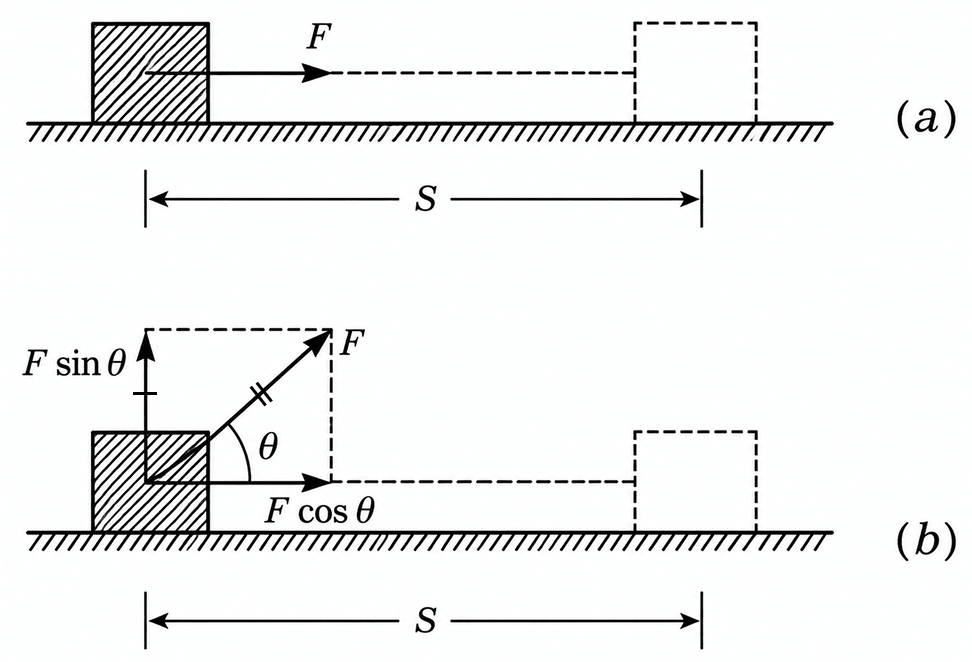
(a) When the force and the displacement are in the same direction : Work is measured by the product of the applied force and the displacement of the body in the direction of the force, that is,
If a force F acting on a body produces a displacement s in the direction of the force, then
(b) When the force makes an angle θ with the displacement : If the force F makes an angle θ with the direction of the displacement of the body, then the component of the force in the direction of displacement is F cos θ, and the work done is
Since the body does not move in the vertical direction, no work is done by the component F sin θ.
In vector notation, since both force and displacement are vector quantities, the work done is the scalar product of the force and the displacement,
Therefore work is a scalar quantity.
Angle for maximum work : For a fixed F and s, the work done is maximum when cos θ is maximum, that is, cos θ = 1 or θ = 0°, when both the force and the displacement are in the same direction. Then
Angle for minimum work : The work done is minimum when cos θ is minimum, that is, cos θ = − 1 or θ = 180°, when the force acts opposite to the displacement. Then
(a) Explain the meaning of kinetic energy with examples. Obtain an expression for the kinetic energy of a body moving with a uniform velocity.
(b) State and explain work-energy theorem.
Answer
(a) Kinetic energy : The energy possessed by a body by virtue of its state of motion is known as kinetic energy. Energy possessed by a body by virtue of its translational motion is known as translational kinetic energy.
Examples : A moving bullet can pierce a target, flowing water can turn a turbine, and a moving hammer can drive a nail into wood. In each case the body is able to do work on account of its motion, that is, it possesses kinetic energy.
Expression for kinetic energy : Consider a body of mass m, initially at rest. Let it be subjected to a constant force of magnitude F, causing it to move with velocity v in the direction of the force over a distance s. The work done by the force is
But F = m a, and from the equation of kinematics, since the body starts from rest,
Substituting these in equation (i),
This work done is converted into the kinetic energy of the body. Thus the kinetic energy of the body is
The kinetic energy of a moving body is measured by the amount of work which has been done in bringing the body from the rest position to its present state of motion, and vice-versa. Its S.I. unit is the joule (J).
(b) Work-kinetic energy theorem : The work-kinetic energy theorem states that the work done by the net force acting on a system is equal to the change in its kinetic energy. Mathematically,
Proof for a constant force : Let a body of mass m be moving with an initial velocity u. When it is subjected to a constant force F, its velocity is changed to v in a displacement s in the direction of the force. The work done by the force is
From the equation of kinematics, v2 = u2 + 2as, so that
Substituting this value of s,
which proves the theorem.
A small object of mass m is attached to a string of length l and is whirled in a vertical circle. Derive the expression for the minimum speed at the top of the circle required for the object to complete the circle without the string going slack. Also discuss the forces acting on the object at different points in the vertical circle and the variation of tension in the string throughout the motion.
Answer
Motion in a vertical circle : When a body tied to the end of a string is revolved in a vertical circle, the speed of the body is different at different points of the circular path. Therefore, the centripetal force on the body and the tension in the string change continuously.
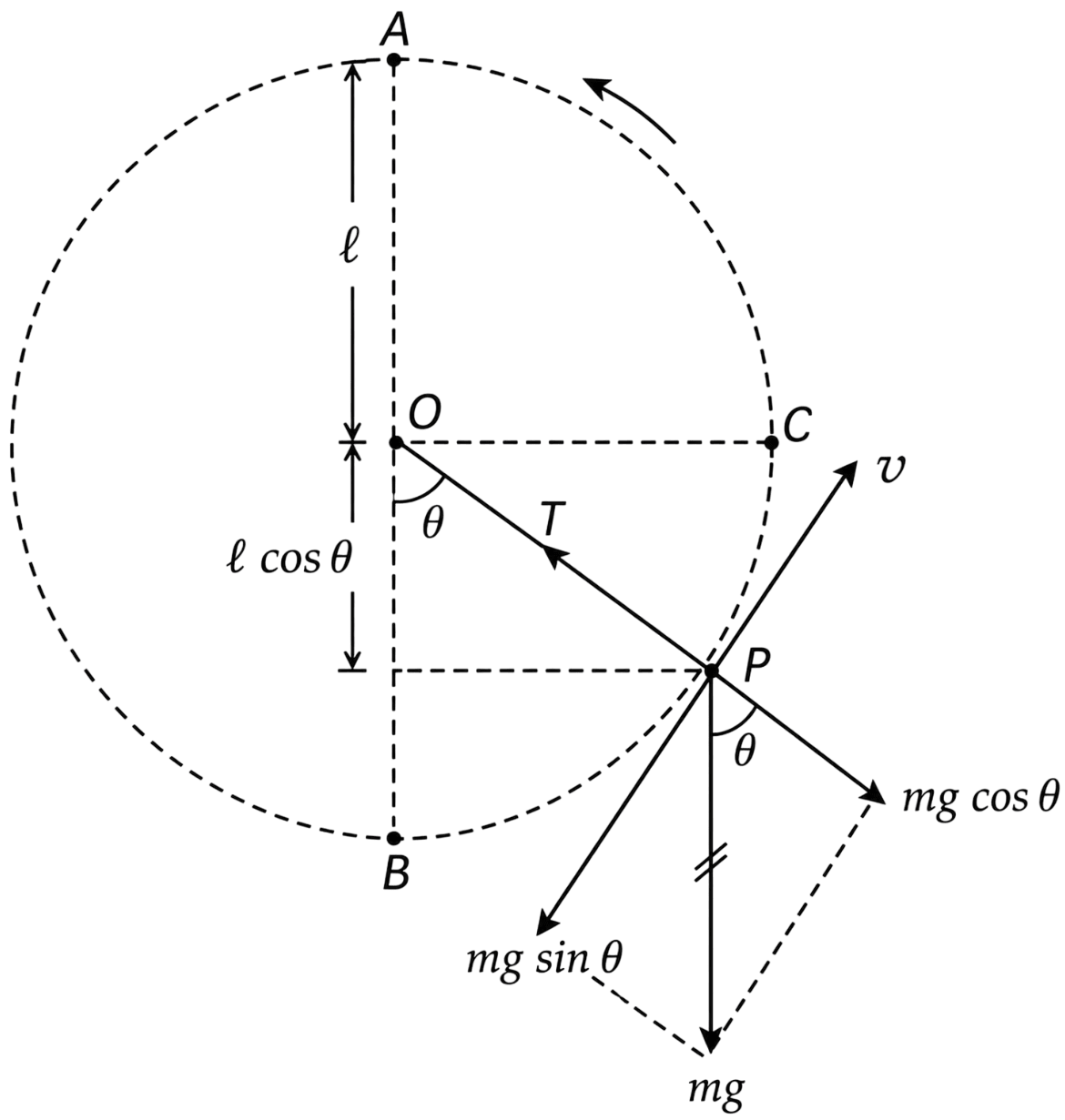
Suppose a small object of mass m tied at one end of a weightless string of length l is being revolved in a vertical circle in the anticlockwise direction. Let O be the centre of the circle, A the highest point and B the lowest point. Suppose that at any instant the object is at the point P of the circle, whose angular displacement from the lowest point B is θ. Let the velocity of the object at the point P be v, directed along the tangent drawn at the point P, and let T be the tension in the string at the point P.
Forces acting on the object : Two forces act upon the object in the position P :
(i) the weight of the object, mg, vertically downwards, and
(ii) the tension T in the string, towards the centre of the circular path.
The weight mg may be resolved into two components : the tangential component mg sin θ, and the radial component mg cos θ which is directed opposite to the tension T.
Expression for the tension : The net radial force on the object towards the centre of the circular path is T − mg cos θ, and this provides the necessary centripetal force for the circular motion of the object. Therefore,
where l, the length of the string, is the radius of the circle. Thus the tension in the string at the point P is
Minimum speed at the highest point : As the object goes upwards on the circular path, its velocity v goes on decreasing and its angular displacement θ goes on increasing, that is, cos θ goes on decreasing. Hence, according to equation (i), the tension T in the string goes on decreasing and becomes minimum at the highest point A.
At the highest point A, θ = 180° and cos 180° = − 1. If the velocity of the object at A be vA, then the tension in the string at A is
If the velocity of the object at the highest point is decreased, the tension TA in the string will decrease and become zero at a certain minimum value of the velocity. Let this minimum value of the velocity be vc. Then, putting TA = 0 and vA = vc in the above equation, we get
The object will cross over the highest point A, provided the velocity of the object at the highest point be at least . This is called the 'critical velocity' for the motion in a vertical circle. If the velocity of the object is less than this, the string would slack and the object will not remain on the circular path.
Velocity of the object at any point : In going from the point P to the highest point A, the kinetic energy of the object would decrease and the potential energy would increase by the same amount, since the height of A above P is (l + l cos θ). Therefore, by energy-conservation,
If the object just crosses the highest point A, then , that is, vA2 = gl. Then we have
Variation of the tension in the string : Substituting this value of v in equation (i), in the condition of the object just crossing over the highest point, the tension in the string at the point P is given by
Now we consider three positions of the object on the circular path in the condition of just crossing over the highest point A :
(i) At the lowest point B (θ = 0) : From equations (iii) and (iv),
(ii) When the string is horizontal, that is, at the point C (θ = 90°) :
(iii) At the highest point A (θ = 180°) :
Hence, the minimum speed at the highest point is and the corresponding minimum speed at the lowest point is . The tension is maximum at the lowest point, where TB = 6 mg, falls to 3 mg when the string is horizontal, and becomes zero at the highest point. Thus, if on revolving an object in a vertical circle the tension in the string at the highest point be zero, then the tension at the lowest point would be six times the weight of the object.
Define work. What is S.I. unit of work ? What is meant by positive work, negative work and zero work ? Illustrate your answer with two examples of each type. Explain, how we can find the work done by a variable force.
Answer
Work : When an applied force happens to displace the point of application in the direction of the force, work is said to have been done. Work is measured by the product of the applied force and the displacement of the body in the direction of the force,
S.I. unit of work : The S.I. absolute unit of work is the joule (J). If a force of 1 newton produces a displacement of 1 metre in the direction of the force, then the work done is 1 joule, that is,
In the C.G.S. system the unit of work is the erg, and 1 joule = 107 erg.
Positive work : When the applied force has a component in the direction of the displacement, that is, when θ is less than 90°, cos θ is positive and the work done is positive. It is maximum when θ = 0°.
Examples : (i) The work done by a person in lifting a bucket out of a well. (ii) The work done by gravity on a freely falling body.
Negative work : When the applied force has a component opposite to the direction of the displacement, that is, when θ is more than 90°, cos θ is negative and the work done is negative. It is minimum when θ = 180°.
Examples : (i) The work done by friction on a body sliding down an inclined plane. (ii) The work done by gravity when a body is lifted upwards.
Zero work : The work done is zero in two cases : when the displacement is zero, and when the force is perpendicular to the displacement (θ = 90°), since cos 90° = 0.
Examples : (i) The work done by a person carrying a load on his head while walking on a horizontal road. (ii) The work done by the tension in the string of a stone whirled in a circle.
Work done by a variable force : When the force acting on a body is not constant, the total displacement is divided into a large number of infinitesimally small displacements Δx, over each of which the force F(x) may be regarded as constant. The small work done over one such displacement is F(x) Δx, and the total work done in moving the body from x1 to x2 is the sum of all such terms,
In the language of integral calculus, this becomes
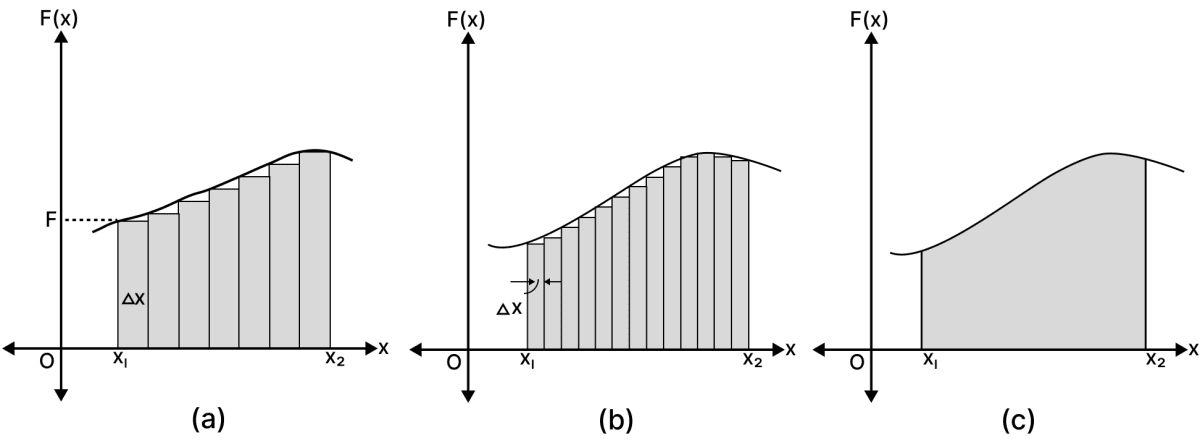
Numerically this quantity is equal to the area between the force curve and the x-axis between the values x1 and x2. Hence, the work done by a variable force is equal to the area between the force curve and the displacement axis.
What are conservative and non-conservative forces ? Explain with examples. Mention some of their properties.
Answer
Conservative force : A force is said to be conservative if the work done by the force, or against the force, in moving a body from one position to another, depends only on the initial and the final positions and not upon the path followed between the two positions.
Examples : the gravitational force, the electrostatic force, the magnetic force and the elastic force of a spring.
Properties of conservative forces :
(i) The work done by a conservative force in moving a body between two positions is independent of the path followed.
(ii) The work done by a conservative force over a closed path is zero. If a particle goes from a position A to a position B along one path and returns to A along another path, then
(iii) A potential energy can be associated with a conservative force, and the force is the negative gradient of the potential energy, .
(iv) In the presence of conservative forces alone, the total mechanical energy of a system remains constant.
A central force, that is, a force acting upon a particle which is always directed towards or away from a fixed point and whose magnitude depends only on the distance of the particle from that point, is a conservative force.
Non-conservative force : A force is said to be non-conservative if the work done by the force, or against the force, in moving a body from one position to another, depends upon the path followed between the two positions.
Examples : the frictional force, the viscous force and the induction force acting on an electron in a betatron.
Properties of non-conservative forces :
(i) The work done depends upon the path followed. The longer the path between two points, the greater is the work done against the force.
(ii) The net work done in moving a body through one complete round trip is not zero. This is because a frictional force always opposes the motion of a body, so work has to be done against it on the return journey as well.
(iii) No potential energy can be associated with such a force, since the mechanical energy is dissipated, usually as heat, and is not recoverable.
(a) Mention some of the different forms of energy and discuss them briefly.
(b) Give a brief account of mass-energy equivalence. What is its significance in physics ?
Answer
(a) Different forms of energy : Energy is the capacity to do work. It exists in various forms, each with unique characteristics and applications. Some of the primary forms are :
(i) Mechanical energy : It is associated with the motion and the position of objects. Mechanical energy is the sum of the kinetic energy and the potential energy of a system. A moving vehicle and a stretched spring both possess mechanical energy.
(ii) Thermal energy : It is the energy possessed by a body on account of the thermal agitation of its particles. When we rub our hands together, mechanical energy is converted into thermal energy.
(iii) Chemical energy : It is the potential energy which arises due to the chemical bondings between the atoms of a substance. The burning of coal and the working of a cell are examples of the release of chemical energy.
(iv) Electrical energy : It is the energy associated with the flow of electric charge. An electric heater converts electrical energy into heat energy.
(v) Nuclear energy : It is the result of the short-range, strongest nuclear force between the nucleons inside the nucleus. It is released in the processes of nuclear fission and fusion.
(vi) Sound energy : It is the energy carried by the vibrations of a medium. A loudspeaker converts electrical energy into sound energy.
(vii) Light energy : It is the energy carried by radiation. An electric bulb converts electrical energy into light energy.
(b) Mass-energy equivalence : Till the beginning of the 20th century it was believed that matter and energy are two different entities and that, like energy, the mass of the universe is also conserved. Einstein for the first time established that mass and energy are two different forms of the same entity and they are inter-convertible. He gave the mass-energy equivalence relation
where E is the energy obtained when a mass m is completely converted into energy and c is the velocity of light in free space (= 3 × 10⁸ m/s).
Significance in physics :
(i) Since c2 is an enormously large number, the relation indicates that an enormous amount of energy is obtained from the complete conversion of a very small amount of mass.
(ii) It explains the release of energy in nuclear fusion, in which a small amount of mass is converted into a large amount of energy when hydrogen nuclei fuse to form helium within the sun.
(iii) It also explains the reverse process. In particle accelerators, particles can be accelerated to high energies, and when they collide the energy from the collision can create new particles, effectively converting kinetic energy into mass. An example is the process of pair production, in which a photon of energy hν converts into an electron and a positron in the presence of a nucleus,
What is meant by collision ? Give a brief account of elastic and inelastic collisions.
Answer
Collision : A collision is an event where two particles come together and mutually interact for a very brief period. This interaction, which may or may not involve physical contact, leads to measurable changes in their relative motions. Notably, during a collision, no external force acts on the system, and hence the total momentum of the system remains conserved in all types of collisions.
Key characteristics of collisions : there is a mutual force exerted between the particles; the interaction lasts for a finite, often very brief, period; the paths or trajectories of the particles are altered; and both the energy and the momentum of the individual particles change.
Elastic collision : An elastic collision is one in which both momentum and total kinetic energy are conserved. The final particles are identical to the initial particles. Collisions between atomic, nuclear and fundamental particles are usually elastic.
Characteristics of an elastic collision :
(i) The total linear momentum before and after the collision remains the same.
(ii) The total angular momentum remains unchanged.
(iii) The mechanical energy and the total energy of the system are conserved.
(iv) Mechanical energy is not converted into other forms like heat, sound or light.
(v) The forces involved are conservative in nature.
(vi) The particles after the collision are the same as those before the collision.
Inelastic collision : An inelastic collision is one in which the total kinetic energy is not conserved, though the momentum is still conserved. When two bodies collide and stick together after the collision, some kinetic energy is lost, and this type of collision is known as a perfectly inelastic collision. For instance, the collision between two automobiles on a road is inelastic.
Characteristics of an inelastic collision :
(i) The momentum remains conserved.
(ii) The angular momentum is conserved.
(iii) The total energy of the system is conserved.
(iv) The total kinetic energy is not conserved.
(v) Potential energy changes and other forms of energy, such as heat and sound in macroscopic cases or light and gamma rays in microscopic cases, are produced.
In practice, there is no collision which is perfectly elastic or perfectly inelastic.
Discuss elastic collision in two-dimensional motion.
Answer
Elastic collision in two dimensions (oblique collision) : An oblique collision in two dimensions is a type of collision where the objects involved do not move along the same line before or after the collision. In such collisions the objects typically have velocities that form an angle with each other, rather than being perfectly head-on.
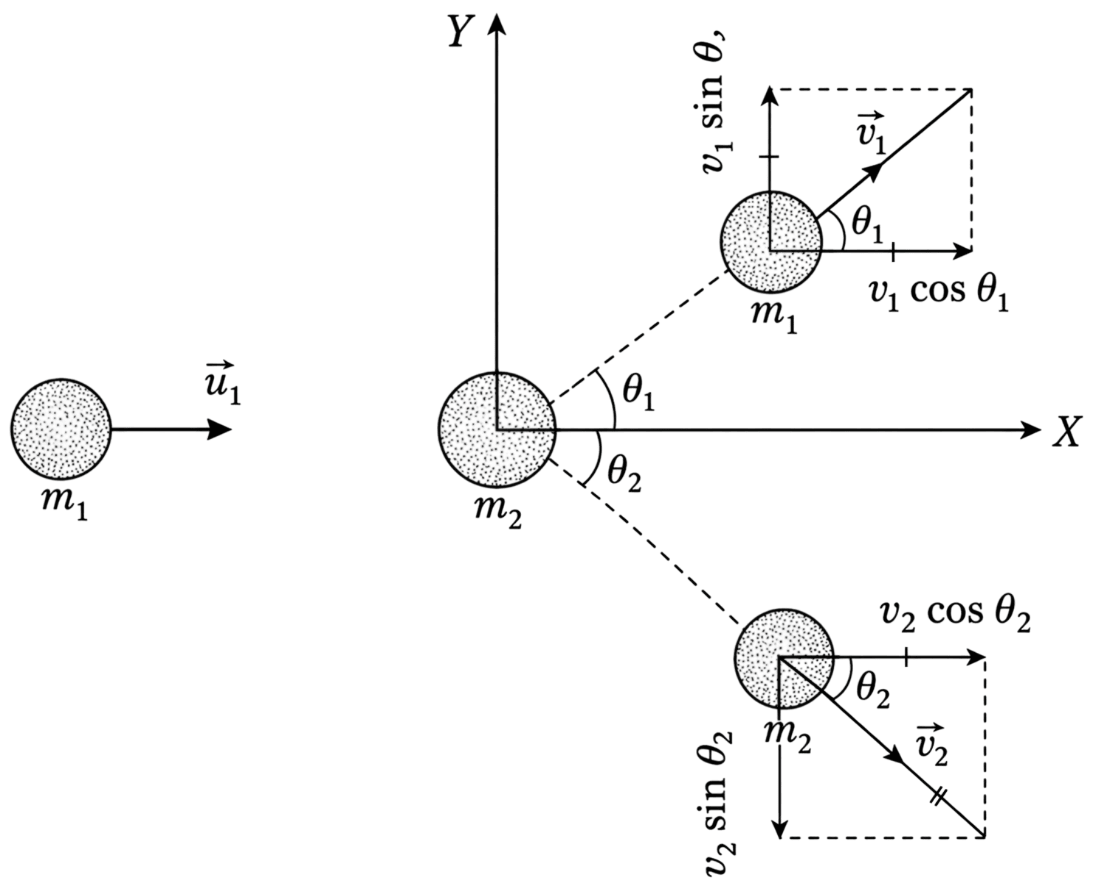
Suppose an elastic body of mass m1 moving with velocity along a straight line, say the X-axis, collides with another elastic body of mass m2, initially at rest. After the collision the bodies m1 and m2 move with velocities and in the X-Y plane, making angles θ1 and θ2 respectively with the X-axis.
By the law of conservation of linear momentum,
Taking the scalar components along the X- and the Y-directions and applying the law of conservation of linear momentum separately for the two directions, we have
Along the X-axis :
Along the Y-axis : Since there is no momentum along the Y-direction before the collision,
Since the collision is elastic, the kinetic energy is also conserved. That is,
In equations (i), (ii) and (iii) we may assume that m1, m2 and u1 are known. But the motion after the collision involves four unknown quantities v1, v2, θ1 and θ2, which cannot all be determined from three equations. At least one of them should be given. For example, for a given value of θ1, the quantities θ2, v1 and v2 can be computed from the three equations.
Glancing collision : For such a collision the object of mass m1 has θ1 ≈ 0° and the object of mass m2, initially at rest, then moves at θ2 ≈ 90°. From equation (i),
that is, the striking body continues with practically the same velocity.
Discuss inelastic collision and write its properties.
Answer
Inelastic collision : An inelastic collision is one in which the total kinetic energy is not conserved, though the momentum is still conserved. Some of the kinetic energy is converted into other forms of energy such as heat, sound and the energy of deformation.
When two bodies collide and stick together after the collision, the collision is called a perfectly inelastic collision. In this case the two bodies move with a common velocity after the impact.
Common velocity : Let a body of mass m1 moving with velocity u1 collide with a body of mass m2 moving with velocity u2, and let them stick together and move with a common velocity v. By the conservation of linear momentum,
Loss of kinetic energy : Let the second body be initially at rest (u2 = 0). The kinetic energy of the system before the collision is and that after the collision is . Substituting the value of v,
Since m1 is less than (m1 + m2), we see that K2 < K1. Thus the inelastic collision results in a loss of kinetic energy.
Properties of an inelastic collision :
(i) The total linear momentum remains conserved.
(ii) The angular momentum is conserved.
(iii) The total energy of the system is conserved.
(iv) The total kinetic energy is not conserved.
(v) Potential energy changes and other forms of energy, such as heat and sound, are produced.
It is not necessary that in an inelastic collision there is always a loss of kinetic energy. If, in a collision, the potential energy of a body is released, then the kinetic energy would increase.
Define potential energy. Derive an expression for the potential energy stored in a system of a block attached to a massless spring, when the block is pulled from its equilibrium position.
Answer
Potential energy : The energy possessed by a body by virtue of its position or configuration is called potential energy. The potential energy of a body is measured by the amount of work which has been done in bringing the body from its zero-position to the present position, or by the amount of work which the body can do in going from its present position to the zero-position.
Potential energy of a block attached to a massless spring :
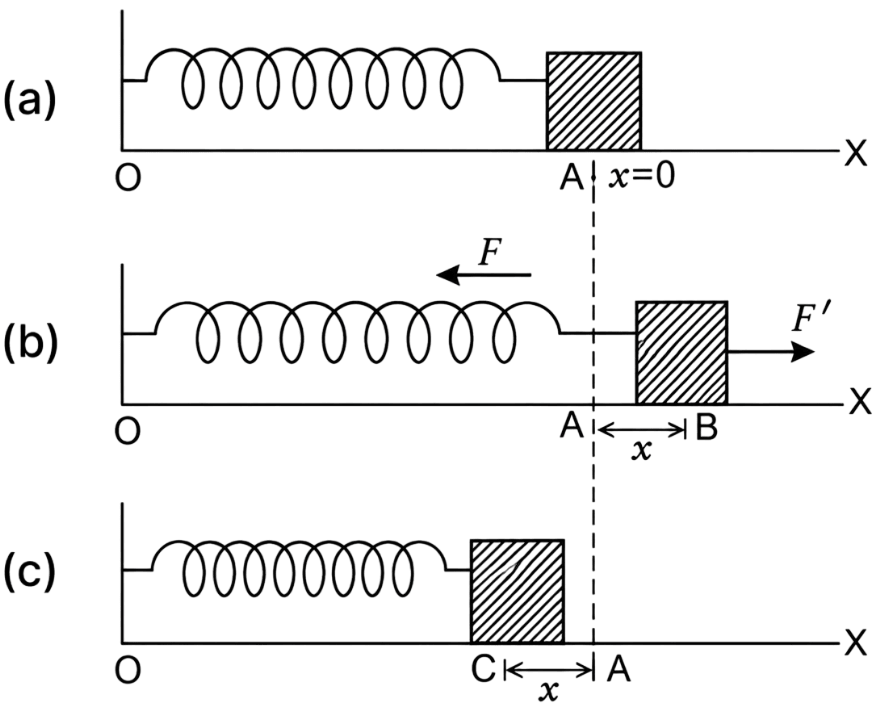
Suppose one end of a massless spring is fixed to a rigid wall at a point O and the other end is attached to a block placed on a smooth horizontal surface along the X-axis. Initially, when the spring is unstretched, the block is at a point A, where x = 0. This is the equilibrium position.
When the block is displaced from its equilibrium position A to a point B, where AB = x, then an elastic restoring force F is set up in the spring which is proportional to the displacement x and directed opposite to the displacement, that is,
where k is the force constant of the spring, or the spring constant. The negative sign signifies that the force F acts opposite to the displacement x.
Thus, to stretch the spring through a distance x, we must exert on it a force F′, equal and opposite to the restoring force F, that is,
Now, suppose the block is displaced further from B through an infinitesimally small distance dx. The work done in stretching the spring through dx by the applied force F′ is
the variable force F′ being taken constant over the infinitesimally small distance dx. Therefore, the total work done in stretching the spring through the distance x is obtained by integration,
This work is stored in the spring in the form of elastic potential energy. Hence the potential energy of the spring is
The same expression is obtained when the spring is compressed through a distance x, since the expression involves x2.
Define mechanical energy of a body. Show that the mechanical energy of a body is conserved, when it falls freely under gravity.
Answer
Mechanical energy : The mechanical energy of a body is the sum of its kinetic energy and potential energy. It is associated with the motion and the position of the body.
Principle of conservation of mechanical energy : For an isolated system or a body in the presence of conservative forces, the sum of the kinetic and the potential energy at any point remains constant throughout the motion. It does not depend upon time.
Conservation of mechanical energy for a freely falling body :
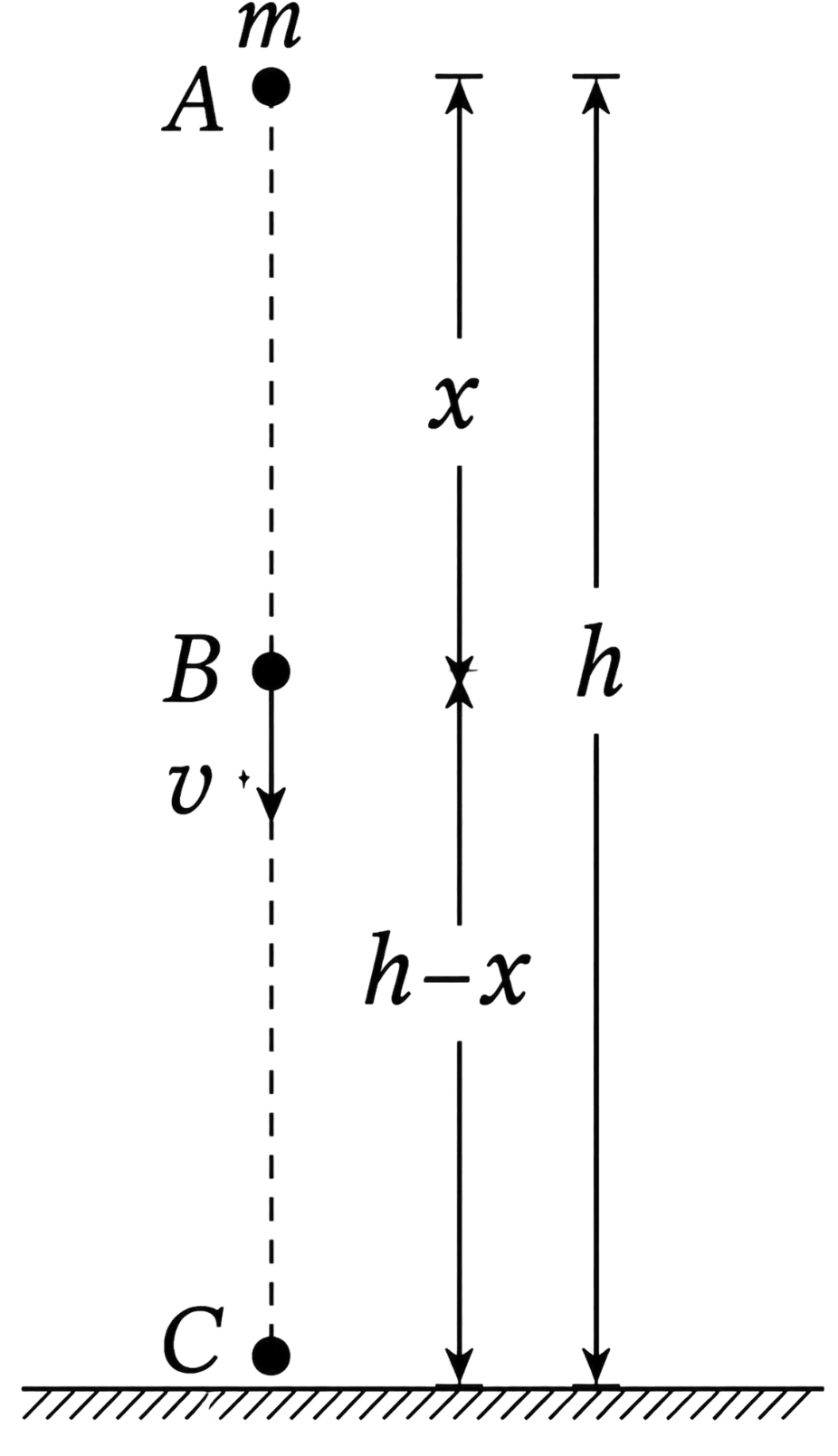
Suppose a body of mass m is held at a point A at a height h above the ground and is allowed to fall freely under gravity. Let g be the acceleration due to gravity.
At the point A : In the beginning the body is at rest at A, so that its kinetic energy is zero. It has only potential energy mgh. Thus the total energy of the body at A is
At the point B : Now, suppose during the free fall, when the body is passing across a point B at a distance x vertically below A, its velocity is v. Then from the equation v2 = u2 + 2as, with u = 0 and s = x,
Therefore the kinetic energy of the body at B is
The height of the body above the ground at B is (h − x), so its potential energy at B is mg (h − x). Thus the total energy at B is
At the point C (the ground) : Here the height is zero, so the potential energy is zero. The velocity on reaching the ground is given by v2 = 2gh, so the kinetic energy is
Thus the total energy at C is
From equations (i), (ii) and (iii),
Hence, the mechanical energy of a body falling freely under gravity remains constant at every point of its motion.
Prove that negative potential energy gradient is equal to force, that is, .
Answer
To prove : The negative potential energy gradient is equal to the force.
Consider a particle placed in the field of a conservative force F. Let an external force Fext be applied on it, so that the particle experiences a net force
Work done by an external force can change either the kinetic energy or the potential energy of a body, or both. Thus, if the particle is displaced from a position A to a position B through a small displacement Δs,
where ΔK is the change in the kinetic energy and ΔU is the change in the potential energy.
If the particle moves through the small displacement Δs, the work-kinetic energy theorem shows that
From equations (i) and (iii),
Comparing equations (ii) and (iv), we get
In the limit Δs → 0, this gives
Hence, the force is equal to the negative potential energy gradient, that is, the negative of the rate of change of potential energy with distance. The negative sign shows that the conservative force always acts in the direction in which the potential energy decreases.
Note: The question writes the relation as ; here the symbol in the numerator stands for the potential energy U, as used in the textbook.
Prove that in an elastic collision in one-dimension, the relative velocity of approach before impact is equal to the relative velocity of separation after impact.
Answer
To prove : In a one-dimensional elastic collision, the relative velocity of approach before impact is equal to the relative velocity of separation after impact.
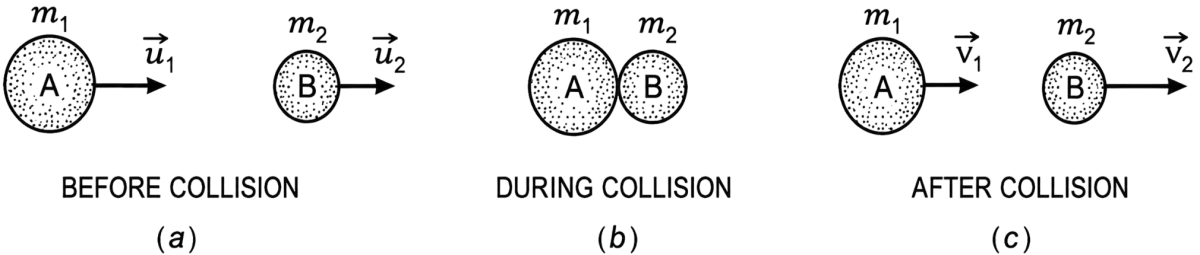
Let us consider two elastic bodies A and B of respective masses m1 and m2 moving along the same straight line with velocities u1 and u2 respectively, where u1 > u2, so that they collide head-on. Let v1 and v2 be their velocities after the collision. Since the collision is head-on, all the velocities are along the same straight line.
By the law of conservation of linear momentum,
Since the collision is elastic, the kinetic energy is also conserved,
Dividing equation (ii) by equation (i),
Factorising the numerators as the difference of two squares,
Rearranging the terms,
Here (u1 − u2) is the relative velocity with which the bodies A and B approach each other before the collision, and (v2 − v1) is the relative velocity with which they separate from each other after the collision.
Hence, the relative velocity with which two bodies approach each other before collision is equal to the relative velocity with which they depart from each other after the collision.
Two bodies of masses m1 and m2 moving with velocities u1 and u2 respectively in the same direction collide with each other elastically; calculate their velocities after the collision. Discuss what happens, when :
(a) both the colliding bodies have the same mass.
(b) one of the bodies is initially at rest.
(c) a light body collides with a heavy body at rest.
(d) a heavy body collides with a light body at rest.
Answer
Let two bodies A and B of masses m1 and m2 move along the same straight line with velocities u1 and u2 respectively, where u1 > u2, and collide elastically. Let v1 and v2 be their velocities after the collision.
By the law of conservation of linear momentum,
Since the collision is elastic, the kinetic energy is conserved,
Dividing equation (ii) by equation (i),
Velocity of A after the collision : From equation (iii), v2 = u1 − u2 + v1. Putting this value in equation (i),
Velocity of B after the collision : Similarly, putting v1 = v2 + u2 − u1 from equation (iii) in equation (i),
Special cases :
(a) Both the colliding bodies have the same mass. Putting m1 = m2 = m in equations (iv) and (v),
That is, in a one-dimensional elastic collision of two bodies of equal masses, the bodies merely exchange their velocities after the collision.
(b) One of the bodies is initially at rest. Putting u2 = 0 in equations (iv) and (v),
(c) A light body collides with a heavy body at rest. Here m1 << m2 and u2 = 0, so m1 may be neglected in comparison with m2,
That is, the light body rebounds with almost its original speed while the heavy body practically remains at rest.
(d) A heavy body collides with a light body at rest. Here m1 >> m2 and u2 = 0, so m2 may be neglected in comparison with m1,
That is, the heavy body continues to move with almost the same velocity while the light body moves off with twice the velocity of the heavy body.
If (where g acceleration due to gravity and r is the radius of the circle), is the minimum speed of the body to complete a vertical circle of radius r. Calculate the speed of the body of mass m when string becomes horizontal at this point. Also calculate the tension in the string at this point.
Answer
Given,
- Minimum speed at the top of the circle,
- Radius of the circle = r, mass of the body = m
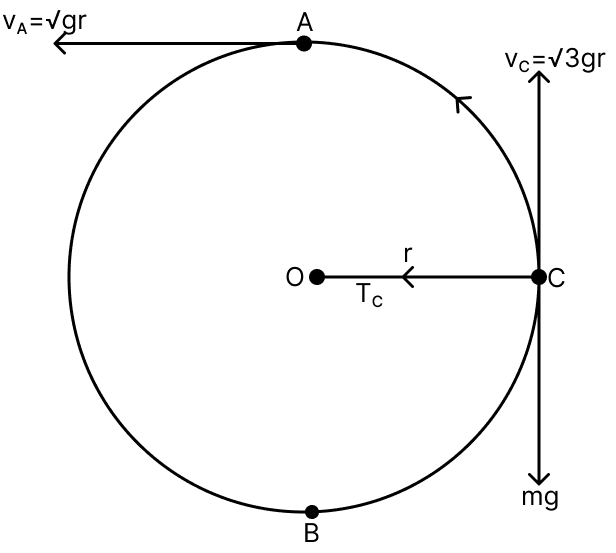
Speed when the string is horizontal : Let A be the highest point, C the point where the string is horizontal and B the lowest point. The point C is at a vertical depth r below the highest point A.
Applying the principle of conservation of mechanical energy between A and C, taking the level of C as the reference,
Since the body just completes the circle, , that is, vA2 = gr. Therefore,
Tension when the string is horizontal : At the point C the string is horizontal, so the tension TC acts horizontally towards the centre while the weight mg acts vertically downwards, that is, perpendicular to the string. Hence the weight has no component along the string, and the tension alone provides the centripetal force,
Hence, when the string becomes horizontal the speed of the body is and the tension in the string is 3 mg.
A 55 kg man holds a weight of 20 kg on his head. What is the work done by him against gravity if he moves a distance of 20 m (i) on a horizontal road, (ii) on an incline of 1 in 5 ? Take g = 10 m s-2.
Answer
Given,
- Mass of the man, m1 = 55 kg
- Mass of the weight, m2 = 20 kg
- Distance moved, s = 20 m
- g = 10 m s-2
The total mass carried up is
(i) On a horizontal road : The force of gravity acts vertically downwards while the displacement is horizontal, so the angle between them is 90°,
Hence, the work done against gravity on the horizontal road is zero.
(ii) On an incline of 1 in 5 : An incline of 1 in 5 means that the body rises 1 m for every 5 m travelled along the incline. Hence the vertical height gained is
The work done against gravity is
Hence, the work done against gravity on the incline is 3000 J.
Find the work done when a 25 kg weight is (i) lifted to a vertical height of 2.0 m from the ground, (ii) carried to the same place by pushing it up an inclined plane making an angle of 30° with the ground.
Take g = 9.8 m s-2.
Answer
Given,
- Mass of the weight, m = 25 kg
- Vertical height, h = 2.0 m
- Angle of the inclined plane, θ = 30°
- g = 9.8 m s-2
(i) Lifted vertically : The work done against gravity is
(ii) Pushed up the inclined plane : The length of the inclined plane needed to reach the same height is
The force required to push the weight up the smooth incline is the component of the weight along the incline,
Therefore the work done is
Hence, the work done is 490 J in both the cases.
The work done against gravity depends only on the vertical height through which the body is raised and not on the path followed, since the gravitational force is a conservative force.
A man pulls a roller by a force of 20 kg f applied at 60° with the ground. If he pulls it a distance of 10 m in 1 min, calculate the power dissipated. (Take g = 10 m s-2).
Answer
Given,
- Force applied, F = 20 kg f
- Angle with the ground, θ = 60°
- Distance moved, s = 10 m
- Time taken, t = 1 min = 60 s
- g = 10 m s-2
Converting the force into the absolute unit,
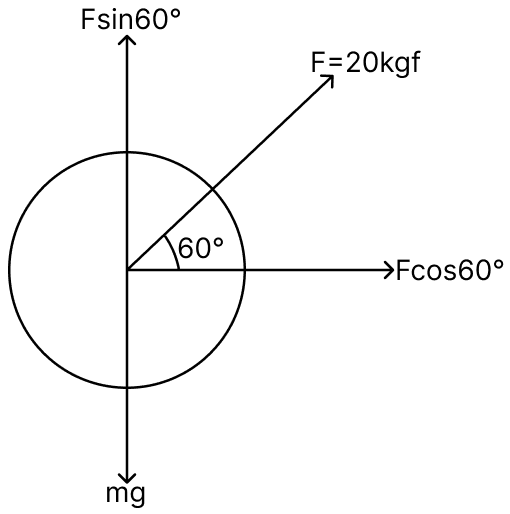
The work done by the force is
The power dissipated is
Hence, the power dissipated is 16.7 W.
The human heart forces 4 × 10⁻³ m3 of blood per minute through the arteries under a pressure of 0.13 m. Calculate the horsepower of the heart. The density of blood is 1.03 × 10³ kg m-3. Take g = 9.8 m s-2 and 1 H.P. = 746 W.
Answer
Given,
- Volume of blood forced per minute, V = 4 × 10⁻³ m3
- Pressure head, h = 0.13 m
- Density of blood, ρ = 1.03 × 10³ kg m-3
- g = 9.8 m s-2, 1 H.P. = 746 W
The pressure exerted by the heart is
The work done in forcing a volume V of blood against this pressure is
This work is done in one minute, that is, in 60 s. Hence the power of the heart is
Converting into horsepower,
Hence, the horsepower of the heart is 1.17 × 10⁻⁴ H.P.
A force of 30 N acts on a body of mass 2.0 kg starting from rest up to a distance of 3.0 m. Then the force reduces to 15 N and acts in the same direction up to 2.0 m. Calculate the final kinetic energy of the body.
Answer
Given,
- Mass of the body, m = 2.0 kg, initially at rest
- First force, F1 = 30 N acting over s1 = 3.0 m
- Second force, F2 = 15 N acting over s2 = 2.0 m
Both the forces act in the same direction as the displacement, so the work done by each is positive.
The work done by the first force is
The work done by the second force is
The total work done on the body is
By the work-kinetic energy theorem, the work done by the net force is equal to the change in the kinetic energy of the body. Since the body starts from rest, its initial kinetic energy is zero, so
Hence, the final kinetic energy of the body is 120 J.
A 0.2 kg ball is suspended by a thread of length 1 m. It is pulled aside until the thread makes an angle of 30° with the vertical. How much work is done against gravity ? The ball is now released. Find its velocity at the lowest point. Ignore air resistance and take g = 10 m s-2.
Answer
Given,
- Mass of the ball, m = 0.2 kg
- Length of the thread, l = 1 m
- Angle with the vertical, θ = 30°
- g = 10 m s-2
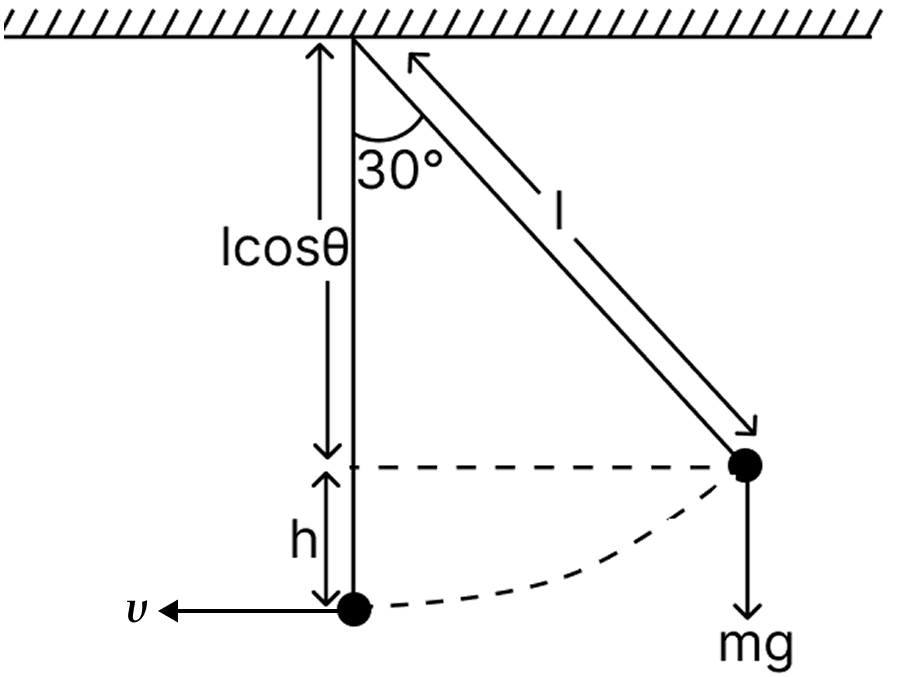
The height through which the ball is raised is
The work done against gravity is equal to the gain in the potential energy of the ball,
Hence, the work done against gravity is 0.268 J.
When the ball is released, this potential energy is converted into kinetic energy at the lowest point. By the conservation of mechanical energy,
Substituting the values,
Hence, the velocity of the ball at the lowest point is 1.637 m s-1.
A bullet of mass 20 g moving with a speed of 150 ms-1 strikes a block and comes to rest after piercing 10 cm into it. Find the average force of resistance offered by the block.
Answer
Given,
- Mass of the bullet, m = 20 g = 0.02 kg
- Speed of the bullet, u = 150 m s-1
- Distance pierced into the block, s = 10 cm = 0.1 m
- Final velocity, v = 0
The kinetic energy of the bullet before striking the block is
The bullet comes to rest inside the block, so the whole of this kinetic energy is used up in doing work against the force of resistance offered by the block. By the work-kinetic energy theorem,
Substituting the values,
Hence, the average force of resistance offered by the block is 2250 N.
Two identical 5 kg blocks are moving with same speed of 2 ms-1 towards each other along a frictionless horizontal surface. The blocks collide, stick together and come to rest. Considering the two blocks as a system, calculate the work done by (i) external forces and (ii) internal forces.
Answer
Given,
- Mass of each block, m = 5 kg
- Speed of each block, u = 2 m s-1, moving towards each other
- The blocks stick together and come to rest
- The horizontal surface is frictionless
The total kinetic energy of the system before the collision is
Since the two blocks stick together and come to rest, the final kinetic energy of the system is
(i) Work done by external forces : The surface is frictionless and horizontal, so the weight of the blocks and the normal reaction of the surface are both perpendicular to the displacement and do no work. No external horizontal force acts on the system.
(ii) Work done by internal forces : By the work-kinetic energy theorem applied to the system, the total work done is equal to the change in its kinetic energy,
Hence, the work done by the external forces is zero and that done by the internal forces is − 20 J, that is, 20 J of kinetic energy is lost in the collision and appears as heat and the energy of deformation.
Note: The printed answer gives (i) 20 J and (ii) zero. Since no external horizontal force acts on the system on a frictionless surface, the whole of the change in kinetic energy must be accounted for by the internal forces of the collision, as worked out above.
A ball is dropped from rest at a height of 60 m. On striking the ground, it loses 25% of its energy. To what height does it rebound ?
Answer
Given,
- Height from which the ball is dropped, h = 60 m
- Energy lost on striking the ground = 25% of its energy
The ball is dropped from rest, so on reaching the ground the whole of its potential energy mgh has been converted into kinetic energy. Its energy on striking the ground is therefore
On striking the ground the ball loses 25% of its energy, so the energy retained by it is
If the ball rebounds to a height h′, this retained energy is again converted into potential energy,
The mass m and g cancel from both sides, giving
Hence, the ball rebounds to a height of 45 m.
A 10 kg body is dropped from a height of 20 m. What is its potential energy before dropping ? What is its kinetic energy when it is 8.0 m high above the ground ? What, when it hits the ground ?
(g = 9.8 ms-2)
Answer
Given,
- Mass of the body, m = 10 kg
- Height from which it is dropped, h = 20 m
- g = 9.8 m s-2
Potential energy before dropping : Taking the ground as the reference level,
Kinetic energy at a height of 8.0 m : The body has fallen through a distance of
The loss in potential energy over this fall appears as kinetic energy,
Kinetic energy on hitting the ground : At the ground the height is zero, so the potential energy is zero and the whole of the initial potential energy has been converted into kinetic energy,
Hence, the potential energy before dropping is 1960 J, the kinetic energy at a height of 8.0 m is 1176 J and the kinetic energy on hitting the ground is 1960 J.
A block of mass 2 kg is dropped from a height of 40 cm on a spring whose force-constant is 1960 N/m (Fig.). What will be the maximum distance x of the compression of the spring ? (g = 9.8 m s-2)
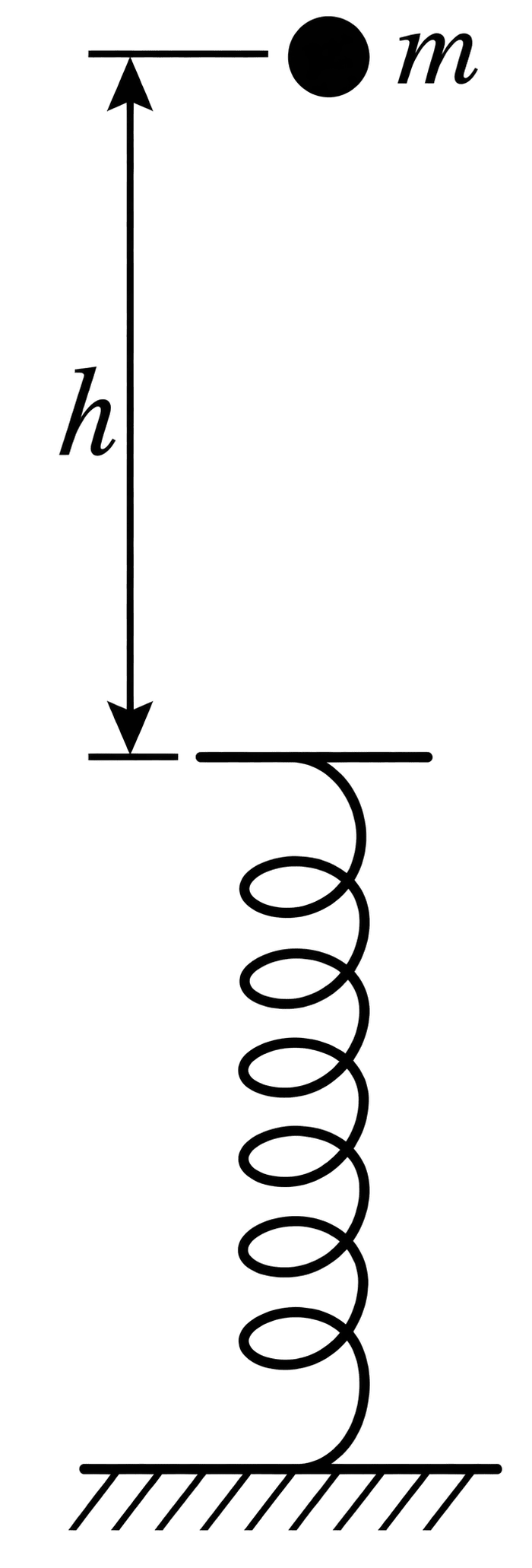
Answer
Given,
- Mass of the block, m = 2 kg
- Height of fall, h = 40 cm = 0.4 m
- Force constant of the spring, k = 1960 N/m
- g = 9.8 m s-2
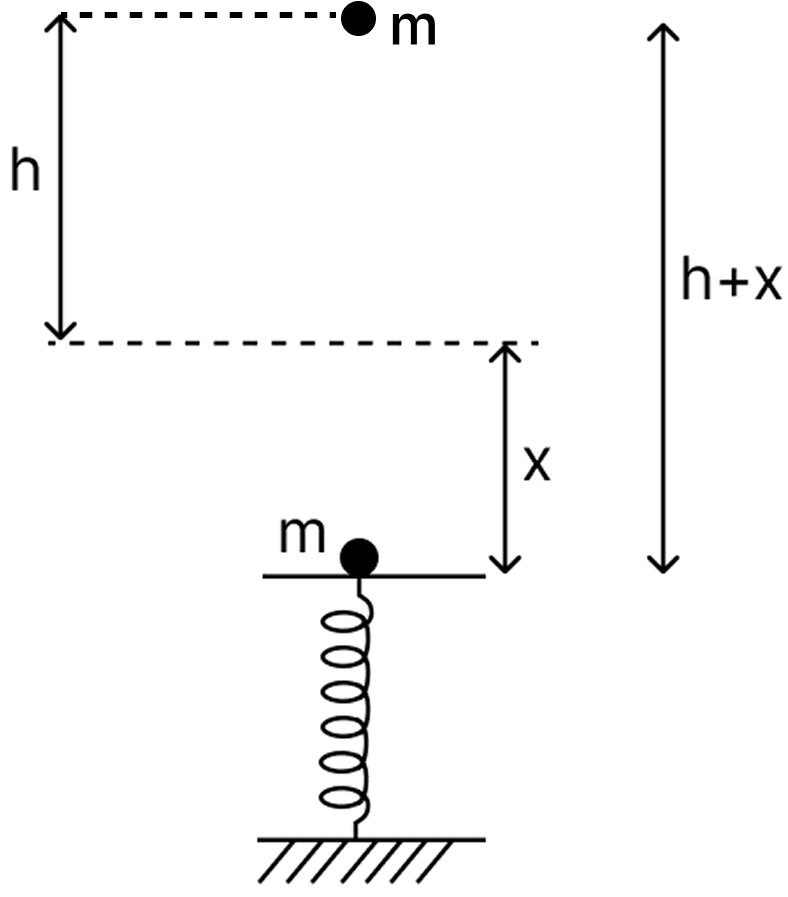
Let x be the maximum compression of the spring. The block falls through the height h and then compresses the spring through a further distance x, so the total fall of the block is (h + x).
At the position of maximum compression the block is momentarily at rest, so its kinetic energy is zero. Hence, by the conservation of energy, the whole of the loss in the gravitational potential energy of the block is stored as the elastic potential energy of the spring,
Substituting the values,
Dividing throughout by 19.6,
Solving this quadratic equation,
Rejecting the negative root, since the compression cannot be negative,
Hence, the maximum compression of the spring is 10 cm.
A ball is rolling to and fro in a smooth circular cup as shown in the figure. It goes up on either side of the lowest point A to points 10 cm high above A. What is the speed of the ball at A? (g = 9.8 m/s2).
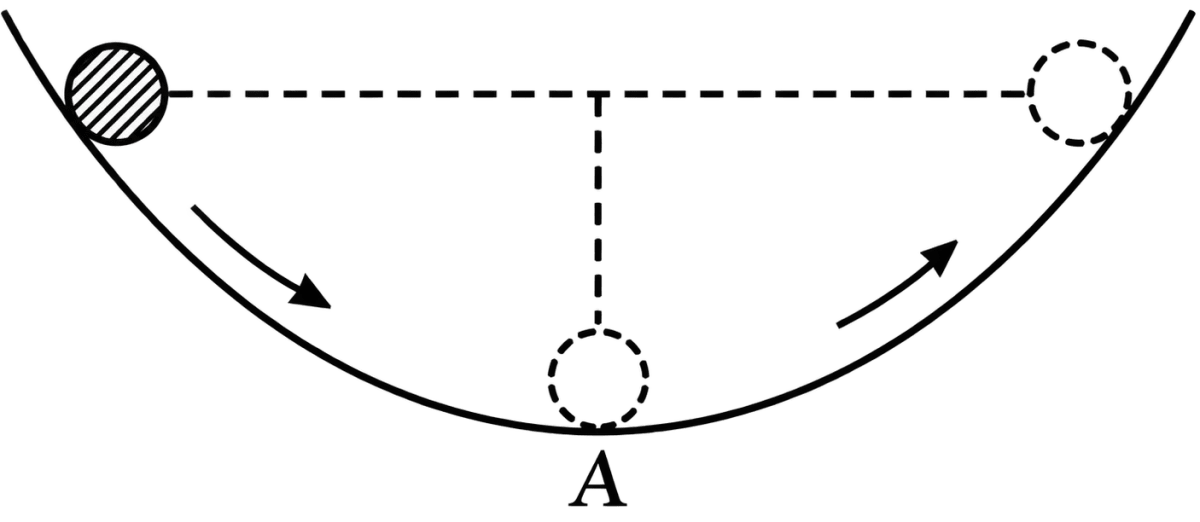
Answer
Given,
- Height to which the ball rises on either side, h = 10 cm = 0.1 m
- g = 9.8 m/s2
Let m be the mass of the ball and v its speed at the lowest point A. The cup is smooth, so no energy is lost against friction.
At the highest point of its swing the ball is momentarily at rest, so it possesses only potential energy mgh. At the lowest point A the height is zero, so it possesses only kinetic energy .
By the principle of conservation of mechanical energy,
Substituting the values,
Hence, the speed of the ball at the lowest point A is 1.4 m/s.
A smooth body is released from rest A at a point A at the top of a smooth curved track of vertical height 40 cm. What is the speed of the body at the bottom of the curved track? How far along the adjoining smooth inclined plane will the body go ?
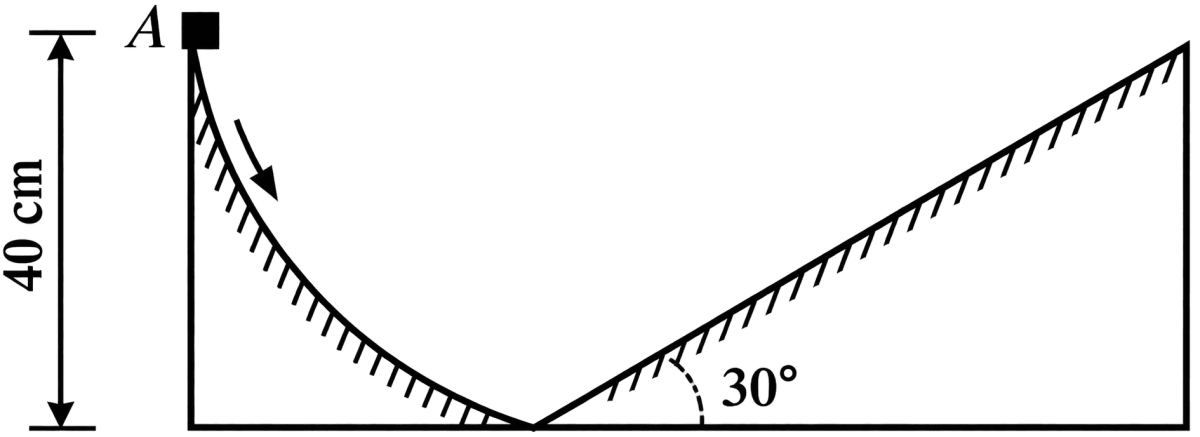
Answer
Given,
- Vertical height of the curved track, h = 40 cm = 0.4 m
- Angle of the inclined plane, θ = 30°
- g = 9.8 m s-2
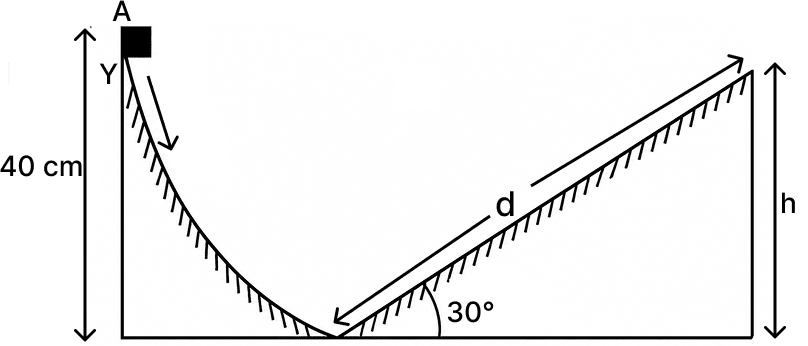
Speed at the bottom of the curved track : The track is smooth, so the whole of the loss in potential energy appears as kinetic energy. By the conservation of mechanical energy,
Substituting the values,
Distance covered along the inclined plane : The inclined plane is also smooth, so the body rises along it until the whole of its kinetic energy is again converted into potential energy. It therefore rises to the same vertical height h = 0.4 m.
If d is the distance travelled along the incline,
Substituting the values,
Hence, the speed of the body at the bottom of the curved track is 2.8 m/s and it goes 80 cm along the inclined plane.
An automobile moving at a speed of 72 km h-1 reaches the foot of a smooth incline when the engine is switched off. How much distance does the automobile go up the incline before stopping ? The incline makes an angle of 30° with the horizontal. (g = 9.8 m s-2)
Answer
Given,
- Speed of the automobile, v = 72 km h-1
- Angle of the incline, θ = 30°
- g = 9.8 m s-2
Converting the speed into SI units,
The incline is smooth and the engine is switched off, so the whole of the kinetic energy of the automobile is converted into potential energy as it goes up the incline and comes to rest. If h is the vertical height risen,
Substituting the values,
If d is the distance travelled along the incline, then h = d sin θ, so
Hence, the automobile goes 40.8 m up the incline before stopping.
The length of a simple pendulum is 1 m and the mass of the bob is 0.1 kg. The bob is taken towards one side until the thread becomes horizontal and then released. Calculate the kinetic energy of the bob when the thread makes an angle of (i) 0°, (ii) 30° with the vertical.
Answer
Given,
- Length of the pendulum, l = 1 m
- Mass of the bob, m = 0.1 kg
- The bob is released from the horizontal position
- g = 9.8 m s-2
Since the bob is released from the horizontal position, its initial height above the lowest point is equal to the length of the pendulum, that is, 1 m. Its initial potential energy is therefore
When the thread makes an angle θ with the vertical, the height of the bob above the lowest point is l (1 − cos θ), so its potential energy at that position is mgl (1 − cos θ). By the conservation of mechanical energy, its kinetic energy is
(i) When θ = 0° :
(ii) When θ = 30° :
Hence, the kinetic energy of the bob is 0.98 J at 0° and J, that is, about 0.849 J, at 30° with the vertical.
A block of wood of mass 5 kg is suspended by a thread. A gun is fired in the horizontal direction and the bullet strikes the block and is embedded in it. As a result the block is raised to 15 cm. If the mass of the bullet be 20 g, find the initial velocity of the bullet. (g = 9.8 m s-2)
Answer
Given,
- Mass of the block, M = 5 kg
- Mass of the bullet, m = 20 g = 0.02 kg
- Height to which the block is raised, h = 15 cm = 0.15 m
- g = 9.8 m s-2
Step 1 : Common velocity just after the impact. The block with the bullet embedded in it rises through the height h, so by the conservation of mechanical energy,
Substituting the values,
Step 2 : Initial velocity of the bullet. The bullet is embedded in the block, so the collision is perfectly inelastic. By the conservation of linear momentum,
Substituting the values,
Hence, the initial velocity of the bullet is about 430 m/s.
A bullet of mass 0.02 kg moving with a speed of 200 ms-1 strikes a 2 kg wooden block suspended by a 1 m long thread and is embedded in the block. What is the maximum inclination of the thread with the vertical ? (g = 9.8 m s-2)
Answer
Given,
- Mass of the bullet, m = 0.02 kg
- Speed of the bullet, u = 200 m s-1
- Mass of the block, M = 2 kg
- Length of the thread, l = 1 m
- g = 9.8 m s-2
Step 1 : Common velocity after the impact. The bullet is embedded in the block, so the collision is perfectly inelastic. By the conservation of linear momentum,
Step 2 : Height to which the block rises. By the conservation of mechanical energy,
Step 3 : Maximum inclination of the thread. If θ is the maximum angle made by the thread with the vertical, then
Substituting the values,
Hence, the maximum inclination of the thread with the vertical is 37°.
A 1 kg body falls freely under gravity. Find its momentum and kinetic energy 5 s after it starts falling. Take g = 10 ms-2.
Answer
Given,
- Mass of the body, m = 1 kg
- Time of fall, t = 5 s
- Initial velocity, u = 0 (falls freely)
- g = 10 m s-2
The velocity of the body after 5 s of free fall is
Momentum :
Kinetic energy :
Hence, the momentum of the body is 50 kg m s-1 and its kinetic energy is 1250 J.
Find the ratio of kinetic energies of two bodies of masses 1 kg and 4 kg having equal linear momenta.
Answer
Given,
- Mass of the first body, m1 = 1 kg
- Mass of the second body, m2 = 4 kg
- The two bodies have equal linear momenta, p1 = p2 = p
The kinetic energy of a body in terms of its momentum is
For a given momentum, the kinetic energy varies inversely as the mass, that is, . Therefore
Hence, the ratio of the kinetic energies is K1 : K2 = 4 : 1.
Find the ratio of linear momenta of two bodies of masses 1 kg and 4 kg having equal kinetic energies.
Answer
Given,
- Mass of the first body, m1 = 1 kg
- Mass of the second body, m2 = 4 kg
- The two bodies have equal kinetic energies, K1 = K2 = K
The momentum of a body in terms of its kinetic energy is
For a given kinetic energy, the momentum varies as the square root of the mass, that is, . Therefore
Hence, the ratio of the linear momenta is p1 : p2 = 1 : 2.
A neutron (mass 1.67 × 10⁻²⁷ kg) moving at a speed of 1.0 × 10⁸ ms-1 collides with a deuteron (mass 3.34 × 10⁻²⁷ kg) at rest and sticks to it. Find the speed of the composite particle triton.
Answer
Given,
- Mass of the neutron, m1 = 1.67 × 10⁻²⁷ kg
- Speed of the neutron, u1 = 1.0 × 10⁸ m s-1
- Mass of the deuteron, m2 = 3.34 × 10⁻²⁷ kg, initially at rest
The neutron sticks to the deuteron, so the collision is perfectly inelastic and the two move together as a single particle, the triton. By the conservation of linear momentum,
Substituting the values,
Hence, the speed of the composite particle triton is 3.33 × 10⁷ m s-1.
A ball A of mass 2.4 kg suffers an elastic head-on collision with another ball B at rest. After collision, the ball A continues moving in the same direction with a speed 1/5 of its original speed while the ball B starts moving forward. Find the mass of the ball B.
Answer
Given,
- Mass of the ball A, m1 = 2.4 kg
- The ball B is initially at rest, u2 = 0
- After the collision,
For a one-dimensional elastic collision with the target body initially at rest, the velocity of the striking body after the collision is
Since the ball A continues in the same direction with one-fifth of its original speed,
Cancelling u1 from both sides,
Substituting m1 = 2.4 kg,
Hence, the mass of the ball B is 1.6 kg.
A 30 kg mass moving at 18.0 ms-1 collides with a 90 kg mass moving at 14.4 ms-1 in the opposite direction. The collision is elastic and head-on. Find the velocity of each mass after the collision.
Answer
Given,
- Mass of the first body, m1 = 30 kg with u1 = 18.0 m s-1
- Mass of the second body, m2 = 90 kg with u2 = − 14.4 m s-1 (opposite direction)
For a one-dimensional elastic collision, the velocities after the collision are
Here m1 + m2 = 30 + 90 = 120 kg.
Velocity of the 30 kg mass :
Velocity of the 90 kg mass :
Hence, after the collision the 30 kg mass moves with a velocity of 30.6 m s-1 in the reversed direction and the 90 kg mass moves with a velocity of 1.8 m s-1 in the original direction of the 30 kg mass.
A 10 kg ball A moving at a speed of 8.0 ms-1 collides with a 20 kg ball B initially at rest. After collision, the balls A and B move along directions making angles of 30° and 45° respectively with the initial direction of motion of A. Find the final speeds of the balls A and B.
Answer
Given,
- Mass of the ball A, m1 = 10 kg with u1 = 8.0 m s-1
- Mass of the ball B, m2 = 20 kg, initially at rest
- Angle made by A after the collision, θ1 = 30°
- Angle made by B after the collision, θ2 = 45°
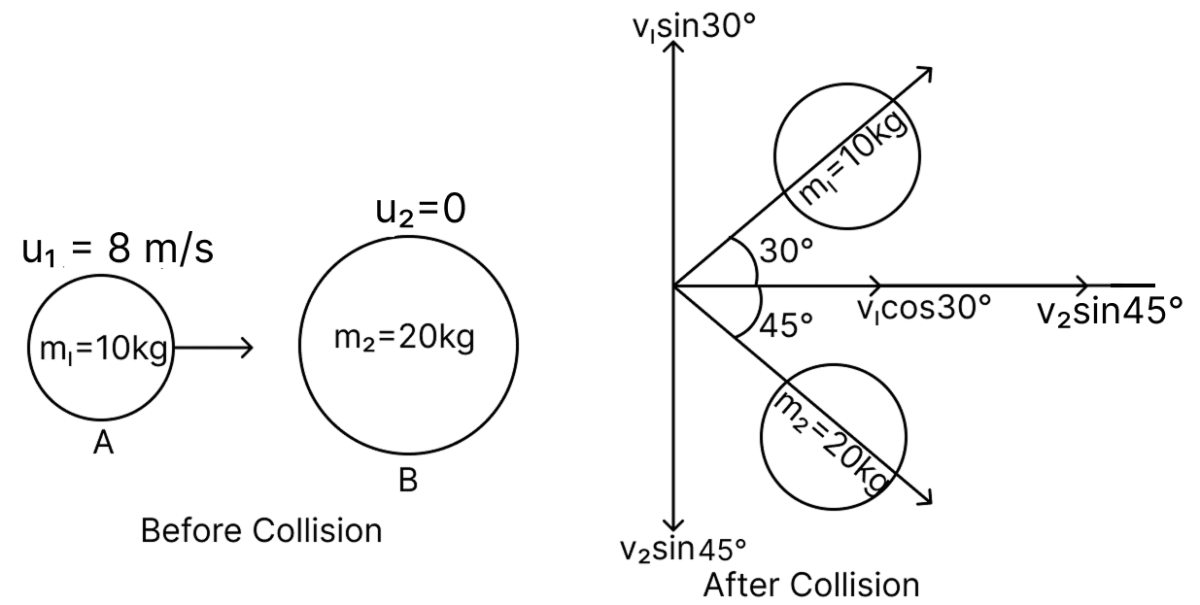
This is an oblique collision in two dimensions. Let v1 and v2 be the final speeds of A and B. Applying the law of conservation of linear momentum separately along the two directions :
Along the initial direction of motion (X-axis) :
Perpendicular to the initial direction (Y-axis) : There is no momentum along this direction before the collision, so
Solving : Substituting equation (ii) in equation (i),
From equation (ii),
Hence, the final speeds are 5.85 m s-1 for the ball A and 2.07 m s-1 for the ball B.
A cylindrical bucket filled with 5 kg of water is whirled around in a vertical circular path of radius 1.8 m. What should be the minimum speed at the top of path as water does not fall out from the bucket ? If it continues with this speed, what normal contact force the bucket exerts on water at the lowest point of the path? (g = 10 m/s2)
Answer
Given,
- Mass of water, m = 5 kg
- Radius of the vertical circular path, r = 1.8 m
- g = 10 m/s2
Minimum speed at the top : The water does not fall out of the bucket provided the centrifugal force on it at the highest point is at least equal to its weight, that is,
Therefore the minimum speed at the top is
Normal contact force at the lowest point : Applying the conservation of mechanical energy between the highest point A and the lowest point B, which are separated by a vertical height 2r,
At the lowest point the normal contact force N exerted by the bucket acts upwards and the weight mg acts downwards, their difference providing the centripetal force,
Substituting the values,
Hence, the minimum speed at the top of the path is 4.2 m s-1 and the normal contact force at the lowest point is 300 N.
Note: The printed answer for the contact force is 294 N, which is obtained by taking g = 9.8 m s-2. The value given in the question, g = 10 m s-2, has been used here.
A ball of mass 1.0 kg is being revolved in a vertical circle, fastened at one end of a string of 5.0 m length. (i) The tension in the string will be zero for which speed of ball at the highest point of the circle ?
(g = 9.8 m/s2)
(ii) What should be the speed of the ball at the lowest point in this situation ?
Answer
Given,
- Mass of the ball, m = 1.0 kg
- Length of the string (radius), l = 5.0 m
- g = 9.8 m/s2
(i) Speed at the highest point for zero tension : At the highest point of the vertical circle, both the tension T and the weight mg act towards the centre,
Putting T = 0, the weight alone provides the centripetal force,
Substituting the values,
(ii) Speed at the lowest point : Applying the conservation of mechanical energy between the highest point A and the lowest point B, separated by a vertical height 2 l,
Hence, the tension is zero when the speed at the highest point is 7 m/s, and the corresponding speed at the lowest point is m/s.
A 10 kg weight is raised to a height of 2.0 m with an acceleration of 1.5 m s-2. Compute the work done, if g = 10 m s-2.
Answer
Given,
- Mass of the weight, m = 10 kg
- Height through which it is raised, h = 2.0 m
- Acceleration, a = 1.5 m s-2 (upwards)
- g = 10 m s-2
Since the weight is raised with an upward acceleration a, the applied force must not only balance the weight but also produce the acceleration,
Substituting the values,
The force and the displacement are both in the upward direction, so the work done is
Hence, the work done is 230 J.
An engine can pull 500 metric ton load up an inclined plane rising 1 in 100 with a speed of 10 m s-1. The frictional force offered by the plane is 2000 N. What is the power of the engine ?
Given : 1 metric ton = 103 kg and g = 9.8 m s-2.
Answer
Given,
- Load pulled, m = 500 metric ton = 500 × 103 = 5 × 10⁵ kg
- Gradient of the inclined plane = 1 in 100
- Speed, v = 10 m s-1
- Frictional force, f = 2000 N
- g = 9.8 m s-2
A rise of 1 in 100 means that for every 100 m travelled along the plane the load rises 1 m, so
The component of the weight acting down the incline is
The engine must overcome this component of the weight as well as the frictional force, so the total force exerted by the engine is
The power of the engine is
Hence, the power of the engine is 510 kW.
An engine pulls a 1500 kg car on a level road at a constant speed of 5.0 m s-1 against a frictional force of 500 N. Calculate the power expended by the engine. What extra power has the engine to expend in order to maintain the same speed of the car up an inclined plane having a gradient of 1 in 10 ?
Answer
Given,
- Mass of the car, m = 1500 kg
- Constant speed, v = 5.0 m s-1
- Frictional force, f = 500 N
- Gradient of the inclined plane = 1 in 10
- g = 9.8 m s-2
Power on the level road : On a level road the engine has only to overcome the frictional force, since the car moves with a constant speed. Therefore,
Extra power on the inclined plane : A gradient of 1 in 10 means
To maintain the same speed up the incline, the engine must exert an additional force equal to the component of the weight along the incline,
The extra power required is therefore
Hence, the power expended on the level road is 2.5 kW and the extra power required on the inclined plane is 7.35 kW.
A bullet of mass 20 g strikes a block of mass 980 g with a velocity v and is embedded in it. The block is in contact of a spring whose force-constant is 100 N/m. After the collision the spring is compressed up to 10 cm. Find (a) the velocity of the block after the collision, (b) magnitude of the velocity v of the bullet, (c) loss in the kinetic energy due to the collision.
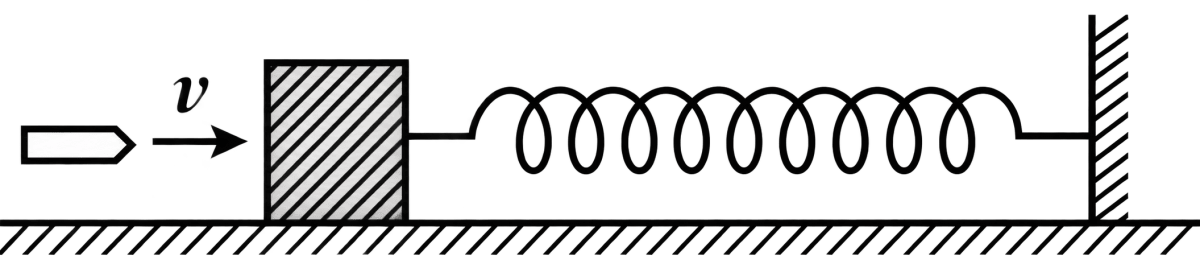
Answer
Given,
- Mass of the bullet, m = 20 g = 0.02 kg
- Mass of the block, M = 980 g = 0.98 kg
- Force constant of the spring, k = 100 N/m
- Compression of the spring, x = 10 cm = 0.1 m
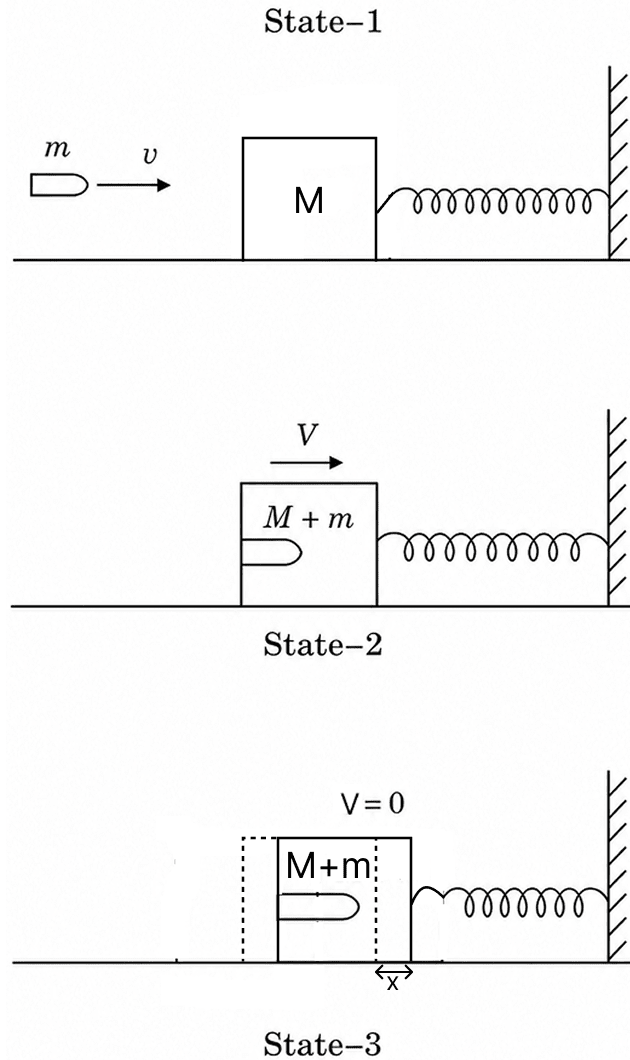
(a) Velocity of the block after the collision : After the collision the block, with the bullet embedded in it, compresses the spring and comes momentarily to rest. Hence the whole of its kinetic energy is stored as the elastic potential energy of the spring,
Here M + m = 0.98 + 0.02 = 1 kg. Substituting the values,
(b) Velocity of the bullet : The bullet is embedded in the block, so the collision is perfectly inelastic. By the conservation of linear momentum,
(c) Loss in the kinetic energy : The kinetic energy of the bullet before the collision is
The kinetic energy of the combined mass just after the collision is
Therefore the loss in kinetic energy is
Hence, the velocity of the block after the collision is 1.0 m/s, the velocity of the bullet is 50 m/s and the loss in kinetic energy is 24.5 J.
A smooth sphere (mass 10 kg) rolls on a smooth curved surface from the point A with a speed of 10 m/s. The sphere reaches the point D passing through point B. Find : (a) the total energy of the sphere at the point A , (b) the kinetic energy and the potential energy at the point B, (c) the kinetic energy at C, (d) the kinetic energy at D, (e) will the sphere go beyond D ? (g = 10 m/s2).
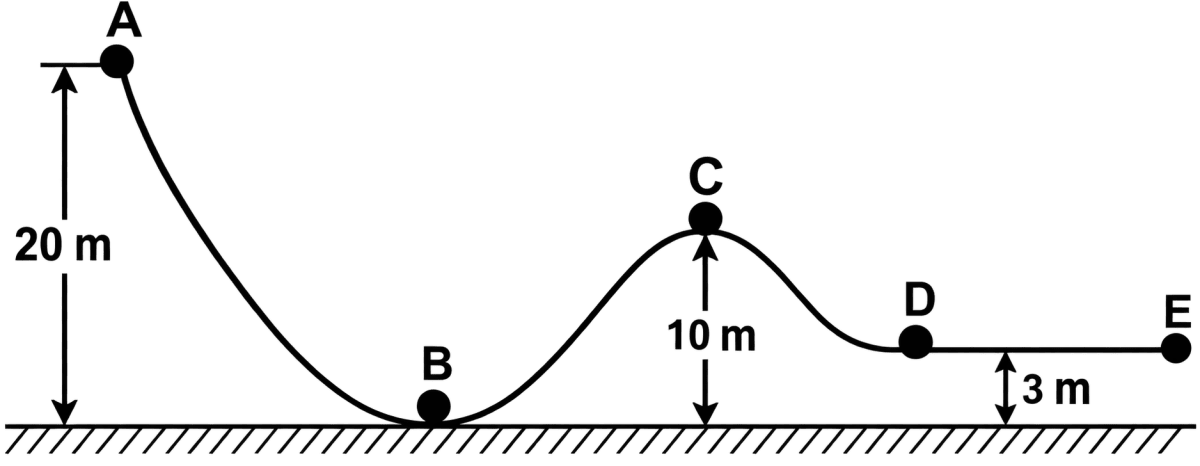
Answer
Given,
- Mass of the sphere, m = 10 kg
- Speed at the point A, vA = 10 m/s
- Heights : A at 20 m, B at 0 m, C at 10 m and D at 3 m
- g = 10 m/s2
(a) Total energy at the point A : The total energy is the sum of the kinetic and the potential energy,
Since the surface is smooth, this total energy remains the same at every point.
(b) At the point B : The height of B above the reference level is zero, so its potential energy is
Therefore its kinetic energy is
(c) At the point C : The height of C is 10 m, so
(d) At the point D : The height of D is 3 m, so
(e) Since the sphere still possesses a kinetic energy of 2200 J at the point D, it will go beyond D.
Hence, the total energy at A is 2500 J; at B the kinetic energy is 2500 J and the potential energy is zero; the kinetic energy is 1500 J at C and 2200 J at D; and the sphere goes beyond D.
If the momentum of a body is increased by 50%, what will be the percentage increase in the kinetic energy of the body?
Answer
Given,
- The momentum of the body is increased by 50%
Let the initial momentum be p and the initial kinetic energy be K. The kinetic energy in terms of the momentum is
Since the mass remains the same, K ∝ p2.
The new momentum after an increase of 50% is
Therefore the new kinetic energy is
The percentage increase in the kinetic energy is
Hence, the kinetic energy of the body increases by 125%.
A stationary bomb explodes into two fragments of masses 0.4 kg and 4 kg. If the bigger fragment has a kinetic energy of 100 J, find the kinetic energy of the smaller fragment.
Answer
Given,
- Mass of the smaller fragment, m1 = 0.4 kg
- Mass of the bigger fragment, m2 = 4 kg
- Kinetic energy of the bigger fragment, K2 = 100 J
The bomb is initially stationary, so its momentum is zero. By the conservation of linear momentum, the two fragments must fly apart with equal and opposite momenta, that is, their magnitudes are equal,
The kinetic energy in terms of the momentum is
so that for the same momentum, . Therefore
Hence the kinetic energy of the smaller fragment is
Hence, the kinetic energy of the smaller fragment is 1000 J.
A 0.1 kg ball moving at a speed of 10 ms-1 collides with an identical ball at rest. After collision, the two balls move symmetrically each making an angle of 30° with the original direction of motion of the moving ball. Find the new speed of each ball. Is the collision elastic?
Answer
Given,
- Mass of each ball, m = 0.1 kg
- Speed of the moving ball, u = 10 m s-1
- After the collision both balls move symmetrically, each making θ = 30° with the original direction
Let v be the new speed of each ball. Since the two balls move symmetrically, their momentum components perpendicular to the original direction are equal and opposite and therefore cancel out.
Applying the conservation of linear momentum along the original direction of motion,
Cancelling m from both sides,
Substituting the values,
Testing whether the collision is elastic : The kinetic energy before the collision is
The kinetic energy after the collision is
Since Kf is less than Ki, the kinetic energy is not conserved.
Hence, the new speed of each ball is 5.77 m s-1 and the collision is not elastic.
A 25 kg box is pulled at a constant speed by a horizontal force on a horizontal floor. The coefficient of sliding friction between the box and the floor is 0.20. How much work is done in pulling the box through 20 m ? (g = 9.8 m s-2).
Answer
Given,
- Mass of the box, m = 25 kg
- Coefficient of sliding friction, μ = 0.20
- Distance moved, s = 20 m
- g = 9.8 m s-2
Since the box is pulled at a constant speed, its acceleration is zero, so the applied force is exactly equal to the force of sliding friction,
Substituting the values,
The applied force is horizontal and the displacement is also horizontal, so the work done is
Hence, the work done in pulling the box through 20 m is 980 J.
Find the power of a 60 kg man who can climb up a height of 10 m in half a minute. g = 9.8 m s-2.
Answer
Given,
- Mass of the man, m = 60 kg
- Height climbed, h = 10 m
- Time taken, t = half a minute = 30 s
- g = 9.8 m s-2
The work done by the man against gravity is
The power of the man is the rate of doing this work,
Hence, the power of the man is 196 W.
The power of a pump-motor is 2 kW. How much water per minute can it raise to a height of 10 m ? (g = 10 m/s2)
Answer
Given,
- Power of the pump-motor, P = 2 kW = 2000 W
- Height to which water is raised, h = 10 m
- Time, t = 1 min = 60 s
- g = 10 m/s2
The work done by the pump-motor in one minute is
This work is used in raising a mass m of water through a height of 10 m, so it is equal to the gain in the gravitational potential energy of the water,
Substituting the values,
Hence, the pump-motor can raise 1200 kg of water per minute to a height of 10 m.
A spring requires 4 J of work to be stretched through 10 cm. Find the spring-constant.
Answer
Given,
- Work done in stretching the spring, W = 4 J
- Extension of the spring, x = 10 cm = 0.1 m
The work done in stretching a spring through a distance x is stored in it as elastic potential energy,
where k is the spring constant. Rearranging,
Substituting the values,
Hence, the spring-constant is 800 N m-1.
A solid of mass 2 kg moving with velocity 10 m/s strikes an ideal weightless spring and produces a compression of 25 cm in it. Calculate the force-constant of the spring.
Answer
Given,
- Mass of the solid, m = 2 kg
- Velocity of the solid, v = 10 m/s
- Compression produced in the spring, x = 25 cm = 0.25 m
The spring is ideal and weightless, so the whole of the kinetic energy of the solid is stored in the spring as elastic potential energy at the position of maximum compression,
The kinetic energy of the solid is
Therefore,
Hence, the force-constant of the spring is 3200 N/m.
A 20 kg mass which is moving with a speed of 10 ms-1 strikes a stationary mass of 5 kg. After collision the masses stick together. (a) With what speed does the combined mass move ? (b) What was the kinetic energy of the whole system before the collision ? (c) What is the kinetic energy after the collision ? (d) Where has the remaining energy gone ?
Answer
Given,
- Mass of the moving body, m1 = 20 kg with u1 = 10 m s-1
- Mass of the stationary body, m2 = 5 kg with u2 = 0
- The masses stick together after the collision
(a) Since the masses stick together, the collision is perfectly inelastic. By the conservation of linear momentum,
(b) The kinetic energy of the system before the collision is
(c) The kinetic energy of the system after the collision is
(d) The loss in kinetic energy is
This energy has not been destroyed. In this perfectly inelastic collision it has been converted into heat, along with sound and the energy of deformation of the bodies.
Hence, the combined mass moves with a speed of 8 m s-1, the kinetic energy is 1000 J before and 800 J after the collision, and the remaining 200 J is changed into heat.
A body of mass 2 kg moving with a velocity of 3 ms-1 collides head-on with a second body of mass 1 kg coming from the opposite direction with a velocity of 4 ms-1. After collision, the two bodies stick together. Find the velocity of the sticked bodies.
Answer
Given,
- Mass of the first body, m1 = 2 kg with u1 = 3 m s-1
- Mass of the second body, m2 = 1 kg with u2 = 4 m s-1 in the opposite direction
- The two bodies stick together after the collision
Taking the direction of motion of the first body as positive, u2 = − 4 m s-1. Since the bodies stick together, the collision is perfectly inelastic. By the conservation of linear momentum,
Substituting the values,
Since v is positive, the sticked bodies move in the original direction of the 2 kg body.
Hence, the velocity of the sticked bodies is m s-1, that is, about 0.67 m s-1, in the direction of motion of the 2 kg body.
A proton of mass 1.67 × 10⁻²⁷ kg collides elastically head-on with an α-particle of mass 6.68 × 10⁻²⁷ kg, initially at rest. After the collision, the α-particle moves with a speed of 8 × 10⁵ ms-1. Find the speed of the proton before and after the collision.
Answer
Given,
- Mass of the proton, m1 = 1.67 × 10⁻²⁷ kg
- Mass of the α-particle, m2 = 6.68 × 10⁻²⁷ kg, initially at rest
- Speed of the α-particle after the collision, v2 = 8 × 10⁵ m s-1
Here m1 + m2 = (1.67 + 6.68) × 10-27 = 8.35 × 10⁻²⁷ kg.
Speed of the proton before the collision : For a one-dimensional elastic collision with the target initially at rest, the velocity of the target after the collision is
Substituting the values,
Speed of the proton after the collision :
Substituting the values,
The negative sign shows that the proton rebounds, that is, it moves back in the opposite direction.
Hence, the speed of the proton before the collision is 2 × 10⁶ m s-1 and after the collision it is 1.2 × 10⁶ m s-1 in the reversed direction.
A particle of mass 1.8 × 10⁻²⁷ kg moving with a speed of 106 ms-1 collides with another particle of mass 3.6 × 10⁻²⁷ kg which is initially at rest. The collision is elastic and head-on. Find the speed of each particle after collision.
Answer
Given,
- Mass of the first particle, m1 = 1.8 × 10⁻²⁷ kg with u1 = 106 m s-1
- Mass of the second particle, m2 = 3.6 × 10⁻²⁷ kg, initially at rest
Here m1 + m2 = (1.8 + 3.6) × 10-27 = 5.4 × 10⁻²⁷ kg.
Speed of the first particle after the collision : For a one-dimensional elastic collision with the target initially at rest,
Substituting the values,
The negative sign shows that the first particle rebounds.
Speed of the second particle after the collision :
Substituting the values,
Hence, the first particle rebounds with a speed of m s-1 while the second particle moves forward with a speed of m s-1.
A stone is tied to a weightless string and revolved in a vertical circle of radius 5 m.
(i) What should be the minimum speed of the stone at the highest point of the circle so that the string does not slack ?
(ii) What should be the speed of the stone at the lowest point in this situation ? (g = 9.8 m/s2)
Answer
Given,
- Radius of the vertical circle, l = 5 m
- g = 9.8 m/s2
(i) Minimum speed at the highest point : At the highest point the tension becomes zero for the minimum speed, and the weight alone provides the centripetal force,
Substituting the values,
(ii) Speed at the lowest point : Applying the conservation of mechanical energy between the highest point A and the lowest point B, which are separated by a vertical height 2 l,
Since vA2 = gl,
Hence, the minimum speed at the highest point is 7 m/s and the speed at the lowest point is m/s.
A body of mass 2 kg tied at one end of a weightless string of length 2.5 m is revolved in a vertical circle. What will be the minimum speed of the body at the top of the circle ? (g = 10 m/s2)
Answer
Given,
- Mass of the body, m = 2 kg
- Length of the string (radius), l = 2.5 m
- g = 10 m/s2
At the top of the vertical circle, the tension T in the string and the weight mg both act vertically downwards, that is, towards the centre,
For the minimum speed at the top, the tension becomes zero, so the weight alone provides the necessary centripetal force,
This is the critical velocity for the motion in a vertical circle, and it does not depend on the mass of the body.
Substituting the values,
Hence, the minimum speed of the body at the top of the circle is 5 m/s.
A stone of mass 2 kg tied at the end of a 1 m long string is whirled in a vertical circle. Find out the velocity of the stone and the tension of the string at the lowest point. (g = 9.8 m/s2).
Answer
Given,
- Mass of the stone, m = 2 kg
- Length of the string (radius), l = 1 m
- g = 9.8 m/s2
Velocity at the lowest point : For the stone to just complete the vertical circle, its speed at the lowest point must be
Substituting the values,
Tension at the lowest point : At the lowest point the tension acts vertically upwards while the weight acts vertically downwards, and their difference provides the centripetal force,
Substituting the values,
Hence, the velocity of the stone at the lowest point is 7 m/s and the tension in the string there is 117.6 N.
The result TB = 117.6 N is also equal to 6 mg = 6 × 2 × 9.8, which is the tension at the lowest point in the condition of just crossing the highest point.
A ball of mass 0.5 kg is tied to one end of a string of length 1 m and rotated in a vertical circle. Find the speed of ball at the lowest point of the circle. Acceleration due to gravity g = 9.8 m/s2.
Answer
Given,
- Mass of the ball, m = 0.5 kg
- Length of the string (radius), l = 1 m
- g = 9.8 m/s2
For the ball to complete the vertical circle, the speed at the highest point must be at least the critical velocity . Applying the conservation of mechanical energy between the highest point A and the lowest point B, separated by a vertical height 2 l,
Therefore the speed at the lowest point is
Substituting the values,
Hence, the speed of the ball at the lowest point of the circle is 7 m/s.
The speed at the lowest point does not depend on the mass of the ball.