
Paragraph-I
Two particles, 1 and 2, each of mass m, are connected by a massless spring, and are on a horizontal frictionless plane, as shown in the figure. Initially, the two particles, with their centre of mass at x0 are oscillating with amplitude a and angular frequency ω. Thus, their positions at time t are given by x1 (t) = (x0 + d) + a sin ωt and x2 (t) = (x0 – d) – a sin ωt, respectively, where d > 2a. Particle 3 of mass m moves towards this system with speed u0 = aω/2, and undergoes instantaneous elastic collision with particle 2, at time t0. Finally, particles 1 and 2 acquire a centre of mass speed vcm and oscillate with amplitude b and the same angular frequency ω.
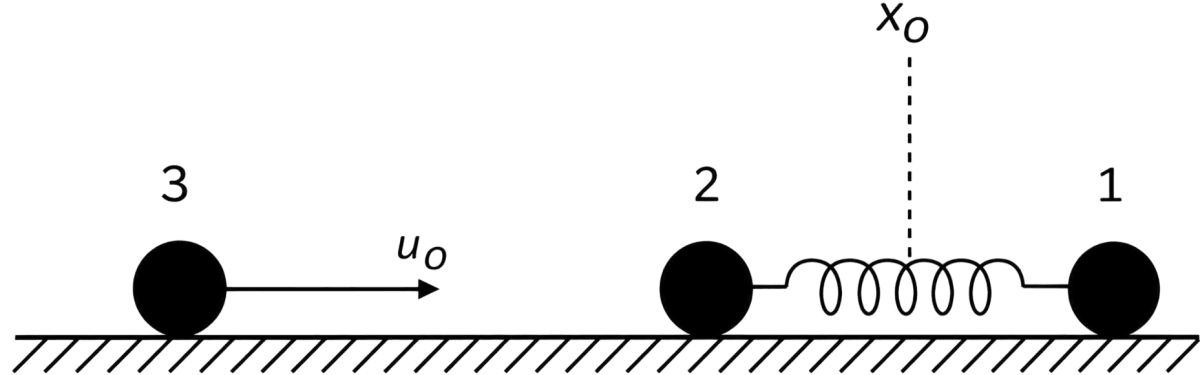
If the collision occurs at time t0 = 0, the value of vcm/(aω) will be ............... .
Answer
Given,
- Two particles 1 and 2, each of mass m, oscillating with amplitude a and angular frequency ω
- Particle 3 of mass m approaches with speed
- The collision occurs at t0 = 0
Velocities of the particles at t = 0 : Differentiating the given positions with respect to time,
At t0 = 0, cos 0 = 1, so the particle 1 is moving with speed aω and the particle 2 with speed aω in the opposite sense.
The collision : The particle 3 has the same mass m as the particle 2, and the collision between them is instantaneous and elastic. In a one-dimensional elastic collision between two bodies of equal masses, the bodies merely exchange their velocities. Hence the particle 2 acquires the speed of the particle 3, that is, .
Centre of mass speed : After the collision the particles 1 and 2, each of mass m, move with speeds aω and respectively. The speed of their centre of mass is
Therefore,
Hence, the value of is 0.75.
Paragraph-II
Two particles, 1 and 2, each of mass m, are connected by a massless spring, and are on a horizontal frictionless plane, as shown in the figure. Initially, the two particles, with their centre of mass at x0, are oscillating with amplitude a and angular frequency ω. Thus, their positions at time t are given by x1 (t) = (x0 + d) + a sin ωt and x2 (t) = (x0 – d) – a sin ωt, respectively, where d > 2a. Particle 3 of mass m moves towards this system with speed u0 = aω/2, and undergoes instantaneous elastic collision with particle 2, at time t0. Finally, particles 1 and 2 acquire a centre of mass speed vcm and oscillate with amplitude b and the same angular frequency ω.
If the collision occur at time , then the value of will be ......... .
Answer
Given,
- Two particles 1 and 2, each of mass m, oscillating with amplitude a and angular frequency ω
- Particle 3 of mass m approaches with speed
- The collision occurs at
Position of the particles at the instant of collision : The angular frequency is related to the time period by . Therefore
At the particles are at their extreme positions, where their velocities are zero and the extension of the spring is 2a.
After the collision : The particle 3 collides elastically with the particle 2 of equal mass, so they exchange their velocities and the particle 2 acquires the speed . Since the particle 1 is momentarily at rest, the speed of the centre of mass of the two particles is
Relative to the centre of mass, each of the two particles therefore has a speed , and the new extension at the extreme position becomes 2b.
Applying the work-energy theorem to the spring : The work done by the spring equals the change in the kinetic energy of the two particles in the centre of mass frame,
For two equal masses connected by a spring, the reduced mass is , so that . Substituting this,
Dividing throughout by 2k,
Therefore,
Hence, the value of is 4.25.
A body of mass m = 10-2 kg is moving in a medium and experiences a frictional force F = – k v2. Its initial speed is v0 = 10 ms-1. If after 10 s, its energy is , the value of k will be :
- 10-1 kg m-1s-1
- 10-3 kg m-1
- 10-3 kg s-1
- 10-4 kg m-1
Answer
10-4 kg m-1
Reason — Given,
- Mass, m = 10-2 kg
- Initial speed, v0 = 10 m s-1
- Frictional force, F = − k v2
- After t = 10 s, the energy is
Speed after 10 s : Since ,
Applying Newton's second law :
Integrating between the limits,
Substituting the values,
Three objects, A : (a solid sphere), B : (a thin circular disk) and C : (a circular ring), each have the same mass M and radius R. They all spin with the same angular speed ω about their own symmetry axes. The amounts of work (W) required to bring them to rest, would satisfy the relation:
- WC > WB > WA
- WA > WC > WB
- WB > WA > WC
- WA > WB > WC
Answer
WC > WB > WA
Reason — The work required to bring a rotating body to rest is equal to its rotational kinetic energy,
Since M, R and ω are the same for all the three objects, W ∝ I. The moments of inertia about their symmetry axes are
Since , we have IC > IB > IA and therefore WC > WB > WA.
In a collinear collision, a particle with an initial speed v0 strikes a stationary particle of the same mass. If the final kinetic energy 50% greater than the original kinetic energy, the magnitude of the relative velocity between the two particles, after collision, is :
Answer
Reason — Given,
- A particle of mass m with initial speed v0 strikes a stationary particle of the same mass
- The final kinetic energy is 50% greater than the original kinetic energy
Let v1 and v2 be the velocities after the collision. By the conservation of linear momentum,
The final kinetic energy is 1.5 times the initial kinetic energy,
Squaring equation (i),
Substituting from equation (ii),
The relative velocity after the collision is given by
It is found that if a neutron suffers an elastic collinear collision with deuterium at rest, fractional loss of its energy is Pd, while for its similar collision with carbon nucleus at rest, fractional loss of energy is Pc. The values of Pd and Pc respectively are :
- (0, 0)
- (0, 1)
- (0.89, 0.28)
- (0.28, 0.89)
Answer
(0.89, 0.28)
Reason — In a head-on elastic collision of a body of mass m1 with a stationary body of mass m2, the fraction of the energy lost by the striking body is
Collision with deuterium : The mass of a deuterium nucleus is twice that of a neutron, so m2 = 2m1,
Collision with carbon : The mass of a carbon nucleus is twelve times that of a neutron, so m2 = 12m1,
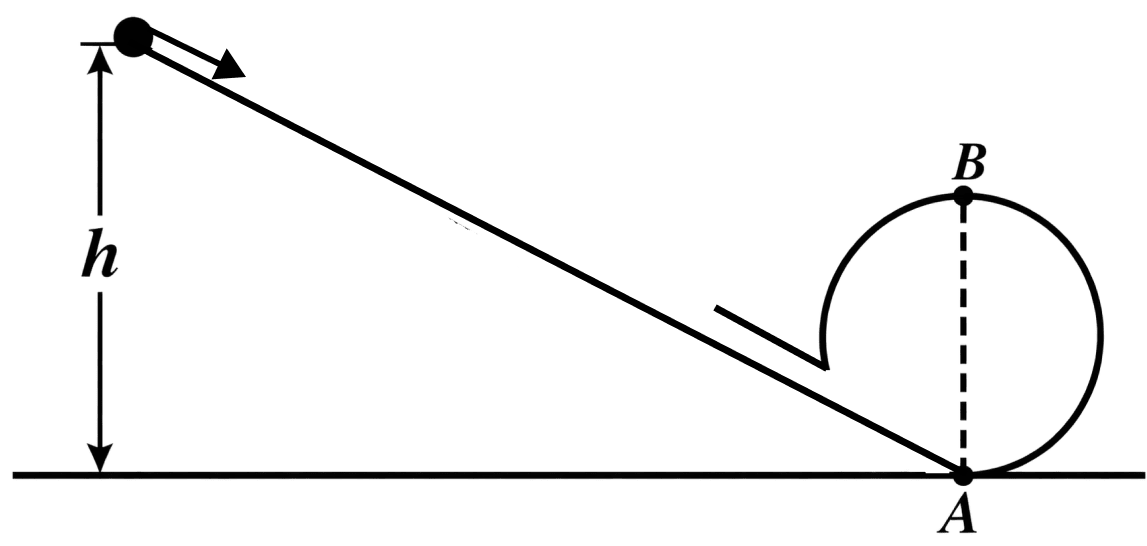
A body initially at rest and sliding along a frictionless track from a height h (as shown in the figure) just-completes a vertical circle of diameter AB = D. The height h is equal to :
- D
Answer
Reason — Given, the diameter of the vertical circle is D, so its radius is .
The body just completes the vertical circle, so at the highest point B its speed is the critical velocity,
The track is frictionless, so by the conservation of mechanical energy between the starting point at height h and the highest point B, which is at a height 2r,
Substituting vB2 = gr,
Substituting ,
A particle is moving in a circular path of radius a under the action of an attractive potential . Its total energy is :
- zero
Answer
zero
Reason — Given, the attractive potential is and the radius of the circular path is a.
Force on the particle : The force is the negative gradient of the potential energy,
Differentiating,
The negative sign shows that the force is directed towards the centre, that is, it is attractive.
Kinetic energy : This force provides the centripetal force for the circular motion of radius a,
Therefore the kinetic energy is
Total energy : The potential energy at r = a is . Hence
A moving block having mass m, collides with another stationary block having mass 4 m. The lighter block comes to rest after collision. When the initial velocity of the lighter block is v, then the value of coefficient of restitution (e) will be :
- 0.5
- 0.4
- 0.8
- 0.25
Answer
0.25
Reason — Given,
- Mass of the moving block, m1 = m with u1 = v
- Mass of the stationary block, m2 = 4m with u2 = 0
- The lighter block comes to rest after the collision, v1 = 0
By the conservation of linear momentum,
The coefficient of restitution is the ratio of the relative speed of separation to the relative speed of approach,
A force F = (20 + 10y) N acts on a particle in Y-direction, where F is in Newton and y is in metre. Work done by this force to move the particle from y = 0 to y = 1 m is :
- 5 J
- 25 J
- 20 J
- 30 J
Answer
25 J
Reason — Given, F = (20 + 10y) N acting in the Y-direction, and the particle moves from y = 0 to y = 1 m.
Since the force varies with the position y, it is a variable force, and the work done is obtained by integration,
Integrating term by term,
Evaluating the limits,
Body A of mass 4 m moving with speed u collides with another body B of mass 2 m, at rest. The collision is head-on and elastic in nature. After the collision the fraction of energy lost by the colliding body A is :
Answer
Reason — Given,
- Mass of the body A, m1 = 4m moving with speed u
- Mass of the body B, m2 = 2m, at rest
In a head-on elastic collision with the target initially at rest, the fraction of the energy lost by the colliding body is
Substituting the values,
A uniform cable of mass m and length L is placed on a horizontal surface such that its part is hanging below the edge of the surface. To lift the hanging part of the cable up to the surface, the work done should be :
Answer
Reason — Given,
- Mass of the cable = m, length = L
- The hanging part is of the cable
Since the cable is uniform, the mass of the hanging part is
and the length of the hanging part is .
The centre of gravity of the hanging part lies at its mid-point, that is, at a depth
below the edge of the surface.
To lift the hanging part up to the surface, its centre of gravity has to be raised through this height h. Therefore the work done is
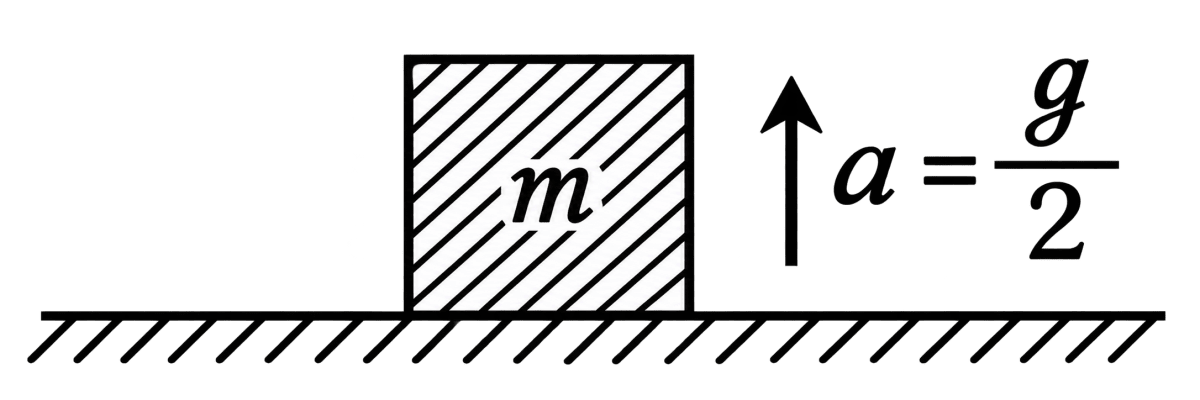
A block of mass m is kept on a platform which starts from rest with constant acceleration g/2 upwards as shown in figure. Work done by normal reaction on block in time t is :
- 0
Answer
Reason —
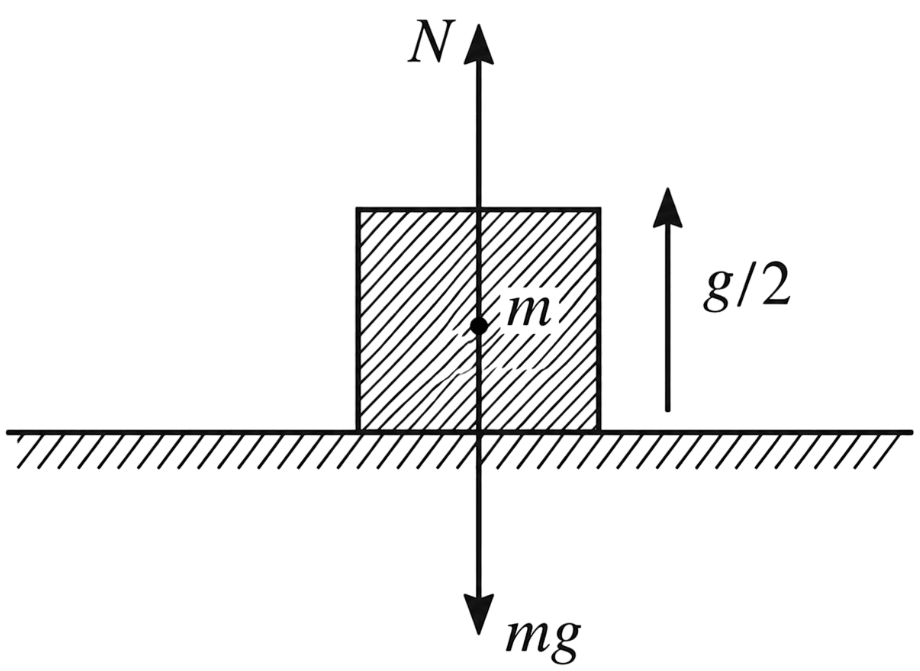
Given, the platform starts from rest with a constant upward acceleration .
Normal reaction : For the block of mass m on the accelerating platform,
Displacement in time t : Starting from rest,
Work done by the normal reaction : The normal reaction and the displacement are both directed upwards, so
A force acts on a 2 kg object, so that its position is given as a function of time as x = 3t2 + 5. What is the work done by this force in first 5 s?
- 850 J
- 900 J
- 950 J
- 875 J
Answer
900 J
Reason — Given,
- Mass of the object, m = 2 kg
- Position as a function of time, x = 3t2 + 5
- Time interval, from t = 0 to t = 5 s
Velocity : Differentiating the position with respect to time,
At t = 0, the velocity is
At t = 5 s, the velocity is
Work done : By the work-kinetic energy theorem, the work done by the force is equal to the change in the kinetic energy,
A body of mass 2 kg makes an elastic collision with a second body at rest and continues to move in the original direction but with one-fourth of its original speed. What is the mass of the second body?
- 1.8 kg
- 1.2 kg
- 1.5 kg
- 1.0 kg
Answer
1.2 kg
Reason — Given,
- Mass of the first body, m1 = 2 kg
- The second body is at rest, u2 = 0
- After the collision, in the original direction
For a one-dimensional elastic collision with the target initially at rest,
Substituting and cancelling u1,
Substituting m1 = 2 kg,
A wedge of mass M = 4m lies on a frictionless plane. A particle of mass m approaches the wedge with speed v. There is no friction between the particle and the plane or between the particle and the wedge. The maximum height climbed by the particle on the wedge is given by:
Answer
Reason — Given,
- Mass of the wedge, M = 4m, lying on a frictionless plane
- Mass of the particle = m, approaching with speed v
- There is no friction anywhere
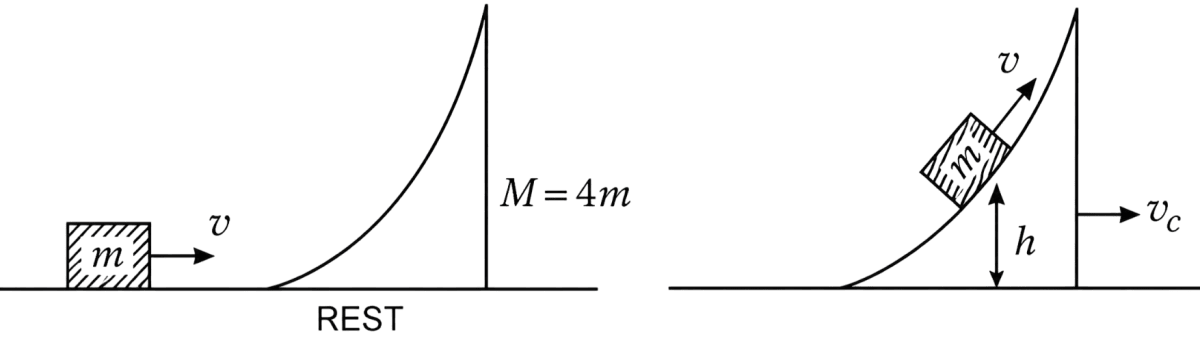
At the instant the particle reaches its maximum height on the wedge, it is momentarily at rest relative to the wedge, so both move together with a common horizontal velocity vc.
Conservation of linear momentum :
Conservation of mechanical energy : Since all the surfaces are frictionless, the loss in kinetic energy appears as the gain in the potential energy of the particle,
Substituting ,
A particle which is experiencing a force, is given by undergoes a displacement of . If the particle had a kinetic energy of 3 J at the beginning of the displacement. What is the kinetic energy at the end of displacement?
- 9 J
- 15 J
- 12 J
- 10 J
Answer
15 J
Reason — Given,
- Force,
- Displacement,
- Initial kinetic energy = 3 J
The work done by the force is the scalar product of the force and the displacement,
Using and ,
By the work-kinetic energy theorem, the work done by the net force is equal to the change in the kinetic energy,
A body of mass 8 kg and another of mass 2 kg are moving with equal kinetic energy. The ratio of their respective momenta will be :
- 1 : 1
- 2 : 1
- 1 : 4
- 4 : 1
Answer
2 : 1
Reason — Given,
- Mass of the first body, m1 = 8 kg
- Mass of the second body, m2 = 2 kg
- The two bodies have equal kinetic energies
The momentum in terms of the kinetic energy is
For the same kinetic energy, . Therefore
An electric lift with a maximum load of 2000 kg (lift + passengers) is moving up with a constant speed of 1.5 ms-1. The frictional force opposing the motion is 3000 N. The minimum power delivered by the motor to the lift in watts is : (g = 10 ms-2)
- 34500
- 23500
- 23000
- 20000
Answer
34500
Reason — Given,
- Maximum load, m = 2000 kg
- Constant speed, v = 1.5 m s-1
- Frictional force opposing the motion, f = 3000 N
- g = 10 m s-2
Since the lift moves up with a constant speed, its acceleration is zero. The motor must therefore exert a force which balances the weight of the lift as well as the opposing frictional force,
Substituting the values,
The minimum power delivered by the motor is
The energy that will be ideally radiated by a 100 kW transmitter in 1 h is:
- 36 × 105 J
- 1 × 10⁵ J
- 36 × 107 J
- 36 × 104 J
Answer
36 × 107 J
Reason — Given,
- Power of the transmitter, P = 100 kW = 105 W
- Time, t = 1 h = 3600 s
The energy radiated is the product of the power and the time,
Writing this in the form given in the options,
A rubber ball falls from a height h and rebounds up to the height h/2. The percentage loss of total energy of the initial system as well as velocity of ball before it strikes the ground respectively are :
- 50%,
- 50%,
- 40%,
- 50%,
Answer
50%,
Reason — Given,
- The ball falls from a height h and rebounds up to a height
Percentage loss of energy : The initial energy of the ball at the height h is mgh, and after the rebound its energy is . The loss of energy is
Therefore the percentage loss is
Velocity before striking the ground : The ball falls freely from rest through the height h, so from v2 = u2 + 2gh with u = 0,
Two bodies of mass 4 g and 25 g are moving with equal kinetic energy. The ratio of magnitudes of their momentum is :
- 3 : 5
- 5 : 4
- 2 : 5
- 4 : 5
Answer
2 : 5
Reason — Given,
- Mass of the first body, m1 = 4 g
- Mass of the second body, m2 = 25 g
- The two bodies have equal kinetic energies
The momentum in terms of the kinetic energy is , so for the same kinetic energy . Therefore
A bob is whirled in a horizontal plane by means of a string with an initial speed of ω rpm. The tension in the string is T. If speed becomes 2ω while keeping the same radius, the tension in the string becomes :
- T
- 4T
- T/4
Answer
4T
Reason — Given,
- Initial angular speed = ω, with tension T in the string
- Final angular speed = 2ω, with the same radius
For a bob whirled in a horizontal circle of radius r, the tension in the string provides the centripetal force,
Since the mass and the radius remain unchanged, . Therefore
At any instant of time t, the displacement of any particle is given by 2t–1 (S.I. Units) under the influence of force of 5N. The value of instantaneous power in (S.I.) is :
- 10
- 5
- 7
- 6
Answer
10
Reason — Given,
- Displacement, s = 2t − 1 (S.I. units)
- Force, F = 5 N
The instantaneous velocity is obtained by differentiating the displacement with respect to time,
The velocity is thus constant. The instantaneous power is the scalar product of the force and the velocity,
Two blocks A and B of same mass undergo completely inelastic collision in one dimension. The body A moves with velocity v1 while body B is at rest before, collision. The velocity of the system after collision is v2. The ratio of v1 : v2 is :
- 1 : 2
- 2 : 1
- 4 : 1
- 1 : 4
Answer
2 : 1
Reason — Given,
- Two blocks A and B of the same mass m
- The body A moves with velocity v1 while B is at rest
- The collision is completely inelastic, and the system moves with velocity v2
Since the collision is completely inelastic, the two blocks move together after the collision. By the conservation of linear momentum,
Therefore the required ratio is
A body of mass 1000 kg is moving horizontally with a velocity 6 ms-1. If 200 kg extra mass is added, the final velocity (in ms-1) is:
- 6
- 2
- 3
- 5
Answer
5
Reason — Given,
- Mass of the body, m1 = 1000 kg moving with velocity u = 6 m s-1
- Extra mass added, m2 = 200 kg
The extra mass is added to the moving body, so the process is like a perfectly inelastic collision in which no external horizontal force acts. By the conservation of linear momentum,
Substituting the values,
The kinetic energies of two similar cars A and B are 100 J and 225 J respectively. On applying breaks, car A stops after 1000 m and car B stops after 1500 m. If FA and FB are the forces applied by the brakes on cars A and B, respectively, then the ratio FA/FB is:
- 32
- 23
- 13
- 12
Answer
Reason — Given,
- Kinetic energy of the car A, KA = 100 J, stopping distance sA = 1000 m
- Kinetic energy of the car B, KB = 225 J, stopping distance sB = 1500 m
By the work-kinetic energy theorem, the work done by the braking force is equal to the whole of the kinetic energy of the car, since the car finally comes to rest,
For the car A,
For the car B,
Therefore the required ratio is
Note: In the printed options the fraction bars are missing, so the four choices appear as 32, 23, 13 and 12. They are intended to be , , and , and the correct choice is the second one, .
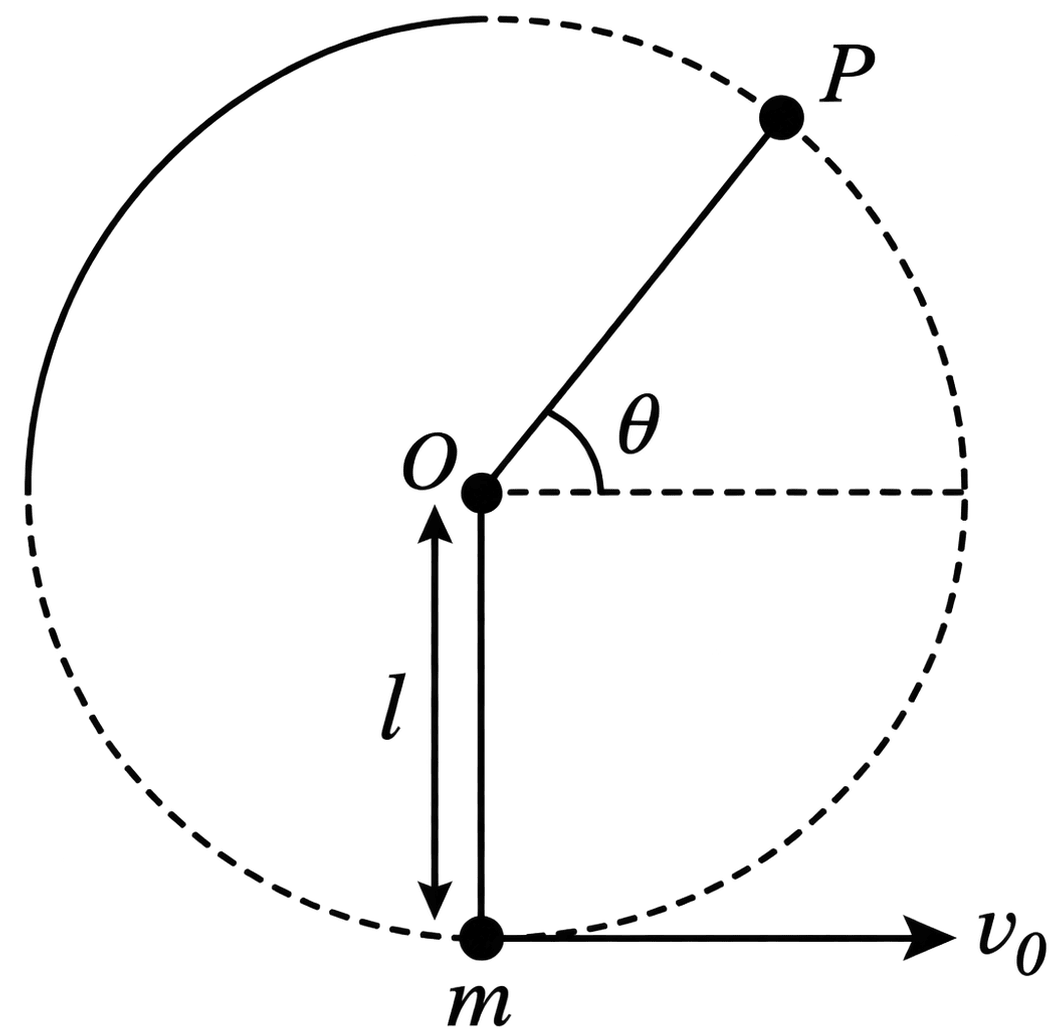
A bob of heavy mass m is suspended by a light string of length l. The bob is given a horizontal velocity v0 as shown in figure. If the string gets slack at some point P making an angle θ from the horizontal, the ratio of the speed v of the bob at point P to its initial speed v0 is:
Answer
Reason —
Given,
- Mass of the bob = m, length of the string = l
- Initial horizontal velocity at the lowest point = v0
- The string gets slack at the point P, making an angle θ with the horizontal
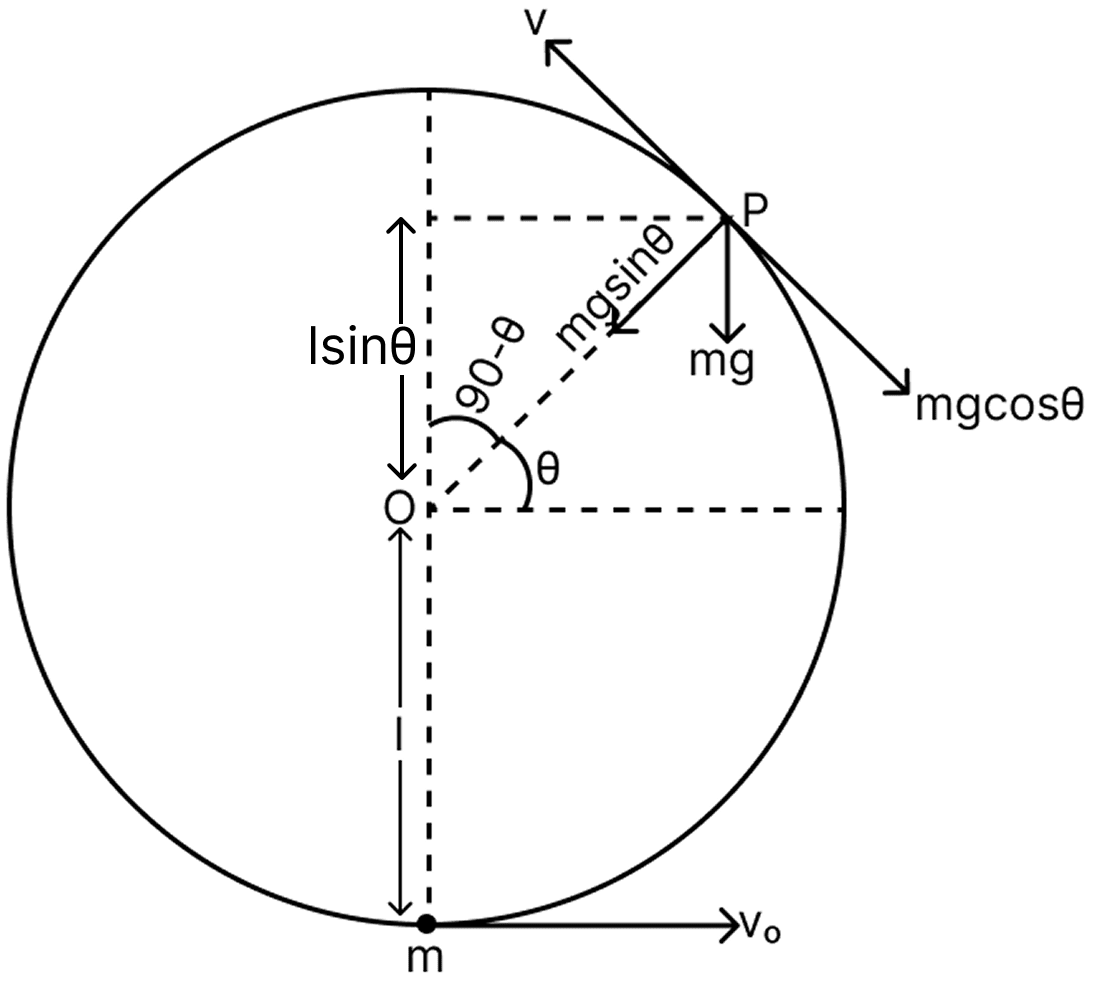
Condition for the string to go slack : At the point P the string becomes slack, so the tension in it is zero. The component of the weight along the string, directed towards the centre, then provides the whole of the centripetal force. Since OP makes an angle θ with the horizontal, this component is mg sin θ,
Conservation of mechanical energy : The height of the point P above the lowest point of the circle is
Applying the conservation of mechanical energy between the lowest point and P,
Substituting v2 from equation (i),
Required ratio : Dividing equation (i) by this result,
In the statement given below one or more alternatives may be correct:
A linear harmonic oscillator of force-constant 2 × 10⁶ N/m and amplitude 0.01 m has a total mechanical energy of 160 J. Its:
- maximum potential energy is 100 J
- maximum kinetic energy is 100 J
- maximum potential energy is 160 J
- minimum potential energy is zero.
Answer
2. maximum kinetic energy is 100 J
3. maximum potential energy is 160 J
Reason — Given,
- Force constant, k = 2 × 10⁶ N/m
- Amplitude, A = 0.01 m
- Total mechanical energy, E = 160 J
For a linear harmonic oscillator, the kinetic energy is maximum at the mean position and zero at the extreme position, while the potential energy is maximum at the extreme position.
The maximum kinetic energy occurs at the mean position and is equal to the energy of oscillation,
Hence option 2 is correct and option 1 is incorrect.
The maximum potential energy occurs at the extreme position, where the kinetic energy is zero. Since the total mechanical energy is constant,
Hence option 3 is correct.
The minimum potential energy occurs at the mean position, where the kinetic energy is maximum,
Since this is not zero, option 4 is incorrect. The oscillator has a constant potential energy of 60 J at the mean position, over and above the energy of oscillation.
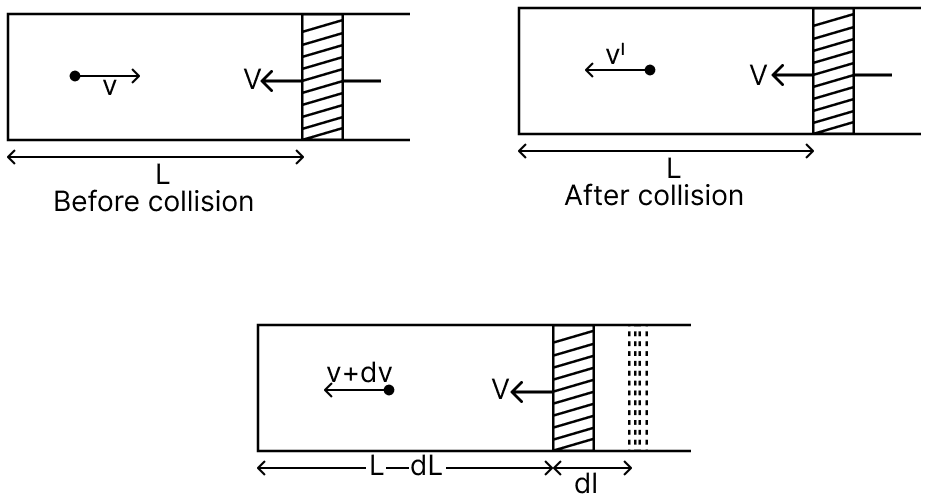
A small particle of mass m moving inside a heavy, hollow and straight tube along the tube axis undergoes elastic collision at two ends. The tube has no friction and it is closed at one end by a flat surface while the other end is fitted with a heavy movable flat piston as shown in figure. When the distance of the piston from closed end is L = L0, the particle speed is v = v0. The piston is moved inward at a very low speed V such that , where dL is the infinitesimal displacement of the piston. Which of the following statement(s) is/are correct?

- After each collision with the piston, the particle speed increases by 2V.
- If the piston moves inward by dL, the particle speed increases by .
- The particles kinetic energy increases by a factor of 4 when the piston is moved inward from L0 to L0/2.
- The rate at which the particle strikes the piston is v/L.
Answer
After each collision with the piston, the particle speed increases by 2V.
The particles kinetic energy increases by a factor of 4 when the piston is moved inward from L0 to L0/2.
Reason —
Given,
- Mass of the particle = m
- Initial length of the tube = L0
- Initial speed of the particle = v0
- Instantaneous length of the tube = L
- Instantaneous speed of the particle = v
- Speed of the piston moving inward = V
Option 1 : The piston is very heavy, therefore its velocity remains practically unchanged during the collision.
Take the direction from the closed end towards the piston as positive. Before the collision the velocities of the particle and of the piston are v and − V respectively, so the velocity of the particle relative to the piston before the collision is
Since the collision is elastic, the relative velocity reverses after the collision. Therefore,
The negative sign shows that the particle rebounds towards the closed end. Hence its speed after the collision is
Therefore the increase in the speed of the particle after each collision with the piston is
Hence, option 1 is correct.
Option 4 : After striking the piston the particle travels to the closed end and then returns to the piston, so it covers approximately a distance 2L between two successive collisions with the piston.
Since the speed of the piston is very small compared with the speed of the particle, the time between two successive collisions with the piston is approximately
Therefore the rate at which the particle strikes the piston is
Since option 4 gives this rate as , option 4 is incorrect.
Option 2 : Let the piston move inward through a small positive distance in time dt. Then
The rate at which the particle strikes the piston is , so the number of collisions with the piston during the time dt is
Each collision increases the speed of the particle by 2V, so the total increase in speed is
Substituting the value of dN,
Since ,
Thus, when the piston moves inward through a distance , the speed of the particle increases by and not by . Hence, option 2 is incorrect.
Option 3 : The distance is the inward displacement of the piston, taken positive, whereas dL is the change in the length of the tube. As the piston moves inward the length L decreases, so
From option 2,
Substituting ,
Integrating,
Using the initial condition that v = v0 when L = L0,
When the piston is moved inward until the length becomes ,
The initial kinetic energy of the particle is
and the final kinetic energy is
Therefore the kinetic energy of the particle becomes four times its initial value. Hence, option 3 is correct.
Hence, the correct statements are options 1 and 3.