
A piece of ice (heat capacity = 2100 J kg-1 °C-1 and latent heat = 3.36 × 10⁵ J kg-1) of mass m gram is at − 5°C at atmospheric pressure. It is given 420 J of heat so that the ice starts melting. Finally when the ice-water mixture is in equilibrium, it is found that 1 gm of ice has melted. Assuming there is no other heat exchange in the process, find the value of m in grams.
Answer
Given,
- Specific heat of ice, c = 2100 J kg-1 °C-1 = 2.1 J g-1 °C-1
- Latent heat of fusion of ice, L = 3.36 × 10⁵ J kg-1 = 336 J g-1
- Mass of ice = m gram at − 5°C
- Heat supplied, Q = 420 J
- Mass of ice melted = 1 g
The heat supplied is used up in two stages. First the whole of the ice is warmed from − 5°C to its melting point 0°C, and then 1 g of this ice is melted at 0°C.
Heat used in warming the ice from − 5°C to 0°C is
Heat used in melting 1 g of ice at 0°C is
Since the total heat supplied is 420 J,
Hence, the value of m is 8 grams.
Coefficient of linear expansion of brass and steel rods are α1 and α2. Lengths of brass and steel rods are l1 and l2 respectively. If (l2 − l1) is maintained same at all temperatures, which one of the following relations holds good?
- α1l2 = α2l1
- α1l22 = α2l12
- α12l2 = α22l1
- α1l1 = α2l2
Answer
α1l1 = α2l2
Reason — Given,
- Coefficient of linear expansion of brass = α1, length of brass rod = l1
- Coefficient of linear expansion of steel = α2, length of steel rod = l2
For a rise in temperature Δt, the increase in the lengths of the two rods are
The difference (l2 − l1) will remain the same at all temperatures only if both the rods increase in length by exactly the same amount, that is,
A pendulum clock loses 12 s a day if the temperature is 40°C and gains 4 s a day if the temperature is 20°C. The temperature at which the clock will show correct time, and the coefficient of linear expansion (α) of the metal of the pendulum shaft are respectively :
- 60°C; α = 1.85 × 10⁻⁴/°C
- 30°C; α = 1.85 × 10⁻³/°C
- 55°C; α = 1.85 × 10⁻²/°C
- 25°C; α = 1.85 × 10⁻⁵/°C
Answer
25°C; α = 1.85 × 10⁻⁵/°C
Reason — Given,
- The clock loses 12 s per day at 40°C
- The clock gains 4 s per day at 20°C
- Number of seconds in a day = 86400 s
The time period of a pendulum is , so T ∝ . If the length changes by Δl = l α Δt, the fractional change in the time period is
Hence the time lost or gained in one day is
Let θ be the temperature at which the clock shows correct time.
At 40°C the clock loses 12 s :
At 20°C the clock gains 4 s :
Dividing equation (i) by equation (ii),
Substituting θ = 25°C in equation (ii),
× 10-5°C-1
Two litres of water (density = 1 kg/litre) at 27°C is heated by a 1-kW heater in an open container. Heat is lost to the surroundings at a rate of 160 J/s. The time taken by the water (specific heat = 4.2 kJ/kg-K) to be heated from 27°C to 77°C is :
- 8 min 20 s
- 6 min 2 s
- 7 min
- 14 min
Answer
8 min 20 s
Reason — Given,
- Volume of water = 2 litre, density = 1 kg litre-1, so mass m = 2 kg
- Power of the heater, P = 1 kW = 1000 J s-1
- Rate of heat loss to the surroundings = 160 J s-1
- Specific heat of water, c = 4.2 kJ kg-1 K-1 = 4200 J kg-1 K-1
- Rise in temperature, ΔT = 77 − 27 = 50°C
The net rate at which heat is supplied to the water is
The heat required to raise the temperature of the water is
Therefore the time taken is
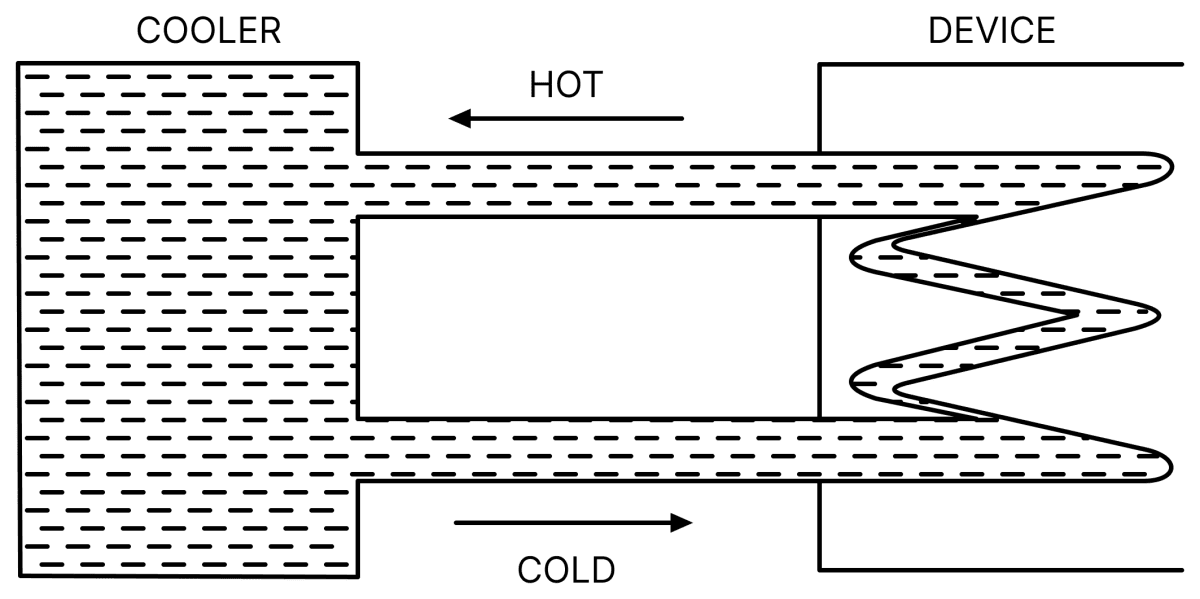
A water cooler of storage capacity 120 litres can cool water at a constant rate of P watts. In a closed circulation system (as shown schematically in the figure) the water from the cooler is used to cool an external device that generates constantly 3 kW of heat (thermal load). The temperature of water fed into the device cannot exceed 30°C and the entire stored 120 litres of water is initially cooled to 10°C. The entire system is thermally insulated. The minimum value of P (in watts) for which the device can be operated for 3 hours is : (Specific heat of water is 4.2 kJ kg-1 K-1 and the density of water is 1000 kg m-3)
- 1600
- 2067
- 2533
- 3933
Answer
2067
Reason — Given,
- Mass of stored water, m = 120 litre = 120 kg
- Rate of heat generated by the device = 3 kW = 3000 J s-1
- Initial temperature of water = 10°C, maximum permissible temperature = 30°C
- Time of operation, t = 3 h = 10800 s
- Specific heat of water, c = 4.2 kJ kg-1 K-1 = 4200 J kg-1 K-1
The heat generated by the device in 3 hours is
Out of this, a part is removed by the cooler and the rest is absorbed by the stored water, whose temperature is allowed to rise from 10°C to 30°C, that is, through 20°C. The heat absorbed by the stored water is
The heat removed by the cooler in 3 hours is P × 10800. Since the system is thermally insulated,
A metal rod AB of length 10x has its one end A in ice at 0°C and the other end B in water at 100°C. If a point P on the rod is maintained at 400°C, then it is found that equal amounts of water and ice evaporate and melt per unit time. The latent heat of evaporation of water is 540 cal/g and latent heat of melting of ice is 80 cal/g. If the point P is at a distance of λx from the ice end A, find the value of λ. (Neglect any heat loss to the surrounding).
(Answer should be in single digit integer, ranging from 0 to 9)
Answer
Given,
- Length of the rod AB = 10x, with A at 0°C (ice) and B at 100°C (water)
- Temperature of the point P = 400°C, at a distance λx from A
- Latent heat of evaporation of water, Lv = 540 cal g-1
- Latent heat of melting of ice, Lf = 80 cal g-1
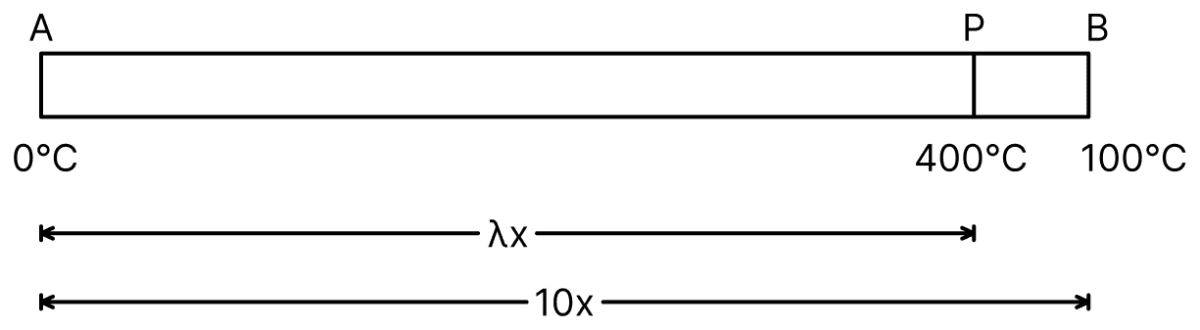
Since P is at the highest temperature, heat flows from P towards A as well as from P towards B.
The distance PA = λx and the distance PB = (10 − λ)x. If K be the thermal conductivity and A the area of cross-section of the rod, then in the steady state
Rate of heat flow from P to A,
Rate of heat flow from P to B,
Let m gram of ice melt and m gram of water evaporate per unit time. Then
Therefore,
Substituting the expressions for H1 and H2,
Hence, the value of λ is 9.
Two spherical bodies A (radius 6 cm) and B (radius 18 cm) are at temperature T1 and T2, respectively. The maximum intensity in the emission spectrum of A is at 500 nm and in that of B is at 1500 nm. Considering them to be black bodies, what will be the ratio of the rate of total energy radiated by A to that of B? The answer is in single-digit ranging from 0 to 9.
Answer
Given,
- Radius of A, rA = 6 cm; radius of B, rB = 18 cm
- Wavelength of maximum intensity for A, λA = 500 nm
- Wavelength of maximum intensity for B, λB = 1500 nm
By Wien's displacement law, λmT = b (a constant), so
By Stefan's law, the total energy radiated per second by a black body of surface area A at absolute temperature T is
Therefore,
Substituting the values,
Hence, the required ratio is 9.
Two spherical stars A and B emit black body radiation. The radius of A is 400 times that of B and A emits 104 times the power emitted from B. What will be the ratio (λA/λB) of their wavelengths λA and λB at which the peaks occur in their respective radiation curves?
Answer
Given,
- Radius of A, rA = 400 rB
- Power emitted by A, PA = 104 PB
By Stefan's law, the power radiated by a spherical black body is
Therefore,
Substituting the given values,
By Wien's displacement law, λmT = constant, so λm is inversely proportional to T,
Hence, the ratio λA/λB is 2.
A metal is heated in a furnace where a sensor is kept above the metal surface to read the power radiated (P) by the metal. The sensor has a scale that displays log2(P/P0), where P0 is a constant. When the metal surface is at a temperature of 487 °C, the sensor shows a value 1. Assume that the emissivity of the metallic surface remains constant. What is the value displayed by the sensor when the temperature of the metal surface is raised to 2767 °C?
Answer
Given,
- Initial temperature, T1 = 487°C = 487 + 273 = 760 K
- Final temperature, T2 = 2767°C = 2767 + 273 = 3040 K
- Sensor reading at T1 is log2(P1/P0) = 1
From the given reading,
By Stefan's law, the power radiated is proportional to the fourth power of the absolute temperature, so
Therefore,
The value displayed by the sensor is
Hence, the sensor displays the value 9.
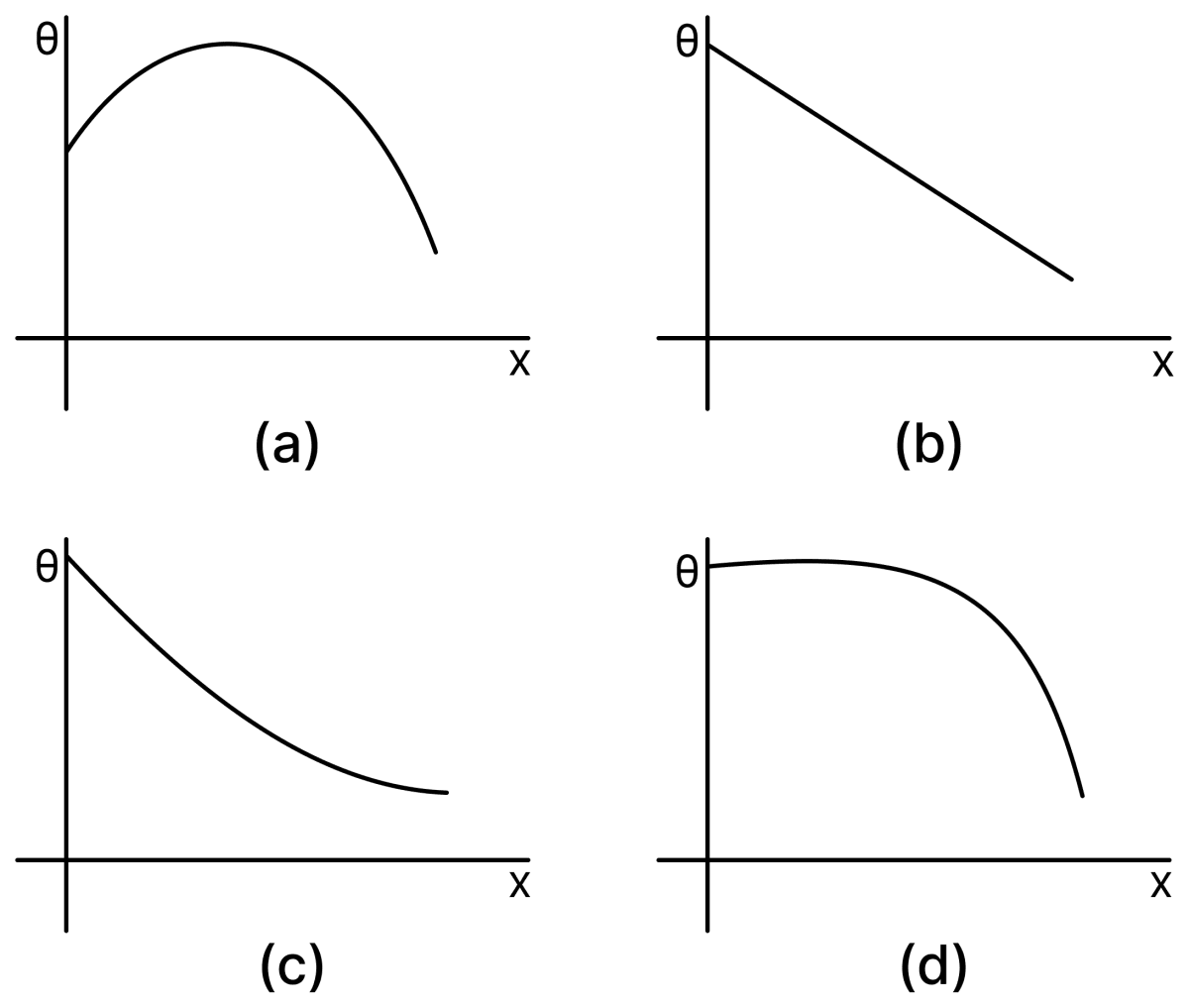
A long metallic bar is carrying heat from one of its ends to the other end under steady state. The variation of temperature θ along the length x of the bar from its hot end is best described by which of the following graphs?
Answer
The graph in which the temperature θ falls linearly with the distance x from the hot end.
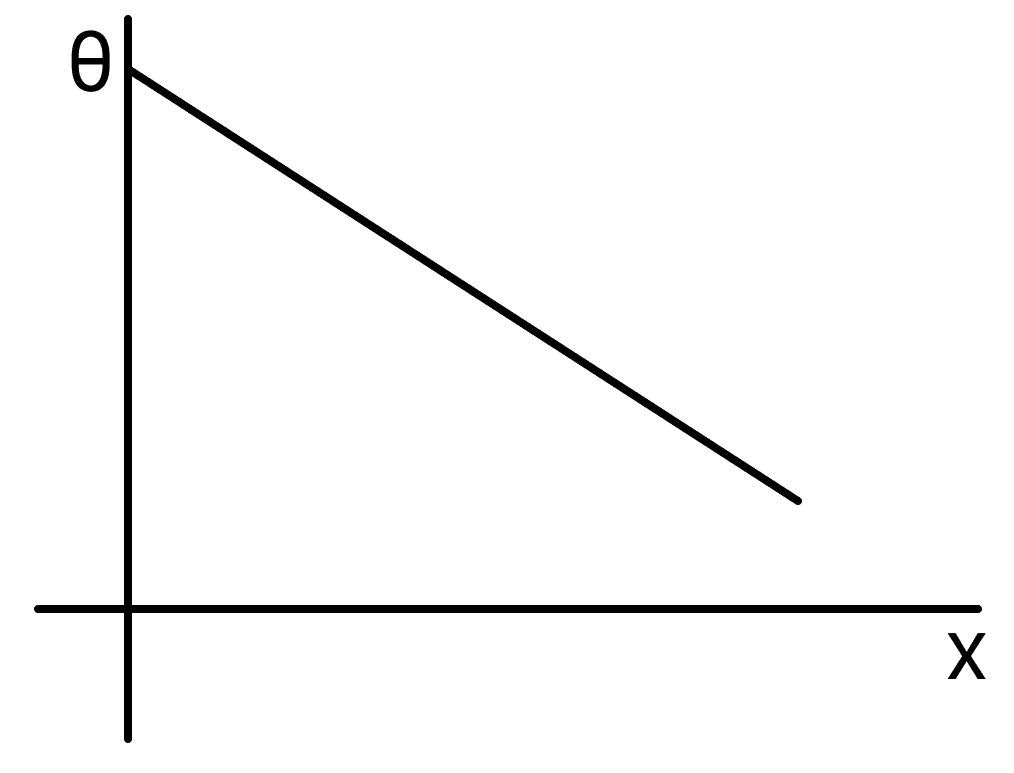
Reason — In the steady state the temperature of each cross-section of the bar becomes constant with time, so no heat is absorbed by any section. The heat that reaches any cross-section is entirely passed on to the next, and hence the rate of flow of heat is the same all along the bar.
By the law of heat conduction,
In the steady state is constant, say r. Therefore
Since K and A are constant for a uniform bar, the temperature gradient is the same at every point. On integrating,
Comparing this with y = − kx + c, the graph between θ and x is a straight line with a negative slope. Hence the temperature decreases uniformly with distance from the hot end.
Three rods of copper, brass and steel are welded together to form a Y-shaped structure. Area of cross-section of each rod = 4 cm2. End of copper rod is maintained at 100°C whereas ends of brass and steel are kept at 0°C. Lengths of the copper, brass and steel rods are 46, 13 and 12 cm respectively. The rods are thermally insulated from surroundings except at ends. Thermal conductivities of copper, brass and steel are 0.92, 0.26 and 0.12 CGS units respectively. Rate of heat flow through copper rod is :
- 1.2 cal/s
- 2.4 cal/s
- 4.8 cal/s
- 6.0 cal/s
Answer
4.8 cal/s
Reason — Given,
- Area of cross-section of each rod, A = 4 cm2
- Lengths : lCu = 46 cm, lBr = 13 cm, lSt = 12 cm
- Thermal conductivities : KCu = 0.92, KBr = 0.26, KSt = 0.12 cal s-1 cm-1 °C-1
- Free end of copper at 100°C, free ends of brass and steel at 0°C
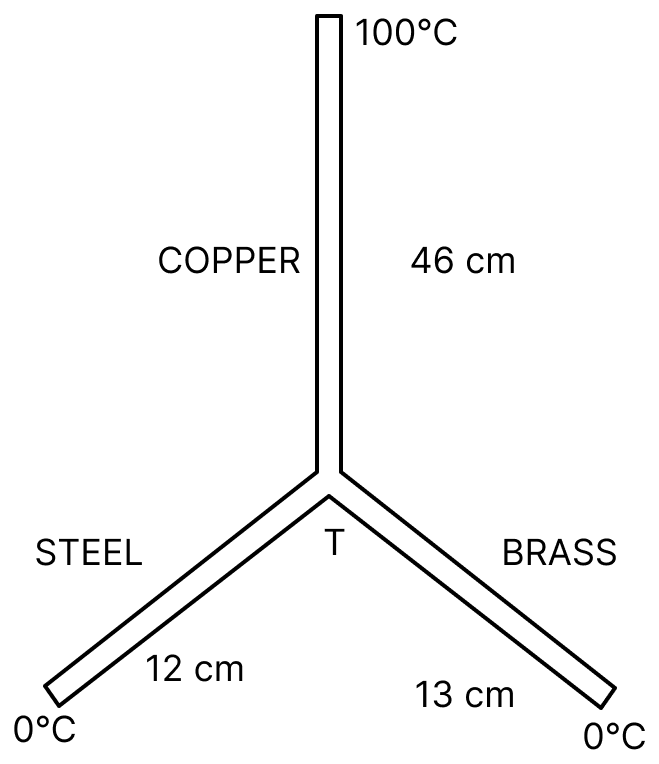
Let θ be the steady temperature of the junction. The copper rod carries heat to the junction, and this heat is then shared by the brass and the steel rods. Hence
Cancelling A and substituting the values,
The rate of heat flow through the copper rod is
The ends Q and R of two thin wires, PQ and RS, are soldered (joined) together. Initially each of the wires has a length of 1 m at 10°C. Now the end P is maintained at 10°C, while the end S is heated and maintained at 400°C. The system is thermally insulated from its surroundings. If the thermal conductivity of wire PQ is twice that of the wire RS and the coefficient of linear thermal expansion of PQ is 1.2 × 10⁻⁵K-1, the change in length of the wire PQ is :
- 0.78 mm
- 0.90 mm
- 1.56 mm
- 2.34 mm
Answer
0.78 mm
Reason — Given,
- Length of each wire, l = 1 m at 10°C
- End P at 10°C, end S at 400°C
- Thermal conductivity of PQ = 2 × thermal conductivity of RS
- Coefficient of linear expansion of PQ, α = 1.2 × 10⁻⁵ K-1
Let the thermal conductivity of RS be K, so that the thermal conductivity of PQ is 2K. Let θ be the steady temperature of the junction QR.
The two wires are joined in series, so the rate of flow of heat through both is the same,
Along the wire PQ the temperature increases uniformly from 10°C at P to 140°C at Q. Hence the average temperature of the wire PQ is
The whole wire was initially at 10°C, so the effective rise in temperature is
The change in the length of PQ is
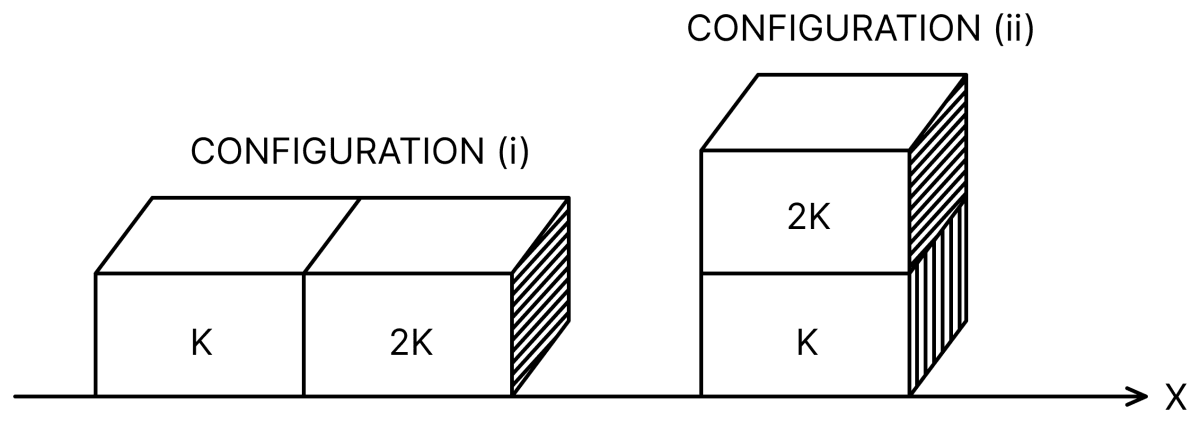
Two rectangular blocks, having identical dimensions, can be arranged either in configuration (i) or in configuration (ii) as shown in the figure. One of the blocks has thermal conductivity K and the other 2K. The temperature difference between the ends along the X-axis is the same in both the configurations. It takes 9s to transport a certain amount of heat from the hot end to the cold end in the configuration (i). The time to transport the same amount of heat in the configuration (ii) is :
- 2.0 s
- 3.0 s
- 4.5 s
- 6.0 s
Answer
2.0 s
Reason — Given,
- Thermal conductivities of the two blocks are K and 2K
- The blocks have identical dimensions, say length l and area of cross-section A
- Same temperature difference Δθ in both configurations
- Time taken in configuration (i), t1 = 9 s
In configuration (i) the two blocks are joined in series along the X-axis. The equivalent thermal resistance is
In configuration (ii) the two blocks are joined in parallel. The rate of flow of heat is the sum of the rates through the two blocks,
The rate of flow of heat in configuration (i) is
Therefore,
For the same quantity of heat Q, the time taken is inversely proportional to the rate of flow of heat, so
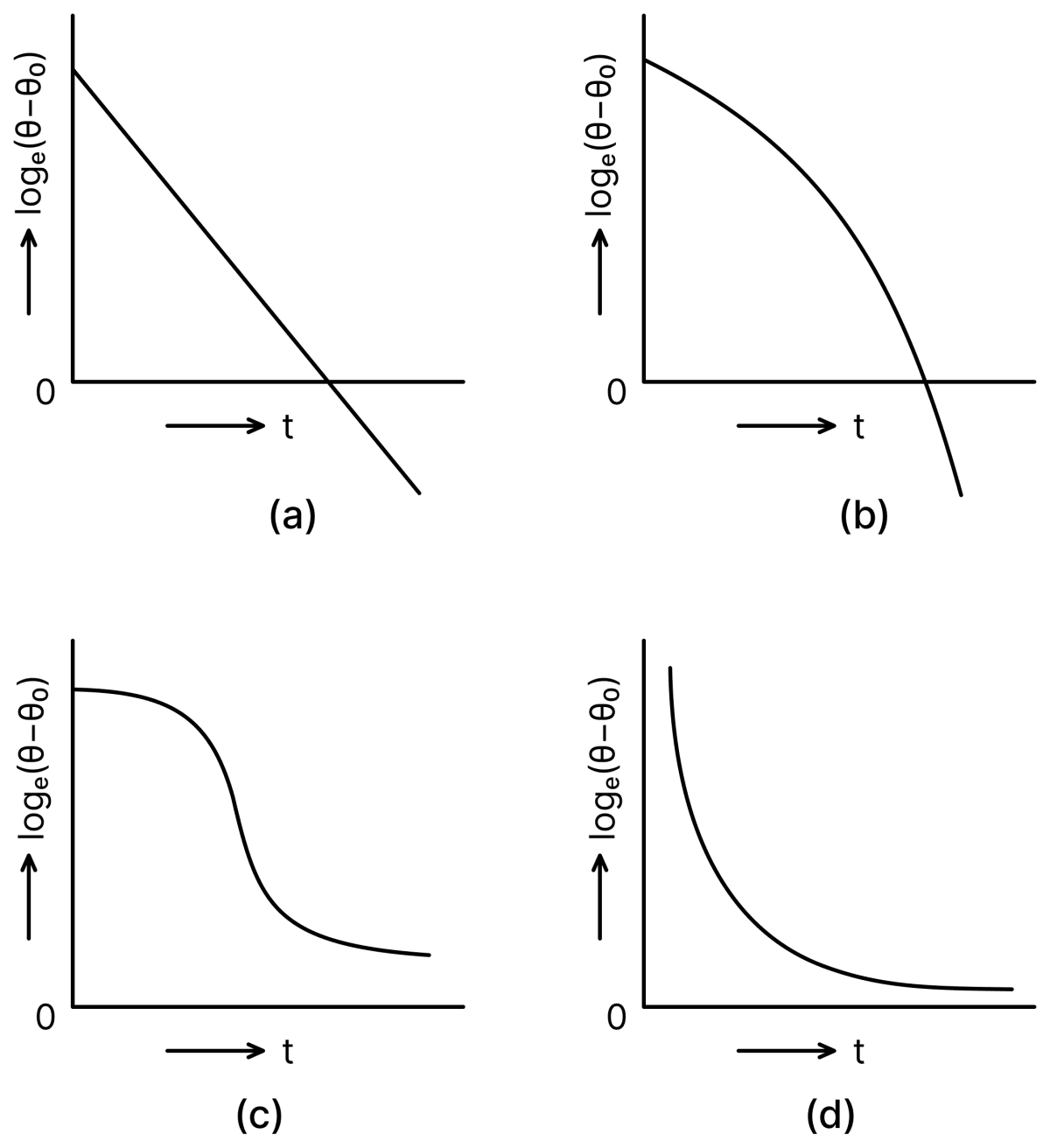
A liquid in a beaker has temperature θ at time t and θ0 is temperature of surroundings, then according to Newton's law of cooling the correct graph between loge(θ − θ0) and t is :
Answer
The graph which is a straight line with a negative slope, having a positive intercept on the loge(θ − θ0) axis.
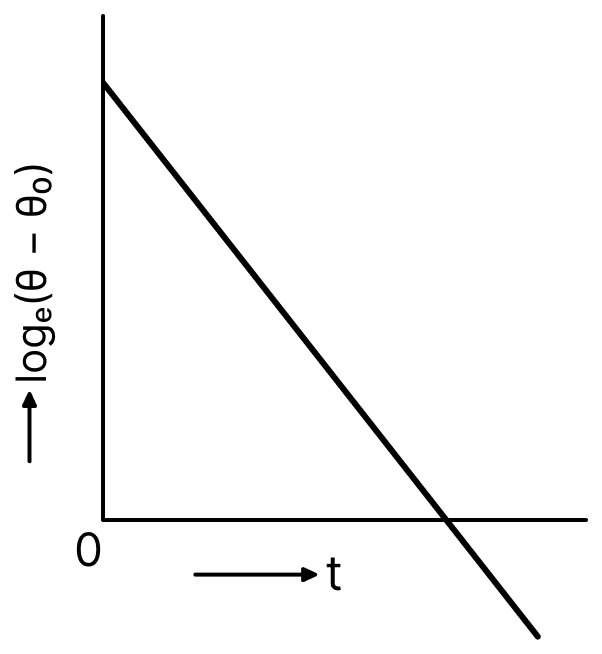
Reason — By Newton's law of cooling, the rate of loss of heat is directly proportional to the temperature difference between the body and its surroundings,
Separating the variables,
On integrating,
where C is the constant of integration. This is of the form y = mx + c, with slope − K and intercept C. Hence the graph between loge(θ − θ0) and t is a straight line having a negative gradient.
If a piece of metal is heated to temperature θi and then allowed to cool in a room which is at temperatue θ0, the graph between the temperature T of the metal and time t will be closed to :
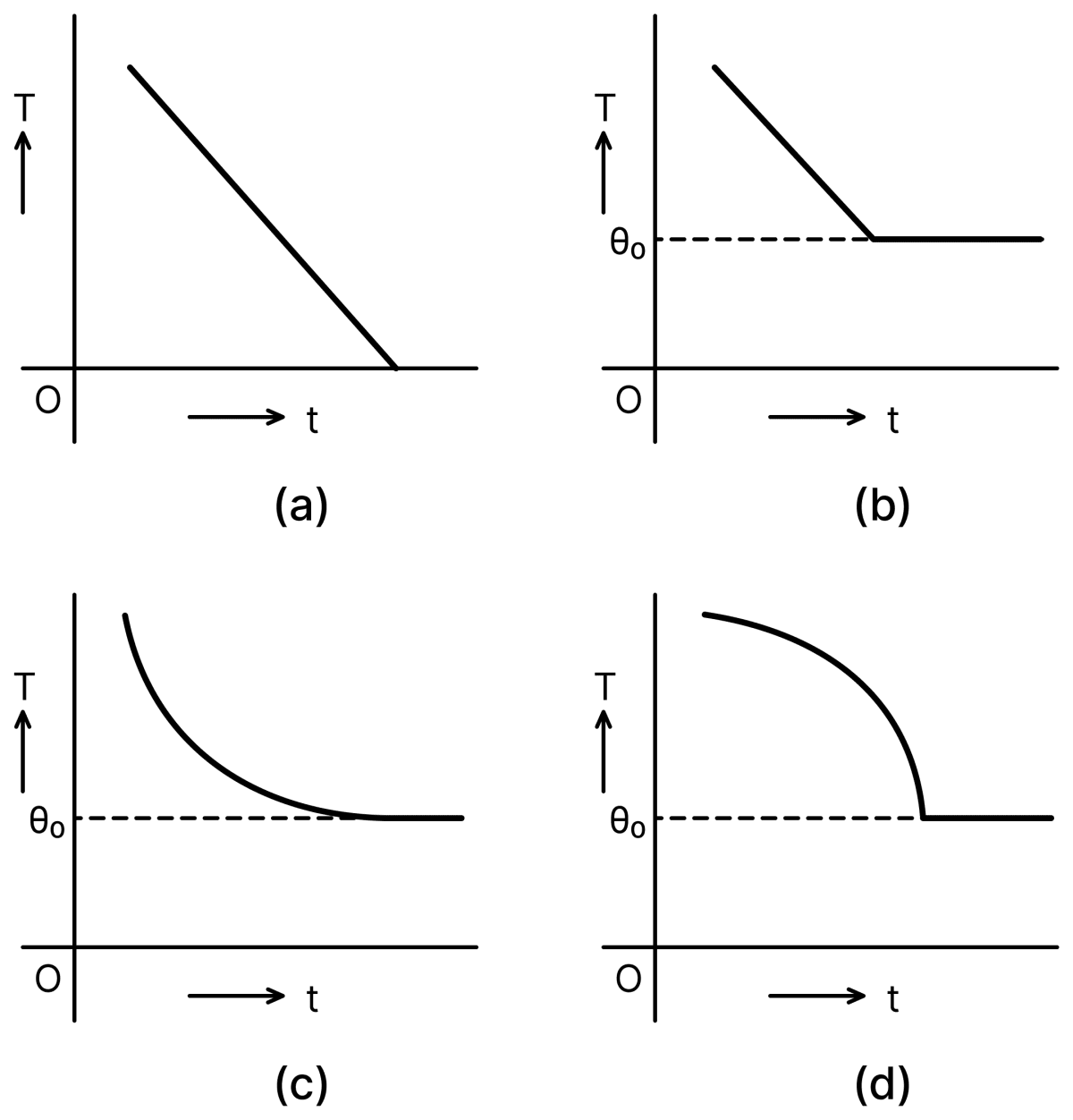
Answer
The graph in which T falls exponentially from θi and approaches the value θ0 asymptotically, without cutting the time axis.
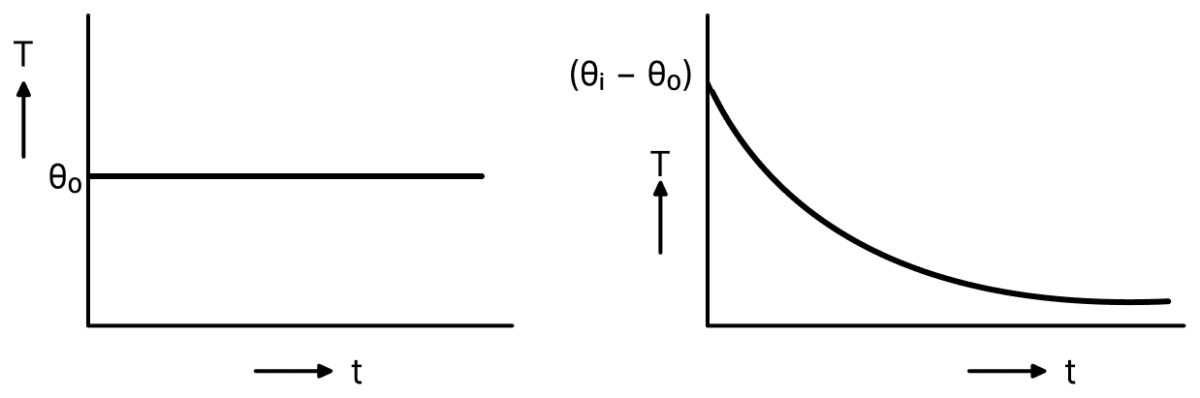
Reason — Given,
- Initial temperature of the metal piece = θi
- Temperature of the surroundings (room) = θ0
- Temperature of the metal piece at any instant t = T
- Mass of the metal piece = m and specific heat capacity of its material = c
By Newton's law of cooling, the rate of loss of heat is directly proportional to the temperature difference between the body and its surroundings,
where k is a positive constant depending upon the area and the nature of the surface of the body.
If in the small time interval dt the temperature of the body changes by dT, then the heat lost is
From equations (i) and (ii),
Separating the variables,
The body cools from its initial temperature θi at t = 0 to the temperature T at time t. Integrating between these limits,
Since θ0 is a constant, the integral on the left is a standard logarithmic integral,
Evaluating the limits on both sides,
Combining the two logarithms,
Taking antilogarithms,
Equation (iii) shows that the temperature of the body decreases exponentially with time. The graph of T versus t is obtained by adding the graph of the constant line T = θ0 and the decaying exponential .
At t = 0 : Since e0 = 1,
so the curve starts from the initial temperature θi on the temperature axis.
As t → ∞ : Since ,
so the curve approaches the line T = θ0.
Slope of the curve : Differentiating equation (iii) with respect to t,
At t = 0 the slope is , which is the largest in magnitude, so the curve falls steeply in the beginning. As t increases, the exponential factor decreases and the slope becomes smaller and smaller, so the curve flattens out.
The body can never become colder than its surroundings, so the curve approaches the line T = θ0 asymptotically and does not meet the time axis.
Three very large plates of same area are kept parallel and close to each other. They are considered as ideal black surfaces and have very high thermal conductivity. The first and third plates are maintained at temperature 2T and 3T respectively. The temperature of the middle (i.e., second) plate under steady state condition is :
Answer
Reason — Given,
- Temperature of the first plate = 2T
- Temperature of the third plate = 3T
- Let the steady temperature of the middle (second) plate be T′
- All three plates are ideal black surfaces of the same area A
Since the third plate is the hottest and the first plate the coldest, heat flows from the third plate to the middle plate, and from the middle plate to the first plate.
By Stefan's law, the energy radiated per second by a black body of surface area A at absolute temperature T is
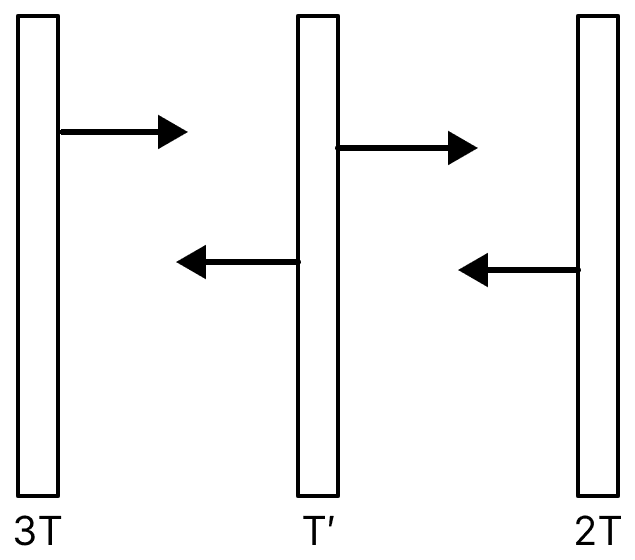
Heat gained by the middle plate from the third plate : The third plate at 3T radiates towards the middle plate, and the middle plate at T′ radiates back towards it. Hence the net rate of heat gained by the middle plate on this side is
Heat lost by the middle plate to the first plate : Similarly, the middle plate at T′ radiates towards the first plate, and the first plate at 2T radiates back. Hence the net rate of heat lost by the middle plate on this side is
Steady state condition : In the steady state the temperature of the middle plate remains constant, so the heat it gains per second must be exactly equal to the heat it loses per second,
Cancelling σA throughout,
Taking the terms containing T′ to one side,
Expanding the fourth powers,
Taking the fourth root of both sides,
The middle plate radiates from both of its faces, which is why the factor 2 appears on the right-hand side. Numerically , so T′ = 2.64 T, which lies between 2T and 3T as expected.