
The temperature at which the volume of water is minimum:
- 0°C
- 4°C
- 100°C
- 50°C
Answer
4°C
Reason — Water exhibits an anomalous property; it contracts on heating between 0°C and 4°C and expands on further heating. Hence, as water is heated from 0°C its volume first decreases, becomes minimum at 4°C, and then increases. Since the mass remains the same, the density of water is maximum at 4°C, being equal to 1 g cm-3.
Which device is used to measure the specific heat capacity of a substance?
- Thermometer
- Calorimeter
- Barometer
- Pyrometer
Answer
Calorimeter
Reason — A device in which heat measurement can be made is called a calorimeter. It consists of a cylindrical copper vessel provided with a copper stirrer and a lid, kept inside a wooden jacket filled with heat-insulating material. By applying the principle of calorimetry to the mixture prepared in it, the specific heat of a given solid or liquid is determined. A thermometer measures temperature, a barometer measures atmospheric pressure and a pyrometer measures very high temperatures.
The process by which heat energy is transmitted without any movement of the medium is called:
- conduction
- convection
- radiation
- evaporation
Answer
radiation
Reason — Radiation is the process by which heat is transferred directly from one body to another without affecting the intervening medium (if any). The heat travels in the form of electromagnetic waves with the speed of light, so no medium is needed at all, and if a medium is present it does not itself become hot.
In convection the material particles of the fluid themselves move from one place to another, so the medium clearly moves. Evaporation is a change of state and not a mode of heat transfer.
The temperature scale based on absolute zero is:
- Celsius
- Fahrenheit
- Kelvin
- Rankine
Answer
Kelvin
Reason — The Kelvin scale is the absolute temperature scale commonly used in science. Its zero is taken at absolute zero (0 K = − 273.15°C), the lowest possible temperature at which molecular motion would theoretically stop. On this scale temperature is always positive and is proportional to the average kinetic energy of the molecules. The zero points of the Celsius and Fahrenheit scales are arbitrary.
The unit of thermal conductivity is:
- J/kg K
- W/m K
- J/m3
- N/m2
Answer
W/m K
Reason — From the relation , the coefficient of thermal conductivity is
Its SI unit is therefore J s-1 m-1 K-1, that is, W m-1 K-1. The unit J/kg K belongs to specific heat capacity and N/m2 to pressure or stress.
Which of the following materials has the highest specific heat capacity?
- Iron
- Copper
- Water
- Lead
Answer
Water
Reason — Water has a very high specific heat capacity, 1 kcal kg-1 K-1 or 4.18 × 10³ J kg-1 K-1. It is nearly ten times the specific heat of copper and five times that of sand or earth. It is because of this high specific heat that water is used as an effective coolant and in hot water bottles for fomentation.
In which phase does water have the greatest density?
- Ice
- Water at 0°C
- Water at 4°C
- Steam
Answer
Water at 4°C
Reason — When water is heated from 0°C its density first increases up to 4°C and then decreases above 4°C. Thus the density of water is maximum at 4°C and is equal to 1 g cm-3. When water at 0°C freezes into ice, the volume of the ice is greater than that of the water, so the density of ice is less than the density of water and ice floats on water.
Which of the following undergoes the least expansion when heated?
- Gases
- Solids
- Liquids
- Plasma
Answer
Solids
Reason — In a solid the molecules are held together by strong intermolecular forces and are able only to vibrate about their fixed mean positions. Hence, for the same rise in temperature, a solid expands the least. Liquids expand more than solids, and gases at ordinary temperature expand much more than both solids and liquids, the coefficient of volume expansion of an ideal gas being , that is, 3.3 × 10⁻³ K-1 at room temperature.
Which phenomenon is responsible for the rising of warm air above cooler air?
- Conduction
- Convection
- Radiation
- Diffusion
Answer
Convection
Reason — When the temperature of the lower region of a fluid becomes higher than that of the upper region, the density of the fluid in the lower region becomes less than that in the upper region. Hence the warmer and lighter particles rise up and their places are taken by the colder and heavier particles from above. This process of heat-transmission in which the material particles of the fluid themselves move is called convection.
The specific heat capacity of a substance is the amount of heat required to raise the temperature of:
- 1 kg of the substance by 1°C
- 1 g of the substance by 1°C
- 1 kg of the substance by 1 K
- Both 1 and 3
Answer
Both 1 and 3
Reason — The specific heat capacity of a substance is the amount of heat required to raise the temperature of the unit mass of the substance through a unit degree (1°C or 1 K). Since a temperature difference of 1°C is exactly equal to a temperature difference of 1 K, both the statements 1 and 3 describe the same quantity, whose SI unit is J kg-1 K-1.
In which mode of heat transfer does thermal radiation occur?
- Through conduction
- Through convection
- In a vacuum
- Through physical contact
Answer
In a vacuum
Reason — In radiation, heat energy is transferred in the form of electromagnetic waves which travel with the speed of light. No medium is required for the propagation of these waves, and if a medium is present it does not become hot. This is how heat from the sun reaches the earth across the empty space.
The SI unit of temperature is:
- Fahrenheit
- Celsius
- Kelvin
- Joule
Answer
Kelvin
Reason — The SI temperature unit is the kelvin, abbreviated K, which is written without a degree sign. It is defined by assigning the value 273.16 K to the triple point of water. The degree Celsius and the degree Fahrenheit are units of other thermometric scales, and the joule is the unit of heat and energy.
Which of the following statements is true for thermal conduction?
- It occurs only in liquids
- It requires a medium
- It occurs through the bulk movement of particles
- It is the most efficient form of heat transfer in a vacuum
Answer
It requires a medium
Reason — In conduction the particles of a body pass on heat to the neighbouring particles by mutual contact without leaving their own positions. A material medium is therefore essential for conduction. It takes place chiefly in solids and in mercury, and it cannot occur in a vacuum. Transfer of heat by the bulk movement of particles is convection.
In which of the following processes does heat transfer occur due to bulk movement of fluid?
- Conduction
- Convection
- Radiation
- Diffusion
Answer
Convection
Reason — In convection the heated portion of a fluid expands, becomes lighter and rises up, and its place is taken by the colder and heavier fluid from above. Thus the material particles carrying heat themselves move from one place to another. Convection takes place only in liquids and gases and not in solids.
Which material would make the best thermal insulator?
- Copper
- Aluminium
- Glass wool
- Steel
Answer
Glass wool
Reason — A material for which the coefficient of thermal conductivity K is small is a poor conductor or a good insulator. Copper, aluminium and steel are metals which possess a large number of free electrons and are therefore very good conductors of heat. Glass wool has hardly any free electrons and also traps air in it, so its thermal conductivity is very small and it makes the best insulator.
Which of the following devices works based on the expansion of liquids?
- Mercury thermometer
- Thermocouple
- Infra-red thermometer
- Thermistor
Answer
Mercury thermometer
Reason — In a mercury thermometer, mercury is used as the thermometric substance because it expands uniformly with a rise in temperature. The expansion of the mercury column in a fine capillary is used as a measure of the temperature. A thermocouple works on the thermo-emf produced at a junction, a thermistor on the change in electrical resistance, and an infra-red thermometer on the radiation emitted by a body.
At what temperature does water have maximum density?
- 0°C
- 4°C
- 100°C
- −1°C
Answer
4°C
Reason — Water contracts on heating from 0°C to 4°C and expands on further heating. Since a given mass of water occupies the minimum volume at 4°C, its density is maximum at 4°C and is equal to 1 g cm-3.
Which law states that the rate of heat transfer through a material is proportional to the temperature gradient?
- Newton's law of cooling
- Stefan-Boltzmann law
- Fourier's law
- Planck's law
Answer
Fourier's law
Reason — The law of heat conduction states that the rate of flow of heat through a material is directly proportional to the area of cross-section and to the temperature gradient,
This is Fourier's law of heat conduction, the negative sign showing that the temperature always decreases in the direction of the flow of heat.
In a calorimetry experiment, the heat gained by the cold object is equal to the:
- heat lost by the hot object
- heat gained by the surroundings
- total heat lost by all objects
- total thermal energy of the system
Answer
heat lost by the hot object
Reason — When bodies at different temperatures are brought in contact, then the heat lost by the hot body must be equal to the heat gained by the cold body, provided no heat escapes to the surroundings. This is known as the principle of calorimetry, and it is a consequence of the principle of conservation of energy. Thus, heat lost = heat gained.
When ice melts at 0°C, the latent heat of fusion:
- raises the temperature of the water
- increases the kinetic energy of the water molecules
- is absorbed without changing the temperature
- lowers the temperature of the water
Answer
is absorbed without changing the temperature
Reason — During the change of state, the heat supplied to the substance does not produce any rise in its temperature. The heat supplied is used up in overcoming the intermolecular force of attraction between the molecules and increasing the potential energy of the substance. Hence the latent heat of fusion is absorbed at the constant temperature of 0°C, and the average kinetic energy of the molecules, which determines the temperature, remains unchanged.
Which one of the following does not expand significantly when heated?
- Solids
- Liquids
- Gases
- Vacuum
Answer
Vacuum
Reason — Thermal expansion occurs because on heating, the molecules of a substance start vibrating more vigorously and the average distance between the molecules increases. A vacuum contains no molecules at all, so there is nothing that can expand. Solids, liquids and gases all expand on heating, gases expanding the most and solids the least.
The efficiency of heat transfer by conduction is highest in which type of material?
- Insulators
- Semiconductors
- Metals
- Non-metals
Answer
Metals
Reason — The heat-conduction in metals mostly takes place by the 'free electrons' present within the metals. These electrons are not bound to any one molecule of the metal but are free to move within it. When one end of a metal is heated, the average kinetic energy of the free electrons at that end increases, and these electrons quickly give energy to their neighbouring electrons by colliding with them. Hence the transmission of heat in metals is very rapid. Bad conductors have hardly any free electrons.
The SI unit of coefficient of linear expansion is :
- °C
- °C-1
- m/°C
- J/kg °C
Answer
°C-1
Reason — The coefficient of linear expansion is
Since the increase in length and the original length have the same unit, they cancel out, leaving only the reciprocal of temperature. Hence the unit of α is per °C, that is, °C-1 (or K-1).
The energy radiated by a black body is proportional to:
- the temperature
- the square of the temperature
- the cube of the temperature
- the fourth power of the temperature
Answer
the fourth power of the temperature
Reason — According to Stefan's law, the total radiant energy emitted per second per unit surface-area of a black body is proportional to the fourth power of the absolute temperature of the body,
where σ is Stefan's constant.
In which unit is thermal conductivity commonly measured?
- W/m2 K
- W/m K
- J/kg K
- J/m3
Answer
W/m K
Reason — The SI unit of the coefficient of thermal conductivity is J s-1 m-1 K-1, which is the same as W m-1 K-1. In the CGS system it is expressed in cal s-1 cm-1 °C-1. The unit J kg-1 K-1 belongs to specific heat capacity.
When heat is transferred through a fluid in motion, the process is called:
- conduction
- convection
- radiation
- absorption
Answer
convection
Reason — Convection is that process of heat-transmission in which the material particles of the fluid themselves move from one place to another carrying heat with them. The water in a vessel placed on fire becomes hot by convection. Convection takes place only in liquids and gases and not in solids.
The SI unit of specific heat capacity is :
- J/kg
- J/kg °C
- J/kg K
- Both 2 and 3
Answer
Both 2 and 3
Reason — From , the unit of specific heat capacity is the unit of heat divided by the units of mass and temperature difference, that is, J kg-1 K-1. Since a temperature difference of 1°C is exactly equal to a temperature difference of 1 K, J kg-1 °C-1 and J kg-1 K-1 are numerically and dimensionally the same unit.
What happens to the pressure of a gas if its temperature is increased at constant volume?
- It decreases
- It remains the same
- It increases
- It becomes zero
Answer
It increases
Reason — From the ideal gas equation PV = nRT, at constant volume
so that P ∝ T. Hence the pressure of a gas increases in direct proportion to its absolute temperature when the volume is kept constant. This is the principle on which the constant-volume gas thermometer works.
Which of the following thermometers uses the expansion of a gas to measure temperature?
- Mercury thermometer
- Constant-volume gas thermometer
- Infra-red thermometer
- Bimetallic strip thermometer
Answer
Constant-volume gas thermometer
Reason — A gas thermometer uses the thermometric property of a gas, whose volume or pressure changes with temperature according to Charles' and Boyle's laws. In the constant-volume gas thermometer, a vessel of constant volume filled with gas is subjected to temperature changes, and the measured temperature is proportional to the change in pressure. Such thermometers are used mostly as standards to calibrate other thermometers.
Note: The option refers to a gas thermometer in general. In the constant-volume type named here, the volume of the gas is held fixed and it is the pressure of the gas, and not its expansion, that is actually measured.
The amount of heat required to raise the temperature of a unit mass of a substance by 1°C is called:
- latent heat
- specific heat
- thermal capacity
- heat flux
Answer
specific heat
Reason — The specific heat capacity of a substance is the amount of heat required to raise the temperature of the unit mass of the substance through a unit degree (1°C or 1 K). Latent heat is the heat needed for a change of state without any change of temperature, and thermal capacity is the heat required to raise the temperature of the whole body through 1 K.
Which law explains why the heat lost by a body is directly proportional to the difference in temperature between the body and its surroundings?
- Newton's law of cooling
- Stefan's law
- Wien's displacement law
- Zeroth law of thermodynamics
Answer
Newton's law of cooling
Reason — Newton's law of cooling states that the rate of loss of heat from a body is directly proportional to the temperature difference between the body and its surroundings, provided the temperature difference is small,
Stefan's law holds for all temperatures of the hot body and relates the emitted energy to T4, while Wien's displacement law relates the wavelength of maximum emission to the temperature.
Thermal radiation is mostly related to which of the following properties of an object?
- Colour
- Temperature
- Shape
- Volume
Answer
Temperature
Reason — All bodies continuously emit energy by virtue of their temperature. The rate of radiant energy emitted does not depend upon the shape, size or material of the body; it depends upon the temperature, being proportional to the fourth power of the absolute temperature. The nature of the surface affects only the emissivity of the body.
Anomalous expansion of water is observed in the temperature range of:
- 0°C to 4°C
- 0°C to 100°C
- −10°C to 0°C
- 100°C to 150°C
Answer
0°C to 4°C
Reason — Almost all substances expand on heating, but water is an exception in the range 0°C to 4°C, in which it contracts on heating instead of expanding. Above 4°C it expands normally. This behaviour is called the anomalous expansion of water, and it is because of this that the density of water is maximum at 4°C.
Which thermometer is most suitable for measuring very high temperatures?
- Mercury thermometer
- Platinum resistance thermometer
- Pyrometer
- Alcohol thermometer
Answer
Pyrometer
Reason — A pyrometer measures temperature from the radiation emitted by a hot body, so it need not be in contact with the body. It is therefore suitable for measuring the very high temperatures of furnaces and molten metals. A mercury thermometer can be used only up to 357°C, the boiling point of mercury, and an alcohol thermometer is useful only at low temperatures.
Thermal radiation does not require a medium to travel. This is because it is transferred by:
- conduction
- electromagnetic waves
- convection
- diffusion
Answer
electromagnetic waves
Reason — In radiation, heat energy is emitted from a hot body in the form of electromagnetic waves which travel with the speed of light. Electromagnetic waves need no material medium for their propagation, and if a medium is present it does not itself become hot. This is why heat from the sun reaches the earth through the empty space.
The process of heat transfer through solids by the vibration of atoms is called:
- convection
- conduction
- radiation
- evaporation
Answer
conduction
Reason — According to kinetic theory, the molecules in a solid vibrate about their equilibrium positions and the amplitude of vibration depends upon the temperature. When the temperature of one part of the solid increases, the amplitude of vibration of the molecules of this part increases, and these molecules give some energy to the adjacent molecules through mutual interaction. Thus energy is transmitted from the hotter part to the colder part without the molecules leaving their positions, which is conduction.
Which of the following statements is true for radiation?
- It requires a medium to transfer heat
- It can occur in a vacuum
- It occurs only in liquids
- It depends on the specific heat of the material
Answer
It can occur in a vacuum
Reason — Radiation is the process by which heat is transferred directly from one body to another without affecting the intervening medium (if any). It travels in the form of electromagnetic waves with the speed of light, and since these waves need no material medium, radiation can take place in a vacuum.
The principle behind a bimetallic strip used in thermometers is based on:
- different thermal conductivities
- different thermal expansions
- heat capacity
- heat absorption
Answer
different thermal expansions
Reason — A bimetallic strip is made by firmly joining two thin strips of different metals, such as brass and iron, which are chosen because they have different coefficients of thermal expansion. Before heating the strip is straight, but on heating it bends with brass on the outside of the curve, since brass expands more than iron for the same rise in temperature. This bending is used as the sensitive element in thermostats and in bimetallic thermometers.
In the context of calorimetry, the heat gained by the cold body is:
- equal to the heat lost by the hot body
- greater than the heat lost by the hot body
- less than the heat lost by the hot body
- independent of the heat lost by the hot body
Answer
equal to the heat lost by the hot body
Reason — By the principle of calorimetry, when bodies at different temperatures are brought in contact in an isolated system, heat lost = heat gained, provided no heat escapes to the surroundings. The heat given out by the body at the higher temperature is entirely received by the body at the lower temperature. This principle follows from the conservation of energy.
Which of the following liquids expands most when heated?
- Water
- Alcohol
- Mercury
- Glycerine
Answer
Alcohol
Reason — The expansion of a liquid for a given rise in temperature is decided by its coefficient of volume expansion γ. Among the liquids listed, alcohol has by far the largest value of γ, of the order of 11 × 10-4 °C-1, as against about 4.9 × 10⁻⁴ °C-1 for glycerine, 2.1 × 10⁻⁴ °C-1 for water and 1.8 × 10⁻⁴ °C-1 for mercury. Hence, for the same rise in temperature and the same original volume, alcohol expands the most.
The transfer of heat by convection is primarily caused by:
- molecular collisions
- electromagnetic waves
- bulk movement of molecules
- none of the above
Answer
bulk movement of molecules
Reason — In convection the heated fluid expands, becomes less dense and rises, while the colder and denser fluid sinks to take its place. Heat is thus carried from one place to another by the actual bodily movement of the material particles of the fluid. Transfer by molecular collisions without change of position is conduction, and transfer by electromagnetic waves is radiation.
Which gas expands the most when heated at constant pressure?
- Nitrogen
- Oxygen
- Hydrogen
- Helium
Answer
Hydrogen
Reason — For an ideal gas the coefficient of volume expansion at constant pressure is , which is the same for all gases and does not depend upon the nature of the gas. Real gases, however, depart slightly from ideal behaviour. Hydrogen, being the lightest gas with the weakest intermolecular forces, behaves most nearly like an ideal gas and shows the largest expansion of the gases listed.
Note: Strictly, all the four gases expand very nearly equally at constant pressure, since γp depends only on the temperature. The option is meaningful only if the small departures of real gases from ideal behaviour are taken into account.
The anomalous expansion of water is an important factor in:
- freezing of oceans
- formation of icebergs
- survival of aquatic life in cold regions
- boiling of water
Answer
survival of aquatic life in cold regions
Reason — In cold weather, when the temperature falls below 4°C, the water at the surface of a pond becomes less dense and remains at the surface where it freezes. Since ice is a poor conductor of heat, the ice layer checks the flow of heat from the water below to the atmosphere, and the water well below the ice layer remains at 4°C. As a result, fish and other aquatic creatures remain alive in the water of the pond even though the surface has frozen into ice.
Which of the following is true about heat and temperature?
- They are the same thing
- Heat is energy and temperature is the measure of that energy
- Temperature measures the total energy of a system
- Heat is the measure of average kinetic energy
Answer
Heat is energy and temperature is the measure of that energy
Reason — Heat is energy in transit, which flows from a hotter body to a colder one on account of a temperature difference. Temperature, on the other hand, is a measure of the average kinetic energy of the particles of a body, and it tells how hot or cold the body is. Temperature is an intensive property and does not measure the total energy of a system.
The coefficient of linear expansion of a material is:
- directly proportional to its temperature
- inversely proportional to its length
- independent of its temperature
- directly proportional to its length
Answer
independent of its temperature
Reason — The coefficient of linear expansion describes how much the length of a material changes per unit length per degree rise in temperature. It is a characteristic property of the material of the rod and does not depend on the original length of the rod. Over ordinary ranges it is taken to be constant, that is, independent of the temperature.
If the temperature of a gas is doubled at constant pressure, its volume will :
- halve
- double
- remain the same
- become four times
Answer
double
Reason — According to Charles' law, at constant pressure the volume of a gas is directly proportional to its absolute temperature,
Hence if the absolute temperature is doubled at constant pressure, the volume of the gas also becomes double.
Which of the following factors does not affect thermal conduction?
- Temperature gradient
- Material thickness
- Cross-sectional area
- Colour of the material
Answer
Colour of the material
Reason — From , the quantity of heat conducted depends upon the area of cross-section, the temperature difference, the thickness of the slab, the time and the nature of the material through K. The colour of the material has no effect on conduction; colour affects only the emission and absorption of radiation.
When a liquid is heated in a glass flask, both the liquid and the flask expand. The apparent expansion of the liquid is:
- equal to the real expansion of the liquid
- less than the real expansion of the liquid
- greater than the real expansion of the liquid
- equal to the expansion of the flask
Answer
less than the real expansion of the liquid
Reason — A liquid is always taken in a vessel, and when it is heated the vessel also expands along with the liquid. Due to the expansion of the vessel, the observed expansion of the liquid is somewhat less than its real expansion. The two are related as
that is, γr = γa + γg. Hence the apparent expansion is less than the real expansion.
A metal rod of uniform cross-section connects two thermal reservoirs at 100°C and 0°C. If its length is halved and cross-sectional area doubled, the rate of heat conduction will:
- become half
- become double
- become four times
- remain the same
Answer
become four times
Reason — The rate of flow of heat in the steady state is
Thus H is directly proportional to the area of cross-section A and inversely proportional to the length l. On doubling A the rate becomes twice, and on halving l it becomes twice again. Hence the rate of heat conduction becomes 2 × 2 = 4 times its original value.
A block of ice at −10°C is added to water at 20°C. The final temperature is 0°C and some ice remains. Which of the following processes occur?
- Only melting of ice
- Melting and heating of water
- Melting of ice and cooling of water
- Heating of ice without melting
Answer
Melting of ice and cooling of water
Reason — The heat given out by the water is used up first in warming the ice from − 10°C to 0°C and then in melting a part of the ice at 0°C. Since the final temperature is 0°C and some ice is still left, the water has cooled from 20°C to 0°C and a part of the ice has melted at 0°C. The temperature of the ice-water mixture cannot rise above 0°C so long as any ice remains.
A uniform metallic rod rotates about its perpendicular bisector with constant angular speed. If it is heated uniformly to raise its temperature slightly, then :
- its speed of rotation increases
- its speed of rotation decreases
- its speed of rotation remains same
- its speed increases because its moment of inertia decreases
Answer
its speed of rotation decreases
Reason — On heating, the length of the rod increases due to linear expansion. The moment of inertia of a rod about its perpendicular bisector is , so the moment of inertia increases with the length.
No external torque acts on the rod, so its angular momentum L = Iω remains conserved. Since I increases, the angular speed ω must decrease.
Refer to the plot of temperature versus time showing the changes in the state of the ice on heating (not on scale). Which of the following is correct?
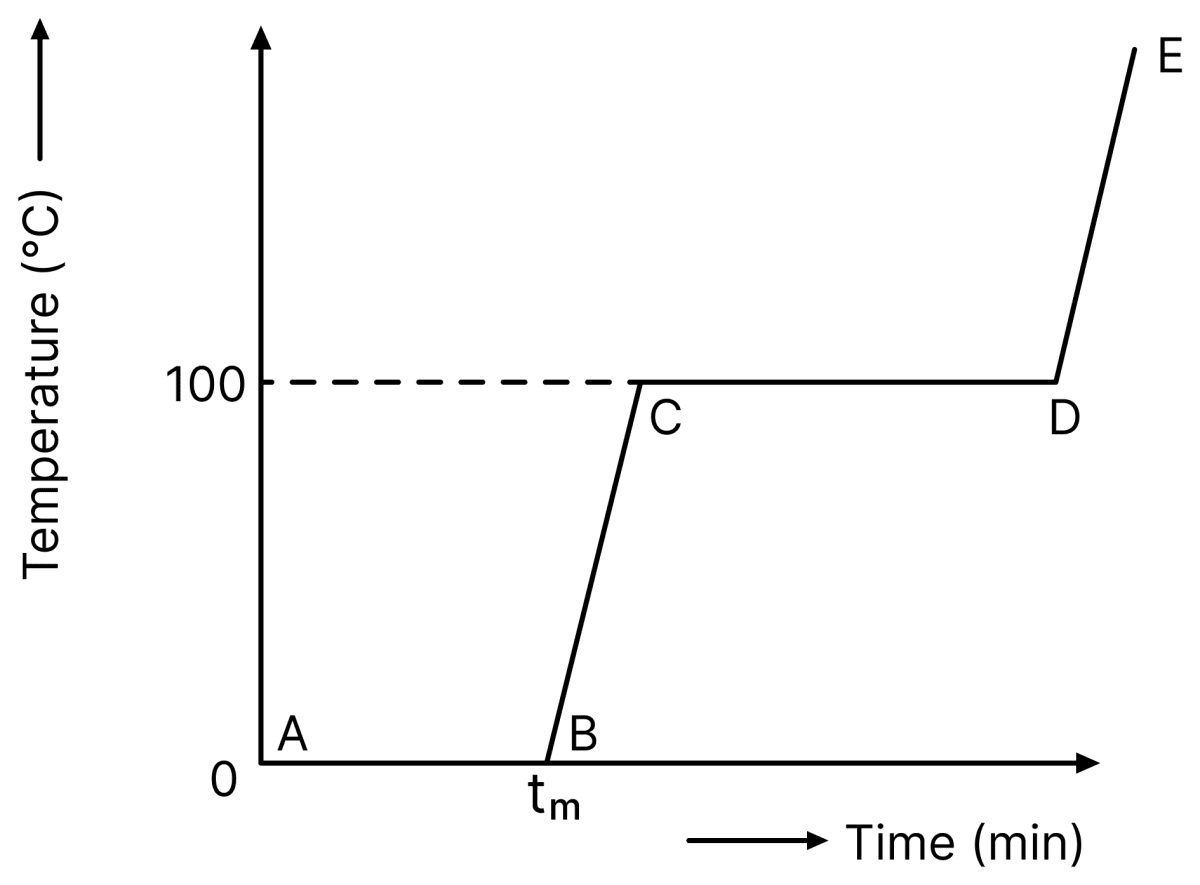
- The region AB represents ice and water in thermal equilibrium
- At B water starts boiling
- CD represents water and steam in equilibrium at boiling point
- Both 1 and 3
Answer
Both 1 and 3
Reason — In the heating curve, the horizontal portion AB is the melting stage, during which the temperature stays constant at the melting point while the solid changes into liquid. Thus, in the region AB both the solid and the liquid states of the substance co-exist in thermal equilibrium.
The horizontal portion CD is the vaporisation stage, during which the temperature remains constant at the boiling point while the liquid changes into vapour. Hence CD represents water and steam co-existing in equilibrium at the boiling point.
At B the whole of the ice has just melted and the temperature of the water begins to rise; boiling starts only at C. Hence option 2 is incorrect and both statements 1 and 3 are correct.
The rate of heat flow through a material is proportional to:
- the thickness of the material
- the area of the material
- the temperature difference across the material
- both 2 and 3
Answer
both 2 and 3
Reason — From the equation of heat conduction in the steady state,
the rate of flow of heat is directly proportional to the area of cross-section A and directly proportional to the temperature difference (θ1 − θ2). It is inversely, and not directly, proportional to the thickness l.
What happens to the kinetic energy of water molecules as water is cooled from 10°C to 4°C?
- It increases
- It decreases
- It remains constant
- It fluctuates randomly
Answer
It decreases
Reason — The temperature of a body is a measure of the average kinetic energy of its particles. As water is cooled from 10°C to 4°C its temperature falls, so the average kinetic energy of its molecules decreases. The fact that the volume also decreases over this range is a consequence of the anomalous behaviour of water and does not alter the fall in kinetic energy.
Assertion (A): Heat always flows from a hotter body to a colder body.
Reason (R): The direction of heat transfer is determined by the second law of thermodynamics.
- If both assertion and reason are true and reason is the correct explanation of assertion.
- If both assertion and reason are true but reason is not the correct explanation of assertion.
- If assertion is true but reason is false.
- If assertion is false but reason is true.
Answer
If both assertion and reason are true and reason is the correct explanation of assertion.
Explanation
Assertion (A) is correct: Heat is energy in transit. When two bodies at different temperatures interact, both exchange energy with each other, but the net flow of energy is always from the hotter body to the colder one, and it continues until both reach the same temperature, a condition called thermal equilibrium.
Reason (R) is also correct: The second law of thermodynamics fixes the direction in which heat can flow of its own accord, namely from a body at a higher temperature to a body at a lower temperature.
Since it is the second law that decides the direction of the net heat transfer, the Reason explains the Assertion.
Therefore, both assertion and reason are true and reason is the correct explanation of assertion.
Assertion (A): Water at 4°C has the maximum density.
Reason (R): Water contracts on heating from 0°C to 4°C and expands on further heating.
- If both assertion and reason are true and reason is the correct explanation of assertion.
- If both assertion and reason are true but reason is not the correct explanation of assertion.
- If assertion is true but reason is false.
- If assertion is false but reason is true.
Answer
If both assertion and reason are true and reason is the correct explanation of assertion.
Explanation
Assertion (A) is correct: The density of water increases as it is heated from 0°C to 4°C and decreases above 4°C. Hence the density of water is maximum at 4°C, being equal to 1 g cm-3.
Reason (R) is also correct: Water exhibits an anomalous property; it contracts on heating between 0°C and 4°C and expands on further heating.
Since a given mass of water occupies the least volume at 4°C on account of this contraction, its density there is the greatest. The Reason therefore explains the Assertion.
Therefore, both assertion and reason are true and reason is the correct explanation of assertion.
Assertion (A): Calorimetry is the science of measuring the amount of heat absorbed or released during a physical or chemical process.
Reason (R): A calorimeter is designed to prevent heat exchange with the surroundings.
- If both assertion and reason are true and reason is the correct explanation of assertion.
- If both assertion and reason are true but reason is not the correct explanation of assertion.
- If assertion is true but reason is false.
- If assertion is false but reason is true.
Answer
If both assertion and reason are true but reason is not the correct explanation of assertion.
Explanation
Assertion (A) is correct: Calorimetry deals with the measurement of the quantity of heat absorbed or given out by a body during a physical or chemical process.
Reason (R) is also correct: In a calorimeter the vessel is kept inside a wooden jacket filled with heat-insulating material, and its surfaces are polished, so that the loss of heat to the surroundings by conduction, convection and radiation is minimised.
The Reason describes the construction of the instrument used, but it does not explain what calorimetry as a science means. Hence the Reason is not the correct explanation of the Assertion.
Therefore, both assertion and reason are true but reason is not the correct explanation of assertion.
Assertion (A): Mercury is used in thermometers because it has a high thermal expansion.
Reason (R): Mercury expands uniformly with temperature, making it suitable for measuring temperature changes.
- If both assertion and reason are true and reason is the correct explanation of assertion.
- If both assertion and reason are true but reason is not the correct explanation of assertion.
- If assertion is true but reason is false.
- If assertion is false but reason is true.
Answer
If assertion is false but reason is true.
Explanation
Assertion (A) is false: Mercury does not have a high coefficient of expansion; its coefficient of volume expansion, about 1.8 × 10⁻⁴ °C-1, is in fact smaller than that of most other liquids such as alcohol and glycerine. Mercury is preferred for other reasons — it has a high thermal conductivity, a wide temperature range from − 39°C to 357°C, it does not wet glass, it is opaque and shiny, and it does not evaporate easily.
Reason (R) is correct: Mercury expands uniformly over a wide range of temperatures. This linear relationship between temperature and expansion simplifies the calibration and the interpretation of thermometers.
Therefore, assertion is false but reason is true.
Assertion (A): The specific heat capacity of a substance depends on its mass.
Reason (R): Specific heat capacity is defined as the amount of heat required to raise the temperature of 1 kg of a substance by 1°C.
- If both assertion and reason are true and reason is the correct explanation of assertion.
- If both assertion and reason are true but reason is not the correct explanation of assertion.
- If assertion is true but reason is false.
- If assertion is false but reason is true.
Answer
If assertion is false but reason is true.
Explanation
Assertion (A) is false: Specific heat capacity is a characteristic property of the material of a body and is entirely independent of its mass. Two pieces of copper of different masses have exactly the same specific heat capacity. It is the thermal capacity (m c) which depends upon the mass.
Reason (R) is correct: From , if m = 1 and ΔT = 1 then c = Q. Hence the specific heat capacity is the amount of heat required to raise the temperature of unit mass of the substance through a unit degree.
Therefore, assertion is false but reason is true.
Assertion (A): During the change of state from solid to liquid, temperature remains constant.
Reason (R): The heat supplied during the change of state is used to break intermolecular bonds.
- If both assertion and reason are true and reason is the correct explanation of assertion.
- If both assertion and reason are true but reason is not the correct explanation of assertion.
- If assertion is true but reason is false.
- If assertion is false but reason is true.
Answer
If both assertion and reason are true and reason is the correct explanation of assertion.
Explanation
Assertion (A) is correct: During the change of state the heat supplied to the substance does not produce any rise in its temperature so long as the change of state takes place. Both the solid and the liquid states of the substance co-exist in thermal equilibrium at the melting point.
Reason (R) is also correct: The heat supplied during the change of state is used up in overcoming the intermolecular force of attraction between the molecules and in increasing the potential energy of the substance.
Since the heat goes into the potential energy of the molecules and not into their kinetic energy, the average kinetic energy and hence the temperature remains unchanged. The Reason therefore explains the Assertion.
Therefore, both assertion and reason are true and reason is the correct explanation of assertion.
Assertion (A): Solids expand on heating, but liquids contract on heating.
Reason (R): The intermolecular forces in solids are stronger than in liquids.
- If both assertion and reason are true and reason is the correct explanation of assertion.
- If both assertion and reason are true but reason is not the correct explanation of assertion.
- If assertion is true but reason is false.
- If assertion is false but reason is true.
Answer
If assertion is false but reason is true.
Explanation
Assertion (A) is false: Almost all substances, solids as well as liquids, expand on heating. In fact liquids expand more than solids for the same rise in temperature. The only well-known exception is water, which contracts on heating between 0°C and 4°C.
Reason (R) is correct: The intermolecular forces in solids are indeed stronger than those in liquids, which is why the molecules of a solid can only vibrate about fixed mean positions while those of a liquid can move about within the liquid.
Therefore, assertion is false but reason is true.
Assertion (A): The linear expansion of a solid is directly proportional to its original length and temperature change.
Reason (R): The coefficient of linear expansion is a material property.
- If both assertion and reason are true and reason is the correct explanation of assertion.
- If both assertion and reason are true but reason is not the correct explanation of assertion.
- If assertion is true but reason is false.
- If assertion is false but reason is true.
Answer
If both assertion and reason are true but reason is not the correct explanation of assertion.
Explanation
Assertion (A) is correct: By experiment it is observed that on heating a rod, the increase in its length is directly proportional to its original length and to the increase in its temperature,
Reason (R) is also correct: The constant of proportionality α is called the coefficient of linear expansion, and it depends only upon the material of the rod.
The Reason tells us what the constant α stands for, but the proportionality itself is an experimental result and is not a consequence of α being a material property. Hence the Reason is not the correct explanation of the Assertion.
Therefore, both assertion and reason are true but reason is not the correct explanation of assertion.
Assertion (A): Gases expand more than liquids for the same rise in temperature.
Reason (R): Gases have weaker intermolecular forces compared to liquids.
- If both assertion and reason are true and reason is the correct explanation of assertion.
- If both assertion and reason are true but reason is not the correct explanation of assertion.
- If assertion is true but reason is false.
- If assertion is false but reason is true.
Answer
If both assertion and reason are true and reason is the correct explanation of assertion.
Explanation
Assertion (A) is correct: Gases at ordinary temperature expand much more than solids and liquids. For an ideal gas the coefficient of volume expansion at constant pressure is , which is about 3.3 × 10⁻³ K-1 at room temperature, far larger than the value for any liquid.
Reason (R) is also correct: The intermolecular forces in a gas are extremely weak compared with those in a liquid, so the molecules of a gas are almost free.
Because the molecules are so weakly bound, they can move much farther apart when heated, and this is precisely why a gas expands more than a liquid. The Reason therefore explains the Assertion.
Therefore, both assertion and reason are true and reason is the correct explanation of assertion.
Assertion (A): The temperature of boiling water can be increased by increasing the pressure.
Reason (R): Boiling point increases with an increase in external pressure.
- If both assertion and reason are true and reason is the correct explanation of assertion.
- If both assertion and reason are true but reason is not the correct explanation of assertion.
- If assertion is true but reason is false.
- If assertion is false but reason is true.
Answer
If both assertion and reason are true and reason is the correct explanation of assertion.
Explanation
Assertion (A) is correct: The temperature at which a liquid changes into vapour is called its boiling point, and this temperature depends upon the pressure. By increasing the pressure over the water, it can be made to boil at a temperature higher than 100°C.
Reason (R) is also correct: Like the melting point, the boiling point of a liquid also depends upon pressure, and it rises as the external pressure is increased.
Since the boiling point itself rises with pressure, the temperature of the boiling water rises with it. The Reason therefore explains the Assertion, and this is the principle of the pressure cooker.
Therefore, both assertion and reason are true and reason is the correct explanation of assertion.
Assertion (A): Thermal conduction occurs mainly in metals.
Reason (R): Metals have free electrons that enhance heat transfer.
- If both assertion and reason are true and reason is the correct explanation of assertion.
- If both assertion and reason are true but reason is not the correct explanation of assertion.
- If assertion is true but reason is false.
- If assertion is false but reason is true.
Answer
If both assertion and reason are true and reason is the correct explanation of assertion.
Explanation
Assertion (A) is correct: Metals are very good conductors of heat, and in solids and in mercury the transmission of heat takes place mainly by conduction. In non-metallic solids the conduction of heat is very small, so they are bad conductors.
Reason (R) is also correct: The heat-conduction in metals mostly takes place by the free electrons present within the metals. These electrons are not bound to any one molecule but are free to move within the metal, and they behave just like the molecules of a gas.
When one end of a metal is heated, the average kinetic energy of the free electrons at that end increases, and these electrons rapidly pass on energy to their neighbouring electrons by colliding with them. The Reason therefore explains the Assertion.
Therefore, both assertion and reason are true and reason is the correct explanation of assertion.
Assertion (A): Radiation can occur even in a vacuum.
Reason (R): Radiation does not require a medium for the transfer of heat.
- If both assertion and reason are true and reason is the correct explanation of assertion.
- If both assertion and reason are true but reason is not the correct explanation of assertion.
- If assertion is true but reason is false.
- If assertion is false but reason is true.
Answer
If both assertion and reason are true and reason is the correct explanation of assertion.
Explanation
Assertion (A) is correct: Radiation is the only mode of heat transfer that can take place through empty space. Heat from the sun reaches the earth through the vacuum of space by radiation.
Reason (R) is also correct: Radiant energy travels in the form of electromagnetic waves with the speed of light, and no medium is required for the propagation of these waves. If a medium is present, it does not itself become hot.
Since no material medium is needed, radiation can proceed in a vacuum. The Reason therefore explains the Assertion.
Therefore, both assertion and reason are true and reason is the correct explanation of assertion.
Assertion (A): Water is a better conductor of heat than air.
Reason (R): The density of water is higher than that of air.
- If both assertion and reason are true and reason is the correct explanation of assertion.
- If both assertion and reason are true but reason is not the correct explanation of assertion.
- If assertion is true but reason is false.
- If assertion is false but reason is true.
Answer
If both assertion and reason are true but reason is not the correct explanation of assertion.
Explanation
Assertion (A) is correct: The coefficient of thermal conductivity of water is much greater than that of air, so water conducts heat better than air. It is because of the very low conductivity of air that trapped air is used as an insulator in woollen clothing and in thermos flasks.
Reason (R) is also correct: The density of water is about eight hundred times that of air.
However, the thermal conductivity of a substance is decided by the way in which its molecules and free electrons transfer energy, and not merely by its density. Mercury, for example, is far denser than many metals and yet conducts heat less well than copper. Hence the Reason is not the correct explanation of the Assertion.
Therefore, both assertion and reason are true but reason is not the correct explanation of assertion.
Assertion (A): A thermos flask minimizes heat loss due to conduction, convection and radiation.
Reason (R): The vacuum between the walls of the flask prevents heat transfer.
- If both assertion and reason are true and reason is the correct explanation of assertion.
- If both assertion and reason are true but reason is not the correct explanation of assertion.
- If assertion is true but reason is false.
- If assertion is false but reason is true.
Answer
If both assertion and reason are true but reason is not the correct explanation of assertion.
Explanation
Assertion (A) is correct: A thermos flask is designed to cut down the loss of heat by all the three modes of heat transfer, so that a hot liquid kept in it remains hot for a long time.
Reason (R) is also correct: The vacuum between the double walls of the flask contains no material particles, so it stops the transfer of heat by conduction and by convection, both of which require a medium.
But the vacuum by itself cannot stop radiation, which needs no medium. The loss by radiation is checked separately by silvering the walls of the flask, which makes them good reflectors and poor emitters. Hence the Reason explains only a part of the Assertion and is not its complete explanation.
Therefore, both assertion and reason are true but reason is not the correct explanation of assertion.
Assertion (A): Ice melts when salt is added to it.
Reason (R): The presence of salt lowers the freezing point of water.
- If both assertion and reason are true and reason is the correct explanation of assertion.
- If both assertion and reason are true but reason is not the correct explanation of assertion.
- If assertion is true but reason is false.
- If assertion is false but reason is true.
Answer
If both assertion and reason are true and reason is the correct explanation of assertion.
Explanation
Assertion (A) is correct: When common salt is sprinkled over ice, the ice begins to melt even though the surroundings are at the same temperature as before.
Reason (R) is also correct: The dissolved salt lowers the freezing point of water below 0°C.
Since the freezing point has been lowered, the ice at 0°C now finds itself above its new melting point and therefore melts, drawing the necessary latent heat from itself and from the surroundings. The Reason therefore explains the Assertion.
Therefore, both assertion and reason are true and reason is the correct explanation of assertion.
Assertion (A): The rate of heat transfer through a material depends on its thickness.
Reason (R): Thicker materials reduce the rate of heat transfer.
- If both assertion and reason are true and reason is the correct explanation of assertion.
- If both assertion and reason are true but reason is not the correct explanation of assertion.
- If assertion is true but reason is false.
- If assertion is false but reason is true.
Answer
If both assertion and reason are true and reason is the correct explanation of assertion.
Explanation
Assertion (A) is correct: In the steady state the rate of flow of heat through a slab is
so it does depend upon the thickness l of the slab.
Reason (R) is also correct: Since H is inversely proportional to l, a thicker slab offers a greater thermal resistance and hence a smaller rate of heat transfer.
The Reason states the exact manner of this dependence and therefore explains the Assertion.
Therefore, both assertion and reason are true and reason is the correct explanation of assertion.
Assertion (A): Thermal expansion of solids is more noticeable than that of liquids.
Reason (R): Solids have fixed shapes, and their expansion is easier to observe.
- If both assertion and reason are true and reason is the correct explanation of assertion.
- If both assertion and reason are true but reason is not the correct explanation of assertion.
- If assertion is true but reason is false.
- If assertion is false but reason is true.
Answer
If both assertion and reason are true but reason is not the correct explanation of assertion.
Explanation
Assertion (A) is correct: A solid has a definite shape of its own and expands in all three dimensions, so the change in its length can be measured directly and its expansion is easily noticed.
Reason (R) is also correct: Solids have fixed shapes, which is why their expansion is easier to observe than that of a liquid, which has no shape of its own and takes the shape of the vessel containing it.
However, the ease of observing the expansion is not the reason why the expansion of a solid is noticeable; the two statements describe different things. Hence the Reason is not the correct explanation of the Assertion.
Therefore, both assertion and reason are true but reason is not the correct explanation of assertion.
Assertion (A): Good absorbers of heat are also good emitters of heat.
Reason (R): According to Kirchhoff's law, the emissive power of a body is equal to its absorptive power at thermal equilibrium.
- If both assertion and reason are true and reason is the correct explanation of assertion.
- If both assertion and reason are true but reason is not the correct explanation of assertion.
- If assertion is true but reason is false.
- If assertion is false but reason is true.
Answer
If both assertion and reason are true and reason is the correct explanation of assertion.
Explanation
Assertion (A) is correct: A surface which is a good absorber of a particular wavelength of radiation is also a good emitter of that wavelength. A perfectly black body, being a perfect absorber, is also a perfect radiator.
Reason (R) is also correct: By Kirchhoff's law, at a definite temperature and for a given wavelength, the ratio of the emissive power to the absorptive power is the same for all bodies and is equal to the emissive power of a perfectly black body at that temperature,
Since this ratio is a constant at a given temperature, a large absorptive power must be accompanied by a large emissive power. The Reason therefore explains the Assertion.
Therefore, both assertion and reason are true and reason is the correct explanation of assertion.
Assertion (A): Heat is transferred faster in a metal rod than in a wooden stick.
Reason (R): Metals have lower thermal conductivity than wood.
- If both assertion and reason are true and reason is the correct explanation of assertion.
- If both assertion and reason are true but reason is not the correct explanation of assertion.
- If assertion is true but reason is false.
- If assertion is false but reason is true.
Answer
If assertion is true but reason is false.
Explanation
Assertion (A) is correct: A metal rod conducts heat far more rapidly than a wooden stick, because the heat-conduction in metals takes place through the free electrons present within them, whereas wood has hardly any free electrons.
Reason (R) is false: Metals have a much higher coefficient of thermal conductivity than wood, not a lower one. It is precisely this high conductivity that makes the transfer of heat faster in a metal rod.
Therefore, assertion is true but reason is false.
Assertion (A): Heat supplied to a substance during a change of state does not raise its temperature.
Reason (R): Heat supplied during the change of state is used to change the potential energy of molecules.
- If both assertion and reason are true and reason is the correct explanation of assertion.
- If both assertion and reason are true but reason is not the correct explanation of assertion.
- If assertion is true but reason is false.
- If assertion is false but reason is true.
Answer
If both assertion and reason are true and reason is the correct explanation of assertion.
Explanation
Assertion (A) is correct: During the change of state, the heat supplied to the substance does not produce any rise in its temperature so long as the change of state continues. The heat so supplied is called the latent heat.
Reason (R) is also correct: The heat supplied is used up in overcoming the intermolecular force of attraction between the molecules and in increasing the potential energy of the substance.
Since the temperature depends on the average kinetic energy of the molecules, and the supplied heat goes entirely into their potential energy, the temperature stays constant. The Reason therefore explains the Assertion.
Therefore, both assertion and reason are true and reason is the correct explanation of assertion.
Assertion (A): The temperature of an object increases as it absorbs more heat.
Reason (R): The increase in temperature is proportional to the specific heat capacity of the object.
- If both assertion and reason are true and reason is the correct explanation of assertion.
- If both assertion and reason are true but reason is not the correct explanation of assertion.
- If assertion is true but reason is false.
- If assertion is false but reason is true.
Answer
If both assertion and reason are true but reason is not the correct explanation of assertion.
Explanation
Assertion (A) is correct: When a body absorbs heat its temperature rises. From Q = m c ΔT, for a given body the rise in temperature increases as more heat is absorbed.
Reason (R) is also correct: The specific heat capacity does decide the amount of heat required to produce a given rise in temperature, since ΔT = .
But the specific heat capacity only fixes how much heat is needed; it is not itself the cause of the rise in temperature, and the rise is inversely, not directly, related to it. Hence the Reason is not the correct explanation of the Assertion.
Therefore, both assertion and reason are true but reason is not the correct explanation of assertion.
Assertion (A): A higher temperature gradient increases the rate of heat conduction.
Reason (R): Heat transfer by conduction is directly proportional to the temperature difference.
- If both assertion and reason are true and reason is the correct explanation of assertion.
- If both assertion and reason are true but reason is not the correct explanation of assertion.
- If assertion is true but reason is false.
- If assertion is false but reason is true.
Answer
If both assertion and reason are true and reason is the correct explanation of assertion.
Explanation
Assertion (A) is correct: The rate of flow of heat in the steady state is
which is directly proportional to the temperature gradient . Hence a larger temperature gradient means a larger rate of conduction.
Reason (R) is also correct: For a slab of given thickness, the quantity of heat conducted is directly proportional to the temperature-difference between the two faces.
Since the temperature gradient is just the temperature difference per unit length, the Reason explains the Assertion.
Therefore, both assertion and reason are true and reason is the correct explanation of assertion.
Assertion (A): In the Celsius scale, the freezing point of water is 0°C.
Reason (R): The Celsius scale is based on the properties of water at standard atmospheric pressure.
- If both assertion and reason are true and reason is the correct explanation of assertion.
- If both assertion and reason are true but reason is not the correct explanation of assertion.
- If assertion is true but reason is false.
- If assertion is false but reason is true.
Answer
If both assertion and reason are true and reason is the correct explanation of assertion.
Explanation
Assertion (A) is correct: On the Celsius scale the freezing point of water is taken as 0°C and the boiling point as 100°C, the interval between them being divided into 100 equal divisions.
Reason (R) is also correct: A thermometric scale is created by selecting certain fixed reference points which are reproducible. For the Celsius scale these fixed points are the freezing point and the boiling point of pure water at standard atmospheric pressure.
Since the zero of the scale is fixed by the freezing point of water at standard atmospheric pressure, the Reason explains the Assertion.
Therefore, both assertion and reason are true and reason is the correct explanation of assertion.
Assertion (A): The thermal conductivity of air is less than that of water.
Reason (R): Air is a better insulator than water.
- If both assertion and reason are true and reason is the correct explanation of assertion.
- If both assertion and reason are true but reason is not the correct explanation of assertion.
- If assertion is true but reason is false.
- If assertion is false but reason is true.
Answer
If both assertion and reason are true and reason is the correct explanation of assertion.
Explanation
Assertion (A) is correct: The coefficient of thermal conductivity of air is very much smaller than that of water. Air is one of the poorest conductors of heat.
Reason (R) is also correct: A material for which K is small is a poor conductor, that is, a good insulator. Since air has a very small K, it is a better insulator than water.
Being a good insulator is the same thing as having a low thermal conductivity, so the Reason supports the Assertion directly. It is because of this that trapped air is used for insulation in woollen clothing and in double-glazed windows.
Therefore, both assertion and reason are true and reason is the correct explanation of assertion.
Assertion (A): A body at thermal equilibrium with its surroundings does not exchange net heat.
Reason (R): At thermal equilibrium, the temperatures of the body and surroundings are equal.
- If both assertion and reason are true and reason is the correct explanation of assertion.
- If both assertion and reason are true but reason is not the correct explanation of assertion.
- If assertion is true but reason is false.
- If assertion is false but reason is true.
Answer
If both assertion and reason are true and reason is the correct explanation of assertion.
Explanation
Assertion (A) is correct: At thermal equilibrium a body continues to emit and to absorb radiant energy, but the rate of emission becomes equal to the rate of absorption, so there is no net exchange of heat.
Reason (R) is also correct: Thermal equilibrium is that condition in which the body and its surroundings have attained the same temperature.
Heat flows only on account of a temperature difference. When the temperatures become equal, the driving cause of the net flow disappears. The Reason therefore explains the Assertion.
Therefore, both assertion and reason are true and reason is the correct explanation of assertion.
Assertion (A): The temperature inside a greenhouse is higher than the outside.
Reason (R): The glass of the greenhouse allows visible light to enter but traps infra-red radiation.
- If both assertion and reason are true and reason is the correct explanation of assertion.
- If both assertion and reason are true but reason is not the correct explanation of assertion.
- If assertion is true but reason is false.
- If assertion is false but reason is true.
Answer
If both assertion and reason are true and reason is the correct explanation of assertion.
Explanation
Assertion (A) is correct: The air inside a greenhouse becomes warmer than the air outside, which is why greenhouses are used for growing plants in cold weather.
Reason (R) is also correct: Glass is largely transparent to the incoming short-wavelength radiation of sunlight, but it is opaque to the long-wavelength infra-red radiation emitted by the warm objects inside.
The short-wavelength radiation passes in and warms the interior, while the long-wavelength radiation emitted by the interior cannot pass out through the glass. The energy is thus trapped inside and the temperature rises. The Reason therefore explains the Assertion.
Therefore, both assertion and reason are true and reason is the correct explanation of assertion.
Assertion (A): Metals feel cold to the touch because they are good conductors of heat.
Reason (R): Metals transfer heat away from the hand faster than materials like wood or plastic.
- If both assertion and reason are true and reason is the correct explanation of assertion.
- If both assertion and reason are true but reason is not the correct explanation of assertion.
- If assertion is true but reason is false.
- If assertion is false but reason is true.
Answer
If both assertion and reason are true and reason is the correct explanation of assertion.
Explanation
Assertion (A) is correct: On a cold day a metal object feels much colder than a wooden or a plastic object lying beside it, although both are at the same temperature.
Reason (R) is also correct: Being a good conductor, a metal conducts heat away from the hand very rapidly, whereas wood and plastic, being bad conductors, conduct it away only very slowly.
The sensation of coldness depends on the rate at which heat leaves the hand, and this rate is governed by the conductivity of the material touched. The Reason therefore explains the Assertion.
Therefore, both assertion and reason are true and reason is the correct explanation of assertion.
Assertion (A): Water vapour at 100°C has more energy than water at 100°C.
Reason (R): Water vapour has latent heat in addition to thermal energy.
- If both assertion and reason are true and reason is the correct explanation of assertion.
- If both assertion and reason are true but reason is not the correct explanation of assertion.
- If assertion is true but reason is false.
- If assertion is false but reason is true.
Answer
If both assertion and reason are true and reason is the correct explanation of assertion.
Explanation
Assertion (A) is correct: Steam at 100°C carries much more heat than water at the same temperature of 100°C. This is why burns from steam are far more serious than those from boiling water.
Reason (R) is also correct: To convert 1 kg of water at 100°C into steam at 100°C, 539 kcal or 22.6 × 10⁵ J of latent heat has to be given. Steam at 100°C therefore carries this latent heat over and above the heat contained in water at 100°C.
Since the extra energy possessed by the steam is exactly this latent heat, the Reason explains the Assertion.
Therefore, both assertion and reason are true and reason is the correct explanation of assertion.
Assertion (A): Solids can expand in all three dimensions on heating.
Reason (R): Solids undergo linear, areal and volumetric expansion.
- If both assertion and reason are true and reason is the correct explanation of assertion.
- If both assertion and reason are true but reason is not the correct explanation of assertion.
- If assertion is true but reason is false.
- If assertion is false but reason is true.
Answer
If both assertion and reason are true and reason is the correct explanation of assertion.
Explanation
Assertion (A) is correct: A solid on heating expands in all directions, so that all the three of its length, area and volume increase.
Reason (R) is also correct: In a solid the expansion in length is called linear expansion, the expansion in area is called superficial expansion and the expansion in volume is called cubical or volume expansion, the corresponding coefficients being related as α : β : γ = 1 : 2 : 3.
Since the solid possesses all the three kinds of expansion, it must expand in all three dimensions. The Reason therefore explains the Assertion.
Therefore, both assertion and reason are true and reason is the correct explanation of assertion.
Assertion (A): Cooking is faster in a pressure cooker.
Reason (R): The boiling point of water increases inside a pressure cooker due to high pressure.
- If both assertion and reason are true and reason is the correct explanation of assertion.
- If both assertion and reason are true but reason is not the correct explanation of assertion.
- If assertion is true but reason is false.
- If assertion is false but reason is true.
Answer
If both assertion and reason are true and reason is the correct explanation of assertion.
Explanation
Assertion (A) is correct: Food is cooked much more quickly in a pressure cooker than in an open vessel.
Reason (R) is also correct: The steam produced inside the closed cooker cannot escape freely, so the pressure inside rises well above the atmospheric pressure. Since the boiling point of a liquid rises with an increase in pressure, the water inside the cooker boils at a temperature well above 100°C.
The food is therefore cooked at a higher temperature, and the rate of cooking is correspondingly faster. The Reason therefore explains the Assertion.
Therefore, both assertion and reason are true and reason is the correct explanation of assertion.
A metal disc has a hole in it. Does the size of hole change when the disc is heated?
Answer
Yes, the size of the hole increases.
On heating, the hole in the disc expands in exactly the same way as a disc of the same metal filling the hole would expand. Every linear dimension of the disc, including the diameter of the hole, increases in the ratio (1 + α Δt). Hence the hole becomes larger and does not shrink.
A metallic ball is heated through a certain temperature. Out of radius, surface area and volume, which will undergo least percentage increase? Which will undergo largest percentage increase? Why?
Answer
For a rise in temperature Δt, the fractional increases in the radius, the surface area and the volume of the ball are
since α : β : γ = 1 : 2 : 3.
The radius undergoes the least percentage increase and the volume undergoes the largest percentage increase. This is because the coefficient of superficial expansion is twice, and the coefficient of volume expansion is three times, the coefficient of linear expansion of the material.
The top of a lake is frozen. Air in contact with the top is at − 15°C. What do you expect the temperature of water (i) just below the lower surface of ice, (ii) at the bottom of the lake?
Answer
(i) Just below the lower surface of ice, the temperature of the water is 0°C. At this surface the ice and the water are in contact and are in thermal equilibrium, so the water there must be at the freezing point.
(ii) At the bottom of the lake, the temperature of the water is 4°C. Water has its maximum density at 4°C, so the densest water sinks to the bottom and stays there. Since ice is a poor conductor of heat, the ice layer checks the flow of heat from this water to the atmosphere, and the water at the bottom remains at 4°C. This is how aquatic life survives in cold regions.
Hot bottles are used for fomentation. Why?
Answer
Water has a very high specific heat capacity, 1 kcal kg-1 K-1, which is nearly ten times that of copper and five times that of sand.
Therefore, when the temperature of the water in the bottle falls by 1°C, the patient receives 1 calorie of heat per gram of water. This is much greater than the heat that would be obtained from any solid or liquid of the same mass. Moreover, on account of its high specific heat, the water cools slowly and supplies this heat steadily over a long time. Hence hot water bottles are used for fomentation.
Water is used as an effective coolant. Why?
Answer
Water is allowed to flow in pipes around the heated parts of machines as an effective coolant, as in the radiators of cars and generating sets.
Due to its high specific heat, water absorbs a large amount of heat for only a small rise in its own temperature. Consequently it carries away a great deal of heat from the machine, and the temperature of the machine does not rise beyond its safe limit.
Does gravity play any part in any mode of heat transmission?
Answer
Yes, gravity plays an essential part in convection.
In convection the heated portion of the fluid expands and becomes lighter, and it therefore rises up under the action of the buoyant force, while the colder and heavier fluid sinks to take its place. Both the rising of the lighter fluid and the sinking of the heavier fluid are due to gravity, and so convection currents cannot be set up in the absence of gravity.
In conduction the particles do not leave their positions, and in radiation the energy travels as electromagnetic waves, so gravity plays no part in conduction and radiation.
The temperature at different points of a rod remains constant under the condition of steady state flow even though the heat is coming from the hot end of the rod.
Answer
In the beginning, each cross-section of the rod absorbs a part of the heat reaching it, so its temperature goes on rising with time. This is the variable state, in which Q = Q1 + Q2 + Q3.
After some time a state is reached in which no heat is absorbed by any cross-section of the rod, that is, Q1 = 0. The heat that reaches any section is entirely transferred to the next section, except for the part which escapes from the sides by convection and radiation. This state of the rod, in which the temperature of each section becomes constant, is called the steady state.
Hence in the steady state for every section, and the temperature at each point of the rod remains constant even though heat continues to flow in from the hot end.
Why is the thermal conductivity of metals very large? Explain its reason.
Answer
The thermal conductivity of metals is very large because the heat-conduction in metals mostly takes place by the 'free electrons' present within the metals.
These electrons are not bound to any one molecule of the metal, but are free to move within it, and they behave just like the molecules of a gas. When one end of a metal is heated, the average kinetic energy of the free electrons at that end increases. These electrons give some energy to their neighbouring free electrons by colliding with them, and these in turn pass on energy to their nearby electrons.
Since the free electrons move very rapidly and can travel over relatively large distances between collisions, the transmission of energy through a metal is extremely fast. Bad conductors have hardly any free electrons, and so heat-conduction in them takes place very slowly.
Does the temperature remain same throughout the length of a rod in the steady state, when the rod is heated at one end?
Answer
No. By steady state it does not mean that the temperature of the whole rod is the same.
In the steady state the temperatures of different parts of the rod are different; as we go away from the hot end, the temperature falls. What the steady state means is that the temperature of each particular section, whatever it may be, remains constant with time, that is, for every section.
Define coefficient of thermal conductivity and thermal resistance and give their units.
Answer
Coefficient of thermal conductivity : The coefficient of thermal conductivity K of a material is defined as the amount of heat that flows in unit time through unit area of the material perpendicular to the flow under unit temperature-gradient, when the steady state has been reached. From
if A = 1, and t = 1, then K = Q.
Its SI unit is J s-1 m-1 K-1 or W m-1 K-1, and in the CGS system it is expressed in cal s-1 cm-1 °C-1.
Thermal resistance : The ratio of the temperature difference (θ1 − θ2) and the rate of heat flow H is called the thermal resistance R of the conductor,
Its SI unit is °C/W or K W-1, and it is also expressed as second-°C/kilocalorie. Its dimensional formula is [M-1 L-2 T3 θ].
Pieces of copper and glass are heated to the same temperature. Why does the piece of copper feel hotter on touching?
Answer
Copper is a good conductor of heat while glass is a bad conductor.
Both the pieces are at the same temperature, but when we touch the copper piece it conducts heat to our hand very rapidly, since heat-conduction in metals takes place through the free electrons. Hence a large quantity of heat is received by the hand in a short time and the copper feels hotter.
The glass piece conducts heat to the hand only very slowly, so much less heat reaches the hand in the same time and it does not feel so hot.
At what temperature would a block of wood and a block of metal appear equally cold or equally hot, when touched?
Answer
They would appear equally cold or equally hot when both are at the temperature of our body, that is, at about 37°C (98.6°F).
The sensation of hotness or coldness depends upon the direction and the rate at which heat flows between the hand and the object touched. If the block is at the temperature of the body, there is no temperature difference between the hand and the block, so no heat flows in either direction whatever be the conductivity of the material. Hence both the wood and the metal feel neither hot nor cold.
We take our right hand at 5 cm above a 500 watt live bulb, and the left hand at the same distance below the bulb. The right hand feels more heat; why?
Answer
Both the hands receive heat from the bulb by radiation, and since they are at the same distance from the bulb, the heat received by radiation is the same for both.
The right hand, however, is placed above the bulb. The air in contact with the bulb becomes hot, expands, becomes lighter and rises upward, carrying heat with it. Thus the right hand receives heat by convection in addition to radiation, while the left hand, being below the bulb, receives heat by radiation only.
Hence the right hand feels more heat.
Define a perfectly black body.
Answer
A perfectly black body is one which absorbs completely all the radiation falling on its surface, whatever be the wavelength. For a perfectly black body the absorptive power is
Since a perfectly black body is a perfect absorber, by Kirchhoff's law it is also a perfect radiator, so when heated to a high temperature it emits radiation of all possible wavelengths.
Explain the Wien's law λmT = constant.
Answer
Wien's displacement law states that the wavelength λm, corresponding to which the energy emitted by a black body is maximum, is inversely proportional to the absolute temperature T of the body,
where b = 2.9 × 10⁻³ m K is called Wien's constant.
It shows that as the temperature of the black body rises, the maximum-energy emitted radiation shifts towards shorter wavelength. On heating a body to an ordinary temperature only long-wavelength radiation is emitted, but as the temperature is raised, radiation of shorter and shorter wavelength is emitted in increasing quantity. That is why, when iron is heated, it first becomes light-red, then dark-red, then yellow, and ultimately it becomes white.
What is the relation between calorie and joule?
Answer
The calorie is the unit of heat in the CGS system and the joule is the SI unit of heat and energy. They are related as
and therefore
What is the value of specific heat of water?
Answer
The specific heat capacity of water at 15°C is
This value is very high, being nearly ten times the specific heat of copper and five times that of sand or earth, and it is responsible for the use of water as a coolant and in hot water bottles.
Write the expression for coefficient of thermal conductivity.
Answer
In the steady state, the quantity of heat Q flowing through a slab of area of cross-section A and thickness l, whose faces are maintained at temperatures θ1 and θ2, in time t is
Therefore, the coefficient of thermal conductivity is
Write dimensional formula of thermal conductivity.
Answer
From , substituting the dimensions of heat [M L2 T-2], length [L], area [L2], temperature [θ] and time [T],
Hence, the dimensional formula of thermal conductivity is [M L T-3 θ-1].
Write the unit of Stefan's constant σ.
Answer
By Stefan's law, per unit surface area. Hence the unit of Stefan's constant is
Its dimensions are [M T-3 θ-4], and its value is 5.67 × 10⁻⁸ W m-2 K-4.
When a drop of water falls on a very hot iron, it takes quite long to evaporate. Why?
Answer
When a drop of water falls on a very hot iron, the layer of water in contact with the iron is instantly converted into vapour, and a thin film of vapour is formed between the drop and the hot iron.
Vapour is a very bad conductor of heat. This film therefore separates the drop from the hot surface and checks the flow of heat from the iron to the drop. Hence the heat reaches the drop very slowly and it takes quite a long time to evaporate.
If the iron is only moderately hot, no such vapour film is formed, the drop remains in direct contact with the iron, and it evaporates quickly.
'Black body radiation is white'. Comment on this statement.
Answer
The statement is correct.
It is not essential that a perfectly black body should appear black. A perfectly black body is one which absorbs externally-incident radiation of all wavelengths, and by Kirchhoff's law it therefore also emits radiation of all wavelengths when heated to a high temperature.
A mixture of the radiations of all wavelengths of the visible region appears white to the eye. Hence the radiation coming from a perfectly black body at a high temperature appears white. The sun emits radiation of all wavelengths and may be called a black body, even though it looks white.
Stefan's law of black body radiation is written as Q/t ∝ T4. Write the unit of Q.
Answer
In Stefan's law, Q is the radiant heat energy emitted by the black body. Since heat is a form of energy, its unit is the same as that of energy.
Hence the SI unit of Q is the joule (J). In the CGS system it may also be expressed in calorie, where 1 calorie = 4.18 joule.
Two identical rectangular strips of copper and steel are rivetted together to form a bimetallic strip. What will happen on heating?
Answer
Copper and steel have different coefficients of linear expansion, that of copper being greater than that of steel.
Before heating the bimetallic strip remains straight. On heating, both the strips tend to expand, but for the same rise in temperature the copper strip becomes longer than the steel strip. Since the two are firmly rivetted together, they cannot slide over each other, and so the strip bends into an arc with the copper strip on the outside (convex side) of the curve and the steel strip on the inside.
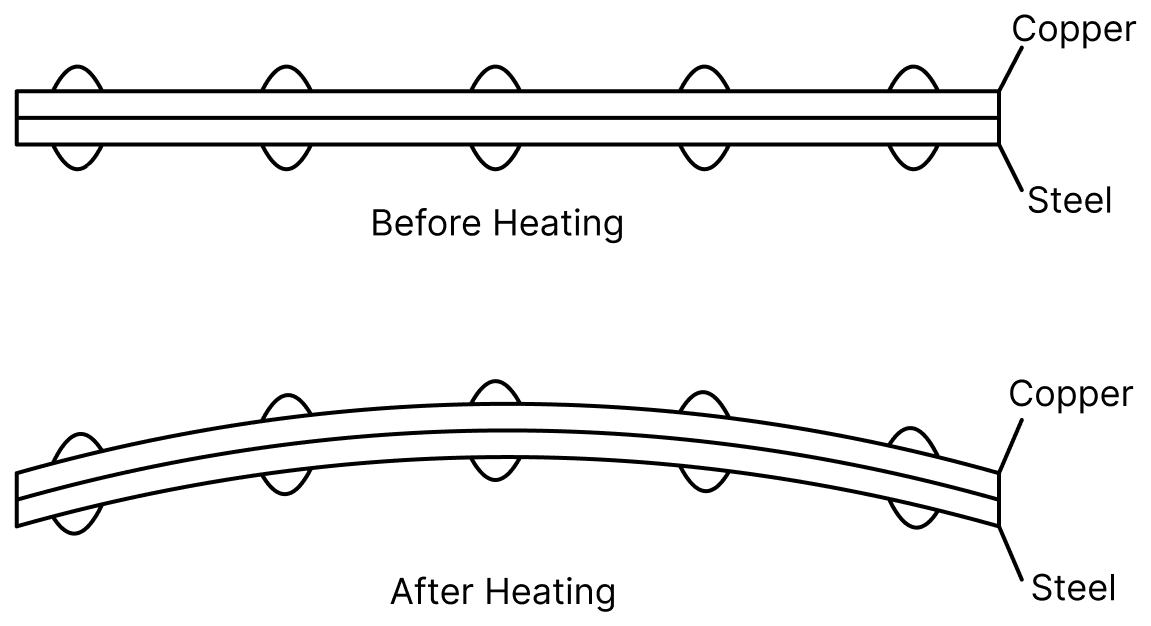
On cooling below the original temperature, the reverse bending occurs, with copper on the concave side. This property of unequal expansion is put to practical use in the electric thermostat.
The coolant used in a chemical or a nuclear plant should have a high specific heat. Why?
Answer
The function of a coolant is to carry away the large quantity of heat produced in the plant so that the temperature of the plant does not rise beyond its safe limit.
The heat absorbed by a coolant of mass m is Q = m c ΔT. For a given rise in temperature ΔT, the greater the specific heat c, the greater is the quantity of heat absorbed.
Hence a coolant of high specific heat absorbs a very large amount of heat for only a small rise in its own temperature, and so a small quantity of it is able to remove a great deal of heat. This is why water, whose specific heat is very high, is used as a coolant in the radiators of cars and in generating sets.
The climate of a town near a sea is more temperate than that of a town in a desert at the same altitude. Why?
Answer
The specific heat of water is nearly five times that of sand or earth.
Therefore, in peak summer, during the day time the temperature of the sea water rises much more slowly than that of the earth remote from the sea. During the night both the earth and the sea water radiate heat energy, but the temperature of the sea water falls more slowly than that of the earth.
Hence, at places remote from the sea, as in a desert, there is a great difference between the temperatures of day and night, while in coastal areas this temperature difference is small. Clearly, in coastal areas the days are not very hot and the nights are not very cold, so the climate is more temperate.
What do you mean by latent heat of fusion and latent heat of vaporisation?
Answer
During the change of state, the heat supplied to a substance does not produce any rise in its temperature; it is used up in overcoming the intermolecular force of attraction between the molecules. This heat is called the latent heat, and it is given by Q = m L.
Latent heat of fusion : It is the heat given (or taken out) to convert unit mass (1 kg) of a substance from the solid state to the liquid state (or from the liquid state to the solid state) at its melting point, without change of temperature. For ice it is 3.34 × 10⁵ J kg-1 or 80 kcal kg-1.
Latent heat of vaporisation : It is the heat given (or taken out) to convert unit mass (1 kg) of a substance from the liquid state to the vapour state (or from the vapour state to the liquid state) at its boiling point, without change of temperature. For water at 100°C it is 22.6 × 10⁵ J kg-1 or 539 kcal kg-1.
The SI unit of latent heat is J kg-1.
Why is latent heat of vaporisation greater than latent heat of fusion of a substance?
Answer
For water the latent heat of fusion is 3.34 × 10⁵ J kg-1, whereas the latent heat of vaporisation is 22.6 × 10⁵ J kg-1, which is nearly seven times as large.
In fusion, the substance passes from the solid to the liquid state. Only the rigid arrangement of the molecules has to be broken down; the molecules still remain close to one another, and the volume changes very little.
In vaporisation, the molecules of the liquid have to be completely separated from one another against the whole of the intermolecular force of attraction, so that a very much larger amount of work has to be done against these forces. Besides this, the volume increases enormously, so additional work has to be done by the substance against the external atmospheric pressure in expanding.
Hence the latent heat of vaporisation of a substance is much greater than its latent heat of fusion.
Can we boil water inside an earth satellite by convection?
Answer
No, water cannot be boiled by convection inside an earth satellite.
In convection, the heated fluid expands, becomes lighter and rises up under the action of the buoyant force, while the colder and heavier fluid sinks down to take its place. Both these motions are produced by gravity.
Inside an earth satellite the condition of weightlessness prevails, so there is no buoyant force acting on the heated water. The heated water therefore does not rise and the colder water does not sink, and no convection currents can be set up. Hence water cannot be boiled by convection in a satellite.
Air and wood are bad conductors of heat. The heat emitted by a hot body does not reach us when a wooden screen is interposed; but we feel the heat of the body when there is air only between us and the hot body. Explain the reason for this difference of wood and air.
Answer
The heat which reaches us from a hot body placed at a distance travels mainly by radiation and not by conduction. Radiant energy travels in the form of electromagnetic waves, and if a medium is present, it does not itself become hot.
Air is transparent to this radiation, so the heat-rays pass freely through the air and fall upon us, and we feel the heat of the hot body. The fact that air is a bad conductor is of no consequence here, because the heat is not being carried by conduction.
Wood, on the other hand, is opaque to this radiation. When a wooden screen is interposed, the heat-rays are absorbed by the screen and cannot pass through it. Since wood is also a bad conductor, the absorbed heat is not conducted through the screen to the other side. Hence the heat does not reach us.
A cloudy night is hotter than a clear-sky night. Why?
Answer
During the night, the earth loses heat by radiating it into the atmosphere.
On a cloudy night, the clouds absorb this radiation emitted by the earth and re-radiate a large part of it back towards the earth's surface. The heat is thus prevented from escaping into space, and the surface of the earth remains warm.
On a clear-sky night, there are no clouds to send the radiation back, so the heat radiated by the earth escapes freely into space and the surface of the earth cools rapidly.
Hence a cloudy night is hotter than a clear-sky night.
Write down the definition of the emissive-power of a surface and relating to it write Kirchhoff's law.
Answer
Emissive power : The total amount of radiant energy emitted per unit area of a surface per second is called the emissive power e of that surface. Its unit is joule per metre2 per second (J m-2 s-1).
The amount of radiant energy emitted per unit area of a surface per second per unit wavelength-range at wavelength λ is called the spectral emissive power eλ of that surface at wavelength λ.
Kirchhoff's law : According to this law, the ratio of the emissive power to the absorptive power for radiation of a given wavelength is the same for all bodies at the same temperature, and is equal to the emissive power of a perfectly black body at that temperature. Thus,
where Eλ is the spectral emissive power of a perfectly black body at that temperature. It follows from this law that if a surface is a good absorber of a particular wavelength of radiation, it is also a good emitter of that wavelength.
On what factors does the rate of emission of thermal radiation from a surface depend?
Answer
The radiant energy emitted per second by a body depends upon the following factors :
(i) The nature of the surface of the body. A rough and black surface emits more strongly than a polished and shining surface of the same area at the same temperature. This is expressed through the emissivity e of the surface.
(ii) The area of the surface. The larger the surface area A, the greater is the total energy emitted per second.
(iii) The temperature of the body. By Stefan's law, the energy emitted per second per unit area is proportional to the fourth power of the absolute temperature. At low temperature the rate of emission is small, and as the temperature is raised, the rate of emission increases rapidly.
Combining these, the heat energy emitted per second by the whole body is
Explain Stefan's law of radiation.
Answer
Statement : According to Stefan's law, the total radiant energy emitted per second per unit surface-area of a black body is proportional to the fourth power of the absolute temperature of the body.
Thus, if the absolute temperature of a black body is T, then the heat energy emitted per second per unit surface area is
where σ is a constant, called Stefan's constant. Its value is 5.67 × 10⁻⁸ W m-2 K-4 and its dimensions are [M T-3 θ-4].
In 1884 Boltzmann gave its theoretical proof and showed that this law applies only to a perfectly black body, and so it is now called the Stefan-Boltzmann law.
If the black body at absolute temperature T is surrounded by a black enclosure at temperature T0, then it emits σT4 and absorbs σT04 per second per unit area. Hence the net heat energy emitted per second per unit area is
The rate of radiant energy emitted does not depend upon the shape, size or material of the body; it depends only upon its temperature.
On a hot day, a car left in sunlight with its glass windows closed, becomes hotter at the inside than the air outside. Why?
Answer
This happens on account of the greenhouse effect.
The sunlight reaching the car is mostly short-wavelength radiation, and the glass windows are transparent to it. This radiation therefore passes into the car and is absorbed by the seats and the other objects inside, whose temperature rises.
These warm objects also radiate energy, but being at a much lower temperature they radiate long-wavelength infra-red radiation. Glass is opaque to this long-wavelength radiation, so it cannot pass out through the closed windows and remains trapped inside the car.
Since energy keeps entering but cannot leave, the temperature inside the car goes on rising and becomes higher than that of the air outside.
Is a body of black colour necessarily a black body?
Answer
No. It is not essential that a perfectly black body should appear black, nor is every black-coloured body a perfectly black body.
A body appears black to the eye if it absorbs all the wavelengths of the visible region of the spectrum. But a perfectly black body must absorb completely all the radiation falling on it, whatever be the wavelength, including the infra-red and the ultraviolet regions.
Lamp-black and platinum-black, for example, look black because they absorb all the visible and near infra-red parts of the incident radiation, but they reflect the far infra-red parts, and so they are not perfectly black bodies. Conversely, the sun emits radiation of all wavelengths and may be called a black body, even though it looks white.
During solar eclipse, the dark Fraunhofer's lines in the solar spectrum appear as bright lines. Why?
Answer
The Fraunhofer lines are the best example of the illustration of Kirchhoff's law.
The light coming from the very hot photosphere of the sun passes through the comparatively cooler vapours of the chromosphere surrounding it. These vapours absorb exactly those wavelengths which they themselves are capable of emitting. Hence these wavelengths are missing from the light reaching us, and they appear as dark lines in the continuous solar spectrum.
At the time of a total solar eclipse, the bright photosphere is covered by the moon, so the strong continuous background is cut off. The vapours of the chromosphere, however, are still hot and continue to emit radiation of those very wavelengths. Against the dark background these emitted wavelengths are now seen as bright lines exactly in the positions where the dark Fraunhofer lines were formerly seen.
The difference between lengths of a copper rod and a steel rod is claimed to be constant at all temperatures. Is it possible? If yes, under what condition?
Answer
Yes, it is possible.
Let the lengths of the copper and the steel rods at a given temperature be lC and lS, and let their coefficients of linear expansion be αC and αS. For a rise in temperature Δt, the increases in their lengths are
The difference (lS − lC) will remain the same at all temperatures only if both the rods increase in length by exactly the same amount, that is, ΔlC = ΔlS. Therefore
Hence the condition is that the lengths of the two rods must be in the inverse ratio of their coefficients of linear expansion.
Two bodies at different temperatures T1 and T2 if brought in thermal contact, do not necessarily settle to the mean temperature (T1 + T2)/2. Why?
Answer
When the two bodies are brought in thermal contact, by the principle of calorimetry the heat lost by the hotter body is equal to the heat gained by the colder body. If T is the final common temperature, then
which gives
This becomes equal to the mean temperature only in the special case when m1c1 = m2c2, that is, when the two bodies have the same thermal capacity.
Hence, in general the final temperature is not the mean temperature, because the two bodies may differ in mass and in specific heat.
One end of each of the two rods A and B of same metal and same area of cross-section has been immersed in ice at 0°C. In which of the following will the rate of heat-conduction be more when : (i) their other ends are at 20°C and 30°C respectively and the length of A is half the length of B, (ii) their other ends are at 20°C and 10°C respectively and the length of A is twice the length of B.
Hint : Rate of flow of heat ∝ Δθ/Δx.
Answer
Since the rods are of the same metal and of the same area of cross-section, K and A are the same for both. Hence the rate of flow of heat is proportional to the temperature gradient,
(i) Let the length of B be 2l, so that the length of A is l.
Since , the rate of heat-conduction is more in rod A.
(ii) Let the length of B be l, so that the length of A is 2l.
Since the two temperature gradients are equal, the rate of heat-conduction is the same in both the rods.
What will be the change in the spectrum of radiation emitted by an incandescent object on increasing its temperature? Explain, giving necessary approximate graph.
Answer
The spectral distribution curves of black body radiation at different temperatures show the following changes when the temperature is increased.
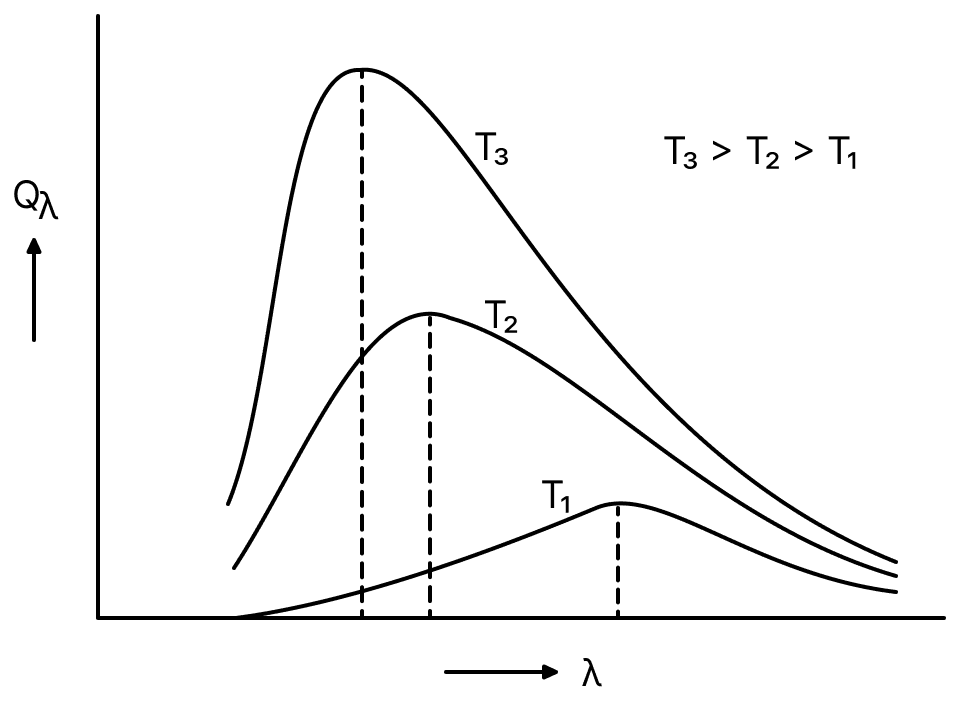
(i) The area enclosed by the curve goes on increasing. The area enclosed by a curve represents the total radiant energy Q of all wavelengths emitted by the body at that temperature, and these areas are found to be proportional to the fourth power of the corresponding absolute temperatures, Q ∝ T4. Thus the curves verify Stefan's law.
(ii) The peak of the distribution curve shifts towards shorter wavelength. By Wien's displacement law λmT = b, so the wavelength λm at which the emitted energy is maximum is inversely proportional to the absolute temperature.
Hence, on heating a body to ordinary temperature only long-wavelength radiation is emitted, but as the temperature is raised, radiation of shorter and shorter wavelength is emitted in increasing quantity. That is why, when iron is heated, it first becomes light-red, then dark-red, then yellow, and ultimately it becomes white.
A uniform pressure p is exerted uniformly on a solid body at a certain temperature. By what amount should the temperature of the body be raised to restore it to its initial volume?
Answer
Let V be the initial volume of the body and ΔV the decrease in its volume under the uniform pressure p. Then the bulk modulus of the material is
To restore the body to its initial volume, the same volume ΔV must be regained by heating. If the temperature is raised through ΔT and γ is the coefficient of volume expansion, then
Equating the two expressions,
Since γ = 3α, where α is the coefficient of linear expansion,
Hence, the temperature of the body should be raised by .
Latent heat of melting of ice is 80 kilocalorie / kg or 3.34 × 10⁵ J/kg. What is meant by this statement?
Answer
The statement means that when 1 kg of ice at 0°C melts into water at 0°C, it absorbs 80 kilocalorie or 3.34 × 10⁵ joule of heat, and during this whole process there is no change of temperature; both the ice and the water remain at 0°C.
Conversely, when 1 kg of water at 0°C freezes to form ice at 0°C, the same amount of heat, 80 kcal or 3.34 × 10⁵ J, is liberated.
This heat is used up in overcoming the intermolecular force of attraction between the molecules and in increasing the potential energy of the substance, and not in raising its temperature.
Latent heat of vaporisation of water is 539 kilocalorie / kg (or 22.6 × 10⁵ J). What is meant by this statement?
Answer
The statement means that to convert 1 kg of water at 100°C into steam at 100°C, 539 kilocalorie or 22.6 × 10⁵ joule of heat has to be given, and during this whole process the temperature does not change; both the water and the steam remain at 100°C.
Conversely, in liquefying 1 kg of steam at 100°C into water at 100°C, the same 539 kcal of heat is taken out.
It is on account of this large latent heat carried by steam that burns from steam are more serious than those from boiling water, and that heating systems based on the circulation of steam are more efficient than those based on the circulation of hot water.
What is meant by 1 calorie and 1 kilocalorie?
Answer
1 calorie is the amount of heat required to raise the temperature of 1 gram of water through 1°C. It is the unit of heat in the CGS system, and 1 calorie = 4.18 joule.
1 kilocalorie is the amount of heat required to raise the temperature of 1 kilogram of water through 1°C. Since 1 kg = 1000 g,
Define thermal capacity of a body.
Answer
The thermal capacity of a body is defined as the amount of heat required to raise the temperature of the body through 1 K (or 1°C).
If in the formula Q = m c ΔT we put ΔT = 1 K, then Q = m c. Thus the thermal capacity of a body is equal to the product of the mass of the body and the specific heat of the substance of that body.
Its unit is cal/°C or kcal/K, and its SI unit is J/K (or J/°C).
What is meant by water equivalent of calorimeter?
Answer
The water equivalent of a calorimeter is the mass of water which would increase in temperature by the same amount as the calorimeter if given the same amount of heat.
If the mass of a calorimeter (with stirrer) is m gram and the specific heat of its material is c cal g-1 °C-1, then the heat required to raise the temperature of the calorimeter by 1°C is m c calorie. The same amount of heat will raise the temperature of m c gram of water by 1°C. Hence, by definition, the water equivalent of the calorimeter is
Define specific heat of a substance.
Answer
The specific heat capacity of a substance is the amount of heat required to raise the temperature of the unit mass of the substance through a unit degree (1°C or 1 K).
From Q = c m ΔT, we have
so that if m = 1 and ΔT = 1, then c = Q.
Its SI unit is J kg-1 K-1, and a commonly used unit is cal g-1 °C-1 or kcal kg-1 °C-1, where 1 cal g-1 °C-1 = 4180 J kg-1 K-1.
Define absorptive power of a surface.
Answer
When radiant energy falls on a body, it is partly reflected from the surface, partly absorbed by the surface and the rest is transmitted through the body.
The ratio of the radiant energy absorbed by a surface in a given time to the total radiant energy incident on the surface in the same time is called the 'absorptive power' or 'absorption coefficient' a of the surface.
Since a is a ratio of two energies, it is a pure number and has no unit.
What is the absorptive power of a perfectly black body?
Answer
A perfectly black body is one which absorbs completely all the radiation falling on its surface, whatever be the wavelength. Hence for it the absorbed energy is equal to the incident energy, and so
The absorptive power of a perfectly black body is 1, which is the maximum possible value.
Write Kirchhoff's law of radiation.
Answer
According to Kirchhoff's law, the ratio of the emissive power to the absorptive power for radiation of a given wavelength is the same for all bodies at the same temperature, and is equal to the emissive power of a perfectly black body at that temperature.
Mathematically, at a definite temperature and for a wavelength λ,
where Eλ is the spectral emissive power of a perfectly black body at that temperature.
The important conclusion from this law is that if a surface is a good absorber of a particular wavelength of radiation, it is also a good emitter of that wavelength of radiation.
Two metal rods 1 and 2, of the same length have same temperature difference between their ends. Their thermal conductivities are K1 and K2 and cross-sectional areas A1 and A2 respectively. What is the required condition for the same rate of the heat conduction in them?
Answer
The rate of flow of heat in the steady state is
For the two rods the length l and the temperature difference (θ1 − θ2) are the same. Hence, for the rates of heat conduction to be equal,
Hence, the required condition is K1A1 = K2A2, that is, the areas of cross-section must be in the inverse ratio of the thermal conductivities.
The given diagram depicts the spectral distribution of radiation of a black body at temperature (between total radiant energy and wavelength). Draw estimated curves showing spectral distribution at 2000 K and 4000 K.
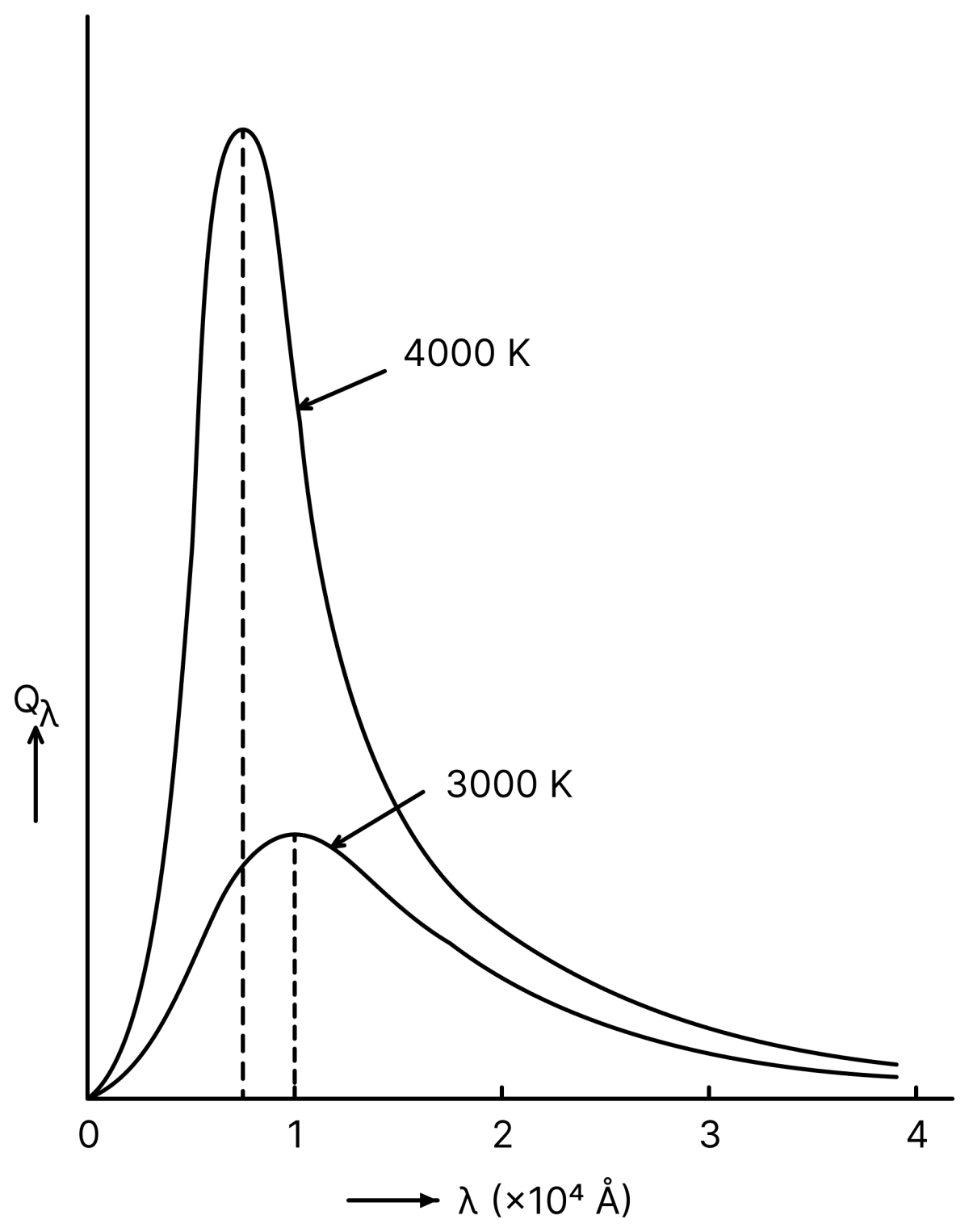
Answer
The estimated spectral distribution curves at 2000 K and 4000 K are drawn below.
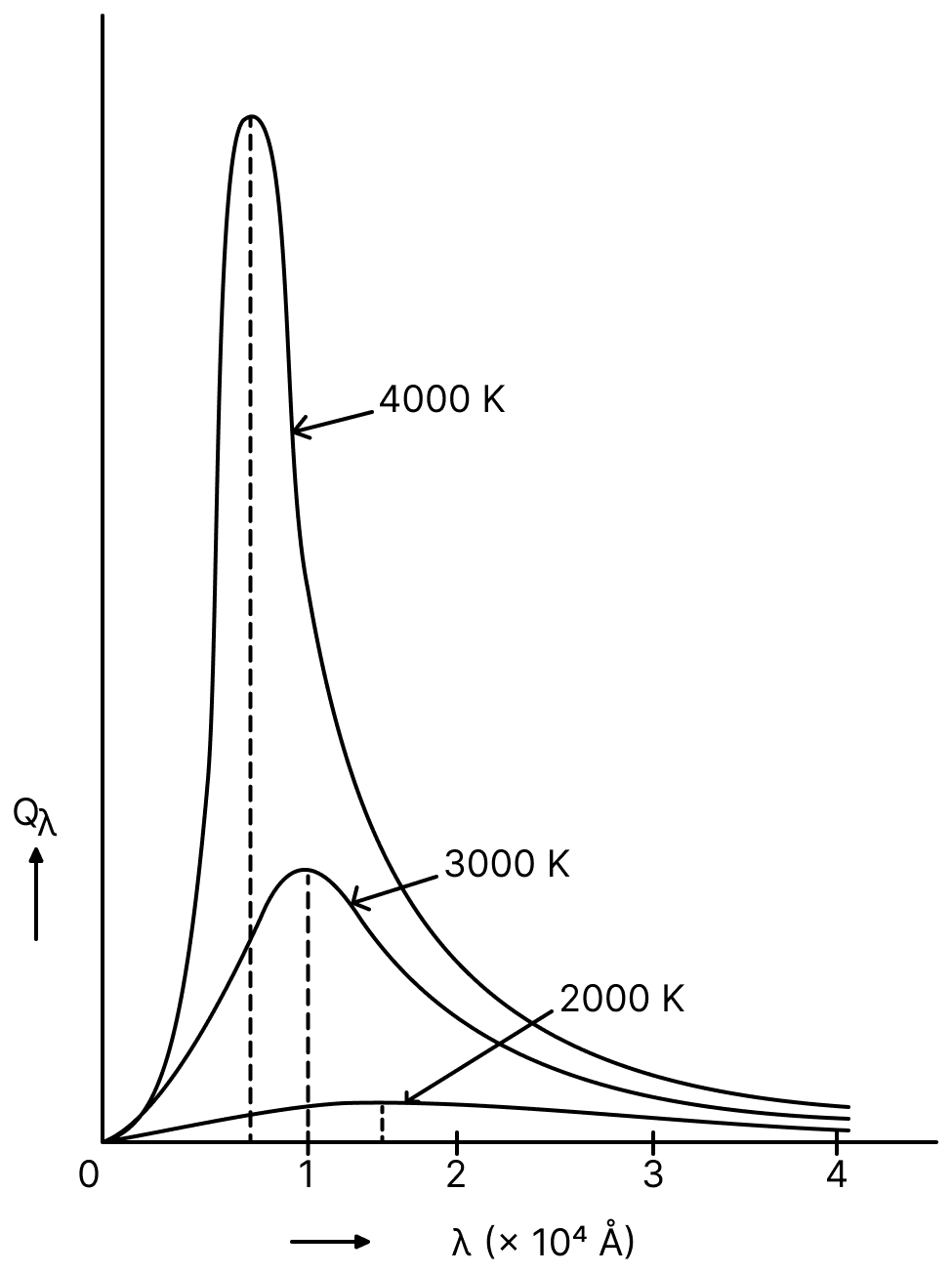
In drawing them, the following two characteristics of black body radiation are used.
(i) By Wien's displacement law, λmT = b, so the wavelength of maximum emission is inversely proportional to the absolute temperature. Since 4000 K is twice 2000 K, the peak of the 4000 K curve occurs at half the wavelength of the peak of the 2000 K curve, that is, it is shifted towards the shorter wavelength side.
(ii) By Stefan's law, the area enclosed by a curve represents the total radiant energy of all wavelengths and is proportional to T4. Since the temperature is doubled, the area under the 4000 K curve is 24 = 16 times the area under the 2000 K curve, so the 4000 K curve lies entirely above the 2000 K curve and is much taller.
Both curves have the same general shape — the energy first increases with wavelength, reaches a maximum at λm, and then decreases.
There are two rods of the same metal, same length, same area of cross-section, but one of square cross-section and the other of circular cross-section. One end of each is kept immersed in steam. After the steady state is reached, the other ends of the rods are touched. Which one will be hotter?
Answer
The rod of circular cross-section will be hotter.
Both the rods have the same length, the same area of cross-section and are of the same metal, so in the ideal case the rate of conduction along them would be the same. In practice, however, a part of the heat escapes from the curved side surfaces of the rod by convection and radiation, and the heat that finally reaches the far end depends on how much is lost from the sides.
For a given area of cross-section, the circle has the least perimeter. Hence the rod of circular cross-section has a smaller side surface area than the rod of square cross-section, and so it loses less heat from its sides. More heat therefore reaches its far end, and that end is found to be hotter.
In a burning-coal oven, the cavities in the coal pieces looks brighter than the surface of the coal, though their temperature is not higher than the coal-surface, why?
Answer
A cavity in a piece of coal behaves very nearly as a perfectly black body, on the same principle as Fery's black body.
Any radiation entering the cavity suffers multiple reflections at its inner walls and has little chance of coming out again, so it is almost completely absorbed. Hence the absorptive power of the cavity is very nearly 1.
By Kirchhoff's law, a good absorber is also a good emitter. Therefore, when the coal is heated, the cavity emits the maximum possible radiation for that temperature, that is, black body radiation, while the outer surface of the coal, not being a perfectly black body, emits less than this.
Hence the cavities look brighter than the surface of the coal, although both are at the same temperature.
A solid sphere and a hollow sphere of same material and same external radius as the solid sphere, are heated to the same temperature and left to cool in the same environment. Which one will cool faster?
Answer
The hollow sphere will cool faster.
Both spheres are of the same material and have the same external radius, so their surface areas are equal and both are at the same temperature. Hence, by Stefan's law, both lose heat by radiation at exactly the same rate, .
The hollow sphere, however, contains less material and so has a smaller mass, and therefore a smaller thermal capacity (m c). The rate of fall of temperature is
Since the numerator is the same for both while m is smaller for the hollow sphere, its temperature falls more rapidly. Hence the hollow sphere cools faster.
The dynamics of heat transfer go beyond the simplified notion of one-way flow. Prevost's theory (1791) states that all bodies, regardless of their temperature, radiate heat to their surroundings. Even cooler bodies radiate heat, though at a lower rate than they absorb from hotter surroundings. The key insight here is that even when a body is cooler, it still emits energy. The net heat flow occurs from the warmer body to the cooler one, as the warmer body radiates more heat than it receives. The flow of heat concept emphasizes that both bodies are constantly exchanging heat, but the warmer body loses more energy, creating an apparent one-way flow. At thermal equilibrium, when two bodies reach the same temperature, they continue to radiate heat equally, resulting in no net heat transfer. According to the second law of thermodynamics, heat flows from hotter to cooler objects until equilibrium is reached. Even in equilibrium, heat exchange doesn't stop; rather, the rate of radiation and absorption equalizes, maintaining a dynamic yet static state with no net flow. At absolute zero (0 K), molecular motion theoretically ceases, halting all heat exchange. This is the only scenario where heat transfer stops entirely. Reconciling these perspectives: While heat flow is often described as "one-way" in terms of net transfer, Prevost's theory shows that energy is radiated in all directions. At equilibrium, there is still continuous exchange, though with no net transfer. Heat transfer ceases only at absolute zero, where molecular motion stops. Therefore, the notion of one-way heat flow is a simplification that applies primarily when discussing net transfer between bodies at different temperatures, while energy exchange persists even in thermal equilibrium.
(i) According to Prevost's Theory of Heat Exchange, what happens when a cooler body is placed in a warmer environment?
- The cooler body absorbs heat and stops radiating any energy.
- The cooler body only absorbs heat but does not radiate any energy.
- The cooler body radiates energy but less than it absorbs from the surroundings.
- The cooler body radiates more energy than it absorbs from the surroundings.
(ii) What is the primary difference between net heat transfer and the actual energy exchange between two bodies at different temperatures?
- Net heat transfer is bidirectional, while actual energy exchange is one-way.
- Net heat transfer is one-way, but actual energy exchange is continuous and bidirectional.
- Net heat transfer and actual energy exchange are both one-way.
- There is no difference; both refer to the same process.
(iii) At thermal equilibrium, which of the following statements is true about heat exchange?
- Heat exchange completely stops.
- Both bodies continue to exchange heat equally, resulting in no net transfer.
- Only the cooler body radiates energy.
- The bodies radiate energy at different rates, but the temperature remains constant.
(iv) When does heat transfer completely cease between two bodies?
- At thermal equilibrium.
- When the bodies have different temperatures.
- Only at absolute zero.
- Heat transfer never completely ceases.
(v) Why is the term "one-way heat flow" considered a simplification?
- Because heat never flows in one direction.
- Because it refers to net heat transfer, but does not consider the fact that energy is radiated in all directions by both bodies.
- Because the term is incorrect, as heat always flows equally in both directions.
- Because it only applies to solid materials, not fluids or gases.
Answer
(i) The cooler body radiates energy but less than it absorbs from the surroundings.
According to Prevost's theory of heat exchange, all bodies, whatever their temperature, radiate heat to their surroundings. A cooler body placed in warmer surroundings therefore does not stop radiating; it continues to emit energy, but its rate of emission is lower than its rate of absorption, and so its temperature rises.
(ii) Net heat transfer is one-way, but actual energy exchange is continuous and bidirectional.
Both bodies radiate energy towards each other all the time, so the actual exchange of energy takes place in both directions. Since the warmer body radiates more than it receives, the net result is a one-way flow of heat from the warmer body to the cooler one.
(iii) Both bodies continue to exchange heat equally, resulting in no net transfer.
At thermal equilibrium the emission and absorption do not stop; the rate of radiation becomes equal to the rate of absorption for each body. Hence the exchange of energy continues, but there is no net transfer of heat in either direction.
(iv) Only at absolute zero.
At absolute zero (0 K), molecular motion theoretically ceases, so no thermal energy can be radiated at all. This is the only condition in which heat exchange stops entirely; at thermal equilibrium it merely becomes equal in both directions.
(v) Because it refers to net heat transfer, but does not consider the fact that energy is radiated in all directions by both bodies.
The description of heat flow as one-way is a simplification that applies only to the net transfer between bodies at different temperatures. In reality, as Prevost's theory shows, energy is radiated in all directions by every body, and this exchange persists even at thermal equilibrium.
Any physical property that depends consistently and reproducibly on temperature can be used as the basis of a thermometer. For example, volume increases with temperature for most substances. This property is the basis for the common alcohol thermometer and the original mercury thermometers. Other properties used to measure temperature include electrical resistance, magnetic susceptibility colour, and the emission of infrared radiation.
Thermometers measure temperature according to well-defined scales of measurement. The three most common temperature scales are Fahrenheit, Celsius, and Kelvin. Temperature scales are created by identifying two reproducible temperatures. The freezing and boiling temperatures of water at standard atmospheric pressure are commonly used.
On the Celsius scale, the freezing point of water is 0°C and the boiling point is 100°C. The unit of temperature on this scale is the degree Celsius (°C). The Fahrenheit scale (still the most frequently used for common purposes) has the freezing point of water at 32° and the boiling point at 212°F. Its unit is the degree Fahrenheit (°F). You can see that 100 Celsius degrees span the same range as 180 Fahrenheit degrees. Thus, a temperature difference of one degree on the Celsius scale is 1.8 times as large as a difference of one degree on the Fahrenheit scale.
The definition of temperature in terms of molecular motion suggests that there should be a lowest possible temperature, where the average kinetic energy of molecules is zero (or the minimum allowed by quantum mechanics). Experiments confirm the existence of such a temperature, called absolute zero. An absolute temperature scale is one whose zero point is absolute zero. Such scales are convenient in science because several physical quantities, such as the volume of an ideal gas, are directly related to absolute temperature.
The Kelvin scale is the absolute temperature scale that is commonly used in science. The SI temperature unit is the kelvin, which is abbreviated K (not accompanied by a degree sign). Thus 0 K is absolute zero. The freezing and boiling points of water are 273.15 K and 373.15 K, respectively. Therefore, temperature differences are the same in units of kelvins and degrees Celsius.
The Kelvin scale is part of the SI system of units, so its actual definition is more complicated than the one given above. First, it is not defined in terms of the freezing and boiling points of water, but in terms of the triple point. The triple point is the unique combination of temperature and pressure at which ice, liquid water, and water vapour can coexist stably. As will be discussed in the section on phase changes, the coexistence is achieved by lowering the pressure and consequently the boiling point to reach the freezing point. The triple-point temperature is defined as 273.16 K. This definition has the advantage that although the freezing temperature and boiling temperature of water depend on pressure, there is only one triple-point temperature.
Second, even with two points on the scale defined, different thermometers give somewhat different results for other temperatures. Therefore, a standard thermometer is required. Metrologists (experts in the science of measurement) have chosen the constant-volume gas thermometer for this purpose. A vessel of constant volume filled with gas is subjected to temperature changes, and the measured temperature is proportional to the change in pressure. Using 'Tp' to represent the triple point.
The results depend somewhat on the choice of gas, but the less dense the gas in the bulb, the better the results for different gases agree. If the results are extrapolated to zero density, the results agree quite well, with zero pressure corresponding to a temperature of absolute zero.
Constant-volume gas thermometers are big and come to equilibrium slowly, so they are used mostly as standards to calibrate other thermometers.
(i) What is the main advantage of using the Kelvin scale in scientific measurements?
- It avoids negative temperatures
- It uses a degree symbol for simplicity
- It defines freezing and boiling points more accurately
- It is based on the triple point of water and absolute zero.
(ii) On the Celsius scale, what is the boiling point of water at standard atmospheric pressure?
- 32°C
- 100°C
- 212°C
- 373°C
(iii) How does the size of one-degree Celsius compare to one degree Fahrenheit?
- 1 degree Celsius is 1.8 times larger
- 1 degree Celsius is the same as 1 degree Fahrenheit
- 1 degree Celsius is 0.8 times larger
- 1 degree Celsius is 32 times larger.
(iv) What type of thermometer is often used as a standard for calibrating other thermometers?
- Alcohol thermometer
- Mercury thermometer
- Constant-volume gas thermometer
- Infra-red thermometer.
Answer
(i) It is based on the triple point of water and absolute zero.
The Kelvin scale is an absolute temperature scale whose zero point is absolute zero, and which is defined by assigning the value 273.16 K to the triple point of water. Such a scale is convenient in science because several physical quantities, such as the volume of an ideal gas, are directly related to absolute temperature. The triple point is preferred as the defining fixed point because, unlike the freezing and boiling temperatures, it occurs at only one temperature.
(ii) 100°C
On the Celsius scale the freezing point of water is taken as 0°C and the boiling point as 100°C, the interval between them being divided into 100 equal divisions.
(iii) 1 degree Celsius is 1.8 times larger
The interval between the freezing and boiling points of water spans 100 divisions on the Celsius scale and 180 divisions on the Fahrenheit scale. Hence
that is, a temperature difference of one degree on the Celsius scale is 1.8 times as large as a difference of one degree on the Fahrenheit scale.
(iv) Constant-volume gas thermometer
Different thermometers give somewhat different results for temperatures other than the fixed points, so a standard thermometer is required. The constant-volume gas thermometer has been chosen for this purpose, since the measured temperature is proportional to the change in pressure of a fixed volume of gas. Such thermometers are big and come to equilibrium slowly, so they are used mostly as standards to calibrate other thermometers.
In 1900, Max Planck proposed a revolutionary theory to describe the energy distribution of black-body radiation. A black body is an idealized object that absorbs all radiation incident upon it and emits radiation at all frequencies. According to classical theories (Rayleigh-Jeans law), the energy distribution at high frequencies was predicted to increase indefinitely, leading to the "ultraviolet catastrophe." Planck introduced the idea that energy is quantized, meaning it can only be emitted or absorbed in discrete packets called quanta or photons. He derived an expression for the energy density of radiation as a function of frequency and temperature, known as Planck's law of radiation.
Planck's law states that the energy radiated per unit area of a black body per unit time per unit frequency is proportional to the frequency raised to the power of three, the concerned formula is as under;
where: E(v, T) is the spectral radiance (energy per unit area per unit frequency), h is Planck's constant, v is the frequency of radiation, T is the absolute temperature, c is the speed of light, k is Boltzmann's constant.
At low frequencies (longer wavelengths), Planck's law agrees with Rayleigh-Jeans law, while at higher frequencies (shorter wavelengths), it avoids the ultraviolet catastrophe by predicting a peak in the emission spectrum. This peak shifts toward higher frequencies as the temperature increases, which is a phenomenon described by Wien's displacement law. This explains why hotter objects appear to shift from red to blue in colour.
(i) What was the major issue with the classical Rayleigh-Jeans law that led to the introduction of Planck's law?
- It could not explain the behaviour of gases.
- It predicted infinite energy at high frequencies.
- It did not account for the behaviour of solids.
- It only worked at very low temperatures.
(ii) According to Planck's law, energy is emitted or absorbed in discrete packets called:
- electrons
- neutrons
- quanta
- waves
(iii) Which physical quantity is directly proportional to the peak wavelength in the spectral distribution of black-body radiation according to Wien's displacement law?
- Frequency
- Temperature
- Wavelength
- Inverse temperature
(iv) Planck's law describes the spectral distribution of black-body radiation as a function of:
- frequency and wavelength
- temperature and frequency
- temperature and pressure
- frequency and pressure
(v) Which of the following constants is not involved in the formulation of Planck's law?
- Planck's constant
- Speed of light
- Gravitational constant
- Boltzmann constant
Answer
(i) It predicted infinite energy at high frequencies.
According to the classical Rayleigh-Jeans law, the energy distribution at high frequencies was predicted to increase indefinitely. This unphysical result is known as the "ultraviolet catastrophe", and it was to remove this difficulty that Planck introduced his theory.
(ii) quanta
Planck proposed that energy is quantized, that is, it can only be emitted or absorbed in discrete packets called quanta or photons, and not continuously.
(iii) Inverse temperature
By Wien's displacement law, λmT = b, so
Thus the peak wavelength is directly proportional to the reciprocal of the absolute temperature, that is, to the inverse temperature. As the temperature increases, the peak shifts towards shorter wavelengths.
(iv) temperature and frequency
In Planck's law the spectral radiance is written as E(v, T), that is, as a function of the frequency v of the radiation and the absolute temperature T of the black body.
(v) Gravitational constant
The formula for Planck's law contains Planck's constant h, the speed of light c and Boltzmann's constant k. The gravitational constant does not appear in it at all.
Note: In the passage the expression is called the spectral radiance. It is in fact the spectral energy density uν, whose unit is J m-3 Hz-1. The spectral radiance is .
Every substance is made-up of molecules. When a substance is heated, its molecules start vibrating and so kinetic energy of molecules increases. Further, average distance between the molecules increases. A solid on heating expands in all directions, i.e., in length, area and volume. Liquids expand in volume only on heating. Water exhibits an anomalous property, it contracts on heating between 0°C and 4°C on further heating water expands. Therefore, density of water is maximum at 4°C.
(i) A metal disc has a hole in it. What will be the size of the hole on heating the metal disc?
(ii) In winters, the top of a lake is frozen. What do you expect the temperature of water (a) just below the lower surface of ice and (b) at the bottom of the lake?
(iii) What do you mean by thermal expansion?
Answer
(i) The size of the hole increases on heating the metal disc.
On heating, the hole in the disc expands in exactly the same way as a disc of the same metal filling the hole would expand. Every linear dimension of the disc, including the diameter of the hole, increases in the ratio (1 + α Δt), so the hole becomes larger.
(ii) (a) Just below the lower surface of ice the temperature of the water is 0°C, since at that surface the ice and the water are in contact and are in thermal equilibrium at the freezing point.
(b) At the bottom of the lake the temperature of the water is 4°C. Water has its maximum density at 4°C, so the densest water sinks to the bottom and remains there. Since ice is a poor conductor of heat, the ice layer checks the flow of heat from this water to the atmosphere, and so the water at the bottom stays at 4°C. This is how fish and other aquatic creatures remain alive in a frozen pond.
(iii) Thermal expansion : Almost all substances expand on heating and contract on cooling. The expansion of a substance on heating is called 'thermal expansion' of that substance.
Every substance is made up of molecules. When a substance is heated, its molecules start vibrating and so the kinetic energy of the molecules increases. Further, the average distance between the molecules increases, and the substance expands. A solid on heating expands in all directions, that is, in length, area and volume, whereas liquids expand in volume only.
The process in which heat energy is transferred from a hot body in the form of electromagnetic waves, is called radiation and this energy is called radiant energy. The total radiant energy emitted per second per unit surface-area of a black body is proportional to the fourth power of the absolute temperature of the body, i.e., E ∝ T4. This law is called Stefan's law. Stefan's law holds for all temperatures of the hot body. If the temperature difference between the hot body and the surroundings is small than the rate of loss of heat from body, is directly proportional to the temperature difference between the body and its surroundings. This law is called Newton's law of cooling.
(i) 'Black body radiation is white.' Comment on this statement.
(ii) The temperatures of two black bodies are 727°C and 327°C, respectively. Find the ratio of energy radiated per second by them.
(iii) Define Newton's law of cooling.
Answer
(i) 'Black body radiation is white' — the statement is correct.
It is not essential that a perfectly black body should appear black. A perfectly black body absorbs externally-incident radiation of all wavelengths, and by Kirchhoff's law it therefore also emits radiation of all wavelengths when heated to a high temperature. A mixture of the radiations of all the wavelengths of the visible region appears white to the eye. Hence the radiation coming from a perfectly black body at a high temperature appears white. The sun emits radiation of all wavelengths and may be called a black body, though it looks white.
(ii) Given,
- Temperature of the first black body, T1 = 727°C = 727 + 273 = 1000 K
- Temperature of the second black body, T2 = 327°C = 327 + 273 = 600 K
By Stefan's law, the energy radiated per second per unit area is proportional to the fourth power of the absolute temperature, E ∝ T4. Therefore
Hence, the ratio of the energy radiated per second by them is 625 : 81, that is, about 7.72 : 1.
(iii) Newton's law of cooling : The rate of loss of heat from a body is directly proportional to the temperature difference between the body and its surroundings, provided the temperature difference is small.
If T is the temperature of the body and T0 that of the surroundings, then
where k is a positive constant depending upon the area and the nature of the surface of the body.
Explain the meaning of the coefficients of linear (α), superficial (β) and volume expansion (γ) of a solid material. Establish relationship among α, β and γ.
Answer
In solids all the three of length, area and volume increase on heating. A solid on heating expands in all directions. Thus, in a solid, expansion in length is called linear expansion, expansion in area is called superficial expansion and expansion in volume is called cubical or volume expansion.
Coefficient of linear expansion (α) : By experiment it is observed that on heating a rod, the increase in its length is directly proportional to its original length and to the increase in its temperature. If the length of a rod is L and its temperature rises by Δt, then
If Δt = 1°C and L = 1, then α = ΔL. Thus, the coefficient of linear expansion of the material of a rod is equal to the increase in unit length of the rod when its temperature rises by 1°C. Its unit is per °C.
Coefficient of superficial expansion (β) : Like linear expansion, the superficial expansion of a solid also depends upon its original area, the rise in temperature and the material of the solid. If the original area of a lamina is A and its area becomes A + ΔA on raising the temperature by Δt°C, then
Thus, the coefficient of superficial expansion of the material of a lamina is equal to the increase in unit area of the lamina when its temperature rises by 1°C.
Coefficient of volume expansion (γ) : If the original volume of a solid is V and it becomes V + ΔV on raising the temperature by Δt°C, then
Thus, the coefficient of volume expansion of the material of a solid is equal to the increase in unit volume of the solid when its temperature rises by 1°C.
Relation between β and α : Let each side of a square lamina be 1 cm at a given temperature, so that its area is 1 cm2. Let the coefficient of linear expansion of its material be α.
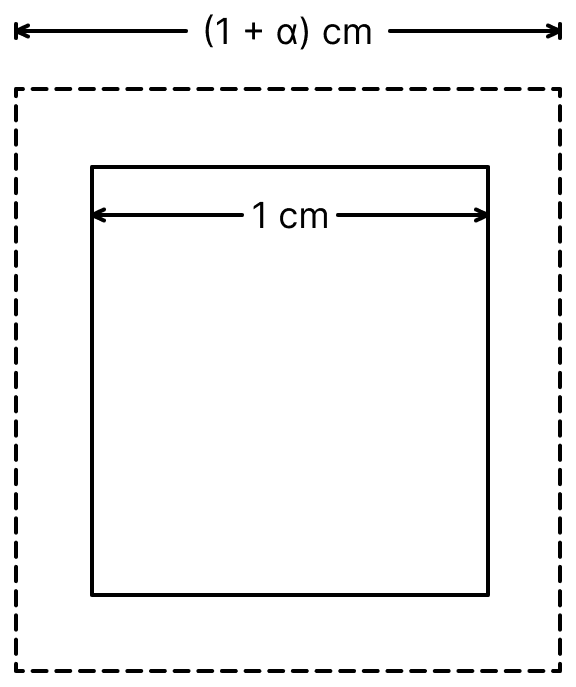
Let the temperature of the lamina be increased by 1°C. Then at the new temperature,
Since α is much less than 1, α2 may be neglected. Then the increase in area = 2α, and
Thus, the coefficient of superficial expansion is twice the coefficient of linear expansion.
Relation between γ and α : Let each side of a cube be 1 cm at a given temperature, so that its volume is 1 cm3.
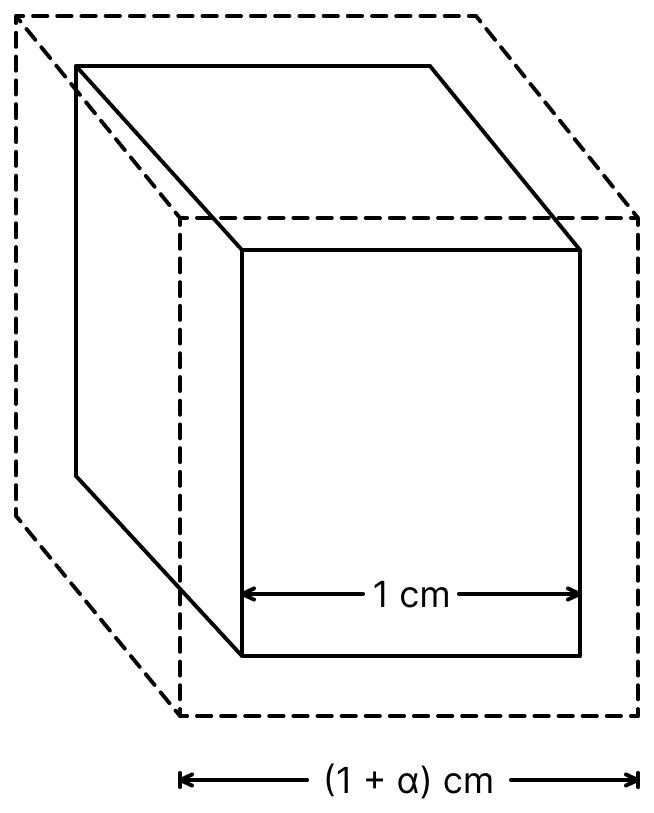
Let the temperature of the cube be raised by 1°C. Then at the new temperature,
Since α is much less than 1, the higher power terms of α may be neglected. Then the increase in volume = 3α, and
Thus, the coefficient of volume expansion is three times the coefficient of linear expansion.
Relation among α, β and γ : Since β = 2α and γ = 3α,
What is meant by 'steady state' of thermal conduction? By writing the equation of rate of heat flowing in steady state, deduce the dimensional equation of coefficient of thermal conductivity.
Answer
Steady state : When one end of a metallic rod is heated, heat flows by conduction from the hot end to the cold end. In the process of conduction each cross-section of the rod receives heat Q from the adjacent cross-section towards the heated end. A part of this heat (Q1) is absorbed by the cross-section itself, due to which its temperature increases, another part (Q2) goes into the atmosphere by convection and radiation, and the rest (Q3) is conducted to the next cross-section. In this variable state, Q = Q1 + Q2 + Q3.
After some time a state is reached when the temperature of each section of the rod becomes constant. In this state no heat is absorbed by the rod, that is, Q1 = 0. This state of the rod in which the temperature of each section of the rod becomes constant is called the 'steady state'.
By steady state it does not mean that the temperature of the whole rod is the same; the temperatures of different parts are different, but the temperature of each part remains constant with time, so that for every section
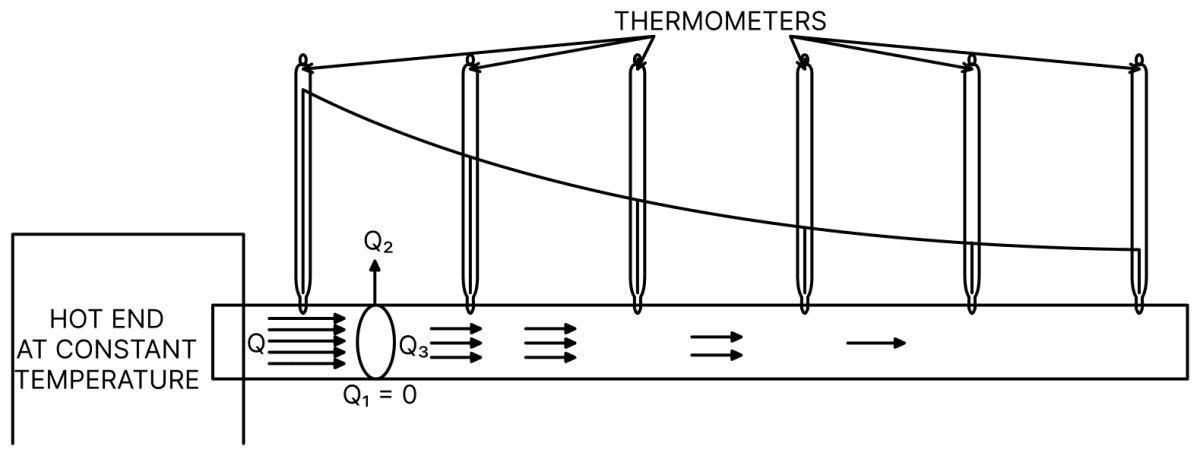
Rate of heat flow in the steady state : Consider a parallel-faced slab of cross-sectional area A and length l, whose faces are maintained at steady temperatures θ1 and θ2 (θ1 > θ2). Experiment shows that the heat Q flowing through the slab in time t is
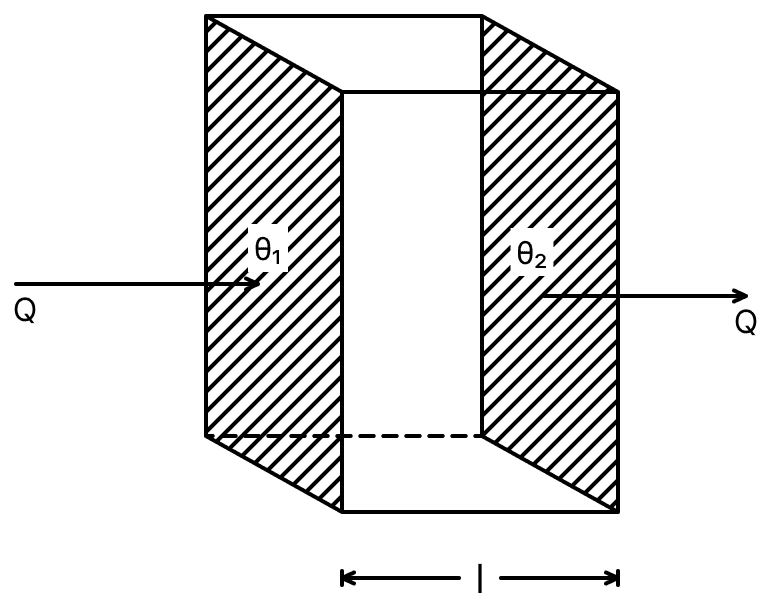
(i) directly proportional to the area of cross-section A,
(ii) directly proportional to the temperature difference (θ1 − θ2),
(iii) directly proportional to the time t, and
(iv) inversely proportional to the length l of the slab.
Combining these,
where K is the coefficient of thermal conductivity of the material. Hence the rate of flow of heat is
Dimensional equation of K : From the above equation,
Substituting the dimensions of heat Q as [M L2 T-2], of length l as [L], of area A as [L2], of temperature difference as [θ] and of time t as [T],
Hence, the dimensional formula of the coefficient of thermal conductivity is [M L T-3 θ-1], and its SI unit is J s-1 m-1 K-1 or W m-1 K-1.
What is meant by 'emissive power' and 'absorptive power' of a surface? Prove that for a wavelength λ at a definite temperature, the ratio of emissive power eλ to absorptive power aλ of all bodies is equal to the emissive power Eλ of a perfectly black body at that temperature.
Answer
Emissive power : When the temperature of a body is higher than that of its surroundings, radiant energy is continuously emitted from the surface of the body. The total amount of radiant energy emitted per unit area of a surface per second is called the 'emissive power' e of that surface. Its unit is joule per metre2 per second (J m-2 s-1).
The amount of radiant energy emitted per unit area of a surface per second per unit wavelength-range at wavelength λ is called the 'spectral emissive power' eλ of that surface at wavelength λ.
Absorptive power : When radiant energy falls on a body, it is partly reflected from the surface, partly absorbed by the surface and the rest is transmitted through the body. The ratio of the radiant energy absorbed by a surface in a given time to the total radiant energy incident on the surface in the same time is called the 'absorptive power' or 'absorption coefficient' a of the surface. Since a is a ratio, it has no unit.
The ratio of the radiant energy absorbed by a surface per unit wavelength-range at wavelength λ in a given time to the incident radiant energy in that time is called the 'spectral absorptive power' aλ of that surface at wavelength λ.
Proof of Kirchhoff's law : Let a body be placed in a uniformly-heated enclosure at a constant temperature T. In the equilibrium state, the temperature of the body will be equal to that of the enclosure.
Suppose at this temperature the absorptive power of the body for the wavelength λ is aλ. Let an amount of radiant energy ΔQ between the wavelengths λ and (λ + Δλ) be incident per second on the unit surface area of the body. Then the amount of energy absorbed by unit surface area of the body per second is
Now, if at temperature T and wavelength λ the emissive power of the surface of the body be eλ, then the amount of energy emitted by unit surface area of the body per second between the wavelengths λ and (λ + Δλ) is
In a uniform-temperature enclosure, the quantity and quality of radiation is not affected by the presence of any body inside it. Hence, whatever radiant energy of any wavelength the body absorbs, it emits exactly an equal amount of radiant energy of the same wavelength. Thus
Now, a perfectly black body absorbs the whole of the radiant energy incident on it, that is, its absorptive power aλ = 1. So, if a perfectly black body whose emissive power is Eλ is placed inside the enclosure, then for it the equation corresponding to equation (i) will be
Dividing equation (i) by equation (ii), we get
Since, for a given temperature, Eλ is a constant, so for all materials at that temperature
Hence, at a definite temperature and for a given wavelength, the ratio of the emissive power to the absorptive power is the same for all surfaces and is equal to the emissive power of a perfectly black body at that temperature. This is Kirchhoff's law.
Importance : A conclusion from Kirchhoff's law is that if a surface is a good absorber of a particular wavelength of radiation, it is also a good emitter of that wavelength of radiation.
State Newton's law of cooling. Prove that temperature of a body decreases exponentially with time.
Answer
Newton's law of cooling : The rate of loss of heat from a body is directly proportional to the temperature difference between the body and its surroundings, provided the temperature difference is small.
Stefan's law holds for all temperatures of the hot body, but Newton's law of cooling is applicable only when the temperature difference (T − T0) is small.
Deduction from Stefan's law : Let T = T0 + ΔT, where ΔT is the small difference between the temperature T of the body and the temperature T0 of the surroundings, so that ΔT << T0. Then, from Stefan's law,
the negative sign being taken because there is a loss of heat. Expanding by the binomial theorem and retaining only the first-order term,
Since T is only slightly greater than T0, we can assume T0 to be practically constant during cooling. Hence
Proof that the temperature decreases exponentially with time : Let at any instant the temperature of the body be T and that of the surroundings be T0. Then the loss of heat in time dt is − dQ, and
If the mass of the body is m and the specific heat capacity of its material is c, and in the infinitesimally small time interval dt the temperature of the body falls by dT, then
From equations (i) and (ii),
Separating the variables,
where is a constant for a given body.
On integrating,
where C is the constant of integration. If the initial temperature of the body at t = 0 is T′, then substituting in equation (iii),
Substituting this value of C in equation (iii),
Taking antilogarithms,
Clearly, the temperature of the body decreases exponentially with time.
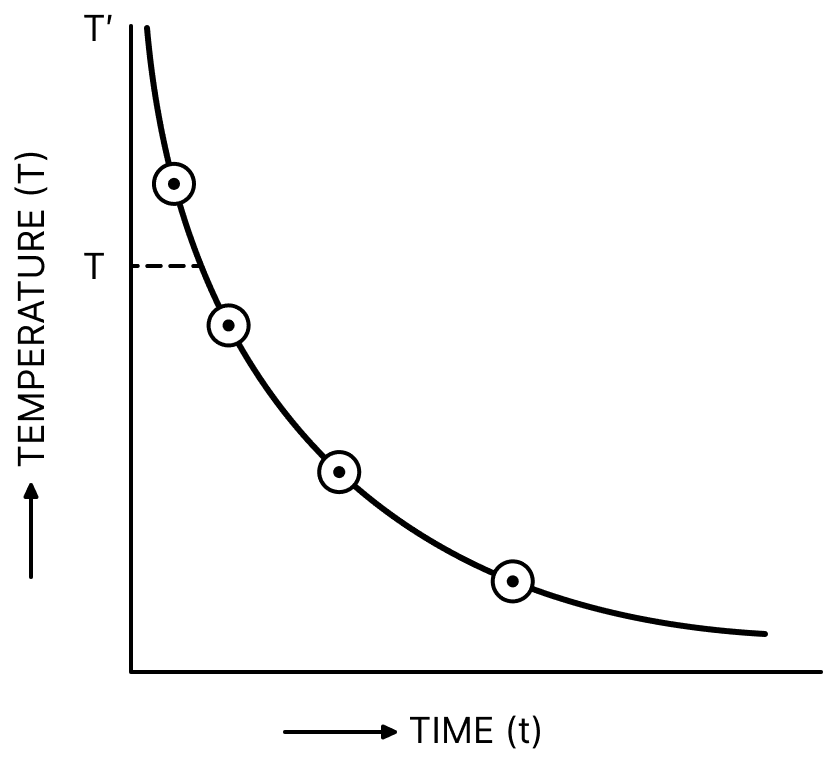
Also, from equation (iii), if a graph is drawn between t and loge(T − T0), it is a straight line having a negative gradient.
(a) Discuss the anomalous expansion of water.
(b) Discuss the variation of the density of liquids with temperature.
Answer
(a) Anomalous expansion of water : Almost all substances expand on heating and contract on cooling. Water, however, exhibits an anomalous property; it contracts on heating between 0°C and 4°C. The volume of a given amount of water decreases when it is cooled from room temperature to 4°C, and below 4°C the volume increases instead of decreasing.
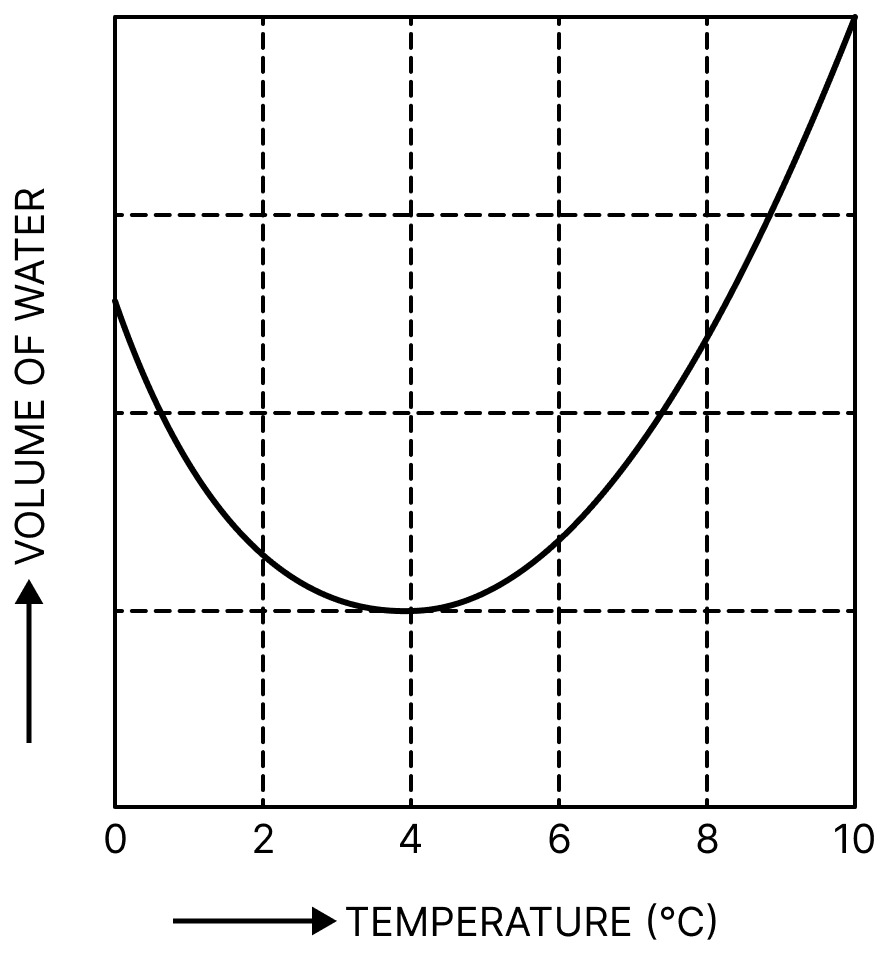
The volume of water first decreases when water is heated from 0°C to 4°C and then increases. Correspondingly, when water is heated from 0°C the density of water first increases from 0°C to 4°C and then decreases above 4°C. Thus, the density of water is maximum at 4°C and is equal to 1 g cm-3.
When the temperature of water becomes 0°C, water freezes into ice, and then the volume of the ice is greater than the volume of the water. It is for this reason that the density of ice is less than the density of water and ice floats on water.
Consequences in everyday life :
(i) In preserving the aquatic life during very cold weather : In cold weather, when the temperature starts falling below 4°C in winter, the water at the surface of a pond or lake near the surface begins to lose heat energy to the atmosphere, becomes denser and sinks, and the warmer less dense water near the bottom rises. However, once the colder water on the top reaches a temperature below 4°C it becomes less dense and remains at the surface where it freezes. Since ice is a poor conductor of heat, the ice now checks the flow of heat from the water of the pond to the atmosphere, and the water well below the ice layer remains at 4°C. As a result fish and other aquatic creatures remain alive in the water of the pond, though the water of the surface has frozen into ice.
(ii) Water pipe lines, nerves of plants and rocks burst during the very cold nights : When the atmospheric temperature in winter starts falling below 4°C, water expands and it exerts large pressure on the water pipe lines, so they burst. The plants also die, as their nerves (or capillaries) burst when water expands below 4°C. For this reason farmers fill their fields with water to save the crop from this effect.
(b) Variation of the density of liquids with temperature : When a given mass of a liquid is heated, its volume increases; accordingly the density of the liquid decreases.
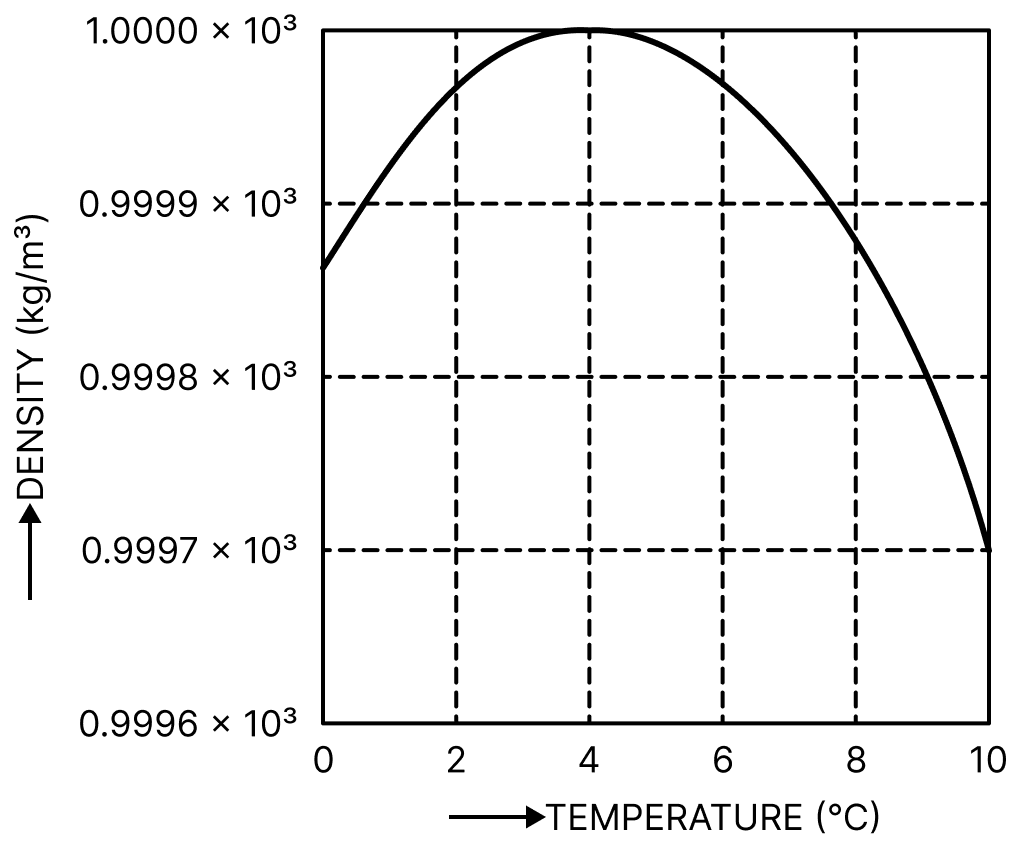
Let V and V′ be the volumes of a liquid at temperatures T and (T + ΔT) respectively, and γ the coefficient of volume expansion. Then
If ρ and ρ′ are the densities of the liquid at temperatures T and (T + ΔT) respectively, then since the mass is the same,
Making this substitution in equation (i),
Expanding by the binomial theorem and neglecting the smaller terms,
Thus, the density of liquids, which expand on heating, decreases with rise in temperature. However, the density of water increases with rise in temperature in the range 0°C to 4°C.
What do you mean by specific heat of a substance? Give its definition and SI unit.
Answer
When a body is heated, its temperature rises. Experiments show that the amount of heat given to a body is directly proportional to the mass of the body and to the temperature-rise. Thus, if an amount of heat Q given to a body of mass m raises its temperature by ΔT, then
where c is a constant depending upon the material of the body. It is called the 'specific heat capacity' of the material. From the above equation,
Definition : If m = 1 and ΔT = 1, then c = Q. Hence, the specific heat capacity of a substance is the amount of heat required to raise the temperature of the unit mass of the substance through a unit degree (1°C or 1 K).
SI unit : The SI unit of specific heat capacity is J kg-1 K-1. A commonly used unit is cal g-1 °C-1 or kcal kg-1 °C-1, the numerical value of the specific heat in these two units being the same. Since 1 kcal is equivalent to 4180 J and a temperature difference of 1°C is equal to a temperature difference of 1 K,
The specific heat capacity of water at 15°C is 1 cal g-1 °C-1 or 4180 J kg-1 K-1.
State the principle of calorimetry. How will you use this principle to determine the specific heat of a solid?
Answer
Principle of calorimetry : A system is said to be isolated if no exchange of heat takes place between the system and its surroundings. When different parts of an isolated system are at different temperatures, then some heat is transferred from the part at higher temperature to the part at lower temperature.
When bodies at different temperatures are brought in contact, then the heat lost by the hot body must be equal to the heat gained by the cold body, provided no heat escapes to the surroundings. This is known as the principle of calorimetry. Mathematically,
This principle is a consequence of the principle of conservation of energy.
Determination of the specific heat of a solid : Let us consider a hot solid of mass m and specific heat c at a temperature t. It is dropped into water of mass m1 at a temperature t1 (lower than t) contained in a calorimeter of water equivalent W.
The contents of the calorimeter are stirred by the stirrer continuously till the temperature of the mixture becomes steady. Let it be t2. In this process the solid has been cooled from temperature t to t2, while the water and the calorimeter have been heated from temperature t1 to t2.
Now,
and
where c1 is the specific heat of water.
By the principle of calorimetry, heat lost = heat gained,
Knowing m, m1, W, c1, t, t1 and t2, the specific heat c of the solid is calculated.
Define and explain latent heat of fusion of a substance. Give its SI unit.
Answer
Latent heat : During the change of state of a substance, the heat supplied to the substance does not produce any rise in the temperature of the substance so long as the change of state takes place. The heat supplied is used up in overcoming the intermolecular force of attraction between the molecules and increasing the potential energy of the substance.
If a mass m of a substance undergoes a change from one state to the other, then the amount of heat required is given by
where L is known as the latent heat and is a characteristic of the substance. Thus . The latent heat for a solid-liquid state change is called the 'latent heat of fusion'.
Definition : The latent heat of fusion of a substance is the heat given (or taken out) to convert unit mass (1 kg) of the substance from the solid state to the liquid state (or from the liquid state to the solid state) at its melting point, without change of temperature.
Explanation : The latent heat of ice is 3.34 × 10⁵ J kg-1 or 80 kcal kg-1 or 80 cal g-1. It means that when 1 kg of ice at 0°C melts, then it absorbs 3.34 × 10⁵ J (or 80 kcal) of latent heat. On the other hand, when 1 kg of water at 0°C freezes to form ice at 0°C, then the same amount of heat is liberated. It may be noted that the melting point of a solid and the freezing point of its liquid are the same; for example, the melting point of ice and the freezing point of water are both 0°C.
SI unit : The SI unit of latent heat is J kg-1. Other units are kcal kg-1 or cal g-1. The value of L also depends upon pressure.
Define 'thermal resistance' of a material. On what factors does it depend?
Answer
Just as charge flows in an electrical circuit due to a potential difference between two points of the circuit, in the same way heat flows in a conductor due to a temperature-difference between two points of the conductor. Hence, like electrical resistance, there is also a thermal resistance in a material.
Definition : Let l be the length and A the area of cross-section of a rod, and let θ1 and θ2 be the temperatures of the hot and the cold ends of the rod in the steady state. Then the rate of flow of heat in the rod is
The ratio of the temperature difference (θ1 − θ2) and the rate of heat flow (H) is called the 'thermal resistance' R of the conductor. Thus,
Factors on which it depends : From the above expression, the thermal resistance of a rod depends upon the following factors.
(i) The length of the rod (l) : R is directly proportional to the length, so a longer rod offers a greater thermal resistance.
(ii) The area of cross-section (A) : R is inversely proportional to the area of cross-section, so a thicker rod offers a smaller thermal resistance.
(iii) The thermal conductivity of the material (K) : R is inversely proportional to K. Thus, greater the coefficient of thermal conductivity of a material, smaller is the thermal resistance of a rod of that material.
Its SI unit is °C/W or K W-1, and it is also expressed as second-°C/kilocalorie. Its dimensional formula is [M-1 L-2 T3 θ].
Define a perfectly black body. Draw spectral distribution curves of black body radiation and write the effect of rise in temperature on it.
Answer
Perfectly black body : A perfectly black body is one which absorbs completely all the radiation falling on its surface, whatever be the wavelength. Thus, for a perfectly black body,
Since a perfectly black body is a perfect absorber, according to Kirchhoff's law it will also be a perfect radiator. So, when a perfectly black body is heated to a high temperature, it emits radiation of all possible wavelengths.
No known body is a perfectly black body. Lamp-black and platinum-black, which absorb all the visible and near infra-red parts of the incident radiation, reflect the far infra-red parts. For practical purposes, Fery designed a perfectly black body which is a double-walled metallic hollow sphere with a narrow hole, whose inner wall is blackened.
Spectral distribution curves : Lummer and Pringsheim heated a black body to different temperatures and drew distribution curves between the emitted energy and the wavelength for all the temperatures on the same graph paper.
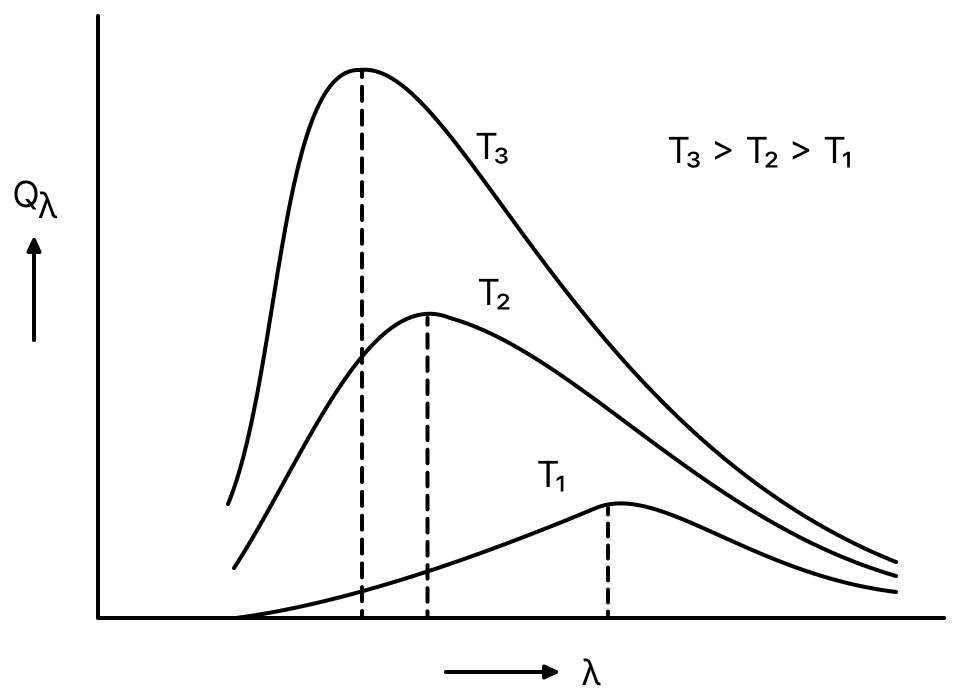
Effect of rise in temperature :
(i) As the temperature of the black body rises, the area enclosed by the distribution curve goes on increasing. The area enclosed by a curve represents the total radiant energy Q (of all wavelengths) emitted by the black body at that temperature. When the areas enclosed by different curves are measured, they are found to be proportional to the fourth power of the corresponding absolute temperatures, that is, Q ∝ T4. Thus these curves verify Stefan's law.
(ii) At a given temperature T, with increase in wavelength λ, the energy Qλ first increases, reaches a maximum and then decreases. Thus for a given temperature the radiant energy emitted by a black body is maximum for a particular wavelength λm.
(iii) As the temperature of the black body rises, the peak of the distribution curve shifts towards shorter wavelength (λ). In 1896 Wien established the relation
where b = 2.9 × 10⁻³ m K. This is called Wien's displacement law. It shows that λm is inversely proportional to the absolute temperature T. That is why, when iron is heated, it first becomes light-red, then dark-red, then yellow and ultimately it becomes white.
Prove that when two or more rods of equal transverse cross-sectional areas are joined in series, then the equivalent thermal resistance of the combined rod is equal to the sum of the thermal resistances of the individual rods.
Answer
Let us consider two slabs of the same area of cross-section A joined in series. Let l1 and l2 be their lengths and K1 and K2 their thermal conductivities. Let heat be allowed to flow through this combination. After the steady state is reached, let θ1 be the temperature of the open face of the first slab, θ2 the temperature of the open face of the second slab, and θ the steady temperature of the interface.
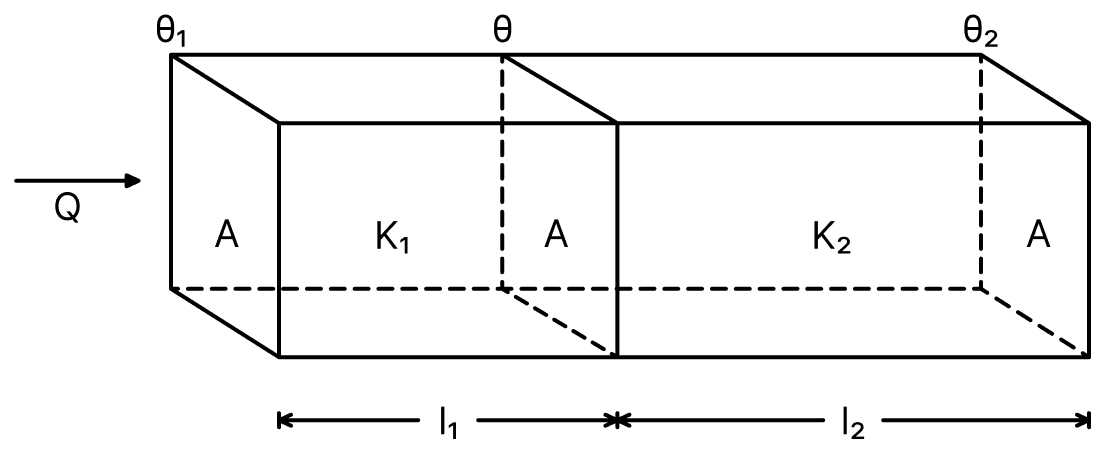
Let R1 be the thermal resistance of the first slab and R2 that of the second slab. In the steady state, the rate of flow of heat H in both the slabs is the same, since whatever heat passes through the first slab must pass through the second.
The rate of flow of heat in the first slab is
Similarly, the rate of flow of heat in the second slab is
Adding equations (i) and (ii), we get
But , the equivalent thermal resistance of the combined rod. Hence
Thus, the equivalent thermal resistance of rods joined in series is equal to the sum of their individual thermal resistances. This is the series law of thermal resistances. For n such rods joined in series,
Derive the expression for the equivalent thermal resistance of two conductors connected in parallel.
Answer
Let two slabs of the same length l be connected in parallel. Let A1 and A2 be their areas of cross-section and K1 and K2 their thermal conductivities. Let heat be allowed to flow from left to right, and in the steady state let the temperatures of the left and right cross-sectional surfaces of the slabs be θ1 and θ2.
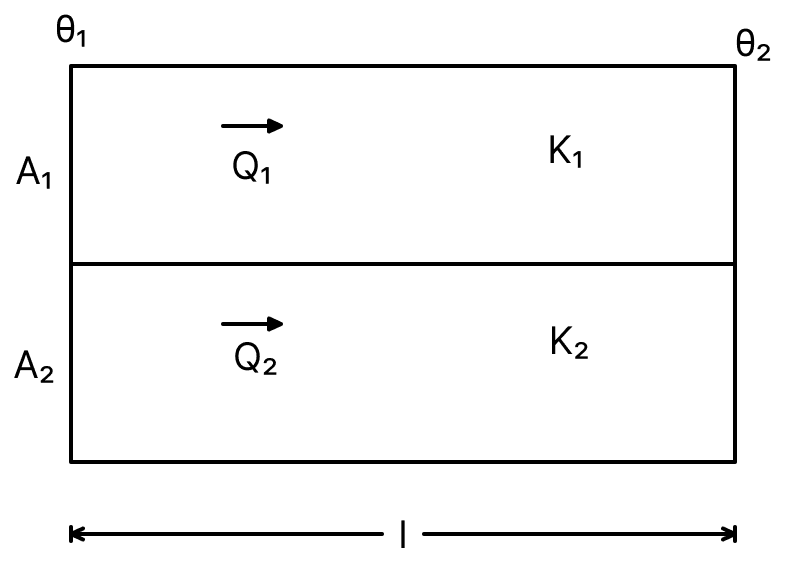
Since the two slabs are connected side by side, the temperature difference across each of them is the same, but the rates of flow of heat in the two slabs are different.
The rate of flow of heat in the first slab is
The rate of flow of heat in the second slab is
The total rate of flow of heat in the combined slab is the sum of the two,
If the combined equivalent thermal resistance of both the slabs is R, then
Comparing equations (i) and (ii), we get
Hence, when two conductors are connected in parallel, the reciprocal of the equivalent thermal resistance is equal to the sum of the reciprocals of the individual thermal resistances. This is the parallel law of thermal resistances.
Two metallic plates having same cross-sectional area of thicknesses l1 and l2, and thermal conductivities K1 and K2 are placed in contact. Show that their equivalent thermal conductivity is :
Answer
Let A be the area of cross-section of each plate, and let θ1 and θ2 be the temperatures of the outer faces of the first and the second plate respectively (θ1 > θ2). Let θ be the steady temperature of the interface.
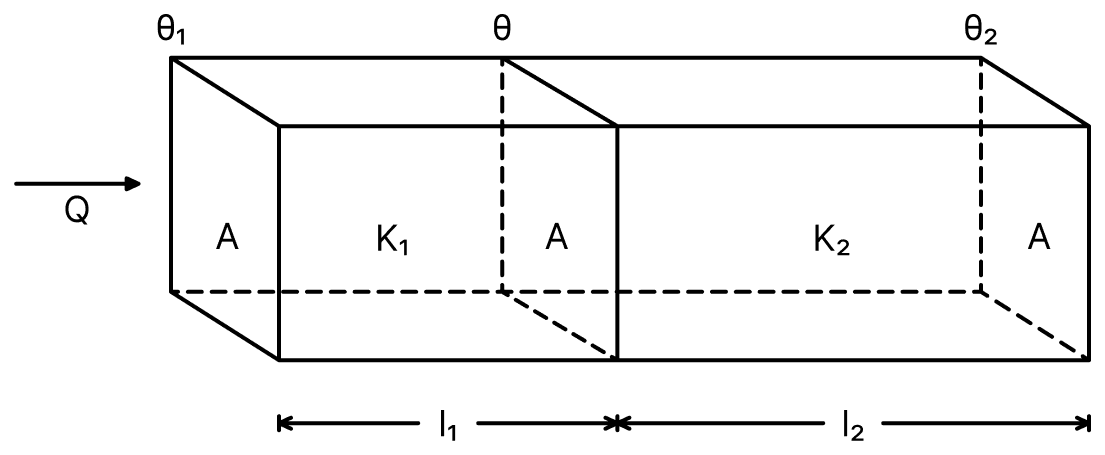
Since the plates are joined in series, in the steady state the rate of flow of heat through both the plates is the same,
From the first two members,
and from the first and the third members,
Adding equations (i) and (ii), the interface temperature θ cancels out,
Now, if K be the equivalent thermal conductivity of the composite slab, then treating the combination as a single slab of total thickness (l1 + l2),
Comparing equations (iii) and (iv),
which is the required result.
A slab has been formed from two plates kept in contact, each of same thickness and cross-section and coefficient of thermal conducitivty K1 and K2. Show that the resultant coefficient of thermal conducitivty of this slab is given by K = 2 K1 K2/(K1 + K2).
Answer
For two plates of the same area of cross-section joined in series, the equivalent thermal conductivity is
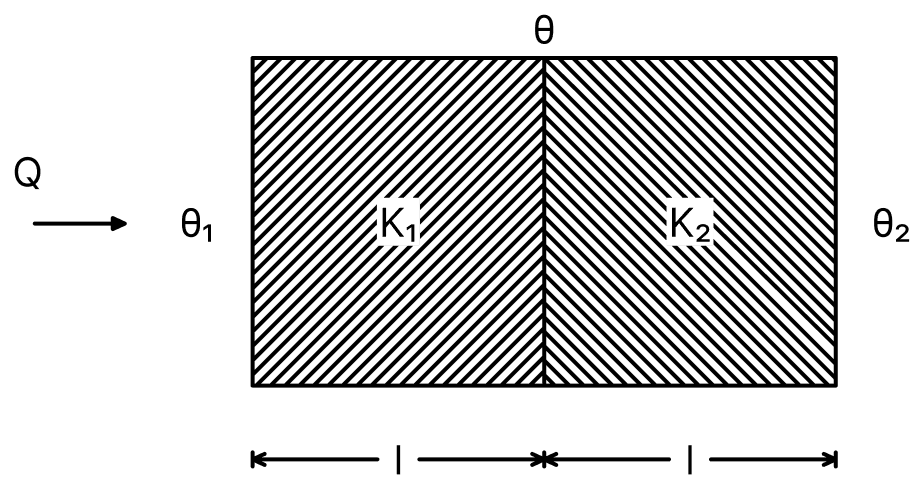
Here both the plates have the same thickness, so l1 = l2 = l (say). Substituting this,
Cancelling l,
which is the required result.
Two metal plates of lengths l1 and l2, and thermal conductivities K1 and K2 respectively, are joined in series. Both plates have same cross-sectional area. Find out the expressions for the temperature at the plane of contact, and the equivalent thermal conductivity.
Answer
Let A be the area of cross-section of each plate. Let θ1 be the temperature of the open face of the first plate and θ2 that of the open face of the second plate (θ1 > θ2), and let θ be the steady temperature of the plane of contact.
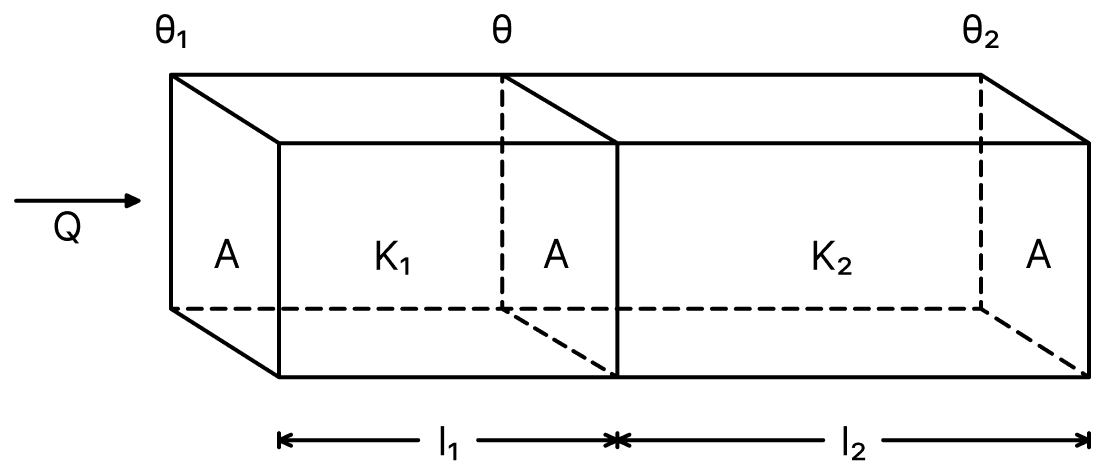
Temperature at the plane of contact : In the steady state, the rate of flow of heat in both the plates is the same. Hence
Cancelling A,
This is the required expression for the temperature of the interface. If the lengths of both the plates are the same (l1 = l2 = l), then
Equivalent thermal conductivity : Substituting the value of θ from equation (ii) in equation (i), the rate of flow of heat in the composite slab is
If K be the equivalent thermal conductivity of the composite slab of total length (l1 + l2), then
Comparing equations (iii) and (iv),
If the lengths of the two plates are equal (l1 = l2 = l), this reduces to
The brass scale of a barometer gives correct reading at 0°C. The barometer reads 75 cm at 27°C. What is the correct atmospheric pressure at 27°C? The coefficient of linear expansion α of brass is 2.0 × 10⁻⁵°C-1.
Answer
Given,
- Reading of the barometer at 27°C, l = 75 cm
- Rise in temperature, Δt = 27 − 0 = 27°C
- Coefficient of linear expansion of brass, α = 2.0 × 10⁻⁵ °C-1
The brass scale gives correct reading at 0°C. At 27°C the scale itself expands, so each division of the scale becomes longer than a true centimetre. The true length of one division of the scale at 27°C is
Hence the correct height of the mercury column is
Hence, the correct atmospheric pressure at 27°C is 75.04 cm of mercury.
An iron scale is calibrated at 0°C. The length of a zinc rod is measured to be 100 cm by the scale when the rod and the scale both are at 0°C. What will be the length of the rod as measured by the scale when both are at 100°C? Given : αiron = 1.2 × 10⁻⁵°C-1 and αzinc = 2.6 × 10⁻⁵°C-1.
Answer
Given,
- Length of the zinc rod at 0°C, l = 100 cm
- Rise in temperature, Δt = 100 − 0 = 100°C
- αiron = 1.2 × 10⁻⁵ °C-1, αzinc = 2.6 × 10⁻⁵ °C-1
At 100°C the true length of the zinc rod is
The iron scale also expands, so the true length of one division of the scale at 100°C is
The reading of the scale is the true length of the rod divided by the true length of one division,
Since the expansions are very small, this may be written as
Hence, the length of the zinc rod as measured by the iron scale at 100°C is 100.14 cm.
A steel cylinder of diameter 'exactly' 1 cm at 30°C is to be fitted into a hole in a steel plate. The diameter of the hole is 0.99970 cm at 30°C. To what temperature should the plate be heated? Given : αsteel = 1.1 × 10⁻⁵°C-1.
Hint : On heating the plate, the hole will expand in the same way as a circular plate of steel filling the hole would do.
Answer
Given,
- Diameter of the steel cylinder at 30°C = 1.000 cm
- Diameter of the hole at 30°C, d = 0.99970 cm
- Coefficient of linear expansion of steel, α = 1.1 × 10⁻⁵ °C-1
- Initial temperature, t1 = 30°C
On heating the plate, the hole expands in exactly the same way as a circular plate of steel filling the hole would expand. The cylinder will just fit into the hole when the diameter of the hole becomes 1.000 cm.
If Δt be the required rise in temperature, then
The final temperature of the plate is
Hence, the plate should be heated to about 57.3°C.
The temperature of equal masses of three different liquids A, B and C are 12°C, 19°C and 28°C respectively. The temperature, when A and B are mixed, is 16°C, and when B and C are mixed, is 23°C. What will be the temperature when A and C are mixed?
Answer
Given,
- Temperatures of A, B and C are 12°C, 19°C and 28°C respectively
- Masses of the three liquids are equal, say m
- On mixing A and B, the temperature is 16°C
- On mixing B and C, the temperature is 23°C
Let cA, cB and cC be the specific heats of the three liquids.
Mixing A and B : Here A is heated from 12°C to 16°C and B is cooled from 19°C to 16°C. By the principle of calorimetry, heat gained = heat lost,
Mixing B and C : Here B is heated from 19°C to 23°C and C is cooled from 28°C to 23°C,
Mixing A and C : Let the final temperature be T. Here A is heated from 12°C to T and C is cooled from 28°C to T,
Substituting the values of cA and cC from equations (i) and (ii),
Multiplying throughout by 20 and cancelling cB,
Hence, the temperature when A and C are mixed is about 20.3°C.
The one end of a rod of length 75 cm and cross-sectional area 10-2 m2 is heated. In the steady state, the temperature difference between its two ends is 90°C. If the thermal conductivity of the metal be 80 cal/(m-s-°C), find : (i) thermal resistance of the rod, (ii) rate of flow of heat.
Answer
Given,
- Length of the rod, l = 75 cm = 0.75 m
- Area of cross-section, A = 10-2 m2
- Temperature difference, θ1 − θ2 = 90°C
- Thermal conductivity, K = 80 cal m-1 s-1 °C-1
(i) The thermal resistance of the rod is
(ii) The rate of flow of heat is
Hence, the thermal resistance of the rod is 0.94 °C s cal-1 and the rate of flow of heat is 96 cal s-1.
One end of a copper rod of length 0.25 m and area of cross-section 10-4 m2 is kept in a liquid boiling at 125°C, whereas the other end is kept in ice at 0°C. In the steady state, find : (i) the rate of heat flow, (ii) the temperature at a point in the rod 0.1 m from the higher temperature end. Thermal conductivity of the copper K = 92 cal/s-m-K.
Answer
Given,
- Length of the copper rod, l = 0.25 m
- Area of cross-section, A = 10-4 m2
- Temperatures of the ends, θ1 = 125°C and θ2 = 0°C
- Thermal conductivity of copper, K = 92 cal s-1 m-1 K-1
(i) The rate of flow of heat in the steady state is
Substituting the values,
(ii) Since no heat escapes from the sides, the temperature falls uniformly along the rod. The temperature gradient is
At a point 0.1 m from the higher temperature end, the fall in temperature is 500 × 0.1 = 50°C. Hence the temperature at that point is
Hence, the rate of heat flow is 4.6 cal s-1 and the temperature at the given point is 75°C.
The thickness of a sheet of nickel is 0.4 cm. The temperature difference between its two faces is 32°C. It transmits heat through an area of 5 cm2 at a rate of 200 kcal per hour. Calculate the coefficient of thermal conductivity of nickel.
Answer
Given,
- Thickness of the sheet, l = 0.4 cm = 4 × 10⁻³ m
- Temperature difference, θ1 − θ2 = 32°C
- Area, A = 5 cm2 = 5 × 10⁻⁴ m2
- Rate of transmission of heat = 200 kcal per hour
The rate of flow of heat in kilocalorie per second is
From the equation of heat conduction, , we get
Substituting the values,
Hence, the coefficient of thermal conductivity of nickel is 1.39 × 10⁻² kcal m-1 s-1 °C-1.
A cubical pot of 10 cm side filled with ice at 0°C is submerged in a hot bath at 100°C. If the thickness of the pot is 0.2 cm and thermal conductivity is 0.02 cal/m-s-°C, find the time taken to melt the total ice. The latent heat of ice is 80 kcal/kg and the mass of ice is 1 kg.
Hint : The pot has six faces.
Answer
Given,
- Side of the cubical pot, a = 10 cm = 0.1 m
- Thickness of the pot, l = 0.2 cm = 2 × 10⁻³ m
- Temperature difference, θ1 − θ2 = 100 − 0 = 100°C
- Thermal conductivity, K = 0.02 cal m-1 s-1 °C-1
- Mass of ice, m = 1 kg; latent heat of ice, L = 80 kcal kg-1
The pot has six faces, so the total surface area through which heat enters is
The rate of flow of heat into the pot is
The total heat required to melt 1 kg of ice is
Therefore the time taken is
Hence, the time taken to melt the total ice is about 1333 s, that is, 22.2 minutes.
Two rods of same metal and of uniform cross-section are of lengths 0.6 and 0.8 metre. The temperatures of the ends of the first rod are 90°C and 60°C and that of the second rod are 150°C and 110°C. Which rod has a higher rate of heat-conduction?
Answer
Given,
- First rod : l1 = 0.6 m, temperature difference = 90 − 60 = 30°C
- Second rod : l2 = 0.8 m, temperature difference = 150 − 110 = 40°C
- Both rods are of the same metal and of uniform cross-section
Since the rods are of the same metal and of the same area of cross-section, K and A are the same for both. Hence the rate of flow of heat is proportional to the temperature gradient,
For the first rod :
For the second rod :
Since the temperature gradients in the two rods are equal,
Hence, neither rod has a higher rate of heat-conduction; the rate of heat-conduction is the same in both the rods.
Two rods of same metal and of same cross-section have lengths 0.5 metre and 0.8 metre. The temperature difference across the ends of the first rod is 40°C. Find the temperature difference across the second rod, if the rate of heat conduction is equal in both the rods.
Answer
Given,
- Length of the first rod, l1 = 0.5 m, temperature difference Δθ1 = 40°C
- Length of the second rod, l2 = 0.8 m
- The rate of heat conduction is the same in both the rods
Since the rods are of the same metal and of the same cross-section, K and A are the same for both. For equal rates of heat conduction,
Substituting the values,
Hence, the temperature difference across the second rod is 64°C.
The ratio of the areas of cross-section of two rods of different materials is 1 : 2, and the ratio of the thermal conductivities of their materials is 4 : 3. On keeping equal temperature-difference between the ends of these rods, the rate of conduction of heat are equal. Determine the ratio of the lengths of the rods.
Answer
Given,
- Ratio of the areas of cross-section, A1 : A2 = 1 : 2
- Ratio of the thermal conductivities, K1 : K2 = 4 : 3
- The temperature difference Δθ is the same for both, and the rates of heat conduction are equal
The rate of flow of heat is
Since H1 = H2 and Δθ is the same for both,
Substituting the given ratios,
Hence, the ratio of the lengths of the rods is 2 : 3.
Two vessels of different materials are identical in size and shape. Both are filled with equal masses of boiled water and are placed on the same heater. If thermal conductivities of the metals of the vessels be 5 × 10⁻² and 3 × 10⁻² kcal/(m-s-°C) respectively, then calculate the ratio of the timings taken by the water in the vessels to convert in steam.
Answer
Given,
- Thermal conductivities of the two vessels, K1 = 5 × 10⁻² and K2 = 3 × 10⁻² kcal m-1 s-1 °C-1
- The vessels are identical in size and shape, and contain equal masses of boiled water
Since both the vessels contain equal masses of boiled water, the quantity of heat Q required to convert the whole of the water into steam is the same for both.
The heat conducted through the base of a vessel in time t is
The vessels are identical in size and shape, and are placed on the same heater, so A, l and (θ1 − θ2) are the same for both. Since Q is also the same,
Hence, the ratio of the timings taken by the water in the two vessels to convert into steam is 3 : 5.
Two blocks of wood and cork, each having a surface-area of 100 cm2, are placed in contact. If their thicknesses are 25 cm and 4 cm respectively, then determine their combined thermal resistance. Thermal conductivities of wood and cork are respectively 2.0 × 10⁻⁵ and 4.0 × 10⁻⁵ kcal/(m-s-°C).
Answer
Given,
- Surface area of each block, A = 100 cm2 = 10-2 m2
- Thickness of wood, l1 = 25 cm = 0.25 m; thickness of cork, l2 = 4 cm = 0.04 m
- Kwood = 2.0 × 10⁻⁵ kcal m-1 s-1 °C-1; Kcork = 4.0 × 10⁻⁵ kcal m-1 s-1 °C-1
The thermal resistance of a slab is .
Thermal resistance of the wood block :
Thermal resistance of the cork block :
The two blocks are placed in contact, that is, joined in series. Hence the combined thermal resistance is
Hence, the combined thermal resistance is 1.35 × 10⁶ °C s kcal-1.
If the temperature of a black body is increased from 273°C to 819°C, how many times will its rate of emission of energy be increased?
Answer
Given,
- Initial temperature, T1 = 273°C = 273 + 273 = 546 K
- Final temperature, T2 = 819°C = 819 + 273 = 1092 K
By Stefan's law, the rate of emission of energy per unit area of a black body is proportional to the fourth power of its absolute temperature,
Therefore,
Substituting the values,
Hence, the rate of emission of energy becomes 16 times its original value.
A black body at 127°C temperature is radiating energy from its surface at a rate of 1.0 × 10⁶ joule per second per metre2. Find that temperature of the black body at which the rate of energy radiation will be 16.0 × 10⁶ joule per second per metre2.
Answer
Given,
- Initial temperature, T1 = 127°C = 127 + 273 = 400 K
- Initial rate of radiation, E1 = 1.0 × 10⁶ J s-1 m-2
- Final rate of radiation, E2 = 16.0 × 10⁶ J s-1 m-2
By Stefan's law, E = σT4, so
Substituting the values,
Hence, the required temperature is 800 K, that is, 527°C.
A black body radiates 1 kilojoule (kJ) energy per second at a temperature of 27°C. Find the temperature at which it will radiate 16 kilojoule energy per second.
Answer
Given,
- Initial temperature, T1 = 27°C = 27 + 273 = 300 K
- Initial rate of radiation, P1 = 1 kJ s-1
- Final rate of radiation, P2 = 16 kJ s-1
By Stefan's law, the energy radiated per second is proportional to the fourth power of the absolute temperature,
Substituting the values,
Hence, the black body will radiate 16 kJ per second at 600 K, that is, at 327°C.
The temperatures of two black bodies are 727°C and 327°C respectively. Find the ratio of energy radiated per second by them.
Answer
Given,
- Temperature of the first black body, T1 = 727°C = 727 + 273 = 1000 K
- Temperature of the second black body, T2 = 327°C = 327 + 273 = 600 K
By Stefan's law, the energy radiated per second per unit area is E = σT4. Hence
Substituting the values,
Hence, the ratio of the energy radiated per second by them is 625 : 81, that is, about 7.72 : 1.
Two bodies heated to 327°C and 427°C are placed in an evacuated vessel at 27°C. Compare the rates of heat loss from them.
Answer
Given,
- Temperature of the first body, T1 = 327°C = 600 K
- Temperature of the second body, T2 = 427°C = 700 K
- Temperature of the surroundings, T0 = 27°C = 300 K
- Both bodies are assumed to have equal surface areas and equal emissivities
When a body at absolute temperature T is surrounded by an enclosure at temperature T0, the net heat energy lost per second per unit area is
For the first body :
Taking out (100)4 as a common factor,
For the second body :
Therefore,
Hence, the rates of heat loss from the two bodies are in the ratio 243 : 464.
The temperature of the filament of a lamp is 2450 K, its effective area is 0.408 cm2 and its emissive power is 0.30. What is the wattage of the lamp?
Answer
Given,
- Temperature of the filament, T = 2450 K
- Effective area, A = 0.408 cm2 = 0.408 × 10⁻⁴ m2
- Emissive power, e = 0.30
- Stefan's constant, σ = 5.67 × 10⁻⁸ W m-2 K-4
The energy radiated per second by a body of emissive power e is
Substituting the values,
Now, (2450)4 = 3.603 × 10¹³. Therefore,
Hence, the wattage of the lamp is about 25 W.
The temperature of the surface of a silver sphere of radius 5 cm is 527°C. If the emissive power of the surface is 0.04, find out the energy of the emitted radiation per second from the surface of the sphere.
Answer
Given,
- Radius of the sphere, r = 5 cm = 0.05 m
- Temperature, T = 527°C = 527 + 273 = 800 K
- Emissive power, e = 0.04
- Stefan's constant, σ = 5.67 × 10⁻⁸ W m-2 K-4
The surface area of the sphere is
The energy radiated per second is
Now, (800)4 = 4.096 × 10¹¹. Substituting the values,
Hence, the energy of the emitted radiation is about 29.2 J per second.
Calculate the rate of emission of energy in W/cm2 by a surface at 227°C, if its emissive power be 0.60.
Answer
Given,
- Temperature of the surface, T = 227°C = 227 + 273 = 500 K
- Emissive power, e = 0.60
- Stefan's constant, σ = 5.67 × 10⁻⁸ W m-2 K-4
The energy emitted per second per unit area is
Substituting the values, with (500)4 = 6.25 × 10¹⁰,
Since 1 m2 = 104 cm2,
Hence, the rate of emission of energy is 0.213 W cm-2.
A mercury thermometer has a bulb of volume 0.300 cm3 and a stem of diameter 0.0100 cm. Find the rise of mercury meniscus in the stem when the temperature rises through 15°C. Given : γmercury = 1.82 × 10⁻⁴°C-1. Ignore the expansion of the bulb.
Answer
Given,
- Volume of the bulb, V = 0.300 cm3
- Diameter of the stem = 0.0100 cm, so radius r = 0.00500 cm
- Rise in temperature, Δt = 15°C
- Coefficient of volume expansion of mercury, γ = 1.82 × 10⁻⁴ °C-1
The increase in the volume of the mercury is
This extra volume of mercury rises into the stem. The area of cross-section of the stem is
If h be the rise of the mercury meniscus in the stem, then ΔV = a h, so
Hence, the mercury meniscus rises through 10.43 cm in the stem.
A glass vessel of volume 256 cm3 is just filled with mercury at 20°C. How much mercury will overflow when the temperature is raised to 100°C? Given : αglass = 4 × 10⁻⁶°C-1 and γmercury = 1.8 × 10⁻⁴°C-1.
Answer
Given,
- Volume of the glass vessel, V = 256 cm3
- Rise in temperature, Δt = 100 − 20 = 80°C
- Coefficient of linear expansion of glass, α = 4 × 10⁻⁶ °C-1
- Coefficient of volume expansion of mercury, γm = 1.8 × 10⁻⁴ °C-1
The coefficient of volume expansion of glass is
On heating, both the mercury and the vessel expand. The volume of mercury that overflows is the difference between the expansion of the mercury and the expansion of the vessel, that is, the apparent expansion of the mercury,
Substituting the values,
Hence, 3.44 cm3 of mercury will overflow.
A glass tube of uniform bore and length 133 cm is to be filled with mercury so that the volume of the tube above the mercury level remains same at all temperatures. Calculate the length of the mercury column. Given : γglass = 2.6 × 10⁻⁵°C-1 and γmercury = 18.2 × 10⁻⁵°C-1.
Answer
Given,
- Length of the glass tube, L = 133 cm
- Coefficient of volume expansion of glass, γg = 2.6 × 10⁻⁵ °C-1
- Coefficient of volume expansion of mercury, γm = 18.2 × 10⁻⁵ °C-1
Let a be the area of cross-section of the tube at a given temperature and l the length of the mercury column. Then the volume of the tube is L a and the volume of the mercury is l a.
The volume of the empty space above the mercury will remain the same at all temperatures only if the increase in the volume of the mercury is exactly equal to the increase in the volume of the tube. Hence, for a rise in temperature Δt,
Cancelling a and Δt,
Hence, the length of the mercury column should be 19 cm.
A sphere of diameter 7.0 cm and mass 266.5 g floats in a liquid bath. On heating the bath, the sphere just begins to sink when the temperature reaches 35°C. The density of the liquid at 0°C is 1.527 g cm-3. Find the coefficient of cubical expansion of the liquid. Neglect thermal expansion of the sphere.
Answer
Given,
- Diameter of the sphere = 7.0 cm, so radius r = 3.5 cm
- Mass of the sphere, m = 266.5 g
- Temperature at which the sphere just sinks, t = 35°C
- Density of the liquid at 0°C, ρ = 1.527 g cm-3
The volume of the sphere is
The density of the sphere is
The sphere just begins to sink when the density of the liquid falls to the density of the sphere. Hence the density of the liquid at 35°C is
When a liquid is heated its volume increases and its density decreases. Neglecting the smaller terms, the density of a liquid at temperature t is related to its density at 0°C by
Substituting the values,
Hence, the coefficient of cubical expansion of the liquid is 8.0 × 10⁻⁴ °C-1.
An aluminium sphere of mass 0.047 kg is heated to 100°C. It is dropped in a copper calorimeter of mass 0.14 kg, containing 0.25 kg of water at 20°C. The temperature of water rises to a steady state at 23°C. Calculate the specific heat of aluminium. Specific heat of water = 4.18 × 10³ J kg-1 °C-1, specific heat of copper = 0.386 × 10³ J kg-1 °C-1.
Answer
Given,
- Mass of the aluminium sphere, m = 0.047 kg at 100°C
- Mass of the copper calorimeter, mc = 0.14 kg
- Mass of water, mw = 0.25 kg at 20°C
- Final steady temperature = 23°C
- Specific heat of water, cw = 4.18 × 10³ J kg-1 °C-1
- Specific heat of copper, cc = 0.386 × 10³ J kg-1 °C-1
Let c be the specific heat of aluminium.
The heat lost by the aluminium sphere in cooling from 100°C to 23°C is
The heat gained by the water and the calorimeter in warming from 20°C to 23°C is
By the principle of calorimetry, heat lost = heat gained,
Hence, the specific heat of aluminium is about 0.911 × 10³ J kg-1 °C-1.
A calorimeter contains 75 g of water at 15°C. When 50 g water of 100°C is poured in the calorimeter, the temperature of the mixture becomes 25°C. Calculate water equivalent of the calorimeter.
Answer
Given,
- Mass of water in the calorimeter, m1 = 75 g at 15°C
- Mass of hot water poured in, m2 = 50 g at 100°C
- Final temperature of the mixture = 25°C
- Specific heat of water, c = 1 cal g-1 °C-1
Let W be the water equivalent of the calorimeter.
The heat lost by the hot water in cooling from 100°C to 25°C is
The heat gained by the cold water and the calorimeter in warming from 15°C to 25°C is
By the principle of calorimetry, heat lost = heat gained,
Hence, the water equivalent of the calorimeter is 300 g.
When 0.15 kg of ice at 0°C is mixed with 0.30 kg of water at 50°C in a container, the resulting temperature is 6.7 °C. Calculate latent heat of melting of ice. Specific heat of water is 4.186 × 10³ J kg-1K-1.
Answer
Given,
- Mass of ice, m1 = 0.15 kg at 0°C
- Mass of water, m2 = 0.30 kg at 50°C
- Final temperature of the mixture = 6.7°C
- Specific heat of water, c = 4.186 × 10³ J kg-1 K-1
Let L be the latent heat of melting of ice.
The heat lost by the water in cooling from 50°C to 6.7°C is
The heat gained by the ice is used up first in melting the ice at 0°C and then in warming the water so formed from 0°C to 6.7°C,
By the principle of calorimetry, heat lost = heat gained,
Hence, the latent heat of melting of ice is 3.34 × 10⁵ J kg-1.
Calculate the heat required to convert 3 kg of ice at 12°C kept in a calorimeter to steam at 100° at atmospheric pressure. Given : specific heat of ice = 2.100 × 10⁵ J kg-1 K-1, specific heat of water = 4.186 × 10³ J kg-1 K-1, latent heat of fusion of ice = 3.35 × 10⁵ J kg-1 and latent heat of steam = 2.256 × 10⁶ J kg-1.
Answer
Given,
- Mass of ice, m = 3 kg at − 12°C
- Specific heat of ice, ci = 2.100 × 10³ J kg-1 K-1
- Specific heat of water, cw = 4.186 × 10³ J kg-1 K-1
- Latent heat of fusion of ice, Lf = 3.35 × 10⁵ J kg-1
- Latent heat of steam, Lv = 2.256 × 10⁶ J kg-1
The whole process takes place in four stages.
Stage 1 — Ice from − 12°C to 0°C :
Stage 2 — Melting of ice at 0°C :
Stage 3 — Water from 0°C to 100°C :
Stage 4 — Vaporisation of water at 100°C :
The total heat required is
Hence, the heat required is 9.10 × 10⁶ J.
Note: The question states the initial temperature of the ice as 12°C, but ice cannot exist at a temperature above 0°C, so it has been taken as − 12°C. Also, the specific heat of ice is printed as 2.100 × 10⁵ J kg-1 K-1, which is not a physically correct value; the standard value 2.100 × 10³ J kg-1 K-1 has been used.
A rod of copper of thermal conductivity 9.2 × 10⁻² kcal/(s-m-°C) whose length is 25 cm and cross-sectional area 1 cm2, is placed between two sources at temperatures 125°C and 0°C. Find rate of transfer of heat.
Answer
Given,
- Thermal conductivity of copper, K = 9.2 × 10⁻² kcal s-1 m-1 °C-1
- Length of the rod, l = 25 cm = 0.25 m
- Area of cross-section, A = 1 cm2 = 10-4 m2
- Temperature difference, θ1 − θ2 = 125 − 0 = 125°C
The rate of transfer of heat in the steady state is
Substituting the values,
Hence, the rate of transfer of heat is 4.6 cal s-1.
The cross-sectional area of a plate is 100 cm2 and thickness 2 cm. Its coefficient of thermal conductivity is 2 × 10⁻⁴ cal/(s-cm-°C). If the difference of temperatures between two ends of the plate is 50°C, calculate the amount of heat flowing through the plate in 10 hours.
Answer
Given,
- Area of cross-section, A = 100 cm2
- Thickness of the plate, l = 2 cm
- Coefficient of thermal conductivity, K = 2 × 10⁻⁴ cal s-1 cm-1 °C-1
- Temperature difference, θ1 − θ2 = 50°C
- Time, t = 10 hours = 10 × 3600 = 36000 s
The quantity of heat flowing through the plate in time t is
Substituting the values in the CGS system,
Hence, the amount of heat flowing through the plate in 10 hours is 18000 cal, that is, 18 kcal.
The area of cross-section of an iron plate of thickness 2 cm is 5000 cm2. The temperatures of its surfaces are 150°C and 140°C respectively. Calculate the heat transmitted per second through this plate. Coefficient of thermal conductivity of iron is 0.015 kcal/(s-m-°C).
Answer
Given,
- Thickness of the plate, l = 2 cm = 0.02 m
- Area of cross-section, A = 5000 cm2 = 0.5 m2
- Temperature difference, θ1 − θ2 = 150 − 140 = 10°C
- Coefficient of thermal conductivity of iron, K = 0.015 kcal s-1 m-1 °C-1
The heat transmitted per second is
Substituting the values,
Hence, the rate of heat transmission through the plate is 3.75 kcal s-1.
The temperature difference between the ends of a rod of aluminium of length 1.0 m and area of cross-section 5.0 cm2 is 200°C. How much heat will flow through the rod in 5 minutes? The coefficient of thermal conductivity of aluminium is 0.2 kJ/(m-s-°C).
Answer
Given,
- Length of the rod, l = 1.0 m
- Area of cross-section, A = 5.0 cm2 = 5.0 × 10⁻⁴ m2
- Temperature difference, θ1 − θ2 = 200°C
- Time, t = 5 minutes = 300 s
- Coefficient of thermal conductivity, K = 0.2 kJ m-1 s-1 °C-1 = 200 J m-1 s-1 °C-1
The quantity of heat flowing through the rod in time t is
Substituting the values,
Hence, 6000 J of heat will flow through the rod in 5 minutes.
A wall is made up of two layers of equal thickness of lead and iron. The coefficients of thermal conductivity are 2 K and 3 K respectively. The outer surface temperatures of both layers are 100°C and 0°C respectively and layer of lead is towards hot end. Find the temperature of contact layer of lead and iron in the steady state.
Answer
Given,
- Thermal conductivity of lead = 2K, thermal conductivity of iron = 3K
- Thickness of each layer is the same, say l
- Outer surface temperature of the lead layer, θ1 = 100°C
- Outer surface temperature of the iron layer, θ2 = 0°C
Let θ be the temperature of the contact layer of lead and iron.
The two layers are joined in series, so in the steady state the rate of flow of heat through both the layers is the same,
Cancelling K, A and l,
Hence, the temperature of the contact layer of lead and iron is 40°C.
As shown in the figure, heat is conducted through a compound plate composed of two parallel plates A and B made of two different materials. A and B are respectively 3.6 cm and 4.2 cm thick. Their coefficients of thermal conductivities are 0.32 and 0.14 kcal/m-s-°C respectively. If, in the steady state, the temperatures of the outer surfaces of A and B are 96°C and 8°C respectively, find the temperature θ of their interface.
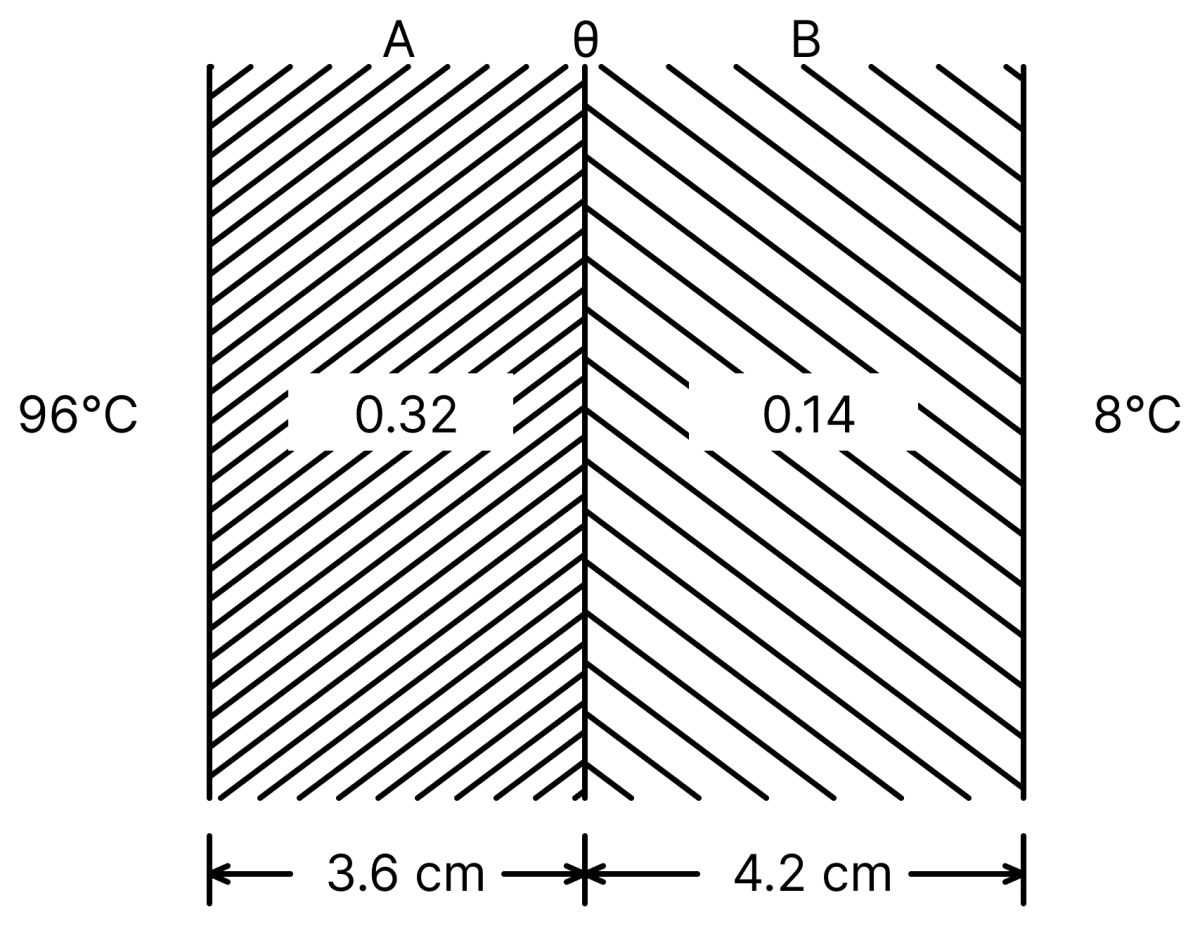
Answer
Given,
- Thickness of plate A, l1 = 3.6 cm; thickness of plate B, l2 = 4.2 cm
- Thermal conductivity of A, K1 = 0.32 kcal m-1 s-1 °C-1
- Thermal conductivity of B, K2 = 0.14 kcal m-1 s-1 °C-1
- Temperature of the outer surface of A, θ1 = 96°C
- Temperature of the outer surface of B, θ2 = 8°C
The plates are joined in series, so in the steady state the rate of flow of heat through both the plates is the same,
Cancelling A and substituting the values,
Hence, the temperature of the interface is 72°C.
The thermal conductivity of copper is four times that of brass. Two rods of copper and brass of same length and cross-section are joined end to end. The free end of copper rod is at 0°C and that of brass rod at 100°C. Calculate the temperature of junction at equilibrium. Neglect radiation losses.
Answer
Given,
- Thermal conductivity of copper, KCu = 4Kbrass
- Both rods have the same length l and the same area of cross-section A
- Free end of the copper rod is at 0°C, free end of the brass rod is at 100°C
Let the thermal conductivity of brass be K, so that the thermal conductivity of copper is 4K. Let θ be the temperature of the junction.
The rods are joined in series, so in the steady state the rate of flow of heat through both is the same,
Cancelling K, A and l,
Hence, the temperature of the junction at equilibrium is 20°C.
Calculate the thermal resistance of a copper rod of length 20.0 cm and diameter 4.0 cm. The coefficient of thermal conductivity of copper is 9.2 × 10⁻² kcal/(m-s-°C). Find the rate of heat-transmission when the temperature-difference between the ends of the rod is 50°C.
Answer
Given,
- Length of the rod, l = 20.0 cm = 0.20 m
- Diameter of the rod = 4.0 cm, so radius r = 2.0 cm = 0.02 m
- Coefficient of thermal conductivity, K = 9.2 × 10⁻² kcal m-1 s-1 °C-1
- Temperature difference, θ1 − θ2 = 50°C
The area of cross-section of the rod is
The thermal resistance of the rod is
The rate of heat-transmission is
Hence, the thermal resistance of the rod is 1.73 × 10³ °C s kcal-1 and the rate of heat-transmission is 2.89 × 10⁻² kcal s-1.
The rate of radiation from a black body at 0°C is Q J s-1. Find the rate of radiation by the same black body at 273°C.
Answer
Given,
- Initial temperature, T1 = 0°C = 273 K, with rate of radiation Q J s-1
- Final temperature, T2 = 273°C = 273 + 273 = 546 K
By Stefan's law, the rate of radiation is proportional to the fourth power of the absolute temperature,
Substituting the values,
Hence, the rate of radiation at 273°C is 16 Q J s-1.
A black body radiates 5000 joules of energy per second at 227°C temperature. What will be the rate of radiation of energy at 727°C temperature?
Answer
Given,
- Initial temperature, T1 = 227°C = 227 + 273 = 500 K
- Rate of radiation at T1, P1 = 5000 J s-1
- Final temperature, T2 = 727°C = 727 + 273 = 1000 K
By Stefan's law,
Substituting the values,
Hence, the rate of radiation of energy at 727°C is 8 × 10⁴ J s-1.
The radius of a spherical body is 1.0 cm and its temperature is steady at 727°C. If this behaves like a perfectly black body then, how much energy will be radiated from its surface?
Answer
Given,
- Radius of the spherical body, r = 1.0 cm = 0.01 m
- Temperature, T = 727°C = 727 + 273 = 1000 K
- Stefan's constant, σ = 5.67 × 10⁻⁸ W m-2 K-4
The surface area of the sphere is
For a perfectly black body, the energy radiated per second is
Substituting the values, with (1000)4 = 1012,
Hence, about 71.25 J of energy is radiated per second from the surface of the body.
The temperature of sun's surface is 6000 K and its radius is 6.95 × 10⁵ km. Calculate the rate of emission of solar-energy. Assume black body radiation.
Answer
Given,
- Temperature of the sun's surface, T = 6000 K
- Radius of the sun, R = 6.95 × 10⁵ km = 6.95 × 10⁸ m
- Stefan's constant, σ = 5.67 × 10⁻⁸ W m-2 K-4
The surface area of the sun is
Treating the sun as a black body, the rate of emission of energy is
Now, (6000)4 = 1.296 × 10¹⁵. Substituting the values,
Hence, the rate of emission of solar energy is about 4.46 × 1026 J s-1.
The luminosity of Rigel star in Orion constellation is 17000 times that of the sun. The surface temperature of sun is 6000 K. Calculate the temperature of the star.
Answer
Given,
- Luminosity of the star, Ps = 17000 × Psun
- Surface temperature of the sun, Tsun = 6000 K
By Stefan's law, the energy radiated per second by a body of surface area A is P = σAT4. Assuming the star and the sun to have the same surface area, the luminosity is proportional to the fourth power of the absolute temperature,
Substituting the values,
Hence, the temperature of the star is about 6.85 × 10⁴ K.
Note: The radius of the star is not given, so the star and the sun have been assumed to be of the same size, and the luminosity has therefore been taken to depend on the temperature alone.
The temperature of a black body is 727°C and its surface area is 0.1 m2. How many calories of heat is this black body emitting per minute?
Answer
Given,
- Temperature of the black body, T = 727°C = 727 + 273 = 1000 K
- Surface area, A = 0.1 m2
- Time, t = 1 minute = 60 s
- Stefan's constant, σ = 5.67 × 10⁻⁸ W m-2 K-4
By Stefan's law, the heat energy emitted by the black body in time t is
Substituting the values, with (1000)4 = 1012,
Converting into calories, using 1 cal = 4.18 J,
Hence, the black body emits about 8.14 × 10⁴ calories of heat per minute.
A pan filled with hot water cools from 95°C to 85°C in 2 minutes when room temperature is 20°C. How long will it take to cool from 73°C to 67°C?
Answer
Given,
- First case : the water cools from 95°C to 85°C in t = 2 minutes
- Second case : the water cools from 73°C to 67°C in time t′
- Temperature of the surroundings, θ0 = 20°C
By Newton's law of cooling,
First case :
Second case :
Substituting the value of K,
Hence, the water will take about 1.68 minutes, that is, nearly 1 minute 41 seconds, to cool from 73°C to 67°C.
Two stars, A and B, emit maximum radiations at wavelengths 5200 Å and 6500 Å respectively. If the temperature of A is 6000 K, then what is the temperature of B?
Answer
Given,
- Wavelength of maximum emission for A, λA = 5200 Å
- Wavelength of maximum emission for B, λB = 6500 Å
- Temperature of A, TA = 6000 K
By Wien's displacement law,
Therefore, for the two stars,
Substituting the values,
Hence, the temperature of star B is 4800 K.
The sun and the moon emit maximum radiations at 5000 Å and 15 μ wavelengths, respectively. If the temperature of the sun be 6000 K, calculate the temperature of the moon.
Hint : 1 μ = 104 Å.
Answer
Given,
- Wavelength of maximum emission for the sun, λs = 5000 Å
- Wavelength of maximum emission for the moon, λm = 15 μ
- Temperature of the sun, Ts = 6000 K
Converting the wavelength of the moon into angstrom, using 1 μ = 104 Å,
By Wien's displacement law, λmT = constant, so
Substituting the values,
Hence, the temperature of the moon is 200 K.
If in a spectral distribution curve of a star, the wavelength at maximum energy is 3540 Å, then calculate the temperature of the star.
(constant b = 3 × 10⁻³ metre-K).
Answer
Given,
- Wavelength at maximum energy, λm = 3540 Å = 3540 × 10-10 m
- Wien's constant, b = 3 × 10⁻³ m K
By Wien's displacement law,
Substituting the values,
Hence, the temperature of the star is about 8475 K.
In solar-radiation the value of λm is 4753 Å and the temperature of the sun is 6080.3 K. Calculate the Wein's constant b.
Hint : λm T = b.
Answer
Given,
- Wavelength of maximum emission, λm = 4753 Å = 4753 × 10-10 m
- Temperature of the sun, T = 6080.3 K
By Wien's displacement law,
Substituting the values,
Hence, the value of Wien's constant is 2.89 × 10⁻³ m K.
A steel sphere is to be passed through a circular brass ring. At 20°C, the outer diameter of the sphere is 25 cm and the inner diameter of the ring is 24.9 cm. If both are heated together, find the temperature at which the sphere will just pass through the ring. Given : αsteel = 1.2 × 10⁻⁵ °C-1 and αbrass = 2.0 × 10⁻⁵ °C-1.
Answer
Given,
- Diameter of the steel sphere at 20°C, ds = 25 cm
- Inner diameter of the brass ring at 20°C, db = 24.9 cm
- αsteel = 1.2 × 10⁻⁵ °C-1, αbrass = 2.0 × 10⁻⁵ °C-1
- Initial temperature, t1 = 20°C
Brass has a greater coefficient of linear expansion than steel, so on heating the ring expands faster than the sphere. The sphere will just pass through the ring when the two diameters become equal.
If Δt be the required rise in temperature, then
Substituting the values,
The required temperature is
Hence, the sphere will just pass through the ring at about 525°C.
The volume of a thin brass vessel and that of a solid brass cube are both equal to 1 litre exactly. What will be their new volumes when heated through 25°C? α for brass is 1.9 × 10⁻⁵ °C-1.
Answer
Given,
- Volume of the thin brass vessel = volume of the solid brass cube = 1 litre = 1000 cm3
- Rise in temperature, Δt = 25°C
- Coefficient of linear expansion of brass, α = 1.9 × 10⁻⁵ °C-1
The coefficient of volume expansion of brass is
The increase in volume is
Hence the new volume is
Hence, the new volume of both the thin brass vessel and the solid brass cube is 1001.425 cm3.
The capacity of a hollow vessel increases in exactly the same way as the volume of a solid piece of the same material would, so both give the same result.
One face of a steel cube is in contact with water vapour at 100°C and its opposite face is in contact with ice at 0°C. If the cross-section of the cube is 4 cm2 and thermal conductivity of steel is 0.2 cal/cm-s°C, then how much ice will melt in 10 minutes?
(Latent heat of ice = 80 cal/g).
Answer
Given,
- Area of cross-section of the cube, A = 4 cm2
- Thermal conductivity of steel, K = 0.2 cal cm-1 s-1 °C-1
- Temperature difference, θ1 − θ2 = 100 − 0 = 100°C
- Time, t = 10 minutes = 600 s
- Latent heat of ice, L = 80 cal g-1
Since the cross-section of the cube is 4 cm2, each side of the cube is
which is the distance between the two opposite faces.
The quantity of heat conducted through the cube in 10 minutes is
The mass of ice melted by this heat is
Hence, 300 g of ice will melt in 10 minutes.
One end of long metal rod of 25 cm is kept in steam and other end is kept in ice. If 12 g of ice melts in 1 minute, calculate the coefficient of thermal conductivity of the metal. The area of corss-section of the rod is 5 cm2 and the latent heat of fusion of ice is 3.4 × 10⁵ J/kg.
Answer
Given,
- Length of the rod, l = 25 cm = 0.25 m
- Area of cross-section, A = 5 cm2 = 5 × 10⁻⁴ m2
- Mass of ice melted, m = 12 g = 0.012 kg in t = 1 minute = 60 s
- Latent heat of fusion of ice, L = 3.4 × 10⁵ J kg-1
- Temperature difference, θ1 − θ2 = 100 − 0 = 100°C
The heat conducted through the rod in 60 s is used up in melting the ice,
Hence the rate of flow of heat is
From , we get
Substituting the values,
Hence, the coefficient of thermal conductivity of the metal is 340 W m-1 K-1.
One end of each of the two rods A and B of same metal having same cross-sectional area are immersed in ice. Find out the ratio of the rates of heat conduction in the rods A and B when (i) their other ends are at 20°C and 30°C respectively and length of A is half the length of B, (ii) their other ends are at 20°C and 10°C respectively and length of A is twice the length of B.
Answer
Since the rods are of the same metal and of the same cross-sectional area, K and A are the same for both. Hence the rate of flow of heat is proportional to the temperature gradient,
(i) Here ΔθA = 20 − 0 = 20°C and ΔθB = 30 − 0 = 30°C. Let the length of B be 2l, so that the length of A is l.
Hence, in the first case the ratio of the rates of heat conduction is 4 : 3.
(ii) Here ΔθA = 20 − 0 = 20°C and ΔθB = 10 − 0 = 10°C. Let the length of B be l, so that the length of A is 2l.
Hence, in the second case the ratio of the rates of heat conduction is 1 : 1.
The temperature difference between the two ends of a bar 1.0 m long is 50°C and that for the other bar 1.25 m long is 75°C. Both the bars have same area of cross-section. If the rates of conduction of heat in the two bars are the same, find the ratio of the coefficients of thermal conductivity of the materials of the two bars. If both the bars are of same length, find the ratio of the rates of heat conduction in them.
Answer
Given,
- First bar : l1 = 1.0 m, Δθ1 = 50°C
- Second bar : l2 = 1.25 m, Δθ2 = 75°C
- Both bars have the same area of cross-section A
Ratio of the thermal conductivities : In the first part the rates of conduction are equal, so
Cancelling A and substituting the values,
Hence, the ratio of the coefficients of thermal conductivity is 6 : 5.
Ratio of the rates of heat conduction : In the second part both the bars are of the same metal, so K1 = K2 = K. The rate of flow of heat is then proportional to the temperature gradient,
Hence, the ratio of the rates of heat conduction in them is 5 : 6.
In the following diagram, two bars of the same metal are connected. The length of the first bar is half of that of the second, but the cross-sectional area is double. What is the temperature of the junction of the bars?

Answer
Given,
- Both bars are of the same metal, so the thermal conductivity K is the same for both
- Length of the first bar, l1 = ; length of the second bar, l2 = l
- Area of cross-section of the first bar, A1 = 2A; of the second bar, A2 = A
- From the figure, the free end of the first bar is at 0°C and that of the second bar is at 100°C
Let θ be the temperature of the junction. Heat flows from the second bar, whose free end is at 100°C, towards the first bar, whose free end is at 0°C.
The bars are joined in series, so in the steady state the rate of flow of heat through both is the same,
Substituting the values,
Cancelling K, A and l,
Hence, the temperature of the junction of the bars is 20°C.
The junction settles much nearer to the cold end because the first bar, being shorter and thicker, offers only one-fourth of the thermal resistance of the second bar.
Note: The temperatures of the free ends are not stated in the text of the question. They have been taken from the figure as 0°C for the shorter, thicker bar and 100°C for the longer bar.
Three rods of equal lengths and equal cross-sections are joined in series. Their thermal conductivities are in the ratio 2 : 3 : 4. If the temperatures of the open ends of the first and third rods are 150°C and 25°C, respectively, calculate the temperatures of the two junctions.
Answer
Given,
- Three rods of equal length l and equal area of cross-section A, joined in series
- Ratio of thermal conductivities = 2 : 3 : 4, so let them be 2K, 3K and 4K
- Temperature of the open end of the first rod = 150°C
- Temperature of the open end of the third rod = 25°C
Let θ1 and θ2 be the temperatures of the first and the second junctions respectively.
Since the rods are joined in series, the rate of flow of heat in all the three rods is the same,
Cancelling K, A and l,
From the first and the second terms :
From the second and the third terms :
Substituting the value of θ1 from equation (ii) in equation (i),
Multiplying throughout by 3,
Substituting this value in equation (ii),
Hence, the temperatures of the two junctions are 92.31°C and 53.85°C.
Thermal conductivity of copper is double that of aluminium and four times that of brass. Three rods of these metals of same length and same diameter are combined in series in such a way that the aluminium rod is in the middle. The free end of the copper rod is at 100°C and that of the brass rod at 10°C. Determine the equilibrium-temperatures of copper-aluminium junction and aluminium-brass junction.
Answer
Given,
- KCu = 2KAl = 4Kbrass
- The three rods have the same length l and the same diameter, so the same area of cross-section A
- Free end of the copper rod is at 100°C, free end of the brass rod is at 10°C
- The aluminium rod is in the middle
Let the thermal conductivity of copper be 4K. Then the thermal conductivity of aluminium is 2K and that of brass is K.
Let θ1 be the temperature of the copper-aluminium junction and θ2 that of the aluminium-brass junction.
Since the rods are joined in series, the rate of flow of heat in all the three rods is the same,
Cancelling K, A and l,
From the first and the second terms :
From the second and the third terms :
Substituting the value of θ1 from equation (ii) in equation (i),
Multiplying throughout by 2,
Substituting this value in equation (ii),
Hence, the temperature of the copper-aluminium junction is 87.14°C and that of the aluminium-brass junction is 61.43°C.
At what rate should energy be supplied to the filament of an electric bulb in order to maintain its temperture at 3600 K, if at 1800 K the energy emitted from the filament is at the rate of 16 watt as a black body?
Answer
Given,
- Initial temperature, T1 = 1800 K, at which the rate of emission is P1 = 16 W
- Final temperature, T2 = 3600 K
To maintain the filament at a steady temperature, energy must be supplied at exactly the same rate at which it is radiated.
By Stefan's law, the energy radiated per second is proportional to the fourth power of the absolute temperature,
Substituting the values,
Hence, energy should be supplied at the rate of 256 W.
If in the spectral energy distribution of the sun's spectrum, the maximum occurs at 4750 Å and the temperature of the sun is 5777°C, then what will be the temperature of that star for which the maximum spectral energy distribution occurs at 9500 Å?
Answer
Given,
- Wavelength of maximum emission for the sun, λs = 4750 Å
- Temperature of the sun, Ts = 5777°C = 5777 + 273 = 6050 K
- Wavelength of maximum emission for the star, λst = 9500 Å
By Wien's displacement law, λmT = constant, so
Substituting the values,
Converting into the Celsius scale,
Hence, the temperature of the star is 3025 K, that is, 2752°C.