
A copper ball of mass 100 gm is at a temperature T. It is dropped in a copper calorimeter of mass 100 gm, filled with 170 gm of water at room temperature. Subsequently, the temperature of the system is found to be 75° C. T is given by : (Given : room temperature = 30°C, specific heat of copper = 0.1 cal/gm°C)
- 825°C
- 800°C
- 885°C
- 1250°C
Answer
885°C
Reason — Given,
- Mass of the copper ball, m1 = 100 g at temperature T
- Mass of the copper calorimeter, m2 = 100 g at 30°C
- Mass of water, m3 = 170 g at 30°C
- Final temperature of the system = 75°C
- Specific heat of copper, cCu = 0.1 cal g-1 °C-1; specific heat of water, cw = 1 cal g-1 °C-1
The heat lost by the copper ball in cooling from T to 75°C is
The heat gained by the calorimeter and the water in warming from 30°C to 75°C is
By the principle of calorimetry, heat lost = heat gained,
A sample of 0.1 g of water at 100°C and normal pressure (1.013 × 10⁵ Nm-2) requires 54 cal of heat energy to convert to steam at 100°C. If the volume of the steam produced is 167.1 cc, the change in internal energy of the sample is :
- 104.3 J
- 84.5 J
- 42.2 J
- 208.7 J
Answer
208.7 J
Reason — Given,
- Mass of water, m = 0.1 g at 100°C
- Heat supplied, Q = 54 cal
- Pressure, P = 1.013 × 10⁵ N m-2
- Volume of steam produced, V2 = 167.1 cc; volume of water, V1 = 0.1 cc
Converting the heat supplied into joule, using 1 cal = 4.18 J,
The change in volume during vaporisation is
The work done by the sample in expanding against the constant external pressure is
By the first law of thermodynamics, the change in internal energy is
When m1 gram of ice at −10°C (specific heat = 0.5 cal g-1 °C-1) is added to m2 gram of water at 50°C, finally no ice is left and the water is at 0°C. The value of latent heat of ice in cal g-1, is :
Answer
Reason — Given,
- Mass of ice, m1 gram at − 10°C, specific heat of ice = 0.5 cal g-1 °C-1
- Mass of water, m2 gram at 50°C, specific heat of water = 1 cal g-1 °C-1
- Final temperature = 0°C, and no ice is left
Let L be the latent heat of ice.
The heat gained by the ice is used up first in warming it from − 10°C to 0°C and then in melting the whole of it at 0°C,
The heat lost by the water in cooling from 50°C to 0°C is
By the principle of calorimetry, heat gained = heat lost,
A thermally insulated vessel contains 150 g of water at 0°C. Then the air from the vessel is pumped out adiabatically. A fraction of water turns into ice and the rest evaporates at 0°C itself. The mass of evaporated water will be closest to (Latent heat of vaporisation of water = 2.10 × 10⁶ J/kg, latent heat of fusion of water = 3.36 × 10⁵ J/kg) :
- 150 g
- 20 g
- 130 g
- 35 g
Answer
20 g
Reason — Given,
- Total mass of water, M = 150 g at 0°C
- Latent heat of vaporisation, Lv = 2.10 × 10⁶ J kg-1 = 2100 J g-1
- Latent heat of fusion, Lf = 3.36 × 10⁵ J kg-1 = 336 J g-1
Let m gram of water evaporate. Then the remaining (150 − m) gram turns into ice.
The vessel is thermally insulated, so no heat comes in from outside. The heat needed for the evaporation must therefore be supplied by the heat given out when the rest of the water freezes,
Substituting the values,
When 100 g of a liquid A at 100°C is added to 50 g of a liquid B at temperature 75°C, the temperature of the mixture becomes 90°C. The temperature of the mixture, if 100 g of liquid A at 100°C is added to 50 g of liquid B at 50°C will be :
- 60°C
- 80°C
- 70°C
- 85°C
Answer
80°C
Reason — Given,
- First case : 100 g of A at 100°C mixed with 50 g of B at 75°C gives a mixture at 90°C
- Second case : 100 g of A at 100°C mixed with 50 g of B at 50°C
Let cA and cB be the specific heats of the two liquids.
First case : By the principle of calorimetry, heat lost by A = heat gained by B,
Second case : Let T be the final temperature of the mixture,
Substituting cA = 0.75 cB and cancelling cB,
A metal ball of mass 0.1 kg is heated upto 500°C and dropped into a vessel of heat capacity 800 J/K and containing 0.5 kg water. The initial temperature of water and vessel is 30°C. What is the approximate percentage increment in the temperature of the water?
[Take specific heat capacities of water and metal as 4200 J kg-1 K-1 and 400 J kg-1 K-1]
- 25%
- 15%
- 30%
- 20%
Answer
20%
Reason — Given,
- Mass of the metal ball, m = 0.1 kg at 500°C, specific heat c = 400 J kg-1 K-1
- Heat capacity of the vessel = 800 J K-1
- Mass of water, mw = 0.5 kg at 30°C, specific heat cw = 4200 J kg-1 K-1
- Initial temperature of the water and the vessel = 30°C
Let T be the final temperature of the mixture.
The heat lost by the metal ball is
The heat gained by the water and the vessel is
By the principle of calorimetry, heat lost = heat gained,
The rise in the temperature of the water is 36.39 − 30 = 6.39°C. Hence the percentage increment is
Ice at −20°C is added to 50 g of water at 40°C. When the temperature of the mixture reaches 0°C, it is found that 20 g of ice is still unmelted. The amount of ice added to the water was close to :
(Specific heat of water = 4.2 J/g°C, specific heat of ice = 2.1 J/g°C, latent heat of fusion of water at 0°C = 334 J/g)
- 40 g
- 50 g
- 60 g
- 100 g
Answer
40 g
Reason — Given,
- Mass of water, mw = 50 g at 40°C, specific heat cw = 4.2 J g-1 °C-1
- Ice added at − 20°C, specific heat of ice ci = 2.1 J g-1 °C-1
- Latent heat of fusion, L = 334 J g-1
- Final temperature = 0°C, with 20 g of ice still unmelted
Let m be the mass of ice added.
The heat released by the water in cooling from 40°C to 0°C is
The heat absorbed by the ice is used up in two parts — first the whole mass m is warmed from − 20°C to 0°C, and then only (m − 20) gram of it melts, since 20 g remains unmelted,
By the principle of calorimetry, heat released = heat absorbed,
A uniform cylindrical rod of length L and radius r, is made from a material whose Young's modulus of elasticity is Y. When this rod is heated by temperature T and simultaneously subjected to a net longitudinal compressional force F, its length remains unchanged. The co-efficient of volume expansion of the material of the rod is (nearly) equal to :
Answer
Reason — Given,
- Length of the rod = L, radius = r, so area of cross-section A = πr2
- Young's modulus = Y, rise in temperature = T
- Compressional force = F, and the length of the rod remains unchanged
On heating, the rod tends to expand in length by
where α is the coefficient of linear expansion. At the same time the compressional force tends to shorten it. From the definition of Young's modulus,
Since the length of the rod remains unchanged, the expansion due to heating is exactly balanced by the compression due to the force,
The coefficient of volume expansion is γ = 3α, so
Two rods A and B of identical dimensions are at temperature 30°C. If A is heated up to 180°C and B up to T°C, then new lengths are the same. If the ratio of the co-efficient of linear expansion of A and B is 4 : 3 then the value of T is :
- 230°C
- 270°C
- 200°C
- 250°C
Answer
230°C
Reason — Given,
- Both rods are of identical dimensions and are initially at 30°C
- Rod A is heated to 180°C, so ΔTA = 180 − 30 = 150°C
- Rod B is heated to T°C, so ΔTB = T − 30
- Ratio of the coefficients of linear expansion, αA : αB = 4 : 3
Since the rods are of identical dimensions, they have the same original length L. Their new lengths will be the same only if the increases in their lengths are equal,
A copper rod of 88 cm and an aluminium rod of unknown length have their increase in length independent of increase in temperature. The length of aluminium rod is :
(αCu = 1.7 × 10⁻⁵ K-1 and αAl = 2.2 × 10⁻⁵K-1)
- 113.9 cm
- 88 cm
- 68 cm
- 6.8 cm
Answer
68 cm
Reason — Given,
- Length of the copper rod, lCu = 88 cm
- αCu = 1.7 × 10⁻⁵ K-1, αAl = 2.2 × 10⁻⁵ K-1
The difference in the lengths of the two rods will be independent of the temperature only if both the rods increase in length by exactly the same amount for any rise in temperature ΔT,
Substituting the values,
A spherical black body with a radius of 12 cm radiates 450 watt power at 500 K. If the radius were halved and the temperature doubled, the power radiated in watt would be :
- 450
- 1000
- 1800
- 225
Answer
1800
Reason — Given,
- Radius of the black body, r1 = 12 cm, temperature T1 = 500 K, power P1 = 450 W
- New radius, ; new temperature, T2 = 2T1
By Stefan's law, the power radiated by a spherical black body of radius r is
Therefore,
Substituting the values,
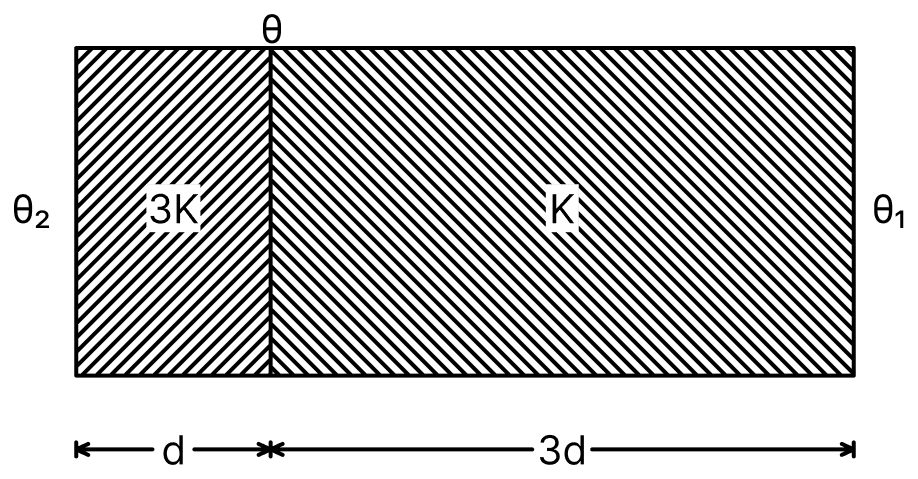
Two materials having coefficients of thermal conductivity 3K and K and thickness d and 3d respectively, are joined to form a slab as shown in figure. The temperature of the outer surfaces are θ2 and θ1 (θ2 > θ1). The temperature at the interface is :
Answer
Reason — Given,
- First material : thermal conductivity 3K, thickness d, outer surface at θ2
- Second material : thermal conductivity K, thickness 3d, outer surface at θ1
- θ2 > θ1
Let θ be the temperature of the interface and A the area of cross-section.
The slabs are joined in series, so in the steady state the rate of flow of heat through both is the same,
Cancelling K, A and d,
A cylinder of radius R is surrounded by a cylindrical shell of inner radius R and outer radius 2R. The thermal conductivity of the material of the inner cylinder is K1 and that of outer cylinder is K2. Assuming no loss of heat, the effective thermal conductivity of the system for heat flowing along the length of the cylinder is :
Answer
Reason — Given,
- Inner cylinder : radius R, thermal conductivity K1
- Outer shell : inner radius R and outer radius 2R, thermal conductivity K2
- Heat flows along the length of the cylinder
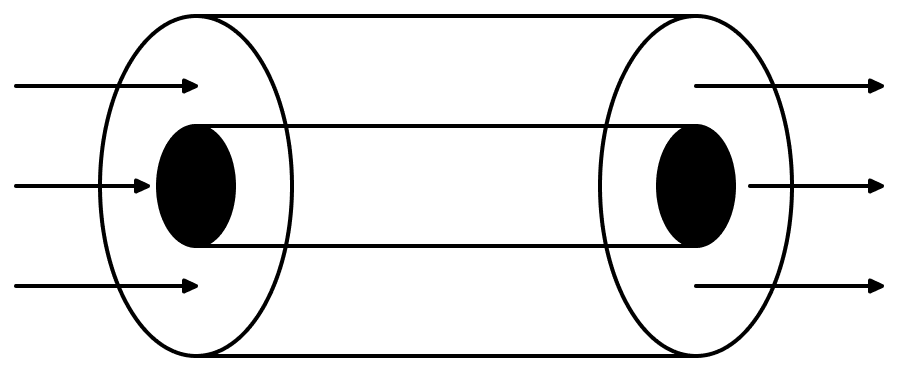
Since the heat flows along the length, the inner cylinder and the outer shell have the same length and the same temperature difference across their ends. Hence they are joined in parallel.
The area of cross-section of the inner cylinder is
The area of cross-section of the outer shell is
For conductors joined in parallel, the equivalent thermal conductivity is
Substituting the values,
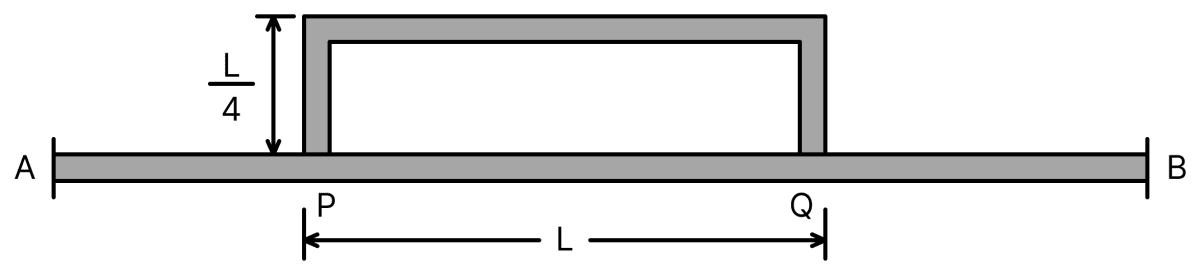
Temperature difference of 120°C is maintained between two ends of a uniform rod AB of length 2L. Another bent rod PQ of same cross-section as AB and length is connected across AB as shown in figure. In steady state, temperature difference between P and Q will be close to :
- 45°C
- 35°C
- 75°C
- 60°C
Answer
45°C
Reason — Given,
- Length of the rod AB = 2L, temperature difference between its ends A and B = 120°C
- The bent rod is PNMQ, of the same area of cross-section as AB and of total length
- From the figure, AP = QB = , PQ = L, and in the bent rod PN = MQ = , NM = L
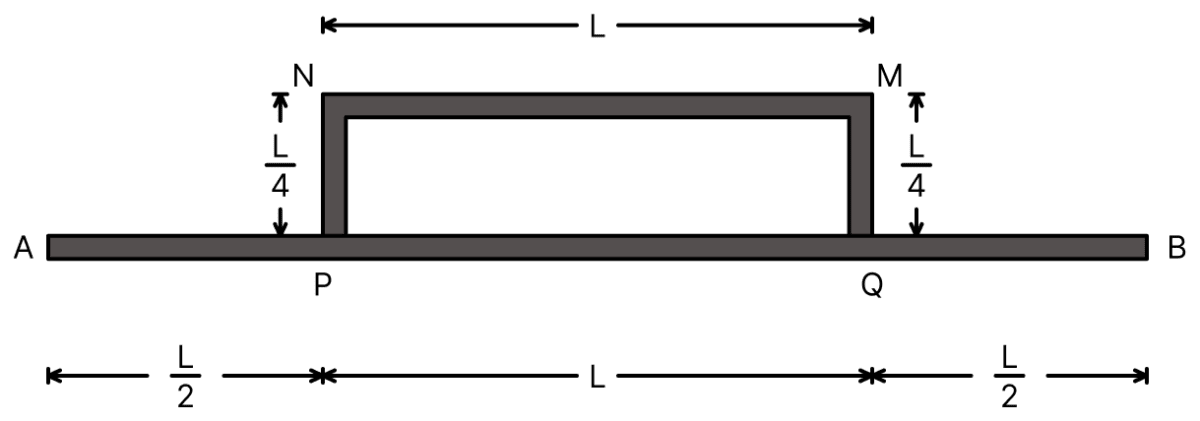
Check on the length of the bent rod : Adding its three parts,
which agrees with the length given in the question.
Thermal resistance : For a conductor of length l and area of cross-section A made of material of thermal conductivity K, the thermal resistance is
Since K and A are the same throughout, the thermal resistance of any part is directly proportional to its length. Let R be the thermal resistance of a part of length L, that is,
Then the resistance of a part of length is , and that of a part of length is .
Resistance of the bent rod PNMQ : The parts PN, NM and MQ carry the same heat one after the other, so they are in series and their resistances add,
Resistance of the section PQ : Between the points P and Q, heat can travel by two separate paths — along the straight portion PQ of the rod AB, of resistance R, and along the bent rod PNMQ, of resistance . Both paths have the same temperature difference across them, so they are in parallel,
Simplifying the numerator and the denominator separately,
Total resistance of the network : The three sections AP, PQ and QB are joined end to end, so they are in series,
Thermal current : In the steady state the same rate of flow of heat passes through the whole network,
Temperature difference between P and Q : This thermal current flows through the section PQ, whose resistance is . Hence
The same result follows directly from the fact that in a series combination the temperature difference is shared in the ratio of the resistances,
The unit of thermal conductivity is :
- J m-1 K-1
- W m K-1
- W m-1 K-1
- J m K-1
Answer
W m-1 K-1
Reason — From the equation of heat conduction,
the unit of K is
Since 1 J s-1 = 1 W, the SI unit of thermal conductivity is W m-1 K-1.
An ice cube of dimensions 60 cm × 50 cm × 20 cm is placed in an insulation box of wall thickness 1 cm. The box keeping the ice cube at 0°C of temperature is brought to a room of temperature 40°C. The rate of melting of ice is approximately :
(Latent heat of fusion of ice is 3.4 × 10⁵ J kg-1 and thermal conducting of insulation wall is 0.05 Wm-1°C-1)
- 61 × 10-3 kg s-1
- 61 × 10-5 kg s-1
- 208 kg s-1
- 30 × 10-5 kg s-1
Answer
61 × 10-5 kg s-1
Reason — Given,
- Dimensions of the ice cube : 60 cm × 50 cm × 20 cm
- Thickness of the insulation wall, l = 1 cm = 0.01 m
- Temperature difference, θ1 − θ2 = 40 − 0 = 40°C
- Thermal conductivity, K = 0.05 W m-1 °C-1
- Latent heat of fusion of ice, L = 3.4 × 10⁵ J kg-1
The total surface area of the box is
The rate of flow of heat into the box is
The rate of melting of ice is
0.08 kg air is heated at constant volume through 5°C. The specific heat of air at constant volume is 0.17 kcal/kg°C and J = 4.18 joule/cal. The change in its internal energy is approximately :
- 318 J
- 298 J
- 284 J
- 142 J
Answer
284 J
Reason — Given,
- Mass of air, m = 0.08 kg
- Rise in temperature, ΔT = 5°C
- Specific heat at constant volume, cv = 0.17 kcal kg-1 °C-1
- J = 4.18 J cal-1
At constant volume no work is done by the gas, so by the first law of thermodynamics the whole of the heat supplied goes into increasing the internal energy,
Substituting the values,
Converting into joule,
The resistances of the platinum wire of a platinum resistance thermometer at the ice point and steam point are 8 Ω and 10 Ω respectively. After inserting in a hot bath of temperature 400°C, the resistance of platinum wire is :
- 2 Ω
- 16 Ω
- 8 Ω
- 10 Ω
Answer
16 Ω
Reason — Given,
- Resistance at the ice point, R0 = 8 Ω
- Resistance at the steam point, R100 = 10 Ω
- Temperature of the hot bath, t = 400°C
For a platinum resistance thermometer, the temperature is given by
Substituting the values,
On Celsius scale the temperature of body increases by 40°C. The increase in temperature on Fahrenheit scale is :
- 70°F
- 68°F
- 72°F
- 75°F
Answer
72°F
Reason — Given,
- Increase in temperature on the Celsius scale, ΔC = 40°C
The interval between the ice point and the steam point contains 100 divisions on the Celsius scale and 180 divisions on the Fahrenheit scale. Hence, for a temperature difference,
Substituting the value,
The factor 32 is not added here, because it applies only to the conversion of a temperature reading and not of a temperature difference.
A metallic bar of Young's modulus, 0.5 × 10¹¹ Nm-2 and coefficient of linear expansion 10-5 °C-1, length 1 m and area of cross-section 10-3 m2 is heated from 0°C to 100°C without expansion or bending. The compressive force developed in it :
- 5 × 10³ N
- 50 × 103 N
- 100 × 103 N
- 2 × 10³ N
Answer
50 × 103 N
Reason — Given,
- Young's modulus, Y = 0.5 × 10¹¹ N m-2
- Coefficient of linear expansion, α = 10-5 °C-1
- Area of cross-section, A = 10-3 m2
- Rise in temperature, ΔT = 100 − 0 = 100°C
On heating, the bar tends to expand by Δl = l α ΔT, but the expansion is prevented. The bar therefore behaves as though it had been compressed by this amount, and a compressive force is developed in it. From the definition of Young's modulus,
Putting Δl = l α ΔT,
Substituting the values,
Note that the force does not depend on the length of the bar.
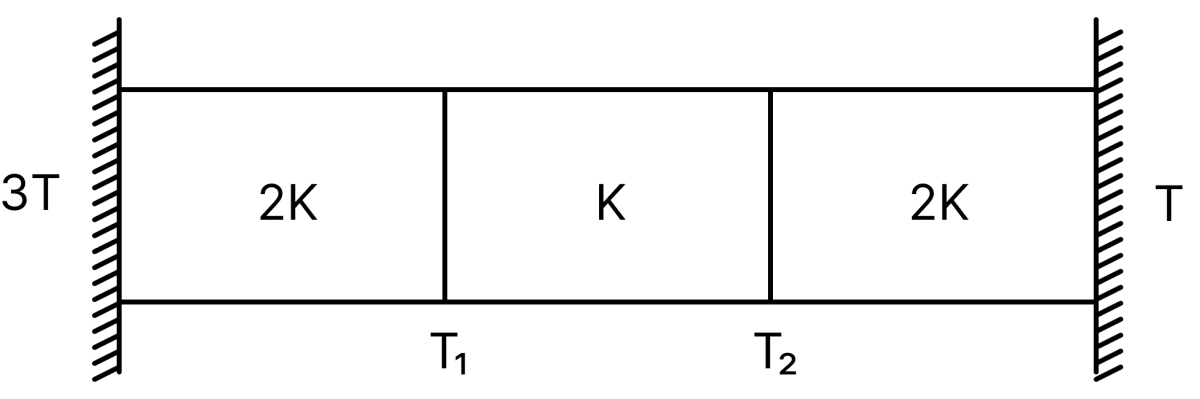
Three identical heat conducting rods are connected in series as shown in the figure. The rods on the sides have thermal conductivity 2K while that in the middle has thermal conductivity K. The left end of the combination is maintained at temperature 3T and the right end at T. The rods are thermally insulated from outside. In steady state, temperature at the left junction is T1 and that at the right junction is T2. The ratio T1/T2 is :
- 3/2
- 4/3
- 5/3
- 5/4
Answer
5/3
Reason — Given,
- Three identical rods of the same length l and area of cross-section A, joined in series
- Thermal conductivities : 2K, K and 2K respectively
- Left end at 3T and right end at T
- Temperature of the left junction = T1, of the right junction = T2
In the steady state the rate of flow of heat through all the three rods is the same,
Cancelling K, A and l,
From the first and the third terms :
From the first and the second terms :
From equation (i), T2 = 4T − T1. Substituting in equation (ii),
Therefore,
A bimetallic strip is formed out of two identical strips, one of copper and the other of brass. The coefficients of linear expansion of the two metals are αC and αB. On heating, the temperature of the strip goes up by ΔT and the strip bends to form an arc of radius of curvature R. Then R is :
- proportional to ΔT
- inversely proportional to ΔT
- proportional to | αB − αC|
- inversely proportional to | αB − αC|
Answer
2. inversely proportional to ΔT
4. inversely proportional to | αB − αC|
Reason — Given,
- Two identical strips, one of copper and one of brass, of coefficients of linear expansion αC and αB
- Rise in temperature = ΔT
- Radius of curvature of the arc formed = R
Let l0 be the original length of each strip and t the thickness of the bimetallic strip.
Expansion of the two strips : On heating, each strip tends to expand by an amount decided by its own coefficient of linear expansion, so their lengths become
Since brass expands more than copper (αB > αC), the brass strip becomes longer than the copper strip. The two strips are firmly rivetted together and cannot slide over each other, so the strip bends with brass on the outside of the curve and copper on the inside.
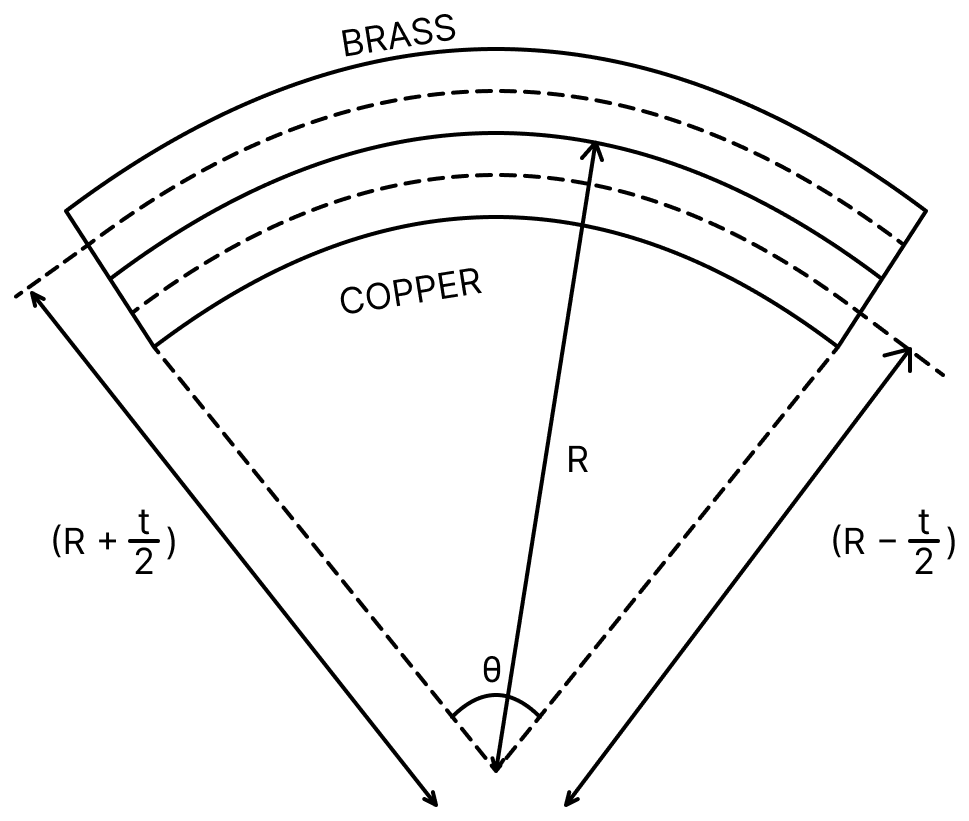
Geometry of the bent strip : Let R be the radius of curvature of the interface between the two strips and θ the angle subtended by the arc at the centre. The brass strip then lies along an arc of radius and the copper strip along an arc of radius .
Using the relation arc = radius × angle for each strip,
Eliminating l0 and θ : Dividing equation (i) by equation (ii), both l0 and θ cancel out,
Cross-multiplying,
Expanding both sides,
The term R cancels from both sides. The terms and are products of two very small quantities and are neglected. Then
Collecting the t terms on one side and the R terms on the other,
Conclusion : In this expression the thickness t is a constant for a given strip. Hence
So the radius of curvature is inversely proportional to the rise in temperature and inversely proportional to the difference of the coefficients of linear expansion. Options 2 and 4 are correct, and options 1 and 3 are incorrect.
Physically, a greater rise in temperature or a greater difference in the coefficients of expansion makes the strip bend more sharply, and a sharper bend means a smaller radius of curvature. This is why a bimetallic strip is used as the sensitive element in an electric thermostat.
Select the correct alternative (s) :
Two bodies A and B, having same outer surface areas, have thermal emissivities of 0.01 and 0.81 respectively. They emit total radiant energy at the same rate. The wavelength λB corresponding to maximum spectral radiancy in the radiation from B is displaced from the wavelength corresponding to maximum spectral radiancy in the radiation from A, by 1.00 μm. If the temperature of A is 5802 K, then :
- the temperature of B is 1934 K
- λB = 1.5 μm
- the temperature of B is 11604 K
- the temperature of B is 2901 K
Answer
1. the temperature of B is 1934 K
2. λB = 1.5 μm
Reason — Given,
- Emissivities, eA = 0.01 and eB = 0.81
- Both bodies have the same outer surface area A and emit total radiant energy at the same rate
- Temperature of A, TA = 5802 K
- λB − λA = 1.00 μm
Temperature of B : Since the rates of emission are equal,
Hence option 1 is correct, and options 3 and 4 are incorrect.
Wavelength λB : By Wien's displacement law, λmT = b, where b = 2.9 × 10⁻³ m K.
Hence option 2 is correct. The displacement is λB − λA = 1.5 − 0.5 = 1.00 μm, which agrees with the data given in the question.
A human body has a surface area of approximately 1 m2. The normal body temperature is 10 K above the surrounding room temperature T0. Take the room temperature to be T0 = 300 K. For T0 = 300 K, the value of σ T04 = 460 Wm-2 (where σ is the Stefan-Boltzmann constant). Which of the following option(s) is are correct?
- If the surrounding temperature reduces by a small amount ΔT0 << T0, then to maintain the same body temperature the same (living) human being needs to radiate ΔW = 4 σT03ΔT0 more energy per unit time
- Reducing the exposed surface area of the body (e.g. by curling up) allows humans to maintain the same body temperature while reducing the energy lost by radiation
- If the body temperature rises significantly then the peak in the spectrum of electromagnetic radiation emitted by the body would shift to longer wavelengths
- The amount of energy radiated by the body in 1 second is close to 60 joules.
Answer
1. If the surrounding temperature reduces by a small amount ΔT0 << T0, then to maintain the same body temperature the same (living) human being needs to radiate ΔW = 4 σT03ΔT0 more energy per unit time
2. Reducing the exposed surface area of the body (e.g. by curling up) allows humans to maintain the same body temperature while reducing the energy lost by radiation
4. The amount of energy radiated by the body in 1 second is close to 60 joules
Reason — Given,
- Surface area of the body, A = 1 m2
- Body temperature, T = T0 + 10, with T0 = 300 K
- σT04 = 460 W m-2
The net energy radiated per second by the body is
Option 1 : If the surrounding temperature falls by ΔT0 while the body temperature is kept the same, the extra energy that must be radiated per unit time is obtained by differentiating σT04 with respect to T0,
Hence option 1 is correct.
Option 2 : Since W = σA(T4 − T04) is directly proportional to the exposed surface area A, reducing A by curling up reduces the energy lost by radiation while the body temperature stays the same. Hence option 2 is correct.
Option 3 : By Wien's displacement law, , so λm is inversely proportional to T. If the body temperature rises, the peak shifts towards shorter wavelengths, not longer. Hence option 3 is incorrect.
Option 4 : Substituting T = T0 + 10,
Since is small, expanding by the binomial theorem and keeping only the first-order term,
Hence option 4 is correct.
The specific heat capacity of a substance is temperature dependent and is given by the formula C = kT, where k is a constant of suitable dimensions in SI units, and T is the absolute temperature. If the heat required to raise the temperature of 1 kg of the substance from −73°C to 27°C is nk, the value of n is ............... .
[Given: 0 K = −273 °C.]
Answer
Given,
- Specific heat capacity, C = kT
- Mass of the substance, m = 1 kg
- Initial temperature, t1 = − 73°C = − 73 + 273 = 200 K
- Final temperature, t2 = 27°C = 27 + 273 = 300 K
- Heat required = nk
Since the specific heat capacity varies with temperature, the heat required cannot be found by simple multiplication; it must be obtained by integration.
For an infinitesimally small rise in temperature dT, the heat required is
Integrating between the limits T = 200 K and T = 300 K,
Putting m = 1 kg and taking the constant k outside,
Evaluating the limits,
Comparing with Q = nk,
Hence, the value of n is 25000.
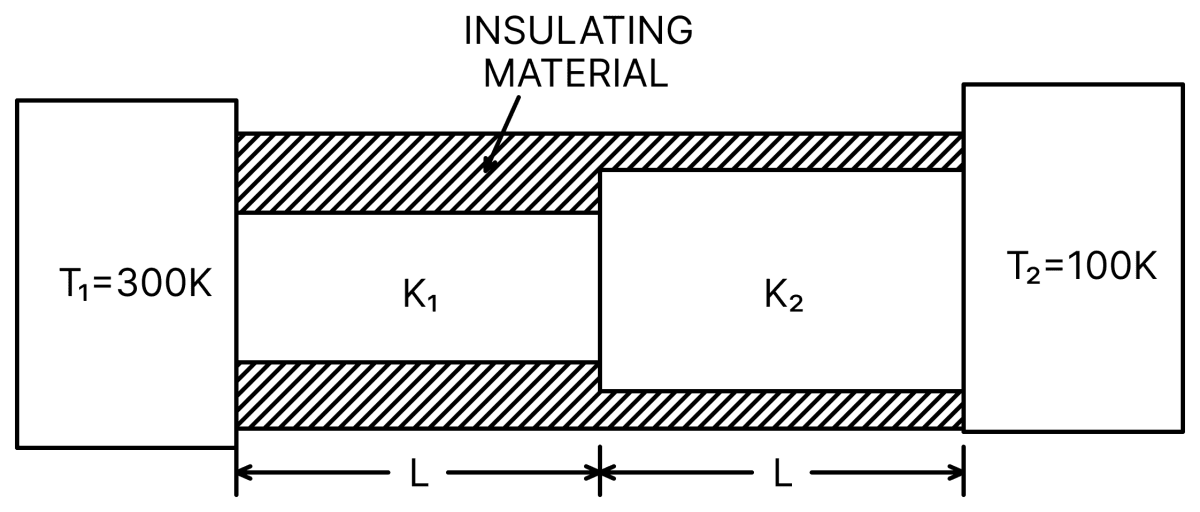
Two conducting cylinders of equal length but different radii are connected in series between two heat baths kept at temperatures T1 = 300 K and T2 = 100 K, as shown in the figure. The radius of the bigger cylinder is twice that of the smaller one and the thermal conductivities of the materials of the smaller and the larger cylinders are K1 and K2 respectively. If the temperature at the junction of the two cylinders in the steady state is 200 K, then K1/K2 = ............... . Round off up to two decimal places.
Answer
Given,
- Both cylinders have the same length l
- Radius of the smaller cylinder = r, radius of the bigger cylinder = 2r
- Thermal conductivity of the smaller cylinder = K1, of the bigger cylinder = K2
- T1 = 300 K, T2 = 100 K, junction temperature T = 200 K
The areas of cross-section of the two cylinders are
The cylinders are connected in series, so in the steady state the rate of flow of heat through both is the same,
Substituting the values,
Cancelling πr2,
Hence, the value of K1/K2 is 4.00.
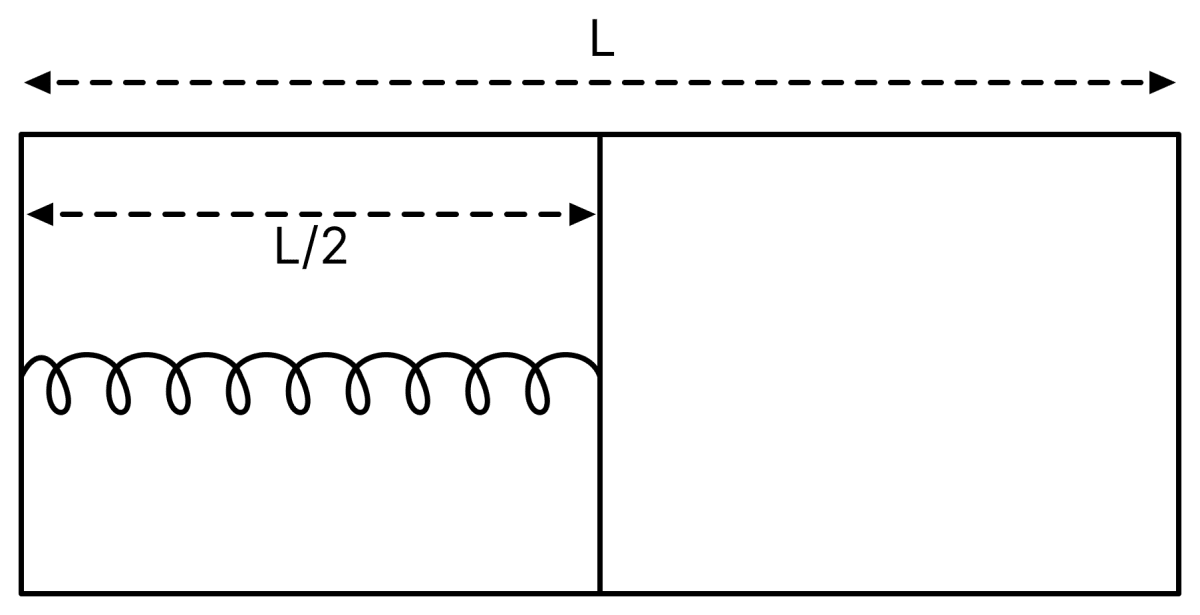
The left and right compartments of a thermally isolated container of length L are separated by a thermally conducting, movable piston of area A. The left and right compartments are filled with and 1 mole of an ideal gas, respectively. In the left compartment the piston is attached by a spring with spring constant k and natural length . In thermodynamic equilibrium, the piston is at a distance from the left and right edges of the container as shown in the figure. Under the above conditions, if the pressure in the right compartment is , then the value of α is ............... .
Answer
Given,
- Length of the container = L, area of the piston = A
- Left compartment : mole of an ideal gas; right compartment : 1 mole of an ideal gas
- Spring constant = k, natural length of the spring =
- In equilibrium, the piston is at a distance from each edge
Temperatures and volumes : The piston is thermally conducting and the container is thermally isolated, so in thermodynamic equilibrium the gases in both the compartments are at the same temperature T. The volume of each compartment is
Pressures of the two gases : From the ideal gas equation PV = nRT, at the same temperature and the same volume the pressure is proportional to the number of moles. Hence
Spring force : The spring lies in the left compartment. Its present length is while its natural length is , so it is stretched by
Since the spring is stretched, it pulls the piston towards the left wall with a force
Force balance on the piston : The gas in the left compartment pushes the piston to the right with force PleftA, while the gas in the right compartment pushes it to the left with force PrightA, and the stretched spring also pulls it to the left with force F. In equilibrium,
Substituting ,
Comparing with ,
Hence, the value of α is 0.2.
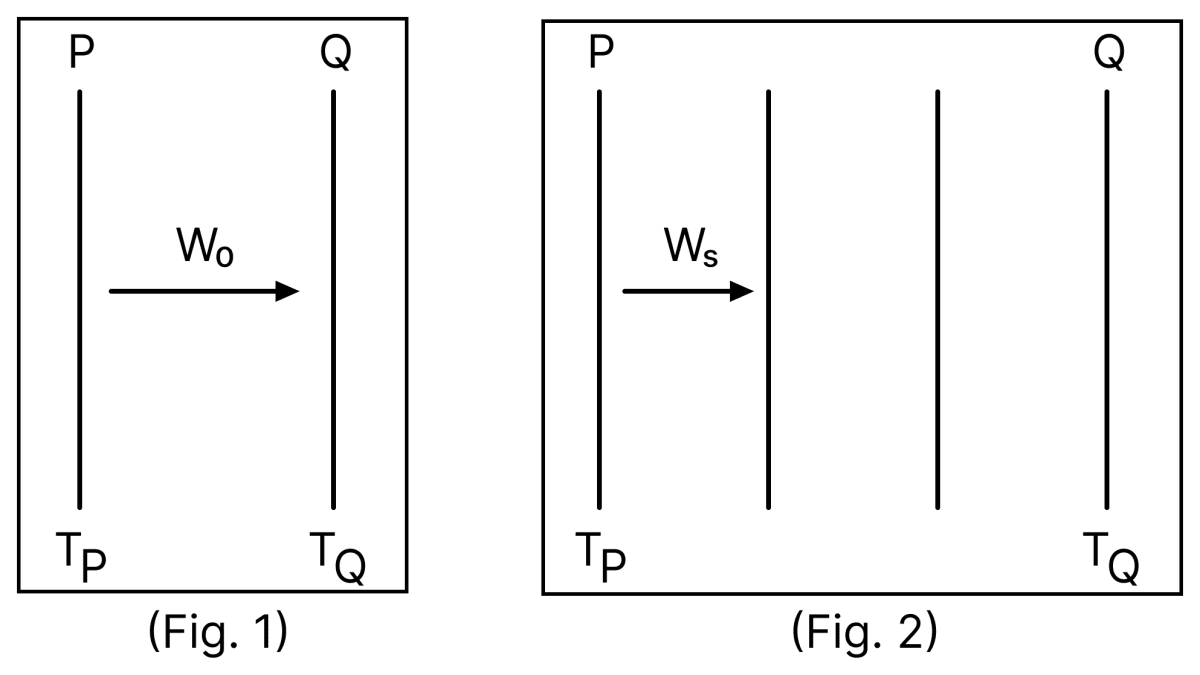
Two identical plates P and Q, radiating as perfect black bodies, are kept in vacuum at constant absolute temperatures TP and TQ, respectively, with TQ < TP, as shown in Fig. 1. The radiated power transferred per unit area from P to Q is W0. Subsequently, two more plates, identical to P and Q, are introduced between P and Q, as shown in Fig. 2. Assume that heat transfer takes place only between adjacent plates. If the power transferred per unit area in the direction from P to Q (Fig. 2) in the steady state is WS, then the ratio is ............... .
Answer
Given,
- Plates P and Q radiate as perfect black bodies, at temperatures TP and TQ, with TQ < TP
- In Fig. 1 the power transferred per unit area from P to Q is W0
- In Fig. 2, two more identical plates are introduced between P and Q
- Heat transfer takes place only between adjacent plates
Case 1 (Fig. 1) : There is a single gap between P and Q. By Stefan's law, the net power transferred per unit area is
Case 2 (Fig. 2) : Now there are four plates in all — P, the two intermediate plates at steady temperatures T1 and T2, and Q. Hence there are three gaps, and in the steady state the same power WS must be transferred across each gap, since otherwise the intermediate plates would go on heating up or cooling down.
Therefore,
Adding the three expressions,
The intermediate terms cancel out, giving
Comparing equations (i) and (ii),
Hence, the required ratio is 3.