
A geyser heats water flowing at the rate of 3.0 L per minute from 27°C to 77°C. If the geyser operates on a gas burner, calculate the rate of consumption of the fuel. The heat of combustion of the gas (fuel) is 4.0 × 10⁴ J g-1. The specific heat and density of water are 4.18 × 10³ J kg-1 °C-1 and 1.0 × 10³ kg m-3 respectively.
Answer
Given,
- Rate of flow of water = 3.0 L per minute = 3.0 × 10⁻³ m3 min-1
- Initial temperature of water = 27°C
- Final temperature of water = 77°C
- Heat of combustion of the fuel = 4.0 × 10⁴ J g-1
- Specific heat of water, c = 4.18 × 10³ J kg-1 °C-1
- Density of water = 1.0 × 10³ kg m-3
The mass of water flowing through the geyser per minute is
The rise in the temperature of water is
Therefore the rate at which heat is taken by the water is
This heat is supplied by the combustion of the fuel. Since the heat of combustion of the gas is 4.0 × 10⁴ J g-1, the rate of consumption of the fuel is
Hence, the rate of consumption of the fuel is 15.7 g min-1.
What amount of heat should be given to 2.0 × 10⁻² kg of nitrogen at room temperature in order to raise its temperature by 45°C at constant pressure ? The molecular mass of N2 is 28. Given : R = 8.31 J mol-1 K-1.
Answer
Given,
- Mass of nitrogen, m = 2.0 × 10⁻² kg = 20 g
- Rise in temperature, ΔT = 45°C = 45 K
- Molecular mass of N2, M = 28
- R = 8.31 J mol-1 K-1
- The gas is heated at constant pressure
The number of moles of nitrogen present is
The amount of heat required to raise the temperature of μ moles of a gas at constant pressure by ΔT is
where Cp is the molar specific heat at constant pressure. Nitrogen (N2) is a diatomic gas, for which
Substituting the values,
Hence, the heat that should be given to the nitrogen is 935 J.
Explain why?
(a) Two bodies at different temperatures T1 and T2, if brought in thermal contact, do not necessarily settle to the mean temperature (T1 + T2)/2.
(b) The coolant used in a chemical or a nuclear plant should have a high specific heat.
(c) Air pressure in a car tyre increases during driving.
(d) The climate of a town near a sea (harbour town) is more temperate than that of a town in a desert at the same altitude.
Answer
(a) Let m1 and c1 be the mass and the specific heat of the body at temperature T1, and m2 and c2 those of the body at temperature T2, with T1 > T2. If T is the common temperature reached, then by the principle of calorimetry,
Solving for T,
The final temperature equals the mean temperature only when m1c1 = m2c2, that is, only when the two bodies have the same thermal capacity (mass × specific heat). In general their thermal capacities are different, and so the two bodies do not necessarily settle to the mean temperature.
(b) The coolant is used to prevent the different parts of the plant from getting too hot. The heat absorbed by a substance is proportional to its specific heat. Hence a coolant having a high specific heat will remove a large amount of heat from the plant for a small rise in its own temperature, and so it cools the plant more effectively.
(c) During driving, the friction between the tyre and the road raises the temperature of the tyre and hence of the air enclosed in it. The volume of the tyre remains practically constant, so the change is isochoric and = constant. As T increases, the air pressure in the tyre also increases.
(d) The specific heat of water is about 5 times higher than that of sand. Therefore, when the same quantity of heat is given to (or taken from) the same mass of water and of sand, the water undergoes a much smaller rise (or fall) in temperature than the sand. During the day the temperature of the sea water rises much more slowly than that of the sand of the desert, so in summer the harbour town remains cooler. At night the sea water cools much more slowly than the sand, so the harbour town remains warmer. Hence the climate of a harbour town is more temperate.
A cylinder with a movable piston contains 3 moles of hydrogen at standard temperature and pressure. The walls of the cylinder are made of a heat insulator and the piston is insulated by having a pile of sand on it. By what factor does the pressure of the gas increase if the gas is compressed to half its original volume?
Answer
Given,
- Number of moles of hydrogen, μ = 3
- The gas is initially at standard temperature and pressure
- Final volume,
- The walls of the cylinder are made of a heat insulator and the piston is insulated
Since the cylinder is insulated on all sides, no heat can enter or leave the gas. Hence the compression is an adiabatic process, which obeys Poisson's law,
Therefore
Hydrogen is a diatomic gas, for which (the vibrational modes being inactive at room temperature)
Substituting ,
Hence, the pressure of the gas increases by a factor of 2.64.
When a gas undergoes a change 'adiabatically' from an equilibrium state A to another equilibrium state B, 22.3 J of work is done 'on' the gas. Now if the gas is taken from state A to B through a process in which 9.35 cal of heat is absorbed by the gas, how much work is done 'by' the gas ? Given : 1 cal = 4.19 J.
Answer
Given,
- Work done on the gas in the adiabatic change A → B = 22.3 J, so W = − 22.3 J
- Heat absorbed by the gas in the second process, Q = 9.35 cal
- 1 cal = 4.19 J
The first law of thermodynamics applied to a system in equilibrium is
where Q is the heat absorbed by the system, W is the work done by the system and ΔU is the change in the internal energy of the system.
For the adiabatic change from state A to state B : No heat enters or leaves the gas, so Q = 0, and the work is done on the gas, so W = − 22.3 J. Therefore
Since the internal energy U is a state function, the change ΔU for any process that takes the gas from state A to state B will be the same, that is, 22.3 J.
For the second process from A to B : The heat absorbed is
Therefore the work done by the gas is
Hence, the work done by the gas in the second process is 16.9 J.
Two cylinders A and B of equal capacity are connected to each other by a stopcock. The cylinder A contains an ideal gas at standard temperature and pressure. B is completely evacuated. The entire system is thermally insulated. The stopcock is suddenly opened. Answer the following:
(a) What is the final pressure of gas in A and B ?
(b) What is the change in internal energy of the gas ?
(c) What is the change in the temperature of the gas ?
(d) Do the intermediate states of the system lie on its P-V-T surface ?
Answer
(a) When the stopcock is suddenly opened, the gas of cylinder A rushes into the evacuated cylinder B. The two cylinders are of equal capacity, so the volume available to the gas is doubled. At constant temperature, by Boyle's law, the pressure is halved. Since the gas was initially at standard temperature and pressure (1 atm), the final pressure of the gas in A and in B is 0.5 atm.
(b) By the first law of thermodynamics, the change in the internal energy of the gas is
The entire system is thermally insulated, so there is no transference of heat with the surroundings, that is, Q = 0. Again, the gas expands into the vacuum of cylinder B, so it has nothing to push against and no external work is done, that is, W = 0. Consequently
Hence the internal energy of the gas does not change.
(c) The internal energy of an ideal gas depends only upon its temperature. Since the internal energy does not change, the temperature of the gas also does not change.
(d) No, the intermediate states do not lie on the P-V-T surface. The process is a 'free expansion' and is too rapid. The intermediate states are non-equilibrium states, for which the pressure, volume and temperature of the gas are not defined for the system as a whole. Only the initial and the final equilibrium states lie on the P-V-T surface of the system.
An electric heater supplies heat to a system at a rate of 100 W. The system performs work at a rate of 75 J per second. At what rate is the internal energy increasing ?
Answer
Given,
- Rate at which heat is supplied to the system, Q = 100 W
- Rate at which the system performs work, W = 75 J s-1 = 75 W
By the first law of thermodynamics, the change in the internal energy of the system is
where Q is the heat taken by the system and W is the work done by the system. Since both the quantities are given as rates, the equation gives directly the rate of change of the internal energy,
which is positive.
Hence, the internal energy of the system is increasing at the rate of 25 W (that is, 25 J per second).
A thermodynamic system is taken from an original state A to an intermediate state C by the linear processes, as shown in the figure.
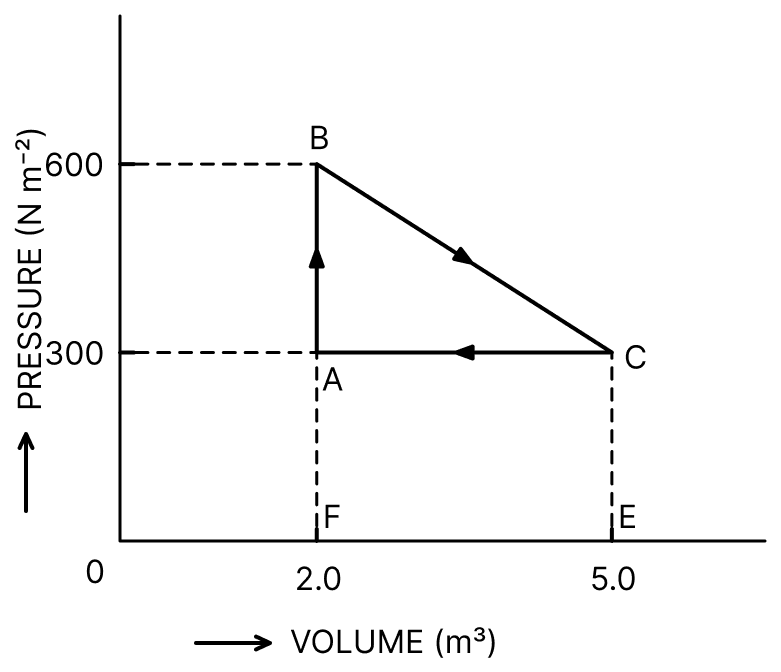
Its volume is then reduced to the original value from C to A by an isobaric process. Calculate the total work done by the gas from B to C to A.
Answer
Given, from the graph,
- At A : P = 300 N m-2, V = 2.0 m3
- At B : P = 600 N m-2, V = 2.0 m3
- At C : P = 300 N m-2, V = 5.0 m3
The gas is taken from A to C through B and is then brought back from C to A by an isobaric process. Thus the gas undergoes a cyclic process A → B → C → A, which is traced clockwise on the P-V diagram.
The work done by a system in a cyclic process is equal to the area enclosed by the closed curve, and since the cycle is traced clockwise, the net work is done by the gas. Here the closed curve is the triangle ABC, so
The base AC is the change in volume and the height AB is the change in pressure,
Therefore
Hence, the total work done by the gas from B to C to A is 450 J.