
Steam at 100°C is passed into 20 g of water at 10°C when water acquires a temperature of 80°C, the mass of water present will be :
[Take specific heat of water = 1 cal g-1 °C-1 and latent heat of steam = 540 cal g-1]
- 24 g
- 31.5 g
- 42.5 g
- 22.5 g
Answer
22.5 g
Reason — Given,
- Mass of cold water, mw = 20 g at 10°C
- Steam at 100°C is passed into it
- Final temperature of the mixture = 80°C
- Specific heat of water, c = 1 cal g-1 °C-1
- Latent heat of steam, L = 540 cal g-1
Heat taken by the cold water in rising from 10°C to 80°C is
Heat given out by the steam : Let m gram of steam be condensed. The steam first condenses into water at 100°C, giving out the latent heat mL, and this water then cools from 100°C to 80°C, giving out mcΔT. Hence
By the principle of calorimetry, heat lost = heat gained,
The condensed steam remains in the vessel as water, so the total mass of water present is
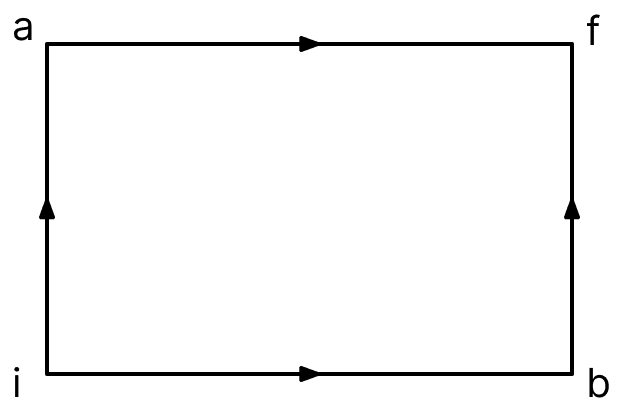
When a system is taken from state i to state f along the path iaf as shown in figure, it is found that Q = 50 cal and W = 20 cal. Along the path ibf, Q = 36 cal. W along the path ibf is :
- 16 cal
- 66 cal
- 14 cal
- 6 cal
Answer
6 cal
Reason — Given,
- Along the path iaf : Q1 = 50 cal and W1 = 20 cal
- Along the path ibf : Q2 = 36 cal, W2 = ?
The internal energy is a state function, so the change in the internal energy in going from the state i to the state f is the same along both the paths,
By the first law of thermodynamics, ΔU = Q − W. Therefore
Substituting the values,
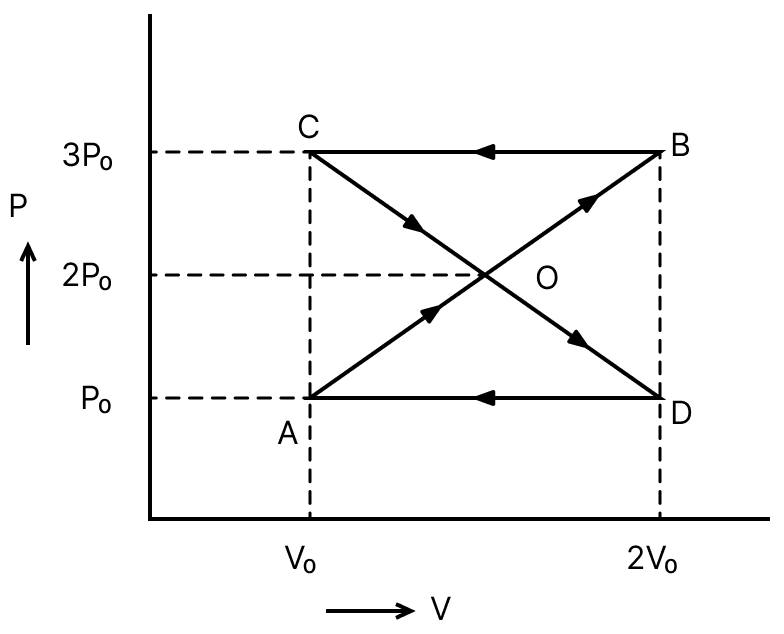
A thermodynamic system undergoes cyclic process ABCDA as shown in figure. The work done by the system in the cycle is :
- P0V0
- 2 P0V0
- zero
Answer
zero
Reason —
From the graph, the four states of the gas are A (V0, P0), B (2V0, 3P0), C (V0, 3P0) and D (2V0, P0). The two straight lines AB and CD cross each other at the point O.
The work done in a thermodynamic process is equal to the area enclosed between the P-V curve and the volume-axis, and the closed figure here is made up of two triangles which meet at O.
Work done in the process O → D → A : This lower triangle is traced clockwise, so the work done is positive,
Work done in the process O → B → C : This upper triangle is traced anticlockwise, so the work done is negative and equal in magnitude,
The two triangles are of equal area but are described in opposite senses. Hence the total work done by the system in the cycle is
The figure shows two paths that may be taken by a gas to go from a state A to a state C.
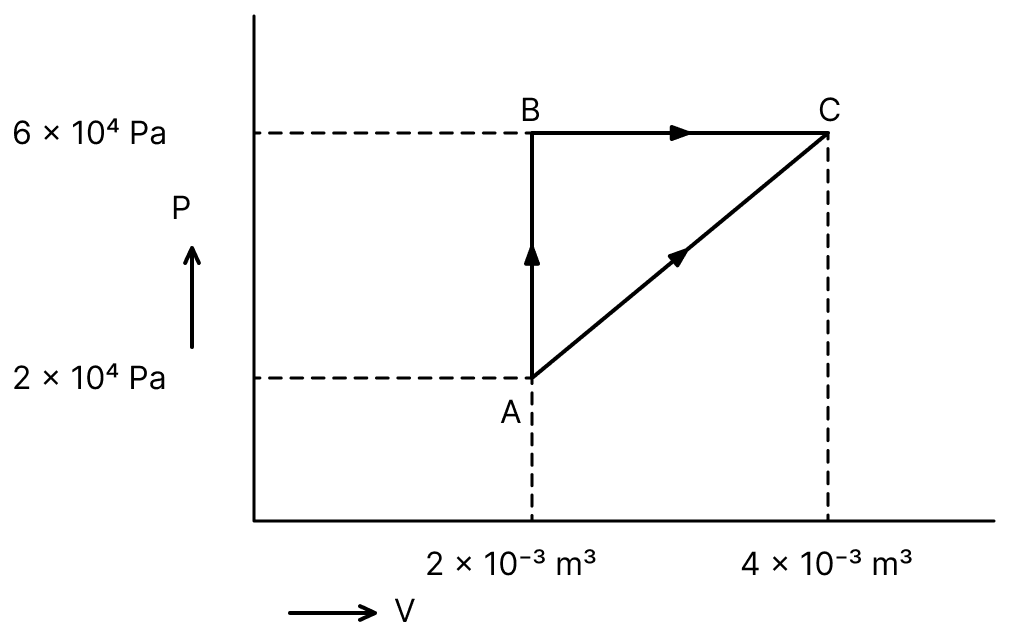
In process AB, 400 J of heat is added to the system and in process BC, 100 J of heat is added to the system. The heat absorbed by the system in the process AC will be :
- 500 J
- 460 J
- 300 J
- 380 J
Answer
460 J
Reason — Given,
- Heat added in the process AB, QAB = 400 J
- Heat added in the process BC, QBC = 100 J
From the graph, the states are A (2 × 10⁻³ m3, 2 × 10⁴ Pa) and C (4 × 10⁻³ m3, 6 × 10⁴ Pa), and the path AC is the straight line joining them.
Since the internal energy is a state function, the change in internal energy is the same along the path ABC and along the path AC.
For the path ABC : The work done is zero along AB (isochoric) and along BC the pressure is constant, but the total heat given is
For the closed cycle A → B → C → A : Applying the first law to the complete cycle, in which ΔU = 0, the net heat absorbed equals the net work done, which is the area of the triangle ABC,
Since the heat absorbed in going from C to A is − 460 J, the heat absorbed by the system in the reverse process, that is, in the process A → C, is
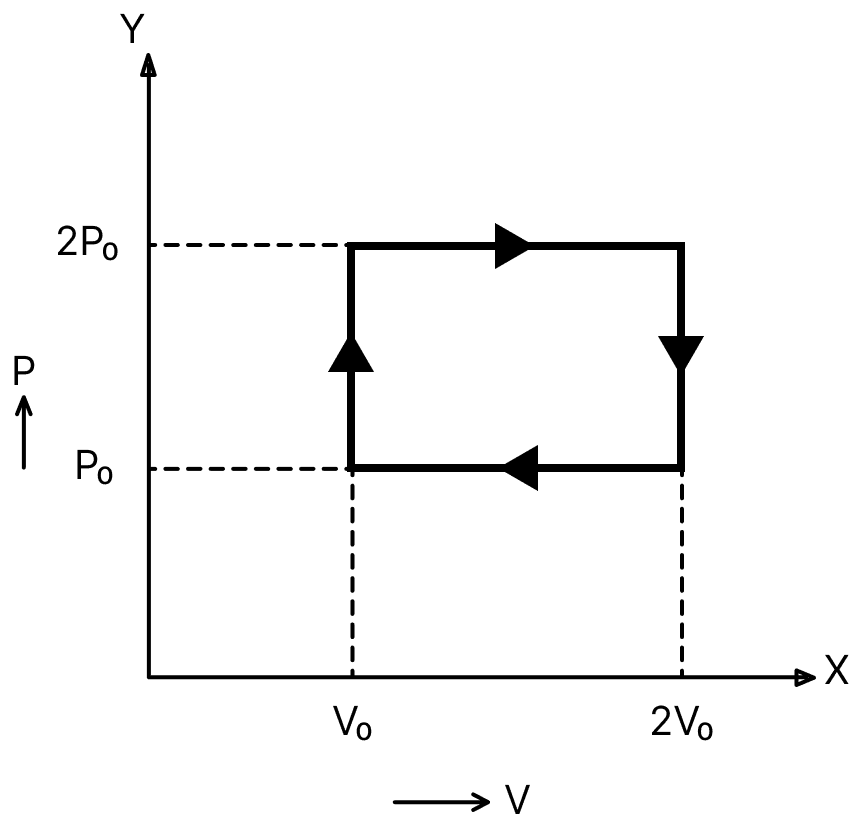
The given P-V diagram represents the thermodynamic cycle of an engine, operating with an ideal monoatomic gas. The amount of heat, extracted from the source in a single cycle is :
- P0V0
- P0V0
- P0V0
- 4 P0V0
Answer
P0V0
Reason —
From the graph the cycle consists of two isochoric and two isobaric processes, the states being (V0, P0) → (V0, 2P0) → (2V0, 2P0) → (2V0, P0) → (V0, P0). The gas is monoatomic, so
Heat is extracted from the source only in those parts of the cycle in which the heat is absorbed by the gas, that is, when the pressure grows at constant volume and when the volume grows at constant pressure.
Heat absorbed when the pressure grows from P0 to 2P0 at the constant volume V0 :
Heat absorbed when the volume grows from V0 to 2V0 at the constant pressure 2P0 :
In the remaining two processes the pressure and the volume decrease, so heat is rejected by the gas.
Adding (i) and (ii), the total heat extracted from the source in a single cycle is
100 g of water is heated from 30°C to 50°C. Ignoring the slight expansion of the water, the change in its internal energy is (specific heat of water is 4184 J/kg/K) :
- 2.1 kJ
- 4.2 kJ
- 8.4 kJ
- 84 kJ
Answer
8.4 kJ
Reason — Given,
- Mass of water, m = 100 g = 100 × 10-3 kg
- Initial temperature = 30°C, final temperature = 50°C, so ΔT = 20°C = 20 K
- Specific heat of water, c = 4184 J kg-1 K-1
- The slight expansion of the water is to be ignored
Since the expansion of the water is ignored, the change in volume is zero and hence no external work is done, W = 0. By the first law of thermodynamics,
The heat taken by the water is
A thermally insulated vessel contains an ideal gas of molecular mass M and ratio of specific heats γ. It is moving with speed v and is suddenly brought to rest. Assuming no heat is lost to the surroundings, its temperature increases by :
K
K
K
K
Answer
K
Reason — Given,
- Molecular mass of the gas = M
- Ratio of specific heats = γ
- Speed of the vessel = v, and the vessel is suddenly brought to rest
- The vessel is thermally insulated, so no heat is lost to the surroundings
Let the vessel contain μ mole of the gas. The mass of the gas is then μM, and the kinetic energy of the gas on account of the motion of the vessel is
When the vessel is suddenly brought to rest, this ordered kinetic energy of the gas is converted into the internal energy of the gas, and hence the temperature of the gas rises. Since no heat is lost, the whole of it appears as the increase in internal energy.
If ΔT be the rise in temperature of μ mole of the gas, then
For an ideal gas the molar specific heat at constant volume is
Substituting this value,
Cancelling μ and solving for ΔT,
Helium gas goes through a cycle ABCDA (consisting of two isochoric and two isobaric lines) as shown in figure. Efficiency of this cycle is nearly : (Assume the gas to be close to ideal gas)
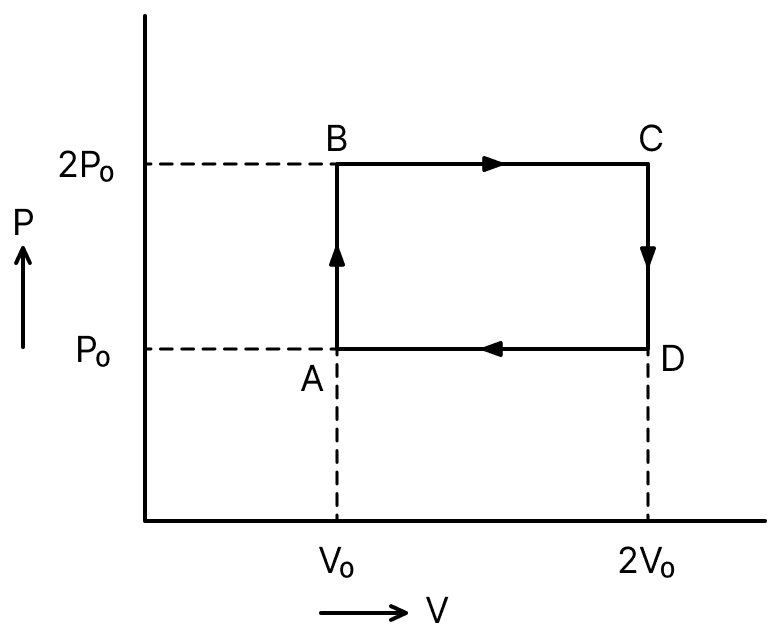
- 15.4%
- 9.1%
- 10.5%
- 12.5%
Answer
15.4%
Reason —
From the graph the cycle ABCDA consists of two isochoric and two isobaric lines, the states being A (V0, P0), B (V0, 2P0), C (2V0, 2P0) and D (2V0, P0). Helium is a monoatomic gas, so
Work done in the complete cycle : No work is done along AB and CD, since the volume does not change there. Therefore
Heat given to the gas from A → B (isochoric) :
But for this path n R ΔT = V0 ΔP = V0(2P0 − P0) = P0V0, so
Heat given to the gas from B → C (isobaric) :
But for this path n R ΔT = 2P0 ΔV = 2P0V0, so
In the processes C → D and D → A heat is rejected by the gas. Hence the efficiency of the cycle is
In a process carried on an ideal gas, W = 0 and Q < 0 . Then, of the gas :
- the temperature will fall
- the volume will increase
- the pressure will remain constant
- the temperature will rise
Answer
the temperature will fall
Reason — Given, for the process W = 0 and Q < 0.
By the first law of thermodynamics,
Since W = 0, we get ΔU = Q. As Q is negative, ΔU is also negative, that is, the internal energy of the gas decreases.
For an ideal gas the change in internal energy is related to the change in temperature by
Since ΔU < 0 and both μ and Cv are positive quantities, ΔT must be negative. Hence the temperature of the gas will fall.
The volume cannot increase, because W = P ΔV = 0 means the volume stays constant.
One mole of diatomic ideal gas undergoes a cyclic process ABC as shown in figure. The process BC is adiabatic. The temperatures at A, B and C are 400 K, 800 K and 600 K respectively. Choose the correct statement.
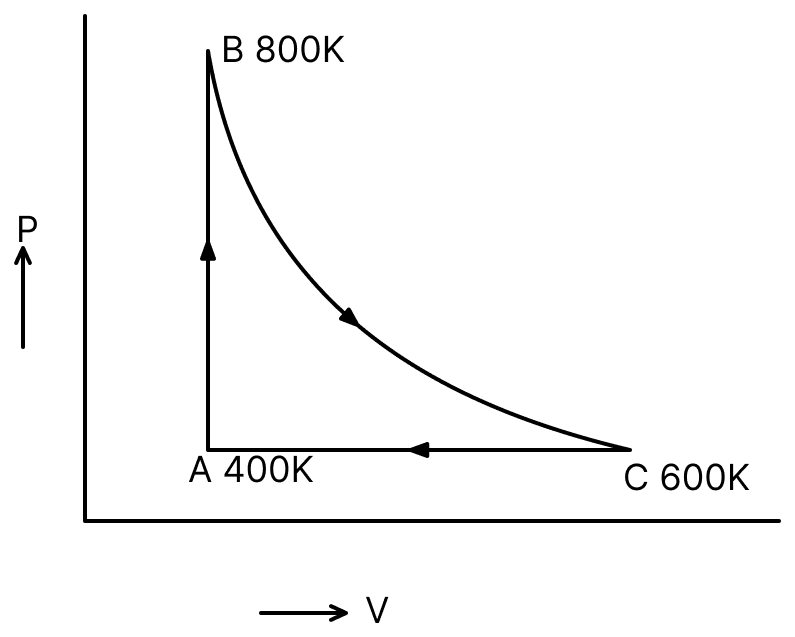
- The change in internal energy in whole cyclic process is 250 R.
- The change in internal energy in the process CA is 700 R.
- The change in internal energy in the process AB is − 350 R.
- The change in internal energy in the process BC is − 500 R
Answer
The change in internal energy in the process BC is − 500 R.
Reason — Given,
- One mole of a diatomic ideal gas, so the degrees of freedom f = 5 and
- TA = 400 K, TB = 800 K, TC = 600 K
- The process BC is adiabatic
For one mole of a gas the change in internal energy is
For the complete cyclic process : The gas returns to its initial state, so
Hence option 1 is incorrect.
For the process CA :
Hence option 2 is incorrect.
For the process AB :
Hence option 3 is incorrect.
For the process BC :
Hence the correct statement is that the change in internal energy in the process BC is − 500 R.
Two moles of ideal helium gas are in a rubber balloon at 30°C. The balloon is fully expandable and can be assumed to require no energy in its expansion. The temperature of the gas in the balloon is slowly changed to 35°C. The amount of heat required in raising the temperature is nearly (take R = 8.31 J/mol K) :
- 62 J
- 104 J
- 124 J
- 208 J
Answer
208 J
Reason — Given,
- Number of moles of helium, μ = 2
- Initial temperature = 30°C, final temperature = 35°C, so ΔT = 5°C = 5 K
- R = 8.31 J mol-1 K-1
- The balloon is fully expandable and requires no energy in its expansion
Since the balloon is fully expandable and needs no energy to expand, the gas inside always stays at the constant atmospheric pressure. The heating is therefore an isobaric process, for which the heat required is
Helium is a monoatomic gas, for which
Substituting the values,
An ideal monoatomic gas is confined in a horizontal cylinder by a spring loaded piston (as shown in the figure). Initially the gas is at temperature T1, pressure P1 and volume V1 and the spring is in its relaxed state. The gas is then heated very slowly to temperature T2, pressure P2 and volume V2. During this process the piston moves out by a distance x. Ignoring the friction between the piston and the cylinder, the correct statement is :

- If V2 = 2 V1 and T2 = 3 T1, then the energy stored in the spring is P1V1.
- If V2 = 2 V1 and T2 = 3 T1, then the change in internal energy is 3 P1V1.
- If V2 = 3 V1 and T2 = 4 T1, then the work done by the gas is P1V1.
- If V2 = 3 V1 and T2 = 4 T1, then the heat supplied to the gas is P1V1
Answer
1. If V2 = 2 V1 and T2 = 3 T1, then the energy stored in the spring is P1V1.
2. If V2 = 2 V1 and T2 = 3 T1, then the change in internal energy is 3 P1V1.
3. If V2 = 3 V1 and T2 = 4 T1, then the work done by the gas is P1V1.
Reason —
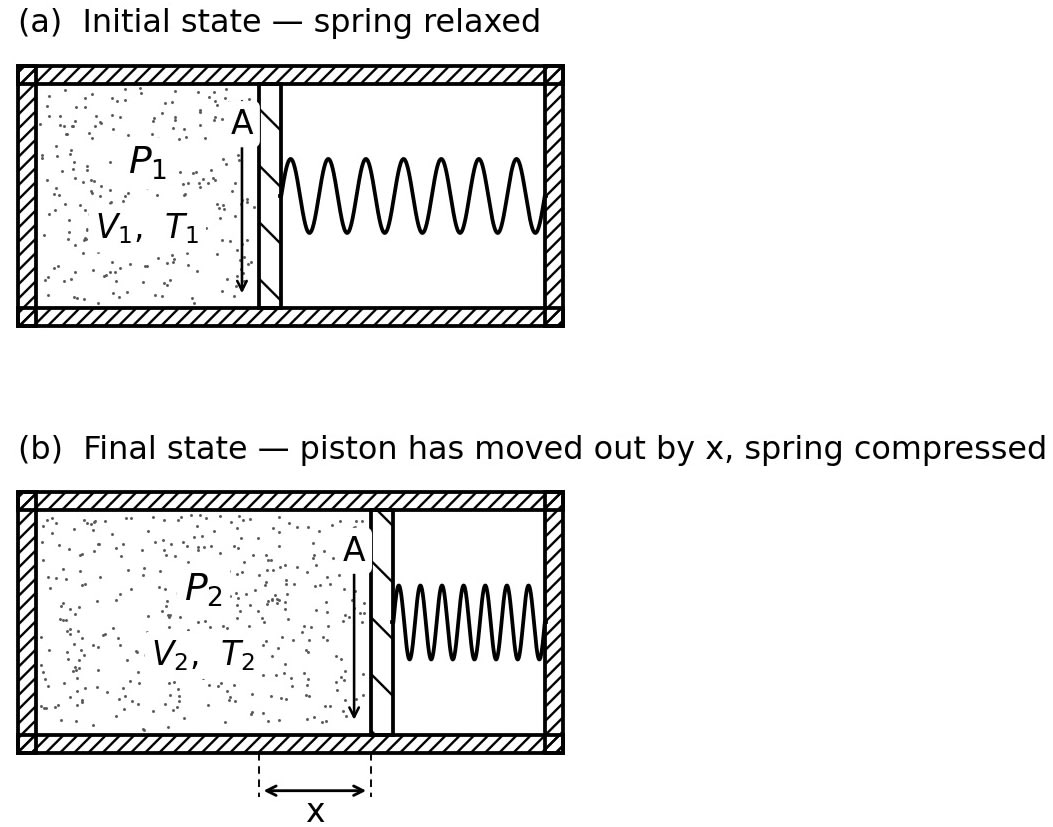
The gas is monoatomic, so and the total internal energy of the gas is .
Force on the piston : Initially the spring is in its relaxed state, so the initial gas pressure P1 is balanced by the external pressure alone. When the piston moves out by x, the spring is deformed and exerts a force kx on it. The new force balance on the piston therefore gives
Since the heating is carried out very slowly, the pressure rises in step with the displacement, so P varies linearly with V between the initial and the final states.
Checking option 1 : For V2 = 2V1 and T2 = 3T1, the gas equation gives
The energy stored in the spring is
since A x is the change in volume. Substituting the values,
Hence option 1 is correct.
Checking option 2 : With P2 = P1 and V2 = 2V1,
Hence option 2 is correct.
Checking option 3 : For V2 = 3V1 and T2 = 4T1,
Since the pressure varies linearly with the volume, the work done by the gas is the area under the straight line joining the initial and the final states,
Hence option 3 is correct.
Checking option 4 : For the same case the change in internal energy is
By the first law of thermodynamics, the heat supplied is
This is not , so option 4 is incorrect.
Hence the correct statements are 1, 2 and 3.
Note: The printed answer key of the textbook gives option (b) alone, its hint having taken the spring force as P2A = kx. Since the spring is relaxed in the initial state, the spring force accounts only for the rise in pressure, so kx = (P2 − P1)A. With this relation options 1, 2 and 3 are all correct, and the heat supplied in option 4 works out to P1V1.
The work of 146 kJ is performed in order to compress on kilo mole of gas adiabatically and in this process the temperature of the gas increases by 7°C. The gas is ( R = 8.3 J mol-1 K-1):
- monoatomic
- diatomic
- triatomic
- a mixture of monoatomic and diatomic
Answer
diatomic
Reason — Given,
- Work done on the gas, W = − 146 kJ = − 146 × 103 J
- Number of moles, μ = 1 kilo mole = 1 × 10³ mol
- Rise in temperature, ΔT = 7°C = 7 K
- R = 8.3 J mol-1 K-1
According to the first law of thermodynamics,
For an adiabatic process Q = 0, so
But the change in internal energy is also ΔU = μ Cv ΔT. Therefore
For a diatomic gas the molar specific heat at constant volume is
Since the calculated value agrees with this, the gas is diatomic.
Two rigid boxes containing different ideal gases are placed on a table. Box A contains one mole of nitrogen at temperature T0, while Box B contains one mole of helium at temperature T0. The boxes are then put in thermal contact with each other and heat flows between them until the gases reach a common final temperature. (Ignore heat capacity of boxes). Then, the final temperature of the gases, Tf in terms of T0 is :
- Tf = T0
- Tf = T0
- Tf = T0
- Tf = T0
Answer
Tf = T0
Reason — Given,
- Box A : 1 mole of nitrogen (diatomic) at temperature T0, so
- Box B : 1 mole of helium (monoatomic) at temperature T0, so
- The heat capacity of the boxes is to be ignored
The boxes are rigid, so the volume of each gas remains constant and no work is done. The heat lost by the hotter gas is therefore gained by the cooler gas, and the total change in internal energy is zero,
Substituting the values,
Multiplying throughout by ,
The figure shows the P-V plot of an ideal gas taken through a cycle ABCDA. The part ABC is a semi-circle and CDA is half of an ellipse. Then select the correct statement(s) from the following :
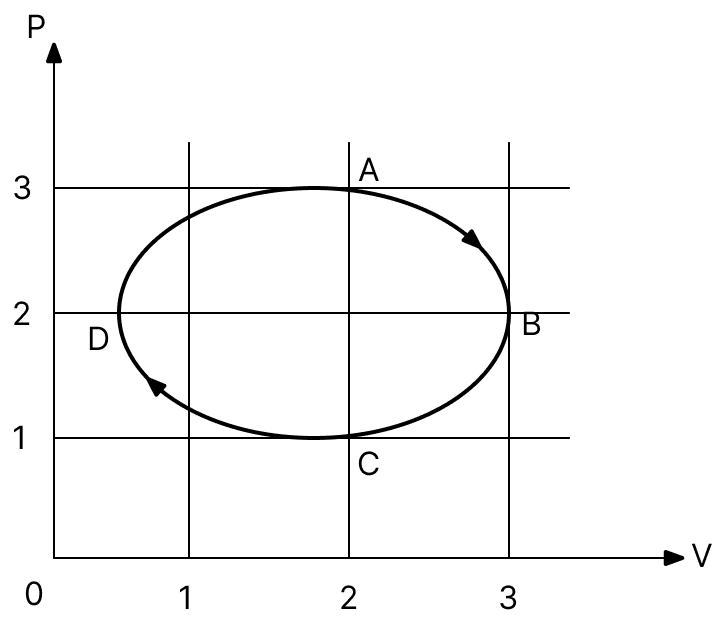
- the process during the path A → B is isothermal.
- heat flows out the gas during the path B → C → D.
- work done during the path A → B → C is zero.
- positive work is done by the gas in the cycle ABCDA.
Answer
2. heat flows out the gas during the path B → C → D.
4. positive work is done by the gas in the cycle ABCDA.
Reason —
By the first law of thermodynamics, ΔQ = ΔU + W.
Checking option 1 : For the path A → B the P-V curve is a part of the semi-circle ABC, and not a rectangular hyperbola. An isothermal curve for an ideal gas obeys PV = constant, which is a rectangular hyperbola. Hence the process A → B is not isothermal and option 1 is incorrect.
Checking option 2 : The states are B (3, 2), C (2, 1) and D (1, 2). Therefore
Since PDVD < PBVB, the change in internal energy
is negative. Again, along the whole path B → C → D the volume falls steadily from 3 to 1, so the work done is also negative. Hence ΔQ is negative, that is, heat flows out of the gas along B → C → D, and option 2 is correct.
Checking option 3 : Along the path A → B → C the volume of the gas changes, so the work done, being the area under the curve, is not zero. Hence option 3 is incorrect.
Checking option 4 : The closed curve ABCDA is traced clockwise on the P-V diagram. For a clockwise cycle the net work is done by the gas and is therefore positive. Hence option 4 is correct.
One or more option(s) is/are correct :
Cv and Cp denote the molar specific heat capacities of a gas at constant volume and constant pressure, respectively. Then,
- Cp − Cv is larger for a diatomic ideal gas than for a monoatomic ideal gas.
- Cp + Cv is larger for a diatomic ideal gas than for a monoatomic ideal gas.
- Cp/Cv is larger for a diatomic ideal gas than for a monoatomic ideal gas.
- Cp · Cv is larger for a diatomic ideal gas than for a monoatomic ideal gas.
Answer
2. Cp + Cv is larger for a diatomic ideal gas than for a monoatomic ideal gas.
4. Cp · Cv is larger for a diatomic ideal gas than for a monoatomic ideal gas.
Reason — For a diatomic ideal gas :
For a monoatomic ideal gas :
Comparing the two :
Cp − Cv = R for both the gases, so option 1 is incorrect.
Cp + Cv is 6R for the diatomic gas and 4R for the monoatomic gas, so option 2 is correct.
is = 1.4 for the diatomic gas and = 1.67 for the monoatomic gas, which is smaller for the diatomic gas, so option 3 is incorrect.
Cp · Cv is for the diatomic gas and for the monoatomic gas, so option 4 is correct.
The figure shows the variation of specific heat capacity c of a solid as a function of temperature T. The temperature is increased continuously from 0 to 500 K at a constant rate. Ignoring any volume change, the following statement(s) is (are) correct to a reasonable approximation.
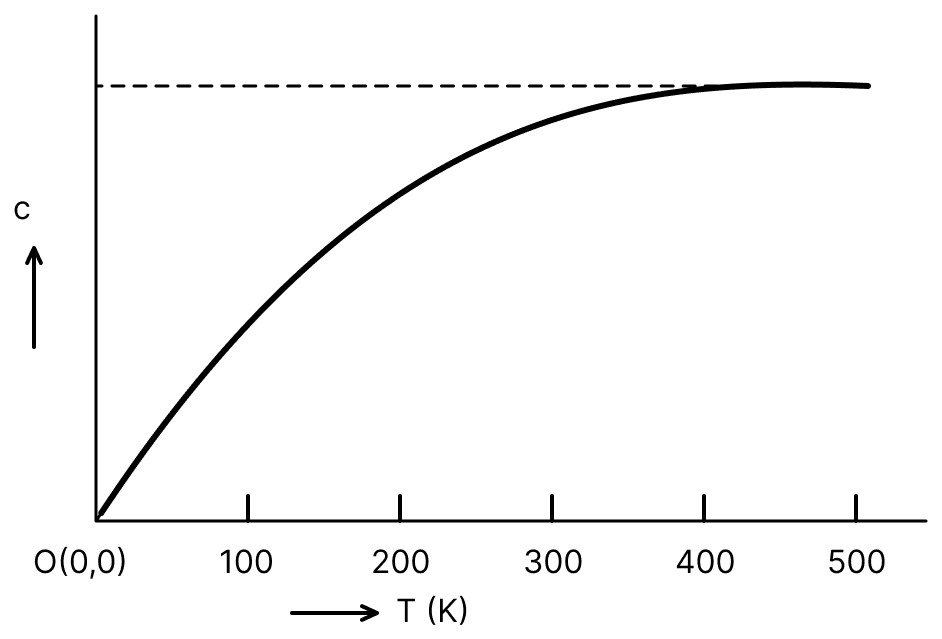
- The rate at which heat is absorbed in the range 0-100 K varies linearly with temperature T.
- Heat absorbed in increasing the temperature from 0-100 K is less than the heat required for increasing the temperature from 400-500 K.
- There is no change in the rate of heat absorption in range 400-500 K.
- The rate of heat absorption increases in the range 200-300 K.
Answer
1. The rate at which heat is absorbed in the range 0-100 K varies linearly with temperature T.
2. Heat absorbed in increasing the temperature from 0-100 K is less than the heat required for increasing the temperature from 400-500 K.
3. There is no change in the rate of heat absorption in range 400-500 K.
4. The rate of heat absorption increases in the range 200-300 K.
Reason —
The heat absorbed in raising the temperature of a solid of mass m is
Differentiating with respect to time,
The temperature is increased at a constant rate, so is constant, and the mass m is also constant. Therefore
that is, the rate of heat absorption at any stage is proportional to the specific heat capacity c at that temperature.
Option 1 is correct, because in the range 0-100 K the graph of c against T is very nearly a straight line, so the rate of heat absorption varies linearly with T.
Option 2 is correct, because the area under the curve in the range 0-100 K is less than the area under the curve in the range 400-500 K, and the heat absorbed is proportional to this area.
Option 3 is correct, because in the range 400-500 K the graph of c against T is parallel to the temperature axis, so c is constant and the rate of heat absorption does not change.
Option 4 is correct, because in the range 200-300 K the specific heat capacity c increases with temperature, and hence the rate of heat absorption also increases.
Hence all the four statements are correct.
A Carnot's engine takes in 3000 kcal of heat from a reservoir at 627°C and gives it to a sink at 27°C. The work done by the engine is : (1 kcal = 4.2 × 10³ J)
- 4.2 × 10⁶ J
- 8.4 × 10⁶ J
- 16.8 × 10⁶ J
- zero
Answer
8.4 × 10⁶ J
Reason — Given,
- Heat taken in from the reservoir, Q1 = 3000 kcal
- Temperature of the source, T1 = 627°C = 627 + 273 = 900 K
- Temperature of the sink, T2 = 27°C = 27 + 273 = 300 K
- 1 kcal = 4.2 × 10³ J
The efficiency of a Carnot engine is
The heat energy taken in from the source, expressed in joule, is
The work done by the engine is
A Carnot's engine, whose efficiency is 40%, takes in heat from a source maintained at a temperature of 500 K. It is desired to have an engine of efficiency 60%. Then, the intake temperature for the same exhaust (sink) temperature must be :
- efficiency of Carnot's engine cannot be made larger than 50%
- 1200 K
- 750 K
- 600 K
Answer
750 K
Reason — Given,
- Efficiency in the first case, η1 = 40%
- Temperature of the source in the first case, T1 = 500 K
- Desired efficiency, η2 = 60%, the sink temperature remaining the same
For the first case : The efficiency of a Carnot engine is
Substituting the values,
For the second case : The sink temperature stays at 300 K and the efficiency is to be 60%. If T1′ be the new intake temperature,
A Carnot's engine operation between temperatures T1 and T2 has efficiency (1/6). When T2 is lowered by 62 K, its efficiency increases to (1/3). Then T1 and T2 respectively are :
- 310 K and 248 K
- 372 K and 310 K
- 372 K and 330 K
- 330 K and 268 K
Answer
372 K and 310 K
Reason — Given,
- Efficiency in the first case,
- When T2 is lowered by 62 K, the efficiency becomes
For the first case : The efficiency of a Carnot engine is
For the second case : The sink temperature becomes (T2 − 62) K,
Subtracting (ii) from (i),
Substituting this value in equation (i),
Hence T1 = 372 K and T2 = 310 K.
A steam engine delivers 5.4 × 10⁸ J of work per minute and receives 3.6 × 10⁹ J of heat per minute from its boiler. What is the efficiency of the engine? How much heat is wasted per minute?
Answer
Given,
- Work delivered by the engine per minute, W = 5.4 × 10⁸ J
- Heat received from the boiler per minute, Q1 = 3.6 × 10⁹ J
Efficiency of the engine : The efficiency is the ratio of the useful work delivered by the engine to the heat taken in from the hot reservoir,
Heat wasted per minute : The heat wasted is the heat rejected to the sink, which is the difference between the heat taken in and the work done,
Hence the efficiency of the engine is 15% and the heat wasted per minute is 3.1 × 10⁹ J.
A refrigerator is to maintain eatables kept inside at 9°C. If room temperature is 36°C, calculate the coefficient of performance.
Answer
Given,
- Temperature of the eatables kept inside (cold body), T2 = 9°C = 9 + 273 = 282 K
- Room temperature (hot body), T1 = 36°C = 36 + 273 = 309 K
The coefficient of performance of a refrigerator is defined as the ratio of the heat taken in from the cold body to the work needed to run the refrigerator, and for an ideal refrigerator it is given by
where T1 is the absolute temperature of the hot body to which heat is delivered and T2 is the absolute temperature of the cold body from which heat is removed.
Substituting the values,
Hence, the coefficient of performance of the refrigerator is 10.4.
An insulated cylinder with a movable insulated piston contains 3 moles of hydrogen at STP. By what factor does the pressure of the gas increase, if the gas is compressed to half its original volume? Given : γ = 1.4.
Answer
Given,
- Number of moles of hydrogen, μ = 3
- The gas is initially at STP
- Final volume,
- γ = 1.4
Let P1, V1 be the original pressure and volume of the gas and P2, V2 those after the gas is compressed.
The cylinder is insulated and the piston is also insulated, so the whole system is well insulated and no heat can enter or leave the gas. The compression is therefore adiabatic and obeys Poisson's law,
Rearranging,
Here , so
Hence, the pressure of the gas increases by a factor of 2.64.