
The first law of thermodynamics is a statement of :
- Conservation of momentum
- Conservation of energy
- Conservation of mass
- Conservation of entropy
Answer
Conservation of energy
Reason — The first law of thermodynamics states that if an amount of heat Q is given to a system, a part of it is used in increasing the internal energy (ΔU) of the system and the rest in doing work (W) by the system,
Energy is thus neither created nor destroyed but only transferred or transformed from one form to another. Hence the first law is a statement of the conservation of energy.
In an isochoric process, the work done by the system is:
- maximum
- minimum
- zero
- equal to the heat added
Answer
zero
Reason — An isochoric process takes place at constant volume, so ΔV = 0. The work done by a system is
Hence the work done by the system in an isochoric process is zero, and the entire heat given to the system is used in increasing its internal energy.
The internal energy of an ideal gas depends on:
- temperature
- pressure
- volume
- all of these
Answer
temperature
Reason — For an ideal gas there are no intermolecular forces, so the potential energy of the molecules is zero and the internal energy is wholly kinetic. The kinetic energy of the molecules depends only upon the temperature. Hence the internal energy of an ideal gas is a function of temperature alone, U = f(T), and does not depend on pressure or volume.
In an adiabatic process, the heat exchanged with the surroundings is:
- maximum
- minimum
- zero
- constant
Answer
zero
Reason — An adiabatic process is one during which no exchange of heat takes place between the system and the surroundings, that is, Q = 0. For such a process to occur, the system must be perfectly insulated from the surroundings.
In an isobaric process, the pressure of the system:
- remains constant
- increases
- decreases
- oscillates
Answer
remains constant
Reason — A process taking place at a constant pressure is called an isobaric process (ΔP = 0). The volume and the temperature of the system may change, but the pressure stays the same. Heating of water in the boiler of a steam engine, formation of steam and freezing of water are isobaric processes.
In an isothermal process, the change in internal energy is:
- positive
- negative
- zero
- infinite
Answer
zero
Reason — In an isothermal process the temperature of the system remains constant (ΔT = 0). The internal energy of an ideal gas depends only upon the temperature, so if the temperature does not change, the internal energy does not change either, that is, ΔU = 0. By the first law, the heat absorbed is then entirely used in the work done by the gas, Q = W.
A process where no work is done, but heat is transferred, is called:
- isothermal
- isochoric
- isobaric
- adiabatic
Answer
isochoric
Reason — In an isochoric process the volume is kept constant, so W = P × ΔV = 0, that is, no work is done. Heat can still be transferred, and by the first law ΔU = Q, so the entire heat given to the system is used in increasing its internal energy.
The second law of thermodynamics introduces the concept of:
- work
- energy conservation
- entropy
- power
Answer
entropy
Reason — The first law tells us only that energy is conserved; it does not tell us in which direction a process will occur. The second law of thermodynamics supplies this direction and introduces the concept of entropy, which is a measure of the disorder or randomness of a system and governs the direction of natural processes.
The internal energy of a system is primarily a function of:
- pressure
- temperature
- volume
- entropy
Answer
temperature
Reason — The internal energy of a system is the sum of the kinetic energy and the potential energy of its molecules. For an ideal gas the intermolecular forces are absent, so the energy is wholly kinetic and depends only upon the temperature. Thus U = f(T).
The first law of thermodynamics can also be considered a law of:
- Entropy
- Conservation of work
- Conservation of heat
- Conservation of energy
Answer
Conservation of energy
Reason — The first law of thermodynamics, ΔU = Q − W, expresses the fact that the energy given to a system appears partly as a rise in its internal energy and partly as the work done by it. No energy is created or destroyed in the process. Hence the first law is essentially a law of conservation of energy.
The heat capacity at constant volume for an ideal gas is related to:
- internal energy only
- pressure only
- volume only
- entropy only
Answer
internal energy only
Reason — At constant volume the gas cannot expand, so no external work is done (W = P × ΔV = 0). By the first law, Q = ΔU. Thus all the heat supplied at constant volume goes into increasing the internal energy of the gas, and
is related to the internal energy only.
An isobaric process is one where:
- volume remains constant
- pressure remains constant
- temperature remains constant
- internal energy remains constant
Answer
pressure remains constant
Reason — An isobaric process is one in which the pressure P is kept constant (ΔP = 0), while the volume and the temperature may change. The work done in such a process is W = P (V2 − V1).
The change in volume a gas in an isochoric process is:
- maximum
- minimum
- zero
- negative
Answer
zero
Reason — 'Isochoric' means constant volume. Hence in an isochoric process the change in the volume of the gas is zero, ΔV = 0, and consequently the work done, W = P × ΔV, is also zero.
During an isothermal process:
- the temperature remains constant
- the pressure remains constant
- no work is done
- heat transfer is zero
Answer
the temperature remains constant
Reason — In an isothermal process the temperature of the system remains constant (ΔT = 0). For such a process to take place, the system must be surrounded by a perfectly conducting material so that any heat produced immediately goes out to the surroundings, or any heat absorbed comes in from the surroundings. Heat can therefore still be exchanged, and work is done.
Which of the following is true for an adiabatic process?
- Heat is absorbed by the system.
- Heat is exchanged between the system and surroundings.
- No heat is transferred.
- Temperature remains constant.
Answer
No heat is transferred.
Reason — In an adiabatic process neither does heat enter the system nor does it leave the system, that is, Q = 0. The temperature of the system does change in such a process, because the work done alters the internal energy of the system.
In a Carnot cycle, the isothermal expansion takes place:
- at a constant temperature
- at a constant pressure
- without heat transfer
- at constant volume
Answer
at a constant temperature
Reason — In the first process of the Carnot cycle, the cylinder is placed on the source and the working substance expands infinitely slowly, taking in heat Q1 from the source by conduction through the base. The expansion is therefore isothermal, taking place at the constant temperature T1 of the source.
In an isothermal process, the internal energy of the system:
- increases
- decreases
- remains constant
- becomes zero
Answer
remains constant
Reason — The internal energy of an ideal gas depends only upon its temperature. Since the temperature is constant in an isothermal process, the internal energy remains constant, ΔU = 0.
For a process to be considered adiabatic, the system must be:
- insulated from its surroundings
- at constant pressure
- at constant temperature
- at constant volume
Answer
insulated from its surroundings
Reason — For an adiabatic process no heat should enter or leave the system. This is possible only when the system is perfectly insulated from the surroundings, so that Q = 0. In practice, since no material is perfectly insulating, a process carried out very rapidly is very nearly adiabatic.
A process in which no heat is exchanged, but the temperature changes, is called:
- Isothermal
- Adiabatic
- Isobaric
- Isochoric
Answer
Adiabatic
Reason — In an adiabatic process no heat is exchanged with the surroundings (Q = 0), but the temperature does change. By the first law ΔU = − W, so when the gas does work its internal energy and hence its temperature falls, and when work is done on the gas its temperature rises.
According to the first law of thermodynamics, the change in the internal energy of a system is equal to:
- the work done on the system
- the heat added to the system
- the sum of the heat added and the work done on the system
- the difference between heat added and work done by the system
Answer
the difference between heat added and work done by the system
Reason — The first law of thermodynamics is
that is, the change in the internal energy of a system is equal to the heat added to the system minus the work done by the system.
The first law of thermodynamics can be expressed as:
- ΔQ = ΔU + ΔW
- ΔQ = ΔU − ΔW
- ΔU = ΔQ + ΔW
- ΔW = ΔQ − ΔU
Answer
ΔQ = ΔU + ΔW
Reason — If an amount of heat ΔQ is given to a system, a part of it is used in increasing the internal energy (ΔU) of the system and the rest in doing external work (ΔW) by the system. Hence
which is the standard form of the first law of thermodynamics.
The internal energy of a system increases when:
- work is done by the system
- work is done on the system
- heat is removed from the system
- entropy decreases
Answer
work is done on the system
Reason — By the first law, ΔU = Q − W. When work is done on the system, W is negative, so
which is positive. Hence the internal energy increases. The internal energy also increases when heat is added to the system.
Which of the following is a correct expression of the first law of thermodynamics for a closed system?
- Q = W
- Q = U + W
- Q = ΔU + W
- Q = ΔU − W
Answer
Q = ΔU + W
Reason — For a closed system the first law of thermodynamics is written as
that is, the heat added to the system equals the change in its internal energy plus the work done by the system. Note that it is the change ΔU, and not U itself, that enters the equation.
The efficiency of a heat engine is determined by:
- the amount of heat absorbed
- the amount of work done
- the temperatures of the reservoirs
- the type of working fluid
Answer
the temperatures of the reservoirs
Reason — The efficiency of a reversible (Carnot) heat engine is
which is independent of the nature of the working substance and depends only upon the absolute temperatures of the source and the sink. The greater the temperature difference between the two reservoirs, the greater is the efficiency.
The first law of thermodynamics is applicable to:
- reversible processes only
- irreversible processes only
- both reversible and irreversible processes
- only closed systems
Answer
both reversible and irreversible processes
Reason — The first law of thermodynamics is simply a statement of the conservation of energy, and energy is conserved whatever be the nature of the process. Hence the first law applies to both reversible and irreversible processes, and to open as well as closed systems.
In an isothermal process involving an ideal gas, the amount of work done is proportional to:
- the change in temperature
- the change in pressure
- the change in volume
- the heat added to the system
Answer
the heat added to the system
Reason — In an isothermal process the temperature is constant, and since the internal energy of an ideal gas depends only upon the temperature,
Therefore, by the first law of thermodynamics ΔU = Q − W,
Hence the work done is equal to, and therefore proportional to, the heat added to the system.
The work done in an isothermal change is
which depends on the ratio of the two volumes and not on their difference, so the work done is not proportional to the change in volume or to the change in pressure. The change in temperature is zero throughout.
Note: The printed answer key of the textbook gives option (c). The work done varies as the logarithm of the volume ratio, so it is not proportional to the change in volume; it is exactly equal to the heat added, since ΔU = 0. Option 4 is therefore the correct choice.
A heat engine operating between two reservoirs at temperatures Th and Tc has maximum efficiency when:
- Th is high and Tc is low
- Th and Tc are equal
- Th is low and Tc is high
- Th and Tc are both low
Answer
Th is high and Tc is low
Reason — The efficiency of a heat engine working between the two reservoirs is
The efficiency is greater the smaller the ratio , that is, the greater the temperature difference between the reservoirs. Hence the efficiency is maximum when Th is high and Tc is low.
The Carnot efficiency of a heat engine operating between two reservoirs is given by:
Answer
Reason — For a Carnot engine the ratio of the heat exchanged to the absolute temperature is the same for the source and the sink, . Therefore
In a reversible isothermal process, the total entropy change of the system and surroundings is:
- positive
- negative
- zero
- infinite
Answer
zero
Reason — A reversible process is one which can be reversed in such a way that all the changes taking place in the direct process are exactly repeated in the inverse order, leaving no change in the bodies taking part in the process or in the surroundings. Since the process can be perfectly reversed, the total entropy change of the system and the surroundings taken together is zero.
The internal energy of an ideal gas undergoing an isothermal process:
- increases
- decreases
- remains constant
- is converted entirely into work
Answer
remains constant
Reason — In an isothermal process the temperature of the gas is constant. As the internal energy of an ideal gas depends only upon its temperature, the internal energy remains constant and ΔU = 0.
For a process to be adiabatic, the system must:
- be perfectly insulated
- be at constant pressure
- be at constant volume
- maintain a constant temperature
Answer
be perfectly insulated
Reason — An adiabatic process demands that no heat should enter or leave the system, Q = 0. This requires the system to be perfectly insulated from the surroundings. Since no material is perfectly insulating, a perfect adiabatic process is an ideal conception; in practice a very rapid process is nearly adiabatic.
The amount of heat added to a system during an isothermal expansion of an ideal gas is:
- zero
- equal to the work done by the gas
- equal to the change in internal energy
- greater than the work done by the gas
Answer
equal to the work done by the gas
Reason — During an isothermal expansion of an ideal gas the temperature is constant, so the internal energy does not change, ΔU = 0. By the first law ΔU = Q − W, we get
Hence the heat absorbed by the gas is entirely used in the work done by the gas.
In an adiabatic expansion of a gas, the temperature:
- remains constant
- increases
- decreases
- oscillates
Answer
decreases
Reason — In an adiabatic expansion no heat is supplied to the gas (Q = 0), so by the first law ΔU = − W. The gas does positive work in expanding at the expense of its own internal energy. Since the internal energy decreases, the temperature of the gas falls.
In an adiabatic process, the temperature of a gas:
- remains constant
- changes due to work done
- depends on heat transfer
- becomes infinite
Answer
changes due to work done
Reason — In an adiabatic process Q = 0, so ΔU = − W. Thus the internal energy, and hence the temperature of the gas, changes solely on account of the work done by or on the gas, and not because of any heat transfer.
The second law of thermodynamics states that:
- Energy is conserved in all processes
- Heat cannot be transferred from a colder body to a hotter body without work
- The total entropy of an isolated system always decreases
- Mechanical work can be fully converted into heat
Answer
Heat cannot be transferred from a colder body to a hotter body without work
Reason — This is the Clausius statement of the second law of thermodynamics : it is impossible to transfer heat from a cold body to a hot body without expenditure of work by an external energy source. In a refrigerator the transfer takes place only because an external agent does work on the working substance.
The Carnot cycle consists of:
- two isobaric and two adiabatic processes
- two isothermal and two adiabatic processes
- two isochoric and two isobaric processes
- two isothermal and two isochoric processes
Answer
two isothermal and two adiabatic processes
Reason — Carnot's cycle consists of four processes — an isothermal expansion AB at the temperature T1 of the source, an adiabatic expansion BC, an isothermal compression CD at the temperature T2 of the sink, and an adiabatic compression DA which restores the substance to its initial state. Hence it consists of two isothermal and two adiabatic processes.
The efficiency of a Carnot engine depends on:
- the type of working substance
- the temperatures of the heat reservoirs
- the amount of work done
- the speed of operation
Answer
the temperatures of the heat reservoirs
Reason — The efficiency of Carnot's reversible engine is
This expression contains only the absolute temperatures of the sink and the source. The efficiency of Carnot's reversible engine is therefore independent of the working substance and depends only upon the absolute temperatures of the sink and the source.
The maximum efficiency of any heat engine is achieved by:
- Otto cycle
- Diesel cycle
- Carnot cycle
- Rankine cycle
Answer
Carnot cycle
Reason — By Carnot's theorem, no engine working between two given temperatures can be more efficient than a reversible engine working between the same two temperatures. The Carnot cycle, being completely reversible, therefore sets the maximum possible efficiency of any heat engine operating between two given temperatures.
The entropy of a system increases when:
- work is done on the system
- heat is removed from the system
- heat is added to the system
- temperature decreases
Answer
heat is added to the system
Reason — Entropy is a measure of the disorder or randomness of a system. When heat is added to the system, the molecular motion becomes more random and the disorder increases. Hence the entropy of the system increases.
The second law of thermodynamics implies that the efficiency of a heat engine:
- can be 100%
- can never be 100%
- depends only on the amount of heat input
- is independent of the heat reservoir temperature
Answer
can never be 100%
Reason — By the Kelvin-Planck statement of the second law, it is impossible to convert 'all' the heat extracted from a hot body into work. Some heat Q2 must always be given up to the sink, so
Hence the efficiency of a heat engine can never be 100%.
Which of the following statements is true for the Carnot cycle?
- It involves only reversible processes.
- It has a higher efficiency at lower temperatures.
- It violates the second law of thermodynamics.
- It can be used for engines with any working substance.
Answer
It involves only reversible processes.
Reason — Each of the four processes of Carnot's cycle — the isothermal expansion, the adiabatic expansion, the isothermal compression and the adiabatic compression — is carried out infinitely slowly and in the complete absence of dissipative forces, so that every step is reversible. Hence the Carnot cycle involves only reversible processes, and this is exactly why it has the maximum efficiency.
In which phase of the Carnot cycle does the gas release heat to the cold reservoir?
- Isothermal expansion
- Adiabatic expansion
- Isothermal compression
- Adiabatic compression
Answer
Isothermal compression
Reason — In the third process of Carnot's cycle the cylinder is placed on the sink and the substance is compressed isothermally in infinitely small steps along the curve CD at the constant temperature T2. During this process work is done on the substance and the heat Q2 developed is given out to the sink.
The Carnot theorem states that:
- All heat engines are equally efficient.
- No engine operating between two heat reservoirs can be more efficient than a Carnot engine.
- Heat engines cannot operate without heat input.
- The efficiency of real engines is greater than that of Carnot engines
Answer
No engine operating between two heat reservoirs can be more efficient than a Carnot engine.
Reason — Carnot's theorem states that no engine working between two given temperatures can be more efficient than a reversible engine working between the same two temperatures, and that all reversible engines working between the same two temperatures have the same efficiency, whatever the working substance.
The Carnot cycle is important because:
- It is the most efficient engine cycle.
- It violates the second law of thermodynamics.
- It is used in real engines.
- It shows how to achieve zero entropy.
Answer
It is the most efficient engine cycle.
Reason — Carnot's engine is an ideal conception which cannot be realised in practice, since bodies of infinitely large heat capacity, perfectly conducting and perfectly insulating materials and the complete absence of dissipative forces are not available. Its importance lies in the fact that it is the most efficient engine cycle and therefore serves as a standard against which the efficiencies of all real engines are compared.
In a heat engine, the work output is obtained by:
- converting all heat into work
- the difference between heat absorbed and heat rejected
- the heat rejected to the cold reservoir
- the heat absorbed by the system
Answer
the difference between heat absorbed and heat rejected
Reason — In one complete cycle the working substance returns to its original state, so there is no net change in its internal energy. Applying the first law of thermodynamics to one complete cycle,
Hence the work output is the difference between the heat absorbed from the source and the heat rejected to the sink.
The work done in an isothermal expansion of an ideal gas is:
- zero
- maximum
- minimum
- infinite
Answer
maximum
Reason — For the same expansion between two given volumes, the isothermal curve lies above the adiabatic curve, so the area enclosed between the isothermal curve and the volume-axis is the largest. Since the work done by a gas is measured by this area, the work done in an isothermal expansion is maximum as compared with the adiabatic and other expansions.
In an adiabatic process, if the system does work, the internal energy:
- remains constant
- increases
- decreases
- becomes zero
Answer
decreases
Reason — In an adiabatic process Q = 0, so the first law gives ΔU = − W. If the system does work, W is positive and therefore ΔU is negative, that is, the internal energy of the system decreases and its temperature falls.
In an adiabatic process, the change in internal energy is equal to:
- heat absorbed by the system
- heat released by the system
- work done by or on the system
- zero
Answer
work done by or on the system
Reason — In an adiabatic process no heat is exchanged, Q = 0. Hence the first law ΔU = Q − W reduces to
Thus the change in the internal energy is equal in magnitude to the work done by or on the system. If work is done on the system the internal energy increases, and if work is done by the system it decreases.
The efficiency of a Carnot engine operating between a hot reservoir at 500 K and a cold reservoir at 100 K is:
- 80%
- 50%
- 60%
- 66.7%
Answer
80%
Reason — Given, Th = 500 K and Tc = 100 K.
The efficiency of a Carnot engine is
The work done by the system during an adiabatic process is equal to:
- heat added to the system
- change in internal energy
- change in entropy
- zero
Answer
change in internal energy
Reason — In an adiabatic process no heat is exchanged with the surroundings, Q = 0. Therefore the first law ΔU = Q − W becomes
Hence the work done by the system during an adiabatic process is equal in magnitude to the change in its internal energy, the work being done at the expense of the internal energy of the system.
Assertion (A): Heat engines can never be 100% efficient.
Reason (R): Some energy is always lost as waste heat due to the second law of thermodynamics.
- If both assertion and reason are true and reason is the correct explanation of assertion.
- If both assertion and reason are true but reason is not the correct explanation of assertion.
- If assertion is true but reason is false.
- If assertion is false but reason is true.
Answer
If both assertion and reason are true and reason is the correct explanation of assertion.
Explanation
Assertion (A) is correct: By the Kelvin-Planck statement of the second law of thermodynamics, it is impossible to convert 'all' the heat extracted from a hot body into work. A part of the heat taken in from the source must always be given up to the sink, so the efficiency
is always less than 1, that is, less than 100%.
Reason (R) is also correct: Since the engine must reject the heat Q2 to the sink, some energy is always transferred to the surroundings as waste heat, and this is demanded by the second law of thermodynamics.
The waste heat rejected to the sink is precisely the reason why the whole of Q1 cannot appear as work. The Reason therefore explains the Assertion.
Therefore, both assertion and reason are true and reason is the correct explanation of assertion.
Assertion (A): The internal energy of an ideal gas is dependent only on its temperature.
Reason (R): For an ideal gas, internal energy does not depend on pressure or volume.
- If both assertion and reason are true and reason is the correct explanation of assertion.
- If both assertion and reason are true but reason is not the correct explanation of assertion.
- If assertion is true but reason is false.
- If assertion is false but reason is true.
Answer
If both assertion and reason are true and reason is the correct explanation of assertion.
Explanation
Assertion (A) is correct: In an ideal gas there are no intermolecular forces, so the potential energy of the molecules is zero and the internal energy is wholly the kinetic energy of the molecules. This kinetic energy depends only upon the temperature, so U = f(T).
Reason (R) is also correct: Because of the large molecular separation in an ideal gas the mutual potential energy is zero, and hence the internal energy has no dependence upon the pressure or the volume of the gas.
Since the internal energy has no term depending on pressure or volume, the only variable left on which it can depend is the temperature. The Reason therefore explains the Assertion.
Therefore, both assertion and reason are true and reason is the correct explanation of assertion.
Assertion (A): The efficiency of a Carnot engine depends only on the temperatures of the hot and cold reservoirs.
Reason (R): The Carnot cycle is an ideal reversible cycle, and its efficiency is determined by the temperature difference.
- If both assertion and reason are true and reason is the correct explanation of assertion.
- If both assertion and reason are true but reason is not the correct explanation of assertion.
- If assertion is true but reason is false.
- If assertion is false but reason is true.
Answer
If both assertion and reason are true and reason is the correct explanation of assertion.
Explanation
Assertion (A) is correct: The efficiency of Carnot's reversible engine is
which contains only the absolute temperatures of the source and the sink. It is independent of the nature of the working substance.
Reason (R) is also correct: The Carnot cycle is an ideal reversible cycle, and the greater the temperature difference between the hot and the cold reservoirs, the greater is the efficiency.
Because every step of the cycle is reversible, the heats exchanged bear the ratio , and this is exactly what makes the efficiency depend on the two temperatures alone. The Reason therefore explains the Assertion.
Therefore, both assertion and reason are true and reason is the correct explanation of assertion.
Assertion (A): In an isothermal expansion, the temperature of the system remains constant.
Reason (R): The heat supplied to the system is used to increase the internal energy.
- If both assertion and reason are true and reason is the correct explanation of assertion.
- If both assertion and reason are true but reason is not the correct explanation of assertion.
- If assertion is true but reason is false.
- If assertion is false but reason is true.
Answer
If assertion is true but reason is false.
Explanation
Assertion (A) is correct: An isothermal process is by definition one in which the temperature of the system remains constant (ΔT = 0). For this the system is surrounded by a perfectly conducting material and the process is carried out very slowly.
Reason (R) is false: The internal energy of an ideal gas depends only upon its temperature. Since the temperature is constant in an isothermal expansion, the internal energy does not change, ΔU = 0. By the first law, the heat supplied is used entirely in doing external work by the gas, not in increasing the internal energy.
Therefore, assertion is true but reason is false.
Assertion (A): In an adiabatic process, no heat is exchanged between the system and its surroundings.
Reason (R): The internal energy of the system remains constant in an adiabatic process.
- If both assertion and reason are true and reason is the correct explanation of assertion.
- If both assertion and reason are true but reason is not the correct explanation of assertion.
- If assertion is true but reason is false.
- If assertion is false but reason is true.
Answer
If assertion is true but reason is false.
Explanation
Assertion (A) is correct: An adiabatic process is defined as one during which no exchange of heat takes place between the system and the surroundings, that is, Q = 0. For this the system must be perfectly insulated from the surroundings.
Reason (R) is false: In an adiabatic process the internal energy does not remain constant. Since Q = 0, the first law gives ΔU = − W. The work done by or on the system therefore changes the internal energy, and hence the temperature of the system changes as well.
Therefore, assertion is true but reason is false.
Assertion (A): The second law of thermodynamics implies that heat can spontaneously flow from a cold body to a hot body.
Reason (R): Entropy always increases in an isolated system.
- If both assertion and reason are true and reason is the correct explanation of assertion.
- If both assertion and reason are true but reason is not the correct explanation of assertion.
- If assertion is true but reason is false.
- If assertion is false but reason is true.
Answer
If assertion is false but reason is true.
Explanation
Assertion (A) is false: The Clausius statement of the second law of thermodynamics is exactly the opposite — it is impossible to transfer heat from a cold body to a hot body without expenditure of work by an external energy source. Heat can never flow spontaneously from a colder to a hotter body.
Reason (R) is correct: The second law states that the entropy of an isolated system tends to increase or at best remains constant; it can never decrease.
Therefore, assertion is false but reason is true.
Assertion (A): The total entropy of an isolated system can never decrease.
Reason (R): The second law of thermodynamics states that the entropy of an isolated system tends to increase or remain constant.
- If both assertion and reason are true and reason is the correct explanation of assertion.
- If both assertion and reason are true but reason is not the correct explanation of assertion.
- If assertion is true but reason is false.
- If assertion is false but reason is true.
Answer
If both assertion and reason are true and reason is the correct explanation of assertion.
Explanation
Assertion (A) is correct: For an isolated system the total entropy can never decrease. It increases in every irreversible (natural) process and remains constant in a reversible process.
Reason (R) is also correct: This is precisely the statement of the second law of thermodynamics in terms of entropy — the entropy of an isolated system tends to increase or remain constant.
The Assertion is simply a restatement of the law contained in the Reason, so the Reason explains the Assertion.
Therefore, both assertion and reason are true and reason is the correct explanation of assertion.
Assertion (A): The work done in an isobaric process is given by W = PΔV.
Reason (R): In an isobaric process, the pressure remains constant while the volume changes.
- If both assertion and reason are true and reason is the correct explanation of assertion.
- If both assertion and reason are true but reason is not the correct explanation of assertion.
- If assertion is true but reason is false.
- If assertion is false but reason is true.
Answer
If both assertion and reason are true and reason is the correct explanation of assertion.
Explanation
Assertion (A) is correct: The work done by a system is dW = P dV. When the pressure P is constant it can be taken outside, and integrating between the initial and the final volumes gives
Reason (R) is also correct: An isobaric process is by definition one in which the pressure remains constant while the volume of the system changes.
It is only because P stays constant that it can be taken out of the integral to give the simple product P ΔV. The Reason therefore explains the Assertion.
Therefore, both assertion and reason are true and reason is the correct explanation of assertion.
Assertion (A): In a Carnot cycle, the net work done is equal to the heat absorbed by the engine.
Reason (R): The Carnot cycle is the most efficient engine cycle, converting all absorbed heat into work.
- If both assertion and reason are true and reason is the correct explanation of assertion.
- If both assertion and reason are true but reason is not the correct explanation of assertion.
- If assertion is true but reason is false.
- If assertion is false but reason is true.
Answer
If assertion is true but reason is false.
Explanation
Assertion (A) is correct: In one complete cycle the working substance returns to its initial state, so there is no net change in its internal energy (ΔU = 0). By the first law the net work done is then equal to the net heat absorbed in the cycle,
Reason (R) is false: The Carnot cycle does not convert all the absorbed heat into work. The heat Q2 is always rejected to the sink, and by the second law this rejection cannot be avoided. Hence its efficiency, though the maximum possible, is still less than 100%.
Therefore, assertion is true but reason is false.
Assertion (A): The first law of thermodynamics is a statement of the conservation of energy.
Reason (R): It states that the internal energy of a system is equal to the heat added minus the work done by the system.
- If both assertion and reason are true and reason is the correct explanation of assertion.
- If both assertion and reason are true but reason is not the correct explanation of assertion.
- If assertion is true but reason is false.
- If assertion is false but reason is true.
Answer
If both assertion and reason are true and reason is the correct explanation of assertion.
Explanation
Assertion (A) is correct: The first law of thermodynamics asserts that the energy given to a system appears partly as an increase in its internal energy and partly as the work done by it, so that no energy is created or destroyed. It is therefore a statement of the conservation of energy.
Reason (R) is also correct: The mathematical form of the law is
that is, the change in the internal energy equals the heat added to the system minus the work done by the system.
The equation in the Reason is exactly the book-keeping of energy that makes the law a conservation law. The Reason therefore explains the Assertion.
Therefore, both assertion and reason are true and reason is the correct explanation of assertion.
Assertion (A): An isochoric process occurs at constant pressure.
Reason (R): The work done in an isochoric process is zero.
- If both assertion and reason are true and reason is the correct explanation of assertion.
- If both assertion and reason are true but reason is not the correct explanation of assertion.
- If assertion is true but reason is false.
- If assertion is false but reason is true.
Answer
If assertion is false but reason is true.
Explanation
Assertion (A) is false: An isochoric process is one which takes place at constant volume (ΔV = 0), and not at constant pressure. A process taking place at constant pressure is called an isobaric process.
Reason (R) is correct: Since the volume does not change in an isochoric process, the work done is
Therefore, assertion is false but reason is true.
Note: The textbook answer key gives option (c), but the correct option is (d). In an isochoric process, volume remains constant, not pressure.
Assertion (A): Heat added during an adiabatic process increases the internal energy of the system.
Reason (R): In an adiabatic process, no heat is exchanged with the surroundings.
- If both assertion and reason are true and reason is the correct explanation of assertion.
- If both assertion and reason are true but reason is not the correct explanation of assertion.
- If assertion is true but reason is false.
- If assertion is false but reason is true.
Answer
If assertion is false but reason is true.
Explanation
Assertion (A) is false: No heat at all is added during an adiabatic process, since Q = 0 by definition. It is therefore meaningless to speak of heat added in such a process. The internal energy changes only because of the work done, ΔU = − W.
Reason (R) is correct: An adiabatic process is precisely one in which no heat is exchanged with the surroundings, the system being perfectly insulated.
Therefore, assertion is false but reason is true.
Assertion (A): The change in internal energy during an isothermal process is zero.
Reason (R): The temperature remains constant in an isothermal process.
- If both assertion and reason are true and reason is the correct explanation of assertion.
- If both assertion and reason are true but reason is not the correct explanation of assertion.
- If assertion is true but reason is false.
- If assertion is false but reason is true.
Answer
If both assertion and reason are true and reason is the correct explanation of assertion.
Explanation
Assertion (A) is correct: For an ideal gas undergoing an isothermal process the change in the internal energy is zero, ΔU = 0, and by the first law the heat absorbed is entirely used in the work done by the gas.
Reason (R) is also correct: An isothermal process is by definition one in which the temperature of the system remains constant.
The internal energy of an ideal gas is a function of temperature alone, so a constant temperature necessarily means a constant internal energy. The Reason therefore explains the Assertion.
Therefore, both assertion and reason are true and reason is the correct explanation of assertion.
Assertion (A): The second law of thermodynamics introduces the concept of entropy.
Reason (R): Entropy measures the disorder or randomness of a system.
- If both assertion and reason are true and reason is the correct explanation of assertion.
- If both assertion and reason are true but reason is not the correct explanation of assertion.
- If assertion is true but reason is false.
- If assertion is false but reason is true.
Answer
If both assertion and reason are true and reason is the correct explanation of assertion.
Explanation
Assertion (A) is correct: The first law places no restriction on the direction of a process. The second law supplies this direction, and in doing so it introduces the state variable entropy.
Reason (R) is also correct: Entropy is the measure of the disorder or randomness in a system, often related to the number of ways a system's energy can be arranged.
It is because entropy measures disorder, and because disorder tends to increase in natural processes, that the second law can use entropy to fix the direction of a process. The Reason therefore explains the Assertion.
Therefore, both assertion and reason are true and reason is the correct explanation of assertion.
Assertion (A): In an adiabatic compression, the temperature of the gas increases.
Reason (R): Work is done on the gas, increasing its internal energy.
- If both assertion and reason are true and reason is the correct explanation of assertion.
- If both assertion and reason are true but reason is not the correct explanation of assertion.
- If assertion is true but reason is false.
- If assertion is false but reason is true.
Answer
If both assertion and reason are true and reason is the correct explanation of assertion.
Explanation
Assertion (A) is correct: When a gas is compressed adiabatically its temperature rises. This is why the barrel of a bicycle pump becomes hot when a tube is pumped.
Reason (R) is also correct: In an adiabatic compression Q = 0 and work is done on the gas, so W is negative. By the first law
which is positive, that is, the internal energy of the gas increases.
Since the internal energy of a gas is determined by its temperature, an increase in internal energy means a rise in temperature. The Reason therefore explains the Assertion.
Therefore, both assertion and reason are true and reason is the correct explanation of assertion.
Assertion (A): The efficiency of all heat engines is always less than 1.
Reason (R): The second law of thermodynamics prohibits a heat engine from being 100% efficient.
- If both assertion and reason are true and reason is the correct explanation of assertion.
- If both assertion and reason are true but reason is not the correct explanation of assertion.
- If assertion is true but reason is false.
- If assertion is false but reason is true.
Answer
If both assertion and reason are true and reason is the correct explanation of assertion.
Explanation
Assertion (A) is correct: Since a part of the heat taken in from the source is always rejected to the sink, Q2 is never zero, and hence
Reason (R) is also correct: By the Kelvin-Planck statement of the second law, it is impossible to convert all the heat extracted from a hot body into work, so no heat engine can be 100% efficient.
The impossibility stated in the Reason is exactly what forces Q2 to be non-zero and the efficiency to be less than 1. The Reason therefore explains the Assertion.
Therefore, both assertion and reason are true and reason is the correct explanation of assertion.
Assertion (A): In an isothermal process, the internal energy of an ideal gas changes.
Reason (R): Internal energy of ideal gas depends only on temperature.
- If both assertion and reason are true and reason is the correct explanation of assertion.
- If both assertion and reason are true but reason is not the correct explanation of assertion.
- If assertion is true but reason is false.
- If assertion is false but reason is true.
Answer
If assertion is false but reason is true.
Explanation
Assertion (A) is false: In an isothermal process the temperature of the gas remains constant. Since the internal energy of an ideal gas depends only upon the temperature, the internal energy does not change, that is, ΔU = 0.
Reason (R) is correct: For an ideal gas there are no intermolecular forces, so the internal energy is wholly kinetic and depends only upon the temperature.
Therefore, assertion is false but reason is true.
Assertion (A): An adiabatic process can occur without heat transfer.
Reason (R): In an adiabatic process, the system is insulated from its surroundings.
- If both assertion and reason are true and reason is the correct explanation of assertion.
- If both assertion and reason are true but reason is not the correct explanation of assertion.
- If assertion is true but reason is false.
- If assertion is false but reason is true.
Answer
If both assertion and reason are true and reason is the correct explanation of assertion.
Explanation
Assertion (A) is correct: An adiabatic process is by definition one in which no heat transfer takes place between the system and the surroundings, Q = 0, though the temperature of the system does change.
Reason (R) is also correct: For such a process the system has to be perfectly insulated from the surroundings, so that heat can neither enter nor leave it.
It is precisely the perfect insulation described in the Reason that makes the absence of heat transfer possible. The Reason therefore explains the Assertion.
Therefore, both assertion and reason are true and reason is the correct explanation of assertion.
Assertion (A): A reversible process is more efficient than an irreversible one.
Reason (R): In a reversible process, entropy remains constant.
- If both assertion and reason are true and reason is the correct explanation of assertion.
- If both assertion and reason are true but reason is not the correct explanation of assertion.
- If assertion is true but reason is false.
- If assertion is false but reason is true.
Answer
If both assertion and reason are true and reason is the correct explanation of assertion.
Explanation
Assertion (A) is correct: By Carnot's theorem, no engine working between two given temperatures can be more efficient than a reversible engine working between the same two temperatures. A reversible process is therefore more efficient than an irreversible one.
Reason (R) is also correct: In a reversible process all the changes of the direct process are exactly repeated in the inverse order, so no entropy is generated and the entropy remains constant.
Irreversible processes generate entropy through dissipative effects such as friction, and this generated entropy is what lowers the efficiency. The Reason therefore explains the Assertion.
Therefore, both assertion and reason are true and reason is the correct explanation of assertion.
Assertion (A): A Carnot engine is an ideal engine and cannot be constructed in reality.
Reason (R): Real processes always involve some irreversibilities and frictional losses.
- If both assertion and reason are true and reason is the correct explanation of assertion.
- If both assertion and reason are true but reason is not the correct explanation of assertion.
- If assertion is true but reason is false.
- If assertion is false but reason is true.
Answer
If both assertion and reason are true and reason is the correct explanation of assertion.
Explanation
Assertion (A) is correct: Carnot's engine requires a source and a sink of infinitely large heat capacities, perfectly insulating walls with a perfectly conducting base, a frictionless piston and infinitely slow processes. These conditions can never be actually realised, so Carnot's engine is an ideal conception.
Reason (R) is also correct: All real processes involve dissipative forces such as friction, viscosity and electrical resistance, and are therefore irreversible.
The unavoidable irreversibilities and frictional losses of the Reason are exactly what prevent the ideal conditions of the Carnot engine from being met. The Reason therefore explains the Assertion.
Therefore, both assertion and reason are true and reason is the correct explanation of assertion.
Assertion (A): The heat rejected in a Carnot cycle is always less than the heat absorbed.
Reason (R): The Carnot cycle operates between two temperatures and some heat is always rejected to the cold reservoir.
- If both assertion and reason are true and reason is the correct explanation of assertion.
- If both assertion and reason are true but reason is not the correct explanation of assertion.
- If assertion is true but reason is false.
- If assertion is false but reason is true.
Answer
If both assertion and reason are true and reason is the correct explanation of assertion.
Explanation
Assertion (A) is correct: In a Carnot cycle the working substance takes in heat Q1 from the source and gives out heat Q2 to the sink, the difference appearing as the useful work W = Q1 − Q2. Since W is positive, Q2 is always less than Q1.
Reason (R) is also correct: The Carnot cycle operates between two temperatures T1 and T2, and by the second law some heat must always be rejected to the cold reservoir.
Because and T2 < T1, the heat rejected is necessarily less than the heat absorbed. The Reason therefore explains the Assertion.
Therefore, both assertion and reason are true and reason is the correct explanation of assertion.
Assertion (A): In a cyclic process, the internal energy change is always zero.
Reason (R): Internal energy is a state function and depends only on the initial and final states of the system.
- If both assertion and reason are true and reason is the correct explanation of assertion.
- If both assertion and reason are true but reason is not the correct explanation of assertion.
- If assertion is true but reason is false.
- If assertion is false but reason is true.
Answer
If both assertion and reason are true and reason is the correct explanation of assertion.
Explanation
Assertion (A) is correct: In a cyclic process the system, after passing through different states, returns to its original state. Hence there is no net change in its internal energy, ΔU = 0, and by the first law the heat given to the system equals the net work done by it, Q = W.
Reason (R) is also correct: The internal energy is a state function; its value depends only upon the state of the system and not upon the path by which that state was reached.
Since the initial and the final states of a cycle are the same state, a quantity that depends only on the state must return to its original value, making ΔU zero. The Reason therefore explains the Assertion.
Therefore, both assertion and reason are true and reason is the correct explanation of assertion.
Assertion (A): The Carnot engine has maximum efficiency among all engines operating between the same two temperatures.
Reason (R): The Carnot cycle consists of reversible processes only.
- If both assertion and reason are true and reason is the correct explanation of assertion.
- If both assertion and reason are true but reason is not the correct explanation of assertion.
- If assertion is true but reason is false.
- If assertion is false but reason is true.
Answer
If both assertion and reason are true and reason is the correct explanation of assertion.
Explanation
Assertion (A) is correct: This is Carnot's theorem — no engine working between two given temperatures can be more efficient than a reversible engine working between the same two temperatures.
Reason (R) is also correct: Each of the four processes of Carnot's cycle is carried out infinitely slowly and in the complete absence of dissipative forces, so the cycle consists of reversible processes only.
It is the complete reversibility of every step that removes all dissipative losses and gives the cycle the maximum possible efficiency. The Reason therefore explains the Assertion.
Therefore, both assertion and reason are true and reason is the correct explanation of assertion.
Assertion (A): In an isochoric process, the work done by the system is zero.
Reason (R): No change in volume occurs in an isochoric process.
- If both assertion and reason are true and reason is the correct explanation of assertion.
- If both assertion and reason are true but reason is not the correct explanation of assertion.
- If assertion is true but reason is false.
- If assertion is false but reason is true.
Answer
If both assertion and reason are true and reason is the correct explanation of assertion.
Explanation
Assertion (A) is correct: In an isochoric process the work done by the system is
so the entire heat given to the system is used in increasing its internal energy, Q = ΔU.
Reason (R) is also correct: An isochoric process is by definition one in which the volume of the system is kept constant, so ΔV = 0.
Since the work done is the product of the pressure and the change in volume, a zero change in volume makes the work zero. The Reason therefore explains the Assertion.
Therefore, both assertion and reason are true and reason is the correct explanation of assertion.
Assertion (A): Entropy can never decrease in an isolated system.
Reason (R): The second law of thermodynamics states that the total entropy of an isolated system can only increase or remain constant.
- If both assertion and reason are true and reason is the correct explanation of assertion.
- If both assertion and reason are true but reason is not the correct explanation of assertion.
- If assertion is true but reason is false.
- If assertion is false but reason is true.
Answer
If both assertion and reason are true and reason is the correct explanation of assertion.
Explanation
Assertion (A) is correct: For an isolated system the entropy either increases, in an irreversible process, or remains constant, in a reversible process. It can never decrease.
Reason (R) is also correct: This is the statement of the second law of thermodynamics in terms of entropy — the total entropy of an isolated system can only increase or remain constant.
The Assertion is a direct consequence of the law quoted in the Reason, so the Reason explains the Assertion.
Therefore, both assertion and reason are true and reason is the correct explanation of assertion.
Assertion (A): The change in internal energy for an adiabatic process depends only on the work done.
Reason (R): No heat is exchanged in an adiabatic process.
- If both assertion and reason are true and reason is the correct explanation of assertion.
- If both assertion and reason are true but reason is not the correct explanation of assertion.
- If assertion is true but reason is false.
- If assertion is false but reason is true.
Answer
If both assertion and reason are true and reason is the correct explanation of assertion.
Explanation
Assertion (A) is correct: In an adiabatic process the first law reduces to ΔU = − W, so the change in the internal energy is determined entirely by the work done by or on the system.
Reason (R) is also correct: An adiabatic process is one in which no heat is exchanged with the surroundings, Q = 0.
Putting Q = 0 in ΔU = Q − W is precisely what leaves the work as the only quantity governing the change in internal energy. The Reason therefore explains the Assertion.
Therefore, both assertion and reason are true and reason is the correct explanation of assertion.
Assertion (A): Work done in an isothermal process is equal to the heat supplied to the system.
Reason (R): In an isothermal process, the internal energy remains constant.
- If both assertion and reason are true and reason is the correct explanation of assertion.
- If both assertion and reason are true but reason is not the correct explanation of assertion.
- If assertion is true but reason is false.
- If assertion is false but reason is true.
Answer
If both assertion and reason are true and reason is the correct explanation of assertion.
Explanation
Assertion (A) is correct: For an isothermal process in an ideal gas the first law gives 0 = Q − W, so
that is, the heat supplied is entirely used in the work done by the gas.
Reason (R) is also correct: In an isothermal process the temperature is constant, and since the internal energy of an ideal gas depends only upon the temperature, the internal energy remains constant, ΔU = 0.
It is exactly because ΔU vanishes that the whole of Q appears as W. The Reason therefore explains the Assertion.
Therefore, both assertion and reason are true and reason is the correct explanation of assertion.
Assertion (A): A heat pump transfers heat from a cold reservoir to a hot reservoir.
Reason (R): A heat pump requires external work to transfer heat against the natural direction of heat flow.
- If both assertion and reason are true and reason is the correct explanation of assertion.
- If both assertion and reason are true but reason is not the correct explanation of assertion.
- If assertion is true but reason is false.
- If assertion is false but reason is true.
Answer
If both assertion and reason are true and reason is the correct explanation of assertion.
Explanation
Assertion (A) is correct: A heat pump, like a refrigerator, is essentially a heat engine running backwards. It removes heat from a cold body and delivers a larger amount of heat to a hot body.
Reason (R) is also correct: By the Clausius statement of the second law, heat cannot flow from a cold body to a hot body without the expenditure of work by an external energy source. The heat pump therefore needs an external agent to do work on the working substance.
The transfer is against the natural direction of heat flow, and it is the external work described in the Reason that makes such a transfer possible. The Reason therefore explains the Assertion.
Therefore, both assertion and reason are true and reason is the correct explanation of assertion.
Assertion (A): During an adiabatic expansion of an ideal gas, the temperature decreases.
Reason (R): The internal energy of an ideal gas depends only on temperature.
- If both assertion and reason are true and reason is the correct explanation of assertion.
- If both assertion and reason are true but reason is not the correct explanation of assertion.
- If assertion is true but reason is false.
- If assertion is false but reason is true.
Answer
If both assertion and reason are true and reason is the correct explanation of assertion.
Explanation
Assertion (A) is correct: In an adiabatic expansion no heat is supplied to the gas, so it does external work at the expense of its own internal energy. The internal energy therefore decreases and the temperature falls.
Reason (R) is also correct: The internal energy of an ideal gas is wholly kinetic and depends only upon the temperature.
Since the internal energy is fixed by the temperature alone, a fall in internal energy must show itself as a fall in temperature. The Reason therefore explains the Assertion.
Therefore, both assertion and reason are true and reason is the correct explanation of assertion.
Assertion (A): In a Carnot engine, the efficiency increases as the temperature of the cold reservoir decreases.
Reason (R): The efficiency of a Carnot engine depends on the temperature difference between the hot and cold reservoirs.
- If both assertion and reason are true and reason is the correct explanation of assertion.
- If both assertion and reason are true but reason is not the correct explanation of assertion.
- If assertion is true but reason is false.
- If assertion is false but reason is true.
Answer
If both assertion and reason are true and reason is the correct explanation of assertion.
Explanation
Assertion (A) is correct: The efficiency of a Carnot engine is
As the temperature T2 of the cold reservoir is lowered, the ratio decreases and the efficiency increases.
Reason (R) is also correct: The efficiency depends upon the temperatures of the hot and the cold reservoirs, and the greater the temperature difference between them, the greater is the efficiency.
Lowering T2 widens the temperature difference, which is exactly why the efficiency rises. The Reason therefore explains the Assertion.
Therefore, both assertion and reason are true and reason is the correct explanation of assertion.
What are different forms of internal energy?
Answer
The internal energy of a system is present in the following forms :
(i) Translational kinetic energy of the molecules.
(ii) Internal rotational and vibrational energy of the molecules.
(iii) Potential energy of the molecules due to the inter-atomic forces.
Write the relation between volume and temperature for adiabatic change in an ideal gas.
Answer
For an adiabatic change in an ideal gas, the relation between the volume V and the absolute temperature T is
where is the ratio of the two specific heats of the gas.
Write the formula for the work done to change the volume V1 to V2 of an ideal gas at constant temperature T.
Answer
The work done by μ moles of an ideal gas in changing its volume from V1 to V2 at the constant temperature T is
where R is the universal gas constant.
How many types of internal energy are present in a molecule of carbon monoxide?
Answer
Two types of internal energy are present in a molecule of carbon monoxide, namely rotational and vibrational energy.
Carbon monoxide (CO) is a diatomic molecule, so besides the translational motion its molecules can also rotate and vibrate.
By what methods can the internal energy of an ideal gas be changed? Give examples.
Answer
The internal energy of an ideal gas can be changed by the following methods :
(i) By heating or cooling the gas in a closed vessel. The volume being constant, no work is done and the whole of the heat given goes into the internal energy of the gas.
(ii) By adiabatic compression or expansion of the gas. In adiabatic compression work is done on the gas and its internal energy increases, while in adiabatic expansion the gas does work at the expense of its internal energy, which therefore decreases.
What is the relation of internal energy of an ideal gas with gas temperature?
Answer
The internal energy of an ideal gas increases with a rise in temperature.
In an ideal gas the intermolecular forces are absent, so the internal energy is wholly the kinetic energy of the molecules, and this kinetic energy is directly proportional to the absolute temperature of the gas.
On raising the temperature of 1 mole gas at constant volume through ΔT, the internal energy of the gas increases by Cv ΔT. What will be the increase in internal energy if temperature is raised at constant pressure?
Answer
The increase in the internal energy will again be Cv ΔT, whatever be the process.
The internal energy of an ideal gas depends only upon its temperature. Hence for the same temperature-rise ΔT the increase in internal energy is the same, whether the gas is heated at constant volume or at constant pressure. At constant pressure a greater amount of heat has to be supplied, but the extra heat is used in doing external work by the expanding gas and not in raising the internal energy.
State first law of thermodynamics. On which physical quantity this law of conservation is based?
Answer
First law of thermodynamics : If an amount of heat Q is given to a thermodynamic system, a part of it is used in increasing the internal energy (ΔU) of the system and the rest in doing external work (W) by the system. Thus
This law is based on the conservation of energy.
Write down the first law of thermodynamics in the form of formula and explain the symbols used.
Answer
The first law of thermodynamics is written as
where
- Q is the heat given to the system. It is taken positive when heat is taken in by the system and negative when heat is given out by the system.
- ΔU is the change in the internal energy of the system.
- W is the work done. It is taken positive when work is done by the system and negative when work is done on the system by an external agency.
All the three quantities must be expressed in the same unit.
Explain why the specific heat of a gas at constant pressure is greater than that at constant volume.
Answer
When a gas is heated at constant pressure, the heat taken by it is used not only in raising its temperature but also in doing external work by the expanding gas against the external pressure.
On the other hand, when the gas is heated at constant volume, the gas cannot expand and so no work is done; the entire heat is used in raising the temperature.
Hence, for the same temperature-rise, the heat required at constant pressure is greater, that is, Cp > Cv.
Answer the following questions :
(i) If an electric fan be switched on in a closed room, will the air of the room be cooled? If not, why do we feel cold?
(ii) An ideal gas is compressed at a constant temperature. Will its internal energy increase or decrease?
(iii) If external energy is not supplied to an expanding gas, will the gas do any external work ? If yes, from where the energy will come for it?
(iv) Can the temperature of a gas be increased, keeping its pressure and volume constant?
(v) Does the temperature of an isolated system remain constant?
(vi) If the door of a fridge is opened in a room, the room becomes hotter?
Answer
(i) No, the air of the room will not be cooled; in fact it will be heated. The fan only sets the air of the room into motion, so the speed of the air molecules increases. We feel cold because the moving air increases the rate of evaporation of sweat from our body, and the heat required for this evaporation is taken from the body.
(ii) The internal energy will remain the same. The internal energy of an ideal gas depends only upon its temperature, and here the temperature is constant.
(iii) Yes, the gas will do external work at the expense of its internal energy. Since no energy is supplied from outside, the energy for the work comes from the internal energy of the gas itself, and consequently the temperature of the gas falls.
(iv) No. For a given mass of a gas the pressure, volume and temperature are connected by the gas equation PV = μRT. If both P and V are kept constant, then T is also fixed automatically and cannot be changed.
(v) Yes, provided no physical or chemical change is taking place in the system. An isolated system can neither do work nor take or give heat, so ΔU = 0 and the temperature remains constant.
(vi) Yes, the room becomes hotter. The refrigerator does not create cooling of itself. Its motor does mechanical work on the working substance, which takes heat from the inside of the fridge and gives out a larger amount of heat to the room through the radiator at the back, the extra amount being equal to the work supplied by the motor. Hence, if the door of the fridge is opened in a room, the heat given to the room is greater than the heat removed from the inside, and therefore the room becomes hotter.
A substance absorbs Q1 amount of heat in going from one state to the other and in coming back again from the second state to the first state it liberates Q2 amount of heat. How much work is done by the substance and how much the internal energy of the substance is changed?
Hint : Internal energy is state function.
Answer
Given,
- Heat absorbed in going from the first state to the second state = Q1
- Heat liberated in coming back from the second state to the first state = Q2
The substance finally returns to its initial state, so the process is a cyclic process.
The internal energy is a state function, that is, it depends only upon the state of the system. Since the initial and the final states are the same,
By the first law of thermodynamics, Q = ΔU + W. The net heat absorbed in the complete cycle is (Q1 − Q2), therefore
Hence the work done by the substance is (Q1 − Q2) and the change in its internal energy is zero.
Which type of motion of the molecules is responsible for the internal energy of a monoatomic gas?
Answer
The translational motion of the molecules is responsible for the internal energy of a monoatomic gas.
A monoatomic gas has single-atom molecules which possess only translational motion; they have no rotational or vibrational energy of consequence.
An ideal gas is compressed at constant temperature. What will be the change in the internal energy of the gas?
Answer
There will be no change in the internal energy of the gas.
The molecules of an 'ideal' gas possess kinetic energy only, since the intermolecular forces and hence the potential energy are absent. This kinetic energy depends only upon the temperature. As the gas is compressed at constant temperature, its internal energy remains unchanged.
The internal energy of a compressed gas is less than that of a rarefied gas at the same temperature, why?
Answer
In a compressed (real) gas the molecules come closer, so the mutual attraction between the molecules increases. Thus potential energy is added to the internal energy of the gas. But this potential energy is negative, so the total internal energy of the compressed gas decreases.
The kinetic energy of the molecules is the same in both the cases, since both the gases are at the same temperature.
Hence the internal energy of a compressed gas is less than that of a rarefied gas at the same temperature.
A liquid is being converted into steam at its boiling point. What will be the specific heat of the liquid at this time?
Answer
The specific heat of the liquid at this time will be infinite.
During vaporisation at the boiling point the temperature of the liquid remains constant, so ΔT = 0. Hence the specific heat is
Is it possible to construct a heat engine which would not reject any heat to the surroundings?
Answer
No, it is not possible.
By the Kelvin-Planck statement of the second law of thermodynamics, no engine can convert the whole of the heat extracted from the source into mechanical work. It has to reject a part of the heat to the colder surroundings. A sink is therefore necessary for obtaining continuous work.
What are the two essential features of Carnot's ideal heat engine?
Answer
The two essential features of Carnot's ideal heat engine are :
(i) The source and the sink are bodies of infinitely large heat capacities, so that the working substance takes in all the heat at a constant temperature and gives up all the heat at another constant temperature.
(ii) Each process of the engine's cycle is fully reversible, being carried out infinitely slowly and in the complete absence of dissipative forces.
Write the relation between temperature and pressure for an ideal gas in adiabatic change.
Answer
For an adiabatic change in an ideal gas, the relation between the absolute temperature T and the pressure P is
where is the ratio of the two specific heats of the gas.
Is the superheating of steam an isobaric process or an isothermal process and why?
Answer
The superheating of steam is an isobaric process.
The process takes place at the constant pressure of the boiler, while during the heating the temperature of the steam does not remain constant but goes on rising. Hence it is isobaric and not isothermal.
Ice at 0°C is heated to be converted into steam at 100°C. State the isothermal changes in this process of conversion of ice into steam.
Answer
There are two isothermal changes in this process :
(i) The conversion of ice at 0°C into water at 0°C, which takes place at the constant temperature of 0°C.
(ii) The conversion of water at 100°C into steam at 100°C, which takes place at the constant temperature of 100°C.
During each of these changes of state the heat supplied is used as latent heat, so the temperature does not change.
Does the internal energy of an ideal gas change in an isothermal process? In an adiabatic process?
Answer
In an isothermal process the internal energy does not change. The internal energy of an ideal gas depends only upon its temperature, and the temperature is constant in an isothermal process, so ΔU = 0.
In an adiabatic process the internal energy does change. Here Q = 0, so by the first law ΔU = − W. The work done by or on the gas alters its internal energy, and hence the temperature of the gas changes.
Heat is neither given to nor taken from a gas in an adiabatic expansion. Does the internal energy of the gas change in this process? Explain.
Answer
Yes, the internal energy of the gas decreases.
In an adiabatic expansion no heat is given to or taken from the gas, so Q = 0. Therefore, according to the first law of thermodynamics (ΔU = Q − W),
Since the gas expands, the work W done by the gas is positive, and so ΔU is negative. Thus the internal energy is decreased by an amount equivalent to the work done by the gas in expansion, and the temperature of the gas falls.
Explain with reason whether it is possible to increase the temperature of the gas without giving heat.
Answer
Yes, it is possible.
The temperature of a gas can be raised without giving any heat to it by compressing the gas adiabatically. In an adiabatic compression Q = 0 and work is done on the gas, so by the first law ΔU = − W, which is positive. The internal energy of the gas therefore increases and its temperature rises.
When a gas filled at high pressure in a vessel is expanded suddenly, its temperature falls, why?
Answer
When the gas is expanded suddenly, the change is adiabatic, since the heat finds no time to flow in or out.
In this expansion the gas does work against the external pressure. As no heat is supplied from outside, a part of the internal energy of the gas is used in doing this work. The internal energy therefore decreases, and hence the temperature of the gas falls.
When the air of the atmosphere rises up, it cools. Why?
Answer
As the air of the atmosphere rises up, the atmospheric pressure decreases, so the air expands. This expansion is so rapid that the air finds no time to take heat from the surroundings, that is, it is an adiabatic expansion.
In expanding, the air does work against the surrounding pressure at the expense of its own internal energy. Hence its internal energy decreases and the air cools.
When, in summer, the valve of a bicycle-tube is removed, the escaping air appears cold. Why?
Answer
When the valve of a bicycle-tube is removed, the compressed air inside rushes out suddenly, so it expands adiabatically.
The escaping air does work against the atmospheric pressure at the expense of its own internal energy. The internal energy therefore decreases and the temperature of the air falls. Hence the escaping air appears cold.
When an air-filled balloon bursts suddenly, the air coming out from the balloon is cooled. Which of the isothermal and adiabatic changes is represented by this phenomenon?
Answer
This phenomenon represents an adiabatic change.
When the balloon bursts suddenly, the air inside expands so rapidly that no heat can be exchanged with the surroundings. Work is done against the external pressure at the expense of the internal energy of the gas, which is therefore cooled.
Can two isothermal curves intersect each other?
Answer
No, two isothermal curves cannot intersect each other.
If they were to intersect, then at the point of intersection the volume and the pressure of the gas would be the same for two different temperatures, which is impossible.
Does the value of γ depend upon the atomicity of the gas? What is its value for a monoatomic gas? For a diatomic gas?
Answer
Yes, the value of γ depends upon the atomicity of the gas.
For a monoatomic gas, γ = 1.67.
For a diatomic gas, γ = 1.41.
Two balls of the same metal having masses 5 g and 10 g collide with a target with the same velocity. If the total energy is used in heating the balls, which ball will attain higher temperature?
Answer
There will be the same rise in temperature of both the balls.
The whole of the kinetic energy of a ball is used in heating it, so
The mass m cancels out. Since both the balls are of the same metal (same specific heat c) and strike the target with the same velocity v, the rise in temperature ΔT is the same for both, irrespective of their masses.
Whose molecules, ice at 0°C or water at 0°C have greater potential energy? Why?
Answer
The molecules of water at 0°C have greater potential energy.
Heat has to be given to ice at 0°C to melt it into water at 0°C. Since the temperature does not change, the kinetic energy of the molecules remains the same. Hence this latent heat is used up in increasing the potential energy of the molecules of the water formed at 0°C.
Which one among a solid, liquid and gas of the same mass and at the same temperature has the greatest internal energy? Which one least? Why?
Answer
The gas has the greatest internal energy and the solid has the least.
In a gas the molecules are far apart, so the (negative) potential energy of its molecules is very small. In a solid the molecules are very close together, so the (negative) potential energy of its molecules is very large. Since the kinetic energy is the same for all three at the same temperature, the total internal energy is greatest for the gas and least for the solid.
A closed thermos-bottle containing water is vigorously shaken for sometime and thereby the temperature of water rises. Regard water as the system.
(i) Has heat been given to water?
(ii) Has work been done on water?
(iii) Has the internal energy of water changed ?
Answer
(i) No, heat has not been given to the water. The thermos-bottle is closed and thermally insulated, so no heat can enter it from outside. Hence Q = 0.
(ii) Yes, work has been done on the water. In shaking the bottle, work is done on the water against the viscous forces present in it. Thus W is negative.
(iii) Yes, the internal energy of the water has increased. According to the first law of thermodynamics, ΔU = Q − W. Here Q = 0 and W is negative, so ΔU is positive. That is why the temperature of the water rises.
In a Carnot's engine plan, the temperature of the sink is raised. How will the efficiency of the engine be affected?
Answer
The efficiency of the engine will decrease.
The efficiency of a Carnot engine is
where T2 is the absolute temperature of the sink. On raising T2, the ratio increases and hence the efficiency η decreases.
Under what conditions the value of specific heat of a gas is zero and infinite?
Hint : .
Answer
The specific heat of a gas is
Specific heat is zero in an adiabatic process, because in it Q = 0, so that c = 0.
Specific heat is infinite in an isothermal process, because in it ΔT = 0, so that c = ∞.
400 J work is done on a gas to reduce its volume by compressing it. If this change is done under adiabatic condition, find out the change in the internal energy of the gas and also the amount of heat absorbed by the gas.
Answer
Given,
- Work done on the gas = 400 J, so W = − 400 J
- The change is adiabatic, so Q = 0
Heat absorbed by the gas : In an adiabatic process no heat is exchanged with the surroundings, so the heat absorbed by the gas is zero.
Change in internal energy : By the first law of thermodynamics,
Hence the internal energy of the gas increases by 400 J and the heat absorbed by the gas is zero.
A sample of an ideal gas contained in a cylinder is compressed adiabatically until its volume reduces to 1/5th of the original volume. Explain whether the final pressure will be more or less than 5 times the initial pressure?
Answer
The final pressure will be more than 5 times the initial pressure.
For an adiabatic compression Poisson's law gives
Here , so
Since γ is always greater than 1, the quantity 5γ is greater than 5. Physically, in adiabatic compression work is done on the gas, so its temperature also rises, and this rise in temperature raises the pressure further than the compression alone would.
What do you understand by cyclic process?
Answer
When a system is taken from an initial state to other different states and is finally brought back to the initial state, then the process is called a cyclic process.
Since the internal energy is a function only of the state of the system, and the initial and the final states are the same, there is no change in the internal energy in a cyclic process, that is, ΔU = 0. Hence by the first law of thermodynamics,
Thus, in a cyclic process the heat given to a system equals the net work done by the system. On a P-V diagram the cyclic process is represented by a closed curve, and the net work done is equal to the area enclosed by that curve.
Give the definition of molar-specific heat of a gas at constant volume.
Answer
Molar specific heat of a gas at constant volume (Cv) : The amount of heat required to raise the temperature of one mole of a gas by 1 K at constant volume is called the molar specific heat capacity at constant volume.
where μ is the number of moles of the gas. Since the volume is fixed, the gas cannot expand and hence all the heat supplied increases the internal energy of the gas.
Explain the isothermal process for an ideal gas on the basis of the first law of thermodynamics.
Answer
Isothermal process : If during a thermodynamic process taking place in a system the temperature remains constant, then the process is 'isothermal'.
In such a process all the three quantities Q, W and ΔU may change. However, in the case of an ideal gas the internal energy depends only upon the temperature of the gas. Therefore, if an ideal gas undergoes an isothermal process, there will be no change in its internal energy,
Then, according to the first law of thermodynamics ΔU = Q − W, we have
Hence, for an isothermal process in an ideal gas, the heat absorbed by the gas is entirely used in the work done by the gas. This is true for an ideal gas only and not for real systems.
Explain adiabatic process in the light of first law of thermodynamics.
Answer
Adiabatic process : If during a process taking place in a system, heat neither enters the system nor leaves it (Q = 0), then the process is 'adiabatic'.
From the first law of thermodynamics ΔU = Q − W, we have
When work is done on the system (that is, W is negative), then
that is, the internal energy of the system increases and its temperature rises.
When work is done by the system (that is, W is positive), then
that is, the internal energy of the system decreases and its temperature falls.
What do you mean by internal energy (U) of a gas? Why is internal energy (U) said to be a unique function?
Answer
Internal energy (U) of a gas : Every bulk system consists of a large number of molecules. The internal energy of the system is the sum of the kinetic energy and the potential energy of these molecules.
Why U is a unique function : Suppose a system is taken from an initial state A to a state B by a process 1. Let Q1 be the heat taken by the system and W1 the work done by the system. If the system is taken from A to B by other different processes 2, 3, 4, ..., then the heat transferred and the work done are found to be different in each case, but the difference is the same for all of them,
This difference (Q − W) is defined as the change in the internal energy of the system.
Thus the internal energy U of a thermodynamic system is a characteristic property of the state of the system; it does not matter how that state has been obtained. U is therefore said to be a unique function, because it depends only upon the state of the system and not upon the path adopted to reach that state.
What is the first law of thermodynamics? Discuss the concept of internal energy on the basis of this law.
Answer
First law of thermodynamics : If an amount of heat Q is given to a system, a part of it will be used in increasing the internal energy (ΔU) of the system and the rest in doing work (W) by the system. Thus
Concept of internal energy on the basis of this law : Let a system be taken from an initial state A to a state B by a process 1, in which Q1 is the heat taken by the system and W1 the work done by the system. Now let the same change of state be brought about by other processes 2, 3, 4, ..., for which the corresponding quantities are Q2, W2; Q3, W3 and so on. It is found that
Thus, although the heat transferred Q and the work done W are different for different processes, their difference (Q − W) is the same for all of them. This means that the difference depends only upon the two states of the system and not upon the path adopted between them.
This quantity (Q − W) is defined as the change in the internal energy of the system, denoted by ΔU. Hence the internal energy is a characteristic property of the state of the system.
The internal latent heat of melting of ice is greater than its total latent heat; while the internal latent heat of steam is less than its total latent heat, why?
Answer
For the melting of ice : When ice melts, its volume decreases, so work is done on the system by the atmosphere. During the change of state the heat absorbed from an external source is called the total latent heat. Since both the total latent heat and the work done on the system remain in the system, the internal latent heat of the system increases. Hence the internal latent heat of melting of ice is greater than its total latent heat.
For the formation of steam : When water is converted into steam, its volume increases considerably, so now the work is done by the system against the atmospheric pressure. In this case a part of the total latent heat is used in doing this external work, and only the rest remains in the steam. Hence the internal latent heat of steam is less than its total latent heat.
Absolute zero temperature is not the temperature of zero energy; explain.
Answer
Only the energy of the translatory motion of the molecules is represented by temperature. The other forms of energy, such as the intermolecular potential energy and the energy of the binding of the atoms within a molecule, are not represented by temperature.
Therefore, at absolute zero, the translational motion of the molecules ceases and the temperature becomes zero, but the substance still possesses these other forms of energy, which do not become zero. (A small residual energy, called the zero-point energy, also remains even at absolute zero.) Hence the internal energy of the substance is still not zero.
Hence absolute zero temperature is not the temperature of zero energy.
Are the following processes reversible or irreversible? Explain : water fall, rusting of iron, electrolysis, heat conduction from hot to cold body.
Answer
Water fall — irreversible. The potential energy of the falling water is not fully converted into kinetic energy; a part is converted into heat (and sound also) on striking the ground. The energy dissipated as heat cannot be recovered.
Rusting of iron — irreversible. In rusting, iron gets oxidised by air, which is a chemical change that cannot be reversed of itself.
Electrolysis — approximately reversible. On reversing the direction of the current, the motion of the ions is reversed.
Heat conduction from a hot to a cold body — irreversible. Heat cannot be transferred back from the cold body to the hot body without any external aid, since that would violate the second law of thermodynamics.
Why can Carnot's engine not be realised in practice?
Answer
The basic requirements of Carnot's engine cannot be fulfilled in practice. For example :
(i) Bodies of infinitely large heat capacities are not available for the source and the sink.
(ii) Perfectly conducting and perfectly insulating materials for the cylinder and the piston do not exist.
(iii) The complete absence of dissipative forces such as friction is not possible.
(iv) An ideal gas as the working substance is only an imaginary conception.
Hence Carnot's engine cannot be realised in practice.
It is impossible to construct a heat engine of 100% efficiency. Why?
Answer
The efficiency of an 'ideal' heat engine is given by
The efficiency will be 1, that is 100%, only when the temperature T2 of the sink is 0 K. Since absolute zero temperature cannot be achieved, a heat engine of 100% efficiency is a theoretical impossibility.
No real engine can have an efficiency greater than a Carnot's engine working between the same two temperatures. Why?
Answer
Carnot's engine is an imaginary conception based on ideal situations, such as the complete absence of dissipative forces, perfectly conducting and perfectly insulating materials, and infinitely slow processes. Hence, for the given working temperatures, it has the theoretically possible maximum efficiency.
Every real engine suffers from friction and other dissipative losses and its processes are irreversible, so its efficiency must be smaller. Carnot's theorem is the mathematical argument for this fact.
How is a heat engine different from a refrigerator?
Answer
A refrigerator is a heat engine working in the reverse direction.
| Heat engine | Refrigerator |
|---|---|
| The working substance takes in heat from a body at a higher temperature (source). | The working substance takes in heat from a body at a lower temperature (inner space of the refrigerator). |
| It converts a part of this heat into mechanical work. | It has a net amount of work done on it by an external agent. |
| It gives out the rest of the heat to a body at a lower temperature (sink). | It gives out a larger amount of heat to a hot body (the atmosphere). |
| Heat flows from the hot body to the cold body, that is, in the natural direction. | Heat is transferred from the cold body to the hot body, that is, against the natural direction. |
Can a room be cooled by leaving the door of an electric refrigerator open?
Answer
No, a room cannot be cooled by leaving the door of an electric refrigerator open. On the contrary, the room will warm up.
The refrigerator removes heat from its interior and expels it through the radiator provided at the back into the surrounding air, thus warming the air. For doing this, additional energy is supplied to the refrigerator by an electric motor. The heat expelled into the air is therefore the sum of the energy from the motor and the heat removed from the interior of the refrigerator.
In other words, the refrigerator adds more heat into the room than it removes from its interior. On opening its door, the refrigerator will run continuously and hence add even more heat to the room than when its door is closed.
Can you use a refrigerator as a heat pump to warm your room?
Answer
Yes, a refrigerator can be used as a heat pump to warm a room.
A refrigerator removes heat from its interior and expels it into the outer surroundings through its radiator at the back, this being done by the expenditure of the electrical energy supplied to it. Therefore, if the refrigerator is installed with its back (radiator) inside the room, the remaining part being outside the room, the room will be warmed up.
The following figures show P-V graphs of a gas. Calculate the work done in each case.
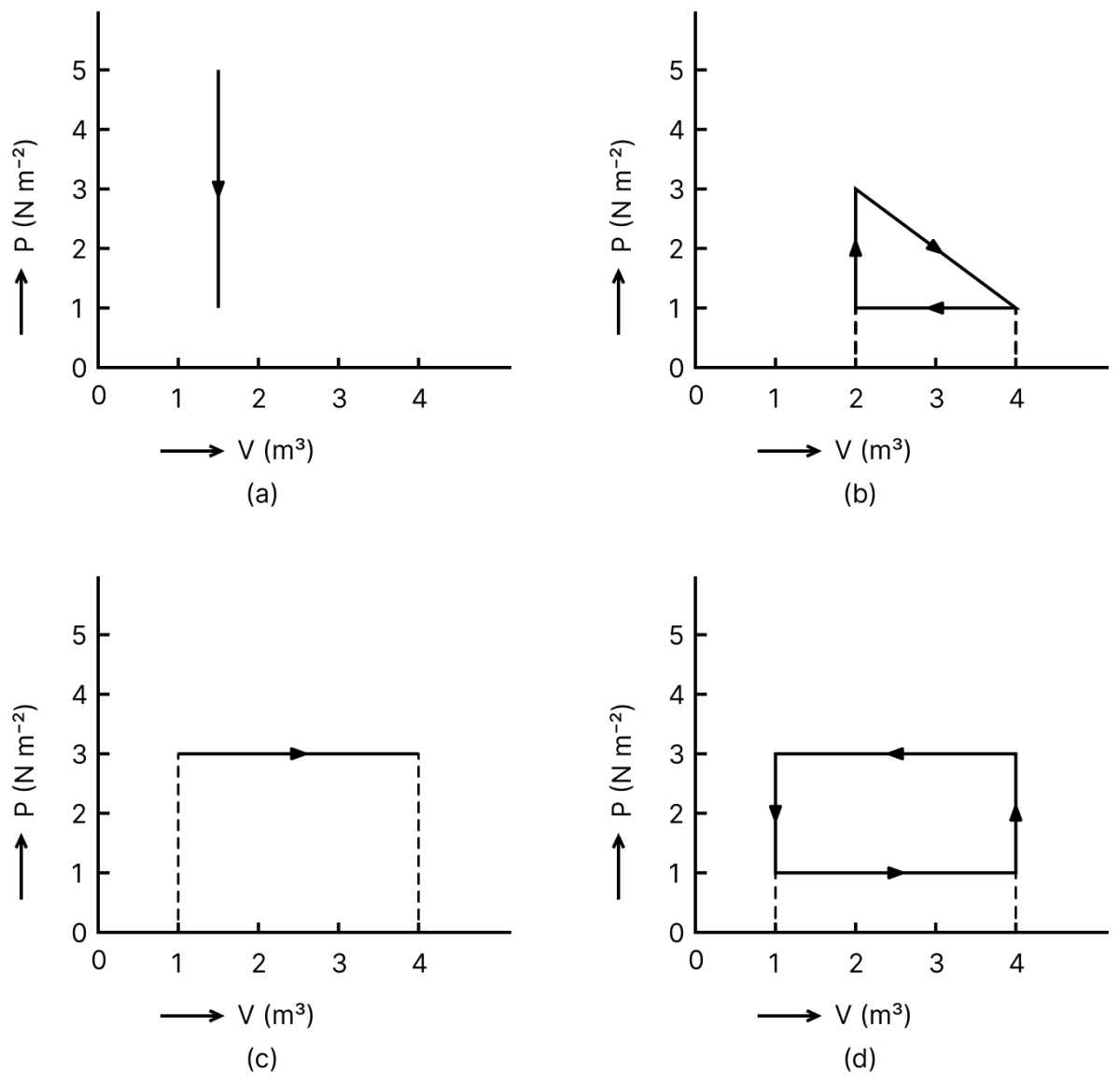
Answer
The work done in a thermodynamic process is equal to the area enclosed between the P-V curve and the volume-axis. It is taken positive when the volume increases (work done by the gas) and negative when the volume decreases (work done on the gas).
(a) The graph is a straight line parallel to the pressure-axis at V = 1.5 m3, so the volume does not change, ΔV = 0. Therefore
Hence the work done is zero.
(b) The closed figure is a triangle with vertices (2, 1), (2, 3) and (4, 1), traced clockwise. The work done is the area of this triangle,
Hence 2 J of work is done by the gas.
(c) The graph is a straight line parallel to the volume-axis at the constant pressure P = 3 N m-2, the volume increasing from 1 m3 to 4 m3. Therefore
Hence 9 J of work is done by the gas.
(d) The closed figure is a rectangle between V = 1 m3 and V = 4 m3 and between P = 1 N m-2 and P = 3 N m-2, traced anticlockwise. The magnitude of the work is the area of the rectangle,
Since the cycle is traced anticlockwise, the net work is done on the gas.
Hence 6 J of work is done on the gas.
The initial pressure and volume of a gas are Pi and Vi respectively. They are increased to Pf and Vf (as shown in figure). In which process will more work have to be done : (i) first increasing the volume only and then increasing the pressure, or (ii) first increasing the pressure only and then increasing the volume? Will the change in internal energy of the gas in these processes be different?
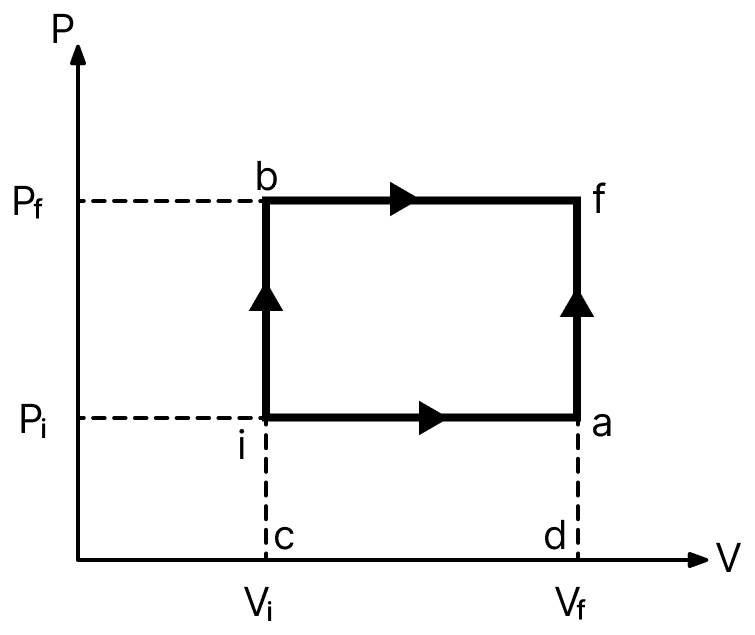
Hint : Work done in the first process iaf = area iadc, in the second process ibf = area bfdc.
Answer
More work will have to be done in the second process, that is, in first increasing the pressure only and then increasing the volume.
The work done is measured by the area enclosed between the P-V curve and the volume-axis.
First process (i a f) : The pressure is first kept at the low value Pi while the volume increases from Vi to Vf, and then the pressure is raised at the constant volume Vf, during which no work is done. Hence
Second process (i b f) : The pressure is first raised at the constant volume Vi, during which no work is done, and then the volume increases from Vi to Vf at the higher constant pressure Pf. Hence
The area bfdc is larger than the area iadc, because in the second process the expansion takes place against the greater pressure Pf. Hence more work is done in the second process.
Change in internal energy : The internal energy is a state function, so its change depends only upon the initial state i and the final state f, which are the same in both the cases. Hence the change in the internal energy of the gas will be the same in the two processes.
In the following table are given some values (in joule) for different processes of a system. Find the unknown.
| Process | Q | W | Ui | Uf | ΔU = Uf − Ui |
|---|---|---|---|---|---|
| 1 | 35 | − 15 | ... | −10 | ... |
| 2 | − 15 | ... | ... | 45 | − 20 |
| 3 | ... | − 20 | 50 | ... | 20 |
Answer
By the first law of thermodynamics,
Process 1 : Given Q = 35 J, W = − 15 J and Uf = − 10 J.
Process 2 : Given Q = − 15 J, Uf = 45 J and ΔU = − 20 J.
Process 3 : Given W = − 20 J, Ui = 50 J and ΔU = 20 J.
Hence the completed table is :
| Process | Q | W | Ui | Uf | ΔU = Uf − Ui |
|---|---|---|---|---|---|
| 1 | 35 | − 15 | − 60 | − 10 | 50 |
| 2 | − 15 | 5 | 65 | 45 | − 20 |
| 3 | 0 | − 20 | 50 | 70 | 20 |
Prove that the difference in the gram-molecular heats (Cp, Cv) of an ideal gas is nearly 2 calorie/(mole-K). Given : R = 8.31 J/(mole-K).
Answer
Given, R = 8.31 J mol-1 K-1.
By Mayer's relation, the difference between the two gram-molecular heats of an ideal gas is
This difference is equal to that amount of heat which is used in doing work against the external pressure in raising the temperature of a gram-molecule of an ideal gas through 1°C at constant pressure.
Expressing R in calorie, and using J = 4.18 J cal-1,
Hence the difference in the gram-molecular heats of an ideal gas is nearly 2 calorie/(mole-K).
How many calories of heat are required for the external work when one gram-molecule (1 mole) of a gas is heated by 1°C at a constant pressure ?
Answer
The difference between Cp and Cv is equal to that amount of heat which is used in doing work against the external pressure in raising the temperature of one gram-molecule of an ideal gas through 1°C at constant pressure. Hence the heat required for the external work is
Converting into calorie, since 4.18 J = 1 cal,
Hence approximately 2 calorie of heat is required for the external work.
Equal masses of helium and oxygen gases are given equal quantities of heat. Which gas will undergo a greater temperature-rise?
Answer
Oxygen will undergo a greater temperature-rise.
Equal masses of the two gases are taken, so the rise in temperature is
where cv is the specific heat per unit mass. For equal masses and equal heat, the gas having the smaller specific heat per unit mass will show the greater rise in temperature.
Helium is monoatomic, so its molar specific heat is , and its molar mass is only 4 g mol-1. Oxygen is diatomic, so , but its molar mass is 32 g mol-1. Hence
Although the molar specific heat of oxygen is the greater of the two, its molar mass is eight times that of helium. Therefore the specific heat per unit mass of helium is much the larger, and one kilogram of helium contains far more molecules than one kilogram of oxygen.
Hence, for equal masses given equal quantities of heat, the temperature-rise of oxygen is greater than that of helium.
Note: The answer given in the textbook is helium. That answer holds when equal numbers of moles are compared, for which the molar specific heats decide the result. The question as set compares equal masses, and then the specific heat per unit mass decides it, which reverses the conclusion in favour of oxygen.
A mixture of oxygen and inflammable gas is burnt in a 'closed' vessel placed in water. The temperature of water rises. Consider mixture as the system. (i) Has heat been given to the water ? (ii) Has work been done on water ? (iii) Has there been any change in the internal energy of water?
Answer
(i) Yes, heat has been transferred from the system to the water. The mixture burns in the vessel and gives out heat, which is taken by the surrounding water; that is why the temperature of the water rises.
(ii) No, the external work has not been done, because the vessel is closed and so the volume of the system remained constant, giving W = P × ΔV = 0.
(iii) Yes, the internal energy of the water has increased. Applying the first law of thermodynamics ΔU = Q − W to the water, here Q is positive (heat has been taken by the water) and W = 0. Thus ΔU is positive, that is, the internal energy of the water has increased.
There is a box whose walls are thermally insulated. It is divided into two parts by a screen. One part is filled with an ideal gas while the other is perfectly evacuated. The screen bursts suddenly and the gas spreads in the whole box. State with reason, what will be the effect on the internal energy and the temperature of the gas. What if the gas were real?
Answer
For an ideal gas : In this expansion neither any exchange of heat takes place (Q = 0), because the box is thermally insulated, nor any external work is done (W = P × ΔV = 0), because the expansion takes place into vacuum where P = 0. Hence by the first law of thermodynamics,
Thus there is no change in the internal energy of the gas. Since the internal energy of an 'ideal' gas depends only upon the temperature, the temperature also remains unchanged.
For a real gas : Among the molecules of a real gas there is mutual attraction, and so internal work will be done against it in the expansion of the gas. Hence the internal energy will decrease and the temperature will also fall.
The efficiency of Carnot's engine can be increased either by increasing the temperature T1 of the source or by decreasing the temperature T2 of the sink. Which method would you prefer and why?
Answer
The method of decreasing the temperature T2 of the sink is preferable.
The efficiency of Carnot's engine is
The efficiency η can be increased either by increasing T1 or by decreasing T2. Since T2 is smaller than T1, a given decrease in T2 changes the ratio by a larger amount than an equal increase in T1.
Hence a decrease in T2 will be more effective than an equal increase in T1.
Ocean contains enormous amount of heat energy. Can we drive a ship across the ocean by utilising this energy?
Answer
It is an attractive idea to drive a ship on the energy drawn from the internal energy of the water of the ocean. At the start of its cycle the engine of the ship will draw some heat Q1 from the water and convert a part of it into work, but where would it reject the rest?
By the second law of thermodynamics, the engine must reject some heat to a colder reservoir, but none is available at hand. Theoretically it is possible if we can arrange some conveyance to the cold upper atmosphere, but the practical difficulties make it almost impossible.
From Carnot's cycle also we see that the efficiency is
Thus η = 0 if T2 = T1, that is, without a temperature-difference the conversion of thermal energy into mechanical work is impossible.
Is it possible to attain the absolute zero of temperature in the freezing compartment of a refrigerator? Explain.
Answer
No, it is not possible.
The coefficient of performance of an 'ideal' refrigerator is given by
Obviously, K becomes vanishingly small as the temperature T2 of the freezer, from which heat is taken, approaches absolute zero. This means that as the freezer becomes more and more cold, the refrigerator finds it more and more difficult to run.
Therefore it is impossible to take the freezer down to T2 = 0 K.
In cold countries heat pumps are used in winter to transfer heat from some source (such as a pond of water) to the interior of houses. Do they violate the laws of thermodynamics?
Answer
No, they do not violate the laws of thermodynamics.
A heat pump transfers heat from some cold place to a hotter place at the expense of energy supplied externally by a motor. The Clausius statement of the second law forbids such a transfer only when it takes place without the expenditure of work by an external energy source.
Since the necessary work is here supplied by the motor, the heat pump does not violate any law of thermodynamics.
The graph shows the variation of the product PV with respect to the pressure (P) of given masses of three gases A, B and C. The temperature is kept constant. State with proper argument which of the three gases is ideal.
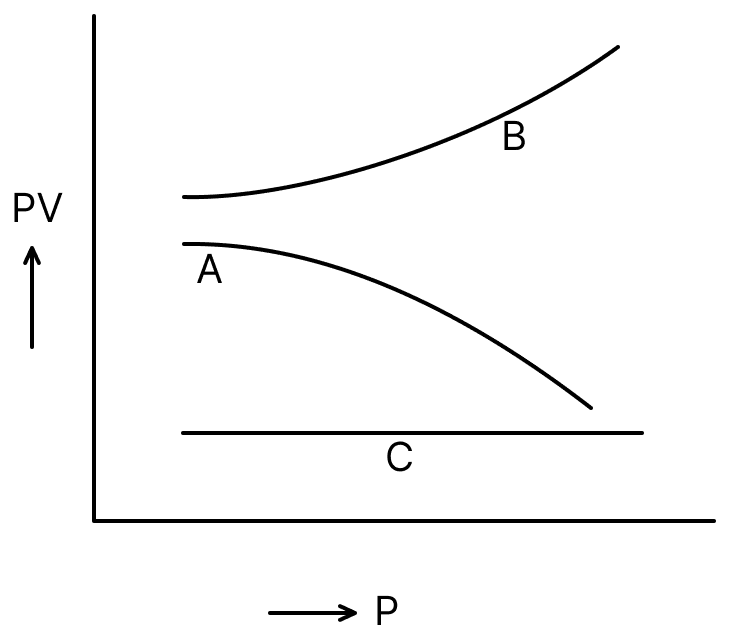
Answer
Gas C is ideal.
For a given mass of an ideal gas at a constant temperature, Boyle's law gives
that is, the product PV should not change however the pressure P is varied. In the graph, the line for the gas C is parallel to the pressure-axis, showing that PV remains constant for it at all pressures.
For the gases A and B the product PV changes with the pressure, so they do not obey Boyle's law at all pressures and are therefore not ideal.
Give two examples of reversible processes.
Answer
A truly reversible process is an ideal conception, not realisable in practice. However, the following two processes are approximately reversible :
(i) An extremely slow isothermal expansion or compression of a so-called perfect gas contained in a cylinder at room temperature and fitted with a smoothly-moving piston.
(ii) An extremely slowly carried extension or contraction of an elastic spring.
Show that the heat transfer through a finite temperature difference is irreversible.
Answer
Suppose there are two bodies 1 and 2 at temperatures T1 and T2, where T1 > T2. When they are brought into contact, heat flows by conduction from body 1 to body 2 till they reach a common temperature.
Heat cannot flow in the reverse direction, from body 2 to body 1, because heat-flow by itself from a cold body to a hot body is not allowed by the second law of thermodynamics.
Thus heat-conduction through a finite temperature difference is an irreversible phenomenon.
A gas expands from a volume V1 to V2 (as shown in figure) in (i) isobaric (ii) isothermal and (iii) adiabatic process. Write which of these processes are denoted by these three curves AB, AC & AD. What does the product P ΔV indicate? For which out of these three processes it is maximum?
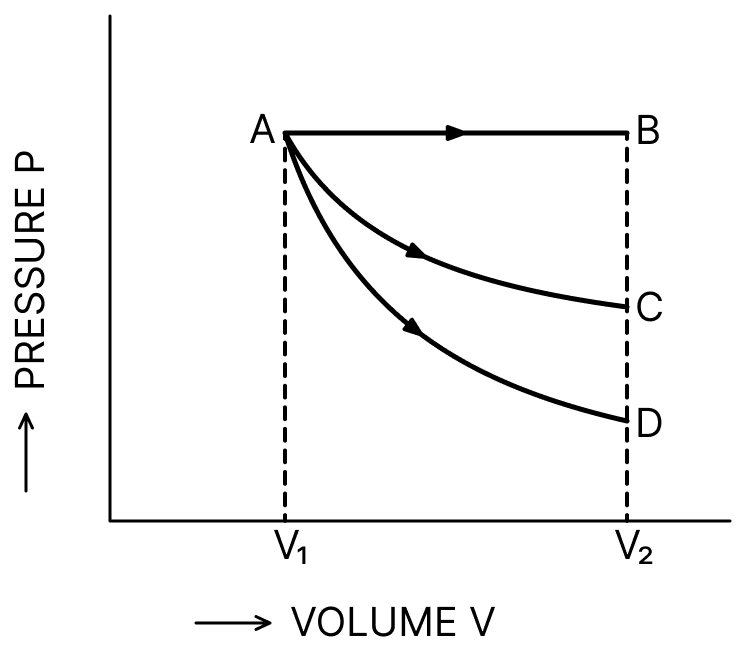
Answer
AB is the isobaric process, since along it the pressure remains constant, the curve being parallel to the volume-axis.
AC is the isothermal process, since its slope is smaller than that of the adiabatic curve.
AD is the adiabatic process, since the slope of an adiabatic curve is greater than the slope of an isothermal curve at the same point, the ratio of the slopes being γ.
The product P ΔV denotes the work done on the gas or by the gas.
The work done is measured by the area enclosed between the curve and the volume-axis. Since for the same change of volume from V1 to V2 the curve AB encloses the largest area, the work done is maximum for the isobaric process AB.
Three students obtained the following three sets of Cp and Cv for a gas. Which one of these is most reliable? All values are in calorie/(mol–K). (i) Cp = 5.0, Cv = 3.0; (ii) Cp = 6.0, Cv = 4.0; (iii) Cp = 4.2, Cv = 3.0.
Hint : For a gas, the difference between Cp and Cv is nearly 2 cal/(mol-K). The ratio of Cp and Cv should be either 1.67 or 1.41.
Answer
For a gas the difference between Cp and Cv should be nearly 2 cal/(mol-K), by Mayer's relation, and the ratio should be either 1.67, for a monoatomic gas, or 1.41, for a diatomic gas.
(i) Cp = 5.0, Cv = 3.0 :
Both the conditions are satisfied.
(ii) Cp = 6.0, Cv = 4.0 :
The difference is correct, but the ratio is neither 1.67 nor 1.41.
(iii) Cp = 4.2, Cv = 3.0 :
The ratio is correct, but the difference is not nearly 2.
Hence the first set (i) is the most reliable.
What is isothermal process? Give example. For an isothermal process in an ideal gas write relation between pressure and volume.
Answer
Isothermal process : When a system undergoes a physical change under the condition that the temperature of the system remains constant, then such a process is called an 'isothermal process'. For such a process to take place, it is necessary that the system be surrounded by a perfectly conducting material and that the process be carried out very slowly, so that heat finds sufficient time to flow.
Examples : The melting of ice at 0°C and the boiling of water at 100°C are isothermal changes, since the temperature remains constant throughout.
Relation between pressure and volume : For an ideal gas an isothermal process obeys Boyle's law, that is, for a given mass of gas at constant temperature,
What is adiabatic process? Give example. For an adiabatic process in an ideal gas write relation between pressure and volume.
Answer
Adiabatic process : When a system undergoes a change under the condition that no exchange of heat takes place between the system and the surroundings, then such a process is called an 'adiabatic process'. For such a process to take place, it is necessary that the system be perfectly insulated from the surroundings, or that the process be carried out very rapidly, so that the heat does not find time to flow in or out.
Examples : The sudden bursting of a bicycle tube and the sudden expansion of the air coming out of a burst balloon are adiabatic changes.
Relation between pressure and volume : For an ideal gas an adiabatic process obeys Poisson's law, that is,
where is the ratio of the two specific heats of the gas.
Of the two curves PQ and PR in the given graph, which one would represent an adiabatic expansion?
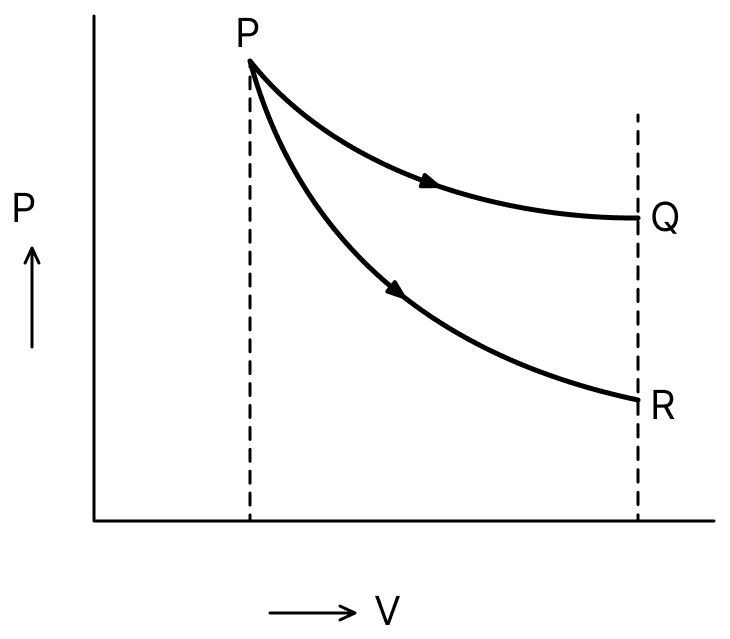
Answer
The curve PR represents the adiabatic expansion.
Of the two curves, the slope of the adiabatic curve is greater than the slope of the isothermal curve at the same point, the ratio of the two slopes being
and γ is always greater than 1.
The reason is that in both the isothermal and the adiabatic expansions the pressure of the gas falls, but for the same fall in pressure the increase in the volume of the gas during the adiabatic expansion is less than that during the isothermal expansion, because during the adiabatic expansion the temperature of the gas also falls.
Since the curve PR is steeper than the curve PQ, PR is the adiabatic expansion.
Thermodynamics is a pivotal branch of physics that examines the complex relationships between heat, work and energy. It fundamentally investigates how energy is transferred and transformed within various systems, particularly those involving parameters like temperature, pressure and volume. By studying thermodynamics, we gain essential insights into the flow of energy and the natural processes that govern our universe. For instance, it helps to explain phenomena such as the natural melting of ice and why reversing such processes without external energy is impossible. The principles of thermodynamics go beyond engines and refrigerators and apply to virtually all aspects of nature.
Thermodynamics acts as a bridge between thermal physics and mechanics. Thermal physics focuses on the behaviour of heat, temperature and energy exchanges, explaining how heat flows from a hotter object to a cooler one. Key concepts include temperature, heat transfer and internal energy. On the other hand, mechanics deals with the motion of objects and the forces acting on them, such as work, kinetic and potential energy, pressure and volume. Mechanics provides the framework for understanding how forces cause motion and how energy can be transferred to do work.
Thermodynamics combines these two fields by investigating how thermal energy can be transformed into mechanical work. For instance, the expansion of gas in a piston converts heat energy into mechanical work, illustrating how thermodynamics links thermal energy flow with the physical performance of mechanical tasks. This interplay between heat and work highlights the significance of thermodynamics as a unifying theory that helps explain numerous physical phenomena in both natural and engineered systems.
(i) What does thermodynamics primarily study?
- The motion of objects
- The transfer and transformation of energy
- The composition of chemical substances
- The behaviour of magnetic fields
(ii) Which of the following is a key concept in thermal physics?
- Work
- Kinetic energy
- Heat transfer
- Potential energy
(iii) What concept connects thermodynamics with mechanics?
- Heat flow
- Work
- Temperature
- Volume
(iv) Which law explains why heat moves from a hotter object to a cooler one?
- First Law of Thermodynamics
- Zeroth Law of Thermodynamics
- Second Law of Thermodynamics
- Third Law of Thermodynamics
(v) In thermodynamics, what happens when a system reaches thermal equilibrium?
- Energy is destroyed
- Heat transfer stops
- The temperature becomes infinite
- Pressure increases exponentially
Answer
(i) The transfer and transformation of energy
Thermodynamics is concerned with how energy is transferred and transformed within systems, particularly those involving temperature, pressure and volume. The motion of objects is the subject of mechanics, not of thermodynamics.
(ii) Heat transfer
Thermal physics focuses on the behaviour of heat, temperature and energy exchanges, and explains how heat flows from a hotter object to a cooler one. Work, kinetic energy and potential energy are the key concepts of mechanics.
(iii) Work
Thermodynamics combines thermal physics and mechanics by investigating how thermal energy can be transformed into mechanical work. For instance, the expansion of a gas in a piston converts heat energy into mechanical work, which is exactly where the two fields meet.
(iv) Second Law of Thermodynamics
The second law states that heat flows naturally from a hotter object to a cooler one until thermal equilibrium is reached, and that the reverse flow cannot take place of itself without external work.
(v) Heat transfer stops
When a system reaches thermal equilibrium, the temperatures of the systems in contact become equal and there is no further net transfer of heat energy between them.
A Carnot engine is a theoretical construct used to define the maximum efficiency possible for a heat engine operating between two thermal reservoirs. The working principle of a Carnot engine relies on the second law of thermodynamics, which asserts that it is impossible to transfer heat from a cooler body to a hotter body without external work being performed. The Carnot cycle consists of four stages: two isothermal processes and two adiabatic processes. During an isothermal expansion, the gas absorbs heat from the hot reservoir, doing work on its surroundings while maintaining a constant temperature. In the adiabatic process that follows, the gas expands without gaining or losing heat and its temperature decreases. The cycle is completed by an isothermal compression, where the gas releases heat to the cold reservoir and an adiabatic compression that brings the gas back to its original state.
The Carnot engine illustrates key thermodynamic concepts such as the conversion of heat into work, the role of entropy and the irreversible nature of real processes. While no real engine can achieve the perfect efficiency of a Carnot engine due to practical limitations, the Carnot cycle serves as a benchmark for the efficiency of all heat engines. The second law of thermodynamics dictates that the efficiency of any real engine will always be less than that of a Carnot engine operating between the same two temperatures.
(i) What does the second law of thermodynamics suggest about heat transfer in a Carnot engine?
- Heat can flow spontaneously from cold to hot.
- Heat flows naturally from hot to cold.
- Work is not required for heat transfer.
- Heat is created in the engine.
(ii) Which process in a Carnot cycle involves the absorption of heat while keeping the temperature constant?
- Adiabatic expansion
- Adiabatic compression
- Isothermal expansion
- Isothermal compression
(iii) What limits the efficiency of real heat engines compared to a Carnot engine?
- Constant temperature
- Perfect insulation
- Irreversibility of real processes
- Unlimited heat supply
(iv) In an adiabatic process, what happens to the gas temperature when it expands?
- Increases
- Decreases
- Remains constant
- Oscillates
(v) What is the significance of the Carnot cycle for real-world engines?
- It shows that real engines can be more efficient than a Carnot engine.
- It defines the maximum theoretical efficiency any heat engine can achieve.
- It operates at 100% efficiency in real conditions.
- It proves that heat engines are impractical.
Answer
(i) Heat flows naturally from hot to cold.
The second law of thermodynamics asserts that heat flows of itself from a hotter body to a cooler body, and that it is impossible to transfer heat from a cooler body to a hotter body unless external work is performed.
(ii) Isothermal expansion
In the first process of the Carnot cycle the gas absorbs heat from the hot reservoir and does work on its surroundings while its temperature remains constant. This is the isothermal expansion.
(iii) Irreversibility of real processes
Real processes are not reversible and involve friction, heat loss and other inefficiencies. These irreversibilities reduce the efficiency of a real engine below that of the ideal Carnot engine.
(iv) Decreases
In an adiabatic expansion no heat is exchanged, so the gas does work on its surroundings at the expense of its own internal energy. The internal energy therefore falls and the temperature decreases.
(v) It defines the maximum theoretical efficiency any heat engine can achieve.
The Carnot cycle sets the upper limit for the efficiency of any heat engine working between the same two temperatures. Real engines can approach this limit but can never exceed it, because of practical limitations.
Consider a heat engine that operates between a high-temperature reservoir at 500 K and a low-temperature reservoir at 300 K. The engine undergoes a cyclic process in which it absorbs 600 J of heat from the hot reservoir during the isothermal expansion phase. The engine then performs work by converting a portion of this heat into mechanical energy. During the isothermal compression phase, the engine releases 400 J of heat to the cold reservoir. The rest of the process involves adiabatic expansion and compression, where no heat is exchanged, but the temperature of the gas changes. The efficiency of the engine is determined by the amount of work done divided by the heat absorbed during the isothermal expansion. According to the second law of thermodynamics, no heat engine can have 100% efficiency, but the Carnot engine offers the highest efficiency possible for engines operating between the same temperatures.
(i) What is the total work done by the engine in one cycle?
- 600 J
- 200 J
- 400 J
- 500 J
(ii) What is the thermal efficiency of this engine?
- 33.3%
- 50%
- 66.7%
- 75%
(iii) How does the second law of thermodynamics limit the engine's efficiency?
- It requires that all heat is converted to work.
- It states that some energy is always lost as heat.
- It allows for 100% conversion of heat to work.
- It ensures heat can only flow from cold to hot.
(iv) In which phase of the engine's cycle does no heat exchange occur?
- Isothermal expansion
- Isothermal compression
- Adiabatic expansion
- Isothermal heating
(v) What would be the Carnot efficiency for a heat engine operating between 500 K and 300 K?
- 50%
- 40%
- 66.7%
- 33.3%
Answer
Given,
- Temperature of the hot reservoir, T1 = 500 K
- Temperature of the cold reservoir, T2 = 300 K
- Heat absorbed from the hot reservoir, Q1 = 600 J
- Heat released to the cold reservoir, Q2 = 400 J
(i) 200 J
In one complete cycle the working substance returns to its original state, so there is no net change in its internal energy. By the first law of thermodynamics, the work done by the engine is the difference between the heat absorbed and the heat released,
(ii) 33.3%
The efficiency is the ratio of the work done to the heat absorbed during the isothermal expansion,
(iii) It states that some energy is always lost as heat.
The second law ensures that not all the absorbed heat can be converted into work; some heat is always rejected to the cold reservoir. Hence the efficiency can never be 100%.
(iv) Adiabatic expansion
In an adiabatic process no heat is exchanged with the surroundings, though the temperature of the gas changes. The isothermal expansion and the isothermal compression both involve heat exchange.
(v) 40%
The Carnot efficiency for an engine operating between the two temperatures is
A fixed amount of matter enclosed with a surface is called a system. Everything outside the system under consideration is called surroundings. The sum of kinetic energy and potential energy of all the constituent particles of a system is called its internal energy. Internal energy of a thermodynamic system depends on the state of the system. If an amount of heat Q is given to a system, a part of it will be used in increasing the internal energy (ΔU) of the system and the rest in doing work (W) by the system, then,
This relation is called first law of thermodynamics.
(i) In an adiabatic process 50 J work is done on the system. Find change in internal energy of the system.
(ii) Find change in internal energy of a system, if 200 J heat is given to the system and 100 J work is done by the system.
(iii) Which type of motion of the molecules is responsible for the internal energy of a monoatomic gas?
Answer
(i) Given, work done on the system = 50 J, so W = − 50 J. The process is adiabatic, so the exchange of heat Q = 0.
From the first law of thermodynamics,
Hence the internal energy of the system increases by 50 J.
(ii) Given, heat given to the system, Q = 200 J, and work done by the system, W = 100 J.
From the first law of thermodynamics,
Hence the internal energy of the system increases by 100 J.
(iii) In a monoatomic gas the molecules consist of single atoms, so only translational motion takes place. Hence the translational motion of the molecules is responsible for the internal energy of a monoatomic gas.
The first law of thermodynamics states the equivalence of mechanical work and heat. There is no restriction in first law of thermodynamics for work completely converting into heat. We know by experience that work cannot be completely converted into heat. It is impossible to convert all the heat extracted from a hot body into work. This law is called second law of thermodynamics. A device by which heat is converted into mechanical work is called a heat engine. The ratio of net work done (W) by the engine during one cycle to the heat taken in form the source (Q) in one cycle, is called efficiency of the heat engine.
(i) A Carnot engine is working between 0°C and 100°C. Calculate its efficiency.
(ii) If the above Carnot engine takes up 746 J of heat from the source per cycle, then find work done by the engine per cycle.
(iii) Also, find heat rejected to the sink per cycle.
Answer
Given,
- The Carnot engine works between 0°C and 100°C
- Temperature of the source, T1 = 100°C = 100 + 273 = 373 K
- Temperature of the sink, T2 = 0°C = 0 + 273 = 273 K
- Heat taken from the source per cycle, Q1 = 746 J
(i) Efficiency of the engine : The efficiency of a Carnot engine is
(ii) Work done by the engine per cycle : The efficiency is the ratio of the work done to the heat taken in from the source,
(iii) Heat rejected to the sink per cycle : The heat rejected is the difference between the heat taken in and the work done,
Hence the efficiency is 26.8%, the work done per cycle is 200 J and the heat rejected to the sink per cycle is 546 J.
Write the value of mechanical equivalent of heat J : in joule-calorie-1 and in joule-kilocalorie-1. Is J a physical quantity or only a 'conversion factor'? Explain with reason.
Answer
Value of the mechanical equivalent of heat J :
J is not a physical quantity; it is simply a 'conversion factor'.
Reason : Joule performed a number of experiments to establish a relation between heat and work. He found that 4.18 × 10³ joule of work produces the same temperature-rise as 1 kilocalorie of heat, and he obtained the same result in every case, whatever the manner of doing the work and whatever the substance used. Thus he concluded that
Hence, if Q calorie of heat is equivalent to W joule of work, then
Here Q is in calorie. Therefore, in order to express Q calorie of heat in joule, it is multiplied by 4.18. Since heat and work are both forms of energy, and are therefore the same physical quantity, the number 4.18 merely converts a measurement expressed in one unit into the same measurement expressed in another unit.
Hence J is not a physical quantity; it is called the 'mechanical equivalent of heat' and is simply a conversion factor.
Explain the equation dQ = dU + P dV. Which law of thermodynamics does it express? Explain the concept of internal energy on the basis of this equation.
Answer
Explanation of the equation dQ = dU + P dV :
Suppose an infinitesimally small amount of heat dQ is given to a system. A part of it is used in increasing the internal energy of the system by dU, and the rest is used by the system in doing external work. If the system expands by a volume dV against a constant external pressure P, then the external work done is P dV. Hence
This equation expresses the first law of thermodynamics. It is simply the law of conservation of energy applied to a thermodynamic system.
Concept of internal energy on the basis of this equation :
Writing the equation as dU = dQ − P dV, let a system be taken from an initial state A to a final state B by a process 1. Let Q1 be the heat taken by the system and W1 the work done by the system, so that the difference is (Q1 − W1).
Now let the same change of state A → B be brought about by other different processes 2, 3, 4, ..., for which the corresponding differences are (Q2 − W2), (Q3 − W3) and so on. It is found experimentally that
Thus, although the heat transferred Q and the work done W are individually different for different processes, their difference is the same for all of them. This means that the difference (Q − W) for two given states of a system depends only upon those states and does not depend upon the path adopted by the system between the two states.
This quantity is defined as the change in the internal energy of the system, ΔU. Hence the internal energy U of a thermodynamic system is a characteristic property of the state of the system; it does not matter how that state has been obtained. U is a unique function, because it depends only upon the state of the system.
Explain the process of freezing of water as an example of first law of thermodynamics. (Remember that the volume of ice is greater than the volume of water of the same mass).
Answer
Let a mass m of water freeze into ice at the freezing point.
Heat given up : In freezing, the water gives up heat. If L be the latent heat of freezing, the heat given up by the water is
the negative sign appearing because the heat is given up by the water and not taken by it.
Work done : When water freezes, its volume increases, since the volume of ice is greater than the volume of water of the same mass. Therefore the water has to do work against the external atmospheric pressure. If P be the atmospheric pressure and ΔV the increase in volume, then the work done by the system is
which is positive, since the volume increases.
Applying the first law of thermodynamics : The change in the internal energy of the water is
Both the terms on the right-hand side are negative, so ΔU is negative.
Hence, when water freezes its internal energy decreases, and this decrease is greater than the heat given up by the water in freezing, the extra decrease being on account of the work done by the water against the atmospheric pressure in expanding.
Compare the formula Cp − Cv = R for an ideal gas with the thermodynamic equation dU = dQ − P dV.
Answer
The thermodynamic equation dU = dQ − P dV can be written as
This means that when an amount of heat dQ is given to an ideal gas, a part of it (dU) is used in increasing the internal energy of the gas and the rest (P dV) is used in doing external work by the expanding gas.
Now, Mayer's formula for an ideal gas is
which may be written as
Comparing the two equations term by term :
- Cp dT is the heat given to one mole of an ideal gas at constant pressure, and so corresponds to dQ.
- Cv dT is the part used in increasing the temperature, that is, in increasing the internal energy of the gas, and so corresponds to dU.
- R dT is the part used in doing work against the external pressure, and so corresponds to P dV.
Hence Mayer's formula is simply the first law of thermodynamics applied to one mole of an ideal gas heated through 1 K at constant pressure, and the universal gas constant R represents the external work done in that process.
Distinguish between reversible and irreversible processes with examples. Discuss conditions for reversibility.
Answer
Reversible process : A reversible process is one which can be reversed in such a way that all changes taking place in the direct process are exactly repeated in the inverse order and opposite sense, and no changes are left in any of the bodies taking part in the process or in the surroundings.
For example, if an amount of heat is supplied to a system and an amount of work is obtained from it in the direct process, the same amount of heat should be obtainable by doing the same amount of work on the system in the reverse process.
Examples : An extremely slow isothermal expansion or compression of a perfect gas contained in a cylinder fitted with a smoothly-moving piston, and an extremely slowly carried extension or contraction of an elastic spring, are approximately reversible.
Irreversible process : Any process which is not reversible exactly is an irreversible process.
Examples : Free expansion, electrical heating of a wire, diffusion of liquids or gases, heat conduction, radiation and radioactive decay are all irreversible. Thus irreversibility is a rule.
Conditions for reversibility : A process can be reversible only when it satisfies the following two conditions :
(i) Dissipative forces such as friction, viscosity, inelasticity, electrical resistance and magnetic hysteresis must be completely absent. Suppose a gas is contained in a cylinder fitted with a piston and placed in contact with a furnace. If the load on the piston is decreased, the gas expands, doing external work in pushing up the piston and also in overcoming the friction between the piston and the walls of the cylinder. If now the load on the piston is increased, the gas is compressed. The work used in pushing up the piston during the expansion is recovered, but not the work used against the friction; on the contrary, more work has to be done against the friction. Thus, due to friction, neither the work done in expansion is fully recovered in compression, nor is the heat taken from the furnace in expansion fully returned to the furnace. The expansion is therefore irreversible.
(ii) The process should take place infinitely slowly. In the above example, when the gas expands, an amount of work is done by the gas to give kinetic energy to the piston. This work cannot be recovered during the reverse process; on the contrary, more work is to be done, again to give kinetic energy to the piston. Hence, in order to make the expansion of the gas reversible, the pressure of the gas on the piston should be only infinitesimally different from the pressure exerted by the piston on the gas. This will be so when the expansion or compression takes place infinitely slowly, so that no kinetic energy is produced.
These conditions are never realised in practice. Hence a reversible process is only an ideal conception.
What is meant by thermodynamic system? What do you mean by cyclic process? Show, by drawing a proper P-V diagram, that the total work done by a thermodynamic system in a cyclic process is equal to the area enclosed by the curve.
Answer
Thermodynamic system : A thermodynamic system refers to that part of the universe on which we are focusing our attention, such as a gas inside a piston or water inside a kettle. Everything outside the system under consideration is called the surroundings. The state of a system is described by the state variables pressure P, volume V, temperature T and internal energy U.
Cyclic process : When a system is taken from an initial state to other different states and is finally brought back to the initial state, then this is called a 'cyclic process'. Since the internal energy is a function only of the state of the system, there is no change in the internal energy in a cyclic process, ΔU = 0. Hence by the first law of thermodynamics,
Work done in a cyclic process :
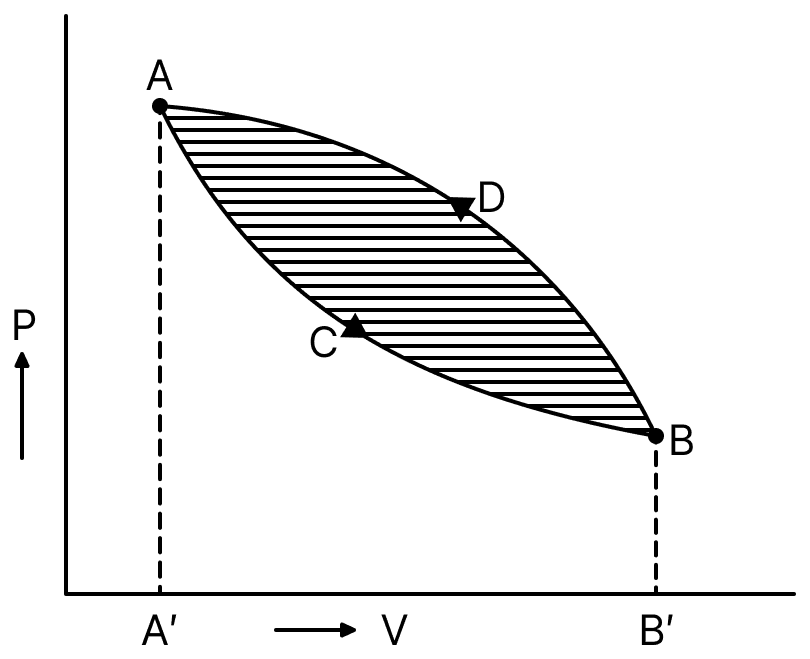
Suppose a gas is in an initial pressure-volume state A and expands to a state B along the curve ACB. Since the volume increases, the work is done by the gas and is equal to the area enclosed between the curve ACB and the volume-axis,
Now suppose the gas is compressed and brought back to the state A along the different curve BDA. Since the volume decreases, the work is now done on the gas by an external agent and is equal to the area enclosed between the curve BDA and the volume-axis,
The area BDAA′B′ is larger than the area ACBB′A′. Hence the work done on the gas is greater than the work done by the gas, and the net work done on the gas is
Hence the total work done by a thermodynamic system in a cyclic process is equal to the area enclosed by the closed curve.
If the closed P-V curve is traced clockwise, the net work is done by the system; if it is traced anticlockwise, the net work is done on the system.
Describe first law of thermodynamics. Apply this law to describe (i) isothermal process, (ii) isochoric process, (iii) adiabatic process.
Answer
First law of thermodynamics : If an amount of heat Q is given to a system, a part of it will be used in increasing the internal energy (ΔU) of the system and the rest in doing work (W) by the system. Thus
If in a process an infinitesimally small heat dQ is given to a system and an infinitesimally small work dW is done by the system, then the change in the internal energy dU will also be infinitesimally small, and
(i) Isothermal process : If during a process taking place in a system the temperature remains constant, then the process is 'isothermal'. In the case of an ideal gas the internal energy depends only upon the temperature of the gas. Therefore, if an ideal gas undergoes an isothermal process, there will be no change in its internal energy, ΔU = 0. Then, from ΔU = Q − W,
Hence, for an isothermal process in an ideal gas, the heat absorbed by the gas is entirely used in the work done by the gas.
(ii) Isochoric process : If a process takes place in a system at a constant volume, then the process is 'isochoric'. Since there is no change in volume (ΔV = 0), no work is done by the system,
Therefore, from ΔU = Q − W,
Hence, in an isochoric process, the entire heat given to the system is used in increasing the internal energy of the system. Explosions in gases are isochoric.
(iii) Adiabatic process : If during a process taking place in a system, heat neither enters the system nor leaves it (Q = 0), then the process is 'adiabatic'. From ΔU = Q − W,
Hence, if work is done on the system (that is, W is negative), then
that is, the internal energy of the system increases. On the other hand, if work is done by the system (that is, W is positive), then
that is, the internal energy of the system decreases.
Why are there two specific heats of a gas? Show that the difference between two specific heats of the gas is equal to the universal gas constant (Cp − Cv = R).
Answer
Why there are two specific heats of a gas : In solids and liquids the specific heat capacity is the amount of heat required to raise the temperature of unit mass of the substance by 1 K. When heat is supplied, the temperature rises uniformly and there is no difference whether the heating takes place at constant volume or at constant pressure, since solids and liquids are nearly incompressible.
For gases, however, the situation is different. Because gases are compressible and can expand significantly when heated, the heat supplied may partly raise the temperature of the gas and partly do external work of expansion in pushing back the surroundings. Hence the amount of heat required depends on the mode of heating — whether the volume is kept constant or the pressure is kept constant. Therefore gases have two specific heat capacities, Cv and Cp.
Deduction of Cp − Cv = R :
Let us consider 1 mole of an ideal gas in equilibrium at a pressure P, volume V and absolute temperature T. Let Cv and Cp be the molar specific heats of the gas at constant volume and at constant pressure respectively.
Heating at constant volume : Let the gas be heated at constant volume so that its temperature is raised by an infinitesimal amount dT. The heat supplied will be Cv dT. As the volume remains constant, the external work done is zero. From the differential form of the first law of thermodynamics,
Here dQ = Cv dT and dW = 0, so that
Heating at constant pressure : Let the same gas now be heated at constant pressure P, until the temperature is raised by the same amount dT. The heat supplied will be Cp dT. Now the gas would expand and do external work against the pressure P. If dV be the change in volume of the gas, the external work would be P dV. Thus, for this process dQ = Cp dT and dW = P dV. Hence, from the first law of thermodynamics,
The temperature-change is the same in both the processes. Since the internal energy U of an ideal gas depends only on the temperature, the change in internal energy dU is the same in both the processes. Then, eliminating dU from equations (i) and (ii), we get
Now, the equation of state for 1 mole of an ideal gas is
where R is the universal gas constant. Differentiating it, keeping P constant, we get
Substituting this value of P dV in equation (iii),
Hence the difference between the two molar specific heats of an ideal gas is equal to the universal gas constant. This relation is known as Mayer's relation.
What is a heat engine and what is its efficiency? Hence, show that the engine cannot convert 'all' the heat taken from a hot source into work.
Answer
Heat engine : Any 'cyclic' device by which heat is converted into mechanical work is called a heat engine.
There are three main parts in an engine : a hot body called the source, a working substance and a cold body called the sink. The working substance takes in heat from the source, converts a part of it into useful work and gives out the rest to the sink. This series of processes is called a 'cycle', since the working substance returns to its original state. By repeating the same cycle over and over again, work can be continuously obtained.
Efficiency : Suppose the working substance takes in an amount of heat Q1 from the source and gives out an amount Q2 to the sink, and suppose W is the amount of work obtained. The net amount of heat absorbed by the substance is (Q1 − Q2), which has been actually converted into work. Applying the first law of thermodynamics to one complete cycle, in which there is no net change in internal energy, we get
The efficiency η of an engine is defined as the ratio of the net work done by the engine during one cycle to the heat taken in from the source in one cycle. Thus
The engine cannot convert 'all' the heat into work :
From the above expression, the efficiency of the heat engine would be unity, that is 100%, only when
This means that no heat at all should be given out to the sink. But by the Kelvin-Planck statement of the second law of thermodynamics, it is impossible to convert 'all' the heat extracted from a hot body into work. No engine has ever been designed which may convert all the heat taken from the source into work, without giving any heat to the sink. In other words, for obtaining continuous work, a sink is necessary.
Since Q2 is always less than Q1 but never zero, the value of η is always less than 1.
Hence the engine cannot convert all the heat taken from a hot source into work.
Describe Carnot's reversible heat engine and obtain an expression for its efficiency. Can you realise it in practice?
Answer
Carnot's reversible heat engine : Carnot developed the plan of an idealised heat engine, free from all the imperfectness of an actual engine.
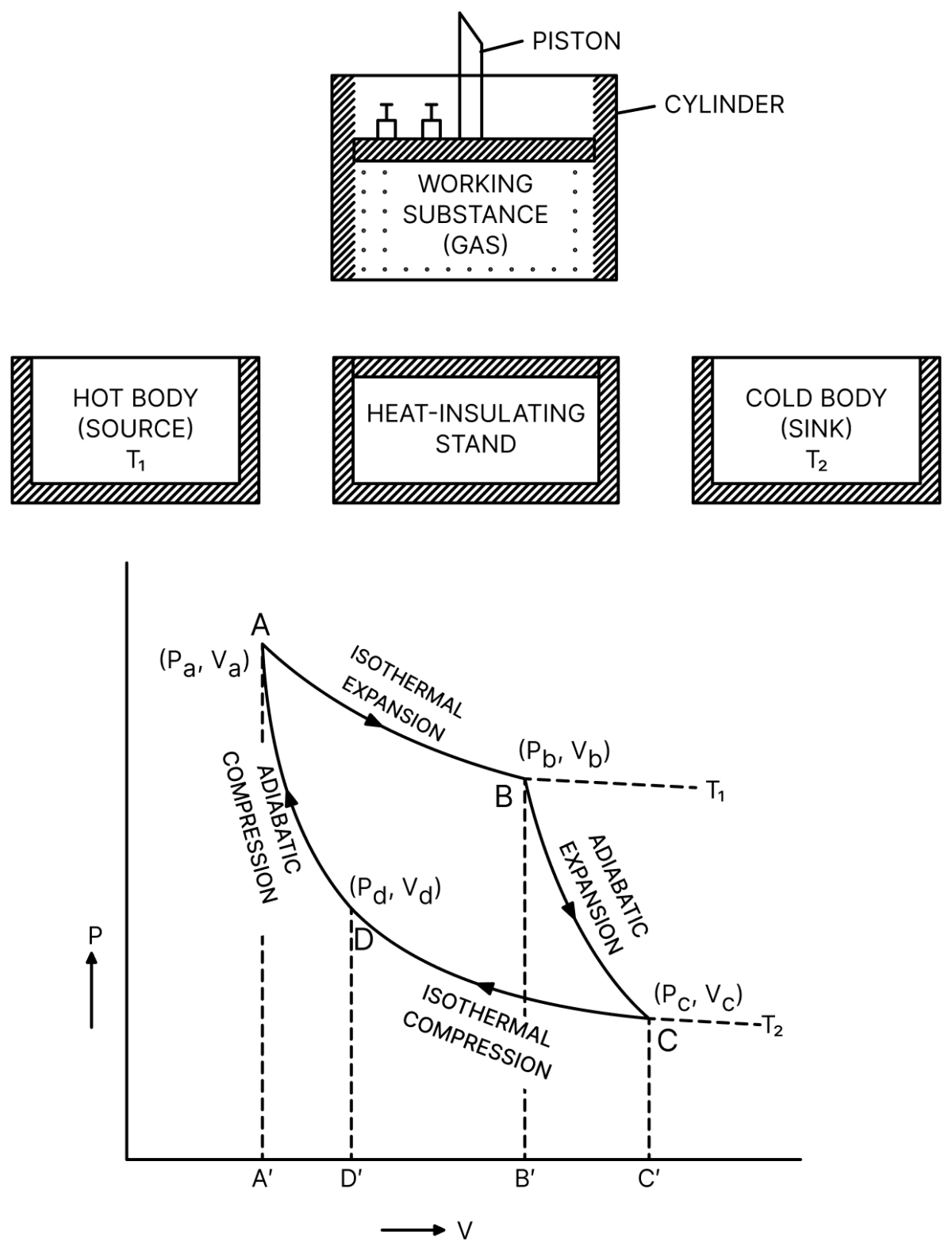
The Carnot's engine consists of four components :
(i) A cylinder with perfectly heat-insulating walls but a perfectly conducting base and closed with a tight-fitting perfectly insulating and frictionless piston. A fixed mass of a gas (working substance) is filled in the cylinder, and some weights are placed on the piston of the cylinder.
(ii) A hot body of infinitely large heat capacity at a constant temperature T1, serving as the 'source'.
(iii) A cold body of infinitely large heat capacity at a constant temperature T2, serving as the 'sink'.
(iv) A perfectly heat-insulating stand.
The working substance is imagined to go through a cycle of four processes, known as the "Carnot's cycle". Suppose it is in an initial state represented by the point A on the P-V diagram.
Process 1 : The cylinder is placed on the source and the weights on the piston are removed in infinitely small steps. The working substance thus expands infinitely slowly, doing work in raising the piston. During this process the substance takes in heat Q1 from the source by conduction through the base. Thus the expansion is isothermal. It is continued until the state represented by the point B is reached. The curve AB represents the isothermal expansion of the substance at the constant temperature T1.
Process 2 : The cylinder is removed from the source and placed on the heat-insulating stand. The weights are further removed so that the substance is further expanded. This expansion is adiabatic, because now no heat can leave or enter the substance through the insulating cylinder. The substance does work in raising the piston and its temperature falls, until it becomes T2. This adiabatic expansion is represented by the curve BC.
Process 3 : The cylinder is now removed from the stand and placed on the sink. Weights are now placed on the piston in infinitely small steps. The substance is thus compressed isothermally until the state represented by the point D is reached. During this process work is done on the substance and the heat Q2 developed is given out to the sink. The curve CD represents the isothermal compression at the constant temperature T2.
Process 4 : The cylinder is once more put on the heat-insulating stand and, by further placing weights on the piston, the substance is compressed adiabatically. A further amount of work is done on the substance and its temperature rises, until it rises once more to T1 and the state A is recovered. The curve DA represents the adiabatic compression.
The area ABCD represents the net external work W done by the substance in one complete cycle. Since the initial and final states of the substance are the same, there is no net change in its internal energy. Hence, by the first law of thermodynamics,
Expression for the efficiency :
Let (Pa, Va), (Pb, Vb), (Pc, Vc) and (Pd, Vd) be the co-ordinates of the points A, B, C and D respectively, and let the working substance be 1 mole of an ideal gas.
Since the internal energy of an ideal gas remains unchanged during the isothermal expansion AB, the heat Q1 is equivalent only to the external work done by the gas in expanding from A to B at the temperature T1,
Similarly, Q2 is equivalent to the external work done on the gas during the compression from C to D at the temperature T2,
Dividing (i) by (ii),
The points B and C, and similarly the points D and A, lie on the same adiabatic. Therefore, from Poisson's law,
Dividing equation (iv) by equation (v), we get
Using this result in equation (iii), the logarithmic terms cancel and we get
Hence the efficiency of Carnot's engine is
Thus the efficiency of Carnot's reversible engine is independent of the working substance and depends only upon the absolute temperatures of the sink and the source.
Can it be realised in practice? No. Carnot's engine has two ideal features :
(i) The source and the sink are bodies of infinitely large heat capacities, so that the working substance takes in all the heat at a constant temperature and gives up all the heat at another constant temperature.
(ii) Each process in Carnot's cycle is completely reversible, which requires that the working substance be contained in a cylinder with perfectly insulating walls and a perfectly insulating frictionless piston so that dissipative forces are absent, that the base of the cylinder be perfectly conducting, and that the gas be expanded and compressed infinitely slowly.
These features cannot be actually realised. Hence it is not possible to obtain a Carnot's engine in practice.
What is Carnot's ideal refrigerator? Find an expressions for its coefficient of performance.
Answer
Carnot's ideal refrigerator : Any device for removing heat from a cold place and adding it to a hotter place is called a "refrigerator" or a heat pump. It is essentially a heat engine running backwards.
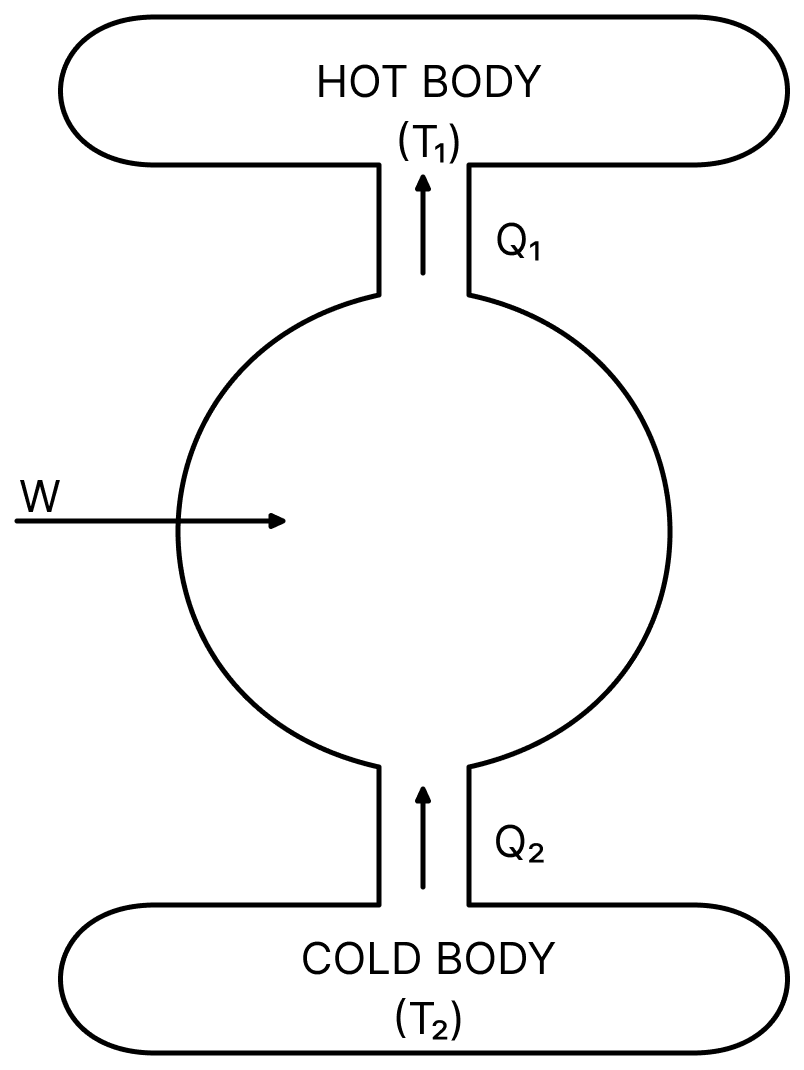
In a heat engine the working substance takes in heat from a body at a higher temperature, converts a part of it into mechanical work and gives out the rest to a body at a lower temperature. In a refrigerator, a working substance takes in heat from a body at a lower temperature, has a net amount of work done on it by an external agent and gives out a larger amount of heat to a hot body. Thus it continually transfers heat from a cold to a hot body at the expense of mechanical energy supplied to it by an external agent. The working substance is called a "refrigerant".
The engine employing the Carnot cycle may be adopted as a refrigerator, since each step in the cycle is reversible and therefore the entire cycle can be reversed.
Expression for the coefficient of performance :
Let Q2 be the heat removed from the cold body at temperature T2, W the net work done on the refrigerant, and Q1 the heat delivered to the hot body at temperature T1. Then
As in Carnot's engine, if we use an ideal gas as the working substance, we can show that
Therefore
This is the expression for the work that must be supplied to run the refrigerator.
Coefficient of performance : The purpose of the refrigerator is to remove as much heat (Q2) as possible from the cold body with the expenditure of as little work (W) as possible. Therefore, a measure of the performance of the refrigerator is expressed by the 'coefficient of performance' K, which is defined as the ratio of the heat taken in from the cold body to the work needed to run the refrigerator. That is
Substituting the value of W obtained above,
This is the expression for the coefficient of performance. A good refrigerator should have a high coefficient of performance, typically 5 or 6. Thicker and high-quality insulation tends to increase the coefficient of performance.
What is an adiabatic process? Establish for a perfect gas the relation connecting absolute temperature T and volume V for adiabatic change.
Answer
Adiabatic process : When a system undergoes a change under the condition that no exchange of heat takes place between the system and the surroundings, then such a process is called an 'adiabatic process'. For such a process to take place, it is necessary that the system be perfectly insulated from the surroundings.
Relation between T and V for an adiabatic change :
For an ideal gas, an adiabatic process obeys Poisson's law, that is, for a given mass of an ideal gas,
where γ is the ratio of the two specific heats Cp and Cv of the gas.
The equation of state for 1 mole of an ideal gas is
Substituting this value of P in Poisson's law,
Since R is also a constant, it can be absorbed into the constant on the right-hand side. Hence
This is the required relation connecting the absolute temperature T and the volume V for an adiabatic change in a perfect gas.
It may also be written for the initial and the final states as
What is an adiabatic process? Establish the relation between the absolute temperature T and the pressure P of an ideal gas.
Answer
Adiabatic process : When a system undergoes a change under the condition that no exchange of heat takes place between the system and the surroundings, then such a process is called an 'adiabatic process'. For such a process to take place, it is necessary that the system be perfectly insulated from the surroundings.
Relation between T and P for an adiabatic change :
For an ideal gas, an adiabatic process obeys Poisson's law,
where γ is the ratio of the two specific heats Cp and Cv of the gas.
The equation of state for 1 mole of an ideal gas is
Substituting this value of V in Poisson's law,
Since R is also a constant, it can be absorbed into the constant on the right-hand side. Hence
This is the required relation between the absolute temperature T and the pressure P of an ideal gas for an adiabatic change.
It may also be written for the initial and the final states as
What is isothermal process? Prove that in isothermal process, the work done by an ideal gas is given by
where symbols have their usual meanings.
Answer
Isothermal process : When a system undergoes a physical change under the condition that the temperature of the system remains constant, then such a process is called an 'isothermal process'. For such a process to take place, it is necessary that the system be surrounded by a perfectly conducting material, so that any heat produced in the process immediately goes out from the system to the surroundings, or any heat absorbed comes from the surroundings into the system, and the temperature of the system remains constant.
Proof of the expression for the work done :
Let μ moles of an ideal gas at the constant absolute temperature T expand from an initial volume Vi to a final volume Vf. Suppose the gas expands by an infinitesimal volume dV against the instantaneous pressure P. The infinitesimal work done by the gas is
The total work done in expanding from Vi to Vf is obtained by integrating between these limits,
From the ideal gas equation for μ moles,
Substituting this value of P in equation (i),
Since the process is isothermal, the temperature T is constant, and μ and R are also constants. Hence they can all be taken outside the integral,
Carrying out the integration,
Evaluating between the limits,
Converting the natural logarithm into the common logarithm, using loge x = 2.3026 log10 x,
Hence proved.
Explain that the internal energy of a thermodynamical system is the characteristic property of the state of the system irrespective of the process by which it has been achieved. State the first law of thermodynamics.
Answer
Internal energy as a characteristic property of the state :
Every bulk system consists of a large number of molecules. The internal energy of the system is simply the sum of the kinetic energy and the potential energy of these molecules, and is denoted by U.
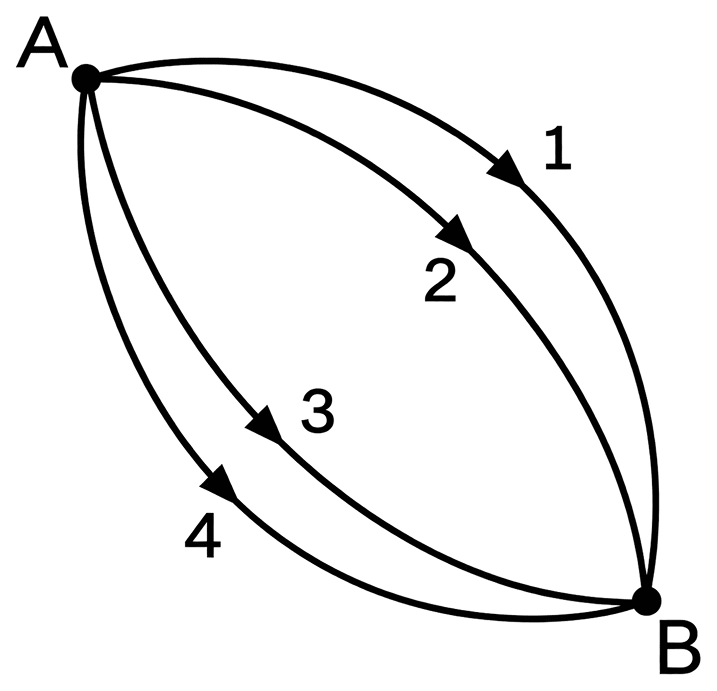
Suppose a system is in an initial state A and is taken to a state B by some process 1. Let Q1 joule be the heat taken by the system and W1 joule the work done by the system in this process. We can compute the difference
Now, suppose we again take the system from the state A to the state B by another process 2. Let Q2 be the heat taken by the system and W2 the work done by the system in this process. We can compute the difference Q2 − W2. Similarly, by taking the system from A to B by other different processes 3, 4, ..., we can compute Q3 − W3, Q4 − W4, and so on. In each case we find that
From this we conclude that in taking a system from one state to another by different processes, the heat transferred Q and the work done W are different, but their difference Q − W is the same for all the processes. This means that the difference Q − W for two given states of a system depends only upon those states; it does not depend upon the path adopted by the system between the two states.
The quantity Q − W is defined as the 'change in the internal energy' of the system and is denoted by ΔU.
Thus, the internal energy U of a thermodynamic system is a characteristic property of the state of the system; it does not matter how that state has been obtained. U is a unique function, because it depends only upon the state of the system. If a system starting from one state passes through different states and finally returns to its initial state, then the change in its internal energy will be zero.
First law of thermodynamics : If an amount of heat Q is given to a system, a part of it will be used in increasing the internal energy (ΔU) of the system and the rest in doing work (W) by the system. Thus
How many types of motions are there in the molecules of a substance? Explain. Which motion represents the temperature ? Why does the internal energy of a gas depend only upon the temperature?
Answer
Types of motion in the molecules of a substance : There are three types of motion in the molecules of a substance :
(i) Translational motion : The molecules move from one place to another in straight lines between collisions. All molecules — of monoatomic, diatomic and polyatomic gases — possess translational motion.
(ii) Rotational motion : The molecules rotate about an axis passing through their centre of mass. Only the molecules having two or more atoms, that is, diatomic and polyatomic molecules, possess rotational motion.
(iii) Vibrational motion : The atoms within a molecule vibrate about their mean positions, as if they were joined by a spring. This motion also occurs only in molecules having two or more atoms, and becomes significant at higher temperatures.
Which motion represents the temperature : Only the energy of the translational motion of the molecules is represented by temperature. The other forms of energy, such as the rotational and vibrational energies and the intermolecular potential energy, are not represented by temperature. This is why, at absolute zero, only the translational motion of the molecules ceases, while the other forms of molecular energy do not become zero.
Why the internal energy of a gas depends only upon the temperature : In an 'ideal' gas the molecules are so far apart that the intermolecular forces of attraction between them are negligible. Hence the mutual potential energy of the molecules is zero, and the internal energy of the gas is wholly the kinetic energy of its molecules. This kinetic energy is directly proportional to the absolute temperature of the gas.
Hence the internal energy of an ideal gas depends only upon its temperature, U = f(T), and not upon its pressure or volume.
For real gases, however, the intermolecular forces are appreciable. When the volume changes at a constant temperature, the distance between the molecules changes and so does their potential energy. Hence for a real gas the internal energy depends upon both the temperature and the volume, U = f(T, V).
On the basis of first law of thermodynamics, prove that the change in internal energy of any system is equal to :
(i) heat given to or heat taken from the system for an isovolumetric process.
(ii) work done by the system or work done on the system in an adiabatic process.
Answer
The first law of thermodynamics states that if an amount of heat Q is given to a system, a part of it is used in increasing the internal energy (ΔU) of the system and the rest in doing work (W) by the system,
(i) For an isovolumetric (isochoric) process :
An isovolumetric process is one which takes place at a constant volume. Since there is no change in the volume of the system,
Therefore the work done by the system is
Substituting W = 0 in the first law of thermodynamics,
Hence, in an isovolumetric process the change in the internal energy of the system is equal to the heat given to or the heat taken from the system. If heat is given to the system, Q is positive and the internal energy increases; if heat is taken from the system, Q is negative and the internal energy decreases.
(ii) For an adiabatic process :
An adiabatic process is one in which heat neither enters the system nor leaves it, that is,
Substituting Q = 0 in the first law of thermodynamics,
Hence, in an adiabatic process the change in the internal energy of the system is equal in magnitude to the work done by the system or the work done on the system.
If work is done on the system, W is negative and
so the internal energy of the system increases. If work is done by the system, W is positive and
so the internal energy of the system decreases.
Write the equation for the first law of thermodynamics and prove that the molar specific heat of an ideal gas at constant pressure is greater than its molar specific heat at constant volume. Obtain also Mayer's formula Cp − Cv = R.
Answer
Equation for the first law of thermodynamics : If an amount of heat Q is given to a system, a part of it will be used in increasing the internal energy (ΔU) of the system and the rest in doing work (W) by the system. Thus
In the differential form, for an infinitesimally small heat dQ given to the system,
Proof that Cp > Cv :
Let us consider 1 mole of an ideal gas in equilibrium at a pressure P, volume V and absolute temperature T. Let Cv and Cp be the molar specific heats of the gas at constant volume and at constant pressure respectively.
Heating at constant volume : Let the gas be heated at constant volume so that its temperature is raised by an infinitesimal amount dT. The heat supplied will be Cv dT. As the volume remains constant, the gas cannot expand and the external work done is zero, dW = 0. From the first law of thermodynamics,
Heating at constant pressure : Let the same gas now be heated at the constant pressure P, until the temperature is raised by the same amount dT. The heat supplied will be Cp dT. Now the gas would expand and do external work against the pressure P. If dV be the change in volume, the external work would be P dV. Hence, from the first law of thermodynamics,
Comparing equations (i) and (ii), we see that in heating at constant pressure the gas requires an extra amount of heat P dV, over and above the heat dU needed to raise its temperature, this extra heat being used in doing external work against the pressure in expansion. In heating at constant volume no such extra heat is needed.
Hence, for the same temperature-rise, more heat is required at constant pressure than at constant volume, that is, Cp > Cv.
Deduction of Mayer's formula :
The temperature-change is the same in both the processes. Since the internal energy U of an ideal gas depends only on the temperature, the change in internal energy dU is the same in both the processes. Then, eliminating dU from equations (i) and (ii), we get
Now, the equation of state for 1 mole of an ideal gas is
where R is the universal gas constant. Differentiating it, keeping P constant, we get
Substituting this value of P dV in equation (iii),
This relation is known as Mayer's formula.
How much maximum work can be done by 100 calories of heat? (J = 4.2 J/cal).
Answer
Given,
- Heat available, Q = 100 calories
- J = 4.2 J cal-1
The maximum work is obtained when the whole of the heat is converted into work. If Q calorie of heat is equivalent to W joule of work, then
Substituting the values,
Hence, the maximum work that can be done by 100 calories of heat is 420 J.
Latent heat of ice is 80 cal/g. Express it in J/kg.
Answer
Given,
- Latent heat of ice, L = 80 cal g-1
- J = 4.18 J cal-1
Converting the calorie into joule and the gram into kilogram,
Hence, the latent heat of ice is 3.34 × 10⁵ J/kg.
Specific heat of water is 1 cal/(g-°C). Express it in J/(kg-°C).
Answer
Given,
- Specific heat of water, c = 1 cal (g-°C)-1
- J = 4.2 J cal-1
Converting the calorie into joule and the gram into kilogram,
Hence, the specific heat of water is 4.2 × 10³ J/(kg-°C).
If in stopping a car of mass 800 kg by applying brakes, 41.8 kcal of heat is produced then what was the speed of the car before applying the brakes ?
Answer
Given,
- Mass of the car, m = 800 kg
- Heat produced, Q = 41.8 kcal
- J = 4.18 × 10³ J kcal-1
When the brakes are applied, the whole of the kinetic energy of the car is converted into heat. Hence
Substituting the values,
Hence, the speed of the car before applying the brakes was 20.9 m/s.
The volume of a gas increases by 0.25 m3 at constant pressure of 103 N/m2. Calculate the work done.
Answer
Given,
- Increase in volume, ΔV = 0.25 m3
- Constant pressure, P = 103 N/m2
Since the pressure remains constant, the work done by the gas is
Substituting the values,
Hence, the work done is 250 J.
A gas expands from 75 litre to 125 L at a constant pressure of 4 atmospheric. If one atmospheric pressure is 1.0 × 10⁵ N/m2, calculate the work done by the gas during this expansion.
Answer
Given,
- Initial volume, V1 = 75 L = 75 × 10-3 m3
- Final volume, V2 = 125 L = 125 × 10-3 m3
- Constant pressure, P = 4 atmosphere = 4 × (1.0 × 105) = 4.0 × 10⁵ N/m2
Since the pressure remains constant, the work done by the gas is
The increase in volume is
Substituting the values,
Hence, the work done by the gas during this expansion is 2.0 × 10⁴ J.
The given diagram shows the P-V graph for a gas.
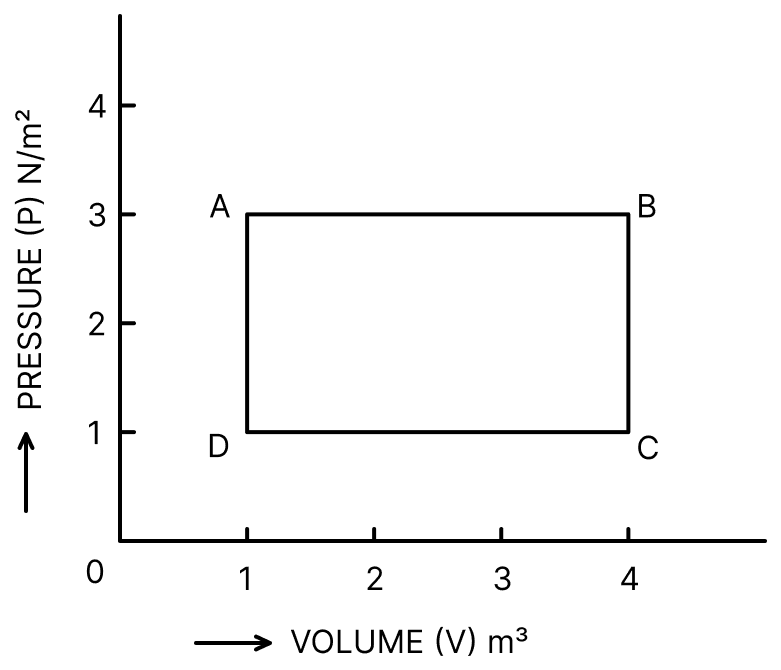
How much work will have to be done in taking the gas from the state A to the state B?
Answer
Given, from the graph,
- Constant pressure along AB, P = 3 N/m2
- Initial volume at A, V1 = 1 m3
- Final volume at B, V2 = 4 m3
Along the path AB the pressure remains constant, so the process is isobaric and the work done is
Substituting the values,
Hence, 9 J of work will have to be done in taking the gas from the state A to the state B.
In the figure, the pressure and the volume of oxygen gas have been shown in different states.
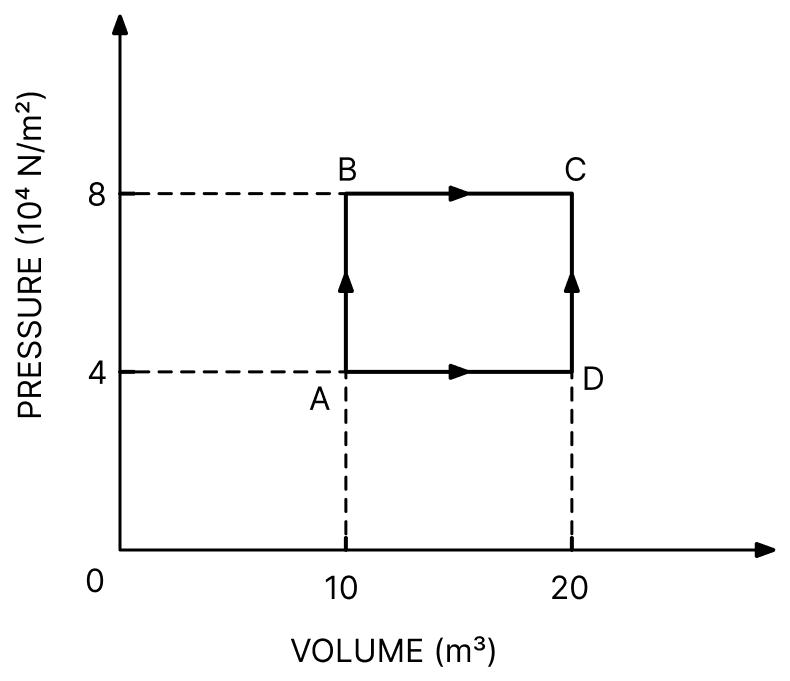
Calculate :
(i) work done by the gas in process ABC,
(ii) work done by the gas in process ADC.
Answer
Given, from the graph,
- At A : P = 4 × 10⁴ N/m2, V = 10 m3
- At B : P = 8 × 10⁴ N/m2, V = 10 m3
- At C : P = 8 × 10⁴ N/m2, V = 20 m3
- At D : P = 4 × 10⁴ N/m2, V = 20 m3
(i) Work done by the gas in the process ABC :
Along A → B the volume remains constant at 10 m3, so the process is isochoric and
Along B → C the pressure remains constant at 8 × 10⁴ N/m2 while the volume increases from 10 m3 to 20 m3, so
Therefore
(ii) Work done by the gas in the process ADC :
Along A → D the pressure remains constant at 4 × 10⁴ N/m2 while the volume increases from 10 m3 to 20 m3, so
Along D → C the volume remains constant at 20 m3, so
Therefore
Hence, the work done by the gas in the process ABC is 8 × 10⁵ J and in the process ADC is 4 × 10⁵ J.
The work done is different along the two paths, although the initial and the final states are the same. This shows that the work done by a system depends upon the path adopted.
In the figure, the P-V graph of a gas is shown. Compute the work done in the processes A → B, B → C, C → D and D → A. Also find the work done in the complete cycle.
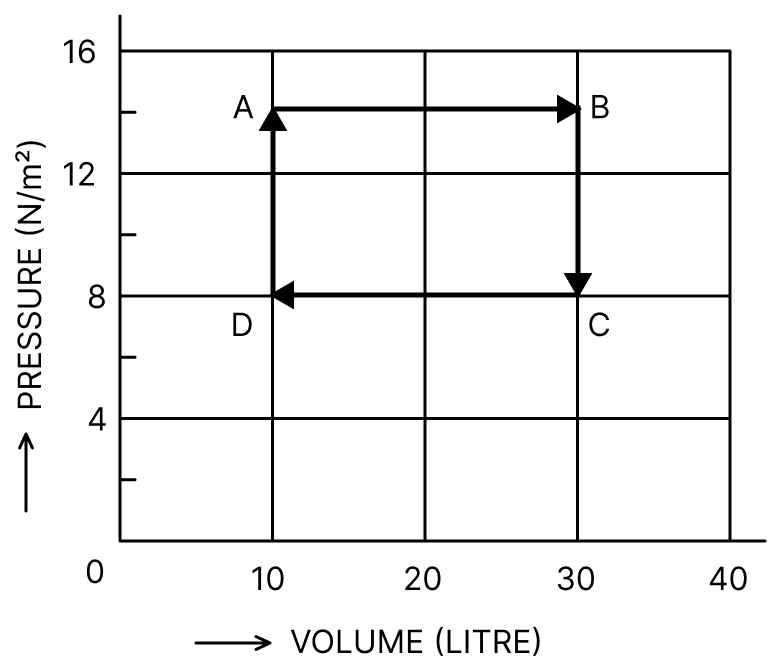
Answer
Given, from the graph,
- At A : P = 14 N/m2, V = 10 L = 10 × 10-3 m3
- At B : P = 14 N/m2, V = 30 L = 30 × 10-3 m3
- At C : P = 8 N/m2, V = 30 L = 30 × 10-3 m3
- At D : P = 8 N/m2, V = 10 L = 10 × 10-3 m3
Process A → B : The pressure is constant at 14 N/m2 and the volume increases,
Process B → C : The volume remains constant at 30 L, so
Process C → D : The pressure is constant at 8 N/m2 and the volume decreases,
Process D → A : The volume remains constant at 10 L, so
Work done in the complete cycle :
Hence, the work done in A → B is 0.28 J, in B → C is zero, in C → D is − 0.16 J, in D → A is zero, and in the complete cycle it is 0.12 J. Since the cycle is traced clockwise, this work is done by the gas.
In the given figure, pressure-volume graph of a gas has been shown.
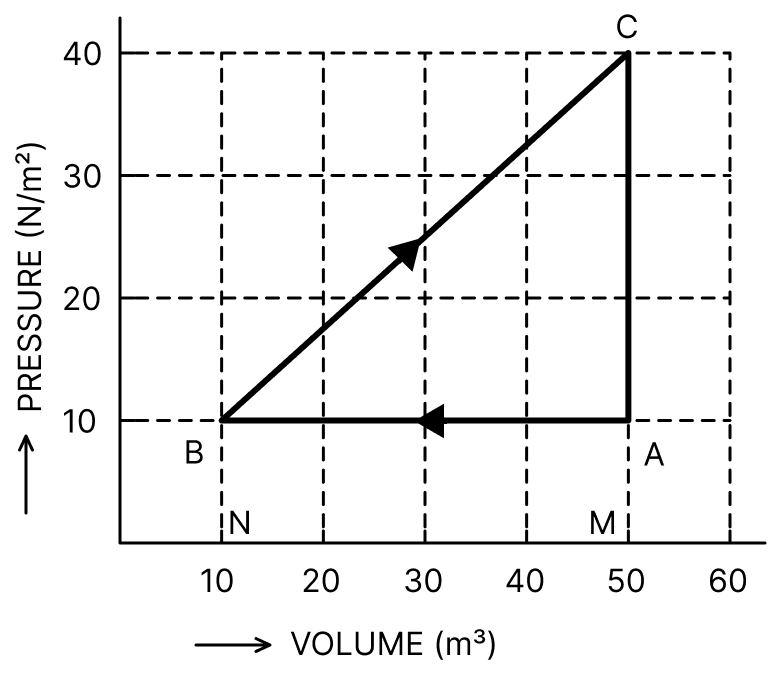
Find out the following from the graph :
(i) work done in carrying the gas from state A to B,
(ii) work done in carrying the gas from state B to C.
Answer
Given, from the graph,
- At A : P = 10 N/m2, V = 50 m3
- At B : P = 10 N/m2, V = 10 m3
- At C : P = 40 N/m2, V = 50 m3
(i) Work done in carrying the gas from A to B :
Along A → B the pressure remains constant at 10 N/m2 while the volume decreases from 50 m3 to 10 m3. Hence
The negative sign shows that the volume decreases, so the work is done on the gas.
(ii) Work done in carrying the gas from B to C :
The path BC is a straight line from B (10 m3, 10 N/m2) to C (50 m3, 40 N/m2). The work done is the area of the trapezium under this line,
Since the volume increases, the work is done by the gas.
Hence, 400 J of work is done on the gas from A to B, and 1000 J of work is done by the gas from B to C.
The diagram shows the pressure-volume graph of thermodynamic processes of an ideal gas.
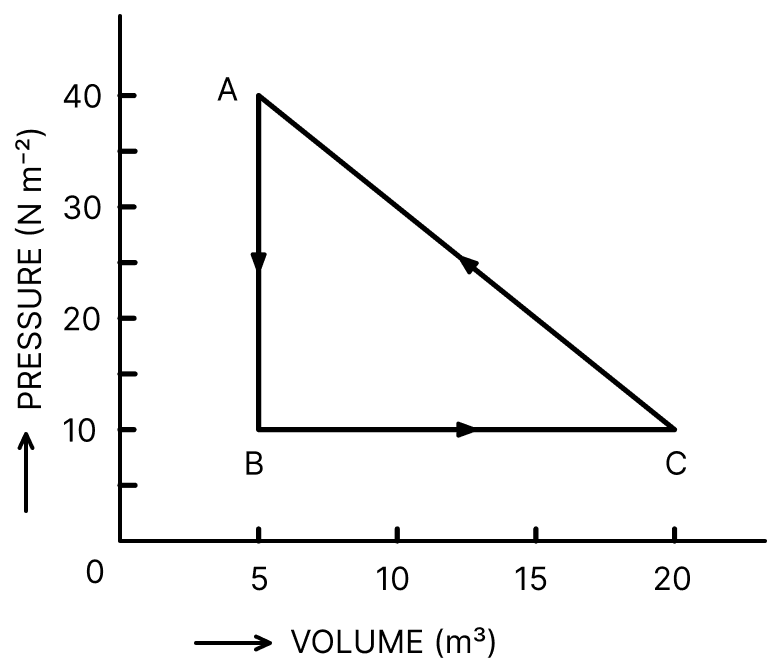
Determine the work done in A → B, B → C and C → A processes separately and the work done in the complete cycle ABCA.
Answer
Given, from the graph,
- At A : P = 40 N m-2, V = 5 m3
- At B : P = 10 N m-2, V = 5 m3
- At C : P = 10 N m-2, V = 20 m3
Process A → B : The volume remains constant at 5 m3, so the process is isochoric and
Process B → C : The pressure remains constant at 10 N m-2 while the volume increases from 5 m3 to 20 m3,
Since the volume increases, this work is done by the gas.
Process C → A : The path CA is a straight line from C (20 m3, 10 N m-2) to A (5 m3, 40 N m-2). The magnitude of the work is the area of the trapezium under this line,
Since the volume decreases, the work is done on the gas, so WCA = − 375 J.
Work done in the complete cycle ABCA :
Hence, the work done in A → B is zero, in B → C it is 150 J by the gas, in C → A it is 375 J on the gas, and in the complete cycle ABCA it is 225 J on the gas. The negative sign, and the fact that the cycle is traced anticlockwise, both show that the net work is done on the gas.
The volume of a gas at the atmospheric pressure is 2.0 L. On giving 300 J of heat to the gas its volume increases to 2.5 L at the same pressure. Determine the change in the internal energy of the gas. Atmospheric pressure = 1.0 × 10⁵ N/m2, 1 L = 10-3 m3.
Answer
Given,
- Initial volume, V1 = 2.0 L = 2.0 × 10⁻³ m3
- Final volume, V2 = 2.5 L = 2.5 × 10⁻³ m3
- Heat given to the gas, Q = 300 J
- Atmospheric pressure, P = 1.0 × 10⁵ N/m2
The volume increases at the same (atmospheric) pressure, so the process is isobaric and the work done by the gas is
By the first law of thermodynamics, the change in the internal energy of the gas is
Hence, the internal energy of the gas increases by 250 J.
A bullet of mass 20 g strikes a target with a velocity 100 m/s and comes to rest. 50% kinetic energy of the bullet raises its temperature by 25°C. Calculate :
(i) increase in the internal energy of the bullet due to rise in temperature ,
(ii) specific heat of the material of the bullet.
Answer
Given,
- Mass of the bullet, m = 20 g = 20 × 10-3 kg
- Velocity of the bullet, v = 100 m/s
- Rise in temperature, ΔT = 25°C
- 50% of the kinetic energy raises the temperature of the bullet
The kinetic energy of the bullet is
(i) Increase in the internal energy of the bullet :
Only 50% of this kinetic energy is used in raising the temperature of the bullet, and this appears as the increase in its internal energy,
(ii) Specific heat of the material of the bullet :
The heat used in raising the temperature is Q = m c ΔT, so
Expressing it in calorie, using J = 4.2 J cal-1,
Hence, the increase in the internal energy of the bullet is 50 J and the specific heat of its material is 100 J/(kg-°C) or 0.0238 cal/(g-°C).
A bullet of lead moving with a speed of 150 m/s stops after striking a target. If 80% of the kinetic energy remains in the bullet, calculate the rise in its temperature. Specific heat of lead is 30 cal/(kg-°C) and J = 4.2 J/cal.
Answer
Given,
- Speed of the bullet, v = 150 m/s
- 80% of the kinetic energy remains in the bullet
- Specific heat of lead, c = 30 cal (kg-°C)-1
- J = 4.2 J cal-1
Let m be the mass of the bullet. Its kinetic energy is
Only 80% of this energy remains in the bullet as heat, so the heat retained is
Expressing this heat in calorie,
This heat raises the temperature of the bullet, so
The mass m cancels from both the sides,
Hence, the rise in the temperature of the bullet is 71.43°C.
A bullet of lead just melts when stopped by an obstacle. Assuming that 25% of the heat produced is absorbed by the obstacle, find the velocity of the bullet if its initial temperature is 27°C. J = 4.2 J/cal, melting point of lead = 327°C, specific heat of lead = 0.03 cal/(g-°C), latent heat of melting of lead = 6 cal/g.
Answer
Given,
- Initial temperature of the bullet = 27°C
- Melting point of lead = 327°C
- Specific heat of lead, c = 0.03 cal (g-°C)-1
- Latent heat of melting of lead, L = 6 cal g-1
- 25% of the heat produced is absorbed by the obstacle, so 75% is retained by the bullet
- J = 4.2 J cal-1
Let m gram be the mass of the bullet and v m/s its velocity.
Heat needed by the bullet : The bullet must first be heated from 27°C to its melting point 327°C, and then just melted. Hence
Heat produced by the bullet : The kinetic energy of the bullet is converted into heat, of which only 75% is retained by the bullet,
Here m must be in kilogram for the energy to be in joule, so m gram = m × 10-3 kg. Equating the two expressions for Q,
The mass m cancels from both the sides,
Hence, the velocity of the bullet is 410 m/s.
A 2-kg sphere falls from a height of 3 m. If whole of its potential energy is converted into heat, then how much heat will be produced? (1 cal = 4.2 J)
Answer
Given,
- Mass of the sphere, m = 2 kg
- Height of fall, h = 3 m
- g = 9.8 m/s2
- 1 cal = 4.2 J
The whole of the potential energy of the sphere is converted into heat. The loss in potential energy is
Converting this energy into calorie,
Hence, 14 cal of heat will be produced.
A 5-kg hammer falls with a velocity 1 m/s on a piece of lead of mass 300 g at 27°C. How many strokes will be required for melting the lead?
Answer
Given,
- Mass of the hammer, M = 5 kg
- Velocity of the hammer, v = 1 m/s
- Mass of the lead, m = 300 g = 0.3 kg
- Initial temperature of the lead = 27°C
- Melting point of lead = 327°C
- Specific heat of lead, c = 0.03 kcal (kg-°C)-1
- Latent heat of lead, L = 6 kcal kg-1
- J = 4.18 × 10³ J kcal-1
Heat required to melt the lead : The lead must first be heated from 27°C to 327°C and then melted,
Expressing this heat in joule,
Energy delivered in one stroke : The kinetic energy of the falling hammer is
Number of strokes required :
Hence, 7524 strokes will be required for melting the lead.
A lead ball of mass 2.0 kg falls from a height of 30.0 m. If the total kinetic energy of the ball is converted into heat and remains in it, calculate the rise in temperature of the ball when it strikes the ground. Find the change in the internal energy of the ball in this process.
Answer
Given,
- Mass of the lead ball, m = 2.0 kg
- Height of fall, h = 30.0 m
- Specific heat of lead, c = 125 J (kg-°C)-1
- g = 9.8 m/s2
The whole of the kinetic energy of the ball is converted into heat and remains in it. On striking the ground the kinetic energy of the ball equals the potential energy lost,
Rise in temperature : This heat raises the temperature of the ball, so
Change in internal energy : No heat is given to the ball from outside and the whole of the energy remains in the ball. Hence the internal energy of the ball increases by the whole of this amount,
Hence, the rise in the temperature of the ball is 2.35°C and its internal energy increases by 588 J.
Water falls from a height of 20 m at a rate of 100 kg per second. How many calorie of heat will be produced per second on striking with the earth? Assume that the whole energy is converted into heat.
Answer
Given,
- Height of fall, h = 20 m
- Rate of fall of water, m = 100 kg per second
- g = 9.8 m/s2
- J = 4.18 × 10³ J kcal-1
The whole of the energy is converted into heat. The potential energy lost by the water per second is
Converting this energy into kilocalorie,
Hence, 4.7 kcal (that is, 4.7 × 10³ calorie) of heat will be produced per second.
From what height should a piece of ice fall upon the ground so that it is completely melted, assuming that all the heat produced remains in ice? (Latent heat of ice = 80 cal/g, J = 4.2 J/cal, g = 9.8 N/kg)
Answer
Given,
- Latent heat of ice, L = 80 cal g-1
- J = 4.2 J cal-1
- g = 9.8 N/kg
Let m kg be the mass of the piece of ice and h the height from which it falls. The loss in potential energy is
This energy is converted into heat, and all of it remains in the ice so that the ice is completely melted. The heat required to melt the ice completely is
Expressing the latent heat in J kg-1,
Equating the two,
The mass m cancels from both the sides,
Hence, the piece of ice should fall from a height of 34.28 km.
What amount of work will have to be done in converting 1 kg of water into steam at 100°C and normal atmospheric pressure ? The volume of 1 kg of water at 100°C is 10-3 m3 and that of 1 kg of steam is 1.671 m3 and the normal pressure is 105 N/m2.
Answer
Given,
- Volume of 1 kg of water at 100°C, V1 = 10-3 m3
- Volume of 1 kg of steam at 100°C, V2 = 1.671 m3
- Normal atmospheric pressure, P = 105 N/m2
When water is converted into steam at the constant atmospheric pressure, the volume increases and the system does work against the atmospheric pressure. The increase in volume is
The work done at the constant pressure is
Hence, 1.670 × 10⁵ J of work will have to be done.
In the given figure the initial and final states of a gas are shown by points i and f.
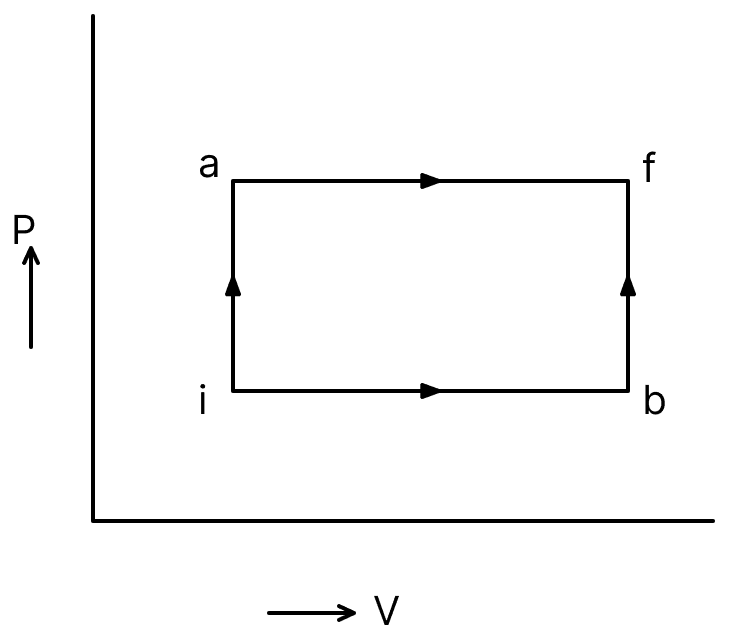
At i and b the internal energies of the gas are 10 and 22 J respectively. For the path iaf, dQ = 50 J and dW = 20 joule. If for the path ibf, dQ = 36 J, then find out the following :
(i) internal energy of the gas at f,
(ii) dW for the path ibf,
(iii) dW for the path i a ,
(iv) dQ for the path b f,
(v) dU and dW for the path i b.
Answer
Given,
- Internal energy at i, Ui = 10 J
- Internal energy at b, Ub = 22 J
- For the path iaf : dQ = 50 J and dW = 20 J
- For the path ibf : dQ = 36 J
From the graph, along the path iaf the gas first goes from i to a at constant volume and then from a to f at constant pressure. Along the path ibf the gas first goes from i to b at constant pressure and then from b to f at constant volume.
(i) Internal energy of the gas at f :
By the first law of thermodynamics, for the path iaf,
Therefore
(ii) dW for the path ibf :
The internal energy is a state function, so the change ΔU from i to f is the same along both the paths, that is, 30 J. Hence
(iii) dW for the path i a :
Along the path i → a the volume of the gas remains constant, so
Hence the work done along the path i a is zero.
(iv) dQ for the path b f :
Along the path b → f the volume remains constant, so dW = 0. The change in internal energy is
Therefore
(v) dU and dW for the path i b :
The change in internal energy is
The total work along the path ibf is 6 J, and the work along b → f is zero. Hence the whole of it is done along i → b,
Hence Uf = 40 J, dW for ibf = 6 J, dW for i a = zero, dQ for b f = 18 J, and for the path i b, dU = 12 J and dW = 6 J.
Figure shows pressure-volume graph of a cyclic process of an ideal gas.
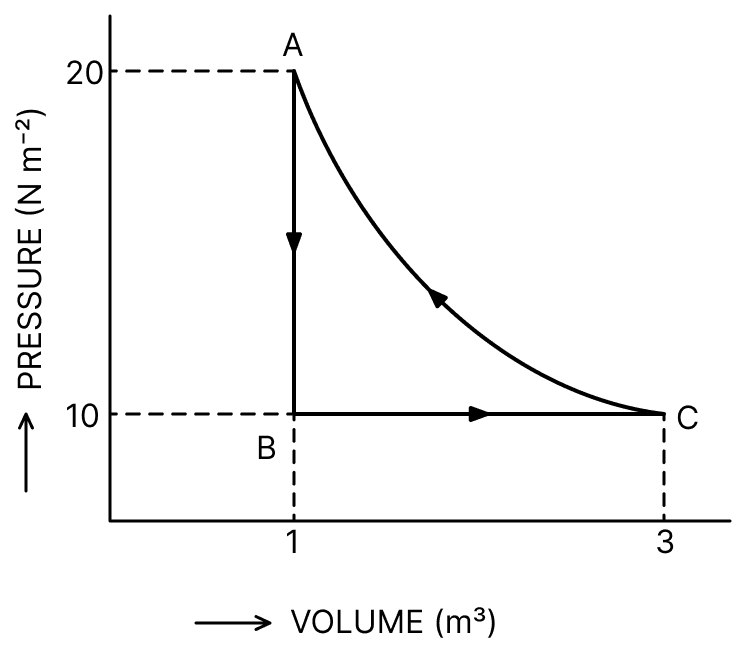
The value of internal energy of the gas is 150 J in state A, 100 J in state B and 250 J in state C. Determine :
(i) heat rejected by the gas in the process A → B,
(ii) work done by the gas in the process B → C,
(iii) heat taken by the gas in the process B → C.
Answer
Given, from the graph,
- At A : P = 20 N m-2, V = 1 m3
- At B : P = 10 N m-2, V = 1 m3
- At C : P = 10 N m-2, V = 3 m3
- Internal energies : UA = 150 J, UB = 100 J, UC = 250 J
(i) Heat rejected by the gas in the process A → B :
Along A → B the volume remains constant at 1 m3, so the process is isochoric and
The change in internal energy is
By the first law of thermodynamics,
The negative sign shows that heat is given out by the gas. Hence 50 J of heat is rejected by the gas.
(ii) Work done by the gas in the process B → C :
Along B → C the pressure remains constant at 10 N m-2 while the volume increases from 1 m3 to 3 m3,
(iii) Heat taken by the gas in the process B → C :
The change in internal energy is
By the first law of thermodynamics,
Hence, 50 J of heat is rejected in A → B, the work done in B → C is 20 J, and the heat taken in B → C is 170 J.
In the given graph are shown two possible paths ABC and AC for changing a gas from the thermodynamic state A to the state C. The internal energy of the gas at A and C is 20 J and 50 J respectively.
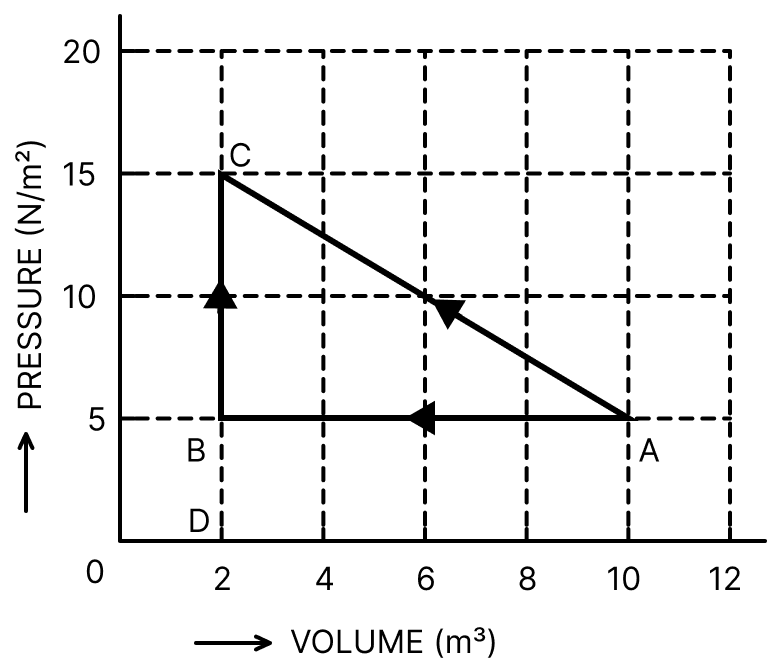
Calculate : (i) the heat necessary to be supplied to the gas to change the state from A to C along the path AC, (ii) if 50 J heat is extracted from the gas in changing from A to B, then what will be the internal energy of the gas at the state B? (iii) What work will be done by the gas along the path BC?
Answer
Given, from the graph,
- At A : P = 5 N/m2, V = 10 m3
- At B : P = 5 N/m2, V = 2 m3
- At C : P = 15 N/m2, V = 2 m3
- Internal energies : UA = 20 J and UC = 50 J
(i) Heat supplied along the path AC :
The path AC is a straight line from A (10 m3, 5 N/m2) to C (2 m3, 15 N/m2). The magnitude of the work is the area of the trapezium under this line,
Since the volume decreases, the work is done on the gas, so WAC = − 80 J.
The change in internal energy is
By the first law of thermodynamics,
The negative sign shows that heat is taken from the gas. Hence 50 J of heat will be taken from the gas.
(ii) Internal energy of the gas at the state B :
Along A → B the pressure remains constant at 5 N/m2 while the volume decreases from 10 m3 to 2 m3,
Since 50 J of heat is extracted from the gas, Q = − 50 J. By the first law,
Therefore
(iii) Work done by the gas along the path BC :
Along B → C the volume remains constant at 2 m3, so
Hence the work done along BC is zero.
In the given graph are shown two possible paths ABC and AC for changing a gas from the thermodynamic state A to the state C :
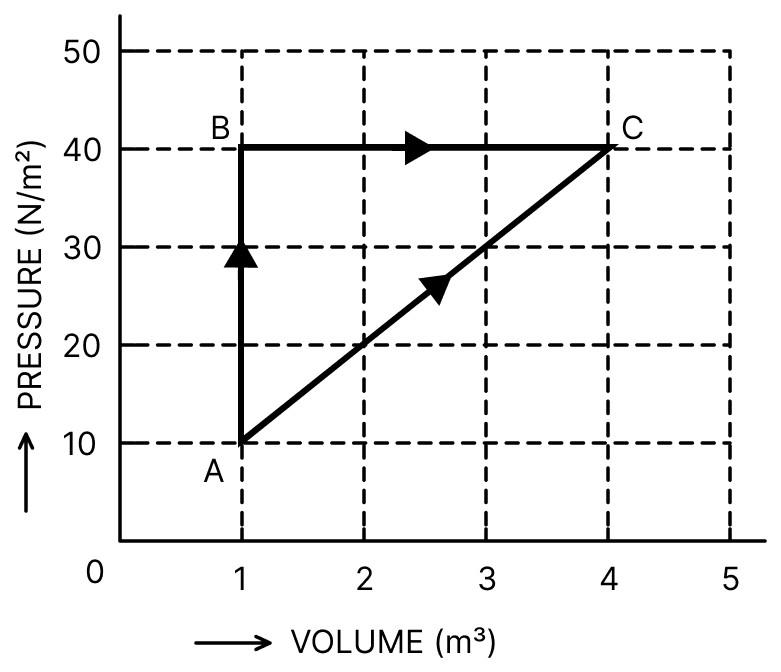
(i) Along which path greater amount of work will have to be done? (ii) If the internal energy of the gas at the state A be 5 J and 100 J heat is supplied to change the state through the path AC, then calculate the internal energy of the gas at the state C. (iii) If the internal energy of the gas at the state B be 10 J, then how much heat will be given to change the state from A to B ?
Answer
Given, from the graph,
- At A : P = 10 N/m2, V = 1 m3
- At B : P = 40 N/m2, V = 1 m3
- At C : P = 40 N/m2, V = 4 m3
- The path AC is the straight line joining A and C
(i) Along which path is greater work done :
The work done is measured by the area enclosed between the path and the volume-axis.
Along the path ABC, no work is done along A → B since the volume remains constant, and along B → C the gas expands at the higher constant pressure of 40 N/m2,
Along the path AC, the pressure rises steadily from 10 N/m2 to 40 N/m2 as the volume increases, so the area under AC is a trapezium,
Hence a greater amount of work has to be done along the path ABC.
(ii) Internal energy of the gas at the state C :
Given UA = 5 J and Q = 100 J supplied along the path AC, for which WAC = 75 J as found above. By the first law of thermodynamics,
Therefore
(iii) Heat given to change the state from A to B :
Along A → B the volume remains constant at 1 m3, so
Given UB = 10 J, the change in internal energy is
By the first law of thermodynamics,
Hence greater work is done along the path ABC, the internal energy at C is 30 J, and 5 J of heat is given to change the state from A to B.
In the given diagram is shown the P-V graph of the thermodynamical process of an ideal gas.
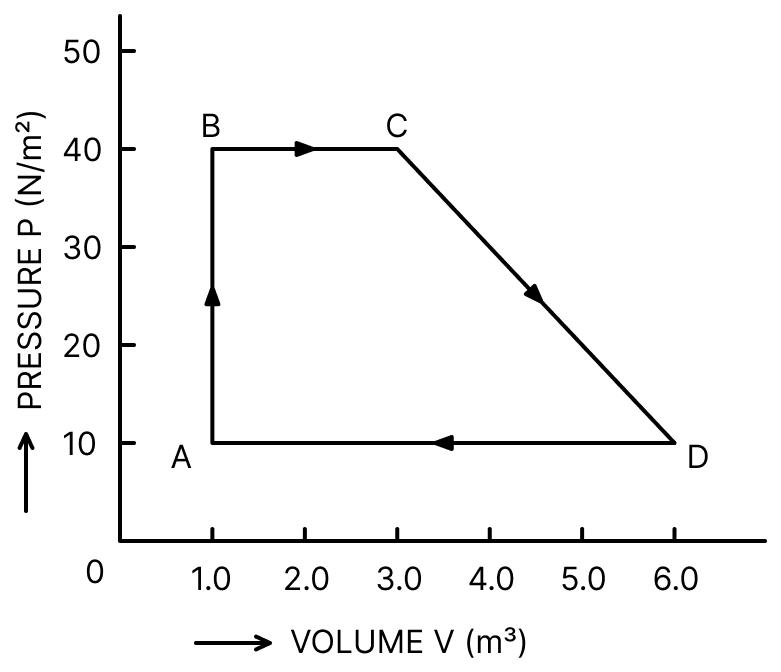
The internal energy of the system in the state D is 150 J. Find from this graph :
(i) the internal energy of system in the state A when 20 J heat is given to bring the system from state D to state A,
(ii) the total work done by the system in the process ABCDA.
Answer
Given, from the graph,
- At A : P = 10 N/m2, V = 1.0 m3
- At B : P = 40 N/m2, V = 1.0 m3
- At C : P = 40 N/m2, V = 3.0 m3
- At D : P = 10 N/m2, V = 6.0 m3
- Internal energy in the state D, UD = 150 J
(i) Internal energy of the system in the state A :
Along D → A the pressure remains constant at 10 N/m2 while the volume decreases from 6.0 m3 to 1.0 m3,
Given that 20 J of heat is given to bring the system from D to A, that is, Q = 20 J. By the first law of thermodynamics,
Therefore
(ii) Total work done by the system in the process ABCDA :
A → B : The volume remains constant at 1.0 m3, so
B → C : The pressure remains constant at 40 N/m2 while the volume increases from 1.0 m3 to 3.0 m3,
C → D : The path is a straight line from C (3.0 m3, 40 N/m2) to D (6.0 m3, 10 N/m2). The work is the area of the trapezium under this line,
D → A : As found above,
Therefore the total work done in the cycle is
Hence, the internal energy in the state A is 220 J and the total work done by the system in the process ABCDA is 105 J.
In the given diagram, the processes occurring in a system are depicted.
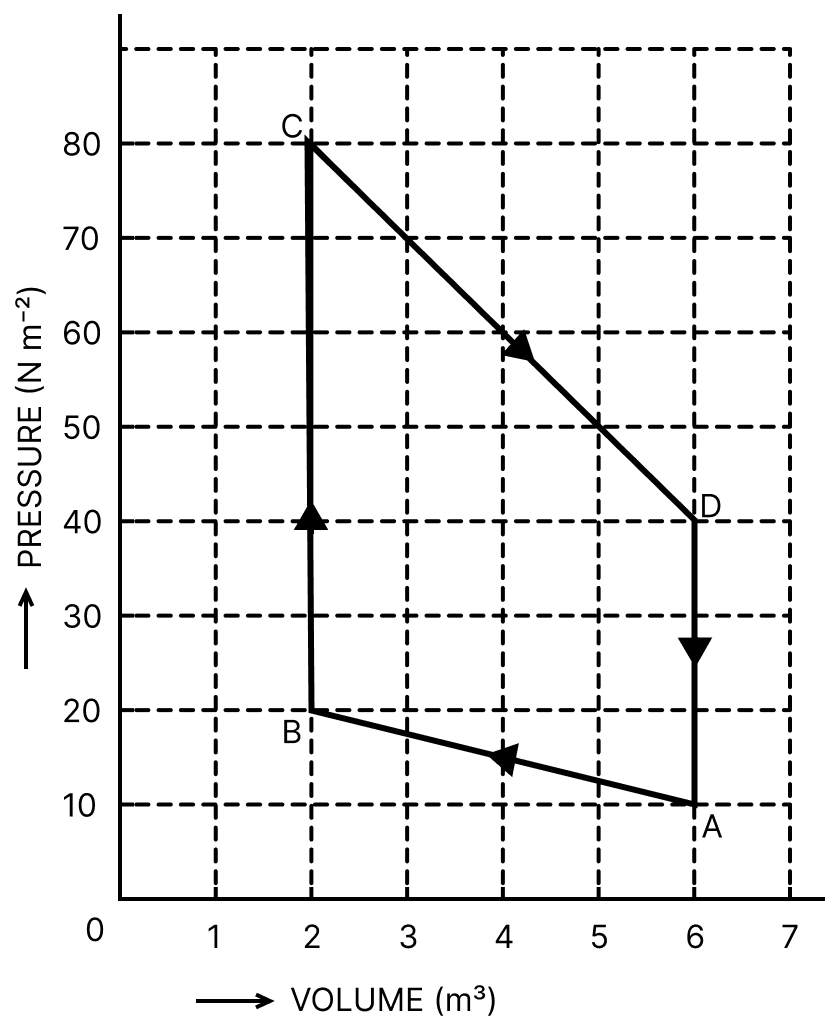
The values of the internal energy of the system in the states A, B and C are 20 J, 50 J and 290 J respectively. In taking the system from state D to A, 15 J heat is released. Determine :
(i) internal energy of the system in the state D,
(ii) quantities of heat released by the system in taking the system from state C to D and from state A to B,
(iii) heat absorbed by the system in going from state B to C,
(iv) work done by the system in the cycle ABCDA.
Answer
Given, from the graph,
- At A : P = 10 N m-2, V = 6 m3
- At B : P = 20 N m-2, V = 2 m3
- At C : P = 80 N m-2, V = 2 m3
- At D : P = 40 N m-2, V = 6 m3
- Internal energies : UA = 20 J, UB = 50 J, UC = 290 J
- In taking the system from D to A, 15 J of heat is released
(i) Internal energy of the system in the state D :
Along D → A the volume remains constant at 6 m3, so
Since heat is released, Q = − 15 J. By the first law of thermodynamics,
But ΔU = UA − UD, so
(ii) Heat released from C to D and from A to B :
Process C → D : The path is a straight line from C (2 m3, 80 N m-2) to D (6 m3, 40 N m-2). The work is the area of the trapezium under this line, and since the volume increases it is positive,
The change in internal energy is
Hence 15 J of heat is released from C to D.
Process A → B : The path is a straight line from A (6 m3, 10 N m-2) to B (2 m3, 20 N m-2). The magnitude of the work is
Since the volume decreases, WAB = − 60 J. The change in internal energy is
Hence 30 J of heat is released from A to B.
(iii) Heat absorbed from B to C :
Along B → C the volume remains constant at 2 m3, so WBC = 0. The change in internal energy is
(iv) Work done by the system in the cycle ABCDA :
Hence UD = 35 J, the heat released is 15 J from C to D and 30 J from A to B, the heat absorbed from B to C is 240 J, and the work done in the cycle is 180 J.
At normal temperature (0 °C) and normal pressure (1.01 × 10⁵ N/m2) the volume of 1g molecule of a gas is 22.4 × 10⁻³ m3. What will be the volume of the gas on increasing its temperature by 100°C at constant pressure? What will be the external work done by the gas ?
Answer
Given,
- Normal temperature, T1 = 0°C = 273 K
- Normal pressure, P = 1.01 × 10⁵ N/m2
- Volume of 1 gram-molecule of the gas, V1 = 22.4 × 10⁻³ m3
- Rise in temperature = 100°C, so T2 = 100 + 273 = 373 K
- The pressure remains constant
Volume of the gas at 373 K : Since the pressure is constant, by Charles' law
External work done by the gas : The pressure remains constant, so
Hence, the volume of the gas becomes 30.6 × 10⁻³ m3 and the external work done by the gas is 828.2 J.
At normal temperature and normal constant pressure (1.0 × 10⁵ N/m2), how much external work will be done in reducing the volume of an ideal gas by 2.4 × 10⁻⁴ m3 ? If on giving 12 J energy, the rise in temperature is 1°C, calculate the final temperature of the gas.
Answer
Given,
- Normal constant pressure, P = 1.0 × 10⁵ N/m2
- Reduction in volume, ΔV = 2.4 × 10⁻⁴ m3
- On giving 12 J of energy, the rise in temperature is 1°C
- Normal temperature = 0°C
External work done : Since the pressure remains constant, the magnitude of the work is
As the volume is reduced, this work is done on the gas, so W = − 24 J.
Final temperature of the gas : No heat is given to the gas from outside, so Q = 0. By the first law of thermodynamics,
Thus the internal energy of the gas increases by 24 J. Since 12 J of energy raises the temperature by 1°C, the rise in temperature is
The gas was initially at the normal temperature of 0°C, so the final temperature is
Hence, 24 J of external work is done on the gas and the final temperature of the gas is 2°C.
1671 cm3 of water vapour is formed from 1 cm3 of water at atmospheric pressure (1.01 × 10⁵ N/m2) and 100°C. Latent heat of vaporisation is 540 cal/g. How much increase in the internal energy will take place when one gram of water is converted into vapour at atmospheric pressure. (J = 4.2 J/cal)
Answer
Given,
- Volume of water, V1 = 1 cm3 = 1 × 10⁻⁶ m3
- Volume of water vapour formed, V2 = 1671 cm3 = 1671 × 10-6 m3
- Atmospheric pressure, P = 1.01 × 10⁵ N/m2
- Latent heat of vaporisation, L = 540 cal g-1
- Mass of water converted into vapour, m = 1 g
- J = 4.2 J cal-1
Heat given to the water : The heat taken by 1 g of water in changing into vapour at 100°C is
External work done : During vaporisation the water expands against the constant atmospheric pressure. The increase in volume is
The work done by the water is
Expressing this work in calorie,
Increase in internal energy : By the first law of thermodynamics,
Hence, the increase in the internal energy is 500 cal. Of the 540 cal of heat given to the water, 40 cal is used in doing work against the atmospheric pressure and the remaining 500 cal is added to the internal energy, that is, it is used in separating the molecules in the form of steam against the mutual attraction of the molecules of water.
2000 cal of heat are given to a thermodynamic system and the system does 3350 J of external work. In this process the internal energy of the system is increased by 5030 J. Calculate the value of the conversion factor J.
Answer
Given,
- Heat given to the system, Q = 2000 cal
- External work done by the system, W = 3350 J
- Increase in internal energy, ΔU = 5030 J
By the first law of thermodynamics,
All the quantities must be expressed in the same unit. Expressing the heat in joule, if J be the conversion factor, then
Substituting the values,
Hence, the value of the conversion factor J is 4.19 J/cal.
0.1 mole nitrogen is heated from 27°C to 327°C at constant pressure. Determine the heat given to the gas, increase in internal energy of the gas and work done by the gas. For nitrogen Cp = 7 and Cv = 5 cal/(mol-°C).
Answer
Given,
- Number of moles of nitrogen, μ = 0.1
- Initial temperature = 27°C, final temperature = 327°C, so ΔT = 300°C = 300 K
- Cp = 7 cal (mol-°C)-1 and Cv = 5 cal (mol-°C)-1
- The gas is heated at constant pressure
Heat given to the gas : For heating at constant pressure,
Increase in the internal energy of the gas : The change in internal energy depends only upon the temperature change, so
Work done by the gas : By the first law of thermodynamics,
Hence, the heat given to the gas is 210 cal, the increase in its internal energy is 150 cal and the work done by the gas is 60 cal.
Calculate the amount of heat required to raise the temperature of 5 moles of an ideal monoatomic gas from 0°C to 100°C if no work is done. You are given that the molar specific heat of the above gas at constant pressure is 2.5 R, where R is the universal gas constant. (R = 8.3 J/mole-K)
Hint : Cv = Cp − R = 1.5 R, so heat required = μ Cv ΔT where μ = 5.
Answer
Given,
- Number of moles, μ = 5
- Initial temperature = 0°C, final temperature = 100°C, so ΔT = 100°C = 100 K
- Molar specific heat at constant pressure, Cp = 2.5 R
- R = 8.3 J (mol-K)-1
- No work is done
Since no work is done, the volume of the gas remains constant, so the heat required is
By Mayer's relation, Cp − Cv = R, so the molar specific heat at constant volume is
Substituting the values,
Hence, 6225 J of heat is required.
In the figure, the pressure-volume graph of a thermodynamic process of one mole of a gas (γ = 5/3) is shown. Find the initial and final temperatures of the gas. Find also the amount of heat given to the gas in the process. Take the value of R to be 8.3 J/(mol K).
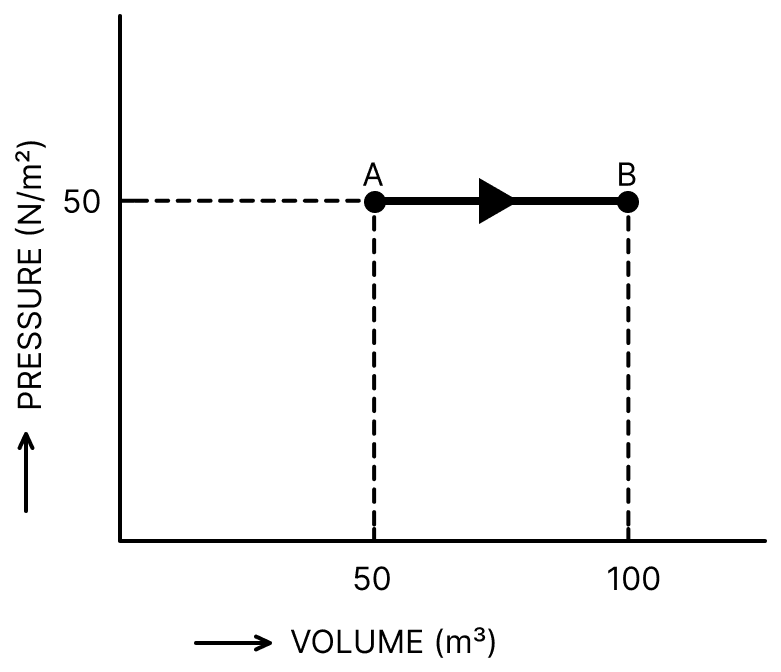
Answer
Given, from the graph,
- At A : P = 50 N/m2, V = 50 m3
- At B : P = 50 N/m2, V = 100 m3
- Number of moles, μ = 1
- R = 8.3 J (mol K)-1
Initial temperature of the gas : For 1 mole of an ideal gas, PV = RT, so
Final temperature of the gas :
Heat given to the gas : Along AB the pressure remains constant, so the process is isobaric and
Now and Cp − Cv = R. Solving these two,
Substituting the values,
Therefore
Hence, the initial temperature is 301.2 K, the final temperature is 602.4 K and the heat given to the gas is 6250 J.
A Carnot's engine has the same efficiency (i) between 100 K and 500 K and (ii) between T K and 900 K. Calculate the temperature T of the sink.
Answer
Given,
- Case (i) : source at 500 K and sink at 100 K
- Case (ii) : source at 900 K and sink at T K
- The efficiency is the same in both the cases
The efficiency of a Carnot engine is
For case (i) :
For case (ii) :
Since the two efficiencies are equal,
Hence, the temperature T of the sink is 180 K.
Calculate the difference in efficiencies of a Carnot's heat engine working between (i) 400 K and 350 K, (ii) 350 K and 300 K.
Answer
Given,
- Case (i) : source at 400 K and sink at 350 K
- Case (ii) : source at 350 K and sink at 300 K
The efficiency of a Carnot engine is
For case (i) :
For case (ii) :
Difference in the efficiencies :
Hence, the difference in the efficiencies is 1.786%.
The temperature of source of a Carnot's heat engine is 127°C. It takes 500 cal of heat from the source and rejects 400 cal to the sink per cycle. Calculate the temperature of the sink and the efficiency of the engine.
Answer
Given,
- Temperature of the source, T1 = 127°C = 127 + 273 = 400 K
- Heat taken from the source, Q1 = 500 cal
- Heat rejected to the sink, Q2 = 400 cal
Temperature of the sink : For a Carnot engine the ratio of the heats exchanged equals the ratio of the absolute temperatures,
Substituting the values,
Converting into the Celsius scale,
Efficiency of the engine :
Hence, the temperature of the sink is 47°C and the efficiency of the engine is 20%.
A Carnot's engine absorbs 1000 J of heat from a source at temperature 127°C and rejects 600 J of heat to the sink during each cycle. Calculate the amount of useful work done during each cycle, efficiency of the engine and temperature of the sink.
Answer
Given,
- Heat absorbed from the source, Q1 = 1000 J
- Heat rejected to the sink, Q2 = 600 J
- Temperature of the source, T1 = 127°C = 127 + 273 = 400 K
Useful work done during each cycle : In one complete cycle there is no net change in the internal energy, so
Efficiency of the engine :
Temperature of the sink : For a Carnot engine,
Converting into the Celsius scale,
Hence, the useful work done per cycle is 400 J, the efficiency of the engine is 40% and the temperature of the sink is − 33°C.
A Carnot's ideal heat engine operates between 227°C and 127°C. It absorbs 600 cal of heat from the source. How much work per cycle is the engine capable of performing? (1 cal = 4.2 J)
Answer
Given,
- Temperature of the source, T1 = 227°C = 227 + 273 = 500 K
- Temperature of the sink, T2 = 127°C = 127 + 273 = 400 K
- Heat absorbed from the source, Q1 = 600 cal
- 1 cal = 4.2 J
The efficiency of a Carnot engine is
The work done per cycle is
Converting into joule,
Hence, the engine is capable of performing 504 J of work per cycle.
The temperature of the sink of a Carnot's engine is 27°C. If the efficiency of the engine is 40%, find the temperature of the source.
Answer
Given,
- Temperature of the sink, T2 = 27°C = 27 + 273 = 300 K
- Efficiency of the engine, η = 40% = 0.4
The efficiency of a Carnot engine is
Substituting the values,
Converting into the Celsius scale,
Hence, the temperature of the source is 227°C.
A Carnot's reversible engine works with an efficiency of 50%. During each cycle, it rejects 150 cal of heat at 30°C. Calculate (i) temperature of the source, (ii) work done by the engine per cycle. (1 cal = 4.2 J)
Answer
Given,
- Efficiency of the engine, η = 50% = 0.5
- Heat rejected per cycle, Q2 = 150 cal
- Temperature of the sink, T2 = 30°C = 30 + 273 = 303 K
- 1 cal = 4.2 J
(i) Temperature of the source : The efficiency of a Carnot engine is
Converting into the Celsius scale,
(ii) Work done by the engine per cycle : For a Carnot engine,
Therefore the work done per cycle is
Converting into joule,
Hence, the temperature of the source is 333°C and the work done by the engine per cycle is 630 J.
A reversible engine converts one-sixth of heat absorbed at the source into work. When the temperature of the sink is reduced by 82°C, the efficiency is doubled. Find the temperatures of the source and the sink.
Answer
Given,
- The engine converts one-sixth of the heat absorbed into work, so
- When the sink temperature is reduced by 82°C, the efficiency is doubled, so
For the first case : The efficiency of a reversible engine is
For the second case : The sink temperature becomes (T2 − 82) K,
Subtracting equation (ii) from equation (i),
Substituting this value in equation (i),
Hence, the temperature of the source is 219°C and that of the sink is 137°C.
A Carnot's engine whose low-temperature reservoir is at 7°C has an efficiency of 50%. It is desired to increase the efficiency to 70%. By how many degree should the temperature of the high-temperature reservoir be raised?
Answer
Given,
- Temperature of the low-temperature reservoir, T2 = 7°C = 7 + 273 = 280 K
- Initial efficiency, η1 = 50% = 0.5
- Desired efficiency, η2 = 70% = 0.7
For the initial case : The efficiency of a Carnot engine is
For the desired case : The sink temperature remains 280 K,
Rise in the temperature of the high-temperature reservoir :
Hence, the temperature of the high-temperature reservoir should be raised by about 373 degree.
The volume of an ideal gas in a vessel is 2 L at normal pressure (1.0 × 10⁵ N/m2). The pressure of the gas is increased (i) under isothermal condition, (ii) under adiabatic condition until its volume remains 1 litre. Find the increased pressure of the gas. (γ for air = 1.4, log10 2 = 0.3010, log10 2.64 = 0.4214)
Answer
Given,
- Initial volume, V1 = 2 L
- Final volume, V2 = 1 L
- Initial pressure, P1 = 1.0 × 10⁵ N/m2
- γ for air = 1.4
- log10 2 = 0.3010, log10 2.64 = 0.4214
(i) Under isothermal condition : An isothermal change obeys Boyle's law,
(ii) Under adiabatic condition : An adiabatic change obeys Poisson's law,
To evaluate (2)1.4, taking logarithms,
Since log10 2.64 = 0.4214, we get (2)1.4 = 2.64. Therefore
Hence, the increased pressure is 2.0 × 10⁵ N/m2 under isothermal condition and 2.64 × 10⁵ N/m2 under adiabatic condition.
The initial pressure of a gas is 5 × 10⁵ N/m2. Its volume is compressed to 1/9 of its original volume adiabatically. What will be the pressure of the gas in this condition? For the gas γ = 3/2.
Answer
Given,
- Initial pressure, P1 = 5 × 10⁵ N/m2
- Final volume,
The compression is adiabatic, so it obeys Poisson's law,
Rearranging,
Substituting ,
Now
Therefore
Hence, the pressure of the gas becomes 1.35 × 10⁷ N/m2.
Dry air is compressed to 1/9 of its original volume by applying atmospheric pressure P adiabatically. What will be resulting pressure of the gas in this condition? (γ = 3/2)
Answer
Given,
- Initial pressure = P (atmospheric pressure)
- Final volume,
The compression is adiabatic, so it obeys Poisson's law,
Rearranging,
Substituting ,
Now
Therefore
Hence, the resulting pressure of the gas is 27 P.
One litre of a gas whose initial pressure is 1 atmosphere is compressed till the pressure becomes 2 atmospheres. If the gas be compressed (i) slowly, (ii) suddenly, what will be the new volume of the gas? γ = 1.4 and (0.5)1/1.4 = 0.61.
Answer
Given,
- Initial volume, V1 = 1 L
- Initial pressure, P1 = 1 atmosphere
- Final pressure, P2 = 2 atmospheres
- γ = 1.4 and (0.5)1/1.4 = 0.61
(i) Compressed slowly : A slow compression is isothermal, and obeys Boyle's law,
(ii) Compressed suddenly : A sudden compression is adiabatic, and obeys Poisson's law,
Rearranging,
Substituting the values,
Hence, the new volume of the gas is 0.50 L when compressed slowly and 0.61 L when compressed suddenly.
The volume is greater in the sudden compression, because in an adiabatic compression the temperature of the gas also rises, which opposes the reduction in volume.
The pressure of a gas (γ = 1.5) is suddenly raised to 8 times. Calculate, how many times the volume of gas will become?
Answer
Given,
- Final pressure, P2 = 8 P1
- γ = 1.5
The pressure is raised suddenly, so the change is adiabatic and obeys Poisson's law,
Rearranging,
Substituting the values,
Now
Therefore
Hence, the volume of the gas becomes one-fourth of its original volume.
A certain mass of air (γ = 1.5) at 27°C is compressed (i) slowly and (ii) suddenly to one-fourth of original volume. Find the final temperature of the compressed air in each case.
Answer
Given,
- Initial temperature, T1 = 27°C = 27 + 273 = 300 K
- Final volume,
- γ = 1.5
(i) Compressed slowly : A slow compression is isothermal, so the temperature of the gas remains unchanged. Since the system is surrounded by a conducting material, the heat produced immediately goes out to the surroundings.
Hence the final temperature is 27°C.
(ii) Compressed suddenly : A sudden compression is adiabatic, and the relation between the temperature and the volume is
Rearranging,
Substituting and γ − 1 = 0.5,
Converting into the Celsius scale,
Hence, the final temperature is 27°C when compressed slowly and 327°C when compressed suddenly.
Initial pressure and temperature of a gas are 1.0 × 10⁵ N/m2 and 15°C respectively. By suddenly compressing, the final volume of gas is made one-fourth of initial volume. Find the last pressure and temperature of the gas. (γ = 1.5)
Answer
Given,
- Initial pressure, P1 = 1.0 × 10⁵ N/m2
- Initial temperature, T1 = 15°C = 15 + 273 = 288 K
- Final volume,
- γ = 1.5
The gas is compressed suddenly, so the change is adiabatic.
Final pressure : By Poisson's law,
Substituting the values,
Now
Therefore
Final temperature : For an adiabatic change,
Substituting the values, with γ − 1 = 0.5,
Converting into the Celsius scale,
Hence, the final pressure of the gas is 8.0 × 10⁵ N/m2 and the final temperature is 303°C.
A monoatomic ideal gas at 17°C is suddenly compressed to 1/8 of its initial volume. Find the final temperature of the gas. Given : for the monoatomic gas γ = 5/3.
Answer
Given,
- Initial temperature, T1 = 17°C = 17 + 273 = 290 K
- Final volume,
- For the monoatomic gas,
The gas is compressed suddenly, so the change is adiabatic, for which
Rearranging,
Here
Substituting ,
Now
Therefore
Converting into the Celsius scale,
Hence, the final temperature of the gas is 887°C.
1 mole gas at 27°C is compressed suddenly so much that its volume remains 1/4th of its initial volume. Calculate the final temperature of the gas and work done in this process. For gas γ = 1.5 and R = 8.31 J/mol-K.
Answer
Given,
- Number of moles, μ = 1
- Initial temperature, T1 = 27°C = 27 + 273 = 300 K
- Final volume,
- γ = 1.5 and R = 8.31 J (mol-K)-1
The gas is compressed suddenly, so the change is adiabatic.
Final temperature : For an adiabatic change,
Substituting the values, with γ − 1 = 0.5,
Converting into the Celsius scale,
Work done : The work done by μ moles of an ideal gas in an adiabatic change from temperature T1 to T2 is
Substituting the values,
The negative sign shows that the work is done on the gas.
Hence, the final temperature of the gas is 327°C and 4986 J of work is done on the gas.
Nitrogen gas has been filled in a cylinder at 30°C temperature and 10 atmospheric pressure. If the cylinder is suddenly burst, then what will be the temperature of the gas just after bursting? For nitrogen, ratio of two specific heats is 1.4.
Hint : (10)2/7 = 1.931.
Answer
Given,
- Initial temperature, T1 = 30°C = 30 + 273 = 303 K
- Initial pressure, P1 = 10 atmosphere
- Final pressure, P2 = 1 atmosphere (the cylinder bursts into the atmosphere)
- γ = 1.4, and (10)2/7 = 1.931
The cylinder bursts suddenly, so the gas expands adiabatically. The relation between the absolute temperature and the pressure for an adiabatic change is
which can be written as
Therefore
Here
Substituting the values,
Hence, the temperature of the gas just after bursting is 157 K.
An ideal gas of volume 1 L and at pressure 8 atmospheres expands adiabatically until the pressure drops to 1 atmosphere. Find the final volume and work done by the gas. Given : γ = 1.5, 1 atmosphere = 1.013 × 10⁵ N m-2 and 1 L = 10-3 m3.
Answer
Given,
- Initial volume, V1 = 1 L = 1 × 10⁻³ m3
- Initial pressure, P1 = 8 atmospheres = 8 × 1.013 × 105 N m-2
- Final pressure, P2 = 1 atmosphere = 1.013 × 10⁵ N m-2
- γ = 1.5
Final volume : The expansion is adiabatic, so it obeys Poisson's law,
Rearranging,
Substituting the values, with ,
Now
Therefore
Work done by the gas : For an adiabatic change,
Substituting the values,
Hence, the final volume of the gas is 4 L and the work done by the gas is 810.4 J.
1 mole gas (γ = 1.5) at 27°C is compressed adiabatically until its final volume is one-third of the initial volume. Find the change in the internal energy of the gas. R = 8.31 J/(mol-K).
Answer
Given,
- Number of moles, μ = 1
- Initial temperature, T1 = 27°C = 27 + 273 = 300 K
- Final volume,
- γ = 1.5 and R = 8.31 J (mol-K)-1
Final temperature : The compression is adiabatic, for which
Substituting the values, with γ − 1 = 0.5,
Change in internal energy : The change in internal energy is
For an ideal gas the molar specific heat at constant volume is
The rise in temperature is
Therefore
Hence, the internal energy of the gas increases by 3650 J.
When 8 g oxygen gas is adiabatically compressed, its temperature rises by 160°C. What will be the change in the internal energy of the gas? γ = 1.4 and R = 8.31 J/(mol-K).
Answer
Given,
- Mass of oxygen, m = 8 g
- Molecular mass of oxygen, M = 32
- Rise in temperature, ΔT = 160°C = 160 K
- γ = 1.4 and R = 8.31 J (mol-K)-1
The number of moles of oxygen is
The molar specific heat at constant volume is
The gas is compressed adiabatically, so Q = 0, and by the first law of thermodynamics the change in internal energy is
Substituting the values,
Hence, the internal energy of the gas increases by 831 J.