
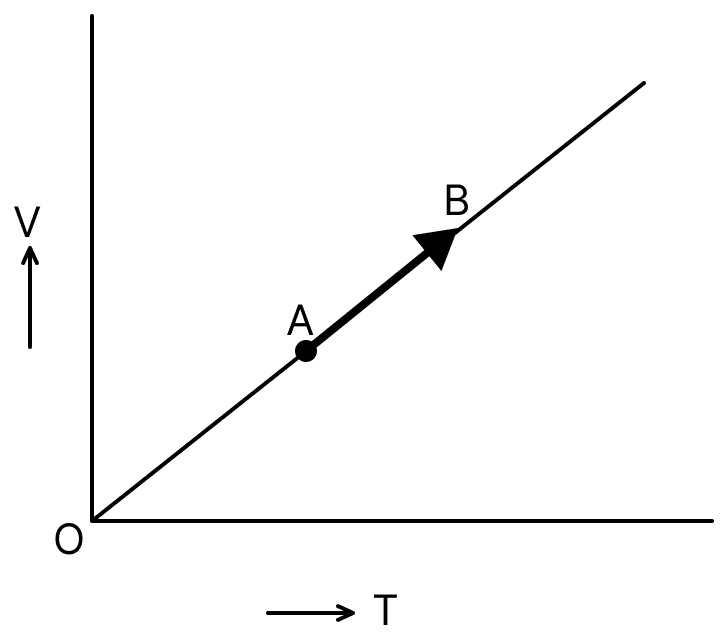
The volume (V) of a monoatomic gas varies with its temperature (T), as shown in the graph. The ratio of work done by the gas, to the heat absorbed by it, when it undergoes a change from state A to state B, is :
Answer
Reason —
From the graph the volume V varies linearly with the temperature T and the straight line passes through the origin, so
This means that the pressure of the gas remains constant, that is, the process from A to B is isobaric.
Heat absorbed by the gas : For an isobaric process,
since the gas is monoatomic, for which .
Work done by the gas : For an isobaric process,
Therefore the required ratio is
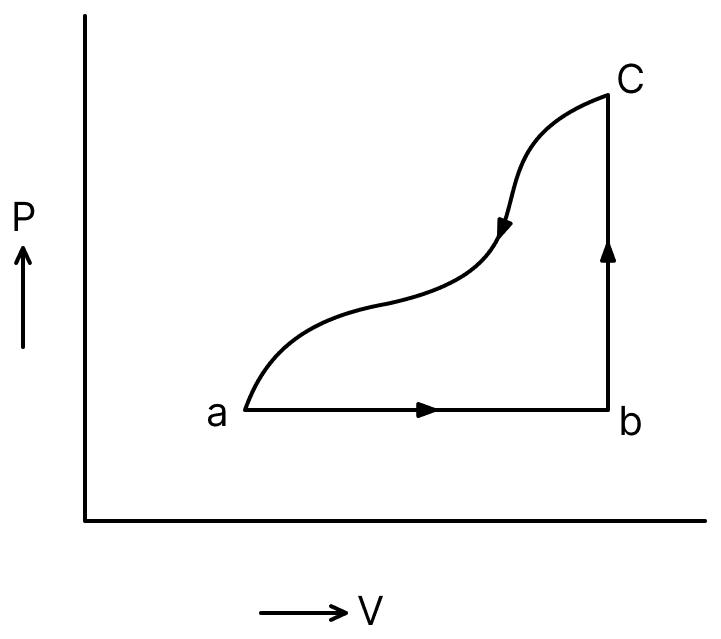
A sample of an ideal gas is taken through the cyclic process abca as shown in the figure. The change in the internal energy of the gas along the path ca is −180 J. The gas absorbs 250 J of heat along the path ab and 60 J along the path bc. The work done by the gas along the path abc is :
- 120 J
- 130 J
- 100 J
- 140 J
Answer
130 J
Reason — Given,
- Change in internal energy along the path ca, dUca = − 180 J
- Heat absorbed along the path ab, dQab = 250 J
- Heat absorbed along the path bc, dQbc = 60 J
In the process b → c : From the graph the volume remains constant, so
By the first law of thermodynamics,
For the complete cyclic process abca : The internal energy returns to its initial value, so
In the process a → b : By the first law of thermodynamics,
Work done along the path abc :
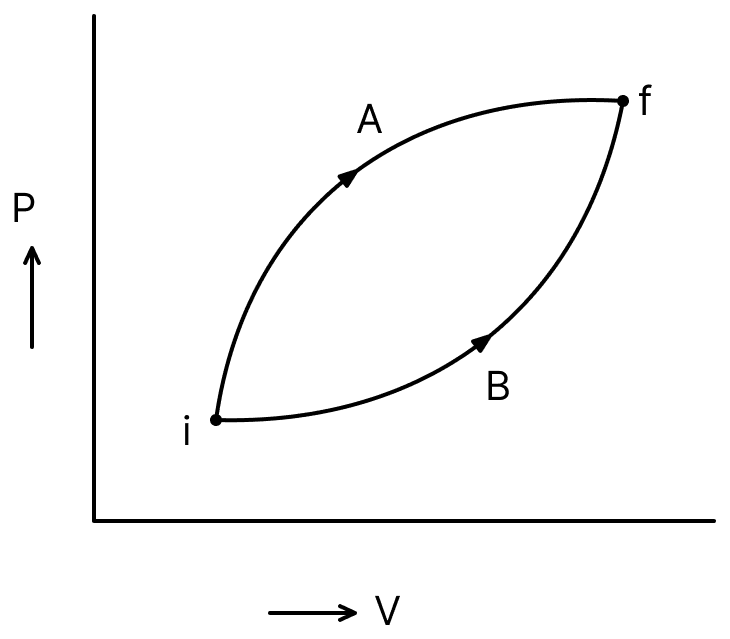
The given figure shows two processes A and B for gas. If ΔQA and ΔQB are the amount of heat absorbed by the system in two cases and ΔUA and ΔUB are changes in internal energies respectively then :
- ΔQA > ΔQB, ΔUA > ΔUB
- ΔQA < ΔQB, ΔUA < ΔUB
- ΔQA > ΔQB, ΔUA = ΔUB
- ΔQA = ΔQB, ΔUA = ΔUB
Answer
ΔQA > ΔQB, ΔUA = ΔUB
Reason —
Both the processes A and B take the gas from the same initial state i to the same final state f.
Change in internal energy : The internal energy is a state function, so its change depends only upon the initial and the final states, which are the same for both the processes. Hence
Work done : The work done is the area enclosed between the curve and the volume-axis. From the graph the curve A lies above the curve B, so the area under A is greater than the area under B,
Heat absorbed : By the first law of thermodynamics,
Since ΔUA = ΔUB and WA > WB, we get
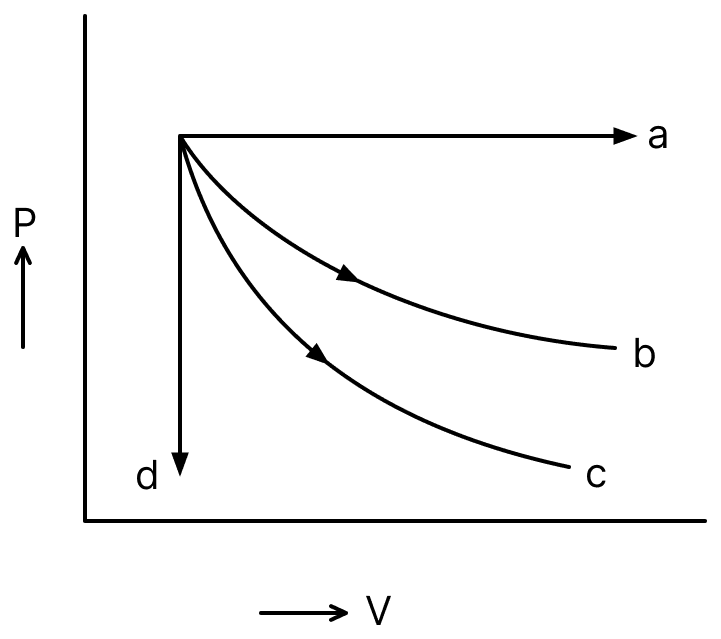
The given diagram shows four processes i.e., isochoric, isobaric, isothermal and adiabatic. The correct assignment of the processes, in the same order is given by :
- dabc
- adbc
- dacb
- adcb
Answer
dabc
Reason —
The four processes are to be identified in the order isochoric, isobaric, isothermal and adiabatic.
Isochoric process : The volume remains constant, so the curve is a straight line parallel to the pressure-axis. From the graph this is the curve d.
Isobaric process : The pressure remains constant, so the curve is a straight line parallel to the volume-axis. From the graph this is the curve a.
Isothermal and adiabatic processes : Both b and c are falling curves. We know that
and γ is always greater than 1, so the adiabatic curve is steeper than the isothermal curve. From the graph the curve c is steeper than the curve b. Hence b is isothermal and c is adiabatic.
Hence the correct sequence is d, a, b, c, that is, dabc.
In which of the following processes, heat is neither absorbed nor released by a system?
- Adiabatic
- Isobaric
- Isochoric
- Isothermal
Answer
Adiabatic
Reason — An adiabatic process is one during which no exchange of heat takes place between the system and the surroundings, that is, Q = 0. For such a process to occur, the system must be perfectly insulated from the surroundings, or the process must be carried out very rapidly.
In the isobaric, isochoric and isothermal processes heat is exchanged with the surroundings.
Half mole of an ideal monoatomic gas is heated at constant pressure of 1 atm from 20°C to 90°C. Work done by the gas is close to : (R = 8.31 J/mol-K)
- 291 J
- 581 J
- 146 J
- 73 J
Answer
291 J
Reason — Given,
- Number of moles, n = 0.5 (half mole)
- Initial temperature = 20°C, final temperature = 90°C, so ΔT = 70°C = 70 K
- Constant pressure = 1 atm
- R = 8.31 J (mol-K)-1
At constant pressure, the work done by the gas is
From the ideal gas equation PV = nRT, at constant pressure
Therefore
A gas has n degrees of freedom. The ratio of specific heat of gas at constant volume to the specific heat of gas at constant pressure will be :
Answer
Reason — Given, the gas has n degrees of freedom.
For a gas having n degrees of freedom, the molar specific heat at constant volume is
By Mayer's relation, the molar specific heat at constant pressure is
Therefore the required ratio is
Dividing the numerator and the denominator by R,
7 mol of a certain monoatomic ideal gas undergoes a temperature increase of 40 K at constant pressure. The increase in the internal energy of the gas in this process is : (Given R = 8.3 JK-1 mol-1)
- 5810 J
- 3486 J
- 11620 J
- 6972 J
Answer
3486 J
Reason — Given,
- Number of moles, n = 7
- Rise in temperature, ΔT = 40 K
- The gas is monoatomic, so
- R = 8.3 J K-1 mol-1
The change in internal energy depends only upon the temperature change, whatever be the process. Hence
Substituting the values,
The efficiency of an ideal heat engine working between the freezing point and boiling point of water is :
- 6.25%
- 20%
- 26.8%
- 12.5%
Answer
26.8%
Reason — Given,
- Temperature of the source (boiling point of water), T1 = 100°C = 373 K
- Temperature of the sink (freezing point of water), T2 = 0°C = 273 K
The efficiency of an ideal heat engine is
Substituting the values,
Three Carnot engines operate in series between a heat source at a temperature T1 and a heat sink at temperature T4. There are two other reservoirs at temperature T2 and T3 as shown with T1 > T2 > T3 > T4. The three engines are equally efficient if :
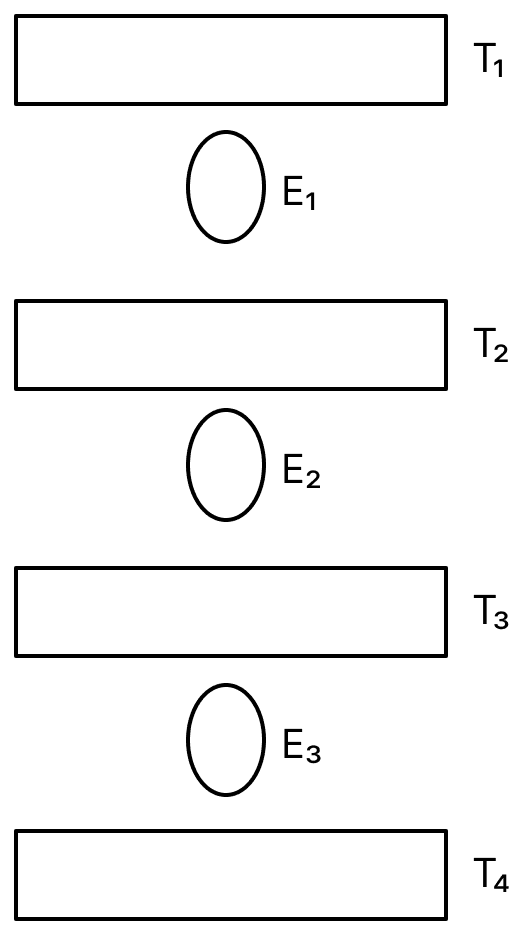
Answer
Reason —
Given, the three Carnot engines operate in series between T1 and T4, with T1 > T2 > T3 > T4, and the three engines are equally efficient.
The efficiency of a Carnot engine is
For the three engines to be equally efficient,
From the first two ratios :
From the last two ratios :
Substituting the value of T3 from equation (ii) into equation (i),
Squaring both the sides,
Substituting this value in equation (ii),
Two Carnot engines A and B are operated in series. The first engine A, receives heat at T1 (= 600 K) and rejects to a reservoir at temperature T2. The second engine B receives heat rejected by the first engine and in turn rejects to a heat reservoir at T3 (= 400 K). If work outputs of two engines are equal then temperature T2 will be :
- 600 K
- 500 K
- 400 K
- 300 K
Answer
500 K
Reason — Given,
- Engine A receives heat at T1 = 600 K and rejects to a reservoir at T2
- Engine B receives the heat rejected by A and rejects to a reservoir at T3 = 400 K
- The work outputs of the two engines are equal
Let Q1 be the heat received by engine A at T1, Q2 the heat rejected by A and received by engine B, and Q3 the heat rejected by engine B.
Work output of engine A :
Work output of engine B :
Since the work outputs are equal,
Dividing throughout by Q2,
For a Carnot engine the heat exchanged is proportional to the absolute temperature, so and . Therefore
Substituting the values,
Cp and Cv are specific heats at constant pressure and constant volume respectively. It is observed that :
Cp − Cv = a for hydrogen gas
Cp − Cv = b for nitrogen gas
The correct relation between a and b is :
- a = 28b
- a = b
- a = 14b
Answer
a = 14b
Reason — Here Cp and Cv are the specific heats, that is, the heat capacities per unit mass. They are related to the molar specific heats CP and CV by
where M is the molar mass. By Mayer's relation,
For hydrogen gas, M = 2, so
For nitrogen gas, M = 28, so
Taking the ratio,
Two moles of an ideal monoatomic gas occupies a volume V at 27°C. The gas expands adiabatically to a volume 2V. Calculate (i) the final temperature of the gas and (ii) change in its internal energy.
- (i) 189 K (ii) −27 kJ
- (i) 195 K (ii) −2.7 kJ
- (i) 189 K (ii) 27 kJ
- (i) 195 k (ii) 2.7 kJ
Answer
(i) 189 K (ii) −27 kJ
Reason — Given,
- Number of moles of the monoatomic gas, μ = 2
- Initial temperature, T1 = 27°C = 300 K
- Initial volume = V, final volume = 2V
- For a monoatomic gas,
(i) Final temperature of the gas : For an adiabatic change,
Here , so
(ii) Change in internal energy : For a monoatomic gas the degrees of freedom f = 3, and
Substituting the values,
Note: The change in internal energy works out to − 2.7 kJ, and the textbook's own hint for this question also obtains − 2.7 kJ. The value "− 27 kJ" printed in option (a) therefore appears to be a misprint for "− 2.7 kJ". Option (a) is the intended answer, since it alone carries the correct final temperature of 189 K.
When heat Q is supplied to a diatomic gas of rigid molecules, at constant volume, its temperature increases by ΔT. The heat required to produce the same change in temperature, at a constant pressure is :
Answer
Reason — Given, heat Q is supplied to a diatomic gas of rigid molecules at constant volume, producing a temperature rise ΔT.
At constant volume : The heat supplied is
At constant pressure : For the same temperature change, the heat required is
Dividing the second by the first,
For a diatomic gas of rigid molecules, . Therefore
n moles of an ideal gas with constant volume heat capacity Cv undergo an isobaric expansion by certain volume. The ratio of the work done in the process, to the heat supplied is :
Answer
Reason — Given, n moles of an ideal gas with constant volume heat capacity Cv undergo an isobaric expansion.
Work done in the process : For an isobaric process,
Heat supplied in the process : The heat supplied at constant pressure is
where Cp is the molar specific heat at constant pressure. Since Cv here is the heat capacity of the whole sample of n moles, the molar specific heat at constant volume is , and by Mayer's relation
Therefore
Dividing equation (i) by equation (ii),
In a process, temperature and volume of one mole of an ideal monoatomic gas are varied according to the relation VT = K, where K is a constant. In this process, the temperature of the gas is increased by ΔT. The amount of heat absorbed by gas is : (R = gas constant)
Answer
Reason — Given,
- One mole of an ideal monoatomic gas
- The process obeys VT = K, where K is a constant
- The temperature is increased by ΔT
Finding the nature of the process : From the ideal gas equation for one mole,
Substituting this in VT = K,
Work done : Equation (i) represents a polytropic process PVx = constant with x = 2. The work done in such a process is
Substituting x = 2,
Change in internal energy : For a monoatomic gas,
Heat absorbed : By the first law of thermodynamics,
A rigid diatomic ideal gas undergoes an adiabatic process at room temperature. The relation between temperature and volume for this process is TVx = constant, then x is :
Answer
Reason — Given, a rigid diatomic ideal gas undergoes an adiabatic process, and the relation is TVx = constant.
For a rigid diatomic gas the degrees of freedom are 5, so
Poisson's equation for an adiabatic process, expressed in terms of the temperature and the volume, is
Comparing this with the given relation TVx = constant,
A monoatomic gas at pressure P and volume V is suddenly compressed to one-eighth of its original volume. The final pressure at constant entropy will be :
- P
- 8P
- 32P
- 64P
Answer
32P
Reason — Given,
- Initial pressure = P and initial volume = V
- Final volume
- The gas is monoatomic, so
The gas is compressed suddenly and the entropy remains constant, so the change is adiabatic and obeys Poisson's law,
Rearranging,
Now
Therefore
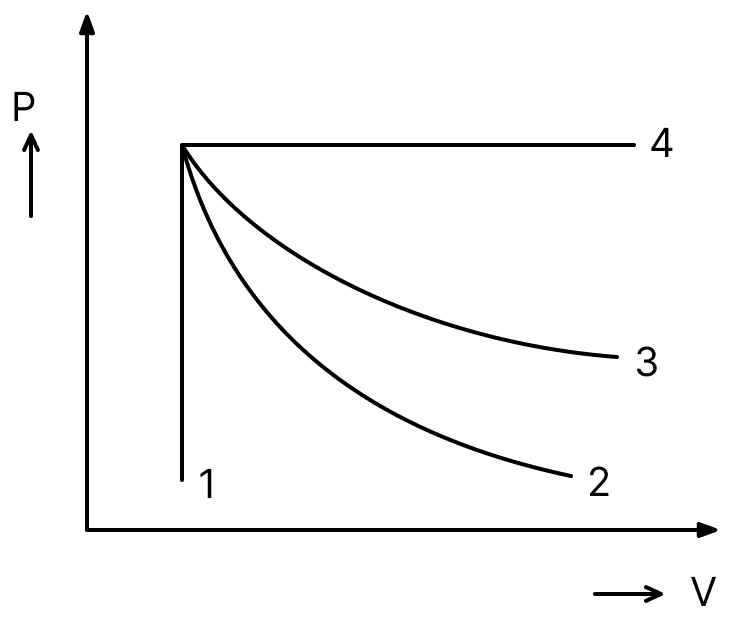
An ideal gas undergoes four different processes from the same initial state as shown in the figure. Those processes are adiabatic, isothermal, isobaric and isochoric. The curve which represents the adiabatic process among 1, 2, 3 and 4 is :
- 3
- 4
- 1
- 2
Answer
2
Reason —
The four processes starting from the same initial state are adiabatic, isothermal, isobaric and isochoric.
- The isobaric process (PV0 = constant) is a straight line parallel to the volume-axis, which is the curve 4.
- The isochoric process is a straight line parallel to the pressure-axis, which is the curve 1.
- Of the two remaining falling curves, the adiabatic curve is steeper than the isothermal curve, since
The isothermal process obeys PV = constant and the adiabatic process obeys PVγ = constant. From the graph the curve 2 is steeper than the curve 3.
Hence the curve 2 represents the adiabatic process.
0.08 kg air is heated at constant volume through 5°C. The specific heat of air at constant volume is 0.17 kcal/kg° C and J = 4.18 J/cal. The change in its internal energy is approximately :
- 318 J
- 298 J
- 284 J
- 142 J
Answer
284 J
Reason — Given,
- Mass of air, m = 0.08 kg
- Rise in temperature, ΔT = 5°C
- Specific heat of air at constant volume, cv = 0.17 kcal (kg-°C)-1
- J = 4.18 J cal-1
Since the air is heated at constant volume, no work is done,
By the first law of thermodynamics,
The heat taken by the air is
Converting into joule,
In an adiabatic process, which of the following statements is true?
- The molar heat capacity is infinite
- Work done by the gas equals the increase in internal energy
- The molar heat capacity is zero
- The internal energy of the gas decreases as the temperature increases
Answer
The molar heat capacity is zero
Reason — In an adiabatic process no heat is exchanged with the surroundings, so
The molar heat capacity is defined as
Since dQ = 0 while dT is not zero, we get
Hence the molar heat capacity in an adiabatic process is zero.
Option 2 is incorrect, because dQ = 0 gives dU = − dW, so the work done by the gas equals the decrease in internal energy. Option 4 is incorrect, because , so the internal energy increases when the temperature increases.
Two gases A and B are filled at the same pressure in separate cylinders with movable pistons of radius rA and rB, respectively. On supplying an equal amount of heat to both the systems reversibly under constant pressure, the pistons of gas A and B are displaced by 16 cm and 9 cm, respectively. If the change in their internal energy is the same, then the ratio is equal to:
4/3
3/4
Answer
3/4
Reason — Given,
- The two gases are at the same pressure, PA = PB = P
- Equal amounts of heat are supplied, QA = QB
- The changes in internal energy are the same, ΔUA = ΔUB
- Displacement of the piston of gas A, xA = 16 cm
- Displacement of the piston of gas B, xB = 9 cm
By the first law of thermodynamics,
Since the heat supplied and the change in internal energy are the same for both the gases, the work done must also be the same,
The process takes place at constant pressure, so
The change in volume is the area of cross-section of the piston multiplied by its displacement,
Taking the square root,
Note: The textbook answer key gives option (a), i.e., 4/3, but the correct option is 3/4. Since the pistons sweep out equal volumes, the piston moving a greater distance must have a smaller radius. The textbook’s hint has interchanged the displacements.
The efficiency of a Carnot engine operating with a hot reservoir kept at a temperature of 1000 K is 0.4. It extracts 150 J of heat per cycle from the hot reservoir. The work extracted from this engine is being fully used to run a heat pump which has a coefficient of performance 10. The hot reservoir of the heat pump is at a temperature of 300 K. Which of the following statements is/are correct ?
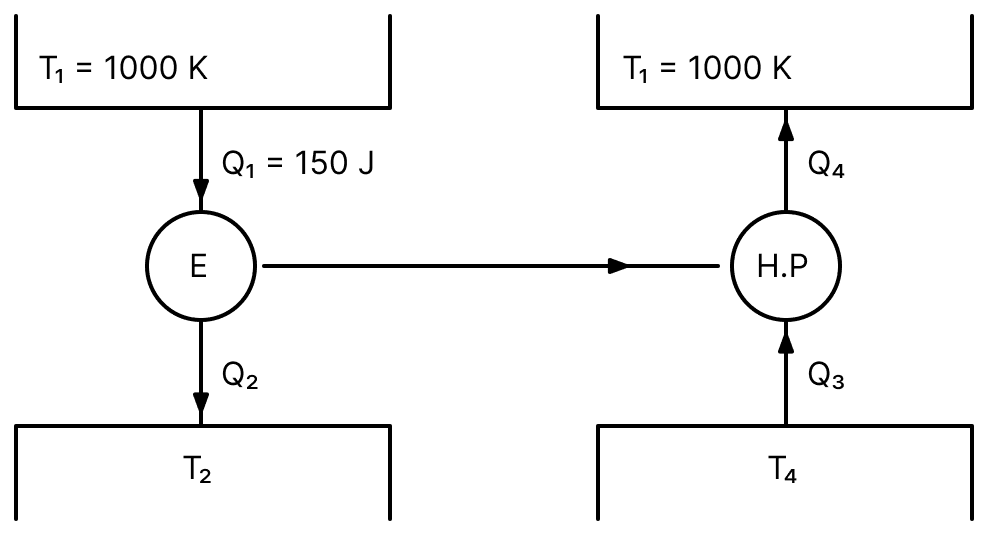
- Work extracted from the Carnot engine in one cycle is 60 J.
- Temperature of the cold reservoir of the Carnot engine is 600 K.
- Temperature of the cold reservoir of the heat pump is 270 K.
- Heat supplied to the hot reservoir of the heat pump in one cycle is 540 J.
Answer
1. Work extracted from the Carnot engine in one cycle is 60 J.
2. Temperature of the cold reservoir of the Carnot engine is 600 K.
3. Temperature of the cold reservoir of the heat pump is 270 K.
Reason — Given,
- Efficiency of the Carnot engine, η = 0.4
- Temperature of the hot reservoir of the engine, T1 = 1000 K
- Heat extracted per cycle, Q1 = 150 J
- Coefficient of performance of the heat pump, (COP)HP = 10
- Temperature of the hot reservoir of the heat pump, T3 = 300 K
Checking option 1 : The work extracted from the Carnot engine is
Hence option 1 is correct.
Checking option 2 : The efficiency of the Carnot engine is
Hence option 2 is correct.
Checking option 3 : For a heat pump the coefficient of performance is
Substituting the values,
Hence option 3 is correct.
Checking option 4 : The work extracted from the engine is fully used to run the heat pump, so the work input to the pump is 60 J. The heat delivered to the hot reservoir of the heat pump is
Since this is not 540 J, option 4 is incorrect.
One mole of a monoatomic ideal gas undergoes an adiabatic expansion in which its volume becomes eight times its inital value. If the initial temperature of the gas is 100 K and the universal gas constant R = 8.0 J mol-1 K-1, the decrease in its internal energy, in J, is ...... . Calculate up to second decimal place.
Answer
Given,
- Number of moles of the monoatomic gas, μ = 1
- Initial temperature, T1 = 100 K
- Final volume, V2 = 8V1
- R = 8.0 J mol-1 K-1
- For a monoatomic gas,
Final temperature : For an adiabatic process,
Substituting V2 = 8V1 and ,
Now
Therefore
Change in internal energy : For an ideal gas,
Substituting the values,
Hence, the decrease in the internal energy of the gas is 900.00 J.
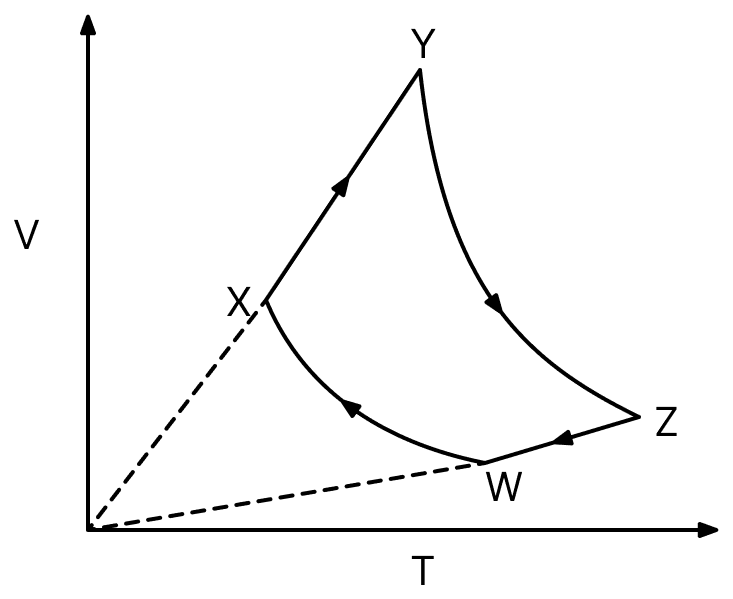
An ideal monatomic gas of n moles is taken through a cycle WXYZW consisting of consecutive adiabatic and isobaric quasi-static processes, as shown in the schematic V-T diagram. The volume of the gas at W, X and Y points are 64 cm3, 125 cm3 and 250 cm3, respectively. If the absolute temperature of the gas TW at the point W is such that nRTW = 1J (R is the universal gas constant), then the amount of heat absorbed (in J) by the gas along the path XY is ......... .
Answer
Given,
- Volume of the gas at W, VW = 64 cm3
- Volume of the gas at X, VX = 125 cm3
- Volume of the gas at Y, VY = 250 cm3
- nRTW = 1 J
- The gas is monatomic, so and
From the V-T diagram, WX is an adiabatic process and XY is an isobaric process.
Temperature at X : For the adiabatic process WX,
Now
Therefore
Temperature at Y : The process XY is isobaric, so by Charles' law
Heat absorbed along the path XY : For an isobaric process,
Substituting ,
Since nRTW = 1 J,
Hence, the heat absorbed by the gas along the path XY is 1.60 J.
Directions :
- Each set has One Multiple Choice Question.
- Each set has Two lists : List-I and List-II.
- List-I has Four entries (P), (Q), (R) and (S) and List-II has Five entries (1), (2), (3), (4) and (5).
- Four options are given in each Multiple Choice Question based on List-I and List-II and only one of these four options satisfies the condition asked in the Multiple Choice Question.
- Answer to each question will be evaluated according to the following marking scheme :
- Full Marks : +3 only if the option corresponding to the correct combination is chosen; Zero Marks : 0 If none of the options is chosen (i.e. the question is unanswered); Negative Marks: −1 In all other cases.
One mole of a monatomic ideal gas undergoes the cyclic process J → K → L → M → J, as shown in the P-T diagram. Match the quantities mentioned in List-I with their values in List-II and choose the correct option. [R is the gas constant.]
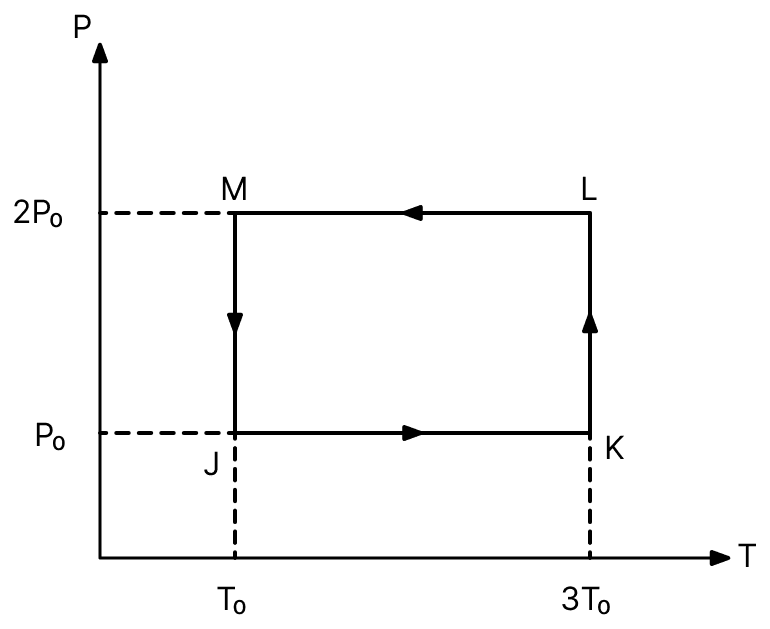
| List-I | List-II |
|---|---|
| P. Work done in the complete cyclic process. | 1. RT0 − 4RT0 ln 2 |
| Q. Change in the internal energy of the gas in the process JK. | 2. 0 |
| R. Heat given to the gas in the process KL. | 3. 3RT0 |
| S. Change in the internal energy of the gas in the process MJ. | 4. −2RT0 ln 2 |
| 5. −3RT0 ln 2 |
- P → 1; Q → 3; R → 5; S → 4
- P → 4; Q → 3; R → 5; S → 2
- P → 4; Q → 1; R → 2; S → 2
- P → 2; Q → 5; R → 3; S → 4.
Answer
P → 4; Q → 3; R → 5; S → 2
Reason —
From the P-T diagram the four states of one mole of the monatomic ideal gas are
where P0V0 = RT0. The process JK is isobaric, KL is isothermal, LM is isobaric and MJ is isothermal.
(P) Work done in the complete cyclic process :
JK is isobaric, so
KL is isothermal at 3T0, and since PV is constant the volume falls to half as the pressure doubles,
LM is isobaric, so
MJ is isothermal at T0, and the volume doubles as the pressure halves,
Adding all the four,
Hence P → 4.
(Q) Change in the internal energy in the process JK : For one mole of a monatomic gas,
Hence Q → 3.
(R) Heat given to the gas in the process KL : The process is isothermal, so ΔU = 0 and by the first law
Hence R → 5.
(S) Change in the internal energy in the process MJ : The process is isothermal, so the temperature does not change and
Hence S → 2.