
Estimate the fraction of molecular volume to the actual volume occupied by oxygen gas at STP. Take the diameter of an oxygen molecule to be 3 Å.
Answer
Given,
- Diameter of an oxygen molecule, d = 3 Å = 3 × 10⁻¹⁰ m
- Radius of an oxygen molecule, r = = 1.5 × 10⁻¹⁰ m
At normal temperature and pressure, the volume of 1 mole of a gas is 22.4 L and this quantity of the gas contains 6.02 × 10²³ molecules (Avogadro's number).
Therefore, the actual volume occupied by the gas is
Considering an oxygen molecule to be a sphere of radius r, the volume of one molecule is . Hence the molecular volume, that is, the volume occupied by the 6.02 × 10²³ molecules themselves, is
Substituting the values,
The required fraction is
Hence, the fraction of the molecular volume to the actual volume occupied by oxygen gas at STP is 3.8 × 10⁻⁴.
The molecular volume is thus about four ten-thousandths of the volume of the gas, which justifies the postulate of the kinetic theory that the actual volume of the molecules is negligible compared to the total volume of the container.
Molar volume is the volume occupied by 1 mol of any (ideal) gas at standard temperature and pressure (STP), that is, at 1 atmospheric pressure and 0°C temperature. Show that it is 22.4 L. Take R = 8.31 J mol-1 K-1.
Answer
Given,
- Number of moles, μ = 1 mol
- Pressure, P = 1 atm = 1.01 × 10⁵ N m-2
- Temperature, T = 0°C = 273 K
- Gas constant, R = 8.31 J mol-1 K-1
The ideal gas equation for μ moles of a gas is
For the molar volume we put μ = 1 mol. Substituting the values,
Since 1 litre = 10-3 m3,
Hence, the molar volume of an ideal gas at STP is 22.4 L.
The figure shows plots of PV/T (in J K-1) versus P (in N m-2) for 1.00 × 10⁻³ kg of oxygen gas at two different temperature T1 and T2.
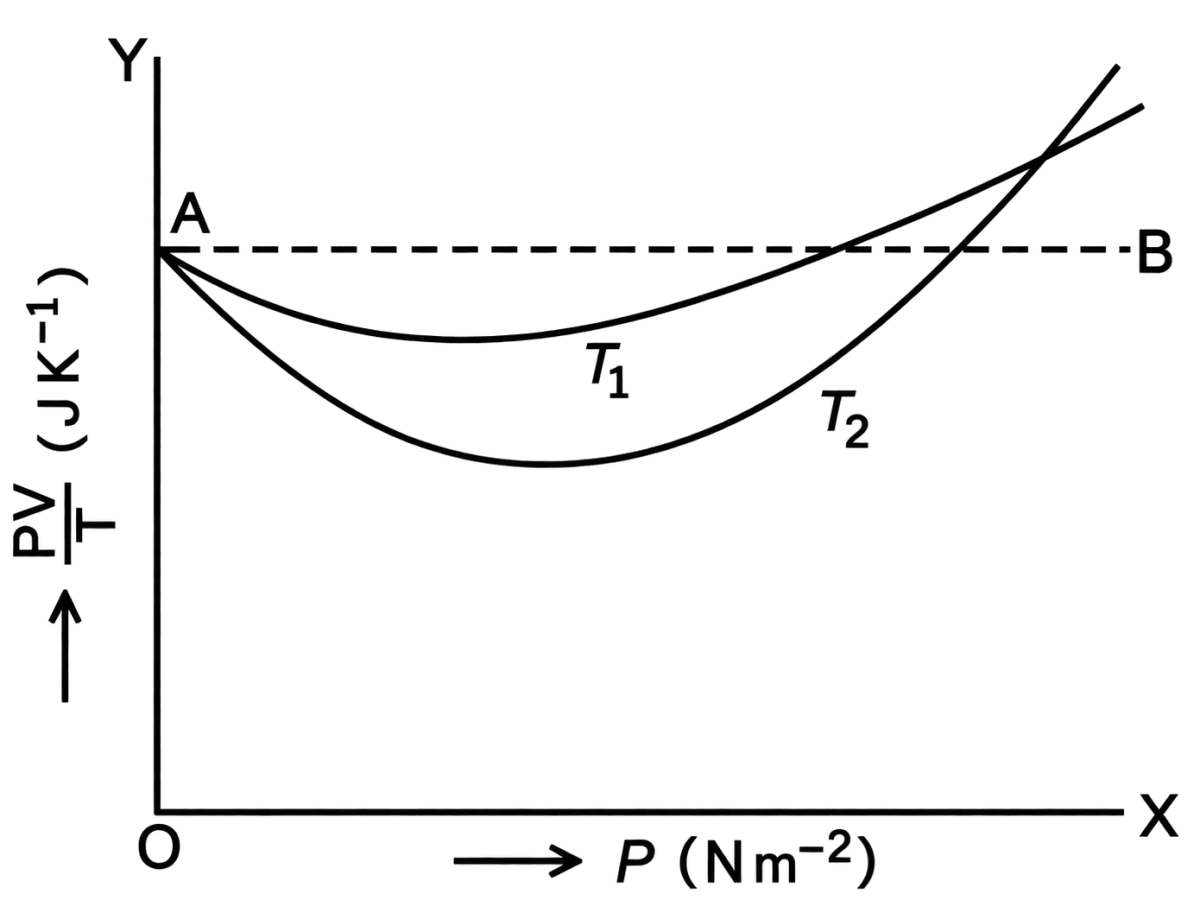
(i) What does the dotted plot signify?
(ii) Which is true : T1 > T2 or T1 < T2?
(iii) What is the value of PV/T where the curves meet on the Y-axis?
(iv) If we obtain similar plots for 1.00 × 10⁻³ kg of hydrogen, would we get the same value of PV/T at the point A? If not, what mass of hydrogen would yield the same value of PV/T for low pressure high temperature region of the plot? Molecular masses of oxygen and hydrogen are 32.0 and 2.02 respectively, and R = 8.31 J mol-1 K-1.
Answer
Given,
- Mass of oxygen gas, m = 1.00 × 10⁻³ kg
- Molecular mass of oxygen, M = 32.0 g mol-1 = 32.0 × 10⁻³ kg mol-1
- Molecular mass of hydrogen = 2.02 g mol-1 = 2.02 × 10⁻³ kg mol-1
- Gas constant, R = 8.31 J mol-1 K-1
(i) The dotted plot is a straight line parallel to the P-axis, which means that the value of stays the same at all pressures. For μ moles of a gas, PV = μRT gives , a constant. Hence the dotted line AB signifies ideal gas behaviour.
(ii) The curve drawn at the temperature T1 lies closer to the dotted line AB than the curve drawn at T2. A real gas approaches ideal gas behaviour at higher temperatures, so the curve nearer to the ideal line corresponds to the higher temperature. Hence T1 > T2.
(iii) At the point A the two curves meet the dotted line, that is, oxygen behaves like an ideal gas there. For μ moles,
The number of moles in 1.00 × 10⁻³ kg of oxygen is
Therefore,
(iv) The value of at the point A would not be the same for 1.00 × 10⁻³ kg of hydrogen, because the molecular mass of hydrogen differs from that of oxygen and hence the same mass contains a different number of moles.
Let m' be the mass of hydrogen which gives the same value 0.26 J K-1. Then
Hence, a mass of 6.3 × 10⁻⁵ kg of hydrogen would yield the same value of PV/T in the low pressure, high temperature region of the plot.
An oxygen cylinder of volume 30 L has an initial gauge pressure of 15 atm and a temperature of 27°C. After some oxygen is withdrawn from the cylinder, the gauge pressure drops to 11 atm and its temperature drops to 17°C. Estimate the mass of oxygen taken out of the cylinder. (R = 8.3 J mol-1 K-1; molecular mass M of O2 = 32.)
Answer
Given,
- Volume of the cylinder, V = 30 L = 30 × 10-3 m3
- Initial gauge pressure = 15 atm
- Initial temperature, T1 = 27°C = 27 + 273 = 300 K
- Final gauge pressure = 11 atm
- Final temperature, T2 = 17°C = 17 + 273 = 290 K
- Atmospheric pressure = 1 atm = 1.01 × 10⁵ N m-2
- Gas constant, R = 8.3 J mol-1 K-1
- Molecular mass of O2, M = 32
The ideal gas equation PV = μRT holds for the absolute pressure of the gas, whereas a pressure gauge reads the pressure above the atmospheric pressure. Hence the pressures must first be converted,
The volume V of the cylinder remains unchanged. Let μ1 be the number of moles of oxygen initially present and μ2 the number of moles left after the withdrawal. Writing the gas equation for the two states,
The number of moles initially present is
The number of moles left is
Therefore the number of moles of oxygen taken out of the cylinder is
The mass of oxygen taken out is
Hence, the mass of oxygen taken out of the cylinder is nearly 140 g.
Note: The textbook substitutes the gauge pressures 15 atm and 11 atm directly into PV = μRT and obtains 141 g. Since the gas equation is valid only for the absolute pressure, the atmospheric pressure of 1 atm must be added to each gauge reading, which gives 140 g.*
An air bubble of volume 1.0 cm3 rises from the bottom of a lake 40 m deep at a temperature of 12°C. To what volume does it grow on reaching the surface where the temperature is 35°C? The atmospheric pressure is 1.0 × 10⁵ Pa and the density of water is 103 kg m-3. Take g = 9.8 N kg-1.
Answer
Given,
- Volume of the bubble at the bottom, V1 = 1.0 cm3 = 1.0 × 10⁻⁶ m3
- Depth of the lake, h = 40 m
- Temperature at the bottom, T1 = 12°C = 12 + 273 = 285 K
- Temperature at the surface, T2 = 35°C = 35 + 273 = 308 K
- Atmospheric pressure, P = 1.0 × 10⁵ Pa
- Density of water, ρ = 103 kg m-3
- g = 9.8 N kg-1
At the bottom of the lake the bubble is under the atmospheric pressure together with the pressure of the water column above it. Hence the pressure at the bottom is
At the surface the bubble is under the atmospheric pressure alone, so
The air enclosed in the bubble obeys the gas law,
Substituting the values,
Hence, the bubble grows to a volume of 5.3 cm3 on reaching the surface.
Estimate the total number of air molecules (inclusive of oxygen, nitrogen, water vapour and other constituents) in a room of volume capacity 25.0 m3 at a temperature of 27°C and 1 atm pressure.
Answer
Given,
- Volume of the room, V = 25.0 m3
- Temperature, T = 27°C = 27 + 273 = 300 K
- Pressure, P = 1 atm = 1.01 × 10⁵ N m-2
- Boltzmann constant, k = 1.38 × 10⁻²³ J K-1
For a given mass of a gas containing n molecules, the gas equation in terms of the Boltzmann constant is
This relation involves no property of the particular gas, so it holds for the mixture of oxygen, nitrogen, water vapour and the other constituents of air taken together.
Substituting the values,
Hence, the total number of air molecules in the room is 6.10 × 1026.
Estimate the average thermal energy of a helium atom at (i) room temperature (27°C), (ii) the temperature on the surface of the sun (6000 K), (iii) the temperature of 10 million degree kelvin (the typical core temperature in case of a star). k = 1.38 × 10⁻²³ J K-1.
Answer
Given,
- Boltzmann constant, k = 1.38 × 10⁻²³ J K-1
Helium is a monoatomic gas, and according to the kinetic theory the average thermal (kinetic) energy of a molecule of a gas at absolute temperature T is
(i) At room temperature, T = 27°C = 300 K :
(ii) At the temperature on the surface of the sun, T = 6000 K :
(iii) At the core temperature of a star, T = 107 K :
Hence, the average thermal energy of a helium atom is 6.21 × 10⁻²¹ J, 1.24 × 10⁻¹⁹ J and 2.07 × 10⁻¹⁶ J at the three temperatures respectively.
Three vessels of equal capacity have gases at same temperature and pressure. The first vessel contains neon (monoatomic). The second contains chlorine (diatomic) and the third contains uranium hexafluoride (polyatomic). Do the vessels contain equal number of respective molecules? Is the root-mean-square speed of molecules the same in the three cases? If not, in which case is vrms the largest?
Answer
Number of molecules : For n molecules of a gas, the ideal gas equation is
The three vessels are of equal capacity and the gases are at the same temperature and pressure, so P, V and T are the same for all three, and k is the Boltzmann constant. Hence the three vessels contain equal numbers of their respective molecules. This is Avogadro's law.
Root-mean-square speed : The rms speed of the molecules of a gas of molecular mass M at absolute temperature T is
Since the three gases have different molecular masses, the root-mean-square speed is not the same in the three cases. The rms speed is the largest for the gas of the smallest molecular mass.
Of the three gases, neon has the least molecular mass, chlorine has a larger one and uranium hexafluoride the largest. Hence vrms is the largest for neon.
At what temperature is the root-mean-square speed of an atom in an argon gas cylinder equal to the rms speed of a helium gas atom at -20°C? The atomic masses of argon and helium are 39.9 a.m.u. and 4.0 a.m.u. respectively.
Answer
Given,
- Atomic mass of argon, MA = 39.9
- Atomic mass of helium, MHe = 4.0
- Temperature of helium, THe = −20°C = −20 + 273 = 253 K
- Temperature of argon, TA = ?
According to the kinetic theory, the rms speed of the atoms of a gas of molecular mass M at absolute temperature T is
For the two gases,
The two rms speeds are to be equal, so
Squaring both sides and cancelling 3R,
Substituting the values,
Hence, at 2523.7 K the rms speed of an argon atom equals the rms speed of a helium atom at −20°C.
Estimate the mean free path and collision frequency of a nitrogen molecule in a cylinder containing nitrogen at 2.0 atm and temperature 17°C. Take the radius of a nitrogen molecule to be roughly 1.0 Å. Compare the collision time with the time the molecule moves freely between two successive collisions. (Molecular mass of N2 = 28.0 u)
Answer
Given,
- Pressure, P = 2.0 atm = 2 × 1.013 × 105 = 2.026 × 10⁵ N m-2
- Temperature, T = 17°C = 17 + 273 = 290 K
- Radius of a nitrogen molecule, r = 1.0 Å = 1.0 × 10⁻¹⁰ m, so d = 2r = 2.0 × 10⁻¹⁰ m
- Molecular mass of N2, M = 28.0 u = 28 × 10-3 kg mol-1
Number of molecules per unit volume : For 1 mole of an ideal gas,
Mean free path : The mean free path of a molecule is
Root-mean-square speed :
Collision frequency : The collision frequency is the number of collisions made by a molecule per second,
Collision time : The collision time is the time for which a molecule is actually in contact during a collision, that is, the time taken to cover a distance equal to its own diameter,
Time between two successive collisions :
Comparison :
Hence, the mean free path is 1.0 × 10⁻⁷ m, the collision frequency is 5.1 × 10⁹ s-1, and the time a molecule moves freely between two successive collisions is about 500 times the collision time.