
A cylindrical vessel of height 500 mm has an orifice (small hole) at its bottom. The orifice is initially closed and water is filled in it up to height H. Now the top is completely sealed with a cap and the orifice at the bottom is opened. Some water comes from the orifice and the water level in the vessel becomes steady with height of water column being 200 mm. Find the fall in height (in mm) of water level due to opening of the orifice. [Take atmospheric pressure = 1.0 × 10⁵ N/m2, density of water 1000 kg/m3 and g = 10 m/s2. Neglect any effect of surface tension.]
Answer
Given,
- Height of the cylindrical vessel = 500 mm
- Steady height of the water column after opening the orifice = 200 mm
- Atmospheric pressure, Patm = 1.0 × 10⁵ N/m2
- Density of water, ρ = 1000 kg/m3
- g = 10 m/s2
![A cylindrical vessel of height 500 mm has an orifice (small hole) at its bottom. The orifice is initially closed and water is filled in it up to height H. Now the top is completely sealed with a cap and the orifice at the bottom is opened. Some water comes from the orifice and the water level in the vessel becomes steady with height of water column being 200 mm. Find the fall in height (in mm) of water level due to opening of the orifice. [Take atmospheric pressure = 1.0 × 10 5 N/m 2, density of water 1000 kg/m 3 and g = 10 m/s 2. Neglect any effect of surface tension.]. Kinetic Theory, Solutions for Class 11 ISC Nootan Physics Kumar Mittal Nageen Prakashan](https://cdn1.knowledgeboat.com/img/np11/q1-hots-questions-ans-1-nootan-physics-icse-class-11-c12-202609171105-1200x535.png)
Let H be the initial height of the water column when the orifice is closed. The air enclosed above the water is then at the atmospheric pressure, since the vessel was open before it was sealed with the cap.
Initial state of the enclosed air :
where A is the area of cross-section of the vessel.
Final state of the enclosed air : When the orifice is opened, some water flows out and the level becomes steady at 200 mm. The water column then stands still, so the pressure at the level of the orifice due to the enclosed air together with the water column must equal the atmospheric pressure. Hence the final pressure of the enclosed air is
and its volume is
Applying Boyle's law : The temperature stays constant, so
Fall in the height of the water level :
Hence, the fall in the height of the water level due to opening of the orifice is 6 mm.
Based upon the following paragraph two multiple choice type questions are to be answered. Each question has four choices out of which only one is correct.
In the given figure, a container is shown to have a movable (without friction) piston on top. The container and the piston are all made of perfectly insulating material allowing no heat transfer between outside and inside the container. The container is divided into two compartments by a rigid partition made of a thermally conducting material that allows slow transfer of heat. The lower compartment of the container is filled with 2 moles of an ideal monoatomic gas at 700 K and the upper compartment is filled with 2 moles of an ideal diatomic gas at 400 K. The heat capacities per mole of an ideal monoatomic gas are Cv = R, Cp = R and those for an ideal diatomic gas are Cv = R, Cp = R.

(i) Consider the partition to be rigidly fixed so that it does not move. When equilibrium is achieved, the final temperature of the gases will be :
- 550 K
- 525 K
- 513 K
- 490 K
(ii) Now, consider the partition to be free to move without friction so that the pressure of gases in both compartments is the same. Then total work done by the gases till the time they achieve equilibrium will be :
- 250 R
- 200 R
- 100 R
- -100 R
Answer
Given,
- Lower compartment : 2 moles of an ideal monoatomic gas at 700 K, Cv = R, Cp = R
- Upper compartment : 2 moles of an ideal diatomic gas at 400 K, Cv = R, Cp = R
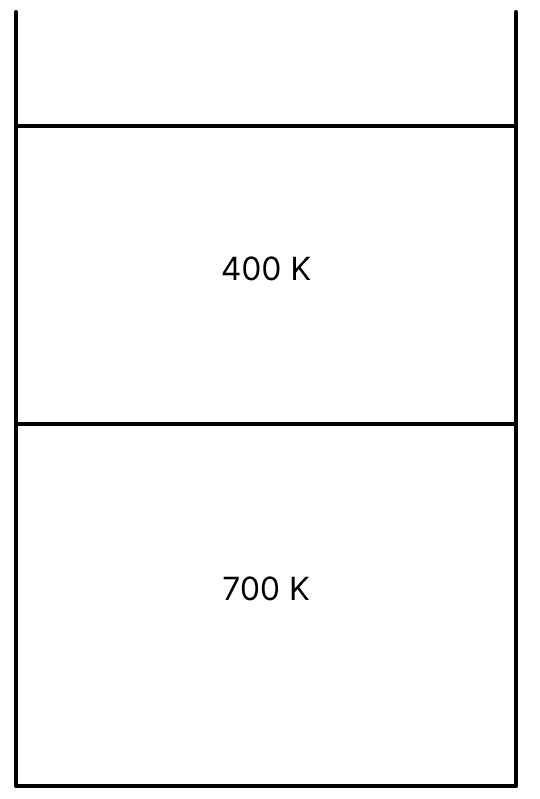
The container and the piston are perfectly insulating, so no heat is exchanged with the surroundings. The partition is thermally conducting, so heat flows from the hotter lower gas to the colder upper gas until both reach a common temperature T.
(i) 490 K
The partition is rigidly fixed, so the volume of the lower gas cannot change and the heat is given out by it at constant volume,
The piston on the top is free to move, so the upper gas receives heat at constant pressure,
Since the container is insulated, the heat given out by the lower gas is entirely absorbed by the upper gas. Equating (i) and (ii),
Hence, the final temperature of the gases is 490 K.
(ii) -100 R
Now the partition is also free to move, so the pressure of the gas in both the compartments is the same and both the gases undergo their changes at constant pressure.
Equating (i) and (ii),
The work done by a gas at constant pressure is W = μRΔT. For the upper gas,
For the lower gas,
The total work done by the gases is
Hence, the total work done by the gases till they achieve equilibrium is −100 R.
Two non-reactive monoatomic ideal gases have their atomic masses in the ratio 2 : 3. The ratio of their partial pressures, when enclosed in a vessel kept at a constant temperature is 4 : 3. The ratio of their densities is :
- 1 : 4
- 1 : 2
- 6 : 9
- 8 : 9
Answer
8 : 9
Given,
- Ratio of the atomic masses, M1 : M2 = 2 : 3
- Ratio of the partial pressures, P1 : P2 = 4 : 3
- Both the gases are in the same vessel at a constant temperature
For μ moles of an ideal gas of molecular mass M and mass m,
Since the temperature T is the same for both the gases,
Substituting the values,
Hence, the ratio of the densities of the two gases is 8 : 9.
A mixture of 2 moles of helium gas (atomic mass = 4 amu) and 1 mole of argon gas (atomic mass = 40 amu) is kept at 300 K in a container. The ratio of the rms speed is :
- 0.32
- 0.45
- 2.24
- 3.16
Answer
3.16
Given,
- Atomic mass of helium, MHe = 4 amu
- Atomic mass of argon, MAr = 40 amu
- Temperature, T = 300 K (the same for both the gases)
The rms speed of the molecules of a gas of molecular mass M at absolute temperature T is
Both the gases are in the same container at the same temperature. Hence
Substituting the values,
Hence, the required ratio of the rms speeds is 3.16.
The number of moles of the two gases does not enter the result, because the rms speed depends only on the temperature and the molecular mass of the gas.
An ideal gas is expanding such that PT2 = constant. The coefficient of volume expansion of the gas is :
Answer
Given,
- The gas expands such that PT2 = constant = K
For 1 mole of an ideal gas,
Substituting this value of P in PT2 = K,
Differentiating both sides with respect to T,
Putting back K = PT2,
The coefficient of volume expansion of the gas is
Since PV = RT for 1 mole,
Hence, the coefficient of volume expansion of the gas is .
A real gas behaves like an ideal gas if its :
- pressure and temperature are both high
- pressure and temperature are both low
- pressure is high and temperature is low
- pressure is low and temperature is high
Answer
pressure is low and temperature is high
A real gas behaves like an ideal gas when the two chief properties assumed for an ideal gas are nearly satisfied, namely that the volume of the molecules is negligible and that there is no force of attraction between them.
At low pressure the volume of the gas is large, so the actual volume of the molecules is negligible in comparison with the volume of the gas.
At high temperature the molecules have large kinetic energy, so the effect of the intermolecular force on their motion is negligible.
Hence, at low pressure and high temperature the behaviour of a real gas is approximately ideal.
Three perfect gases at absolute temperatures T1, T2 and T3 are mixed. The masses of molecules are m1, m2 and m3 and the number of molecules are n1, n2 and n3 respectively. Assuming no loss of energy, the final temperature of the mixture is :
Answer
Given,
- Absolute temperatures of the three gases : T1, T2, T3
- Number of molecules : n1, n2, n3
- There is no loss of energy on mixing
Assumption: the three gases have the same number of degrees of freedom, or only the translational kinetic energy of the molecules is being considered.
According to the kinetic theory, the average translational kinetic energy of one molecule of a gas at absolute temperature T is , where k is the Boltzmann constant. Hence, for a gas containing n molecules, the total translational kinetic energy is
Before mixing, the total energy of the three gases is
After mixing, the mixture contains (n1 + n2 + n3) molecules at the common temperature T, so its energy is
Since there is no loss of energy on mixing, the two are equal,
Cancelling the common factor throughout,
Hence, the final temperature of the mixture is .
The masses m1, m2 and m3 of the molecules do not appear in the result, because the average kinetic energy per molecule depends only on the temperature and not on the mass of the molecule.
Consider an ideal gas confined in an isolated closed chamber. As the gas undergoes an adiabatic expansion, the average time of collision between molecules increases as Vq, where V is the volume of the gas. The value of q is : (γ = Cp / Cv)
Answer
The average time of collision, that is, the average time between two successive collisions of a molecule, is
where the mean free path is and .
Since the number of molecules per unit volume is , the mean free path is proportional to V. Therefore
For an adiabatic expansion of an ideal gas,
Substituting this in the expression for τ,
Comparing with τ ∝ Vq,
Hence, the value of q is .
A metre long narrow bore tube held horizontally (and closed at one end) contains a 76 cm long mercury thread, which traps a 15 cm column of air. What happens if the tube is held vertically with the open end at the bottom?
Answer
Given,
- Length of the tube = 100 cm, closed at one end
- Length of the mercury thread = 76 cm
- Length of the trapped air column = 15 cm
- Atmospheric pressure = 76 cm of mercury
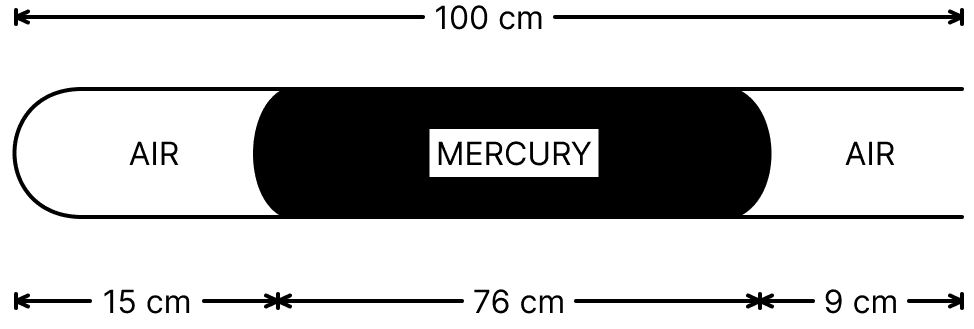
When the tube is horizontal : The trapped air column lies next to the closed end, the mercury thread is 76 cm long, and the length of the open portion of the tube is
The mercury thread is horizontal, so it exerts no pressure of its own on the enclosed air. Hence
where A is the area of cross-section of the tube.
When the tube is held vertically with the open end at the bottom : The mercury tends to run down, so the enclosed air expands into the 9 cm of empty tube and its length would become 15 + 9 = 24 cm. In this position the pressure of the enclosed air column together with the 76 cm mercury column exceeds the atmospheric pressure, and therefore some mercury flows out of the open end.
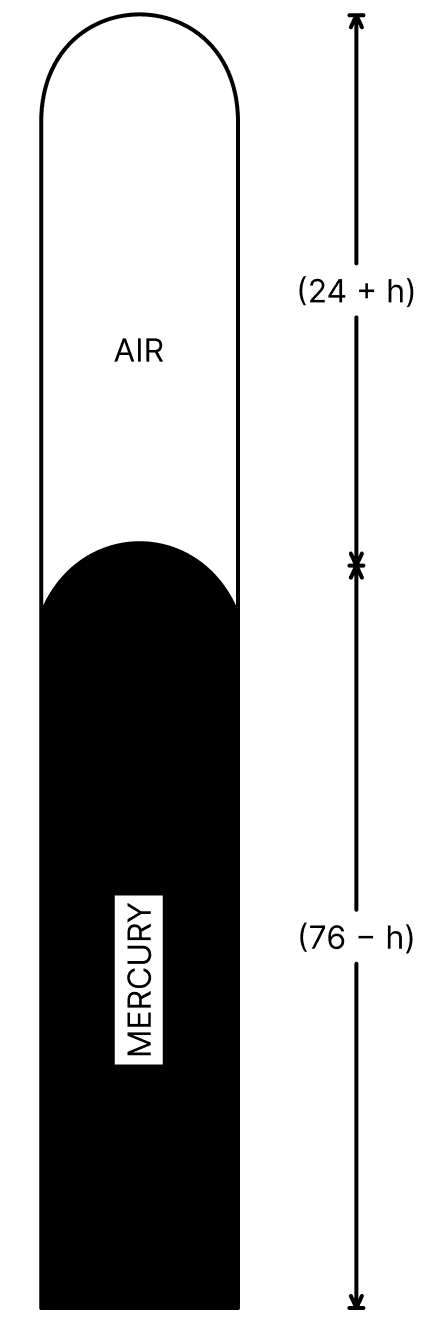
Let h cm of mercury flow out. Then the length of the mercury thread left in the tube is (76 − h) cm and the length of the enclosed air column becomes (24 + h) cm.
For the mercury to be in equilibrium, the pressure of the enclosed air together with the mercury column must balance the atmospheric pressure,
Applying Boyle's law : The temperature remains constant, so
Solving this quadratic equation,
A negative length has no meaning, so h = 23.85 cm.
Hence, when the tube is held vertically with the open end at the bottom, nearly 24 cm of mercury flows out of the tube, leaving a mercury column of about 52 cm and an enclosed air column of about 48 cm, which together keep the atmospheric pressure in balance.
From a certain apparatus, the diffusion rate of hydrogen has an average value of 28.7 cm3 s-1 while that of another gas is 7.2 cm3 s-1. Identify the gas.
Answer
Given,
- Diffusion rate of hydrogen, R1 = 28.7 cm3 s-1
- Diffusion rate of the unknown gas, R2 = 7.2 cm3 s-1
- Molecular mass of hydrogen, M1 = 2
The rate of diffusion of a gas is directly proportional to the rms speed of its molecules,
Since , at the same temperature the rms speed is inversely proportional to the square-root of the molecular mass. Therefore, for hydrogen and the unknown gas,
Squaring both sides,
Hence, the molecular mass of the unknown gas is 32, and the gas is oxygen.
A gas in equilibrium has uniform density and pressure throughout its volume. This is strictly true only if there are no external influences. A gas column under gravity, for example, does not have uniform density (and pressure). As you might expect, its density decreases with height. The precise dependence is given by the so-called law of atmospheres.
where n2, n1 refer to number density at heights h2 and h1 respectively. Use this relation to derive the equation for sedimentation equilibrium of a suspension in a liquid column :
where ρ is the density of the suspended particle, and ρ' that of surrounding medium. [NA is Avogadro's number, and R the universal gas constant.]
Answer
The law of atmospheres for a gas column under gravity is
Here the quantity mg in the exponent is the weight of one particle of the column.
Apparent weight of a suspended particle : When a particle of mass m and density ρ is suspended in a liquid of density ρ', it is buoyed up by the weight of the liquid displaced. The volume of the liquid displaced is equal to the volume of the particle,
Hence the apparent weight of the suspended particle is
Sedimentation equilibrium : For a suspension in a liquid column the particle settles under its apparent weight, so mg in equation (i) is to be replaced by Wapp,
Replacing the Boltzmann constant : Since , where R is the universal gas constant and NA is Avogadro's number,
Substituting this value,
Hence, the equation for sedimentation equilibrium of a suspension in a liquid column is established.
Given below are densities of some solids and liquids. Give rough estimates of the size of their atoms :
| Substance | Atomic mass (u) | Density (103 kg m-3) |
|---|---|---|
| Carbon (diamond) | 12.01 | 2.22 |
| Gold | 197.00 | 19.32 |
| Nitrogen (liquid) | 14.01 | 1.00 |
| Lithium | 6.94 | 0.53 |
| Fluorine (liquid) | 19.00 | 1.14 |
Answer
Let M be the atomic mass of the substance in gram, so that the mass of 1 mole is M × 10-3 kg. If NA is Avogadro's number, the mass of one atom is
Assuming an atom to be a sphere of radius r, its volume is and its mass is
Equating the two expressions for m,
Putting NA = 6 × 10²³ and simplifying,
For carbon (diamond) : M = 12.01 and ρ = 2.22 × 10³ kg m-3,
Working in the same way for the other substances,
| Substance | Atomic mass (u) | Density (103 kg m-3) | Size of atom |
|---|---|---|---|
| Carbon (diamond) | 12.01 | 2.22 | 1.29 Å |
| Gold | 197.00 | 19.32 | 1.59 Å |
| Nitrogen (liquid) | 14.01 | 1.00 | 1.77 Å |
| Lithium | 6.94 | 0.53 | 1.73 Å |
| Fluorine (liquid) | 19.00 | 1.14 | 1.88 Å |
Hence, the sizes of the atoms of these different elements are all of the order of 1 Å.