
The kinetic theory of gases assumes that gas molecules:
- are stationary
- are in constant random motion
- interact strongly with each other
- lose energy during collisions
Answer
are in constant random motion
Reason — According to the first postulate of the kinetic theory of gases, gas molecules move in continuous, random motion in all directions. They travel in straight lines until they collide with other gas molecules or with the walls of the container. The molecules are therefore never stationary, they do not exert forces on one another except during collisions, and the collisions being perfectly elastic, no kinetic energy is lost in them.
The pressure of a gas is due to:
- collisions of gas molecules with the walls of the container
- attraction between gas molecules
- repulsion between gas molecules
- volume of the gas
Answer
collisions of gas molecules with the walls of the container
Reason — The molecules of a gas keep on colliding with the walls of the vessel and thus transfer momentum to them. By Newton's law of motion, this rate of change of momentum appears as a steady force acting perpendicular to the walls of the vessel. The magnitude of this force per unit area of the walls is called the pressure of the gas. The attraction or repulsion between the molecules is negligible except during collisions, so it plays no part in producing the pressure.
According to kinetic theory, the average kinetic energy of gas molecules is directly proportional to:
- volume
- temperature
- pressure
- number of molecules
Answer
temperature
Reason — According to the kinetic theory, the average kinetic energy of a gas molecule at absolute temperature T is
where k is the Boltzmann constant. Since k is a constant, the average kinetic energy of the molecules is directly proportional to the absolute temperature of the gas, and it does not depend on the volume, the pressure or the number of molecules.
The root mean square speed of gas molecules is proportional to:
- the square root of the temperature
- the square of the temperature
- the temperature
- the pressure
Answer
the square root of the temperature
Reason — From the kinetic theory, the root-mean-square speed of the molecules of a gas of molecular weight M at absolute temperature T is
Since 3R/M is a constant for a given gas, the root-mean-square speed of the molecules is directly proportional to the square-root of the absolute temperature of the gas. This is the kinetic interpretation of temperature.
If the temperature of a gas is doubled, the average kinetic energy of its molecules:
- becomes half
- remains the same
- doubles
- becomes four times
Answer
doubles
Reason — The average kinetic energy of a gas molecule is , so . If the absolute temperature is doubled,
Hence the average kinetic energy of the molecules also becomes twice its original value.
The temperature of an ideal gas is directly proportional to the :
- potential energy of the gas
- average kinetic energy of gas molecules
- number of gas molecules
- volume of the gas
Answer
average kinetic energy of gas molecules
Reason — According to the kinetic theory, the average kinetic energy of a molecule of an ideal gas is , which gives
Thus the absolute temperature of a gas is directly proportional to the average kinetic energy of its molecules. This is called the kinetic interpretation of temperature. In an ideal gas there are no intermolecular forces, so there is no internal potential energy.
At absolute zero temperature, the molecules of an ideal gas:
- have zero potential energy
- have maximum kinetic energy
- have zero kinetic energy
- move at the speed of light
Answer
have zero kinetic energy
Reason — Since , the average kinetic energy of the molecules becomes zero when T = 0. Also becomes zero at T = 0. Hence absolute zero is that temperature at which the motion of all the molecules of a gas stops. As the kinetic energy can never be negative, no temperature is possible below the absolute zero.
Boyle's law states that at constant temperature, the volume of a given mass of gas is:
- directly proportional to pressure
- inversely proportional to pressure
- directly proportional to temperature
- inversely proportional to temperature
Answer
inversely proportional to pressure
Reason — Boyle's law states that for a fixed amount of gas at constant temperature, the volume V of a gas is inversely proportional to its pressure P,
Thus, at a constant temperature, if the pressure of a gas increases its volume decreases, and vice-versa.
Charles' law states that at constant pressure, the volume of a gas is:
- inversely proportional to temperature
- directly proportional to temperature
- inversely proportional to pressure
- independent of temperature
Answer
directly proportional to temperature
Reason — Charles' law states that the volume of a given mass of gas at constant pressure is directly proportional to its absolute temperature,
Thus, at constant pressure, a gas expands on heating and contracts on cooling.
The pressure law states that at constant volume, the pressure of a gas is:
- inversely proportional to temperature
- directly proportional to temperature
- inversely proportional to volume
- independent of temperature
Answer
directly proportional to temperature
Reason — The pressure law (Gay-Lussac's law) states that for a fixed amount of gas at constant volume, the pressure P of the gas is directly proportional to its absolute temperature T,
Thus, when the volume is kept constant, heating a gas raises its pressure in the same ratio as the absolute temperature.
The number of degrees of freedom for a monoatomic gas is:
- 1
- 3
- 5
- 7
Answer
3
Reason — The molecule of a monoatomic gas, such as helium or argon, consists of a single atom. Its translational motion can take place in any direction in space and can therefore be resolved along the three coordinate axes, giving three independent motions. Hence a monoatomic gas has three degrees of freedom, all translational. A monoatomic molecule can rotate also, but its moment of inertia is so small that the kinetic energy of rotation is insignificant.
A diatomic gas molecule has:
- 3 degrees of freedom
- 5 degrees of freedom
- 6 degrees of freedom
- 7 degrees of freedom
Answer
5 degrees of freedom
Reason — The molecule of a diatomic gas, such as H2 or O2, is made up of two atoms joined rigidly through a bond. It can not only move bodily, giving three translational degrees of freedom, but can also rotate about any of the three coordinate axes. However, its moment of inertia about the axis joining the two atoms is negligible, so it can have only two rotational motions. Hence a diatomic molecule has five degrees of freedom, three translational and two rotational. The vibrational motion does not usually occur at ordinary temperatures.
For a polyatomic gas, the degrees of freedom are:
- 3
- 5
- 6
- greater than 5
Answer
greater than 5
Reason — A polyatomic molecule, such as H2O, H2S or CO2, can rotate about any of the three coordinate axes. Hence a polyatomic gas has six degrees of freedom, three translational and three rotational, which is greater than 5. If the atoms of the molecule vibrate with respect to each other, it would possess vibrational degrees of freedom also.
The law of equipartition of energy states that each degree of freedom contributes how much energy to the total energy of a system?
kT
kT
kT
2kT
Answer
kT
Reason — According to the law of equipartition of energy, in a classical system of particles which is in equilibrium at absolute temperature T, the average internal (kinetic) energy per particle associated with each degree of freedom is kT, where k is Boltzmann's constant. If the particle has f degrees of freedom, its average kinetic energy would be f kT.
For a diatomic gas, the average energy per molecule is:
kT
kT
kT
kT
Answer
kT
Reason — By the law of equipartition of energy, the average energy per molecule is f kT, where f is the number of degrees of freedom. A diatomic gas molecule has f = 5, three translational and two rotational degrees of freedom. Hence the average energy per molecule of a diatomic gas is
Note: The value kT obtained above is not offered among the four options. The printed answer key marks option 2, that is, kT, which is the energy associated with one degree of freedom of a molecule and not the average energy of a diatomic molecule. The textbook's own explanation for this question also states the value as kT, so the options appear to be misprinted.*
Which of the following is an assumption of the kinetic theory of gases?
- Gas molecules are strongly attracted to each other
- Collisions between gas molecules are elastic
- Gas molecules have high potential energy
- All molecules have the same velocity
Answer
Collisions between gas molecules are elastic
Reason — One of the postulates of the kinetic theory is that the collisions between the gas molecules, and between the molecules and the walls of the container, are perfectly elastic, so that no kinetic energy is lost in the collisions. The other statements contradict the postulates, since gas molecules do not exert attractive or repulsive forces on each other except during collisions, they have negligible potential energy, and their speeds vary over a wide range.
The mean free path of gas molecules is defined as:
- the distance between two gas molecules
- the average distance a molecule travels before colliding with another molecule
- the distance between two walls of the container
- the total distance travelled by a molecule
Answer
the average distance a molecule travels before colliding with another molecule
Reason — The molecules of a gas move in straight lines with constant speeds between two successive collisions, so a particular molecule is found to follow short zig-zag paths of different lengths. These are called the 'free paths' of the molecule. The mean free path is the average distance travelled by a molecule between two successive collisions with other molecules.
The mean free path of a gas molecule is inversely proportional to:
- the volume of the gas
- the number density of the gas
- the temperature of the gas
- the molecular mass of the gas
Answer
the number density of the gas
Reason — The mean free path of a molecule is
where n is the number of molecules per unit volume, that is, the number density, and d is the diameter of a molecule. Hence the mean free path is inversely proportional to the number density of the gas, which is why the mean free path varies inversely as the density of the gas.
According to the kinetic theory, the pressure exerted by a gas is due to:
- molecular collisions with each other
- molecular collisions with the walls of the container
- the gravitational force between molecules
- the temperature of the gas
Answer
molecular collisions with the walls of the container
Reason — The pressure exerted by a gas on the walls of its container is due to the collisions of the gas molecules with the walls. Each collision imparts a small force on the wall, and the cumulative effect of a very large number of such collisions results in the measurable pressure. The collisions of the molecules with one another do not contribute to the pressure on the walls.
The kinetic energy of one mole of an ideal gas at temperature T is given by:
RT
RT
RT
2RT
Answer
RT
Reason — For 1 mole of a gas of molecular weight M, the kinetic theory gives , and the ideal gas equation gives PV = RT. Hence the kinetic energy of 1 mole of the gas is
Thus the kinetic energy of one mole of an ideal gas at absolute temperature T is RT.
If the pressure of a gas is doubled while keeping the temperature constant, its volume will:
- remain unchanged
- become half
- become double
- become one-fourth
Answer
become half
Reason — By Boyle's law, at constant temperature P1V1 = P2V2. Putting P2 = 2P1,
Hence, on doubling the pressure at constant temperature, the volume of the gas becomes half.
If the temperature of a gas is doubled at constant pressure, the volume will:
- double
- become half
- remain unchanged
- become four times
Answer
double
Reason — By Charles' law, at constant pressure . Putting T2 = 2T1,
Hence, on doubling the absolute temperature at constant pressure, the volume of the gas also doubles.
If the temperature of a gas is doubled at constant volume, its pressure will:
- double
- remain the same
- become half
- become one-fourth
Answer
double
Reason — By the pressure law, at constant volume . Putting T2 = 2T1,
Hence, on doubling the absolute temperature at constant volume, the pressure of the gas doubles.
The internal energy of a monoatomic gas depends on:
- the temperature only
- the pressure only
- the volume only
- both pressure and volume
Answer
the temperature only
Reason — In an ideal gas there are no intermolecular forces, so there is no internal potential energy and the total internal energy of the gas is entirely the kinetic energy of its molecules. For μ moles of a gas having f degrees of freedom,
For a monoatomic gas f = 3, so . Thus, for a given amount of the gas, the internal energy depends only on the temperature and not on the pressure or the volume.
In an isothermal process, the temperature of the system:
- increases
- decreases
- remains constant
- fluctuates
Answer
remains constant
Reason — An isothermal process is one which is carried out at a constant temperature, and Boyle's law applies to such a process. For an ideal gas the internal energy depends only on the temperature, so in an isothermal process the internal energy also remains unchanged, and changes in pressure do not affect the energy of the gas directly.
The average velocity of gas molecules is proportional to:
- T
- 1/T
Answer
Reason — The average speed of the molecules of a gas, like the root-mean-square speed, is proportional to the square-root of the absolute temperature of the gas,
This follows from the kinetic theory, since and the average speed differs from the rms speed only by a numerical factor.
The pressure of an ideal gas is proportional to:
- volume
- number of molecules
- kinetic energy of molecules
- square of the temperature
Answer
kinetic energy of molecules
Reason — From the kinetic theory, the pressure of a gas is
where is the translational kinetic energy of the gas per unit volume. Thus the pressure of a gas is equal to two-thirds of its translational kinetic energy per unit volume, that is, the pressure is proportional to the kinetic energy of the molecules.
A gas behaves most ideally at:
- high pressure and low temperature
- low pressure and high temperature
- high pressure and high temperature
- low pressure and low temperature
Answer
low pressure and high temperature
Reason — At low pressure the volume of the gas is large, so the actual volume of the molecules is negligible in comparison with it. At high temperature the molecules have large kinetic energy, so the effect of the intermolecular force on their motion is negligible. Since these are exactly the two properties assumed for a perfect gas, the behaviour of a real gas is most nearly ideal at low pressure and high temperature.
If the pressure of a gas increases while keeping the temperature constant, the mean free path of the molecules will:
- increase
- decrease
- remain the same
- become zero
Answer
decrease
Reason — The mean free path of the molecules of a gas is
so at a constant temperature . On increasing the pressure the molecules are packed more closely together, so a molecule collides with another after covering a shorter distance and the mean free path decreases.
The pressure exerted by an ideal gas on the walls of a container is given by:
- PV = nRT
- P = ρvrms2
- PV = nRT / V
- P =
Answer
P = ρvrms2
Reason — From the kinetic theory, the pressure exerted by an ideal gas on the walls of the container is
Since mn is the mass of the whole gas and V its volume, mn/V is the density ρ of the gas. Hence
The relation PV = nRT is the equation of state of the gas, and P = F/A is only the general definition of pressure; neither is derived from the kinetic theory.
If the temperature of an ideal gas is doubled, and the number of molecules is halved, the pressure of the gas (assuming constant volume) will:
- double
- remain the same
- quadruple
- halve
Answer
remain the same
Reason — For n molecules of a gas, PV = nkT, so at constant volume
Here the temperature is doubled and the number of molecules is halved, so
The two changes cancel each other, and hence the pressure of the gas remains the same.
A gas is compressed to half its initial volume while its temperature is increased to double the original value. The pressure of the gas will:
- remain the same
- double
- quadruple
- halve
Answer
quadruple
Reason — From the ideal gas equation PV = μRT, for a given mass of gas
Here and T2 = 2T1. Therefore
Hence the pressure of the gas becomes four times, that is, it quadruples.
For a gas kept at constant temperature, the ratio of the final volume to the initial volume is 3:1 when the pressure is decreased by:
- 1/3
- 2/3
- 3 times
- 1/2
Answer
2/3
Reason — By Boyle's law, at constant temperature P1V1 = P2V2, that is,
Given that ,
The fall in the pressure is therefore
Hence, the pressure has been decreased by of its initial value, the final pressure being one-third of the initial pressure.
Note: The printed answer key marks option 3, "3 times". Since the pressure falls to one-third of its initial value, the decrease is of the initial pressure.
A gas with 3 translational and 2 rotational degrees of freedom is heated. According to the law of equipartition of energy, the fraction of total energy associated with rotational motion is:
- 1/5
- 2/5
- 3/5
- 1/3
Answer
2/5
Reason — By the law of equipartition of energy, each degree of freedom contributes an equal amount kT to the energy. The gas has 3 translational and 2 rotational degrees of freedom, so the total number of degrees of freedom is f = 5, of which 2 are rotational.
Hence the fraction of the total energy associated with rotational motion is 2/5.
If the mean free path of a gas molecule is decreased by a factor of 4, which of the following could be a possible explanation?
- The volume of the gas was decreased by a factor of 4 at constant temperature
- The number of molecules was decreased by a factor of 2
- The pressure was decreased by a factor of 4
- The temperature was quadrupled
Answer
The volume of the gas was decreased by a factor of 4 at constant temperature
Reason — The mean free path is inversely proportional to the number density of the gas,
If the volume is decreased by a factor of 4 at constant temperature, the same number of molecules N is confined in one-fourth of the volume, so the number density n becomes 4 times and the mean free path becomes one-fourth of its earlier value. Decreasing the number of molecules or the pressure would increase the mean free path, and raising the temperature at constant pressure would also increase it.
Assertion (A): The pressure of a gas decreases if the volume is increased at constant temperature.
Reason (R): According to Boyle's law, the pressure of a gas is inversely proportional to its volume at constant temperature.
- If both assertion and reason are true and reason is the correct explanation of assertion.
- If both assertion and reason are true but reason is not the correct explanation of assertion.
- If assertion is true but reason is false.
- If assertion is false but reason is true.
Answer
If both assertion and reason are true and reason is the correct explanation of assertion.
Explanation
Assertion (A) is correct: At a constant temperature, when the volume of a given mass of gas is increased, the molecules have to travel a larger distance before striking the walls and the number of collisions per unit area per second falls. Hence the pressure of the gas decreases.
Reason (R) is also correct: Boyle's law states that for a fixed amount of gas at constant temperature, the pressure of a gas is inversely proportional to its volume, , or P1V1 = P2V2.
Since P is inversely proportional to V, an increase in V must be accompanied by a decrease in P. The Reason therefore explains the Assertion.
Therefore, both assertion and reason are true and reason is the correct explanation of assertion.
Assertion (A): Gas molecules move with different speeds in random directions.
Reason (R): Gas molecules have the same kinetic energy at a given temperature.
- If both assertion and reason are true and reason is the correct explanation of assertion.
- If both assertion and reason are true but reason is not the correct explanation of assertion.
- If assertion is true but reason is false.
- If assertion is false but reason is true.
Answer
If assertion is true but reason is false.
Explanation
Assertion (A) is correct: According to the postulates of the kinetic theory, gas molecules move in continuous random motion in all directions, and their speeds vary over a wide range. This is why the root-mean-square speed has to be defined as an average over all the molecules.
Reason (R) is false: The molecules of a gas do not all have the same kinetic energy at a given temperature. Their speeds, and hence their kinetic energies, are distributed over a wide range, and the molecules keep exchanging energy among themselves at every collision. What the kinetic theory fixes is only the average kinetic energy per molecule, , which depends on the temperature alone.
The Reason would have been correct had it stated that the molecules have the same average kinetic energy at a given temperature.
Therefore, assertion is true but reason is false.
Note: The printed answer key marks option 2, treating the Reason as true. As worded, the Reason asserts that individual molecules have equal kinetic energies, which contradicts the distribution of molecular speeds that the Assertion itself describes.*
Assertion (A): Gases expand to fill the entire volume of their container.
Reason (R): Gas molecules have negligible intermolecular forces.
- If both assertion and reason are true and reason is the correct explanation of assertion.
- If both assertion and reason are true but reason is not the correct explanation of assertion.
- If assertion is true but reason is false.
- If assertion is false but reason is true.
Answer
If both assertion and reason are true and reason is the correct explanation of assertion.
Explanation
Assertion (A) is correct: A gas has neither a definite volume nor a definite shape. It covers the entire volume of the containing vessel, which is why, when the cork of an ammonia bottle is opened, the smell of ammonia spreads in the whole room.
Reason (R) is also correct: According to the postulates of the kinetic theory, gas molecules do not exert attractive or repulsive forces on each other, except during collisions.
Since the molecules hardly attract one another and possess large kinetic energy, nothing holds them together and they continue to move throughout the entire available space. The Reason therefore explains the Assertion.
Therefore, both assertion and reason are true and reason is the correct explanation of assertion.
Assertion (A): An increase in the temperature of a gas increases the root mean square speed of its molecules.
Reason (R): The root mean square speed of gas molecules is directly proportional to the square root of the temperature.
- If both assertion and reason are true and reason is the correct explanation of assertion.
- If both assertion and reason are true but reason is not the correct explanation of assertion.
- If assertion is true but reason is false.
- If assertion is false but reason is true.
Answer
If both assertion and reason are true and reason is the correct explanation of assertion.
Explanation
Assertion (A) is correct: Raising the temperature of a gas increases the average kinetic energy of its molecules, and hence the speed of the molecules increases.
Reason (R) is also correct: From the kinetic theory,
that is, the root-mean-square speed is directly proportional to the square-root of the absolute temperature.
Since vrms varies as , a rise in temperature necessarily raises the root-mean-square speed. The Reason therefore explains the Assertion.
Therefore, both assertion and reason are true and reason is the correct explanation of assertion.
Assertion (A): The kinetic theory of gases assumes that collisions between gas molecules are perfectly elastic.
Reason (R): In elastic collisions, the total kinetic energy of the system is conserved.
- If both assertion and reason are true and reason is the correct explanation of assertion.
- If both assertion and reason are true but reason is not the correct explanation of assertion.
- If assertion is true but reason is false.
- If assertion is false but reason is true.
Answer
If both assertion and reason are true and reason is the correct explanation of assertion.
Explanation
Assertion (A) is correct: One of the postulates of the kinetic theory is that the collisions between the gas molecules, and between the molecules and the walls of the container, are perfectly elastic.
Reason (R) is also correct: In a perfectly elastic collision the total kinetic energy of the colliding bodies is conserved, so no kinetic energy is lost in the collision.
It is precisely because the collisions involve no loss of kinetic energy that the total kinetic energy of the gas remains constant as long as the temperature is constant, though energy may be transferred between the molecules. The Reason therefore explains the Assertion.
Therefore, both assertion and reason are true and reason is the correct explanation of assertion.
Assertion (A): The average kinetic energy of gas molecules is directly proportional to the absolute temperature.
Reason (R): Kinetic energy of gas molecules depends on both temperature and pressure.
- If both assertion and reason are true and reason is the correct explanation of assertion.
- If both assertion and reason are true but reason is not the correct explanation of assertion.
- If assertion is true but reason is false.
- If assertion is false but reason is true.
Answer
If assertion is true but reason is false.
Explanation
Assertion (A) is correct: According to the kinetic theory, the average kinetic energy of a gas molecule is , so it is directly proportional to the absolute temperature of the gas.
Reason (R) is false: The relation contains only the temperature. The average kinetic energy of the molecules depends on the temperature alone and not on the pressure. In fact, different gases at the same temperature have the same average kinetic energy per molecule whatever their pressure may be.
Therefore, assertion is true but reason is false.
Assertion (A): At absolute zero temperature, the kinetic energy of gas molecules becomes zero.
Reason (R): Temperature is a measure of the average kinetic energy of gas molecules.
- If both assertion and reason are true and reason is the correct explanation of assertion.
- If both assertion and reason are true but reason is not the correct explanation of assertion.
- If assertion is true but reason is false.
- If assertion is false but reason is true.
Answer
If both assertion and reason are true and reason is the correct explanation of assertion.
Explanation
Assertion (A) is correct: Since , putting T = 0 gives = 0. Absolute zero is that temperature at which the motion of all the molecules of the gas stops, so their kinetic energy becomes zero.
Reason (R) is also correct: Temperature is a measure of the average kinetic energy of the molecules of a gas, since . This is the kinetic interpretation of temperature.
As the temperature is itself the measure of the average kinetic energy, the vanishing of the temperature means the vanishing of the kinetic energy. The Reason therefore explains the Assertion.
Therefore, both assertion and reason are true and reason is the correct explanation of assertion.
Assertion (A): The pressure of an ideal gas increases with an increase in temperature, provided the volume is constant.
Reason (R): The pressure of a gas is proportional to the average kinetic energy of the molecules.
- If both assertion and reason are true and reason is the correct explanation of assertion.
- If both assertion and reason are true but reason is not the correct explanation of assertion.
- If assertion is true but reason is false.
- If assertion is false but reason is true.
Answer
If both assertion and reason are true and reason is the correct explanation of assertion.
Explanation
Assertion (A) is correct: By the pressure law, at constant volume , so the pressure of an ideal gas increases with a rise in temperature when the volume is held constant.
Reason (R) is also correct: From the kinetic theory , where E is the translational kinetic energy of the gas per unit volume. Hence the pressure of a gas is proportional to the average kinetic energy of its molecules.
A rise in temperature increases the average kinetic energy of the molecules, so they strike the walls more frequently and with greater momentum, and the pressure rises. The Reason therefore explains the Assertion.
Therefore, both assertion and reason are true and reason is the correct explanation of assertion.
Assertion (A): For a given amount of gas, the pressure decreases if the volume increases at constant temperature.
Reason (R): The number of collisions per unit area decreases as the volume increases.
- If both assertion and reason are true and reason is the correct explanation of assertion.
- If both assertion and reason are true but reason is not the correct explanation of assertion.
- If assertion is true but reason is false.
- If assertion is false but reason is true.
Answer
If both assertion and reason are true and reason is the correct explanation of assertion.
Explanation
Assertion (A) is correct: By Boyle's law, for a given amount of gas at constant temperature , so the pressure decreases when the volume increases.
Reason (R) is also correct: When the volume of the vessel is increased at constant temperature, the molecules have to cover a greater distance between two successive collisions with the walls, so the number of collisions per unit area of the walls per second decreases.
Since the pressure of a gas arises from the momentum transferred to the walls by these collisions, fewer collisions per unit area mean a smaller pressure. The Reason therefore explains the Assertion.
Therefore, both assertion and reason are true and reason is the correct explanation of assertion.
Assertion (A): Boyle's law is valid for real gases under all conditions of temperature and pressure.
Reason (R): The behaviour of real gases deviates from ideal gases at high pressures and low temperatures.
- If both assertion and reason are true and reason is the correct explanation of assertion.
- If both assertion and reason are true but reason is not the correct explanation of assertion.
- If assertion is true but reason is false.
- If assertion is false but reason is true.
Answer
If assertion is false but reason is true.
Explanation
Assertion (A) is false: Boyle's law is strictly true only for a perfect gas. Real gases obey it only approximately, and they deviate from it appreciably under extreme conditions, so it is not valid for real gases under all conditions of temperature and pressure.
Reason (R) is correct: At high pressures the actual volume of the molecules is no longer negligible, and at low temperatures the intermolecular forces are no longer negligible. Hence the behaviour of real gases deviates from ideal gas behaviour at high pressures and low temperatures.
Therefore, assertion is false but reason is true.
Assertion (A): The volume of a gas increases when its temperature increases at constant pressure.
Reason (R): Charles' law states that volume is directly proportional to absolute temperature at constant pressure.
- If both assertion and reason are true and reason is the correct explanation of assertion.
- If both assertion and reason are true but reason is not the correct explanation of assertion.
- If assertion is true but reason is false.
- If assertion is false but reason is true.
Answer
If both assertion and reason are true and reason is the correct explanation of assertion.
Explanation
Assertion (A) is correct: When a gas is heated at constant pressure it expands, so its volume increases with a rise in temperature.
Reason (R) is also correct: Charles' law states that the volume of a given mass of gas at constant pressure is directly proportional to its absolute temperature, , or = a constant.
Since the volume is directly proportional to the absolute temperature, a rise in temperature must be accompanied by an increase in volume. The Reason therefore explains the Assertion.
Therefore, both assertion and reason are true and reason is the correct explanation of assertion.
Assertion (A): If the temperature of a gas is doubled, its volume also doubles, provided the pressure remains constant.
Reason (R): According to Charles' law, the volume of a gas is directly proportional to its absolute temperature.
- If both assertion and reason are true and reason is the correct explanation of assertion.
- If both assertion and reason are true but reason is not the correct explanation of assertion.
- If assertion is true but reason is false.
- If assertion is false but reason is true.
Answer
If both assertion and reason are true and reason is the correct explanation of assertion.
Explanation
Assertion (A) is correct: From Charles' law, at constant pressure . Putting T2 = 2T1 gives V2 = 2V1, so the volume also doubles.
Reason (R) is also correct: Charles' law states that the volume of a gas at constant pressure is directly proportional to its absolute temperature.
The doubling of the volume follows directly from this proportionality, provided the temperature used is the absolute temperature. The Reason therefore explains the Assertion.
Therefore, both assertion and reason are true and reason is the correct explanation of assertion.
Assertion (A): The pressure of a gas increases with an increase in temperature if the volume is held constant.
Reason (R): An increase in temperature increases the kinetic energy of gas molecules, leading to more frequent and forceful collisions with the container walls.
- If both assertion and reason are true and reason is the correct explanation of assertion.
- If both assertion and reason are true but reason is not the correct explanation of assertion.
- If assertion is true but reason is false.
- If assertion is false but reason is true.
Answer
If both assertion and reason are true and reason is the correct explanation of assertion.
Explanation
Assertion (A) is correct: By the pressure law, at constant volume , so heating a gas in a closed vessel of fixed volume raises its pressure.
Reason (R) is also correct: A rise in temperature increases the average kinetic energy of the molecules, and hence their mean speed. This increases both the momentum transferred in each collision with the walls and the number of collisions per second.
Since the pressure of a gas is the force per unit area produced by these collisions, more frequent and more forceful collisions raise the pressure. The Reason therefore explains the Assertion.
Therefore, both assertion and reason are true and reason is the correct explanation of assertion.
Assertion (A): The pressure of an ideal gas decreases as the temperature decreases, at constant volume.
Reason (R): The kinetic energy of gas molecules decreases with decreasing temperature, causing fewer collisions with the container walls.
- If both assertion and reason are true and reason is the correct explanation of assertion.
- If both assertion and reason are true but reason is not the correct explanation of assertion.
- If assertion is true but reason is false.
- If assertion is false but reason is true.
Answer
If both assertion and reason are true and reason is the correct explanation of assertion.
Explanation
Assertion (A) is correct: By the pressure law, at constant volume the pressure of an ideal gas is directly proportional to its absolute temperature, so the pressure decreases as the temperature decreases.
Reason (R) is also correct: Since , a fall in temperature lowers the average kinetic energy of the molecules and hence their mean speed, so they strike the walls less often and with smaller momentum.
The pressure being the result of these collisions, the weaker and less frequent collisions produce a smaller pressure. The Reason therefore explains the Assertion.
Therefore, both assertion and reason are true and reason is the correct explanation of assertion.
Assertion (A): A diatomic gas has 5 degrees of freedom at room temperature.
Reason (R): Diatomic gases possess both translational and rotational degrees of freedom but no vibrational degrees of freedom at room temperature.
- If both assertion and reason are true and reason is the correct explanation of assertion.
- If both assertion and reason are true but reason is not the correct explanation of assertion.
- If assertion is true but reason is false.
- If assertion is false but reason is true.
Answer
If both assertion and reason are true and reason is the correct explanation of assertion.
Explanation
Assertion (A) is correct: A diatomic molecule has five degrees of freedom at room temperature, three with respect to translation and two with respect to rotation.
Reason (R) is also correct: A diatomic molecule can move bodily in three independent directions and can rotate about two of the three coordinate axes, its moment of inertia about the axis joining the two atoms being negligible. The molecule can also vibrate along the line joining the two atoms, but the vibrational motion does not usually occur at ordinary temperatures.
Adding the three translational and the two rotational motions gives exactly five degrees of freedom. The Reason therefore explains the Assertion.
Therefore, both assertion and reason are true and reason is the correct explanation of assertion.
Assertion (A): A monoatomic gas has only 3 degrees of freedom.
Reason (R): Monoatomic gases can only move in the three spatial dimensions and have no rotational or vibrational degrees of freedom.
- If both assertion and reason are true and reason is the correct explanation of assertion.
- If both assertion and reason are true but reason is not the correct explanation of assertion.
- If assertion is true but reason is false.
- If assertion is false but reason is true.
Answer
If both assertion and reason are true and reason is the correct explanation of assertion.
Explanation
Assertion (A) is correct: A monoatomic gas molecule, such as He or Ar, consists of a single atom and has three degrees of freedom, all translational.
Reason (R) is also correct: The translational motion of a single atom can take place in any direction in space and can be resolved along the three coordinate axes, giving three independent motions. A monoatomic molecule can rotate also, but its moment of inertia is so small that the kinetic energy of rotation is insignificant, and it has no vibrational motion.
Since only the three translational motions are available, the molecule has exactly three degrees of freedom. The Reason therefore explains the Assertion.
Therefore, both assertion and reason are true and reason is the correct explanation of assertion.
Assertion (A): The internal energy of an ideal monoatomic gas depends only on its temperature.
Reason (R): According to the law of equipartition of energy, each degree of freedom contributes kT to the energy.
- If both assertion and reason are true and reason is the correct explanation of assertion.
- If both assertion and reason are true but reason is not the correct explanation of assertion.
- If assertion is true but reason is false.
- If assertion is false but reason is true.
Answer
If both assertion and reason are true and reason is the correct explanation of assertion.
Explanation
Assertion (A) is correct: In an ideal gas there are no intermolecular forces, so there is no internal potential energy and the total internal energy is entirely the kinetic energy of the molecules. For μ moles of a monoatomic gas , which depends only on the temperature.
Reason (R) is also correct: By the law of equipartition of energy, each degree of freedom contributes an average energy kT per molecule, so for f degrees of freedom the internal energy of 1 mole is .
As every one of these contributions contains the temperature and nothing else, the internal energy can depend only on the temperature. The Reason therefore explains the Assertion.
Therefore, both assertion and reason are true and reason is the correct explanation of assertion.
Assertion (A): In a diatomic gas, rotational degrees of freedom contribute to the internal energy at high temperatures.
Reason (R): The law of equipartition of energy states that each degree of freedom contributes equally to the internal energy.
- If both assertion and reason are true and reason is the correct explanation of assertion.
- If both assertion and reason are true but reason is not the correct explanation of assertion.
- If assertion is true but reason is false.
- If assertion is false but reason is true.
Answer
If both assertion and reason are true but reason is not the correct explanation of assertion.
Explanation
Assertion (A) is correct: The rotational degrees of freedom of a diatomic molecule do contribute to the internal energy of the gas, each contributing kT per molecule.
Reason (R) is also correct: The law of equipartition of energy states that in a system in equilibrium at absolute temperature T, each degree of freedom contributes an equal average energy kT.
However, the two rotational degrees of freedom of a diatomic molecule are already active at ordinary room temperature, and it is the vibrational motion that is excited only at high temperatures. The Reason therefore does not explain the Assertion as it is worded.
Therefore, both assertion and reason are true but reason is not the correct explanation of assertion.
Assertion (A): The internal energy of a diatomic gas is greater than that of a monoatomic gas at the same temperature.
Reason (R): Diatomic gases have more degrees of freedom than monoatomic gases.
- If both assertion and reason are true and reason is the correct explanation of assertion.
- If both assertion and reason are true but reason is not the correct explanation of assertion.
- If assertion is true but reason is false.
- If assertion is false but reason is true.
Answer
If both assertion and reason are true and reason is the correct explanation of assertion.
Explanation
Assertion (A) is correct: For μ moles of an ideal gas having f degrees of freedom, . For a monoatomic gas f = 3 and for a diatomic gas f = 5, so at the same temperature is greater than .
Reason (R) is also correct: A monoatomic molecule has three degrees of freedom, all translational, while a diatomic molecule has five, three translational and two rotational.
Since each degree of freedom contributes an equal share of energy, the gas with the greater number of degrees of freedom has the greater internal energy at the same temperature. The Reason therefore explains the Assertion.
Therefore, both assertion and reason are true and reason is the correct explanation of assertion.
Assertion (A): Vibrational modes do not contribute to the internal energy of diatomic gases at room temperature.
Reason (R): Vibrational energy levels in diatomic gases are typically not excited at low temperatures.
- If both assertion and reason are true and reason is the correct explanation of assertion.
- If both assertion and reason are true but reason is not the correct explanation of assertion.
- If assertion is true but reason is false.
- If assertion is false but reason is true.
Answer
If both assertion and reason are true and reason is the correct explanation of assertion.
Explanation
Assertion (A) is correct: A diatomic molecule can vibrate along the line joining the two atoms, but this vibrational motion does not usually occur at ordinary temperatures. Hence the vibrational modes make no contribution to the internal energy of a diatomic gas at room temperature, and its energy corresponds to only five degrees of freedom.
Reason (R) is also correct: The vibrational energy levels of a diatomic molecule are not excited at low temperatures, and become excited only when the temperature is raised sufficiently.
Since the vibrational motion is not excited at room temperature, it can contribute nothing to the internal energy there. The Reason therefore explains the Assertion.
Therefore, both assertion and reason are true and reason is the correct explanation of assertion.
An ideal gas is at a temperature of 127°C. It is heated at constant pressure until its volume becomes 1.5 times. What will be the new temperature of the gas?
Answer
Given,
- Initial temperature, T1 = 127°C = 127 + 273 = 400 K
- Final volume, V2 = 1.5 V1
- The pressure remains constant
By Charles' law, at constant pressure = a constant, so
Hence, the new temperature of the gas is 327°C.
The pressure of a gas at -173°C temperature is 1 atmosphere. Keeping the volume constant, to what temperature should the gas be heated so that its pressure becomes 2 atmospheres?
Answer
Given,
- Initial temperature, T1 = −173°C = −173 + 273 = 100 K
- Initial pressure, P1 = 1 atmosphere
- Final pressure, P2 = 2 atmospheres
- The volume remains constant
By the pressure law, at constant volume = a constant, so
Hence, the gas should be heated to −73°C.
The ratio of the vapour densities of two gases at the same temperature is 8 : 9. Compare the root-mean-square speeds of their molecules.
Answer
Given,
- Ratio of the vapour densities, ρ1 : ρ2 = 8 : 9
- Both the gases are at the same temperature
From the kinetic theory, , so at the same temperature and pressure
Substituting the values,
Hence, the root-mean-square speeds of the molecules of the two gases are in the ratio .
At a constant temperature, what is the relation between the pressure P and the density d for an ideal gas?
Answer
From the kinetic theory, the pressure of a gas is
where d is the density of the gas. At a constant temperature the mean-square speed of the molecules remains constant, so
Hence, at a constant temperature the pressure of an ideal gas is directly proportional to its density, that is, = constant.
A gas, enclosed in a vessel, has pressure P, volume V and absolute temperature T. Write down the formula for the number of molecules 'n' of the gas.
Answer
For a gas containing n molecules, the gas equation in terms of Boltzmann's constant is
Therefore the number of molecules of the gas is
where P is the pressure, V the volume, T the absolute temperature and k the Boltzmann constant.
What is the relation between absolute temperature T of a gas and average kinetic energy of its one molecule ? Explain, writting necessary formula.
Answer
According to the kinetic theory, the average kinetic energy of one molecule of a gas at absolute temperature T is
where k is Boltzmann's constant.
Since k is a constant, .
Hence, in an ideal gas the average kinetic energy of one molecule is directly proportional to the absolute temperature of the gas. This relation contains no term for the mass of the molecule, which means that different gases at the same temperature have the same average kinetic energy per molecule.
Although the root-mean-square speed of gas molecules is of the order of the speed of sound in that gas, yet on opening a bottle of ammonia in one corner of a room its smell takes time in reaching the other corner. Explain, why?
Answer
The molecules of ammonia do not travel in straight lines across the room. As they move, they continuously collide with the molecules of air and with one another, and after each collision the magnitudes and the directions of their speeds change.
Because of these frequent collisions, an ammonia molecule follows a short zig-zag path, its mean free path being very small. Hence, although the root-mean-square speed of the molecules is very large, they are not able to advance speedily in one particular direction.
Hence, the smell of ammonia takes time in reaching the other corner of the room.
What is the relation between absolute temperature T of a gas and average kinetic energy E of a gas molecule? Explain by writing the necessary formula.
Answer
According to the kinetic theory, the average kinetic energy of a molecule of a gas at absolute temperature T is
where k is Boltzmann's constant, k = R/N.
Since k is a constant,
Hence, the average kinetic energy of a gas molecule is directly proportional to the absolute temperature of the gas. This is known as the kinetic interpretation of temperature.
How much will be the kinetic energy of a gas at the absolute zero? Explain with reason.
Answer
The kinetic energy of a gas at the absolute zero is zero.
The average kinetic energy of a molecule of a gas is , that is, E ∝ T. Putting T = 0 gives E = 0.
The same result follows from , which becomes zero at T = 0. Hence absolute zero is that temperature at which the motion of all the molecules of the gas stops.
A box contains equal number of molecules of hydrogen and oxygen. If there is a fine hole in the box, then which gas will leak rapidly? Why?
Answer
Hydrogen will leak out more rapidly.
The rate at which a gas escapes through a fine hole is proportional to the root-mean-square speed of its molecules, and
Both the gases are in the same box at the same temperature. The molecular weight of hydrogen (2) is much less than that of oxygen (32), so the hydrogen molecules have the larger root-mean-square speed and reach the hole more often.
Write down the formula for the total internal energy of monoatomic and diatomic gases in terms of absolute temperature and universal gas constant.
Answer
The molar internal energy of an ideal gas having f degrees of freedom is , where R is the universal gas constant and T the absolute temperature.
Monoatomic gas : f = 3, so
Diatomic gas : f = 5 at ordinary temperatures, so
For μ moles of the gas the total internal energy is measured in joule.
A mosquito is flying in a room. What are the degrees of freedom of its flight?
Answer
The degrees of freedom of the flight of the mosquito are 3.
The degrees of freedom of a particle indicate the number of independent motions which the particle can undergo. A mosquito flying in a room moves bodily and its translational motion can take place in any direction in space, so it can be resolved along the three coordinate axes. Hence it has three independent motions, all translational.
Do the number of degrees of freedom of a gas molecule change on raising temperature of the gas?
Answer
Yes, the number of degrees of freedom increases on raising the temperature of the gas.
At ordinary temperatures the vibrational motion of the atoms within a molecule does not occur, so a diatomic molecule has only five degrees of freedom, three translational and two rotational.
On raising the temperature of the gas the vibrational motion of the atoms of the molecule is also promoted, and the molecule then possesses vibrational degrees of freedom in addition. Hence the number of degrees of freedom increases.
What is the relation between the pressure and kinetic energy per unit volume of a gas?
Answer
From the kinetic theory, the pressure of a gas is
where is the translational kinetic energy of the gas per unit volume.
Hence, the pressure of a gas is equal to two-thirds of its translational kinetic energy per unit volume.
Write the formula for the pressure of an ideal gas in terms of mass of molecules, their number and speed on the basis of kinetic theory.
Answer
On the basis of the kinetic theory, the pressure of an ideal gas is
where
- m = mass of one molecule of the gas
- n = total number of molecules of the gas
- V = volume of the gas
- vrms = root-mean-square speed of the molecules
Write down the SI unit of gas constant.
Answer
From the gas equation PV = μRT, we have . Therefore
Hence, the SI unit of the gas constant is J/(mol-K) or J mol-1 K-1.
What is meant by Boltzmann constant?
Answer
The Boltzmann constant k is the gas constant per molecule. It is the ratio of the universal gas constant R to Avogadro's number N,
With this constant the gas equation for n molecules of a gas takes the form PV = nkT, and the average kinetic energy of one molecule is kT.
Write the unit of Boltzmann constant.
Answer
The unit of the Boltzmann constant is J/K (joule per kelvin).
Since k = R/N, its unit is the unit of R, that is J mol-1 K-1, divided by Avogadro's number, which is a pure number per mole. Hence the unit of k is J K-1.
Write the relation between gas constant (R) and Boltzmann constant (k).
Answer
The Boltzmann constant is the gas constant per molecule, so
where R is the universal gas constant and N is Avogadro's number, that is, the number of molecules in 1 mole of a gas.
On the basis of kinetic theory, write the formula for pressure of an ideal gas.
Answer
On the basis of the kinetic theory, the pressure of an ideal gas is
where ρ is the density of the gas and is the mean-square speed of its molecules.
What is the volume of one mole gas at normal temperature and pressure?
Answer
The volume of one mole of a gas at normal temperature and pressure is 22.4 L, that is, 22.4 × 10⁻³ m3.
This quantity of the gas contains 6.02 × 10²³ molecules, which is Avogadro's number.
What is the value of the ratio of the two specific heats (Cp/Cv) of a monoatomic gas?
Answer
A molecule of a monoatomic gas has f = 3 degrees of freedom. The ratio of the two specific heats is
Hence, for a monoatomic gas .
At which temperature will the mean kinetic energy of molecules of a gas be 1/3 of its kinetic energy at 27°C.
Answer
Given,
- Initial temperature, T1 = 27°C = 27 + 273 = 300 K
- Final mean kinetic energy,
The mean kinetic energy of a molecule is , so . Therefore
Hence, at 100 K the mean kinetic energy of the molecules will be one-third of its value at 27°C.
State the relation between root-mean-square speed of the molecules of a gas and the speed of sound in that gas.
Answer
The speed of sound in a gas is
and the root-mean-square speed of the molecules of the gas is
Dividing the first by the second,
Hence, the speed of sound in a gas is times the root-mean-square speed of its molecules, where γ is the ratio of the two specific heats of the gas.
The volume of a vessel A is twice the volume of another vessel B, and both of them are filled with the same gas. If the gas in A is at twice the temperature and twice the pressure in comparison to the gas in B, what is the ratio of gas molecules in A and B?
Answer
Given,
- VA = 2VB
- TA = 2TB
- PA = 2PB
For n molecules of a gas, PV = nkT, so
Taking the ratio for the two vessels,
Substituting the values,
Hence, the ratio of the number of gas molecules in A and B is 2 : 1.
The temperature of an ideal gas is increased from 150 K to 600 K. If the root-mean-square speed of molecules at 150 K be v, then find its value at 600 K.
Answer
Given,
- T1 = 150 K, v1 rms = v
- T2 = 600 K
From the kinetic theory, . Therefore
Hence, the root-mean-square speed of the molecules at 600 K is 2v.
What will be the ratio of the rms speeds of hydrogen molecules to that of oxygen molecules at same temperature?
Answer
Given,
- Molecular weight of hydrogen, MH = 2
- Molecular weight of oxygen, MO = 32
- Both the gases are at the same temperature
The ratio of the rms speeds of the molecules of two different gases at the same temperature is inversely proportional to the square-root of their molecular weights,
Hence, the ratio of the rms speeds of hydrogen molecules to that of oxygen molecules is 4 : 1.
If the temperature of oxygen gas be raised from 0°C to 273°C, in what ratio will the mean kinetic energy of its molecules be increased?
Answer
Given,
- Initial temperature, T1 = 0°C = 273 K
- Final temperature, T2 = 273°C = 273 + 273 = 546 K
The mean kinetic energy of a molecule is , so . Therefore
Hence, the mean kinetic energy of the molecules will be increased in the ratio 2 : 1, that is, it will become twice.
There are n molecules of gas in a box. If the number of molecules is increased to 2n, what will be the effect on the pressure of the gas? On the total kinetic energy of the gas? On the root-mean-square speed of the molecules?
Answer
Given,
- The number of molecules in the box is increased from n to 2n, the volume and the temperature remaining unchanged
(i) Pressure of the gas : For n molecules, PV = nkT, so at constant V and T,
Hence the pressure of the gas will be doubled.
(ii) Total kinetic energy of the gas : The average kinetic energy of one molecule is kT, which depends only on the temperature. The total kinetic energy of the gas is , which is proportional to n.
Hence the total kinetic energy of the gas will also be doubled.
(iii) Root-mean-square speed : Since , the rms speed depends only upon the temperature of the gas and its molecular weight, and not on the number of molecules.
Hence the root-mean-square speed of the molecules will remain the same.
From the ideal gas equation PV = μ RT, find the unit of R.
Answer
From the ideal gas equation PV = μRT, we have
Therefore the unit of R is
Hence, the unit of R is J mol-1 K-1, that is, J/(mol-K).
Since a difference of 1 K is equal to a difference of 1°C, the unit of R can also be written as J mol-1 °C-1.
Show that in ideal gas equation, the value of universal gas constant R is 8.31 J/(mol-K).
Answer
Given,
- Number of moles, μ = 1 mol
- Normal pressure, P = 1.013 × 10⁵ N m-2
- Normal temperature, T = 0°C = 273 K
- Volume of 1 mole of a gas at N.T.P., V = 22.4 L = 22.4 × 10⁻³ m3
According to Avogadro's hypothesis, at normal temperature and normal pressure the volume of 1 mole of any gas is 22.4 litre.
From the ideal gas equation PV = μRT,
Substituting the values,
Hence, the value of the universal gas constant R is 8.31 J/(mol-K).
Assuming the relation of kinetic theory, prove that the average kinetic energy of a molecule of an ideal gas is directly proportional to the absolute temperature of the gas.
Answer
From the kinetic theory, the pressure of a gas is
For 1 gram-molecule of the gas, if M is the molecular weight and V the volume, then the density is . Hence
The average kinetic energy of 1 gram-molecule of the gas is
Since M = ρV,
There are N (Avogadro's number) molecules in 1 gram-molecule of the gas. Hence the average kinetic energy of one molecule is
where k (= R/N) is Boltzmann's constant.
Since k is a constant,
Hence, the average kinetic energy of a molecule of an ideal gas is directly proportional to the absolute temperature of the gas.
A mixture of helium and hydrogen gases is filled in a vessel at 30°C. Compare the root-mean-square velocities of the molecules of these gases at this temperature. Atomic weight of helium = 4.
Answer
Given,
- Atomic weight of helium, MHe = 4
- Molecular weight of hydrogen, MH = 2
- Both the gases are in the same vessel at 30°C
The rms velocity of the molecules of a gas is
At the same temperature, the ratio of the rms velocities of the molecules of two different gases is inversely proportional to the square-root of their molecular weights,
Substituting the values,
Hence, the root-mean-square velocities of the molecules of helium and hydrogen are in the ratio .
The mass of a molecule of krypton is 2.25 times the mass of a hydrogen molecule. A mixture of equal masses of these gases is enclosed in a vessel. Calculate at any constant temperature the ratio of the root-mean-square velocities of the molecules of krypton and hydrogen gases.
Answer
Given,
- Mass of a krypton molecule, mKr = 2.25 mH
- Equal masses of the two gases are enclosed in the vessel
- The temperature is constant
The rms velocity of the molecules of a gas is
where m is the mass of one molecule. Hence, at the same temperature,
Substituting mKr = 2.25 mH,
Hence, the root-mean-square velocities of the molecules of krypton and hydrogen are in the ratio 2 : 3.
The masses of the two gases taken do not affect the result, since the rms velocity depends only on the temperature and the mass of a molecule.
1 cm3 of hydrogen and 1cm3 of oxygen are at N.T.P. Explain, with reason, which will have a larger number of molecules?
Answer
Both will have an equal number of molecules.
From the kinetic theory, for two gases occupying equal volumes V,
Since the two samples are at the same pressure and occupy the same volume,
Both the gases are at the same temperature, so their average kinetic energies of translation per molecule are equal,
Applying this result in the previous expression,
Hence, 1 cm3 of hydrogen and 1 cm3 of oxygen at N.T.P. contain an equal number of molecules. This is Avogadro's law, which states that equal volumes of all gases under the same conditions of temperature and pressure contain an equal number of molecules.
In the upper part of the atmosphere the kinetic temperature of air is of the order of 1000 K, even then one feels severe cold there. Why?
Answer
The sensation of heat depends upon the quantity of heat absorbed by the skin, that is, upon the heat-density of the surroundings, and not upon the kinetic temperature alone.
As we go up in the atmosphere, the number of air molecules per unit volume goes on decreasing. Hence the quantity of heat per unit volume also goes on decreasing.
The kinetic temperature is the measure of the translational kinetic energy per molecule. In the upper part of the atmosphere the kinetic energy per molecule is quite large, so the kinetic temperature is high, but the molecules are so few that the heat-density is very low.
Hence, in the upper part of the atmosphere one feels severe cold although the kinetic temperature there is of the order of 1000 K.
The graph shows the variation of the product PV with respect to the pressure (P) of given masses of three gases A, B and C. The temperature is kept constant. State with proper arguments which of the three gases is ideal.
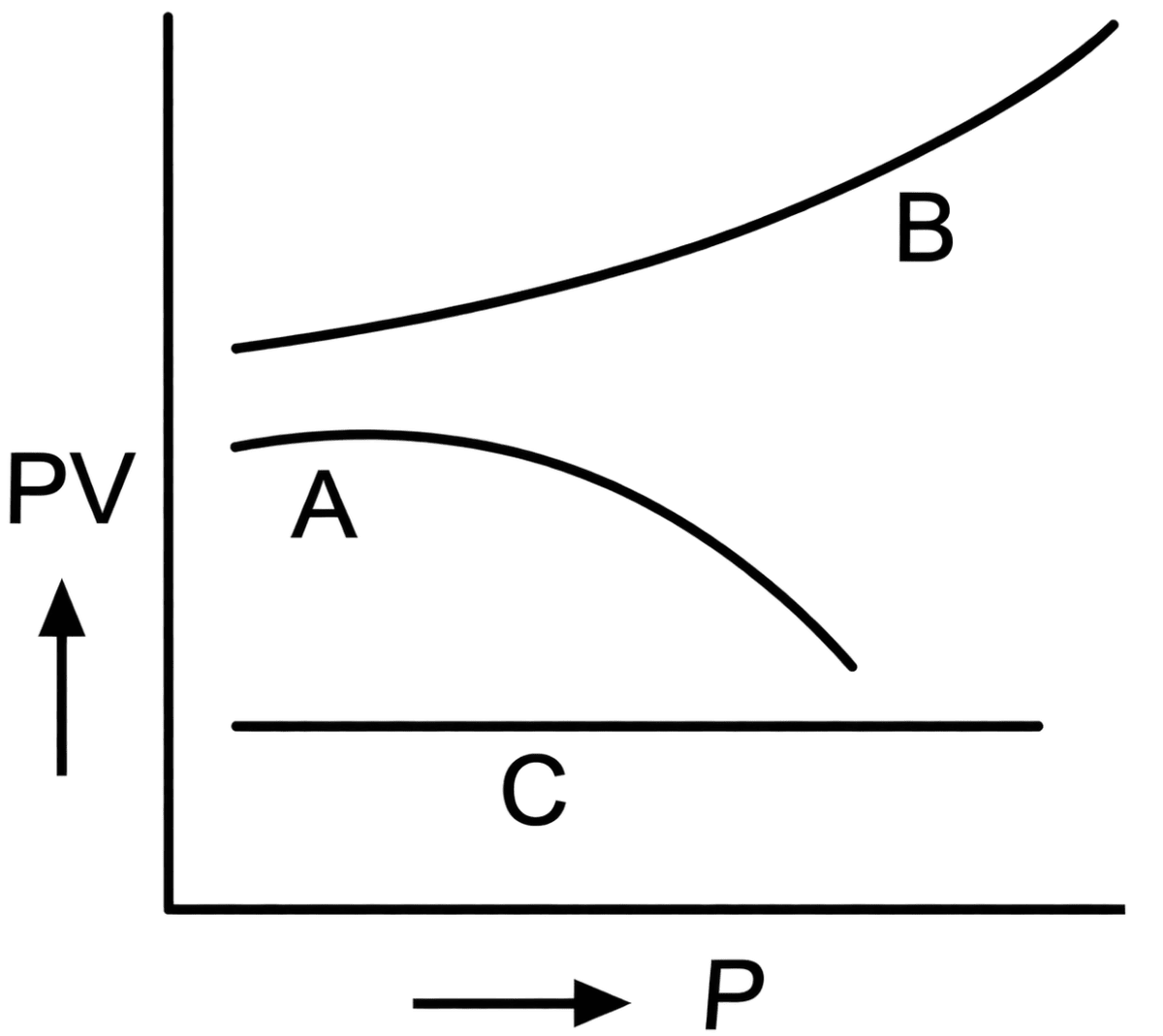
Answer
For a fixed mass of an ideal gas at a constant temperature, Boyle's law gives
so the graph of PV against P must be a straight line parallel to the P-axis for an ideal gas.
In the given graph, the line for the gas C is parallel to the P-axis, showing that the product PV keeps the same value at all pressures.
For the gas B the product PV increases with pressure, and for the gas A it decreases with pressure. Hence these two gases do not obey Boyle's law at all pressures and are real gases.
Hence, the gas C is ideal, because it obeys Boyle's law at all pressures.
In what respect real gases differ from ideal gas? In which conditions a real gas behaves like an ideal gas?
Answer
Difference between real gases and an ideal gas :
| Ideal gas | Real gas |
|---|---|
| It strictly obeys Boyle's law, Charles' law and the law of pressure under all conditions of temperature and pressure. | It obeys these laws only approximately, and the deviations are different for different gases. |
| Its molecules are infinitesimally small, so their actual volume is negligible. | The actual volume of its molecules is not always negligible compared with the volume of the gas. |
| There is no force of attraction between its molecules. | Its molecules attract one another, which is why a real gas can be liquefied. |
| Its pressure coefficient and volume coefficient are exactly equal to each other. | The two coefficients are not exactly equal. |
Conditions under which a real gas behaves like an ideal gas :
At low pressure the volume of the gas is large, so the actual volume of the molecules is negligible in comparison with the volume of the gas.
At high temperature the molecules have large kinetic energy, so the effect of the intermolecular force on their motion is negligible.
Hence, at low pressure and high temperature the behaviour of a real gas is approximately ideal.
When do the real gases obey more correctly the gas equation PV/RT?
Answer
The two chief properties of the molecules of an ideal gas are that their volume is zero and that there is no mutual force between them.
At low pressure the volume of the gas is large, so the volume of the molecules is negligible in comparison with the volume of the gas.
At high temperature the molecules have large kinetic energy, so the effect of the intermolecular force on their motion is negligible.
Hence, at low pressure and high temperature the real gases obey the gas equation more correctly, that is, their behaviour is approximately ideal.
How does the mean free path of a gas depend upon temperature and pressure?
Answer
The mean free path of the molecules of a gas is
where n is the number of molecules per unit volume and d is the diameter of a molecule. For N molecules of an ideal gas, PV = NkT gives
Substituting this value of n,
Dependence on temperature : , that is, the mean free path is directly proportional to the absolute temperature of the gas.
Dependence on pressure : , that is, the mean free path is inversely proportional to the pressure of the gas.
What is Avogadro's number? How does it have the same value for all substances?
Answer
Avogadro's number : The Avogadro number is the number of molecules in 1 mole of a substance. It is denoted by NA and its value is 6.0221 × 10²³.
Thus 1 mole of a substance may also be defined as the mass of the substance containing 6.0221 × 10²³ molecules.
Why it has the same value for all substances : Let 1 mole of a substance A have an absolute mass MA in gram and let a molecule of A have an absolute mass mA. A 6C12 atom has an absolute mass mC and 1 mole of 6C12 has a mass of exactly 12 g. Since the mass of 1 mole is proportional to the mass of its molecule,
The ratio is the number of molecules in 1 mole of the substance A, which is the Avogadro number NA. The right-hand side contains only the mass of a carbon-12 atom and does not depend on the substance A at all.
Hence, the Avogadro number is the same for all substances. It is essentially a counting unit fixed by convention, just as a dozen is.
What do you mean by degrees of freedom of a gas?
Answer
The degrees of freedom of a particle indicate the number of independent motions which the particle can undergo, or the number of independent methods of exchanging energy.
For a gas molecule these independent motions may be translational, rotational or vibrational.
Monoatomic gas : The molecule consists of a single atom, and its translational motion can be resolved along the three coordinate axes. Hence it has three degrees of freedom, all translational.
Diatomic gas : The molecule is made up of two atoms joined rigidly. It can move bodily in three independent directions and can rotate about two of the three coordinate axes, its moment of inertia about the axis joining the two atoms being negligible. Hence it has five degrees of freedom, three translational and two rotational.
Polyatomic gas : The molecule can rotate about any of the three coordinate axes, so it has six degrees of freedom, three translational and three rotational.
Kinetic Theory of Gases and Laws
The kinetic theory of gases provides a molecular-level understanding of gas behaviour. According to this theory, gas molecules are in constant random motion, colliding elastically with each other and the walls of the container. The pressure exerted by a gas is due to these molecular collisions with the container walls. Boyle's law, which is derived from kinetic theory, states that the pressure of a gas is inversely proportional to its volume at constant temperature. Charles' law explains that the volume of a gas is directly proportional to its temperature at constant pressure. Gay-Lussac's law, on the other hand, relates the pressure of a gas to its temperature when the volume is held constant. The average kinetic energy of gas molecules is directly proportional to the absolute temperature, giving a kinetic interpretation of temperature. This theory is further extended by the law of equipartition of energy, which states that energy is distributed equally among all available degrees of freedom.
(i) What is the primary cause of gas pressure according to the kinetic theory?
- The volume of the gas
- The mass of the gas molecules
- The collisions of gas molecules with the walls of the container
- The energy from the external environment.
(ii) According to Boyle's law, how does the pressure of a gas change if its volume is doubled at constant temperature?
- It remains the same
- It doubles
- It decreases by half
- It quadruples
(iii) How does the volume of a gas change according to Charles' law when its temperature is increased at constant pressure?
- It increases
- It decreases
- It remains the same
- It depends on the pressure
(iv) Which law relates the pressure of a gas to its temperature at constant volume?
- Boyle's law
- Charles' law
- Avogadro's law
- Gay-Lussac's law
(v) What does the law of equipartition of energy state?
- The energy is concentrated in the translational degrees of freedom only
- Energy is distributed equally among all available degrees of freedom
- Energy is proportional to the pressure of the gas
- The energy of a gas depends only on its mass
Answer
(i) The collisions of gas molecules with the walls of the container
The molecules of a gas keep on colliding with the walls of the vessel and thus transfer momentum to them. A steady force therefore acts perpendicular to the walls, and the magnitude of this force per unit area of the walls is called the pressure of the gas.
(ii) It decreases by half
By Boyle's law, at constant temperature P1V1 = P2V2. Putting V2 = 2V1,
Hence, on doubling the volume the pressure falls to half its original value.
(iii) It increases
Charles' law states that at constant pressure the volume of a gas is directly proportional to its absolute temperature, V ∝ T. Hence, when the temperature is increased at constant pressure, the volume of the gas increases.
(iv) Gay-Lussac's law
Gay-Lussac's law, also called the pressure law, states that for a fixed mass of gas at constant volume the pressure is directly proportional to the absolute temperature, P ∝ T.
(v) Energy is distributed equally among all available degrees of freedom
According to the law of equipartition of energy, in a system in equilibrium at absolute temperature T, the average energy associated with each degree of freedom is kT, where k is Boltzmann's constant. The energy is therefore shared equally among all the available degrees of freedom.
Molecular Motion and Mean Free Path
In a gas, molecules are in constant random motion and travel in straight lines between collisions. The average distance a molecule travels before colliding with another molecule is known as the mean free path. The mean free path depends on the temperature, pressure, and size of the gas molecules. As the pressure of a gas increases, the mean free path decreases because the gas molecules are closer together. Similarly, the temperature of the gas affects the speed of the molecules; higher temperatures increase molecular speed and collision frequency. This results in higher pressure if the volume is kept constant. The relationship between the pressure, volume, and temperature of a gas is explained by the ideal gas law PV = nRT.
(i) What is the mean free path of a gas molecule?
- The distance between two gas molecules
- The average distance a molecule travels before colliding with another molecule
- The time taken for a molecule to travel from one side of the container to the other
- The speed of gas molecules
(ii) What happens to the mean free path of gas molecules if the pressure is increased at constant temperature?
- It increases
- It decreases
- It remains constant
- It becomes zero
(iii) How does the temperature of a gas affect the speed of gas molecules?
- Increasing temperature decreases molecular speed
- Increasing temperature increases molecular speed
- Temperature does not affect molecular speed
- Molecular speed decreases as temperature increases
(iv) According to the ideal gas law, what will happen to the pressure of a gas if the volume is kept constant and the temperature is increased?
- It decreases
- It remains constant
- It increases
- It depends on the molecular size
(v) Which of the following factors affects the mean free path of a gas?
- The type of container
- The volume of the gas only
- The temperature, pressure, and size of gas molecules
- Only the temperature of the gas
Answer
(i) The average distance a molecule travels before colliding with another molecule
Between two successive collisions a molecule moves in a straight line with a constant speed, so it follows short zig-zag paths of different lengths. The mean of these free paths is called the mean free path.
(ii) It decreases
The mean free path is , so at constant temperature . On increasing the pressure the molecules are packed more closely together, so a molecule collides with another after covering a shorter distance.
(iii) Increasing temperature increases molecular speed
The root-mean-square speed of the molecules is , that is, . Hence a rise in temperature increases the speed of the molecules and also their collision frequency.
(iv) It increases
From the ideal gas law PV = nRT, at constant volume P ∝ T. Hence, when the temperature is increased and the volume is kept constant, the pressure of the gas increases.
(v) The temperature, pressure, and size of gas molecules
Since , the mean free path depends on the absolute temperature T, on the pressure P, and on the diameter d of the gas molecules.
Pressure and Degrees of Freedom
The pressure exerted by a gas on the walls of a container is directly related to the kinetic energy of the gas molecules. For an ideal gas, pressure is given by the equation , where ρ is the density and vrms is the root mean square (rms) speed of the molecules. According to the law of equipartition of energy, each degree of freedom contributes kT to the total energy, where T is the temperature and k is the Boltzmann constant. Monoatomic gases have three translational degrees of freedom, while diatomic gases have additional rotational degrees of freedom. At higher temperatures, vibrational degrees of freedom may also be excited in diatomic gases, contributing to the internal energy.
(i) How does the pressure of a gas change if the root mean square (rms) speed of the molecules increases?
- Pressure decreases
- Pressure increases
- Pressure remains constant
- Pressure is independent of molecular speed
(ii) How many translational degrees of freedom does a monoatomic gas have?
- 2
- 3
- 5
- 6
(iii) According to the law of equipartition of energy, how much energy is associated with each degree of freedom for a gas at temperature T?
- kT
- kT
- 2kT
- kT
(iv) What is the contribution of rotational degrees of freedom to the total energy of a diatomic gas at room temperature?
- Zero
- Equal to translational energy
- Less than translational energy
- More than translational energy
(v) What additional degrees of freedom become available for diatomic gases at high temperatures?
- Translational
- Rotational
- Vibrational
- Gravitational
Answer
(i) Pressure increases
From the kinetic theory, , so the pressure is proportional to the square of the rms speed. An increase in the rms speed makes the collisions of the molecules with the walls both more frequent and more forceful, and hence the pressure increases.
(ii) 3
The molecule of a monoatomic gas consists of a single atom whose translational motion can be resolved along the three coordinate axes. Hence it has three degrees of freedom, all translational.
(iii) kT
According to the law of equipartition of energy, the average energy associated with each degree of freedom of a particle in a system in equilibrium at absolute temperature T is kT, where k is Boltzmann's constant.
(iv) Less than translational energy
A diatomic molecule has three translational and two rotational degrees of freedom at room temperature. By the law of equipartition of energy, the energy in the translational modes is , while the energy in the rotational modes is . Since , the rotational contribution is less than the translational contribution.
Note: The printed answer key marks option 2, "Equal to translational energy". A diatomic molecule has only two rotational degrees of freedom against three translational ones, so by the law of equipartition of energy the rotational contribution is kT against a translational contribution of kT. Option 3 is therefore the correct choice.*
(v) Vibrational
At ordinary temperatures the vibrational motion of a diatomic molecule does not occur. At high temperatures this motion is promoted, so vibrational degrees of freedom become available and contribute to the internal energy.
The molecules of a gas are widely separated from each other and there is empty space between them in which they keep on moving rapidly in all possible directions. Gas molecules have large kinetic energy and hence they continue to move throughout the entire available space. The molecules of a gas keep on colliding with the walls of the vessel in which they contained and thus transferring momentum to them. Thus, a steady force acts perpendicular to the walls of the vessel. The magnitude of this force per unit area of the walls is called the pressure of the gas.
(i) Write the formula for the pressure of an ideal gas.
(ii) Explain Boyle's law on the basis of pressure of an ideal gas.
(iii) Two vessels of the same volume are filled with the same gas at the same temperature. If the pressure of the gas in these vessels be in the ratio 1 : 2, then find the ratio of the root-mean-square speeds of the molecules.
Answer
(i) Formula for the pressure of an ideal gas :
From the kinetic theory, the pressure of an ideal gas is
where
- m = mass of one molecule of the gas
- n = total number of molecules of the gas
- V = volume of the gas
- vrms = root-mean-square speed of the molecules
(ii) Explanation of Boyle's law :
Boyle's law states that the product of the pressure and the volume of a given mass of gas at constant temperature is constant. From the kinetic theory,
Here mn is the mass of the gas, which is constant for a given mass of gas. If the temperature remains constant, the mean-square speed of the molecules also remains constant, because . Therefore the whole of the right-hand side is constant,
This is Boyle's law.
(iii) Given,
- Both the vessels are of the same volume and are filled with the same gas at the same temperature
- Ratio of the pressures, P1 : P2 = 1 : 2
The root-mean-square speed of the molecules of a gas is
so it depends only upon the absolute temperature of the gas and its molecular weight, and not upon the pressure. Since the same gas is at the same temperature in both the vessels,
Hence, the ratio of the root-mean-square speeds of the molecules in the two vessels is 1 : 1.
What is an ideal gas? Under what conditions of pressure and temperature can a gas be assumed as an ideal gas? Determine the gas constant for one gram-molecule of a gas.
Answer
Ideal gas : In practice, gases do not obey Boyle's law, Charles' law and the law of pressure strictly under all conditions of temperature and pressure. Experiments show that as the pressure is decreased, different gases become more and more similar in behaviour and more and more obedient to the gas laws. So we may imagine a gas whose properties are similar to the properties of a real gas at infinitely low pressure. Such an imaginary gas is called a 'perfect gas' or an 'ideal gas'.
The following properties are imagined in a perfect gas :
(i) It strictly obeys Boyle's law, Charles' law and the law of pressure under all conditions of temperature and pressure.
(ii) Its pressure coefficient and volume coefficient are exactly equal to each other.
(iii) Its molecules are infinitesimally small.
(iv) There is no force of attraction between its molecules. Hence a perfect gas cannot be converted into the liquid or the solid state.
Conditions under which a gas can be assumed to be ideal :
At low pressure the volume of the gas is large, so the actual volume of the molecules is negligible in comparison with the volume of the gas.
At high temperature the molecules have large kinetic energy, so the effect of the intermolecular force on their motion is negligible.
Hence, at low pressure and high temperature a gas can be assumed to be an ideal gas. In practice, the gases which are difficult to liquefy, such as oxygen, nitrogen, hydrogen and helium, can be considered as perfect.
Gas constant for one gram-molecule : For 1 gram-molecule (1 mole) of a gas the equation of state is
According to Avogadro's hypothesis, at normal temperature (0°C or 273 K) and normal pressure (1 atmosphere or 1.013 × 10⁵ N m-2) the volume of 1 mole of a gas is 22.4 litre, that is, 22.4 × 10⁻³ m3.
Substituting the values,
Hence, the gas constant for one gram-molecule of a gas is 8.31 J mol-1 K-1. As it has the same value for all gases, it is called the universal gas constant.
Establish the equation PV = RT for an ideal gas and obtain the dimensional formula for R.
Answer
Establishment of the equation PV = RT :
The volume, pressure and temperature of a given mass of a gas are inter-related. Suppose that initially the pressure, volume and absolute temperature of a given mass of a gas are P1, V1 and T1, and that they finally change to P2, V2 and T2. This change may be divided into two parts.
(1) Change of pressure at constant temperature : Let the temperature be kept constant at T1 and the pressure be changed from P1 to P2. If the volume changes from V1 to V', then by Boyle's law
(2) Change of temperature at constant pressure : Now let the pressure be kept constant at P2 and the absolute temperature be changed from T1 to T2. If the volume changes from V' to V2, then by Charles' law
From equations (i) and (ii),
Hence, for a given mass of a gas the value of remains constant. If this constant is taken as R for 1 gram-molecule of the gas, then
Since the gas laws are strictly true only for an ideal gas, this equation is also strictly true only for an ideal gas, and it is therefore called the ideal gas equation. For μ moles of a gas it takes the form PV = μRT.
Dimensional formula for R : From the gas equation,
The dimensions of pressure are [M L-1 T-2], those of volume are [L3] and those of temperature are [θ]. Therefore
Hence, the dimensional formula for R is [M L2 T-2 θ-1], the mole being dimensionless.
Establish a relation between the pressure and kinetic energy per unit volume of a gas.
Answer
Expression for the pressure of a gas :
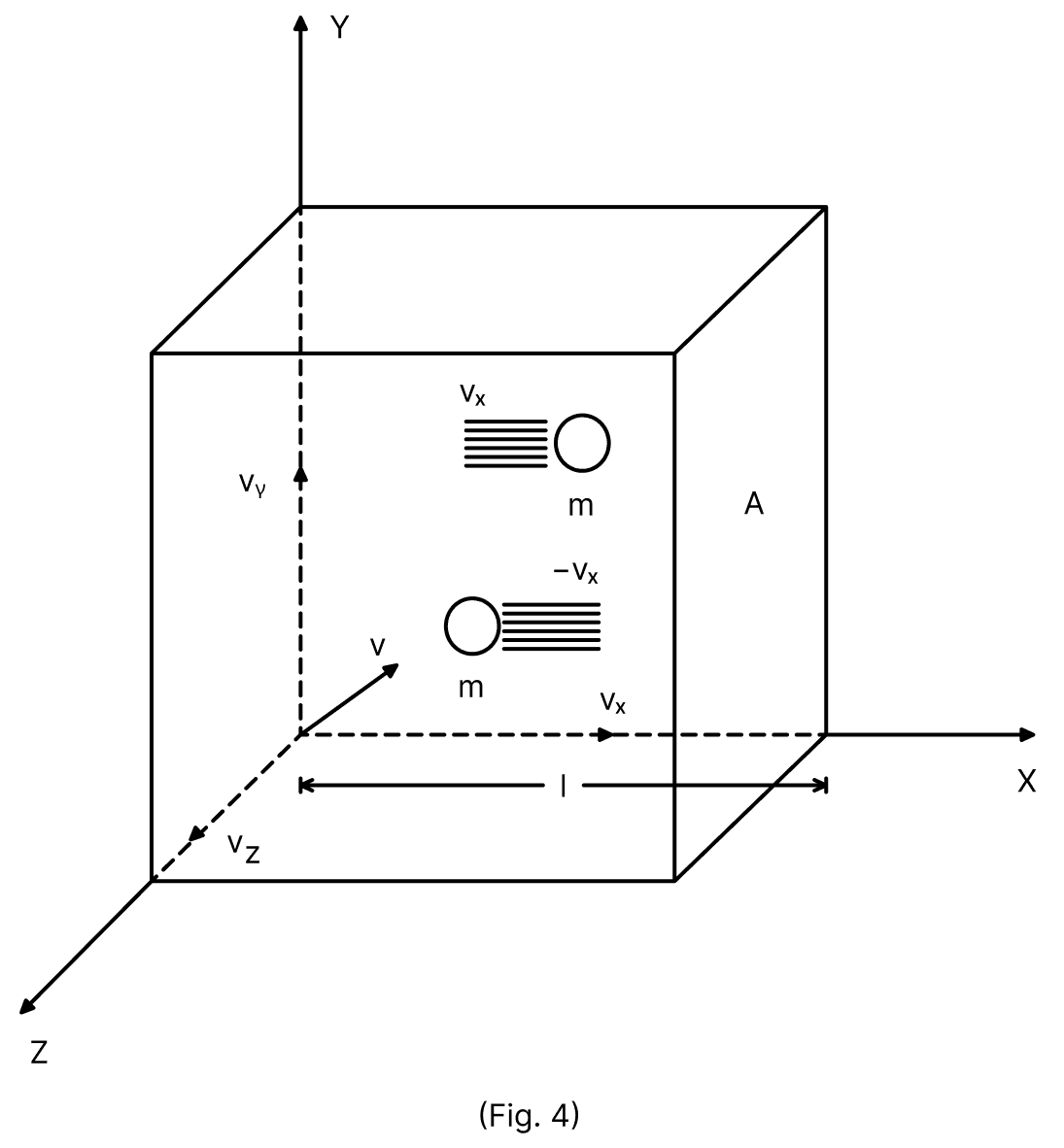
Consider an ideal gas contained in a cubical vessel whose walls are perfectly elastic. Let l be the length of each side of the cube, m the mass of each molecule and n the total number of molecules in the gas. The vessel is placed so that its three edges lie along the rectangular coordinate axes.
Let v be the velocity of a molecule and let vx, vy and vz be its components along the X-, Y- and Z-axes, so that
Consider the motion of this molecule along the X-axis. When it collides with the face A, the collision being perfectly elastic, its velocity changes from vx to −vx. Hence the change in its momentum in one collision is
By the law of conservation of momentum, the momentum transferred to the wall A in one collision is + 2 mvx.
After rebounding from A the molecule collides with the opposite wall and returns, so it covers a distance 2l between two successive collisions with A. Since its velocity is vx, it takes second between two collisions with A, that is, it collides with A times per second.
Therefore the momentum transferred to the wall A in 1 second is
According to Newton's law of motion, the rate of change of momentum is equal to the force exerted. Since there are n molecules, the total force exerted on the wall A is
The area of the wall is l2, so the pressure on the wall A is
But l3 = V, the volume of the cube, and the bracketed quantity is the average value of vx2 for all the n molecules. Therefore
Since v2 = vx2 + vy2 + vz2 holds for every molecule, it also holds for the mean values,
The directions of motion of the molecules are quite at random, that is, all directions are equally possible. Hence
From equation (ii),
Substituting this value of in equation (i),
This is the expression for the pressure of the gas, being the mean-square velocity of the molecules. Since mn is the mass of the whole gas and V its volume, mn/V is the density ρ of the gas, and the above expression can be written as
Relation between pressure and kinetic energy per unit volume :
The expression obtained above may be written as
Here is the translational kinetic energy of the gas per unit volume, since ρ is the mass of the gas per unit volume. Denoting it by E,
Hence, the pressure of a gas is equal to two-thirds of its translational kinetic energy per unit volume.
How is temperature interpreted in terms of the kinetic theory of the gases? Show that the root-mean-square velocity of molecules is proportional to the square-root of absolute temperature of the gas. Also, show that the mean kinetic energy of a molecule is kT.
Answer
Kinetic interpretation of temperature :
Suppose 1 mole of a gas is at an absolute temperature T and has a volume V. Let the mass of a molecule of the gas be m and the mean-square speed of its molecules be . There are N (Avogadro's number) molecules in 1 mole. According to the kinetic theory, the pressure of the gas is
But mN, the mass of one molecule multiplied by the number of molecules in 1 mole, is the mass M of 1 mole of the gas. Therefore
The ideal gas equation for 1 mole is PV = RT. Hence
Taking the square-root,
Since 3R/M is a constant for a given gas,
Hence, the root-mean-square velocity of the molecules of a gas is directly proportional to the square-root of the absolute temperature of the gas. This is the kinetic interpretation of temperature: the faster the motion of the molecules, the higher is the temperature of the gas.
It is also clear from this relation that if the absolute temperature becomes zero, the motion of the molecules ceases (vrms = 0). Hence absolute zero is that temperature at which the motion of all the molecules of the gas stops. Since vrms can never be negative, no temperature is possible below the absolute zero.
Mean kinetic energy of a molecule :
The kinetic energy of 1 mole of the gas is
There are N molecules in 1 mole of the gas. Therefore the average kinetic energy of one molecule is
The ratio R/N is a constant which is called Boltzmann's constant and is denoted by k. Hence
Hence, the mean kinetic energy of a molecule of a gas is kT.
This expression does not contain the mass of the molecule, which means that different gases at the same temperature have the same average kinetic energy per molecule.
Prove that , where M is the molecular weight of gas, R is gas constant, T is absolute temperature and vrms is root-mean-square speed. If the temperature of oxygen changes from 0°C to 273°C, what will be the change in its mean kinetic energy?
Answer
Proof : According to the kinetic theory, the pressure of a gas is
where M is the molecular weight of the gas, that is, the mass of 1 mole, and V is the volume of 1 mole.
The ideal gas equation for 1 mole of the gas is
Comparing the two expressions,
Since ,
Hence, is proved.
Change in the mean kinetic energy of oxygen :
Given,
- Initial temperature, T1 = 0°C = 273 K
- Final temperature, T2 = 273°C = 273 + 273 = 546 K
The mean kinetic energy of a molecule is , so . Therefore
Hence, when the temperature of oxygen changes from 0°C to 273°C, its mean kinetic energy becomes twice.
What do you mean by degree of freedom? Write the degree of freedom of monoatomic and diatomic gases.
Answer
Degree of freedom : The degrees of freedom of a particle indicate the number of independent motions which the particle can undergo, or the number of independent methods of exchanging energy.
Monoatomic gas : The molecule of a monoatomic gas, such as He or Ar, consists of a single atom. Its translational motion can take place in any direction in space and can therefore be resolved along the three coordinate axes, so that it has three independent motions.
Hence, a monoatomic gas has three degrees of freedom, all translational.
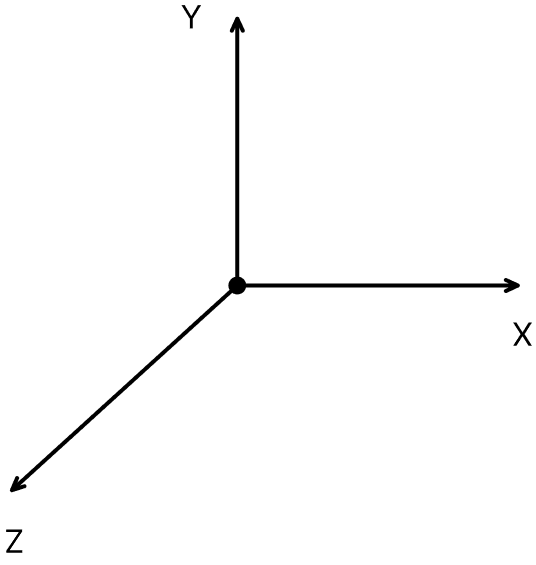
A monoatomic molecule can rotate also, but it has such a small moment of inertia that its kinetic energy of rotation is insignificant. Therefore it possesses only kinetic energy of translation.
Diatomic gas : The molecule of a diatomic gas, such as H2 or O2, is made up of two atoms joined rigidly to one another through a bond. It cannot only move bodily, but can also rotate about any of the three coordinate axes. However, its moment of inertia about the axis joining the two atoms is negligible, so it can have only two rotational motions.
Hence, a diatomic molecule has five degrees of freedom, three with respect to translation and two with respect to rotation.
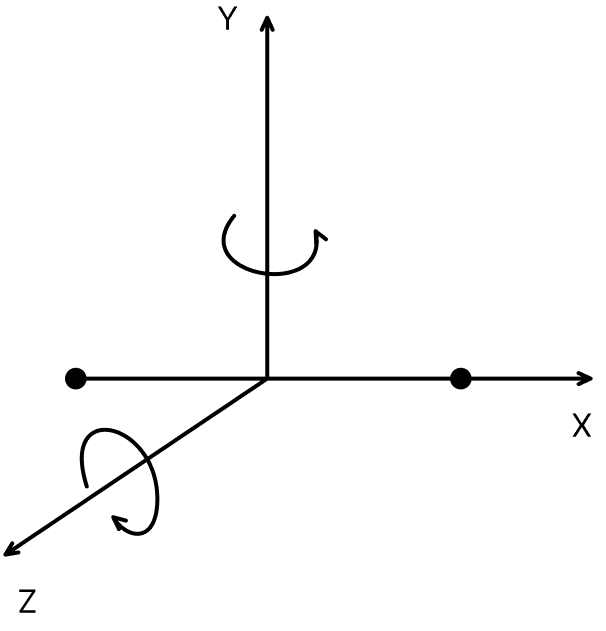
The diatomic molecule can vibrate also along the line joining the two atoms, but the vibrational motion does not usually occur at ordinary temperatures.
The number of degrees of freedom can also be obtained from the molar specific heat at constant volume, since , that is,
For a monoatomic gas , giving f = 3, and for a diatomic gas , giving f = 5.
Write down the main postulates of the kinetic theory of gases. Find an expression for the pressure of a gas on its basis.
Answer
Postulates of the kinetic theory of gases :
(i) Gas particles are in constant, random motion : Gas molecules move in continuous, random motion in all directions. They travel in straight lines until they collide with other gas molecules or with the walls of the container.
(ii) Negligible volume of gas molecules : The actual volume of the individual gas molecules is extremely small compared to the total volume of the container. Most of the space in a gas is empty, which allows gas molecules to be treated as point particles with no volume of their own.
(iii) No intermolecular forces : Gas molecules do not exert attractive or repulsive forces on each other, except during collisions. Between collisions the gas particles move independently of one another.
(iv) Elastic collisions : Collisions between the gas molecules, and between the molecules and the walls of the container, are perfectly elastic, so that no kinetic energy is lost in the collisions.
(v) Average kinetic energy is proportional to temperature : The average kinetic energy of the gas molecules is directly proportional to the absolute temperature of the gas.
(vi) Large number of molecules : A gas contains a very large number of molecules, which makes a statistical treatment of the properties of the gas possible.
(vii) Pressure is due to collisions : The pressure exerted by a gas on the walls of its container is due to the collisions of the gas molecules with the walls.
Expression for the pressure of a gas :
Consider an ideal gas contained in a cubical vessel whose walls are perfectly elastic. Let l be the length of each side of the cube, m the mass of each molecule and n the total number of molecules in the gas. The vessel is placed so that its three edges lie along the rectangular coordinate axes.
Let v be the velocity of a molecule and let vx, vy and vz be its components along the X-, Y- and Z-axes, so that
Consider the motion of this molecule along the X-axis. When it collides with the face A, the collision being perfectly elastic, its velocity changes from vx to −vx. Hence the change in its momentum in one collision is
By the law of conservation of momentum, the momentum transferred to the wall A in one collision is + 2 mvx.
After rebounding from A the molecule collides with the opposite wall and returns, so it covers a distance 2l between two successive collisions with A. Since its velocity is vx, it takes second between two collisions with A, that is, it collides with A times per second.
Therefore the momentum transferred to the wall A in 1 second is
According to Newton's law of motion, the rate of change of momentum is equal to the force exerted. Since there are n molecules, the total force exerted on the wall A is
The area of the wall is l2, so the pressure on the wall A is
But l3 = V, the volume of the cube, and the bracketed quantity is the average value of vx2 for all the n molecules. Therefore
Since v2 = vx2 + vy2 + vz2 holds for every molecule, it also holds for the mean values,
The directions of motion of the molecules are quite at random, that is, all directions are equally possible. Hence
From equation (ii),
Substituting this value of in equation (i),
This is the expression for the pressure of the gas, being the mean-square velocity of the molecules. Since mn is the mass of the whole gas and V its volume, mn/V is the density ρ of the gas, and the above expression can be written as
Hence, the pressure of a gas on the basis of the kinetic theory is .
State the postulates of the kinetic theory of an ideal gas and show that the pressure P exerted by the gas on the walls of the container is 2/3 times the translational kinetic energy per unit volume.
Answer
Postulates of the kinetic theory of gases :
(i) Gas particles are in constant, random motion : Gas molecules move in continuous, random motion in all directions. They travel in straight lines until they collide with other gas molecules or with the walls of the container.
(ii) Negligible volume of gas molecules : The actual volume of the individual gas molecules is extremely small compared to the total volume of the container. Most of the space in a gas is empty, which allows gas molecules to be treated as point particles with no volume of their own.
(iii) No intermolecular forces : Gas molecules do not exert attractive or repulsive forces on each other, except during collisions. Between collisions the gas particles move independently of one another.
(iv) Elastic collisions : Collisions between the gas molecules, and between the molecules and the walls of the container, are perfectly elastic, so that no kinetic energy is lost in the collisions.
(v) Average kinetic energy is proportional to temperature : The average kinetic energy of the gas molecules is directly proportional to the absolute temperature of the gas.
(vi) Large number of molecules : A gas contains a very large number of molecules, which makes a statistical treatment of the properties of the gas possible.
(vii) Pressure is due to collisions : The pressure exerted by a gas on the walls of its container is due to the collisions of the gas molecules with the walls.
Expression for the pressure of a gas :
Consider an ideal gas contained in a cubical vessel whose walls are perfectly elastic. Let l be the length of each side of the cube, m the mass of each molecule and n the total number of molecules in the gas. The vessel is placed so that its three edges lie along the rectangular coordinate axes.
Let v be the velocity of a molecule and let vx, vy and vz be its components along the X-, Y- and Z-axes, so that
Consider the motion of this molecule along the X-axis. When it collides with the face A, the collision being perfectly elastic, its velocity changes from vx to −vx. Hence the change in its momentum in one collision is
By the law of conservation of momentum, the momentum transferred to the wall A in one collision is + 2 mvx.
After rebounding from A the molecule collides with the opposite wall and returns, so it covers a distance 2l between two successive collisions with A. Since its velocity is vx, it takes second between two collisions with A, that is, it collides with A times per second.
Therefore the momentum transferred to the wall A in 1 second is
According to Newton's law of motion, the rate of change of momentum is equal to the force exerted. Since there are n molecules, the total force exerted on the wall A is
The area of the wall is l2, so the pressure on the wall A is
But l3 = V, the volume of the cube, and the bracketed quantity is the average value of vx2 for all the n molecules. Therefore
Since v2 = vx2 + vy2 + vz2 holds for every molecule, it also holds for the mean values,
The directions of motion of the molecules are quite at random, that is, all directions are equally possible. Hence
From equation (ii),
Substituting this value of in equation (i),
This is the expression for the pressure of the gas, being the mean-square velocity of the molecules. Since mn is the mass of the whole gas and V its volume, mn/V is the density ρ of the gas, and the above expression can be written as
Pressure in terms of the translational kinetic energy per unit volume :
The above expression may be rewritten as
Since ρ is the mass of the gas per unit volume, the quantity is the translational kinetic energy of the gas per unit volume. Denoting it by E,
Hence, the pressure P exerted by the gas on the walls of the container is times the translational kinetic energy per unit volume.
Write the formula for the pressure of an ideal gas in terms of molecular mass, number of molecules and their velocity on the basis of kinetic theory and with the help of it, establish the relation between kinetic energy of the molecules and temperature of the gas.
Answer
Formula for the pressure of an ideal gas : On the basis of the kinetic theory, the pressure of an ideal gas is
where
- m = mass of one molecule of the gas
- n = total number of molecules of the gas
- V = volume of the gas
- = mean-square velocity of the molecules
Relation between the kinetic energy of the molecules and the temperature of the gas :
Consider 1 mole of the gas. It contains N (Avogadro's number) molecules, so putting n = N in the above formula,
But mN is the mass M of 1 mole of the gas, so
The ideal gas equation for 1 mole is PV = RT. Comparing the two,
The kinetic energy of 1 mole of the gas is therefore
Dividing by the N molecules present in 1 mole, the average kinetic energy of one molecule is
where k (= R/N) is Boltzmann's constant. Since k is a constant,
Hence, the average kinetic energy of a molecule of a gas is directly proportional to the absolute temperature of the gas. As this expression contains no term for the mass of the molecule, different gases at the same temperature have the same average kinetic energy per molecule.
State the law of equipartition of energy. Prove that for an ideal gas, γ = 1 + (2/f), where f is the number of degrees of freedom of gas molecules.
Answer
Law of equipartition of energy : According to this law, in a classical system of particles which is in equilibrium at absolute temperature T, the average internal (kinetic) energy per particle associated with each degree of freedom is kT, where k is Boltzmann's constant. If the particle has f degrees of freedom, its average kinetic energy would be f kT.
Proof that :
Consider 1 mole of an ideal gas at absolute temperature T. It has NA molecules, and since there are no intermolecular forces in an ideal gas there is no internal potential energy. Hence the internal energy of 1 mole of the gas is entirely kinetic,
Differentiating with respect to T,
Molar specific heat at constant volume : Suppose the gas is heated at constant volume until its temperature rises through dT. The heat given is dQ = Cv dT, and no external work is done as the volume remains constant. Therefore, by the first law of thermodynamics, dU = dQ − dW gives
Substituting the value of dU/dT obtained above,
Molar specific heat at constant pressure : By Mayer's formula, Cp − Cv = R, so
Ratio of the two specific heats :
Hence, for an ideal gas is proved.
It follows that γ decreases with an increase in the number of degrees of freedom. For a monoatomic gas f = 3 gives γ = 1.67, for a diatomic gas f = 5 gives γ = 1.40, and for a triatomic gas f = 6 gives γ = 1.33.
Explain : (a) Boyle's law, (b) Charles' law on the basis of kinetic theory of gases.
Answer
(a) Boyle's law : According to this law, the product of the pressure and the volume of a given mass of gas at constant temperature is constant.
From the kinetic theory, the pressure of a given mass of an ideal gas is
where m is the mass of a molecule, n the total number of molecules, V the volume of the gas and the mean-square speed of the molecules. Thus
Here mn is the mass of the gas, which is constant for a given mass of gas. If the temperature remains constant, the mean-square speed of the molecules also remains constant, since the average kinetic energy of a molecule depends only on the temperature. Therefore
This is Boyle's law.
(b) Charles' law : According to this law, the volume of a given mass of gas at constant pressure is directly proportional to the absolute temperature of the gas.
From the kinetic theory,
Since the average kinetic energy of one molecule is ,
If the pressure P is constant, then for a given mass of the gas n and k are also constant, so
This is Charles' law.
There are 4 × 1024 gas molecules in a vessel at 50 K temperature. The pressure of the gas in the vessel is 0.03 atmospheric. Calculate the volume of the vessel.
Answer
Given,
- Number of molecules, n = 4 × 1024
- Temperature, T = 50 K
- Pressure, P = 0.03 atmospheric = 0.03 × 1.01 × 105 = 3.03 × 10³ N/m2
- Boltzmann constant, k = 1.38 × 10⁻²³ J/K
For n molecules of a gas, the gas equation is
Substituting the values,
Hence, the volume of the vessel is 0.91 m3.
Calculate the value of Boltzmann constant k. Given : R = 8.3 × 10³ J/(k mol-K) and Avogadro's number N = 6.03 × 1026/(k mol).
Answer
Given,
- Gas constant, R = 8.3 × 10³ J/(k mol-K)
- Avogadro's number, N = 6.03 × 1026/(k mol)
The Boltzmann constant is the gas constant per molecule,
Substituting the values,
Hence, the value of the Boltzmann constant is 1.376 × 10⁻²³ J/K.
The volume of a gas at pressure 1.2 × 10⁷ N/m2 and temperature 127°C is 2.0 litre. Find the number of molecules in the gas.
Answer
Given,
- Pressure, P = 1.2 × 10⁷ N/m2
- Temperature, T = 127°C = 127 + 273 = 400 K
- Volume, V = 2.0 litre = 2.0 × 10⁻³ m3
- Boltzmann constant, k = 1.38 × 10⁻²³ J/K
For n molecules of a gas, the gas equation is
Substituting the values,
Hence, the number of molecules in the gas is 4.35 × 1024.
The residual pressure in a vessel, which is evacuated at 27°C, is 10-11 N/m2. Find the number of molecules per cm3 still remaining in the vessel.
Answer
Given,
- Residual pressure, P = 10-11 N/m2
- Temperature, T = 27°C = 27 + 273 = 300 K
- Boltzmann constant, k = 1.38 × 10⁻²³ J/K
For n molecules of a gas, PV = nkT. Hence the number of molecules per unit volume is
Substituting the values,
Since 1 m3 = 106 cm3, the number of molecules per cm3 is
Hence, 2415 molecules per cm3 still remain in the vessel.
The density of a gas at normal pressure and 0°C temperature is 1.2 kg/m3. Calculate : (i) the root-mean-square speed of the molecules of the gas at 0°C, (ii) the temperature at which the speed will become three times the initial speed. (Normal pressure = 1.0 × 10⁵ N/m2).
Answer
Given,
- Density of the gas, ρ = 1.2 kg/m3
- Normal pressure, P = 1.0 × 10⁵ N/m2
- Temperature, T1 = 0°C = 273 K
(i) Root-mean-square speed at 0°C :
From the kinetic theory, , so
Substituting the values,
(ii) Temperature at which the speed becomes three times :
The rms speed is proportional to the square-root of the absolute temperature,
Here v2 = 3v1, so
Hence, the rms speed of the molecules at 0°C is 500 m/s, and the speed becomes three times at 2184°C.
The root-mean-square speed of oxygen molecules at a certain temperature is 150 m/s. Calculate the root-mean-square speed of hydrogen molecules at the same temperature. Molecular weights of oxygen and hydrogen respectively are 32 and 2.
Answer
Given,
- rms speed of oxygen molecules, (vrms)O = 150 m/s
- Molecular weight of oxygen, MO = 32
- Molecular weight of hydrogen, MH = 2
- Both the gases are at the same temperature
At the same temperature, the ratio of the rms speeds of the molecules of two different gases is inversely proportional to the square-root of their molecular weights,
Substituting the values,
Hence, the root-mean-square speed of hydrogen molecules at the same temperature is 600 m/s.
Calculate the mean kinetic energy of a gas molecule at 27°C if the Boltzmann constant is equal to 1.38 × 10⁻²³ J/K.
Answer
Given,
- Temperature, T = 27°C = 27 + 273 = 300 K
- Boltzmann constant, k = 1.38 × 10⁻²³ J/K
According to the kinetic theory, the mean kinetic energy of a gas molecule at absolute temperature T is
Substituting the values,
Hence, the mean kinetic energy of a gas molecule at 27°C is 6.21 × 10⁻²¹ J.
Calculate the temperature for which the average kinetic energy of a molecule of any gas is 4.2 × 10⁻¹⁹ J. (Boltzmann constant k = 1.4 × 10⁻²³ J/K).
Answer
Given,
- Average kinetic energy of a molecule, = 4.2 × 10⁻¹⁹ J
- Boltzmann constant, k = 1.4 × 10⁻²³ J/K
The average kinetic energy of a molecule of any gas at absolute temperature T is
Substituting the values,
Hence, the required temperature is 2 × 10⁴ K.
If the kinetic energy of 1 g-molecule of a gas at 27°C is 3400 J, what will be its value at 327°C?
Answer
Given,
- Initial temperature, T1 = 27°C = 27 + 273 = 300 K
- Kinetic energy at T1, E1 = 3400 J
- Final temperature, T2 = 327°C = 327 + 273 = 600 K
The kinetic energy of 1 gram-molecule of a gas is , so E ∝ T. Therefore
Substituting the values,
Hence, the kinetic energy of 1 g-molecule of the gas at 327°C is 6800 J.
The average kinetic energy of a hydrogen molecules at 27°C is 9.3 × 10⁻²¹ J. The mass of hydrogen molecule is 3.1 × 10⁻²⁷ kg. (i) Determine the average kinetic energy at 227°C. (ii) Determine the root-mean-square speed of hydrogen molecule at 27°C.
Answer
Given,
- Average kinetic energy at 27°C, = 9.3 × 10⁻²¹ J
- Initial temperature, T1 = 27°C = 27 + 273 = 300 K
- Final temperature, T2 = 227°C = 227 + 273 = 500 K
- Mass of a hydrogen molecule, m = 3.1 × 10⁻²⁷ kg
(i) Average kinetic energy at 227°C :
The average kinetic energy of a molecule is , so ,
Substituting the values,
(ii) Root-mean-square speed at 27°C :
The average kinetic energy of a molecule is also , so
Substituting the values,
Hence, the average kinetic energy at 227°C is 1.55 × 10⁻²⁰ J and the root-mean-square speed of a hydrogen molecule at 27°C is 2.45 × 10³ m/s.
If the degree of freedom of a molecule of a gas is 5, then find Cp/Cv of the gas.
Answer
Given,
- Degrees of freedom of a molecule of the gas, f = 5
For an ideal gas the molar specific heats are
Therefore the ratio of the two specific heats is
Substituting f = 5,
Hence, of the gas is 1.4.
Calculate the number of molecules, volume occupied by one molecule and the average distance between two molecules in the 1.00 cm3 volume of gas at N.T.P.
Answer
Given,
- Volume of the gas, V = 1.00 cm3 = 1.00 × 10⁻⁶ m3
- At N.T.P. the volume of 1 mole of a gas is 22.4 L = 22.4 × 103 cm3
- Avogadro's number, N = 6.02 × 10²³/mol
(i) Number of molecules : Since 22.4 × 103 cm3 of the gas contains 6.02 × 10²³ molecules, the number of molecules in 1.00 cm3 is
(ii) Volume occupied by one molecule : In an ideal gas the volume of the molecules themselves is negligible, so the whole of the 1.00 cm3 is available to the 2.68 × 10¹⁹ molecules. Hence the average volume available to one molecule is
(iii) Average distance between two molecules : If this space is assumed to be cubical, the mean distance between two molecules is the side of the cube,
Hence, 1.00 cm3 of the gas at N.T.P. contains 2.68 × 10¹⁹ molecules, the volume available to one molecule is 37.3 × 10⁻²⁷ m3, and the average distance between two molecules is 3.34 × 10⁻⁹ m.
The temperature of a gas filled in a vessel is 273 K and the pressure is 1.60 × 10⁻³ N/m2. Determine : (i) number of molecules in unit volume of the vessel, (ii) average distance between the molecules.
Answer
Given,
- Temperature, T = 273 K
- Pressure, P = 1.60 × 10⁻³ N/m2
- Boltzmann constant, k = 1.38 × 10⁻²³ J/K
(i) Number of molecules in unit volume : For n molecules of a gas, PV = nkT, so
Substituting the values,
(ii) Average distance between the molecules : The average volume available to one molecule is
If this space is assumed to be cubical, the average distance between two molecules is the side of the cube,
Hence, the number of molecules in unit volume is 4.25 × 10¹⁷ per m3 and the average distance between the molecules is 1.33 × 10⁻⁶ m.
A flask of volume 1 × 10⁻³ m3 contains 3.0 × 10¹² oxygen molecules at a certain temperature. The mass of one molecule of oxygen is 5.3 × 10⁻²⁶ kg and the root-mean-square speed of its molecules at the same temperature is 400 m/s. Calculate the pressure of the oxygen gas in the flask.
Answer
Given,
- Volume of the flask, V = 1 × 10⁻³ m3
- Number of oxygen molecules, n = 3.0 × 10¹²
- Mass of one molecule of oxygen, m = 5.3 × 10⁻²⁶ kg
- Root-mean-square speed, vrms = 400 m/s
From the kinetic theory, the pressure of the gas is
Substituting the values,
Hence, the pressure of the oxygen gas in the flask is 8.48 × 10⁻⁶ N/m2.
Find out the root-mean-square speed of the smoke particle having mass 5 × 10-17 kg performing Brownian motion in air at normal temperature and pressure.
Answer
Given,
- Mass of the smoke particle, m = 5 × 10-17 kg
- Normal temperature, T = 273 K
- Boltzmann constant, k = 1.38 × 10⁻²³ J/K
A smoke particle performing Brownian motion behaves like a very heavy molecule of the gas, so its mean kinetic energy is also kT,
Substituting the values,
Hence, the root-mean-square speed of the smoke particle is 1.5 × 10⁻² m/s.
The root-mean-square speed of oxygen molecules at 0°C is 460 m/s. What will be the speed of helium molecules at 40°C ? Molecular weight of oxygen is 32 g/mol while that of helium is 4 g/mol.
Answer
Given,
- rms speed of oxygen molecules at 0°C, (vrms)O = 460 m/s
- Temperature of oxygen, TO = 0°C = 273 K
- Temperature of helium, THe = 40°C = 40 + 273 = 313 K
- Molecular weight of oxygen, MO = 32 g/mol
- Molecular weight of helium, MHe = 4 g/mol
The rms speed of the molecules of a gas is
Taking the ratio for the two gases,
Substituting the values,
Hence, the root-mean-square speed of the helium molecules at 40°C is 1394 m/s.
The mean kinetic energy of 1 kg-mol of nitrogen at 27°C is 600 J. What will be its mean kinetic energy at 127°C?
Answer
Given,
- Mean kinetic energy at 27°C, E1 = 600 J
- Initial temperature, T1 = 27°C = 27 + 273 = 300 K
- Final temperature, T2 = 127°C = 127 + 273 = 400 K
The mean kinetic energy of a gas is , so E ∝ T for a given quantity of the gas. Therefore
Substituting the values,
Hence, the mean kinetic energy of 1 kg-mol of nitrogen at 127°C is 800 J.
Calculate the kinetic energy of translation of 1 mole gas at 0°C temperature. R = 8.31 J/(mol-K).
Answer
Given,
- Number of moles, μ = 1 mol
- Temperature, T = 0°C = 273 K
- Gas constant, R = 8.31 J/(mol-K)
The kinetic energy of translation of 1 mole of a gas at absolute temperature T is
Substituting the values,
Hence, the kinetic energy of translation of 1 mole of the gas at 0°C is 3.4 × 10³ J.
Calculate the total kinetic energy of O2 molecules at 127°C. k = 1.38 × 10⁻²³ J/(molecule-K).
Answer
Given,
- Temperature, T = 127°C = 127 + 273 = 400 K
- Boltzmann constant, k = 1.38 × 10⁻²³ J/(molecule-K)
Oxygen is a diatomic gas, so a molecule of oxygen has f = 5 degrees of freedom, three translational and two rotational. By the law of equipartition of energy, the total kinetic energy of one molecule is
Substituting the values,
Hence, the total kinetic energy of an O2 molecule at 127°C is 1.38 × 10⁻²⁰ J.
A bulb of volume 500 cm3 is sealed at a pressure of 10-3 mm of mercury and at temperature of 27°C. Find the number of molecules of air inside the bulb. (g = 10 m/s2)
Answer
Given,
- Volume of the bulb, V = 500 cm3 = 500 × 10-6 m3 = 5 × 10⁻⁴ m3
- Pressure, h = 10-3 mm of mercury = 10-6 m of mercury
- Temperature, T = 27°C = 27 + 273 = 300 K
- Density of mercury, ρ = 13.6 × 10³ kg/m3
- g = 10 m/s2
- Boltzmann constant, k = 1.38 × 10⁻²³ J/K
Pressure inside the bulb :
Number of molecules : For n molecules of a gas, PV = nkT, so
Substituting the values,
Hence, the number of molecules of air inside the bulb is 16.425 × 10¹⁵.
A vessel is filled with oxygen gas (molecular weight 32) at 0°C temperature and at 1 atmospheric pressure. What is the root-mean-square speed of the oxygen molecules?
Answer
Given,
- Molecular weight of oxygen, M = 32 g/mol = 32 × 10-3 kg/mol
- Temperature, T = 0°C = 273 K
- Pressure, P = 1 atmosphere = 1.01 × 10⁵ N/m2
At 0°C and 1 atmospheric pressure the volume of 1 gram-molecule of a gas is 22.4 L, that is, 2.24 × 10⁻² m3. Hence the density of oxygen is
From the kinetic theory,
Substituting the values,
Hence, the root-mean-square speed of the oxygen molecules is 460.5 m/s.
The root-mean-square speed of helium atoms at normal temperature and pressure is 1300 m/s. Calculate : (i) density of helium at 0°C, (ii) mass of helium atom. (Normal pressure = 1.01 × 10⁵ N/m2).
Answer
Given,
- rms speed of helium atoms, vrms = 1300 m/s
- Normal pressure, P = 1.01 × 10⁵ N/m2
- Normal temperature, T = 0°C = 273 K
- Atomic weight of helium, M = 4
- Avogadro's number, N = 6.02 × 10²³/mol
(i) Density of helium at 0°C :
From the kinetic theory, . Squaring both sides,
Substituting the values,
(ii) Mass of a helium atom :
The mass of one atom is the mass of 1 mole divided by Avogadro's number,
Hence, the density of helium at 0°C is 0.179 kg/m3 and the mass of a helium atom is 6.64 × 10⁻²⁴ g.
The density of hydrogen at normal temperature and pressure is 0.09 kg/m3. What will be the root-mean-square speed of its molecules? What of oxygen? Oxygen is 16 times heavier than hydrogen.
Answer
Given,
- Density of hydrogen at N.T.P., ρH = 0.09 kg/m3
- Normal pressure, P = 1.01 × 10⁵ N/m2
- Oxygen is 16 times heavier than hydrogen
Root-mean-square speed of hydrogen molecules : From the kinetic theory,
Substituting the values,
Root-mean-square speed of oxygen molecules : At the same temperature the rms speed is inversely proportional to the square-root of the molecular weight,
Hence, the rms speed of hydrogen molecules is 1.84 × 10³ m/s and that of oxygen molecules is 4.6 × 10² m/s.
At what absolute temperature will the root-mean-square speed of molecules of an ideal gas be thrice the root-mean-square speed at temperature 40 K ?
Answer
Given,
- Initial temperature, T1 = 40 K
- Final rms speed, v2 = 3v1
The rms speed of the molecules of a gas is proportional to the square-root of the absolute temperature,
Substituting v2 = 3v1,
Hence, at 360 K the rms speed of the molecules will be thrice the rms speed at 40 K.
At what temperature will the effective speed (root-mean-square speed) of oxygen molecule will be equal to the effective speed of nitrogen molecule at 0°C ?
Answer
Given,
- Molecular weight of oxygen, MO = 32
- Molecular weight of nitrogen, MN = 28
- Temperature of nitrogen, TN = 0°C = 273 K
The rms speed of the molecules of a gas is
The two speeds are to be equal, so
Squaring both sides and cancelling 3R,
Substituting the values,
Hence, at 39°C the effective speed of an oxygen molecule will be equal to the effective speed of a nitrogen molecule at 0°C.
There are 6 × 10²¹ hydrogen molecules in a vessel of volume 200 cm3. Its temperature is 27°C and the pressure is 105 N/m2. If the temperature be raised to 47°C, then in what ratio the following quantities would change : (i) number of molecules per unit volume, (ii) pressure of the gas in the vessel, (iii) average kinetic energy of hydrogen?
Answer
Given,
- Number of hydrogen molecules, n = 6 × 10²¹
- Volume of the vessel, V = 200 cm3
- Initial temperature, T1 = 27°C = 27 + 273 = 300 K
- Initial pressure, P1 = 105 N/m2
- Final temperature, T2 = 47°C = 47 + 273 = 320 K
(i) Number of molecules per unit volume : The vessel is closed, so neither the number of molecules nor the volume changes on heating. Hence
The number of molecules per unit volume will remain unchanged, that is, the ratio is 1 : 1.
(ii) Pressure of the gas : For n molecules, PV = nkT. Since n and V are constant, P ∝ T, so
The pressure will change in the ratio 15 : 16.
(iii) Average kinetic energy of hydrogen : The average kinetic energy of a molecule is kT, so E ∝ T,
The average kinetic energy will also change in the ratio 15 : 16.
Calculate for hydrogen (molecular-weight = 2) at 27°C : (i) kinetic energy of one gram-molecule of the gas, (ii) kinetic energy of one gram gas, (iii) root-mean-square speed of the molecules.
Answer
Given,
- Molecular weight of hydrogen, M = 2 g/mol = 2 × 10⁻³ kg/mol
- Temperature, T = 27°C = 27 + 273 = 300 K
- Gas constant, R = 8.31 J/(mol-K)
(i) Kinetic energy of one gram-molecule :
(ii) Kinetic energy of one gram of the gas : Since 1 gram-molecule of hydrogen has a mass of 2 g, the kinetic energy of 1 g of the gas is
(iii) Root-mean-square speed of the molecules :
Hence, the kinetic energy of one gram-molecule is 3.74 × 10³ J, that of one gram of the gas is 1.87 × 10³ J, and the root-mean-square speed of the molecules is 1.93 × 10³ m/s.
The first excited state of hydrogen atom is 10.2 eV higher than its ground state. At what temperature will the hydrogen atom go from its ground state to the first excited state? (1 eV = 1.6 × 10⁻¹⁹ J)
Answer
Given,
- Energy of the first excited state above the ground state, E = 10.2 eV
- 1 eV = 1.6 × 10⁻¹⁹ J
- Boltzmann constant, k = 1.38 × 10⁻²³ J/K
Converting the energy into joule,
The hydrogen atom can go from the ground state to the first excited state when its average kinetic energy becomes equal to this energy. The average kinetic energy of an atom at absolute temperature T is kT, so
Substituting the values,
Hence, at 7.88 × 10⁴ K the hydrogen atom will go from its ground state to the first excited state.
Calculate the average translatory kinetic energy and total kinetic energy of oxygen molecule at 127°C. Boltzmann constant kB = 1.38 × 10⁻²³ J/mol-K.
Answer
Given,
- Temperature, T = 127°C = 127 + 273 = 400 K
- Boltzmann constant, kB = 1.38 × 10⁻²³ J K-1
Average translatory kinetic energy : A molecule has three translational degrees of freedom, so
Substituting the values,
Total kinetic energy : Oxygen is a diatomic gas, so a molecule of oxygen has f = 5 degrees of freedom, three translational and two rotational. By the law of equipartition of energy,
Substituting the values,
Hence, the average translatory kinetic energy of an oxygen molecule at 127°C is 8.28 × 10⁻²¹ J and its total kinetic energy is 1.38 × 10⁻²⁰ J.
Note: The unit of the Boltzmann constant is quoted in the question as J/mol-K but its unit is J K-1.
Calculate the total internal energy of 4.0 g oxygen at the temperature of 27°C. (Number of degrees of freedom of oxygen is 5 and gas constant R = 2.0 cal/mol-K)
Answer
Given,
- Mass of oxygen, m = 4.0 g
- Molecular weight of oxygen, M = 32 g/mol
- Temperature, T = 27°C = 27 + 273 = 300 K
- Number of degrees of freedom, f = 5
- Gas constant, R = 2.0 cal/mol-K
The number of moles of oxygen is
The total internal energy of μ moles of an ideal gas having f degrees of freedom is
Substituting the values,
Hence, the total internal energy of 4.0 g of oxygen at 27°C is 187.5 cal.
The initial temperature of a gas is -73°C. To what temperature should it be heated so that (i) the root-mean-square speed of the molecules of the gas be doubled, (ii) the average kinetic energy of the molecules be doubled?
Answer
Given,
- Initial temperature, T1 = −73°C = −73 + 273 = 200 K
(i) When the root-mean-square speed is doubled :
The rms speed is proportional to the square-root of the absolute temperature,
Putting v2 = 2v1,
(ii) When the average kinetic energy is doubled :
The average kinetic energy of a molecule is kT, so E ∝ T,
Hence, the gas should be heated to 527°C for the rms speed to be doubled and to 127°C for the average kinetic energy to be doubled.