KnowledgeBoat Logo
|
OPEN IN APP

Chapter 12

Kinetic Theory — Competition Zone

Class 11 - Nootan Physics


Competition Zone — MCQ (One Correct Option)

Question 1

At what temperature will the rms speed of oxygen molecules become just sufficient for escaping from the Earth's atmosphere? (Given mass of oxygen molecule (m) = 2.76 × 10⁻²⁶ kg, Boltzmann's constant k = 1.38 × 10⁻²³ JK-1.)

  1. 5.016 × 10⁴ K
  2. 8.360 × 10⁴ K
  3. 2.508 × 10⁴ K
  4. 1.254 × 10⁴ K

Answer

8.360 × 10⁴ K

Reason — Given,

  • Mass of an oxygen molecule, m = 2.76 × 10⁻²⁶ kg
  • Boltzmann constant, k = 1.38 × 10⁻²³ J K-1
  • Escape velocity from the Earth, ve = 11.2 km/s = 11.2 × 10³ m/s

The rms speed of the molecules is just sufficient for escaping when it becomes equal to the escape velocity,

vrms=ve3kTm=ve\text v_{rms} = \text v_e \quad \Rightarrow \quad \sqrt{\dfrac{3\text{kT}}{\text m}} = \text v_e

Squaring both sides,

3kTm=ve2T=mve23k\dfrac{3\text{kT}}{\text m} = \text v_e^2 \quad \Rightarrow \quad \text T = \dfrac{\text m\text v_e^2}{3\text k}

Substituting the values,

T=(2.76×1026)×(11.2×103)23×(1.38×1023)=(2.76×1026)×(1.2544×108)4.14×1023=3.462×10184.14×1023\text T = \dfrac{(2.76 \times 10^{-26}) \times (11.2 \times 10^3)^2}{3 \times (1.38 \times 10^{-23})} \\[1em] = \dfrac{(2.76 \times 10^{-26}) \times (1.2544 \times 10^8)}{4.14 \times 10^{-23}} \\[1em] = \dfrac{3.462 \times 10^{-18}}{4.14 \times 10^{-23}}

T=8.360×10⁴ K\text T = 8.360 \times 10^4\ \text K

Question 2

A diatomic gas with rigid molecules does 10 J of work when expanded at constant pressure. What would be the heat energy absorbed by the gas, in this process?

  1. 25 J
  2. 35 J
  3. 30 J
  4. 40 J

Answer

35 J

Reason — Given,

  • Work done by the gas at constant pressure, W = 10 J
  • The gas is diatomic with rigid molecules, so f = 5 and Cp=72R\text C_p = \dfrac{7}{2}\text R

The work done by a gas expanding at constant pressure is

W=PΔV\text W = \text P\Delta \text V

For n moles of an ideal gas, PV = nRT, so at constant pressure PΔV = nRΔT. Therefore

nRΔT=W=10 J\text{nR}\Delta \text T = \text W = 10\ \text J

The heat absorbed at constant pressure is

ΔQ=nCpΔT=n(72R)ΔT=72(nRΔT)\Delta \text Q = \text n\text C_p \Delta \text T = \text n\left(\dfrac{7}{2}\text R\right)\Delta \text T = \dfrac{7}{2}(\text{nR}\Delta \text T)

Substituting nRΔT = 10 J,

ΔQ=72×10=35 J\Delta \text Q = \dfrac{7}{2} \times 10 \\[1em] = 35\ \text J

Question 3

Two moles of helium gas are mixed with three moles of hydrogen molecules (taken to be rigid). What is the molar specific heat of mixture at constant volume? [R = 8.3 J/mol-K]

  1. 19.7 J/mol-K
  2. 15.7 J/mol-K
  3. 17.4 J/mol-K
  4. 21.6 J/mol-K

Answer

17.4 J/mol-K

Reason — Given,

  • Helium (monoatomic), n1 = 2 mol, Cv1=32R\text C_{v_1} = \dfrac{3}{2}\text R
  • Hydrogen (diatomic, rigid), n2 = 3 mol, Cv2=52R\text C_{v_2} = \dfrac{5}{2}\text R
  • R = 8.3 J/mol-K

The heat required to raise the temperature of the mixture through ΔT is the sum of the heats required for the two gases,

n(Cv)mixΔT=n1Cv1ΔT+n2Cv2ΔT\text n(\text C_v)_{mix}\Delta \text T = \text n_1 \text C_{v_1}\Delta \text T + \text n_2 \text C_{v_2}\Delta \text T

n(Cv)mix=n1Cv1+n2Cv2\text n(\text C_v)_{mix} = \text n_1 \text C_{v_1} + \text n_2 \text C_{v_2}

where n = n1 + n2 = 2 + 3 = 5 mol.

Substituting the values,

5(Cv)mix=2×32R+3×52R=3R+7.5R=10.5R5(\text C_v)_{mix} = 2 \times \dfrac{3}{2}\text R + 3 \times \dfrac{5}{2}\text R \\[1em] = 3\text R + 7.5\text R = 10.5\text R

(Cv)mix=10.5R5=10.5×8.35(\text C_v)_{mix} = \dfrac{10.5\text R}{5} = \dfrac{10.5 \times 8.3}{5}

(Cv)mix=17.4 J/mol-K(\text C_v)_{mix} = 17.4\ \text{J/mol-K}

Question 4

One mole of an ideal gas passes through a process, where pressure and volume obey the relation

P=P0[112(V0V)2]\text P = \text P_0\left[1 - \dfrac{1}{2}\left(\dfrac{\text V_0}{\text V}\right)^2\right]

Here P0 and V0 are constants. The change in the temperature of the gas, if its volume changes from V0 to 2V0, will be :

  1. 12P0V0R\dfrac{1}{2}\dfrac{\text P_0 \text V_0}{\text R}

  2. 14P0V0R\dfrac{1}{4}\dfrac{\text P_0 \text V_0}{\text R}

  3. 34P0V0R\dfrac{3}{4}\dfrac{\text P_0 \text V_0}{\text R}

  4. 54P0V0R\dfrac{5}{4}\dfrac{\text P_0 \text V_0}{\text R}

Answer

54P0V0R\dfrac{5}{4}\dfrac{\text P_0 \text V_0}{\text R}

Reason — Given,

  • Number of moles = 1
  • P=P0[112(V0V)2]\text P = \text P_0\left[1 - \dfrac{1}{2}\left(\dfrac{\text V_0}{\text V}\right)^2\right]
  • The volume changes from V0 to 2V0

For 1 mole of an ideal gas, PV = RT, so

T=PVR\text T = \dfrac{\text{PV}}{\text R}

Substituting the given value of P,

T=P0VR[112(V0V)2]\text T = \dfrac{\text P_0 \text V}{\text R}\left[1 - \dfrac{1}{2}\left(\dfrac{\text V_0}{\text V}\right)^2\right]

When the volume is V0 :

T1=P0V0R[112(V0V0)2]=P0V0R[112]=P0V02R\text T_1 = \dfrac{\text P_0 \text V_0}{\text R}\left[1 - \dfrac{1}{2}\left(\dfrac{\text V_0}{\text V_0}\right)^2\right] = \dfrac{\text P_0 \text V_0}{\text R}\left[1 - \dfrac{1}{2}\right] \\[1em] = \dfrac{\text P_0 \text V_0}{2\text R}

When the volume is 2V0 :

T2=P0(2V0)R[112(V02V0)2]=2P0V0R[118]=2P0V0R×78=74P0V0R\text T_2 = \dfrac{\text P_0 (2\text V_0)}{\text R}\left[1 - \dfrac{1}{2}\left(\dfrac{\text V_0}{2\text V_0}\right)^2\right] = \dfrac{2\text P_0 \text V_0}{\text R}\left[1 - \dfrac{1}{8}\right] \\[1em] = \dfrac{2\text P_0 \text V_0}{\text R} \times \dfrac{7}{8} = \dfrac{7}{4}\dfrac{\text P_0 \text V_0}{\text R}

Change in temperature :

ΔT=T2T1=P0V0R[7412]=54P0V0R\Delta \text T = \text T_2 - \text T_1 = \dfrac{\text P_0 \text V_0}{\text R}\left[\dfrac{7}{4} - \dfrac{1}{2}\right] \\[1em] = \dfrac{5}{4}\dfrac{\text P_0 \text V_0}{\text R}

Question 5

A cylinder with fixed capacity of 67.2 L contains helium gas at S.T.P. The amount of heat needed to raise the temperature of the gas by 20°C is : [Take, R = 8.31 J mol-1 K-1]

  1. 700 J
  2. 748 J
  3. 374 J
  4. 350 J

Answer

748 J

Reason — Given,

  • Capacity of the cylinder, V = 67.2 L (fixed)
  • The gas is helium (monoatomic) at S.T.P., so Cv=32R\text C_v = \dfrac{3}{2}\text R
  • Rise in temperature, ΔT = 20°C = 20 K
  • R = 8.31 J mol-1 K-1

At S.T.P. the volume of 1 mole of any ideal gas is 22.4 L. Hence the number of moles of helium in the cylinder is

n=67.2 L22.4 L=3 mol\text n = \dfrac{67.2\ \text L}{22.4\ \text L} = 3\ \text{mol}

The capacity of the cylinder is fixed, so the heat is supplied at constant volume,

Q=nCvΔT=n(32R)ΔT\text Q = \text n\text C_v\Delta \text T = \text n\left(\dfrac{3}{2}\text R\right)\Delta \text T

Substituting the values,

Q=3×32×8.31×20=90×8.31=747.9 J\text Q = 3 \times \dfrac{3}{2} \times 8.31 \times 20 \\[1em] = 90 \times 8.31 = 747.9\ \text J

Q748 J\text Q \approx 748\ \text J

Question 6

The temperature, at which the root-mean-square velocity of hydrogen molecules equals their escape velocity from the earth, is closest to : [Boltzmann constant KB = 1.38 × 10⁻²³ J/K, Avogadro number NA = 6.02 × 1026 /kg. Radius of earth = 6.4 × 10⁶ m, g = 10 m/s2]

  1. 104 K
  2. 650 K
  3. 3 × 10⁵ K
  4. 800 K

Answer

104 K

Reason — Given,

  • Boltzmann constant, KB = 1.38 × 10⁻²³ J/K
  • Avogadro number, NA = 6.02 × 1026/kg
  • Radius of the earth, Re = 6.4 × 10⁶ m
  • g = 10 m/s2
  • Molecular mass of hydrogen = 2

The mass of one hydrogen molecule is

m=26.02×1026 kg=3.32×1027 kg\text m = \dfrac{2}{6.02 \times 10^{26}}\ \text{kg} = 3.32 \times 10^{-27}\ \text{kg}

The rms velocity of the molecules and the escape velocity from the earth are

vrms=3KBTmandve=2gRe\text v_{rms} = \sqrt{\dfrac{3\text K_\text B \text T}{\text m}} \quad \text{and} \quad \text v_e = \sqrt{2\text{gR}_e}

Equating the two and squaring,

3KBTm=2gReT=2gRem3KB\dfrac{3\text K_\text B \text T}{\text m} = 2\text{gR}_e \quad \Rightarrow \quad \text T = \dfrac{2\text{gR}_e \text m}{3\text K_\text B}

Substituting the values,

T=2×10×(6.4×106)×(3.32×1027)3×(1.38×1023)=4.25×10194.14×1023\text T = \dfrac{2 \times 10 \times (6.4 \times 10^6) \times (3.32 \times 10^{-27})}{3 \times (1.38 \times 10^{-23})} \\[1em] = \dfrac{4.25 \times 10^{-19}}{4.14 \times 10^{-23}}

T104 K\text T \approx 10^4\ \text K

Question 7

An ideal gas occupies a volume of 2m3 at a pressure of 3 × 10⁶ Pa. The energy of the gas is :

  1. 6 × 10⁴ J
  2. 108 J
  3. 9 × 10⁶ J
  4. 3 × 10² J

Answer

9 × 10⁶ J

Reason — Given,

  • Volume, V = 2 m3
  • Pressure, P = 3 × 10⁶ Pa

The internal energy of n moles of an ideal gas at absolute temperature T is

U=32nRT\text U = \dfrac{3}{2}\text{nRT}

But for n moles PV = nRT, so nRT may be replaced by PV,

U=32PV\text U = \dfrac{3}{2}\text{PV}

Substituting the values,

U=32×(3×106)×2=9×10⁶ J\text U = \dfrac{3}{2} \times (3 \times 10^6) \times 2 \\[1em] = 9 \times 10^6\ \text J

Question 8

A gas mixture consists of 3 moles of oxygen and 5 moles of argon at temperature T. Considering only translational and rotational modes, the total internal energy of the system is :

  1. 12 RT
  2. 15 RT
  3. 20 RT
  4. 4 RT

Answer

15 RT

Reason — Given,

  • Oxygen : 3 moles, diatomic, so considering translational and rotational modes f = 5
  • Argon : 5 moles, monoatomic, so f = 3
  • Temperature = T

The internal energy of n moles of a gas having f degrees of freedom is

U=12nfRT\text U = \dfrac{1}{2}\text{nfRT}

For oxygen :

UO2=12×3×5×RT=7.5 RT\text U_{\text{O}_2} = \dfrac{1}{2} \times 3 \times 5 \times \text{RT} = 7.5\ \text{RT}

For argon :

UAr=12×5×3×RT=7.5 RT\text U_{\text{Ar}} = \dfrac{1}{2} \times 5 \times 3 \times \text{RT} = 7.5\ \text{RT}

Total internal energy of the system :

U=UO2+UAr=7.5 RT+7.5 RT=15 RT\text U = \text U_{\text{O}_2} + \text U_{\text{Ar}} = 7.5\ \text{RT} + 7.5\ \text{RT} \\[1em] = 15\ \text{RT}

Question 9

The volume occupied by the molecules contained in 4.5 kg water at STP, if the intermolecular forces vanish away is :

  1. 5.6 × 10⁻³ m3
  2. 5.6 m3
  3. 5.6 × 10⁶ m3
  4. 5.6 × 10³ m3

Answer

5.6 m3

Reason — Given,

  • Mass of water, m = 4.5 kg = 4.5 × 10³ g
  • Molecular mass of water, M = 18
  • At STP, P = 1.01 × 10⁵ N/m2 and T = 273 K
  • R = 8.3 J mol-1 K-1

If the intermolecular forces vanish away, the water molecules no longer hold together and the whole of the water exists in the vapour phase, that is, it behaves like an ideal gas.

The number of moles of water is

n=mM=4.5×10318=250 mol\text n = \dfrac{\text m}{\text M} = \dfrac{4.5 \times 10^3}{18} = 250\ \text{mol}

From the ideal gas equation PV = nRT,

V=nRTP\text V = \dfrac{\text{nRT}}{\text P}

Substituting the values,

V=250×8.3×2731.01×105=5.665×1051.01×105\text V = \dfrac{250 \times 8.3 \times 273}{1.01 \times 10^5} \\[1em] = \dfrac{5.665 \times 10^5}{1.01 \times 10^5}

V=5.6 m3\text V = 5.6\ \text m^3

Question 10

P-T diagram of an ideal gas having three different densities ρ1, ρ2, ρ3 (in three different cases) is shown in the figure. Which of the following is correct?
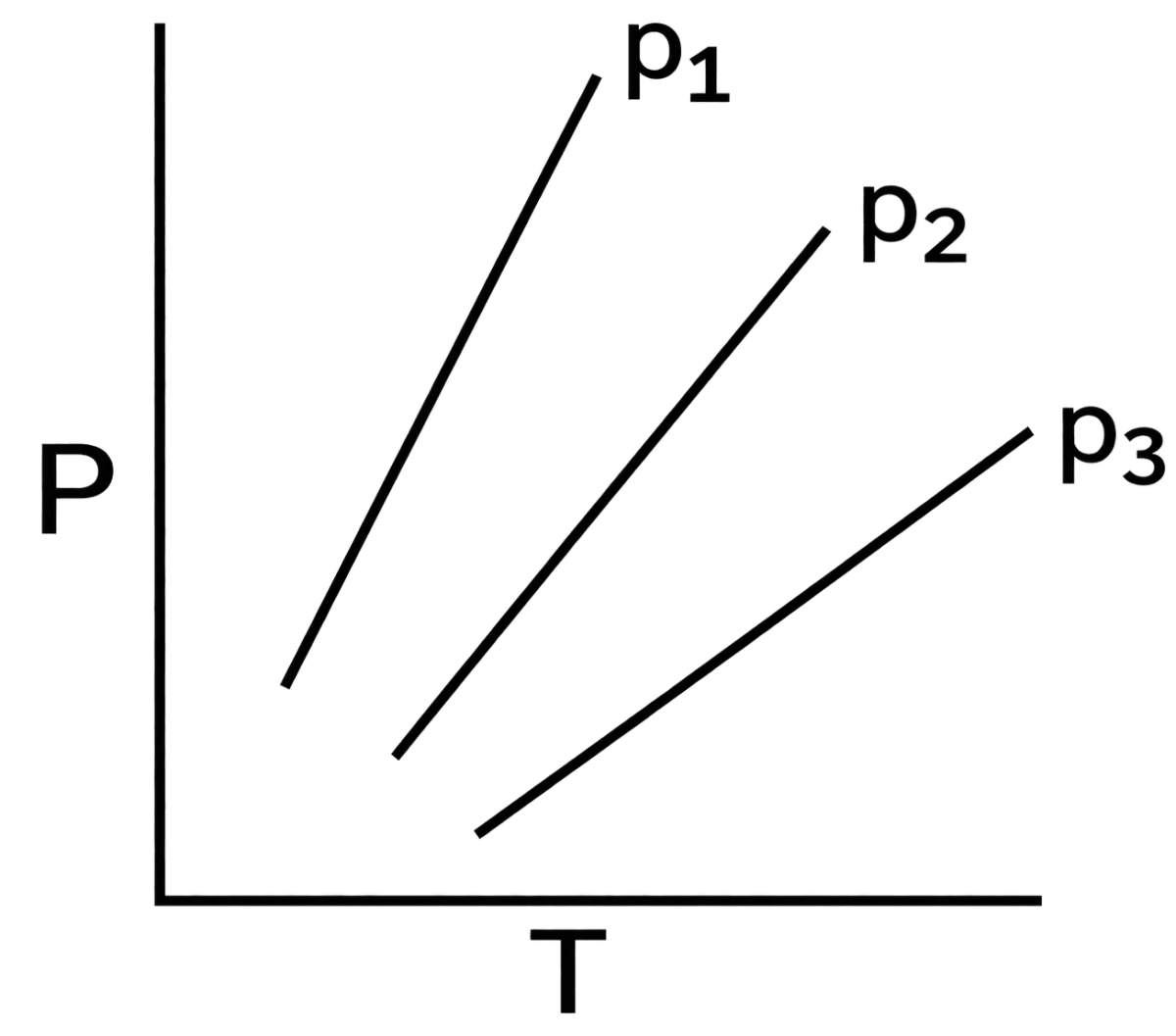
P-T diagram of an ideal gas having three different densities ρ 1, ρ 2, ρ 3 (in three different cases) is shown in the figure. Which of the following is correct? Kinetic Theory, Solutions for Class 11 ISC Nootan Physics Kumar Mittal Nageen Prakashan
  1. ρ2 < ρ3
  2. ρ1 > ρ2
  3. ρ1 < ρ2
  4. ρ1 = ρ2 = ρ3

Answer

ρ1 > ρ2

Reason — Refer to the P-T diagram given in the question.

For n moles of an ideal gas of mass m and molecular mass M,

PV=nRT=mMRT\text{PV} = \text{nRT} = \dfrac{\text m}{\text M}\text{RT}

P=(mV)RTMP=ρRTM\text P = \left(\dfrac{\text m}{\text V}\right)\dfrac{\text{RT}}{\text M} \quad \Rightarrow \quad \text P = \dfrac{\rho \text{RT}}{\text M}

Hence, on a P-T diagram the slope of the straight line is

PT=ρRMslopeρ\dfrac{\text P}{\text T} = \dfrac{\rho \text R}{\text M} \quad \Rightarrow \quad \text{slope} \propto \rho

In the given figure the line for ρ1 has the greatest slope and that for ρ3 the least. Therefore

ρ1>ρ2>ρ3\rho_1 \gt \rho_2 \gt \rho_3

Of the four options, only ρ1 > ρ2 agrees with this result.

Question 11

The graph represents the T-V curves of an ideal gas (where T is the temperature and V is the volume) at all three pressures P1, P2 and P3 compared with those of Charles' Law represented as dotted lines. The correct relation is;
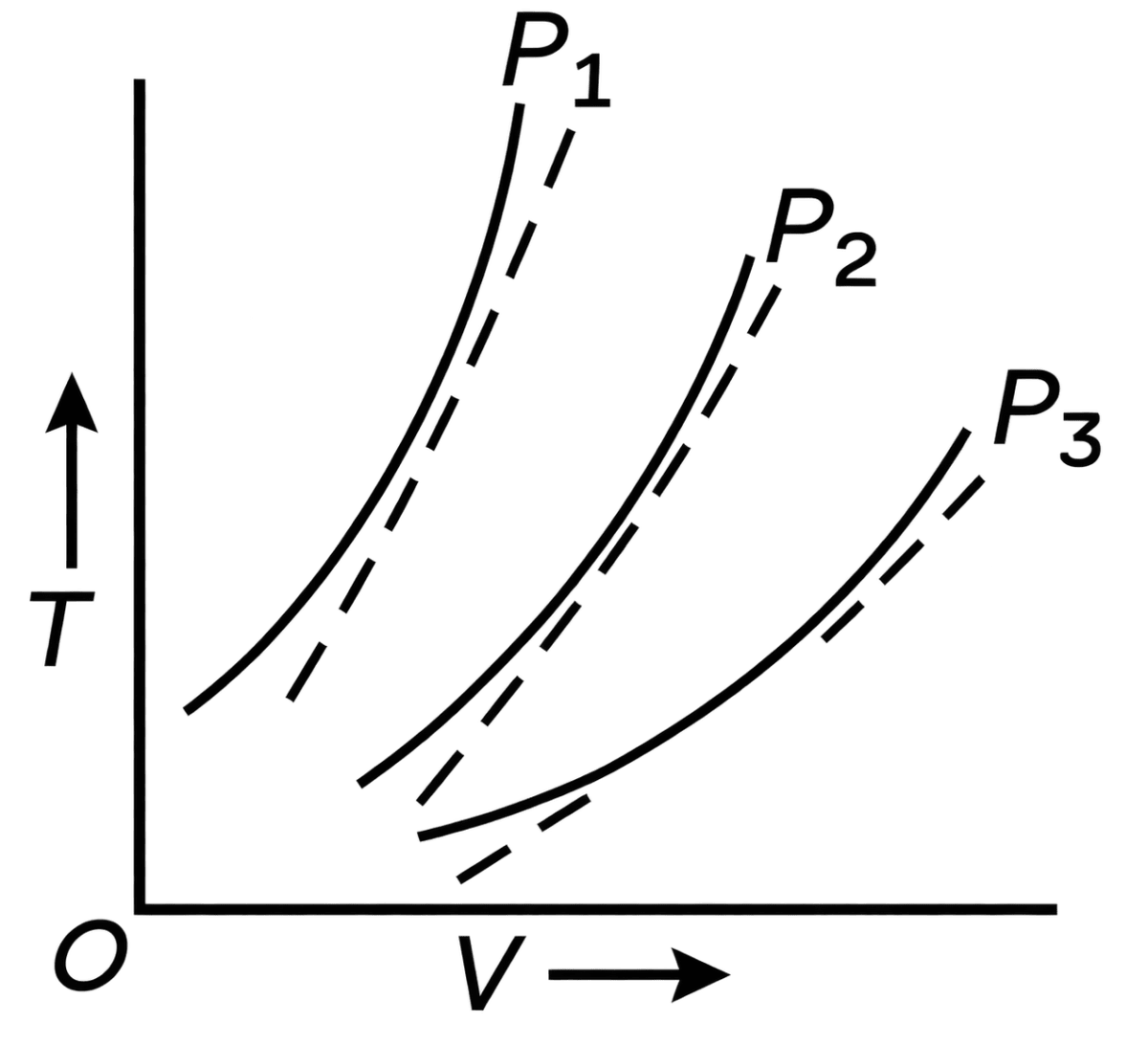
The graph represents the T-V curves of an ideal gas (where T is the temperature and V is the volume) at all three pressures P 1, P 2 and P 3 compared with those of Charles Law represented as dotted lines. The correct relation is;. Kinetic Theory, Solutions for Class 11 ISC Nootan Physics Kumar Mittal Nageen Prakashan
  1. P3 > P2 > P1
  2. P1 > P3 > P2
  3. P2 > P1 > P3
  4. P1 > P2 > P3

Answer

P1 > P2 > P3

Reason — Refer to the T-V curves given in the question.

For n moles of an ideal gas, PV = nRT, so

T=(PnR)V\text T = \left(\dfrac{\text P}{\text{nR}}\right)\text V

Comparing this with the equation of a straight line y = mx, the slope of the T-V curve is

slope=PnRslopeP\text{slope} = \dfrac{\text P}{\text{nR}} \quad \Rightarrow \quad \text{slope} \propto \text P

In the given graph the curve drawn for P1 has the greatest slope and that for P3 the least. Therefore

P1>P2>P3\text P_1 \gt \text P_2 \gt \text P_3

Question 12

An oxygen cylinder of volume 30 L has 18.20 moles of oxygen. After some oxygen is withdrawn from the cylinder, its gauge pressure drops to 11 atmospheric pressure at temperature 27°C. The mass of the oxygen withdrawn from the cylinder is nearly equal to: [Given, R = 10012\dfrac{100}{12} J mol-1K-1 and molecular mass of O2 = 32, 1 atm pressure = 1.01 × 10⁵ N/m2]

  1. 0.125 kg
  2. 0.144 kg
  3. 0.116 kg
  4. 0.156 kg

Answer

0.116 kg

Reason — Given,

  • Volume of the cylinder, V = 30 L = 30 × 10-3 m3
  • Initial number of moles, ni = 18.20 mol
  • Final gauge pressure, Pg = 11 atm
  • Temperature, T = 27°C = 27 + 273 = 300 K
  • R=10012\text R = \dfrac{100}{12} J mol-1 K-1
  • Molecular mass of O2 = 32, 1 atm = 1.01 × 10⁵ N/m2

The gauge pressure is the pressure above the atmospheric pressure, so the final absolute pressure is

Pf=Pg+Patm=11+1=12 atm=12×1.01×105 Nm2\text P_f = \text P_g + \text P_{atm} = 11 + 1 = 12\ \text{atm} \\[1em] = 12 \times 1.01 \times 10^5\ \text N\text m^{-2}

From the gas equation PfV = nfRT, the number of moles left in the cylinder is

nf=PfVRT\text n_f = \dfrac{\text P_f \text V}{\text{RT}}

Substituting the values,

nf=(12×1.01×105)×(30×103)10012×300=3.636×1042.5×103=14.544 mol\text n_f = \dfrac{(12 \times 1.01 \times 10^5) \times (30 \times 10^{-3})}{\dfrac{100}{12} \times 300} \\[1em] = \dfrac{3.636 \times 10^4}{2.5 \times 10^3} = 14.544\ \text{mol}

Therefore the number of moles withdrawn is

ninf=18.2014.544=3.656 mol\text n_i - \text n_f = 18.20 - 14.544 = 3.656\ \text{mol}

The mass of oxygen withdrawn is

m=3.656×321000 kg=0.116 kg\text m = 3.656 \times \dfrac{32}{1000}\ \text{kg} \\[1em] = 0.116\ \text{kg}

Question 13

A container has two chambers of volumes V1 = 2 L and V2 = 3 L separated by a partition made of a thermal insulator. The chambers contain n1 = 5 and n2 = 4 moles of ideal gas at pressures P1 = 1 atm and P2 = 2 atm, respectively. When the partition is removed, the mixture attains an equilibrium pressure of:

  1. 1.3 atm
  2. 1.6 atm
  3. 1.4 atm
  4. 1.8 atm

Answer

1.6 atm

Reason — Given,

  • V1 = 2 L, n1 = 5 mol, P1 = 1 atm
  • V2 = 3 L, n2 = 4 mol, P2 = 2 atm
  • The partition is a thermal insulator

The chambers are separated by a thermal insulator, so no energy is lost to the surroundings. When the partition is removed, the total energy of the mixture is equal to the sum of the energies of the two gases,

E1+E2=Emix\text E_1 + \text E_2 = \text E_{mix}

The internal energy of n moles of a gas having f degrees of freedom is U=12nfRT\text U = \dfrac{1}{2}\text{nfRT}. Taking the same f for the gases,

n1fRT12+n2fRT22=(n1+n2)fRT2\dfrac{\text n_1 \text f\text{RT}_1}{2} + \dfrac{\text n_2 \text f\text{RT}_2}{2} = \dfrac{(\text n_1 + \text n_2)\text f\text{RT}}{2}

Using nRT = PV for each gas and (n1 + n2)RT = Pmix(V1 + V2) for the mixture, and cancelling the common factor f2\dfrac{\text f}{2},

P1V1+P2V2=Pmix(V1+V2)\text P_1 \text V_1 + \text P_2 \text V_2 = \text P_{mix}(\text V_1 + \text V_2)

Substituting the values,

(1×2)+(2×3)=Pmix×(2+3)2+6=5Pmix(1 \times 2) + (2 \times 3) = \text P_{mix} \times (2 + 3) \\[1em] 2 + 6 = 5\text P_{mix}

Pmix=85=1.6 atm\text P_{mix} = \dfrac{8}{5} = 1.6\ \text{atm}

Competition Zone — Numericals

Question 1

γA is the specific heat ratio of monoatomic gas A having 3 translational degrees of freedom. γB is the specific heat ratio of polyatomic gas B having 3 translational, 3 rotational degrees of freedom and 1 vibrational mode. If γAγB=(1+1n)\dfrac{γ_\text A}{γ_\text B} = \left(1 + \dfrac{1}{\text n}\right), then the value of n is ............... .

Answer

3

Given,

  • Gas A is monoatomic with 3 translational degrees of freedom
  • Gas B is polyatomic with 3 translational and 3 rotational degrees of freedom and 1 vibrational mode

For an ideal gas the ratio of the two specific heats is

γ=1+2f=f+2f\gamma = 1 + \dfrac{2}{\text f} = \dfrac{\text f + 2}{\text f}

For gas A : The gas is monoatomic with only three translational degrees of freedom, so

fA=3γA=3+23=53\text f_{\text A} = 3 \quad \Rightarrow \quad \gamma_{\text A} = \dfrac{3 + 2}{3} = \dfrac{5}{3}

For gas B : A vibrational mode carries two terms of energy, one kinetic and one potential, so it contributes 2 to the number of degrees of freedom. Hence

fB=3+3+(2×1)=8\text f_{\text B} = 3 + 3 + (2 \times 1) = 8

γB=8+28=108\gamma_{\text B} = \dfrac{8 + 2}{8} = \dfrac{10}{8}

Ratio of the specific heat ratios :

γAγB=53108=53×810=4030=43\dfrac{\gamma_{\text A}}{\gamma_{\text B}} = \dfrac{\dfrac{5}{3}}{\dfrac{10}{8}} = \dfrac{5}{3} \times \dfrac{8}{10} \\[1em] = \dfrac{40}{30} = \dfrac{4}{3}

Comparing with the given relation,

1+1n=431n=431=131 + \dfrac{1}{\text n} = \dfrac{4}{3} \quad \Rightarrow \quad \dfrac{1}{\text n} = \dfrac{4}{3} - 1 = \dfrac{1}{3}

n=3\text n = 3

Hence, the value of n is 3.

PrevNext