
Which of the following examples represent periodic motion?
(a) A swimmer completing one (return) trip from one bank of a river to the other and back.
(b) A freely suspended bar-magnet displaced from its N-S direction and released.
(c) A hydrogen molecule rotating about its centre of mass.
(d) An arrow released from a bow.
Answer
(a) It is a non-periodic motion. The motion of the swimmer is to and fro, but its nature is such that it cannot have a definite period. The swimmer does not repeat the trip after a fixed interval of time.
(b) It is a periodic motion, and is also simple harmonic. The suspended bar-magnet oscillates to and fro about its N-S direction under a restoring torque, repeating its motion after a fixed interval of time.
(c) It is a periodic motion. The hydrogen molecule returns to the same state after every complete rotation about its centre of mass, so the motion repeats itself at regular intervals of time.
(d) It is a non-periodic motion, as the arrow never returns to its initial position.
Which of the following examples represent (nearly) S.H.M., and which represent periodic but not S.H.M.?
(a) The rotation of the earth about its own axis.
(b) Motion of an oscillating mercury column in a U-tube.
(c) Motion of a ball-bearing inside a smooth curved bowl when released from a point slightly above the lowermost position.
(d) General vibration of a polyatomic molecule about its equilibrium position.
Answer
(a) It is a periodic, but not simple harmonic, motion. The earth repeats its rotation after every 24 hours, but it does not have a to and fro motion about a fixed point, which is the first condition for linear S.H.M.
(b) It is (nearly) simple harmonic motion. When the mercury column is depressed in one limb and released, the weight of the unbalanced column provides a restoring force which is directly proportional to the displacement and is directed towards the mean position.
(c) It is (nearly) simple harmonic motion. For a small displacement from the lowermost position, the ball-bearing behaves like the bob of a simple pendulum whose length equals the radius of curvature of the bowl, and the restoring force is proportional to the displacement.
(d) It is a periodic, but not simple harmonic, motion. A polyatomic molecule has a number of natural frequencies, so its general vibration is a superposition of S.H.M.'s of a number of different frequencies. Such a superposition is periodic, but not simple harmonic.
Given below are X-t plots for linear motion of a particle. Which of the plots represent periodic motion? What is the period of motion (in case of periodic motion)?
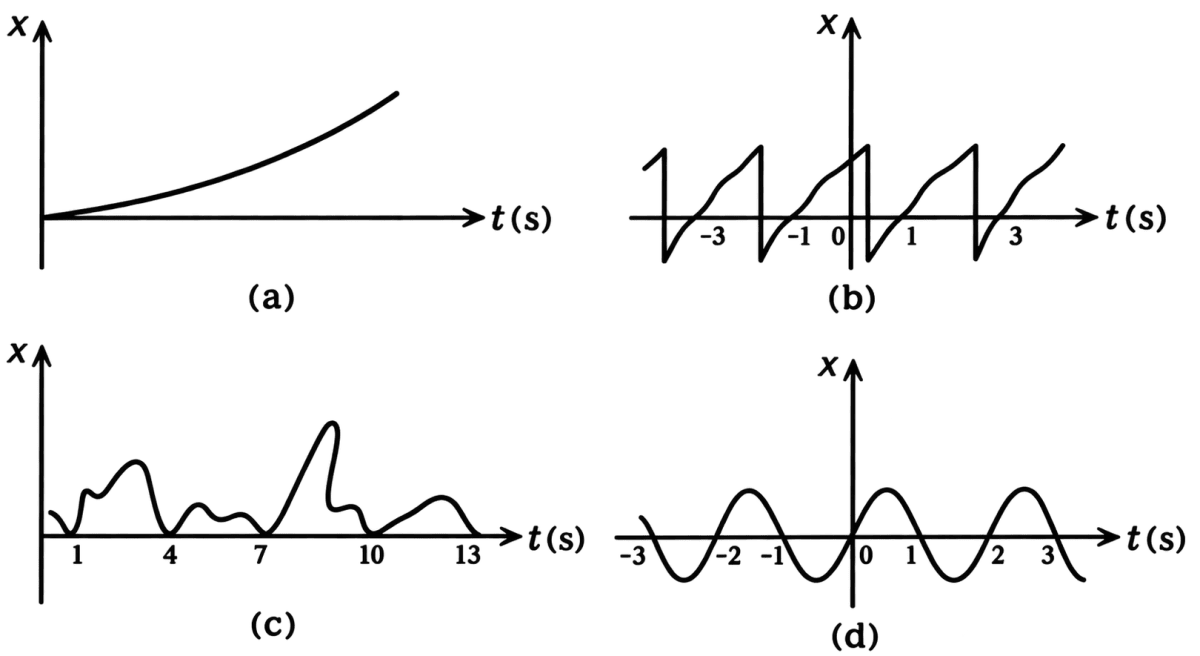
Answer
Fig. (a) does not represent periodic motion, because the particle does not repeat the path of its motion. The displacement goes on increasing continuously with time.
Fig. (b) represents periodic motion. The whole pattern of the motion repeats itself after every 2 s, so the period of motion is 2 s.
Fig. (c) does not represent periodic motion. Apparently it looks to be a periodic motion of period 3 s, but for a motion to be periodic the repetition of merely one position is not enough; instead, the entire motion should be repeated successively.
Fig. (d) represents periodic motion. The pattern repeats itself after every 2 s, so the period of motion is 2 s.
Which of the following functions of time represent (i) simple harmonic, (ii) periodic but not simple harmonic, and (iii) non-periodic motion? Give the period for each case of periodic motion. (ω is any positive constant)
(a) sin ωt − cos ωt
(b) sin3 ωt
(c)
(d) cos ωt + cos 3ωt + cos 5ωt
(e)
(f) 1 + ωt + ω2t2
Answer
(a) Taking common,
This is of the form a sin (ωt + φ0). Hence it represents simple harmonic motion, of time period .
(b) Using the trigonometric identity,
Here each term, sin ωt and sin 3ωt, individually represents S.H.M. However, the resultant outcome of the superposition of two simple harmonic motions of different frequencies is periodic but not simple harmonic. Its periodic-time is .
(c) Since cos (− θ) = cos θ,
This is of the form a cos (ωt + φ0) with angular frequency 2ω. Hence it represents simple harmonic motion, whose time period is
(d) The three terms cos ωt, cos 3ωt and cos 5ωt have angular frequencies ω, 3ω and 5ω. Each term separately is simple harmonic, but their sum is not. Since the frequencies are integral multiples of ω, the function repeats itself after . Hence it represents periodic but not simple harmonic motion, of time period .
(e) is an exponential function which decreases continuously with time and never repeats itself. Hence it represents non-periodic motion.
(f) The function 1 + ωt + ω2t2 also represents non-periodic motion, because it tends to ∞ as t → ∞ and hence never repeats its values.
A particle is in linear S.H.M. between two points A and B, 10 cm apart. Take the direction from A to B as the positive direction and give the signs of velocity, acceleration, and force on the particle when it is:
(a) at the end A,
(b) at the end B,
(c) at the mid-point of AB going towards A,
(d) at 2 cm away from B going towards A,
(e) at 3 cm away from A going towards B,
(f) at 4 cm away from B going towards A.
Answer
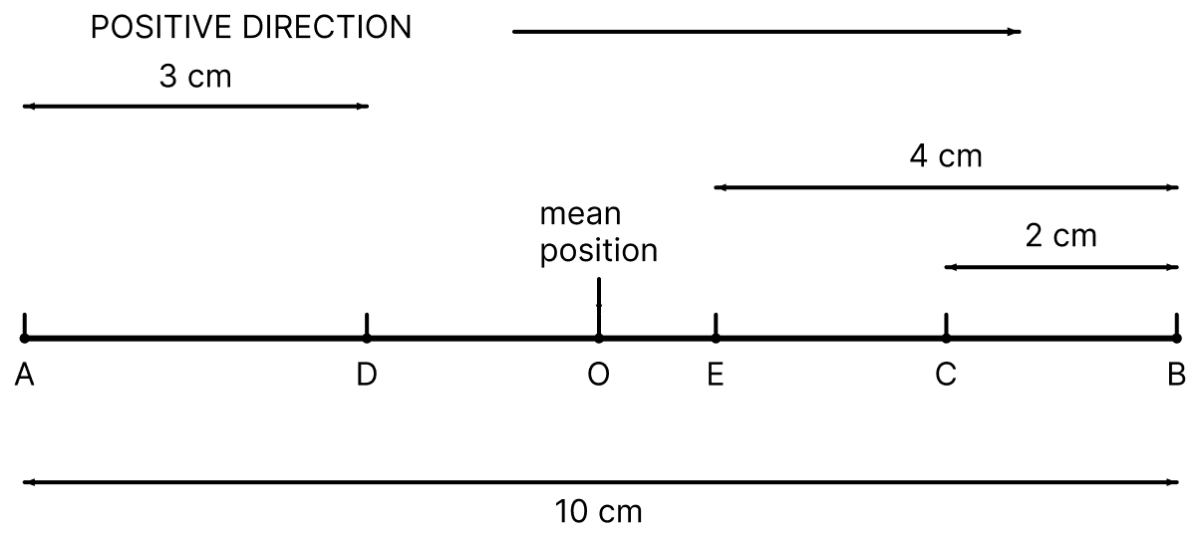
The points A and B, 10 cm apart, are the extreme positions of the particle in S.H.M., and the point O is the mean position. The direction from A to B is taken as positive. In S.H.M. the acceleration α and the force F are always directed towards the mean position O.
(a) At the end A : This is an extreme position, so the velocity v is zero. The acceleration α and the force F are directed from A towards O, that is, along the positive direction. Hence the signs are (0, +, +).
(b) At the end B : This is also an extreme position, so v is zero. The acceleration α and the force F are directed from B towards O, that is, along the negative direction. Hence the signs are (0, −, −).
(c) At the mid-point of AB going towards A : Here the particle is at the mean position O, so α and F are zero. The particle is moving towards A, that is, in the negative direction, so v is negative. Hence the signs are (−, 0, 0).
(d) At 2 cm away from B going towards A : The particle lies between O and B and moves towards A, so v is negative. Being on the B-side of O, α and F are directed towards O, that is, negative. Hence the signs are (−, −, −).
(e) At 3 cm away from A going towards B : The particle lies between A and O and moves towards B, so v is positive. Being on the A-side of O, α and F are directed towards O, that is, positive. Hence the signs are (+, +, +).
(f) At 4 cm away from B going towards A, that is, at E : Since AB = 10 cm, this point is 6 cm from A, that is, 1 cm on the B-side of the mean position O. The particle moves towards A, so v is negative. Being on the B-side of O, α and F are directed towards O, that is, along the negative direction. Hence the signs are (−, −, −).
Note: The textbook prints the answer to this part as (−, +, +), its figure marking the point E at 4 cm from A instead of at 4 cm from B.
Which of the following relationships between the acceleration α and the displacement x of a particle involve simple harmonic motion?
(a) α = 0.7 x
(b) α = − 200 x2
(c) α = − 10 x
(d) α = 100 x3
Answer
Relation (c), α = − 10 x, represents simple harmonic motion.
In S.H.M. the acceleration must be directly proportional to the displacement and directed always towards the mean position, that is,
This condition requires the acceleration to be proportional to the first power of x and to carry a negative sign.
- In (a) the sign is positive, so the acceleration is directed away from the mean position.
- In (b) the acceleration is proportional to x2, and not to x.
- In (d) the acceleration is proportional to x3 and the sign is also positive.
Only relation (c) satisfies α = − ω2x, with ω2 = 10 s-2.
(a) The motion of the particle executing S.H.M. is described by the displacement function, x (t) = A cos (ωt + φ), . If the initial (t = 0) position of the particle is 1 cm and its initial velocity is π cm s-1, what are its amplitude and initial phase angle? The angular frequency of the particle is π rad s-1.
(b) If instead of cosine function we choose sine function to describe S.H.M : x = B sin (ωt + α), then what are the amplitude and initial phase of the particle with the same initial condition as above?
Answer
Given,
- Initial displacement, x0 = 1 cm
- Initial velocity, v0 = π cm s-1
- Angular frequency, ω = π rad s-1
(a) Using the cosine function : The displacement at any instant t is
Differentiating with respect to t, the velocity of the particle is
Putting t = 0 in equations (i) and (ii),
Squaring and adding equations (iii) and (iv),
Substituting the given values,
Dividing equation (iv) by equation (iii),
Hence, with the cosine function the amplitude is cm and the initial phase angle is .
(b) Using the sine function : The displacement is
and the velocity is
At t = 0,
Squaring and adding,
Dividing the two equations,
Hence, with the sine function the amplitude is again cm and the initial phase is . The amplitude is the same in both cases, since it is a physical property of the motion and does not depend on the function chosen to describe it.
A spring balance has a scale that reads from 0 to 50 kg. The length of the scale is 20 cm. A body suspended from this spring, when displaced and released, oscillates with a period of 0.60 s. What is the weight of the body? (g = 9.8 m s-2)
Answer
Given,
- Maximum load on the scale = 50 kg
- Length of the scale, y = 20 cm = 0.2 m
- Period of oscillation, T = 0.60 s
- g = 9.8 m s-2
When a mass of 50 kg hangs from the spring balance, the spring extends through the full length of the scale, that is, by 0.2 m. If k is the force-constant of the spring, then by Hooke's law,
The periodic-time of a body of mass M suspended by a spring of force-constant k is
Squaring and solving for M,
Substituting the values,
The weight of the body is
Hence, the weight of the body is 219.13 N.
A spring having with a spring constant 1200 Nm-1 is mounted on a horizontal table, as shown in the figure. A 3.0 kg mass is attached to the free end of the spring, pulled sideways to a distance of 2.0 cm and released. Find (i) frequency of oscillations, (ii) maximum acceleration of the mass, (iii) the maximum speed of the mass.

Answer
Given,
- Force-constant of the spring, k = 1200 N m-1
- Mass attached, m = 3.0 kg
- Amplitude of oscillation, a = 2.0 cm = 0.02 m
(i) Frequency of oscillations : The mass performs S.H.M. whose angular frequency is
The frequency is
(ii) Maximum acceleration : In S.H.M. the acceleration is maximum at the extreme position, where y = a,
(iii) Maximum speed : The speed is maximum at the mean position,
Hence, the frequency of oscillation is 3.2 s-1, the maximum acceleration is 8.0 m s-2 and the maximum speed is 0.40 m s-1.
In Exercise 9 let us take the position of the mass when the spring is unstretched as x = 0, and the direction from left to right as the positive direction of X-axis. Give x as a function of time t for the oscillating mass, if at the moment we start the stop watch (t = 0), the mass is (a) at the mean position, (b) at the maximum stretched position, and (c) at the maximum compressed position.
In what ways do these functions for S.H.M. differ from each other, in frequency, in amplitude or in initial phase?
Answer
Given,
- Amplitude of oscillation, a = 2.0 cm
- Angular frequency, ω = 20 rad s-1 (from Exercise 9)
The displacement of the mass along the X-axis at any instant t is
where φ is the initial phase.
(a) At the mean position at t = 0 : Here x = 0 at t = 0, so sin φ = 0, giving φ = 0, the mass being taken to move along the positive direction of the X-axis at that instant. From equation (i),
(b) At the maximum stretched position at t = 0 : Here x = + a at t = 0, so sin φ = 1, giving . From equation (i),
(c) At the maximum compressed position at t = 0 : Here x = − a at t = 0, so sin φ = − 1, giving . From equation (i),
Hence, the three functions differ neither in amplitude nor in frequency, but in initial phase only.
Fig. (a), (b) given correspond to two circular motions. The radius of the circle, the period of revolution, the initial position and the sense of revolution (that is, clockwise or anticlockwise) are indicated in each figure. Obtain the corresponding S.H.M.'s of the X-projection of the radius vector of the revolving particle P in each case.
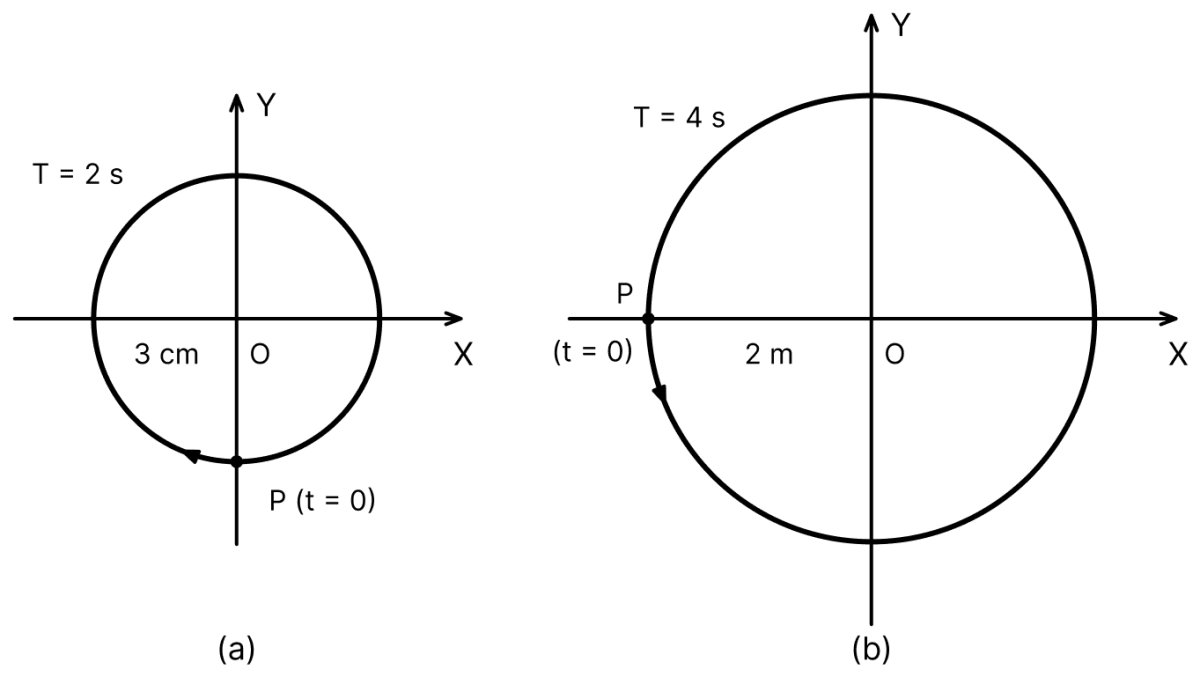
Answer
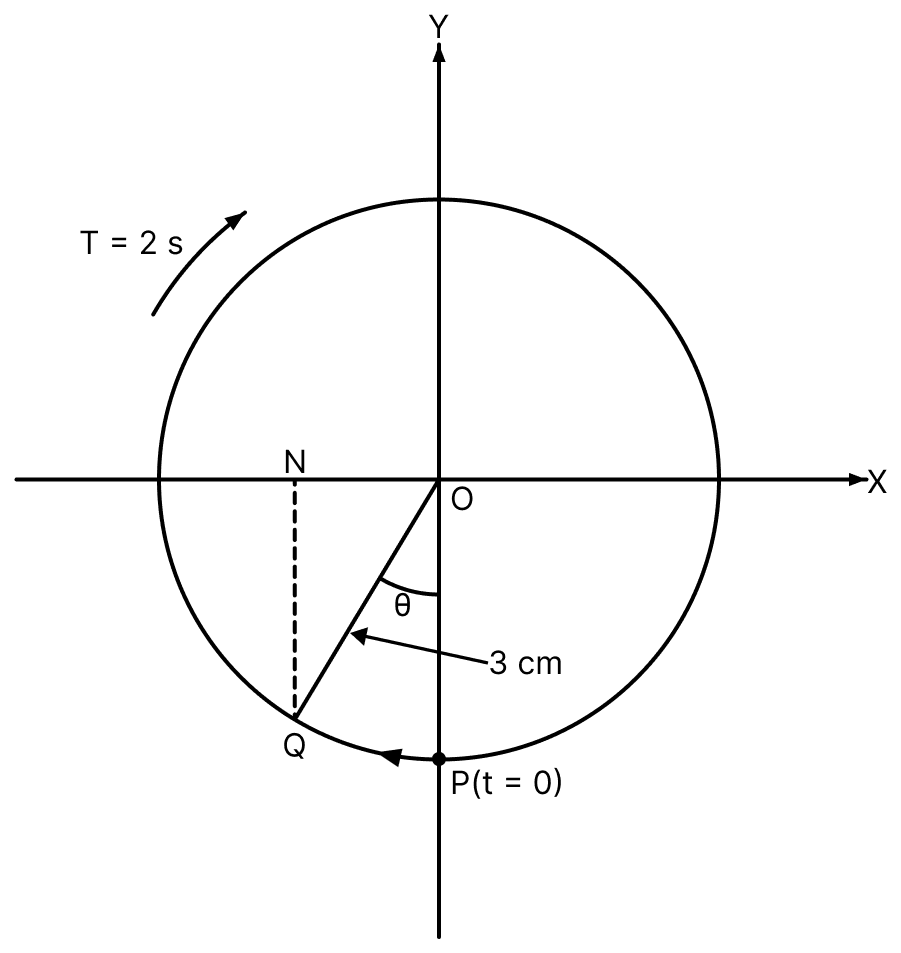
Fig. (a) : Here the radius of the reference circle is 3 cm, the period is T = 2 s, and the particle P starts from the lowermost point of the circle and revolves clockwise.
Suppose the particle arrives at a position Q in time t. The radius vector sweeps an angle
Let N be the foot of the perpendicular from Q on the X-axis. As P revolves, the projection N executes S.H.M. along the X-axis. The displacement x of N at time t is
Here ON = − x cm, OQ = 3 cm and θ = πt. Therefore,
Hence, for Fig. (a) the required equation of S.H.M. is x = − 3 sin πt, where x is in cm.
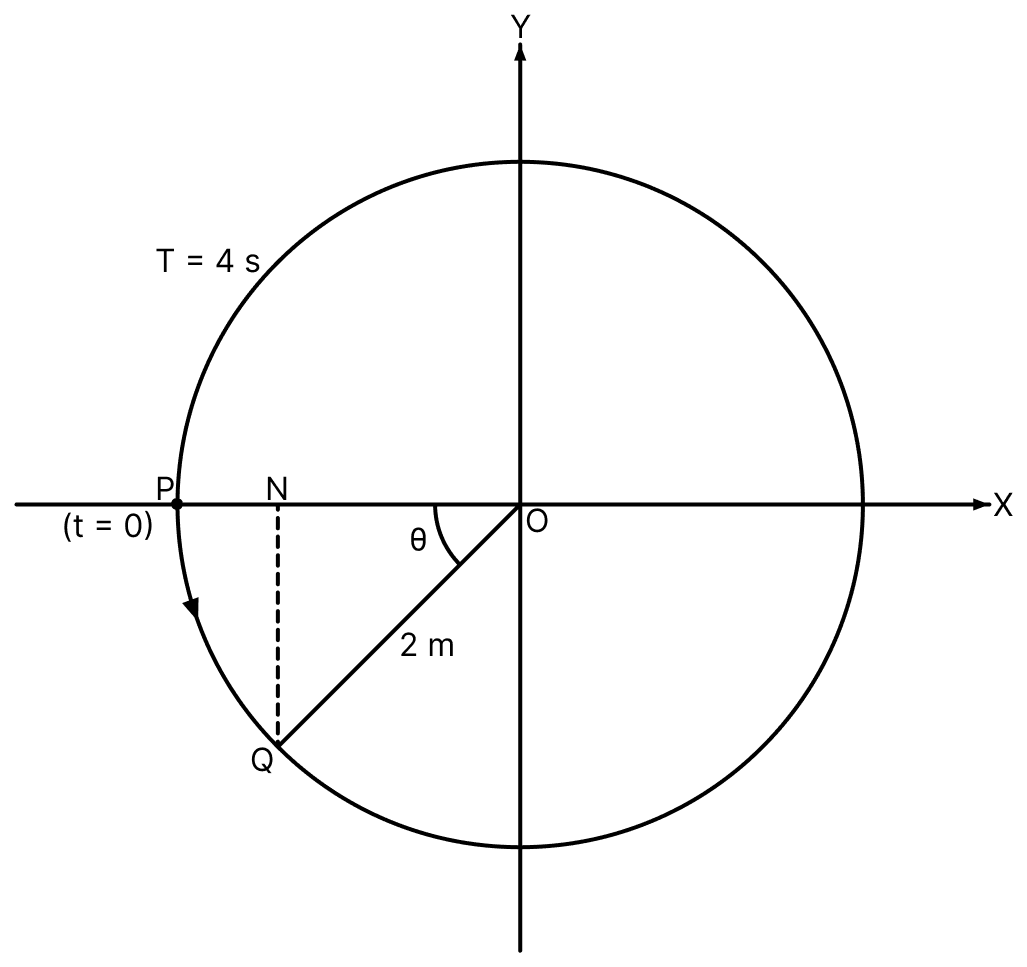
Fig. (b) : Here the radius of the reference circle is 2 m, the period is T = 4 s, and the particle P starts from the extreme left of the circle and revolves anticlockwise.
The radius vector sweeps an angle
As above, the displacement x of the X-projection of Q is
Here ON = − x m, OQ = 2 m and . Therefore,
Hence, for Fig. (b) the required equation of S.H.M. is , where x is in metre.
Plot the corresponding reference circle for each of the following simple harmonic motions. Indicate the initial (t = 0) position of the particle, the radius of the circle, and the angular speed of the revolving particle. For simplicity, the sense of rotation may be fixed to be anticlockwise in every case : (x is in cm and t is in s).
(a)
(b)
(c)
(d) x = 2 cos πt
Answer
Each equation is first brought to the standard form x = a cos (ωt + φ0), from which the radius a of the reference circle, the angular speed ω of the revolving particle and the initial phase φ0 can be read directly.
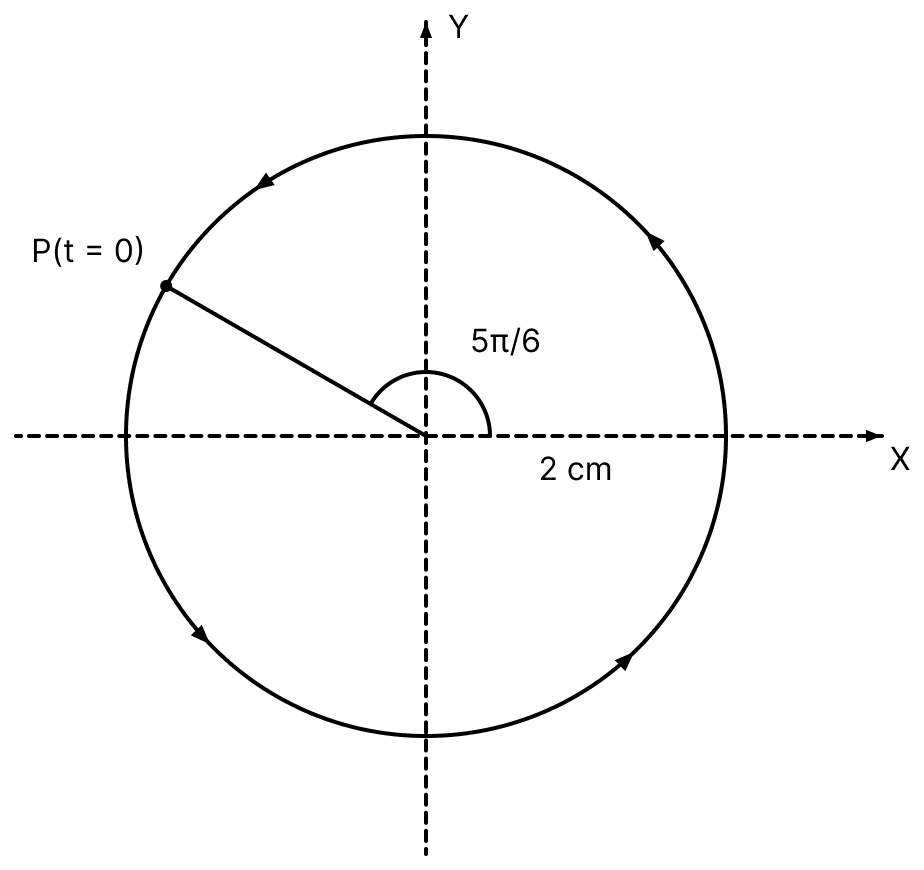
(a) Using ,
Comparing with x = a cos (ωt + φ0),
The reference circle is of radius 2 cm, and the initial (t = 0) position P of the particle makes an angle of with the positive X-axis.
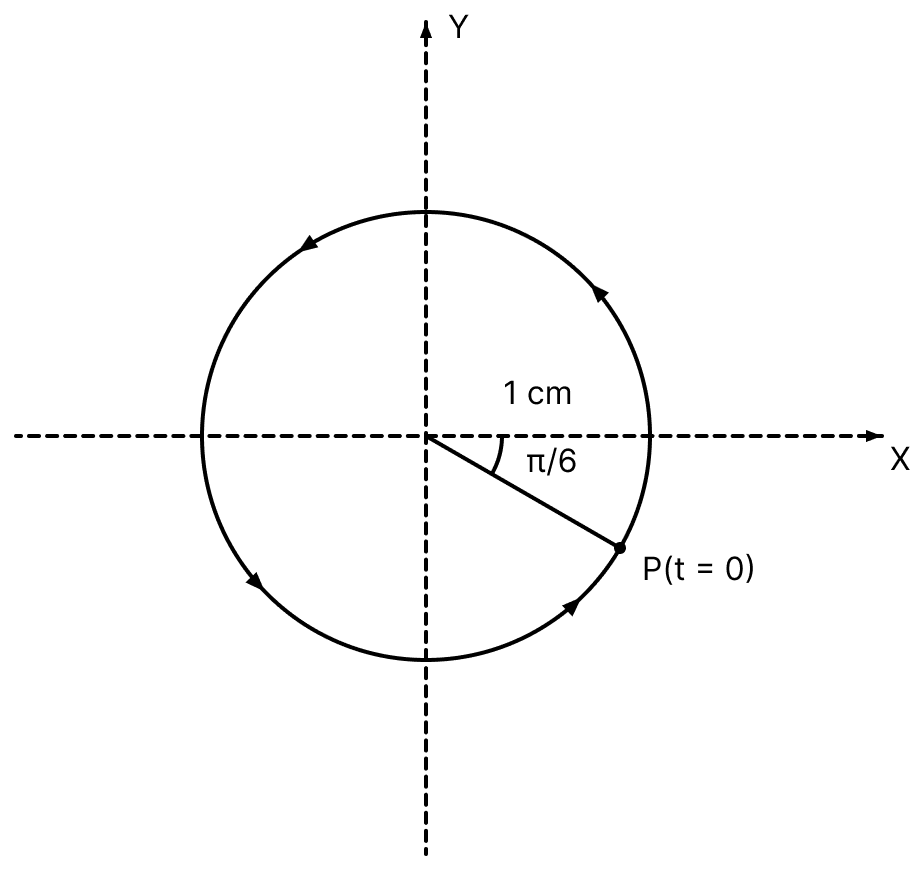
(b) Using cos (− θ) = cos θ,
Comparing with x = a cos (ωt + φ0),
The reference circle is of radius 1 cm, with the initial position P at an angle of below the positive X-axis.
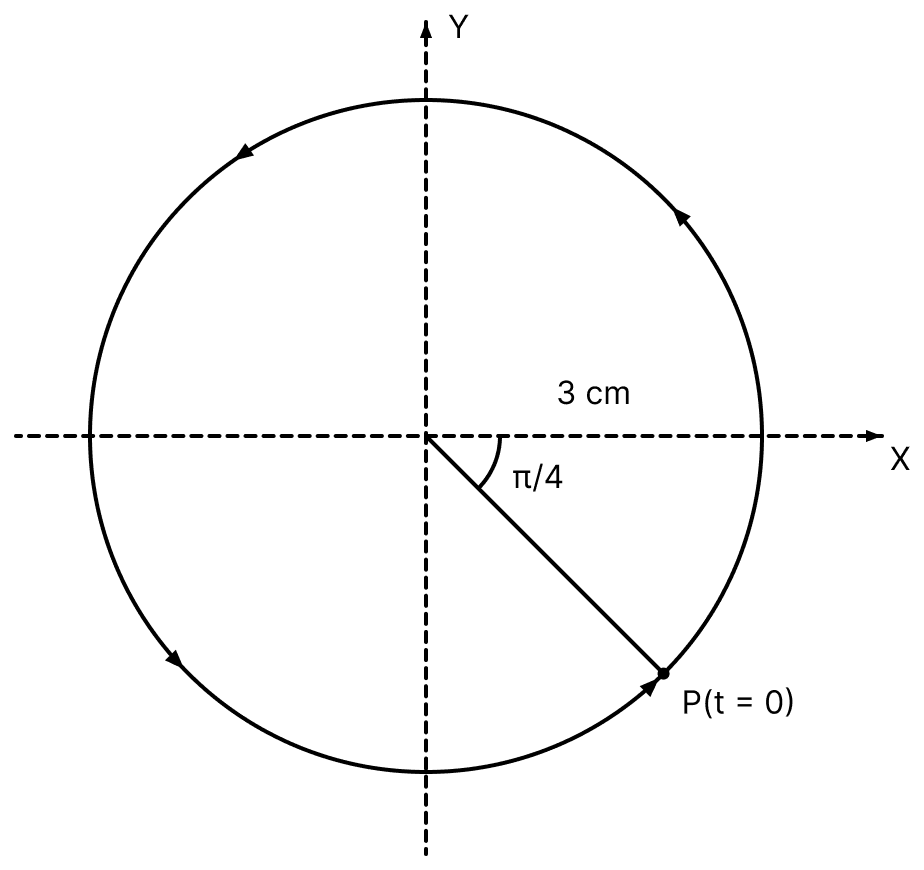
(c) Using ,
Comparing with x = a cos (ωt + φ0),
The reference circle is of radius 3 cm, with the initial position P at an angle of below the positive X-axis.
(d) The equation x = 2 cos πt is already in the standard form. Comparing with x = a cos (ωt + φ0),
The reference circle is of radius 2 cm, with the initial position P on the positive X-axis itself.
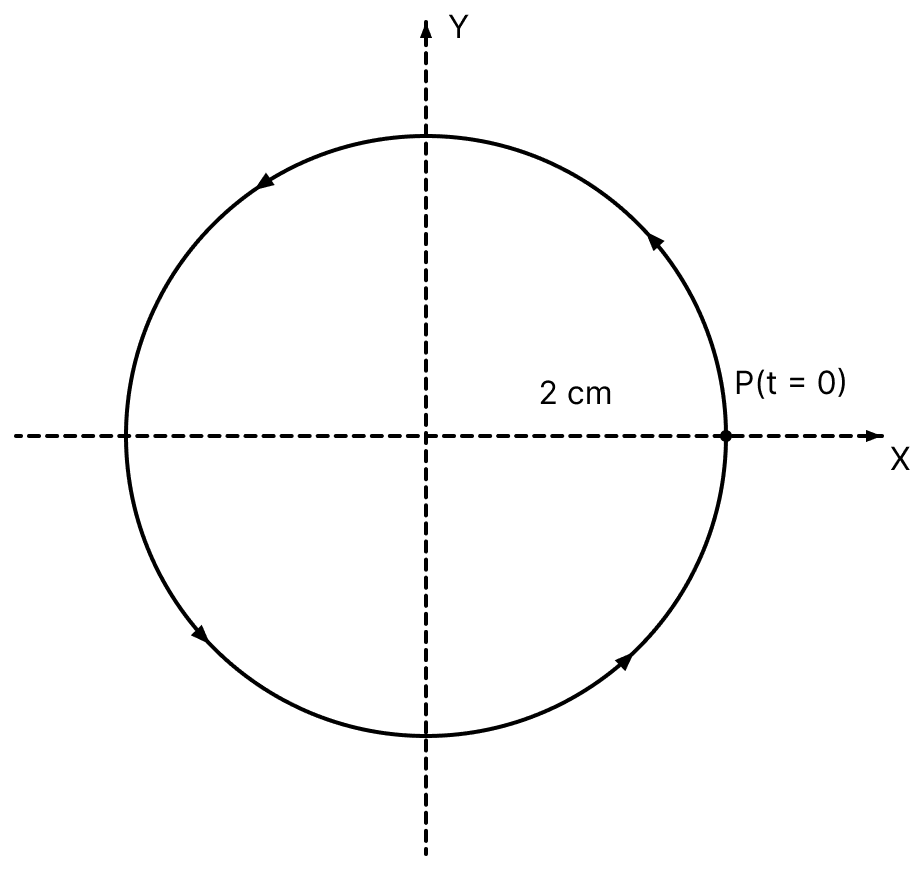
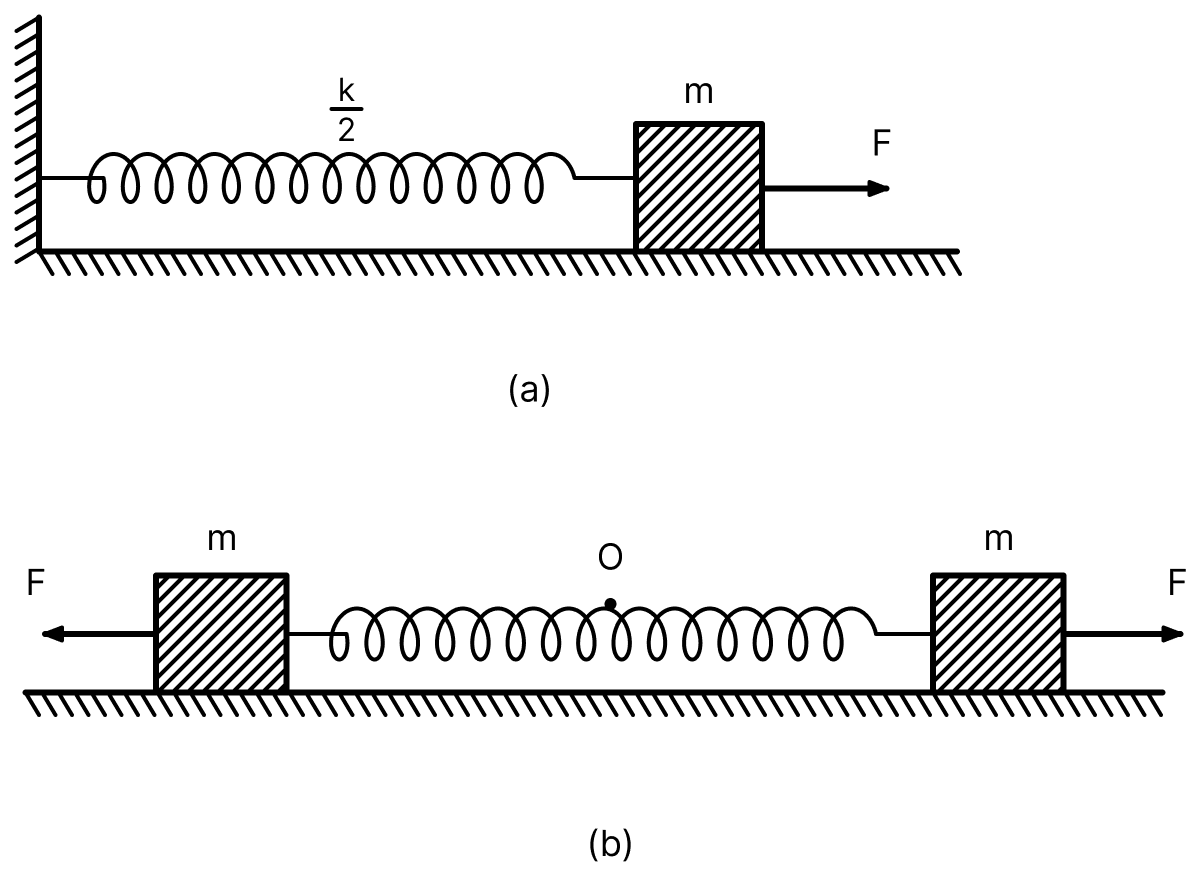
Fig. (a) shows a spring of force-constant k clamped rigidly at one end and a mass m attached to its free end. The spring is stretched by a force F at its free end. Fig. (b) shows the same spring with both ends free and attached to a mass m at either end. Each end of the spring in Fig. (b) is stretched by the same force F.
(i) What is the maximum extension of the spring in the two cases?
(ii) If the mass in Fig. (a) and the two masses in Fig. (b) are released free, what is the period of oscillation in each case?
Answer
(i) Maximum extension of the spring
In Fig. (a) : Let x be the maximum extension produced in the spring. By Hooke's law,
In Fig. (b) : Here the forces F, F are applied on the two masses m, m in opposite directions. Hence the middle point O of the spring remains stationary at its position.
Therefore the spring of length l may be considered to be made up of two parts, each of length , and hence of force-constant 2k, joined to each other at the point O. Since extension is proportional to the length of the spring, each part undergoes an extension given by
The total extension in the spring is
Hence the maximum extension of the spring is in both the cases.
(ii) Period of oscillation
In Fig. (a) : The mass m oscillates under a spring of force-constant k, so
In Fig. (b) : The spring is equivalent to two springs, each of length and force-constant 2k, fixed at the point O. Hence the period of oscillation of each mass m is
The piston in the cylinder head of a locomotive has a stroke (twice the amplitude) of 1.0 m. If the piston moves with simple harmonic motion with an angular frequency of 200 rad/min, what is the maximum speed?
Answer
Given,
- Stroke of the piston = 2a = 1.0 m
- Angular frequency, ω = 200 rad min-1
The amplitude of the motion is
Converting the angular frequency into SI units,
The maximum speed of a particle in S.H.M. occurs at the mean position and is given by
Substituting the values,
Hence, the maximum speed of the piston is 1.67 m s-1.
The acceleration due to gravity on the surface of the moon is 1.7 m s-2. What is the time period of a simple pendulum on the moon, if its time period on the earth is 3.5 s? Given : g on earth = 9.8 m s-2.
Answer
Given,
- Acceleration due to gravity on the moon, gm = 1.7 m s-2
- Acceleration due to gravity on the earth, ge = 9.8 m s-2
- Time period on the earth, Te = 3.5 s
Let l be the length of the simple pendulum. Its time periods on the earth and on the moon are
Dividing the second by the first, the length l cancels out,
Substituting the values,
Hence, the time period of the simple pendulum on the moon is 8.4 s. Since g is smaller on the moon, the pendulum oscillates more slowly there.
A simple pendulum of length l and having a bob of mass M is suspended in a car. The car is moving on a circular track of radius R with a uniform speed v. If the pendulum makes small oscillations in a radial direction about its equilibrium position, what will be its time period?
Answer
Given,
- Length of the simple pendulum = l
- Mass of the bob = M
- Radius of the circular track = R
- Uniform speed of the car = v
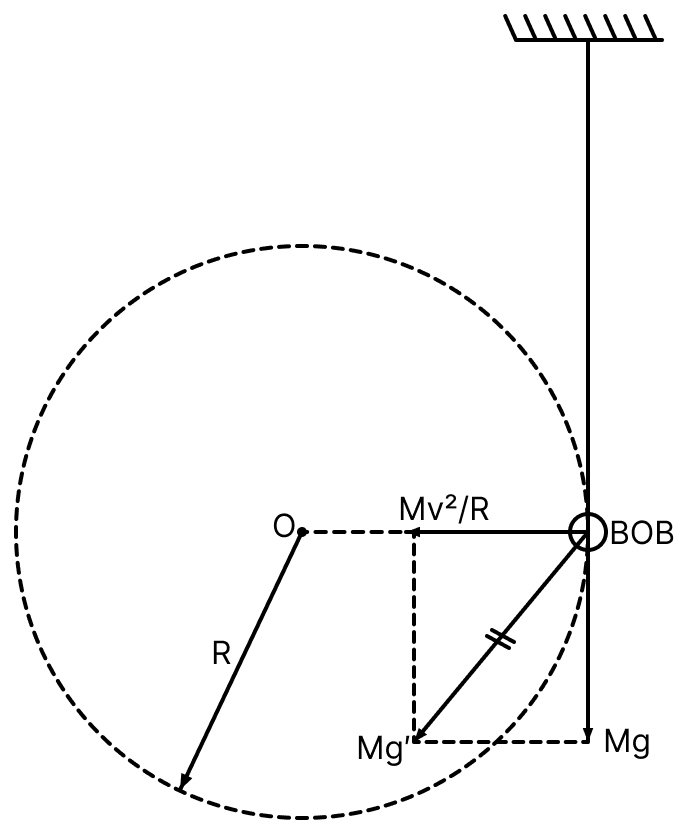
The bob is suspended in a car moving on a circular track. Hence, in addition to its weight Mg acting vertically downwards, the bob is acted upon by a centripetal force directed horizontally towards the centre of the circle.
These two forces are mutually perpendicular, so the effective force on the bob is their resultant,
Therefore the effective value of the acceleration due to gravity is
The time period of the pendulum is obtained by replacing g by g' in the formula for a simple pendulum,
Hence, the time period of the pendulum is . Since g' > g, the time period is reduced on account of the radial acceleration .
A cylindrical piece of cork of density of base area A and height h floats in a liquid of density ρ1. The cork is depressed slightly and then released. Show that the cork oscillates up and down simple harmonically with a period
where ρ is the density of cork. (Ignore damping due to viscosity of the liquid).
Answer
Given,
- Base area of the cork = A
- Height of the cork = h
- Density of the cork = ρ
- Density of the liquid = ρ1
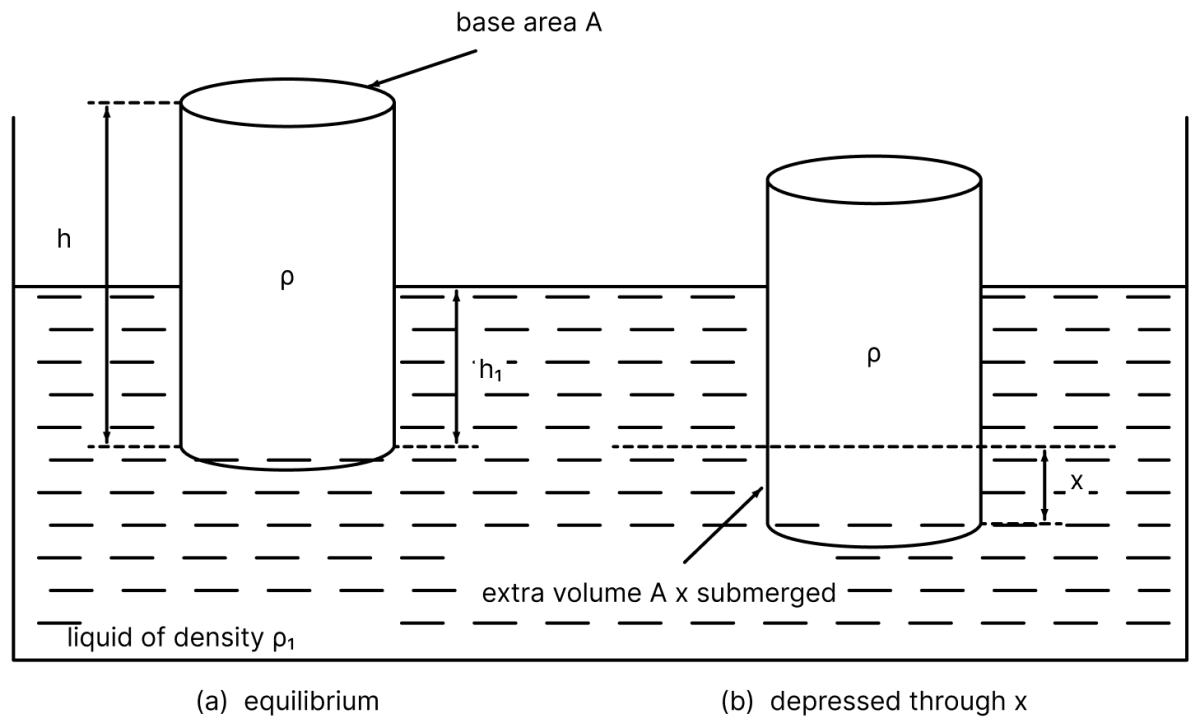
Let h1 be the length of the cork submerged in the liquid at equilibrium. By the law of floatation, the upthrust on the cork equals its weight,
Now let the cork be pushed down further through a small distance x and released. An additional volume Ax of the liquid is displaced, so the increase in upthrust is ρ1gAx. This acts as the net upward force, that is, the restoring force,
The negative sign is taken because the restoring force is directed opposite to the displacement x. By Newton's second law of motion, if α is the instantaneous acceleration of the cork,
But the mass of the cylindrical piece of cork is
Substituting this in equation (ii),
Here is a constant. Hence α ∝ − x, that is, the acceleration of the cork is directly proportional to its displacement and is directed towards the mean position. Therefore the motion of the cork is simple harmonic.
Comparing equation (iii) with α = − ω2x,
The time period is
Hence, the cork oscillates up and down simple harmonically with a period .
One end of a U-tube containing mercury is connected to a suction pump and the other end to atmosphere. A small pressure difference is maintained between the two columns. Show that, when the suction pump is removed, the column of mercury in the U-tube executes simple harmonic motion.
Answer
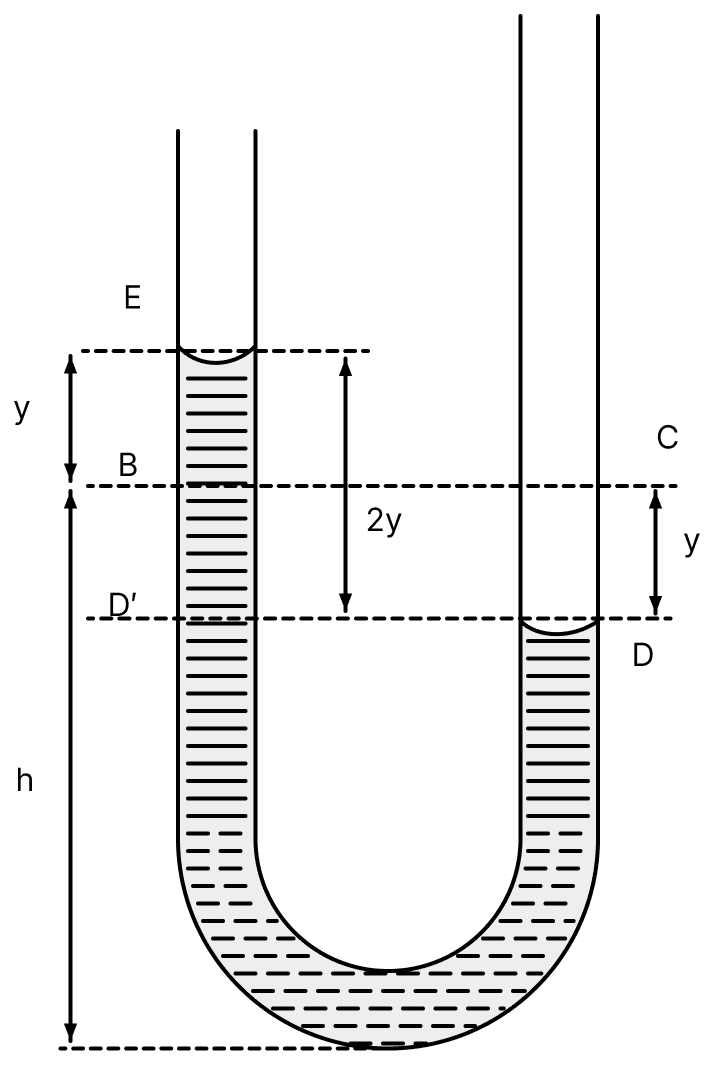
Initially the mercury stands at the same height in both the limbs of the U-tube, say at B and C. On working the suction pump, the level C is pressed down through a distance y up to D, and consequently the level B rises up by the same distance y to E. Thus, in the left limb of the U-tube there is now an additional mercury column D′E of length 2y.
When the pressed level of the mercury is left free, the whole mercury column oscillates up and down due to the restoring force provided by the weight of this unbalanced mercury-column D′E.
Let m be the mass of mercury per unit length of the tube. Then the mass of the column D′E is (m × 2y), and the restoring force acting on the mercury is
The negative sign is taken because this force acts in the direction opposite to the displacement of the liquid.
If 2h is the length of the whole liquid column, the mass of the whole liquid filled in the tube is (m × 2h). Hence the acceleration of the liquid is
Here is a constant for a given liquid column. Hence the acceleration α is directly proportional to the displacement y and is directed opposite to it, towards the mean position.
Hence, the column of mercury in the U-tube executes simple harmonic motion, whose time period is