A 0.1 kg mass is suspended from a wire of negligible mass. The length of the wire is 1 m and its cross-sectional area is 4.9 × 10⁻⁷ m2. If the mass is pulled a little in the vertically downward direction and released, it performs simple harmonic motion of angular frequency 140 rad s-1. If the Young's modulus of the material of the wire is n × 109 N m-2, find the value of n.
Answer
Given,
Mass suspended, m = 0.1 kg
Length of the wire, L = 1 m
Area of cross-section, A = 4.9 × 10⁻⁷ m2
Angular frequency, ω = 140 rad s-1
Young's modulus, Y = n × 109 N m-2
The Young's modulus of the material of the wire is
Y=l/LF/A=AlFL⇒F=(LYA)l
If the elongation of the wire on suspending the mass m is l, then the restoring force acting on the mass due to elasticity is
F=kl
Comparing the two equations, the force-constant of the wire is
k=LYA
The angular frequency of the resulting S.H.M. is
ω=mk=mLYA
Substituting the values,
140=[0.1×1n×109×4.9×10−7]21
140=[0.14.9×102n]21=[4900n]21=70n
n=70140=2⇒n=4
Hence, the value of n is 4.
Question 2
Based upon the following paragraph three multiple choice type questions are to be answered. Each question has four choices out of which only one is correct.
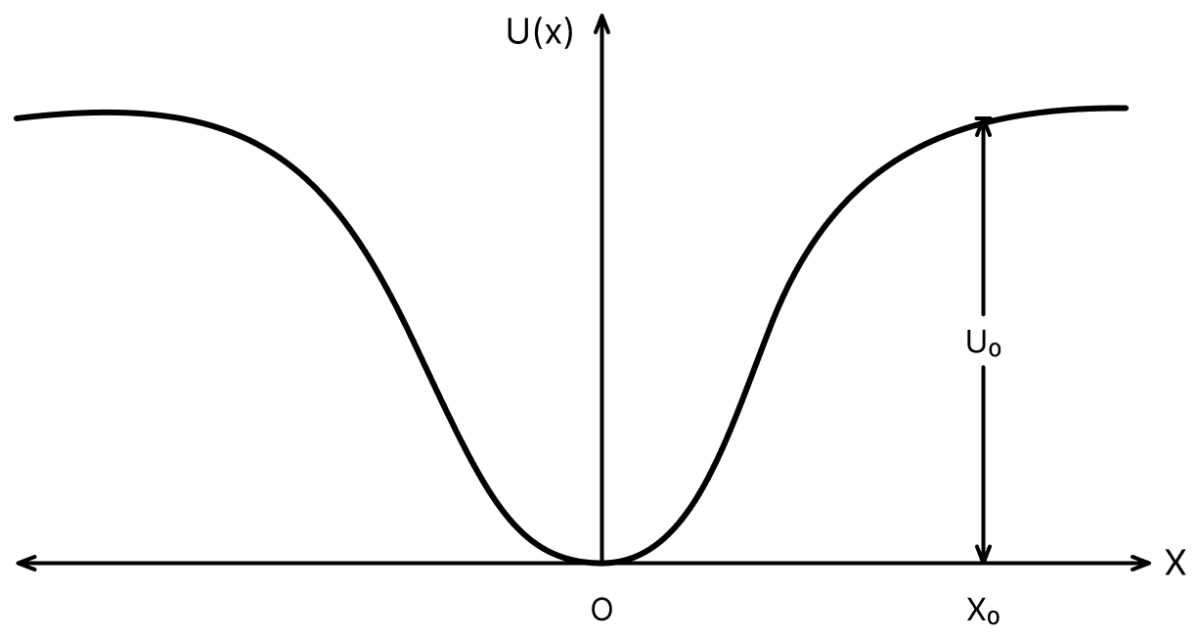
When a particle of mass m moves on the X-axis in a potential of the form U(x) = kx2, it performs simple harmonic motion. The corresponding time period is proportional to km, as can be seen easily using dimensional analysis. However, the motion of a particle can be periodic even when its potential energy increases on both sides of x = 0 in a way different from kx2 and its total energy is such that the particle does not escape to infinity. Consider a particle of mass m moving on the X-axis. Its potential energy is U(x) = αx4 (α > 0) for | x | near the origin and becomes a constant equal to U0 for | x | ≥ X0 (see fig. below).
(i) If the total energy of the particle is E, it will perform periodic motion only if :
E < 0
E > 0
U0 > E > 0
E > U0
(ii) For periodic motion of small amplitude A, the time period T of this particle is proportional to :
Aαm
A1αm
Amα
A1mα
(iii) The acceleration of this particle for | x | > X0 is :
proportional to U0
proportional to mX0U0
proportional to mX0U0
zero
Answer
(i) U0 > E > 0
The particle will perform periodic motion (and not escape to infinity) only if a restoring force continues to act upon it. This is possible only when the particle remains confined within the potential well, that is, when its total energy is less than the constant value U0 attained by the potential energy outside the well,
E<U0
Since the potential energy is positive everywhere, E must also be positive. Hence the condition is U0 > E > 0.
Now checking the dimensions of the option A1αm,
[L]1[ML−2T−2][M]=[L]1[L2T2]=[L][LT]=[T]
This has the dimensions of time. Hence the time period is proportional to A1αm.
(iii) Zero
For | x | > X0, the potential energy is a constant, U = U0. Therefore the force acting on the particle is
F=−dxdU=0[∵U=constant]
Since no force acts on the particle in this region, its acceleration is zero.
Question 3
A particle performs simple harmonic motion with amplitude A. Its speed is trebled at the instant when it is at a distance 32A from equilibrium position. The new amplitude of the motion is :
3A
A3
37A
3A41
Answer
37A
Given,
Original amplitude of the motion = A
Displacement at which the speed is trebled, x=32A
The velocity of a particle in S.H.M. at displacement x is
u=ωA2−x2
At x=32A,
u=ωA2−(32A)2=ωA2−94A2=ω95A2=35ωA
The speed at this position is now trebled, so the new speed is
unew=3u=5ωA
The displacement is unchanged at this instant, so if Anew is the new amplitude,
unew=ωAnew2−x2=5ωA
Squaring both sides and cancelling ω2,
Anew2−x2=5A2
Anew2=5A2+(32A)2=5A2+94A2=945A2+4A2=949A2
Anew=37A
Hence, the new amplitude of the motion is 37A.
Question 4
A particle is executing S.H.M. along a straight line. Its velocities at distances x1 and x2 from the mean position are v1 and v2 respectively. Its time period is :
2πv12−v22x22−x12
2πx12+x22v12+v22
2πx12−x22v12−v22
2πv12−v22x12−x22
Answer
2πv12−v22x22−x12
The velocity of a particle in S.H.M. at a displacement x from the mean position is
v=ωa2−x2
where a is the amplitude. Squaring, at the two given displacements,
v12=ω2(a2−x12)…(i)
v22=ω2(a2−x22)…(ii)
Subtracting equation (ii) from equation (i), the amplitude a is eliminated,
v12−v22=ω2(x22−x12)
ω=x22−x12v12−v22
But ω=T2π, therefore
T=ω2π=2πv12−v22x22−x12
Question 5
A particle moves with simple harmonic motion in a straight line. In first τ s, after starting from rest it travels a distance a and in next τ s, it travels 2a, in same direction, then :
amplitude of motion is 3a
time period of oscillations is 8τ
amplitude of motion is 4a
time period of oscillations is 6τ
Answer
time period of oscillations is 6τ
Since the particle starts from rest, it starts from the extreme position. Hence its displacement is measured from the extreme position as
x=Acosωt,so that at t=0,x=A
At t = τ : The particle has travelled a distance a, so x = A − a,
A−a=Acosωτ⇒a=A(1−cosωτ)…(i)
At t = 2τ : The particle has travelled a further 2a, so the total distance travelled is 3a and x = A − 3a,
A−3a=Acos2ωτ⇒3a=A(1−cos2ωτ)…(ii)
Dividing equation (i) by equation (ii),
31=1−cos2ωτ1−cosωτ=2sin2ωτ1−cosωτ
Let x = cos ωτ. Then sin2ωτ = 1 − x2, so
31=2(1−x2)1−x=2(1−x)(1+x)1−x=2(1+x)1
2(1+x)=3⇒x=21=cosωτ
Therefore,
ωτ=3π⇒T2πτ=3π
T=6τ
Hence, the time period of oscillations is 6τ.
Question 6
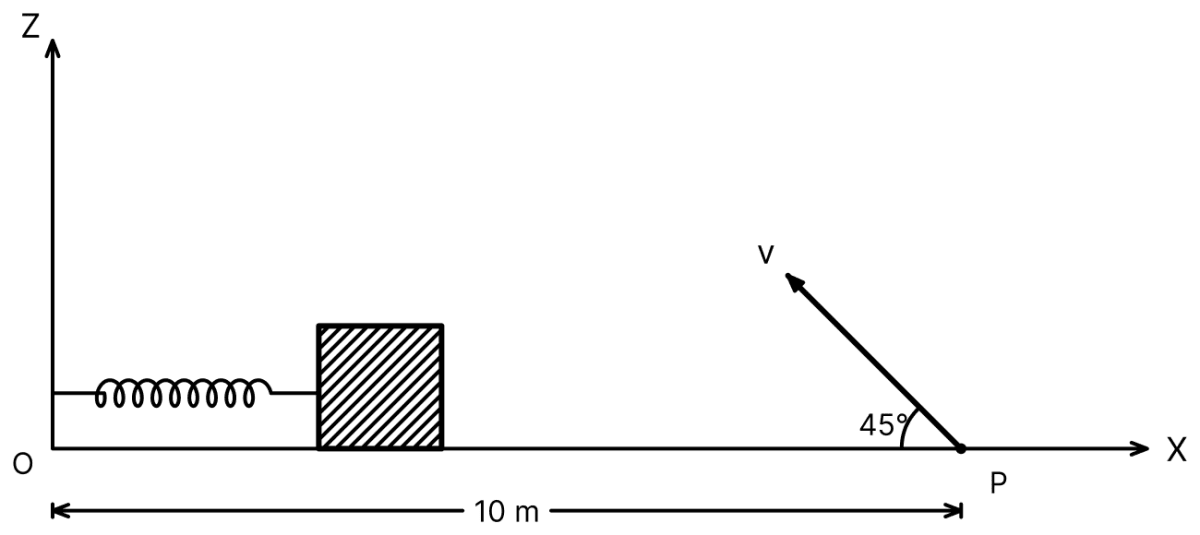
A small block is connected to one end of a massless spring of unstretched length 4.9 m. The other end of the spring (see the figure) is fixed. The system lies on a horizontal frictionless surface. The block is stretched by 0.2 m and released from rest at t = 0. It then executes simple harmonic motion with angular frequency ω=3π rad/s. Simultaneously at t = 0, a small pebble is projected with speed v from point P at an angle of 45° as shown in the figure. Point P is at a horizontal distance of 10 m from O. If the pebble hits the block at t = 1 s, the value of v is : (take g = 10 m/s2)
50 m/s
51 m/s
52 m/s
53 m/s
Answer
50 m/s
Given,
Unstretched length of the spring = 4.9 m
Amplitude of oscillation, a = 0.2 m
Angular frequency, ω=3π rad s-1
Horizontal distance OP = 10 m
Angle of projection = 45°, time of flight = 1 s, g = 10 m s-2
Position of the block at t = 1 s : The time period of the block is
T=ω2π=π2π×3=6s
The block is released from the stretched (extreme) position, so its displacement from the mean position is
x=acosωt=0.2cos(T2πt)
At t = 1 s,
x=0.2cos(62π×1)=0.2cos3π=20.2=0.1m
Hence the position of the block measured from the wall at t = 1 s is
4.9m+0.1m=5m
Range of the pebble : Since P is at 10 m from O, the horizontal distance covered by the pebble is
R=10−5=5m
The horizontal component of the velocity of the pebble remains constant, so
vcos45°×t=5m
v×21×1=5⇒v=52=50m s−1
Hence, the value of v is 50 m/s.
Question 7
A point mass is subjected to two simultaneous sinusoidal displacements in X-direction, x1(t) = A sin ωt and x2(t)=Asin(ωt+32π). Adding a third sinusoidal displacement x3(t) = B sin (ωt + φ) brings the mass to a complete rest. The values of B and φ are :
2A,43π
A,34π
3A,65π
A,3π
Answer
A,34π
Given,
x1(t) = A sin ωt
x2(t)=Asin(ωt+32π)
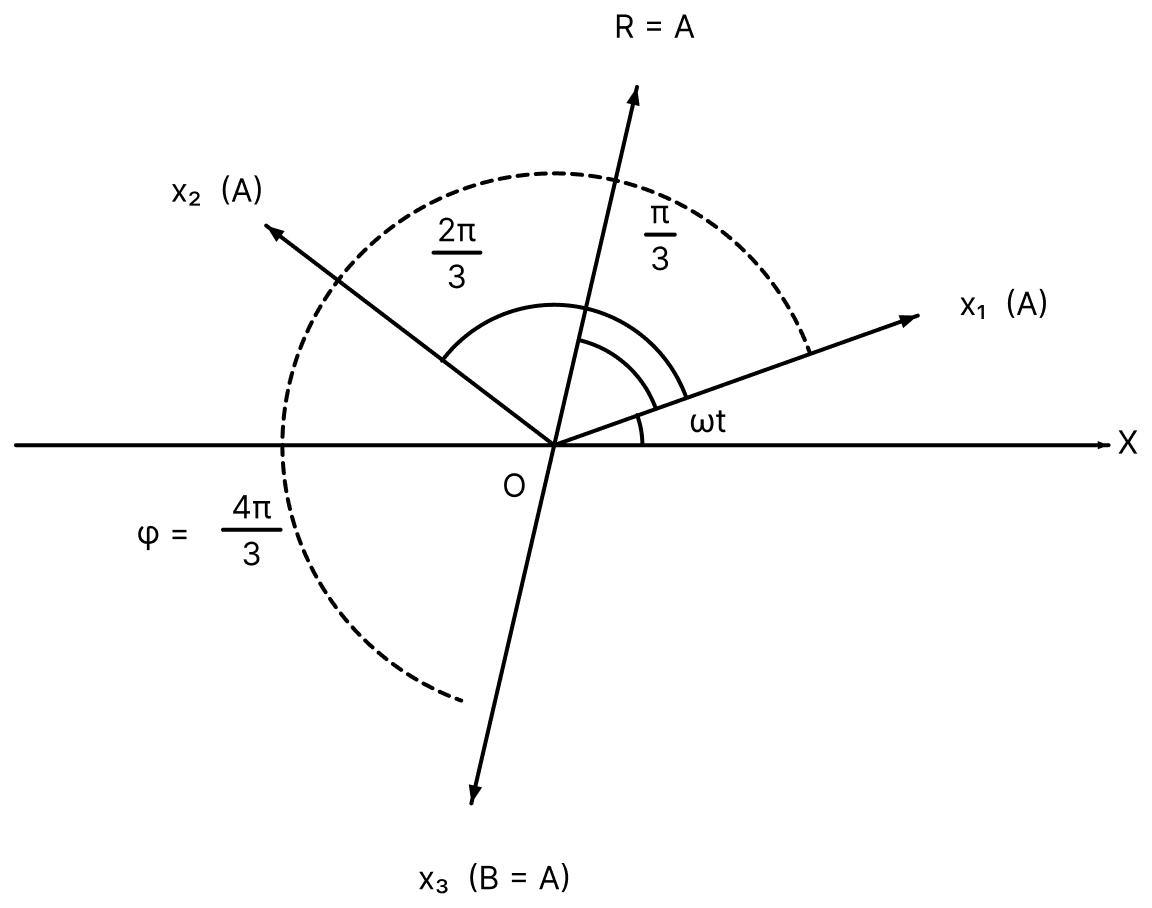
The two displacements x1 and x2 have equal amplitudes A and a phase difference of 32π. Their resultant amplitude is
R=A2+A2+2A⋅Acos32π
Since cos32π=−21,
R=2A2+2A2(−21)=2A2−A2=A
Since the two amplitudes are equal, this resultant bisects the angle between them, so its phase is 3π.
The third displacement x3(t) = B sin (ωt + φ) will bring the mass to complete rest only when it is equal and opposite to this resultant. Hence,
B=Aandφ=π+3π=34π
Hence, B = A and φ=34π.
Question 8
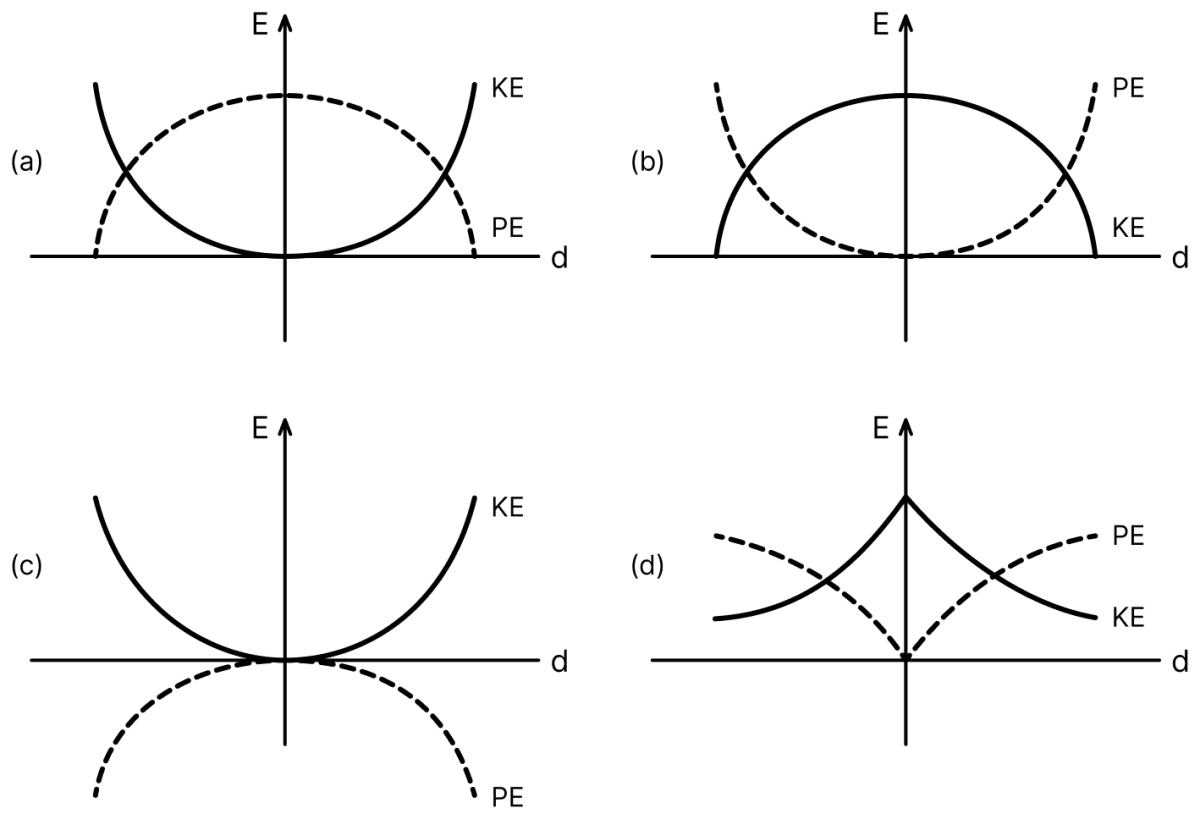
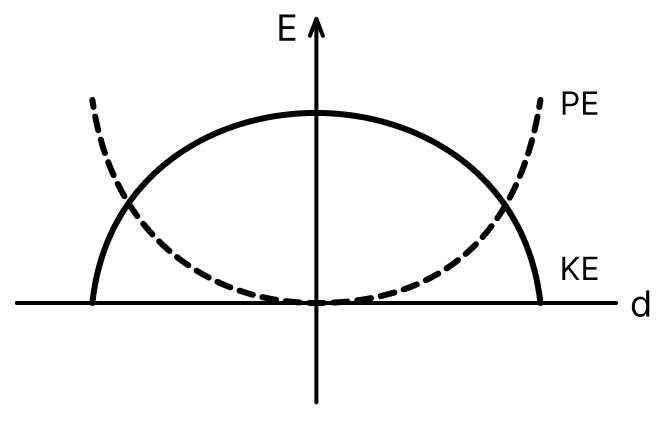
For a simple pendulum, a graph is plotted between its kinetic energy (KE) and potential energy (PE) against its displacement d. Which one of the following represents these correctly?
(Graphs are schematic and not drawn to scale)
Answer
For a particle executing S.H.M. with amplitude a, the kinetic energy and the potential energy at a displacement d are
K=21mω2(a2−d2)andU=21mω2d2
From these expressions,
The kinetic energy is maximum at the mean position (d = 0) and becomes minimum (zero) at the extreme positions (d = ± a).
The potential energy is minimum (zero) at the mean position and becomes maximum at the extreme positions.
Both graphs are parabolas, the KE curve opening downwards and the PE curve opening upwards, and their sum is the constant total energy. Only graph (b) shows the KE curve with its maximum at d = 0 and the PE curve with its minimum at d = 0.
Question 9
A simple pendulum has a time period T1. When its point of suspension is moved vertically upwards according as y = k t2, where y is vertical distance covered and k = 1 m/s2, its time period becomes T2. Then, T22T12 is (g = 10 m/s2) :
65
1011
56
45
Answer
56
Given,
Vertical distance covered by the point of suspension, y = kt2
k = 1 m s-2
g = 10 m s-2
The upward acceleration of the point of suspension is obtained by differentiating y twice with respect to time,
dtdy=dtd(kt2)=2kt
ay=dt2d2y=dtd(2kt)=2k=2×1=2m s−2
When the support moves upward with acceleration ay, the effective value of the acceleration due to gravity becomes (g + ay). Hence the two time periods are
T1=2πglandT2=2πg+ayl
Squaring and dividing,
T22T12=gg+ay=10m s−2(10+2)m s−2=1012=56
Hence, T22T12=56.
Question 10
Two particles are executing simple harmonic motion of the same amplitude A and frequency ω along the X-axis. Their mean position is separated by distance X0 (X0 > A). If the maximum separation between them is (X0 + A), the phase difference between their motions is :
6π
2π
3π
4π
Answer
3π
Given,
Amplitude of each particle = A
Angular frequency of each particle = ω
Separation between the mean positions = X0
Maximum separation = X0 + A
Let the displacements of the two particles be
x1=Asinωtandx2=X0+Asin(ωt+φ)
The separation between them at any instant is
x2−x1=X0+Asin(ωt+φ)−Asinωt
Using the identity sinC−sinD=2cos(2C+D)sin(2C−D),
x2−x1=X0+2Asin(2φ)cos(ωt+2φ)
The maximum value of the cosine term is 1, so the maximum separation is
(x2−x1)max=X0+2Asin2φ
But it is given that the maximum separation is X0 + A. Therefore,
X0+2Asin2φ=X0+A
sin2φ=21⇒2φ=6π⇒φ=3π
Hence, the phase difference between their motions is 3π.
Question 11
A piece of wire is bent in the space of a parabola y = k x2 (Y-axis vertical) with a bead of mass m on it. The bead can slide on the wire without friction. It stays at the lowest point of the parabola when the wire is at rest. The wire is now accelerated parallel to the X-axis with a constant acceleration a. The distance of the new equilibrium position of the bead, where the bead can stay at rest with respect to the wire, from the Y-axis is :
gka
2gka
gk2a
4gka
Answer
2gka
Given,
Equation of the parabolic wire, y = kx2
Horizontal acceleration of the wire = a
Let the bead settle at a point where the tangent to the parabola makes an angle θ with the horizontal. In the frame of the wire, the bead is in equilibrium under its weight mg, the normal reaction of the smooth wire, and the pseudo force ma acting horizontally opposite to the acceleration.
Resolving along and perpendicular to the wire, the condition of equilibrium gives
ma=mgtanθ⇒a=gtanθ
The slope of the parabola at the point (x, y) is
tanθ=dxdy=dxd(kx2)=2kx
Substituting this value,
a=g×2kx
x=2gka
Hence, the new equilibrium position of the bead is at a distance 2gka from the Y-axis.
Question 12
An ideal gas enclosed in a vertical cylindrical container supports a freely moving piston of mass M. The piston and the cylinder have equal cross-sectional area A. When the piston is in equilibrium, the volume of the gas is V0 and its pressure is P0. The piston is slightly displaced from the equilibrium position and released. Assuming that the system is completely isolated from its surrounding, the piston executes a simple harmonic motion with frequency :
2π1V0MAγP0
2π1A2γV0MP0
2π1MV0A2γP0
2π1AγP0MV0
Answer
2π1MV0A2γP0
Given,
Mass of the piston = M
Area of cross-section = A
Equilibrium volume of the gas = V0
Equilibrium pressure of the gas = P0
Since the system is completely isolated from its surroundings, the process is adiabatic. Hence, by Poisson's law,
PVγ=a constant
Taking logarithms and differentiating,
PdP+γVdV=0⇒dP=−VγPdV
If the piston is displaced through a small distance x, the change in volume is dV = Ax. The net restoring force on the piston is
Fnet=dP×A=−V0γP0(Ax)×A=−(V0γP0A2)x
By Newton's second law of motion, Fnet = Mα, so the acceleration of the piston is
α=−(MV0γP0A2)x…(i)
Since α ∝ − x, the motion of the piston is simple harmonic. Comparing equation (i) with α = − ω2x,
ω2=MV0γP0A2
The frequency of oscillation is
n=2πω=2π1MV0A2γP0
Question 13
If x, v and a denote the displacement, the velocity and the acceleration of a particle executing simple harmonic motion of time period T, then, which of the following does not change with time?
vaT
a2T2 + 4π2v2
xaT
aT + 2πv
Answer
a2T2 + 4π2v2 and xaT
For a particle executing S.H.M. with amplitude A,
x=Asinωt,v=Aωcosωt,a=−Aω2sinωt
Checking a2T2 + 4π2v2 : Substituting the values and using T=ω2π,
a2T2+4π2v2=A2ω4sin2ωt×ω24π2+4π2A2ω2cos2ωt
=4π2A2ω2sin2ωt+4π2A2ω2cos2ωt
=4π2A2ω2(sin2ωt+cos2ωt)=4π2A2ω2=a constant
Checking xaT :
xaT=Asinωt−Aω2sinωt×ω2π=−2πω=a constant
The remaining two expressions contain sin ωt and cos ωt separately and therefore change with time.
Hence, the quantities a2T2 + 4π2v2 and xaT do not change with time.
Note: The question is worded as though only one option is correct, but two of the given expressions, options 2 and 3, are both independent of time. The textbook answer key also marks both (b) and (c) as correct.
Question 14
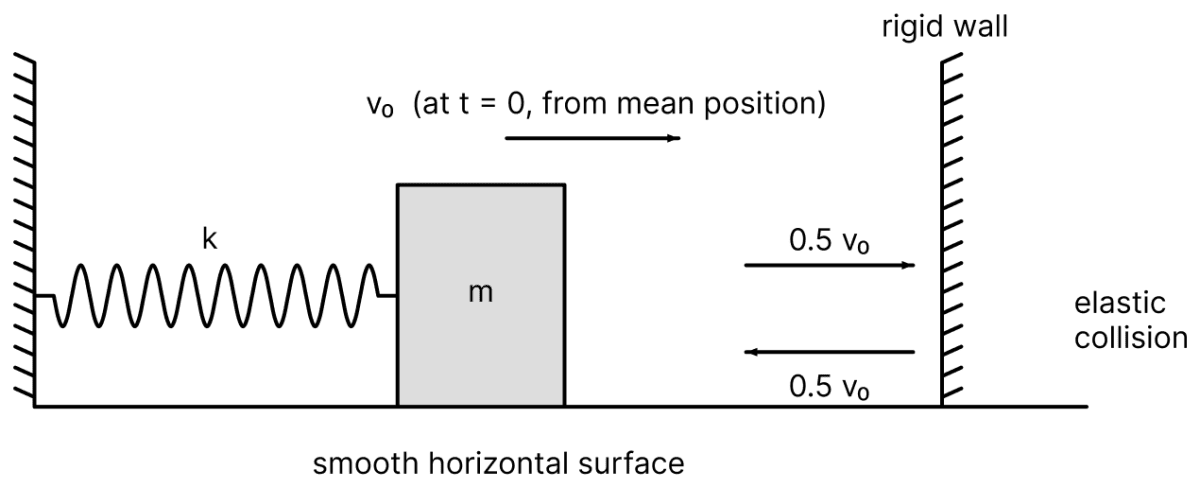
A particle of mass m is attached to one end of a massless spring of force constant k, lying on a frictionless horizontal plane. The other end of the spring is fixed. The particle starts moving horizontally from its equilibrium position at time t = 0 with an initial velocity v0. When the speed of the particle is 0.5 v0, it collides elastically with a rigid wall. After this collision :
the speed of the particle when it returns to its equilibrium position is v0
the time at which the particle passes through the equilibrium position for the first time is t=πkm
the time at which the maximum compression of the spring occurs is t=34πkm
the time at which the particle passes through the equilibrium position for the second time is t=35πkm
Answer
Options 1 and 4
Since the particle starts from the equilibrium position, its displacement is
x=asinωt⇒v=aωcosωt=v0cosωt
Checking option 1 : The collision with the rigid wall is elastic, so no mechanical energy is lost. Hence, when the particle returns to its equilibrium position it again has the full speed v0. Option 1 is correct.
Time of collision : At the instant of collision the speed is 0.5 v0,
2v0=v0cosωt1⇒cosωt1=21⇒ωt1=3π⇒t1=3ωπ
Checking option 2 : After the elastic collision the particle retraces its path, so it returns to the equilibrium position after a further time t1. Hence
t2=2t1=3ω2π=32π×2π1T=32πkm
using ω=mk. This is not πkm, so option 2 is incorrect.
Checking option 3 : After crossing the equilibrium position, the spring is compressed and the compression is maximum a quarter of a period later,
t3=t2+4T=32πkm+42πkm=67πkm
This is not 34πkm, so option 3 is incorrect.
Checking option 4 : The particle passes the equilibrium position for the second time a further quarter period later,
t4=t3+4T=67πkm+42πkm=35πkm
Option 4 is correct.
Hence, options 1 and 4 are correct.
Question 15
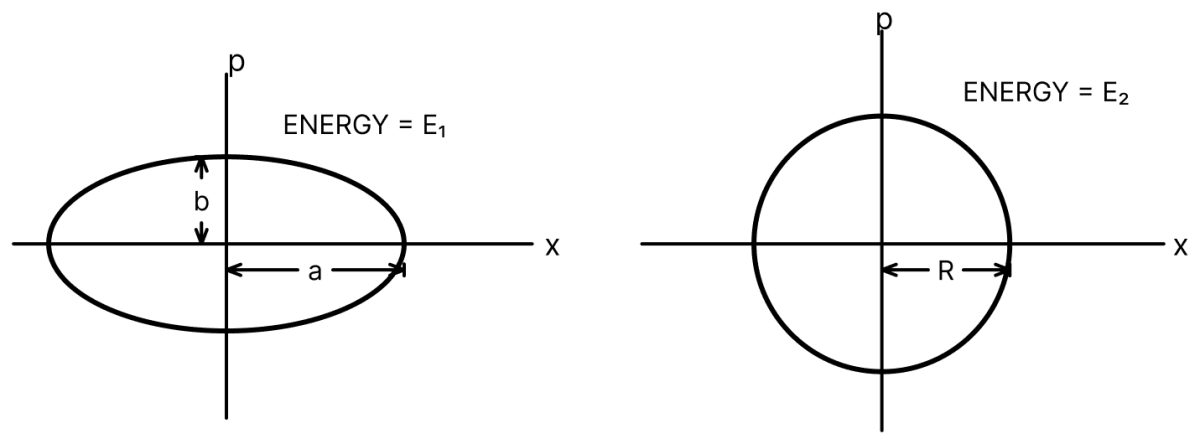
Two independent harmonic oscillators of equal mass are oscillating about the origin with angular frequencies ω1 and ω2 and have total energies E1 and E2, respectively. Then variations of their momenta p with positions x are shown in the figures. If ba=n2 and Ra=n, then the correct equations are :
E1ω1 = E2ω2
ω1ω2=n2
ω1ω2 = n2
ω1E1=ω2E2
Answer
Options 2 and 4
Given,
ba=n2 and Ra=n
Both oscillators have the same mass m
From the figures, the first oscillator gives an ellipse with semi-axes a (along x) and b (along p), while the second gives a circle of radius R.
First oscillator : The amplitude is a and the maximum momentum is b, so
p1=maω1=b…(i)
Second oscillator : The amplitude is R and the maximum momentum is also R, so
p2=mRω2=R⇒mω2=1…(ii)
From equation (i), ab=mω1. Dividing this by equation (ii),
ω2ω1=ab=n21⇒ω1ω2=n2
Hence option 2 is correct.
Total energies : For a harmonic oscillator of mass m, amplitude A and angular frequency ω, the total energy is E=21mω2A2. Therefore
E1=21mω12a2andE2=21mω22R2
Dividing,
E2E1=ω22ω12×(Ra)2=ω22ω12×n2
Substituting n2=ω1ω2,
E2E1=ω22ω12×ω1ω2=ω2ω1
ω1E1=ω2E2
Hence options 2 and 4 are correct.
Question 16
(i) Time period of a particle in S.H.M. depends on the force-constant k and mass m of the particle : T=2πkm. A simple pendulum executes S.H.M. approximately. Why then is the time period of a pendulum independent of the mass of the pendulum?
(ii) The motion of a simple pendulum is approximately simple harmonic for small angles of oscillation. For larger angles of oscillation, T is worked out to be greater than 2πgl. Explain this result.
(iii) A man with a wrist watch on his hand falls from the top of a tower. Does the watch give correct time during the free fall?
(iv) What is the frequency of oscillation of a simple pendulum mounted in a cabin that is falling freely under gravity?
Answer
(i) In the case of a simple pendulum, the restoring force acting on the bob is
F=−(lmg)x=−kx
so the force-constant is k=lmg. Substituting this value in the relation T=2πkm,
T=2πmg/lm=2πgl
The mass m cancels out, because for a pendulum the force-constant itself is proportional to the mass. Hence the time period of a pendulum does not depend upon the mass of its bob.
(ii) For larger angles θ of oscillation, the restoring force on the bob of a simple pendulum is
F=−mgsinθ=−mge′
where ge′ (= g sin θ) is the effective value of g. For a small angle we take sin θ ≈ θ, so the effective value is ge = gθ.
But sin θ < θ for every value of θ. Therefore
ge′<ge
that is, the effective value of g decreases for a larger value of θ. Since T=2πgl, a reduction in g implies an increase in T. Hence for larger angles the time period is greater than 2πgl.
(iii) Yes, the wrist watch gives correct time during the free fall. The reason is that a wrist watch works on spring action; it has nothing to do with the acceleration due to gravity.
(iv) In free fall the effective value of the acceleration due to gravity becomes zero, that is, g = 0. Hence the frequency of oscillation of the simple pendulum,
n=2π1lg
becomes zero. The pendulum does not oscillate at all.
Question 17
Show that for a particle in linear S.H.M., the average kinetic energy over a period of oscillation is equal to the average potential energy over the same period.
Answer
Let a particle of mass m perform S.H.M. with time period T and angular frequency ω(=T2π). Its instantaneous displacement from the mean position is
y=asinωt
The instantaneous kinetic energy and potential energy are
Hence, for a particle in linear S.H.M. the average kinetic energy over a period of oscillation is equal to the average potential energy over the same period, each being one-half of the total energy.
Question 18
A circular disc of mass 10 kg is suspended by a wire attached to its centre. The wire is twisted by rotating the disc and released. The period of torsional oscillation is found to be 1.5 s. The radius of the disc is 15 cm. Determine the torsional spring constant (torsional rigidity) of the wire.
Answer
Given,
Mass of the disc, M = 10 kg
Radius of the disc, R = 15 cm = 0.15 m
Period of torsional oscillation, T = 1.5 s
The torsional oscillations of the disc are angular simple harmonic oscillations, whose time period is given by
T=2πcI
where I is the moment of inertia of the disc about the wire as axis and c is the torsional rigidity of the wire.
The moment of inertia of a circular disc about an axis passing through its centre and perpendicular to its plane is
Hence, the torsional spring constant of the wire is 1.97 N m.
Question 19
A body describes simple harmonic motion with an amplitude of 5 cm and a period of 0.2 s. Find the acceleration and velocity of the body when the displacement is (i) 5 cm, (ii) 3 cm, (iii) 0 cm.
Answer
Given,
Amplitude, a = 5 cm = 0.05 m
Time period, T = 0.2 s
The angular frequency of the motion is
ω=T2π=0.2s2π=10πs−1
For a body in S.H.M. at displacement y, the acceleration and the velocity are
Hence, at y = 5 cm the acceleration is − 5π2 m s-2 and the velocity is zero; at y = 3 cm the acceleration is − 3π2 m s-2 and the velocity is 0.4π m s-1; and at y = 0 the acceleration is zero and the velocity is 0.5π m s-1.
Note: The velocity at the mean position is printed in the textbook as 0.05π m s-1. Substituting ω = 10π s-1 and a = 0.05 m in u = ωa gives 0.5π m s-1, so the printed value carries a decimal-place slip.
Question 20
A mass attached to a spring is free to oscillate, with angular velocity ω in a horizontal plane without friction. It is pulled to a distance x0 and pushed towards the centre with a velocity v0 at time t = 0. Determine the amplitude of the resulting oscillation in terms of the parameters ω, x0 and v0.
Answer
Given,
Initial displacement at t = 0 = x0
Initial velocity at t = 0 = v0
Angular velocity of the oscillation = ω
Let the general equation for the displacement of the mass be
x=acos(ωt+θ)
where a is the amplitude and θ the initial phase. Differentiating with respect to time, the velocity of the particle is
v=dtdx=−aωsin(ωt+θ)
At t = 0, x = x0 and v = v0. Therefore,
x0=acosθ⇒ax0=cosθ…(i)
v0=−aωsinθ⇒aωv0=−sinθ…(ii)
Squaring and adding equations (i) and (ii), and using sin2θ + cos2θ = 1,
(ax0)2+(aωv0)2=1
a2=x02+(ωv0)2
a=x02+(ωv0)2
Hence, the amplitude of the resulting oscillation is a=x02+(ωv0)2.
Question 21
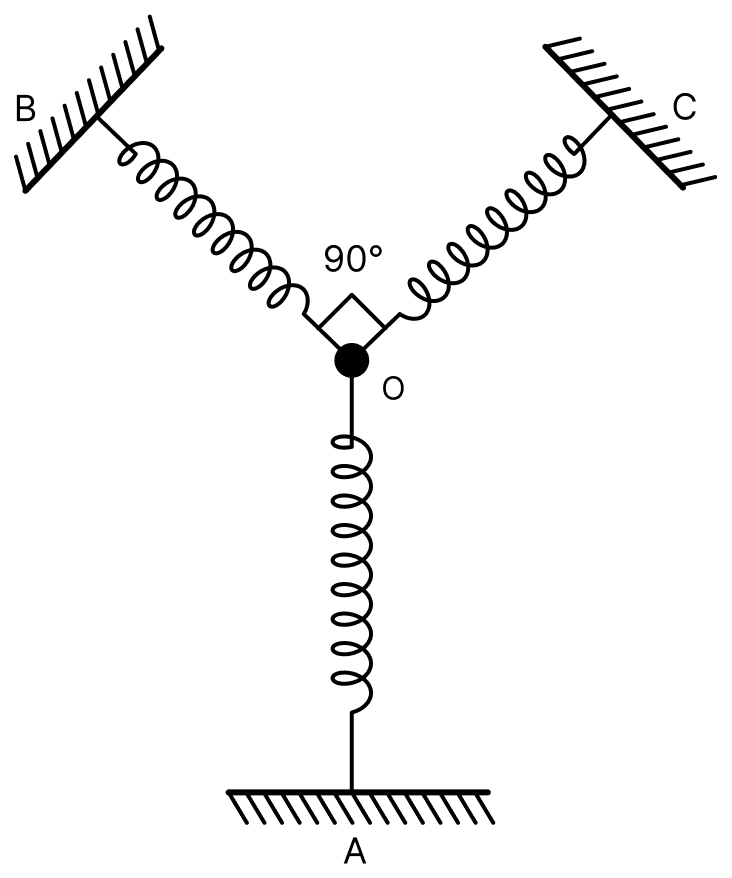
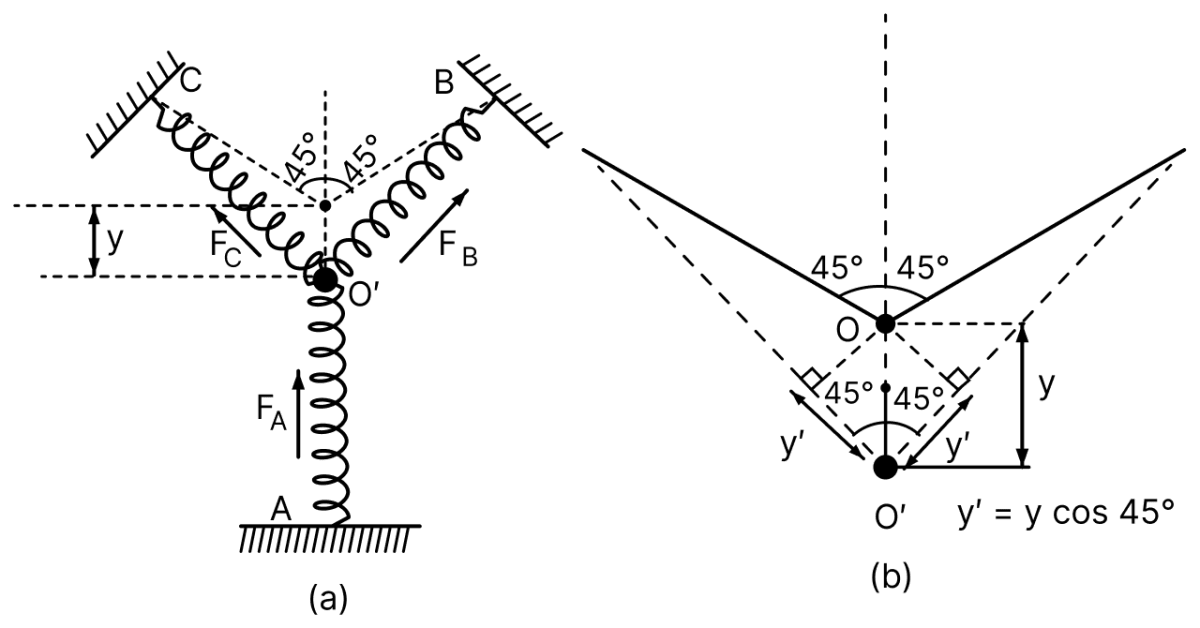
A particle of mass m placed on smooth horizontal surface is attached to three identical springs A, B and C each of force constant k as shown in the figure. If the particle of mass m is pushed slightly against the spring A and released, find the time period of oscillation.
Answer
Given,
Mass of the particle = m
Force-constant of each of the three springs = k
The springs B and C are inclined at 45° on either side of the line of the spring A
Let the particle at O be pushed through a small distance y in the direction of the spring A. Then the spring A is compressed by y, while the springs B and C are each stretched by
y′=ycos45°
The restoring forces due to B and C act along their own lengths; their components along the line OA are FB cos 45° and FC cos 45°. Hence the total restoring force acting on m along AO is
F=−(FA+FBcos45°+FCcos45°)
=−(ky+ky′cos45°+ky′cos45°)=−(ky+2ky′cos45°)
Substituting y′ = y cos 45°,
F=−{ky+2k(ycos45°)cos45°}=−{ky+2ky(21)(21)}
F=−(ky+ky)=−2ky
By Newton's second law of motion, F = mα, so
mα=−2ky⇒α=−(m2k)y
Since α ∝ − y, the motion of the particle is simple harmonic. Comparing with α = − ω2y,
ω2=m2k
The time period of oscillation is
T=ω2π=2π2km
Hence, the time period of oscillation of the particle is T=2π2km.