
In simple harmonic motion, the acceleration is always:
- constant
- in the direction of motion
- opposite to the direction of velocity
- zero.
Answer
opposite to the direction of velocity
Reason — In S.H.M. the acceleration is given by α = − ω2y, so it is always directed towards the mean position and opposite to the displacement. Its magnitude changes with displacement, so it is not constant, and it is zero only at the mean position. Among the given options, only the third one describes a directional property of the acceleration in S.H.M.
Note: Strictly, the acceleration in S.H.M. is always directed towards the mean position, that is, opposite to the displacement. It is opposite to the velocity only while the particle moves from the mean position towards an extreme position; while returning from the extreme position to the mean position the two are in the same direction. Option 3 is the intended answer as the other three options are definitely incorrect.
A periodic function is one that:
- repeats itself at regular intervals of time
- changes its frequency with time
- decreases in amplitude continuously
- is non-repetitive.
Answer
repeats itself at regular intervals of time
Reason — A function f(t) is said to be periodic if it repeats its values at regular intervals of the independent variable, that is,
where T is called the period of the function. Sine and cosine functions of fixed time period are the simplest examples of periodic functions.
The time period of a simple pendulum is independent of:
- length of the pendulum
- mass of the bob
- acceleration due to gravity
- amplitude of oscillation.
Answer
mass of the bob
Reason — The periodic-time of a simple pendulum is
This formula does not contain m. Hence the periodic-time of the pendulum does not depend upon the mass of the bob. It does depend on the effective length l and on the acceleration due to gravity g.
The angular frequency (ω) of a body executing S.H.M. is related to its time period (T) by:
ω = 2πT
Answer
Reason — The angular frequency of an oscillation represents how rapidly the phase of oscillation changes with time. In one complete oscillation the phase changes by 2π radian in a time T, so
Its SI unit is radian per second (rad s-1).
The time period of a spring-mass system is given by:
T = 2πmk
Answer
Reason — For a body of mass m attached to a spring of force-constant k, the restoring force is F = − kx, so the acceleration is . Comparing with α = − ω2x gives , and therefore
The restoring force in a simple harmonic oscillator is directly proportional to:
- displacement
- velocity
- time
- acceleration.
Answer
displacement
Reason — A particle is said to execute simple harmonic motion if it moves to and fro along the same straight line about a mean position under the action of a restoring force which is directly proportional to its displacement from the mean position and is directed always towards the mean position,
Here k is the force-constant, defined as restoring force per unit displacement.
A function that repeats itself after every 2π radians is:
- sinusoidal
- exponential
- linear
- quadratic.
Answer
sinusoidal
Reason — Sine and cosine functions satisfy sin (θ + 2π) = sin θ and cos (θ + 2π) = cos θ, so they repeat themselves after every 2π radian. Exponential, linear and quadratic functions do not repeat their values at regular intervals and are therefore non-periodic.
The frequency of oscillation of a simple pendulum depends on:
- the length of the string
- the mass of the bob
- both 1 and 2
- none of the above.
Answer
the length of the string
Reason — The frequency of a simple pendulum is the reciprocal of its periodic-time,
It depends upon the effective length l of the pendulum and on the acceleration due to gravity g, but not upon the mass of the bob.
The equation of position for a particle in S.H.M. is given by y(t) = A sin(ωt + φ). What does the phase constant φ represent?
- The maximum displacement of the particle
- The initial phase of the particle
- The angular frequency of the particle
- The time period of the particle.
Answer
The initial phase of the particle
Reason — In the equation y(t) = A sin (ωt + φ), the quantity φ is the value of the phase of the oscillation at time t = 0. It is therefore called the initial phase or epoch. It tells us the initial state of motion, that is, the position of the oscillating particle and its direction of motion when observation begins. Here A is the amplitude and ω the angular frequency.
The velocity in S.H.M. is maximum when the displacement is:
- zero
- maximum
- half of amplitude
- between mean and extreme positions.
Answer
zero
Reason — The velocity of a particle in S.H.M. at displacement y is
This is maximum when y = 0, that is, when the particle passes through its equilibrium position, where umax = aω. At the maximum displacement (y = a) the velocity is zero.
In the motion of a mass connected to a horizontal spring, the force acting on the mass is proportional to:
- displacement
- velocity
- acceleration
- time.
Answer
displacement
Reason — When the body attached to a light horizontal spring is displaced through a small distance x, the spring exerts a restoring force on it given by Hooke's law,
where k is the force-constant of the spring. The negative sign indicates that the force F acts opposite to the displacement.
In S.H.M., the phase difference between displacement and acceleration is:
- 0
- radian
- π radian
- 2π radian.
Answer
π radian
Reason — If the displacement is y = a sin ωt, then the acceleration is
Thus the acceleration is always directed opposite to the displacement, so the two are 180° (π radian) out of phase.
If the amplitude of a simple harmonic oscillator is doubled, the time period:
- remains unchanged
- is doubled
- is halved
- becomes four times.
Answer
remains unchanged
Reason — The time period of S.H.M. is determined only by the inertia factor and the spring factor of the system, as in . The amplitude does not appear in this expression, so the time period of S.H.M. is independent of the amplitude of oscillation.
A pendulum has maximum speed at:
- the highest point
- the mean position
- halfway between mean and extreme points
- the lowest point.
Answer
the mean position
Reason — In S.H.M. the speed is , which is greatest where y = 0. For a pendulum this mean position is the lowest point of the swing, at which the whole of the energy is in the form of kinetic energy and the potential energy is zero.
Note: For a simple pendulum the mean position is the lowest point of the swing, so options 2 and 4 name the same position. Option 2 is the answer because 'mean position' is the general term used for S.H.M., the lowest point being its particular form for a pendulum.
The energy of a simple harmonic oscillator is:
- constant
- varies with time
- maximum at the extreme position
- zero at the mean position.
Answer
constant
Reason — The total energy of a body in S.H.M. is
The displacement y has cancelled out, so the total energy remains the same during the motion of the body. The potential energy and kinetic energy change continuously, but their sum is constant.
The acceleration of a particle executing S.H.M. is zero when the particle is at:
- the mean position
- the extreme position
- midway between the mean and extreme position
- any point in its path.
Answer
the mean position
Reason — The acceleration in S.H.M. is α = − ω2y. It is therefore zero when y = 0, that is, at the mean position, where the velocity is maximum. The acceleration is maximum in the position of maximum displacement.
In a vertical spring-mass system, the equilibrium position is determined by:
- the mass of the object
- the spring constant
- both 1 and 2
- neither 1 nor 2.
Answer
both 1 and 2
Reason — In the equilibrium position of a body of mass m hanging from a spring of force-constant k, the weight of the body is balanced by the restoring force of the stretched spring,
Hence the extension l which fixes the equilibrium position depends upon both the mass of the object and the spring constant.
The kinetic energy in S.H.M. is maximum at:
- mean position
- extreme position
- halfway between mean and extreme position
- at any random point.
Answer
mean position
Reason — The kinetic energy of a body in S.H.M. at displacement y is
Clearly K decreases with increase of displacement y, and is maximum in the equilibrium position, where y = 0, its value being .
A particle moves in S.H.M. with a frequency f. Its maximum velocity is proportional to:
f2
f
Answer
f
Reason — The maximum velocity of a particle in S.H.M. occurs at the mean position and is given by
For a given amplitude a, the quantity 2πa is a constant. Hence umax ∝ f.
Which of the following is not an example of simple harmonic motion?
- Motion of a simple pendulum
- Motion of a mass on a spring
- Circular motion of a car on a track
- Vibration of a tuning fork.
Answer
Circular motion of a car on a track
Reason — For linear S.H.M. the motion of the particle must be in a straight line, to and fro about a fixed point, under a restoring force proportional to the displacement. The circular motion of a car on a track is not a to and fro motion along a straight line, so it is not simple harmonic, although it is periodic. The other three are standard examples of S.H.M.
A function is non-periodic if:
- it repeats after a regular interval
- it never repeats itself
- it repeats after an irregular interval
- it repeats with decreasing amplitude.
Answer
it never repeats itself
Reason — Non-periodic functions are functions that do not repeat their values at regular intervals, that is, they do not satisfy the condition F(t) = F(t + T) for all t. A classic example is the exponential function F(t) = et, which never repeats itself.
A simple pendulum is brought from the surface of Earth to the surface of moon. Its time period will:
- increase
- decrease
- remain the same
- become zero.
Answer
increase
Reason — The periodic-time of a simple pendulum is inversely proportional to the square-root of the acceleration due to gravity,
On the moon's surface the value of g is th of that on the earth's surface. A smaller g therefore gives a larger T, so the pendulum oscillates more slowly on the moon.
Which of the following is an example of a non-periodic motion?
- Motion of a simple pendulum
- Vibrations of a guitar string
- A ball dropped from a height
- Oscillations of a tuning fork.
Answer
A ball dropped from a height
Reason — A motion is said to be periodic if it repeats itself at regular intervals of time. The motion of a ball dropped from a height is non-repetitive, since the ball does not return to its starting point after a fixed interval. The remaining three are oscillatory, and hence periodic, motions.
A mass attached to a spring undergoes S.H.M. If the mass is doubled, the new time period becomes:
- times the original time period
- half the original time period
- twice the original time period
- unchanged.
Answer
times the original time period
Reason — The time period of a spring-mass system is
If the mass is doubled while the same spring is used,
The displacement of a particle in S.H.M. is given by y(t) = A cos ωt. The velocity of the particle is:
- − Aω cos ωt
- Aω sin ωt
- − Aω sin ωt
- A cos ωt.
Answer
− Aω sin ωt
Reason — Velocity is the derivative of displacement with respect to time. Differentiating y = A cos ωt,
A pendulum makes 30 complete oscillations in 1 minute. The frequency of oscillation is:
- 0.5 Hz
- 1 Hz
- 2 Hz
- 30 Hz.
Answer
0.5 Hz
Reason — Frequency is the number of complete oscillations completed per unit time,
In S.H.M., the phase difference between displacement and velocity is:
- 0
- π
- 2π
Answer
Reason — If the displacement is y = a sin ωt, then the velocity is
Hence the displacement and the velocity are 90°, that is, radian, out of phase.
If the potential energy in S.H.M. is , then the force acting on the particle is:
ky2
− ky
Answer
− ky
Reason — The restoring force is obtained from the potential energy as the negative of its gradient,
The negative sign shows that the force is directed opposite to the displacement, towards the mean position.
A particle is undergoing S.H.M. with amplitude A. The ratio of kinetic energy to potential energy when the displacement is is:
- 1 : 1
- 1 : 3
- 3 : 1
- 1 : 2.
Answer
3 : 1
Reason — At a displacement y, the kinetic energy and the potential energy are
Substituting ,
Hence at the kinetic energy is 3 times the potential energy.
A particle in S.H.M. crosses the mean position 12 times in 4 seconds. The frequency of oscillation is:
- 6 Hz
- 1.5 Hz
- 2 Hz
- 12 Hz.
Answer
1.5 Hz
Reason — In one complete oscillation a particle crosses the mean position twice, once while moving in one direction and again while moving back. Hence the number of oscillations completed in 4 seconds is
Therefore the frequency of oscillation is
Assertion (A): A particle in S.H.M. experiences maximum acceleration when it is at its extreme position.
Reason (R): The acceleration in S.H.M. is directly proportional to displacement and acts in the opposite direction.
- If both assertion and reason are true and reason is the correct explanation of assertion.
- If both assertion and reason are true but reason is not the correct explanation of assertion.
- If assertion is true but reason is false.
- If assertion is false but reason is true.
- If assertion and reason both are false.
Answer
If both assertion and reason are true and reason is the correct explanation of assertion.
Explanation
Assertion (A) is correct: In S.H.M. the acceleration is α = − ω2y. At the extreme position the displacement has its maximum value y = a, so the acceleration attains its maximum magnitude αmax = ω2a.
Reason (R) is also correct: The acceleration in S.H.M. is directly proportional to the displacement from the mean position and is directed opposite to it, towards the mean position.
Since the acceleration is proportional to the displacement, it must be greatest where the displacement is greatest, that is, at the extreme position. The Reason therefore explains the Assertion.
Therefore, both assertion and reason are true and reason is the correct explanation of assertion.
Assertion (A): The total mechanical energy of a particle in S.H.M. remains constant.
Reason (R): In S.H.M., potential energy and kinetic energy are continuously interchanged while the total energy remains the same.
- If both assertion and reason are true and reason is the correct explanation of assertion.
- If both assertion and reason are true but reason is not the correct explanation of assertion.
- If assertion is true but reason is false.
- If assertion is false but reason is true.
- If assertion and reason both are false.
Answer
If both assertion and reason are true and reason is the correct explanation of assertion.
Explanation
Assertion (A) is correct: Adding the potential energy and the kinetic energy of a body in S.H.M.,
The displacement y cancels out, so the total energy is free from the displacement and remains the same during the motion.
Reason (R) is also correct: During oscillation the two energies convert into each other continuously — the potential energy is maximum at the extreme position and the kinetic energy is maximum at the mean position — but their sum stays the same.
The continuous interchange of the two forms of energy, with no loss to friction, is precisely why the total remains constant. The Reason therefore explains the Assertion.
Therefore, both assertion and reason are true and reason is the correct explanation of assertion.
Assertion (A): The time period of a simple pendulum is directly proportional to the square root of its length.
Reason (R): The time period of a pendulum depends on its mass and amplitude of oscillation.
- If both assertion and reason are true and reason is the correct explanation of assertion.
- If both assertion and reason are true but reason is not the correct explanation of assertion.
- If assertion is true but reason is false.
- If assertion is false but reason is true.
- If assertion and reason both are false.
Answer
If assertion is true but reason is false.
Explanation
Assertion (A) is correct: From , at a given place g is constant, so the periodic-time of a pendulum is directly proportional to the square-root of its effective length l.
Reason (R) is incorrect: The formula for the periodic-time does not contain the mass of the bob, so T is independent of the mass. It is also independent of the amplitude, provided the amplitude is small.
Therefore, assertion is true but reason is false.
Assertion (A): In S.H.M., the velocity of the particle is zero at the extreme position.
Reason (R): The kinetic energy of the particle is zero at the extreme position.
- If both assertion and reason are true and reason is the correct explanation of assertion.
- If both assertion and reason are true but reason is not the correct explanation of assertion.
- If assertion is true but reason is false.
- If assertion is false but reason is true.
- If assertion and reason both are false.
Answer
If both assertion and reason are true and reason is the correct explanation of assertion.
Explanation
Assertion (A) is correct: The velocity of a particle in S.H.M. is . At the extreme position y = a, so u = 0.
Reason (R) is also correct: The kinetic energy at displacement y is , which becomes zero at y = a. At the extreme position the whole of the energy is in the form of potential energy.
Since , the kinetic energy being zero requires the velocity also to be zero. The Reason therefore explains the Assertion.
Therefore, both assertion and reason are true and reason is the correct explanation of assertion.
Assertion (A): In a mass-spring system, the time-period increases if the mass is doubled.
Reason (R): The time period of oscillation is directly proportional to the square root of the mass in the system.
- If both assertion and reason are true and reason is the correct explanation of assertion.
- If both assertion and reason are true but reason is not the correct explanation of assertion.
- If assertion is true but reason is false.
- If assertion is false but reason is true.
- If assertion and reason both are false.
Answer
If both assertion and reason are true and reason is the correct explanation of assertion.
Explanation
Assertion (A) is correct: From , doubling the mass with the same spring gives , so the time-period increases.
Reason (R) is also correct: For a given spring, k is constant, so , that is, the time period is directly proportional to the square-root of the mass.
This proportionality is exactly what makes the time-period increase when the mass is doubled. The Reason therefore explains the Assertion.
Therefore, both assertion and reason are true and reason is the correct explanation of assertion.
Assertion (A): For a simple pendulum, the restoring force is directly proportional to the displacement from the mean position.
Reason (R): The restoring force in a simple pendulum is proportional to the acceleration due to gravity.
- If both assertion and reason are true and reason is the correct explanation of assertion.
- If both assertion and reason are true but reason is not the correct explanation of assertion.
- If assertion is true but reason is false.
- If assertion is false but reason is true.
- If assertion and reason both are false.
Answer
If both assertion and reason are true but reason is not the correct explanation of assertion.
Explanation
Assertion (A) is correct: For small angular displacement θ of the bob, sin θ ≈ θ = , so the restoring force is
which is directly proportional to the displacement x.
Reason (R) is also correct: The above expression also contains g, so the restoring force is proportional to the acceleration due to gravity.
However, the proportionality of F to displacement follows from the small-angle approximation sin θ ≈ θ, not from the presence of g. The Reason states a separate fact and does not explain the Assertion.
Therefore, both assertion and reason are true but reason is not the correct explanation of assertion.
Assertion (A): A particle moving in S.H.M., has maximum speed when passing through the equilibrium position.
Reason (R): The potential energy is maximum at the equilibrium position.
- If both assertion and reason are true and reason is the correct explanation of assertion.
- If both assertion and reason are true but reason is not the correct explanation of assertion.
- If assertion is true but reason is false.
- If assertion is false but reason is true.
- If assertion and reason both are false.
Answer
If assertion is true but reason is false.
Explanation
Assertion (A) is correct: From , the speed is greatest at y = 0, that is, at the equilibrium position, where umax = aω.
Reason (R) is incorrect: The potential energy is zero at the equilibrium position. It is the kinetic energy, and not the potential energy, that is maximum there.
Therefore, assertion is true but reason is false.
Assertion (A): The motion of a mass-spring system in a vertical plane is independent of the force of gravity.
Reason (R): The gravitational force only affects the equilibrium position, not the time period of oscillation.
- If both assertion and reason are true and reason is the correct explanation of assertion.
- If both assertion and reason are true but reason is not the correct explanation of assertion.
- If assertion is true but reason is false.
- If assertion is false but reason is true.
- If assertion and reason both are false.
Answer
If both assertion and reason are true and reason is the correct explanation of assertion.
Explanation
Assertion (A) is correct: For a body of mass m hanging from a spring, the weight mg is balanced by the restoring force kl at the equilibrium position, so the net force on the body when displaced through y is F″ = − ky. Gravity therefore drops out of the equation of motion, and contains no g.
Reason (R) is also correct: The only effect of the weight is to stretch the spring by , which shifts the equilibrium position downward. It does not enter the expression for the time period.
Since gravity only relocates the mean position and cancels out of the restoring force, the oscillation itself is unaffected by it. The Reason therefore explains the Assertion.
Therefore, both assertion and reason are true and reason is the correct explanation of assertion.
Assertion (A): The phase difference between displacement and acceleration in S.H.M. is π.
Reason (R): In S.H.M., acceleration is always directed opposite to displacement.
- If both assertion and reason are true and reason is the correct explanation of assertion.
- If both assertion and reason are true but reason is not the correct explanation of assertion.
- If assertion is true but reason is false.
- If assertion is false but reason is true.
- If assertion and reason both are false.
Answer
If both assertion and reason are true and reason is the correct explanation of assertion.
Explanation
Assertion (A) is correct: For y = a sin ωt, the acceleration is α = − aω2 sin ωt = aω2 sin (ωt + π), so the displacement and the acceleration differ in phase by π radian.
Reason (R) is also correct: In S.H.M. α = − ω2y, so the acceleration always points opposite to the displacement, towards the mean position.
Two quantities that are always opposite in direction and vary with the same frequency are exactly π radian out of phase. The Reason therefore explains the Assertion.
Therefore, both assertion and reason are true and reason is the correct explanation of assertion.
Assertion (A): The time period of a simple pendulum decreases with increasing gravitational acceleration.
Reason (R): Time period .
- If both assertion and reason are true and reason is the correct explanation of assertion.
- If both assertion and reason are true but reason is not the correct explanation of assertion.
- If assertion is true but reason is false.
- If assertion is false but reason is true.
- If assertion and reason both are false.
Answer
If both assertion and reason are true and reason is the correct explanation of assertion.
Explanation
Assertion (A) is correct: The periodic-time of a simple pendulum is inversely proportional to the square-root of the acceleration due to gravity, so an increase in g decreases T.
Reason (R) is also correct: The time period of a simple pendulum is indeed given by .
Since g appears in the denominator under the square-root, the formula itself displays the inverse relation stated in the Assertion. The Reason therefore explains the Assertion.
Therefore, both assertion and reason are true and reason is the correct explanation of assertion.
Assertion (A): In S.H.M., if the amplitude is doubled, the maximum velocity of the particle also doubles.
Reason (R): The maximum velocity in S.H.M. is proportional to the square of the amplitude.
- If both assertion and reason are true and reason is the correct explanation of assertion.
- If both assertion and reason are true but reason is not the correct explanation of assertion.
- If assertion is true but reason is false.
- If assertion is false but reason is true.
- If assertion and reason both are false.
Answer
If assertion is true but reason is false.
Explanation
Assertion (A) is correct: The maximum velocity in S.H.M. is umax = aω. For a given system ω is fixed, so doubling the amplitude a doubles umax.
Reason (R) is incorrect: The maximum velocity is directly proportional to the first power of the amplitude, and not to its square.
Therefore, assertion is true but reason is false.
Assertion (A): In S.H.M., the potential energy is maximum at the equilibrium position.
Reason (R): Potential energy is a function of displacement and is maximum at the maximum displacement from the mean position.
- If both assertion and reason are true and reason is the correct explanation of assertion.
- If both assertion and reason are true but reason is not the correct explanation of assertion.
- If assertion is true but reason is false.
- If assertion is false but reason is true.
- If assertion and reason both are false.
Answer
If assertion is false but reason is true.
Explanation
Assertion (A) is incorrect: The potential energy is zero at the equilibrium position (y = 0), not maximum. It is maximum at the extreme positions.
Reason (R) is correct: The potential energy increases with increase of displacement y and attains its maximum value in the extreme position of oscillation, where y = a.
Therefore, assertion is false but reason is true.
Assertion (A): A mass-spring system oscillates with a higher frequency on the Moon than on Earth.
Reason (R): The gravitational acceleration on the Moon is less than on Earth.
- If both assertion and reason are true and reason is the correct explanation of assertion.
- If both assertion and reason are true but reason is not the correct explanation of assertion.
- If assertion is true but reason is false.
- If assertion is false but reason is true.
- If assertion and reason both are false.
Answer
If assertion is false but reason is true.
Explanation
Assertion (A) is incorrect: The frequency of a mass-spring system is , which contains no g. Hence the frequency is the same on the Moon as on the Earth.
Reason (R) is correct: The acceleration due to gravity on the Moon's surface is th of that on the Earth's surface, so it is indeed less.
Therefore, assertion is false but reason is true.
Assertion (A): The displacement-time graph of a particle in S.H.M. is sinusoidal.
Reason (R): The displacement in S.H.M. varies as a sine or cosine function of time.
- If both assertion and reason are true and reason is the correct explanation of assertion.
- If both assertion and reason are true but reason is not the correct explanation of assertion.
- If assertion is true but reason is false.
- If assertion is false but reason is true.
- If assertion and reason both are false.
Answer
If both assertion and reason are true and reason is the correct explanation of assertion.
Explanation
Assertion (A) is correct: On plotting t along the X-axis and the corresponding values of y along the Y-axis, the displacement curve obtained for S.H.M. is the 'sine curve'.
Reason (R) is also correct: The displacement of a particle in S.H.M. is , which is a sine function of time; if the motion is timed from an extreme position it becomes a cosine function.
Since the displacement is itself a sine or cosine function of time, its graph must have the sinusoidal shape. The Reason therefore explains the Assertion.
Therefore, both assertion and reason are true and reason is the correct explanation of assertion.
Assertion (A): The time period of a simple pendulum depends on the mass of the bob.
Reason (R): The time period of a simple pendulum is given by .
- If both assertion and reason are true and reason is the correct explanation of assertion.
- If both assertion and reason are true but reason is not the correct explanation of assertion.
- If assertion is true but reason is false.
- If assertion is false but reason is true.
- If assertion and reason both are false.
Answer
If assertion is false but reason is true.
Explanation
Assertion (A) is incorrect: The periodic-time of a pendulum does not depend upon the mass of the bob. If a girl is swinging on a swing and another girl is seated with her on the swing, then the periodic-time of the swing would not change.
Reason (R) is correct: The formula is the standard expression for the periodic-time of a simple pendulum, and it clearly does not contain m.
Therefore, assertion is false but reason is true.
Assertion (A): The frequency of oscillation in a spring-mass system is independent of the spring constant.
Reason (R): The frequency of oscillation is inversely proportional to the square root of the mass.
- If both assertion and reason are true and reason is the correct explanation of assertion.
- If both assertion and reason are true but reason is not the correct explanation of assertion.
- If assertion is true but reason is false.
- If assertion is false but reason is true.
- If assertion and reason both are false.
Answer
If assertion and reason both are false.
Explanation
Assertion (A) is incorrect: The frequency of a spring-mass system is
which contains k. The frequency therefore depends on the spring constant, increasing as the spring is made stiffer.
Reason (R) is treated as incorrect in the textbook, on the ground that the frequency depends on both the spring constant and the mass, and cannot be described by the mass alone.
Therefore, assertion and reason both are false.
Note: Read strictly, Reason (R) is a correct statement, since for a given spring k is a constant and . On that reading the answer would be option 4. The textbook answer key marks option 5, treating (R) as an incomplete and hence unacceptable statement of the dependence of frequency.
Assertion (A): A simple pendulum has a larger time period at the higher altitudes.
Reason (R): The value of gravitational acceleration decreases at higher altitudes.
- If both assertion and reason are true and reason is the correct explanation of assertion.
- If both assertion and reason are true but reason is not the correct explanation of assertion.
- If assertion is true but reason is false.
- If assertion is false but reason is true.
- If assertion and reason both are false.
Answer
If both assertion and reason are true and reason is the correct explanation of assertion.
Explanation
Assertion (A) is correct: When a pendulum-clock is taken up to a hill, its periodic-time increases, that is, the clock is slowed down.
Reason (R) is also correct: The value of the acceleration due to gravity g decreases as we go to higher altitudes.
Since , the periodic-time is inversely proportional to the square-root of g, so a smaller g at higher altitudes gives a larger T. The Reason therefore explains the Assertion.
Therefore, both assertion and reason are true and reason is the correct explanation of assertion.
Assertion (A): The total mechanical energy in S.H.M. is proportional to the square of the amplitude.
Reason (R): In S.H.M., the total energy is the sum of kinetic and potential energies, and both depend on the square of displacement.
- If both assertion and reason are true and reason is the correct explanation of assertion.
- If both assertion and reason are true but reason is not the correct explanation of assertion.
- If assertion is true but reason is false.
- If assertion is false but reason is true.
- If assertion and reason both are false.
Answer
If both assertion and reason are true and reason is the correct explanation of assertion.
Explanation
Assertion (A) is correct: The total energy of a body in S.H.M. is , so E ∝ a2.
Reason (R) is also correct: Adding the two forms of energy,
Both K and U involve the square of the displacement, and on adding them the y2 terms cancel, leaving an expression containing a2 only. The Reason therefore explains the Assertion.
Therefore, both assertion and reason are true and reason is the correct explanation of assertion.
Assertion (A): The velocity of a particle in S.H.M. is zero when it is at the mean position.
Reason (R): The displacement of a particle in S.H.M. is maximum at the mean position.
- If both assertion and reason are true and reason is the correct explanation of assertion.
- If both assertion and reason are true but reason is not the correct explanation of assertion.
- If assertion is true but reason is false.
- If assertion is false but reason is true.
- If assertion and reason both are false.
Answer
If assertion and reason both are false.
Explanation
Assertion (A) is incorrect: From , the velocity is maximum, and not zero, at the mean position (y = 0). It is zero at the extreme positions.
Reason (R) is also incorrect: The mean position is the position of zero displacement. The displacement is maximum at the extreme positions, where it equals the amplitude.
Therefore, assertion and reason both are false.
Assertion (A): The restoring force in a simple pendulum is directly proportional to the displacement from the mean position.
Reason (R): For small angles, sin θ ≈ θ, making the restoring force proportional to displacement.
- If both assertion and reason are true and reason is the correct explanation of assertion.
- If both assertion and reason are true but reason is not the correct explanation of assertion.
- If assertion is true but reason is false.
- If assertion is false but reason is true.
- If assertion and reason both are false.
Answer
If both assertion and reason are true and reason is the correct explanation of assertion.
Explanation
Assertion (A) is correct: For a simple pendulum executing small oscillations, the restoring force is , which is directly proportional to the displacement x and directed towards the mean position.
Reason (R) is also correct: The restoring force is in general F = − mg sin θ. If the angular displacement θ is small and measured in radian, then sin θ ≈ θ = .
It is precisely this small-angle approximation that converts the sine dependence into a linear dependence on x. The Reason therefore explains the Assertion.
Therefore, both assertion and reason are true and reason is the correct explanation of assertion.
Assertion (A): The amplitude of a damped harmonic oscillator decreases exponentially over time.
Reason (R): The damping force is directly proportional to the square of the velocity of the particle.
- If both assertion and reason are true and reason is the correct explanation of assertion.
- If both assertion and reason are true but reason is not the correct explanation of assertion.
- If assertion is true but reason is false.
- If assertion is false but reason is true.
- If assertion and reason both are false.
Answer
If assertion is true but reason is false.
Explanation
Assertion (A) is correct: In a damped oscillation, frictional or resistive forces continuously withdraw energy from the system, so the amplitude falls off exponentially with time.
Reason (R) is incorrect: For the usual case of damped harmonic motion, the damping force is directly proportional to the velocity of the particle, and not to the square of the velocity.
Therefore, assertion is true but reason is false.
Assertion (A): In forced oscillations, resonance occurs when the frequency of the external force matches the natural frequency of the system.
Reason (R): At resonance, the amplitude of oscillations becomes infinitely large in any practical system.
- If both assertion and reason are true and reason is the correct explanation of assertion.
- If both assertion and reason are true but reason is not the correct explanation of assertion.
- If assertion is true but reason is false.
- If assertion is false but reason is true.
- If assertion and reason both are false.
Answer
If assertion is true but reason is false.
Explanation
Assertion (A) is correct: When an external periodic force is applied to a system and the frequency of the external force matches the natural frequency of the system, resonance occurs, resulting in a large increase in amplitude.
Reason (R) is incorrect: In practical systems damping is always present, and it limits the amplitude at resonance. The amplitude becomes large but never infinitely large.
Therefore, assertion is true but reason is false.
Assertion (A): The energy of a particle in S.H.M. is equally divided between kinetic and potential energy at all positions.
Reason (R): The total mechanical energy in S.H.M. is conserved and is constant throughout the motion.
- If both assertion and reason are true and reason is the correct explanation of assertion.
- If both assertion and reason are true but reason is not the correct explanation of assertion.
- If assertion is true but reason is false.
- If assertion is false but reason is true.
- If assertion and reason both are false.
Answer
If assertion is false but reason is true.
Explanation
Assertion (A) is incorrect: The two energies are equal only at the particular displacement . At the mean position the energy is wholly kinetic and at the extreme positions it is wholly potential, so the division between them changes continuously as the particle oscillates.
Reason (R) is correct: The total energy is free from the displacement and remains constant throughout the motion.
Therefore, assertion is false but reason is true.
Assertion (A): The motion of a pendulum in a clock is not a simple harmonic motion when the amplitude of oscillation is large.
Reason (R): For large angles of displacement, the restoring force is not directly proportional to the displacement in a pendulum.
- If both assertion and reason are true and reason is the correct explanation of assertion.
- If both assertion and reason are true but reason is not the correct explanation of assertion.
- If assertion is true but reason is false.
- If assertion is false but reason is true.
- If assertion and reason both are false.
Answer
If both assertion and reason are true and reason is the correct explanation of assertion.
Explanation
Assertion (A) is correct: The motion of a simple pendulum is only approximately simple harmonic, and this holds true only for small amplitudes. For large amplitudes the periodic-time itself begins to increase, showing that the motion is no longer simple harmonic.
Reason (R) is also correct: For large angular displacements the approximation sin θ ≈ θ fails, so the restoring force F = − mg sin θ is no longer proportional to the displacement.
Since proportionality of the restoring force to the displacement is the defining condition of S.H.M., its failure at large angles is exactly why the motion ceases to be simple harmonic. The Reason therefore explains the Assertion.
Therefore, both assertion and reason are true and reason is the correct explanation of assertion.
Assertion (A): The time period of a spring-mass system is independent of the amplitude of oscillation.
Reason (R): The time period of oscillation depends only on the mass and the spring constant in an ideal system.
- If both assertion and reason are true and reason is the correct explanation of assertion.
- If both assertion and reason are true but reason is not the correct explanation of assertion.
- If assertion is true but reason is false.
- If assertion is false but reason is true.
- If assertion and reason both are false.
Answer
If both assertion and reason are true and reason is the correct explanation of assertion.
Explanation
Assertion (A) is correct: The time period of a spring-mass system is independent of the amplitude of oscillation.
Reason (R) is also correct: The time period is , which contains the mass of the block attached and the force-constant of the spring, and nothing else.
Since the amplitude does not appear anywhere in this expression, the time period cannot depend on it. The Reason therefore explains the Assertion.
Therefore, both assertion and reason are true and reason is the correct explanation of assertion.
Find out the amplitude and the frequency from the equation of S.H.M. y = 0.5 sin 100 πt. The displacement has been expressed in metres and the time in seconds.
Answer
Given,
- Equation of S.H.M., y = 0.5 sin 100πt (y in metre, t in second)
The general equation of S.H.M. is
Comparing the given equation with the general equation,
The frequency is
Hence, the amplitude is 0.5 m and the frequency is 50 Hz.
Calculate the length of second's pendulum on earth. The value of g on earth is 9.8 m s-2. (π = 3.14)
Answer
Given,
- Periodic-time of a second's pendulum, T = 2 s
- g = 9.8 m s-2
The periodic-time of a simple pendulum is
Squaring both sides and solving for l,
Substituting the values,
Hence, the length of a second's pendulum on the earth is 0.994 m, that is, 99.4 cm (nearly 1 metre).
Determine the time-period of a simple pendulum of length m.
Answer
Given,
- Length of the simple pendulum, m
The periodic-time of a simple pendulum is
Substituting the given length,
Hence, the time-period of the pendulum is 2 s. Such a pendulum is called a second's pendulum.
Write the relation between acceleration, displacement and frequency of a particle executing S.H.M.
Answer
For a particle executing S.H.M., the acceleration is related to the displacement by
Since the angular frequency is related to the frequency n by ω = 2πn, substituting this value gives
Hence, the required relation is α = − 4π2n2y, where α is the acceleration, y the displacement from the mean position and n the frequency. The negative sign shows that the acceleration is always directed towards the mean position.
Write the expressions for velocity and acceleration of a particle executing simple harmonic motion in terms of its displacement.
Answer
For a particle executing simple harmonic motion of amplitude a and angular frequency ω, at a displacement y from the mean position,
Velocity :
Acceleration :
The velocity is maximum (umax = aω) at the mean position and zero at the extreme positions, while the acceleration is zero at the mean position and maximum (αmax = ω2a) at the extreme positions.
Write down the formula for the time-period of S.H.M. of a particle in terms of its displacement and acceleration.
Answer
For a particle executing S.H.M., . Hence the time-period is
where y is the displacement of the particle from the mean position and α is its instantaneous acceleration. Both are taken in magnitude here, since α = − ω2y shows that the acceleration is always directed opposite to the displacement.
The equation of motion of a particle is given by , where x is the displacement from the mean position at time t and b is a constant. What kind of motion will the particle execute and what will be its time period of oscillation?
Answer
The given equation of motion is
Here is the acceleration of the particle. Since b is a constant, the acceleration is directly proportional to the displacement x and is directed opposite to it, towards the mean position. Hence the particle will execute simple harmonic motion.
Comparing the given equation with the differential equation of S.H.M.,
we get
The time period of oscillation is
The time period of a particle executing simple harmonic motion is . What will be the nature of the graphs plotted between l and T and l and T2?
Answer
Squaring the given relation,
Graph between l and T : From , we have , or l ∝ T2. Since l varies as the square of T, the graph between l and T will be a parabola.
Graph between l and T2 : Here T2 ∝ l with the constant of proportionality . Since the relation is linear and passes through the origin, the graph between l and T2 will be a straight line.
A particle is executing simple harmonic motion. Its acceleration is given by m/s2, where is the displacement from its mean position. Find its time period.
Answer
Given,
- Acceleration, m s-2
Comparing the given relation with the standard relation for S.H.M.,
we get
The time period is
Hence, the time period of the particle is 1 s.
The amplitude of motion of a particle executing simple harmonic motion is a. At what displacements (y) of the particle : (i) velocity will be zero and maximum, (ii) acceleration will be zero and maximum?
Answer
(i) Velocity : The velocity of the particle at displacement y is .
- The velocity is zero at y = ± a, that is, in the position of maximum displacement.
- The velocity is maximum at y = 0, that is, in the equilibrium position, where umax = aω.
(ii) Acceleration : The acceleration of the particle at displacement y is α = − ω2y.
- The acceleration is zero at y = 0, that is, in the equilibrium position.
- The acceleration is maximum at y = ± a, that is, in the position of maximum displacement, where αmax = ω2a.
What is simple harmonic motion?
Answer
A particle is said to execute simple harmonic motion if it moves to and fro along the same straight line about a mean position under the action of a restoring force which is directly proportional to its displacement from the mean position and is directed always towards the mean position.
If y is the displacement of a particle of mass m at any instant, the restoring force acting on it is
where k is the proportionality constant called the force constant, defined as restoring force per unit displacement. Its SI unit is N m-1. The negative sign indicates that the restoring force F is opposite to the displacement y.
Write down the kinematical definition of simple harmonic motion.
Answer
If a particle is moving with uniform speed along the circumference of a circle, then the straight-line motion of the foot of the perpendicular drawn from the particle on the diameter of the circle is called 'simple harmonic motion'.
The circle is called the 'reference circle' of the simple harmonic motion. This is the kinematical definition of simple harmonic motion.
What are the characteristics (conditions) of simple harmonic motion?
Answer
The following three conditions should be fulfilled for the linear S.H.M. of a particle :
(i) The motion of the particle should be in a straight line to and fro about a fixed point.
(ii) The restoring force (or acceleration) acting on the particle should always be proportional to the displacement of the particle from that point.
(iii) The force (or acceleration) should always be directed towards that point.
What do you understand by restoring force acting on a vibrating body? Give its one example.
Answer
The force which tends to bring a vibrating body from its displaced position to the equilibrium position is called restoring force.
It is always directed towards the mean position and, for simple harmonic motion, is directly proportional to the displacement of the body from the mean position.
Example : In the motion of a simple pendulum, when the bob is displaced through an angle θ, then the component of the force due to gravity, mg sin θ, acts along the arc towards the mean position. This is the restoring force.
A weight of 1 kg suspended by a light spring performs 4 oscillation in 1 second. How many oscillations per second will be performed by a weight of 4 kg suspended by the same spring?
Answer
Given,
- First mass, m1 = 1 kg, with frequency n1 = 4 s-1
- Second mass, m2 = 4 kg
The frequency of oscillation of a body of mass m suspended by a spring of force-constant k is
The same spring is used in both cases, so k is the same. Hence
Substituting the values,
Hence, the 4 kg weight will perform 2 oscillations per second.
A mass M when suspended by an ideal spring oscillates vertically with a time-period of 1 second. If an additional mass of 3 kg be also suspended with it, its time-period is doubled. Find the value of M.
Answer
Given,
- Time-period with mass M, T = 1 s
- Additional mass suspended = 3 kg
- New time-period, T′ = 2 × 1 = 2 s
The time-period of a body of mass m suspended by a spring of force-constant k is
For the two cases,
Dividing the second by the first,
Substituting the values,
Hence, the value of M is 1 kg.
What do you mean by second's pendulum? What will be the lengths of second's pendulum on earth and on another planet? The value of g on earth is 10 m/s2 and on the other planet is th of that on earth.
Answer
Second's pendulum : If the periodic-time of a pendulum is 2 seconds, then it is called a 'second pendulum'.
Given,
- Periodic-time, T = 2 s
- g on the earth, ge = 10 m s-2
- g on the planet, m s-2
Putting T = 2 s in the formula for the time period of a simple pendulum,
Length on the earth :
Length on the planet :
Hence, the length of a second's pendulum is m on the earth and m on the other planet. Since g is smaller on the planet, the second's pendulum there is shorter.
Two identical springs have the same force-constant of 147 N/m. What elongation will be produced in each spring in each case shown in the figure? (g = 9.8 m/s2)
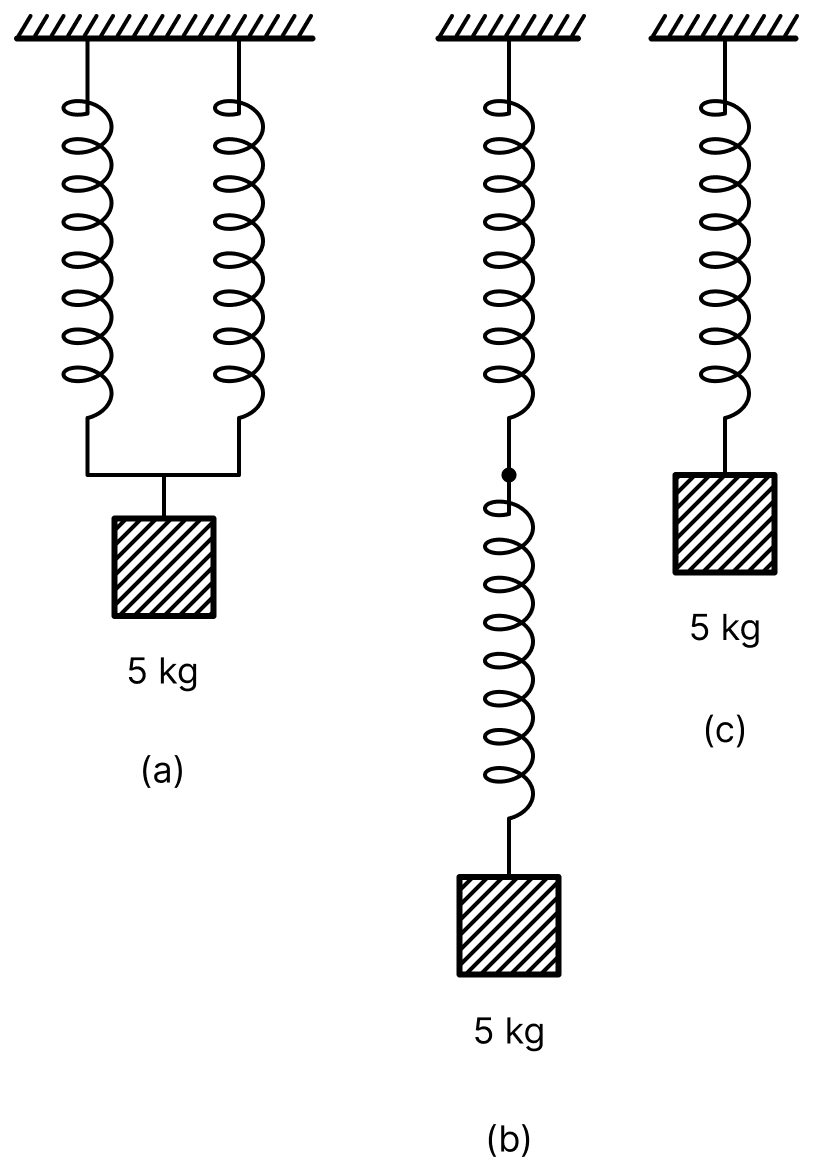
Answer
Given,
- Force-constant of each spring, k = 147 N m-1
- Mass suspended, m = 5 kg
- g = 9.8 m s-2
The weight of the suspended body is
By Hooke's law, the elongation produced in a spring by a force F is .
(a) The two springs are in parallel : Here the load is shared equally between the two springs, so the force on each spring is
(b) The two springs are in series : In a series combination the same force is transmitted to all the springs connected in series. Hence each spring carries the full weight of 49 N,
so each of the two springs elongates by m.
(c) The body hangs from a single spring : The spring carries the whole weight,
Hence, the elongations are m in case (a), m in each spring in case (b), and m in case (c).
The periodic-time of a mass suspended by a spring (force-constant k) is T. If the spring be cut in three equal pieces, what will be the force-constant of each part? If the same mass be suspended from one piece, what will be the periodic-time?
Answer
Given,
- Force-constant of the original spring = k
- Periodic-time of the mass with the original spring = T
Force-constant of each part : The force-constant of a spring is inversely proportional to its length,
If the spring of length l is cut into three equal pieces, the length of each piece becomes . Hence, if k′ is the force-constant of each piece,
Periodic-time with one piece : The periodic-time of a mass m suspended by a spring of force-constant k is
With the piece of force-constant 3k,
Hence, the force-constant of each part is 3k and the new periodic-time is .
A simple pendulum of length l is suspended from the ceiling of a train. The train is advancing with acceleration a in the horizontal direction. If the pendulum be allowed to oscillate, what will be its time period?
Answer
Given,
- Length of the simple pendulum = l
- Horizontal acceleration of the train = a
When the frame of reference is accelerating horizontally, the bob experiences the vertical gravitational acceleration g downward together with a horizontal acceleration a. These two are mutually perpendicular, so the effective acceleration due to gravity is their resultant,
Replacing g by geff in the formula for the time period of a simple pendulum,
Hence, the time period of the pendulum is . Since geff > g, the time period is smaller than that in a stationary train.
A particle is executing simple harmonic motion. The amplitude of motion is a. State those positions of the particle in terms of a when (i) the kinetic energy of the particle is zero, (ii) potential energy is zero, (iii) potential energy is one-fourth of the total energy, (iv) potential energy and kinetic energy are equal.
Answer
For a particle in S.H.M. of amplitude a, at displacement y,
(i) Kinetic energy is zero : Putting K = 0,
that is, at the extreme positions.
(ii) Potential energy is zero : Putting U = 0,
that is, at the mean position.
(iii) Potential energy is one-fourth of the total energy :
(iv) Potential energy and kinetic energy are equal :
A simple pendulum is suspended in a stationary lift. Its period of oscillation is T. How is its period of oscillation affected if (i) the lift is ascending with an acceleration a? (ii) the lift is descending with the acceleration a?
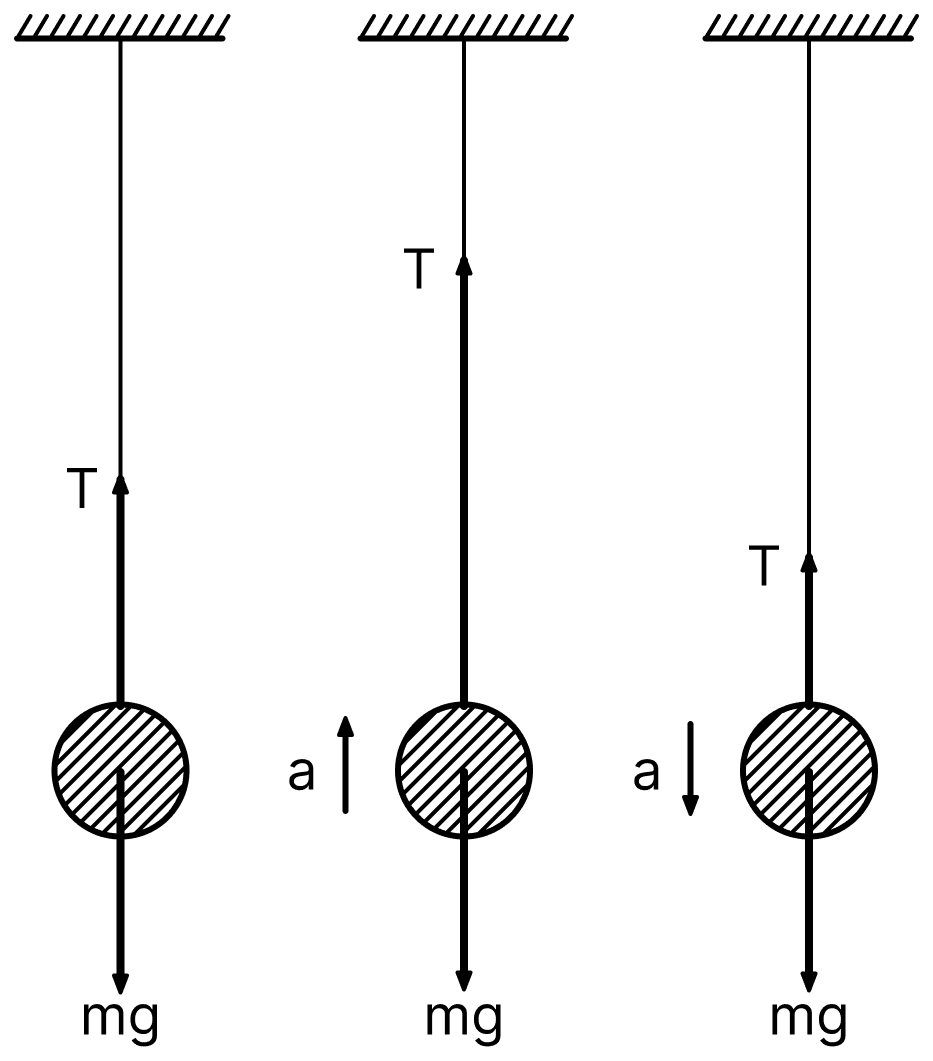
Answer
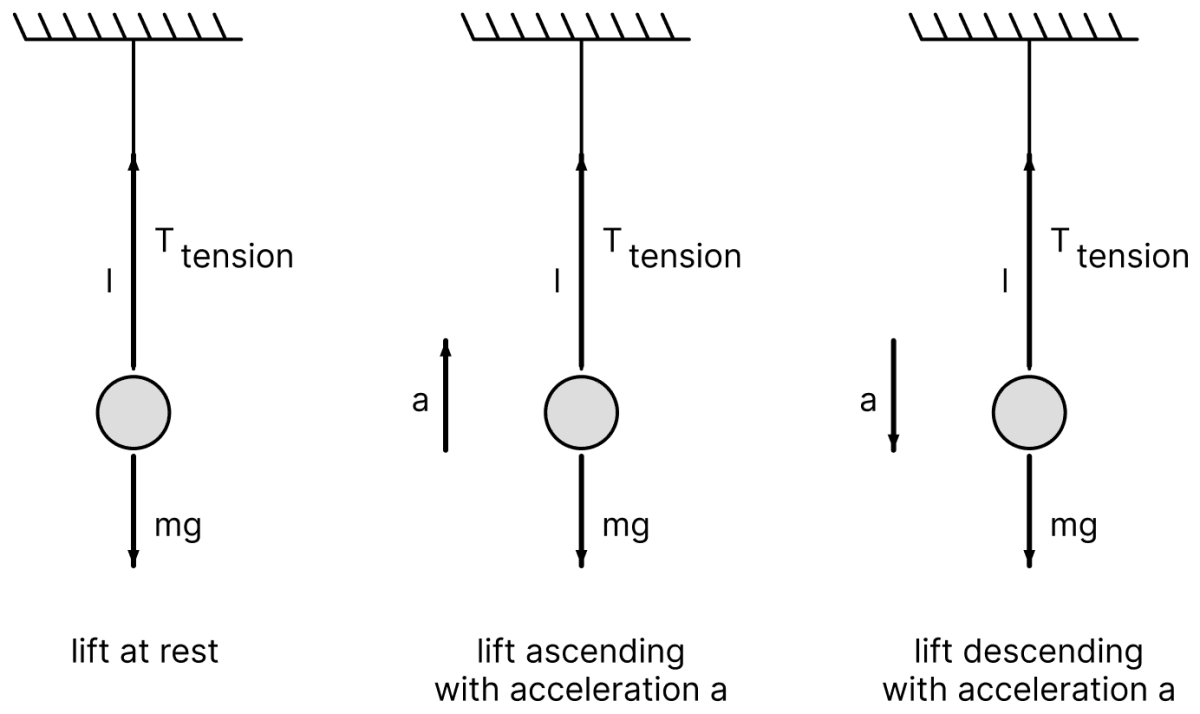
When the pendulum is at rest in the stationary lift, the net force on it is zero. Hence the tension in its string is
and its period of oscillation is .
(i) When the lift is ascending with acceleration a : The net upward force on the bob is
Thus the effective value of g is (g + a), and the time period becomes
This is times the period in the stationary lift. That is, the time period decreases.
(ii) When the lift is descending with acceleration a : Proceeding similarly, the effective value of g becomes (g − a), and the time period is
This is times the period in the stationary lift. That is, the time period increases.
If radius of the earth is 6.4 × 10⁶ metre, calculate the periodic-time of a simple pendulum of infinite length. (g = 9.8 m s-2)
Answer
Given,
- Radius of the earth, Re = 6.4 × 10⁶ m
- g = 9.8 m s-2
For a simple pendulum of infinite length, the restoring force on the bob is directed towards the mean position and its acceleration works out to be . Hence the motion is simple harmonic and its periodic-time is
Substituting the values,
Converting into minutes,
Hence, the periodic-time of a simple pendulum of infinite length is 84.6 minutes. This is the maximum limit of the time period of a simple pendulum.
Simple Harmonic Motion (S.H.M.)
In simple harmonic motion (S.H.M.), the restoring force acting on the particle is directly proportional to its displacement from the mean position and acts in the opposite direction. The time period of S.H.M. depends on the properties of the system, such as mass and spring constant in a mass-spring system, or the length of the pendulum in a simple pendulum. The displacement of a particle in S.H.M. can be described by a sinusoidal function of time, and the velocity of the particle is maximum when it passes through the mean position. At the extreme positions, the velocity is zero, and the particle has maximum potential energy. In a simple pendulum, the time period is independent of the mass of the bob but depends on the length of the pendulum and the acceleration due to gravity.
(i) What is the nature of the force acting on a particle in S.H.M.?
- Constant
- Proportional to displacement and acts in the opposite direction
- Independent of displacement
- Proportional to velocity.
(ii) What happens to the velocity of the particle when it reaches the mean position?
- It becomes zero
- It is maximum
- It is half of the maximum velocity
- It becomes infinite.
(iii) Which factor does the time period of a simple pendulum depend on?
- Mass of the bob
- Amplitude of oscillation
- Length of the pendulum and gravitational acceleration
- Frequency of oscillation.
(iv) In S.H.M., when is the potential energy of the system maximum?
- At the mean position
- At the extreme positions
- When the particle is moving towards the mean position
- When the particle is at rest.
Answer
(i) Proportional to displacement and acts in the opposite direction
The restoring force in S.H.M. is directly proportional to the displacement from the mean position and acts in the opposite direction,
The negative sign shows that the force is always directed towards the mean position.
(ii) It is maximum
The velocity of a particle in S.H.M. is . At the mean position y = 0, so the velocity attains its maximum value umax = aω. At this instant the whole of the energy of the particle is kinetic.
(iii) Length of the pendulum and gravitational acceleration
The time period of a simple pendulum is . This formula contains only l and g. It does not depend upon the mass of the bob, nor upon the amplitude, provided the amplitude is small.
(iv) At the extreme positions
The potential energy of a body in S.H.M. is . It increases with increase of displacement y, and hence is maximum in the extreme position of oscillation, where y = a and the displacement is greatest.
Mass-Spring System and Oscillations
A mass-spring system exhibits simple harmonic motion (S.H.M.) when displaced from its equilibrium position. The time period of oscillation for such a system is given by , where m is the mass attached to the spring and k is the spring constant. The frequency of oscillation is inversely proportional to the time period, and thus, as the mass increases, the time period increases and the frequency decreases. In both horizontal and vertical mass-spring systems, the restoring force is proportional to the displacement from equilibrium, and the system obeys Hooke's law. However, in the vertical case, the weight of the mass shifts the equilibrium position, but the time period remains unaffected by the gravitational force.
(i) What is the relationship between the time period T and the spring constant k in a mass-spring system?
- Directly proportional to k
- Inversely proportional to k
- Independent of k
- Proportional to the square of k.
(ii) What happens to the time period if the mass m attached to the spring is increased?
- The time period decreases
- The time period increases
- The time period remains the same
- The time period becomes zero.
(iii) In a vertical mass-spring system, why does the equilibrium position shift when the mass is attached?
- Due to the restoring force of the spring
- Due to the tension in the spring
- Due to the weight of the mass
- Due to the displacement of the spring.
(iv) Which law is obeyed by the restoring force in a mass-spring system?
- Newton's law of gravitation
- Hooke's law
- Boyle's law
- Coulomb's law.
Answer
(i) Inversely proportional to k
From for a given mass the time period is inversely proportional to the square-root of the spring constant. A hard spring (large k) therefore gives a smaller periodic-time than a soft spring.
Note: Strictly, that is, the time period is inversely proportional to the square-root of k and not to k itself, so none of the four options states the relation exactly. Option 2 is the intended answer because it alone carries the inverse dependence.
(ii) The time period increases
Since , the time period is directly proportional to the square-root of the mass. Increasing the mass therefore increases the time period, so a heavier body suspended from a spring oscillates more slowly than a lighter body.
(iii) Due to the weight of the mass
When a body of mass m is suspended from the spring, the spring extends until the restoring force balances the weight of the body,
It is this weight that causes the shift of the equilibrium position in the vertical mass-spring system.
(iv) Hooke's law
The restoring force exerted by the spring is given by Hooke's law, F = − kx, that is, the force is proportional to the displacement and directed opposite to it.
Simple Pendulum and S.H.M.
A simple pendulum consists of a mass (called a bob) attached to a string or rod of fixed length, oscillating under the influence of gravity. For small angular displacements, the motion of the pendulum is approximately simple harmonic, and the time period of the pendulum is given by , where l is the length of the pendulum and g is the acceleration due to gravity. The time period is independent of the mass of the bob and the amplitude of oscillation, provided the amplitude is small. If the length of the pendulum increases, the time period also increases. The pendulum's motion deviates from simple harmonic motion for larger angular displacements, as the restoring force is no longer proportional to displacement.
(i) For a simple pendulum, the time period is proportional to:
- The mass of the bob
- The square of the amplitude.
(ii) What happens to the time period if the length of the pendulum is increased?
- The time period decreases
- The time period increases
- The time period remains constant
- The time period becomes zero.
(iii) When does the motion of a simple pendulum deviate from simple harmonic motion?
- When the angular displacement is small
- When the angular displacement is large
- When the mass of the bob is increased
- When the length of the pendulum decreases.
(iv) In the formula for the time period of a simple pendulum , what does g represent?
- The gravitational potential energy
- The weight of the bob
- The acceleration due to gravity
- The force on the pendulum.
(v) If the acceleration due to gravity g decreases (for example, on the Moon), how will it affect the time period of a simple pendulum?
- The time period will decrease
- The time period will increase
- The time period will remain the same
- The time period will become zero.
Answer
(i)
From , at a given place g is a constant, so the periodic-time of a pendulum is directly proportional to the square-root of its effective length l.
(ii) The time period increases
Since , an increase in the effective length increases the time period. If the length of the pendulum is increased to four times, the periodic-time will become twice.
(iii) When the angular displacement is large
For small angular displacements sin θ ≈ θ, which makes the restoring force proportional to the displacement. For large angular displacements this approximation fails, so the restoring force is no longer proportional to displacement and the motion deviates from simple harmonic motion.
(iv) The acceleration due to gravity
In the formula for the time period of a simple pendulum, g stands for the acceleration due to gravity at the place where the pendulum is oscillating.
(v) The time period will increase
The periodic-time of a simple pendulum is inversely proportional to the square-root of g. On the Moon g is th of its value on the Earth, so the pendulum oscillates more slowly there, leading to a longer time period.
Damped and Forced Oscillations
A. In real systems, oscillations are often subject to damping, where frictional or resistive forces reduce the amplitude over time. Damped oscillations can be classified as underdamped, critically damped, or overdamped, depending on the nature of the damping force. In underdamped systems, the oscillations continue with gradually decreasing amplitude, while in overdamped systems, the system returns to equilibrium without oscillating. Critically damped systems return to equilibrium in the shortest time without oscillating. When an external periodic force is applied to a system, forced oscillations occur. If the frequency of the external force matches the natural frequency of the system, resonance occurs, resulting in a large increase in amplitude.
(i) What type of damping allows the system to oscillate with gradually decreasing amplitude?
- Underdamped
- Critically damped
- Overdamped
- Resonant damping.
(ii) In which type of damping does the system return to equilibrium without oscillating?
- Underdamped
- Critically damped
- Overdamped
- Resonant damping.
(iii) What occurs when the frequency of an external force matches the natural frequency of the system?
- Damping
- Resonance
- Overdamping
- Critical damping.
(iv) Which of the following systems returns to equilibrium in the shortest time without oscillating?
- Underdamped
- Critically damped
- Overdamped
- Resonant damping.
B. If a particle is moving to and fro along the same straight line about a mean position under the action of a restoring force which is directly proportional to its displacement from the mean position and is directed towards the mean position, i.e., F ∝ − y ⇒ The displacement — equation of S.H.M. is given by y = a sin ωt, where a is the amplitude.
(i) A particle is executing S.H.M. Its time period is 2 seconds. After how much interval from time t = 0, will its displacement be half of its amplitude?
(ii) A particle is executing S.H.M. with amplitude, 10 cm and time period 1 second. Find the maximum value of acceleration of the particle.
(iii) Find the equation for velocity from the equation of displacement of the particle executing S.H.M.
Answer
A. (i) Underdamped
In underdamped systems the oscillations occur with gradually decreasing amplitude, since the damping force removes energy slowly enough for the system to continue oscillating.
A. (ii) Overdamped
In overdamped systems the damping force is so large that the system returns to equilibrium without oscillating at all.
A. (iii) Resonance
When the frequency of the external periodic force matches the natural frequency of the system, resonance occurs, causing a large increase in amplitude.
A. (iv) Critically damped
A critically damped system returns to equilibrium in the shortest possible time without oscillating.
B. (i)
Given,
- Time period, T = 2 s
- Displacement required,
The displacement equation of S.H.M. is
Let t′ be the interval after t = 0 at which . Then,
Taking π = 180°,
Hence, the displacement becomes half of the amplitude after an interval of s.
B. (ii)
Given,
- Amplitude, a = 10 cm
- Time period, T = 1 s
The maximum value of acceleration in S.H.M. occurs at the extreme position and is
Substituting the values,
Hence, the maximum value of the acceleration of the particle is 394.4 cm s-2.
B. (iii)
The displacement equation of S.H.M. is
The velocity is the time-derivative of the displacement. Differentiating with respect to t,
Hence, the equation for the velocity of a particle executing S.H.M. is v = aω cos ωt.
The same result may also be written in terms of the displacement. Using cos ωt = ,
This second form gives the magnitude of the velocity at a displacement y, the direction being settled by the sign of cos ωt.
Write down the conditions for simple harmonic motion. Establish the displacement equation for a particle executing simple harmonic motion.
Answer
Conditions for simple harmonic motion : The following three conditions should be fulfilled for the linear S.H.M. of a particle :
(i) The motion of the particle should be in a straight line to and fro about a fixed point.
(ii) The restoring force (or acceleration) acting on the particle should always be proportional to the displacement of the particle from that point.
(iii) The force (or acceleration) should always be directed towards that point.
Displacement equation of S.H.M. :
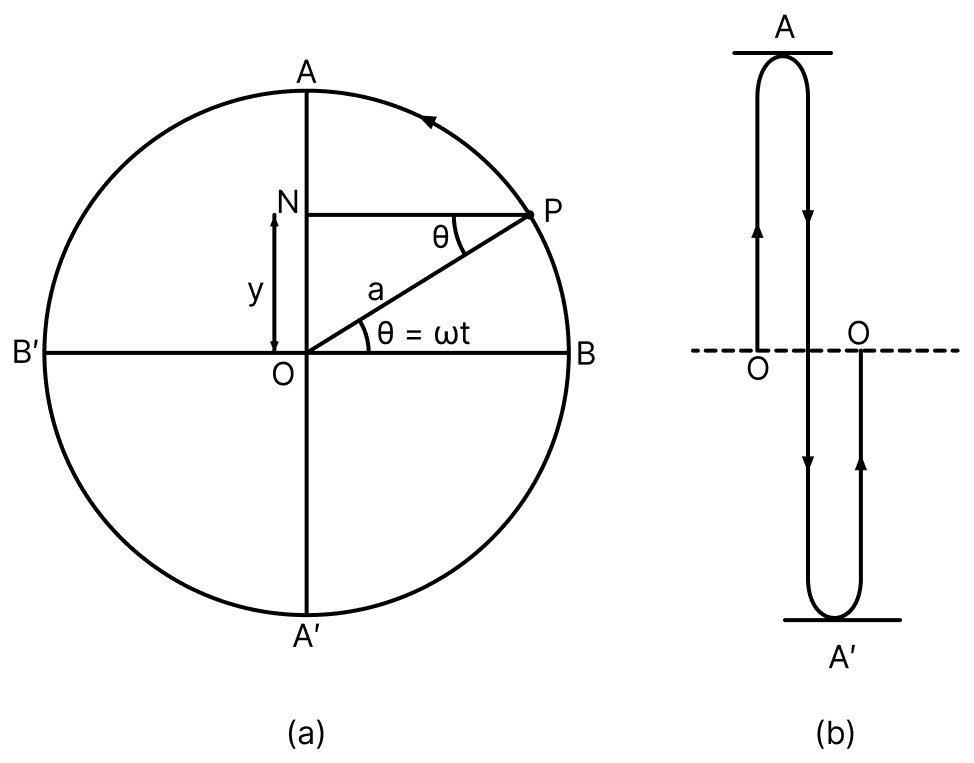
Suppose a particle P is moving with uniform speed along the circumference of a circle of radius a and centre O. This circle is called the reference circle. Let the particle start from the point B and rotate through an angle θ radian in t second.
If the angular velocity of the particle is ω, then
Let N be the foot of the perpendicular drawn from P on the diameter AA′. As P moves along the circumference, N moves in a straight line to and fro about the point O. This straight-line motion of N is simple harmonic motion.
In t second the displacement of N from O is ON. Writing this displacement as y,
But OP = a and ∠NPO = ∠POB = θ = ωt. Therefore,
This is the displacement equation of simple harmonic motion.
If the time is measured from an instant when the particle on the reference circle was at a point P0 different from B, where ∠P0OB = φ, then the displacement of N after time t is
Here φ is called the initial phase or epoch, and (ωt + φ) is the phase of the motion. This is the general equation of simple harmonic motion.
Since , equation (i) may also be written as
Establish a relation between acceleration and displacement for simple harmonic motion and with its help obtain the formula for time period.
Answer
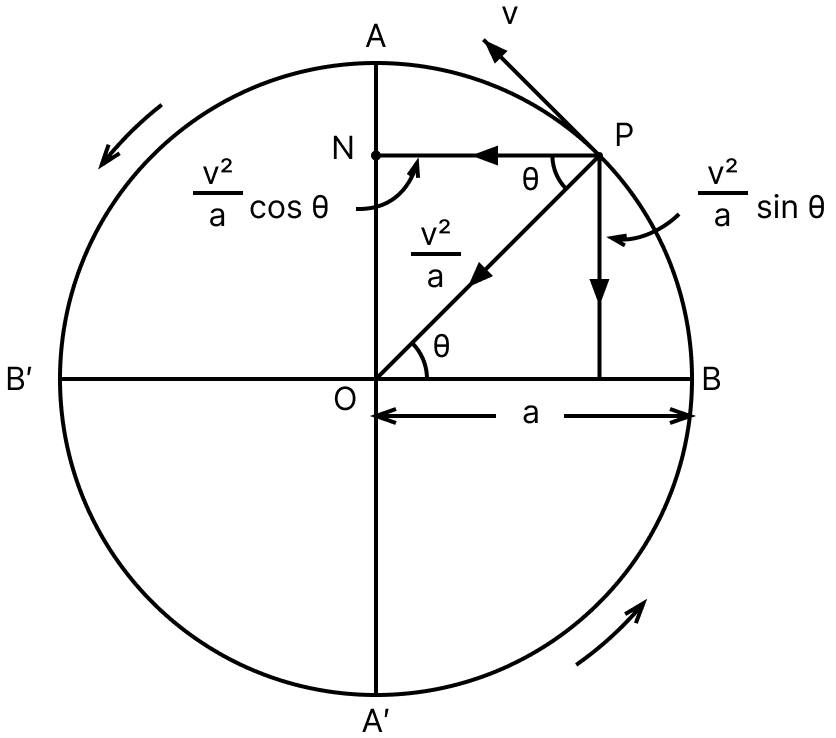
Let a particle P move with uniform speed v along the circumference of a circle of radius a, and let N be the foot of the perpendicular drawn from P on the diameter. The straight-line motion of N is simple harmonic motion.
Since P moves on the circumference of a circle, its motion has a centripetal acceleration directed towards the centre O of the circle. This acceleration can be resolved into two components :
- a component perpendicular to the direction of motion of N, and
- a component parallel to the direction of motion of N.
The component is parallel to the line of motion of N, but its direction is opposite to the motion of N, that is, it is directed towards the equilibrium position O. Therefore the acceleration of N is
The negative sign indicates that the acceleration of N is directed opposite to its displacement, that is, always towards the equilibrium position O. From the figure,
where y (= ON) is the displacement of N at this instant. Therefore,
But v = aω, so , giving
This is the relation between the acceleration and the displacement. Since ω2 is a constant,
Thus, the acceleration of N is proportional to the displacement y and its direction is opposite to the direction of displacement.
Formula for the time period : From equation (i),
The periodic-time of N is . Substituting the value of ω,
This is the formula for the periodic-time of S.H.M.
What do you understand by second pendulum? How will you measure acceleration due to gravity with the help of a simple pendulum?
Answer
Second pendulum : If the periodic-time of a pendulum is 2 seconds, then it is called a 'second pendulum'.
Putting T = 2 second in the formula for the time period of a simple pendulum,
Taking the value of g as 9.8 metre/second2 on the earth's surface, the length of a second pendulum is
Hence the length of a second pendulum on the earth's surface is nearly 1 metre. On the moon's surface the value of g is , so there the length of a second pendulum will be nearly metre, or 16.6 cm.
Measurement of acceleration due to gravity : A small metallic solid sphere is suspended by a cotton thread from a rigid support, and the distance from the point of suspension to the centre of gravity of the bob is taken as the effective length l of the pendulum.
The periodic-time of a simple pendulum is
Squaring both sides and rearranging,
The bob is displaced slightly to one side from its mean position and released, so that it oscillates through a small amplitude. The time for a large number of oscillations, say 20, is measured with a stop watch, and the periodic-time T is obtained by dividing this time by the number of oscillations. The experiment is repeated for several different lengths l.
Substituting the measured values of l and T in the above expression, the value of g at that place is calculated.
Alternatively, a graph is plotted between l and T2. Since , this graph is a straight line passing through the origin. From its slope ,
which gives a more accurate value of the acceleration due to gravity.
Obtain expressions for the kinetic energy of oscillation and potential energy of a body performing simple harmonic motion. Show that the total energy of a particle executing simple harmonic motion is proportional to the square of the amplitude and frequency of vibration.
Answer
When a body oscillates in simple harmonic motion, it is acted upon by a restoring force which tends to bring it in the equilibrium position. Due to this force there is potential energy in the body. Also, as the body is in motion it has kinetic energy. During oscillation of the body the two energies convert into each other, but their sum remains constant, taking friction negligible.
Potential energy : Let m be the mass of the oscillating body and y its displacement from the equilibrium position at any instant t. Then the displacement equation of S.H.M. is
where a is the amplitude of oscillation and ω the angular velocity of the body. The linear acceleration of the body is
The restoring force acting on the body at this instant is
If the body undergoes a further infinitesimally small displacement dy, the work done against the restoring force is
The total work done for displacing the body through y is obtained by integrating the right hand side between the limits y = 0 to y = y,
This work done on the body appears as the potential energy U of the body at that instant. Thus,
Clearly, the potential energy of the body increases with increase of displacement y, and in the extreme position of oscillation (where y = a) it is maximum.
Kinetic energy : When the displacement of the body in S.H.M. is y, its velocity is
Hence the instantaneous kinetic energy of the body is
Clearly, the kinetic energy of the body decreases with increase of displacement y, and in the equilibrium position (where y = 0) it is maximum.
Total energy : On adding equations (i) and (ii), the total energy of the body is
It is evident from this that the total energy of the body is free from the displacement y, that is, it remains the same during the motion of the body.
We know that ω = 2πn, where n is the frequency. Substituting this in equation (iii),
Hence, in S.H.M. the total energy of a particle is directly proportional to the square of the amplitude (a2) and to the square of the frequency (n2).
A body of mass m suspended from an ideal spring of force-constant k is executing simple harmonic motion. Prove that the time period of oscillation of the body is .
Answer
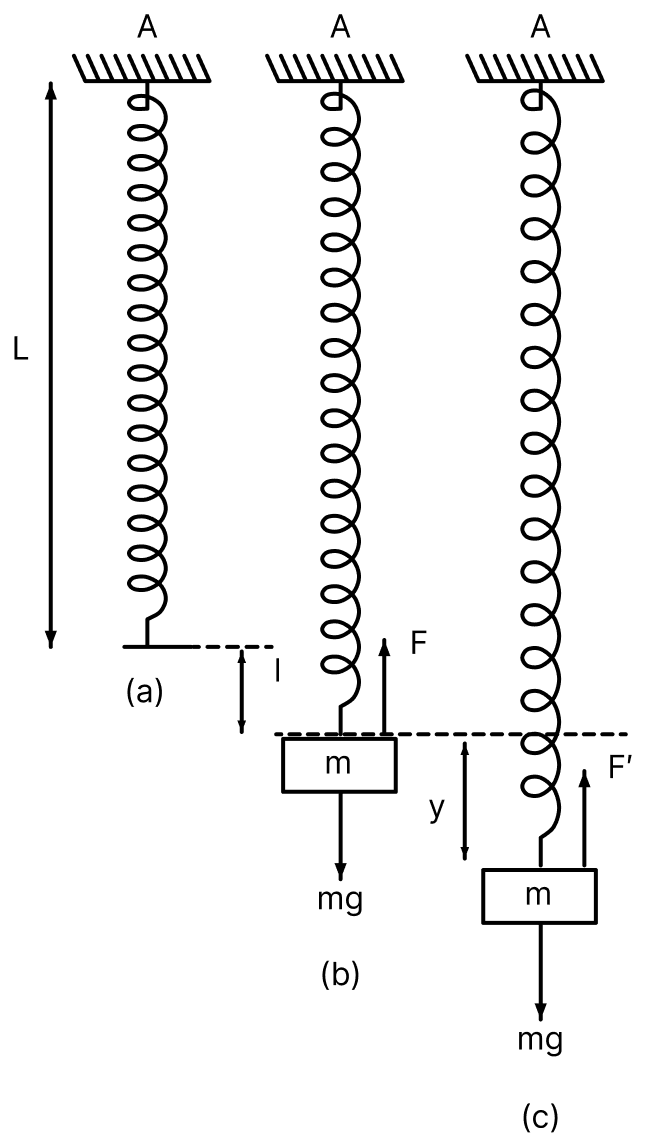
Suppose a light spring, whose normal length is L, is hanging from a rigid support A. When a body of mass m is suspended from its lower end, then due to the weight of the body the length of the spring is extended, say, by l. The spring, due to its elasticity, exerts a restoring force F on the body. By Hooke's law,
where k is the force-constant of the spring. The negative sign indicates that the force F is directed opposite (upwards) to the weight of the body.
The other force acting on the body is its weight mg. Since at this instant the body has no acceleration, the resultant force acting on it must be zero. That is,
If we now pull the body slightly downwards and release it, then it oscillates up and down. Suppose at any instant during oscillation the body is at a distance y below the equilibrium position. At this instant the total extension in the length of the spring is (l + y). Hence the force exerted on the body by the spring is
The weight of the body is still mg. Hence the resultant force acting on the body is
But from equation (i), kl = mg. Therefore,
According to Newton's law of motion, the resultant force acting on a body is equal to the product of the mass and the acceleration of the body. Hence, if the acceleration of the body is α, then
In this equation is a constant, as the mass m of the body is constant and k is also constant for the spring. Hence,
Thus the acceleration α is directly proportional to the displacement y of the body and its direction is opposite to the displacement. Hence the motion of the body is simple harmonic. Its periodic-time is
From equation (ii),
Therefore,
Hence proved.
A spiral spring of negligible mass is hung vertically and a mass m is hanged at its second end. When the mass is pulled slightly downwards and released, then it is in up and down motion. Show that this sort of motion is simple harmonic. If m = 500 g and force-constant of spring is 50 N m-1, find time period of the spring's vibrations.
Answer
Let the normal length of the spiral spring hanging from a rigid support be L. When the mass m is suspended from its lower end, the spring is extended by l. By Hooke's law the restoring force is F = − kl, where k is the force-constant of the spring. Since the body has no acceleration in this position,
Now the mass is pulled slightly downwards and released. Suppose at any instant during oscillation the mass is at a distance y below the equilibrium position. The total extension of the spring is then (l + y), and the force exerted by the spring on the mass is
The weight of the body is still mg, so the resultant force on it is
Using equation (i), kl = mg, so
By Newton's law of motion, F″ = mα, where α is the acceleration of the body. Therefore,
Here is a constant, so α ∝ − y, that is, the acceleration is directly proportional to the displacement and is directed opposite to it. Hence the up and down motion of the mass is simple harmonic, and its periodic-time is
Numerical part
Given,
- Mass, m = 500 g = 0.5 kg
- Force-constant of the spring, k = 50 N m-1
Substituting the values,
Hence, the time period of the spring's vibrations is 0.628 s.
If a tunnel be dug inside the earth (not necessarily passing through the centre of the earth) and a ball is dropped at one end of it then prove that the ball will execute simple harmonic motion. Determine its time-period also. The radius of the earth Re = 6.4 × 10⁶ m.
Answer
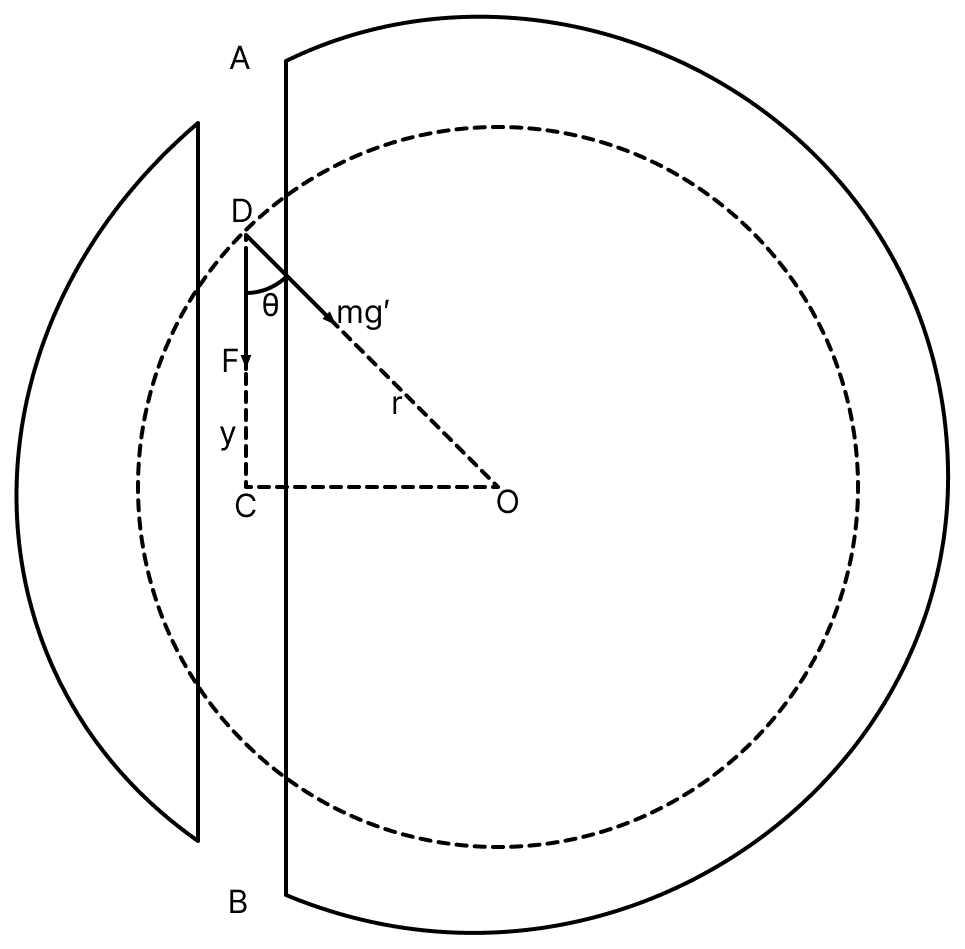
Let O be the centre of the earth and AB the tunnel across it. Suppose at any instant a body D of mass m dropped into the tunnel is at a distance y from the centre C of the tunnel, and at a distance r from the centre O of the earth.
At this instant a gravity-force mg′ directed towards the centre O of the earth will act on the body D, where g′ is the acceleration due to gravity inside the earth at the position of the body. The component of this force directed towards the centre C of the tunnel is mg′ cos θ, and this is the restoring force,
The negative sign shows that the force F is directed opposite to the displacement, that is, towards the centre C.
The acceleration due to gravity at the location of D is
where M′ is the mass of the sphere of radius r. If ρ is the density of the earth, then
Substituting this value in equation (i),
Therefore the acceleration of the body is
From the figure, , so
Since the acceleration is directly proportional to the displacement y and is directed opposite to it, the motion of the body is simple harmonic.
Time period : The period of the body is
At the surface of the earth,
Substituting this value in equation (ii),
Putting Re = 6.4 × 10⁶ m and g = 9.8 m s-2,
Hence, the ball executes simple harmonic motion of time-period 84.6 minutes. The result is independent of the position of the tunnel, so it is the same whether or not the tunnel passes through the centre of the earth.
Two springs of force-constants k1 and k2 are joined end to end and suspended from a support. A body of mass m is attached to the lower end. Find out the period of oscillation of the body.
Answer
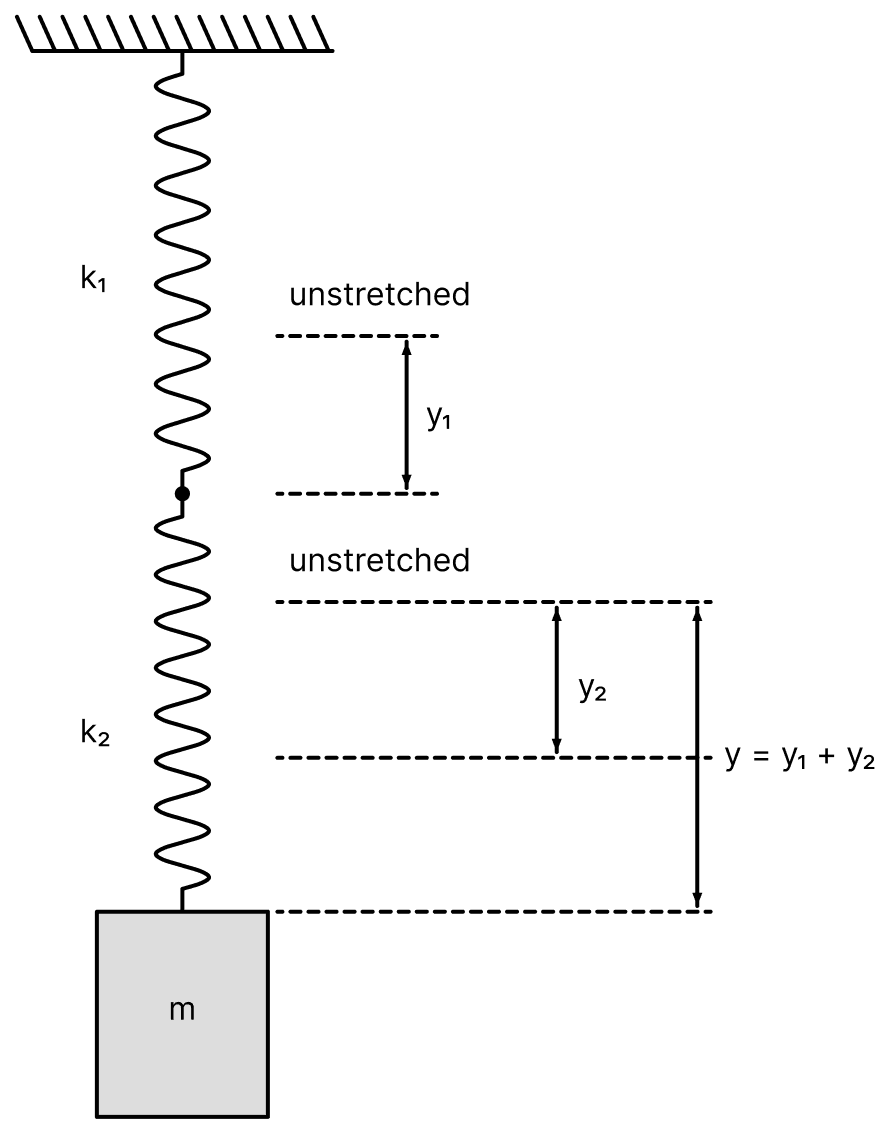
The two springs are joined end to end, so they form a series combination. Let the displacement of the body of mass m from the equilibrium position be y. As the force-constants of both the springs are different, the extensions in their lengths will also be different. Let the extension in the length of the spring k1 be y1 and that of k2 be y2. Then,
The force exerted by the spring k1 is
and that exerted by the spring k2 is
Multiplying equation (i) by k2 and equation (ii) by k1, and adding,
As both the springs are in series, they apply the same force on the body, that is, F1 = F2 = F (say). Then,
If the effective force-constant of the combination is k, then
Therefore the periodic-time of the body is
Hence, the period of oscillation of the body is .
The time (t) and displacement (y) relation of a particle executing S.H.M. is given by the equation y = 0.50 sin (500 t + 0.5), where distance is in cm and time in seconds. Calculate the values of amplitude, angular frequency, frequency and initial phase of the particle.
Answer
Given,
- Displacement equation, y = 0.50 sin (500 t + 0.5), with y in cm and t in second
The general equation of S.H.M. is
Comparing the given equation with the general equation,
Amplitude :
Angular frequency :
Frequency :
Initial phase :
Hence, the amplitude is 0.50 cm, the angular frequency is 500 rad s-1, the frequency is s-1 and the initial phase is 0.5 rad.
The displacement x (in metre) of a particle executing S.H.M. at time t second is given by the equation . Find out : (i) amplitude of the particle, (ii) maximum velocity, (iii) maximum acceleration and (iv) initial displacement.
Answer
Given,
- metre
Comparing with the general equation x = a cos (ωt + φ0),
(i) Amplitude :
(ii) Maximum velocity : In S.H.M. the velocity is maximum at the mean position,
(iii) Maximum acceleration : In S.H.M. the acceleration is maximum at the extreme position,
(iv) Initial displacement : Putting t = 0 in the given equation,
Hence, the amplitude is 0.06 m, the maximum velocity is 0.03π m s-1, the maximum acceleration is 0.015π2 m s-2 and the initial displacement is m.
A body of mass 0.1 kg is executing simple harmonic motion according to the equation metre. Find : (i) the frequency of oscillation, (ii) initial phase, (iii) maximum velocity, (iv) maximum acceleration, (v) total energy.
Answer
Given,
- Mass of the body, m = 0.1 kg
- metre
Comparing with x = a cos (ωt + φ0),
(i) Frequency of oscillation :
(ii) Initial phase :
(iii) Maximum velocity :
(iv) Maximum acceleration :
(v) Total energy :
Hence, the frequency is s-1, the initial phase is , the maximum velocity is 50 m s-1, the maximum acceleration is 5000 m s-2 and the total energy is 125 J.
A particle is executing simple harmonic motion with amplitude 5 cm and time-period 2 second. Find the maximum value of the acceleration of the particle.
Answer
Given,
- Amplitude, a = 5 cm = 5 × 10⁻² m
- Time-period, T = 2 s
The angular frequency of the motion is
The maximum acceleration of a particle in S.H.M. occurs at the extreme position and is
Substituting the values,
Hence, the maximum value of the acceleration of the particle is 5 × 10⁻²π2 m s-2.
The force-constant of an ideal spring is 50 N m-1. A body of mass 500 g is suspended from the spring and made to oscillate. Find the period of oscillation.
Answer
Given,
- Force-constant of the spring, k = 50 N m-1
- Mass of the body, m = 500 g = 0.5 kg
The period of oscillation of a body of mass m suspended by a spring of force-constant k is
Substituting the values,
Hence, the period of oscillation is 0.628 s.
On suspending a mass of 1.2 kg from a weightless spring and the spring is stretched by 2 cm. The mass is pulled down and released. Find (i) force-constant of the spring, (ii) time-period of oscillation of the mass. (g = 10 m s-2)
Answer
Given,
- Mass suspended, m = 1.2 kg
- Extension of the spring, y = 2 cm = 0.02 m
- g = 10 m s-2
(i) Force-constant of the spring : If a force F produces an increase of y in the length of a spring, then
Substituting the values,
(ii) Time-period of oscillation :
Hence, the force-constant of the spring is 600 N m-1 and the time-period of oscillation is 0.28 s.
The force-constant of a weightless spring is 16 N m-1. A body of mass 1.0 kg is suspended by it. The body is pulled down through 5 cm and then left free. Determine : (i) period of oscillation of the body, (ii) maximum potential energy of the spring.
Answer
Given,
- Force-constant of the spring, k = 16 N m-1
- Mass of the body, m = 1.0 kg
- Amplitude of oscillation, a = 5 cm = 0.05 m
(i) Period of oscillation :
(ii) Maximum potential energy of the spring : The potential energy of the spring is maximum at the extreme position, where the extension equals the amplitude,
Hence, the period of oscillation is 1.57 s and the maximum potential energy of the spring is 2 × 10⁻² J.
A 2.0 kg body is suspended by a spring. When in addition to it, another body of 300 g is suspended, the spring further stretches by 2.0 cm. If the second body is removed and the first body is made to oscillate, then what will be the time period?
Answer
Given,
- Mass of the first body, m = 2.0 kg
- Additional mass suspended = 300 g = 0.3 kg
- Further extension produced, y = 2.0 cm = 0.02 m
Force-constant of the spring : The additional weight of 0.3 kg produces a further extension of 0.02 m, so
Time period of the first body : When the second body is removed, only the 2.0 kg body oscillates,
Hence, the time period of the 2.0 kg body is 0.73 s.
When a body is suspended by a light and long spring, the spring stretches by 20 cm. The body is pulled down and released. Calculate the period of oscillation of the body.
Answer
Given,
- Extension of the spring, l = 20 cm = 0.20 m
- g = 9.8 m s-2
In the equilibrium position, the weight of the body is balanced by the restoring force of the spring,
Substituting this in the expression for the period of oscillation,
Substituting the values,
Hence, the period of oscillation of the body is 0.898 s.
At a certain place, a freely-falling body falls 125 metres in 5 seconds. What will be the period of a pendulum of length 2.5 metre at that place?
Answer
Given,
- Distance fallen by the freely-falling body, h = 125 m
- Time of fall, t = 5 s
- Length of the pendulum, l = 2.5 m
Value of g at that place : The body falls freely from rest, so using ,
Period of the pendulum :
Hence, the period of the pendulum at that place is 3.14 s.
On pouring 10 g mercury into a test tube of mass 8 g and external diameter 2 cm, the test tube floats vertically in water. The test tube is pressed down into the water and left. Prove that the motion of the tube will be simple harmonic. Also find its time period. (Assume the effect of viscosity of water negligible).
Answer
Given,
- Mass of the mercury poured = 10 g
- Mass of the test tube = 8 g
- External diameter of the test tube = 2 cm, so radius r = 1 cm = 0.01 m
- Density of water, ρl = 1000 kg m-3
The total mass of the floating system is
The area of cross-section of the test tube is
Proof that the motion is simple harmonic : By the law of floatation, in the equilibrium position the weight of the water displaced by the immersed part of the tube equals the total weight of the tube.
Suppose the tube is pressed down through a small distance y and left. Then an additional volume Ay of water is displaced, and the extra upthrust provides the restoring force,
The negative sign is taken because F acts in the direction opposite to the displacement of the tube. By Newton's law of motion, if α is the instantaneous acceleration of the tube,
Here is a constant, so the acceleration α is proportional to the displacement y and is directed opposite to it. Hence the motion of the test tube is simple harmonic.
Time period :
Substituting the values,
Hence, the motion of the test tube is simple harmonic with a time period of about 0.48 s.
The period of a simple pendulum is 2 second and the amplitude of vibration is 5 cm. Write down the equation of its motion. What will be the displacement and the velocity of the particle after 1.5 second of the start of motion? Assume that the particle starts moving from its mean position.
Answer
Given,
- Time period, T = 2 s
- Amplitude, a = 5 cm
- The particle starts from the mean position
Equation of motion : Since the motion starts from the mean position, the initial phase is zero, so
Substituting a = 5 cm and T = 2 s,
Displacement after 1.5 s :
Velocity after 1.5 s : Differentiating the displacement equation with respect to time,
At t = 1.5 s,
Hence, the equation of motion is y = 5 sin πt cm, the displacement after 1.5 s is − 5 cm and the velocity is zero. The particle is at an extreme position at that instant, which is why its velocity vanishes.
A small body of mass 0.10 kg is executing simple harmonic motion whose amplitude is 1.0 m and the period is 0.20 s. What is the maximum value of the force acting on it? If oscillations are performed by means of a spring, then what will be the force-constant of the spring?
Answer
Given,
- Mass of the body, m = 0.10 kg
- Amplitude, a = 1.0 m
- Time period, T = 0.20 s
The angular frequency of the motion is
Maximum force : The force is maximum at the extreme position, where the acceleration is maximum,
Substituting the values,
Force-constant of the spring : For a spring-mass system,
Hence, the maximum value of the force acting on the body is 98.6 N and the force-constant of the spring is 98.6 N m-1.
A body of mass 8 kg is executing S.H.M. whose amplitude is 30 cm. When the body is in a position of maximum displacement, then the force acting on it is 60 N. Calculate : (i) time period, (ii) acceleration, potential energy and kinetic energy at 12 cm displacement.
Answer
Given,
- Mass of the body, m = 8 kg
- Amplitude, a = 30 cm = 0.30 m
- Force at maximum displacement, F = 60 N
- Displacement at which the quantities are required, y = 12 cm = 0.12 m
Force-constant : At the maximum displacement the restoring force is F = ka, so
(i) Time period : The angular frequency is
(ii) At y = 0.12 m :
Acceleration :
Potential energy :
Kinetic energy : The total energy of the body is
Therefore,
Hence, the time period is 1.256 s, and at 12 cm displacement the acceleration is 3.0 m s-2, the potential energy is 1.44 J and the kinetic energy is 7.56 J.
When the length of a spring is altered by 0.1 metre, the potential energy of the spring changes by 0.5 joule. Find the force-constant of the spring.
Answer
Given,
- Change in the length of the spring, x = 0.1 m
- Change in the potential energy, U = 0.5 J
The potential energy stored in a spring stretched or compressed through x is
Solving for the force-constant,
Substituting the values,
Hence, the force-constant of the spring is 100 N m-1.
The time period of oscillation of a mass m suspended from an ideal spring is 2 seconds. The time period becomes 3 seconds when a 2 kg mass is suspended along with it. Find the value of the mass m.
Answer
Given,
- Time period with mass m, T1 = 2 s
- Time period with mass (m + 2), T2 = 3 s
The time period of a body of mass m suspended by a spring of force-constant k is
For the two cases,
Dividing the second by the first and squaring,
Substituting the values,
Hence, the value of the mass m is 1.6 kg.
The length of a spring increases by 20 cm when a 1 kg body is suspended from it. Determine the force-constant of the spring. If the body is pulled down slightly and then released, what will be the period of oscillations? If this body along with the spring executes S.H.M. on a frictionless horizontal surface, then what will be the time period?
Answer
Given,
- Mass of the body, m = 1 kg
- Increase in the length of the spring, l = 20 cm = 0.20 m
- g = 9.8 m s-2
Force-constant of the spring :
Period of vertical oscillations :
Period on a frictionless horizontal surface : The time period of a spring-mass system depends only on the mass of the block attached and the force-constant of the spring, and not on the acceleration due to gravity. Hence the time period remains the same,
Hence, the force-constant of the spring is 49 N m-1, and the time period is 0.9 s both for the vertical oscillations and for the oscillations on the frictionless horizontal surface.
A body of mass 0.2 kg, when suspended by a spring, increases the length of the spring by 4.9 cm. If the spring obeys Hooke's law, then determine : (i) the period of oscillation of the spring when a body of 0.4 kg is suspended by it and (ii) the change in accumulated energy of the spring when its extension changes from 4.9 cm to 9.8 cm.
Answer
Given,
- Mass suspended, m = 0.2 kg
- Increase in the length of the spring, y = 4.9 cm = 0.049 m
- g = 9.8 m s-2
Force-constant of the spring :
(i) Period of oscillation with a 0.4 kg body :
(ii) Change in the accumulated energy : The energy stored in a spring extended through x is . Here the extension changes from x1 = 4.9 cm = 0.049 m to x2 = 9.8 cm = 0.098 m,
Hence, the period of oscillation with the 0.4 kg body is 0.628 s and the change in the accumulated energy of the spring is 0.144 J.
On hanging two bodies of masses 300 g and 200 g together from a weightless spring, the increase in the length of the spring is 5 cm. The body of 300 g is slowly removed. Find the angular frequency and amplitude of oscillation of the body of 200 g. (Acceleration due to gravity = 10 m/s2)
Answer
Given,
- m1 = 300 g = 0.3 kg and m2 = 200 g = 0.2 kg
- Increase in the length of the spring, y = 5 cm = 0.05 m
- g = 10 m s-2
Force-constant of the spring : With both the masses suspended,
Angular frequency of the 200 g body :
Amplitude of oscillation : When the 300 g body is removed, the equilibrium position of the spring rises. The shift in the equilibrium position is exactly the extension that the removed weight had produced, and this becomes the amplitude of the resulting oscillation,
Hence, the angular frequency is rad s-1 and the amplitude of oscillation is 3 cm.
The period of oscillation of a body suspended by a spring is 1.5 s. What will be the new period if the spring is cut into three equal parts and (i) the body is suspended by any one part, (ii) suspended by all the three parts in parallel?
Answer
Given,
- Period of oscillation with the original spring, T = 1.5 s
The force-constant of a spring is inversely proportional to its length. Hence, if the spring of force-constant k is cut into three equal parts, the force-constant of each part becomes
(i) Body suspended by any one part :
(ii) Body suspended by all the three parts in parallel : For springs in parallel the effective force-constant is the sum of the individual force-constants,
Hence, the new periods are 0.866 s in the first case and 0.5 s in the second case.
A simple pendulum whose length is 20 cm is suspended from the ceiling of a lift which is rising up with an acceleration of 3.0 m s-2. Calculate the time period of the pendulum.
Answer
Given,
- Length of the pendulum, l = 20 cm = 0.20 m
- Upward acceleration of the lift, a = 3.0 m s-2
- g = 9.8 m s-2
When the lift is rising up with an accelerated motion, the effective value of the acceleration due to gravity is increased to
Hence the time period of the pendulum is
Substituting the values,
Hence, the time period of the pendulum is 0.79 s. It is smaller than the value in a stationary lift, because the effective value of g is increased.
Two pendulums of lengths 100 and 110.25 cm start oscillating in phase simultaneously. After, how many oscillations will they again be in phase together?
Answer
Given,
- Length of the shorter pendulum, l1 = 100 cm
- Length of the longer pendulum, l2 = 110.25 cm
The time periods of the two pendulums are
Taking the ratio,
Since the longer pendulum has the larger time period, it completes fewer oscillations in the same time. For the two to be in phase again, if the larger pendulum makes n oscillations then the smaller one must make (n + 1) oscillations in the same time. Hence,
Hence, the two pendulums will again be in phase after 20 oscillations of the larger pendulum, that is, after 21 oscillations of the smaller one.
The time period of a body executing simple harmonic motion is 0.05 s. If the amplitude is 4 cm, then what will be the maximum velocity and maximum acceleration of the body?
Answer
Given,
- Time period, T = 0.05 s
- Amplitude, a = 4 cm = 0.04 m
The angular frequency of the motion is
Maximum velocity : The velocity is maximum at the mean position,
Maximum acceleration : The acceleration is maximum at the extreme position,
Hence, the maximum velocity is 1.6π m s-1 and the maximum acceleration is 64π2 m s-2.
The displacement and acceleration of a particle executing S.H.M. are 4 cm and cm s-2 respectively. Find the time period of the particle.
Answer
Given,
- Displacement, y = 4 cm
- Acceleration, cm s-2
In S.H.M. the magnitude of the acceleration at displacement y is
Substituting the values,
The time period is
Hence, the time period of the particle is 8 s.
The maximum velocity of a body executing simple harmonic motion is 10 m/s and its amplitude is 2.5 m. What will be the angular velocity of the body?
Answer
Given,
- Maximum velocity, umax = 10 m s-1
- Amplitude, a = 2.5 m
The maximum velocity of a body in S.H.M. occurs at the mean position and is
Solving for the angular velocity,
Hence, the angular velocity of the body is 4 radian/second.
The maximum velocity of a particle executing simple harmonic motion is 1.0 m/s and the maximum acceleration is 1.57 m/s2. Find the periodic-time of the particle.
Answer
Given,
- Maximum velocity, umax = aω = 1.0 m s-1
- Maximum acceleration, αmax = aω2 = 1.57 m s-2
Dividing the second relation by the first, the amplitude a cancels out,
The periodic-time is
Hence, the periodic-time of the particle is 4 s.
A body whose mass is 0.50 kg is executing S.H.M. Its period is 0.1 s and amplitude 10 cm. When the body is at a distance of 5 cm from the mean position, then find out its acceleration, force acting upon it and its potential energy.
Answer
Given,
- Mass of the body, m = 0.50 kg
- Time period, T = 0.1 s
- Amplitude, a = 10 cm = 0.10 m
- Displacement, y = 5 cm = 0.05 m
The angular frequency of the motion is
Acceleration :
Force acting on the body :
Potential energy :
Hence, the acceleration is 197.2 m s-2, the force acting on the body is 98.6 N and its potential energy is 2.465 J.
A body of mass 8 kg suspended by a spring executes simple harmonic motion. The amplitude of vibration is 0.3 m and time-period is 0.6 second. Find out the maximum kinetic energy of the body and force constant of the spring.
Answer
Given,
- Mass of the body, m = 8 kg
- Amplitude, a = 0.3 m
- Time period, T = 0.6 s
The angular frequency of the motion is
Maximum kinetic energy : The kinetic energy is maximum at the mean position,
Force constant of the spring :
Hence, the maximum kinetic energy of the body is 39.44 J and the force constant of the spring is 876.40 N m-1.
The length of a weightless ideal spring increases by 0.1 m when a load of 2.0 kg is suspended from it. Find the time period of its up and down oscillations.
Answer
Given,
- Increase in the length of the spring, l = 0.1 m
- Mass suspended, m = 2.0 kg
- g = 9.8 m s-2
In the equilibrium position the weight of the load is balanced by the restoring force of the spring,
Hence the time period of the up and down oscillations is
Substituting the values,
Hence, the time period of the up and down oscillations is 0.634 s.
A 10 kg body is suspended by an ideal spring (force-constant 250 N m-1). (i) Calculate the time period of the body. (ii) If the body is displaced downward by 30 cm and released, with what speed will it pass through its mean position? (iii) What is the total energy in the body? (iv) How much time it takes in reaching its mean position from its position of maximum displacement?
Answer
Given,
- Mass of the body, m = 10 kg
- Force-constant of the spring, k = 250 N m-1
- Amplitude, a = 30 cm = 0.30 m
(i) Time period :
(ii) Speed at the mean position : The angular frequency is
The speed is maximum at the mean position,
(iii) Total energy :
(iv) Time from the extreme position to the mean position : The body travels from an extreme position to the mean position in one quarter of a complete oscillation,
Hence, the time period is 1.256 s, the speed at the mean position is 1.50 m s-1, the total energy is 11.25 J and the time taken to reach the mean position from the position of maximum displacement is 0.314 s.
A particle which is attached to a spring oscillates horizontally with simple harmonic motion with a frequency of Hz and total energy of 10 joule. If the maximum speed of the particle is 0.4 metre per second, what is the force-constant of the spring? What will be the maximum potential energy of the spring during the motion?
Answer
Given,
- Frequency, Hz
- Total energy, E = 10 J
- Maximum speed, umax = 0.4 m s-1
The angular frequency of the motion is
Amplitude : Since umax = aω,
Force-constant of the spring : The total energy is , so
Maximum potential energy : At the extreme position the whole of the energy of the particle is in the form of potential energy. Hence,
Hence, the force-constant of the spring is 500 N m-1 and the maximum potential energy of the spring during the motion is 10 J.
On suspending a 0.5 kg body by a spring of negligible mass, the spring stretches by 7 cm. Now, the body is given a velocity of 40 cm s-1 downward from its mean position. Calculate the angular velocity and the amplitude of the resulting oscillatory motion.
Answer
Given,
- Mass of the body, m = 0.5 kg
- Extension of the spring, l = 7 cm = 0.07 m
- Velocity given at the mean position, umax = 40 cm s-1 = 0.40 m s-1
- g = 9.8 m s-2
Force-constant of the spring :
Angular velocity :
Amplitude : The body is given the velocity at the mean position, where the speed is maximum. Since umax = aω,
Hence, the angular velocity is 11.8 rad s-1 and the amplitude of the resulting oscillatory motion is 3.4 cm.
The simple pendulum whose periodic-time is 2 s, is called 'seconds pendulum'. What will be the length of second's pendulum on earth? On moon? The value of g on earth is 9.8 m s-2 and on moon it is th of that on earth.
Answer
Given,
- Periodic-time of a second's pendulum, T = 2 s
- g on the earth, ge = 9.8 m s-2
- g on the moon,
The periodic-time of a simple pendulum is
Length on the earth :
Length on the moon : Since for a fixed time period,
Hence, the length of a second's pendulum is 99.39 cm on the earth and 16.56 cm on the moon.
A second's pendulum is taken to a height where the value of g is 4.36 m s-2. Determine the new time period of the pendulum.
Answer
Given,
- Time period of a second's pendulum on the earth, T = 2 s
- g on the earth's surface, g = 9.8 m s-2
- g at the height, g′ = 4.36 m s-2
The length of the pendulum remains unchanged, so from ,
Substituting the values,
Hence, the new time period of the pendulum is 3 seconds. The periodic-time has increased because the value of g is smaller at that height.