KnowledgeBoat Logo
|
OPEN IN APP

Chapter 13

Oscillations — Competition Zone

Class 11 - Nootan Physics


Competition Zone — MCQ (One Correct Option)

Question 1

A particle executes linear simple harmonic motion with an amplitude of 3 cm. When the particle is at 2 cm from the mean position, the magnitude of its velocity is equal to that of its acceleration. Then its time period in seconds is:

  1. 5π\dfrac{\sqrt5}{π}

  2. 5\dfrac{\sqrt5}{\text{2π}}

  3. 5\dfrac{\text{4π}}{\sqrt5}

  4. 3\dfrac{\text{2π}}{\sqrt3}

Answer

5\dfrac{\text{4π}}{\sqrt5}

Reason

Given,

  • Amplitude, a = 3 cm
  • Displacement, y = 2 cm
  • Magnitude of velocity = magnitude of acceleration

For a particle in S.H.M., the velocity and the magnitude of the linear acceleration at displacement y are

u=ωa2y2andα=ω2y\text u = ω\sqrt{\text a^2 - \text y^2} \qquad \text{and} \qquad |α| = ω^2 \text y

Equating the two at y = 2 cm,

ωa2y2=ω2yω\sqrt{\text a^2 - \text y^2} = ω^2 \text y

a2y2=ωy\sqrt{\text a^2 - \text y^2} = ω\text y

Substituting a = 3 cm and y = 2 cm,

3222=ω×25=2ω\sqrt{3^2 - 2^2} = ω \times 2 \quad \Rightarrow \quad \sqrt5 = 2ω

ω=52 rad s1ω = \dfrac{\sqrt5}{2}\ \text{rad s}^{-1}

The time period is

T=ω=52=5 s\text T = \dfrac{\text{2π}}{ω} = \dfrac{\text{2π}}{\dfrac{\sqrt5}{2}} = \dfrac{\text{4π}}{\sqrt5}\ \text s

Question 2

A pendulum is hung from the roof of a sufficiently high building and is moving freely to and fro like a simple harmonic oscillator. The acceleration of the bob of the pendulum is 20 m/s2 at a distance of 5 m from the mean position. The time period of oscillation is:

  1. 2π s
  2. 1 s
  3. 2 s
  4. π s.

Answer

π s

Reason

Given,

  • Acceleration, |α| = 20 m s-2
  • Displacement, y = 5 m

In S.H.M. the magnitude of the acceleration at displacement y is

α=ω2y|α| = ω^2 \text y

Substituting the values,

20 m s2=ω2×5 m20\ \text{m s}^{-2} = ω^2 \times 5\ \text m

ω2=4 s2ω=2 rad s1ω^2 = 4\ \text s^{-2} \quad \Rightarrow \quad ω = 2\ \text{rad s}^{-1}

The time period of oscillation is

T=ω=2=π s\text T = \dfrac{\text{2π}}{ω} = \dfrac{\text{2π}}{2} = π\ \text s

Question 3

A spring of force constant k is cut into lengths of ratio 1 : 2 : 3. They are connected in series and the new force constant is k'. Then they are connected in parallel and force constant is k". Then k' : k" is:

  1. 1 : 6
  2. 1 : 9
  3. 1 : 11
  4. 1 : 14.

Answer

1 : 11

Reason

Given,

  • Force constant of the original spring = k
  • The spring is cut into lengths in the ratio 1 : 2 : 3

The force constant of a spring is inversely proportional to its length,

k1l\text k \propto \dfrac{1}{\text l}

If the original length l is cut in the ratio 1 : 2 : 3, the three parts have lengths l6\dfrac{\text l}{6}, l3\dfrac{\text l}{3} and l2\dfrac{\text l}{2}. Hence their force constants are

k1=6k,k2=3k,k3=2k\text k_1 = 6\text k, \qquad \text k_2 = 3\text k, \qquad \text k_3 = 2\text k

When connected in series :

1k=1k1+1k2+1k3=16k+13k+12k\dfrac{1}{\text k'} = \dfrac{1}{\text k_1} + \dfrac{1}{\text k_2} + \dfrac{1}{\text k_3} = \dfrac{1}{6\text k} + \dfrac{1}{3\text k} + \dfrac{1}{2\text k}

1k=1+2+36k=66k=1kk=k\dfrac{1}{\text k'} = \dfrac{1 + 2 + 3}{6\text k} = \dfrac{6}{6\text k} = \dfrac{1}{\text k} \quad \Rightarrow \quad \text k' = \text k

This is expected, since joining the three pieces in series simply restores the original spring.

When connected in parallel :

k=k1+k2+k3=6k+3k+2k=11k\text k'' = \text k_1 + \text k_2 + \text k_3 = 6\text k + 3\text k + 2\text k = 11\text k

Therefore,

k:k=k:11k=1:11\text k' : \text k'' = \text k : 11\text k = 1 : 11

Question 4

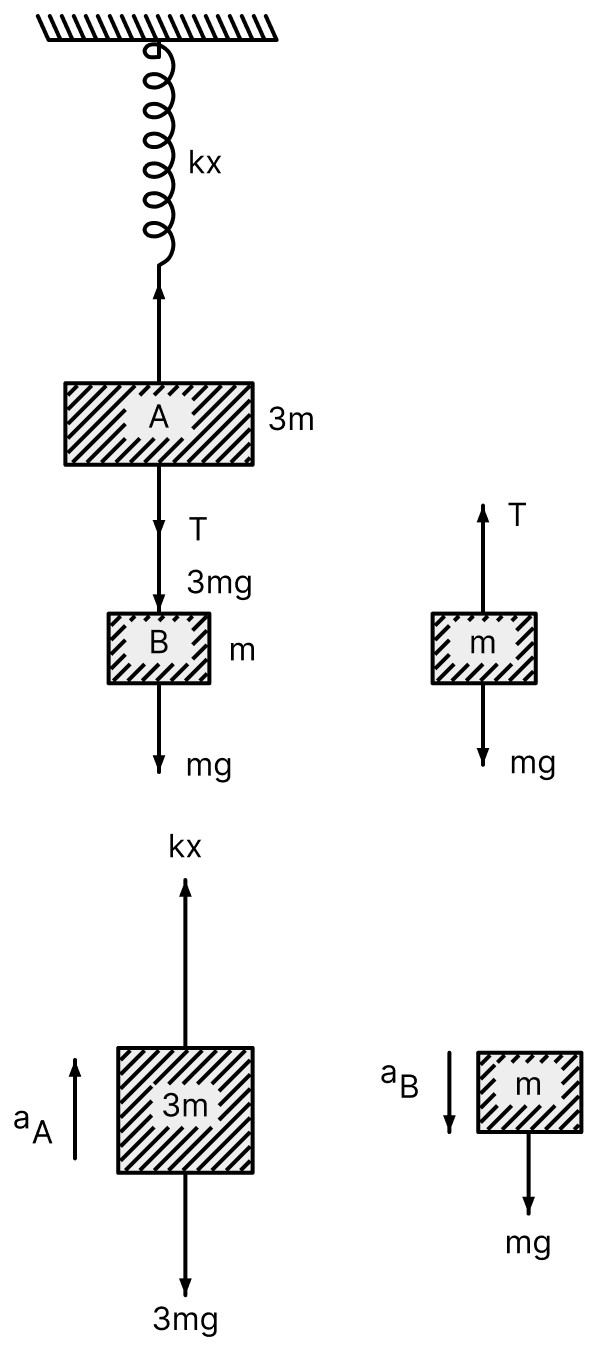
Two blocks A and B of masses 3m and m respectively are connected by a massless and inextensible string. The whole system is suspended by a massless spring as shown in figure. The magnitudes of acceleration of A and B immediately after the string is cut, are respectively:
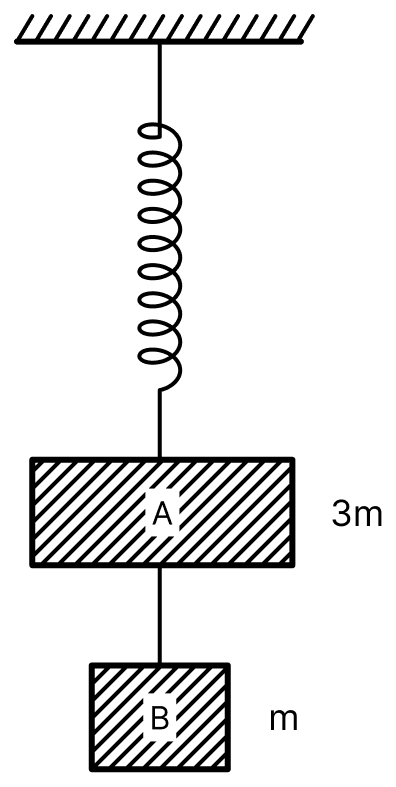
Two blocks A and B of masses 3m and m respectively are connected by a massless and inextensible string. The whole system is suspended by a massless spring as shown in figure. The magnitudes of acceleration of A and B immediately after the string is cut, are respectively:. Oscillations, Solutions for Class 11 ISC Nootan Physics Kumar Mittal Nageen Prakashan
  1. g,g3\text g, \dfrac{\text g}{3}
  2. g3,g\dfrac{\text g}{3}, \text g
  3. g, g
  4. g3,g3\dfrac{\text g}{3}, \dfrac{\text g}{3}

Answer

g3,g\dfrac{\text g}{3}, \text g

Reason

Two blocks A and B of masses 3m and m respectively are connected by a massless and inextensible string. The whole system is suspended by a massless spring as shown in figure. The magnitudes of acceleration of A and B immediately after the string is cut, are respectively:. Oscillations, Solutions for Class 11 ISC Nootan Physics Kumar Mittal Nageen Prakashan

Given,

  • Mass of block A = 3m and mass of block B = m
  • The two blocks are joined by a massless inextensible string and the system hangs from a spring

Before the string is cut : The whole system is in equilibrium, so the spring force balances the total weight,

kx=3mg+mg=4mg\text{kx} = 3\text{mg} + \text{mg} = 4\text{mg}

and the tension in the string is T = mg.

Immediately after the string is cut : The spring cannot change its extension instantaneously, so the spring force is still 4mg. The tension in the string becomes zero.

For block A : The forces acting on it are the spring force 4mg upward and its weight 3mg downward,

aA=kx3mg3m=4mg3mg3m=g3 (upward)\text a_\text A = \dfrac{\text{kx} - 3\text{mg}}{3\text m} = \dfrac{4\text{mg} - 3\text{mg}}{3\text m} = \dfrac{\text g}{3}\ (\text{upward})

For block B : The only force acting on it is its own weight, since the string has been cut,

aB=mgm=(downward)\text a_\text B = \dfrac{\text{mg}}{\text m} = \text g\ (\text{downward})

Question 5

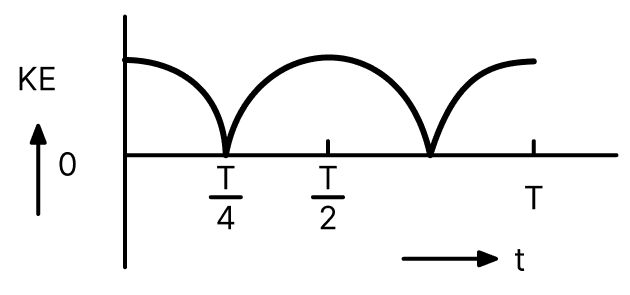
A particle is executing simple harmonic motion with a time period T. At time = 0, it is at its position of equilibrium. The kinetic energy-time graph of the particle will look like:
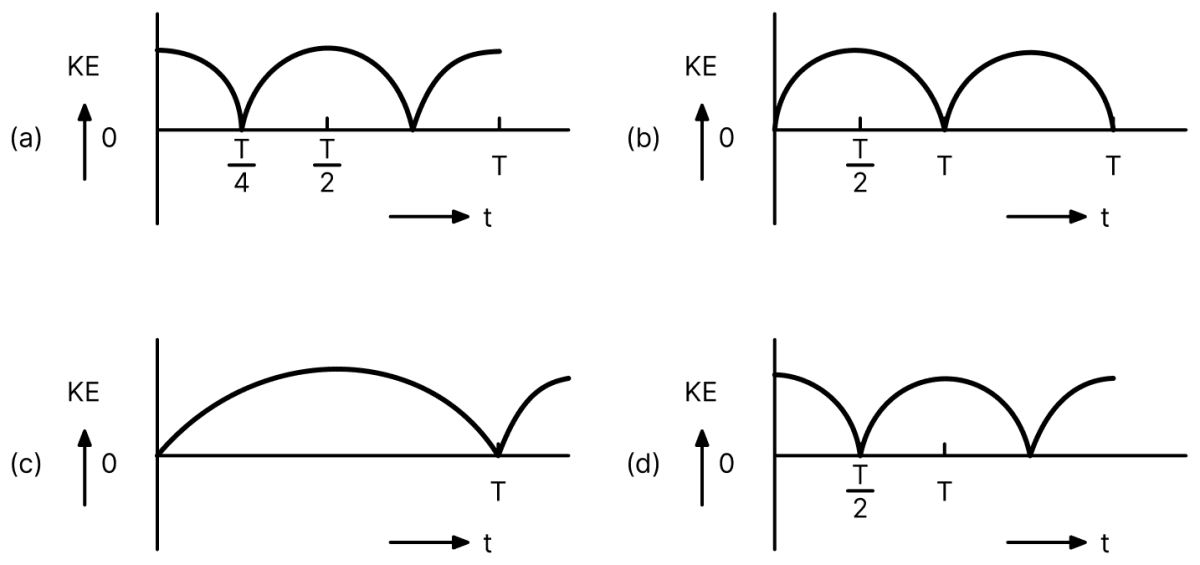
A particle is executing simple harmonic motion with a time period T. At time = 0, it is at its position of equilibrium. The kinetic energy-time graph of the particle will look like:. Oscillations, Solutions for Class 11 ISC Nootan Physics Kumar Mittal Nageen Prakashan

Answer

Graph (a)

Reason

A particle is executing simple harmonic motion with a time period T. At time = 0, it is at its position of equilibrium. The kinetic energy-time graph of the particle will look like:. Oscillations, Solutions for Class 11 ISC Nootan Physics Kumar Mittal Nageen Prakashan

Given,

  • At t = 0 the particle is at its equilibrium position

The velocity is maximum at the equilibrium position and zero at the extreme position. Hence the motion is described by

x=Asinωtv=dxdt=Aωcosωt\text x = \text A\sin ω\text t \quad \Rightarrow \quad \text v = \dfrac{\text{dx}}{\text{dt}} = \text Aω\cos ω\text t

The kinetic energy at any instant is

K=12mv2=12mA2ω2cos2ωt\text K = \dfrac{1}{2}\text m \text v^2 = \dfrac{1}{2}\text m \text A^2 ω^2\cos^2 ω\text t

At t = 0 : cos 0 = 1, so the kinetic energy is maximum.

At t=T4\text t = \dfrac{\text T}{4} : the particle is at the extreme position, and

K=12mA2ω2cos24=0\text K = \dfrac{1}{2}\text m \text A^2 ω^2\cos^2\dfrac{\text{2π}}{4} = 0

Since K varies as cos2ωt, the kinetic energy completes two full cycles in one time period T, starting from a maximum at t = 0 and touching zero at T4\dfrac{\text T}{4}, 3T4\dfrac{\text{3T}}{4} and so on. Only graph (a) shows this behaviour.

Question 6

A silver atom in a solid oscillates in simple harmonic motion in some direction with a frequency of 1012/sec. What is the force constant of the bonds connecting one atom with the other? (Mole wt. of silver = 108 and Avogadro number = 6.02 × 10²³ gm mole-1)

  1. 2.2 N/m
  2. 5.5 N/m
  3. 6.4 N/m
  4. 7.1 N/m.

Answer

7.1 N/m

Reason

Given,

  • Frequency of oscillation, n = 1012 s-1
  • Molecular weight of silver = 108
  • Avogadro number = 6.02 × 10²³ per gram mole

Mass of one silver atom :

m=1086.02×1023 gm=1086.02×1023×103 kg\text m = \dfrac{108}{6.02 \times 10^{23}}\ \text{gm} = \dfrac{108}{6.02 \times 10^{23}} \times 10^{-3}\ \text{kg}

Force constant : The frequency of a body of mass m attached to a spring of force constant k is

n=1kmk=4π2mn2\text n = \dfrac{1}{\text{2π}}\sqrt{\dfrac{\text k}{\text m}} \quad \Rightarrow \quad \text k = 4π^2 \text m \text n^2

Substituting the values,

k=4π2×108×1036.02×1023×(1012)2\text k = 4π^2 \times \dfrac{108 \times 10^{-3}}{6.02 \times 10^{23}} \times (10^{12})^2

k=4×10×108×1036.02×1023×1024[π210]\text k = \dfrac{4 \times 10 \times 108 \times 10^{-3}}{6.02 \times 10^{23}} \times 10^{24} \qquad [\because π^2 ≈ 10]

k=4.326.02×10=7.1 N m1\text k = \dfrac{4.32}{6.02} \times 10 = 7.1\ \text{N m}^{-1}

Question 7

A particle undergoing simple harmonic motion has time dependent displacement given by x(t)=Asinπt90\text x(\text t) = \text A\sin\dfrac{π\text t}{90}. The ratio of kinetic to potential energy of this particle at t = 210 s will be:

  1. 2

  2. 1

  3. 19\dfrac{1}{9}

  4. 13\dfrac{1}{3}

Answer

13\dfrac{1}{3}

Reason

Given,

  • x(t)=Asinπt90\text x(\text t) = \text A\sin\dfrac{π\text t}{90}
  • t = 210 s

Potential energy :

U=12mω2x2=12mω2A2sin2(πt90)\text U = \dfrac{1}{2}\text m ω^2 \text x^2 = \dfrac{1}{2}\text m ω^2 \text A^2\sin^2\left(\dfrac{π\text t}{90}\right)

At t = 210 s,

πt90=π×21090=3=+π3\dfrac{π\text t}{90} = \dfrac{π \times 210}{90} = \dfrac{\text{7π}}{3} = \text{2π} + \dfrac{π}{3}

U=12mω2A2sin2π3=12mω2A2×34=38mω2A2(i)\text U = \dfrac{1}{2}\text m ω^2 \text A^2\sin^2\dfrac{π}{3} = \dfrac{1}{2}\text m ω^2 \text A^2 \times \dfrac{3}{4} = \dfrac{3}{8}\text m ω^2 \text A^2 \qquad \dots(\text i)

Kinetic energy :

K=12mω2(A2x2)=12mω2A2cos2(πt90)\text K = \dfrac{1}{2}\text m ω^2(\text A^2 - \text x^2) = \dfrac{1}{2}\text m ω^2 \text A^2\cos^2\left(\dfrac{π\text t}{90}\right)

At t = 210 s,

K=12mω2A2cos2π3=12mω2A2×14=18mω2A2(ii)\text K = \dfrac{1}{2}\text m ω^2 \text A^2\cos^2\dfrac{π}{3} = \dfrac{1}{2}\text m ω^2 \text A^2 \times \dfrac{1}{4} = \dfrac{1}{8}\text m ω^2 \text A^2 \qquad \dots(\text{ii})

Dividing equation (ii) by equation (i),

KU=18mω2A238mω2A2=13\dfrac{\text K}{\text U} = \dfrac{\dfrac{1}{8}\text m ω^2 \text A^2}{\dfrac{3}{8}\text m ω^2 \text A^2} = \dfrac{1}{3}

Question 8

A particle is executing simple harmonic motion (SHM) of amplitude A, along the X-axis, about x = 0. When its potential energy (PE) equals kinetic energy (KE), the position of the particle will be:

  1. A

  2. A2\dfrac{\text A}{2}

  3. A22\dfrac{\text A}{2\sqrt2}

  4. A2\dfrac{\text A}{\sqrt2}

Answer

A2\dfrac{\text A}{\sqrt2}

Reason

Given,

  • Amplitude of the S.H.M. = A
  • Condition : potential energy = kinetic energy

At a displacement x from the mean position,

U=12mω2x2andK=12mω2(A2x2)\text U = \dfrac{1}{2}\text m ω^2 \text x^2 \qquad \text{and} \qquad \text K = \dfrac{1}{2}\text m ω^2(\text A^2 - \text x^2)

Putting K = U,

12mω2(A2x2)=12mω2x2\dfrac{1}{2}\text m ω^2(\text A^2 - \text x^2) = \dfrac{1}{2}\text m ω^2 \text x^2

A2x2=x2A2=2x2\text A^2 - \text x^2 = \text x^2 \quad \Rightarrow \quad \text A^2 = 2\text x^2

A22=x2x=A2\dfrac{\text A^2}{2} = \text x^2 \quad \Rightarrow \quad \text x = \dfrac{\text A}{\sqrt2}

Question 9

A simple harmonic motion is represented by y=5(sin3πt+3cos3πt)\text y = 5\left(\sin 3π\text t + \sqrt3\cos 3π\text t\right) cm. The amplitude and time period of the motion are:

  1. 10 cm, 32\dfrac{3}{2} s

  2. 5 cm, 23\dfrac{2}{3} s

  3. 5 cm, 32\dfrac{3}{2} s

  4. 10 cm, 23\dfrac{2}{3} s.

Answer

10 cm, 23\dfrac{2}{3} s

Reason

Given,

  • y=5(sin3πt+3cos3πt)\text y = 5\left(\sin 3π\text t + \sqrt3\cos 3π\text t\right) cm

Taking 2 common inside the bracket,

y=5×2(12sin3πt+32cos3πt)\text y = 5 \times 2\left(\dfrac{1}{2}\sin 3π\text t + \dfrac{\sqrt3}{2}\cos 3π\text t\right)

y=10(cosπ3sin3πt+sinπ3cos3πt)\text y = 10\left(\cos\dfrac{π}{3}\sin 3π\text t + \sin\dfrac{π}{3}\cos 3π\text t\right)

Using sin (A + B) = sin A cos B + cos A sin B,

y=10sin(3πt+π3)(i)\text y = 10\sin\left(3π\text t + \dfrac{π}{3}\right) \qquad \dots(\text i)

Comparing equation (i) with the general equation of S.H.M., y = A sin (ωt + φ),

A=10 cmandω=3π rad s1\text A = 10\ \text{cm} \qquad \text{and} \qquad ω = 3π\ \text{rad s}^{-1}

The time period is

T=ω=3π=23 s\text T = \dfrac{\text{2π}}{ω} = \dfrac{\text{2π}}{3π} = \dfrac{2}{3}\ \text s

Question 10

A particle executes simple harmonic motion with an amplitude of 5 cm. When the particle is at 4 cm from the mean position, the magnitude of its velocity in SI units is equal to that of its acceleration. Then, its periodic time (in seconds) is:

  1. 3\dfrac{\text{4π}}{3}

  2. 3\dfrac{\text{8π}}{3}

  3. 3\dfrac{\text{7π}}{3}

  4. 8\dfrac{\text{3π}}{8}

Answer

3\dfrac{\text{8π}}{3}

Reason

Given,

  • Amplitude, a = 5 cm
  • Displacement, y = 4 cm
  • Magnitude of velocity = magnitude of acceleration

In S.H.M.,

u=ωa2y2andα=ω2y\text u = ω\sqrt{\text a^2 - \text y^2} \qquad \text{and} \qquad |α| = ω^2 \text y

Equating the two at y = 4 cm,

ω5242=ω2×4ω\sqrt{5^2 - 4^2} = ω^2 \times 4

2516=4ω3=4ω\sqrt{25 - 16} = 4ω \quad \Rightarrow \quad 3 = 4ω

ω=34 rad s1ω = \dfrac{3}{4}\ \text{rad s}^{-1}

The periodic time is

T=ω=34=3 s\text T = \dfrac{\text{2π}}{ω} = \dfrac{\text{2π}}{\dfrac{3}{4}} = \dfrac{\text{8π}}{3}\ \text s

Question 11

A spring whose unstretched length is l has a force constant k. The spring is cut into two pieces of unstretched lengths l1 and l2 where, l1 = nl2 and n is an integer. The ratio k2k1\dfrac{\text k_2}{\text k_1} of the corresponding force constants k1 and k2 will be:

  1. n

  2. 1n2\dfrac{1}{\text n^2}

  3. 1n\dfrac{1}{\text n}

  4. n2

Answer

1n\dfrac{1}{\text n}

Reason

Given,

  • Force constant of the original spring = k
  • l1 = nl2, where n is an integer

Since the restoring force is F = − kl, the force constant of a spring is inversely proportional to its unstretched length,

k1l\text k \propto \dfrac{1}{\text l}

Hence, for the two pieces,

k1k2=l2l1=l2nl2=1n\dfrac{\text k_1}{\text k_2} = \dfrac{\text l_2}{\text l_1} = \dfrac{\text l_2}{\text n \text l_2} = \dfrac{1}{\text n}

Note: The stem asks for k2k1\dfrac{\text k_2}{\text k_1} but then names the constants in the order "k1 and k2", and the printed answer key gives 1n\dfrac{1}{\text n}, which is the value of k1k2\dfrac{\text k_1}{\text k_2}. Read exactly as printed, k2k1=n\dfrac{\text k_2}{\text k_1} = \text n, that is, option 1. The ratio intended by the question is k1k2=1n\dfrac{\text k_1}{\text k_2} = \dfrac{1}{\text n}.

Question 12

A massless spring (k = 800 N/m), attached with a mass (500 g) is completely immersed in 1 kg of water. The spring is stretched by 2 cm and released, so that it starts vibrating. What would be the order of magnitude of the change in the temperature of water when the vibrations stop completely? (Assume that the water container and spring receive negligible heat and specific heat of mass = 400 J/kg K, specific heat of water = 4184 J/kg K).

  1. 10-4 K
  2. 10-3 K
  3. 10-1 K
  4. 10-5 K.

Answer

10-5 K

Reason

Given,

  • Force constant of the spring, k = 800 N m-1
  • Mass attached, m1 = 500 g = 0.5 kg, specific heat c1 = 400 J kg-1 K-1
  • Mass of water, m2 = 1 kg, specific heat c2 = 4184 J kg-1 K-1
  • Amplitude of oscillation, x = 2 cm = 0.02 m

When the vibrations of the mass stop completely, the energy stored in the spring is dissipated in the form of heat, due to which the temperature of the water rises. Hence, by the law of conservation of energy,

12kx2=(m1c1+m2c2)ΔT\dfrac{1}{2}\text k \text x^2 = (\text m_1 \text c_1 + \text m_2 \text c_2)Δ\text T

Solving for the rise in temperature,

ΔT=12kx2m1c1+m2c2Δ\text T = \dfrac{\dfrac{1}{2}\text k \text x^2}{\text m_1 \text c_1 + \text m_2 \text c_2}

Substituting the values,

ΔT=12×800×(0.02)2(0.5×400)+(1×4184)=0.16200+4184Δ\text T = \dfrac{\dfrac{1}{2} \times 800 \times (0.02)^2}{(0.5 \times 400) + (1 \times 4184)} = \dfrac{0.16}{200 + 4184}

ΔT=0.164384=3.65×10⁵ KΔ\text T = \dfrac{0.16}{4384} = 3.65 \times 10^{-5}\ \text K

Hence the order of magnitude of the change in the temperature of water is 10-5 K.

Question 13

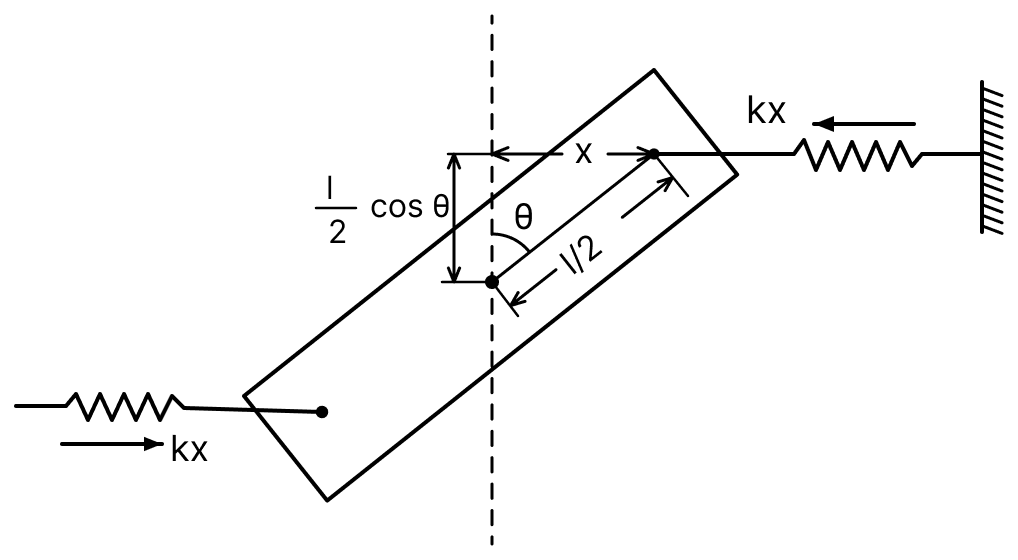
Two light identical springs of spring constant k are attached horizontally at the two ends of an uniform horizontal rod AB of length l and mass m. The rod is pivoted at its centre 'O' and can rotate freely in horizontal plane. The other ends of the two springs are fixed to rigid supports as shown in figure. The rod is gently pushed through a small angle and released. The frequency of resulting oscillation is:
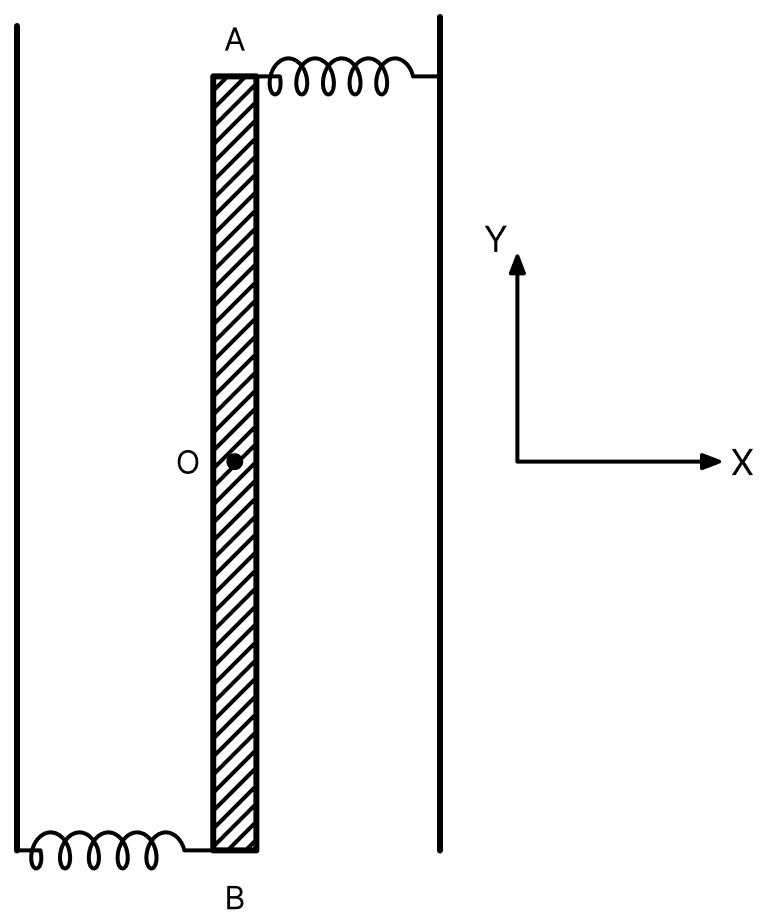
Two light identical springs of spring constant k are attached horizontally at the two ends of an uniform horizontal rod AB of length l and mass m. The rod is pivoted at its centre O and can rotate freely in horizontal plane. The other ends of the two springs are fixed to rigid supports as shown in figure. The rod is gently pushed through a small angle and released. The frequency of resulting oscillation is:. Oscillations, Solutions for Class 11 ISC Nootan Physics Kumar Mittal Nageen Prakashan
  1. 12km\dfrac{1}{\text{2π}}\sqrt{\dfrac{2\text k}{\text m}}
  2. 13km\dfrac{1}{\text{2π}}\sqrt{\dfrac{3\text k}{\text m}}
  3. 16km\dfrac{1}{\text{2π}}\sqrt{\dfrac{6\text k}{\text m}}
  4. 1km\dfrac{1}{\text{2π}}\sqrt{\dfrac{\text k}{\text m}}

Answer

16km\dfrac{1}{\text{2π}}\sqrt{\dfrac{6\text k}{\text m}}

Reason

Two light identical springs of spring constant k are attached horizontally at the two ends of an uniform horizontal rod AB of length l and mass m. The rod is pivoted at its centre O and can rotate freely in horizontal plane. The other ends of the two springs are fixed to rigid supports as shown in figure. The rod is gently pushed through a small angle and released. The frequency of resulting oscillation is:. Oscillations, Solutions for Class 11 ISC Nootan Physics Kumar Mittal Nageen Prakashan

Given,

  • Spring constant of each spring = k
  • Length of the rod = l and its mass = m
  • The rod is pivoted at its centre O

When the rod is turned through a small angle θ, each end of the rod is displaced through

x=l2θ\text x = \dfrac{\text l}{2}θ

Each spring then exerts a restoring force kx at a perpendicular distance l2\dfrac{\text l}{2} from the pivot. Hence the total restoring torque due to the two springs is

τ=2(kx×l2)cosθ=kxlcosθτ = 2\left(\text{kx} \times \dfrac{\text l}{2}\right)\cos θ = \text{kxl}\cos θ

For a small deflection, cos θ ≈ 1 and x=l2θ\text x = \dfrac{\text l}{2}θ, so

τ=k(l2θ)l=kl22θτ = \text k\left(\dfrac{\text l}{2}θ\right)\text l = \dfrac{\text k \text l^2}{2}θ

The moment of inertia of the rod about an axis through its centre and perpendicular to its length is

I=ml212\text I = \dfrac{\text m \text l^2}{12}

The angular acceleration is therefore

α=τI=kl22θml212=6kmθα = \dfrac{τ}{\text I} = \dfrac{\dfrac{\text k \text l^2}{2}θ}{\dfrac{\text m \text l^2}{12}} = \dfrac{6\text k}{\text m}θ

Since the angular acceleration is proportional to the angular displacement and is directed opposite to it, the motion is angular simple harmonic with

ω2=6kmω^2 = \dfrac{6\text k}{\text m}

Hence the frequency of the resulting oscillation is

n=ω=16km\text n = \dfrac{ω}{\text{2π}} = \dfrac{1}{\text{2π}}\sqrt{\dfrac{6\text k}{\text m}}

Question 14

A block of mass m lying on a smooth horizontal surface is attached to a spring (of negligible mass) of spring constant k. The other end of the spring is fixed as shown in the figure. The block is initially at rest in its equilibrium position. If now the block is pulled with a constant force F, the maximum speed of the block is:
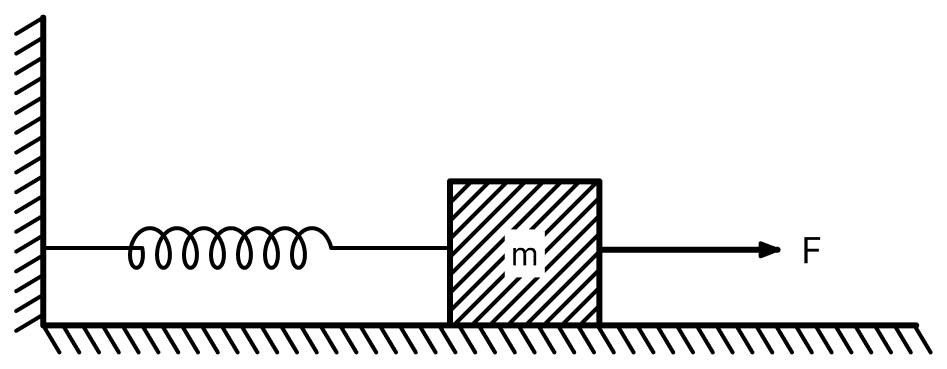
A block of mass m lying on a smooth horizontal surface is attached to a spring (of negligible mass) of spring constant k. The other end of the spring is fixed as shown in the figure. The block is initially at rest in its equilibrium position. If now the block is pulled with a constant force F, the maximum speed of the block is:. Oscillations, Solutions for Class 11 ISC Nootan Physics Kumar Mittal Nageen Prakashan
  1. πFmk\dfrac{π\text F}{\sqrt{\text{mk}}}

  2. Fmk\dfrac{\text F}{\sqrt{\text{mk}}}

  3. 2Fmk\dfrac{2\text F}{\sqrt{\text{mk}}}

  4. Fπmk\dfrac{\text F}{π\sqrt{\text{mk}}}

Answer

Fmk\dfrac{\text F}{\sqrt{\text{mk}}}

Reason

Given,

  • Mass of the block = m
  • Spring constant = k
  • Constant applied force = F

The speed of the block is maximum at the new equilibrium position, that is, at the point where the restoring force of the spring balances the applied force F. If x is the extension at this position, then

F=kxx=Fk\text F = \text{kx} \quad \Rightarrow \quad \text x = \dfrac{\text F}{\text k}

Since the block starts from rest at the natural length of the spring and executes S.H.M. about this new equilibrium position, the amplitude of the motion is

A=x=Fk\text A = \text x = \dfrac{\text F}{\text k}

The maximum speed of a particle in S.H.M. is

vmax=Aω=Fkkm[ω=km]\text v_{max} = \text A ω = \dfrac{\text F}{\text k}\sqrt{\dfrac{\text k}{\text m}} \qquad \left[\because ω = \sqrt{\dfrac{\text k}{\text m}}\right]

vmax=Fmk\text v_{max} = \dfrac{\text F}{\sqrt{\text{mk}}}

Question 15

A simple pendulum oscillating in air has period T. The bob of the pendulum is completely immersed in a non-viscous liquid. The density of the liquid is 116\dfrac{1}{16} th of the material of the bob. If the bob is inside liquid all the time, its period of oscillation in this liquid is:

  1. 2T1102\text T\sqrt{\dfrac{1}{10}}

  2. 2T1142\text T\sqrt{\dfrac{1}{14}}

  3. 4T1144\text T\sqrt{\dfrac{1}{14}}

  4. 4T1154\text T\sqrt{\dfrac{1}{15}}

Answer

4T1154\text T\sqrt{\dfrac{1}{15}}

Reason

Given,

  • Period of oscillation in air = T
  • Density of the liquid, ρliquid=ρ16ρ_{liquid} = \dfrac{ρ}{16}, where ρ is the density of the material of the bob

In air : The effective value of the acceleration due to gravity is g, so

T=Lg(i)\text T = \text{2π}\sqrt{\dfrac{\text L}{\text g}} \qquad \dots(\text i)

In the liquid : The bob experiences an upthrust equal to the weight of the liquid displaced. If V is the volume of the bob, the net downward force on it is

Fnet=VρgV(ρ16)g(ii)\text F_{net} = \text Vρ\text g - \text V\left(\dfrac{ρ}{16}\right)\text g \qquad \dots(\text{ii})

Writing this net force in terms of the effective acceleration due to gravity,

Fnet=Vρgeffective(iii)\text F_{net} = \text Vρ\text g_{effective} \qquad \dots(\text{iii})

From equations (ii) and (iii),

Vρgeffective=VρgVρg16\text Vρ\text g_{effective} = \text Vρ\text g - \dfrac{\text Vρ\text g}{16}

geffective=gg16=15g16\text g_{effective} = \text g - \dfrac{\text g}{16} = \dfrac{15\text g}{16}

Hence the new time period is

T=L15g16=1615×Lg\text T' = \text{2π}\sqrt{\dfrac{\text L}{\dfrac{15\text g}{16}}} = \sqrt{\dfrac{16}{15}} \times \text{2π}\sqrt{\dfrac{\text L}{\text g}}

T=4T115\text T' = 4\text T\sqrt{\dfrac{1}{15}}

Question 16

A simple pendulum of length 1 m is oscillating with an angular frequency 10 rad/s. The support of the pendulum starts oscillating up and down with a small angular frequency of 1 rad/s and an amplitude of 10-2 m. The relative change in the angular frequency of the pendulum is best given by:

  1. 1 rad/s
  2. 10-5 rad/s
  3. 10-3 rad/s
  4. 10-1 rad/s.

Answer

10-3 rad/s

Reason

Given,

  • Length of the pendulum, l = 1 m
  • Angular frequency of the pendulum, ω = 10 rad s-1
  • Angular frequency of the support, ω1 = 1 rad s-1
  • Amplitude of the support, A = 10-2 m

The angular frequency of a simple pendulum is

ω=T=gl(i)ω = \dfrac{\text{2π}}{\text T} = \sqrt{\dfrac{\text g}{\text l}} \qquad \dots(\text i)

Differentiating with respect to g,

dωdg=12gldω=dg2gl(ii)\dfrac{\text dω}{\text{dg}} = \dfrac{1}{2\sqrt{\text g}\sqrt{\text l}} \quad \Rightarrow \quad \text dω = \dfrac{\text{dg}}{2\sqrt{\text{gl}}} \qquad \dots(\text{ii})

Dividing equation (ii) by equation (i),

dωω=dg2gΔωω=Δg2g\dfrac{\text dω}{ω} = \dfrac{\text{dg}}{2\text g} \quad \Rightarrow \quad \dfrac{Δω}{ω} = \dfrac{Δ\text g}{2\text g}

The change in the effective value of g arises from the oscillation of the support, whose maximum acceleration is ω12Aω_1^2 \text A. Taking the full variation between the two extremes,

Δg=2ω12AΔ\text g = 2ω_1^2 \text A

Substituting this value,

Δωω=2ω12A2g=ω12Ag=(1 rad s1)2×10² m10 m s2\dfrac{Δω}{ω} = \dfrac{2ω_1^2 \text A}{2\text g} = \dfrac{ω_1^2 \text A}{\text g} = \dfrac{(1\ \text{rad s}^{-1})^2 \times 10^{-2}\ \text m}{10\ \text{m s}^{-2}}

Δωω=103\dfrac{Δω}{ω} = 10^{-3}

Question 17

A pendulum is executing simple harmonic motion and its maximum kinetic energy is K1. If the length of the pendulum is doubled and it performs simple harmonic motion with the same amplitude as in the first case, its maximum kinetic energy is K2. Then:

  1. K2 = 2K1

  2. K2=K12\text K_2 = \dfrac{\text K_1}{2}

  3. K2=K14\text K_2 = \dfrac{\text K_1}{4}

  4. K2 = K1

Answer

K2=K12\text K_2 = \dfrac{\text K_1}{2}

Reason

Given,

  • The amplitude a is the same in both the cases
  • The length of the pendulum in the second case, l2 = 2l1

In S.H.M. the maximum speed is umax = aω, so the maximum kinetic energy is

Kmax=12m(aω)2=12ma2ω2\text K_{max} = \dfrac{1}{2}\text m(\text a ω)^2 = \dfrac{1}{2}\text m \text a^2 ω^2

For a simple pendulum the angular frequency is

ω=T=lg=glω2=glω = \dfrac{\text{2π}}{\text T} = \dfrac{\text{2π}}{\text{2π}\sqrt{\dfrac{\text l}{\text g}}} = \sqrt{\dfrac{\text g}{\text l}} \quad \Rightarrow \quad ω^2 = \dfrac{\text g}{\text l}

Hence, for a fixed amplitude,

Kmaxω21l\text K_{max} \propto ω^2 \propto \dfrac{1}{\text l}

Therefore,

(Kmax)1(Kmax)2=l2l1=2l1l1=2\dfrac{(\text K_{max})_1}{(\text K_{max})_2} = \dfrac{\text l_2}{\text l_1} = \dfrac{2\text l_1}{\text l_1} = 2

K2=K12\text K_2 = \dfrac{\text K_1}{2}

Question 18

When a particle executes simple harmonic motion, the nature of graph of velocity as a function of displacement will be:

  1. circular
  2. elliptical
  3. sinusoidal
  4. straight line.

Answer

elliptical

Reason

Let the displacement of the particle be

x=Asinωt\text x = \text A\sin ω\text t

Differentiating with respect to time, the velocity is

v=Aωcosωtv=±ωA2x2\text v = \text Aω\cos ω\text t \quad \Rightarrow \quad \text v = \pmω\sqrt{\text A^2 - \text x^2}

Squaring and rearranging,

v2=ω2(A2x2)v2ω2+x2=A2\text v^2 = ω^2(\text A^2 - \text x^2) \quad \Rightarrow \quad \dfrac{\text v^2}{ω^2} + \text x^2 = \text A^2

v2A2ω2+x2A2=1\dfrac{\text v^2}{\text A^2ω^2} + \dfrac{\text x^2}{\text A^2} = 1

This is the standard equation of an ellipse with semi-axes A along the displacement axis and Aω along the velocity axis. Hence the velocity-displacement graph of a particle in S.H.M. is an ellipse.

Question 19

As per the given figure, two blocks each of mass 250 g are connected to a spring of spring constant 2 Nm-1. If both are given velocity v in opposite directions, then maximum elongation of the spring is:

As per the given figure, two blocks each of mass 250 g are connected to a spring of spring constant 2 Nm -1. If both are given velocity v in opposite directions, then maximum elongation of the spring is:. Oscillations, Solutions for Class 11 ISC Nootan Physics Kumar Mittal Nageen Prakashan
  1. v22\dfrac{\text v}{2\sqrt2}

  2. v2\dfrac{\text v}{2}

  3. v4\dfrac{\text v}{4}

  4. v2\dfrac{\text v}{\sqrt2}

Answer

v2\dfrac{\text v}{2}

Reason

Given,

  • Mass of each block, m = 250 g = 0.25 kg
  • Spring constant, k = 2 N m-1
  • Each block is given a velocity v in opposite directions

At the instant of maximum elongation the two blocks are momentarily at rest relative to each other, so the whole of the kinetic energy of the two blocks has been converted into the potential energy stored in the spring. By the law of conservation of energy,

2×12mv2=12kxm22 \times \dfrac{1}{2}\text m \text v^2 = \dfrac{1}{2}\text k \text x_m^2

Substituting the values,

2×12×0.25×v2=12×2×xm22 \times \dfrac{1}{2} \times 0.25 \times \text v^2 = \dfrac{1}{2} \times 2 \times \text x_m^2

0.25v2=xm20.25\text v^2 = \text x_m^2

xm=v24=v2\text x_m = \sqrt{\dfrac{\text v^2}{4}} = \dfrac{\text v}{2}

Question 20

Two pendulums of length 121 cm and 100 cm start vibrating in phase. At some instant, the two are at their mean position in the same phase. The minimum number of vibrations of the shorter pendulum after which the two are again in phase at the mean position is:

  1. 10
  2. 8
  3. 11
  4. 9

Answer

11

Reason

Given,

  • Length of the longer pendulum, L1 = 121 cm
  • Length of the shorter pendulum, L2 = 100 cm

The time period of a simple pendulum is T=Lg\text T = \text{2π}\sqrt{\dfrac{\text L}{\text g}}, so

T1T2=L1L2=121100=1110\dfrac{\text T_1}{\text T_2} = \sqrt{\dfrac{\text L_1}{\text L_2}} = \sqrt{\dfrac{121}{100}} = \dfrac{11}{10}

10T1=11T210\text T_1 = 11\text T_2

Thus the time taken by the longer pendulum to complete 10 vibrations is exactly equal to the time taken by the shorter pendulum to complete 11 vibrations. At the end of this interval both pendulums are again at the mean position in the same phase.

Hence, the minimum number of vibrations of the shorter pendulum is 11.

Question 21

If x=5sin(πt+π3)\text x = 5\sin\left(π\text t + \dfrac{π}{3}\right) m represents the motion of a particle executing S.H.M., the amplitude and the time-period of motion respectively:

  1. 5 cm, 2 s
  2. 5 m, 2 s
  3. 5 cm, 1 s
  4. 5 m, 1 s.

Answer

5 m, 2 s

Reason

Given,

  • x=5sin(πt+π3)\text x = 5\sin\left(π\text t + \dfrac{π}{3}\right) m

Comparing with the general equation of S.H.M., x = A sin (ωt + φ),

A=5 mandω=π rad s1\text A = 5\ \text m \qquad \text{and} \qquad ω = π\ \text{rad s}^{-1}

The time period of the motion is

T=ω=π=2 s\text T = \dfrac{\text{2π}}{ω} = \dfrac{\text{2π}}{π} = 2\ \text s

Since the displacement is expressed in metre, the amplitude is 5 m and the time period is 2 s.

Question 22

A particle is subjected two simple harmonic motions as:

x1=7sin5t cm and x2=27sin(5t+π3) cm\text x_1 = \sqrt7\sin 5\text t \text{ cm and } \text x_2 = 2\sqrt7\sin\left(5\text t + \dfrac{π}{3}\right) \text{ cm}

where x is displacement and t is time in seconds. The maximum acceleration of the particle is x × 10-2 ms-2. The value of x is:

  1. 175
  2. 257
  3. 57
  4. 125

Answer

175

Reason

Given,

  • x1=7sin5t\text x_1 = \sqrt7\sin 5\text t cm and x2=27sin(5t+π3)\text x_2 = 2\sqrt7\sin\left(5\text t + \dfrac{π}{3}\right) cm
  • Phase difference, θ=π3=60°θ = \dfrac{π}{3} = 60°

Resultant amplitude : For two simple harmonic motions of the same angular frequency, the resultant amplitude is

A=A12+A22+2A1A2cosθ\text A = \sqrt{\text A_1^2 + \text A_2^2 + 2\text A_1\text A_2\cos θ}

Substituting A1=7\text A_1 = \sqrt7 cm, A2=27\text A_2 = 2\sqrt7 cm and cos 60° = 0.5,

A=(7)2+(27)2+2×7×27×0.5\text A = \sqrt{(\sqrt7)^2 + (2\sqrt7)^2 + 2 \times \sqrt7 \times 2\sqrt7 \times 0.5}

A=7+28+14=49=7 cm\text A = \sqrt{7 + 28 + 14} = \sqrt{49} = 7\ \text{cm}

Maximum acceleration : Since both the motions have ω = 5 rad s-1, the resultant motion also has ω = 5 rad s-1. Hence

αmax=Aω2=7 cm×(5 s1)2=175 cm s2α_{max} = \text A ω^2 = 7\ \text{cm} \times (5\ \text s^{-1})^2 = 175\ \text{cm s}^{-2}

αmax=175×102 m s2α_{max} = 175 \times 10^{-2}\ \text{m s}^{-2}

Comparing with the given form x × 10-2 m s-2, the value of x is 175.

Question 23

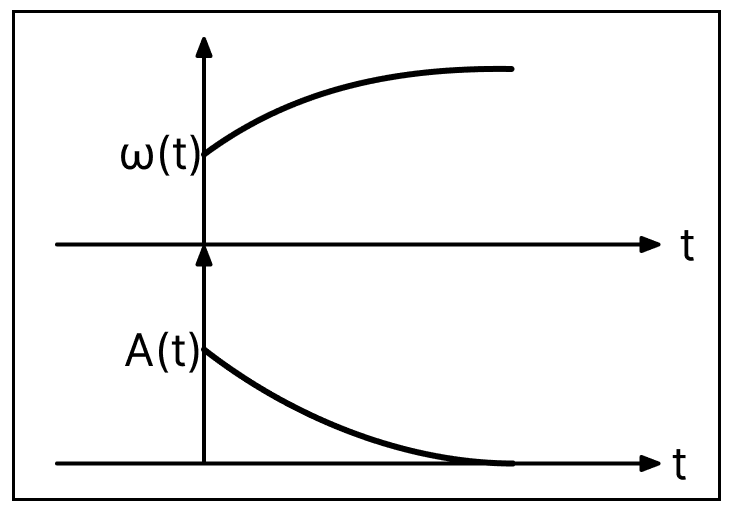
In an oscillating spring mass system, a spring is connected to a box filled with sand. As the box oscillates, sand leaks slowly out of the box vertically so that the average frequency ω(t) and average amplitude A(t) of the system change with time t. Which one of the following options schematically depicts these changes correctly?
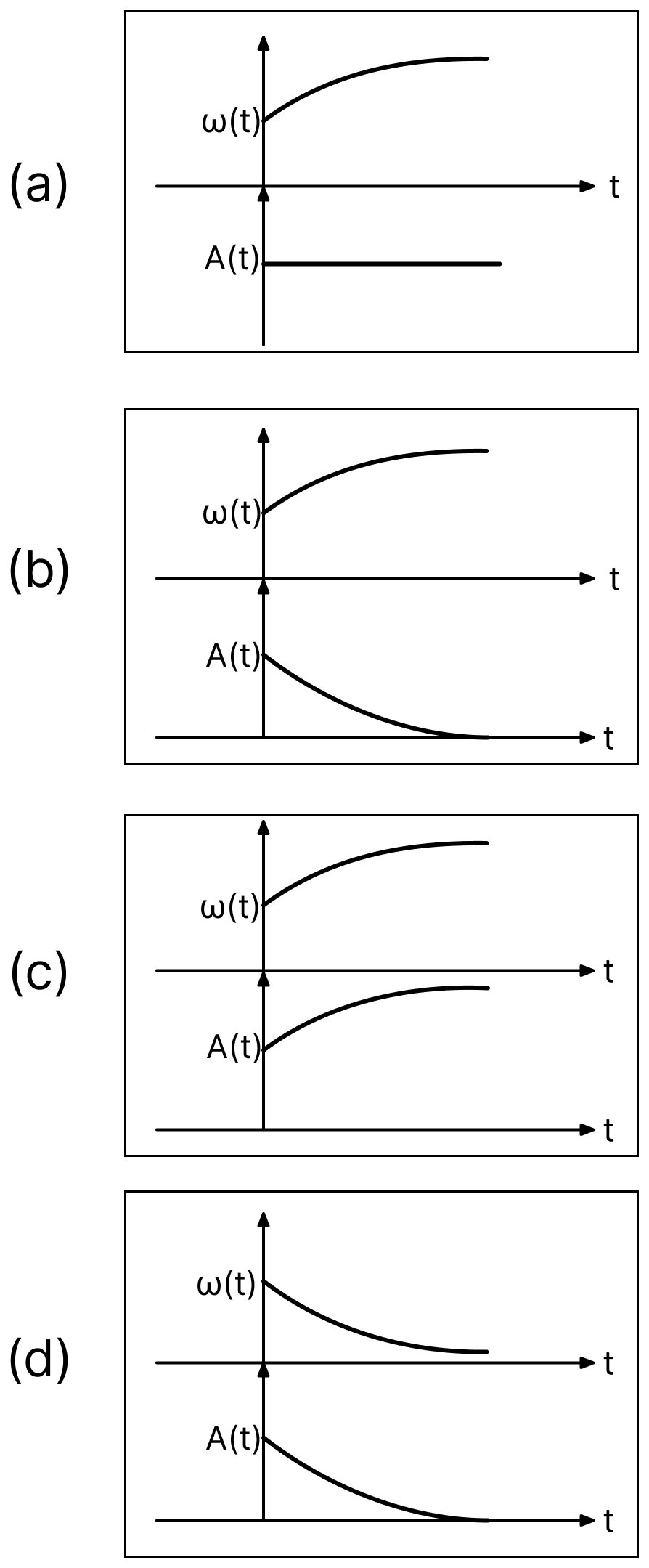
In an oscillating spring mass system, a spring is connected to a box filled with sand. As the box oscillates, sand leaks slowly out of the box vertically so that the average frequency ω(t) and average amplitude A(t) of the system change with time t. Which one of the following options schematically depicts these changes correctly? Oscillations, Solutions for Class 11 ISC Nootan Physics Kumar Mittal Nageen Prakashan

Answer

Graph (b)

Reason

In an oscillating spring mass system, a spring is connected to a box filled with sand. As the box oscillates, sand leaks slowly out of the box vertically so that the average frequency ω(t) and average amplitude A(t) of the system change with time t. Which one of the following options schematically depicts these changes correctly? Oscillations, Solutions for Class 11 ISC Nootan Physics Kumar Mittal Nageen Prakashan

The angular frequency of a spring-mass system is

ω=kmω = \sqrt{\dfrac{\text k}{\text m}}

where k is a constant and m decreases with time as the sand leaks out.

Effect on ω(t) : Since m appears in the denominator under the square-root, a decrease in m makes ω increase with time. The increase becomes slower as the box empties, so ω(t) rises and then levels off.

Effect on A(t) : The leaking sand carries energy away from the oscillating system, which acts like a dissipative effect. Hence the amplitude A(t) must decrease with time.

Checking the four options against these two requirements :

  • (a) ω(t) increases and levels off, but A(t) remains constant. The amplitude cannot stay constant while energy is being lost, so this is wrong.
  • (b) ω(t) increases and levels off, and A(t) decreases with time. This is correct.
  • (c) ω(t) increases, but A(t) increases with time. The amplitude cannot increase with energy loss, so this is wrong.
  • (d) ω(t) decreases with time, which is wrong.

Hence, graph (b) depicts the changes correctly.

Question 24

Two identical point masses P and Q, suspended from two separate massless springs of spring constants k1 and k2 respectively, oscillate vertically. If their maximum speeds are the same, the ratio (AQAP)\left(\dfrac{\text A_\text Q}{\text A_\text P}\right) of the amplitude AQ of mass Q to the amplitude AP of mass P is:

  1. k2k1\dfrac{\text k_2}{\text k_1}

  2. k1k2\dfrac{\text k_1}{\text k_2}

  3. k2k1\sqrt{\dfrac{\text k_2}{\text k_1}}

  4. k1k2\sqrt{\dfrac{\text k_1}{\text k_2}}

Answer

k1k2\sqrt{\dfrac{\text k_1}{\text k_2}}

Reason

Given,

  • The two point masses are identical, so mP = mQ = m
  • Their maximum speeds are the same

The maximum speed of a particle in S.H.M. is umax = Aω. Since the maximum speeds are equal,

APωP=AQωQ\text A_\text P ω_\text P = \text A_\text Q ω_\text Q

For a spring-mass system, ω=kmω = \sqrt{\dfrac{\text k}{\text m}}. Substituting,

APk1mP=AQk2mQ\text A_\text P\sqrt{\dfrac{\text k_1}{\text m_\text P}} = \text A_\text Q\sqrt{\dfrac{\text k_2}{\text m_\text Q}}

Since the masses are equal, they cancel out,

AQAP=k1k2\dfrac{\text A_\text Q}{\text A_\text P} = \sqrt{\dfrac{\text k_1}{\text k_2}}

Question 25

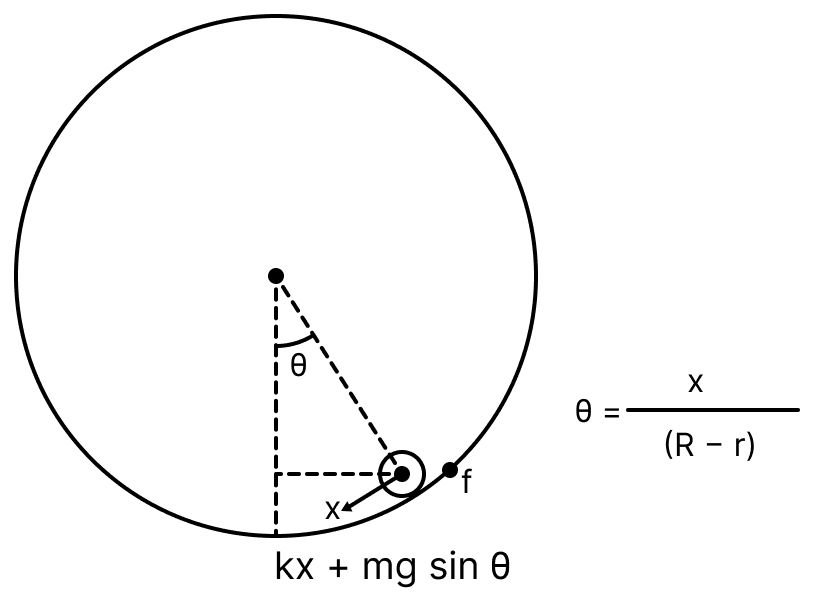
The centre of a disk of radius r and mass m is attached to a spring of spring constant k, inside a ring of radius R > r as shown in the figure. The other end of the spring is attached on the periphery of the ring. Both the ring and the disk are in the same vertical plane. The disk can only roll along the inside periphery of the ring, without slipping. The spring can only be stretched or compressed along the periphery of the ring, following the Hooke's law. In equilibrium, the disk is at the bottom of the ring. Assuming small displacement of the disc, the time period of oscillation of centre of mass of the disk is written as T=ω\text T = \dfrac{\text{2π}}{ω}. The correct expression for ω is (g is the acceleration due to gravity):
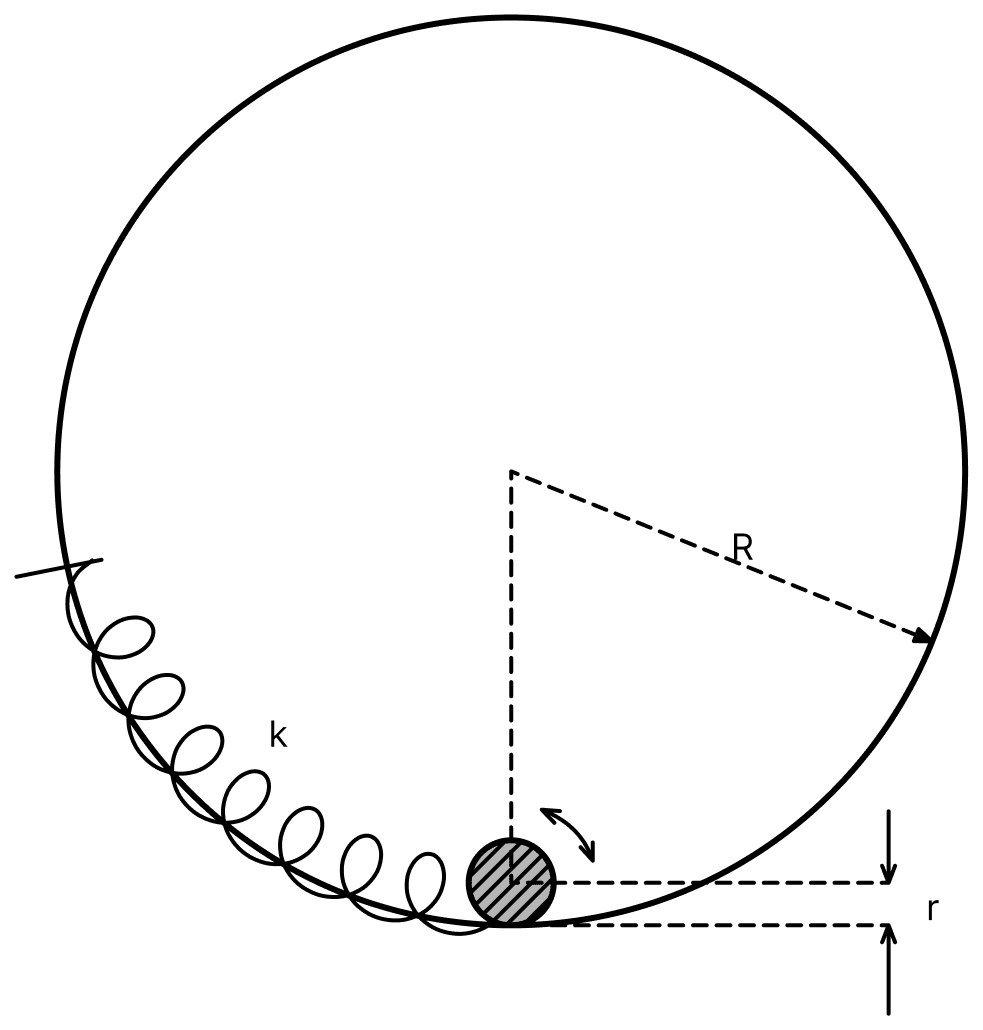
The centre of a disk of radius r and mass m is attached to a spring of spring constant k, inside a ring of radius R > r as shown in the figure. The other end of the spring is attached on the periphery of the ring. Both the ring and the disk are in the same vertical plane. The disk can only roll along the inside periphery of the ring, without slipping. The spring can only be stretched or compressed along the periphery of the ring, following the Hookes law. In equilibrium, the disk is at the bottom of the ring. Assuming small displacement of the disc, the time period of oscillation of centre of mass of the disk is written as text T = dfrac2πω. The correct expression for ω is (g is the acceleration due to gravity):. Oscillations, Solutions for Class 11 ISC Nootan Physics Kumar Mittal Nageen Prakashan
  1. 23(gRr+km)\sqrt{\dfrac{2}{3}\left(\dfrac{\text g}{\text R - \text r} + \dfrac{\text k}{\text m}\right)}

  2. 2g3(Rr)+km\sqrt{\dfrac{2\text g}{3(\text R - \text r)} + \dfrac{\text k}{\text m}}

  3. 16(gRr+km)\sqrt{\dfrac{1}{6}\left(\dfrac{\text g}{\text R - \text r} + \dfrac{\text k}{\text m}\right)}

  4. 14(gRr+km)\sqrt{\dfrac{1}{4}\left(\dfrac{\text g}{\text R - \text r} + \dfrac{\text k}{\text m}\right)}

Answer

23(gRr+km)\sqrt{\dfrac{2}{3}\left(\dfrac{\text g}{\text R - \text r} + \dfrac{\text k}{\text m}\right)}

Reason

The centre of a disk of radius r and mass m is attached to a spring of spring constant k, inside a ring of radius R > r as shown in the figure. The other end of the spring is attached on the periphery of the ring. Both the ring and the disk are in the same vertical plane. The disk can only roll along the inside periphery of the ring, without slipping. The spring can only be stretched or compressed along the periphery of the ring, following the Hookes law. In equilibrium, the disk is at the bottom of the ring. Assuming small displacement of the disc, the time period of oscillation of centre of mass of the disk is written as text T = dfrac2πω. The correct expression for ω is (g is the acceleration due to gravity):. Oscillations, Solutions for Class 11 ISC Nootan Physics Kumar Mittal Nageen Prakashan

Given,

  • Radius of the disk = r and its mass = m
  • Radius of the ring = R, with R > r
  • Spring constant = k

Let the centre of the disk be displaced through a small arc x along the periphery, so that the line joining the centres makes a small angle θ with the vertical, where

θ=xRrθ = \dfrac{\text x}{\text R - \text r}

Taking the forces along the direction of motion, with f the force of friction and a the linear acceleration of the centre of mass,

kx+mgsinθf=ma\text{kx} + \text{mg}\sin θ - \text f = \text{ma}

For a small displacement, sin θ ≈ θ, so

kx+mg(xRr)f=ma(i)\text{kx} + \text{mg}\left(\dfrac{\text x}{\text R - \text r}\right) - \text f = \text{ma} \qquad \dots(\text i)

Frictional force : The disk rolls without slipping, so taking torques about its own centre,

fr=Iα=(mr22)(ar)f=ma2\text f \text r = \text I α = \left(\dfrac{\text m \text r^2}{2}\right)\left(\dfrac{\text a}{\text r}\right) \quad \Rightarrow \quad \text f = \dfrac{\text{ma}}{2}

Substituting this value in equation (i),

kx+mgxRrma2=ma\text{kx} + \dfrac{\text{mgx}}{\text R - \text r} - \dfrac{\text{ma}}{2} = \text{ma}

(k+mgRr)x=3ma2\left(\text k + \dfrac{\text{mg}}{\text R - \text r}\right)\text x = \dfrac{3\text{ma}}{2}

a=23(km+gRr)x\text a = \dfrac{2}{3}\left(\dfrac{\text k}{\text m} + \dfrac{\text g}{\text R - \text r}\right)\text x

Since the acceleration is proportional to the displacement and is directed towards the equilibrium position, the motion is simple harmonic with

ω=23(gRr+km)ω = \sqrt{\dfrac{2}{3}\left(\dfrac{\text g}{\text R - \text r} + \dfrac{\text k}{\text m}\right)}

Question 26

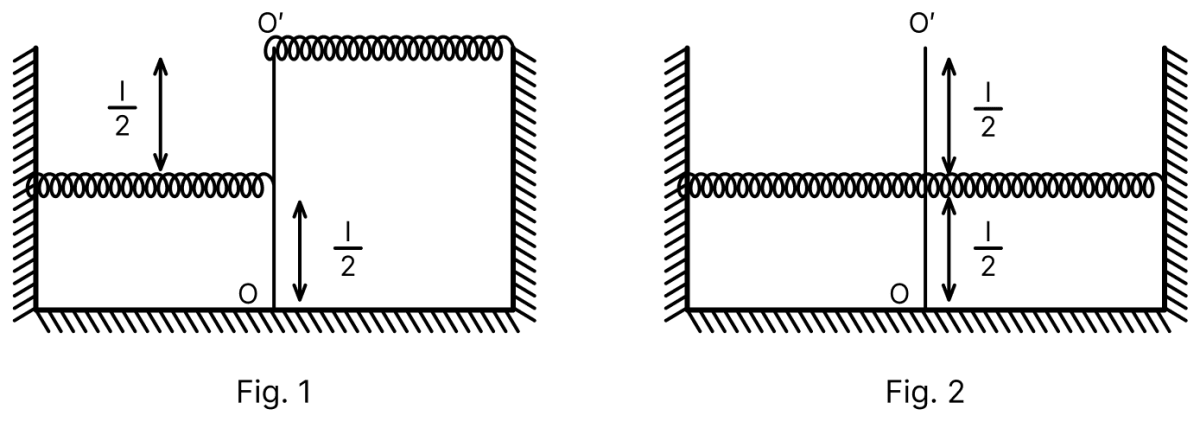
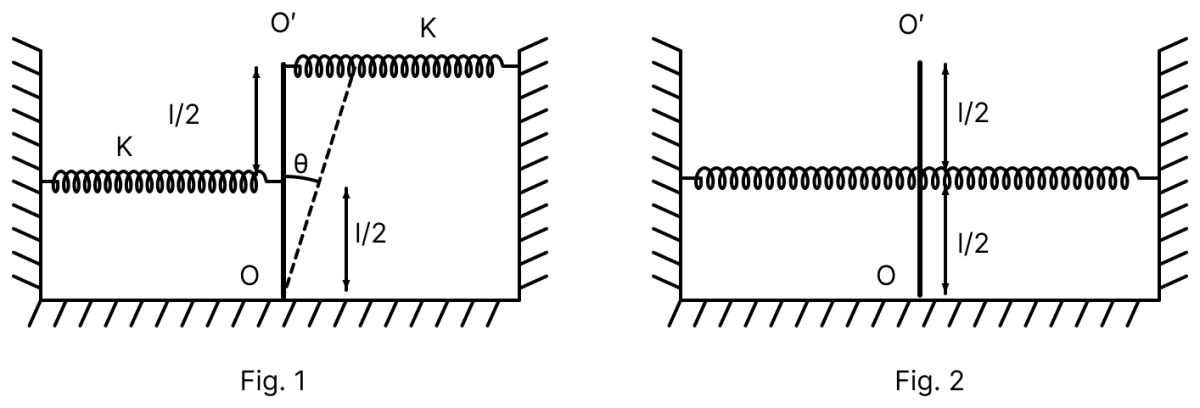
As shown in the figures, a uniform rod OO' of length l is hinged at the point O and held in placed vertically between two walls using two massless springs of same spring constant. The springs are connected at the mid-point and at the top-end (O') of the rod, as shown in Fig. 1 and the rod is made to oscillate by a small angular displacement. The frequency of oscillation of the rod is n1. On the other hand, if both the springs are connected at the mid-point of the rod, as shown in Fig. 2 and the rod is made to oscillate by a small angular displacement, then the frequency of oscillation is n2. Ignoring gravity and assuming motion only in the plane of the diagram, the value of n1n2\dfrac{\text n_1}{\text n_2} is:

As shown in the figures, a uniform rod OO of length l is hinged at the point O and held in placed vertically between two walls using two massless springs of same spring constant. The springs are connected at the mid-point and at the top-end (O) of the rod, as shown in Fig. 1 and the rod is made to oscillate by a small angular displacement. The frequency of oscillation of the rod is n 1. On the other hand, if both the springs are connected at the mid-point of the rod, as shown in Fig. 2 and the rod is made to oscillate by a small angular displacement, then the frequency of oscillation is n 2. Ignoring gravity and assuming motion only in the plane of the diagram, the value of text n_1/ text n_2 is:. Oscillations, Solutions for Class 11 ISC Nootan Physics Kumar Mittal Nageen Prakashan
  1. 2
  2. 2\sqrt2
  3. 52\sqrt{\dfrac{5}{2}}
  4. 25\sqrt{\dfrac{2}{5}}

Answer

52\sqrt{\dfrac{5}{2}}

Reason

As shown in the figures, a uniform rod OO of length l is hinged at the point O and held in placed vertically between two walls using two massless springs of same spring constant. The springs are connected at the mid-point and at the top-end (O) of the rod, as shown in Fig. 1 and the rod is made to oscillate by a small angular displacement. The frequency of oscillation of the rod is n 1. On the other hand, if both the springs are connected at the mid-point of the rod, as shown in Fig. 2 and the rod is made to oscillate by a small angular displacement, then the frequency of oscillation is n 2. Ignoring gravity and assuming motion only in the plane of the diagram, the value of text n_1/ text n_2 is:. Oscillations, Solutions for Class 11 ISC Nootan Physics Kumar Mittal Nageen Prakashan

Given,

  • Length of the rod = l, mass = M, hinged at O
  • Spring constant of each spring = K

The moment of inertia of a uniform rod about an axis through one end and perpendicular to its length is

I=Ml23\text I = \dfrac{\text M \text l^2}{3}

Fig. 1 : One spring is connected at the mid-point (l2)\left(\dfrac{\text l}{2}\right) and the other at the top end (l). For a small angular displacement θ, the corresponding linear displacements are l2θ\dfrac{\text l}{2}θ and lθ. Hence the equation of angular motion is

Ml23(d2θdt2)+K×l2θ×l2+K×lθ×l=0\dfrac{\text M \text l^2}{3}\left(\dfrac{\text d^2θ}{\text{dt}^2}\right) + \text K \times \dfrac{\text l}{2}θ \times \dfrac{\text l}{2} + \text K \times \text lθ \times \text l = 0

d2θdt2+154KMθ=0\dfrac{\text d^2θ}{\text{dt}^2} + \dfrac{15}{4} \cdot \dfrac{\text K}{\text M}θ = 0

Comparing with d2θdt2=ω2θ\dfrac{\text d^2θ}{\text{dt}^2} = -ω^2θ,

ω1=15K4Mω_1 = \sqrt{\dfrac{15\text K}{4\text M}}

Fig. 2 : Both the springs are connected at the mid-point (l2)\left(\dfrac{\text l}{2}\right), so

Ml23(d2θdt2)+2K×l2θ×l2=0\dfrac{\text M \text l^2}{3}\left(\dfrac{\text d^2θ}{\text{dt}^2}\right) + 2\text K \times \dfrac{\text l}{2}θ \times \dfrac{\text l}{2} = 0

d2θdt2+32KMθ=0\dfrac{\text d^2θ}{\text{dt}^2} + \dfrac{3}{2} \cdot \dfrac{\text K}{\text M}θ = 0

ω2=3K2Mω_2 = \sqrt{\dfrac{3\text K}{2\text M}}

Ratio of the frequencies : Since n=ω\text n = \dfrac{ω}{\text{2π}},

n1n2=ω1ω2=15K4M×2M3K=15×24×3=52\dfrac{\text n_1}{\text n_2} = \dfrac{ω_1}{ω_2} = \sqrt{\dfrac{15\text K}{4\text M} \times \dfrac{2\text M}{3\text K}} = \sqrt{\dfrac{15 \times 2}{4 \times 3}} = \sqrt{\dfrac{5}{2}}

Competition Zone — Numericals

Question 1

On a frictionless horizontal plane, a bob of mass m = 0.1 kg is attached to a spring with natural length l0 = 0.1 m. The spring constant is k1 = 0.009 Nm-1 when the length of the spring l > l0 and is k2 = 0.016 Nm-1 when l < l0. Initially the bob is released from l = 0.15 m. Assume that Hooke's law remains valid throughout the motion. If the time period of the full oscillation is T = (nπ) s, then the integer closest to n is ............... .

Answer

Given,

  • Mass of the bob, m = 0.1 kg
  • Natural length of the spring, l0 = 0.1 m
  • Spring constant when l > l0, k1 = 0.009 N m-1
  • Spring constant when l < l0, k2 = 0.016 N m-1
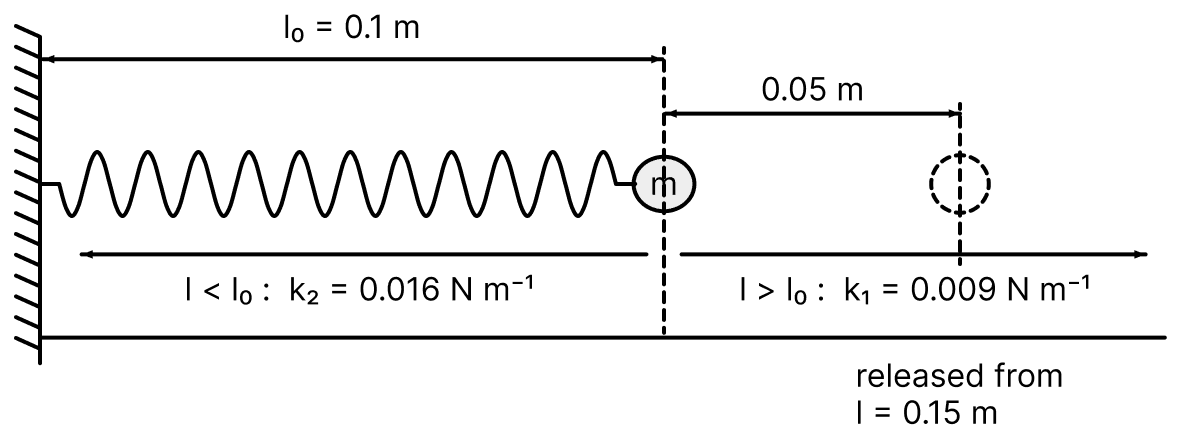
On a frictionless horizontal plane, a bob of mass m = 0.1 kg is attached to a spring with natural length l 0 = 0.1 m. The spring constant is k 1 = 0.009 Nm -1 when the length of the spring l > l 0 and is k 2 = 0.016 Nm -1 when l < l 0. Initially the bob is released from l = 0.15 m. Assume that Hookes law remains valid throughout the motion. If the time period of the full oscillation is T = (nπ) s, then the integer closest to n is................ Oscillations, Solutions for Class 11 ISC Nootan Physics Kumar Mittal Nageen Prakashan

The bob oscillates about the natural length of the spring. During one full oscillation it spends half the period on the stretched side, where the spring constant is k1, and the other half on the compressed side, where the spring constant is k2. The angular frequencies for the two halves are

ω1=k1mandω2=k2mω_1 = \sqrt{\dfrac{\text k_1}{\text m}} \qquad \text{and} \qquad ω_2 = \sqrt{\dfrac{\text k_2}{\text m}}

Hence the time period of the full oscillation is the sum of the two half-periods,

T=12(mk1)+12(mk2)=πmk1+πmk2\text T = \dfrac{1}{2}\left(\text{2π}\sqrt{\dfrac{\text m}{\text k_1}}\right) + \dfrac{1}{2}\left(\text{2π}\sqrt{\dfrac{\text m}{\text k_2}}\right) = π\sqrt{\dfrac{\text m}{\text k_1}} + π\sqrt{\dfrac{\text m}{\text k_2}}

Substituting the values,

T=π0.10.009+π0.10.016\text T = π\sqrt{\dfrac{0.1}{0.009}} + π\sqrt{\dfrac{0.1}{0.016}}

T=π0.3+π0.4=π(10.3+10.4)\text T = \dfrac{π}{0.3} + \dfrac{π}{0.4} = π\left(\dfrac{1}{0.3} + \dfrac{1}{0.4}\right)

T=π(4+312)×10=70π12=5.83π s\text T = π\left(\dfrac{4 + 3}{12}\right) \times 10 = \dfrac{70π}{12} = 5.83π\ \text s

Comparing with T = (nπ) s,

n=5.83\text n = 5.83

Hence, the value of n is 5.83.

Note: The question asks for "the integer closest to n". Since n = 5.83, the closest integer is 6. The textbook answer key records the computed value 5.83 rather than the nearest integer.

Question 2

As per given figures, two springs of spring constants k and 2k are connected to mass m. If the period of oscillation in figure (a) is 3 s, then the period of oscillation in figure (b) will be x\sqrt{\text x} s. The value of x is ............... .
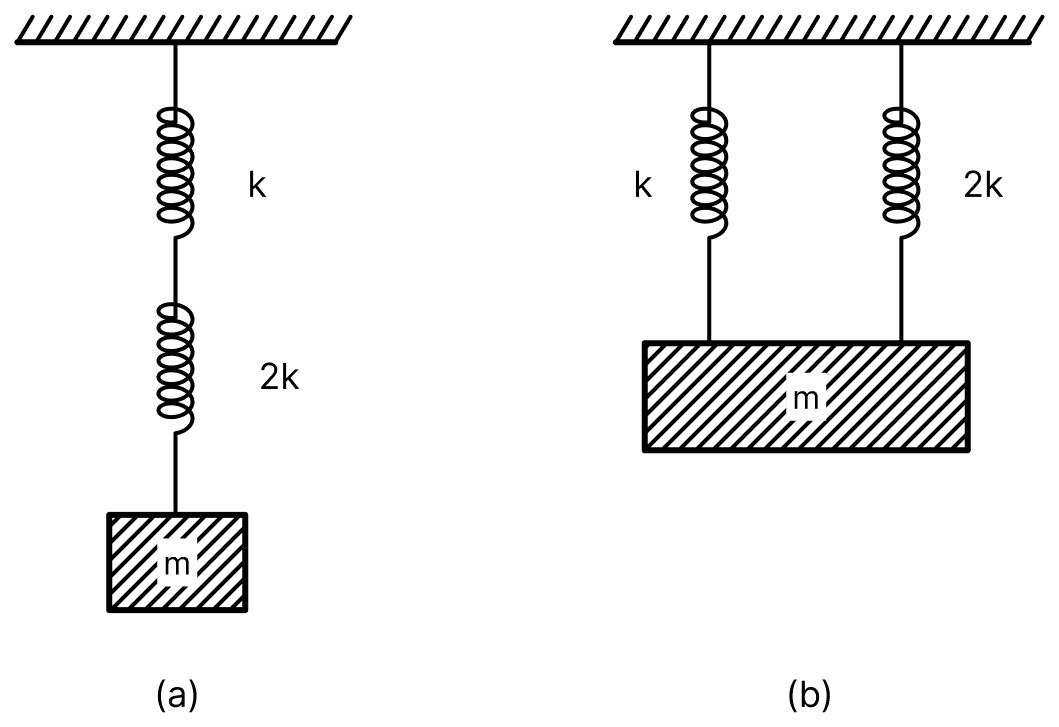
As per given figures, two springs of spring constants k and 2k are connected to mass m. If the period of oscillation in figure (a) is 3 s, then the period of oscillation in figure (b) will be √( text x) s. The value of x is................ Oscillations, Solutions for Class 11 ISC Nootan Physics Kumar Mittal Nageen Prakashan

Answer

Given,

  • Spring constants of the two springs = k and 2k
  • Period of oscillation in figure (a), Ta = 3 s
  • Period of oscillation in figure (b), Tb=x\text T_b = \sqrt{\text x} s

For case (a) : The two springs are joined end to end, so they form a series combination. The effective spring constant is

ka=k×2kk+2k=2k23k=2k3\text k_a = \dfrac{\text k \times 2\text k}{\text k + 2\text k} = \dfrac{2\text k^2}{3\text k} = \dfrac{2\text k}{3}

For case (b) : The two springs support the mass side by side, so they form a parallel combination. The effective spring constant is

kb=k+2k=3k\text k_b = \text k + 2\text k = 3\text k

Ratio of the time periods : Since T=mk\text T = \text{2π}\sqrt{\dfrac{\text m}{\text k}}, for the same mass,

TaTb=kbka=3k2k3=3k×32k=92=32\dfrac{\text T_a}{\text T_b} = \sqrt{\dfrac{\text k_b}{\text k_a}} = \sqrt{\dfrac{3\text k}{\dfrac{2\text k}{3}}} = \sqrt{\dfrac{3\text k \times 3}{2\text k}} = \sqrt{\dfrac{9}{2}} = \dfrac{3}{\sqrt2}

Substituting Ta = 3 s,

3Tb=32Tb=2 s\dfrac{3}{\text T_b} = \dfrac{3}{\sqrt2} \quad \Rightarrow \quad \text T_b = \sqrt2\ \text s

Comparing with Tb=x\text T_b = \sqrt{\text x} s,

x=2\text x = 2

Hence, the value of x is 2.

Question 3

A particle executes simple harmonic motion with an amplitude of 4 cm. At the mean position, velocity of the particle is 10 cm/s. The distance of the particle from the mean position when its speed becomes 5 cm/s is α cm, where α = ............... .

Answer

Given,

  • Amplitude, A = 4 cm
  • Velocity at the mean position, umax = 10 cm s-1
  • Speed at the required position, v = 5 cm s-1

Angular frequency : The velocity is maximum at the mean position, where umax = Aω,

10 cm s1=4 cm×ωω=104 rad s110\ \text{cm s}^{-1} = 4\ \text{cm} \times ω \quad \Rightarrow \quad ω = \dfrac{10}{4}\ \text{rad s}^{-1}

Distance from the mean position : At a displacement y the velocity is

v=ωA2y2\text v = ω\sqrt{\text A^2 - \text y^2}

Substituting the values,

5=10442y25 = \dfrac{10}{4}\sqrt{4^2 - \text y^2}

5×410=16y22=16y2\dfrac{5 \times 4}{10} = \sqrt{16 - \text y^2} \quad \Rightarrow \quad 2 = \sqrt{16 - \text y^2}

Squaring both sides,

4=16y2y2=124 = 16 - \text y^2 \quad \Rightarrow \quad \text y^2 = 12

y=12 cm=23 cm\text y = \sqrt{12}\ \text{cm} = 2\sqrt3\ \text{cm}

Writing this in the form y=α\text y = \sqrt{α} cm,

α=12α = 12

Hence, the value of α is 12.

Note: As printed, the stem reads "is α cm", which would give α = 232\sqrt3 ≈ 3.46. The printed answer key value of 12 corresponds to the form α\sqrt{α} cm, so the stem should read "is α\sqrt{α} cm".

Question 4

A person sitting inside an elevator performs a weighing experiment with an object of mass 50 kg. Suppose that the variation of the height y (in m) of the elevator, from the ground, with time t (in s) is given by

y=8[1+sin(2πtT)]\text y = 8\left[1 + \sin\left(\dfrac{\text{2π}\text t}{\text T}\right)\right]

where T = 40 π s. Taking acceleration due to gravity, g = 10 m/s2, the maximum variation of the object's weight (in N) as observed in the experiment is ............... .

Answer

Given,

  • Mass of the object, m = 50 kg
  • y=8[1+sin(2πtT)]\text y = 8\left[1 + \sin\left(\dfrac{\text{2π}\text t}{\text T}\right)\right] metre
  • T = 40π s
  • g = 10 m s-2

Nature of the motion : Expanding the given relation,

y=8+8sin(2πtT)\text y = 8 + 8\sin\left(\dfrac{\text{2π}\text t}{\text T}\right)

This is of the form y = y0 + A sin ωt, so the elevator is performing S.H.M. of amplitude A = 8 m about a mean height of 8 m, with angular frequency

ω=T=40π=120 rad s1ω = \dfrac{\text{2π}}{\text T} = \dfrac{\text{2π}}{40π} = \dfrac{1}{20}\ \text{rad s}^{-1}

Maximum acceleration of the elevator :

αmax=Aω2=8 m×(120 s1)2=8400=0.02 m s2α_{max} = \text A ω^2 = 8\ \text m \times \left(\dfrac{1}{20}\ \text s^{-1}\right)^2 = \dfrac{8}{400} = 0.02\ \text{m s}^{-2}

Maximum variation of weight : The apparent weight of the object varies between m(g − αmax) and m(g + αmax). Hence the maximum variation is

ΔW=m(g+αmax)m(gαmax)=2mαmaxΔ\text W = \text m(\text g + α_{max}) - \text m(\text g - α_{max}) = 2\text m α_{max}

Substituting the values,

ΔW=2×50 kg×0.02 m s2=2 NΔ\text W = 2 \times 50\ \text{kg} \times 0.02\ \text{m s}^{-2} = 2\ \text N

Hence, the maximum variation of the object's weight is 2 N.

PrevNext