
A string of mass 2.50 kg is under a tension of 200 N. The length of the stretched string is 20.0 m. If a transverse jerk is struck at one end of the string, how long does the disturbance take to reach the other end?
Answer
Given,
- Mass of the string, M = 2.50 kg
- Tension in the string, T = 200 N
- Length of the stretched string, l = 20.0 m
The mass per unit length of the string is
The speed of a transverse wave in a stretched string is given by
Substituting the values,
The time taken by the transverse jerk to travel the whole length of the string is
Hence, the disturbance takes 0.5 s to reach the other end of the string.
A stone is dropped from the top of a tower of height 300 m splashes in to the water of a pond near the base of the tower. When is the splash heard at the top, given that the speed of sound in air is 340 m s-1? (g = 9.8 m s-2).
Answer
Given,
- Height of the tower, h = 300 m
- Speed of sound in air, v = 340 m s-1
- Acceleration due to gravity, g = 9.8 m s-2
The splash is heard at the top after two separate intervals — the time t1 taken by the stone to fall to the water surface, and the time t2 taken by the sound of the splash to travel back up to the top.
Time of fall of the stone : The stone is dropped, so its initial velocity u = 0. From
with u = 0,
Time taken by the sound to travel up :
Therefore, the total time after which the splash is heard at the top is
Hence, the splash is heard at the top of the tower 8.70 s after the stone is dropped.
A steel wire has a length of 12.0 m and a mass of 2.10 kg. What should be the tension in the wire so that the speed of a transverse wave on the wire equals the speed of sound in dry air at 20°C (= 343 m s-1)?
Answer
Given,
- Length of the steel wire, l = 12.0 m
- Mass of the steel wire, M = 2.10 kg
- Required speed of the transverse wave, v = 343 m s-1
The mass per unit length of the wire is
The speed of a transverse wave in a stretched wire is given by
Substituting the values,
Hence, the tension in the wire should be 2.06 × 10⁴ N.
Use the formula to explain why the speed of sound in air:
(a) is independent of pressure, (b) increases with temperature and (c) increases with humidity?
Answer
The speed of sound in a gas is given by Laplace's formula,
(a) Independent of pressure : Let one gram-molecule (mole) of the gas have pressure P and volume V. According to the gas equation,
If M is the molecular-weight of the gas and ρ its density, then , so that
At a constant temperature the ratio is a constant. That is, if P changes, the density ρ also changes in such a way that the ratio remains constant. Hence, if the temperature of the gas remains constant, then there is no effect of the pressure-change on the speed of sound.
(b) Increases with temperature : Substituting the value of from equation (ii) in equation (i),
Here there is no term of pressure, and the speed of sound is directly proportional to the square-root of the absolute temperature of the gas. Hence the speed of sound increases with rise in temperature.
(c) Increases with humidity : The density of moist air, that is, air mixed with water-vapour, is less than the density of dry air. Assuming the value of γ for moist air to be the same as that for dry air, it is clear from equation (i) that at a constant pressure
Hence, with increase in humidity the density decreases and the speed of sound in moist air is slightly greater than in dry air.
You have learnt that a travelling wave in one dimension is represented by a function y = f (x, t), where x and t must appear in combination x − vt or x + vt, i.e., y = f (x ± vt). Is the converse true?
Examine if the following functions for y can possibly represent a travelling wave:
(a) (x − vt)2
(b)
(c)
Answer
No, the converse is not true.
Every function of the combination (x − vt) or (x + vt) does represent a travelling wave, but the mere fact that x and t occur in this combination is not by itself sufficient. An acceptable function for a travelling wave must also be finite everywhere and at all times, since the displacement of a particle of the medium can never become infinitely large.
Examining the three functions on this basis :
(a) (x − vt)2 — as x or t increases without limit, the value of the function increases without limit. It is not finite everywhere, and so it cannot represent a travelling wave.
(b) — when (x + vt) tends to zero, the logarithm tends to − ∞, and the function is not finite. Hence it cannot represent a travelling wave.
(c) — this function is finite at all points and at all times, and it also contains x and t in the combination (x + vt). Hence it can represent a travelling wave.
Hence, out of the three, only the function in part (c) can possibly represent a travelling wave.
A bat emits ultrasonic sound of frequency 1000 kHz in air. If the sound meets a water surface, what is the wavelength of: (a) the reflected sound, (b) the transmitted sound? Speed of sound in air = 340 ms-1 and in water = 1486 m s-1.
Answer
Given,
- Frequency of the ultrasonic sound, n = 1000 kHz = 1000 × 103 Hz
- Speed of sound in air, va = 340 m s-1
- Speed of sound in water, vw = 1486 m s-1
The frequency of a wave is decided by the source and remains unchanged whether the wave travels in air or in water. Hence the frequency of both the reflected and the transmitted sound is 1000 kHz.
(a) Reflected sound : The reflected sound travels back in air, so
(b) Transmitted sound : The transmitted sound travels in water, so
Hence, the wavelength of the reflected sound is 0.34 × 10⁻³ m and that of the transmitted sound is 1.486 × 10⁻³ m.
A hospital uses an ultrasonic scanner to locate tumours in a tissue. What is the wavelength of sound in the tissue in which the speed of sound is 1.7 km s-1? The operating frequency of the scanner is 4.2 MHz.
Answer
Given,
- Speed of the ultrasonic sound in the tissue, v = 1.7 km s-1 = 1.7 × 10³ m s-1
- Operating frequency of the scanner, n = 4.2 MHz = 4.2 × 10⁶ Hz
From the relation between speed, frequency and wavelength,
Substituting the values,
Hence, the wavelength of sound in the tissue is 4.0 × 10⁻⁴ m.
A transverse harmonic wave on a string is described by
where x, y are in cm and t in s. The positive direction of x is from left to right.
(a) Is this a travelling or a stationary wave? If travelling, what are the speed and direction of its propagation? (b) What are its amplitude and frequency? (c) What is the initial phase at the origin? (d) What is the least distance between two successive crests in the wave?
Answer
Given, the wave is
where x, y are in cm and t in s.
The standard equation of a plane progressive simple harmonic wave travelling along the − X direction, that is, from right to left, is
where a is the amplitude, ω the angular frequency, k the propagation constant and φ the initial phase at the origin.
(a) The argument of the sine contains x and t in the combination (ωt + kx), so the given equation is identical in form with equation (i). Hence it represents a travelling wave moving from right to left, that is, along the negative direction of the X-axis. Comparing, ω = 36 s-1 and k = 0.018 cm-1, so the speed is
(b) Comparing with equation (i), the amplitude is
and the frequency is
(c) The initial phase at the origin is
(d) The least distance between two successive crests is the wavelength λ. Since ,
Hence, it is a travelling wave moving from right to left with a speed of 20 m s-1, its amplitude is 3.0 cm, its frequency is 5.7 Hz, its initial phase at the origin is and the least distance between two successive crests is 3.5 m.
For the wave described in Question 8, plot the displacement (y) versus (t) graphs for x = 0, 2 and 4 cm. What are the shapes of these graphs? In which aspects does the oscillatory motion in travelling wave differ from one point to another: amplitude, frequency or phase?
Answer
The wave of Question 8 is
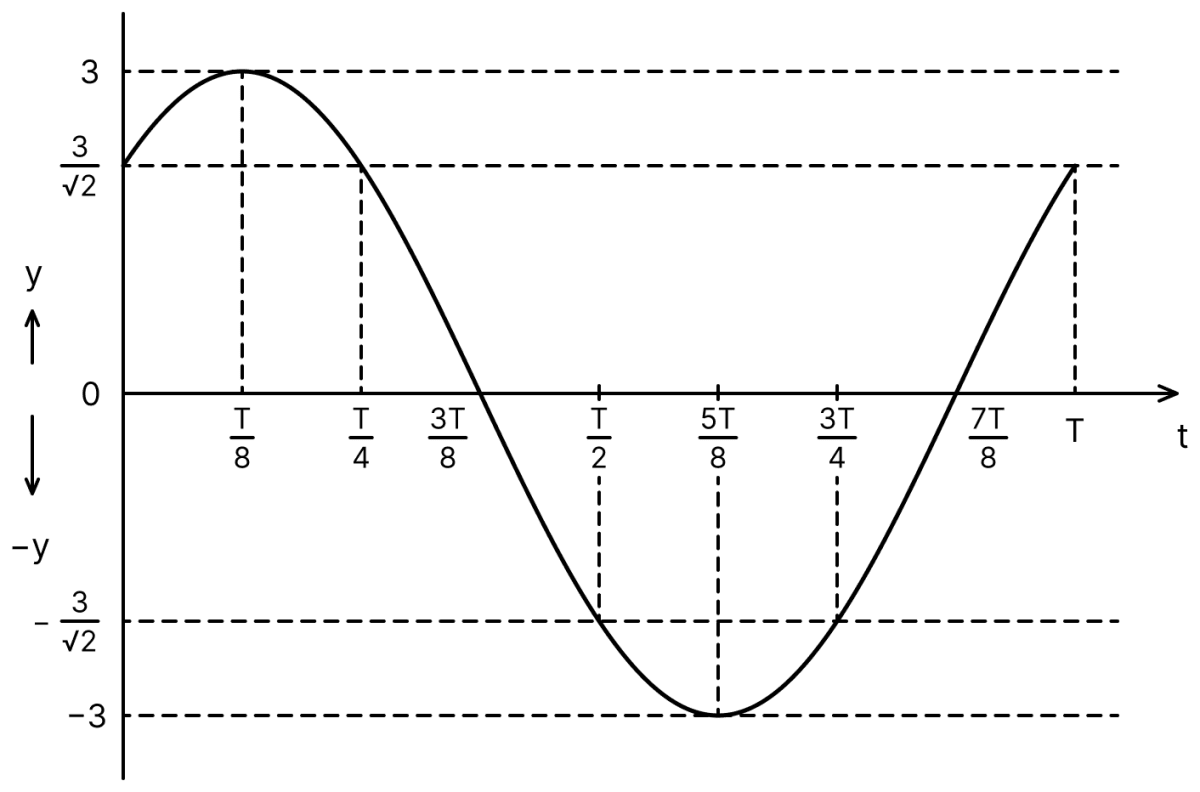
At x = 0 :
Here
Taking values of t at intervals of , the corresponding values of y are

Plotting these values gives the following graph.
At x = 2 cm :
At x = 4 cm :
Shapes of the graphs : In each of the three cases the graph so obtained is sinusoidal, the three curves being identical in shape.
Aspect in which the motion differs : The amplitude of every curve is 3.0 cm and the angular frequency of every curve is 36 s-1, so the amplitude and the frequency are the same at all the three points. Only the constant term inside the sine, that is, the initial phase, changes from 0 to 0.036 and then to 0.072.
Hence, the oscillatory motion of a travelling wave differs from one point to another only in phase, and not in amplitude or frequency.
For the travelling harmonic wave
y (x, t) = 2.0 cos 2π (10 t − 0.0080 x + 0.35),
where x and y are in cm and t in s. What is the phase difference between oscillatory motion of two points separated by a distance of (a) 4 m, (b) 0.5 m, (c) λ/2 and (d) 3λ/4?
Answer
Given, the travelling harmonic wave is
y (x, t) = 2.0 cos 2π (10 t − 0.0080 x + 0.35)
where x and y are in cm and t in s.
Re-writing the equation,
Comparing this with the general equation of a travelling wave,
we get
The phase difference between two points separated by a path difference Δx is
(a) For Δx = 4 m :
(b) For Δx = 0.5 m :
(c) For Δx = λ/2 :
(d) For Δx = 3λ/4 :
Hence, the phase differences are 6.4π rad, 0.8π rad, π rad and rad respectively.
The transverse displacement of a string (clamped at its both ends) is given by
where x and y are in metre and t in second. The length of the string is 1.5 m and its mass is 3.0 × 10⁻² kg.
(a) Does the function represent a travelling wave or a stationary wave?
(b) Interpret the wave as a superposition of two waves travelling in opposite directions. What are the wavelength, frequency and speed of propagation of each wave?
(c) Determine the tension in the string.
Answer
Given,
- Displacement, , with x and y in metre and t in second
- Length of the string, l = 1.5 m
- Mass of the string, M = 3.0 × 10⁻² kg
(a) In the argument of the trigonometric functions x and t do not occur in the combination (ωt ± kx), which is the characteristic of a travelling wave. The equation is instead a product of a harmonic function of x and a harmonic function of t taken separately. Hence the function represents a stationary wave.
(b) Let a wave travelling on the string in the positive direction of the X-axis be
The string is clamped at its ends, so the wave reflected at the clamped end suffers a phase change of π and travels in the negative direction of the X-axis,
By the principle of superposition, the stationary wave formed is
Comparing equation (i) with the given equation,
The speed of propagation of each wave is
(c) The mass per unit length of the string is
The speed of a transverse wave in a stretched string is , so that
Hence, it is a stationary wave; each component wave has a wavelength of 3 m, a frequency of 60 Hz and a speed of 180 m s-1, and the tension in the string is 648 N.
(i) For the wave on a string described in Question 11, do all the points on the string oscillate with the same (a) frequency, (b) phase, (c) amplitude? Explain your answers. (ii) What is the amplitude of a point 0.375 m away from one end?
Answer
The stationary wave on the string is
(i) (a) Frequency — Yes.
Every point of the string carries the common time factor cos (120πt) with the same angular frequency ω = 120π rad s-1. Hence all the points oscillate with the same frequency,
(i) (b) Phase — Not the same for all points.
The time dependence cos (120πt) is the same for every x, but the spatial factor may be positive or negative. Where this factor is positive the point oscillates as + |A(x)| cos ωt, and where it is negative it oscillates as |A(x)| cos (ωt + π). Hence all the points lying in the same segment between two successive nodes vibrate in the same phase, while the points on the two sides of a node are opposite in phase.
(i) (c) Amplitude — No.
The amplitude of a point at a distance x is
which depends on x. It is zero at the nodes and maximum, equal to 0.06 m, at the antinodes. Hence different points have different amplitudes.
(ii) Amplitude at x = 0.375 m :
Here , so
Therefore,
Hence, all the points oscillate with the same frequency of 60 Hz but not with the same phase or amplitude, and the amplitude of a point 0.375 m from one end is 0.042 m.
The functions of x and t given below represent the displacement (transverse or longitudinal) of an elastic wave. State which of these represent a travelling wave, a stationary wave or none at all:
(a) y = 2 cos (3 x) sin (10 t)
(b)
(c) y = 3 sin (5 x − 0.5 t) + 4 cos (5 x − 0.5 t)
(d) y = cos x sin t + cos 2 x sin 2 t
Answer
A function represents a travelling wave only if x and t occur in it in the combination (ωt ± kx), and it represents a stationary wave only if it contains harmonic functions of x and of t separately. Applying this test :
(a) y = 2 cos (3 x) sin (10 t)
The equation contains harmonic functions of x and of t separately. Hence it represents a stationary wave.
(b)
Although x and t occur in the combination (x − vt), the function is not a harmonic function. Hence it represents none of the two — it cannot represent any type of wave.
(c) y = 3 sin (5 x − 0.5 t) + 4 cos (5 x − 0.5 t)
Both the terms are harmonic functions in which x and t occur in the combination (5x − 0.5t). Their sum is therefore a single harmonic function of the same combination, so it represents a travelling wave.
(d) y = cos x sin t + cos 2 x sin 2 t
Each of the two terms separately contains a harmonic function of x and a harmonic function of t. Hence the equation is a sum of two stationary waves, that is, it represents a superposition of two stationary waves.
A wire stretched between two rigid supports vibrates in its fundamental mode with a frequency of 45 Hz. The mass of the wire is 3.5 × 10⁻² kg and its linear mass density is 4.0 × 10⁻² kg m-1. What is (a) the speed of transverse wave in the wire and (b) the tension in the wire?
Answer
Given,
- Frequency of the fundamental mode, n = 45 Hz
- Mass of the wire, M = 3.5 × 10⁻² kg
- Linear mass density of the wire, m = 4.0 × 10⁻² kg m-1
The length of the wire is
(a) Speed of the transverse wave : The wire is stretched between two rigid supports, so in the fundamental mode there is a node at each end and an antinode in the middle. The frequency of the fundamental mode is
Substituting the values,
(b) Tension in the wire : The speed of a transverse wave in a stretched wire is , so that
Hence, the speed of the transverse wave in the wire is 78.75 m s-1 and the tension in the wire is 248 N.
A 1 m long tube open at one end, with a movable piston at the other end, shows resonance with a fixed frequency source (a tuning fork of frequency 340 Hz) when the tube length is 25.5 cm or 79.3 cm. Estimate the speed of sound in air at the temperature of the experiment. Ignore edge effect.
Answer
Given,
- Frequency of the tuning fork, n = 340 Hz
- First resonating length of the air column, l1 = 25.5 cm
- Second resonating length of the air column, l2 = 79.3 cm
The tube is open at one end and closed by the movable piston at the other, so it behaves as a closed pipe. In a closed pipe the successive resonating lengths differ by half a wavelength,
Therefore the speed of sound in the air column is
Substituting the values,
Hence, the speed of sound in air at the temperature of the experiment is 365.84 m s-1.
A steel rod 100 cm long is clamped at its middle. The fundamental frequency of longitudinal vibrations of the rod is given to be 2.53 kHz. What is the speed of sound in steel?
Answer
Given,
- Length of the steel rod, l = 100 cm
- Fundamental frequency of longitudinal vibrations, n = 2.53 kHz = 2.53 × 10³ Hz
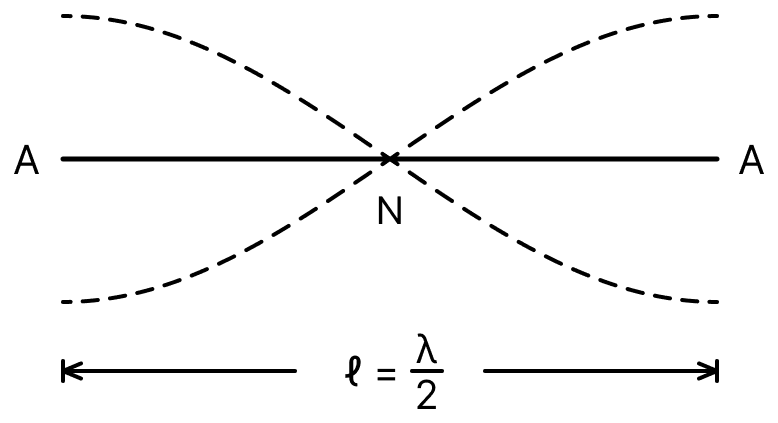
The rod is clamped at its middle point, so the middle point is necessarily a node (N). In the fundamental mode of longitudinal vibration the two end-points of the rod are free to vibrate, so each end is an antinode (A).
The distance between two consecutive antinodes is , where λ is the wavelength of the stationary wave set up in the rod. Hence
The speed of sound in the rod is
Hence, the speed of sound in steel is 5.06 × 10³ m s-1.
A pipe 20 cm long is closed at one end. Which harmonic mode of the pipe is resonantly excited by a 430 Hz source? Will this same source be in resonance with the pipe if both ends are open? (Speed of sound in the air = 340 m s-1)
Answer
Given,
- Length of the pipe, l = 20 cm = 0.2 m
- Frequency of the source, n = 430 Hz
- Speed of sound in air, v = 340 m s-1
Pipe closed at one end : A closed organ pipe produces only odd harmonics. The frequency of the mth mode of vibration is
Substituting the values,
Hence the fundamental mode, that is, the first harmonic, of the air column in the closed pipe is resonantly excited.
Pipe open at both ends : An open organ pipe produces all the harmonics, and the frequency of the mth mode is
Substituting the values,
But m must be an integer, and 0.5 is not an integer.
Hence, the 430 Hz source excites the fundamental mode (first harmonic) of the closed pipe, and the same source cannot be in resonance with the pipe if both of its ends are open.
Two sitar strings A and B playing the note 'Ga' are slightly out of tune and produce beats of frequency 6 Hz. The tension in the string A is slightly reduced and the beat frequency is found to reduce to 3 Hz. If the original frequency of A is 324 Hz, what is the frequency of B?
Answer
Given,
- Original frequency of the string A, nA = 324 Hz
- Beat frequency before the change, = 6 Hz
- Beat frequency after the tension in A is reduced, = 3 Hz
The number of beats per second is equal to the difference in the frequencies of the two sources. Hence the possible frequencies of the string B are
The frequency of a stretched string is proportional to the square-root of the tension in it,
When the tension in A is slightly reduced, the frequency of A becomes slightly lower than 324 Hz.
- If the frequency of B were 330 Hz, then on lowering the frequency of A below 324 Hz the difference (nB − nA) would become more than 6 Hz, so the beat frequency would increase.
- If the frequency of B were 318 Hz, then on lowering the frequency of A below 324 Hz the difference (nA − nB) would become less than 6 Hz, so the beat frequency would decrease.
It is given that the beat frequency is reduced to 3 Hz. This is possible only in the second case.
Hence, the frequency of the string B is 318 Hz.
Explain why (or how):
(a) in sound wave, a displacement node is a pressure antinode and vice-versa.
(b) bats can ascertain distances, directions, nature and sizes of the obstacles without any 'eyes'.
(c) a violin note and sitar note may have the same frequency, yet we can distinguish between the two notes.
(d) solids can support both longitudinal and transverse waves, but only longitudinal waves can propagate in gases.
(e) the shape of a pulse gets distorted during propagation in a dispersive medium.
Answer
(a) In a sound wave, a displacement node is a pressure antinode and vice-versa.
A displacement node is a point where the amplitude of vibration of the particles of the medium is the minimum, that is, zero. At such a point the particles on the two sides move towards it or away from it together, so the crowding together and thinning out of the particles is the greatest there. Hence the variation in pressure is maximum, which makes it a pressure antinode. At a displacement antinode, on the other hand, the amplitude of vibration is maximum but the particles on the two sides move in the same direction by the same amount, so there is no change in pressure. Hence a displacement antinode is a pressure node.
(b) Bats can ascertain distances, directions, nature and sizes of the obstacles without any 'eyes'.
Bats emit ultrasonic sound waves of very high frequency. These waves are reflected back towards the bat by the obstacles in its path. From the reflected waves the bat estimates the distance, the direction, the size and the nature of the obstacle with the help of its brain senses.
(c) A violin note and a sitar note may have the same frequency, yet we can distinguish between the two notes.
Along with the fundamental tone, a musical instrument also produces a number of overtones. The overtones produced by a violin and those produced by a sitar are of different strengths, so the quality or timbre of the sound produced by them is different. Hence the two notes of the same frequency can be distinguished from each other.
(d) Solids can support both longitudinal and transverse waves, but only longitudinal waves can propagate in gases.
Solids have a shear modulus, so they can sustain shearing stress. The propagation of a transverse wave is such that it produces shearing stress in the medium, so its propagation is possible only in solids. Gases do not have any definite shape and so they yield to shearing stress. Hence a transverse wave cannot propagate in a gas, and only longitudinal waves, for which the medium is alternately compressed and rarefied, can travel in it.
(e) The shape of a pulse gets distorted during propagation in a dispersive medium.
A pulse is actually a combination of waves having different wavelengths. In a dispersive medium the speed of a wave depends upon its wavelength, so these component waves travel with different velocities. As the pulse advances, the component waves get separated from one another and this results in the distortion of the shape of the pulse.