
When two progressive waves y1 = 4 sin (2x − 6t) and are superimposed, what is the amplitude of the resultant wave?
Answer
Given,
- y1 = 4 sin (2x − 6t), so a1 = 4
- , so a2 = 3
- Phase difference between the two waves,
The two waves have the same frequency and travel along the same path in the same direction, so by the principle of superposition the amplitude of the resultant wave is
Substituting the values,
Hence, the amplitude of the resultant wave is 5 units.
Two particles are excuting simple harmonic motion of the same amplitude a and frequency ω along the X-axis. Their mean position is separated by distance x(x0 > a). If the maximum separation between them is (x0 + a), the phase difference between their motion is:
- π /6
- π /2
- π /3
- π /4
Answer
π /3
Given, the two particles execute simple harmonic motion of the same amplitude a and the same angular frequency ω along the X-axis, their mean positions being separated by a distance x0, and the maximum separation between them is (x0 + a).
Let the displacements of the two particles from their own mean positions be
where φ is the phase difference between their motions.
The separation between the two particles at any instant is
Using ,
The cosine term has a maximum value of 1, so the maximum separation is
It is given that this maximum separation is (x0 + a). Therefore,
Hence, the phase difference between their motions is .
The displacement of a particle varies according to the relation x = 4 (cos π t + sin πt). The amplitude of the particle is:
- − 4
- 4
- 8
Answer
Given, the displacement of the particle is
x = 4 (cos π t + sin πt)
To find the amplitude, the expression is written as a single harmonic function. Multiplying and dividing by ,
Since ,
Using sin A cos B + cos A sin B = sin (A + B),
Comparing this with the standard equation x = A sin (ωt + φ), the amplitude is
Hence, the amplitude of the particle is .
An open pipe resonates in its second harmonic with frequency f1. One end of the pipe is closed and the frequency is slowly raised until this pipe resonates in its nth harmonic with frequency f2. Then:
- n = 3, f2 = (3 / 4) f1
- n = 3, f2 = (5 / 4) f1
- n = 5, f2 = (5 / 4) f1
- n = 5, f2 = (3 / 4) f1
Answer
n = 5, f2 = (5 / 4) f1
Given, an open pipe resonates in its second harmonic with frequency f1, and after closing one end the same pipe resonates in its nth harmonic with frequency f2.
Let l be the length of the pipe and v the speed of sound in air.
Open pipe : The frequency of the second harmonic of an open pipe is
Closed pipe : A closed pipe produces only odd harmonics, and the frequency of its nth harmonic is
where n is odd, that is, n = 1, 3, 5, ...
It is given that the frequency is slowly raised until resonance occurs, so f2 must be greater than f1. That is,
\dfrac{\text n}{4} \gt 1 \qquad \Rightarrow \qquad \text n > 4
The smallest odd value of n greater than 4 is n = 5. Hence the first resonance on raising the frequency occurs at
Hence, n = 5 and .
A closed organ pipe of length L and an open organ pipe contain gases of densities ρ1 and ρ2 respectively. The compressibility of gases is same in both the pipes which are vibrating in their first overtone with same frequency. The length of the open organ pipe is:
Answer
Given,
- Length of the closed organ pipe = L, gas density = ρ1
- Length of the open organ pipe = L' (say), gas density = ρ2
- The compressibility of the gases is the same in both the pipes
- Both pipes vibrate in their first overtone with the same frequency
Let v1 and v2 be the speeds of sound in the two gases. Since the compressibility, and hence the elasticity, is the same for both,
First overtone of the closed pipe : For a closed pipe the first overtone is the third harmonic, so
First overtone of the open pipe : For an open pipe the first overtone is the second harmonic, so
The two frequencies are equal, that is, n2 = n2'. Therefore,
Substituting ,
Hence, the length of the open organ pipe is .
A student is performing an experiment using a resonance column and a tuning fork of frequency 244 s-1. He is told that the air in the tube has been replaced by another gas (assume that the column remains filled with the gas). If the minimum height at which resonance occurs is (0.350 ± 0.005) m, the gas in the tube is:
(Useful information : J1/2mol-1/2, J1/2mol-1/2. The molar masses M in grams are given in the options. Take the values of for each gas as given there.)
neon
nitrogen
oxygen
argon
Answer
argon
Given,
- Frequency of the tuning fork, n = 244 s-1
- Minimum height at which resonance occurs, l = (0.350 ± 0.005) m
The resonance column tube is closed at the lower end by the gas column, so at the minimum height the air column vibrates in its fundamental mode,
The speed of sound in the gas is therefore
Maximum error in the speed : Since n is fixed, , so
Hence the permissible range of the speed is v = (342 ± 5) m s-1.
Speed of sound in each gas : Using , where M is the molar mass in gram,
(a) Neon is monoatomic, γ = 1.67 and M = 20,
(b) Nitrogen is diatomic, γ = 1.4 and M = 28,
(c) Oxygen is diatomic, γ = 1.4 and M = 32,
(d) Argon is monoatomic, γ = 1.67 and M = 36,
Only the value 340 m s-1 lies within the permissible range (342 ± 5) m s-1.
Hence, the gas in the tube is argon.
A pipe of length 85 cm is closed from one end. Find the number of possible natural oscillations of air column in the pipe whose frequencies lie below 1250 Hz. The velocity of sound in air is 340 m/s.
- 6
- 4
- 12
- 8
Answer
6
Given,
- Length of the pipe, l = 85 cm = 0.85 m
- Speed of sound in air, v = 340 m/s
- Upper limit of frequency = 1250 Hz
The pipe is closed at one end, so it produces only odd harmonics. The frequency of the mode corresponding to m = 0, 1, 2, ... is
The natural oscillations are required to have frequencies below 1250 Hz, so
Since m must be a whole number, the permissible values are
Hence, there are 6 possible natural oscillations of the air column whose frequencies lie below 1250 Hz.
In the experiment for the determination of the speed of sound in air using the resonance column method, the length of the air column that resonates in the fundamental mode with a tuning fork is 0.1 m. When this length is changed to 0.35 m, the same tuning fork resonates with the first overtone. The end correction is:
- 0.012 m
- 0.025 m
- 0.05 m
- 0.024 m
Answer
0.025 m
Given,
- Length of the air column resonating in the fundamental mode, l1 = 0.1 m
- Length of the air column resonating with the first overtone, l2 = 0.35 m
Let e be the end correction. In a resonance column, which behaves as a closed pipe,
Fundamental mode :
First overtone, which is the third harmonic :
Multiplying equation (i) by 3,
Comparing equations (ii) and (iii),
Substituting the values,
Hence, the end correction is 0.025 m.
A student is performing the experiment of resonance column. The diameter of the column tube is 4 cm. The frequency of the tuning fork is 512 Hz. The air temperature is 38°C in which the speed of sound is 336 m/s. The zero of the meter scale coincides with the top of the resonance column tube. When the first resonance occurs, the reading of the water level in the column is:
- 14.0 cm
- 15.2 cm
- 16.4 cm
- 17.6 cm
Answer
15.2 cm
Given,
- Diameter of the column tube, d = 4 cm
- Frequency of the tuning fork, n = 512 Hz
- Speed of sound in air, v = 336 m/s = 33600 cm/s
- The zero of the metre scale coincides with the top of the resonance column tube
At the first resonance the air column vibrates in its fundamental mode, so the distance between the antinode at the open end and the node at the water surface is
where l1 is the length of the air column and e is the end correction. Therefore,
The end correction for a tube of diameter d is e = 0.3 d. Also , so
Substituting the values,
Since the zero of the scale coincides with the top of the tube, the reading of the water level is equal to the length of the air column.
Hence, the reading of the water level in the column is 15.2 cm.
A person blows into open-end of a long pipe. As a result, a high pressure pulse of air travels down the pipe. When this pulse reaches the other end of the pipe:
- a high-pressure pulse starts travelling up the pipe, if the other end of the pipe is open
- a low-pressure pulse starts travelling up the pipe, if the other end of the pipe is open
- a low-pressure pulse starts travelling up the pipe, if the other end of the pipe is closed
- a high-pressure pulse starts travelling up the pipe, if the other end of the pipe is closed.
Answer
a low-pressure pulse starts travelling up the pipe, if the other end of the pipe is open
a high-pressure pulse starts travelling up the pipe, if the other end of the pipe is closed.
For sound waves, which are pressure waves, an optically rarer medium behaves as the denser medium, so the behaviour of sound waves on reflection is just the opposite of that of light waves.
If the other end is open : The open end behaves as a free boundary for the pressure wave. A compression, that is, a high-pressure pulse, is reflected back as a rarefaction, that is, a low-pressure pulse. Hence a low-pressure pulse starts travelling up the pipe.
If the other end is closed : The closed end behaves as a rigid boundary. A compression is reflected back as a compression, so a high-pressure pulse starts travelling up the pipe.
Hence, a low-pressure pulse starts travelling up the pipe if the other end of the pipe is open, and a high-pressure pulse starts travelling up the pipe if the other end is closed.
Note: Both the second and the fourth options are correct statements of what happens, and the printed answer key marks both of them.
One end of a taut string of length 3 m along the X-axis is fixed at x = 0. The speed of the waves in the string is 100 ms-1. The other end of the string is vibrating in the Y-direction so that stationary waves are set up in the string. The possible waveforms of these stationary waves are:
Answer
, and
Given,
- Length of the taut string, l = 3 m, fixed at x = 0
- Speed of the waves in the string, v = 100 m s-1
- The other end is vibrated so that stationary waves are set up
Since the end x = 0 is fixed, it must be a node, and every option already has the factor sin kx, which is zero at x = 0. The end x = 3 m is being vibrated, so it must be an antinode. Hence at x = 3, sin kx must be ± 1.
Also, the speed of the wave in the string must come out to be 100 m s-1 in every acceptable waveform, that is, .
Testing each option :
(1) at x = 3 is , so x = 3 is an antinode. Here and , so m s-1. Acceptable.
(2) at x = 3 is , so x = 3 is a node, not an antinode. Not acceptable.
(3) at x = 3 is , so x = 3 is an antinode. Here and , so m s-1. Acceptable.
(4) at x = 3 is , so x = 3 is an antinode. Here ω = 250π and , so m s-1. Acceptable.
Hence, the possible waveforms are those given in the first, the third and the fourth options.
Select the correct alternative(s):
A student performed the experiment to measure the speed of sound in air using resonance air-column method. Two resonances in the air-column were obtained by lowering the water level. The resonance with the shorter air-column is the first resonance and that with the longer air-column is the second resonance. Then:
- the intensity of the sound heard at the first resonance was more than that at the second resonance
- the prongs of the tuning fork were kept in a horizontal plane above the resonance tube
- the amplitude of vibration of the ends of the prongs is typically around 1 cm
- the length of the air-column at the first resonance was some what shorter than 1/4th of the wavelength of the sound in air.
Answer
the intensity of the sound heard at the first resonance was more than that at the second resonance, and the length of the air-column at the first resonance was some what shorter than 1/4th of the wavelength of the sound in air
Given, a resonance air-column experiment in which the first resonance corresponds to the shorter air-column and the second resonance to the longer air-column.
First option — correct. As the length of the air column increases, a part of the energy supplied by the fork is dissipated in the longer column. Hence the sound heard at the first resonance is louder than that heard at the second resonance.
Second option — incorrect. The prongs of the tuning fork are held in a vertical plane above the mouth of the resonance tube, so that the vibrations are communicated along the length of the air column.
Third option — incorrect. The amplitude of vibration of the ends of the prongs of a tuning fork is of the order of a fraction of a millimetre, and never as large as 1 cm.
Fourth option — correct. On account of the end correction e, the antinode is formed slightly outside the open end. Hence
that is, the length of the air column at the first resonance is somewhat shorter than .
Hence, the first and the fourth alternatives are correct.
A 20 cm long string, having a mass of 1.0 g, is fixed at both the ends. The tension in the string is 0.5 N. The string is set into vibrations using an external vibrator of frequency 100 Hz. Find the separation (in cm) between the successive nodes on the string. (Answer should be in single digit integer, ranging from 0 to 9.)
Answer
5
Given,
- Length of the string, l = 20 cm = 20 × 10-2 m
- Mass of the string, M = 1.0 g = 1.0 × 10⁻³ kg
- Tension in the string, T = 0.5 N
- Frequency of the external vibrator, n = 100 Hz
The mass per unit length of the string is
The speed of the transverse wave in the string is
The wavelength of the wave set up in the string is
In a stationary wave the separation between two successive nodes is . Therefore,
Hence, the separation between the successive nodes on the string is 5 cm.
Based upon the following paragraph two multiple choice type questions are to be answered. Each question has four choices out of which only one is correct.
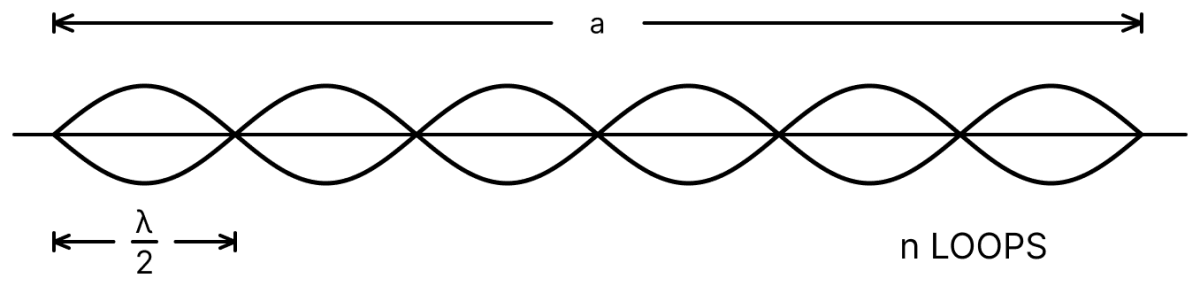
When a particle is restricted to move along X-axis between x = 0 and x = a, where a is of nanometer dimension, its energy can take only certain specific values. The allowed energies of the particle moving in such a restricted region, correspond to the formation of standing waves with nodes at its ends x = 0 and x = a. The wavelength of this standing wave is related to the linear momentum p of the particle according to the de Broglie relation. The energy of the particle of mass is related to its linear momentum as . Thus, the energy of the particle can be denoted by a quantum number 'n' taking values 1, 2, 3, ... (n = 1, called the ground state) corresponding to the number of loops in the standing wave.
Use the model described above to answer the following three questions for a particle moving in the line x = 0 to x = a.
Take h = 6.6 × 10⁻³⁴ J-s and e = 1.6 × 10⁻¹⁹ C.
(i) The allowed energy for the particle for a particular value of n is proportional to:
- a-2
- a-3/2
- a-1
- a2
(ii) If the mass of the particle is m = 1.0 × 10⁻³⁰ kg and a = 6.6 nm, the energy of the particle in its ground state is closest to:
- 0.8 meV
- 8 meV
- 80 meV
- 800 meV
(iii) The speed of the particle, that can take discrete values, is proportional to:
- n-3/2
- n-1
- n1/2
- n
Answer
(i) a-2
The particle is restricted between x = 0 and x = a, with nodes at both the ends. If n be the number of loops in the standing wave, then since the distance between two consecutive nodes is ,
By the de Broglie relation, the linear momentum of the particle is
The energy of the particle is
Substituting the value of λ,
For a particular value of n, all the other quantities being constant,
Hence, the allowed energy for a particular value of n is proportional to a-2.
(ii) 8 meV
Given, m = 1.0 × 10⁻³⁰ kg, a = 6.6 nm = 6.6 × 10⁻⁹ m, h = 6.6 × 10⁻³⁴ J-s and e = 1.6 × 10⁻¹⁹ C.
For the ground state n = 1, so
Substituting the values,
Converting into electron-volt,
Hence, the energy of the particle in its ground state is closest to 8 meV.
(iii) n
For the nth state,
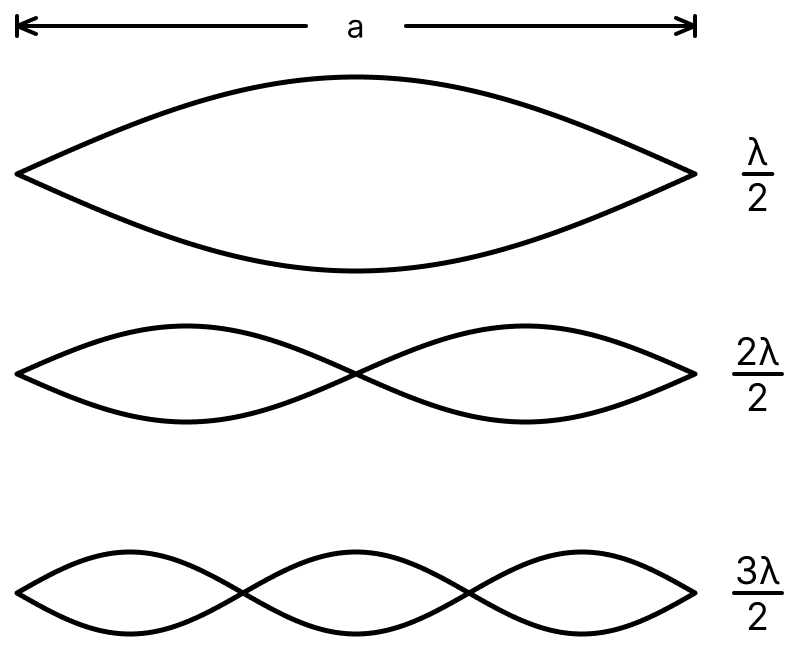
The linear momentum of the particle is
Since a and h are constants, p ∝ n. But p = mv, and the mass m is fixed, so
Hence, the speed of the particle is proportional to n.
The equation of a wave on a string of linear mass density 0.04 kg m-1 is given by
The tension in the string is:
- 6.25 N
- 4.0 N
- 12.5 N
- 0.5 N
Answer
6.25 N
Given,
- Linear mass density of the string, m = 0.04 kg m-1
Comparing the given equation with the standard equation of a progressive wave y = a sin (ωt − kx),
The speed of the wave in the string is
The speed of a transverse wave in a stretched string is , so that
Substituting the values,
Hence, the tension in the string is 6.25 N.
A hollow pipe of length 0.8 m is closed at one end. At its open end a 0.5 m long uniform string is vibrating in its second harmonic and it resonates with the fundamental frequency of the pipe. If the tension in the wire is 50 N and the speed of sound is 320 m s-1, the mass of the string is:
- 5 gram
- 10 gram
- 20 gram
- 40 gram
Answer
10 gram
Given,
- Length of the hollow pipe closed at one end, l1 = 0.8 m
- Length of the uniform string, l2 = 0.5 m
- Tension in the wire, T = 50 N
- Speed of sound in air, v = 320 m s-1
Fundamental frequency of the pipe closed at one end :
Frequency of the second harmonic of the string :
where m is the mass per unit length of the string.
For resonance, n1 = n2. Therefore,
Rearranging,
The mass of the string is
Hence, the mass of the string is 10 gram.
A sonometer wire of length 1.5 m is made of steel. The tension in it produces an elastic strain of 1%. What is the fundamental frequency of steel, if density and elasticity of steel are 7.7 × 10³ kg/m3 and 2.2 × 10¹¹ N/m2 respectively?
- 188.5 Hz
- 178.2 Hz
- 200.5 Hz
- 770 Hz
Answer
178.2 Hz
Given,
- Length of the sonometer wire, l = 1.5 m
- Elastic strain produced in the wire = 1% =
- Density of steel, ρ = 7.7 × 10³ kg/m3
- Young's modulus of steel, Y = 2.2 × 10¹¹ N/m2
Stress in the wire : By the definition of Young's modulus,
Fundamental frequency : The fundamental frequency of the vibrating sonometer wire is
The mass per unit length of the wire is
Substituting this value,
Substituting the values,
Hence, the fundamental frequency of the steel wire is 178.2 Hz.
A horizontal stretched string fixed at two ends, is vibrating in its fifth harmonic according to the equation y(x, t) = 0.01 m sin [(62.8 m-1)x] cos [(628 s-1)t]. Assuming π = 3.14, the correct statement(s) is (are):
- The number of nodes is 5
- The length of the string is 0.25 m
- The maximum displacement of the mid-point of the string, from its equilibrium position is 0.01 m
- The fundamental frequency is 100 Hz.
Answer
The length of the string is 0.25 m, and the maximum displacement of the mid-point of the string, from its equilibrium position is 0.01 m
Given, the string is vibrating in its fifth harmonic according to
y(x, t) = 0.01 m sin [(62.8 m-1)x] cos [(628 s-1)t]
![A horizontal stretched string fixed at two ends, is vibrating in its fifth harmonic according to the equation y(x, t) = 0.01 m sin [(62.8 m -1 )x] cos [(628 s -1 )t]. Assuming π = 3.14, the correct statement(s) is (are):. Waves, Solutions for Class 11 ISC Nootan Physics Kumar Mittal Nageen Prakashan](https://cdn1.knowledgeboat.com/img/np11/q18-hots-questions-ans-1-nootan-physics-icse-class-11-c14-202609181227-1200x347.png)
Comparing with the standard equation of a stationary wave,
Number of nodes : In the fifth harmonic the string vibrates in five segments, so the number of nodes is 5 + 1 = 6, not 5. Hence the first statement is wrong.
Length of the string :
For the fifth harmonic,
Hence the second statement is correct.
Maximum displacement of the mid-point : The maximum displacement at an antinode is 2a, and from the given equation 2a = 0.01 m. In the fifth harmonic the mid-point of the string is an antinode, so its maximum displacement is 0.01 m. Hence the third statement is correct.
Fundamental frequency :
Hence the fourth statement is wrong.
Hence, the second and the third statements are correct.
A travelling harmonic wave on a string is described by y (x, t) = 7.5 sin (0.0050 x + 12 t + π/4).
(i) Find displacement and velocity of oscillation of a point at x = 1 cm, and at t = 1 s. In this velocity equal to the velocity of wave propagation.
(ii) Locate the points of the string which have the same transverse displacement and velocity as the x = 1 cm point at t = 2 s, 5 s and 11 s.
Answer
Given, the travelling harmonic wave is
y (x, t) = 7.5 sin (0.0050 x + 12 t + π/4) ...(i)
(i) Displacement and velocity at x = 1 cm and t = 1 s :
From equation (i), the displacement is
Since 1 rad = 57.3°,
The velocity of oscillation of the particle is obtained by differentiating equation (i) with respect to t, keeping x constant,
At x = 1 cm and t = 1 s,
Speed of wave propagation : The wave travels along the negative direction of the X-axis, and is described by
Comparing equation (i) with equation (iii),
Dividing,
Hence, the velocity of oscillation of the particle, 0.877 m s-1, is not equal to the velocity of wave propagation, which is 24 m s-1. The wave velocity is the same at all points of the wave, whereas the particle velocity changes from point to point.
(ii) Points having the same displacement and velocity :
Also from equation (iii),
All the points that are separated from the point x = 1 cm by a whole number of wavelengths have the same transverse displacement and the same velocity, and these values do not change with the instant of time chosen. Hence the required points lie at distances
from the point x = 1 cm.
Hence, the required points are at distances of ± 12.56 m, ± 25.12 m, ± 37.68 m, ... from the point x = 1 cm, and these are the same for t = 2 s, 5 s and 11 s.
Earthquakes generate sound waves inside the earth. Unlike a gas, the earth can experience both transverse (S) and longitudinal (P) sound waves. Typically the speed of S wave is about 4.0 km s-1, and that of P wave is 8.0 km s-1. A seismograph records P and S waves from an earthquake. The first P wave arrives 4 min before the first S wave. Assuming the waves travel in straight line, at what distance does the earthquake occur?
Answer
Given,
- Speed of the S wave, vS = 4.0 km s-1
- Speed of the P wave, vP = 8.0 km s-1
- The first P wave arrives 4 min = 240 s before the first S wave
Let d be the distance of the earthquake from the seismograph. Both the waves travel in a straight line and cover the same distance d.
The time taken by the S wave to reach the seismograph is
and that taken by the P wave is
It is given that
Substituting the values,
Hence, the earthquake occurs at a distance of 1920 km from the seismograph.
One end of a long string of linear mass density 8.0 × 10⁻³ kg m-1 is connected to an electrically driven tuning fork of frequency 256 Hz. The other end passes over a pulley and is tied to a pan containing a mass of 90 kg. The pulley end absorbs all the incoming energy so that reflected waves at this end have negligible amplitude. At t = 0, the left end (fork end) of the string x = 0 has zero transverse displacement (y = 0) and is moving along positive y-direction. The amplitude of the wave is 5.0 cm. Write down the transverse displacement y as function of x and t that describes the wave on the string.
Answer
Given,
- Linear mass density of the string, m = 8.0 × 10⁻³ kg m-1
- Frequency of the tuning fork, n = 256 Hz
- Mass in the pan, M = 90 kg
- Amplitude of the wave, a = 5.0 cm = 0.05 m
- At t = 0, the end x = 0 has y = 0 and is moving along the positive y-direction
Tension in the string : The string passes over a pulley and is tied to the pan, so
Speed of the wave :
Angular frequency :
Wavelength and propagation constant :
Equation of the wave : The pulley end absorbs all the incoming energy, so there is no reflected wave and only a progressive wave travels along the positive direction of the X-axis,
At t = 0 and x = 0 it is given that y = 0 and the end is moving along the positive y-direction. Hence sin φ = 0 with cos φ positive, which gives φ = 0. Therefore,
Substituting the values of a, ω and k,
Hence, the transverse displacement of the string is y = 0.05 sin (1.6 × 10³ t − 4.83 x), where y and x are in metre and t in second.