
The speed of sound in air depends on:
- the amplitude of the sound
- the frequency of the sound
- the temperature of the air
- the wavelength of the sound.
Answer
the temperature of the air
Reason — The speed of sound in a gas is given by , so that . As the temperature of the air rises, the molecules move faster and the speed of sound increases. The amplitude, the frequency and the wavelength of the sound are not properties of the medium, so they do not decide the speed of sound in air.
The speed of a mechanical wave is determined by:
- the medium through which it travels
- its frequency
- its wavelength
- its amplitude.
Answer
the medium through which it travels
Reason — The speed of a mechanical wave depends only upon the properties of the medium through which it travels, that is, upon its elasticity and its inertia (density). For example, the speed of a transverse wave in a stretched string is and that of sound in a gas is . Neither expression contains the frequency, the wavelength or the amplitude of the wave.
When two waves of slightly different frequencies are sounded together, the phenomenon of beats occurs. The beat frequency is equal to :
- the sum of the two frequencies
- the product of the two frequencies
- the average of the two frequencies.
- the difference between the two frequencies
Answer
the difference between the two frequencies
Reason — When two waves of nearly equal frequencies n1 and n2 are sounded together, the intensity of the resultant sound rises and falls (n1 − n2) times in one second. Hence the number of beats per second, that is, the beat frequency, is equal to the difference in the frequencies of the two sound-sources.
In stationary waves, the points of maximum amplitude are called:
- nodes
- antinodes
- crests
- troughs.
Answer
antinodes
Reason — In a stationary wave, the points at which the displacement of the medium particles is always maximum are called antinodes, and the points at which the displacement remains permanently zero are called nodes. At an antinode constructive interference takes place, so the amplitude there is maximum.
The wave equation for a progressive wave is y = a sin (ωt − kx). The term ω represents:
- wave number
- angular frequency
- amplitude
- wavelength.
Answer
angular frequency
Reason — In the equation of a progressive wave y = a sin (ωt − kx), the quantity ω is the angular frequency of the oscillating particles, and is related to the frequency n and the time-period T by
Here a is the amplitude and is the propagation constant, or wave number.
In a closed organ pipe, the fundamental frequency is determined by:
- the length of the pipe
- the diameter of the pipe
- the frequency of the source
- the temperature of the air.
Answer
the length of the pipe
Reason — In a closed organ pipe a node is formed at the closed end and an antinode at the open end, so that . Hence the fundamental frequency is
which is decided by the length l of the pipe. The frequency of the source only selects which mode is excited; it does not decide the natural frequency of the pipe.
The phase difference between two points in a wave separated by one wavelength is:
- 0
- π/2 rad
- π rad
- 2π rad.
Answer
2π rad
Reason — The phase difference between two points whose path difference is Δx is
Putting Δx = λ,
Thus, two particles separated by one wavelength are in the same phase of oscillation.
The speed of a wave on a string is given by . In this equation, m represents:
- mass of the string
- tension in the string
- length of the string
- mass per unit length of the string.
Answer
mass per unit length of the string
Reason — In the formula , T is the tension in the string and m is the mass per unit length, that is, the linear mass density of the string. It is not the mass of the whole string. If r be the radius of the string and d the density of its material, then m = πr2d.
The phenomenon of beats occurs when two waves:
- are in phase
- have slightly different frequencies
- travel in opposite directions
- have the same frequency but different amplitudes.
Answer
have slightly different frequencies
Reason — Beats are produced by the superposition of two waves of nearly equal frequencies travelling in the same direction. If the frequencies were exactly equal, the phase difference between the waves at any point would remain steady and the intensity of sound at that point would remain constant, so no beats would be heard.
The distance between two consecutive nodes in a stationary wave is:
- equal to one wavelength
- half a wavelength
- quarter of a wavelength
- one-third of a wavelength.
Answer
half a wavelength
Reason — In a stationary wave the nodes are situated at x = 0, , , , ... Hence the distance between two consecutive nodes, and also between two consecutive antinodes, is , while the distance between a node and its neighbouring antinode is .
In an open organ pipe, the fundamental frequency is:
- directly proportional to the length of the pipe
- inversely proportional to the length of the pipe
- directly proportional to the square of the length of the pipe
- independent of the length of the pipe.
Answer
inversely proportional to the length of the pipe
Reason — In an open organ pipe an antinode is formed at each end, so that . Hence the fundamental frequency is
that is, the fundamental frequency is inversely proportional to the length of the pipe.
In a stationary wave, the points where the displacement is always zero are called:
- crests
- troughs
- nodes
- antinodes.
Answer
nodes
Reason — In a stationary wave certain points of the bounded medium, situated at equal distances, always remain in the position of rest, that is, their displacement remains zero. These points are called nodes, and destructive interference takes place there.
In a wave, the speed of propagation is affected by:
- the frequency of the wave
- the amplitude of the wave
- the properties of the medium
- the wavelength of the wave.
Answer
the properties of the medium
Reason — The speed of propagation of a wave is decided by the elasticity and the density of the medium alone. For example, for a longitudinal wave. Changing the frequency of the source changes the wavelength in such a way that the product nλ, that is, the speed, remains the same.
The wavelength of a sound wave in air is determined by:
- its amplitude
- its frequency and the speed of sound in air
- the temperature of the air
- the density of the air.
Answer
its frequency and the speed of sound in air
Reason — The wavelength of a sound wave in air is the ratio of the speed of sound in air to its frequency,
so it is decided by the frequency of the wave together with the speed of sound in air.
Note: The book's answer key prints option 3, the temperature of the air, but its own explanation states that the wavelength is the ratio of the speed of sound to its frequency, which is option 2. The temperature affects the wavelength only indirectly, through its effect on the speed of sound.
In a closed organ pipe, the first overtone corresponds to:
- the fundamental frequency
- the second harmonic
- the third harmonic
- the first harmonic.
Answer
the third harmonic
Reason — A closed organ pipe produces only odd harmonics, whose frequencies are in the ratio n1 : n2 : n3 ... = 1 : 3 : 5 ... The tone next above the fundamental is therefore three times the fundamental frequency. This tone is called the first overtone or the third harmonic of the closed pipe.
A sound wave with a frequency of 300 Hz travels through a medium with a speed of 330 m/s. The wavelength of the sound wave is:
- 1.1 m
- 0.9 m
- 1.2 m
- 0.5 m.
Answer
0.9 m
Reason — Given, n = 300 Hz and v = 330 m/s. From v = nλ,
Note: The book's answer key prints option (b), 0.9 m, but its own explanation carries out exactly this calculation and obtains 1.1 m. Hence the correct answer should be 1.1 m.
In an open organ pipe, the number of nodes for the second harmonic is:
- One
- Two
- Three
- Four.
Answer
Three
Reason — In an open organ pipe an antinode is formed at each of the two ends. In the second harmonic the length of the pipe is l = λ, so there are antinodes at x = 0, and l, that is, three antinodes, and nodes at and , that is, two nodes.
Note: The book's answer key prints option (c), Three, and its explanation states that the second harmonic of an open pipe has two antinodes and three nodes. In fact the counts are the other way round — three antinodes and two nodes — so the number of nodes is two and the correct answer should be Two.
In a stationary wave, the distance between two consecutive antinodes is:
- half the wavelength
- equal to the wavelength
- twice the wavelength
- a quarter of the wavelength.
Answer
half the wavelength
Reason — In a stationary wave the antinodes are situated at x = , , , ... Hence the distance between two consecutive antinodes is , which is the same as the distance between two consecutive nodes.
Two waves having slightly different frequencies and travelling in the same direction produce a phenomenon called:
- resonance
- diffraction
- beats
- doppler effect.
Answer
beats
Reason — When two sound waves of nearly equal frequencies travelling in the same direction superpose, the intensity of the resultant sound rises and falls alternately with time. This periodic rise and fall in the intensity of sound is called the phenomenon of beats.
The beat frequency between two sound waves of frequencies 1000 Hz and 1005 Hz is:
- 1000 Hz
- 1005 Hz
- 5 Hz
- 500 Hz.
Answer
5 Hz
Reason — The beat frequency is the difference between the frequencies of the two sound waves,
That is, five beats are heard in one second.
The phenomenon in which waves bend around obstacles or spread as they pass through openings is known as:
- reflection
- refraction
- diffraction
- interference.
Answer
diffraction
Reason — The bending of waves around obstacles, or their spreading out on passing through narrow openings, is called diffraction. It is the confirmative evidence of the wave nature of a disturbance.
In an organ pipe open at both ends, the wavelength of the fundamental mode is:
- equal to the length of the pipe
- twice the length of the pipe
- four times the length of the pipe
- half the length of the pipe.
Answer
twice the length of the pipe
Reason — In an organ pipe open at both ends there is an antinode at each end and a node in the middle. Hence for the fundamental mode,
that is, the wavelength of the fundamental mode is twice the length of the pipe.
The speed of sound in air increases when:
- the temperature of the air decreases
- the temperature of the air increases
- the pressure of the air decreases
- the density of the air increases.
Answer
the temperature of the air increases
Reason — The speed of sound in air is directly proportional to the square-root of its absolute temperature, . Numerically,
so the speed increases by about 0.61 m s-1 for each °C rise in temperature. A change in pressure alone has no effect, since then remains constant.
The principle of superposition states that when two waves overlap:
- their amplitudes add up
- their frequencies add up
- their wavelengths change
- their velocities add up.
Answer
their amplitudes add up
Reason — According to the principle of superposition, when two or more waves overlap at a point, the resultant displacement at that point is the algebraic sum of the displacements produced by the individual waves,
Each wave, however, retains its own frequency, wavelength and velocity even after the superposition.
In a string fixed at both ends, the fundamental mode of vibration corresponds to:
- one antinode and two nodes
- two antinodes and three nodes
- one node and one antinode
- two nodes and one antinode.
Answer
one antinode and two nodes
Reason — A string fixed at both ends must have a node at each of the two fixed ends. In the fundamental mode the string vibrates as a whole in one segment, with , so a single antinode is formed at the middle. Hence there are two nodes and one antinode.
In a sonometer experiment, the frequency of the vibrating string is proportional to:
- the square of the length
- the square root of the tension
- the inverse of the mass per unit length
- the inverse of the tension.
Answer
the square root of the tension
Reason — The fundamental frequency of a vibrating sonometer wire is
For a given length and a given mass per unit length, . This is the law of tension of the transverse vibrations of a stretched string. The frequency is inversely proportional to the square-root of m, not to m itself.
The wave speed in a string will increase if:
- the mass per unit length increases
- the tension decreases
- the tension increases
- the amplitude increases.
Answer
the tension increases
Reason — The speed of a transverse wave in a stretched string is
so the speed increases with increasing tension and decreases with increasing mass per unit length. The amplitude of the wave has no effect on its speed.
In a progressive wave, the velocity of the wave is related to its frequency and wavelength by:
- v = nλ
- v = n/λ
- v = n2λ
- v = λ/n.
Answer
v = nλ
Reason — In one time-period T the wave travels a distance equal to one wavelength λ. Hence the distance travelled in one second is
that is, speed = frequency × wavelength.
In a sonometer experiment, the frequency of the vibrating string increases if :
- the tension is decreased
- the length of the string is increased
- the tension is increased
- the mass per unit length is increased.
Answer
the tension is increased
Reason — The frequency of a vibrating sonometer wire is
Hence and and . The frequency therefore increases only when the tension is increased; increasing the length or the mass per unit length lowers the frequency.
The number of harmonics present in a vibrating string depends on :
- the length of the string
- the tension in the string
- the nature of the boundary conditions (whether the ends are fixed or free)
- the amplitude of the wave.
Answer
the nature of the boundary conditions (whether the ends are fixed or free)
Reason — The boundary conditions decide which stationary waves can be set up in the medium. A string fixed at both ends must have a node at each end and so gives both even and odd harmonics in the ratio 1 : 2 : 3 : 4 ..., whereas a string fixed at one end and free at the other gives only the odd harmonics. The length and the tension decide the values of the frequencies, not which harmonics are permitted.
In an open organ pipe, the fundamental mode of vibration is characterized by:
- one node and one antinode
- two nodes
- two antinodes
- no nodes.
Answer
two antinodes
Reason — In an open organ pipe the air particles at both the ends have the greatest freedom to vibrate, so an antinode is formed at each end. In the fundamental mode there is one node in the middle of the pipe. Hence the fundamental mode is characterised by two antinodes, one at each open end.
When two waves meet and interfere constructively, the amplitude of the resulting wave:
- increases
- decreases
- stays the same
- becomes zero.
Answer
increases
Reason — In constructive interference the two waves meet in the same phase, that is, φ = 0. The resultant amplitude is then
which is larger than the amplitude of either wave. Hence the amplitude of the resulting wave increases.
Two waves, described by y1 = a sin (kx − ωt) and y2 = a sin (kx + ωt), travel in opposite directions. The resultant wave:
- is a travelling wave
- is a stationary wave
- has double the amplitude of the original waves
- has zero displacement at all points.
Answer
is a stationary wave
Reason — The two waves have the same amplitude and the same frequency and travel in opposite directions. By the principle of superposition,
Here x and t occur in separate harmonic functions, so the resultant is a stationary wave. Its amplitude, 2a sin kx, varies from point to point and is not double the original amplitude everywhere.
If the length of an air column in a closed organ pipe is increased by a factor of 3, the fundamental frequency of the pipe will:
- remain unchanged
- increase by a factor of 3
- decrease by a factor of 3
- decrease by a factor of .
Answer
decrease by a factor of 3
Reason — The fundamental frequency of a closed organ pipe is
If the length of the air column is made 3 l, the fundamental frequency becomes , that is, it decreases by a factor of 3.
For two waves undergoing interference, if the phase difference between the waves is 2π, the resultant intensity will be:
- maximum
- zero
- half of the original intensity
- equal to the sum of the individual intensities.
Answer
maximum
Reason — A phase difference of 2π corresponds to a path difference of one full wavelength, so the two waves arrive at the point in the same phase. Constructive interference takes place, the resultant amplitude is a1 + a2, and since I ∝ a2 the resultant intensity is maximum.
In progressive waves, the particles of the medium:
- Move with the wave
- Do not move
- Oscillate about their mean positions
- Move randomly.
Answer
Oscillate about their mean positions
Reason — In a progressive wave the energy is transferred from one point to another, but the medium itself does not travel along with the wave. Each particle of the medium merely oscillates about its own mean position, and only the phase of oscillation changes from particle to particle.
In a string of length l with fixed ends, the third harmonic has:
- one node and two antinodes
- three nodes and two antinodes
- four nodes and three antinodes
- two nodes and three antinodes.
Answer
four nodes and three antinodes
Reason — In a string of length l fixed at both ends, the pth mode of vibration has (p + 1) nodes and p antinodes. For the third harmonic p = 3, so the string vibrates in three segments with
that is, four nodes, and three antinodes between them.
The phase difference between two points separated by a distance equal to in a progressive wave is:
- π radian
- 2π radian
- radian.
Answer
Reason — The phase difference corresponding to a path difference Δx is
Putting ,
In a standing wave pattern on a string, if the distance between a node and the adjacent antinode is 0.25 m, the wavelength of the wave is:
- 0.5 m
- 1 m
- 2 m
- 4 m.
Answer
1 m
Reason — The distance between a node and the adjacent antinode in a stationary wave is . Given that this distance is 0.25 m,
In a progressive wave, if the amplitude at a certain point becomes zero, it indicates that:
- the wave has reached a node
- the wave has reached an antinode
- the wave is undergoing destructive interference
- the wave is undergoing constructive interference.
Answer
the wave is undergoing destructive interference
Reason — A progressive wave advances in the medium with a definite velocity and all its particles vibrate with the same amplitude, so it has no permanent points of zero amplitude. If the amplitude at a certain point becomes zero, it means that another wave has arrived there in the opposite phase and the two have cancelled each other. Hence the wave is undergoing destructive interference.
The wave velocity in a vibrating string depends on:
- tension and mass per unit length
- frequency and amplitude
- length of the string
- number of nodes formed.
Answer
tension and mass per unit length
Reason — The speed of a transverse wave in a vibrating string is
so it depends only on the tension T in the string and the mass per unit length m of the string. It does not depend upon the frequency, the amplitude, the length of the string or the number of nodes formed.
In the phenomenon of beats, the amplitude of the resultant wave:
- varies periodically
- remains constant
- becomes zero
- increases linearly with time.
Answer
varies periodically
Reason — In the phenomenon of beats the resultant displacement is
The quantity within the brackets is the amplitude, and it depends upon t. Hence the amplitude of the resultant wave varies periodically with time between 2a and zero, giving alternate constructive and destructive interference.
In a string fixed at one end and free at the other, the fundamental frequency n is given by:
v × 2l.
Answer
Reason — A string fixed at one end and free at the other has a node at the fixed end and an antinode at the free end. Hence in the fundamental mode
so the fundamental frequency is
In a sonometer experiment, if the tension in the wire is quadrupled, keeping other factors fixed, the frequency of the vibrating wire will:
- Remain unchanged
- Double
- Increase by a factor of
- Increase by a factor of 4.
Answer
Double
Reason — The frequency of a vibrating sonometer wire is
If the tension is made 4 T, the new frequency is
that is, the frequency is doubled.
If two tuning forks of frequencies 256 Hz and 260 Hz are sounded together, the beat frequency observed will be:
- 516 Hz
- 258 Hz
- 4 Hz
- 2 Hz.
Answer
4 Hz
Reason — The number of beats heard per second is equal to the difference in the frequencies of the two tuning forks,
A progressive wave is described by the equation y = 0.05 sin (4πx − 200 πt), where x is in meters and t in seconds. The wavelength of the wave is:
- 0.5 m
- 1 m
- 2 m
- 4 m.
Answer
0.5 m
Reason — Comparing y = 0.05 sin (4πx − 200 πt) with the standard equation y = a sin (kx − ωt),
In a sonometer, if the length of the vibrating string is halved, keeping other factors constant, the fundamental frequency will:
- remain unchanged
- double
- increase by a factor of
- become zero.
Answer
double
Reason — The fundamental frequency of a sonometer wire is
This is the law of length. If the vibrating length is halved, the new frequency is
that is, the fundamental frequency is doubled.
If the amplitude of a wave is doubled, the energy carried by the wave becomes:
- doubled
- quadrupled
- halved
- unchanged.
Answer
quadrupled
Reason — The energy carried by a wave is directly proportional to the square of its amplitude,
If the amplitude is doubled, the energy becomes (2)2 = 4 times its original value, that is, it is quadrupled.
Two waves are given by y1 = a sin (kx − ωt) and y2 = a cos (kx − ωt). The resultant wave will have an amplitude of :
- a
- 2a
- a/2.
Answer
Reason — The second wave may be written as
so the phase difference between the two waves is , that is, 90°. The resultant amplitude is
Assertion (A): The speed of sound is greater in solids than in gases.
Reason (R): In solids, particles are closely packed, allowing for faster transmission of energy.
- If both assertion and reason are true and reason is the correct explanation of assertion.
- If both assertion and reason are true but reason is not the correct explanation of assertion.
- If assertion is true but reason is false.
- If assertion is false but reason is true.
Answer
If both assertion and reason are true and reason is the correct explanation of assertion.
Explanation
Assertion (A) is correct: The speed of a longitudinal wave in a medium is , where E is the modulus of elasticity. Solids possess a very large modulus of elasticity, so the speed of sound is minimum in gases, more in liquids and maximum in solids.
Reason (R) is also correct: In a solid the particles are closely packed and are held in place by strong elastic forces, so a disturbance is passed on from one particle to the next very rapidly.
Because the particles are closely spaced and strongly bound, the energy is transferred more quickly between them, which is exactly why the speed of sound is greater in solids than in gases. The Reason therefore explains the Assertion.
Therefore, both assertion and reason are true and reason is the correct explanation of assertion.
Assertion (A): The speed of a wave on a string increases with increasing tension.
Reason (R): The wave speed on a string is directly proportional to the square root of tension in the string.
- If both assertion and reason are true and reason is the correct explanation of assertion.
- If both assertion and reason are true but reason is not the correct explanation of assertion.
- If assertion is true but reason is false.
- If assertion is false but reason is true.
Answer
If both assertion and reason are true and reason is the correct explanation of assertion.
Explanation
Assertion (A) is correct: On increasing the tension in a stretched string, the transverse wave travels along it with a greater speed.
Reason (R) is also correct: The speed of a transverse wave in a stretched string is
for a string of given mass per unit length. Since the speed varies directly as the square-root of the tension, an increase in T necessarily increases v. The Reason therefore explains the Assertion.
Therefore, both assertion and reason are true and reason is the correct explanation of assertion.
Assertion (A): The speed of sound in air increases with an increase in temperature.
Reason (R): At higher temperatures, air molecules move faster, increasing the rate of energy transfer.
- If both assertion and reason are true and reason is the correct explanation of assertion.
- If both assertion and reason are true but reason is not the correct explanation of assertion.
- If assertion is true but reason is false.
- If assertion is false but reason is true.
Answer
If both assertion and reason are true and reason is the correct explanation of assertion.
Explanation
Assertion (A) is correct: From it follows that , so the speed of sound in air increases with a rise in temperature. Numerically, vt = (332 + 0.61 t) m s-1.
Reason (R) is also correct: At higher temperatures the molecules of air move faster, so a disturbance is handed on from one molecule to the next more rapidly and the rate of energy transfer increases.
The faster molecular motion at a higher temperature is the physical cause of the greater speed of sound, so the Reason explains the Assertion.
Therefore, both assertion and reason are true and reason is the correct explanation of assertion.
Assertion (A): A progressive wave transfers energy from one point to another.
Reason (R): In a progressive wave, the displacement of particles is perpendicular to the direction of wave propagation.
- If both assertion and reason are true and reason is the correct explanation of assertion.
- If both assertion and reason are true but reason is not the correct explanation of assertion.
- If assertion is true but reason is false.
- If assertion is false but reason is true.
Answer
If both assertion and reason are true but reason is not the correct explanation of assertion.
Explanation
Assertion (A) is correct: A progressive wave advances in the medium with a definite velocity and transmits energy from one point to another, although the particles of the medium merely oscillate about their mean positions.
Reason (R) is also correct, but only for one kind of progressive wave: In a transverse progressive wave the displacement of the particles is perpendicular to the direction of wave propagation.
A progressive wave may be transverse or longitudinal, and a longitudinal progressive wave, in which the particles oscillate along the direction of propagation, also transfers energy. Hence the perpendicular displacement is not the reason for the transfer of energy. The Reason therefore does not explain the Assertion.
Therefore, both assertion and reason are true but reason is not the correct explanation of assertion.
Assertion (A): In stationary waves, no energy is transferred across the medium.
Reason (R): In stationary waves, nodes and antinodes are formed due to the superposition of two waves travelling in opposite directions.
- If both assertion and reason are true and reason is the correct explanation of assertion.
- If both assertion and reason are true but reason is not the correct explanation of assertion.
- If assertion is true but reason is false.
- If assertion is false but reason is true.
Answer
If both assertion and reason are true and reason is the correct explanation of assertion.
Explanation
Assertion (A) is correct: Stationary waves do not advance in the medium, and so they do not transmit energy across it. The energy remains confined within the segments between the nodes.
Reason (R) is also correct: Stationary waves are formed by the superposition of two identical waves travelling in opposite directions with the same speed, and this superposition produces permanently fixed nodes and antinodes.
Because the two component waves carry equal energy in opposite directions, and because the nodes remain permanently at rest, there is no net transfer of energy across the medium. The Reason therefore explains the Assertion.
Therefore, both assertion and reason are true and reason is the correct explanation of assertion.
Assertion (A): A wave with a higher frequency will have a shorter wavelength if the speed remains constant.
Reason (R): The speed of a wave is directly proportional to its frequency.
- If both assertion and reason are true and reason is the correct explanation of assertion.
- If both assertion and reason are true but reason is not the correct explanation of assertion.
- If assertion is true but reason is false.
- If assertion is false but reason is true.
Answer
If assertion is true but reason is false.
Explanation
Assertion (A) is correct: From v = nλ, at a constant speed . Hence a wave of higher frequency has a shorter wavelength.
Reason (R) is incorrect: The speed of a wave is the product of its frequency and its wavelength, v = nλ, and it is decided by the properties of the medium alone. It is not directly proportional to the frequency; if the frequency of the source is changed, the wavelength changes in such a way that the speed remains unaltered.
Therefore, assertion is true but reason is false.
Assertion (A): A string with a higher linear mass density will have a slower wave speed for the same tension.
Reason (R): Wave speed on a string is inversely proportional to the square root of the linear mass density.
- If both assertion and reason are true and reason is the correct explanation of assertion.
- If both assertion and reason are true but reason is not the correct explanation of assertion.
- If assertion is true but reason is false.
- If assertion is false but reason is true.
Answer
If both assertion and reason are true and reason is the correct explanation of assertion.
Explanation
Assertion (A) is correct: For a given tension, a string of larger linear mass density carries the transverse wave with a smaller speed.
Reason (R) is also correct: The speed of a transverse wave in a stretched string is
Since the speed varies inversely as the square-root of the linear mass density, a larger value of m gives a smaller value of v. The Reason therefore explains the Assertion.
Therefore, both assertion and reason are true and reason is the correct explanation of assertion.
Assertion (A): Superposition of two waves can result in either constructive or destructive interference.
Reason (R): The resultant displacement at any point is the sum of the displacements of the individual waves.
- If both assertion and reason are true and reason is the correct explanation of assertion.
- If both assertion and reason are true but reason is not the correct explanation of assertion.
- If assertion is true but reason is false.
- If assertion is false but reason is true.
Answer
If both assertion and reason are true and reason is the correct explanation of assertion.
Explanation
Assertion (A) is correct: When two waves superpose in the same phase the resultant amplitude is a1 + a2, which is constructive interference, and when they superpose in opposite phases the resultant amplitude is a1 ~ a2, which is destructive interference.
Reason (R) is also correct: By the principle of superposition, the resultant displacement at any point is the algebraic sum of the displacements produced by the individual waves,
Whether this algebraic sum is large or small depends upon the phase difference between the waves, which is precisely why both constructive and destructive interference are possible. The Reason therefore explains the Assertion.
Therefore, both assertion and reason are true and reason is the correct explanation of assertion.
Assertion (A): A sound wave is a longitudinal wave.
Reason (R): In a longitudinal wave, the particles of the medium oscillate parallel to the direction of wave propagation.
- If both assertion and reason are true and reason is the correct explanation of assertion.
- If both assertion and reason are true but reason is not the correct explanation of assertion.
- If assertion is true but reason is false.
- If assertion is false but reason is true.
Answer
If both assertion and reason are true and reason is the correct explanation of assertion.
Explanation
Assertion (A) is correct: Sound waves in air propagate in the form of compressions and rarefactions, and are therefore longitudinal waves.
Reason (R) is also correct: In a longitudinal wave the particles of the medium oscillate parallel to the direction of wave propagation.
In a sound wave the air molecules move back and forth along the direction in which the sound advances, producing the compressions and rarefactions. This is exactly the defining property of a longitudinal wave, so the Reason explains the Assertion.
Therefore, both assertion and reason are true and reason is the correct explanation of assertion.
Assertion (A): Beats are produced when two sound waves of slightly different frequencies interfere.
Reason (R): The beat frequency is the difference between the two frequencies of the interfering waves.
- If both assertion and reason are true and reason is the correct explanation of assertion.
- If both assertion and reason are true but reason is not the correct explanation of assertion.
- If assertion is true but reason is false.
- If assertion is false but reason is true.
Answer
If both assertion and reason are true and reason is the correct explanation of assertion.
Explanation
Assertion (A) is correct: When two sound waves of nearly equal frequencies are sounded together, the intensity of the resultant sound rises and falls alternately, producing beats.
Reason (R) is also correct: The number of beats heard per second is equal to the difference in the frequencies of the two interfering waves, that is, beat frequency = n1 ~ n2.
If the frequencies were exactly equal, the difference would be zero and the phase difference at any point would remain steady, so no beats would be heard. The Reason therefore explains the Assertion.
Therefore, both assertion and reason are true and reason is the correct explanation of assertion.
Assertion (A): In organ pipes, the fundamental frequency is higher for shorter pipes.
Reason (R): The wavelength of the fundamental frequency is inversely proportional to the length of the pipe.
- If both assertion and reason are true and reason is the correct explanation of assertion.
- If both assertion and reason are true but reason is not the correct explanation of assertion.
- If assertion is true but reason is false.
- If assertion is false but reason is true.
Answer
If both assertion and reason are true and reason is the correct explanation of assertion.
Explanation
Assertion (A) is correct: For an organ pipe the fundamental frequency is for an open pipe and for a closed pipe, so in either case . Hence a shorter pipe gives a higher fundamental frequency.
Reason (R) is also correct: For a given type of pipe the wavelength of the fundamental mode is a fixed multiple of the length of the pipe, so a shorter pipe supports a shorter wavelength and hence a higher frequency.
The Reason therefore explains the relationship between the length of the pipe and its fundamental frequency.
Therefore, both assertion and reason are true and reason is the correct explanation of assertion.
Assertion (A): A closed organ pipe produces a fundamental frequency that is half the wavelength of the pipe's length.
Reason (R): The closed end of the organ pipe acts as a node, and the open end acts as an antinode.
- If both assertion and reason are true and reason is the correct explanation of assertion.
- If both assertion and reason are true but reason is not the correct explanation of assertion.
- If assertion is true but reason is false.
- If assertion is false but reason is true.
Answer
If both assertion and reason are true and reason is the correct explanation of assertion.
Explanation
Assertion (A) is correct: For a closed organ pipe, in the fundamental mode
that is, the length of the pipe is one-fourth of the wavelength of the fundamental note.
Reason (R) is also correct: The closed end of the pipe acts as a node, because the air particles there have no freedom to vibrate, and the open end acts as an antinode, because the air particles there have the greatest freedom to vibrate.
These very boundary conditions fix the relation between the length of the pipe and the wavelength of the fundamental tone, so the Reason explains the Assertion.
Note: The Assertion as printed reads "a fundamental frequency that is half the wavelength of the pipe's length", which compares a frequency with a length and is therefore not dimensionally meaningful. It has been read here in the sense intended by the book's own explanation, namely the relation between the length of the pipe and the wavelength of the fundamental tone.
Therefore, both assertion and reason are true and reason is the correct explanation of assertion.
Assertion (A): In a vibrating string, the frequency of the wave increases if the tension is increased.
Reason (R): The wave speed on a string is directly proportional to the square root of the tension.
- If both assertion and reason are true and reason is the correct explanation of assertion.
- If both assertion and reason are true but reason is not the correct explanation of assertion.
- If assertion is true but reason is false.
- If assertion is false but reason is true.
Answer
If both assertion and reason are true and reason is the correct explanation of assertion.
Explanation
Assertion (A) is correct: The frequency of a vibrating string is
so the frequency increases when the tension is increased.
Reason (R) is also correct: The speed of a wave on a string is , that is, it is directly proportional to the square-root of the tension.
Since , and the length of the string is unchanged, an increase in the wave speed produced by the greater tension directly raises the frequency. The Reason therefore explains the Assertion.
Therefore, both assertion and reason are true and reason is the correct explanation of assertion.
Assertion (A): The amplitude of a stationary wave is maximum at the nodes.
Reason (R): Nodes are points where destructive interference occurs, resulting in no displacement.
- If both assertion and reason are true and reason is the correct explanation of assertion.
- If both assertion and reason are true but reason is not the correct explanation of assertion.
- If assertion is true but reason is false.
- If assertion is false but reason is true.
Answer
If assertion is false but reason is true.
Explanation
Assertion (A) is incorrect: The nodes are the points of a stationary wave at which the displacement of the particles remains permanently zero. The amplitude is maximum at the antinodes, not at the nodes.
Reason (R) is correct: At a node the two component waves always arrive in opposite phases, so destructive interference takes place there and the resultant displacement is always zero.
Therefore, assertion is false but reason is true.
Assertion (A): In a progressive wave, particles of the medium transfer energy without transferring matter.
Reason (R): Progressive waves involve the oscillation of particles around their equilibrium positions.
- If both assertion and reason are true and reason is the correct explanation of assertion.
- If both assertion and reason are true but reason is not the correct explanation of assertion.
- If assertion is true but reason is false.
- If assertion is false but reason is true.
Answer
If both assertion and reason are true and reason is the correct explanation of assertion.
Explanation
Assertion (A) is correct: A progressive wave carries energy from one point of the medium to another, but the medium itself is not carried forward along with the wave.
Reason (R) is also correct: In a progressive wave each particle of the medium merely oscillates about its own equilibrium position, only the phase of the oscillation changing from particle to particle.
Since every particle returns to its equilibrium position after each oscillation, there is no permanent displacement of matter, and yet the disturbance, and with it the energy, is handed on from particle to particle. The Reason therefore explains the Assertion.
Therefore, both assertion and reason are true and reason is the correct explanation of assertion.
Assertion (A): In a closed organ pipe, only odd harmonics are produced.
Reason (R): The closed end of the pipe acts as a node, and the open - end acts as an antinode, allowing only odd harmonics.
- If both assertion and reason are true and reason is the correct explanation of assertion.
- If both assertion and reason are true but reason is not the correct explanation of assertion.
- If assertion is true but reason is false.
- If assertion is false but reason is true.
Answer
If both assertion and reason are true and reason is the correct explanation of assertion.
Explanation
Assertion (A) is correct: In a closed organ pipe the frequencies of the fundamental tone and the overtones are in the ratio n1 : n2 : n3 ... = 1 : 3 : 5 ..., that is, only the odd harmonics are produced.
Reason (R) is also correct: The closed end of the pipe acts as a node and the open end as an antinode, so that
These boundary conditions permit only those wavelengths for which the length of the pipe is an odd multiple of , and therefore permit only the odd harmonics. The Reason therefore explains the Assertion.
Therefore, both assertion and reason are true and reason is the correct explanation of assertion.
Assertion (A): The principle of superposition applies only to mechanical waves.
Reason (R): Superposition occurs when two or more waves overlap and the resultant displacement is the sum of individual displacements.
- If both assertion and reason are true and reason is the correct explanation of assertion.
- If both assertion and reason are true but reason is not the correct explanation of assertion.
- If assertion is true but reason is false.
- If assertion is false but reason is true.
Answer
If assertion is false but reason is true.
Explanation
Assertion (A) is incorrect: The principle of superposition applies to all types of waves, including light waves, water waves and sound waves, provided the medium behaves linearly. It is not restricted to mechanical waves.
Reason (R) is correct: Superposition occurs when two or more waves overlap at a point, and the resultant displacement there is the algebraic sum of the displacements produced by the individual waves.
Therefore, assertion is false but reason is true.
Assertion (A): In a sound wave, compression corresponds to the maximum displacement of air molecules.
Reason (R): In a longitudinal wave, compressions are regions of high pressure and density.
- If both assertion and reason are true and reason is the correct explanation of assertion.
- If both assertion and reason are true but reason is not the correct explanation of assertion.
- If assertion is true but reason is false.
- If assertion is false but reason is true.
Answer
If both assertion and reason are true but reason is not the correct explanation of assertion.
Explanation
Assertion (A) as printed is not correct: In a longitudinal sound wave a compression is a region of maximum pressure and maximum density, and it is a displacement node — the particles there have zero displacement. The maximum displacement of the air molecules occurs midway between a compression and a rarefaction.
Reason (R) is correct: In a longitudinal wave the compressions are indeed the regions of high pressure and high density.
Note: The book's answer key marks option (b), and its own printed explanation states that maximum displacement occurs between compressions and rarefactions — which shows the Assertion to be false. On that reading the correct choice would be If assertion is false but reason is true.
Therefore, both assertion and reason are true but reason is not the correct explanation of assertion.
Assertion (A): In S.H.M., the velocity of a particle is maximum at the equilibrium position.
Reason (R): The acceleration is zero at the equilibrium position in S.H.M.
- If both assertion and reason are true and reason is the correct explanation of assertion.
- If both assertion and reason are true but reason is not the correct explanation of assertion.
- If assertion is true but reason is false.
- If assertion is false but reason is true.
Answer
If both assertion and reason are true and reason is the correct explanation of assertion.
Explanation
Assertion (A) is correct: In S.H.M. the velocity of the particle is , which is maximum, equal to ωa, at the equilibrium position where y = 0.
Reason (R) is also correct: The acceleration in S.H.M. is aacc. = − ω2y, which is zero at the equilibrium position where y = 0.
Since the restoring force, and hence the retardation, vanishes at the equilibrium position, the particle has been accelerated over the whole of its journey up to that point and there attains its greatest speed. The Reason therefore explains the Assertion.
Therefore, both assertion and reason are true and reason is the correct explanation of assertion.
Assertion (A): Beats can only occur with sound waves.
Reason (R): Beats are the result of interference between two waves of slightly different frequencies.
- If both assertion and reason are true and reason is the correct explanation of assertion.
- If both assertion and reason are true but reason is not the correct explanation of assertion.
- If assertion is true but reason is false.
- If assertion is false but reason is true.
Answer
If assertion is false but reason is true.
Explanation
Assertion (A) is incorrect: Beats can be produced with any type of wave whose frequencies differ slightly and which can superpose. They are not restricted to sound waves alone.
Reason (R) is correct: Beats are indeed the result of the interference of two waves of slightly different frequencies, the intensity of the resultant rising and falling alternately with time.
Therefore, assertion is false but reason is true.
Assertion (A): The frequency of a wave depends only on the source of the wave and not on the medium.
Reason (R): The speed of a wave depends on the properties of the medium through which it travels.
- If both assertion and reason are true and reason is the correct explanation of assertion.
- If both assertion and reason are true but reason is not the correct explanation of assertion.
- If assertion is true but reason is false.
- If assertion is false but reason is true.
Answer
If both assertion and reason are true but reason is not the correct explanation of assertion.
Explanation
Assertion (A) is correct: The frequency of a wave is decided by the source producing it and remains unchanged when the wave passes from one medium into another. Only the speed and the wavelength change.
Reason (R) is also correct: The speed of a wave is determined by the elasticity and the density of the medium through which it travels.
The two statements are about different quantities. The fact that the speed depends upon the medium does not by itself explain why the frequency is fixed by the source; frequency is a characteristic of the wave-emitting source. Hence the Reason does not explain the Assertion.
Therefore, both assertion and reason are true but reason is not the correct explanation of assertion.
Assertion (A): The intensity of a sound wave decreases as it moves away from the source.
Reason (R): The energy of the wave spreads over a larger area as the distance from the source increases.
- If both assertion and reason are true and reason is the correct explanation of assertion.
- If both assertion and reason are true but reason is not the correct explanation of assertion.
- If assertion is true but reason is false.
- If assertion is false but reason is true.
Answer
If both assertion and reason are true and reason is the correct explanation of assertion.
Explanation
Assertion (A) is correct: The intensity of a sound wave goes on decreasing as the wave travels away from the source.
Reason (R) is also correct: The energy sent out by the source spreads over a spherical surface whose area increases as the wave advances, so
where P is the power of the source and r the distance from it. Since the same energy is distributed over a larger and larger area, the intensity falls off as . The Reason therefore explains the Assertion.
Therefore, both assertion and reason are true and reason is the correct explanation of assertion.
Assertion (A): A standing wave is formed when two waves of the same frequency and amplitude travel in the same direction.
Reason (R): Standing waves are a result of constructive and destructive interference.
- If both assertion and reason are true and reason is the correct explanation of assertion.
- If both assertion and reason are true but reason is not the correct explanation of assertion.
- If assertion is true but reason is false.
- If assertion is false but reason is true.
Answer
If assertion is false but reason is true.
Explanation
Assertion (A) is incorrect: A standing wave is formed when two identical waves travel in a bounded medium in opposite directions and superpose. Two waves travelling in the same direction can only produce interference or beats, never a standing wave.
Reason (R) is correct: Standing waves are indeed the result of constructive interference at the antinodes and destructive interference at the nodes.
Therefore, assertion is false but reason is true.
Assertion (A): The first harmonic of a vibrating string is also called the fundamental frequency.
Reason (R): The first harmonic corresponds to the longest wavelength that can form on the string.
- If both assertion and reason are true and reason is the correct explanation of assertion.
- If both assertion and reason are true but reason is not the correct explanation of assertion.
- If assertion is true but reason is false.
- If assertion is false but reason is true.
Answer
If both assertion and reason are true and reason is the correct explanation of assertion.
Explanation
Assertion (A) is correct: The lowest frequency of vibration of a stretched string is called its fundamental frequency, and the corresponding tone is the first harmonic.
Reason (R) is also correct: In the first mode the string vibrates as a whole in a single segment, so that
which is the longest wavelength that the string can support.
Since , the longest wavelength corresponds to the lowest frequency. The Reason therefore explains the Assertion.
Therefore, both assertion and reason are true and reason is the correct explanation of assertion.
Assertion (A): The speed of sound in helium is higher than in air.
Reason (R): The speed of sound in a gas depends on its molecular weight, and helium has a lower molecular weight than air.
- If both assertion and reason are true and reason is the correct explanation of assertion.
- If both assertion and reason are true but reason is not the correct explanation of assertion.
- If assertion is true but reason is false.
- If assertion is false but reason is true.
Answer
If both assertion and reason are true and reason is the correct explanation of assertion.
Explanation
Assertion (A) is correct: At the same temperature the speed of sound in helium is greater than that in air.
Reason (R) is also correct: The speed of sound in a gas is
that is, it is inversely proportional to the square-root of the molecular mass of the gas.
Helium has a molecular mass of 4, which is much less than the average molecular mass of air, so the speed of sound in helium comes out to be greater. The Reason therefore explains the Assertion.
Therefore, both assertion and reason are true and reason is the correct explanation of assertion.
Assertion (A): The fundamental frequency of an open organ pipe is lower than that of a closed organ pipe of the same length.
Reason (R): The fundamental frequency of a closed pipe is half that of an open pipe of the same length.
- If both assertion and reason are true and reason is the correct explanation of assertion.
- If both assertion and reason are true but reason is not the correct explanation of assertion.
- If assertion is true but reason is false.
- If assertion is false but reason is true.
Answer
If assertion is false but reason is true.
Explanation
Assertion (A) is incorrect: For pipes of the same length, the fundamental frequency of an open pipe is and that of a closed pipe is . Hence the fundamental frequency of an open pipe is twice, that is, higher than, that of a closed pipe of the same length, not lower.
Reason (R) is correct: The fundamental frequency of a closed pipe is indeed half that of an open pipe of the same length,
Therefore, assertion is false but reason is true.
Assertion (A): The amplitude of a sound wave is directly proportional to its speed.
Reason (R): The amplitude of a wave determines its energy, but not its speed.
- If both assertion and reason are true and reason is the correct explanation of assertion.
- If both assertion and reason are true but reason is not the correct explanation of assertion.
- If assertion is true but reason is false.
- If assertion is false but reason is true.
Answer
If assertion is false but reason is true.
Explanation
Assertion (A) is incorrect: The speed of a sound wave is decided by the elasticity and the density of the medium alone, and is completely independent of the amplitude of the wave.
Reason (R) is correct: The amplitude of a wave determines the energy it carries, since E ∝ a2, but it has no effect on the speed with which the wave travels.
Therefore, assertion is false but reason is true.
Assertion (A): The frequency of beats increases as the frequency difference between two interfering sound waves decreases.
Reason (R): Beat frequency is the absolute difference between the frequencies of the two interfering waves.
- If both assertion and reason are true and reason is the correct explanation of assertion.
- If both assertion and reason are true but reason is not the correct explanation of assertion.
- If assertion is true but reason is false.
- If assertion is false but reason is true.
Answer
If assertion is false but reason is true.
Explanation
Assertion (A) is incorrect: The beat frequency is n1 ~ n2. Hence the frequency of the beats decreases, and not increases, as the frequency difference between the two interfering waves decreases.
Reason (R) is correct: The beat frequency is indeed the absolute difference between the frequencies of the two interfering waves.
Therefore, assertion is false but reason is true.
Assertion (A): In a stationary wave, the points of zero displacement are called antinodes.
Reason (R): In a stationary wave, energy is transferred between nodes and antinodes.
- If both assertion and reason are true and reason is the correct explanation of assertion.
- If both assertion and reason are true but reason is not the correct explanation of assertion.
- If assertion is true but reason is false.
- If assertion is false but reason is true.
Answer
If assertion is false but reason is true.
Explanation
Assertion (A) is incorrect: In a stationary wave the points of zero displacement are called nodes. The antinodes are the points of maximum displacement.
Reason (R) is correct as regards the confinement of energy: In a stationary wave the energy remains confined within the segments and merely changes back and forth between the kinetic and the potential forms; there is no transfer of energy across the medium from one segment to another.
Therefore, assertion is false but reason is true.
Assertion (A): The wavelength of a sound wave decreases as it moves from air to water.
Reason (R): The speed of sound in water is higher than in air.
- If both assertion and reason are true and reason is the correct explanation of assertion.
- If both assertion and reason are true but reason is not the correct explanation of assertion.
- If assertion is true but reason is false.
- If assertion is false but reason is true.
Answer
If both assertion and reason are true but reason is not the correct explanation of assertion.
Explanation
Assertion (A) is incorrect as printed: The frequency of a sound wave is fixed by the source and does not change on passing from air into water. Since v = nλ and the speed of sound in water is greater than that in air, the wavelength increases on going from air to water, and does not decrease.
Reason (R) is correct: The speed of sound in water, about 1450 m s-1, is indeed much greater than that in air, about 332 m s-1, because water has a far greater bulk modulus.
Therefore, both assertion and reason are true but reason is not the correct explanation of assertion.
Note: The book's answer key marks option (b), and its printed explanation states that the wavelength increases rather than decreases, which makes the Assertion false. On that reading the correct choice would be If assertion is false but reason is true.
Assertion (A): The speed of a wave on a string is independent of the frequency of the wave.
Reason (R): The speed of a wave on a string depends on the tension and the linear mass density of the string.
- If both assertion and reason are true and reason is the correct explanation of assertion.
- If both assertion and reason are true but reason is not the correct explanation of assertion.
- If assertion is true but reason is false.
- If assertion is false but reason is true.
Answer
If both assertion and reason are true and reason is the correct explanation of assertion.
Explanation
Assertion (A) is correct: The speed of a wave on a string does not change when the frequency of the source vibrating it is changed; only the wavelength changes so that the product nλ stays the same.
Reason (R) is also correct: The speed of a wave on a string is
which contains only the tension in the string and its linear mass density.
Since the expression for the speed involves no term of frequency, the speed is necessarily independent of the frequency. The Reason therefore explains the Assertion.
Therefore, both assertion and reason are true and reason is the correct explanation of assertion.
Assertion (A): In S.H.M., the potential energy is maximum at the equilibrium position.
Reason (R): The potential energy in S.H.M. is proportional to the square of the displacement.
- If both assertion and reason are true and reason is the correct explanation of assertion.
- If both assertion and reason are true but reason is not the correct explanation of assertion.
- If assertion is true but reason is false.
- If assertion is false but reason is true.
Answer
If assertion is false but reason is true.
Explanation
Assertion (A) is incorrect: In S.H.M. the potential energy is , which is zero at the equilibrium position where y = 0, and maximum at the extreme positions where y = ± a.
Reason (R) is correct: The potential energy in S.H.M. is indeed proportional to the square of the displacement from the mean position.
Therefore, assertion is false but reason is true.
Assertion (A): The superposition of two waves always results in constructive interference.
Reason (R): Constructive interference occurs when the waves are in phase.
- If both assertion and reason are true and reason is the correct explanation of assertion.
- If both assertion and reason are true but reason is not the correct explanation of assertion.
- If assertion is true but reason is false.
- If assertion is false but reason is true.
Answer
If assertion is false but reason is true.
Explanation
Assertion (A) is incorrect: The superposition of two waves may result in either constructive or destructive interference, depending upon the phase difference between them. The resultant amplitude lies anywhere between a1 + a2 and a1 ~ a2.
Reason (R) is correct: Constructive interference does occur when the two waves meet in the same phase, that is, when φ = 0, and then amax = a1 + a2.
Therefore, assertion is false but reason is true.
Assertion (A): In a closed pipe, the fundamental frequency is higher than the second harmonic.
Reason (R): The second harmonic does not exist in a closed pipe.
- If both assertion and reason are true and reason is the correct explanation of assertion.
- If both assertion and reason are true but reason is not the correct explanation of assertion.
- If assertion is true but reason is false.
- If assertion is false but reason is true.
Answer
If both assertion and reason are true and reason is the correct explanation of assertion.
Explanation
Assertion (A) is correct: In a closed organ pipe the frequencies present are n1, 3n1, 5n1, ..., so the tone next above the fundamental is the third harmonic. Since the second harmonic 2n1 is missing altogether, the fundamental is the lowest frequency the pipe can produce and no note of frequency 2n1 exists below or above it.
Reason (R) is also correct: The second harmonic does not exist in a closed pipe, because the boundary conditions — a node at the closed end and an antinode at the open end — permit only those modes for which the length is an odd multiple of .
The absence of the second harmonic is thus the very reason for the statement made in the Assertion, so the Reason explains the Assertion.
Therefore, both assertion and reason are true and reason is the correct explanation of assertion.
Assertion (A): The speed of mechanical waves in a medium depends on the frequency of the waves.
Reason (R): The wave speed in a medium is determined by the properties of the medium, not by the frequency.
- If both assertion and reason are true and reason is the correct explanation of assertion.
- If both assertion and reason are true but reason is not the correct explanation of assertion.
- If assertion is true but reason is false.
- If assertion is false but reason is true.
Answer
If assertion is false but reason is true.
Explanation
Assertion (A) is incorrect: The speed of a mechanical wave in a medium does not depend upon the frequency of the wave. Sound waves of different frequencies travel through air with the same speed, although their wavelengths in air are different.
Reason (R) is correct: The wave speed in a medium is determined by the properties of the medium, that is, by its elasticity and its density, and not by the frequency.
Therefore, assertion is false but reason is true.
Assertion (A): The velocity of a particle in S.H.M. is zero at the equilibrium position.
Reason (R): In S.H.M., velocity is maximum at the extreme positions.
- If both assertion and reason are true and reason is the correct explanation of assertion.
- If both assertion and reason are true but reason is not the correct explanation of assertion.
- If assertion is true but reason is false.
- If assertion is false but reason is true.
Answer
If assertion is false but reason is true.
Explanation
Assertion (A) is incorrect: In S.H.M. the velocity of the particle is maximum, equal to ωa, at the equilibrium position, and it is zero at the extreme positions.
Reason (R) is correct in the sense that it identifies where the velocity is not maximum, but as printed it too is wrong: the velocity in S.H.M. is zero, and not maximum, at the extreme positions.
Therefore, assertion is false but reason is true.
Note: The book's answer key marks option (d). Strictly, both the Assertion and the Reason as printed are incorrect statements about S.H.M., since the velocity is maximum at the equilibrium position and zero at the extreme positions.
Assertion (A): In an open organ pipe, all harmonics are possible.
Reason (R): Both ends of an open organ pipe act as antinodes.
- If both assertion and reason are true and reason is the correct explanation of assertion.
- If both assertion and reason are true but reason is not the correct explanation of assertion.
- If assertion is true but reason is false.
- If assertion is false but reason is true.
Answer
If both assertion and reason are true and reason is the correct explanation of assertion.
Explanation
Assertion (A) is correct: In an open organ pipe the frequencies of the fundamental tone and the overtones are in the ratio n1 : n2 : n3 ... = 1 : 2 : 3 ..., that is, both the even and the odd harmonics are produced.
Reason (R) is also correct: Both the ends of an open organ pipe are open to the atmosphere, so the air particles there have the greatest freedom to vibrate and an antinode is formed at each end.
These boundary conditions give with m = 1, 2, 3, ..., which permits every integral harmonic. The Reason therefore explains the Assertion.
Therefore, both assertion and reason are true and reason is the correct explanation of assertion.
Assertion (A): A node is a point on a stationary wave where the displacement is maximum.
Reason (R): At a node, destructive interference results in zero displacement.
- If both assertion and reason are true and reason is the correct explanation of assertion.
- If both assertion and reason are true but reason is not the correct explanation of assertion.
- If assertion is true but reason is false.
- If assertion is false but reason is true.
Answer
If assertion is false but reason is true.
Explanation
Assertion (A) is incorrect: A node is a point of a stationary wave at which the displacement is always zero, not maximum. The points of maximum displacement are the antinodes.
Reason (R) is correct: At a node the two component waves always arrive in opposite phases, so destructive interference takes place and the resultant displacement there is zero.
Therefore, assertion is false but reason is true.
Assertion (A): The first harmonic of a string is also called the second overtone.
Reason (R): Overtones are numbered starting from the second harmonic.
- If both assertion and reason are true and reason is the correct explanation of assertion.
- If both assertion and reason are true but reason is not the correct explanation of assertion.
- If assertion is true but reason is false.
- If assertion is false but reason is true.
Answer
If assertion is false but reason is true.
Explanation
Assertion (A) is incorrect: The first harmonic of a string is the fundamental tone itself. The second overtone is the third harmonic, whose frequency is three times the fundamental frequency.
Reason (R) is correct: The overtones are numbered from the second harmonic onwards — the second harmonic is the first overtone, the third harmonic is the second overtone, and so on.
Therefore, assertion is false but reason is true.
Assertion (A): The fundamental frequency of a vibrating string decreases as the length of the string increases.
Reason (R): The frequency is inversely proportional to the length of the vibrating string.
- If both assertion and reason are true and reason is the correct explanation of assertion.
- If both assertion and reason are true but reason is not the correct explanation of assertion.
- If assertion is true but reason is false.
- If assertion is false but reason is true.
Answer
If both assertion and reason are true and reason is the correct explanation of assertion.
Explanation
Assertion (A) is correct: As the vibrating length of a string is increased, the fundamental frequency of the note emitted by it falls.
Reason (R) is also correct: The fundamental frequency of a stretched string is
for a given tension and a given mass per unit length. This is the law of length, and it shows directly that lengthening the string lowers the frequency. The Reason therefore explains the Assertion.
Therefore, both assertion and reason are true and reason is the correct explanation of assertion.
Can you hear on earth the sound of an extremely violent explosion on moon ?
Answer
No, the sound of an extremely violent explosion on the moon cannot be heard on the earth.
Sound is a mechanical wave and it requires a material medium for its propagation. There is no atmosphere on the moon, and the space between the moon and the earth is a vacuum. Since a vacuum has no particles to carry the wave's energy, sound cannot travel through it.
The transverse waves cannot be produced in gases, why?
Answer
Transverse waves cannot be produced in gases because gases do not have rigidity.
The propagation of a transverse wave requires the medium to sustain shearing stress, and only a medium possessing a modulus of rigidity can do so. A gas has no definite shape and yields at once to shearing stress, so a transverse wave cannot be set up in it. Only longitudinal waves, for which the medium is alternately compressed and rarefied, can travel in a gas.
Sound is produced simultaneously at one end of two strings of the same length, one of rubber and the other of steel. In which string will the sound reach the other end earlier and why ?
Answer
The sound will reach the other end earlier in the steel string.
The speed of a longitudinal wave in a solid rod is
where Y is the Young's modulus of the material and d its density. The value of is much larger for steel than for rubber, so the speed of sound in steel is much greater. Since both the strings are of the same length, the sound takes less time in the steel string.
What will be the speed of sound in a perfectly rigid rod?
Answer
The speed of sound in a perfectly rigid rod would be infinite.
The speed of a longitudinal wave in a rod is . For a perfectly rigid rod the Young's modulus Y is infinite, since such a rod suffers no strain whatever the stress applied. Hence the speed of sound in it comes out to be infinite.
In which substances among gas, liquid and solid, the velocity of sound is maximum and minimum ?
Answer
The velocity of sound is maximum in solids and minimum in gases.
The speed of a longitudinal wave in a medium is , where E is the modulus of elasticity of the medium. Solids possess a very large modulus of elasticity, liquids a smaller one and gases the smallest. Hence the speed of sound is minimum in gases, more in liquids and maximum in solids.
A man produces sound by striking the railway track. Another man listens two sounds by putting his ear on the railway track at a distance of 1.0 km from the first man. Give reason. Which sound is heard first and why ?
Answer
The sound travelling through the railway track is heard first.
The sound produced by striking the track travels to the second man by two separate paths — through the steel rail and through the air. The speed of sound in steel is far greater than that in air, since the ratio is much larger for steel. Hence the sound reaching through the rail arrives earlier, and the sound reaching through the air is heard a little later. This is why two sounds are heard at a small interval of time.
The velocity of sound is 330 m/s in air at constant temperature and pressure. Explain giving reason how velocity of sound changes on halving the pressure and keeping temperature constant.
Answer
There will be no change in the velocity of sound; it will remain 330 m/s.
The speed of sound in a gas is . From the gas equation, at a constant temperature
Hence when the pressure is halved, the density is also halved in the same proportion, so the ratio does not change. Therefore there is no effect of the pressure-change on the speed of sound.
At normal temperature and pressure, the speed of sound in air is 332 m s-1. What will be the speed of sound on doubling the pressure ?
Answer
The speed of sound will remain 332 m s-1.
On doubling the pressure at a constant temperature, the density of the air is also doubled, so that the ratio remains constant. Since , the speed of sound is unaltered.
What is the effect of temperature on the speed of sound in air ?
Answer
As the temperature of the air increases, the speed of sound in air increases.
The speed of sound in a gas is
that is, the speed of sound in a gas is directly proportional to the square-root of its absolute temperature.
What is the increase in the velocity of sound in air when the temperature of air rises by 1°C ?
Answer
The velocity of sound in air increases by 0.61 m s-1 for each 1°C rise in temperature.
Taking the speed of sound in air at 0°C to be 332 m s-1, the speed at t°C is
so that a rise of 1°C raises the speed by 0.61 m s-1.
Explain the effect of humidity on the velocity of sound in air.
Answer
The speed of sound in air increases with increase in humidity.
The density of water-vapour is less than that of air, so the density of moist air, that is, air mixed with water-vapour, is less than that of dry air. Assuming the value of γ for moist air to be the same as that for dry air, it follows from
that the speed of sound in moist air is slightly greater than in dry air. This is why the sirens of mills and the whistles of trains are heard up to longer distances in the rainy season.
Write the relation between root-mean-square speed vrms of the molecules of a gas and the speed of sound v in the same gas.
Answer
The speed of sound in a gas and the root-mean-square speed of its molecules are related by
where γ (> 1) is the ratio of the two molar specific heats of the gas. Since the value of is less than 1, the speed of sound in a gas is smaller than the root-mean-square speed of the molecules of that gas.
Write the equation of a plane progressive wave and explain the symbols used.
Answer
The equation of a plane progressive wave travelling along the positive direction of the X-axis is
The symbols used have the following meanings :
- y — the displacement of the particle situated at a distance x from the origin, at any instant t
- a — the amplitude of the wave, that is, the maximum displacement of the particle from its rest position
- T — the time-period of the oscillation of the particle
- λ — the wavelength of the wave
- x — the distance of the particle from the origin, measured along the direction of propagation
- t — the instant of time at which the displacement is measured
If the wave travels along the − X direction, the minus sign inside the bracket is replaced by a plus sign.
In the wave equation y = a sin (ω t − k x), what are ω and k ? What is represented by ω/k?
Answer
In the wave equation y = a sin (ω t − k x),
- ω is the angular frequency of the oscillating particle, related to the frequency n and the time-period T by
- k is the propagation constant, or wave number, given by , which defines how rapidly the phase of the wave changes with distance
The ratio represents the speed of the wave,
A plane progressive wave has an amplitude A metre, velocity v metre/second and frequency 'n' hertz. Write down the equation of the wave.
Answer
Given, the amplitude is A metre, the velocity is v metre/second and the frequency is n hertz.
The equation of a plane progressive wave travelling along the positive direction of the X-axis is
where y is the displacement, at any instant t, of the particle situated at a distance x from the origin.
In the equation of a progressive wave y = a sin (ω t − k x), y and a are displacement and amplitude respectively. ω is angular frequency, t is time, k is propagation constant and x is the distance on X-axis. What is the phase and the velocity of the wave at time t ?
Answer
In the equation y = a sin (ω t − k x), the argument of the sine gives the phase of the particle. Hence
Phase at time t :
Velocity of the wave : The phase of a given point of the wave remains constant as the wave advances, so
since and , which gives .
Two waves meet at a point in opposite phases. What may be the possible phase difference between them?
Answer
Two waves meet in opposite phases when the phase difference between them is an odd multiple of π, that is,
or, in general, Δφ = (2m − 1)π, where m = 1, 2, 3, ... At such places destructive interference takes place and the resultant amplitude is a1 ~ a2.
Write the relation between phase difference (Δφ) and path difference (Δx) between two points.
Answer
The relation between the phase difference (Δφ) and the path difference (Δx) between two points is
where λ is the wavelength of the wave. Thus a path difference of one full wavelength corresponds to a phase difference of 2π, which means that the two particles are in the same phase of oscillation.
What are beats?
Answer
Beats : When two sound waves of nearly equal frequencies are produced simultaneously, the intensity of the resultant sound produced by their superposition increases and decreases alternately with time. This rise and fall in the intensity of sound is called the phenomenon of beats.
One rise and one fall of the intensity together form one beat, and the number of times the intensity of sound rises and falls in one second is called the beat frequency. It is equal to the difference in the frequencies of the two sound-sources, that is, n1 ~ n2.
As in sound, can beats be observed by two light-sources? Explain.
Answer
No, beats cannot be observed with two light-sources.
To observe beats, the phase difference between the two sources must change regularly with time. In light-sources this change takes place at random, because a light-source consists of innumerable atoms and each atom emits wave independently of the others. Hence the phase difference between two light-sources does not vary in a regular manner, and no beats are observed.
To hear the beats clearly, what should be the maximum difference in the frequencies of the two sound-sources?
Answer
The maximum difference in the frequencies of the two sound-sources should be 10.
The sensitivity of our ear is second, that is, the effect of any sound remains on the ear for second. Hence the ear can clearly hear a maximum of 10 beats per second. If the difference in the frequencies exceeds 10, the successive beats overlap on the ear and cannot be distinguished separately.
Write the distances between (i) a node and the nearest antinode, and (ii) two successive antinodes in a stationary wave, in terms of the wavelength.
Answer
In a stationary wave,
(i) The distance between a node and the nearest antinode is
(ii) The distance between two successive antinodes is
which is also the distance between two successive nodes.
What is the phase difference between a node and its nearest antinode in a stationary wave?
Answer
The phase difference between a node and its nearest antinode in a stationary wave is radian.
The distance between a node and its nearest antinode is . Hence, using ,
What is the phase difference between the particles of medium on the two sides of a node? What for the particles between two nodes?
Answer
Particles on the two sides of a node : The phase difference is π. At any instant, the phase of vibration of the points on one side of a node is opposite to the phase of vibration of the points on the other side.
Particles lying between two nodes : The phase difference is zero. All the points between two successive nodes vibrate in the same phase — they reach their positions of maximum displacement simultaneously and pass simultaneously through their mean positions.
A light wave is reflected from a mirror and the incident and the reflected waves superpose to form stationary wave, but the nodes and antinodes are not seen. Why?
Answer
The nodes and antinodes are not seen because they are far too close together to be resolved.
The wavelength of light is of the order of 10-7 metre. The distance between two consecutive nodes, or between two consecutive antinodes, is , which is therefore also of the order of 10-7 metre. It is not possible to resolve such a small distance by the eye or by an ordinary optical instrument, and so the nodes and antinodes are not seen.
An organ pipe emits a fundamental note of frequency 128 hertz. When blown forcefully, its first overtone of 384 hertz is emitted. Is the pipe closed or open?
Answer
The pipe is closed at one end.
Given, the fundamental frequency n1 = 128 hertz and the frequency of the first overtone = 384 hertz. The ratio of the two is
A closed organ pipe produces only odd harmonics, so its first overtone is the third harmonic, that is, 3 n1. An open pipe would have given the first overtone as the second harmonic, 2 n1 = 256 hertz. Hence the pipe is closed.
Two cylindrical open organ pipes A and B have the same length, but the diameter of A is double that of B. Which pipe has higher frequency?
Answer
The pipe B, which has the smaller diameter, has the higher frequency.
Applying the end correction, the fundamental frequency of an open organ pipe of radius r is
As r increases, the denominator increases and so the frequency n decreases. The diameter of A is double that of B, so A has the larger radius and therefore the lower frequency. Hence pipe B has the higher fundamental frequency.
Write the frequencies of the second and the third harmonics of a stretched string in terms of fundamental frequency.
Answer
Let n be the fundamental frequency of a stretched string. Since a stretched string gives both the even and the odd harmonics, in the ratio n1 : n2 : n3 ... = 1 : 2 : 3 ...,
Frequency of the second harmonic = 2n
Frequency of the third harmonic = 3n
The second harmonic is also called the first overtone and the third harmonic the second overtone.
Write the formula for the speed of transverse waves in a stretched string, explaining the symbols used.
Answer
The speed of a transverse wave in a stretched string is
where
- T — the tension in the string
- m — the mass per unit length of the string, that is, its linear mass density, and not the mass of the whole string
If r be the radius of the string and d the density of its material, then m = πr2d, so that the speed may also be written as
Write down the formula for the speed (v) of sound in a medium in terms of the modulus of elasticity (E) and the density (d) of the medium.
Answer
The speed of sound in a medium, in terms of the modulus of elasticity E and the density d of the medium, is
Here E is the appropriate modulus of elasticity of the medium — Young's modulus for a long rod, and the bulk modulus for a liquid or a gas.
Write the formula for the speed of longitudinal waves in a metallic rod in terms of the density and Young's modulus of the metal.
Answer
The speed of longitudinal waves in a metallic rod is
where Y is the Young's modulus of the metal and d is its density.
Write Newton's formula for the speed of longitudinal waves in a gaseous medium.
Answer
Newton's formula : Newton assumed that when longitudinal waves travel in a gas, the temperature of the gas remains constant, so that the elasticity concerned is the isothermal elasticity, whose value is equal to the pressure P of the gas. Hence
where P is the pressure of the gas and d is its density.
Write the Laplace's formula for the speed of sound in a gas.
Answer
Laplace's formula : Laplace showed that the compressions and rarefactions occur so rapidly that the exchange of heat cannot take place, so the process is adiabatic and the elasticity concerned is the adiabatic elasticity, whose value is γP. Hence
where is the ratio of the specific heat of the gas at constant pressure to that at constant volume, P is the pressure of the gas and d is its density.
Write down the formula for the speed of transverse wave on a stretched string.
Answer
The speed of a transverse wave on a stretched string is
where T is the tension in the string and m is the mass per unit length of the string.
Draw a graph between the pressure P of a gas and the speed v of sound travelling through the gas.
Answer
The graph will be a straight line parallel to the P-axis.
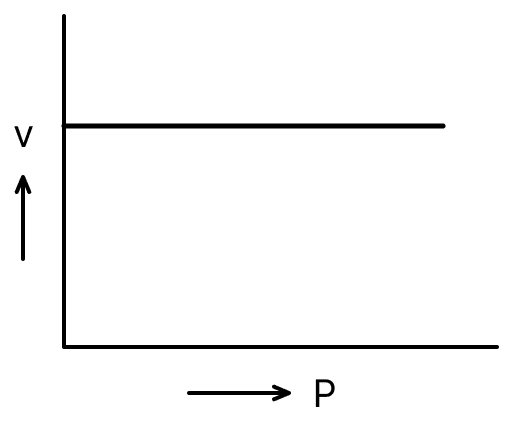
At a constant temperature the ratio is a constant, since a change in P is accompanied by a proportional change in d. Hence from the speed v does not change with P, and the graph between P and v is a straight line parallel to the pressure axis.
What is the ratio of the speed of sound in a polyatomic gas (γ = 4/3) and the rms speed of the molecules in that gas?
Answer
Given, γ = 4/3 for the polyatomic gas.
The ratio of the speed of sound in a gas to the root-mean-square speed of its molecules is
Substituting the value of γ,
Hence, the required ratio is 2 : 3.
Find the ratio of the speed of sound in hydrogen gas and root-mean-square speed of hydrogen molecules.
Answer
Hydrogen is a diatomic gas, so .
The ratio of the speed of sound in a gas to the root-mean-square speed of its molecules is
Substituting the value of γ,
Hence, the required ratio is .
The fundamental frequency of an open organ pipe is 512 Hz. What will be the fundamental frequency if its one end is closed?
Answer
Given, the fundamental frequency of the open organ pipe, nopen = 512 Hz.
For an open pipe of length l,
and for a pipe of the same length closed at one end,
Substituting the value,
Hence, the fundamental frequency becomes 256 hertz when one end is closed.
The frequency of a closed-end organ pipe is 50 Hz. What will be its resonating frequencies if the other end of the pipe is opened?
Answer
Given, the frequency of the closed-end organ pipe, nclosed = 50 Hz.
For a closed pipe of length l,
When the other end is also opened, the pipe becomes an open pipe of the same length, and its fundamental frequency is
An open pipe produces both the even and the odd harmonics, in the ratio 1 : 2 : 3 : 4 ... Hence the resonating frequencies are
Hence, the resonating frequencies of the opened pipe are 100 Hz, 200 Hz, 300 Hz, and so on.
The frequency of the fundamental note produced by a pipe closed at one end is 150 per second. What will be the frequency of the fundamental note from another pipe of the same type but of half its length?
Answer
Given, the frequency of the fundamental note of the closed pipe, n = 150 per second, and the length of the second pipe is half that of the first.
The fundamental frequency of a pipe closed at one end is
For the second pipe of length ,
Hence, the frequency of the fundamental note of the second pipe is 300 per second.
The frequency of the fundamental note of a closed organ pipe and that of an open organ pipe are the same. What is the ratio between their lengths?
Answer
Let l1 be the length of the closed organ pipe and l2 that of the open organ pipe.
The fundamental frequencies are
It is given that the two fundamental frequencies are the same, so n1 = n2,
Hence, the ratio of the length of the closed pipe to that of the open pipe is 1 : 2.
In the given diagrams is shown a stretched string vibrating between two points P and Q . Write the ratio of the frequencies of the string in the two cases. The tension in the string remains unchanged.
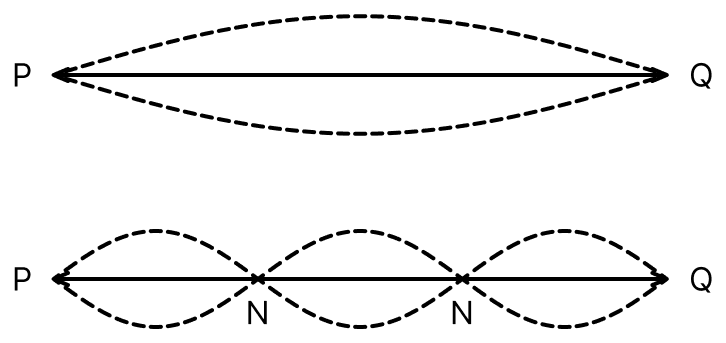
Answer
In the two diagrams the stretched string vibrates between the fixed points P and Q, so a node is formed at each of these ends.
First case : The string vibrates in one segment, that is, in the fundamental mode. If l be the length PQ, then
Second case : The string vibrates in three segments, with two additional nodes between P and Q. Hence
The tension in the string remains unchanged, so the speed v is the same in both the cases.
Hence, the ratio of the frequencies of the string in the two cases is 1 : 3.
In a plane progressive wave, the maximum particle velocity is twice the wave velocity. Find the ratio of the wavelength and the amplitude of the wave.
Answer
Given, the maximum particle velocity is twice the wave velocity.
For a plane progressive wave the maximum particle velocity is
and the wave velocity is
It is given that umax = 2v, so
Hence, the ratio of the wavelength to the amplitude of the wave is π : 1.
Sound waves of frequency 660 Hz fall normally on a perfectly reflecting wall. Determine the shortest distance from the wall at which the air particles have a maximum amplitude of vibration. The speed of sound in air is 330 m/s.
Answer
Given,
- Frequency of the sound waves, n = 660 Hz
- Speed of sound in air, v = 330 m/s
The wave falls normally on a perfectly reflecting wall, so the incident and the reflected waves superpose and form a stationary wave. The wall is a rigid boundary, so a node is formed at the wall.
The wavelength of the wave is
The air particles have a maximum amplitude of vibration at an antinode, and the distance of the nearest antinode from the node at the wall is . Hence the shortest distance is
Hence, the shortest distance from the wall at which the air particles have a maximum amplitude of vibration is 0.125 m.
Write the equation of a stationary wave. Explain the meaning of symbols used.
Answer
The equation of a stationary wave is
The symbols used have the following meanings :
- y — the resultant displacement, at the instant t, of the particle situated at a distance x from the origin
- a — the amplitude of each of the two component progressive waves, so that 2a is the maximum amplitude at an antinode
- λ — the wavelength of the component waves
- T — the time-period of the component waves
- x — the distance of the particle from the origin
- t — the instant of time
In this wave the positions x = 0, , , ... are the antinodes, and the positions x = , , , ... are the nodes.
The fundamental frequency of pipe closed at one end is 200 hertz. What will be the fundamental frequency of another similar pipe of the same length, open at both ends?
Answer
Given, the fundamental frequency of the pipe closed at one end, nclosed = 200 hertz.
For a pipe of length l closed at one end,
For a similar pipe of the same length open at both ends,
Hence, the fundamental frequency of the pipe open at both ends is 400 hertz.
In the figure, two vibrating air columns are shown. Find the ratio of frequencies in the two cases shown.
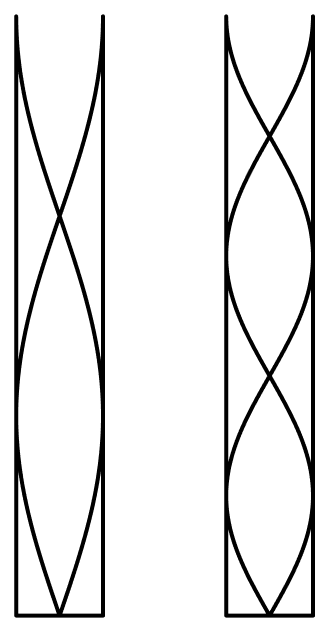
Answer
In the figure the two vibrating air columns are those of pipes closed at one end, since each has a node at the closed end and an antinode at the open end.
First case : The figure shows the first overtone, that is, the third harmonic, of the closed pipe. Its frequency is
Second case : The figure shows the second overtone, that is, the fifth harmonic, of the closed pipe. Its frequency is
Therefore,
Hence, the ratio of the frequencies in the two cases is 3 : 5.
Two strings of equal lengths are stretched by equal forces. The strings are made of the same material. If their diameters are in the ratio 3 : 2, what will be the ratio of their fundamental frequencies?
Answer
Given, the two strings are of equal length, are stretched by equal forces, are made of the same material, and their diameters are in the ratio 3 : 2, that is, r1 : r2 = 3 : 2.
The fundamental frequency of a stretched string is
since l, T and d are the same for both the strings. Therefore,
Hence, the ratio of their fundamental frequencies is 2 : 3.
The frequency of the third harmonic of a stretched string is 255 hertz. Determine its fundamental frequency.
Answer
Given, the frequency of the third harmonic of the stretched string, n3 = 255 hertz.
A stretched string gives both the even and the odd harmonics, whose frequencies are in the ratio n1 : n2 : n3 ... = 1 : 2 : 3 ... Hence the third harmonic is three times the fundamental frequency,
Hence, the fundamental frequency of the string is 85 hertz.
The speed of sound does not depend upon its frequency. Can you verify this statement from some experience of your daily life ?
Answer
Yes. If sounds are produced simultaneously by different musical instruments in an orchestra, they are all heard by the ear at the same time.
The notes produced by the various instruments have widely different frequencies. If the speed of sound depended upon the frequency, then the notes of different frequencies would reach the listener at different instants of time and the music would be heard jumbled. Since we hear them together and in the proper sequence, the speed of sound in air must be the same for all frequencies. This is why we can enjoy an orchestra even when seated far away.
How will the frequency of a note emitted by an organ pipe be affected by rise in temperature?
Answer
The frequency of the note emitted by an organ pipe increases with a rise in temperature.
The frequency of the note emitted by an organ pipe is
With a rise in temperature the speed of sound in air increases, since . The length of the pipe is practically unchanged, so the frequency of the note also increases.
How will the fundamental frequency of a closed organ pipe be affected if instead of air it is filled with a gas heavier than air?
Answer
The fundamental frequency of the closed organ pipe will decrease.
The fundamental frequency of a closed organ pipe is
where v is the speed of sound in the gas filling the pipe. Since , a gas heavier than air has a greater density and so the speed of sound in it is smaller. The length of the pipe being unchanged, the fundamental frequency therefore decreases.
A tuning fork produces resonance in a closed pipe, but the same tuning fork does not produce resonance in an open pipe of the same length. Why?
Answer
This happens because of the end correction.
Applying the end correction e, the fundamental frequencies of a closed pipe and of an open pipe of the same length l are
Hence the fundamental frequency of the open pipe is not exactly twice that of the closed pipe of the same length, but slightly less than twice. Since the harmonics of the open pipe therefore do not coincide exactly with the frequency of the fork that resonates with the closed pipe, the same fork does not produce resonance in the open pipe.
If the tension of a stretched string is made four times its initial value, then the final velocity of the wave will be how many times of its initial velocity?
Answer
The final velocity of the wave will be twice its initial velocity.
The speed of a transverse wave in a stretched string is
If the tension is made 4 T, then
If the radius of a stretched wire is reduced to half, then what will be the new wave speed compared to its initial value?
Answer
The new wave speed will be double its initial value.
The speed of a transverse wave in a stretched wire of radius r is
for a given tension and a given material. If the radius is reduced to , then
A sonometer wire of length l is in unison with a tuning fork of frequency n. If the length of the wire is reduced to one-half then with what frequency will it be in unison?
Answer
The wire will be in unison with a fork of frequency 2 n.
The fundamental frequency of a sonometer wire is
for a given tension and a given wire. If the length is reduced to , the frequency becomes
Write (i) λ/4 in forms of phase difference and time difference and (ii) π/3 in forms of time difference and wavelength.
Answer
(i) A path difference of corresponds to
(ii) A phase difference of corresponds to
Equation of motion of a progressive wave is . The amplitude of reflected wave remains 2/3 of that of progressive wave when the wave is reflected back from a rigid wall. Determine the equation of the reflected wave.
Answer
Given, the equation of the progressive wave is
and the amplitude of the reflected wave is of that of the incident wave.
Amplitude of the reflected wave :
Direction of travel : The incident wave travels along the positive direction of the X-axis, so the reflected wave travels along the negative direction. Hence x is replaced by − x, that is, the minus sign inside the bracket becomes a plus sign.
Phase change : The wave is reflected back from a rigid wall, so it suffers a phase change of π. Therefore
Using sin (θ + π) = − sin θ,
Hence, the equation of the reflected wave is .
Why did Laplace introduce a correction in Newton's formula for velocity of sound ?
Answer
Newton assumed that when longitudinal waves travel in a gas, the temperature of the gas remains constant. On this assumption the elasticity concerned is the isothermal elasticity, whose value is equal to the pressure P of the gas, and the speed of sound is
Taking P = 1.01 × 10⁵ N m-2 and d = 1.29 kg m-3 for air at 0°C, this gives v = 280 m s-1, whereas the experimental value is nearly 331 m s-1. The discrepancy is far too large.
Laplace pointed out that Newton's assumption is wrong. When sound waves travel in a gaseous medium, the states of compression and rarefaction occur alternately at every point. At a compression some heat is developed and at a rarefaction some heat is lost. The compressions and rarefactions occur so rapidly that the heat produced during compression cannot go out into the surroundings and the heat lost during rarefaction cannot come in from them. Besides this, gases are bad conductors of heat, so no exchange of heat takes place at all. Hence the temperature at a point rises during compression and falls during rarefaction, and the process is adiabatic, not isothermal.
Therefore the elasticity concerned is the adiabatic elasticity, whose value is γP, and the corrected formula is
With γ = 1.41 for air, this gives m s-1, which agrees closely with the experimental value.
The speed of sound in moist air is greater than in dry air, why ? Will the speed of sound in moist hydrogen be greater than in dry hydrogen ?
Answer
The speed of sound in moist air is greater than in dry air.
The density of water-vapour is less than that of air, so the density of air mixed with water-vapour, that is, moist air, is less than that of dry air. Since
at a given pressure, the smaller density of moist air gives a greater speed of sound.
No, the speed of sound in moist hydrogen will be less than in dry hydrogen.
The density of water-vapour is more than that of hydrogen, which is the lightest of all gases. Hence the density of moist hydrogen is greater than that of dry hydrogen, and by the same relation the speed of sound in moist hydrogen is less than in dry hydrogen.
Sound waves propagate in air with a speed of 300 m s-1. Will the speed of these waves in hydrogen at the same temperature less or more ? In carbon-dioxide ?
Answer
In hydrogen the speed will be more, and in carbon-dioxide it will be less than 300 m s-1.
At a given temperature the speed of sound in a gas is
that is, the speed of sound in a gas is inversely proportional to the square-root of its molecular-mass.
The molecular mass of hydrogen, 2, is much less than the average molecular mass of air, about 29, so the speed of sound in hydrogen is much more than in air.
The molecular mass of carbon-dioxide, 44, is more than that of air, so the speed of sound in carbon-dioxide is less than in air.
What is meant by stationary waves? Write equation.
Answer
Stationary waves : When two identical transverse, or longitudinal, progressive waves travel in a bounded medium with the same speed but in opposite directions, then by their superposition a new type of wave is produced which appears stationary in the medium. This wave is called a stationary (or standing) wave.
The characteristic of the stationary wave is that some particles of the medium remain permanently at rest, while some other particles undergo maximum displacement compared to others. The former are called the nodes and the latter the antinodes.
Equation : If two waves of amplitude a travelling in opposite directions superpose, the equation of the resulting stationary wave is
where λ is the wavelength and T the time-period of the component waves.
Write the conditions for the formation of a stationary wave.
Answer
The conditions for the formation of a stationary wave are :
(i) The medium should not be unlimited; it should have a boundary. That is, the medium must be a bounded medium, so that the wave propagating in it is reflected at the boundary.
(ii) The two superposing waves must travel in opposite directions along the same line.
(iii) The two waves must be of the same kind, that is, both transverse or both longitudinal.
(iv) The two waves must have the same frequency (or wavelength) and the same speed.
(v) The amplitudes of the two waves should be equal, or nearly equal, so that the nodes are well defined.
A vessel is placed below a water-tap. We can estimate the height of the water level reached in the vessel from a distance simply by listening the sound. How?
Answer
The air column above the water level in the vessel behaves as an air column closed at one end, the water surface being the closed end. The frequency of the note emitted by such an air column is
that is, the frequency is inversely proportional to the length of the air column.
As the water level in the vessel rises, the length l of the air column above it goes on decreasing, so the frequency of the emitted note goes on increasing, that is, the note becomes more and more shrill.
Hence, simply by listening to the sound and noting how shrill it has become, we can estimate from a distance the height up to which the vessel has been filled with water.
An organ pipe is in resonance with a tuning fork. What change will have to be done in its length l, if (i) the temperature rises, (ii) hydrogen is filled in the pipe in place of air, (iii) pressure becomes higher?
Answer
The organ pipe is in resonance with the tuning fork, so its frequency must be kept unchanged.
(i) Temperature rises : With a rise in temperature the speed of sound in air increases, since . To keep the frequency of the pipe unchanged, the length l of the pipe must therefore be increased.
(ii) Hydrogen is filled in place of air : Hydrogen is far lighter than air, and since , the speed of sound is more in hydrogen than in air. Hence again, to keep the frequency unchanged, the length l must be increased.
(iii) Pressure becomes higher : There is no effect of a pressure rise on the speed of sound, because at a constant temperature the ratio remains constant. Hence no change is required in l.
What is meant by 'harmonics'? Explain giving examples.
Answer
Harmonics : If the frequencies of the fundamental tone and the overtones produced by a source of sound are in a harmonic series, then these tones are called harmonics. The fundamental tone is the first harmonic, and the tone whose frequency is m times the fundamental frequency is the mth harmonic.
Examples :
(i) Closed organ pipe : The frequencies of the fundamental tone and the overtones are in the ratio
that is, a closed pipe produces only the odd harmonics.
(ii) Open organ pipe : The frequencies of the fundamental tone and the overtones are in the ratio
that is, an open pipe produces both the even and the odd harmonics. A stretched string also gives both types of harmonics in this same ratio.
Mention the differences between fundamental frequency, harmonics and overtones.
Answer
| S. No. | Fundamental frequency | Harmonics | Overtones |
|---|---|---|---|
| (i) | It is the lowest frequency with which a bounded medium can vibrate. | These are the tones whose frequencies are integral multiples of the fundamental frequency. | These are the tones of frequency higher than the fundamental tone which are actually produced by the source. |
| (ii) | It is denoted by n, and corresponds to the simplest mode of vibration. | If the fundamental frequency is n, the harmonics are n, 2n, 3n, 4n, ... | If the fundamental frequency is n, then 2n, 3n, 4n, ... are called the first, the second, the third, ... overtones. |
| (iii) | There is only one fundamental frequency for a given medium. | The fundamental tone itself is the first harmonic. | The fundamental tone is not counted among the overtones. |
| (iv) | It is the same for the medium whatever be the mode excited. | All the harmonics need not be present; in a closed pipe only the odd harmonics are present. | The overtones are numbered in the order in which they actually occur, starting from the tone next above the fundamental. |
What is resonance? Explain.
Answer
Resonance : When an external periodic force is applied over a body and the frequency of the force is different from the natural frequency of the body, then the body executes forced vibrations with the frequency of the applied force but with a small amplitude. If, however, the frequency of the external force is equal to the natural frequency of the body, or to its integral multiple, then the amplitude of the forced vibrations of the body becomes quite large. This phenomenon is called resonance. Thus, resonance is a particular case of forced vibrations.
Explanation : When the frequency of the external force is equal to the natural frequency of the body, then at each step the force is in phase with the oscillating body. Hence the successive impulses given by the periodic force to the body are added up and increase the amplitude of oscillation continuously. But with increasing amplitude the air resistance and the internal friction also increase, so that the loss of energy from the body also increases. Finally a stage is reached when the energy supplied by the external force becomes equal to the energy lost by the body, and the amplitude becomes steady.
Example : If a tuning fork of frequency 256 Hz is vibrated over the mouth of a resonance tube and the length of the air column is gradually adjusted, then at one particular length the air column emits a loud sound. This happens when the natural frequency of the air column becomes equal to the frequency of the fork.
Show that in air the velocity of sound waves increases by 0.61 m s-1 for each °C rise in temperature of the air.
Answer
The speed of sound in a gas is directly proportional to the square-root of its absolute temperature,
If v0 be the speed of sound at 0°C and vt the speed at t°C, then
Dividing equation (ii) by equation (i),
Since t is small compared with 273, the binomial theorem may be applied and the terms beyond the first power of neglected,
Taking the speed of sound in air at 0°C as v0 = 332 m s-1,
Hence, the velocity of sound in air increases by 0.61 m s-1 for each °C rise in the temperature of the air.
Draw a graph between the absolute temperature (T) of a gas and the square of the speed of sound (v2) in the gas.
Answer
The graph will be a straight line passing through the origin.
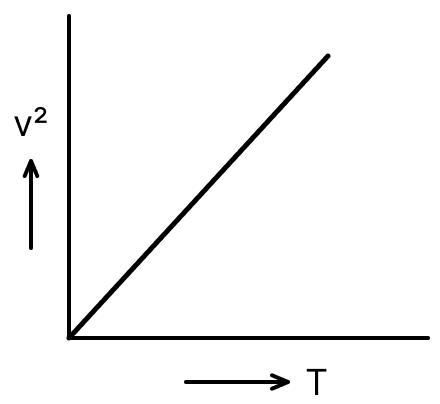
The speed of sound in a gas is
For a given gas the quantity is a constant, so
Since v2 is directly proportional to T, and v2 = 0 when T = 0, the graph between the absolute temperature T and the square of the speed of sound v2 is a straight line passing through the origin.
Express the equation in two other forms.
Answer
Given, the equation of the progressive wave is
First other form : In wave motion . Substituting this,
Second other form : In wave motion , so that . Substituting this in the first form,
In the diagram below, the displacement-time curve of a wave is shown.
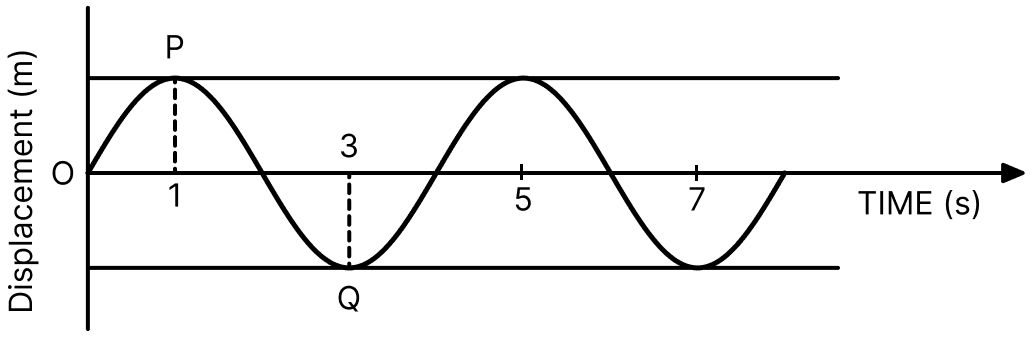
(i) What are the phases of points P and Q ?
(ii) What is time-period of the wave ?
Answer
(i) Phases of the points P and Q :
In one complete wave cycle the phase changes by 2π radian. From the curve, the point P is at the position of maximum positive displacement, that is, at a crest, which corresponds to one-quarter of a cycle. Hence
The point Q is at the position of maximum negative displacement, that is, at a trough, which corresponds to three-quarters of a cycle. Hence
(ii) Time-period of the wave :
The time-period is the time taken for one complete oscillation. From the graph the displacement curve repeats itself after every 4 seconds.
Hence, the phases of P and Q are and respectively, and the time-period of the wave is 4 seconds.
The equations of two progressive waves are
Find the equation of the resultant wave when these two waves are superimposed.
Answer
Given, the two progressive waves are
The two waves are identical and travel in opposite directions, so their superposition gives a stationary wave.
By the principle of superposition, the resultant displacement is
Using ,
Since ,
Hence, the equation of the resultant wave is , which is the equation of a stationary wave.
Draw a diagram showing the positions of nodes and antinodes in an open organ pipe when the air column inside it produces second overtone.
Answer
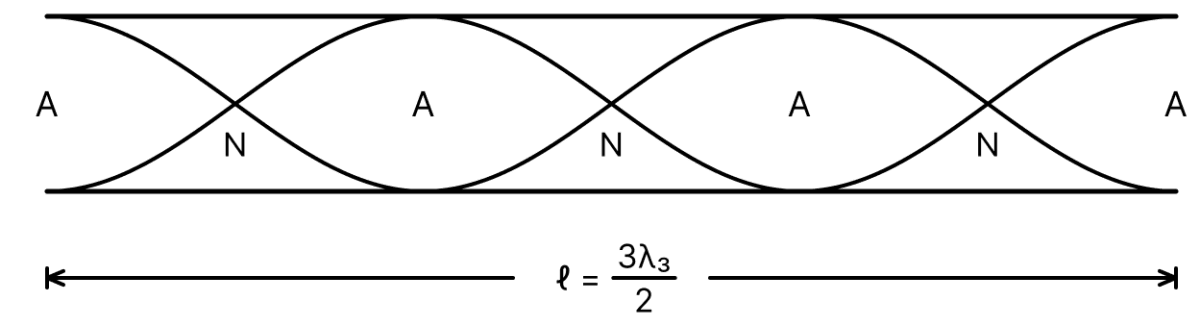
In an open organ pipe an antinode (A) is formed at each of the two open ends.
The second overtone of an open pipe is its third harmonic, corresponding to m = 3. In this mode
The air column therefore vibrates with four antinodes — one at each of the two ends and two in between — and three nodes (N) between them, as shown in the diagram.
The frequency of this mode is
Show in a diagram the positions of nodes and antinodes in an organ pipe closed at one end when the third harmonic of its fundamental frequency is produced.
Answer
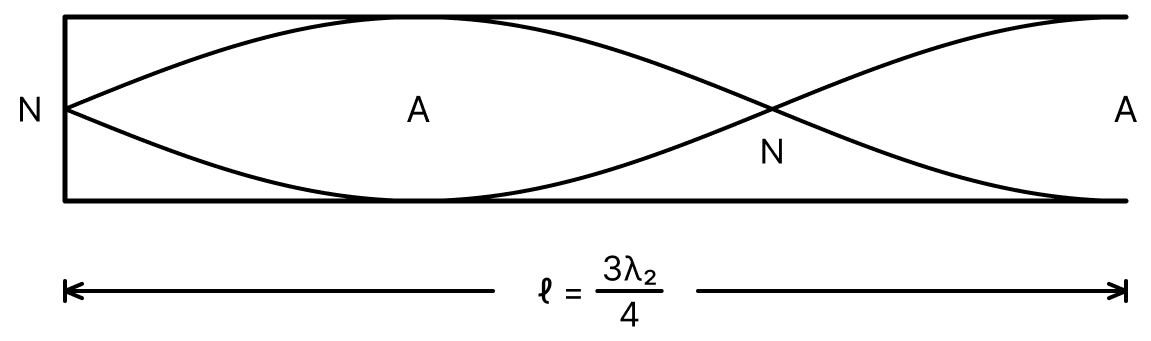
In an organ pipe closed at one end, a node (N) is always formed at the closed end and an antinode (A) at the open end.
The third harmonic of a closed pipe is its first overtone, corresponding to m = 2. In this mode
In this mode one additional antinode and one additional node are formed between the closed and the open ends of the pipe, so the air column has two nodes and two antinodes, as shown in the diagram.
The frequency of this mode is
Draw diagrams for the fundamental tone and the first and the second overtones in a stretched string, and show the positions of nodes and antinodes.
Answer
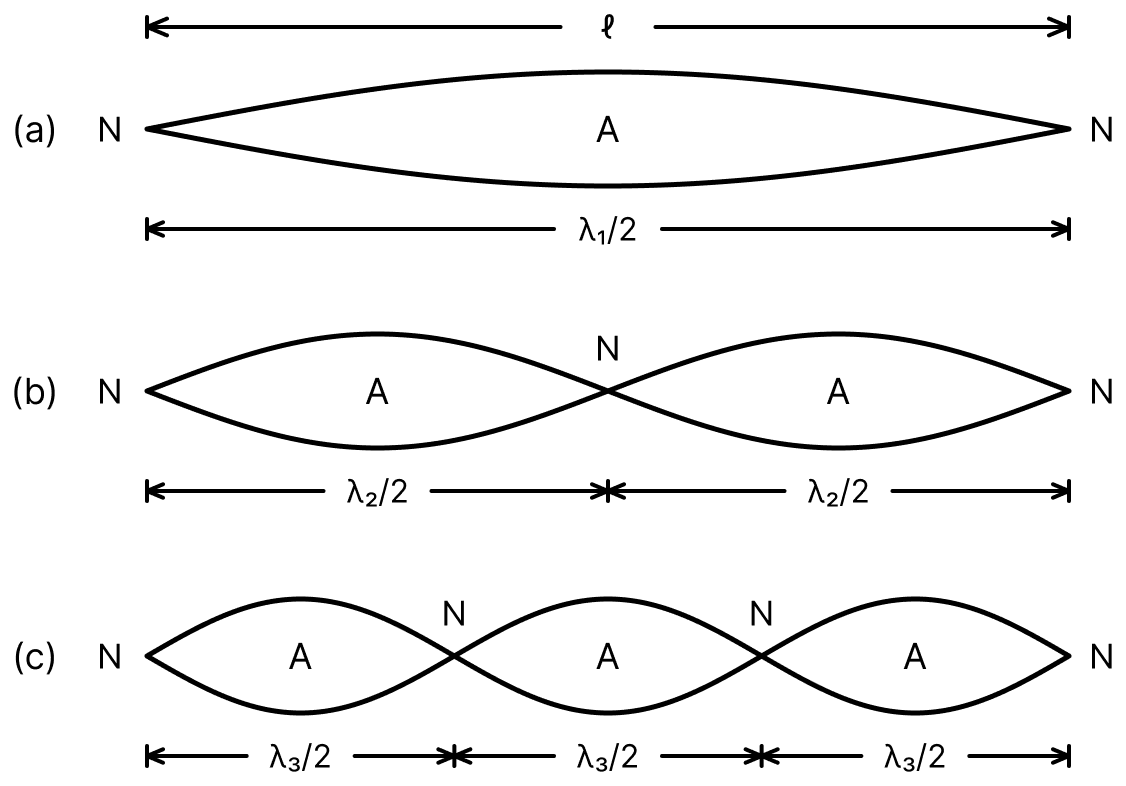
A stretched string is clamped at both its ends, so a node (N) is always formed at each end.
Fundamental tone (first harmonic), p = 1 : The string vibrates as a whole in one segment. There are two nodes, one at each end, and one antinode (A) in the middle.
First overtone (second harmonic), p = 2 : The string vibrates in two segments. There are three nodes — one at each end and one in the middle — and two antinodes.
Second overtone (third harmonic), p = 3 : The string vibrates in three segments. There are four nodes and three antinodes.
A 100 cm long iron rod is clamped at 25 cm from one end. Then the rod is rubbed forward and backward at one end with the help of a sand-paper. Determine the wavelength of the wave produced in the rod.
Answer
Given,
- Length of the iron rod = 100 cm
- The rod is clamped at 25 cm from one end
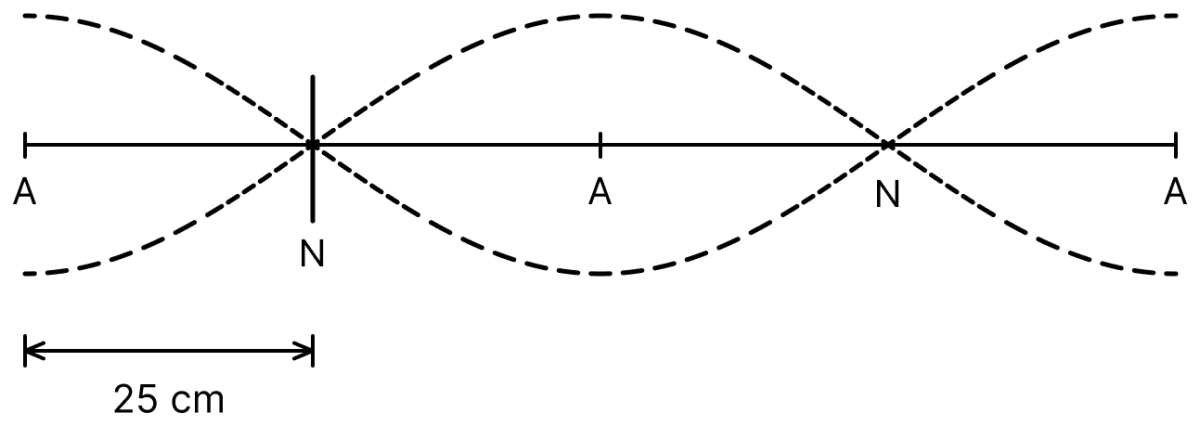
On rubbing the rod with a sand-paper, longitudinal stationary waves are established in it. At the clamped point the rod cannot vibrate, so a node (N) is formed there. At each free end-point the rod has the greatest freedom to vibrate, so an antinode (A) is formed there.
The distance between an antinode and its nearest node is . The clamp is at 25 cm from one end, so the distance between the antinode at that end and the node at the clamp is 25 cm. Hence
Hence, the wavelength of the wave produced in the rod is 100 cm.
At the same temperature and pressure, the densities of two diatomic gases are d1 and d2. Determine the ratio of the speeds of sound in these gases.
Answer
Given, two diatomic gases at the same temperature and pressure, of densities d1 and d2.
The speed of sound in a gas is
Both the gases are diatomic, so the value of γ is the same for both, namely . The pressure P is also the same for both. Hence
Dividing,
Hence, the ratio of the speeds of sound in the two gases is .
Two gases, one monoatomic and the other diatomic, at the same temperature and pressure, have densities d1 and d2 respectively. Find the ratio of the speeds of sound in those gases.
Answer
Given, one gas is monoatomic of density d1 and the other is diatomic of density d2, both at the same temperature and pressure.
The speed of sound in a gas is
Since the pressure is the same for both,
For a monoatomic gas and for a diatomic gas . Substituting these values,
Hence, the ratio of the speeds of sound in the two gases is .
What will be the speed of sound in hydrogen as compared to that in oxygen at constant temperature ?
Answer
Given, hydrogen and oxygen at a constant temperature.
Both hydrogen and oxygen are diatomic gases, so the value of γ is the same for both. At the same temperature the speed of sound in a gas is
The molecular masses of hydrogen and oxygen are MH = 2 and MO = 32. Hence
Hence, the speed of sound in hydrogen is four times that in oxygen, that is, the ratio is 4 : 1.
The equation of a transverse wave is . The maximum particle velocity is four times the wave velocity. Find out the wavelength of the wave.
Answer
Given, the equation of the transverse wave is
and the maximum particle velocity is four times the wave velocity.
Particle velocity : Differentiating y with respect to t, keeping x constant,
The maximum value of the cosine term is 1, so the maximum particle velocity is
Wave velocity :
It is given that umax = 4 v, so
Hence, the wavelength of the wave is .
Write the equation of a stationary wave. State the positions of nodes and antinodes.
Answer
The equation of a stationary wave is
where a is the amplitude of each of the two component progressive waves, λ their wavelength and T their time-period.
Positions of the antinodes : Substituting x = 0, , , , ... in the equation, the value of becomes alternately + 1 and − 1. At these points the displacement y is always maximum in comparison with the other points. These points are the antinodes, and they are separated from each other by a distance .
Positions of the nodes : Substituting x = , , , ... the value of becomes zero. At these points the displacement y is always zero. These points are the nodes, and they too are separated from each other by a distance .
In the figure below is shown a progressive wave (amplitude = 0.5 cm) incident on a hard (rigid) surface. Draw (i) figure of reflected wave, (ii) figure of the resultant wave produced due to superposition of the incident and the reflected waves.
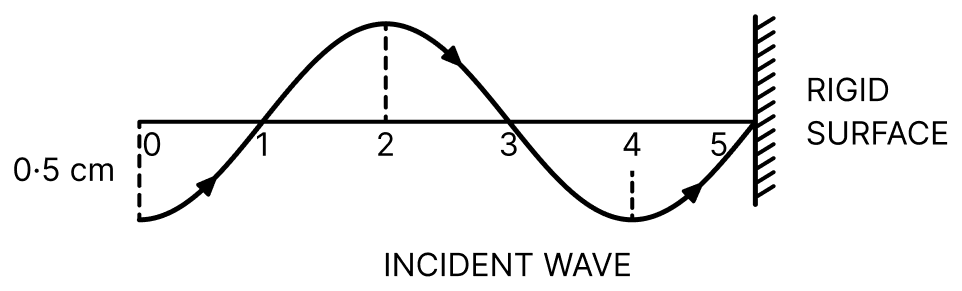
Answer
Given, the amplitude of the incident wave = 0.5 cm, and the wave is incident on a hard (rigid) surface.
(i) Reflected wave : In the absence of the hard surface the incident wave would have advanced further. On reflection at a rigid surface, however, the wave suffers a phase change of 180°, that is, the directions of displacement of the particles in the reflected wave become inverted with respect to the incident wave.
Hence the reflected wave is a similar curve of amplitude 0.5 cm, but turned upside down with respect to the incident wave.
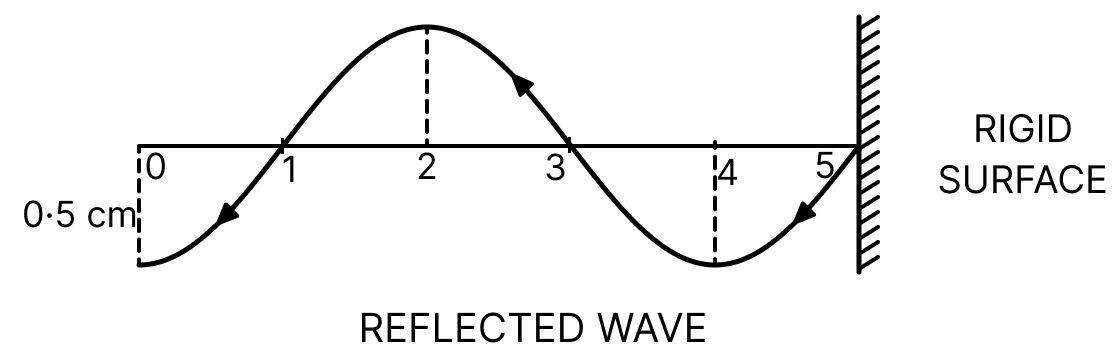
(ii) Resultant wave : For the figure drawn, the displacements of the incident wave and of the reflected wave are similar at all points. Hence, by the principle of superposition, the resultant wave obtained by adding the two displacements algebraically is also a similar curve, but with an amplitude of
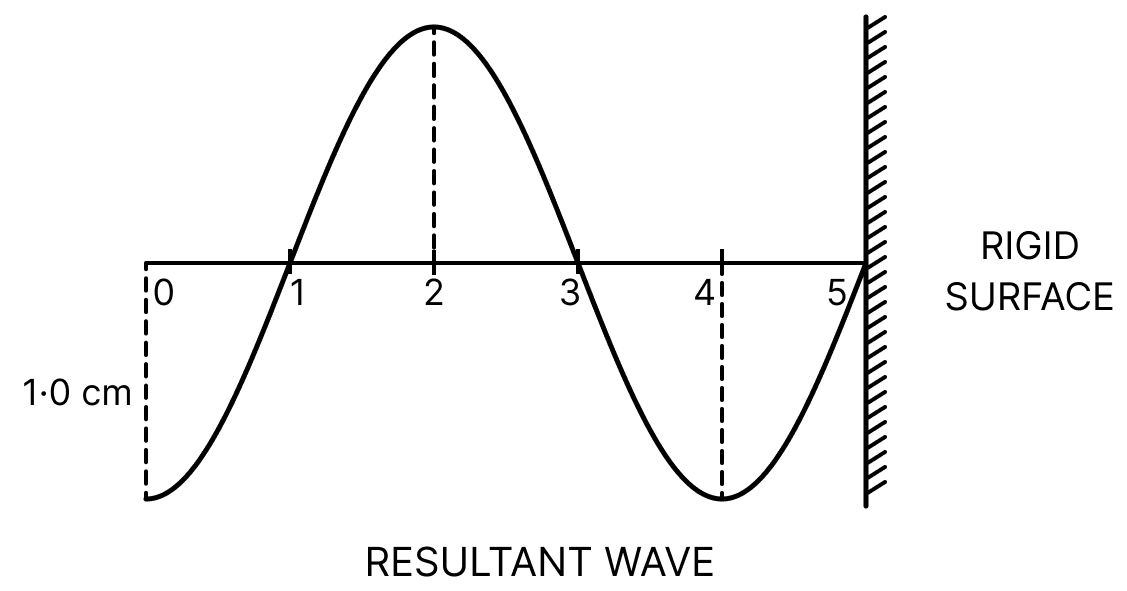
Hence, the reflected wave has an amplitude of 0.5 cm and is inverted with respect to the incident wave, while the resultant wave is a similar curve of amplitude 1.0 cm.
A. Mechanical waves are disturbances that transfer energy through a medium without permanently displacing the particles of the medium. The speed of a mechanical wave is determined by the properties of the medium it travels through. In general, waves move faster in solids than in liquids and faster in liquids than in gases. This is because the particles in solids are more tightly bound together, allowing energy to be transferred more quickly between them. For waves on a string, the speed depends on both the tension in the string and its linear mass density. Mathematically, the speed v is given by , where T is the tension in the string, and m is the mass per unit length. Similarly, the speed of sound in air is affected by the temperature of the air, as warmer air allows sound waves to travel faster due to increased molecular motion. Understanding how wave speed is determined is crucial in fields ranging from musical instrument design to seismic analysis.
(i) The speed of a wave on a string increase when:
- the tension in the string is increased
- the mass per unit length of the string is increased
- the frequency of the wave is increased
- the wavelength of the wave is decreased.
(ii) Why do sound waves travel faster in solids than in gases?
- Solids are more compressible
- Solids have a higher density
- The particles in solids are closer together
- Solids are less dense.
(iii) What is the relationship between the speed of sound and temperature?
- Speed decreases as temperature increases
- Speed increases as temperature increases
- Speed remains constant regardless of temperature
- Speed decreases at high temperatures and increases at low temperatures.
(iv) The speed of sound in a medium depends on:
- frequency only
- amplitude only
- properties of the medium
- wavelength only.
(v) If the temperature of air increases, the speed of sound in the air:
- decreases
- increases
- stays the same
- becomes zero.
B. If on propagation of a wave through a medium, the medium particles oscillate along a direction perpendicular to the direction of propagation of the wave, the wave is called a transverse wave. These waves propagates in the form of troughs and crests. If on propagation of a wave through a medium, the medium particles oscillate along the direction of propagation of the wave, the wave is called a longitudinal wave. These waves propagates in the form of compressions and rarefactions. The speed of longitudinal waves in gases is given by, , where P is pressure and d is the density of the gas.
(i) Explain the effect of pressure of gas on the speed of longitudinal waves in a gas.
(ii) Explain the effect of temperature of gas on the speed of longitudinal waves in a gas.
(iii) At what temperature will the speed of sound in air be double of its speed at 97°C?
Answer
A.
(i) the tension in the string is increased.
The speed of a wave on a string is . Hence the speed increases when the tension T is increased, and it decreases when the mass per unit length m is increased. The frequency and the wavelength of the wave have no effect on the speed, since the speed is decided by the properties of the medium alone.
(ii) The particles in solids are closer together.
In a solid the particles are closely packed and are bound by strong elastic forces, so a disturbance is handed on from one particle to the next very rapidly. Hence the energy is transferred more quickly and the speed of sound in a solid is greater than in a gas.
(iii) Speed increases as temperature increases.
The speed of sound in a gas is , so that . At a higher temperature the molecules move faster and the rate of energy transfer between them increases, so the speed of sound increases.
(iv) properties of the medium.
The speed of sound in a medium is , where E is the modulus of elasticity of the medium and d its density. The frequency, the amplitude and the wavelength of the wave do not enter into this expression.
(v) increases.
Since , a rise in the temperature of the air raises the speed of sound. Numerically, vt = (332 + 0.61 t) m s-1, so the speed increases by about 0.61 m s-1 for each °C rise.
B.
(i) Effect of pressure of gas on the speed of longitudinal waves in a gas :
The speed of longitudinal waves in a gas is
From the ideal gas equation for one mole,
If M be the molecular weight and d the density of the gas, then , so
At a constant temperature, . Hence, if P changes, d also changes in the same proportion and the ratio does not change.
Hence, at a constant temperature there is no effect of pressure on the speed of longitudinal waves in a gas.
(ii) Effect of temperature of gas on the speed of longitudinal waves in a gas :
Substituting in equation (i),
Hence, the speed of longitudinal waves in a gas is directly proportional to the square-root of its absolute temperature, so it increases with a rise in temperature.
(iii) Given,
- Initial temperature, t1 = 97°C, so T1 = 97 + 273 = 370 K
- Speed at this temperature, v1 = v (say)
- Required speed, v2 = 2 v
Since ,
Substituting the values,
Squaring both sides,
Converting into the celsius scale,
Hence, the speed of sound in air will be double of its speed at 97°C at a temperature of 1207°C.
Progressive waves are waves that continuously transfer energy from one point to another through a medium. These waves can be either transverse, where the particle motion is perpendicular to the direction of wave's propagation, or longitudinal, where the particle's motion is parallel to the wave direction. The characteristics of a progressive wave include wavelength, frequency, amplitude and speed. These properties are interconnected, with the speed of a wave being determined by the product of its frequency and wavelength, that is, v = nλ. A common example of a transverse progressive wave is a wave on a stretched string, where the particles move up and down while the wave travels horizontally. In contrast, sound waves in air are longitudinal waves, where particles oscillate back and forth in the same direction as the wave's motion. Progressive waves are fundamental to understanding phenomena like sound, light and even water waves.
(i) What type of wave involves particle motion perpendicular to the direction of wave propagation?
- Longitudinal wave
- Electromagnetic wave
- Transverse wave
- Stationary wave.
(ii) A progressive wave has a wavelength of 1.5 m and a frequency of 200 Hz. What is its speed?
- 200 m/s
- 300 m/s
- 400 m/s
- 500 m/s.
(iii) Which of the following is an example of a longitudinal wave?
- Light wave
- Water wave
- Sound wave in air
- Wave on a string.
(iv) The frequency of a progressive wave depends on:
- the speed and wavelength
- only the amplitude
- only the speed of the wave
- the type of medium.
(v) Which statement is true about longitudinal waves?
- Particle motion is perpendicular to wave direction
- They require a vacuum to travel
- Particle motion is parallel to wave direction
- They have nodes and antinodes.
Answer
(i) Transverse wave.
In a transverse wave the particles of the medium oscillate along a direction perpendicular to the direction of propagation of the wave, and the wave travels in the form of crests and troughs. A wave on a stretched string is a common example.
(ii) 300 m/s.
Given, λ = 1.5 m and n = 200 Hz. From the relation between speed, frequency and wavelength,
(iii) Sound wave in air.
Sound waves in air are longitudinal waves, in which the air particles oscillate back and forth along the same direction in which the wave advances, producing compressions and rarefactions. Light waves are transverse electromagnetic waves, and a wave on a string is a transverse mechanical wave.
(iv) the speed and wavelength.
The three quantities are related by v = nλ, so that
Thus the frequency is fixed by the speed of the wave and its wavelength. The amplitude has no bearing on the frequency.
(v) Particle motion is parallel to wave direction.
This is the defining property of a longitudinal wave. Such waves do not require a vacuum — on the contrary they need a material medium — and nodes and antinodes belong to stationary waves, not to progressive longitudinal waves.
The superposition principle is a key concept in wave theory, stating that when two or more waves overlap, the resulting displacement is the algebraic sum of the displacements of the individual waves. This principle explains the phenomenon of interference, where waves can combine to produce constructive or destructive interference. In constructive interference, the waves add together to create a larger amplitude, while in destructive interference, the waves cancel each other out, reducing the amplitude. The superposition principle is applicable to all types of waves, including sound waves, light waves and water waves. This principle is also responsible for the formation of standing waves when waves travelling in opposite directions interfere with each other, and for the phenomenon of beats, which occurs when two waves of slightly different frequencies interfere to produce periodic variations in amplitude.
(i) What happens when two waves of the same frequency and amplitude meet in phase?
- They cancel each other out
- They create a wave of larger amplitude
- They create a wave of smaller amplitude
- Their frequencies change.
(ii) What phenomenon occurs when two waves of slightly different frequencies interfere?
- Resonance
- Beats
- Diffraction
- Reflection.
(iii) If two waves interfere destructively, the result will be:
- a wave with increased amplitude
- a wave with decreased amplitude
- a wave of the same amplitude
- a wave with a frequency equal to the sum of the original frequencies.
(iv) What is the superposition principle?
- The principle that waves never interfere
- The principle that wave displacement is the sum of individual displacements
- The principle that waves must travel in the same direction
- The principle that the frequency of a wave changes after interference.
(v) In constructive interference, the resulting amplitude is:
- smaller than the original amplitudes
- zero
- equal to the amplitude of one wave
- greater than the original amplitudes.
Answer
(i) They create a wave of larger amplitude.
When two waves of the same frequency and amplitude meet in phase, the phase difference between them is φ = 0. The resultant amplitude is then
which is larger than the amplitude of either wave. This is constructive interference.
(ii) Beats.
When two waves of slightly different frequencies interfere, the phase difference between them at any point varies with time, so the intensity of the resultant sound rises and falls alternately. This periodic variation in amplitude is called the phenomenon of beats, and the beat frequency is n1 ~ n2.
(iii) a wave with decreased amplitude.
In destructive interference the two waves meet in opposite phases, that is, φ = π, and the resultant amplitude is
which is smaller than the amplitude of either wave. It becomes zero only when the two amplitudes are exactly equal.
(iv) The principle that wave displacement is the sum of individual displacements.
According to the principle of superposition, when two or more waves overlap at a point, the resultant displacement at that point is the algebraic sum of the displacements produced by the individual waves,
(v) greater than the original amplitudes.
In constructive interference the waves add together, so the resultant amplitude a1 + a2 is greater than either of the original amplitudes. Since I ∝ a2, the intensity at such a place is maximum.
A. Stationary waves, also known as standing waves, form when two identical waves travelling in opposite directions interfere with each other. Unlike progressive waves, stationary waves do not transfer energy from one point to another. Instead, they are characterized by points of no displacement, called nodes, and points of maximum displacement, called antinodes. Stationary waves are commonly observed in musical instruments like stringed instruments and organ pipes, where the length of the string or pipe determines the possible wavelengths of the standing waves that can form. For example, in a string fixed at both ends, a standing wave can form with nodes at the fixed ends and antinodes in between. The frequency of the standing wave is determined by the length of the string, the tension and the linear density of the string.
(i) In a stationary wave, nodes are points where:
- the displacement is maximum
- the displacement is minimum
- the velocity is maximum
- the frequency is highest.
(ii) What condition is necessary for the formation of stationary waves?
- Two waves of different amplitudes must interfere
- Two waves of the same frequency travelling in opposite directions must interfere
- A single wave must reflect off a boundary
- The medium must be non-elastic.
(iii) Which of the following best describes an antinode in a stationary wave?
- A point where the displacement is zero
- A point where the velocity is zero
- A point of maximum displacement
- A point where the frequency changes.
(iv) In a string fixed at both ends, what determines the fundamental frequency of a standing wave?
- The amplitude of the wave
- The speed of the wave only
- The length, tension, and mass per unit length of the string
- The air pressure around the string.
(v) How does a stationary wave differ from a progressive wave?
- A stationary wave transfers energy, while a progressive wave does not
- A stationary wave does not transfer energy, while a progressive wave does
- A stationary wave has no nodes or antinodes, while a progressive wave has.
- A stationary wave only occurs in solids, while a progressive wave occurs in fluids.
B. When a stationary wave is produced in a bounded medium some particles of the medium remain permanently at rest, while some other particles undergo maximum displacement compared to others. The former are called the nodes and the latter the antinode. When air is blown gently at the open end on a closed organ pipe one node is obtained at the closed end while one antinode is obtained at the open end. This called first mode of vibration and the frequency of the produced sound is called natural frequency of the closed organ pipe.
(i) What is the distance between two successive nodes?
(ii) What is the distance between consecutive nodes and antinodes?
(iii) The length of a closed organ pipe is 0.80 m. Calculate the frequency of its fundamental tone. Speed of sound in air = 330 m/s.
Answer
A.
(i) the displacement is minimum.
The nodes are the points of a stationary wave at which the particles of the medium remain permanently at rest, so their displacement is always zero, that is, minimum. Destructive interference occurs at these points.
(ii) Two waves of the same frequency travelling in opposite directions must interfere.
For the formation of a stationary wave, two identical waves of the same frequency, wavelength and speed must travel in a bounded medium in opposite directions and superpose. A bounded medium is essential, since the wave must be reflected at the boundary to produce the oppositely travelling wave.
(iii) A point of maximum displacement.
The antinodes are the points at which the particles of the medium undergo maximum displacement in comparison with the others. Constructive interference occurs at these points, and the amplitude there is 2a.
(iv) The length, tension, and mass per unit length of the string.
The fundamental frequency of a string fixed at both ends is
so it is decided by the length l, the tension T and the mass per unit length m of the string.
(v) A stationary wave does not transfer energy, while a progressive wave does.
A stationary wave remains steady between the two boundaries of the medium and does not advance, so it does not transmit energy across the medium. A progressive wave, on the other hand, advances with a definite velocity and carries energy from one point to another.
B.
(i) In a stationary wave the nodes are situated at x = 0, , , , ...
Hence, the distance between two successive nodes is .
(ii) The antinodes lie exactly midway between two successive nodes.
Hence, the distance between consecutive nodes and antinodes is .
(iii) Given,
- Length of the closed organ pipe, l = 0.80 m
- Speed of sound in air, v = 330 m/s
In a closed organ pipe a node is formed at the closed end and an antinode at the open end, so in the first mode of vibration
The frequency of the fundamental tone is
Substituting the values,
Hence, the frequency of the fundamental tone of the closed organ pipe is 103.12 Hz.
The phenomenon of beats occurs when two sound waves of slightly different frequencies interfere with each other. As the waves interact, they alternately reinforce and cancel each other, leading to a periodic rise and fall in the amplitude of the sound. This fluctuation in loudness is heard as beats. The frequency of the beats is equal to the absolute difference between the frequencies of the two waves. For example, if one wave has a frequency of 440 Hz and the other has a frequency of 442 Hz, the beat frequency will be 2 Hz, meaning two beats per second. The beat frequency can be used to detect small differences in pitch, which is useful in tuning musical instruments. Beats also provide an example of the principle of superposition, where the resultant wave is the sum of the individual wave displacements.
(i) Beats are produced when two sound waves:
- have the same frequency and amplitude superpose.
- have slightly different frequencies superpose
- have different wavelengths but the same frequency superpose.
- are in phase with each other superpose.
(ii) The beat frequency is equal to:
- the sum of the two frequencies
- the difference between the two frequencies
- the product of the two frequencies
- the average of the two frequencies.
(iii) If two sound waves have frequencies of 350 Hz and 355 Hz, the beat frequency will be:
- 2 Hz
- 5 Hz
- 7 Hz
- 10 Hz.
(iv) Fifty tunning forks are arranged in the order of increasing frequency. Any two successive fork when sounded together gives 4 beats per second. The frequency of 50th fork is one octave higher than the 1st tunning fork. The frequency of first will be :
- 4 Hz
- 54 Hz
- 200 Hz
- 196 Hz.
(v) The beat frequency can be used to:
- measure the amplitude of a wave
- measure the wavelength of a wave
- tune musical instruments
- increase the speed of sound.
Answer
(i) have slightly different frequencies superpose.
Beats are produced by the superposition of two sound waves of nearly equal frequencies. If the frequencies were exactly equal, the phase difference at any point would remain steady and the intensity of sound would remain constant, so no beats would be heard.
(ii) the difference between the two frequencies.
The number of times the intensity of sound rises and falls in one second is equal to the difference in the frequencies of the two sound-sources, that is, beat frequency = n1 ~ n2.
(iii) 5 Hz.
Given, n1 = 355 Hz and n2 = 350 Hz. Hence
(iv) 196 Hz.
Given, fifty tuning forks are arranged in the order of increasing frequency, any two successive forks giving 4 beats per second, and the frequency of the 50th fork is one octave higher than that of the 1st fork.
Let the frequency of the first fork be n. Since each successive fork is 4 Hz higher,
- Frequency of the second fork = n + 4 = n + 1 × 4
- Frequency of the third fork = n + 8 = n + 2 × 4
- Frequency of the fourth fork = n + 12 = n + 3 × 4
Continuing in this way, the frequency of the 50th fork is
One octave higher means double the frequency, so the frequency of the 50th fork is also 2n. Therefore,
(v) tune musical instruments.
Musicians sound two instruments together and adjust the frequency of one until the number of beats per second goes on decreasing and finally the beats disappear. When no beats are heard, the frequencies of the two instruments are exactly equal.
The speed of transverse wave in a stretched string is given by where T is the tension in the string and m is the mass per unit length of the string. If string is clamped to rigid supports at its ends and is gently plucked at its mid-point then it vibrates in one loop. The frequency of vibration of the string, , where l is the length of the string.
(i) A wire clamped at its both ends is vibrating in two loops. Write the formula for the frequency of the vibration of the string.
(ii) A wire is clamped at its both ends. The density of the material of the wire is 4.8 × 10³ kg/m3. If the stress in the wire is 3 × 10⁸ N/m2, find out the speed of transverse waves in the wire.
(iii) A stretched wire is of 2 metres length and its fundamental frequency is 400 Hz. Find the speed of the transverse waves in the wire.
Answer
(i) A wire clamped at both its ends and vibrating in two loops is vibrating in its second mode, that is, p = 2. In this mode
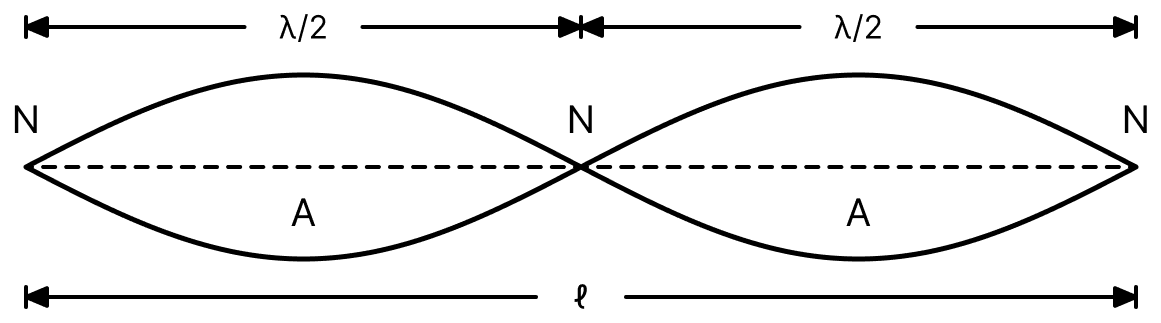
Hence the frequency of vibration of the string is
Hence, the formula for the frequency of vibration in two loops is , which is twice the fundamental frequency.
(ii) Given,
- Density of the material of the wire, d = 4.8 × 10³ kg/m3
- Stress in the wire = 3 × 10⁸ N/m2
The speed of a transverse wave in a stretched wire is
since is the tension per unit area of cross-section, that is, the stress.
Substituting the values,
Hence, the speed of transverse waves in the wire is 250 m/s.
(iii) Given,
- Length of the stretched wire, l = 2 m
- Fundamental frequency, n = 400 Hz
The fundamental frequency of a stretched wire is
Substituting the values,
Hence, the speed of the transverse waves in the wire is 1600 m/s.
Write characteristics of a harmonic wave and derive the relation
also write the meaning of the symbols.
Answer
Characteristics of a harmonic wave :
(i) The wave is produced by a source executing simple harmonic motion, so every particle of the medium also executes simple harmonic motion about its own mean position.
(ii) All the particles of the medium oscillate with the same amplitude and the same frequency.
(iii) The phase of oscillation changes continuously from one particle to the next, so that at any instant all the particles are in different phases of their oscillation.
(iv) The wave advances in the medium with a constant velocity, which is decided by the properties of the medium.
(v) The wave carries energy from one point of the medium to another without any permanent movement of matter.
Derivation of the relation :
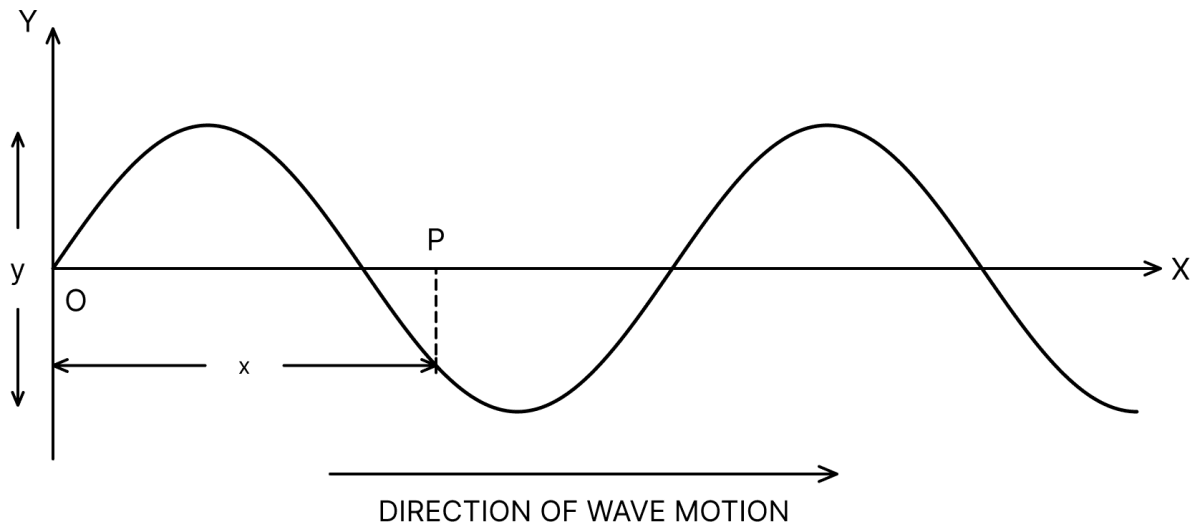
Suppose a simple harmonic progressive wave is advancing in a medium along the positive direction of the X-axis. Let the time be counted from the instant when the particle at the origin O passes through the mean position in the positive direction of the Y-axis. Then the displacement y of the particle at O at any time t is
where a is the amplitude and ω is the angular frequency of the S.H.M. executed by the particle.
In a wave motion the successive particles start oscillating a definite time later than the preceding particle. Hence, as we move away from O, the phase lag of the oscillation of a particle with respect to the particle at O goes on increasing. If φ be the phase lag of a particle P distant x from the origin O, then the displacement of P at any instant t is
For a distance λ, the phase-change is 2π radian. Hence the phase-change for a distance x will be
where is called the propagation constant.
Substituting equation (iii) in equation (ii),
Now , where T is the period of an oscillation of the particles, and . Substituting these values in equation (iv),
Meaning of the symbols :
- y — the displacement, at the instant t, of the particle situated at a distance x from the origin
- a — the amplitude of the wave
- T — the time-period of the oscillation
- λ — the wavelength of the wave
- x — the distance of the particle from the origin
- t — the instant of time
If the wave is travelling along the − X direction, the minus sign inside the bracket is replaced by a plus sign,
Define wave velocity and particle velocity. Explain their variation with time and obtain a relation between particle and wave velocity.
Answer
Wave velocity : Wave velocity, or propagation velocity, is the speed with which the wavefronts, or the energy of the wave, travels through the medium. It depends upon the properties of the medium and the type of the wave, and is given by
Particle velocity : Particle velocity refers to the velocity of the individual particles of the medium as they oscillate due to a wave passing through them. It is the rate of change of the displacement of a particle with time.
Variation with time :
The equation of a travelling wave along the positive X-axis is
Differentiating equation (i) with respect to t, keeping x constant, the instantaneous particle velocity is
The particle velocity therefore changes harmonically with time and with distance, whereas the wave velocity v remains constant. From equation (ii) the particle velocity is maximum when the cosine term is ± 1, so
There is a phase difference of between the displacement and the particle velocity.
Relation between particle and wave velocity :
Differentiating equation (i) with respect to x, keeping t constant,
Dividing equation (ii) by equation (iii),
Hence, particle velocity = − wave velocity × slope of the displacement curve.
Discuss adiabatic process in the propagation of wave. Obtain relation for adiabatic elasticity of gases and obtain the relation
where P is pressure of gas and ρ is density.
Answer
Adiabatic process in the propagation of a wave :
When longitudinal waves travel in a gaseous medium, the states of compression and rarefaction occur alternately at every point. At the time of compression some heat is developed at the point, and at the time of rarefaction some heat is lost from the medium at that point.
The compressions and rarefactions occur so rapidly that the heat produced during compression cannot go out into the surroundings, and the heat which disappeared during rarefaction cannot come in from the surroundings. Besides this, gases are bad conductors of heat, so the exchange of heat does not take place at all.
Hence, during the propagation of sound waves, the temperature at a point of the medium rises during compression and falls during rarefaction, that is, temperature-changes take place in the gaseous medium. Therefore the process is adiabatic and not isothermal, as Newton had assumed.
Adiabatic elasticity of a gas :
For an adiabatic change in a gas,
where is the ratio of the specific heat of the gas at constant pressure to that at constant volume.
Differentiating both sides,
Dividing throughout by Vγ - 1,
By definition, the elasticity of a gas is
Substituting the value of dP,
Speed of sound in a gas :
The speed of a longitudinal wave in a medium of elasticity E and density ρ is
Substituting the adiabatic elasticity E = γP,
where P is the pressure of the gas and ρ is its density. This is Laplace's formula.
For air at 0°C, taking γ = 1.41, P = 1.01 × 10⁵ N m-2 and ρ = 1.29 kg m-3,
which agrees closely with the experimental value.
What do you understand by superposition of sound waves ? Use this principle in interference of waves and obtain the relation
where a1 and a2 are amplitudes.
Answer
Superposition of sound waves : When two or more waves travel through the same medium, each individual wave behaves as though it were travelling alone. The resultant wave that we observe in the medium is the sum of the displacements of all the individual waves at any point. Even after the superposition, each wave retains its own nature — its amplitude, phase, frequency and direction — and continues its journey as though nothing had happened.
Mathematically, if y1 and y2 are the displacements produced by two waves at a point, then the resultant displacement is
Application to interference of waves :
Let the displacements at a point due to the arrival of two waves of the same frequency and amplitudes a1 and a2 be
where the second wave is ahead of the first by a phase angle φ.
According to the superposition principle,
Expanding the second term,
Let us put
From equations (ii), (iii) and (iv),
This shows that the resultant wave has the same frequency as the component waves.
Amplitude of the resultant wave : Squaring and adding equations (iii) and (iv),
Maximum intensity : The intensity of a wave is directly proportional to the square of its amplitude, that is, I ∝ a2.
At places where φ = 0, that is, where the two waves arrive in the same phase, cos φ = + 1 and equation (vi) gives the maximum amplitude,
Hence the maximum intensity is
Similarly, at places where φ = π, cos φ = − 1 and the amplitude is minimum,
so that
What are beats? Prove that the number of beats per second produced by two sources of sound is equal to the difference in the frequencies of the two sources (n1 ~ n2).
Answer
Beats : When two sound waves of nearly equal frequencies are produced simultaneously, the intensity of the resultant sound produced by their superposition increases and decreases alternately with time. This rise and fall in the intensity of sound is called the phenomenon of beats. One rise and one fall together form one beat, and the number of times the intensity of sound rises and falls in one second is called the beat frequency.
Analytical proof :
Let us consider two harmonic waves of the same amplitude a but of slightly different frequencies n1 and n2, where ω1 = 2πn1 and ω2 = 2πn2, moving with the same velocity in the same direction. Their wave functions are
Let the observation point be located at x = 0. Then
By the principle of superposition, the resultant displacement of the particle is
Using ,
Putting ,
Thus the particle vibrates in simple harmonic motion with amplitude A. But the value of A depends upon t, so the amplitude is not constant but varies periodically with time.
For maximum amplitude :
Substituting k = 0, 1, 2, 3, ...,
Hence the time-interval between two consecutive maximum intensities is second, so in one second the intensity will be maximum (n1 − n2) times.
For minimum amplitude :
Substituting k = 1, 3, 5, ...,
Hence the time-interval between two consecutive minimum intensities is also second, so in one second the intensity will be minimum (n1 − n2) times, the minima occurring in between the maxima.
Thus, in one second the intensity of sound will be (n1 − n2) times maximum and (n1 − n2) times minimum, that is, (n1 − n2) beats will be heard in 1 second.
Hence, the number of beats per second, that is, the beat frequency, is equal to the difference in the frequencies of the two sound-sources, n1 ~ n2.
What do you understand by waves produced in a bounded medium ? Write conditions for the formation of stationary waves and show by diagram that a wave does not suffer any phase change due reflection from a free end and suffers by a phase change of 180° or π due to reflection from a rigid end.
Answer
Waves produced in a bounded medium :
A bounded medium is one which has definite boundaries and whose boundaries are separated from other media by distinct surfaces. Such a medium can vibrate with only certain definite frequencies, and these frequencies are the characteristic frequencies of that medium. The string of a sitar, the air column of a flute and the membrane of a tabla are all bounded media, and when any of these is sounded, notes of only certain definite frequencies are produced from them.
The boundary of a bounded medium may be of two types — rigid (or closed) and free (or open). When a wave travels in a medium having no boundary, it continues to travel as such. If the medium has a boundary, then the wave is reflected from the boundary, and the superposition of the incident and the reflected waves gives rise to a stationary wave.
Conditions for the formation of stationary waves :
(i) The medium must be a bounded medium, so that the wave is reflected at the boundary and produces a wave of the same kind travelling in the opposite direction.
(ii) The two superposing waves must be of the same kind, that is, both transverse or both longitudinal.
(iii) The two waves must have the same frequency and the same speed.
(iv) The amplitudes of the two waves should be equal or nearly equal.
Reflection from a free end :
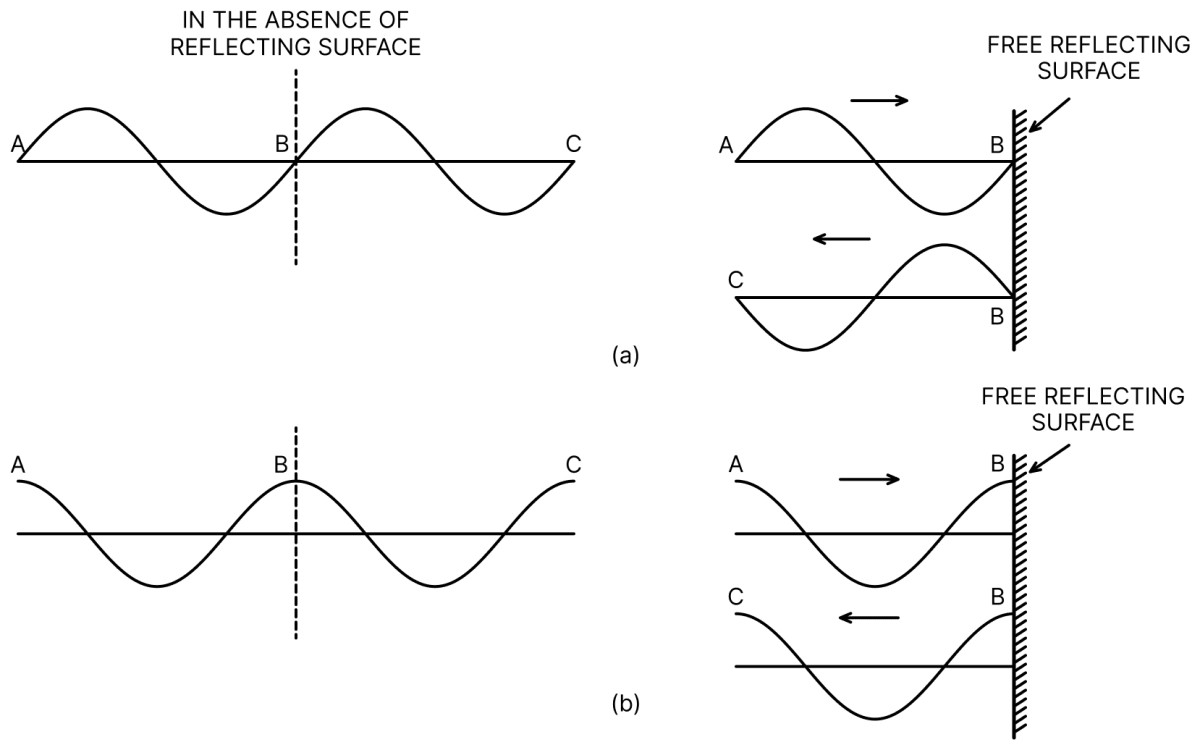
Suppose a transverse progressive wave is sent along a string whose one end is free to move perpendicular to the length of the string. The wave is reflected from this end, but in the reflected wave the directions of displacements of the particles of the string remain the same as in the incident wave.
When the pulse of the incident wave reaches the free end, there is no change in its phase and the wave returns in the same way as it would have advanced in the absence of the reflecting surface. In the figure, AB is the incident wave and BC is the reflected wave.
Hence, the wave does not suffer any phase change on reflection from a 'free' end.
Reflection from a rigid end :
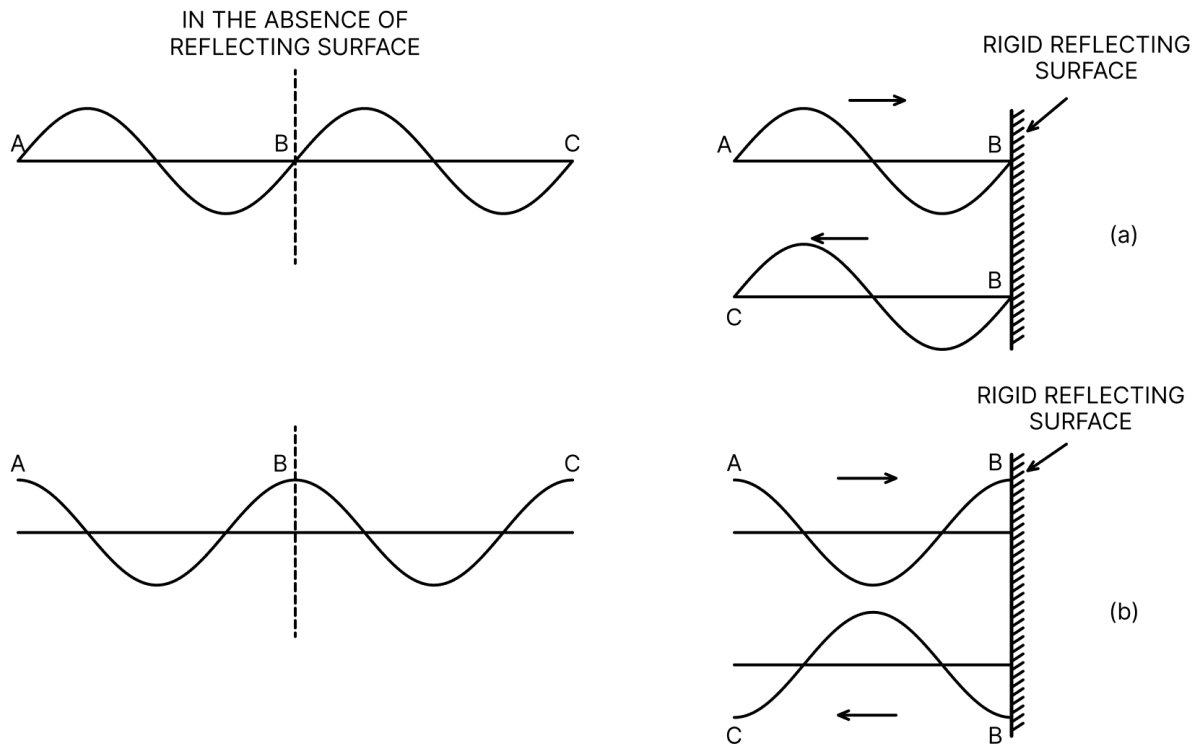
When a transverse progressive wave is sent along a string whose one end is tied to a rigid surface, then in the reflected wave the directions of displacements of the particles of the string become inverted with respect to the incident wave.
In the figure, AB is the incident wave and BC is the reflected wave, and the reflected curve is seen to be turned upside down with respect to the incident one.
Hence, the wave undergoes a phase change of 180° or π on reflection from a 'rigid' end.
What do you understand by stationary wave ? Derive the relation
where symbols have their usual meanings.
Answer
Stationary wave : When two identical transverse, or longitudinal, progressive waves travel in a bounded medium with the same speed but in opposite directions, then by their superposition a new type of wave is produced which appears stationary in the medium. This wave is called a stationary (or standing) wave.
The characteristic of a stationary wave is that some particles of the medium remain permanently at rest, while some other particles undergo maximum displacement compared to others. The former are called the nodes and the latter the antinodes.
Derivation of the equation :
Suppose a plane progressive wave of amplitude a is travelling along the positive direction of the X-axis. The equation of this wave is
where ω is the angular frequency of the wave and k is the propagation constant.
Suppose this wave is reflected from a free boundary and the reflected wave advances in the negative direction of the X-axis. Since there is no phase change on reflection from a free end, the equation of the reflected wave is
Let y1 and y2 be the displacements at a point x at any instant t due to the incident and the reflected waves respectively. Then, by the principle of superposition, the resultant displacement at that point is
Using ,
Substituting and ,
which may be written as
with 2a replaced by a for brevity. This is the equation of a stationary wave.
Nodes and antinodes : Substituting x = 0, , , , ... in this equation, the value of becomes alternately + 1 and − 1. At these points the displacement y is always maximum in comparison with the other points. These points are the antinodes, and they are separated from each other by a distance .
Similarly, substituting x = , , , ... the value of becomes zero, so the displacement y becomes zero. These points are the nodes, and these are also separated from each other by a distance .
Explain the formation of the standing waves in a closed organ pipe and show that only odd harmonics are produced in the ratio 1 : 3 : 5 : 7.
Answer
Formation of standing waves in a closed organ pipe :
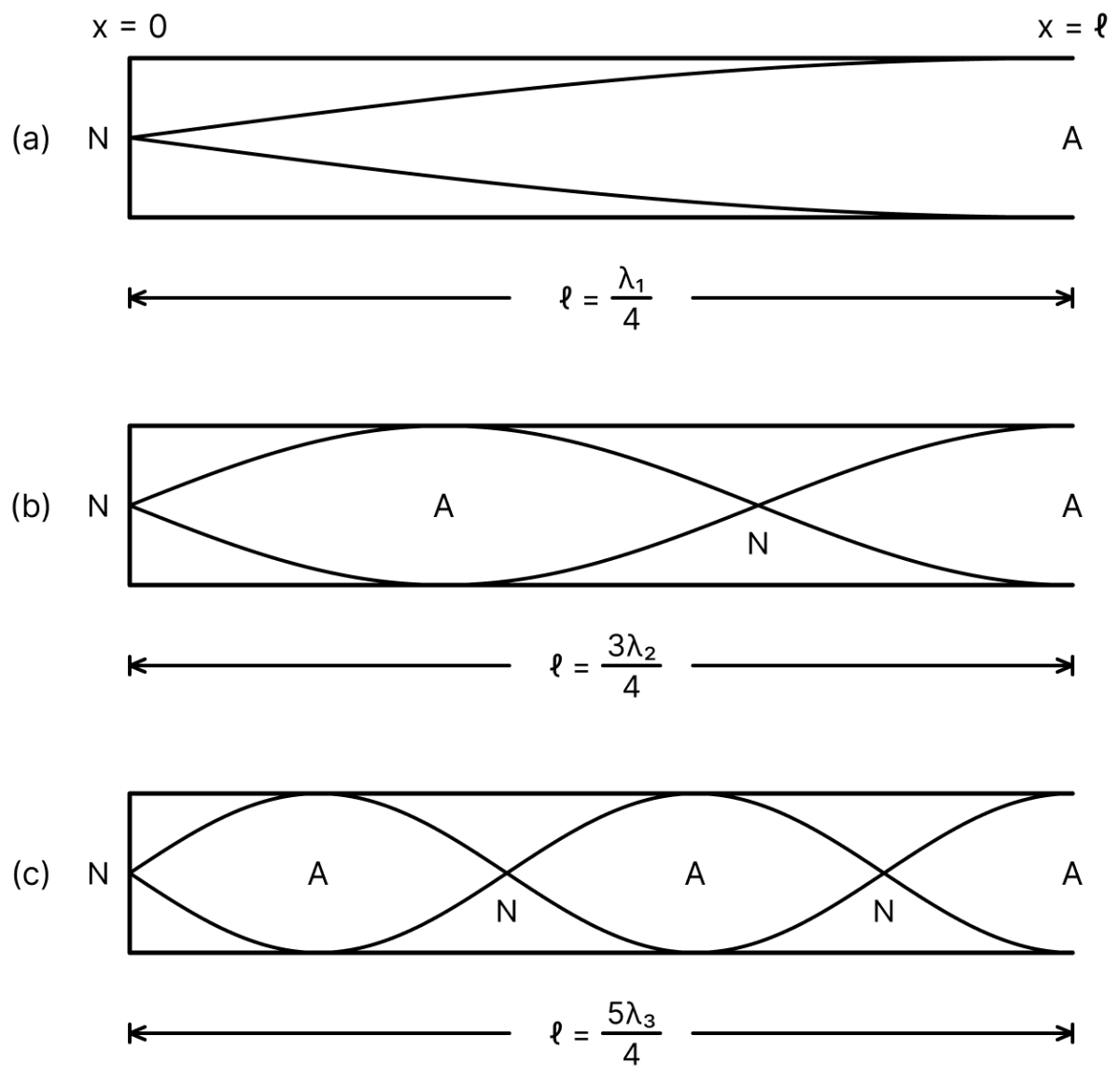
Let us consider a closed organ pipe of length l lying along the X-axis, the closed end being at x = 0 and the open end at x = l. When we blow air at its open end, a longitudinal (sound) wave travels in the air of the pipe towards the closed end, which reflects it back towards the open end. The incident and the reflected waves travelling in the air-column in opposite directions superpose and form stationary longitudinal waves.
At the closed end of the pipe the particles of air have no freedom to vibrate. Hence there is always a node at the closed end. At the open end the air particles have the greatest freedom to vibrate. Hence there is always an antinode at the open end.
The incident wave moving along the negative direction of the X-axis is represented by
The wave reflected at the closed end suffers a phase change of π and moves along the positive direction of the X-axis, so it is represented by
On superposition the resultant displacement is
At the closed end (x = 0), equation (i) gives y = 0 for all values of t, that is, a node is formed there.
At the open end (x = l),
The displacement y will always be maximum if
First mode of vibration (m = 1) :
This is the lowest frequency of vibration and is called the fundamental frequency. The note produced is the fundamental tone or the first harmonic.
Second mode of vibration (m = 2) :
The note produced is called the first overtone or the third harmonic.
Third mode of vibration (m = 3) :
The note produced is called the second overtone or the fifth harmonic.
In general, the frequency of the mth mode of vibration is
Hence the frequencies of the fundamental tone and the overtones have the relationship
Hence, a closed organ pipe produces only odd harmonics, in the ratio 1 : 3 : 5 : 7.
What do you understand by the different modes of vibration in air columns ? Show that in a open pipe, even and odd both type of the harmonic are produced while in closed organ pipe only odd harmonics can be produced.
Answer
Different modes of vibration in air columns : The air column in an organ pipe can vibrate in a number of different ways, each way corresponding to a different stationary wave pattern with its own arrangement of nodes and antinodes. Each such pattern is called a mode of vibration, and each mode has a definite frequency of its own. The mode of lowest frequency is the fundamental mode, and the higher modes give the overtones.
Open organ pipe :
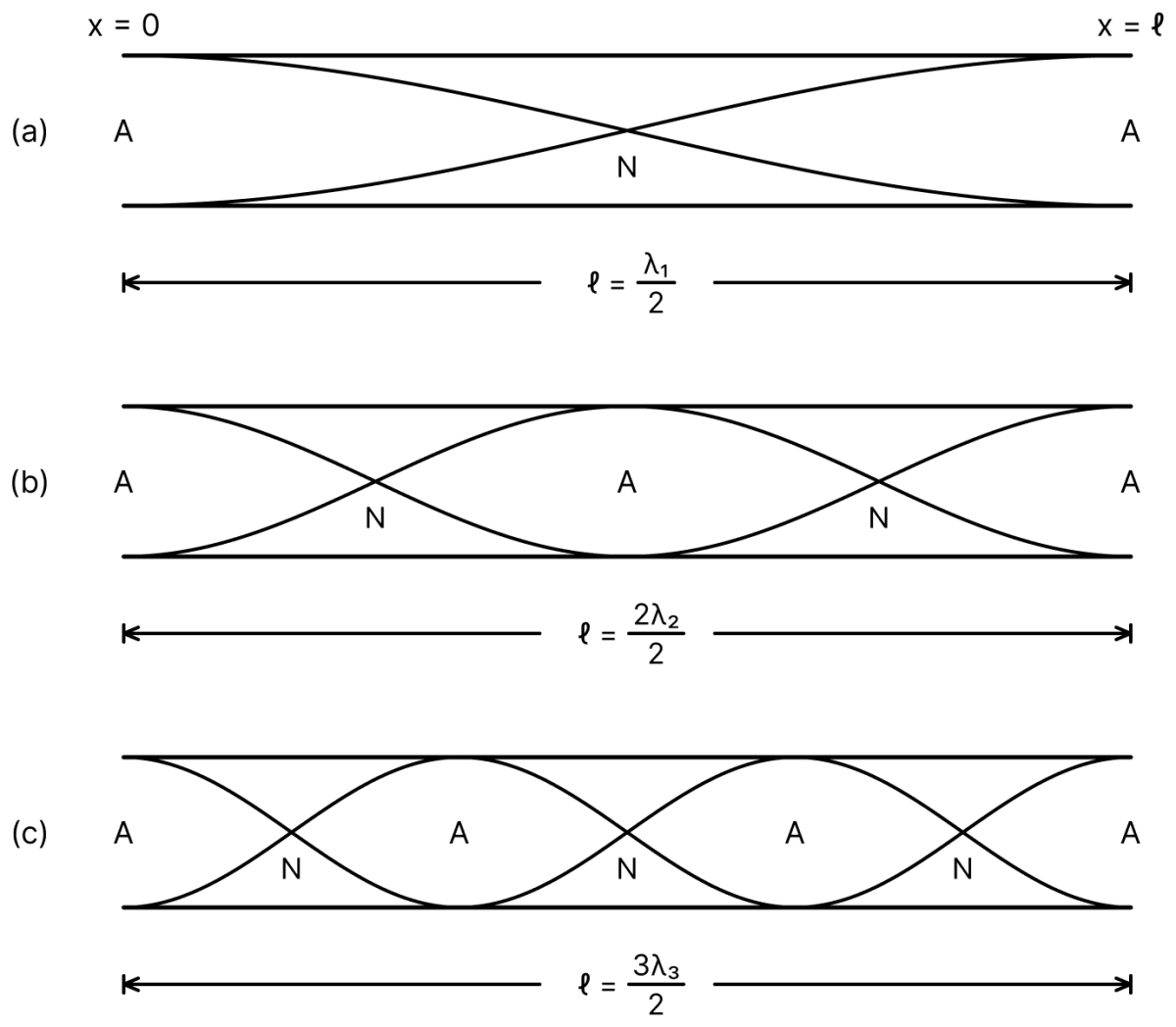
Let us consider a pipe of length l open at both ends, lying along the X-axis with ends at x = 0 and x = l. Since the pipe is open at both ends, the air particles at both the ends have the greatest freedom to vibrate, so there is an antinode at each end.
The incident and the reflected waves are
since reflection at an open end introduces no change in phase. On superposition,
At both the ends the resultant displacement should always be maximum. At x = l,
Hence the frequency of the mth mode is
For m = 1, 2, 3, ... the frequencies are
so that
Hence, an open pipe produces both the even and the odd harmonics.
Closed organ pipe :
In a pipe closed at one end there is always a node at the closed end and an antinode at the open end. On superposing the incident wave and the wave reflected at the closed end, which suffers a phase change of π,
At the open end x = l the displacement must always be maximum, so
Hence the frequency of the mth mode is
For m = 1, 2, 3, ... the frequencies are
so that
Hence, in a closed organ pipe only the odd harmonics can be produced, the even harmonics being missing. This is why the musical sound produced by an open organ pipe is richer than that produced by a closed organ pipe.
Describe vibrations of a stretched string. Write expression for velocity of transverse wave and obtain expression for fundamental frequency.
Answer
Vibrations of a stretched string :
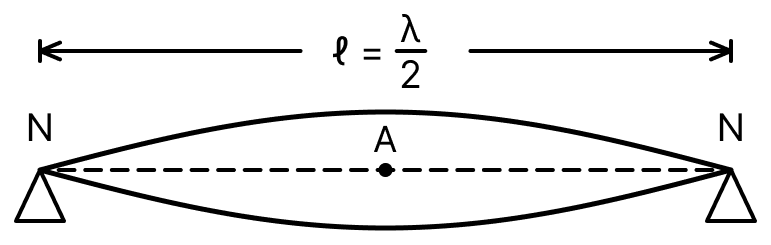
When a wire clamped to rigid supports at its ends is plucked in the middle, transverse progressive waves travel towards each end of the wire. These waves are reflected at the ends of the wire, and by the superposition of the incident and the reflected waves, transverse stationary waves are set up in the wire.
Since the ends of the wire are clamped, there is a node (N) at each end. In the simplest mode of vibration the wire vibrates as a whole in a single segment, with an antinode (A) in the middle.
Expression for the velocity of a transverse wave :
The speed of a transverse wave in a flexible stretched string depends upon the tension in the string and the mass per unit length of the string. It is given by
where T is the tension in the wire and m is the mass per unit length of the wire, and not the mass of the whole wire.
If r be the radius of the wire and d the density of the material of the wire, then
so that the speed may also be written as
Expression for the fundamental frequency :
We know that the distance between two consecutive nodes is , where λ is the wavelength. Hence if l be the length of the wire between the clamped ends, then in the simplest mode
If n be the frequency of vibration of the wire, then
Substituting the value of v from equation (i),
This is the fundamental frequency, or the first harmonic, of the stretched string, and the sound note produced by the string in this mode is called the fundamental tone.
Equation (ii) shows that the frequency of the sound emitted from a stretched string can be changed in two ways — by changing the length of the string, or by changing the tension in the string. In a sitar and a violin the frequencies of the notes are adjusted by tightening or loosening the pegs of the wires.
Derive the formula for the fundamental frequency of an open organ pipe. Out of the closed and open organ pipes the sound of which one is more musical and why?
Answer
Fundamental frequency of an open organ pipe :
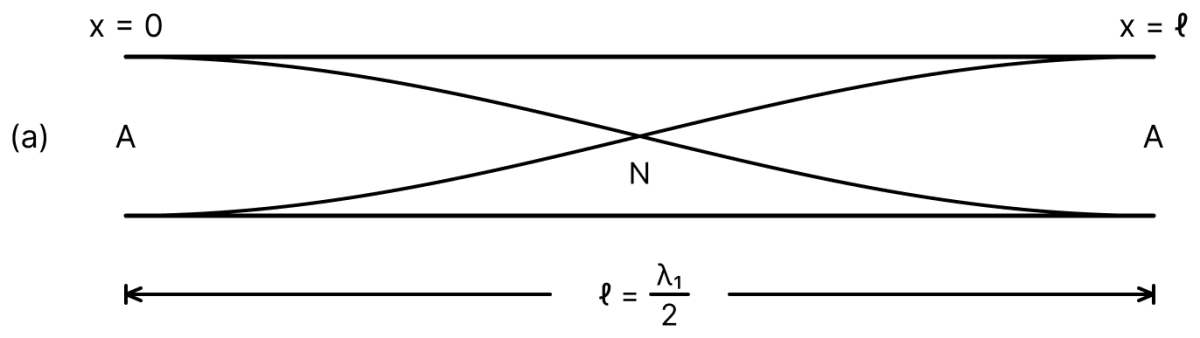
Let us consider a pipe of length l, open at both ends, lying along the X-axis with its ends at x = 0 and x = l. When we blow air at one end, a longitudinal (sound) wave travels in the air of the pipe towards the other end, which reflects it back. The incident and the reflected waves travelling in opposite directions superimpose and form stationary waves.
Since the pipe is open at both ends, the air particles at each end have the greatest freedom to vibrate, so there is an antinode at each end.
The incident and the reflected waves are represented by
since the reflection at an open end introduces no change in phase.
On superposition the resultant displacement is
At both the ends of the pipe the resultant displacement should always be maximum. At the end x = l,
The displacement y will always be maximum if
First mode of vibration : For m = 1, equation (ii) gives
There are antinodes at the two ends and a node in the middle of the pipe. Hence the fundamental frequency is
Which pipe gives the more musical sound :
In a closed organ pipe only the odd harmonics are present and the even harmonics are missing, whereas in an open organ pipe all the harmonics are present, the frequencies being in the ratio 1 : 2 : 3 : 4 ...
Hence, the musical sound produced by an open organ pipe is richer than that produced by a closed organ pipe, because a larger number of overtones blend with the fundamental tone in it.
How does the frequency of the transverse oscillations of a stretched string depend on the tension and the density of the material of the string? Give the necessary formula. Show in a diagram the positions of nodes and antinodes on the string when it vibrates to produce the third harmonic of its fundamental frequency.
Answer
Dependence of the frequency on tension and density :
The frequency of the transverse oscillations of a stretched string in its fundamental mode is
where l is the vibrating length of the string, T the tension in it and m the mass per unit length of the string.
If r be the radius of the string and d the density of the material of the string, then
Substituting this in equation (i), the necessary formula is
Dependence on tension : For a uniform string of given length and material,
that is, the frequency of the string varies directly as the square-root of its tension. This is the law of tension.
Dependence on density : For a given tension, a given length and a given radius,
that is, the frequency of the string varies inversely as the square-root of the density of the material of the string. Hence a string made of a denser material emits a note of lower frequency.
Third harmonic of the fundamental frequency :

In the third harmonic the string vibrates in three segments, so that
Hence the frequency is
The positions of the nodes and the antinodes are as follows. There are four nodes (N), situated at
and three antinodes (A), situated at
What do you mean by harmonics? Explain, giving necessary sketch, that both types of harmonics, even and odd, are produced in a stretched string.
Answer
Harmonics : If the frequencies of the fundamental tone and the overtones produced by a source of sound are in a harmonic series, then these tones are called harmonics. The fundamental tone is the first harmonic, and a tone whose frequency is m times the fundamental frequency is called the mth harmonic.
The tones of frequencies n1, n3, n5, ... are called the odd harmonics, and the tones of frequencies n2, n4, n6, ... are called the even harmonics.
Harmonics produced in a stretched string :
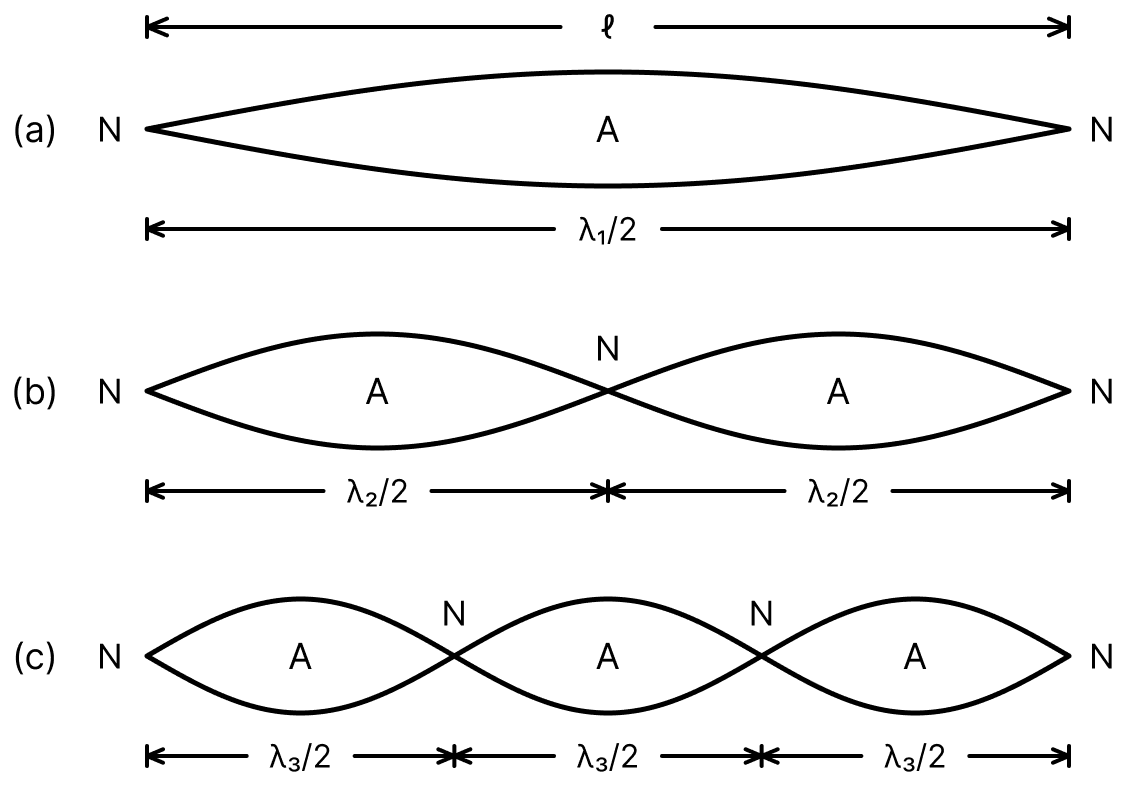
Let us consider a uniform string of length l, stretched by a tension T between two fixed points at x = 0 and x = l. Since the string is rigidly fixed at both the ends, there can be no motion at all at these ends, so a node is formed at each end.
Applying this boundary condition, the permitted wavelengths are
where p is the number of segments in which the string vibrates.
First mode of vibration (p = 1) : The string vibrates as a whole in one segment, with
This is the fundamental frequency, or the first harmonic.
Second mode of vibration (p = 2) : The string vibrates in two segments, with
This tone is called the first overtone, or the second harmonic, and it is an even harmonic.
Third mode of vibration (p = 3) : The string vibrates in three segments, with
This tone is called the second overtone, or the third harmonic, and it is an odd harmonic.
If the string vibrates in p segments, then its frequency is
Hence the frequencies of the fundamental tone and the overtones of a stretched string have the relationship
Hence, a stretched string gives both the even and the odd harmonics.
Write Newton's formula for speed of sound waves in air. Which type of elasticity of gases was assumed by the Newton. Explain Laplace correction in Newton's formula.
Answer
Newton's formula :
Newton was of the opinion that when longitudinal waves (sound) travel in a gas, the temperature of the gas remains constant. Hence in the formula
the quantity B is the isothermal elasticity of the gas, whose value is equal to the initial pressure P of the gas. Therefore, according to Newton, the speed of sound in a gas should be
Type of elasticity assumed by Newton : Newton assumed the isothermal elasticity of the gas, that is, he treated the propagation of sound waves in a gas as an isothermal process.
Failure of Newton's formula : For air at 0°C, the pressure is P = 1.01 × 10⁵ N m-2 and the density is d = 1.29 kg m-3. Hence the speed of sound in air at 0°C works out to be
But by experiment, the speed of sound in air at 0°C was found to be nearly 331 m s-1, which is quite different from the value obtained by Newton's formula. Hence Newton's formula for gases was not accepted.
Laplace's correction :
After 100 years of Newton, in the year 1816, Laplace discovered the discrepancy in Newton's formula and modified it satisfactorily. He told that the idea of Newton — that when sound waves travel in a gas the temperature of the gas remains constant — is wrong.
In fact, when sound waves travel in a gaseous medium then at any point in the medium the states of compression and rarefaction occur alternately. At the time of compression some heat is developed at the point, and at the time of rarefaction some heat is lost from the medium at that point. The compressions and rarefactions occur so rapidly that the heat produced during compression cannot go out into the surroundings, and the heat which disappeared during rarefaction cannot come in from the surroundings. Besides this, the exchange of heat does not take place because gases are bad conductors of heat.
Hence the temperature at a point in the medium rises during compression and falls during rarefaction. That is, during the propagation of sound waves, temperature-changes take place in the gaseous medium, so the process is adiabatic.
Therefore, in Newton's formula, B should represent the adiabatic elasticity of the gas, whose value is equal to γ × P, where
Thus, according to Laplace, the formula for the speed of sound in a gas is
For air, γ = 1.41, so the speed of sound in air at 0°C is
This value closely agrees with the experimental value. Hence, Laplace's modified formula is correct.
Explain the dependence of speed of sound wave on temperature, humidity of medium and compare it for two gases at a constant temperature.
Answer
The speed of sound in a gas, according to Laplace's formula, is
Effect of temperature :
Let one gram-molecule (mole) of the gas have pressure P and volume V. If T be the absolute temperature of the gas, then according to the gas equation,
where R is the universal gas constant. If M be the molecular-weight of the gas and d its density, then , so
Putting this value of in equation (i),
Hence, the speed of sound in a gas is directly proportional to the square-root of its absolute temperature.
If v0 be the speed at 0°C and vt the speed at t°C, then it can be shown, on applying the binomial theorem, that
Taking v0 = 332 m s-1 for air,
that is, the speed of sound in air increases roughly by 0.61 m s-1 per degree celsius rise in temperature.
Effect of humidity :
The density of moist air, that is, air mixed with water-vapour, is less than the density of dry air. Assuming the value of γ for moist air to be the same as that for dry air, it is clear from equation (i) that at a constant pressure
Hence, the speed of sound in moist air is slightly greater than in dry air. This is why the sirens of mills and the whistles of trains are heard up to longer distances in the rainy season as compared to summer.
Comparison for two gases at a constant temperature :
If the value of γ for any two gases be the same, and their densities at this temperature and pressure be d1 and d2, then
If the molecular masses of the gases be M1 and M2 respectively, then from equation (ii),
Hence, the speed of sound in a gas is inversely proportional to the square-root of the density or the molecular-mass of the gas. For example, the molecular masses of H2 and O2 are 2 and 32 respectively, so
that is, at the same temperature the speed of sound in oxygen is one-fourth the speed of sound in hydrogen.
What do you mean by interference of waves ? Explain constructive, destructive interference and write the phase relationship respectively.
Answer
Interference of waves : Interference is the modification in the distribution of wave intensity that occurs when two or more coherent waves superpose, depending on their relative phase difference. It is through this process that two sounds can combine to produce silence, or two beams of light can produce darkness.
The displacement of the resultant wave at any point is the algebraic sum of the displacements of the individual waves, leading to patterns of amplification or cancellation depending on their phase relationship.
Constructive interference : When two waves meet in phase, with crests overlapping crests and troughs overlapping troughs, they reinforce each other, producing a wave of larger amplitude. This is known as constructive interference.
If a1 and a2 be the amplitudes of the two waves and φ the phase difference between them, then the resultant amplitude is
At places where φ = 0, cos φ = + 1 and the amplitude is maximum,
Phase relationship for constructive interference : The phase difference must be zero or an even multiple of π, that is,
and the corresponding path difference is , that is, an integral number of full waves.
Destructive interference : When two waves meet out of phase, with crests overlapping troughs, they tend to cancel each other, resulting in a wave of reduced or even zero amplitude. This is called destructive interference.
At places where φ = π, cos φ = − 1 and the amplitude is minimum,
Phase relationship for destructive interference : The phase difference must be an odd multiple of π, that is,
and the corresponding path difference is , that is, an odd integral number of half-waves.
Write conditions for interference, write the phase difference and path difference between two waves for constructive and destructive interference of waves.
Answer
Conditions for sustained interference : For two waves to produce a steady (sustained) interference pattern, the following conditions must be satisfied.
(a) Coherent sources : The two waves must originate from coherent sources, that is, they must maintain a zero-phase difference or a constant phase difference. Without coherence the interference pattern changes rapidly and becomes unobservable.
(b) Same frequency and wavelength : The interfering waves must have the same frequency and wavelength, so that the phase difference between them remains constant with time.
(c) Equal or nearly equal amplitudes : The amplitudes of the two waves need not be exactly equal, but they should be comparable in magnitude to produce good contrast between the regions of constructive and destructive interference. If one amplitude is much larger than the other, the intensity variation becomes negligible.
(d) Same type of waves : The waves must be of the same nature, both sound or both light.
(e) Path difference within the coherence length : The path difference between the two waves should remain less than the coherence length, so that the phase relationship remains stable.
(f) Should travel along the same straight-line path : The waves should travel along the same straight-line path, or along different paths slightly inclined.
Constructive interference :
Phase difference : The two waves must arrive in the same phase, that is,
Path difference : The path difference between the interfering waves must be an integral number of full waves, that is,
At such places the resultant amplitude is a1 + a2 and the intensity is maximum.
Destructive interference :
Phase difference : The two waves must arrive in opposite phases, that is,
Path difference : The path difference between the interfering waves must be an odd integral number of half-waves, that is,
At such places the resultant amplitude is a1 ~ a2 and the intensity is minimum.
Write characteristics of stationary waves and compare these waves with simple progressive waves.
Answer
Characteristics of stationary waves :
(i) Certain points in the bounded medium, situated at equal distances, are always in the position of rest, that is, their displacement remains zero. These points are called nodes. If the stationary waves are longitudinal, then at these nodes the change in pressure (and density) is maximum as compared to other points.
(ii) The displacement of the mid-points between the nodes is always maximum as compared to other points. These points are called antinodes. In longitudinal stationary waves, there is no change in pressure (and density) at these points.
(iii) The distance between two consecutive nodes, or between two consecutive antinodes, is . The distance between a node and its neighbouring antinode is .
(iv) Except the nodes, all points of the medium vibrate, but the amplitude of vibration is different from one point to the other. It is zero at the nodes and maximum at the antinodes.
(v) All the points between two successive nodes vibrate in the same phase. They reach simultaneously their positions of maximum displacement and pass simultaneously through their mean positions.
(vi) At any instant, the phase of vibration of the points on one side of a node is opposite to the phase of vibration of the points on the other side.
(vii) All the points of the medium pass through their mean positions simultaneously twice in each period, that is, the stationary wave takes the form of a straight line twice.
(viii) In longitudinal stationary waves, the nodes are found alternately in the states of maximum compression and maximum rarefaction twice in each period.
(ix) A stationary wave does not advance in the medium, but remains steady at its place. This is why it is called a stationary (or standing) wave.
Comparison between progressive and stationary waves :
| S. No. | Progressive waves | Stationary waves |
|---|---|---|
| (i) | These waves advance in a medium with a definite velocity. | These waves remain stationary between two boundaries in the medium. |
| (ii) | In these waves, all particles of the medium vibrate and the amplitude of vibration is the same for all of them. | In these waves, except nodes, all other particles of the medium vibrate but the amplitude of vibration is different from one particle to another particle. The amplitude is zero at the nodes and maximum at the antinodes. |
| (iii) | At any instant, the phase of vibration varies continuously from one particle to the other. | At any instant, the phase of all particles between two successive nodes is the same, but the phase of particles on one side of a node is opposite to the phase of particles on the other side of the node. |
| (iv) | In these waves, at no instant all the particles of the medium pass through their mean positions simultaneously. | In these waves, all particles of the medium pass through their mean positions simultaneously twice in each time-period. |
| (v) | In longitudinal progressive waves, all the particles of the medium suffer, in succession, the same variation in pressure and density. | In longitudinal stationary waves, the variation in pressure and density is maximum at nodes and minimum at antinodes. |
| (vi) | Crests and troughs in transverse progressive waves, and centres of compression and rarefaction in longitudinal progressive waves, advance with a definite velocity. | Crests and troughs in transverse stationary waves, and centres of compression and rarefaction in longitudinal stationary waves, occur alternately at definite places, and do not advance. |
| (vii) | These waves transmit energy in the medium. | These waves do not transmit energy in the medium. |
Write the formula for the fundamental frequency of a transverse wave in a stretched string and explain with its help how the frequency of the string depends on the length and radius of the string. Write the frequency of the first overtone produced along with fundamental frequency n of the string.
Answer
Formula for the fundamental frequency :
The fundamental frequency of a transverse wave in a stretched string is
where l is the vibrating length of the string, T the tension in it and m the mass per unit length of the string.
If r be the radius of the string and d the density of the material of the string, then m = πr2d, so that equation (i) becomes
Dependence on the length of the string :
From equation (i), for a given string under a given tension,
Hence, the frequency of the string varies inversely as its vibrating length. This is called the law of length. If the length of the string is halved, its frequency is doubled.
Dependence on the radius of the string :
From equation (ii), for a given tension, a given length and a given material,
Hence, the frequency of the string varies inversely as the radius of the string. A thicker string therefore emits a note of lower frequency, which is why the bass strings of a sitar are made thicker.
Frequency of the first overtone :
If the string is made to vibrate in two segments, then
The frequency of vibration in this mode is
Hence, the frequency of the first overtone, which is the second harmonic, is 2 n, that is, twice the fundamental frequency n of the string.
Describe the construction and working of sonometer to determine frequency of a tuning fork, also explain the utility of hollow sound box in sonometer.
Answer
Sonometer : A sonometer is the simplest apparatus for demonstrating the vibrations of a stretched string.
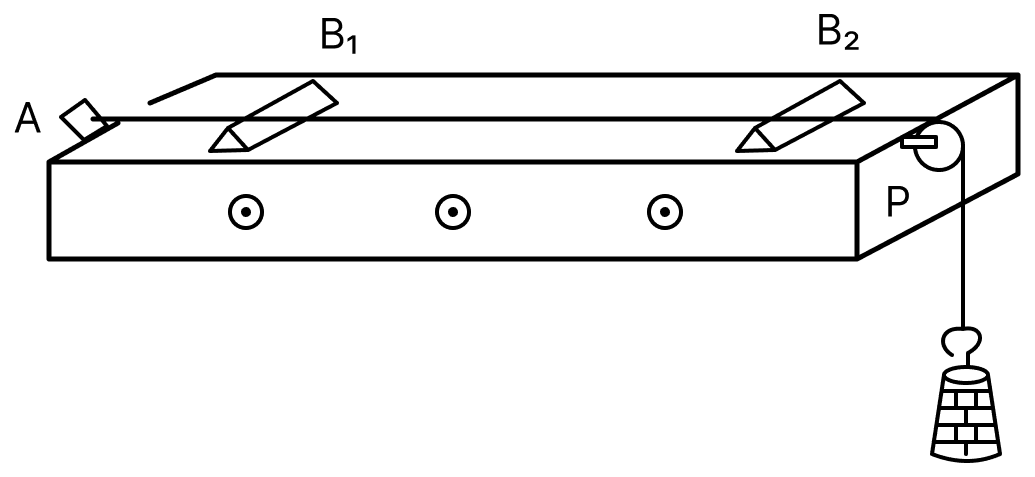
Construction : It consists of a hollow wooden box about 1 metre long, which is called the 'sound board'. A thin wire is stretched over the sound-board. One end of the wire is fastened to a peg A at the edge of the sound-board, and the other end passes over a frictionless pulley P and carries a hanger upon which weights can be placed.
These weights produce tension in the wire and press it against two bridges B1 and B2. One of these bridges is fixed and the other is movable, so that the vibrating length of the wire can be changed by changing the position of the movable bridge.
Working — determination of the frequency of a tuning fork :
When the sonometer wire is plucked at its middle-point, it vibrates in its fundamental mode with a natural frequency n given by
where l is the length of the wire between the bridges, T is the tension in the wire and m is the mass per unit length of the wire. If r be the radius of the wire, ρ the density of the material of the wire and M the mass of the weights suspended from the wire, then
so that
To determine the frequency of a given tuning fork, a suitable weight is placed on the hanger and the fork is struck and placed vertically on the sound-board. The movable bridge is then displaced slowly so as to vary the vibrating length of the wire, and hence its natural frequency. At one particular length the amplitude of vibration of the wire becomes very large, and a loud sound is heard. This happens when the natural frequency of the wire becomes equal to the frequency of the tuning fork, that is, when the wire is in resonance with the fork. This length l is measured, and the frequency of the fork is calculated from the above formula.
Utility of the hollow sound box :
The wall of the sound-board contains holes, so that the air inside the sound-board remains in contact with the air outside. When the wire vibrates, these vibrations reach, through the bridges, the upper surface of the sound-board and the air inside it. Along with it, the air outside the sound-board also begins to vibrate.
Because the surface area of the sound board is quite large, the vibrations of the board send out sound waves in a large volume of air. Hence a loud sound is heard, and the intensity of the note is greatly increased. These vibrations produced in the air inside the box are forced vibrations.
Write the formula for the fundamental frequency of a transverse wave in a stretched string and explain with its help how does the frequency of the string depend on the length and radius of the string. Write the frequency of the first overtone produced along with fundamental frequency n of the string.
Answer
Formula for the fundamental frequency :
The fundamental frequency of a transverse wave in a stretched string is
where l is the vibrating length of the string, T the tension in it and m the mass per unit length of the string.
If r be the radius of the string and d the density of the material of the string, then the mass per unit length is
Substituting this in equation (i),
Dependence on the length of the string :
From equation (i), when T and m are kept constant,
Hence, for a given string under a given tension, the frequency of the string varies inversely as its vibrating length. This is the law of length. It is applied in a sitar and a violin, where the player shortens the vibrating length of a wire by pressing it with a finger in order to raise the pitch of the note.
Dependence on the radius of the string :
From equation (ii), when T, l and d are kept constant,
Hence, the frequency of the string varies inversely as the radius of the string. A string of larger radius, that is, a thicker string, therefore emits a note of lower frequency.
Frequency of the first overtone :
When the string vibrates in two segments, there is an additional node at the middle-point of the string. Then
and the frequency of vibration is
Hence, the frequency of the first overtone, that is, the second harmonic, is 2 n — twice the fundamental frequency n of the string.
The frequency of a radio transmission centre is 30 megahertz (MHz). What is the wavelength of the waves transmitted from the station? (c = 3 × 10⁸ m/s)
Answer
Given,
- Frequency of the radio transmission centre, n = 30 MHz = 30 × 106 Hz
- Speed of the radio waves, c = 3 × 10⁸ m/s
From the relation between speed, frequency and wavelength,
Substituting the values,
Hence, the wavelength of the waves transmitted from the station is 10 m.
Ripples are being generated by a vibrator on the surface of water. The distance between two consecutive crests is 3 cm. Ripples cover a distance of 25.2 cm in 1.2 seconds. Calculate the wavelength, wave velocity and the frequency of the generated waves.
Answer
Given,
- Distance between two consecutive crests = 3 cm
- Distance covered by the ripples = 25.2 cm
- Time taken = 1.2 seconds
Wavelength : The distance between two consecutive crests is one wavelength. Hence
Wave velocity :
Frequency : From v = nλ,
Hence, the wavelength is 3 cm, the wave velocity is 21 cm/s and the frequency is 7 s-1.
A wave of frequency 250 Hz (s-1) travels with a speed of 4800 m/s in iron. (i) What will be its wavelength in iron ? (ii) What will be its wavelength in air if its speed in air is 332 m/s ?
Answer
Given,
- Frequency of the wave, n = 250 Hz
- Speed of the wave in iron, v1 = 4800 m/s
- Speed of the wave in air, v2 = 332 m/s
The frequency of a wave is decided by the source and remains unchanged when the wave passes from one medium to another.
(i) Wavelength in iron :
(ii) Wavelength in air :
Hence, the wavelength of the wave in iron is 19.2 m and that in air is 1.328 m.
The modulus of volume elasticity and density of a liquid are 8 × 10⁹ N/m2 and 2 × 10³ kg/m3 respectively. Calculate the velocity of sound in the liquid.
Answer
Given,
- Modulus of volume elasticity of the liquid, B = 8 × 10⁹ N/m2
- Density of the liquid, d = 2 × 10³ kg/m3
The speed of longitudinal waves in a liquid is
Substituting the values,
Hence, the velocity of sound in the liquid is 2000 m/s.
The speed of sound in a liquid is 1500 m/s. The density of the liquid is 1.0 × 10³ kg/m3. Determine the coefficient of volume elasticity of the liquid.
Answer
Given,
- Speed of sound in the liquid, v = 1500 m/s
- Density of the liquid, d = 1.0 × 10³ kg/m3
The speed of sound in a liquid is
Substituting the values,
Hence, the coefficient of volume elasticity of the liquid is 2.25 × 10⁹ N/m2.
At 105 N/m2 atmospheric pressure the density of air is 1.29 kg/m3. If γ = 1.40 for air, then calculate the speed of sound in air.
Answer
Given,
- Atmospheric pressure, P = 105 N/m2
- Density of air, d = 1.29 kg/m3
- Ratio of the specific heats of air, γ = 1.40
By Laplace's formula, the speed of sound in a gas is
Substituting the values,
Hence, the speed of sound in air is 329.4 m/s.
The mass of one litre of hydrogen is 0.0896 g and that of one litre of air is 1.293 g. The speed of sound in air is 332 m/s. Calculate the speed of sound in hydrogen.
Answer
Given,
- Mass of one litre of hydrogen = 0.0896 g
- Mass of one litre of air = 1.293 g
- Speed of sound in air, va = 332 m/s
Since both the masses are of the same volume, the ratio of the densities is equal to the ratio of the masses,
The speed of sound in a gas is . Taking γ to be the same for both, at the same pressure
Substituting the values,
Hence, the speed of sound in hydrogen is 1261.2 m/s.
The speed of sound in air is 332 m/s. If the volumes of nitrogen (molecular wt. 28) and oxygen (molecular wt. 32) in air are in the ratio 4 : 1, then find out the speed of sound in oxygen.
Answer
Given,
- Speed of sound in air, va = 332 m/s
- Molecular weight of nitrogen = 28, molecular weight of oxygen = 32
- The volumes of nitrogen and oxygen in air are in the ratio 4 : 1
Average molecular weight of air : Since the volumes are in the ratio 4 : 1, the numbers of moles are also in the ratio 4 : 1. Hence
Both nitrogen and oxygen are diatomic gases, so the value of γ is the same for air and for oxygen. At the same temperature,
Substituting the values,
Hence, the speed of sound in oxygen is 315 m/s.
If the speed of sound at 0°C be 330 m/s, then at what temperature its value will become 495 m/s ?
Answer
Given,
- Speed of sound at 0°C, v0 = 330 m/s, so T0 = 273 K
- Required speed, vt = 495 m/s
The speed of sound in a gas is directly proportional to the square-root of its absolute temperature,
Substituting the values,
Squaring both sides,
Converting into the celsius scale,
Hence, the speed of sound will become 495 m/s at a temperature of 341.25°C.
At what temperature will the speed of sound be double of its value at 27°C?
Answer
Given,
- Initial temperature, t1 = 27°C, so T1 = 27 + 273 = 300 K
- Speed at this temperature, v1 = v (say)
- Required speed, v2 = 2 v
Since the speed of sound in a gas is directly proportional to the square-root of its absolute temperature,
Substituting the values,
Squaring both sides,
Converting into the celsius scale,
Hence, the speed of sound will be double of its value at 27°C at a temperature of 927°C.
Calculate the temperature at which the velocity of sound in air is double its velocity at 0°C ?
Answer
Given,
- Initial temperature, t1 = 0°C, so T1 = 273 K
- Speed at this temperature, v1 = v (say)
- Required speed, v2 = 2 v
Since the speed of sound in a gas is directly proportional to the square-root of its absolute temperature,
Substituting the values,
Squaring both sides,
Converting into the celsius scale,
Hence, the velocity of sound in air will be double its velocity at 0°C at a temperature of 819°C.
Find the equation of a plane progressive wave travelling along the positive direction of X-axis having amplitude 10 cm, speed 330 m/s and frequency 660 Hz.
Answer
Given,
- Amplitude of the wave, a = 10 cm = 0.1 m
- Speed of the wave, v = 330 m/s
- Frequency of the wave, n = 660 Hz
Wavelength :
The equation of a plane progressive wave travelling along the positive direction of the X-axis is
Substituting the values of a and λ,
Hence, the equation of the wave is y = 0.1 sin 4π (330 t − x) metre.
A sound-source of frequency 500 hertz is producing longitudinal waves in air. The amplitude of vibration of air-particles is 5 mm and the speed of the wave is 330 m/s. Find the distance-displacement equation of the wave.
Answer
Given,
- Frequency of the sound-source, n = 500 hertz
- Amplitude of vibration of the air-particles, a = 5 mm = 0.5 cm
- Speed of the wave, v = 330 m/s = 33000 cm/s
Wavelength :
The equation of a plane progressive wave travelling along the positive direction of the X-axis is
Substituting the values of a, n and λ,
Hence, the distance-displacement equation of the wave is , where y and x are in cm.
Find the equation of that plane progressive wave which is moving along the positive direction of X-axis and has an amplitude of 0.04 m, frequency of 440 Hz and speed of 330 m/s.
Answer
Given,
- Amplitude of the wave, a = 0.04 m
- Frequency of the wave, n = 440 Hz
- Speed of the wave, v = 330 m/s
Wavelength :
The equation of a plane progressive wave travelling along the positive direction of the X-axis is
Substituting the values,
Hence, the equation of the wave is metre.
A sound-source of frequency 500 hertz is producing longitudinal waves in air. The distance between two consecutive rarefactions in the wave is 0.64 metre and the amplitude of oscillation of air particles is 0.002 metre. Obtain the displacement equation for this wave.
Answer
Given,
- Frequency of the sound-source, n = 500 hertz
- Distance between two consecutive rarefactions = 0.64 metre
- Amplitude of oscillation of the air particles, a = 0.002 metre
Wavelength : The distance between two consecutive rarefactions is one wavelength. Hence
The equation of a plane progressive wave travelling along the positive direction of the X-axis is
Substituting the values of a, n and λ,
Hence, the displacement equation for this wave is metre.
A wave of frequency 1000 Hz and amplitude 0.005 m is travelling in a medium with a speed of 300 m/s. Write displacement-equation of the oscillations due to this wave at a distance of 0.15 m from the source.
Answer
Given,
- Frequency of the wave, n = 1000 Hz
- Amplitude of the wave, a = 0.005 m
- Speed of the wave, v = 300 m/s
- Distance from the source, x = 0.15 m
Angular frequency :
Propagation constant :
The equation of a plane progressive wave travelling along the positive direction of the X-axis is
Substituting the values,
Hence, the displacement-equation of the oscillations at a distance of 0.15 m from the source is y = 0.005 sin (6280 t − 3.14) metre.
The equation of a transverse progressive wave propagating in a string is y = 0.02 sin 4π (2 x − 15 t), where y and x are distances expressed in metre and t in second. Find amplitude, frequency, wavelength, velocity and time period of the wave.
Answer
Given, the equation of the transverse progressive wave is
y = 0.02 sin 4π (2 x − 15 t)
where y and x are in metre and t in second.
Re-writing the equation in the standard form,
Comparing this with the standard equation y = a sin (kx − ωt),
Amplitude :
Angular frequency and frequency :
Propagation constant and wavelength :
Velocity :
Time period :
Hence, the amplitude is 0.02 metre, the frequency is 30 s-1, the wavelength is 0.25 metre, the velocity is 7.5 m/s and the time period is second.
The equation of a progressive wave in a string is y = 5 sin π (100 t − 0.002 x), where y and x are in cm, and t in second. Find out : (i) amplitude of the wave, (ii) frequency, (iii) wavelength, (iv) speed.
Answer
Given, the equation of the progressive wave is
y = 5 sin π (100 t − 0.002 x)
where y and x are in cm and t in second.
Re-writing the equation in the standard form,
Comparing this with the standard equation y = a sin (ωt − kx),
(i) Amplitude of the wave :
(ii) Frequency :
(iii) Wavelength :
(iv) Speed :
Hence, the amplitude is 5 cm, the frequency is 50 Hz, the wavelength is 10 m and the speed is 500 m/s.
The equation of a progressive wave is y = 2.5 × 10⁻³ sin (314 t − 6.28 x), where y, x are in metre and t in second. Determine the velocity and frequency of the wave.
Answer
Given, the equation of the progressive wave is
y = 2.5 × 10⁻³ sin (314 t − 6.28 x)
where y and x are in metre and t in second.
Comparing this with the standard equation y = a sin (ωt − kx),
Velocity of the wave :
Frequency of the wave :
Hence, the velocity of the wave is 50 m/s and its frequency is 50 Hz.
The equation of a progressive wave is y = 0.02 sin (0.02 t − 0.01 x), where distances are in metre and time is in second. What is the direction of the wave ? Calculate amplitude, wavelength and frequency of the wave.
Answer
Given, the equation of the progressive wave is
y = 0.02 sin (0.02 t − 0.01 x)
where the distances are in metre and the time is in second.
Comparing this with the standard equation y = a sin (ωt − kx),
Direction of the wave : In the argument of the sine, x and t occur in the combination (ωt − kx). Hence the wave is going along the positive direction of the X-axis.
Amplitude :
Wavelength :
Frequency :
Hence, the wave is going along the + X-axis, its amplitude is 0.02 m, its wavelength is 200π m and its frequency is s-1.
A wave is expressed by the equation y = 0.2 sin π (0.01 x + 3.0 t), where y and x are in metre, and t in second. Find the speed of the wave.
Answer
Given, the equation of the wave is
y = 0.2 sin π (0.01 x + 3.0 t)
where y and x are in metre and t in second.
Re-writing the equation in the standard form,
Comparing this with the standard equation y = a sin (kx + ωt),
The speed of the wave is
Since x and t occur in the combination (kx + ωt), the wave travels along the negative direction of the X-axis.
Hence, the speed of the wave is 300 m/s, in the − X-direction.
The wavelength of a progressive wave is 0.5 m. There are two points 10 cm apart in the path of the wave. Determine the phase difference between those two points.
Answer
Given,
- Wavelength of the progressive wave, λ = 0.5 m
- Distance between the two points, Δx = 10 cm = 0.1 m
The phase difference between two points whose path difference is Δx is
Substituting the values,
Converting into degrees, since π radian = 180°,
Hence, the phase difference between the two points is 72°.
Speed of a wave is 360 m/s and frequency is 500 Hz. The phase difference between two nearest particles is 60°. What will be the path difference between them?
Answer
Given,
- Speed of the wave, v = 360 m/s
- Frequency of the wave, n = 500 Hz
- Phase difference between the two nearest particles, Δφ = 60°
Wavelength :
The relation between the phase difference and the path difference is
Converting the phase difference into radian,
Substituting the values,
Hence, the path difference between the two particles is 12 cm.
The distance between two consecutive nodes in a stationary wave is 25 cm. If the speed of the wave be 300 m/s, calculate the frequency.
Answer
Given,
- Distance between two consecutive nodes = 25 cm = 0.25 m
- Speed of the wave, v = 300 m/s
In a stationary wave the distance between two consecutive nodes is . Hence
From v = nλ, the frequency is
Hence, the frequency of the wave is 600 hertz.
The equation of a stationary wave formed in a closed organ pipe is y = 7 cos (π x /6) sin (30 π t), where x and y are in cm and t in second. Find the amplitude, wavelength, frequency and speed of the progressive waves which produce the aforesaid stationary wave.
Answer
Given, the equation of the stationary wave is
where x and y are in cm and t in second.
Comparing this with the standard equation of a stationary wave,
Amplitude of the progressive waves :
Wavelength :
Frequency :
Speed :
Hence, the amplitude is 3.5 cm, the wavelength is 12 cm, the frequency is 15 hertz and the speed of the progressive waves is 180 cm/s.
The length of an open organ pipe is 0.50 m. Calculate the frequency of the fundamental tone of this organ pipe. If one end of this organ pipe is closed, then what would the fundamental frequency become? (The velocity of sound in air is 330 metre/second).
Answer
Given,
- Length of the open organ pipe, l = 0.50 m
- Velocity of sound in air, v = 330 metre/second
Fundamental frequency of the open pipe : In an open organ pipe an antinode is formed at each end, so that . Hence
Substituting the values,
Fundamental frequency when one end is closed : In a closed organ pipe a node is formed at the closed end and an antinode at the open end, so that . Hence
Substituting the values,
Hence, the fundamental frequency of the open organ pipe is 330 hertz, and it becomes 165 hertz when one end is closed.
What should be the minimum length of an open organ pipe for producing a note of 110 hertz? The speed of sound is 330 m/s.
Answer
Given,
- Frequency of the note, n = 110 hertz
- Speed of sound, v = 330 m/s
The minimum length of an open organ pipe corresponds to its fundamental mode, for which
Substituting the values,
Hence, the minimum length of the open organ pipe should be 1.5 m.
The sum of the frequencies of the first overtone of a closed pipe and the second overtone of an open pipe of the same length is 180. What are the fundamental frequencies of the closed and open pipes ?
Answer
Given,
- The closed pipe and the open pipe are of the same length l
- Sum of the frequency of the first overtone of the closed pipe and the second overtone of the open pipe = 180
Let n1 and n2 be the fundamental frequencies of the closed and the open pipes respectively, and v the speed of sound in air. Then
First overtone of the closed pipe : A closed pipe gives only odd harmonics, so its first overtone is the third harmonic,
Second overtone of the open pipe : An open pipe gives all the harmonics, so its second overtone is the third harmonic,
According to the question,
Since n2 = 2 n1,
Therefore,
Hence, the fundamental frequency of the closed pipe is 20 Hz and that of the open pipe is 40 Hz.
The fundamental frequency of an open organ pipe is 300 s-1. The frequency of the first overtone of another closed organ pipe is the same as the frequency of the first overtone of open pipe. What are the lengths of the pipes? The speed of sound is 330 m/s.
Answer
Given,
- Fundamental frequency of the open organ pipe, n2 = 300 s-1
- Speed of sound, v = 330 m/s
- The first overtone of the closed pipe has the same frequency as the first overtone of the open pipe
Length of the open pipe :
Substituting the values,
Length of the closed pipe : The first overtone of the open pipe is its second harmonic,
The first overtone of the closed pipe is its third harmonic, whose frequency is . Equating the two,
Hence, the length of the open pipe is 55.0 cm and that of the closed pipe is 41.25 cm.
A tuning fork of frequency 256 hertz resonates with a closed organ pipe of length 25.4 cm. If the length of the pipe be increased by 2 mm, then calculate the number of beats produced per second.
Answer
Given,
- Frequency of the tuning fork, n1 = 256 hertz
- Length of the closed organ pipe, l1 = 25.4 cm
- Increase in the length of the pipe = 2 mm = 0.2 cm
The fork resonates with the pipe, so the fundamental frequency of the pipe is also 256 hertz,
New length of the pipe :
New frequency of the pipe : Since ,
Substituting the values,
Number of beats per second : The beat frequency is the difference in the two frequencies,
Hence, 2 beats are produced per second.
A tuning fork of frequency 660 Hz is vibrated just above a pipe of length 75 cm filled with water. Water is gradually taken out of the tube. Find two positions of resonance from the upper end of the tube. Speed of sound in air is 330 m/s.
Answer
Given,
- Frequency of the tuning fork, n = 660 Hz
- Length of the pipe = 75 cm
- Speed of sound in air, v = 330 m/s = 33000 cm/s
Water is gradually taken out of the tube, so the air column above the water surface behaves as an air column closed at one end.
Wavelength :
For a closed air column, resonance occurs when the length of the air column is
First resonance (m = 1) :
Second resonance (m = 2) :
Both these lengths are less than the length of the tube, 75 cm, so both resonances can be obtained.
Hence, the two positions of resonance are at 12.5 cm and 37.5 cm from the upper end of the tube.
When a sound source of frequency 300 hertz is held near the open end of a closed pipe, a loud sound is emitted from the pipe. Calculate the minimum length of the pipe and two other frequencies which may sound the pipe. Speed of sound = 330 m/s .
Answer
Given,
- Frequency of the sound source, n = 300 hertz
- Speed of sound, v = 330 m/s
A loud sound is emitted when the pipe resonates with the source. The pipe is closed at one end, so it produces only odd harmonics.
Minimum length of the pipe : The minimum length corresponds to the fundamental mode, for which
Substituting the values,
Other frequencies which may sound the pipe : A closed pipe produces only the odd harmonics, whose frequencies are in the ratio 1 : 3 : 5 : 7 ... Hence
Hence, the minimum length of the pipe is 27.5 cm, and two other frequencies which may sound the pipe are 900 hertz and 1500 hertz.
A pipe closed at one end is in resonance of a vibrating tuning fork when the length of the air column is 25 cm. The next resonance occurs when the length of the air column is 77 cm. If the speed of sound in air be 338 m/s, then calculate the wavelength of the emitted note and the frequency of the fork.
Answer
Given,
- First resonating length of the air column, l1 = 25 cm
- Next resonating length of the air column, l2 = 77 cm
- Speed of sound in air, v = 338 m/s = 33800 cm/s
The pipe is closed at one end, so the successive resonating lengths differ by half a wavelength,
Substituting the values,
Frequency of the fork :
Hence, the wavelength of the emitted note is 104 cm and the frequency of the fork is 325 hertz.
A 25 cm long closed organ pipe resonates with a tuning fork at 40°C. Determine the frequency of the fork. The speed of sound in air at 0°C is 330 m/s.
Answer
Given,
- Length of the closed organ pipe, l = 25 cm = 0.25 m
- Temperature of the experiment, t = 40°C
- Speed of sound in air at 0°C, v0 = 330 m/s
Speed of sound at 40°C : The speed of sound in air increases by 0.61 m s-1 for each °C rise in temperature, that is,
Substituting the values,
Frequency of the fork : The fork resonates with the closed organ pipe in its fundamental mode, so
Substituting the values,
Hence, the frequency of the fork is 354.4 hertz.
Note: If the exact relation is used instead, the speed comes out to be 353.4 m s-1 and the frequency 353.4 hertz. The small difference arises because is the binomial approximation of that relation.
In a sonometer experiment, the density of the material of the wire used is 7.5 × 10³ kg/m3. If the stress in the wire is 3.0 × 10⁸ N/m2, find out the speed of transverse waves in the wire.
Answer
Given,
- Density of the material of the wire, d = 7.5 × 10³ kg/m3
- Stress in the wire = 3.0 × 10⁸ N/m2
The speed of a transverse wave in a stretched wire of radius r is
since is the tension per unit area of cross-section, that is, the stress.
Substituting the values,
Hence, the speed of transverse waves in the wire is 200 m/s.
The mass of a 35 cm long wire is 2 g. Find the stretching force in newton which should be applied on the wire so that it may vibrate with a fundamental frequency of 500 Hz.
Answer
Given,
- Length of the wire, l = 35 cm = 0.35 m
- Mass of the wire, M = 2 g = 2 × 10⁻³ kg
- Fundamental frequency, n = 500 Hz
Mass per unit length of the wire :
The fundamental frequency of a stretched wire is
Squaring both sides and solving for T,
Substituting the values,
Hence, a stretching force of 700 N should be applied on the wire.
At normal temperature and pressure, 4 g of helium encloses a volume of 22.4 litre. Determine the speed of sound in helium. (For helium, γ = 1.67, 1 atmospheric pressure = 105 N/m2).
Answer
Given,
- Mass of helium, M = 4 g = 4 × 10⁻³ kg
- Volume enclosed, V = 22.4 litre = 22.4 × 10⁻³ m3
- Ratio of the specific heats of helium, γ = 1.67
- Pressure, P = 105 N/m2
Density of helium :
By Laplace's formula, the speed of sound in a gas is
Substituting the values,
Hence, the speed of sound in helium is 967 m/s.
The longitudinal waves starting from a ship returns from the bottom of the sea to the ship after 2.64 seconds. If the bulk modulus of water be 220 kg mm-2 and the density 1.1 × 10³ kg m-3, then calculate the depth of the sea. (g = 9.8 N/kg).
Answer
Given,
- Total time taken by the waves, t = 2.64 seconds
- Bulk modulus of water, B = 220 kg mm-2
- Density of water, d = 1.1 × 10³ kg m-3
- g = 9.8 N/kg
Bulk modulus in SI units :
Speed of the longitudinal waves in water :
Depth of the sea : The waves travel from the ship to the bottom and back, so they cover twice the depth in 2.64 s. Hence
Hence, the depth of the sea is 1848 m.
Calculate the difference in the speeds of sound in air at − 3°C, 60 cm pressure of mercury and 30°C, 75 cm pressure of mercury. The speed of sound in air at 0°C is 332 m/s.
Answer
Given,
- First condition : t1 = − 3°C at 60 cm pressure of mercury
- Second condition : t2 = 30°C at 75 cm pressure of mercury
- Speed of sound in air at 0°C, v0 = 332 m/s
There is no effect of pressure on the speed of sound, because at a constant temperature the ratio remains constant. Hence only the change of temperature has to be considered.
Using the relation
Speed at − 3°C :
Speed at 30°C :
Difference in the speeds :
Hence, the difference in the speeds of sound under the two conditions is 20.06 m/s.
If the density of air at normal temperature and pressure be 1.293 kg/m3, the density of mercury at 0°C be 13.6 × 10³ kg/m3, Cp = 0.2417 and Cv = 0.1715, then calculate the speed of sound in air at 100°C (g = 9.8 N/kg).
Answer
Given,
- Density of air at N.T.P., d = 1.293 kg/m3
- Density of mercury at 0°C = 13.6 × 10³ kg/m3
- Cp = 0.2417 and Cv = 0.1715
- g = 9.8 N/kg
Ratio of the specific heats :
Atmospheric pressure at N.T.P. : The normal pressure is that of a mercury column of height 0.76 m,
Speed of sound at 0°C :
Speed of sound at 100°C : Since ,
Hence, the speed of sound in air at 100°C is 388.4 m/s.
At a temperature, the speed of sound in air is 332 m/s. Due to sudden rise in temperature of atmosphere, the speed of sound in air becomes 338.5 m/s. Calculate the increment in temperature of the atmosphere.
Answer
Given,
- Initial speed of sound in air, v1 = 332 m/s
- Final speed of sound in air, v2 = 338.5 m/s
The speed of sound in air increases by 0.61 m s-1 for each °C rise in temperature, that is,
Increase in the speed :
Increment in temperature :
Hence, the increment in the temperature of the atmosphere is 10.65°C.
At what temperature will the speed of sound in hydrogen be the same as in oxygen at 100°C ? Densities of oxygen and hydrogen are in the ratio 16 : 1.
Answer
Given,
- Temperature of oxygen, t = 100°C, so T100 = 100 + 273 = 373 K
- Densities of oxygen and hydrogen are in the ratio 16 : 1, so the molecular masses are also in the ratio 16 : 1, that is,
Both hydrogen and oxygen are diatomic, so γ is the same for both. The speed of sound in a gas is
The speeds are to be the same, so
Substituting the values,
Converting into the celsius scale,
Hence, the speed of sound in hydrogen will be the same as in oxygen at 100°C when the hydrogen is at − 249.7°C.
If the speed of sound in helium at 0°C be 960 m/s, then what will be the speed of sound in hydrogen at the same temperature? The values of γ for He and H2 are respectively 1.67 and 1.40 and the ratio of their molecular weights is 2 : 1.
Answer
Given,
- Speed of sound in helium at 0°C, vHe = 960 m/s
- γ for helium = 1.67 and γ for hydrogen = 1.40
- Ratio of the molecular weights, MHe : MH = 2 : 1
The speed of sound in a gas is
At the same temperature,
Substituting the values,
Hence, the speed of sound in hydrogen at 0°C is 1243 m/s.
A source performing 25 vibrations per second is sending longitudinal waves in a spring. The distance between two consecutive rarefactions is 24 cm. If the amplitude of vibration of a particle of the spring is 3.0 cm and the wave is travelling in the −X direction, then write the equation for the wave. Assume that the source is at x = 0 and at this point the displacement is zero at the time t = 0.
Answer
Given,
- Frequency of the source, n = 25 vibrations per second
- Distance between two consecutive rarefactions = 24 cm
- Amplitude of vibration, a = 3.0 cm
- The wave travels in the − X direction, with the source at x = 0 and y = 0 at t = 0
Wavelength : The distance between two consecutive rarefactions is one wavelength,
The equation of a plane progressive wave travelling along the negative direction of the X-axis is
Since the displacement is zero at x = 0 and t = 0, the initial phase is zero and no extra phase term is required.
Substituting the values of a, n and λ,
Hence, the equation of the wave is , where y and x are in cm and t in second.
Find the wavelength and wave speed from the wave equation , where distance is in metre and time in second.
Answer
Given, the wave equation is
where the distance is in metre and the time in second.
Comparing this with the standard equation y = a sin (ωt − kx),
Wavelength :
Wave speed :
Hence, the wavelength is 2.5 m and the wave speed is 150 m s-1.
The displacement equation of a wave is y = 0.5 sin π (2 t − 0.01 x), where x is in metre and t is in second. Find the frequency, amplitude, speed and phase difference between two particles situated at a distance of 5 metre from each other.
Answer
Given, the displacement equation of the wave is
y = 0.5 sin π (2 t − 0.01 x)
where x is in metre and t is in second, and the separation between the two particles is 5 metre.
Re-writing the equation in the standard form,
Comparing this with the standard equation y = a sin (ωt − kx),
Amplitude :
Frequency :
Wavelength and speed :
Phase difference : For a path difference Δx = 5 m,
Hence, the frequency is 1 Hz, the amplitude is 0.5 metre, the speed is 200 m/s and the phase difference between the two particles is radian.
The distance between two points on a stretched string is 20 cm. The frequency of the progressive wave is 400 hertz and the velocity is 100 m/s. Find the phase difference between these points.
Answer
Given,
- Distance between the two points, Δx = 20 cm = 0.2 m
- Frequency of the progressive wave, n = 400 hertz
- Velocity of the wave, v = 100 m/s
Wavelength :
Phase difference :
Substituting the values,
Converting into degrees, since π radian = 180°,
Hence, the phase difference between these points is 1.6 π radian, that is, 288°.
If a source X of unknown frequency produces 8 beats with a source of frequency 250 Hz and 12 beats with another source of frequency 270 Hz, calculate the frequency of source X.
Answer
Given,
- The source X produces 8 beats with a source of frequency 250 Hz
- The source X produces 12 beats with another source of frequency 270 Hz
Let n be the frequency of the source X.
With the 250 Hz source : The beat frequency is 8, so
With the 270 Hz source : The beat frequency is 12, so
The frequency of X must satisfy both the conditions, so it must be the value common to the two sets.
Hence, the frequency of the source X is 258 Hz.
The wavelengths of two waves are 49 and 50 cm. If the room temperature be 30°C, then how many beats per second will be heard due to these two waves? Velocity of sound at 0°C = 332 m/s.
Answer
Given,
- Wavelengths of the two waves, λ1 = 49 cm = 0.49 m and λ2 = 50 cm = 0.50 m
- Room temperature, t = 30°C
- Velocity of sound at 0°C, v0 = 332 m/s
Velocity of sound at 30°C :
Frequencies of the two waves :
Number of beats per second :
Hence, nearly 14 beats per second will be heard due to these two waves.
The equation of a progressive wave is y = 0.09 sin 8 π [t −(x/20)]. On striking a rigid wall the amplitude of the reflected wave becomes 2/3rd of its initial value. Determine : (i) the equation of the reflected wave, (ii) the displacement equation of the particle at x = 0 in the reflected wave.
Answer
Given, the equation of the progressive wave is
y = 0.09 sin 8 π [t −(x/20)]
and on striking a rigid wall the amplitude of the reflected wave becomes of its initial value.
(i) Equation of the reflected wave :
Amplitude of the reflected wave :
Direction of travel : The incident wave travels along the positive direction of the X-axis, so the reflected wave travels along the negative direction. Hence the minus sign inside the bracket becomes a plus sign.
Phase change : The wave is reflected from a rigid wall, so it suffers a phase change of π. Therefore
Using sin (θ + π) = − sin θ,
(ii) Displacement equation of the particle at x = 0 :
Substituting x = 0 in the equation of the reflected wave,
Hence, the equation of the reflected wave is and the displacement equation of the particle at x = 0 is y = − 0.06 sin 8 π t.
The equation of vibrations in a stretched string is given by
where y and x are in cm and t is in second. Find (i) amplitude, (ii) wavelength and velocity of the component waves whose superposition gave rise to this wave, (iii) the distance between two successive nodes.
Answer
Given, the equation of vibrations in the stretched string is
where y and x are in cm and t is in second.
Comparing this with the standard equation of a stationary wave,
(i) Amplitude of the component waves :
(ii) Wavelength and velocity of the component waves :
(iii) Distance between two successive nodes :
In a stationary wave the distance between two successive nodes is ,
Hence, the amplitude is 3 cm, the wavelength and velocity of the component waves are 6 cm and 120 cm/s respectively, and the distance between two successive nodes is 3 cm.
Two open organ pipes of lengths 75 cm and 80 cm are sounded together. How many beats per second will be produced by them? (Speed of sound in air = 332 m/s)
Answer
Given,
- Lengths of the two open organ pipes, l1 = 75 cm = 0.75 m and l2 = 80 cm = 0.80 m
- Speed of sound in air, v = 332 m/s
The fundamental frequency of an open organ pipe is
Frequency of the first pipe :
Frequency of the second pipe :
Number of beats per second :
Hence, nearly 14 beats per second will be produced by the two pipes.
Two organ pipes closed at one end are of equal diameters but different lengths. They produce 8 beats per second when sounded simultaneously. The smaller organ pipe is 16 cm long and the speed of sound in air is 320 m/s. Find the length of the other pipe.
Answer
Given,
- Length of the smaller closed organ pipe, l1 = 16 cm = 0.16 m
- Number of beats produced per second = 8
- Speed of sound in air, v = 320 m/s
The fundamental frequency of a closed organ pipe is
Frequency of the smaller pipe :
Frequency of the longer pipe : The other pipe is longer, so its frequency is lower. Since 8 beats per second are produced,
Length of the longer pipe :
Hence, the length of the other pipe is 16.26 cm.
Two open organ pipes on sounding simultaneously produce 5 beats/second. If the smaller pipe be 66 cm long, then determine the length of the bigger organ pipe. (The speed of sound in air is 330 m/s)
Answer
Given,
- Length of the smaller open organ pipe, l1 = 66 cm = 0.66 m
- Number of beats produced per second = 5
- Speed of sound in air, v = 330 m/s
The fundamental frequency of an open organ pipe is
Frequency of the smaller pipe :
Frequency of the bigger pipe : The bigger pipe is longer, so its frequency is lower. Since 5 beats per second are produced,
Length of the bigger pipe :
Hence, the length of the bigger organ pipe is 67.3 cm.
Two open organ pipes of lengths 50.0 cm and 50.6 cm produce 4 beats/second. Calculate the speed of sound in air.
Answer
Given,
- Lengths of the two open organ pipes, l1 = 50.0 cm = 0.500 m and l2 = 50.6 cm = 0.506 m
- Number of beats produced per second = 4
The fundamental frequency of an open organ pipe is
Hence the frequencies of the two pipes are
The shorter pipe has the higher frequency, so
Substituting the values,
Hence, the speed of sound in air is 337 m/s.
A 1 metre long tube of glass is in vertical position and is completely filled with water. Water leaks slowly from the bottom. If a vibrating tuning fork of frequency 495 Hz be brought at the upper end of the tube, then at what positions of the water-level will the resonance occur at 0°C? The speed of sound at 0°C is 330 m/s.
Answer
Given,
- Length of the glass tube = 1 metre = 100 cm
- Frequency of the tuning fork, n = 495 Hz
- Speed of sound at 0°C, v = 330 m/s = 33000 cm/s
Water leaks slowly from the bottom, so the air column above the water surface behaves as an air column closed at one end.
Wavelength :
For a closed air column, resonance occurs when the length of the air column is
First resonance (m = 1) :
Second resonance (m = 2) :
Third resonance (m = 3) :
The next length would be cm, which is greater than the length of the tube, so no further resonance is possible.
Hence, the resonance will occur when the water-level is at 16.7 cm, 50.0 cm and 83.3 cm from the upper end of the tube.
A tuning fork of frequency 341 hertz is vibrated just over a tube of length 1 metre. Water is being poured gradually in the tube. What height of water column will be required for resonance? The speed of sound in air is 341 m/s.
Answer
Given,
- Frequency of the tuning fork, n = 341 hertz
- Length of the tube = 1 metre = 100 cm
- Speed of sound in air, v = 341 m/s = 34100 cm/s
Water is poured gradually into the tube, so the air column above the water surface behaves as an air column closed at one end.
Wavelength :
For a closed air column, resonance occurs when the length of the air column is
First resonance (m = 1) :
The height of the water column is therefore
Second resonance (m = 2) :
The height of the water column is therefore
Hence, resonance will occur when the height of the water column is 25 cm or 75 cm.
A 30 cm long pipe whose one end is closed and the other is open resonates at a minimum frequency of 274 Hz. Can this pipe resonate at other frequencies also? If yes, then give the values of two of them. Calculate also the speed of sound in air.
Answer
Given,
- Length of the pipe, l = 30 cm = 0.30 m
- Minimum resonating frequency, n1 = 274 Hz
The pipe has one end closed and the other open, so it is a closed organ pipe. It produces only odd harmonics, so its resonating frequencies are in the ratio 1 : 3 : 5 : 7 ...
Yes, the pipe can resonate at other frequencies also. These are the odd multiples of the minimum frequency.
Speed of sound in air : The minimum frequency corresponds to the fundamental mode, for which
Substituting the values,
Hence, the pipe can also resonate at 822 Hz and 1370 Hz, and the speed of sound in air is 328.80 m/s.
A tuning fork of frequency 440 hertz is held at the open end of a closed pipe. If the distance between the closed and the open ends can be changed, then calculate the distance betwen the closed and the open ends for the first two resonances. Speed of sound in air is 330 m/s.
Answer
Given,
- Frequency of the tuning fork, n = 440 hertz
- Speed of sound in air, v = 330 m/s = 33000 cm/s
The pipe is closed at one end, so it behaves as a closed organ pipe.
Wavelength :
For a closed pipe, resonance occurs when the distance between the closed and the open ends is
First resonance (m = 1) :
Second resonance (m = 2) :
Hence, the distances between the closed and the open ends for the first two resonances are 18.75 cm and 56.25 cm.
Note: The book's answer prints the second distance as 56.26 cm; the exact value of is 56.25 cm.
The fundamental frequency of transverse vibrations of a stretched string is 500 hertz. If the tension of the string is made four times, then calculate its fundamental frequency.
Answer
Given,
- Initial fundamental frequency, n1 = 500 hertz
- The tension is made four times, that is, T2 = 4 T1
The fundamental frequency of a stretched string is
for a given length and a given mass per unit length. Hence
Substituting the value,
Hence, the fundamental frequency becomes 1000 hertz.
Determine the mass of a 55 cm long wire which vibrates with a frequency of 300 Hz under a tension of 600 N.
Answer
Given,
- Length of the wire, l = 55 cm = 0.55 m
- Frequency of vibration, n = 300 Hz
- Tension in the wire, T = 600 N
The fundamental frequency of a stretched wire is
Squaring both sides and solving for m,
Substituting the values,
Mass of the wire :
Hence, the mass of the wire is 3.03 g.
The mass of a 1 m wire of steel is 20 g. The wire is stretched under a tension of 800 N. What are the frequencies of its fundamental mode of vibration and the next three higher modes?
Answer
Given,
- Length of the steel wire, l = 1 m
- Mass of the wire, M = 20 g = 20 × 10-3 kg
- Tension in the wire, T = 800 N
Mass per unit length :
Fundamental frequency :
Substituting the values,
Next three higher modes : A stretched string gives both the even and the odd harmonics, whose frequencies are in the ratio 1 : 2 : 3 : 4 ... Hence
Hence, the frequency of the fundamental mode is 100 hertz, and those of the next three higher modes are 200 hertz, 300 hertz and 400 hertz.
One end of a thin wire of length 75.0 cm and weight 30.0 g is rigidly tied with a peg and the second end of the wire is loaded with 1.5 kg weight, passing over a pulley. If the fundamental frequency of the wire between peg and pulley is 50 Hz, then what is the length of the vibrating wire? (g = 10 m/s2) Write three overtones of the fundamental frequency.
Answer
Given,
- Total length of the wire = 75.0 cm = 0.75 m
- Weight of the wire, M = 30.0 g = 30 × 10-3 kg
- Load suspended = 1.5 kg
- Fundamental frequency of the vibrating wire, n1 = 50 Hz
- g = 10 m/s2
Mass per unit length of the wire :
Tension in the wire :
Length of the vibrating wire : The fundamental frequency is
Substituting the values,
Three overtones of the fundamental frequency : A stretched wire gives all the harmonics, so
Hence, the length of the vibrating wire is 19.36 cm, and the frequencies of the three overtones are 100 Hz, 150 Hz and 200 Hz.
Two stretched strings give 3 beats per second. The frequency of one of them is 440 hertz. (a) What are possible frequencies of the other string? (b) What is the possible frequency of the other string, if on increasing the tension of this string the frequency of beats decreases?
Answer
Given,
- Number of beats produced per second = 3
- Frequency of one of the strings, n1 = 440 hertz
(a) Possible frequencies of the other string :
The number of beats per second is equal to the difference in the frequencies of the two sources. Hence
(b) Frequency when the beat frequency decreases on increasing the tension :
The frequency of a stretched string is proportional to the square-root of its tension,
So on increasing the tension of the second string, its frequency increases.
- If the frequency of the second string were 443 hertz, then on increasing it further the difference from 440 hertz would become more than 3, so the beat frequency would increase.
- If the frequency of the second string were 437 hertz, then on increasing it towards 440 hertz the difference would become less than 3, so the beat frequency would decrease.
It is given that the beat frequency decreases, which is possible only in the second case.
Hence, the possible frequencies of the other string are 443 hertz or 437 hertz, and if the beat frequency decreases on increasing the tension then its frequency is 437 hertz.
The frequency of the fundamental tone of 1 m long wire of a sitar is 256 Hz. At how much distance from the upper end should the wire be pressed to produce a note of frequency 384 Hz?
Answer
Given,
- Length of the sitar wire, l1 = 1 m
- Frequency of the fundamental tone, n1 = 256 Hz
- Required frequency, n2 = 384 Hz
The fundamental frequency of a stretched wire is
for a given tension and a given wire. This is the law of length, so
Substituting the values,
The wire must therefore be pressed so that only m of it is free to vibrate. The distance of the pressing point from the upper end is
Hence, the wire should be pressed at a distance of m from the upper end.
When a wire has a tension of 10 kg-wt, then its fundamental frequency is 256 Hz. (a) At what tension will its frequency become 512 Hz? (b) If the tension be kept 10 kg-wt, then how the frequency of the wire can be changed to 768 Hz?
Answer
Given,
- Initial tension, T1 = 10 kg-wt
- Initial fundamental frequency, n1 = 256 Hz
(a) Tension for a frequency of 512 Hz :
The fundamental frequency of a stretched wire is proportional to the square-root of its tension,
Substituting the values,
Squaring both sides,
(b) Frequency of 768 Hz keeping the tension at 10 kg-wt :
When the tension is unchanged, the frequency can be altered only by changing the length,
Substituting the values,
Hence, the frequency becomes 512 Hz at a tension of 40 kg-wt, and it can be changed to 768 Hz at the same tension by reducing the length of the wire to one-third of its initial value.
If the tension in a stretched string is increased by 5 kg-wt, the frequency of its fundamental tone increases in the ratio 2 : 3. What was the initial tension in the string?
Answer
Given,
- Increase in tension = 5 kg-wt
- The frequency of the fundamental tone increases in the ratio 2 : 3
Let T be the initial tension in the string and n1 the initial fundamental frequency. Then the final tension is (T + 5) kg-wt and
The fundamental frequency of a stretched string is proportional to the square-root of its tension,
Substituting the values,
Squaring both sides,
Cross-multiplying,
Hence, the initial tension in the string was 4 kg-wt.
Two wires whose lengths are in the ratio 3 : 2, when stretched by equal weights, produce the same note. If the wires are made of different metals and their radii are in the ratio 1 : 2, then determine the ratio of the densities of the two metals.
Answer
Given,
- Lengths of the two wires are in the ratio l1 : l2 = 3 : 2
- The wires are stretched by equal weights, so T1 = T2
- Radii of the two wires are in the ratio r1 : r2 = 1 : 2
- The two wires produce the same note, so n1 = n2
The fundamental frequency of a stretched wire of radius r and density d is
Since the two frequencies are equal,
Cancelling the common factors and squaring both sides,
Substituting the values,
Hence, the ratio of the densities of the two metals is 16 : 9.
Two wires A and B are stretched between two points. The diameter, tension and density of B are twice the diameter, tension and density of A. What will be the ratio of frequencies of A and B?
Answer
Given, for the two wires A and B stretched between two points,
- Diameter of B = 2 × diameter of A, so rB = 2 rA
- Tension in B = 2 × tension in A, so TB = 2 TA
- Density of B = 2 × density of A, so dB = 2 dA
The wires are stretched between the same two points, so their lengths are equal.
The fundamental frequency of a stretched wire is
Hence
Substituting the values,
Hence, the ratio of the frequencies of A and B is 2 : 1.
A and B are two wires stretched under the same tension. The length of A is twice the length of B, and the diameter of A is half the diameter of B. If the density of A is 0.09 times the density of B, then compare the frequencies of A and B.
Answer
Given, for the two wires A and B stretched under the same tension,
- Length of A = 2 × length of B, so lA = 2 lB
- Diameter of A = × diameter of B, so
- Density of A = 0.09 × density of B, so dA = 0.09 dB
The fundamental frequency of a stretched wire is
since the tension is the same for both. Hence
Substituting the values,
Hence, the frequency of B is 0.3 times the frequency of A.
A wire has a length of 100 cm and a mass of 0.4 g. If a 5 kg weight has been suspended from the wire and the wire is vibrating in two segments, then determine the frequency of the note emitted by the wire.
Answer
Given,
- Length of the wire, l = 100 cm = 1 m
- Mass of the wire, M = 0.4 g = 0.4 × 10⁻³ kg
- Weight suspended = 5 kg
- The wire vibrates in two segments, that is, p = 2
Mass per unit length :
Tension in the wire :
Frequency when the wire vibrates in p segments :
Substituting the values with p = 2,
Hence, the frequency of the note emitted by the wire is 350 s-1.
The frequency of a brass wire is 240 Hz when its tension is 625 N. If its tension is decreased to 100 N and length halved, what will be its frequency?
Answer
Given,
- Initial frequency of the brass wire, n1 = 240 Hz
- Initial tension, T1 = 625 N
- Final tension, T2 = 100 N
- The length is halved, so
The fundamental frequency of a stretched wire is
Hence
Substituting the values,
Hence, the new frequency of the brass wire is 192 Hz.
The frequency of a sonometer wire is 100 Hz. On doubling the length of the wire and changing the tension, the frequency becomes 75 Hz. Determine the ratio of the initial and final tensions.
Answer
Given,
- Initial frequency of the sonometer wire, n1 = 100 Hz
- Final frequency, n2 = 75 Hz
- The length of the wire is doubled, so l2 = 2 l1
The fundamental frequency of a sonometer wire is
Hence
Substituting the values,
Squaring both sides,
Hence, the ratio of the initial and the final tensions is 4 : 9.
The ratio of frequencies of two wires having same length and same tension and made of the same material is 2 : 3. If the diameter of one wire be 0.09 cm, then determine the diameter of the other.
Answer
Given,
- Ratio of the frequencies of the two wires, n1 : n2 = 2 : 3
- The wires have the same length, the same tension and are made of the same material
- Diameter of one wire, D1 = 0.09 cm
The fundamental frequency of a stretched wire of radius r is
since l, T and d are the same for both. Hence
Substituting the values,
Hence, the diameter of the other wire is 0.06 cm.
Two forks A and B when sounded together produce 4 beats/second. The fork A is in unison with 30 cm length of a sonometer wire, and B is in unison with 25 cm length of the same wire at the same tension. Calculate the frequencies of the forks.
Answer
Given,
- Number of beats produced per second = 4
- The fork A is in unison with a 30 cm length of a sonometer wire
- The fork B is in unison with a 25 cm length of the same wire at the same tension
Let nA and nB be the frequencies of the forks A and B respectively.
For the same wire under the same tension, the law of length gives
Since B corresponds to the shorter length, its frequency is the higher one. The two forks produce 4 beats per second, so
Substituting equation (i) in equation (ii),
Therefore,
Hence, the frequencies of the forks A and B are 20 Hz and 24 Hz respectively.
On a prong of one of the two tuning forks of equal frequencies, some wax is affixed. When both tuning forks are sounded together, 5 beats are heard. If the frequency of one tuning fork is 100 hertz, then find the frequency of the second tuning fork which is waxed.
Answer
Given,
- The two tuning forks are of equal frequencies
- Number of beats heard per second = 5
- Frequency of one tuning fork, n1 = 100 hertz
When wax is affixed on a prong of a tuning fork, the mass of the prong increases and so its frequency is slightly lowered.
Since the two forks were originally of equal frequency, the waxed fork now has the lower frequency. The number of beats per second is equal to the difference in the two frequencies, so
Substituting the value,
Hence, the frequency of the second tuning fork, which is waxed, is 95 hertz.
Two tuning forks A and B are in unison. The frequency of B is 256. When the prongs of A are scraped by a file and sounded with B, then 4 beats per second are heard. What is the frequency of A after scraping?
Answer
Given,
- The two tuning forks A and B are in unison
- Frequency of the fork B, nB = 256
- Number of beats heard per second after scraping A = 4
When a prong of a tuning fork is scraped by a file, some material is removed from it, so the mass of the prong decreases and its frequency is slightly increased.
Since the two forks were originally in unison, both had a frequency of 256. After scraping, the frequency of A becomes higher than that of B. Hence
Substituting the value,
Hence, the frequency of the fork A after scraping is 260.
Two tuning forks A and B are sounded together. The beats produced are shown by the straight line OQ in the graph. After putting wax on the tuning fork B, they are sounded together again. The beats produced are shown by the straight line OR. If the frequency of the tuning fork A is 341 hertz, calculate the frequency of the tuning fork B.
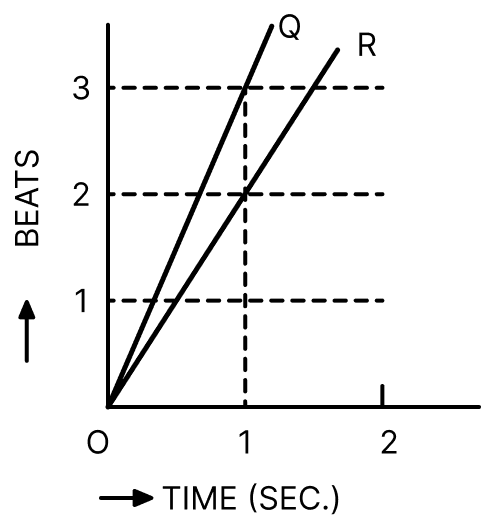
Answer
Given,
- Frequency of the tuning fork A, nA = 341 hertz
- The beats produced by A and B are shown by the straight line OQ
- After putting wax on B, the beats are shown by the straight line OR
Beat frequency before waxing : The line OQ is the steeper of the two. From the graph it passes through the point (1 s, 3 beats), so
Beat frequency after waxing : The line OR passes through the point (1 s, 2 beats), so
Thus, on putting wax on B the number of beats per second decreases from 3 to 2.
Possible frequencies of B : Since 3 beats per second are heard before waxing,
When wax is put on a prong of B, its mass increases and so its frequency decreases.
- If the frequency of B were 338 Hz, then on lowering it further its difference from 341 Hz would become more than 3, so the beat frequency would increase.
- If the frequency of B were 344 Hz, then on lowering it towards 341 Hz its difference would become less than 3, so the beat frequency would decrease.
The graph shows that the beat frequency decreases from 3 to 2, which is possible only in the second case.
Hence, the frequency of the tuning fork B is 344 Hz.
26 tuning forks are arranged in the order of increasing frequency and any two successive forks give 4 beats per second when sounded together. If the frequency of the last fork is three times the frequency of the first fork, then calculate the frequency of the first fork.
Answer
Given,
- Number of tuning forks = 26
- Any two successive forks give 4 beats per second
- Frequency of the last fork = 3 × frequency of the first fork
Let the frequency of the first fork be n. Then the frequency of the last fork is 3 n.
The forks are arranged in the order of increasing frequency, and there are 26 forks, so the number of pairs of successive forks is
The frequency difference in each pair is 4. Hence the total difference between the frequencies of the last and the first fork is
Hence, the frequency of the first fork is 50.
A column of air and a tuning fork produce 4 beats per second when sounded together. The tuning fork gives the lower note. The temperature of air is 15°C. When the temperature falls to 10°C, the two produce 3 beats per second. Find the frequency of the fork. Temperature coefficient of sound velocity is α = 0.0036 per °C.
Answer
Given,
- Number of beats produced per second at 15°C = 4
- Number of beats produced per second at 10°C = 3
- Temperature coefficient of sound velocity, α = 0.0036 per °C
- The tuning fork gives the lower note
Let n be the frequency of the tuning fork and n1 the frequency of the air column at 15°C.
Since the fork gives the lower note, the frequency of the air column is higher than that of the fork. Hence at 15°C,
The frequency of an air column is proportional to the speed of sound in it, and
When the temperature falls to 10°C, the speed of sound decreases, so the frequency of the air column decreases and its difference from the frequency of the fork becomes smaller. Hence at 10°C,
Taking the ratio of the two frequencies of the air column,
Substituting the values of n1 and n2,
Cross-multiplying,
Hence, the frequency of the fork is 110 hertz.
The equation of a plane progressive wave is y = 0.02 sin 2 π (330 t − x). (i) If this wave is reflected from a rigid end, then what will be the equation of the reflected wave? The amplitude remains 60% after the reflection. (ii) If the wave is reflected from a free end and the amplitude remains 75%, then what will be the equation of the reflected wave?
Answer
Given, the equation of the plane progressive wave is
y = 0.02 sin 2π (330 t − x)
(i) Reflection from a rigid end, amplitude remaining 60% :
Amplitude of the reflected wave :
Direction of travel : The reflected wave travels along the negative direction of the X-axis, so x is replaced by − x.
Phase change : The wave is reflected from a rigid end, so it suffers a phase change of π. Therefore
Using sin (θ + π) = − sin θ,
(ii) Reflection from a free end, amplitude remaining 75% :
Amplitude of the reflected wave :
Phase change : The wave is reflected from a free end, so there is no change in its phase. The reflected wave travels along the negative direction of the X-axis, so
Hence, the equation of the wave reflected from the rigid end is y = − 0.012 sin 2π (330 t + x), and that of the wave reflected from the free end is y = 0.015 sin 2π (330 t + x).
The equation of a longitudinal stationary wave produced in a closed organ pipe is , where x, y are expressed in cm and t in second. Find : (i) the amplitude, wavelength and frequency of the original progressive wave, (ii) separation between two consecutive antinodes, (iii) equation of the original progressive wave.
Answer
Given, the equation of the longitudinal stationary wave produced in a closed organ pipe is
where x and y are in cm and t in second.
Comparing this with the standard equation of a stationary wave,
(i) Amplitude, wavelength and frequency of the original progressive wave :
(ii) Separation between two consecutive antinodes :
In a stationary wave the distance between two consecutive antinodes is ,
(iii) Equation of the original progressive wave :
The speed of the wave is
The equation of a plane progressive wave travelling along the positive direction of the X-axis is
Substituting the values of a, n and λ,
Hence, the amplitude is 6 cm, the wavelength is 6 cm and the frequency is 80 hertz; the separation between two consecutive antinodes is 3 cm; and the equation of the original progressive wave is cm.
Two tuning forks A and B when sounded together produce 8 beats per second. A and B are in resonance with closed organ pipes having lengths 32 and 33 cm respectively. Determine the frequencies of the tuning forks.
Answer
Given,
- Number of beats produced per second = 8
- Length of the closed organ pipe in resonance with A, lA = 32 cm
- Length of the closed organ pipe in resonance with B, lB = 33 cm
The fundamental frequency of a closed organ pipe is
Hence
Since A corresponds to the shorter pipe, its frequency is the higher one, so
From equation (i), . Substituting in equation (ii),
Therefore,
Hence, the frequencies of the tuning forks A and B are 264 hertz and 256 hertz respectively.
A and B are two wires whose fundamental frequencies are 256 and 382 hertz respectively. How many beats in two seconds will be heard by the third harmonic of A and the second harmonic of B?
Answer
Given,
- Fundamental frequency of the wire A, nA = 256 hertz
- Fundamental frequency of the wire B, nB = 382 hertz
Third harmonic of A : A stretched wire gives all the harmonics, so
Second harmonic of B :
Number of beats per second :
Number of beats in two seconds :
Hence, 8 beats will be heard in two seconds.
A uniform wire is stretched between two bridges situated at a distance of 1.0 m. The wire is fixed at one end and its other end passes over a pulley and carries a weight of 9 kg. The fundamental frequency of the wire is 750 Hz. (a) Find the speed of sound in the wire. (b) If the weight is reduced to 4 kg, then what will be the speed, wavelength and frequency?
Answer
Given,
- Distance between the two bridges, l = 1.0 m
- Weight carried initially = 9 kg
- Fundamental frequency of the wire, n1 = 750 Hz
- Weight reduced to = 4 kg
(a) Speed of sound in the wire :
The fundamental frequency of a stretched wire is
Substituting the values,
(b) Speed, wavelength and frequency when the weight is reduced to 4 kg :
The speed of a transverse wave in a stretched wire is , so . Hence
In the fundamental mode the wavelength depends only on the length of the wire,
The new frequency is
Hence, the speed of sound in the wire is 1500 m/s; on reducing the weight to 4 kg the speed becomes 1000 m/s, the wavelength is 2 m and the frequency is 500 Hz.
The frequency of the fundamental note of a 66 cm long open tube is the same as that of a 20 cm long stretched wire whose mass is 0.1 g/cm. If the speed of sound in air is 330 m/s, then determine the tension in the wire.
Answer
Given,
- Length of the open pipe, l1 = 66 cm = 0.66 m
- Length of the stretched wire, l2 = 20 cm = 0.20 m
- Mass per unit length of the wire, m = 0.1 g/cm = 0.01 kg/m
- Speed of sound in air, v = 330 m/s
Fundamental frequency of the open pipe :
Fundamental frequency of the wire : Since the two frequencies are the same,
Solving for T,
Squaring both sides,
Hence, the tension in the wire is 100 N.
A tuning fork of frequency 256 Hz is in unison with a certain length of a sonometer wire. On increasing the length of the wire, 10 beats/second are produced. Calculate the frequency of the wire of increased length.
Answer
Given,
- Frequency of the tuning fork, n = 256 Hz
- Number of beats produced per second after increasing the length = 10
The fork is initially in unison with the sonometer wire, so the frequency of the wire is also 256 Hz.
The fundamental frequency of a sonometer wire is
On increasing the length of the wire, its frequency decreases. Hence the frequency of the wire of increased length is
Hence, the frequency of the wire of increased length is 246 Hz.
A tuning fork is vibrated and kept on a sonometer with its wire under a given tension. 6 beats are heard when the wire length is adjusted at 45 cm as well as at 50 cm. Calculate the frequency of the tuning fork.
Answer
Given,
- Number of beats heard per second = 6
- The wire length is adjusted at 45 cm as well as at 50 cm
Let n be the frequency of the tuning fork.
The frequency of a sonometer wire varies inversely as its vibrating length,
At the shorter length of 45 cm the frequency of the wire is higher than that of the fork, so the frequency of the wire is (n + 6). At the longer length of 50 cm the frequency of the wire is lower than that of the fork, so it is (n − 6).
Applying the law of length to the two cases,
Expanding both sides,
Hence, the frequency of the tuning fork is 114 Hz.
When a tuning fork is vibrated with a sonometer wire of length 0.60 m or 0.62 m, in each case 3 beats per second are heard. Calculate the frequency of the tuning fork.
Answer
Given,
- Lengths of the sonometer wire, l1 = 0.60 m and l2 = 0.62 m
- Number of beats heard per second in each case = 3
Let n be the frequency of the tuning fork.
The frequency of a sonometer wire varies inversely as its vibrating length,
At the shorter length of 0.60 m the frequency of the wire is higher than that of the fork, so it is (n + 3). At the longer length of 0.62 m the frequency of the wire is lower than that of the fork, so it is (n − 3).
Applying the law of length to the two cases,
Expanding both sides,
Hence, the frequency of the tuning fork is 183 Hz.
A weight is suspended from a sonometer wire. When the length of the wire between the bridges is 80 cm, the wire is found in unison with a tuning fork. But when an additional 0.1 kg weight is suspended from it then, to keep it in unison with the same fork, its length between the bridges is to be increased by 1 cm. What weight was suspended from the wire in the beginning?
Answer
Given,
- Initial length between the bridges, l1 = 80 cm
- Additional weight suspended = 0.1 kg
- Increase in length required, = 1 cm, so l2 = 81 cm
Let the weight suspended in the beginning be M kg. Then the final weight is (M + 0.1) kg.
The wire remains in unison with the same tuning fork in both the cases, so its frequency is unchanged. The fundamental frequency of a sonometer wire is
Hence
Squaring both sides and cancelling g,
Substituting the values,
Cross-multiplying,
Hence, a weight of 4 kg-wt was suspended from the wire in the beginning.
The fundamental tone produced by an organ pipe has a frequency of 110 Hz. Some other frequencies in the notes produced by this pipe are 220, 440, 550, 660 Hz. Is this pipe open at both ends or open at one end and closed at the other? Calculate the effective length of the pipe. (Speed of sound = 330 m/s)
Answer
Given,
- Frequency of the fundamental tone, n1 = 110 Hz
- Some other frequencies produced = 220, 440, 550, 660 Hz
- Speed of sound, v = 330 m/s
Nature of the pipe : Dividing each of the given frequencies by the fundamental frequency,
The harmonics present therefore include the even harmonics 2, 4, 6 as well as the odd harmonic 5. A closed pipe produces only the odd harmonics, so the presence of even harmonics shows that the pipe is open at both ends.
Effective length of the pipe : For an open pipe,
Substituting the values,
Hence, the pipe is open at both ends and its effective length is 1.5 m.
For a certain organ pipe, three successive resonance frequencies are observed at 425, 595 and 765 Hz respectively. Taking the speed of sound in the air to be 340 m/s (i) explain whether the pipe is closed at one end or open at both the ends and (ii) determine the fundamental frequency and the length of the pipe.
Answer
Given,
- Three successive resonance frequencies = 425 Hz, 595 Hz and 765 Hz
- Speed of sound in air, v = 340 m/s
(i) Nature of the pipe :
The difference between the successive resonance frequencies is
Dividing each resonance frequency by 85, which is half of 170,
The harmonics present are therefore the 5th, the 7th and the 9th — all odd harmonics. Since only odd harmonics are produced, the pipe is closed at one end.
(ii) Fundamental frequency and length of the pipe :
For a closed pipe the successive odd harmonics differ by 2 n1, so
The fundamental frequency of a closed pipe is
Substituting the values,
Hence, the pipe is closed at one end, its fundamental frequency is 85 Hz and its length is 1 metre.
The length of a pipe open at both ends is 48.8 cm and its fundamental frequency is 320 Hz. Find the radius of the pipe. If one end of the pipe be closed, what will be the fundamental frequency? (Speed of sound = 320 m/s )
Answer
Given,
- Length of the pipe open at both ends, l = 48.8 cm = 0.488 m
- Fundamental frequency, n = 320 Hz
- Speed of sound, v = 320 m/s
Radius of the pipe : Applying the end correction, the fundamental frequency of an open pipe of radius r is
Substituting the values,
Fundamental frequency when one end is closed : Applying the end correction for a closed pipe,
Substituting the values,
Hence, the radius of the pipe is 1.0 cm, and on closing one end the fundamental frequency becomes 162 Hz.
A stretched wire is of 1 metre length and its fundamental frequency is 300 Hz. What is the speed of the transverse wave in the wire?
Answer
Given,
- Length of the stretched wire, l = 1 metre
- Fundamental frequency, n = 300 Hz
The fundamental frequency of a stretched wire is
and the speed of a transverse wave in the wire is
Combining the two,
Substituting the values,
Hence, the speed of the transverse wave in the wire is 600 m/s.
The length of a stretched string is 2 metres and its mass is 8 × 10⁻³ kg. If a tension of 2 kg is applied to the wire, then how long will a transverse-wave take in reaching from one end of the wire to the other? (g = 9.8 m/s2)
Answer
Given,
- Length of the stretched string, l = 2 metres
- Mass of the string, M = 8 × 10⁻³ kg
- Tension applied = 2 kg
- g = 9.8 m/s2
Mass per unit length :
Tension in the string :
Speed of the transverse wave :
Time taken to travel the length of the wire :
Hence, the transverse wave takes second in reaching from one end of the wire to the other.
The speed (v) of transverse wave in a stretched string is 342 m/s, when the tension (T) of the string is 3.6 kg-wt. Calculate the speed of the transverse wave in the same string, if the tension of the string is changed to 4.9 kg-wt.
Answer
Given,
- Initial speed of the transverse wave, v1 = 342 m/s
- Initial tension, T1 = 3.6 kg-wt
- Final tension, T2 = 4.9 kg-wt
The speed of a transverse wave in a stretched string is
since the string is the same in both the cases. Hence
Substituting the values,
Hence, the speed of the transverse wave in the same string becomes 399 m/s.
The diameter of an iron wire is 1.20 mm. If the speed of the transverse wave in the wire be 50.0 m s-1, then what is the tension in the wire? The density of iron is 7.7 × 10³ kg/m3.
Answer
Given,
- Diameter of the iron wire, D = 1.20 mm, so the radius is r = 0.60 mm = 0.6 × 10⁻³ m
- Speed of the transverse wave, v = 50.0 m s-1
- Density of iron, d = 7.7 × 10³ kg/m3
Mass per unit length of the wire :
Substituting the values,
Tension in the wire : The speed of a transverse wave in a stretched wire is , so
Substituting the values,
Hence, the tension in the wire is 21.76 N.
A tuning fork is marked 256 number. What does it indicate? It is in unison with the wire of a sonometer whose length is 81 cm and which is under a tension of 4 kg. How can this wire be brought in unison with a fork marked 384 by (i) changing the tension only, (ii) changing the length only?
Answer
Given,
- The tuning fork is marked 256
- Length of the sonometer wire, l1 = 81 cm
- Tension in the wire, T1 = 4 kg
- Frequency of the second fork, n2 = 384
What the marking indicates : The number marked on a tuning fork indicates its frequency, that is, the fork vibrates 256 times in one second. Since the wire of length 81 cm under a tension of 4 kg is in unison with this fork, the frequency of the wire is also 256.
(i) Changing the tension only :
The frequency of a sonometer wire is proportional to the square-root of its tension,
Substituting the values,
Squaring both sides,
(ii) Changing the length only :
The frequency of a sonometer wire is inversely proportional to its vibrating length,
Substituting the values,
Hence, the marking indicates the frequency of the fork; the wire can be brought in unison with the fork marked 384 either by changing the tension to 9 kg, or by changing the length to 54 cm.