
A granite rod of 60 cm length is clamped at its middle point and is set into longitudinal vibrations. The density of granite is 2.7 ×10³ kg/m3 and its Young's modulus is 9.27 × 10¹⁰ Pa. What will be the fundamental frequency of the longitudinal vibrations?
- 10 kHz
- 7.5 kHz
- 5 kHz
- 2.5 kHz.
Answer
5 kHz
Reason — Given,
- Length of the granite rod, L = 60 cm = 0.6 m
- Density of granite, d = 2.7 × 10³ kg/m3
- Young's modulus of granite, Y = 9.27 × 10¹⁰ Pa
The speed of a longitudinal wave in a rod is
The rod is clamped at its middle point, so a node is formed there and an antinode at each free end. Hence
The fundamental frequency is
A heavy ball of mass M is suspended from the ceiling of a car by a light string of mass m (m < < M). When the car is at rest, the speed of transverse waves in the string is 60 ms-1. When the car has acceleration a, the wave speed increases to 60.5 ms-1. The value of a, in terms of gravitational acceleration g is closest to :
Answer
Reason — Given,
- Speed of the transverse wave when the car is at rest, v = 60 m s-1
- Speed when the car has acceleration a, v' = 60.5 m s-1
Since m < < M, the mass of the string may be neglected.
Car at rest : The tension in the string is T = Mg, so
Car accelerating : The string makes an angle θ with the vertical, and resolving the tension,
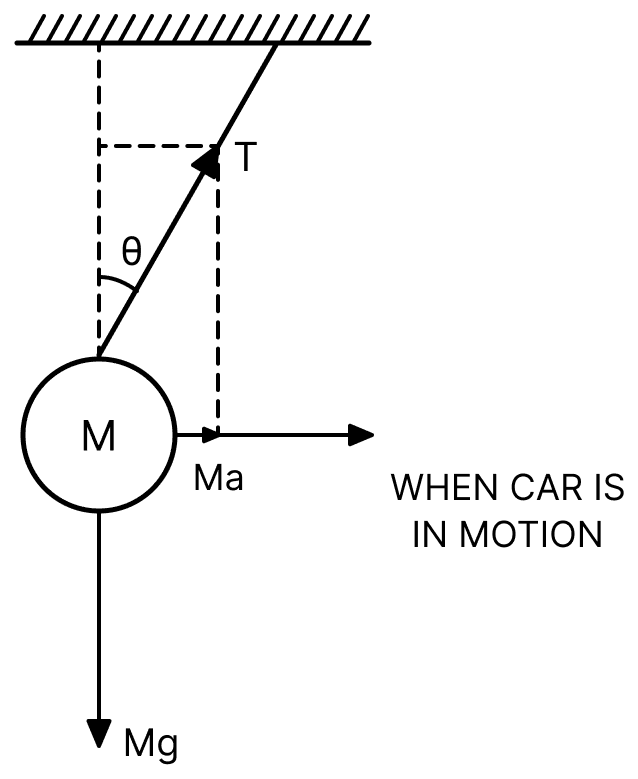
Squaring and adding,
Hence the new speed is
Dividing,
Applying the binomial theorem on both sides,
Equation of travelling wave on a stretched string of linear density 5 g/m is y = 0.03 sin (450t − 9x), where distance and time are measured in SI units. The tension in the string is :
- 5 N
- 12.5 N
- 7.5 N
- 10 N.
Answer
12.5 N
Reason — Given,
- Linear density of the string, m = 5 g/m = 5 × 10⁻³ kg/m
- Equation of the wave, y = 0.03 sin (450 t − 9 x)
Comparing with the standard equation y = A sin (ωt − kx),
The speed of the wave is
The speed of a transverse wave in a stretched string is , so
The pressure wave P = 0.01 sin [1000t − 3x] Nm-2, corresponds to the sound produced by a vibrating blade on a day when atmospheric temperature is 0°C. On some other day when temperature is T, the speed of sound produced by the same blade and at the same frequency is found to be 336 ms-1. Approximate value of T is :
- 15°C
- 11°C
- 12°C
- 4°C.
Answer
4°C
Reason — Given,
- Pressure wave, P = 0.01 sin [1000 t − 3 x] N m-2, at 0°C, so T1 = 273 K
- Speed of sound at temperature T, v2 = 336 m s-1
Comparing the given wave with P = P0 sin (ωt − kx),
The speed of sound at 0°C is
The speed of sound in a gas is , so . Hence
Substituting the values,
Converting into the celsius scale,
If the initial tension on a stretched string is doubled, then the ratio of the initial and final speeds of a transverse wave along the string is:
- 1 : 2
- 1 : 1
- .
Answer
Reason — Given, the final tension is twice the initial tension, that is, T2 = 2 T1.
The speed of a transverse wave along a string is
where T is the tension in the string and μ is the mass per unit length. Hence
Dividing,
Hence the ratio of the initial and the final speeds is .
A progressive wave travelling along the positive X-direction is represented by y (x, t) = a sin (kx − ωt + φ). Its snapshot at t = 0 is given in the figure.
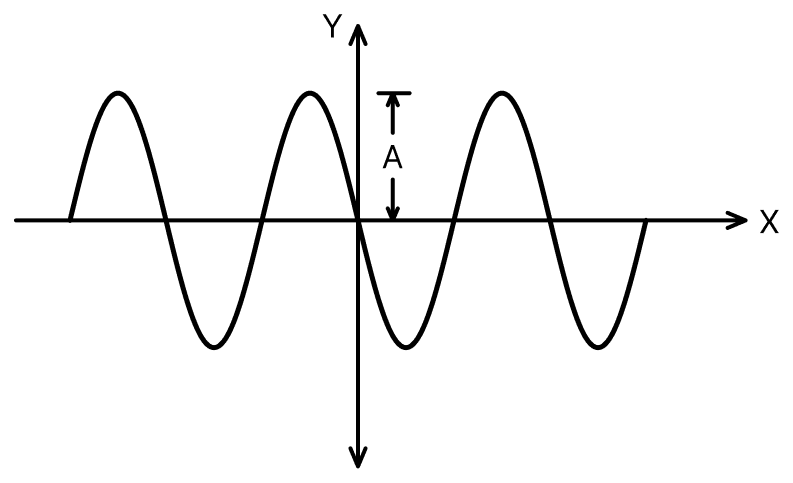
For this wave, the phase φ is :
- π
- 0
Answer
π
Reason — Given, the wave is y (x, t) = a sin (kx − ωt + φ), and its snapshot at t = 0 is shown in the figure.
At t = 0 the equation becomes
From the snapshot it is clear that at x = 0 the displacement is y = 0, and that y becomes negative as x increases from zero.
For y = 0 at x = 0,
If φ were 0, then y = a sin kx would become positive as x increases, which contradicts the figure. Hence
so that y = a sin (kx + π) = − a sin (kx), which is negative for small positive x, as shown.
A travelling harmonic wave is represented by the equation y (x, t) = 10-3 sin (50t + 2x), where x and y are in metre and t is in second. Which of the following is a correct statement about the wave?
- The wave is propagating along the negative X-axis with speed 25 ms-1.
- The wave is propagating along the positive X-axis with speed 25 ms-1.
- The wave is propagating along the positive X-axis with speed 100 ms-1.
- The wave is propagating along the negative X-axis with speed 100 ms-1.
Answer
The wave is propagating along the negative X-axis with speed 25 ms-1
Reason — Given, the travelling harmonic wave is
y (x, t) = 10-3 sin (50 t + 2 x)
Direction of propagation : In the argument of the sine, x and t occur in the combination (ωt + kx). Hence the wave is propagating along the negative direction of the X-axis.
Speed of the wave : The phase of the wave remains constant as the wave advances, so
Differentiating with respect to t,
The magnitude of the speed is therefore 25 m s-1, and the minus sign confirms that the wave travels along the negative X-axis.
A transverse wave is represented by y = 2sin (ωt − kx) cm. The value of wavelength (in cm) for which the wave velocity becomes equal to the maximum particle velocity, will be :
- 4π
- 2π
- π
- 2
Answer
4π
Reason — Given, the transverse wave is y = 2 sin (ωt − kx) cm, so the amplitude is a = 2 cm.
Maximum particle velocity : Differentiating y with respect to t,
The maximum value of the cosine term is 1, so
Wave velocity :
According to the question, the wave velocity is equal to the maximum particle velocity,
Since ,
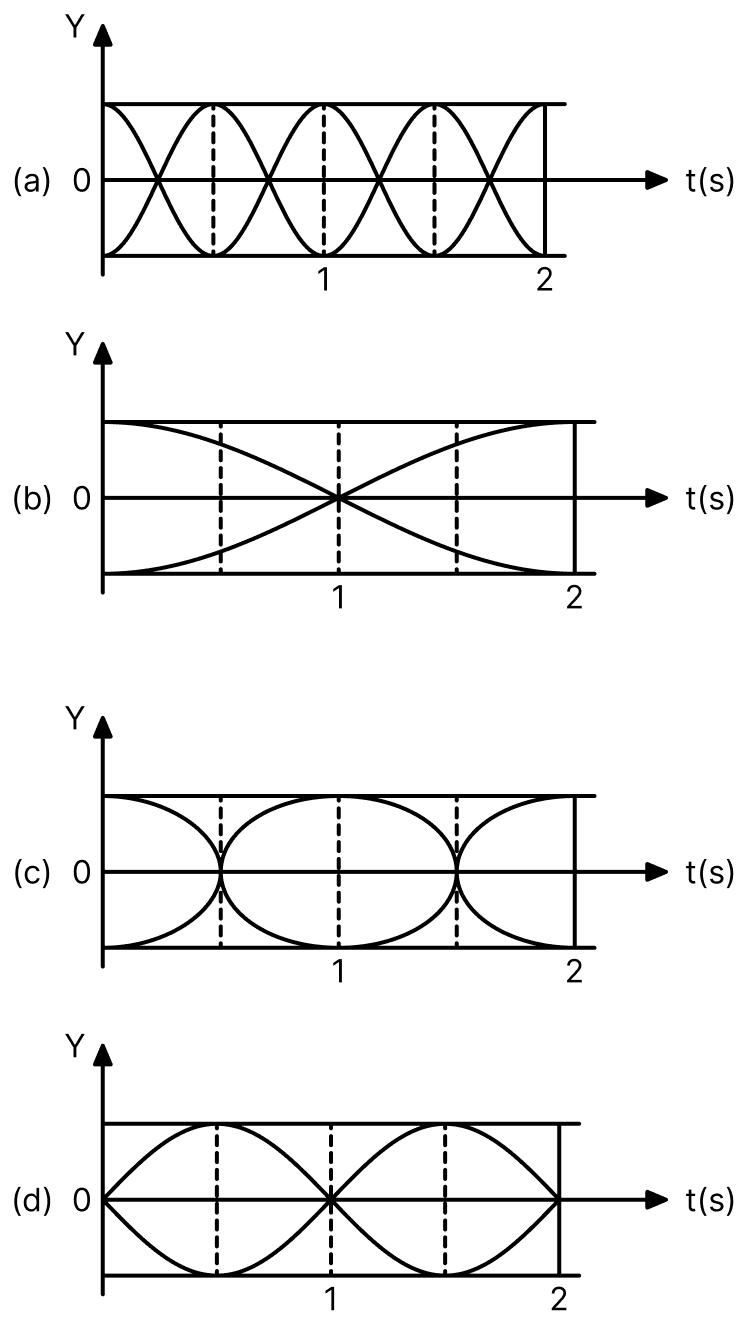
The correct figure that shows schematically, the wave pattern produced by superposition of two waves of frequencies 9 Hz and 11 Hz, is :
Answer
the first figure
Reason — Given, the two superposing waves have frequencies of 9 Hz and 11 Hz.
When two waves of slightly different frequencies superpose, beats are produced. The number of beats heard per second is equal to the difference in the two frequencies,
Hence the amplitude of the resultant wave must rise and fall twice in one second, that is, two beats must appear in the interval from t = 0 to t = 1 s, and two more in the interval from t = 1 s to t = 2 s.
Only the pattern in the first figure shows this — a rapidly oscillating wave whose envelope swells and collapses twice in every second. The remaining figures show either one beat per second or a still smaller number, and so do not correspond to a beat frequency of 2 Hz.
The fundamental frequency in an open organ pipe is equal to the third harmonic of a closed organ pipe. If the length of the closed organ pipe is 20 cm, the length of the open organ pipe is :
- 13.3 cm
- 16 cm
- 12.5 cm
- 8 cm.
Answer
13.3 cm
Reason — Given,
- Length of the closed organ pipe, lc = 20 cm
- The fundamental frequency of the open pipe is equal to the third harmonic of the closed pipe
Let lo be the length of the open pipe and v the speed of sound in air.
Fundamental frequency of the open pipe :
Third harmonic of the closed pipe :
Equating the two frequencies,
Substituting the value,
The two nearest harmonics of a tube closed at one end and open at other end are 220 Hz and 260 Hz. What is the fundamental frequency of the system?
- 10 Hz
- 20 Hz
- 30 Hz
- 40 Hz.
Answer
20 Hz
Reason — Given, the two nearest harmonics of the tube are 220 Hz and 260 Hz.
The tube is closed at one end and open at the other, so it produces only the odd harmonics. If n1 be the fundamental frequency, then the harmonics present are
The difference between two successive odd harmonics is
Hence
While measuring the speed of sound by performing a resonance column experiment, a student gets the first resonance condition at a column length of 18 cm during winter. Repeating the same experiment during summer, he measures the column length to be x cm for the second resonance. Then :
- 54 > x > 36
- 36 > x > 18
- 18 > x
- x > 54.
Answer
x > 54
Reason — Given, the first resonance in winter occurs at a column length of 18 cm, and the second resonance in summer occurs at a column length of x cm.
The resonance column tube behaves as a closed pipe, so the resonating lengths are
In winter : l1 = 18 cm, so the second resonance in winter would occur at
In summer : The temperature is higher, so the speed of sound is greater, since . The frequency of the tuning fork is fixed, so from v = nλ the wavelength λ also increases.
Hence the length of the air column at the second resonance in summer must be greater than the corresponding length in winter,
A tuning fork is used to produce resonance in a glass tube. The length of the air column in this tube can be adjusted by a variable piston. At room temperature of 27°C two successive resonances are produced at 20 cm and 73 cm of column length. If the frequency of the tuning fork is 320 Hz, the velocity of sound in air at 27°C is :
- 330 m/s
- 339 m/s
- 350 m/s
- 300 m/s.
Answer
339 m/s
Reason — Given,
- Two successive resonating column lengths, l1 = 20 cm and l2 = 73 cm
- Frequency of the tuning fork, n = 320 Hz
The glass tube with a variable piston behaves as a closed pipe, so the successive resonating lengths differ by half a wavelength,
Substituting the values,
Hence the velocity of sound at 27°C is
A string of length 1 m and mass 5 g is fixed at both ends. The tension in the string is 8.0 N. The string is set into vibration using an external vibrator of frequency 100 Hz. The separation between successive nodes on the string is close to :
- 16.6 cm
- 33.3 cm
- 10.0 cm
- 20.0 cm.
Answer
20.0 cm
Reason — Given,
- Length of the string, l = 1 m
- Mass of the string, M = 5 g = 5 × 10⁻³ kg
- Tension in the string, T = 8.0 N
- Frequency of the external vibrator, n = 100 Hz
Mass per unit length :
Speed of the transverse wave :
Wavelength :
Separation between successive nodes : In a stationary wave this separation is ,
A tuning fork of frequency 480 Hz is used in an experiment for measuring speed of sound (v) in air by resonance tube method. Resonance is observed to occur at two successive lengths of the air column l1 = 30 cm and l2 = 70 cm. Then v is equal to :
- 332 ms-1
- 384 ms-1
- 338 ms-1
- 379 ms-1.
Answer
384 ms-1
Reason — Given,
- Frequency of the tuning fork, n = 480 Hz
- Two successive resonating lengths, l1 = 30 cm and l2 = 70 cm
In the resonance tube method the air column behaves as a closed pipe, so the successive resonating lengths differ by half a wavelength,
Substituting the values,
Hence the speed of sound is
A string is clamped at both the ends and it is vibrating in its 4th harmonic. The equation of the stationary wave is Y = 0.3 sin (0.157x) cos (200πt). The length of the string is (all quantities are in SI units).
- 60 m
- 40 m
- 80 m
- 20 m.
Answer
80 m
Reason — Given, the equation of the stationary wave is
Y = 0.3 sin (0.157 x) cos (200 π t)
and the string is vibrating in its 4th harmonic.
Comparing with the standard equation of a stationary wave,
we have
The string is clamped at both ends, so in the pth harmonic
For the 4th harmonic, p = 4,
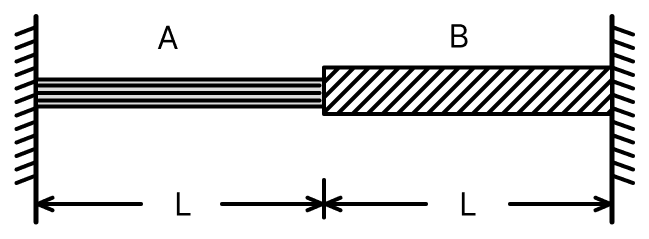
A wire of length 2L, is made by joining two wires A and B of same length but different radii r and 2r and made of the same material. It is vibrating at a frequency such that the joint of the two wires forms a node. If the number of antinodes in wire A is p and that in B is q, then the ratio p : q is :
- 3 : 5
- 4 : 9
- 1 : 2
- 1 : 4.
Answer
1 : 2
Reason — Given, the wire of length 2 L is made by joining two wires A and B of the same length L but of radii r and 2 r, made of the same material.
Since both the wires are of the same material and are joined end to end, the tension T is the same in both, and the mass per unit length is
Hence
The speed of the transverse wave in each wire is , so
The joint is a node, and the frequency n is the same throughout the composite wire. From v = nλ,
The number of antinodes in a wire of length L is
Therefore,
A resonance tube is old and has jagged end. It is still used in the laboratory to determine velocity of sound in air. A tuning fork of frequency 512 Hz produces first resonance when the tube is filled with water to mark 11 cm below a reference mark, near the open end of the tube. The experiment is repeated with another fork of frequency 256 Hz which produces first resonance when water reaches a mark 27 cm below the reference mark. The velocity of sound in air, obtained in the experiment is close to :
- 328 ms-1
- 341 ms-1
- 322 ms-1
- 335 ms-1.
Answer
328 ms-1
Reason — Given,
- The 512 Hz fork produces the first resonance when the water reaches a mark 11 cm below the reference mark
- The 256 Hz fork produces the first resonance when the water reaches a mark 27 cm below the reference mark
Since the tube has a jagged end, the position of the antinode is not known exactly, so an unknown end correction e must be allowed for. If l be the length measured below the reference mark, then for the first resonance of a closed air column,
For the 512 Hz fork :
For the 256 Hz fork :
Subtracting equation (i) from equation (ii), the unknown e is eliminated,
A closed organ pipe has a fundamental frequency of 1.5 kHz. The number of overtones that can be distinctly heard by a person with this organ pipe will be (assume that the highest frequency a person can hear is 20,000 Hz).
- 7
- 4
- 5
Answer
6
Reason — Given,
- Fundamental frequency of the closed organ pipe, n1 = 1.5 kHz = 1500 Hz
- Highest frequency a person can hear = 20,000 Hz
A closed organ pipe produces only the odd harmonics, so the frequencies present are
The frequency must not exceed 20,000 Hz,
Hence the permissible odd values of (2m − 1) are 1, 3, 5, 7, 9, 11, 13, giving the frequencies
These are 7 frequencies in all. The first of them is the fundamental tone, so the number of overtones that can be distinctly heard is
Frequency n in air. The pipe is now dippd vertically in a water drum to half of its length. The fundamental frequency of the air column is now equal to :
- n
- 2n.
Answer
n
Reason — Given, an open organ pipe of length l has a fundamental frequency n in air. The pipe is then dipped vertically in a water drum to half of its length.
Before dipping : The pipe is open at both ends, so
After dipping : The lower half of the pipe is filled with water, so the vibrating air column is only long. The water surface acts as a rigid boundary, so a node is formed there, while the upper end remains open and an antinode is formed there. The pipe therefore behaves as a closed pipe of length .
Hence the new fundamental frequency is
Note: The question stem is incomplete as printed. It has been read as an open organ pipe of length l having fundamental frequency n in air.
In an experiment to measure the speed of sound by a resonating air column, a tuning fork of frequency 500 Hz is used. The length of the air column is varied by changing the level of water in the resonance tube. Two successive resonances are heard at air columns of length 50.7 cm and 83.9 cm. Which of the following statements is (are) true?
- The speed of sound determined from this experiment is 332 ms-1.
- The end correction in this experiment is 0.9 cm.
- The wavelength of the sound wave is 66.4 cm.
- The resonance at 50.7 cm corresponds to the fundamental harmonic.
Answer
The speed of sound determined from this experiment is 332 ms-1, the end correction in this experiment is 0.9 cm, and the wavelength of the sound wave is 66.4 cm
Reason — Given,
- Frequency of the tuning fork, n = 500 Hz
- Two successive resonating lengths, l1 = 50.7 cm and l2 = 83.9 cm
Wavelength : In a resonance tube the air column behaves as a closed pipe, so the successive resonating lengths differ by half a wavelength,
Substituting the values,
Hence the third statement is correct.
Speed of sound :
Hence the first statement is correct.
End correction : For the first resonance,
Substituting the values,
This is not acceptable, so the resonance at 50.7 cm cannot be the fundamental. Taking it to be the third harmonic,
The magnitude of the end correction is therefore 0.9 cm, so the second statement is correct.
Nature of the first resonance : Since the resonance at 50.7 cm corresponds to the third harmonic and not to the fundamental, the fourth statement is wrong.
Hence, the first, the second and the third statements are correct.
A block M hangs vertically at the bottom end of a uniform rope of constant mass per unit length. The top end of the rope is attached to a fixed rigid support at O. A transverse wave pulse (Pulse 1) of wavelength λ0 is produced at point O on the rope. The pulse takes time TOA to reach point A. If the wave pulse of wavelength λ0 is produced at a point A (Pulse 2) without disturbing the position of M it takes time TAO to reach O. Which of the following options is/are correct?
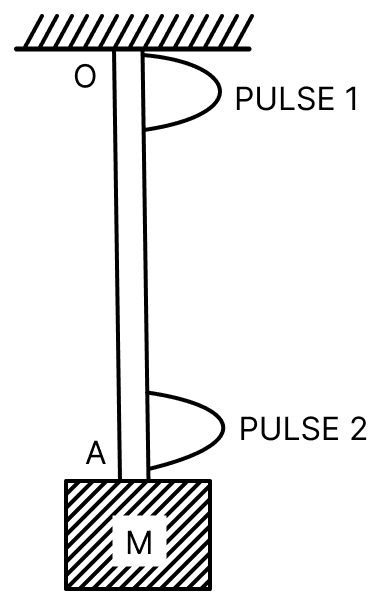
- The velocities of the two pulses (Pulse 1 and Pulse 2) are the same at the mid-point of rope
- The velocity of any pulse along the rope is independent of its frequency and wavelength
- The wavelength of pulse 1 becomes longer when it reaches point A
- The time TAO = TOA.
Answer
The velocity of any pulse along the rope is independent of its frequency and wavelength, and the time TAO = TOA
Reason — Given, a block M hangs at the bottom end A of a uniform rope of constant mass per unit length whose top end O is fixed to a rigid support.
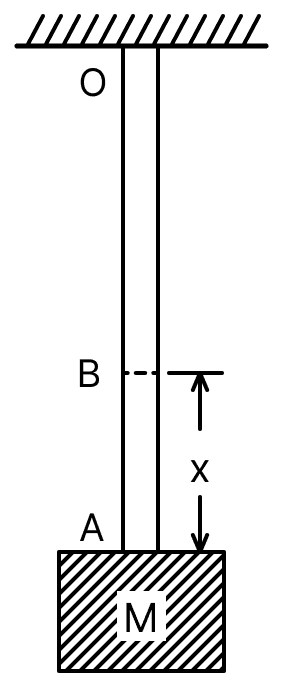
Let μ be the mass per unit length of the rope, L its total length, and let x be the distance measured upward from the bottom end A.
Tension in the rope : At a height x above A, the rope has to support the block M together with the length x of rope hanging below that point. Hence
The tension therefore increases as one goes up the rope.
Speed of the pulse :
First statement : The speed at any point depends only on the tension at that point, and the tension at the mid-point is the same whichever way the pulse is travelling. So the speeds are indeed equal at the mid-point. However, the option as printed compares the velocities, which are oppositely directed for the two pulses — Pulse 1 travels downward and Pulse 2 upward. Hence this statement is wrong.
Second statement : The expression for v(x) contains only the tension and the mass per unit length; it contains no term of frequency or wavelength. Hence the velocity of any pulse along the rope is independent of its frequency and wavelength, and the statement is correct.
Third statement : As Pulse 1 travels downward from O to A, the tension decreases, so the speed decreases. The frequency is fixed by the source, so from v = nλ the wavelength decreases, and does not become longer. Hence this statement is wrong.
Fourth statement : The time taken to traverse the rope is
This integral has exactly the same value whether it is evaluated from O to A or from A to O, since the speed at each point of the rope is the same in both the journeys. Hence
and the statement is correct.
Hence, the second and the fourth statements are correct.
Consider a system of three connected strings, S1, S2 and S3 with uniform linear mass densities μ kg/m, 4μ kg/m and 16μ kg/m, respectively. S1 and S2 are connected at the point P, whereas S2 and S3 are connected at the point Q, and the other end of S3 is connected to a wall. A wave generator O is connected to the free end of S1. The wave from the generator is represented by y = y0 cos (ωt − kx) cm, where y0, ω and k are constants of appropriate dimensions. Which of the following statements is/are correct?
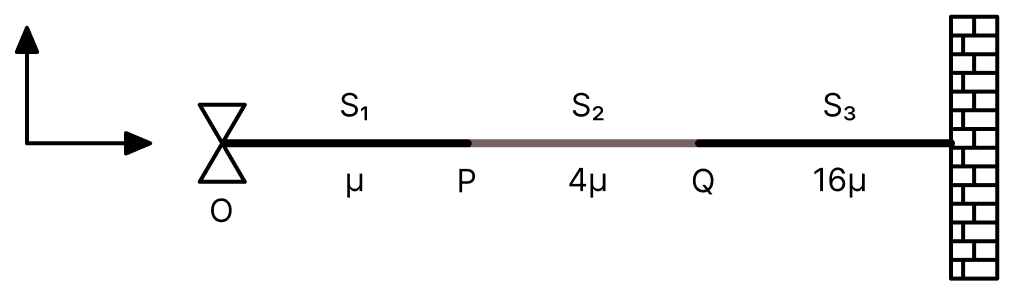
- When the wave reflects from P for the first time, the reflected wave is represented by y = α1 y0 cos (ωt − kx + π) cm, where α1 is a positive constant.
- When the wave transmits through P for the first time, the transmitted wave is represented by y = α2y0 cos (ωt − kx) cm, where α2 is a positive constant.
- When the wave reflects from Q for the first time, the reflected wave is represented by y = α3 y0 cos (ωt − kx + π) cm, where α3 is a positive constant.
- When the wave transmits through Q for the first time, the transmitted wave is represented by y = α4y0 cos (ωt − 4 kx) cm, where α4 is a positive constant.
Answer
When the wave reflects from P for the first time, the reflected wave is represented by y = α1 y0 cos (ωt − kx + π) cm, where α1 is a positive constant, and when the wave transmits through Q for the first time, the transmitted wave is represented by y = α4y0 cos (ωt − 4 kx) cm, where α4 is a positive constant
Reason — Given, three connected strings S1, S2 and S3 of linear mass densities μ, 4μ and 16μ respectively, with S1 joined to S2 at P and S2 joined to S3 at Q.

The tension T is the same throughout the connected strings, so the speed of the wave in each is
Hence
The frequency is fixed by the generator and is unchanged at every junction. Since ,
Reflection at P : The wave passes from the lighter string S1 into the denser string S2. A denser medium behaves as a rigid boundary, so the reflected wave suffers a phase change of π. The reflected wave travels back in S1, where the propagation constant is still k. Hence it is represented by
so the first statement is correct.
Transmission through P : The transmitted wave travels in S2, where the propagation constant is 2k, not k. Hence it should be written with (ωt − 2kx), and the second statement as printed is wrong.
Reflection at Q : The wave again passes from the lighter string S2 into the denser string S3, so a phase change of π does occur. But the reflected wave travels back in S2, where the propagation constant is 2k. Hence it should be written with (ωt − 2kx + π), and the third statement as printed is wrong.
Transmission through Q : The transmitted wave travels in S3, where the propagation constant is 4k, and there is no phase change on transmission. Hence it is represented by
so the fourth statement is correct.
Hence, the first and the fourth statements are correct.