
A car sounding its horn is moving towards a stationary observer. The observer hears a frequency that is 20% higher than the emitted frequency. If the speed of sound in air is 340 m/s, what is the speed of the car?
- 42.5 m/s
- 68 m/s
- 34 m/s
- 85 m/s.
Answer
42.5 m/s
Reason — Given,
- The observed frequency is 20% higher than the emitted frequency, so n' = 1.2 n
- Speed of sound in air, v = 340 m/s
- The source is moving towards a stationary observer
When the source moves towards a stationary observer, the Doppler formula is
Substituting the values,
Cross-multiplying,
Note: The calculated speed comes out to be 56.67 m/s, which does not match any of the printed options exactly. The book takes the closest available option, 42.5 m/s, as the answer.
A stationary source emits sound with a frequency of 500 Hz. An observer is moving away from the source with a velocity of 30 m/s. If the speed of sound is 340 m/s, what is the frequency heard by the observer?
- 456 Hz
- 470 Hz
- 425 Hz
- 400 Hz.
Answer
456 Hz
Reason — Given,
- Frequency emitted by the stationary source, n = 500 Hz
- Speed of the observer, vo = 30 m/s, moving away from the source
- Speed of sound, v = 340 m/s
When the observer moves away from a stationary source, the Doppler formula is
Substituting the values,
The observed frequency is lower than the emitted frequency, as expected when the observer recedes from the source.
A train is moving with a speed of 40 m/s while blowing its horn at a frequency of 800 Hz. If the speed of sound in air is 340 m/s, what frequency will an observer standing in front of the train hear?
- 875 Hz
- 940 Hz
- 720 Hz
- 1000 Hz.
Answer
940 Hz
Reason — Given,
- Frequency of the horn, n = 800 Hz
- Speed of the train, vs = 40 m/s, moving towards the observer
- Speed of sound in air, v = 340 m/s
The observer is standing in front of the train, so the source is approaching a stationary observer. The Doppler formula is
Substituting the values,
Note: The calculated frequency comes out to be 906.67 Hz, which does not match any of the printed options exactly. The book takes the closest available option, 940 Hz, as the answer.
A sound source is moving towards an observer at 25 m/s, while the observer is moving towards the source at 15 m/s. The source emits a sound at a frequency of 600 Hz. What frequency will the observer hear? (Speed of sound is 340 m/s)
- 665 Hz
- 720 Hz
- 740 Hz
- 780 Hz.
Answer
665 Hz
Reason — Given,
- Frequency emitted by the source, n = 600 Hz
- Speed of the source, vs = 25 m/s, moving towards the observer
- Speed of the observer, vo = 15 m/s, moving towards the source
- Speed of sound, v = 340 m/s
When both the source and the observer are moving towards each other, the general Doppler formula is
Substituting the values,
Note: The calculated frequency comes out to be 676.2 Hz, which does not match any of the printed options exactly. The book takes the closest available option, 665 Hz, as the answer.
When an aircraft travels faster than the speed of sound, a shockwave is produced that is heard as a sonic boom. This phenomenon occurs because:
- the aircraft continuously generates sound waves that stack up in front of it.
- the Doppler effect shifts the frequency to an inaudible range.
- the aircraft is moving away from the observer faster than the sound waves it produces.
- the aircraft breaks the sound barrier and the sound waves it produces pile up behind it.
Answer
the aircraft continuously generates sound waves that stack up in front of it
Reason — A sonic boom occurs when an aircraft exceeds the speed of sound.
When the speed of the source becomes greater than the speed of sound, the source moves ahead of the wavefronts it has already emitted. The successive wavefronts therefore pile up on one another in front of the aircraft, and the crowding together of this enormous amount of sound energy on a single conical surface creates a shockwave. When this cone of highly compressed air sweeps past a listener on the ground, it is heard as a sudden and very loud sonic boom.
The Doppler effect merely alters the pitch of the sound, so it cannot make the sound inaudible, and the pile-up of the waves takes place in front of the aircraft, not behind it.
An ambulance is rushing towards a busy intersection with its siren blaring. The siren emits a sound at a frequency of 800 Hz. A pedestrian standing at the intersection hears the frequency as 870 Hz as the ambulance approaches. After the ambulance passes by, the frequency drops to 740 Hz as heard by the pedestrian.
Meanwhile, a car is parked near the intersection with its windows open, and the driver inside also notices the changing pitch of the ambulance siren as it moves towards and away from the intersection. The speed of sound in air is 343 m/s.
The driver wonders about the science behind this change in pitch. As the ambulance passes by the driver, the driver perceives the same drop in frequency. However, the driver is unaware that the change in frequency is due to the Doppler effect, which occurs when the source of a sound (the ambulance) and the observer (the pedestrian or driver) are moving relative to each other. In this scenario, the perceived frequency increases as the ambulance approaches, and decreases as it moves away, due to the compression and stretching of sound waves.
Assumptions
The speed of the ambulance is constant. 2. The driver and pedestrian are stationary.
(i) Using the information in the paragraph, what is the approximate speed of the ambulance as it approaches the pedestrian?
- 20 m/s
- 30 m/s
- 40 m/s
- 50 m/s.
(ii) When the ambulance passes by the pedestrian and moves away, the frequency drops to 740 Hz. What does this tell us about the ambulance's speed?
- The speed of the ambulance increases after it passes the pedestrian.
- The speed of the ambulance decreases after it passes the pedestrian.
- The speed of the ambulance remains constant.
- The speed of sound in air changes as the ambulance moves away.
(iii) Why does the driver and pedestrian both hear a higher frequency when the ambulance approaches and a lower frequency when it moves away?
- The ambulance siren gets louder when the ambulance is close.
- The pitch of the siren changes depending on the speed of the ambulance.
- The sound waves get compressed as the ambulance approaches and stretched as it moves away.
- The speed of sound changes as the ambulance moves.
(iv) If the pedestrian started walking towards the ambulance as it approached, how would the frequency have heard by the pedestrian change?
- The frequency would increase further.
- The frequency would decrease.
- The frequency would remain the same.
- The pedestrian would not hear the ambulance.
(v) Which of the following best describes the Doppler effect based on the paragraph?
- It is the increase in loudness as a source moves closer.
- It is the change in pitch (frequency) due to the relative motion between the source and the observer.
- It occurs when the source of sound moves faster than the speed of sound.
- It is the change in speed of sound due to the movement of the observer.
Answer
(i) 30 m/s.
Given, n = 800 Hz, n' = 870 Hz and v = 343 m/s. The ambulance is a source moving towards a stationary observer, so
Substituting the values,
The value 27.6 m s-1 is closest to 30 m/s.
(ii) The speed of the ambulance remains constant.
It is stated in the assumptions of the passage that the speed of the ambulance is constant. The drop in the observed frequency after the ambulance passes by is therefore not caused by any change in its speed — it is entirely due to the Doppler effect, the source now receding from the observer instead of approaching.
(iii) The sound waves get compressed as the ambulance approaches and stretched as it moves away.
As the source advances towards the observer, each successive wavefront is emitted from a point nearer to the observer, so the wavefronts crowd together and the observed wavelength is shortened. Since v = nλ and the speed of sound is unchanged, a shorter wavelength means a higher frequency. When the source recedes, the wavefronts are stretched apart, the wavelength is lengthened and the observed frequency is lower.
(iv) The frequency would increase further.
If the pedestrian also starts walking towards the approaching ambulance, then both the source and the observer are moving towards each other, and the general Doppler formula applies,
The numerator increases while the denominator stays the same, so the relative speed between the source and the observer increases and the perceived frequency rises still further.
(v) It is the change in pitch (frequency) due to the relative motion between the source and the observer.
The Doppler effect is the change in the frequency, that is, the pitch, of a wave in relation to an observer moving relative to the source of the wave. It has nothing to do with loudness, and it does not require the source to travel faster than sound — that condition produces a sonic boom, which is a separate phenomenon.
A source (S) of sound has frequency 240 Hz. When the observer (O) and the source move towards each other at a speed v with respect to the ground (as shown in Case 1 in the figure), the observer measures the frequency of the sound to be 288 Hz. However, when the observer and the source move away from each other at the same speed v with respect to the ground (as shown in Case 2 in the figure), the observer measures the frequency of sound to be n Hz. The value of n is ............... .

Answer
Given,
- Frequency of the source, ns = 240 Hz
- In Case 1, the observer and the source move towards each other, each with speed v, and the observed frequency is 288 Hz
- In Case 2, the observer and the source move away from each other, each with the same speed v, and the observed frequency is n Hz
Let C be the speed of sound in air.
Case 1 — approaching each other : Both the source and the observer move towards each other, so
Substituting the values,
Case 2 — receding from each other : Both the source and the observer move away from each other, so
Multiplying equation (i) by equation (ii),
The bracketed factors cancel each other, so
Hence, the value of n is 200.
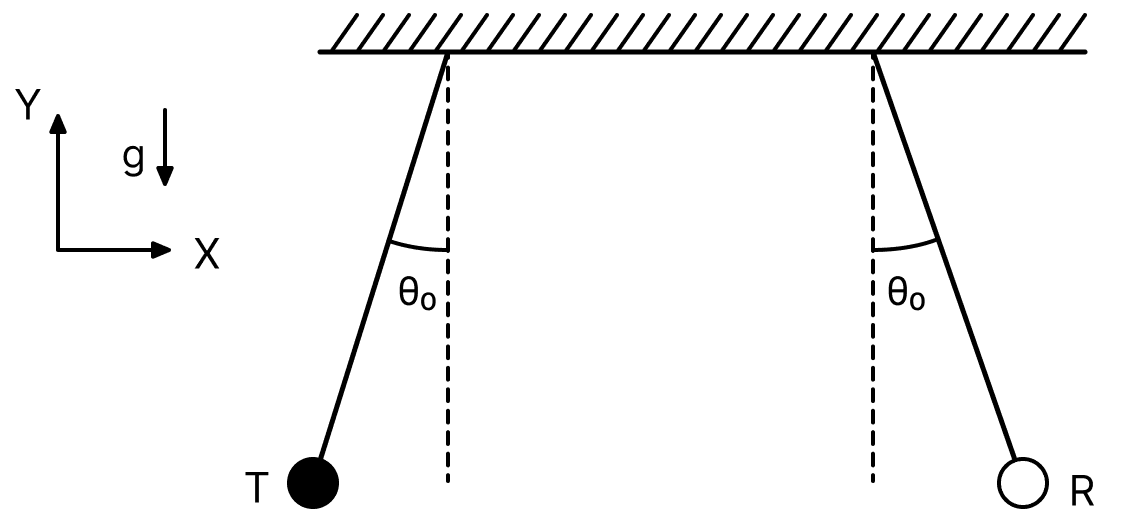
An audio transmitter (T) and a receiver (R) are hung vertically from two identical massless strings of length 8 m with their pivots well separated along the X-axis. They are pulled from the equilibrium position in opposite directions along the X-axis by a small angular amplitude θ0 = cos-1 (0.9) and released simultaneously. If the natural frequency of the transmitter is 660 Hz and the speed of sound in air is 330 m/s, the maximum variation in the frequency (in Hz) as measured by the receiver (Take the acceleration due to gravity g = 10 m/s2) is ......... .
Answer
Given,
- Length of each string, l = 8 m
- Angular amplitude, θ0 = cos-1 (0.9)
- Natural frequency of the transmitter, f = 660 Hz
- Speed of sound in air, v = 330 m/s
- Acceleration due to gravity, g = 10 m/s2
Angular amplitude : For a small angle,
Maximum linear speed of each bob : For a pendulum executing simple harmonic motion,
Substituting the values,
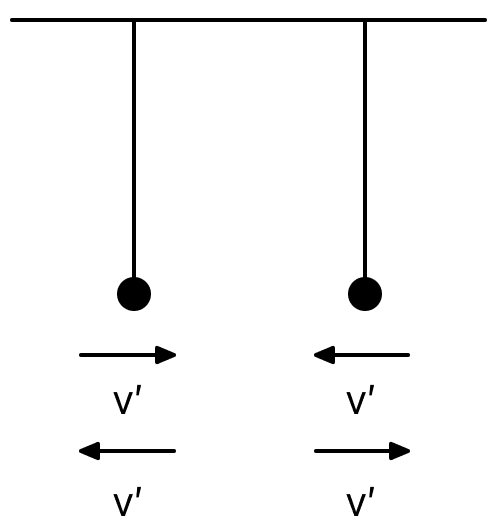
Maximum and minimum observed frequencies : The transmitter and the receiver swing in opposite directions, so at the instant of maximum speed they are either approaching each other or receding from each other, each with speed v'.
Maximum variation in frequency :
Expanding the numerator,
Hence
Substituting the values,
Hence, the maximum variation in the frequency as measured by the receiver is nearly 32 Hz.