
Why sound is heard more intense in carbon dioxide as compared to air?
Answer
Sound is heard more intense in carbon dioxide because carbon dioxide is denser than air.
The intensity of sound depends upon the density of the medium — a denser medium carries a greater amount of energy per unit volume for the same amplitude of vibration. Since the density of carbon dioxide is greater than that of air, the sound produced in carbon dioxide is heard as more intense.
Give one example of forced vibration.
Answer
Melde's experiment is a common example of forced vibration.
When an alternating current is sent through the solenoid, the steel rod placed along its axis becomes a magnet whose polarity changes periodically with the frequency of the alternating current. The rod is therefore forced to vibrate with the frequency of the alternating current and not with its own natural frequency. These vibrations of the rod are forced vibrations.
Another everyday example is the vibration of a table on which the stem of a vibrating tuning fork is placed — the table is forced to vibrate with the frequency of the fork.
Give an example of resonance in electromagnetic oscillations.
Answer
The tuning of a radio or a television receiver is an example of resonance in electromagnetic oscillations.
The receiving circuit has a natural frequency of its own, which can be changed by adjusting the tuning knob. When this natural frequency is made equal to the frequency of the electromagnetic waves being transmitted by a particular station, the circuit resonates and the amplitude of the oscillations set up in it becomes very large. Only that station is then received clearly.
The frequency of a tuning fork is 256. Tuning forks, of which of the following frequencies will resonate it?
200, 256, 380, 512, 768, 1024.
Answer
The tuning forks of frequencies 256, 512, 768 and 1024 will resonate it.
Resonance occurs when the frequency of the external periodic force is equal to the natural frequency of the body, or to its integral multiple. The natural frequency here is 256, and
The frequencies 200 and 380 are neither equal to 256 nor integral multiples of it, so the forks of these frequencies will not resonate it.
The natural frequency of a musical instrument is 256 hertz. When in oscillation, a periodic force of 300 hertz frequency is applied on it. What will be the effect on the amplitude of oscillations?
Answer
The amplitude of the oscillations will be small.
The frequency of the applied periodic force, 300 hertz, is different from the natural frequency of the instrument, 256 hertz, and is not an integral multiple of it. Hence the instrument executes forced vibrations with the frequency of the applied force, that is, 300 hertz, but with a small amplitude.
What is the difference between forced vibrations and resonant vibrations?
Answer
| S. No. | Forced vibrations | Resonant vibrations |
|---|---|---|
| (i) | When a body is acted upon by an external periodic force whose frequency is different from the natural frequency of the body, the body vibrates with the frequency of the applied force. These are called forced vibrations. | When the frequency of the external periodic force is equal to the natural frequency of the body, or to its integral multiple, the body vibrates with a very large amplitude. These are called resonant vibrations. |
| (ii) | The amplitude of the vibrations is small. | The amplitude of the vibrations is quite large. |
| (iii) | The body vibrates with the frequency of the applied force, whatever be its own natural frequency. | The body vibrates with its own natural frequency, which is the same as that of the applied force. |
| (iv) | The energy transferred from the applied force to the body is small. | The energy transferred from the applied force to the body is maximum. |
| (v) | Example : the vibrations of a table on which the stem of a vibrating tuning fork is pressed. | Example : the loud sound emitted by the air column of a resonance tube when its length is adjusted to match the frequency of the fork. |
Resonance is therefore a particular case of forced vibrations.
Why is a hollow box fitted in sitar?
Answer
A hollow box is fitted in a sitar to increase the intensity of the note produced.
The sound produced by a stretched wire alone is very feeble, because the surface area of the wire is small and it can set only a small volume of air into vibration.
When a note of any frequency is produced in a string of the instrument, the vibrations of the string reach the hollow box through the bridge fixed below the string. Hence forced vibrations are produced in the air inside the box as well as in the large surface of the box itself. Since a large volume of air is now set into vibration, the intensity of the sound increases greatly. This hollow box is called the 'sound board'.
When an army crosses a suspension bridge, then the soldiers break steps, why?
Answer
The soldiers break steps to avoid the danger of resonance.
When soldiers march in step, their footfalls act as an external periodic force on the bridge. If the frequency of their march happens to coincide with the natural frequency of the suspension bridge, then resonance occurs.
At resonance the successive impulses given by the marching feet are in phase with the oscillating bridge, so they add up and the amplitude of oscillation of the bridge goes on increasing. The bridge may then be set into violent oscillations and may collapse. Hence the soldiers are ordered to break steps, so that their footfalls no longer form a single periodic force of one definite frequency.
If we put a glass on our ear, a humming sound is heard, why?
Answer
The humming sound is heard because of resonance.
The air column enclosed in the glass has a natural frequency of its own, which depends upon the size of the glass.
Numerous feeble sounds of many different frequencies are always present in the surroundings. Among these there are some whose frequency happens to be equal to the natural frequency of the air column in the glass. The air column is set into resonant vibrations by these sounds, and its amplitude of vibration becomes large. Hence a humming sound is heard when the glass is put on the ear.
The window panes jingle during thunder, why?
Answer
The window panes jingle during thunder because of resonance.
Thunder produces intense sound waves containing a wide range of frequencies. The window panes have natural frequencies of their own, which depend upon their size and the way they are fixed in their frames.
When the frequency of some component of the sound of the thunder becomes equal to the natural frequency of a window pane, the pane is set into resonant vibrations of large amplitude. Hence the panes jingle.
When a vibrating tuning fork is held on the mouth of a jar and water is poured in the jar, then in one particular position of the water level a sound comes from the jar, why?
Answer
The sound comes from the jar because of resonance.
The air column above the water level in the jar behaves as an air column closed at one end, whose natural frequency is
where l is the length of the air column. As water is poured into the jar, the length l of the air column goes on decreasing and so its natural frequency goes on increasing.
At one particular position of the water level, the natural frequency of the air column becomes equal to the frequency of the tuning fork. The air column is then set into resonant vibrations of large amplitude, and a loud sound is heard from the jar.
Explain 'sharpness of resonance' by an example.
Answer
Sharpness of resonance : It is a measure of how rapidly the amplitude of the forced vibrations falls off as the frequency of the applied periodic force is made to differ from the natural frequency of the body.
If the amplitude falls very rapidly on either side of the natural frequency, the resonance is said to be sharp. If the amplitude falls slowly, so that a fairly large amplitude is obtained over a range of frequencies, the resonance is said to be flat.
The sharpness of resonance depends upon the damping present. A body with very little damping gives a sharp resonance, while a heavily damped body gives a flat resonance.
Example : In a radio receiver the tuning circuit has very little damping, so its resonance is sharp. When the tuning knob is adjusted to the frequency of a particular station, only that station is received loudly, and the stations whose frequencies are even slightly different are not heard. If the resonance were flat, several stations would be received together and the programme could not be heard clearly.
With the help of diagram explain damped vibrations. Give two examples of damped vibrations. What should be done for converting damped vibrations into forced vibrations?
Answer
Damped vibrations :
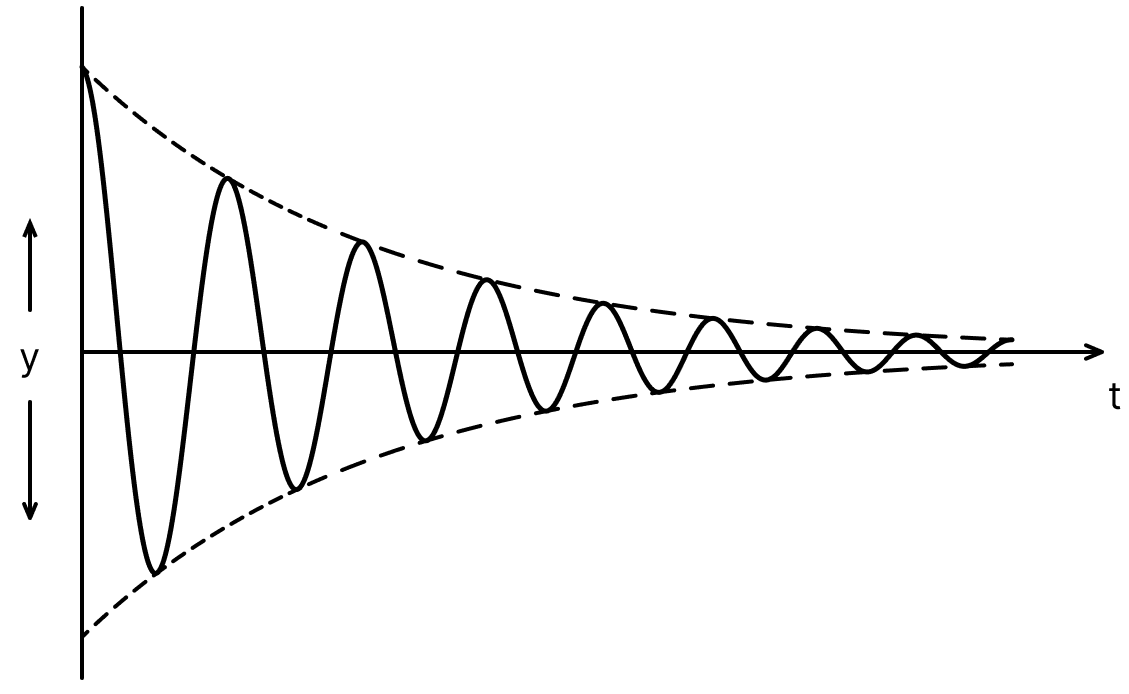
When a body vibrates (or oscillates) in air or in any other medium, a resisting or frictional force acts upon the body. This force opposes the motion of the body, whether the body is going away from the equilibrium position or is returning towards the equilibrium position.
The vibrating body has to do some work in moving against this resisting force, and so the energy given to the body in the initial displacement is slowly dissipated as heat and sound. Therefore the amplitude of vibration of the body goes on decreasing, as shown in the figure. When the whole of the energy of the body is dissipated, the amplitude of vibration becomes zero, that is, the body stops vibrating.
These vibrations of the body are called 'damped vibrations'. The continuous decay in the amplitude of vibrations due to energy dissipation is called 'damping'.
Examples of damped vibrations :
(i) The oscillations of the bob of a simple pendulum. The friction of the pivot from which the bob is suspended, and the viscosity of the air, remain present, due to which the amplitude of the oscillations of the bob goes on decreasing slowly and ultimately the bob stops.
(ii) The vibrations of the prongs of a tuning fork struck on a rubber pad. The prongs vibrate with their natural frequency, but the amplitude goes on decreasing and the sound gradually dies out.
Converting damped vibrations into forced vibrations :
To convert damped vibrations into forced vibrations, an external periodic force should be applied continuously upon the body.
In the beginning the body tends to vibrate with its natural frequency while the external periodic force tries to impose its own frequency upon the body. Hence there is a sort of tussle between the two, due to which the amplitude of vibration of the body undergoes periodic increase and decrease. These irregular vibrations die out in a short time, and finally the body vibrates with the frequency of the external periodic force with a constant amplitude. These are the forced vibrations.
What are forced vibrations? How would you demonstrate the production of forced oscillations with Melde's experiment? Explain this with the help of a diagram.
Answer
Forced vibrations : When a body is subjected to an external periodic force whose frequency is different from the natural frequency of the body, then in the beginning the body tends to vibrate with its natural frequency while the external periodic force tries to impose its own frequency upon the body. Hence there is a sort of tussle between the body and the external force, due to which the amplitude of vibrations of the body undergoes periodic increase and decrease. These irregular vibrations of the body die out in a short time, and finally the body vibrates with the frequency of the external periodic force with a constant amplitude.
Thus, when a body being acted by an external periodic force vibrates with the frequency of the force, then the vibrations of the body are called 'forced vibrations'. These are called 'forced' because the body is forced to vibrate with the frequency of the external force, whatever be its natural frequency.
Melde's experiment :
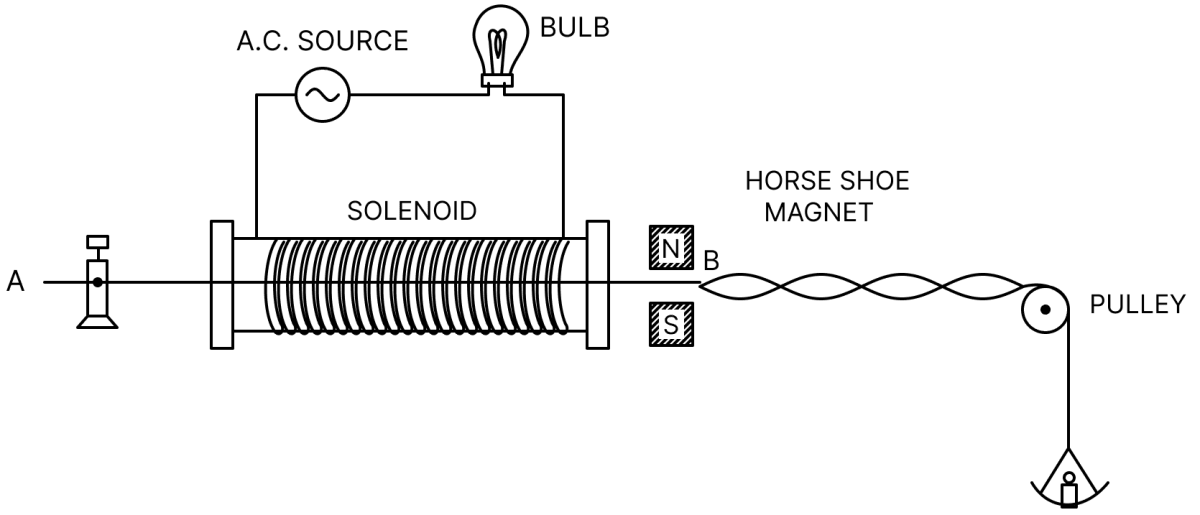
Apparatus : Melde's experiment is a simple experiment to demonstrate the production of forced vibrations. It consists of a solenoid connected to an A.C. source through a bulb-resistance. A steel rod AB about 10 cm long and 2 mm in diameter is placed along the axis of the solenoid. Its one end A is clamped by a screw and the other end B passes between the poles N, S of a powerful horse-shoe magnet.
A thin cord whose one end is fastened with the end B of the rod passes over a frictionless pulley and carries a pan. By placing weights on the pan, any desired tension can be produced in the cord.
Working : When alternating current is sent in the solenoid, the rod becomes a magnet and the polarity of its ends changes periodically with the frequency of the alternating current.
- When the free end B of the rod becomes a north magnetic pole, it is attracted towards the south pole of the horse-shoe magnet.
- When it becomes a south pole, it is attracted towards the north pole of the horse-shoe magnet.
Thus, in one complete cycle of the alternating current, the rod completes one vibration. That is, the rod continues to vibrate with the frequency of the alternating current and not with its own natural frequency. These vibrations of the rod are therefore forced vibrations.
When the rod vibrates, transverse waves travel along the cord and are reflected back from the pulley. The direct and the reflected waves superpose on each other. On properly adjusting the length and the tension of the cord, stationary waves are produced in the cord, which vibrates in one or more loops. These vibrations of the cord are also forced vibrations.
Differentiate between free and forced vibrations, by giving one example for each.
Answer
| S. No. | Free vibrations | Forced vibrations |
|---|---|---|
| (i) | When a body capable of vibration is displaced from its equilibrium position and then left free, it begins to vibrate with a definite frequency of its own. These are called free vibrations. | When a body is acted upon by an external periodic force and vibrates with the frequency of that force, the vibrations are called forced vibrations. |
| (ii) | The body vibrates with its natural frequency, which depends upon the intrinsic properties of the body such as its size and elasticity. | The body vibrates with the frequency of the external periodic force, whatever be its own natural frequency. |
| (iii) | No external force acts upon the body during the vibrations. | An external periodic force acts upon the body continuously. |
| (iv) | Theoretically the energy of the body remains constant and the amplitude remains constant. In practice, some damping is always present, so the amplitude goes on decreasing and the body finally stops. | The amplitude remains constant so long as the external periodic force continues to act, since the force goes on supplying the energy lost by the body. |
| (v) | Example : When a tuning fork is struck on a rubber pad, its prongs vibrate with their natural frequency, which depends upon the length and thickness of the prongs and the elasticity of its material. | Example : When the stem of a vibrating tuning fork is made to stand on a table, the vibrations of the fork are communicated to the table, which is set in forced vibrations and the sound becomes intense. |
What is resonance? Explain by giving example. Mention two possible disadvantages due to this.
Answer
Resonance : When an external periodic force is applied over a body and the frequency of the force is different from the natural frequency of the body, then the body executes forced vibrations with the frequency of the applied force with a small amplitude. If, however, the frequency of the external force is equal to the natural frequency of the body, or to its integral multiple, then the amplitude of the forced vibrations of the body becomes quite large. This phenomenon is called 'resonance'.
Thus, resonance is a particular case of forced vibrations.
Explanation : When the frequency of the external force is equal to the natural frequency of the body, then at each step the force is in phase with the oscillating body. Hence the successive impulses given by the periodic force to the body are added up and increase the amplitude of oscillation continuously. But with increasing amplitude the air resistance and the internal friction also increase, so that the loss of energy from the body also increases. Finally a stage is reached when the energy supplied by the external force becomes equal to the energy lost by the body, and the amplitude becomes steady.
Example :
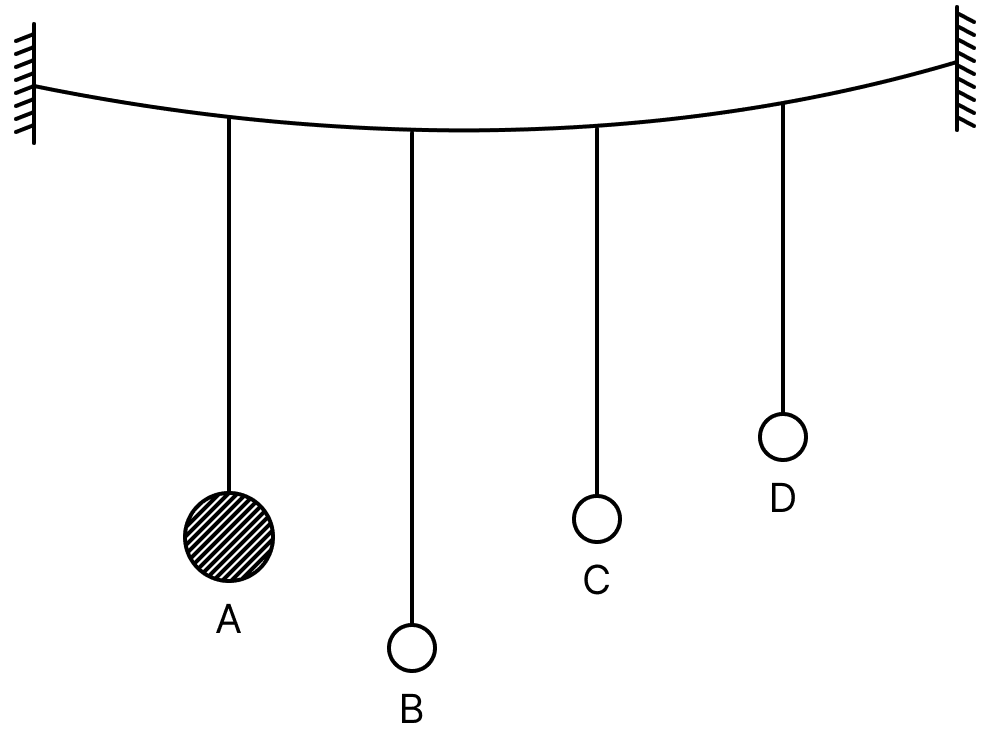
Four simple pendulums A, B, C and D are suspended from a thin cord. The lengths of the pendulums A and C are equal, so their natural frequencies are also equal. The length of B is slightly greater and that of D is slightly smaller.
When the pendulum A is set into oscillations, the pendulums B, C and D experience a periodic force of frequency equal to that of A, and are set in forced oscillations. It is seen that the pendulums B and D, whose natural frequencies are different from the frequency of A, execute forced oscillations with a very small amplitude. But the amplitude of the forced oscillations of the pendulum C goes on increasing slowly and becomes equal to the amplitude of A. The oscillations of C are resonant oscillations.
Two disadvantages of resonance :
(i) Collapse of bridges : If the frequency of the march of soldiers passing over a suspension bridge, or the frequency of revolution of the wheels of a train passing over a bridge, coincides with the natural frequency of the bridge, then due to resonance the bridge may be set into large-amplitude oscillations and there is a chance of its collapsing. This is why soldiers are ordered to break steps while crossing a suspension bridge.
(ii) Damage to buildings and machinery : If the frequency of a machine fitted in a house is equal to the natural frequency of the house, then on the operation of the machine the house may be put in resonance and may fall. It is because of this reason that sometimes the musical sounds produced in a restaurant cause the cup-plates placed on the tables to jingle and even to break.