
A point-charge of 1.8 μC is at the centre of a cubical Gaussian surface of 55 cm side. Find the net electric flux through the surface.
Answer
Given,
- Point-charge at the centre of the cube, q = 1.8 μC = 1.8 × 10⁻⁶ C
- Side of the cubical Gaussian surface = 55 cm
- ε0 = 8.85 × 10⁻¹² C2/N-m2
By Gauss' theorem, the electric flux through the closed surface of the cube is times the charge q enclosed by the cube,
Substituting the values,
The side of the cube does not enter the calculation, since the flux through a closed surface does not depend upon its shape or size.
Hence the net electric flux through the surface is 2.0 × 10⁵ N-m2 C-1.
The net outward electric flux through the surface of a box is 8.0 × 10³ N m2 C-1. What is the net charge inside the box?
Answer
Given,
- Net outward electric flux through the surface of the box, ΦE = 8.0 × 10³ N m2 C-1
- ε0 = 8.85 × 10⁻¹² C2/N-m2
By Gauss' theorem,
Substituting the values,
The flux is outward, so the net charge inside the box is positive.
Hence the net charge inside the box is 70.8 nC (nano-coulomb).
A point-charge produces an electric flux of − 750 N m2 C-1 through a spherical Gaussian surface of 10 cm radius with centre at the charge. (i) If the radius of the Gaussian surface be doubled, how much flux would pass through the surface? (ii) What is the magnitude of the point-charge?
Answer
Given,
- Electric flux through the spherical Gaussian surface, ΦE = − 750 N m2 C-1
- Radius of the Gaussian surface = 10 cm, with centre at the charge
- ε0 = 8.85 × 10⁻¹² C2/N-m2
(i) By Gauss' theorem, the flux through a closed surface depends only upon the net charge enclosed by the surface, and not upon the shape or the size of the surface.
When the radius of the Gaussian surface is doubled, the charge enclosed remains the same. Hence the flux passing through the surface is still
(ii) From Gauss' theorem,
Substituting the values,
The negative sign shows that the charge is negative, as is also indicated by the inward (negative) flux.
Hence (i) the flux remains − 750 N m2 C-1 and (ii) the magnitude of the point-charge is 6.64 × 10⁻⁹ C.
Note: The printed answer gives − 6.64 × 10⁻⁹ C, which is the signed charge; since the question asks for magnitude, the answer is 6.64 × 10⁻⁹ C.
An isolated conductor of any shape has a net charge of + 10 μC. Inside the conductor is a cavity within which is a point-charge of + 3.0 μC. What is the charge on the cavity wall? On the outer surface of the conductor.
Answer
Given,
- Net charge on the isolated conductor = + 10 μC
- Point-charge inside the cavity = + 3.0 μC
Charge on the cavity wall :
Let a Gaussian surface be drawn within the material of the conductor, enclosing the cavity. The electric field inside the material of a conductor is zero, so the flux through this Gaussian surface is zero, and by Gauss' theorem the net charge enclosed by it must also be zero.
The charge enclosed is the sum of the point-charge in the cavity and the charge induced on the cavity wall. Therefore
Charge on the outer surface :
The conductor as a whole carries a net charge of + 10 μC. Since − 3.0 μC of it appears on the cavity wall, the charge on the outer surface is
Hence the charge on the cavity wall is − 3.0 μC and that on the outer surface of the conductor is + 13 μC.
Given a uniform electric field NC-1, find the electric flux of this field through a square of side 10 cm, whose plane is parallel to the YZ-plane. What would be the flux through the same square, if the plane of the square makes an angle of 30° with the X-axis?
Answer
Given,
- Uniform electric field, NC-1
- Side of the square = 10 cm = 0.10 m
The area of the square is
Case (i) : Plane of the square parallel to the YZ-plane
When the plane of the square is parallel to the YZ-plane, the normal to the square is along the X-axis, that is, along . Hence
Case (ii) : Plane of the square making an angle of 30° with the X-axis
If the plane of the square makes an angle of 30° with the X-axis, then the normal to the square makes an angle of
with the X-axis, that is, with the direction of . Hence
Hence the electric flux is 50 N-m2 C-1 in the first case and 25 N-m2 C-1 in the second case.
State Gauss' law in electrostatic. A cube with each side 'a' meter is kept in an electric field given by , (as is shown in the figure) where K is a positive dimensional constant. Surface ABCD is parallel to Y-Z plane and surface CDEH is parallel to X-Z plane. Find out :
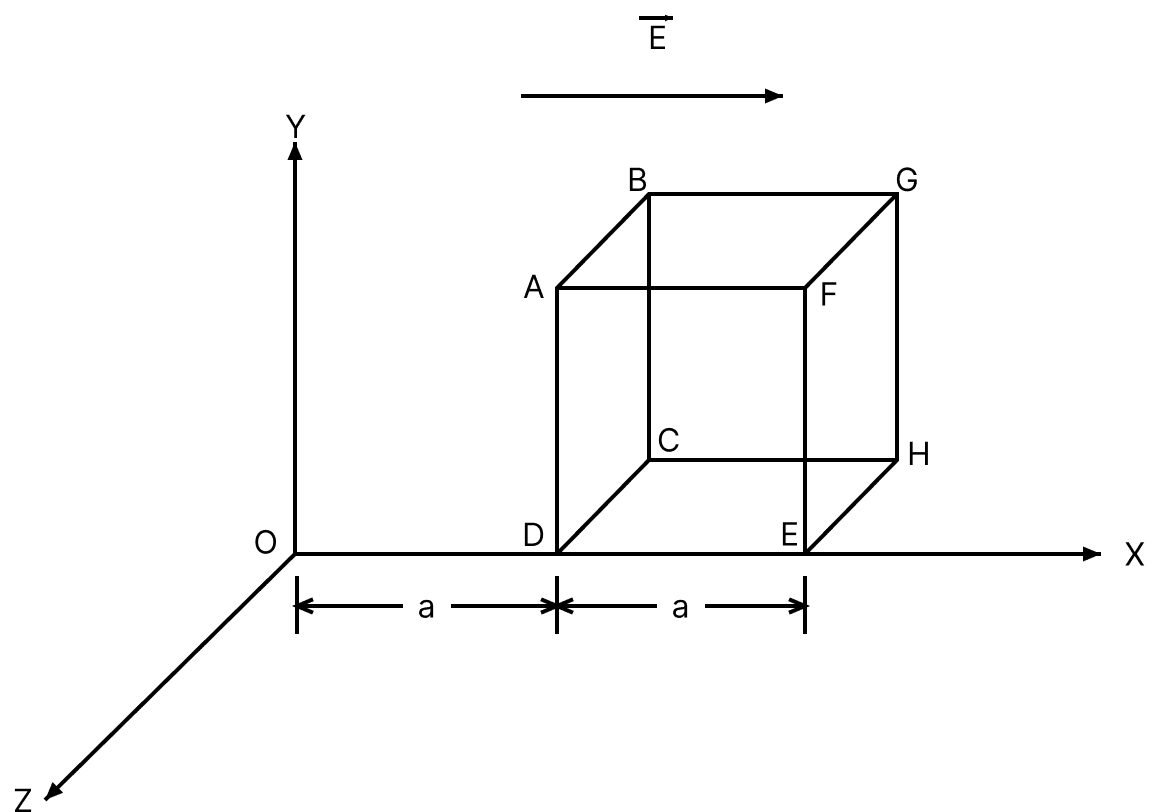
(i) the electric flux through the cube, and
(ii) the net charge inside the cube.
Answer
Gauss' law in electrostatics : The electric flux ΦE through any closed surface is equal to times the 'net' charge q enclosed by the surface,
Given,
- Side of the cube = a
- Electric field, , where K is a positive dimensional constant
From the figure, the cube is placed with the face ABCD parallel to the Y-Z plane at x = a and the opposite face at x = 2a. The area of each face is a2.
The field is directed along the X-axis, so the flux is zero through the four faces whose outward normals are perpendicular to the X-axis, that is, through the faces parallel to the X-Z and X-Y planes, since for each of these the angle between the area vector and the electric field is 90°.
(i) Electric flux through the cube :
Flux through the face at x = a : Here Ex = Ka and the outward drawn normal is along the negative X-axis, so θ = 180°,
Flux through the face at x = 2a : Here Ex = K(2a) and the outward drawn normal is along the positive X-axis, so θ = 0,
The net flux associated with the cube is
(ii) Net charge inside the cube :
According to Gauss' theorem,
Hence the electric flux through the cube is Ka3 Nm2C-1 and the net charge inside the cube is coulomb.
A hollow cylindrical box of length 1 m and area of cross-section 25 cm2 is placed in a three-dimensional coordinate system as shown in the figure. The electric field in the region is given by , where E is in NC-1 and x is in metres. Find
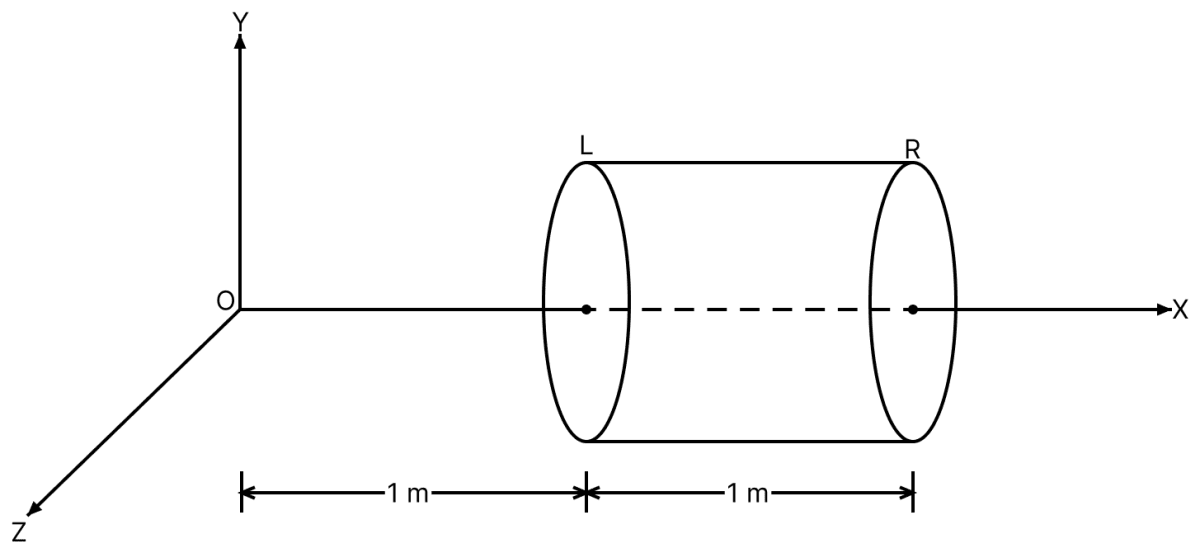
(i) net flux through the cylinder.
(ii) charge enclosed by the cylinder.
Answer
Given,
- Length of the hollow cylindrical box = 1 m
- Area of cross-section, A = 25 cm2 = 25 × 10-4 m2
- Electric field, NC-1, with x in metres
- ε0 = 8.85 × 10⁻¹² C2/N-m2
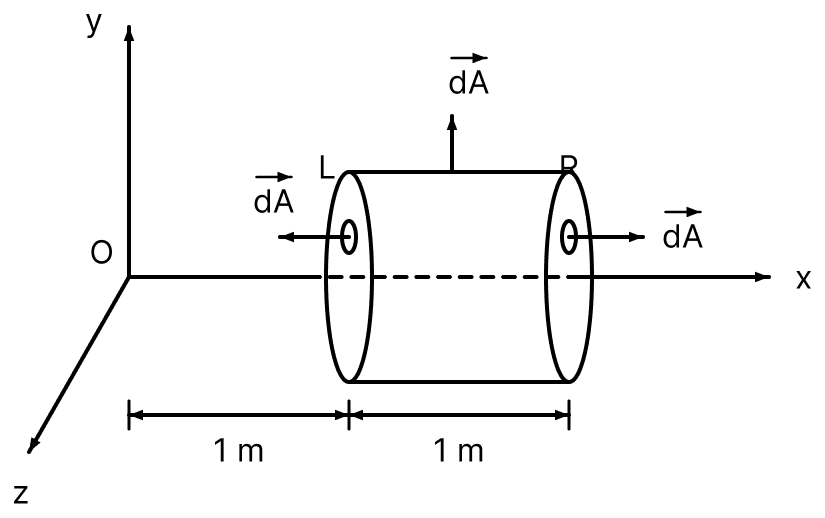
From the figure, the axis of the cylinder lies along the X-axis, the left plane face L being at x = 1 m and the right plane face R at x = 2 m.
(i) Net flux through the cylinder :
The flux through the curved surface is zero, because there the area vector is at right angles to .
Flux through the left face (x = 1 m) : Here E = 50 × 1 = 50 NC-1 and the outward drawn normal is along the negative X-axis, so θ = 180°,
Flux through the right face (x = 2 m) : Here E = 50 × 2 = 100 NC-1 and the outward drawn normal is along the positive X-axis, so θ = 0,
The net flux through the cylinder is
(ii) Charge enclosed by the cylinder :
By Gauss' theorem,
Hence the net flux through the cylinder is 0.125 Nm2C-1 and the charge enclosed by it is 1.106 × 10⁻¹² C.
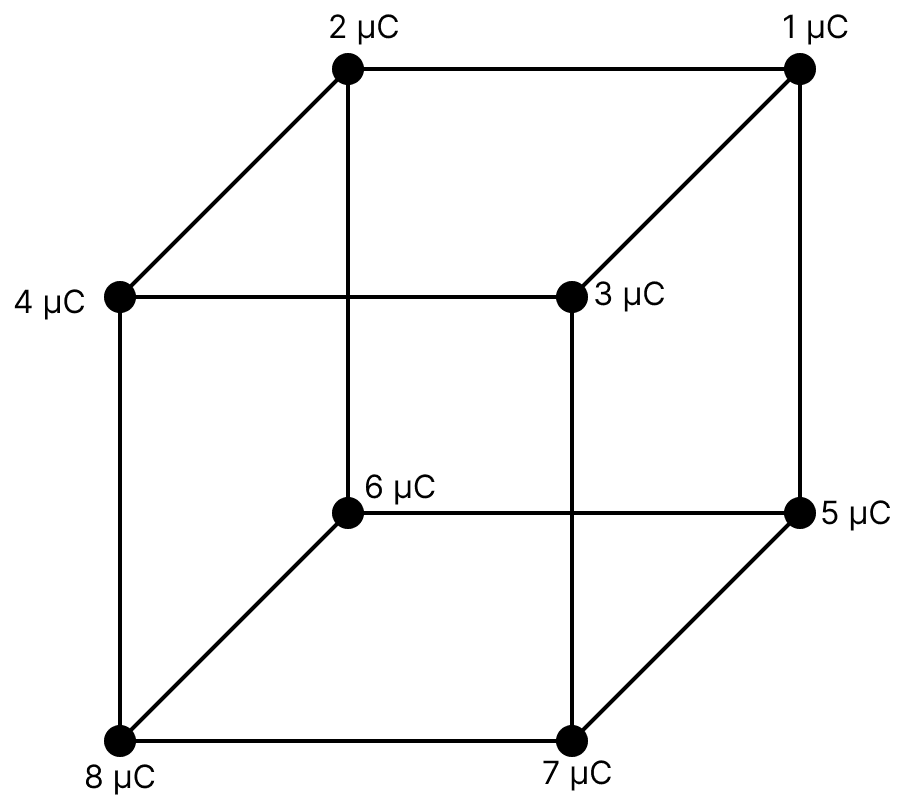
Find the total electric flux associated with the given cube of side 'a'.
Answer
Given,
- Side of the cube = a
- Charges at the eight corners of the cube = 1 μC, 2 μC, 3 μC, 4 μC, 5 μC, 6 μC, 7 μC and 8 μC
- = 9.0 × 10⁹ N-m2/C2
From the figure, charges of 1 μC, 2 μC, 3 μC, 4 μC, 5 μC, 6 μC, 7 μC and 8 μC are placed at the eight corners of the cube of side a.
A charge placed at a corner of a cube is shared by eight such cubes meeting at that corner. Hence only of the flux due to each corner charge passes through the given cube.
The sum of all the charges at the corners is
The effective charge enclosed by the cube is therefore
By Gauss' theorem, the total electric flux associated with the cube is
Using , we have . Therefore
Hence the total electric flux associated with the cube is Nm2/C.
An infinite line charge produces an electric field of 9.0 × 10⁴ N C-1 at a distance of 2.0 cm. What is the linear charge density?
Answer
Given,
- Electric field due to the infinite line charge, E = 9.0 × 10⁴ N C-1
- Distance from the line charge, r = 2.0 cm = 2.0 × 10⁻² m
- = 9.0 × 10⁹ N-m2/C2
The electric intensity due to an infinitely long line charge of linear charge density λ, at a point distant r from it, is
Substituting the values,
Hence the linear charge density is 0.1 μC/m.
Two large, thin metal plates are placed parallel and close to each other. Their inner faces have equal and opposite charges with a surface charge density of 17.0 × 10⁻¹² C m-2. What are the magnitudes of electric fields to the left of the plates, to the right of the plates and in between the plates?
Answer
Given,
- Surface charge density on the inner faces, σ = 17.0 × 10⁻¹² C m-2, equal and opposite
- ε0 = 8.85 × 10⁻¹² C2/N-m2
The magnitude of the field due to each plate alone is .
To the left of the plates and to the right of the plates :
At a point outside the two plates the fields due to the positively and the negatively charged plates are equal in magnitude but oppositely directed. Therefore
In between the plates :
At a point between the plates the two fields are in the same direction, so they add up,
Substituting the values,
Hence the electric field is zero to the left of the plates, zero to the right of the plates and 2.0 N C-1 in between the plates.
Two large metal plates of area 1.0 m2 face each other. They are 5.0 cm apart and have equal but opposite charges on their inner surfaces. If the electric field between the plates, ignoring edge effects, is 55 N C-1, find the charges on the plates.
Answer
Given,
- Area of each plate, A = 1.0 m2
- Separation between the plates = 5.0 cm
- Electric field between the plates, E = 55 N C-1
- ε0 = 8.85 × 10⁻¹² C2/N-m2
For two large metal plates carrying equal and opposite charges on their inner surfaces, the field between the plates is
where is the surface charge density on the inner surfaces. Therefore
Substituting the values,
The separation between the plates does not enter the calculation, since the field between the plates is independent of the separation.
Hence the charges on the plates are + 4.9 × 10⁻¹⁰ C and − 4.9 × 10⁻¹⁰ C.
A uniformly charged conducting sphere of 1.2 m radius has a surface charge density of 80.0 μC/m2. What is the charge on the sphere and the total electric flux leaving the surface of the sphere?
Answer
Given,
- Radius of the conducting sphere, R = 1.2 m
- Surface charge density, σ = 80.0 μC/m2 = 80.0 × 10⁻⁶ C/m2
- ε0 = 8.85 × 10⁻¹² C2/N-m2
Charge on the sphere :
The charge resides on the surface of the conducting sphere, whose area is 4πR2. Hence
Substituting the values,
Total electric flux leaving the surface :
By Gauss' theorem,
Hence the charge on the sphere is 1.45 × 10⁻³ C and the total electric flux leaving its surface is 1.64 × 10⁸ N-m2 C-1.
The electric field due to a charged conducting sphere of radius 10 cm, at a distance of 20 cm from the centre of the sphere is 1.5 × 10³ N C-1 and points radially inwards. What is the charge on the sphere?
Answer
Given,
- Radius of the charged conducting sphere = 10 cm
- Distance of the point from the centre, r = 20 cm = 0.20 m
- Electric field at that point, E = 1.5 × 10³ N C-1, pointing radially inwards
- = 9.0 × 10⁹ N-m2/C2
The point lies outside the sphere, since 20 cm > 10 cm. For an external point the charged conducting sphere behaves as if its entire charge were concentrated at its centre,
Substituting the values,
As the field points radially inwards, the charge on the sphere is negative.
Hence the charge on the sphere is − 6.67 nC.
A sphere of metal has a radius of 12 cm and carries a charge of 1.6 × 10⁻⁷ C distributed uniformly on its surface. Calculate the electric field intensity at a point (i) inside the sphere, (ii) just outside the sphere and (iii) 18 cm from the centre of the sphere.
Answer
Given,
- Radius of the metal sphere, R = 12 cm = 0.12 m
- Charge distributed uniformly on its surface, q = 1.6 × 10⁻⁷ C
- = 9.0 × 10⁹ N-m2/C2
In a metal sphere the entire charge lies on the surface, so it behaves just like a charged thin spherical shell.
(i) At a point inside the sphere :
A Gaussian surface drawn inside the sphere encloses no charge. Hence, by Gauss' theorem,
The electric field intensity inside the sphere is zero.
(ii) At a point just outside the sphere :
Here r = R = 0.12 m,
Substituting the values,
(iii) At 18 cm from the centre of the sphere :
Here r = 18 cm = 0.18 m, which is an external point,
Substituting the values,
Hence the electric field intensity is (i) zero inside the sphere, (ii) 1.0 × 10⁵ N C-1 just outside the sphere and (iii) 4.4 × 10⁴ N C-1 at 18 cm from the centre.