
Which of the following phenomena cannot take place in sound waves?
- Reflection
- Interference
- Diffraction
- Polarisation
Answer
Polarisation
Reason — Only transverse waves can be polarised. Sound waves are longitudinal — the particles of the medium vibrate along the direction of propagation — so their vibrations cannot be confined to a single direction in a plane perpendicular to that direction.
In the propagation of light waves, the angle between the direction of propagation and the plane of polarisation is :
- 0
- 45°
- 90°
- 180°
Answer
0
Reason — The plane of polarisation is the plane containing the direction of propagation of light and perpendicular to the plane of vibration. As the direction of propagation lies in this plane, the angle between them is zero.
The Brewster's law in polarisation of light is :
- n sin ip = 1
- n cos ip = 1
- n tan ip = 1
- n cot ip = 1
Answer
n cot ip = 1
Reason — By Brewster's law, n = tan ip. Since cot ip = , this gives n cot ip = 1.
A ray of light in air is incident on a glass plate at Brewster's angle ip. If n be the refractive index of glass relative to air, then the angle between the reflected and the refracted rays is :
- 90° − ip
- 90°
- 90° + sin-1 (tan ip)
- 90° − sin-1 (tan ip)
Answer
90°
Reason — At the polarising angle, ip + r = 90°. The reflected ray makes an angle ip and the refracted ray an angle r with the normal, so the angle between them is 180° − (ip + r) = 90°.
Plane-polarised light is passed through a Polaroid. On viewing through the Polaroid we find that when the Polaroid is given one complete rotation about the direction of light, then :
- the intensity of light gradually decreases to zero and remains at zero
- the intensity of light gradually increases to a maximum and remains at maximum
- there is no change in intensity
- the intensity of light is twice maximum and twice zero
Answer
the intensity of light is twice maximum and twice zero
Reason — By the law of Malus, I = I0 cos2 θ. In one complete rotation, cos2 θ = 1 at θ = 0° and 180° (maximum) and cos2 θ = 0 at θ = 90° and 270° (zero).
When a Polaroid placed in the path of light is rotated, the intensity of light appears to vary but never reduces to zero. The light is :
- unpolarised
- plane-polarised
- partially plane-polarised
- no conclusion can be drawn
Answer
partially plane-polarised
Reason — When the intensity of the emergent light changes on rotating the Polaroid but never becomes zero, the given light is partially polarised.
A beam of light is incident at the polarizing angle of 35° on a certain glass plate. The refractive index of the glass plate is :
- sin 35°
- tan 35°
- tan 55°
- sin 55°
Answer
tan 35°
Reason — By Brewster's law, n = tan ip. With ip = 35°, the refractive index of the glass plate is tan 35°.
Who discovered polarisation of light?
Answer
Huygens (in 1690).
Explanation:
Huygens had first assumed light waves to be longitudinal, but he had to discard this idea when he discovered the phenomenon of polarisation in 1690. Later, in 1808, Malus discovered that light reflected from a transparent surface becomes partially plane-polarised (polarisation by reflection).
Note: The textbook's answer gives Etienne Malus, but the chapter's own theory credits Huygens (1690) with the discovery of polarisation; Malus discovered polarisation by reflection (1808).
Which nature of light is established by polarisation of light?
Answer
Transverse nature of light.
Explanation:
Only a transverse wave can be polarised. Since light waves can be polarised, they must be transverse in nature.
Name a phenomenon which proves that light travels in the form of transverse waves.
Answer
Polarisation of light.
Give any two methods by which ordinary light can be polarised.
Answer
(i) By reflection — light reflected from the surface of a transparent material such as glass at the polarising angle is completely plane-polarised.
(ii) By a Polaroid (or a tourmaline crystal) — it transmits only those vibrations of the electric vector which are parallel to its polarising direction (axis).
Which among the X-rays, sound waves and radio waves can be polarised and why?
Answer
X-rays and radio waves can be polarised, because they are electromagnetic waves and hence transverse. Sound waves are longitudinal, so they cannot be polarised.
Will ultrasonic waves show any polarisation? Give reason.
Answer
No. Ultrasonic waves are sound waves, which are longitudinal, and only transverse waves can be polarised.
Name three properties which are mutually perpendicular to one another in a plane-polarised light wave.
Answer
The electric field vector , the magnetic field vector and the direction of propagation of the wave.
What is the difference between polarised light and unpolarised light?
Answer
In unpolarised light, the vibrations of the electric vector occur symmetrically in all possible directions in a plane perpendicular to the direction of propagation, whereas in polarised light they are confined to a single direction in that plane.
Is sunlight polarised? Sodium light? Headlight of a car?
Answer
No. None of these is polarised — sunlight, sodium light and the headlight of a car are all unpolarised.
When light is polarised by reflection, what is the plane of vibration of the electric field vector in polarised light?
Answer
Perpendicular to the plane of incidence.
Explanation:
At the polarising angle, the reflected light is completely plane-polarised, with the vibrations of the electric vector perpendicular to the plane of incidence.
A ray of light is incident on a medium at the polarising angle. What is the angle between the reflected and refracted rays?
Answer
90°.
Explanation:
At the polarising angle, ip + r = 90°, so the reflected and the refracted rays are perpendicular to each other.
If the polarising angle for air-glass interface is 56°, what will be the angle of refraction in glass?
Answer
Given,
- Polarising angle, ip = 56°
When light is incident at the polarising angle, the reflected and refracted rays are perpendicular, so ip + r = 90°.
Hence, the angle of refraction in glass is 34°.
The critical angle for a given transparent medium and air is ic. A ray of light travelling in air incident on this transparent medium at an angle of incidence equal to the polarising angle ip. What is the relation between the two angles ic and ip?
Answer
ip = tan-1 (cosec ic)
Explanation:
By Brewster's law, n = tan ip, and for the critical angle, n = . Equating the two,
Hence, ip = tan-1 (cosec ic).
State Brewster's law of polarisation of light.
Answer
When ordinary light is incident on the surface of a transparent material at the polarising angle ip, the reflected light is completely plane-polarised and the refracted light is partially polarised. The refractive index n of the material is related to ip by
Ordinary light is incident on the surface of a transparent material at polarising angle. If it is partly reflected and partly refracted, what is the angle between the reflected ray and the refracted ray of light?
Answer
90°.
Explanation:
At the polarising angle, ip + r = 90°, so the reflected ray and the refracted ray are perpendicular to each other.
Why are two images observed of an object which is being seen through a calcite crystal?
Answer
This is due to double refraction — a ray of light entering the calcite crystal splits into two refracted rays, and each forms its own image of the object.
Name two devices using polarised light.
Answer
Polaroid sunglasses and Polaroid glasses used for viewing three-dimensional pictures.
Two Polaroids A and B are parallel and ordinary light falls on A. What will be the intensity of light emerging from B compared to that of ordinary light? If A and B are perpendicular, then?
Answer
When A and B are parallel, the intensity of the emergent light is half that of the ordinary light. When A and B are perpendicular, it is zero.
Explanation:
Polaroid A transmits plane-polarised light of half the intensity of the ordinary light. By the law of Malus, B transmits all of it when parallel (cos2 0° = 1) and none of it when perpendicular (cos2 90° = 0).
A beam of light rays of intensity 10 Wm-2 is transmitted from two Polaroids whose polarising directions are mutually perpendicular. What is the intensity of transmitted light?
Answer
Zero.
Explanation:
The first Polaroid transmits plane-polarised light of intensity 5 Wm-2. As the second Polaroid is crossed with the first (θ = 90°), by the law of Malus the transmitted intensity is 5 cos2 90° = 0.
Two Polaroids A and B are parallel. How be a third Polaroid C placed between A and B so that the intensity of the emergent light be (i) zero, (ii) maximum?
Answer
(i) The polarising direction of C should be perpendicular to that of A (and hence of B).
(ii) The polarising direction of C should be parallel to that of A (and hence of B).
State 'law of Malus'.
Answer
When a completely plane-polarised light beam from a polariser is incident on an analyser, the intensity of light emerging from the analyser varies as the square of the cosine of the angle θ between the planes of transmission of the analyser and the polariser,
Light waves can be polarised while sound waves cannot be. Why?
Answer
Light waves are transverse, whereas sound waves are longitudinal. Polarisation means confining the vibrations, which in ordinary light occur in all directions in a plane perpendicular to the direction of propagation, to a single direction in that plane. In a longitudinal wave the vibrations take place only along the direction of propagation, so the question of polarisation does not arise.
What evidence is there to show that sound is not electromagnetic in nature?
Answer
Sound cannot travel through vacuum, whereas electromagnetic waves such as light travel through vacuum. Moreover, sound waves cannot be polarised, which shows that they are longitudinal, while electromagnetic waves are transverse.
What is plane-polarised light?
Answer
Light in which the vibrations of the electric field vector are confined to a single direction in a plane perpendicular to the direction of propagation of light is called plane-polarised (or linearly polarised) light.
What is the essential difference between polarised light and unpolarised light?
Answer
| Unpolarised light | Polarised light |
|---|---|
| The vibrations of the electric vector occur symmetrically in all possible directions in a plane perpendicular to the direction of propagation. | The vibrations of the electric vector are confined to a single direction in that plane. |
| The vibrations are symmetrical about the direction of propagation. | The vibrations are asymmetrical about the direction of propagation. |
| On rotating a Polaroid in its path, the intensity of the emergent light does not change. | On rotating a Polaroid in its path, the intensity changes and becomes zero twice in one rotation. |
Which plane is defined as the plane of polarisation in a plane-polarised electromagnetic wave?
Answer
The plane containing the direction of propagation of light and perpendicular to the plane of vibration is defined as the plane of polarisation. No vibrations of the electric vector occur in this plane.
What is polarising angle?
Answer
The angle of incidence at which ordinary (unpolarised) light reflected from the surface of a transparent material becomes completely plane-polarised is called the polarising angle ip. It is also called Brewster's angle and is related to the refractive index by n = tan ip.
Draw a sketch showing the incident, reflected and transmitted rays when light is incident at the polarising angle on a glass slab.
Answer
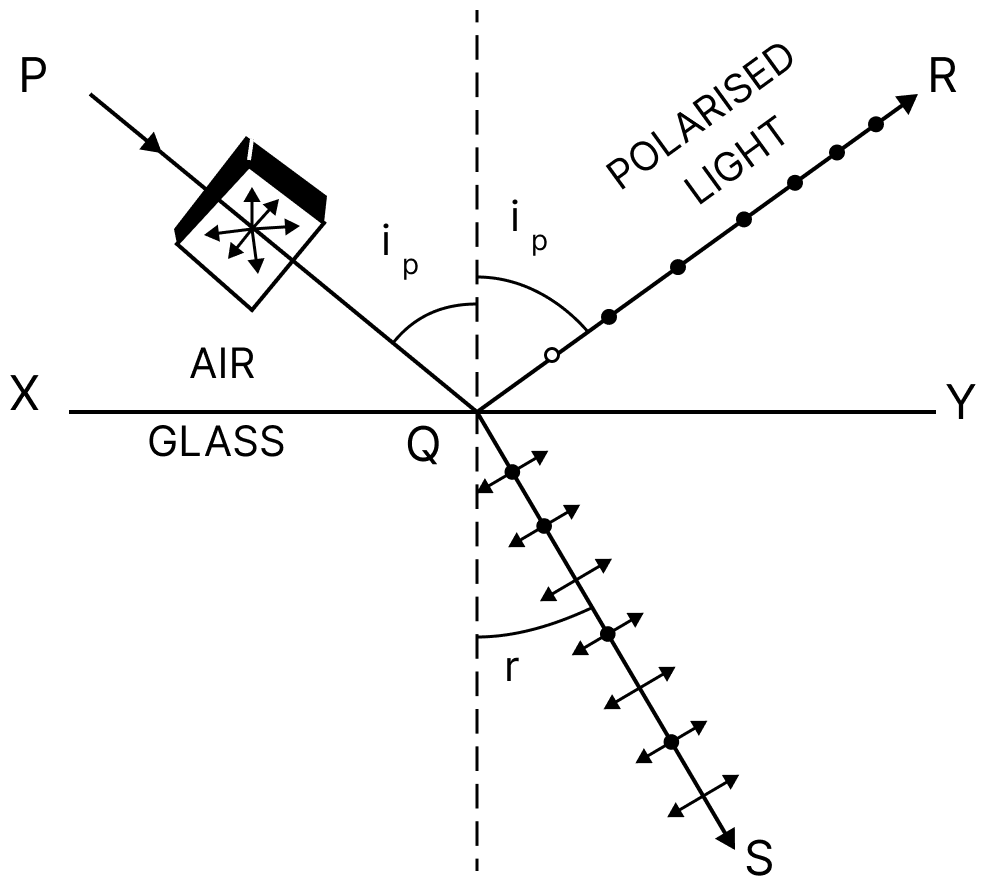
The unpolarised incident ray (dots and double arrows) strikes the glass slab at the polarising angle ip. The reflected ray is completely plane-polarised, with vibrations perpendicular to the plane of incidence (dots only), while the transmitted (refracted) ray is partially plane-polarised. Since ip + r = 90°, the reflected and transmitted rays are perpendicular to each other.
(i) In case of polarized light, what is meant by the 'plane of polarisation'?
(ii) Find refractive index of glass, if its polarising angle is 60°.
Answer
(i) Plane of polarisation : It is the plane containing the direction of propagation of light and perpendicular to the plane of vibration. It contains no vibrations of the electric vector.
(ii) Refractive index :
Given,
- Polarising angle, ip = 60°
By Brewster's law,
Hence, the refractive index of glass is 1.732 (= ).
State one use of a Polaroid.
Answer
Polaroid sunglasses are used to avoid the glare of light reflected from bright surfaces such as wet roads and polished tables.
How will you identify experimentally whether a given beam of light is plane polarised or unpolarised?
Answer
A Polaroid (or a tourmaline crystal) is placed in the path of the beam and rotated about the direction of the beam, and the emergent light is observed. If the intensity of the emergent light remains unchanged in all positions, the beam is unpolarised. If the intensity varies periodically and becomes zero twice in each rotation, the beam is plane-polarised.
What is the special utility of sunglasses made of Polaroids instead of coloured glass?
Answer
Coloured glass absorbs light uniformly, so objects seen through it appear dim. The light reflected from bright surfaces, which produces glare, is partially plane-polarised with vibrations in the horizontal plane; Polaroid sunglasses with their vibration-planes vertical cut off mainly this light. Thus, glare is removed while the objects remain clearly visible.
Copy the adjoining diagram and indicate the polarisation components (of electric field) on the reflected ray and refracted ray, by double arrows and/or dots.
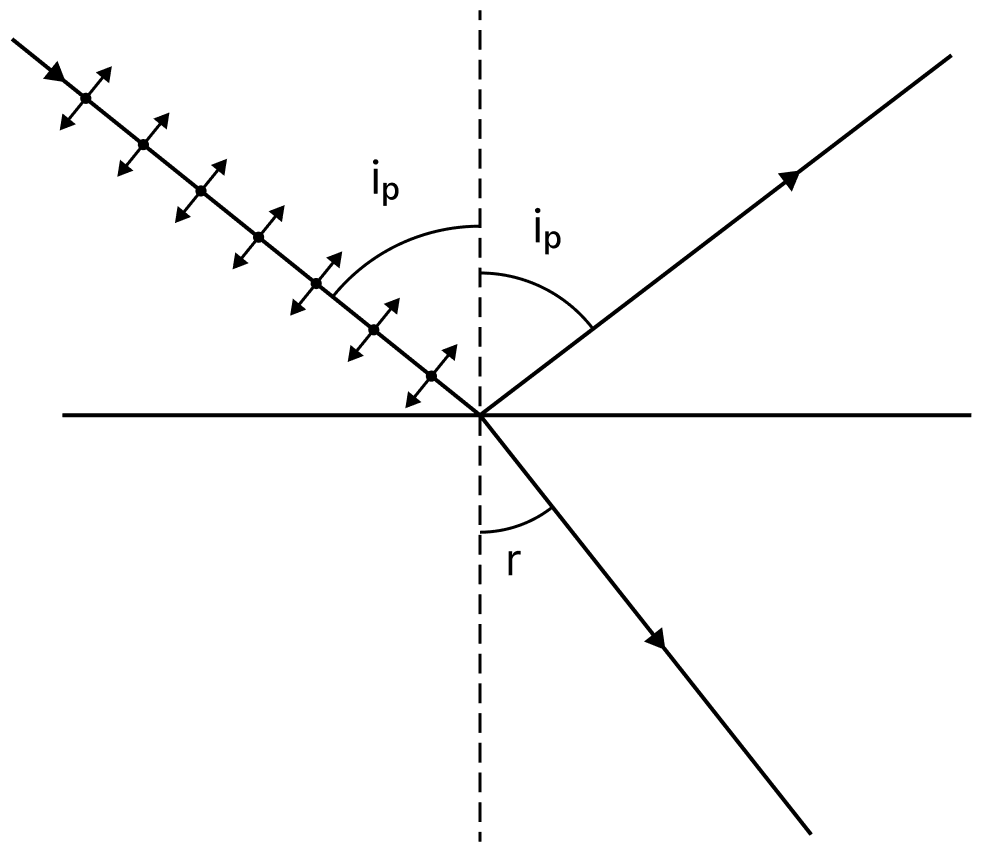
Answer
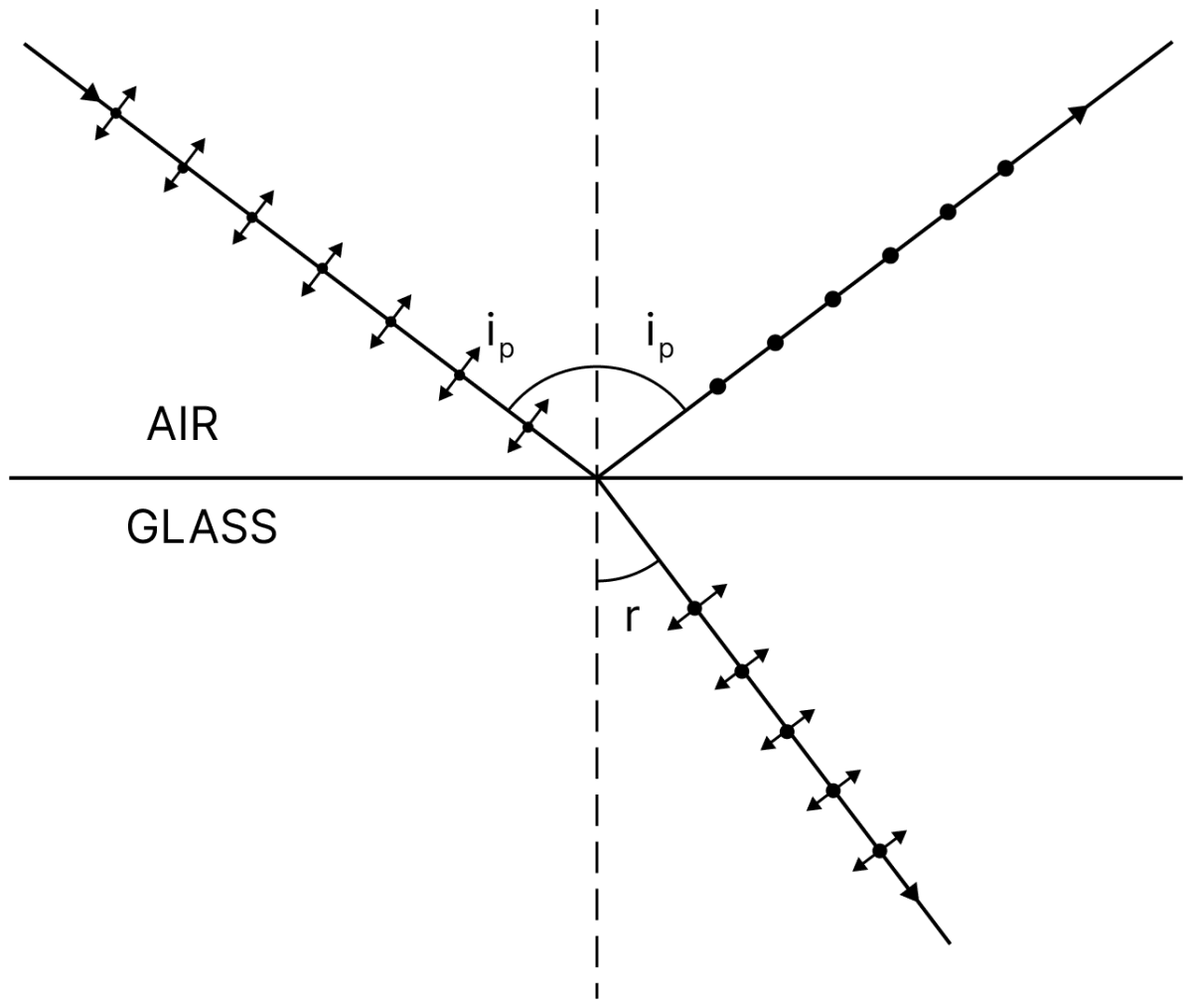
At the polarising angle, the reflected ray is completely plane-polarised with vibrations of the electric field perpendicular to the plane of incidence, so it is marked with dots only. The refracted ray is partially plane-polarised; it carries vibrations in the plane of incidence (double arrows) together with fewer vibrations perpendicular to it (dots).
What is the difference between the electric field vector at any point in the path of a linearly polarised light and that of an unpolarised light?
Answer
In linearly polarised light, the vibrations of the electric vector are confined to a single direction in a plane perpendicular to the direction of propagation of light. In unpolarised light, the vibrations of occur symmetrically in all directions in that plane.
Does the value of the polarising angle ip for a transparent medium depend upon the wavelength λ (or colour) of light?
Light is incident on a block of glass at the polarising angle. How does this polarising angle vary with the wavelength of light?
Answer
Yes, the polarising angle depends upon the wavelength of light; it decreases with increase in wavelength.
From Brewster's law, ip = tan-1 n, and the refractive index n depends upon λ according to Cauchy's relation, n = A + . As λ increases, n decreases, and so ip decreases. Therefore, complete polarisation by reflection is possible only for monochromatic light.
If a ray of light is incident at angle of polarisation ip on a transparent medium, then prove that n = tan ip, where n is the refractive index of the transparent medium.
Answer
When light is incident at the polarising angle ip, the reflected and refracted rays are perpendicular, so the angle of refraction r is given by
By Snell's law, the refractive index of the medium is
Hence proved, n = tan ip.
Define 'polarising angle' and 'critical angle'. Establish relation between the two.
Answer
Polarising angle : The angle of incidence ip of a light beam on a transparent surface (of refractive index n) for which the reflected beam is completely plane-polarised.
Critical angle : The angle of incidence ic of a light beam in the denser medium (of refractive index n) for which the angle of refraction in the rarer medium is 90°.
Relation : By Brewster's law, n = tan ip, and by Snell's law, n = . Hence,
The critical angle between a given transparent medium and air is denoted by ic. A ray of light in air enters this transparent medium at an angle of incidence equal to the polarising angle ip. Deduce a relation for the angle of refraction r in terms of ic.
Answer
Let n be the refractive index of the medium and r the angle of refraction. By Snell's law,
At the polarising angle, ip + r = 90°, so sin ip = sin (90° − r) = cos r. Hence, from Eq. (i),
For the critical angle, n = . Equating with Eq. (ii),
Hence, r = tan-1 (sin ic).
Describe an experiment to show that light waves are transverse.
Answer
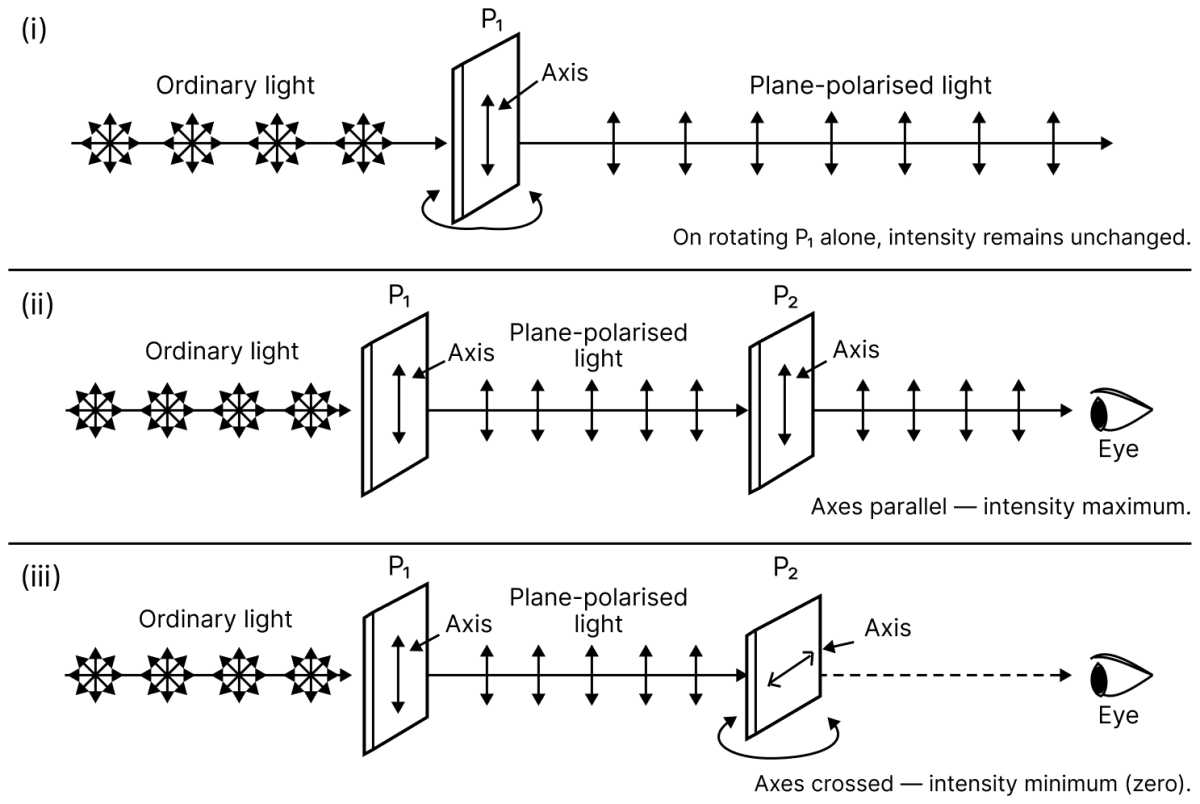
Experiment : Two tourmaline crystals P1 and P2, cut so that their axes lie in their planes, are used. Ordinary light is allowed to fall normally on P1.
(i) On rotating P1 alone about the ray as axis, the intensity of the emergent light does not change. Hence, in ordinary light the vibrations of the electric vector occur in all directions in a plane perpendicular to the direction of propagation.
(ii) P2 is now placed between P1 and the eye. When the axes of P1 and P2 are parallel, the intensity of the emergent light is maximum.
(iii) As P2 is rotated in its own plane, the intensity goes on decreasing, and it becomes minimum (zero) when the axes of the two crystals are perpendicular, i.e., crossed.
Conclusion : The light emerging from P1 has its vibrations in a single direction, and P2 transmits only the component of these vibrations parallel to its axis. Had light waves been longitudinal, the intensity would not have been affected by the rotation of P2. Hence, the vibrations of the electric vector in light waves are transverse.
How does polarisation of light establish the transverse nature of light waves?
Answer
Polarisation means that the vibrations of the electric vector , which in ordinary light occur in all directions in a plane perpendicular to the direction of propagation, are confined to a single direction in that plane. This is possible only if the vibrations are perpendicular to the direction of propagation, i.e., only for transverse waves. In a longitudinal wave the vibrations are along the direction of propagation and would pass a polariser equally in every orientation.
Experimentally, when ordinary light passes through two tourmaline crystals (polariser and analyser), the intensity of the emergent light varies as the analyser is rotated and becomes zero when the two are crossed. Since light shows this property of polarisation, light waves must be transverse.
What do you mean by polarised light? Define plane of vibration and plane of polarisation. How are they related?
Answer
Polarised light : Light in which the vibrations of the electric vector are confined to a single direction in a plane perpendicular to the direction of propagation is called plane-polarised (polarised) light.
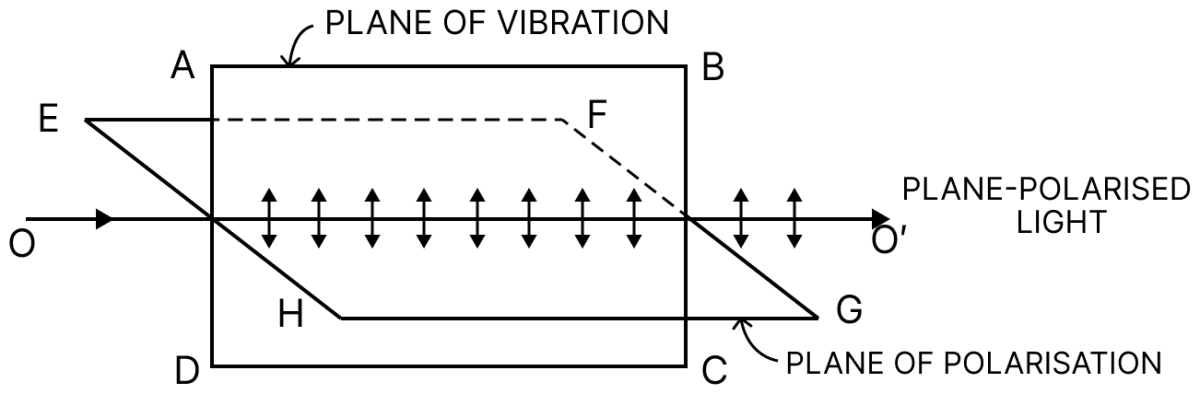
Plane of vibration : The plane containing the direction of vibration of the electric vector and the direction of propagation of light (ABCD in the figure).
Plane of polarisation : The plane containing the direction of propagation of light and perpendicular to the plane of vibration (EFGH in the figure). There are no vibrations of light in this plane.
Relation : The plane of vibration and the plane of polarisation are perpendicular to each other, and the direction of propagation of light (OO') lies in both of them.
What is meant by polarising angle? Show that when a ray of light is incident on a transparent surface at the polarising angle, the reflected and the refracted rays are at right angles to each other.
Answer
Polarising angle : The angle of incidence at which ordinary light reflected from the surface of a transparent material becomes completely plane-polarised is called the polarising angle ip.
Let PQ be the ray incident at the polarising angle ip on the surface XY at Q, QR the reflected ray and QS the refracted ray making an angle r with the normal.
By Snell's law, n = , and by Brewster's law, n = tan ip. Hence,
The angles about Q on the side of incidence add up to 180°, so
Hence, the reflected ray QR and the refracted ray QS are at right angles to each other.
What is meant by plane-polarised light? What type of waves show the property of polarisation? Give a method for producing a beam of plane-polarised light. Show how you will detect the presence of plane-polarised light. Give one practical use of polarised light.
Answer
Plane-polarised light : Light in which the vibrations of the electric vector are confined to a single direction in a plane perpendicular to the direction of propagation.
Waves showing polarisation : Only transverse waves, such as light and other electromagnetic waves, show polarisation.
Production : A beam of ordinary light is passed through a Polaroid (or a tourmaline crystal). Only the vibrations parallel to its polarising direction are transmitted, so the emergent beam is plane-polarised.
Detection : The beam is viewed through a second Polaroid (analyser), which is rotated about the direction of the beam. If the intensity becomes maximum twice and zero twice in one complete rotation, the light is plane-polarised.
Practical use : Polaroid sunglasses are used to avoid the glare of light reflected from bright surfaces such as wet roads.
How can a pile of glass plates be used to produce polarised light?
Answer
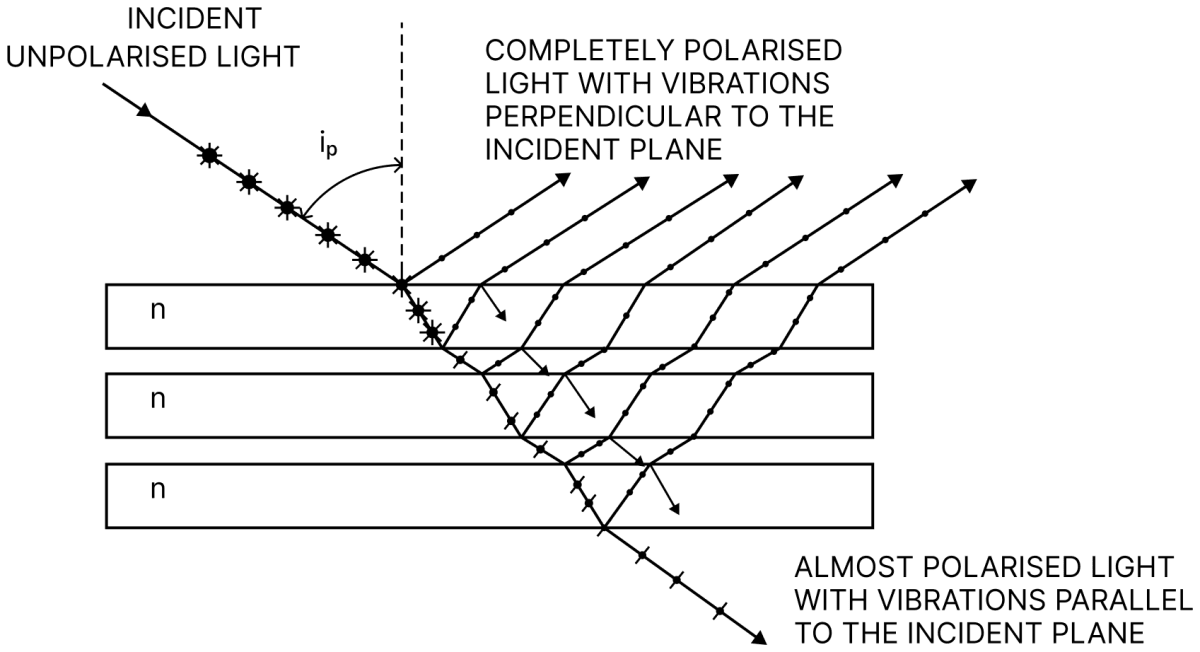
A number of parallel glass plates (a pile of plates) is placed so that unpolarised light falls on it at the polarising angle ip.
At the upper surface of the first plate, the reflected light is completely plane-polarised with vibrations perpendicular to the plane of incidence (plane of paper), while the refracted light is partially plane-polarised — it contains vibrations in the plane of incidence as well as a smaller proportion perpendicular to it.
The angle of refraction in the plate equals the polarising angle for its lower face, so at every surface the vibrations perpendicular to the plane of incidence are partly removed by reflection. After successive reflections at the upper and lower surfaces of many plates, the proportion of these vibrations in the transmitted light continuously decreases. Finally, the light emerging from the pile is almost plane-polarised, with vibrations parallel to the plane of incidence.
What is a Polaroid? What is meant by (i) plane-polarised light and (ii) polarising angle?
Answer
Polaroid : A Polaroid is a cheap commercial device for producing and detecting plane-polarised light. It is a large polarising film, made by spreading ultra-microscopic crystals of herpathite (iodosulphate of quinine) on a thin sheet of nitro-cellulose with their optic axes parallel, mounted between two glass plates. It transmits only those vibrations of the electric vector which are parallel to its polarising direction.
(i) Plane-polarised light : Light in which the vibrations of the electric vector are confined to a single direction in a plane perpendicular to the direction of propagation of light.
(ii) Polarising angle : The angle of incidence at which ordinary light reflected from the surface of a transparent material becomes completely plane-polarised. It is given by n = tan ip.
State 'Law of Malus'. Give an expression for intensity of polarised light emerging out of a polaroid when ordinary light of intensity I0 is incident on it. If the Polaroid is rotated draw the graph of intensity versus θ (angle of rotation).
Answer
Law of Malus : When a completely plane-polarised light beam from a polariser is incident on an analyser, the intensity of light emerging from the analyser varies as the square of the cosine of the angle θ between the planes of transmission of the analyser and the polariser,
where I1 is the intensity of the plane-polarised light incident on the analyser.
Intensity from a Polaroid : In ordinary light the electric vector vibrates randomly in all directions in a plane perpendicular to the direction of propagation, so the average value of cos2 θ, i.e. , applies. The intensity of the plane-polarised light emerging from the Polaroid is
Graph : When this light falls on a second Polaroid (analyser) rotated through an angle θ, the emergent intensity is I = cos2 θ. It is maximum () at θ = 0°, 180° and 360°, and zero at θ = 90° and 270°.
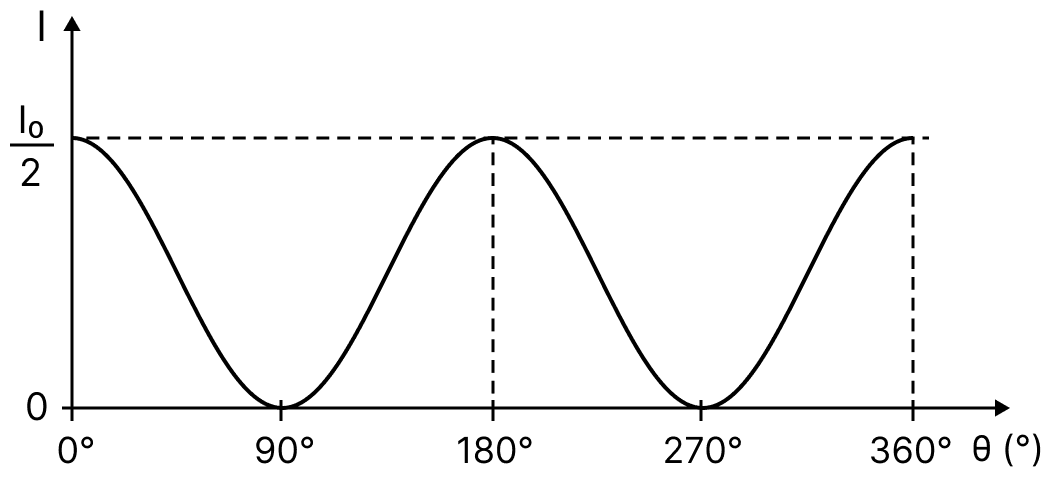
Note: On rotating a single Polaroid in ordinary light, the intensity stays constant at ; the graph is drawn for rotation of the analyser, as the law of Malus intends.
Describe briefly how a given beam of light can be analysed to determine whether it is linearly-polarised or unpolarised?
Answer
The given beam is passed through a Polaroid (analyser), which is rotated about the direction of the beam through one complete rotation while the emergent light is observed.
(i) If there is no change in the intensity of the emergent light in any position, the given light is unpolarised.
(ii) If the intensity changes and becomes maximum twice and zero twice in one complete rotation, the given light is linearly (plane) polarised.
You are provided with a narrow and parallel beam of light. State how you will determine experimentally, whether it is a beam of ordinary (unpolarised) light, partially polarised light or completely polarised light.
Answer
The beam is passed through a Polaroid, which is rotated about the direction of the beam through one complete rotation, and the intensity of the emergent light is observed.
(i) If there is no change in the intensity in any position, the beam is of ordinary (unpolarised) light.
(ii) If the intensity changes but never becomes zero, the beam is partially polarised.
(iii) If the intensity becomes maximum twice and zero twice in one complete rotation, the beam is completely plane-polarised.
Define polarisation of light and plane of polarisation. Distinguish plane polarised, partially polarised light and unpolarised light.
Answer
Polarisation of light : The phenomenon by which the vibrations of the electric vector of light, occurring in all directions in a plane perpendicular to the direction of propagation, are confined to a single direction in that plane is called polarisation of light.
Plane of polarisation : The plane containing the direction of propagation of light and perpendicular to the plane of vibration. No vibrations of the electric vector occur in this plane.
| Plane polarised light | Partially polarised light | Unpolarised light |
|---|---|---|
| Vibrations of are confined to a single direction in a plane perpendicular to the direction of propagation. | Vibrations occur in all directions in that plane, but are stronger in one direction than in others. | Vibrations of occur symmetrically in all possible directions in that plane. |
| On rotating an analyser, the intensity becomes maximum twice and zero twice in one rotation. | On rotating an analyser, the intensity varies but never becomes zero. | On rotating an analyser, the intensity does not change. |
| Example: light emerging from a Polaroid. | Example: light reflected from glass at an angle other than the polarising angle. | Example: sunlight, light from a sodium lamp. |
Briefly dsecribe the Brewster's law and relate it to the critical angle. Show that reflected and refracted light vibrate mutually perpendicular to each other.
Answer
Brewster's law : When unpolarised light is incident on the surface of a transparent material at the polarising angle ip, the reflected light is completely plane-polarised, and the refractive index n of the material is given by
Relation with critical angle : For the critical angle ic of the same material, n = . Combining with Eq. (i),
Reflected and refracted rays are perpendicular :
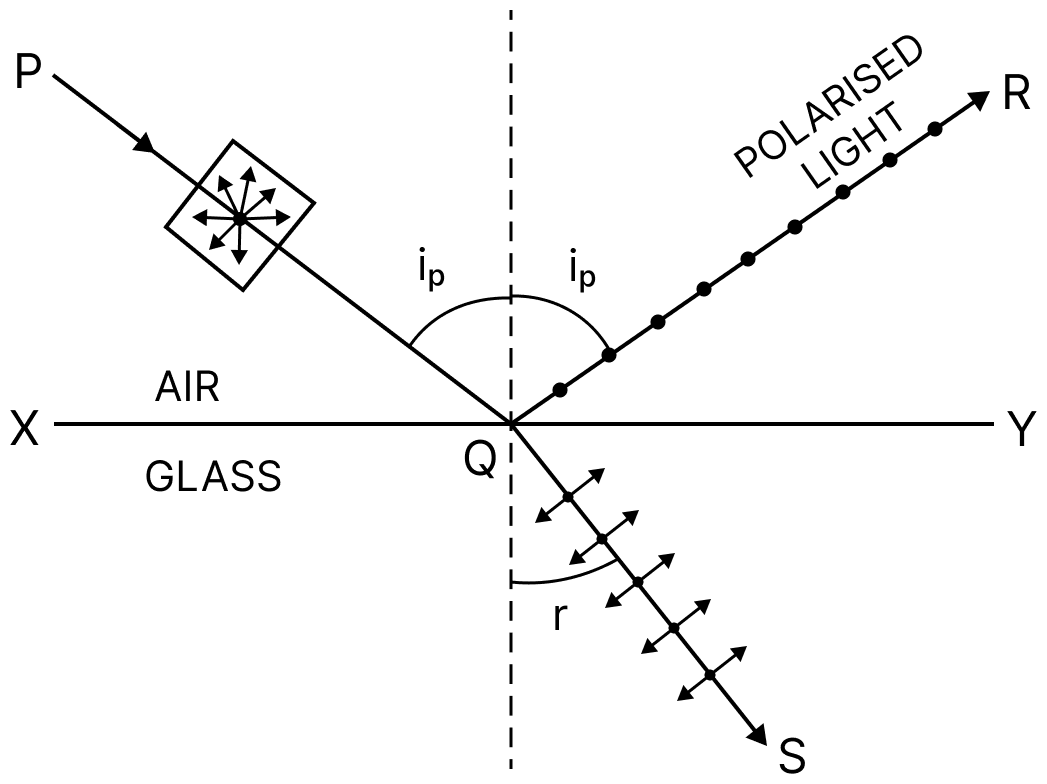
Let PQ be the incident ray, QR the reflected ray and QS the refracted ray, with angle of refraction r. By Snell's law, n = . Equating with Eq. (i),
Since ip + r + ∠RQS = 180°, ∠RQS = 90°.
The reflected light is completely plane-polarised, with vibrations perpendicular to the plane of incidence. The refracted light is only partially plane-polarised; its vibrations lie mainly in the plane of incidence, with a smaller proportion perpendicular to it.
Hence, the reflected and the refracted rays are at right angles, and the vibrations of the reflected light are perpendicular to the vibrations of the refracted light that lie in the plane of incidence.
Note: The question states that the reflected and refracted light vibrate mutually perpendicular; this holds only for the in-plane vibrations of the refracted light, as the refracted light is partially polarised.
Write various methods to get polarised light. Explain utility of polarised light.
Answer
Methods of getting polarised light :
(i) By selective absorption (tourmaline crystal or Polaroid) : Only the vibrations parallel to the axis (polarising direction) are transmitted; the rest are absorbed.
(ii) By reflection : Light reflected from a transparent surface at the polarising angle (n = tan ip) is completely plane-polarised, with vibrations perpendicular to the plane of incidence.
(iii) By refraction (pile of plates) : Light refracted through a pile of glass plates at the polarising angle loses, by successive reflections, its vibrations perpendicular to the plane of incidence and emerges almost plane-polarised.
(iv) By scattering : Light scattered by fine particles in a direction perpendicular to the incident beam is plane-polarised.
Utility of polarised light (Polaroids) :
(i) Polaroid sunglasses avoid the glare of light reflected from wet roads, polished tables and glazy paper.
(ii) Polaroids fitted on car headlights and windscreens, with axes at 45°, cut off the dazzling light of an approaching car.
(iii) Microscopes fitted with Polaroids remove glare while viewing minute particles.
(iv) A Polaroid in front of a camera lens gives distinct photographs of clouds.
(v) A pair of Polaroids controls the intensity of light entering trains and aeroplanes.
(vi) Polaroid glasses are used for viewing three-dimensional pictures.
Read the passage given below and answer the following questions on the basis of the same :
When a beam of unpolarised light is passed through certain crystals like tourmaline, the light splits up into two beams, polarised at right angles to each other; the light with vibrations perpendicular to optic axis are absorbed and the other component with vibrations parallel to the optic axis are transmitted. The selective absorption is called dichroism. Polaroids work on the principle of dichroism. Polaroids are made by embedding the tiny synthetic crystals of herpathite, with their optic axis parallel in a transparent film of cellulose acetate.
(i) Which nature of light is established by polarisation of light?
(ii) Give one example of dichroic crystal.
(iii) State one use of Polaroids.
(iv) What is plane polarised light?
(v) A ray of light is incident on a medium at the polarising angle. What is the angle between the reflected and refracted rays?
Answer
(i) Polarisation of light establishes the transverse nature of light. Only a transverse wave can be polarised, so light waves must be transverse.
(ii) Tourmaline is an example of a dichroic crystal.
(iii) Polaroids are used to produce and analyse plane-polarised light; for example, as filters in photographic cameras to reduce the glare of reflected light.
(iv) Light in which the vibrations of the electric field vector are confined to a single direction in a plane perpendicular to the direction of propagation is called plane-polarised light.
(v) The angle between the reflected and refracted rays is 90°.