
What is the polarising angle for a medium of refractive index 2.4?
Answer
Given,
- Refractive index of the medium, n = 2.4
By Brewster's law, the refractive index of the medium is related to the polarising angle ip by
Substituting n = 2.4,
Hence, the polarising angle for the medium is 67.4°.
What is the angle of incidence, if the reflected rays of light falling on a thick transparent plate of refractive index are completely polarised? Does this angle depend upon the wavelength of light?
Answer
Given,
- Refractive index of the plate, n =
As the reflected rays are completely polarised, the light is incident at the polarising angle ip. By Brewster's law,
The polarising angle is given by ip = tan-1 n, and the refractive index n of the plate depends upon the wavelength λ of light. Hence, ip also depends upon λ; it decreases with increase in wavelength.
Hence, the angle of incidence is 60°. Yes, this angle depends upon the wavelength of light.
Light rays strike a glass plate at 57° incidence. If the reflected and the refracted rays are mutually at right angles, what is the refractive index of glass?
Answer
Given,
Angle of incidence, i = 57°
Reflected and refracted rays are mutually at right angles
When the reflected and the refracted rays are perpendicular to each other, the light is incident at the polarising angle. Hence, ip = 57°.
By Brewster's law,
Hence, the refractive index of glass is 1.54.
A ray of light is incident on the surface of a glass plate of refractive index 1.5 at the polarising angle. What is the angle of refraction?
Answer
Given,
- Refractive index of glass, n = 1.5
By Brewster's law, the polarising angle ip is given by
At the polarising angle, the reflected and the refracted rays are perpendicular to each other, so
Hence, the angle of refraction is 33.7°.
A light-ray is incident on a glass plate of refractive index 1.54. If the reflected ray is completely plane-polarised, then determine : (i) angle of incidence, (ii) angle of refraction and (iii) critical angle. (Given : tan 57° = 1.54 and sin 40.5° = 0.6493).
Answer
Given,
Refractive index of glass, n = 1.54
tan 57° = 1.54 and sin 40.5° = 0.6493
(i) Angle of incidence :
As the reflected ray is completely plane-polarised, the light is incident at the polarising angle ip. By Brewster's law,
(ii) Angle of refraction :
At the polarising angle, ip + r = 90°, so
(iii) Critical angle :
If c is the critical angle, then n = , so
As sin 40.5° = 0.6493 (given), sin c ≈ sin 40.5°. Therefore,
Hence, (i) angle of incidence = 57°, (ii) angle of refraction = 33° and (iii) critical angle = 40.5°.
At what angle θ above the horizon should the sun be situated so that its light reflected from the surface of still water of the pond be totally polarised?
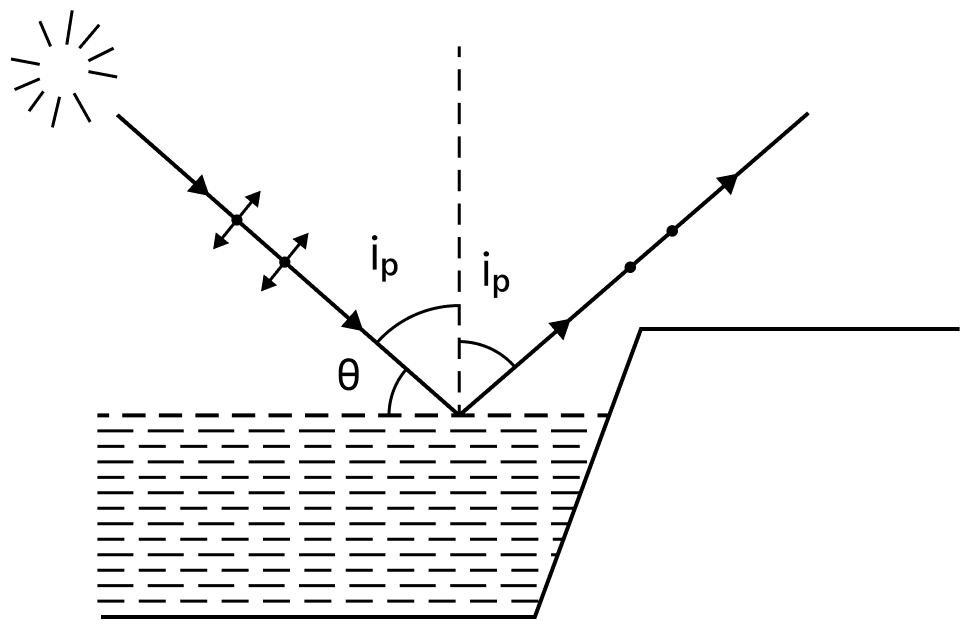
Given : refractive index of water n = 1.327 and tan 53° = 1.327.
Answer
Given,
Refractive index of water, n = 1.327
tan 53° = 1.327
For the reflected light to be totally polarised, the sunlight must be incident on the water surface at the polarising angle ip. By Brewster's law,
In the figure, ip is measured from the normal to the water surface, while θ is measured from the horizontal water surface. As the normal is perpendicular to the surface,
Hence, the sun should be situated at an angle of 37° above the horizon.
When sun light is incident on water at an angle of 53°, the reflected light is found to be completely plane-polarised. Determine : (i) angle of refraction of light, (ii) refractive index of water.
Answer
Given,
Angle of incidence, i = 53°
Reflected light is completely plane-polarised
As the reflected light is completely plane-polarised, 53° is the polarising angle, i.e., ip = 53°.
(i) Angle of refraction :
At the polarising angle, the reflected and the refracted rays are perpendicular to each other, so ip + r = 90°.
(ii) Refractive index of water :
By Brewster's law,
Hence, (i) the angle of refraction is 37° and (ii) the refractive index of water is 1.327.
The critical angle for a medium is 45°. What is polarising angle? Angle of refraction?
Answer
Given,
- Critical angle, c = 45°
Refractive index of the medium :
Polarising angle :
By Brewster's law,
Angle of refraction :
At the polarising angle, ip + r = 90°, so
Hence, the polarising angle is 54.7° and the angle of refraction is 35.3°.
The refractive index of water is and that of glass . A beam of light travelling in water enters glass. For what angle of incidence the reflected light will be completely plane-polarised? (tan 48° 22′ = 1.125)
Answer
Given,
Refractive index of water,
Refractive index of glass,
tan 48° 22′ = 1.125
As the light travels in water and enters glass, the refractive index in Brewster's law is that of glass with respect to water,
By Brewster's law,
Hence, the reflected light will be completely plane-polarised for an angle of incidence of 48° 22′.
The refractive indices of glass and water are 1.54 and 1.33 respectively. For which light-ray the polarising angle will be greater, a ray going from water to glass or a ray going from glass to water?
Answer
Given,
Refractive index of glass, = 1.54
Refractive index of water, = 1.33
Ray going from water to glass :
The refractive index of glass with respect to water is
By Brewster's law,
Ray going from glass to water :
The refractive index of water with respect to glass is
By Brewster's law,
Hence, as 49.2° > 40.8°, the polarising angle will be greater for the ray going from water to glass.
Two Polaroids are so oriented that the intensity of light transmitted by them is maximum. To what percentage of its maximum value is the intensity of transmitted light reduced when one of the Polaroids is rotated through (i) 30° (ii) 60°?
Answer
Given,
Initially, the intensity of transmitted light is maximum
Angle of rotation, θ = 30° and 60°
For maximum transmitted intensity, the polarising directions of the two Polaroids are parallel (θ = 0). Let I0 be this maximum intensity. When one Polaroid is rotated through θ, by the law of Malus, the intensity of the transmitted light is
(i) When θ = 30° :
Percentage of the maximum value,
(ii) When θ = 60° :
Percentage of the maximum value,
Hence, the intensity of transmitted light is reduced to (i) 75% and (ii) 25% of its maximum value.
Two 'crossed' Polaroids A and B are placed in the path of a light beam. In between them, a third Polaroid C is placed whose polarisation axis makes angle θ with the polarisation axis of Polaroid A. If I0 be the intensity of light coming out of Polaroid A, then what will be the intensity of light coming out of the Polaroid B?
Answer
Given,
Polaroids A and B are crossed
Angle between the polarisation axes of C and A = θ
Intensity of light coming out of A = I0
As A and B are crossed, the polarisation axis of B is at 90° to that of A. Hence, the angle between the polarisation axes of C and B is (90° − θ).
The light coming out of A is plane-polarised along the axis of A. By the law of Malus, the intensity of light coming out of C is
This light falls on B, whose axis makes (90° − θ) with that of C. Again by the law of Malus, the intensity of light coming out of B is
Hence, the intensity of light coming out of Polaroid B is .