
What is a polaroid? How is used to obtain plane polarised light from ordinary (unpolarised) light? If the polarising angle for the air-glass interface is 56.3°, what is the angle of refraction in glass?
Answer
Polaroid : A Polaroid is a cheap commercial device for producing and detecting plane-polarised light. It is a large polarising film held between two glass plates. The film is a thin sheet of nitro-cellulose on which ultra-microscopic crystals of herpathite (iodosulphate of quinine) are spread so that the optic axes of all the crystals are parallel. These crystals are highly dichroic, i.e., they completely absorb one of the doubly-refracted beams. Every Polaroid has a characteristic direction, called its polarising direction.
Obtaining plane-polarised light : When unpolarised light falls on a Polaroid, the components whose electric vectors vibrate parallel to the polarising direction are transmitted, while those vibrating perpendicular to it are absorbed. The electric vector of the emergent light therefore vibrates in a single direction only, i.e., the transmitted light is plane-polarised.
Angle of refraction :
Given,
- Polarising angle, ip = 56.3°
When light is incident at the polarising angle, the reflected and the refracted rays are perpendicular to each other, so that ip + r = 90°.
Hence, the angle of refraction in glass is 33.7°.
Describe a polaroid. How is plane-polarised light obtained with its help? How will you use it to distinguish between unpolarised light and plane polarised light?
Answer
Polaroid : A Polaroid is a large-sized polarising film mounted between two glass plates. It is prepared by spreading ultra-microscopic crystals of herpathite (iodosulphate of quinine) on a thin sheet of nitro-cellulose with the optic axes of all the crystals parallel. The crystals are highly dichroic, so they absorb one of the doubly-refracted beams completely. The direction in which the Polaroid allows vibrations to pass is called its polarising direction.
Production of plane-polarised light : When a beam of unpolarised light passes through the Polaroid, only those components whose electric vectors vibrate parallel to the polarising direction are transmitted; the components vibrating perpendicular to this direction are absorbed. Hence, the transmitted light is plane-polarised.
Distinguishing unpolarised and plane-polarised light : The given light is passed through a Polaroid and the Polaroid is rotated about the direction of the light as axis.
(i) If the intensity of the emergent light does not change in any position of the Polaroid, the given light is unpolarised.
(ii) If the intensity changes, and in one complete rotation becomes maximum twice and zero twice, the given light is plane-polarised.
State Brewster's law (of polarisation) and draw a diagram to illustrate it.
Answer
Brewster's law : When unpolarised light is incident on the surface of a transparent material at the polarising angle ip, the reflected light is completely plane-polarised, and the refractive index n of the material with respect to the surrounding medium is equal to the tangent of the polarising angle,
At this angle of incidence, the reflected and the refracted rays are perpendicular to each other.
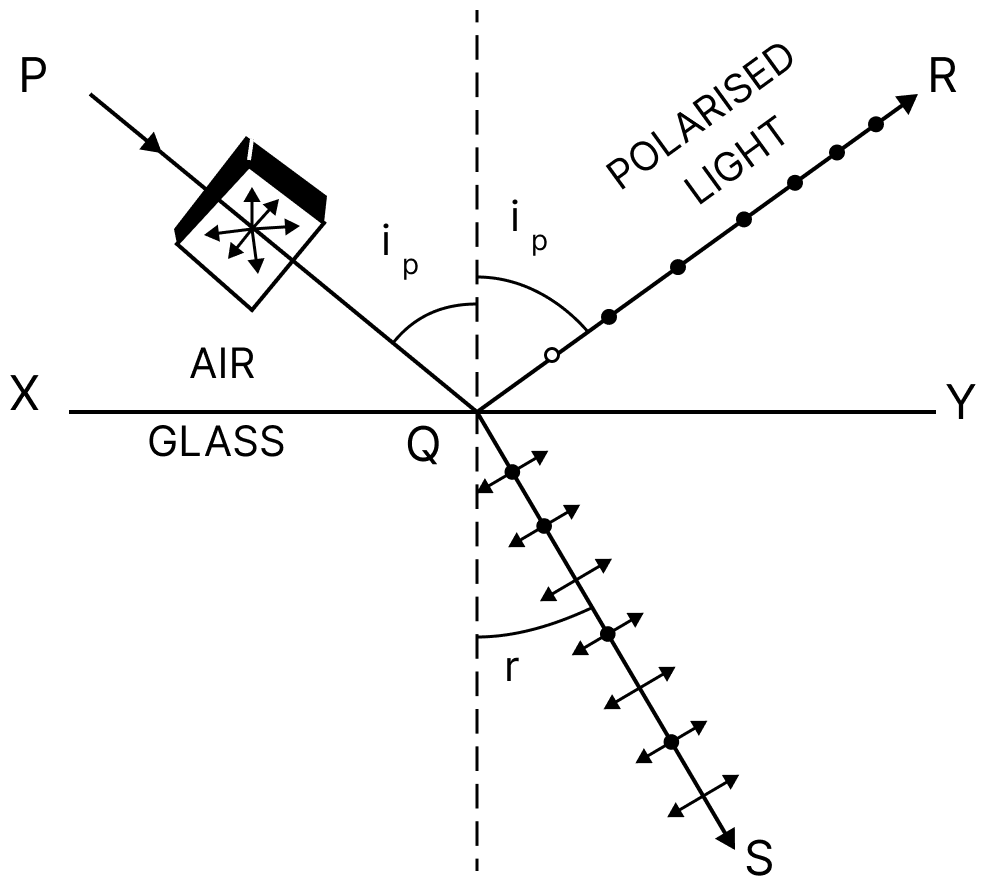
In the figure, PQ is the unpolarised ray incident at the polarising angle ip on the air-glass surface XY. QR is the reflected ray, which is completely plane-polarised with vibrations perpendicular to the plane of incidence (shown by dots), and QS is the refracted ray, which is partially polarised. The angle RQS between the reflected and the refracted rays is 90°.
Name three properties which are mutually perpendicular to one another in a plane-polarised light.
Answer
The electric field vector , the magnetic field vector and the direction of propagation of the light wave.
Explanation:
According to Maxwell's electromagnetic theory, light is an electromagnetic wave in which the electric field vector and the magnetic field vector vibrate in mutually perpendicular directions, and each is perpendicular to the direction of propagation of the wave. In plane-polarised light, the electric vector is further confined to a single direction in its plane.
The refractive index of glass with respect to air is . Find the angle of polarisation.
Answer
Given,
- Refractive index of glass with respect to air, n =
By Brewster's law,
Hence, the angle of polarisation is 56.3°.
What is meant by polarising angle? Show that when a ray of light is incident on a transparent surface at the polarising angle the reflected and refracted rays are at right angles to each other.
Answer
Polarising angle : The polarising angle is that angle of incidence at which unpolarised light, on reflection from the surface of a transparent material, becomes completely plane-polarised with vibrations perpendicular to the plane of incidence. It is denoted by ip and is also called Brewster's angle.
Reflected and refracted rays are perpendicular :
Let an unpolarised ray PQ be incident at the polarising angle ip on the surface XY of a transparent medium of refractive index n. Let QR be the reflected ray and QS the refracted ray, r being the angle of refraction.
By Snell's law,
By Brewster's law,
Comparing Eqs. (i) and (ii),
The angle of reflection is also ip. As the angles on one side of the surface XY at Q add up to 180°,
Hence, the reflected ray QR and the refracted ray QS are at right angles to each other.
Light is incident on a block of glass at the polarising angle. How does this polarising angle vary with the wavelength of light?
Answer
The polarising angle decreases with increase in the wavelength of light.
Explanation:
By Brewster's law, ip = tan-1 n. The refractive index n of glass depends on the wavelength according to Cauchy's relation, , so n decreases as λ increases. Hence, ip also decreases as λ increases; it is greater for violet light than for red light.
Does the value of the polarising angle ip for a transparent medium depend upon the wavelength λ (or colour) of light?
Answer
Yes.
Explanation:
By Brewster's law, ip = tan-1 n. The refractive index n of a transparent medium depends upon the wavelength of light (Cauchy's relation, ), so ip also depends upon λ; it decreases as λ increases. For this reason, complete polarisation by reflection at a given angle is possible only for monochromatic light.
Explain why light waves can be polarised but sound waves cannot be. Describe a method by which a plane polarised light can be distinguished from a partially polarised light.
Answer
Why light can be polarised but sound cannot : Polarisation of a wave means confining its vibrations to a single direction in the plane perpendicular to the direction of propagation, out of the vibrations taking place in all directions in that plane. This is possible only for a transverse wave. Light waves are transverse, since the electric vector vibrates perpendicular to the direction of propagation, so light can be polarised. Sound waves are longitudinal: the particles of the medium vibrate along the direction of propagation and there are no vibrations in the perpendicular plane to be separated. Hence, sound waves cannot be polarised.
Distinguishing plane-polarised and partially polarised light : The given light is passed through a Polaroid (used as an analyser) and the Polaroid is rotated through one complete rotation about the light as axis.
(i) If the intensity of the emergent light varies and becomes zero twice in one complete rotation, the light is plane-polarised.
(ii) If the intensity varies but never becomes zero, the light is partially polarised.
A ray of light incident in air for a certain air glass surface of separation has a polarising angle of 56°. What will be the angle of refraction in glass?
Answer
Given,
- Polarising angle, ip = 56°
At the polarising angle, the reflected and the refracted rays are perpendicular to each other, so
Hence, the angle of refraction in glass is 34°.
Describe briefly how a given beam of light can be analysed to determine whether it is linearly-polarised or unpolarised?
Answer
The beam is analysed with a Polaroid (or a tourmaline crystal). The light is made to fall normally on the Polaroid, and the Polaroid is rotated about the direction of the beam as axis while the emergent light is observed.
(i) If the intensity of the emergent light remains the same in all positions of the Polaroid, the beam is unpolarised.
(ii) If the intensity varies periodically, becoming maximum twice and zero twice in one complete rotation, the beam is linearly-polarised.
What is the Brewster angle for water? The refractive index of water with respect to air is 1.33.
Answer
Given,
- Refractive index of water with respect to air, n = 1.33
By Brewster's law, the Brewster angle ip is given by
Hence, the Brewster angle for water is 53.1°.
How will you identify, experimentally, whether a given beam of light is plane-polarised or unpolarised?
Answer
A tourmaline crystal or a Polaroid is placed in the path of the given beam, so that the light falls normally on it. The light emerging from the Polaroid is observed while the Polaroid is rotated in its own plane, about the beam as axis.
(i) If the intensity of the emerging light remains unchanged during the rotation, the beam is unpolarised.
(ii) If the intensity changes periodically and becomes zero twice in each complete rotation, the beam is plane-polarised.
What is the difference between polarised light and unpolarised light? Find Brewster's angle for water having refractive index, n = 1.33.
Answer
Difference between polarised and unpolarised light :
| Unpolarised light | Polarised (plane-polarised) light |
|---|---|
| The vibrations of the electric vector occur symmetrically in all possible directions in a plane perpendicular to the direction of propagation. | The vibrations of the electric vector are confined to a single direction in the plane perpendicular to the direction of propagation. |
| The vibrations are symmetrical about the direction of propagation. | The vibrations are asymmetrical about the direction of propagation. |
| When seen through a rotating Polaroid, its intensity does not change. | When seen through a rotating Polaroid, its intensity varies and becomes zero twice in one rotation. |
Brewster's angle for water :
Given,
- Refractive index of water, n = 1.33
By Brewster's law,
Hence, Brewster's angle for water is 53.1°.
Give any two methods by which (ordinary) light can be polarised.
Answer
(i) By reflection.
(ii) By using a Polaroid.
Explanation:
(i) When unpolarised light is incident on the surface of a transparent material (such as glass) at the polarising angle ip, where n = tan ip, the reflected light is completely plane-polarised with vibrations perpendicular to the plane of incidence.
(ii) When unpolarised light passes through a Polaroid or a tourmaline crystal, only the vibrations parallel to its polarising direction (axis) are transmitted and the rest are absorbed (selective absorption), so the emergent light is plane-polarised.
A ray of ordinary light is incident on a rectangular block of glass at Brewster's angle. What is the angle between the reflected ray and the refracted ray of light?
Answer
90°
Explanation:
Brewster's angle is the polarising angle ip. For incidence at this angle, Snell's law together with Brewster's law (n = tan ip) gives ip + r = 90°. Hence, the reflected ray and the refracted ray are perpendicular to each other.
(i) In case of polarised light, what is meant by the 'plane of polarisation'?
(ii) Find refractive index of glass, if its polarising angle is 60°.
Answer
(i) Plane of polarisation : In plane-polarised light, the plane containing the direction of propagation of light and perpendicular to the plane of vibration is called the plane of polarisation. There are no vibrations of the electric vector in this plane.
(ii) Refractive index of glass :
Given,
- Polarising angle, ip = 60°
By Brewster's law,
Hence, the refractive index of glass is = 1.732.
State one use of polaroid.
Answer
Polaroids are used in sunglasses to avoid the glare of light reflected from bright surfaces.
Explanation:
Light reflected from bright surfaces such as wet roads, polished tables and glazy paper is partially plane-polarised with vibrations in the horizontal plane, and it produces glare on reaching the eye. Sunglasses fitted with Polaroids whose vibration-planes are vertical cut off most of this light.
Green light is incident at the polarising angle on a certain glass plate. The angle of refraction is 32°. What are :
(i) the polarising angle?
(ii) the refractive index of refraction of glass.
Answer
Given,
- Angle of refraction, r = 32°
(i) Polarising angle :
For incidence at the polarising angle, the reflected and the refracted rays are perpendicular to each other, so
(ii) Refractive index of glass :
By Brewster's law,
Hence, (i) the polarising angle is 58° and (ii) the refractive index of glass is 1.6.
You are provided with a narrow and parallel beam of light. State how you will determine, experimentally, whether it is a beam of ordinary (unpolarised) light, partially polarised light or completely polarised light.
Answer
The narrow parallel beam is made to fall normally on a Polaroid, and the Polaroid is given one complete rotation about the beam as axis while the intensity of the emergent light is observed.
(i) If the intensity remains the same in all positions of the Polaroid, the beam is of ordinary (unpolarised) light.
(ii) If the intensity changes but never becomes zero, the beam is partially polarised.
(iii) If the intensity becomes maximum twice and zero twice in one complete rotation, the beam is completely (plane) polarised.
State Brewster's law of polarisation of light.
Answer
When a beam of unpolarised light is incident on the surface of a transparent material at an angle of incidence ip (the polarising angle) such that the reflected light is completely plane-polarised, the refractive index n of the material is equal to the tangent of the polarising angle:
At this angle, the reflected and the refracted rays are perpendicular to each other.
What is the difference between the electric field vector at any point in the path of a linearly polarised light and that of an unpolarised light?
Answer
In linearly polarised light, the vibrations of the electric field vector at any point are confined to a single direction in the plane perpendicular to the direction of propagation of light. In unpolarised light, the vibrations of occur symmetrically in all possible directions in that plane.
A ray of light is incident on a medium at the polarising angle. What is the angle between the reflected and refracted rays?
Answer
90°
Explanation:
When light is incident at the polarising angle ip, Brewster's law (n = tan ip) and Snell's law together give ip + r = 90°. Therefore, the reflected and the refracted rays are at right angles to each other.
Ordinary (i.e., unpolarised) light is incident on the surface of a transparent material at the polarising angle. If it is partly reflected and partly refracted, what is the angle between the reflected and the refracted rays?
Answer
90°
Explanation:
At the polarising angle ip, n = tan ip (Brewster's law) and (Snell's law). These give cos ip = sin r, i.e., ip + r = 90°. Hence, the reflected ray and the refracted ray are perpendicular to each other.
With the help of an experiment, state how will you identify whether a given beam of light is polarised or unpolarised.
Answer
Experiment : The given beam of light is allowed to fall normally on a Polaroid (or a tourmaline crystal). Looking through the Polaroid, it is rotated slowly about the beam as axis through one complete rotation, and the intensity of the emergent light is observed.
(i) If the intensity of the emergent light remains unchanged in every position of the Polaroid, the given beam is unpolarised.
(ii) If the intensity of the emergent light changes, becoming maximum twice and zero twice in one complete rotation, the given beam is plane-polarised.
The light emerging from the Polaroid itself is plane-polarised; it is completely cut off by a second Polaroid when the two are crossed.
A beam of light is incident at the polarising angle of 35° on a certain glass plate. The refractive index of the glass plate is :
- sin 35°
- tan 35°
- tan 55°
- tan 55°
Answer
tan 35°
Given,
- Polarising angle, ip = 35°
Reason — By Brewster's law, the refractive index of a transparent material is equal to the tangent of the polarising angle. Hence,
Note: Options 3 and 4 are both printed as tan 55° in the textbook; the repetition does not affect the answer.