
Two waves of equal frequencies have their amplitudes in the ratio of 3 : 5. They are superimposed on each other. Calculate the ratio of maximum and minimum intensities of the resultant wave.
Answer
Given,
- Ratio of amplitudes, a1 : a2 = 3 : 5
In interference, the maximum and minimum resultant amplitudes are (a1 + a2) and (a1 ~ a2). As intensity is proportional to the square of the amplitude,
Substituting a1 = 3 and a2 = 5 (in the given ratio),
Hence, the ratio of maximum and minimum intensities of the resultant wave is 16 : 1.
Two coherent light sources whose intensity ratio is 81 : 1 produce interference fringes. Calculate the ratio of intensities of maxima and minima in the fringe-system.
Answer
Given,
- Intensity ratio of the sources, I1 : I2 = 81 : 1
Let a1 and a2 be the amplitudes of the light waves from the two sources. Since intensity is proportional to the square of the amplitude,
The ratio of intensities of maxima and minima is
Substituting a1 = 9a2,
Hence, the ratio of intensities of maxima and minima in the fringe-system is 25 : 16.
The two slits in Young's double-slit experiment have widths in the ratio 9 : 4. Find the ratio of light intensities at maxima and minima in the interference pattern.
Answer
Given,
- Ratio of slit widths, W1 : W2 = 9 : 4
The intensity of light from a slit is proportional to the width of the slit. Therefore,
The ratio of light intensities at maxima and minima is
Substituting a1 = 3 and a2 = 2 (in the ratio found),
Hence, the ratio of light intensities at maxima and minima is 25 : 1.
The intensity ratio of maxima and minima in an interference pattern is 4 : 1. Find the ratio of slit widths.
Answer
Given,
- Imax : Imin = 4 : 1
The ratio of intensities at maxima and minima is
where a1 and a2 are the amplitudes of the waves from the two slits, with a1 > a2. Substituting the given ratio,
The intensity of light from a slit is proportional to the width of the slit, so
Hence, the ratio of slit widths is 9 : 1.
Two coherent sources of sound S1 and S2, produce sound waves of the same wavelength, λ = 1 m, in phase. S1 and S2 are placed 1.5 m apart (see figure). A listener, located at L, directly in front of S2 finds that the intensity is at a minimum when he is 2 m away from S2. The listener moves away from S1, keeping his distance from S2 fixed. The adjacent maximum of intensity is observed when the listener is at a distance d from S1. Find the value of d.
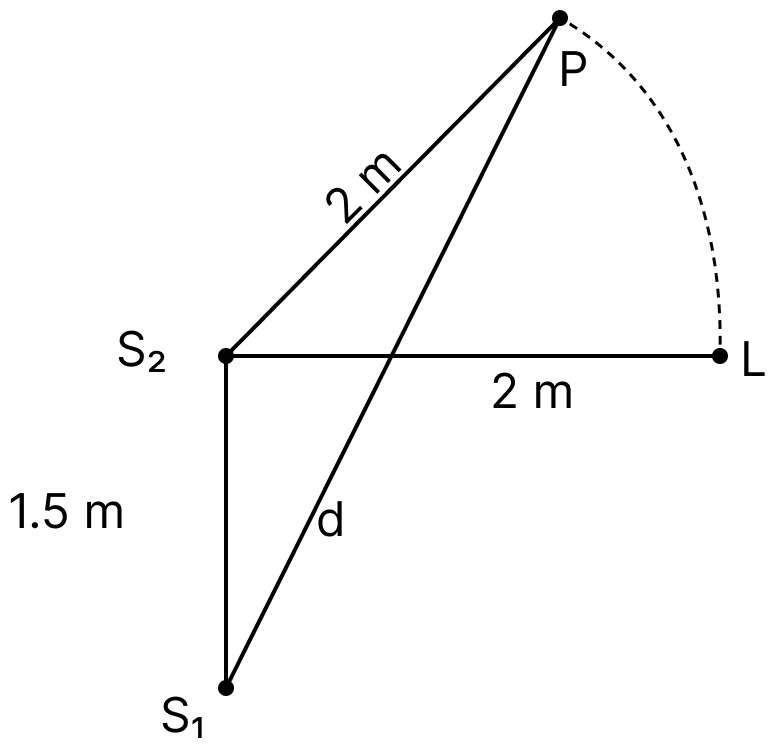
Answer
Given,
- Wavelength, λ = 1 m
- Separation between the sources, S1S2 = 1.5 m
- Distance of L from S2, S2L = 2 m, with S2L perpendicular to S1S2
The sources are coherent and in phase, so the intensity at a point depends only on the path difference Δx between the waves reaching it. Intensity is maximum when Δx = mλ and minimum when Δx = (2m − 1).
At L :
From the right triangle S1S2L,
Path difference at L,
This confirms that L is a point of minimum intensity.
Adjacent maximum :
The listener moves along a circle of radius 2 m about S2, away from S1. His distance from S2 stays 2 m while his distance d from S1 increases, so the path difference increases from . The adjacent maximum is therefore reached when the path difference becomes λ.
Hence, the value of d is 3 m.
Two beams of light of same wavelength and having intensities I and 4I interfere to produce a fringe pattern on a screen. The path difference between the beams is at point P and λ at point Q on the screen. Find the ratio of the resultant intensities at P and Q.
Answer
Given,
- Intensities of the beams, I1 = I and I2 = 4I
- Path difference at P, ΔxP =
- Path difference at Q, ΔxQ = λ
The resultant intensity at a point where the phase difference is ϕ is
and the phase difference is related to the path difference by
At P :
At Q :
Therefore,
Hence, the ratio of the resultant intensities at P and Q is 1 : 9.
The initial phase difference between two interfering waves is 54°. When these waves reach a point on a screen, a path difference of 1.5 λ is introduced between them. What is the total phase difference at that point?
Answer
Given,
- Initial phase difference, ϕ0 = 54°
- Path difference introduced, Δx = 1.5 λ
The initial phase difference in radian is
The phase difference due to the path difference is
The total phase difference at the point is
Hence, the total phase difference at that point is 3.3π rad.
Two slits are 1.0 mm apart and placed at a distance of 1.0 m from a screen. Find fringe-width when light of wavelength 500 nm is used. What would be the fringe-width if the separation between the slits is halved and the distance of the screen from the slits is doubled?
Answer
Given,
- Separation between the slits, d = 1.0 mm = 1.0 × 10⁻³ m
- Distance of the screen, D = 1.0 m
- Wavelength, λ = 500 nm = 500 × 10-9 m
The fringe-width in Young's double-slit experiment is
Substituting the values,
When d is halved and D is doubled :
Here d' = and D' = 2D. Then
Hence, the fringe-width is 0.5 mm, and it becomes 2.0 mm when the slit separation is halved and the screen distance is doubled.
Find the maximum number of possible interference maxima for slit separation equal to twice the wavelength in Young's double-slit experiment.
Answer
Given,
- Slit separation, d = 2λ
The path difference between the waves from the two slits reaching a point at angle θ is d sin θ. For an interference maximum,
Substituting d = 2λ,
Since sin θ cannot exceed 1 in magnitude, n can take only the values
n = −2, −1, 0, 1, 2
(the highest order is nmax = = 2).
Hence, the maximum number of possible interference maxima is 5.
In Young's double-slit experiment, the slits are separated by 0.24 mm. The screen is 1.2 m away from the slits. The fringe-width is 0.3 cm. Find the wavelength of light used.
Answer
Given,
- Separation between the slits, d = 0.24 mm = 0.24 × 10⁻³ m
- Distance of the screen, D = 1.2 m
- Fringe-width, β = 0.3 cm = 0.3 × 10⁻² m
The fringe-width is
so that the wavelength is
Hence, the wavelength of light used is 6000 Å.
In Young's experiment, what will be the phase difference and the path difference between the light waves reaching (i) the third bright fringe and (ii) the third dark fringe from the central fringe? (λ = 6000 Å).
Answer
Given,
- Wavelength, λ = 6000 Å
The phase difference is related to the path difference by
(i) Third bright fringe :
For the mth bright fringe the path difference is mλ. Here m = 3,
(ii) Third dark fringe :
For the mth dark fringe the path difference is (2m − 1). Here m = 3,
Hence, (i) at the third bright fringe the phase difference is 6π rad and the path difference is 18000 Å; (ii) at the third dark fringe the phase difference is 5π rad and the path difference is 15000 Å.
In Young's double-slit experiment, the slits are 0.2 mm apart and the screen is 1.5 m away. The distance between the central bright fringe and the fourth dark fringe is 1.8 cm. Find the wavelength of light used and the fringe width.
Answer
Given,
- Separation between the slits, d = 0.2 mm = 0.2 × 10⁻³ m
- Distance of the screen, D = 1.5 m
- Distance of the fourth dark fringe, x'4 = 1.8 cm = 1.8 × 10⁻² m
Wavelength :
The position of the mth dark fringe with respect to the central bright fringe is
For m = 4,
Fringe width :
Hence, the wavelength of light used is 6857 Å and the fringe width is 5.14 mm.
In Young's double-slit experiment, light of wavelength 5000 Å is used. The third bright band on the screen is formed at a distance of 1 cm from the central bright band. If the screen is at a distance of 1.5 m from the centre of the two narrow slits, calculate the fringe width and the separation between the slits.
Answer
Given,
- Wavelength, λ = 5000 Å = 5 × 10⁻⁷ m
- Distance of the third bright band, x3 = 1 cm = 1 × 10⁻² m
- Distance of the screen, D = 1.5 m
Fringe width :
The mth bright fringe lies at xm = mβ from the central bright band. For m = 3,
Separation between the slits :
From ,
Hence, the fringe width is 3.33 mm and the separation between the slits is 0.225 mm.
The light used in Young's double-slit experiment has a frequency of 6.0 × 10¹⁴ s-1. The distance between the centres of adjacent bright fringes is 0.75 mm. If the screen is 1.5 m away, what is the distance between the slits?
Answer
Given,
- Frequency of light, ν = 6.0 × 10¹⁴ s-1
- Fringe-width, β = 0.75 mm = 0.75 × 10⁻³ m
- Distance of the screen, D = 1.5 m
- Speed of light, c = 3.0 × 10⁸ ms-1
The wavelength of the light is
The distance between the centres of adjacent bright fringes is the fringe-width . Therefore,
Hence, the distance between the slits is 1.0 mm.
A double-slit of separation 0.5 mm is illuminated by blue light of wavelength 480 nm. At what distance should a screen be placed from the double-slit to obtain interference fringes that are 1.0 mm apart? What would be the fringe-width, if this distance be doubled?
Answer
Given,
- Separation between the slits, d = 0.5 mm = 0.5 × 10⁻³ m
- Wavelength, λ = 480 nm = 480 × 10-9 m
- Fringe-width, β = 1.0 mm = 1.0 × 10⁻³ m
Distance of the screen :
From ,
When this distance is doubled :
For a given arrangement the fringe-width is directly proportional to D. With D' = 2D,
Hence, the screen should be placed 104 cm from the double-slit, and the fringe-width becomes 2.0 mm when this distance is doubled.
In Young's experiment, the wavelength of light used is 6000 Å, the distance between two slits is 0.05 cm and the distance of screen from the slits is 1 m. Find out the distance between first dark fringe and first bright fringe.
Answer
Given,
- Wavelength, λ = 6000 Å = 6 × 10⁻⁷ m
- Separation between the slits, d = 0.05 cm = 5 × 10⁻⁴ m
- Distance of the screen, D = 1 m
The fringe-width is
The first bright fringe is at x1 = β and the first dark fringe is at from the central fringe. Therefore, the distance between them is
Hence, the distance between the first dark fringe and the first bright fringe is 0.06 cm.
The fringe-width in Young's experiment, when the separation between the slits is 0.5 mm and the distance of the screen from the slits in 1.5 m, is 1.8 mm. Find the path difference between the interfering waves at the position of first-order maximum.
Answer
Given,
- Separation between the slits, d = 0.5 mm = 0.5 × 10⁻³ m
- Distance of the screen, D = 1.5 m
- Fringe-width, β = 1.8 mm = 1.8 × 10⁻³ m
From , the wavelength is
At the mth maximum the path difference is mλ. For the first-order maximum, m = 1,
Hence, the path difference at the position of first-order maximum is 6 × 10⁻⁷ m.
A double-slit is illuminated by light of wavelength 6000 Å. The slits are 0.1 cm apart and the screen is placed 1 m away. Find the angular position of the 10th maximum in radian and the separation between two adjacent minima.
Answer
Given,
- Wavelength, λ = 6000 Å = 6 × 10⁻⁷ m
- Separation between the slits, d = 0.1 cm = 1 × 10⁻³ m
- Distance of the screen, D = 1 m
Angular position of the 10th maximum :
The angular position of the mth bright fringe is
For m = 10,
Separation between two adjacent minima :
The separation between any two adjacent minima is the fringe-width,
Hence, the angular position of the 10th maximum is 6 × 10⁻³ rad and the separation between two adjacent minima is 0.6 mm.
In Young's double-slit experiment the distance between the centres of the adjacent fringes is 0.10 mm. If the distance of the screen from the slits is doubled, the distance between the slits is halved and the wavelength of light changed from 6.4 × 10⁻⁷ m to 4.0 × 10⁻⁷ m, then what is the new distance between the fringes?
Answer
Given,
- Initial fringe-width, β1 = 0.10 mm
- D2 = 2D1, d2 =
- λ1 = 6.4 × 10⁻⁷ m, λ2 = 4.0 × 10⁻⁷ m
The fringe-width is . Therefore,
So,
Hence, the new distance between the fringes is 0.25 mm.
In Young's double-slit experiment, the slits are 1.5 mm apart and the screen is placed 1 m away from the slits. When the slits are illuminated by monochromatic light, the width of 10 fringes on the screen is measured as 3.93 mm. Find the wavelength of light used. What will be the width of 10 fringes when the screen is placed 1.5 m away from the slits and the same light is used?
Answer
Given,
- Separation between the slits, d = 1.5 mm = 1.5 × 10⁻³ m
- Distance of the screen, D = 1 m
- Width of 10 fringes = 3.93 mm
The fringe-width is
Wavelength :
From ,
Width of 10 fringes at D' = 1.5 m :
For the same light and slits, the fringe-width is directly proportional to D, so
Width of 10 fringes,
Hence, the wavelength of light used is 5895 Å and the width of 10 fringes with the screen 1.5 m away is 5.895 mm.
In an experiment with sodium light (5890 Å), an interference pattern is obtained in which 20 equally spaced fringes occupy 2.30 cm on the screen. On replacing sodium light with another monochromatic source, 30 fringes occupy 2.80 cm on the screen. Find the wavelength of the light from the second source.
Answer
Given,
- Wavelength of sodium light, λ1 = 5890 Å
- 20 fringes occupy 2.30 cm with sodium light
- 30 fringes occupy 2.80 cm with the second source
The fringe-widths in the two cases are
For the same arrangement, the fringe-width is directly proportional to the wavelength. Therefore,
or
Hence, the wavelength of the light from the second source is 4780 Å.
A double-slit is illuminated by sodium light (λ = 5893 Å). In the double-slit the distance between the two slits is 0.050 cm. The interference pattern is obtained on a screen placed at a distance of 1.00 m. Calculate the distance between the fifth bright fringe and 1st dark fringe on the same side of central fringe.
Answer
Given,
- Wavelength, λ = 5893 Å = 5893 × 10-10 m
- Separation between the slits, d = 0.050 cm = 5.0 × 10⁻⁴ m
- Distance of the screen, D = 1.00 m
The distance of the mth bright fringe from the central fringe is
and that of the mth dark fringe is
For the fifth bright fringe, m = 5, and for the first dark fringe, m = 1. On the same side of the central fringe, the distance between them is
Hence, the distance between the fifth bright fringe and the first dark fringe is 0.53 cm.
Note: The textbook prints 1.18 cm, which is incorrect; the separation between the 5th bright and 1st dark fringe is (5 − 1 + )β = 4.5β = 0.53 cm, where β = 0.118 cm.
In Young's double-slit experiment, the slits are 0.05 cm apart and the interference fringes are obtained on a screen 1 m away from the slits. The slits are illuminated by sodium light (5893 Å). Find the distance between 4th bright fringe and 1st dark fringe on the same side of central fringe.
Answer
Given,
- Separation between the slits, d = 0.05 cm = 5 × 10⁻⁴ m
- Distance of the screen, D = 1 m
- Wavelength, λ = 5893 Å = 5893 × 10-10 m
The distance of the mth bright fringe from the central fringe is
and that of the mth dark fringe is
For the 4th bright fringe, m = 4, and for the 1st dark fringe, m = 1. On the same side of the central fringe, the distance between them is
Hence, the distance between the 4th bright fringe and the 1st dark fringe is 4.125 mm.
In Young's double-slit experiment, the separation between the slits is 0.15 mm and the fringes are obtained on a screen distant 0.75 m from the slits. If the third dark fringe is at a distance of 5.5 mm from the central (bright) fringe, find the wavelength of light used. What will be the distance of the same dark fringe from the centre, if the entire apparatus is immersed in water? The refractive index of water is .
Answer
Given,
- Separation between the slits, d = 0.15 mm = 0.15 × 10⁻³ m
- Distance of the screen, D = 0.75 m
- Distance of the third dark fringe, x'3 = 5.5 mm = 5.5 × 10⁻³ m
- Refractive index of water, nw =
Wavelength :
The position of the mth dark fringe is
For m = 3,
or
In water :
When the apparatus is immersed in water, the wavelength decreases to . The same dark fringe is then at
Hence, the wavelength of light used is 4400 Å, and in water the third dark fringe is at 4.125 mm from the centre.
In young's double-slit experiment, the distance between the two slits is 0.1 mm, the distance between the slits and the screen is 1 m and the wavelength of the light used is 600 nm. The intensity at a point on the screen is 75% of the maximum intensity. What is the smallest distance of this point from the central fringe?
Answer
Given,
- Separation between the slits, d = 0.1 mm = 1 × 10⁻⁴ m
- Distance of the screen, D = 1 m
- Wavelength, λ = 600 nm = 6 × 10⁻⁷ m
- Intensity at the point, I = 75% of Im = Im
When the two interfering waves are of the same intensity, the resultant intensity at a point of phase difference ϕ is
where Im is the maximum intensity. Substituting,
taking the smallest value. The corresponding path difference is
At a distance x from the central fringe the path difference is . Therefore,
Hence, the smallest distance of this point from the central fringe is 1 mm.
A mixture of light consisting of two wavelengths 480 nm and 720 nm, illuminates Young's double-slit and gives rise to two overlapping maximum of the two given wavelengths. The central maximum of both lights coincide. Find the minimum distance (along the screen) from central maximum where the maximum of the two wavelengths the coincide. Distance between the two slits is 0.4 mm and distance between slits and screen is 1 m.
Answer
Given,
- λ1 = 480 nm = 480 × 10-9 m
- λ2 = 720 nm = 720 × 10-9 m
- Separation between the slits, d = 0.4 mm = 0.4 × 10⁻³ m
- Distance of the screen, D = 1 m
The position of the mth bright fringe is . Where a maximum of λ1 (order m1) coincides with a maximum of λ2 (order m2),
The first coincidence after the central maximum is for the smallest whole numbers, m1 = 3 and m2 = 2. Its distance from the central maximum is
Hence, the minimum distance from the central maximum where the maxima of the two wavelengths coincide is 3.6 mm.
In the Young's double-slit experiment, the point source is placed slightly off the central axis as shown in figure.
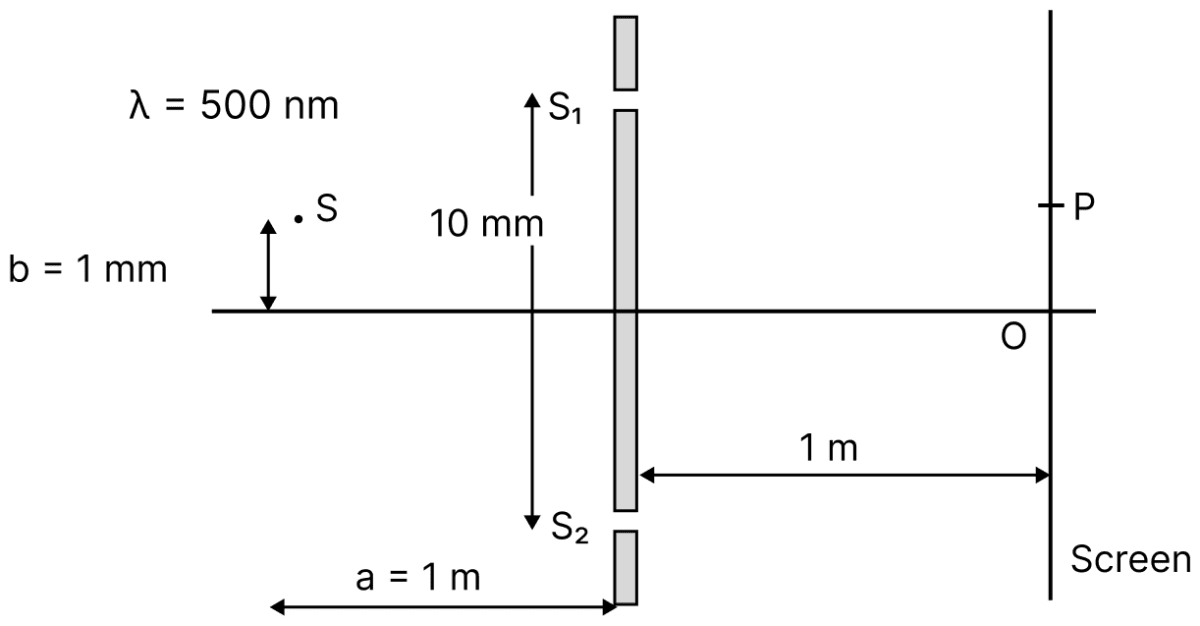
(i) Find the position of central bright fringe from point O.
(ii) Find the nature and order of the interference at point O.
Answer
Given,
- Wavelength, λ = 500 nm = 5 × 10⁻⁷ m
- Height of the source S above the central axis, b = 1 mm = 1 × 10⁻³ m
- Distance of the source from the slits, a = 1 m
- Separation between the slits, d = 10 mm = 1 × 10⁻² m
- Distance of the screen from the slits, D = 1 m
Since S lies above the axis, it is nearer to S1 than to S2, and the waves reach the slits with an initial path difference. At a point P on the screen at a height y above O, the total path difference is
Here,
(i) Position of central bright fringe :
At the central bright fringe, Δ = 0. From Eq. (i),
The negative sign shows that the central bright fringe lies below O.
(ii) Nature and order at O :
At O, y = 0, so from Eq. (i),
Comparing with the wavelength,
so Δ = 20λ, an integral multiple of λ. The interference at O is therefore constructive.
Hence, (i) the central bright fringe is 1 mm below point O; (ii) the interference at O is constructive, and the 20th maximum is formed there.
A parallel beam of white light is incident on the plane of the slits as shown in the given figure.
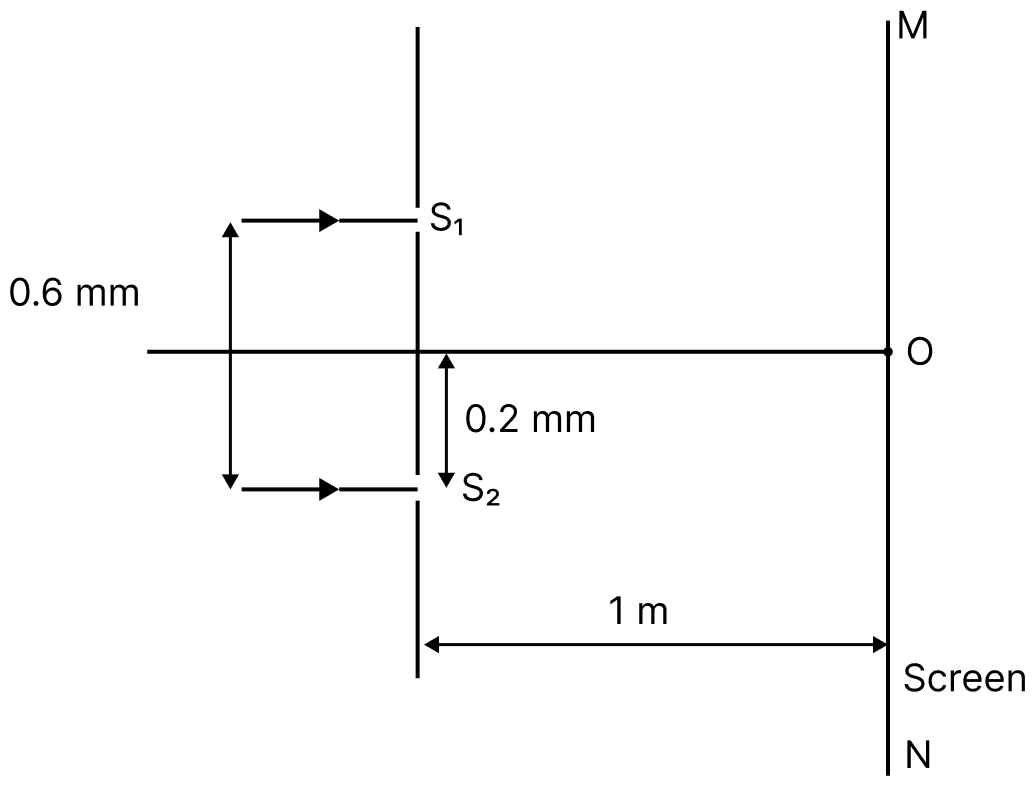
If λ << d, then find the distance of the nearest white spot on the screen from O.
Answer
Given,
- Separation between the slits, d = 0.6 mm
- S2 is 0.2 mm below the line through O, so S1 is 0.4 mm above it
- Distance of the screen, D = 1 m
The beam is parallel and incident on the plane of the slits, so the light reaches S1 and S2 in the same phase. A white spot is formed where the path difference is zero for every wavelength, that is, at the central bright fringe. Since λ << d, this zero-order fringe is the only white one; for all other orders the colours separate.
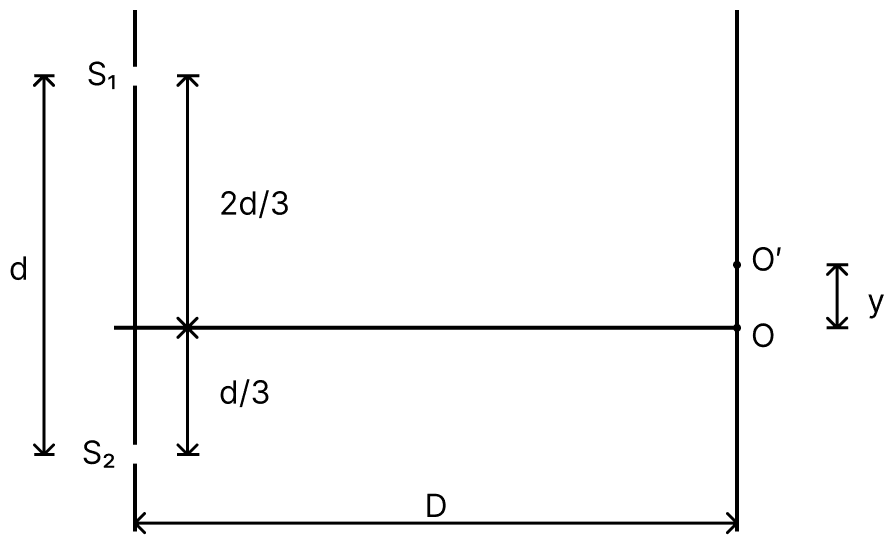
Let O' be the point on the screen, at a distance y from O towards M, where the path difference is zero. In terms of d, S2 is below and S1 is above the line through O. Then
Putting the path difference equal to zero,
Hence, the nearest white spot is at a distance of 0.1 mm from O, towards M.