
Can two independent monochromatic sources of light be coherent? Explain very briefly.
Answer
No. In an ordinary source, light is emitted by innumerable atoms independently, each giving out short wave-pulses lasting about 10-8 s at random instants. The phase of the emitted light therefore varies randomly with time. Hence the phase difference between the waves from two independent sources does not remain constant, and they cannot act as coherent sources or produce a sustained interference pattern.
A beam of monochromatic light of wavelength 500 nm falls on two parallel slits. The distance between the slits is 0.15 mm. Determine the width of the interference fringes on a screen placed at a distance of 1.5 m from the slits.
Answer
Given,
- Wavelength, λ = 500 nm = 500 × 10-9 m
- Distance between the slits, d = 0.15 mm = 0.15 × 10⁻³ m
- Distance of the screen from the slits, D = 1.5 m
The fringe-width in Young's double-slit experiment is
Substituting the values,
Hence, the width of the interference fringes is 5 mm.
In Young's double-slit experiment with monochromatic light how is fringe width affected if :
(i) the separation of the slits is decreased.
(ii) the screen is moved closer to the slits.
Answer
The fringe-width is given by .
(i) Since , decreasing the separation of the slits increases the fringe width.
(ii) Since β ∝ D, moving the screen closer to the slits decreases D, so the fringe width decreases.
Obtain the ratio of the interference fringe widths β1 and β2 obtained with monochromatic red light of λ1 = 660 nm and ultraviolet light of λ2 = 330 nm.
Answer
Given,
- λ1 = 660 nm (red light)
- λ2 = 330 nm (ultraviolet light)
The fringe-width is . For the same D and d, β ∝ λ. Therefore,
Hence, β1 : β2 = 2 : 1.
In Young's double-slit experiment, if white light is used in place of monochromatic light, what changes are observed in the interference pattern?
Answer
With white light, the interference pattern consists of a central white fringe, a few coloured fringes on both sides of it, and then a general (uniform) white illumination.
At the centre the path difference is zero for all wavelengths, so every colour forms a bright fringe there and their superposition makes the central fringe white. Since is different for different colours, the fringes of different colours separate on either side. The first minimum occurs first for violet (shortest wavelength), so the inner edge of the first dark fringe is reddish and its outer edge is violet. Far from the centre, many wavelengths give maxima and an equal number give minima at each point, so uniform white illumination results.
What are the conditions necessary for sustained interference?
In Young's double-slit experiment, the distance of the 4th bright fringe from the centre of the screen is 1.5 mm. The distance between the slits and the screen is 1.5 m and the distance between the slits is 2 mm. Find the wavelength of light used.
Answer
Conditions for sustained interference :
(i) The two sources should be coherent, that is, they should emit light waves having a sharply defined phase difference that remains constant with time.
(ii) The waves from the two sources should have the same frequency.
(iii) The separation d between the two sources should be small and the distance D of the screen from them should be large, so that the fringes are widely spaced.
(iv) The amplitudes of the interfering waves should be equal or very nearly equal, for good contrast.
(v) The two sources should be narrow.
Wavelength of light used :
Given,
- Distance of the 4th bright fringe from the centre, x4 = 1.5 mm = 1.5 × 10⁻³ m
- Distance between the slits and the screen, D = 1.5 m
- Distance between the slits, d = 2 mm = 2 × 10⁻³ m
The distance of the mth bright fringe from the centre is
For m = 4,
Hence, the wavelength of light used is 500 nm.
In a Young's double-slit experiment with monochromatic light, fringes are obtained on a screen placed at a distance D from the slits. If the screen is moved by 5 × 10⁻² m towards the slits, the change in the frindth is 3 × 10⁻⁵ m. If the distance between the slits is 10-3 m, calculate the wavelength of the light used.
Answer
Given,
- Distance moved by the screen towards the slits = 5 × 10⁻² m
- Change in fringe-width, β − β′ = 3 × 10⁻⁵ m
- Distance between the slits, d = 10-3 m
With the screen at a distance D, the fringe-width is
When the screen is moved 5 × 10⁻² m towards the slits, the fringe-width becomes
Subtracting Eq. (ii) from Eq. (i),
Hence, the wavelength of the light used is 600 nm.
(i) Derive an expression for the fringe width in Young's double-slit experiment. Use λ as the wavelength of the monochromatic source, D as the distance of the screen from the slits and d as the distance of separation between the slits.
(ii) How does the fringe pattern change if the monochromatic source of light in the above experiment is replaced by a white source of light?
Answer
(i) Expression for fringe-width :
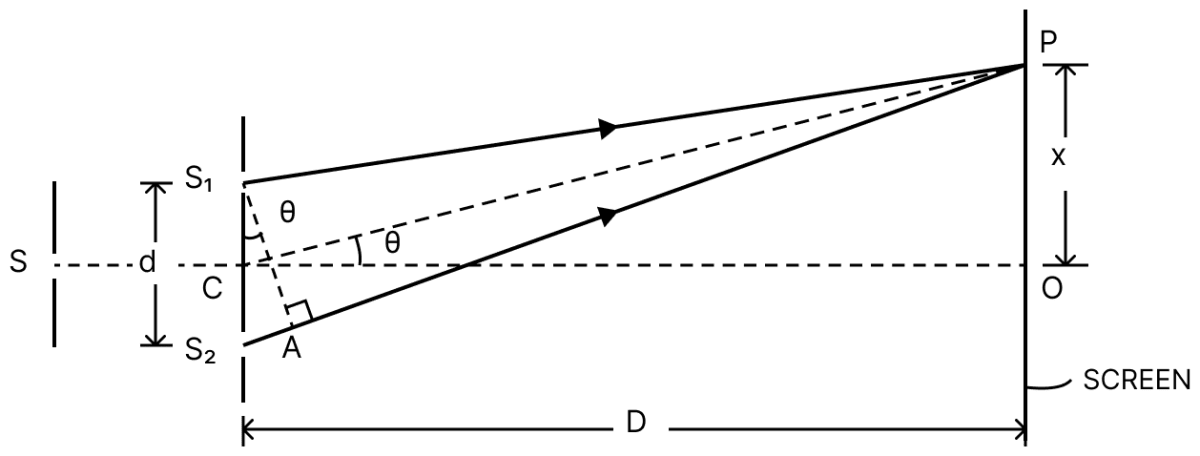
Let S be a narrow slit illuminated by monochromatic light of wavelength λ, and let S1 and S2 be two narrow parallel slits, equidistant from S and separated by a distance d. Light waves from S reach S1 and S2 in the same phase, so S1 and S2 act as coherent sources. The screen is placed at a distance D from the slits, with D much larger than d. The perpendicular bisector CO of S1S2 meets the screen at O, where the waves arrive in the same phase and form the central bright fringe.
Path difference : Consider a point P on the screen at a distance x from O. Draw S1A perpendicular to S2P, so that S1P = AP. The path difference between the waves reaching P is
Let θ be the angle which CP makes with CO. From the right triangle S1AS2 and the right triangle POC,
As θ is small, sin θ ≈ tan θ. Hence,
Positions of bright fringes : The intensity at P is maximum when the path difference is zero or an integral multiple of λ,
Fringe-width : The fringe-width β is the distance between two consecutive bright fringes. Using Eq. (ii) for the (m + 1)th and the mth bright fringes,
The intensity at P is minimum when the path difference is an odd multiple of , which gives the mth dark fringe at . Consecutive dark fringes are therefore also apart, so bright and dark fringes have the same width.
Hence, the fringe-width in Young's double-slit experiment is .
(ii) With a white source of light : The fringe pattern consists of a central white fringe with a few coloured fringes on either side, followed by a general white illumination. At the centre the path difference is zero for every wavelength, so all colours give a bright fringe there and it appears white. Elsewhere, since differs for different colours, the fringes of different colours separate and the fringes appear coloured.
The distance between the first and the sixth bright fringes formed in Young's double-slit experiment is found to be 12.5 mm. The separation between the slits is 0.12 mm and the distance of the screen from the slits is 60 cm. Calculate :
(i) the fringe width,
(ii) the wavelength of the light used (in nm).
Answer
Given,
- Distance between the 1st and the 6th bright fringes = 12.5 mm
- Separation between the slits, d = 0.12 mm = 0.12 × 10⁻³ m
- Distance of the screen from the slits, D = 60 cm = 0.60 m
(i) Fringe width :
The distance of the mth bright fringe from the central fringe is . Therefore,
(ii) Wavelength of light :
From ,
Hence, the fringe width is 2.5 mm and the wavelength of the light used is 500 nm.
What is the effect, if any, on the fringe width in Young's double-slit experiment if red light is used in place of violet light?
Answer
The fringe width increases.
Explanation:
The fringe-width is , so for the same arrangement β ∝ λ. Red light has a longer wavelength than violet light, hence the fringes become wider.
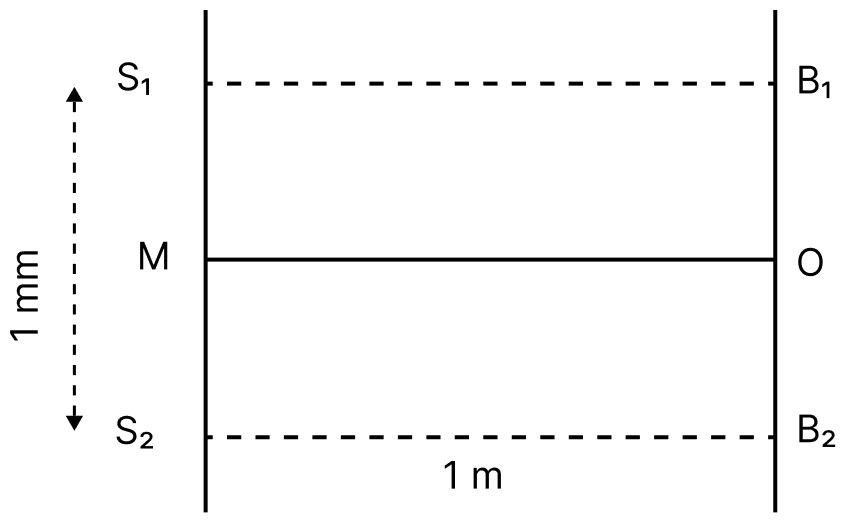
Figure shows the position of the first bright fringes B1 and B2 on either side of central bright fringe O in Young's double-slit experiment. Find the wavelength of monochromatic light used.
Answer
Given,
- Separation between the slits, d = S1S2 = 1 mm = 1 × 10⁻³ m
- Distance of the screen from the slits, D = 1 m
From the figure, the central bright fringe O lies opposite the mid-point M of S1S2, while the first bright fringes B1 and B2 lie directly opposite S1 and S2. Hence,
The distance of the first bright fringe from the central fringe is , which is the fringe-width β. So β = 0.5 mm = 0.5 × 10⁻³ m.
From ,
Hence, the wavelength of the monochromatic light used is 500 nm.
In Young's double-slit experiment, what is meant by 'fringe width' or 'fringe separation'? State two ways of increasing the fringe width, without changing the source of light.
Answer
Fringe width : The distance between two consecutive bright fringes, or between two consecutive dark fringes, on the screen is called the fringe width (fringe separation). It is given by
where D is the distance of the screen from the slits and d is the separation between the slits.
Two ways of increasing the fringe width (λ unchanged) :
(i) Increase D, by moving the screen farther away from the slits.
(ii) Decrease d, by bringing the two slits closer to each other.
Can two sodium vapour lamps act as coherent sources? Explain in brief.
Answer
No. Two sodium vapour lamps are independent sources. In each lamp, light is emitted by a very large number of atoms independently, as short wave-pulses at random instants, so the phase of the emitted light varies randomly with time. The phase difference between the light from the two lamps therefore does not remain constant, and they cannot act as coherent sources.
In Young's double-slit experiment, what is the path difference between the two light waves, forming 5th bright band (fringe) on the screen?
Answer
5λ
Explanation:
For the mth bright fringe, the path difference between the two waves is mλ, where m = 0 for the central bright fringe. For the 5th bright fringe m = 5, so the path difference is 5λ, where λ is the wavelength of the light used.
State the essential condition for obtaining sustained interference of light.
Answer
The two sources must be coherent, that is, they must emit light waves of the same frequency having a phase difference that remains constant with time.
In Young's double-slit experiment, using monochromatic light, L1 of wavelength 700 nm, 10th bright fringe is obtained at a certain point P on a screen. Which bright fringe will be obtained at the same point P if monochromatic light of wavelength 500 nm is used in place of L1. (No other alterations were made in the experiment set-up).
Answer
Given,
- With light L1 : m1 = 10, λ1 = 700 nm
- With the second light : λ2 = 500 nm, m2 = ?
The position of the mth bright fringe is
For the same point P, x is constant, and for the same arrangement is constant. Hence mλ is constant,
Hence, the 14th bright fringe will be obtained at the point P.
In Young's double-slit experiment, using monochromatic light at wavelength 600 nm, interference pattern was obtained on a screen kept 1.5 m away from the plane of the two slits. Calculate the distance between the two slits, if fringe separation/fringe width was found to be 1.0 mm.
Answer
Given,
- Wavelength, λ = 600 nm = 600 × 10-9 m
- Distance of the screen from the slits, D = 1.5 m
- Fringe width, β = 1.0 mm = 1.0 × 10⁻³ m
From , the distance between the slits is
Substituting the values,
Hence, the distance between the two slits is 9 × 10⁻⁴ m (0.9 mm).
With the help of a labelled diagram, show that fringe separation β in Young's double-slit experiment is given by , where terms have their usual meaning.
Answer
Let S be a narrow slit illuminated by monochromatic light of wavelength λ, and let S1 and S2 be two narrow parallel slits, equidistant from S and separated by a distance d. Light waves from S reach S1 and S2 in the same phase, so S1 and S2 act as coherent sources. The screen is placed at a distance D from the slits, with D much larger than d. The perpendicular bisector CO of S1S2 meets the screen at O, where the waves arrive in the same phase and form the central bright fringe.
Path difference : Consider a point P on the screen at a distance x from O. Draw S1A perpendicular to S2P, so that S1P = AP. The path difference between the waves reaching P is
Let θ be the angle which CP makes with CO. From the right triangle S1AS2 and the right triangle POC,
As θ is small, sin θ ≈ tan θ. Hence,
Positions of bright fringes : The intensity at P is maximum when the path difference is zero or an integral multiple of λ,
Fringe-width : The fringe-width β is the distance between two consecutive bright fringes. Using Eq. (ii) for the (m + 1)th and the mth bright fringes,
The intensity at P is minimum when the path difference is an odd multiple of , which gives the mth dark fringe at . Consecutive dark fringes are therefore also apart, so bright and dark fringes have the same width.
Hence, the fringe-width in Young's double-slit experiment is .
In Young's double slit experiment, show graphically how intensity of light varies with distance.
Answer
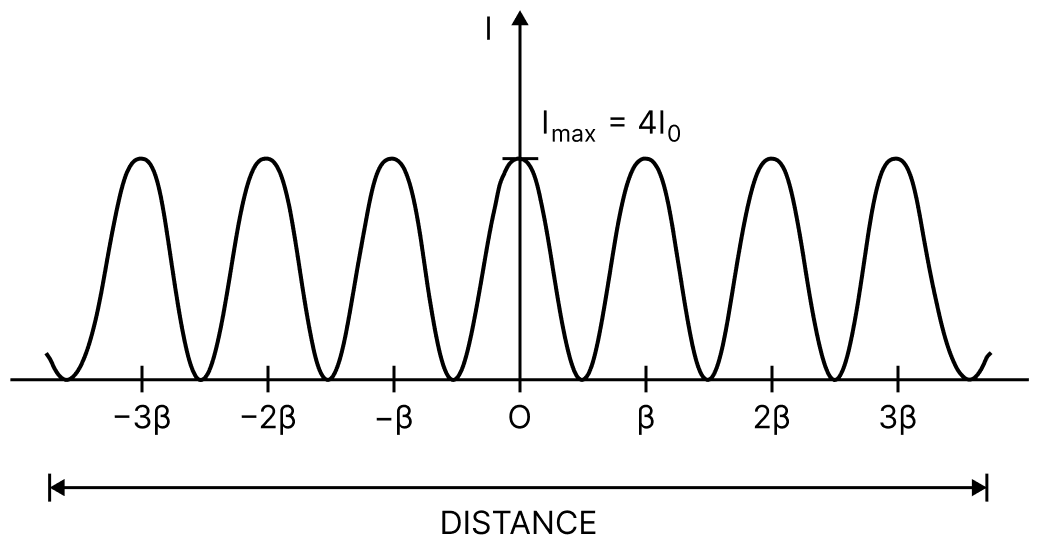
If each slit gives light of intensity I0, the resultant intensity at a point where the phase difference is φ is
At a distance x from the centre O of the screen, the path difference is , so . Using ,
Thus the intensity varies as cos2 with distance from O :
- maxima of equal intensity 4I0 at x = 0, ± β, ± 2β, ...
- minima of zero intensity at x = , ...
The bright and dark fringes are equally spaced and are situated alternately and symmetrically on both sides of the central bright fringe at O.
What should be the path difference between two waves reaching a point for obtaining constructive interference in Young's double-slit experiment?
Answer
Path difference = mλ, where m = 0, 1, 2, ...
Explanation:
Constructive interference takes place where the two waves meet in the same phase, that is, the phase difference is φ = 2mπ. Since path difference = × phase difference, the path difference must be zero or an integral multiple of the wavelength λ (0, λ, 2λ, ...).
In Young's double-slit experiment the screen is kept at a distance of 1.2 m from the plane of the slits. The two slits are separated by 5 mm and illuminated with monochromatic light having wavelength 600 nm. Calculate :
(i) fringe width, i.e., fringe separation of the interference pattern.
(ii) distance of 10th bright fringe from the centre of the pattern.
Answer
Given,
- Distance of the screen from the slits, D = 1.2 m
- Separation between the slits, d = 5 mm = 5 × 10⁻³ m
- Wavelength, λ = 600 nm = 600 × 10-9 m
(i) Fringe width :
(ii) Distance of the 10th bright fringe :
The distance of the mth bright fringe from the centre is . For m = 10,
Hence, the fringe width is 0.144 mm and the 10th bright fringe is 1.44 mm from the centre of the pattern.
Define coherent sources of light.
Answer
Two sources of light are said to be coherent if they emit light waves of the same frequency having a sharply defined phase difference that remains constant with time.
Derive an expression for the fringe-width in Young's double-slit experiment. Use λ as the wavelength of the monochromatic source, D as the distance of the screen from the slits and d as the separation between the slits.
Answer
Let S be a narrow slit illuminated by monochromatic light of wavelength λ, and let S1 and S2 be two narrow parallel slits, equidistant from S and separated by a distance d. Light waves from S reach S1 and S2 in the same phase, so S1 and S2 act as coherent sources. The screen is placed at a distance D from the slits, with D much larger than d. The perpendicular bisector CO of S1S2 meets the screen at O, where the waves arrive in the same phase and form the central bright fringe.
Path difference : Consider a point P on the screen at a distance x from O. Draw S1A perpendicular to S2P, so that S1P = AP. The path difference between the waves reaching P is
Let θ be the angle which CP makes with CO. From the right triangle S1AS2 and the right triangle POC,
As θ is small, sin θ ≈ tan θ. Hence,
Positions of bright fringes : The intensity at P is maximum when the path difference is zero or an integral multiple of λ,
Fringe-width : The fringe-width β is the distance between two consecutive bright fringes. Using Eq. (ii) for the (m + 1)th and the mth bright fringes,
The intensity at P is minimum when the path difference is an odd multiple of , which gives the mth dark fringe at . Consecutive dark fringes are therefore also apart, so bright and dark fringes have the same width.
Hence, the fringe-width in Young's double-slit experiment is .
Note: The textbook prints "Ans. 5λ." against this question; that value is the answer to Question 14 and does not apply to this derivation.
State why two head lamps of a car cannot act as coherent sources?
Answer
The two head lamps of a car are independent sources of light. In each lamp, light is emitted by innumerable atoms independently, as short wave-pulses at random intervals, so the phase of the emitted light changes randomly with time. Hence the phase difference between the light waves from the two lamps does not remain constant with time, and they cannot act as coherent sources.
Monochromatic light of wavelength 620 nm is incident on a pair of slits which are separated by 1.5 mm. If the screen is kept 60 cm away from the plane of the two slits, calculate :
(i) fringe separation, i.e., fringe width.
(ii) distance of the 10th bright fringe from the centre of the interference pattern.
Answer
Given,
- Wavelength, λ = 620 nm = 620 × 10-9 m
- Separation between the slits, d = 1.5 mm = 1.5 × 10⁻³ m
- Distance of the screen from the slits, D = 60 cm = 0.60 m
(i) Fringe width :
(ii) Distance of the 10th bright fringe :
Hence, the fringe width is 2.48 × 10⁻⁴ m and the 10th bright fringe is 2.48 × 10⁻³ m from the centre of the pattern.
If in Young's double-slit interference experiment, the distance between the two slits is made three times, keeping all other conditions same, then the fringe width becomes :
- one third
- one ninth
- nine times
- three times
Answer
one third
Reason — The fringe-width is , so when D and λ are unchanged. Making the slit separation 3d therefore makes the fringe width , that is, one third of its earlier value.
In Young's double-slit experiment, the distance of the 4th bright fringe from the centre of the interference pattern is 1.5 mm. The distance between the slits and screen is 1.5 m and the wavelength of light used is 500 nm. Calculate the distance between the two slits.
Answer
Given,
- Distance of the 4th bright fringe from the centre, x4 = 1.5 mm = 1.5 × 10⁻³ m
- Distance between the slits and the screen, D = 1.5 m
- Wavelength, λ = 500 nm = 500 × 10-9 m
The distance of the mth bright fringe from the centre is
For m = 4,
Hence, the distance between the two slits is 2 mm.
Read the given passage and answer the questions that follow :
Interference of light was discovered in the year 1801 by a British physicist Thomas Young. He illuminated two identical rectangular slits with a monochromatic light. On a distant screen, he obtained a series of altermate bright and dark bands, which were of same width. In the same year, diffraction of light was discovered by a German scientist Fraunhofer. He, however, used a single slit and obtained bright and dark bands on a screen. Scientists of that era tried to explain these two phenomena on the basis of Newton's Corpuscular theory of light but they could not. These phenomena were later explained successfully by Huygen's wave theory.
(i) What is the nature of light as seen in interference and diffraction of light?
(ii) Describe the interference pattern obtained in Young's double-slit experiment.
(iii) What type of fringe / band is obtained on a screen as a result of destructive interference?
(iv) Both Young and Fraunhofer obtained bright bands in their experiments. What is the difference between bright bands obtained by Young and Fraunhofer?
(v) When two light waves overlap and produce a dark band, is energy of light waves destroyed? Explain in brief.
Answer
(i) Interference and diffraction show the wave nature of light.
(ii) The pattern consists of alternate bright and dark fringes running parallel to the slits, all of equal width . The central fringe is bright. The bright fringes are all of equal intensity, while with identical slits the dark fringes are of zero intensity. The fringes lie symmetrically on both sides of the central bright fringe.
(iii) Destructive interference produces a dark fringe (band) of minimum intensity.
(iv) In Young's double-slit experiment all the bright fringes have the same width and the same intensity. In Fraunhofer's single-slit diffraction pattern, the central bright band is the widest and the most intense, and the intensity of the other bright bands decreases rapidly on going away from the centre.
(v) No. Energy is not destroyed; it is only redistributed. The energy that disappears from the dark bands appears at the bright bands, where the intensity is greater than the sum of the separate intensities. The average intensity over the pattern equals the sum of the separate intensities of the two waves, so energy is conserved in interference.