
Young's double-slit experiment is first performed in air and then in a medium other than air. It is found that 8th bright fringe in the medium lies where 5th dark fringe lies in air. The refractive index of the medium is nearly :
- 1.25
- 1.59
- 1.69
- 1.78
Answer
1.78
Reason — In the medium the wavelength becomes , so the 8th bright fringe lies at . In air the 5th dark fringe lies at . Equating,
In a Young's double-slit experiment, slits are separated by 0.5 mm, and the screen is placed 150 cm away. A beam of light consisting of two wavelengths, 650 nm and 520 nm, is used to obtain interference fringes on the screen. The least distance from the common central maximum to the point where the bright fringes due to both the wavelengths coincide is :
- 15.6 mm
- 1.56 mm
- 7.8 mm
- 9.75 mm
Answer
7.8 mm
Reason — The bright fringes coincide when , so
The least distance corresponds to the smallest integers, n1 = 4 and n2 = 5. The least distance is the position of the 4th bright fringe of 650 nm,
In Young's double-slit experiment the separation d between the slits is 2 mm, the wavelength λ of the light used is 5896 Å and distance D between the screen and slits is 100 cm. It is found that the angular width of the fringes is 0.20°. To increases the fringe angular width to 0.21° (with same λ and D) the separation between the slits needs to be changed to :
- 1.8 mm
- 1.7 mm
- 2.1 mm
- 1.9 mm
Answer
1.9 mm
Reason — The angular fringe-width is , so with λ unchanged ,
In a Young's double-slit experiment, the slits are placed 0.320 mm apart. Light of wavelength λ = 500 nm is incident on the slits. The total number of bright fringes that are observed in the angular range −30° ≤ θ ≤ 30° is :
- 320
- 641
- 321
- 640
Answer
641
Reason — For a bright fringe, d sin θ = mλ. At θ = 30°,
Bright fringes occur for m = 0, ± 1, ± 2, ..., ± 320, so their total number is 320 + 1 + 320 = 641.
In a Young's double-slit experiment, the path difference, at a certain point on the screen between two interfering waves is th of wavelength. The ratio of the intensity at this point to that at the centre of a bright fringe is close to :
- 0.94
- 0.74
- 0.85
- 0.80
Answer
0.85
Reason — The phase difference is
With ,
In a Young's double-slit experiment, the ratio of the slits width is 4 : 1. The ratio of the intensity of maxima to minima, close to the central fringe on the screen, will be :
- 25 : 9
- 4 : 1
- : 16
- 9 : 1
Answer
9 : 1
Reason — The intensity of light from a slit is proportional to its width, so I1 = 4I0 and I2 = I0.
Hence, Imax : Imin = 9 : 1.
In a Young's double-slit experiment with slit separation 0.1 mm, one observes a bright fringe at angle radian by using light of wavelength λ1. When the light of wavelength λ2 is used, a bright fringe is seen at the same angle in the same set up. Given that λ1 and λ2 are invisible range (380 nm to 740 nm), their values are :
- 380 nm, 500 nm
- 625 nm, 500 nm
- 380 nm, 525 nm
- 400 nm, 500 nm
Answer
625 nm, 500 nm
Reason — The path difference at angle θ is
For a bright fringe this must equal mλ, so nm. Within 380 nm to 740 nm this gives 625 nm (m = 4), 500 nm (m = 5) and 416.7 nm (m = 6). Of the given options, only 625 nm and 500 nm are both such values.
Note: "invisible range" in the question is a misprint for "in visible range"; the bracketed range 380 nm to 740 nm is the visible range used above.
In a Young's double-slit experiment, when light of wavelength 400 nm was used, the angular width of the first minima formed on a screen placed 1 m away, was found to be 0.2°. What will be the angular width of the first minima, if the entire experimental apparatus is immersed in water? (nwater = )
- 0.05°
- 0.1°
- 0.266°
- 0.15°
Answer
0.15°
Reason — The angular fringe-width is . In water the wavelength becomes , so
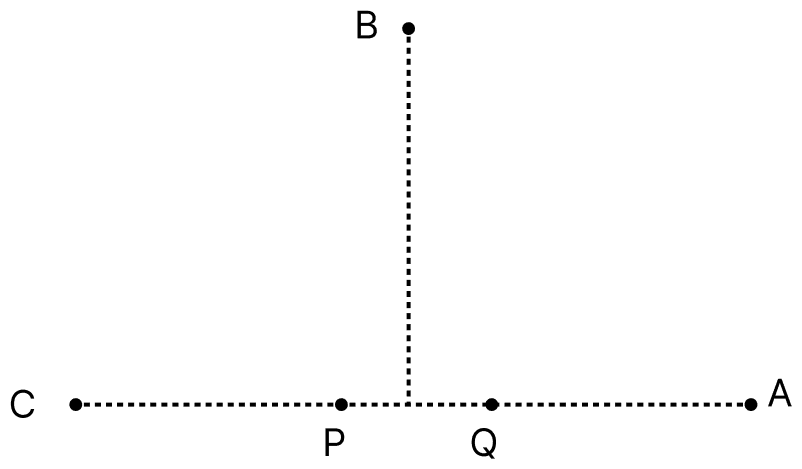
In the given figure, P and Q are two equally intense coherent sources emitting radiation of wavelength 20 m. The separation between P and Q is 5 m and the phase of P is ahead of that of Q by 90°. A, B and C are three distinct points of observation, each equidistant from the midpoint of PQ. The intensities of radiation at A, B, C will be in the ratio :
- 0 : 1 : 2
- 4 : 1 : 0
- 2 : 1 : 0
- 0 : 1 : 4
Answer
2 : 1 : 0
Reason — For two sources of equal intensity I0, . The separation PQ = 5 m = corresponds to a phase difference of .
At A (beyond Q), the wave from P travels 5 m farther, which cancels the 90° lead of P : φA = = 0, so IA = 4I0.
At B (equidistant from P and Q), φB = , so IB = 4I0 cos2 = 2I0.
At C (beyond P), the wave from Q travels 5 m farther : φC = = π, so IC = 0.
Hence, IA : IB : IC = 4I0 : 2I0 : 0 = 2 : 1 : 0.
Interference fringes are observed on a screen by illuminating two thin slits 1 mm apart with a light source (λ = 632.8 nm). The distance between the screen and the slits is 100 cm. If a bright fringe is observed on a screen at a distance of 1.27 mm from the central bright fringe, then the path difference between the waves, which are reaching this point from the slits is close to :
- 1.27 μm
- 2.05 μm
- 2.87 nm
- 2 nm
Answer
1.27 μm
Reason — The path difference at a distance y from the central bright fringe is
Two coherent sources of light interfere and produce fringe pattern on a screen. For central maximum, the phase difference between the two waves will be :
- zero
- π
Answer
zero
Reason — At the central maximum the path difference is zero, so the phase difference is .
Two coherent, light sources having intensities in the ratio 2x produce an interference pattern. The ratio will be :
Answer
Reason — Let I1 = 2x and I2 = 1. Using and ,
The two light beams having intensities I and 9I interfere to produce a fringe pattern on a screen. The phase difference between the beams is at point P and π at point Q. Then the difference between the resultant intensities at P and Q will be :
- 2I
- 6I
- 5I
- 7I
Answer
6I
Reason — Using with I1 = I and I2 = 9I,
A double-slit setup is shown in the figure. One of the slits is in medium 2 of refractive index n2. The other slit is at the interface of this medium with another medium 1 of refractive index n1 (≠ n2). The line joining the slits is perpendicular to the interface and the distance between the slits is d. The slit widths are much smaller than d. A monochromatic parallel beam of light is incident on the slits from medium 1. A detector is placed in medium 2 at a large distance from the slits, and at an angle θ from the line joining them, so that θ equals the angle of refraction of the beam. Consider two approximately parallel rays from the slits received by the detector.
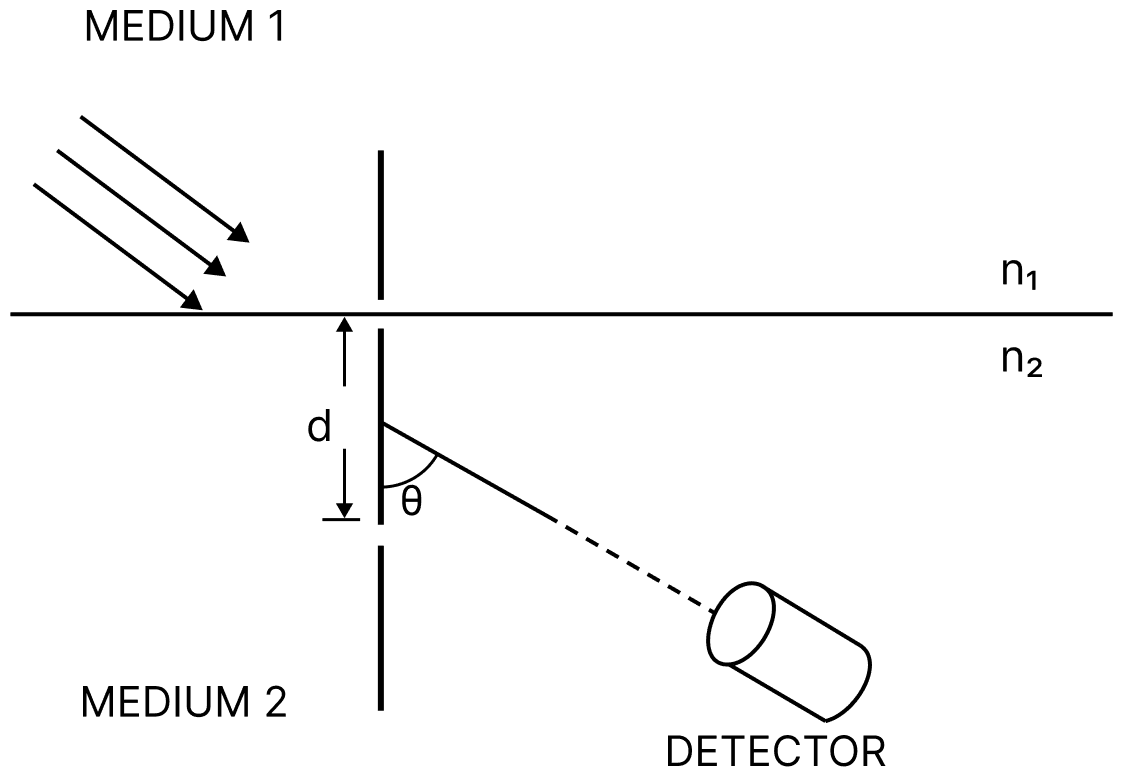
Which of the following statement (s) is (are) correct?
- The phase difference between the two rays is independent of d.
- The two rays interfere constructively at the detector.
- The phase difference between the two rays depends on n1 but is independent of n2.
- The phase difference between the two rays vanishes only for certain values of d and the angle of incidence of the beam, with θ being the corresponding angle of refraction.
Answer
The phase difference between the two rays is independent of d.
The two rays interfere constructively at the detector.
Reason — Let S1 be the slit at the interface and S2 the slit at a distance d from it in medium 2. In medium 2 the refracted beam travels at the angle of refraction θ to the line S1S2.
Before the slits, measured from the refracted wavefront through S1, the wave reaching S2 travels an extra distance d cos θ in medium 2. After the slits, the detector lies along the same direction θ, so the ray from S1 travels the extra distance d cos θ in medium 2. The net optical path difference is
The phase difference is therefore zero for every value of d, n1 and n2. It is independent of d and the rays interfere constructively, so statements 1 and 2 are correct, while statements 3 and 4 are incorrect.
In a Young's double-slit experiment, a student observes 8 fringes in a certain segment of screen when a monochromatic light of 600 nm wavelength is used. If the wavelength of light is changed to 400 nm, then the number of fringes he would observe in the same region of the screen is :
- 12
- 6
- 8
- 9
Answer
12
Reason — The number of fringes in a given segment of length l is . Since β ∝ λ, the number of fringes is inversely proportional to λ,
In a Young's double-slit experiment, two slits are illuminated with a light of wavelength 800 nm. The line joining A1P is perpendicular to A1A2 as shown in the figure. If the first minimum is detected at P, the value of slits separation 'a' will be :
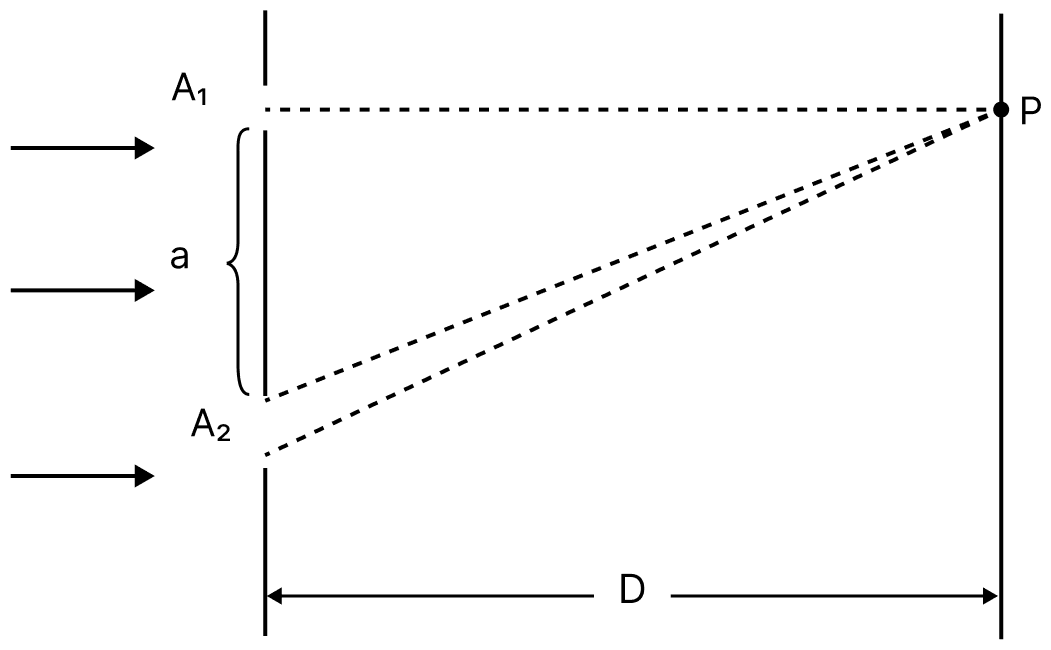
(The distance of screen from slits, D = 5 cm.)
- 0.4 mm
- 0.2 mm
- 0.5 mm
- 0.1 mm
Answer
0.2 mm
Reason — As P lies directly opposite A1, the path difference at P is . For the first minimum this equals ,
For Young's double-slit experiment, two statements are given here :
Statement I : If screen moved away from the plane of slits, angular separation of the fringes remains constant.
Statement II : If the monochromatic source is replaced by another monochromatic source of larger wavelength, the angular separation of fringes decreases.
In the light of the above statements, choose the correct answer from the options given below :
- Statement I is true but Statement II is false.
- Statement I is false but Statement II is true.
- Both Statement I and Statement II are true.
- Both Statement I and Statement II are false.
Answer
Statement I is true but Statement II is false.
Reason — The angular fringe-width is . It does not depend on D, so Statement I is true. It increases with λ, so a source of larger wavelength increases the angular separation, and Statement II is false.
In Young's double-slit experiment, light from two identical sources are superimposing on a screen. The path difference between the two lights reaching at a point on the screen is . The ratio of intensity of fringe at this point with respect to the maximum intensity of the fringe is :
Answer
Reason — The phase difference is . With ,
If the monochromatic source in Young's double slit experiment is replaced by white light, then
- interference pattern will disappear.
- there will be a central dark fringe surrounded by a few coloured fringes.
- there will be a central bright white fringe surrounded by a few coloured fringes.
- all bright fringes will be of equal width.
Answer
there will be a central bright white fringe surrounded by a few coloured fringes.
Reason — At the centre the path difference is zero for every wavelength, so all the colours give a bright fringe there and it appears white. Since differs for different colours, the fringes on either side separate into a few coloured fringes.
A Young's double-slit experiment is performed using monochromatic light of wavelength λ. The intensity of light at a point on the screen, where the path difference is λ, is K units. The intensity of light at a point where the path difference is is given by , where n is an integer. The value of n is ............... .
Answer
Given,
- Intensity at the point where the path difference is λ, I = K
- Path difference at the second point =
For two waves of equal intensity I0, the resultant intensity at a point where the phase difference is φ is
At path difference λ : φ = 2π, so
At path difference :
Comparing with , n = 9.
Hence, the value of n is 9.
In Young's double-slit experiment, monochromatic light of wavelength 5000 Å is used. The slits are 1.0 mm apart and screen is placed at 1.0 m away from slits. The distance from the centre of the screen where intensity becomes half of the maximum intensity for the first time is ............... × 10-6 m.
Answer
Given,
- Wavelength, λ = 5000 Å = 5 × 10⁻⁷ m
- Separation between the slits, d = 1.0 mm = 1.0 × 10⁻³ m
- Distance of the screen from the slits, D = 1.0 m
The intensity at a point where the phase difference is φ is
For ,
The corresponding path difference is
At a distance y from the centre of the screen, . Therefore,
Hence, the required distance is 125 × 10-6 m, so the blank is 125.
In a Young's double-slit experiment, each of the two slits A and B, as shown in the figure, are oscillating about their fixed centre and with a mean separation of 0.8 mm. The distance between the slits at time t is given by d = (0.8 + 0.04 sin ωt) mm, where ω = 0.08 rad s-1. The distance of the screen from the slits is 1 m and the wavelength of the light used to illuminate the slits is 6000 Å. The interference pattern on the screen changes with time, while the central bright fringe (zeroth fringe) remains fixed at point O.
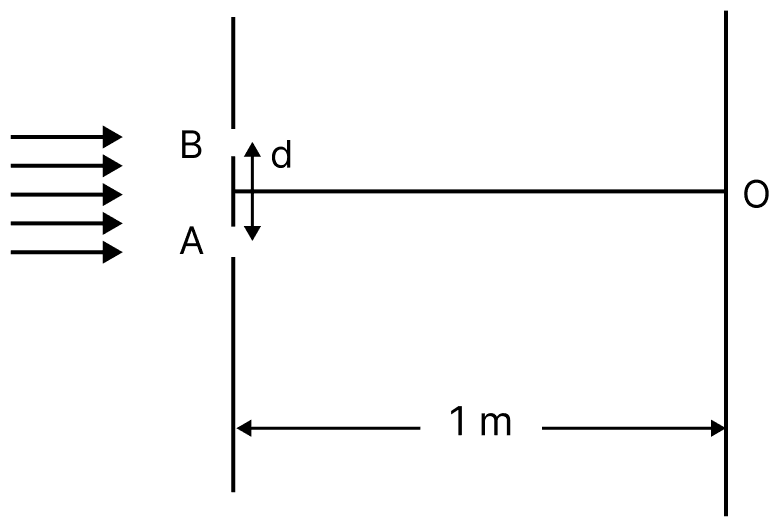
(i) The 8th bright fringe above the point O oscillates with time between two extreme positions. The separation between these two extreme positions in micrometer (μm), is ............... .
(ii) The maximum speed in μm/s at which the 8th bright fringe will move is ............... .
Answer
Given,
- Separation between the slits, d = (0.8 + 0.04 sin ωt) mm
- ω = 0.08 rad s-1
- Distance of the screen from the slits, D = 1 m
- Wavelength, λ = 6000 Å = 6 × 10⁻⁷ m
The distance of the mth bright fringe from O is . For the 8th bright fringe,
(i) Separation between the extreme positions :
As sin ωt varies between −1 and +1, d varies between
From Eq. (i), y is largest when d is smallest. Hence,
(ii) Maximum speed of the 8th bright fringe :
Differentiating Eq. (i) with respect to time, with λ and D constant,
Differentiating d = (0.8 + 0.04 sin ωt) mm,
This is maximum when cos ωt = 1, that is, sin ωt = 0, when d = 0.8 mm. Since d varies by only ±0.04 mm about 0.8 mm, the variation of d2 in Eq. (ii) may be neglected and d ≈ 0.8 mm used. Then,
Substituting in Eq. (ii), the magnitude of the maximum speed is
Hence, (i) the separation between the two extreme positions is 601.5 μm and (ii) the maximum speed of the 8th bright fringe is 24 μm/s.
Note: The exact maximum of |v|, without this approximation, is about 24.1 μm/s.