
Name the physical principle and one advantage in the use of optical fibres.
Answer
Principle : Total internal reflection of light.
Advantage : Light, and the signal it carries, can be sent from one end of the fibre to the other over large distances, even along a bent or twisted path, with very little loss of intensity.
Explanation:
An optical fibre has a central core of glass or quartz clad by a material of slightly lower refractive index. Light entering one end meets the core-cladding interface at an angle greater than the critical angle and is guided along the core by repeated total internal reflections. For this reason optical fibres are used in endoscopy and in telephone and other transmitting cables.
Draw a diagram to show how an image is produced by a pair of total reflecting prism arranged as in a periscope.
Answer
A periscope uses two right-angled isosceles (45°–90°–45°) glass prisms, one at the top and one at the bottom of the tube, with their hypotenuse faces parallel to each other and inclined at 45° to the vertical.
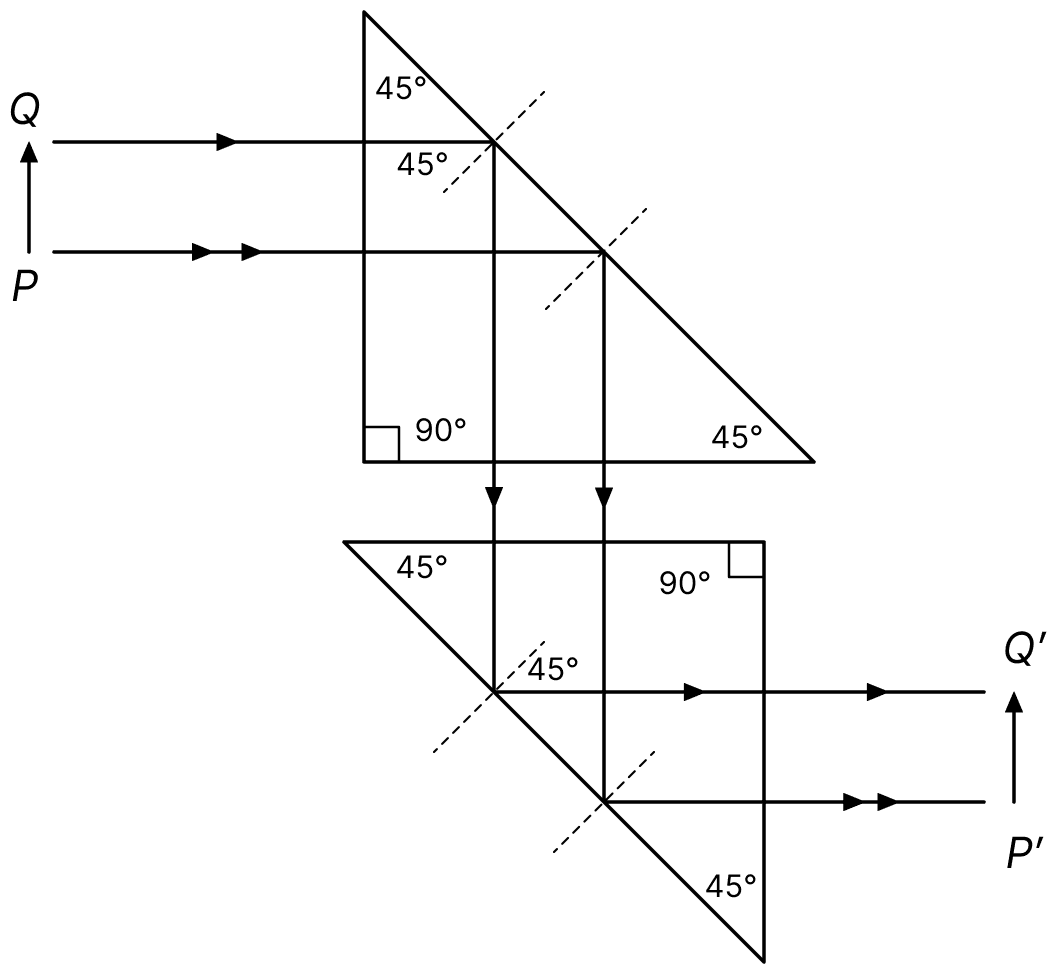
Light from the object PQ enters the upper prism normally through one of its shorter faces, so it goes undeviated and strikes the hypotenuse face at an angle of incidence of 45°. As 45° is greater than the critical angle for the glass-air interface (about 42° for crown glass, μ ≈ 1.5), the light is totally reflected, is turned through 90° and travels down the tube.
It enters the lower prism normally, is again totally reflected at the hypotenuse face, is turned through 90° once more and emerges normally through the other shorter face, parallel to its original direction.
Hence, after two total internal reflections the observer at the lower level sees an erect image P'Q' of the object.
A ray of light is normally incident on one face of an equilateral prism. Trace the course of the ray through the prism and emerging from it.
Answer
Let ABC be the equilateral prism (each angle 60°) and PQ the ray incident normally on the face AB.
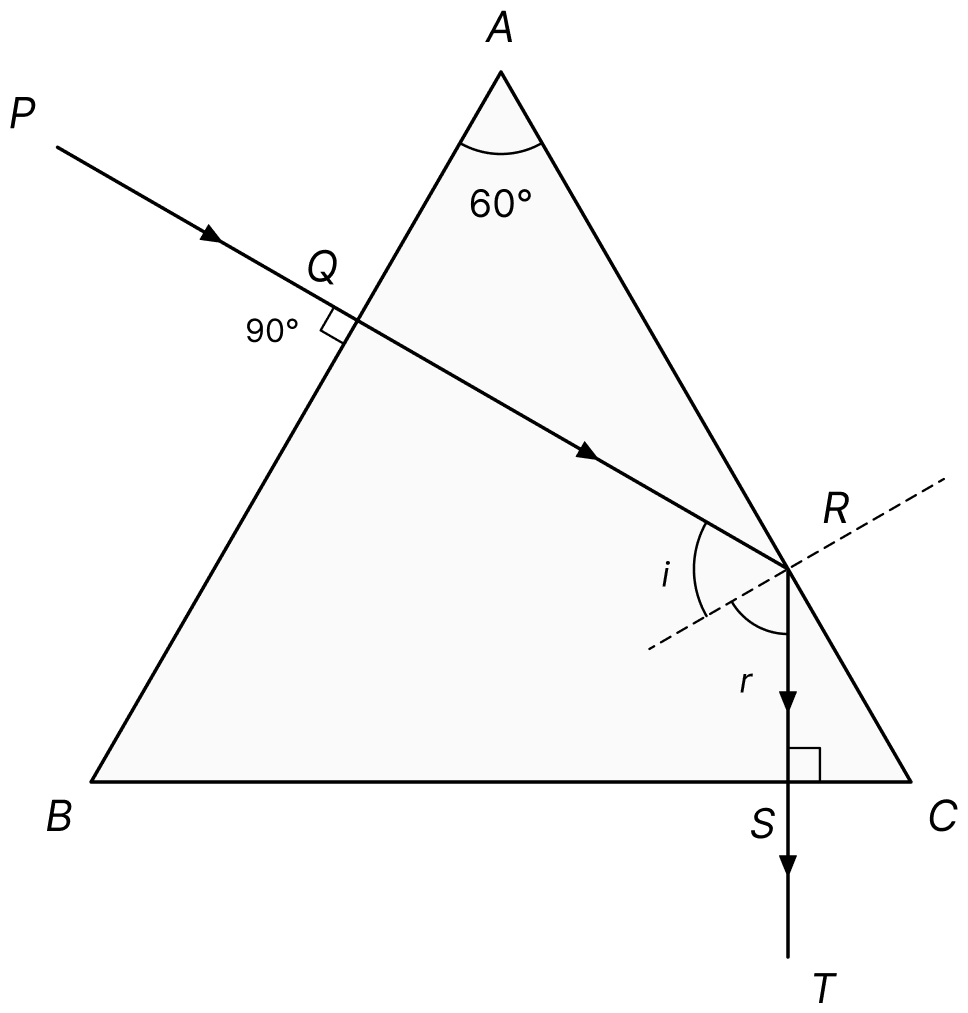
At the face AB : The angle of incidence is 0°, so the ray enters the glass without deviation and travels along QR towards the face AC.
At the face AC : As QR is perpendicular to AB and ∠A = 60°, the ray meets AC at R at an angle of incidence of 60°. For ordinary glass (μ ≈ 1.5) the critical angle for the glass-air interface is about 42°. Since 60° > 42°, the ray suffers total internal reflection at AC and is reflected at an angle of 60°.
At the face BC : The reflected ray makes an angle of 90° − 60° = 30° with RC. As ∠C = 60°, it meets the face BC at 180° − 30° − 60° = 90°, that is, normally. Hence it passes out into air without deviation along RS.
Thus, the ray is totally reflected at the face AC and emerges normally through the face BC.
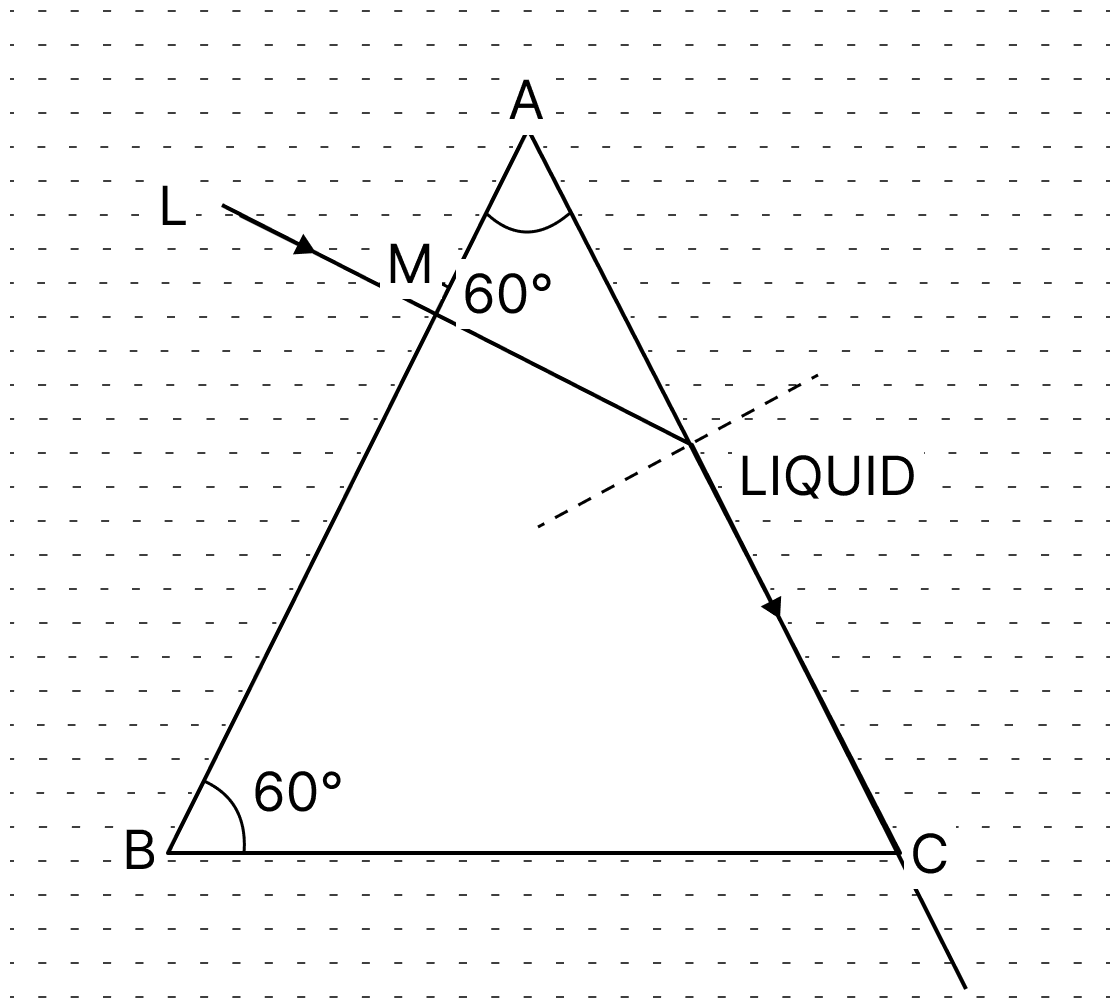
Find the refractive index of the liquid if a ray of light strikes surface AB normally and then comes out from face AC at grazing emergence. (aμg = )
Answer
Given,
- Ray LM is incident normally on the face AB
- ∠A = 60°
- aμg =
- The ray emerges from the face AC into the liquid at grazing emergence
As the ray falls normally on AB, it passes undeviated and meets the face AC at an angle of incidence equal to ∠A, i.e., i = 60°. Grazing emergence means that the angle of refraction in the liquid is r = 90°.
Applying Snell's law at the glass-liquid interface AC,
Substituting the values,
Hence, the refractive index of the liquid is ≈ 1.30.
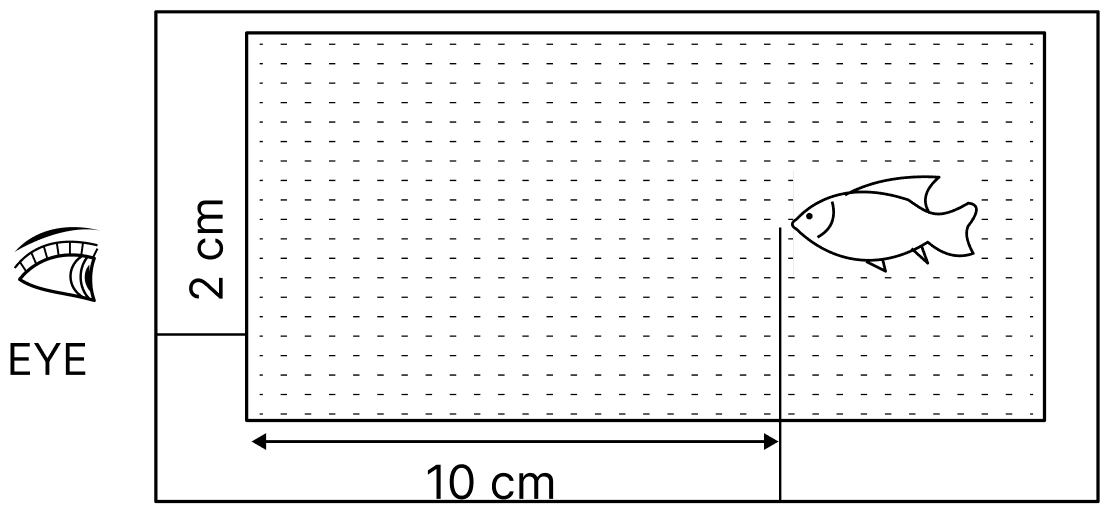
A fish is located at a distance of 10 cm from the wall of fish pond. The thickness of the glass wall is 2 cm. Find the apparent position of the fish.
(Given aμg = and aμw = )
Answer
Given,
- Distance of the fish from the inner surface of the glass wall (thickness of water), t1 = 10 cm
- Thickness of the glass wall, t2 = 2 cm
- aμw = , aμg =
The fish is viewed normally from air through 10 cm of water and 2 cm of glass, so its real distance from the outer surface of the wall is 10 + 2 = 12 cm. Each medium makes the fish appear nearer to the observer by its normal displacement,
Normal displacement due to water :
Normal displacement due to glass :
The total normal displacement is
Therefore, the apparent distance of the fish from the outer surface of the wall is
Hence, the fish appears to be 8.83 cm behind the outer surface of the glass wall, that is, 6.83 cm behind the inner surface of the wall.
A point source of monochromatic light S is kept at the centre C of the bottom of a cylinder. The radius of the circular base of the cylinder is 15.0 cm. The cylinder contains water (Refractive index = ) to a height of 7.0 cm as shown in the figure. Find the area of the surface through which light emerges in air.
(Take, π = )
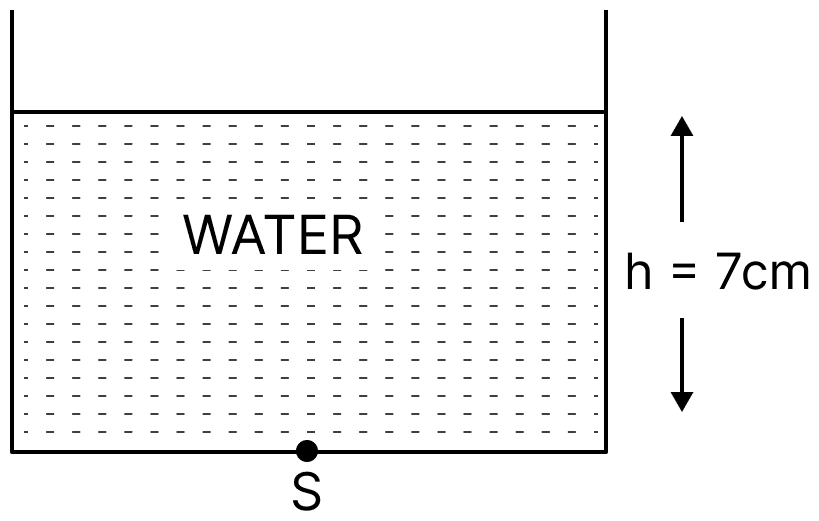
Answer
Given,
- Height of water above the source, h = 7.0 cm
- Refractive index of water, n =
- Radius of the base of the cylinder = 15.0 cm
- π =
Rays from S that meet the water surface at an angle of incidence greater than the critical angle C are totally reflected back into the water. Hence light emerges into air only through a circle of radius r, vertically above S, at whose edge the angle of incidence is exactly C.
The critical angle for the water-air interface is given by
so that
Let O be the point of the surface vertically above S and A a point on the edge of the circle. In the right-angled triangle SOA, tan C = . Therefore,
This is less than the radius of the base (15.0 cm), so the whole circle lies on the water surface. Its area is
Hence, light emerges into air through an area of 198 cm2 of the water surface.
A ray LM of monochromatic light incident normally on one refracting surface AB of a regular glass prism ABC emerges in air from the adjacent surface AC as shown in the figure. Calculate the refractive index of the material of the prism.
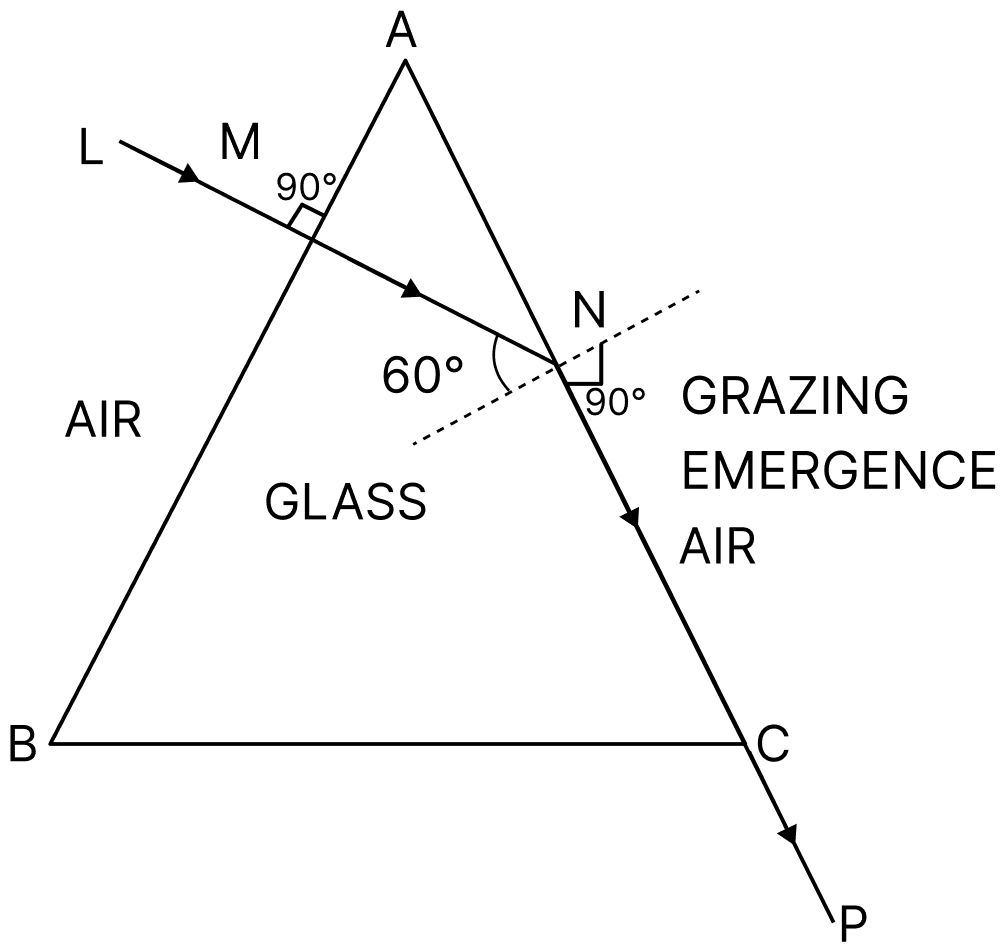
Answer
Given,
- Ray LM is incident normally on the face AB
- ABC is a regular prism, so ∠A = 60°
- The ray emerges in air from the face AC at grazing emergence
The ray LM enters the face AB normally and therefore passes undeviated. It meets the face AC at N at an angle of incidence equal to ∠A, i.e., 60°. Since the ray grazes along AC, the angle of refraction in air is 90°, so 60° is the critical angle C for the glass-air surface.
The refractive index is related to the critical angle by
Substituting C = 60°,
Hence, the refractive index of the material of the prism is ≈ 1.15.
Calculate the critical angle for glass and water pair. (Take refractive index for glass is 1.62 and the refractive index for water is 1.33)
Answer
Given,
- Refractive index of glass, ang = 1.62
- Refractive index of water, anw = 1.33
Total internal reflection is possible only for light travelling from the denser medium (glass) to the rarer medium (water). The refractive index of glass relative to water is
If C is the critical angle for the glass-water interface,
Hence, the critical angle for the glass-water pair is about 55.2° (≈ 55°).
A ray of light LM incident normally on the surface AC of an isosceles right angled prism ABC (where, AB = BC) emerges along PQ, parallel to LM, as shown in the figure below. What can you say about refractive index μ of the material of the prism?
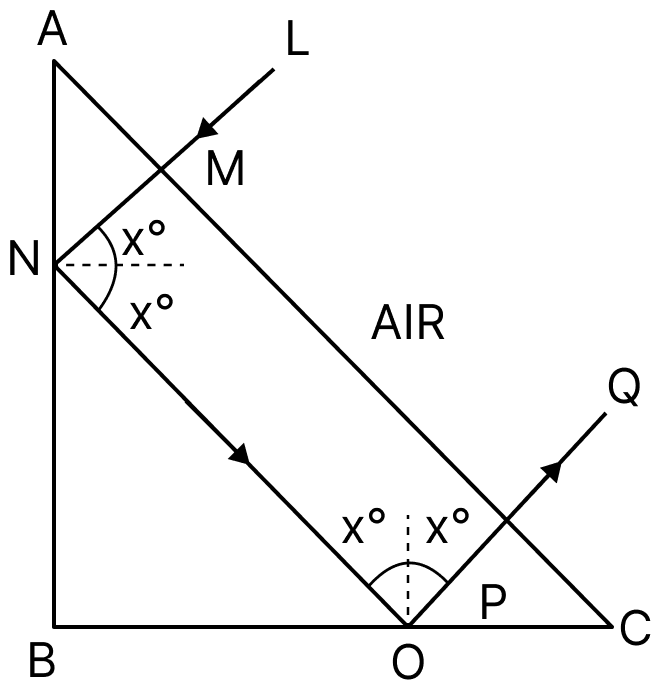
Answer
Since ABC is an isosceles right-angled prism with AB = BC, ∠B = 90° and ∠A = ∠C = 45°.
The ray LM falls normally on the face AC and enters the glass undeviated. It meets the face AB at an angle of incidence of 45°, is totally reflected towards BC, and meets BC again at an angle of incidence of 45°. After a second total reflection it falls normally on AC and emerges undeviated along PQ, parallel to LM.
For total internal reflection at the faces AB and BC, the angle of incidence (45°) must be greater than the critical angle C, i.e.,
Therefore,
Hence, the refractive index of the material of the prism must be greater than (≈ 1.414).
At what angle, a ray of light should be incident on the first face AB of a regular glass prism ABC, so that the emergent ray grazes the adjacent face AC? (Refractive index of glass = 1.6)
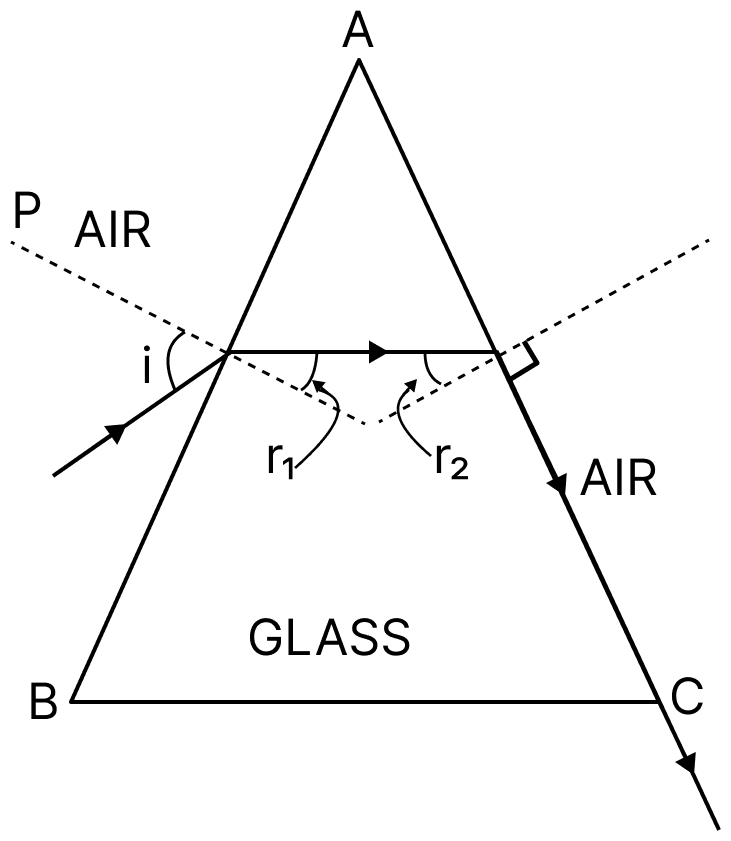
Answer
Given,
- Regular glass prism, so angle of the prism A = 60°
- Refractive index of glass, n = 1.6
- The emergent ray grazes the face AC
Since the emergent ray grazes AC, the ray inside the prism meets AC at the critical angle C, i.e., r2 = C.
From the geometry of the prism, the angle of refraction at the first face AB is
By Snell's law at the face AB,
Therefore,
Hence, the ray should be incident on the face AB at an angle of about 35.6°.
A narrow beam of monochromatic light PQ is incident normally on one face of an equiangular glass prism of refractive index 1.45. When the prism is immersed in a certain 'liquid' the ray makes a grazing emergence along the other face as shown in the figure. Find the refractive index of this liquid.
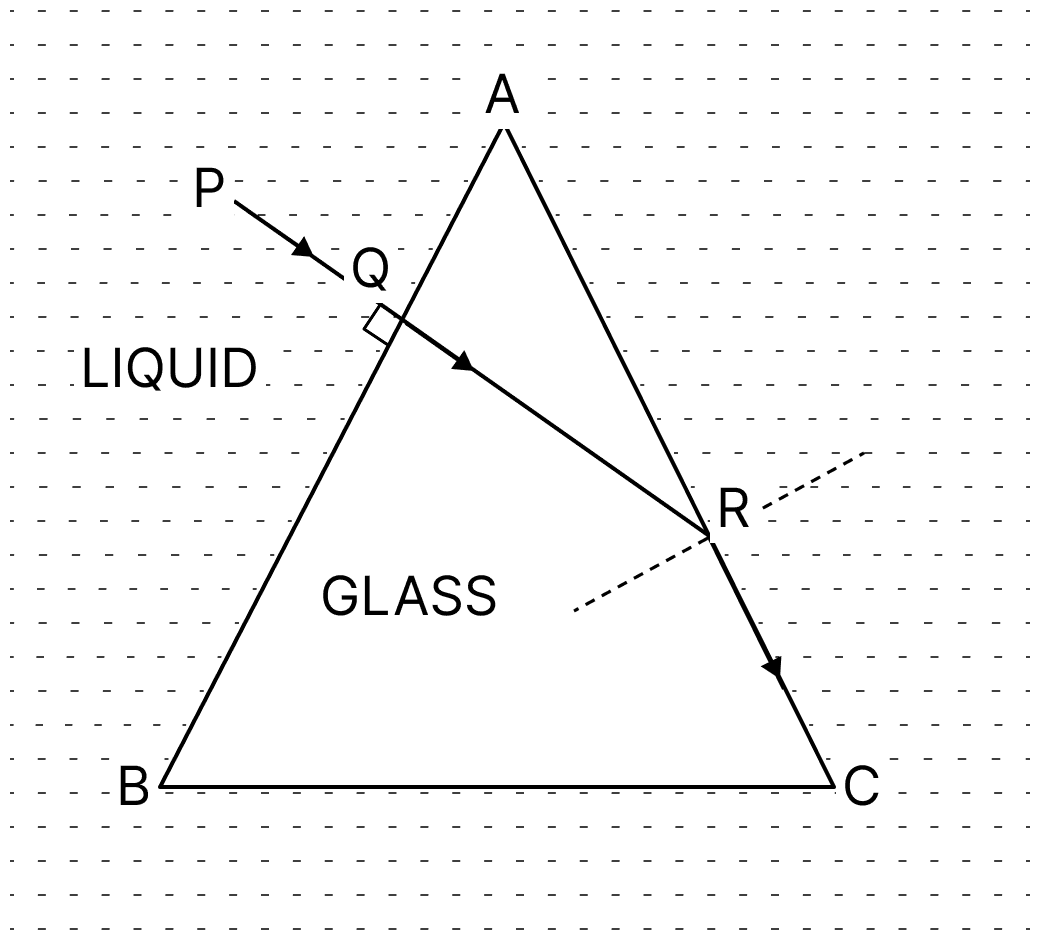
Answer
Given,
- Equiangular prism, so ∠A = 60°
- Refractive index of glass, ang = 1.45
- Ray PQ is incident normally on the face AB and emerges grazing along AC into the liquid
The ray PQ enters AB normally and goes undeviated to the face AC, meeting it at an angle of incidence i = ∠A = 60°. Grazing emergence means the angle of refraction in the liquid is r = 90°.
Applying Snell's law at the glass-liquid interface AC,
Substituting the values,
Hence, the refractive index of the liquid is 1.256.
A fish which is at a depth of 12 cm in water (μ = ) is viewed by an observer on the bank of a lake. Its apparent depth as observed by the observer is :
- 3 cm
- 9 cm
- 12 cm
- 16 cm
Answer
9 cm
Reason — For near-normal viewing from the bank (rarer medium), the fish appears raised, and
Therefore,
Find critical angle for glass and water pair, given refractive index of glass is 1.62 and that of water is 1.33.
Answer
Given,
- Refractive index of glass = 1.62
- Refractive index of water = 1.33
The critical angle refers to light going from glass (denser) into water (rarer). It is given by
Substituting the values,
Hence, the critical angle for the glass-water pair is about 55.2°.
Note: The textbook prints 55.1°; since sin-1(0.821) = 55.18°, the value rounds to 55.2°.
When a light wave travels from air to glass:
- its wavelength decreases
- its wavelength increases
- there is no change in wavelength
- its frequency decreases
Answer
its wavelength decreases
Reason — The frequency of light remains unchanged when it passes from one medium to another, while its speed in glass decreases to v = . Since λ = , the wavelength also decreases, λg = .
Define critical angle for a given medium.
Answer
The critical angle for a given medium (with respect to air) is that angle of incidence in the denser medium for which the angle of refraction in the rarer medium is 90°, that is, the refracted ray grazes along the interface.
Explanation:
It is related to the refractive index n of the medium by sin C = .
Name the physical principle on which the working of optical fibre is based.
Answer
Total internal reflection of light.
Explanation:
In an optical fibre, the core is clad by a material of slightly lower refractive index. Light entering one end strikes the core-cladding interface at an angle of incidence greater than the critical angle and is therefore totally reflected again and again, so it travels along the fibre with very little loss through its sides.
Calculate critical angle for glass (μ = 1.5) and water (μ = 1.33) pair.
Answer
Given,
- Refractive index of glass, μg = 1.5
- Refractive index of water, μw = 1.33
For light going from glass (denser) to water (rarer), the critical angle C is given by
Hence, the critical angle for the glass-water pair is 62.5°.
Name any one optical device / instrument which works on the principle of total internal reflection.
Answer
Optical fibre.
Explanation:
Light introduced at one end of an optical fibre strikes the core-cladding interface at an angle greater than the critical angle and is guided to the other end by repeated total internal reflections. (A totally reflecting prism used in a periscope or binoculars also works on this principle.)