
An air bubble in a glass slab with refractive index 1.5 (near normal incidence) is 5 cm deep when viewed from one surface and 3 cm deep when viewed from the opposite face. The thickness (in cm) of the slab is :
- 16
- 8
- 10
- 12
Answer
12
Reason — Let t be the thickness of the slab and x the real depth of the bubble below the first surface. For near normal viewing, apparent depth = real depth/n, so
Let the refractive index of a denser medium with respect to a rarer medium be n12 and its critical angle θc. At an angle of incidence A when light is travelling from denser medium to rarer medium, a part of the light is reflected and the rest is refracted and the angle between reflected and refracted rays is 90°. Angle A is given by :
- tan-1 (sin θC)
- cos-1 (sin θC)
Answer
tan-1 (sin θC)
Reason — Let nD and nR be the refractive indices of the denser and rarer media, so that . If r is the angle of refraction, the reflected ray makes angle A with the normal, and the angle between the reflected and refracted rays is 180° − (A + r) = 90°, so r = 90° − A. By Snell's law, nD sin A = nR sin r, which gives
Hence tan A = sin θC, i.e., A = tan-1 (sin θC).
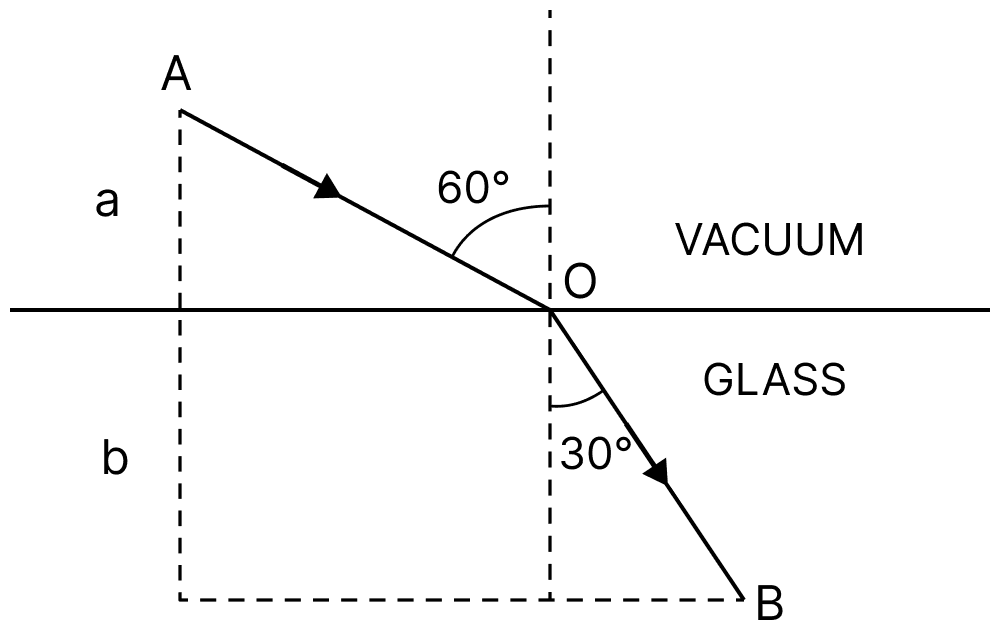
A ray of light AO in vacuum is incident on a glass slab at angle 60° and refracted at angle 30° along OB as shown in the figure. The optical path length of light ray from A to B is :
- 2a + 2b
Answer
2a + 2b
Reason — Optical path length = refractive index × geometrical path. From the figure, AO = = 2a (in vacuum) and OB = (in glass), with n = .
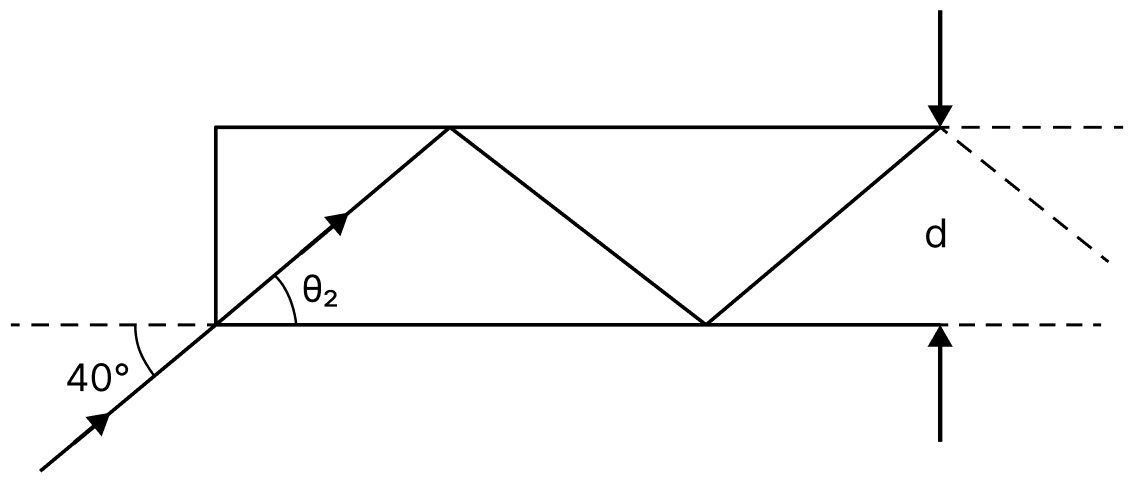
In figure, the optical fibre is l = 2 m long and has a diameter of d = 20 μm. If a ray of light is incident on one end of the fibre at angle θ1 = 40°, the number of reflection it makes before emerging from the other end is close to : (refractive index of fibre is 1.31 and sin 40° = 0.64)
- 55000
- 57000
- 66000
- 45000
Answer
57000
Reason — By Snell's law at the end face, 1 × sin 40° = 1.31 sin θ2, so sin θ2 = ≈ 0.49 ≈ 0.5, i.e., θ2 ≈ 30°. Between two successive reflections the ray crosses the diameter d while advancing a distance x along the fibre, where tan θ2 = , so x = d.
Note: Without the approximation θ2 ≈ 30° (sin θ2 = 0.4885), N ≈ 55990, marginally nearer 55000 than 57000; the printed answer (b) relies on taking θ2 ≈ 30°.
A transparent cube of side, made of a material of refractive index n2, is immersed in a liquid of refractive index n1 (n1 < n2). A ray is incident on the face AB at an angle θ (shown in the figure). Total internal reflection takes place at point E on the face BC.
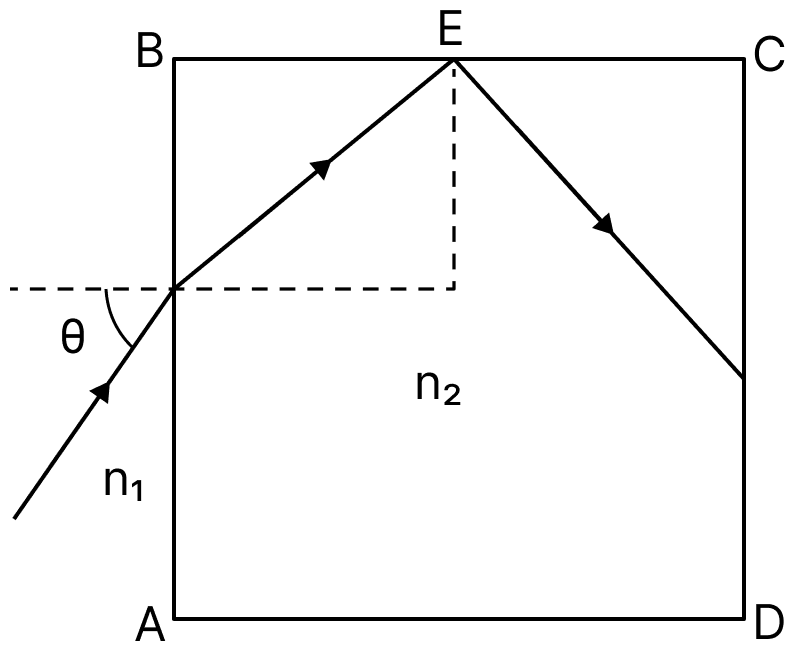
Then θ must satisfy :
Answer
Reason — Let α be the angle of refraction at AB, so n1 sin θ = n2 sin α. The ray meets BC at E at an angle of incidence (90° − α), and total internal reflection there requires n2 sin (90° − α) > n1, i.e., cos α > .
In total internal reflection when the angle of incidence is equal to the critical angle for the pair of media in contact, what will be angle of refraction?
- Equal to angle of incidence
- 90°
- 180°
- 0°
Answer
90°
Reason — By definition, when the angle of incidence in the denser medium equals the critical angle, the refracted ray grazes along the interface, so the angle of refraction is 90°.
Pick the wrong answer in the context with rainbow.
- An observer can see a rainbow when his front is towards the sun
- Rainbow is a combined effect of dispersion, refraction and reflection of sunlight
- When the light rays undergo two internal reflections in a water drop, a secondary rainbow is formed
- The order of colours is reversed in the secondary rainbow
Answer
An observer can see a rainbow when his front is towards the sun
Reason — A rainbow is seen only when the sun is behind the observer, i.e., with his back towards the sun. The other three statements are correct.
A light wave is incident normally on a glass slab of refractive index 1.5. If 10% of light gets reflected and the amplitude of the electric field of the incident light is 30 V/m, then the amplitude of the electric field for the wave propagating in the glass medium will be :
- 10 V/m
- 24 V/m
- 30 V/m
- 6 V/m
Answer
24 V/m
Reason — The intensity of a light wave in a medium of refractive index n is proportional to nE02. As 10% of the light is reflected, 90% enters the glass:
The nearest option is 24 V/m.
Note: The textbook's hint takes 96% of the light as refracted (4% reflected), which gives exactly 24 V/m; with 10% reflected, as printed in the question, E ≈ 23.2 V/m and (b) is still the nearest option.
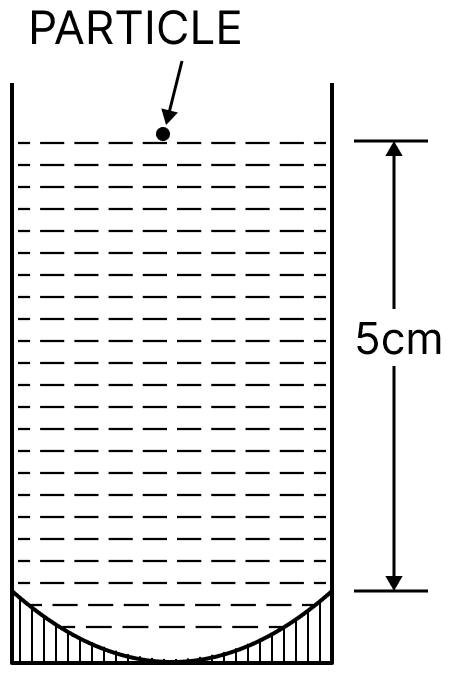
A concave mirror has radius of curvature of 40 cm. It is at the bottom of a glass that has water filled up to 5 cm (see figure). If a small particle is floating on the surface of water, its image as seen, from directly above the glass, is at a distance d from the surface of water. The value of d is close to : (Refractive index of water = 1.33)
- 11.7 cm
- 6.7 cm
- 13.4 cm
- 8.8 cm
Answer
8.8 cm
Reason — The particle is 5 cm from the mirror (f = −20 cm). By the mirror formula, with u = −5 cm,
The virtual image is cm behind the mirror, i.e., cm below the water surface. Viewed from above,
If the critical angle for total internal refraction from a medium to vacuum is 45°, then velocity of light in the medium is :
- 3 × 10⁸ m/s
- 1.5 × 10⁸ m/s
- × 108 m/s
- × 108 m/s
Answer
× 108 m/s
Reason — From sin C = , sin 45° = , so n = . Hence the velocity of light in the medium is
More than one options may be correct.
A wide slab consisting of two media of refractive indices n1 and n2 is placed in air as shown in the figure. A ray of light is incident from medium n1 to n2 at an angle θ, where sin θ is slightly larger than . Take refractive index of air as 1.
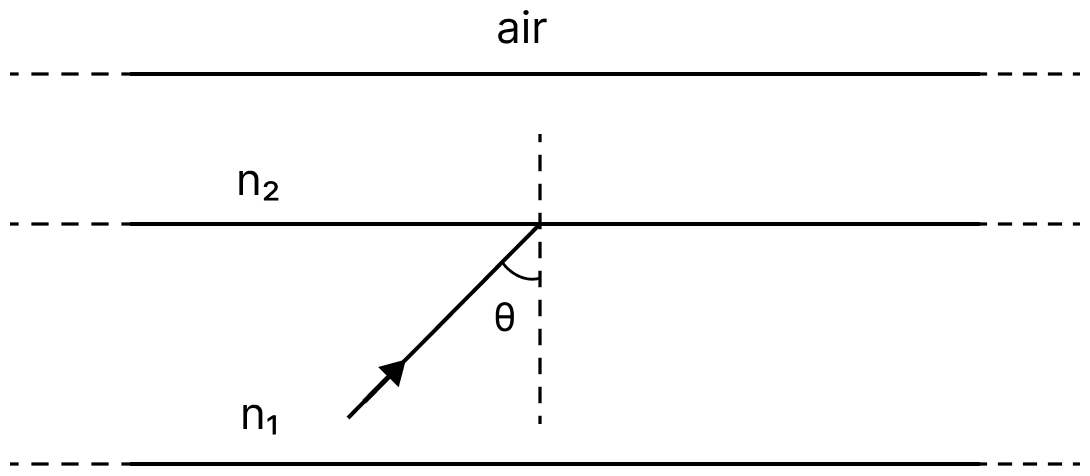
Which of the following statement(s) is/are correct?
- The light ray enters air if n2 = n1
- The light ray is finally reflected back into the medium of refractive index n1 if n2 < n1
- The light ray is finally reflected back into the medium of refractive index n1 if n2 > n1
- The light ray is reflected back into the medium of refractive index n1 if n2 = 1
Answer
The light ray is finally reflected back into the medium of refractive index n1 if n2 < n1
The light ray is finally reflected back into the medium of refractive index n1 if n2 > n1
The light ray is reflected back into the medium of refractive index n1 if n2 = 1
Reason — As the boundaries are parallel, n1 sin θ = n2 sin θ2 = sin θ3, where θ3 would be the angle in air. Since sin θ > , n1 sin θ > 1, so sin θ3 > 1: the ray can never enter air, whatever the value of n2. Whether it is totally reflected at the n1–n2 boundary or at the top surface, it finally returns into n1. Hence statements 2, 3 and 4 are correct and statement 1 is wrong.
A light wave travelling linearly in a medium of dielectric constant 4, incident on the horizontal surface separating medium with air. The angle of incidence for which the total intensity of incident wave will be reflected back into the same medium will be (Given : relative permeability of the medium, μr = 1) :
- 10°
- 20°
- 30°
- 60°
Answer
60°
Reason — The refractive index of the medium is
so sin C = and C = 30°. Total internal reflection occurs for an angle of incidence greater than 30°; among the options this is 60°.
Two transparent media A and B are separated by a plane boundary. The speed of light in those media are 1.5 × 10⁸ m/s and 2.0 × 10⁸ m/s, respectively. The critical angle for a ray of light for these two media is:
- tan-1 (0.750)
- sin-1 (0.500)
- sin-1 (0.750)
- tan-1 (0.500)
Answer
sin-1 (0.750)
Reason — Light is slower in A, so A is the denser medium. For light going from A to B,
Hence C = sin-1 (0.750).
A monochromatic light wave with wavelength λ1 and frequency ν1 in air enters another medium. If the angle of incidence and angle of refraction at the interface are 45° and 30° respectively, then the wavelength λ2 and frequency ν2 of the refracted wave are :
Answer
Reason — The refractive index of the medium is n = = . The frequency does not change on entering another medium, so ν2 = ν1, while the wavelength is reduced in the ratio n: λ2 = .
Light travels a distance x in time t1 in air and 10x in time t2 in another denser medium. What is the critical angle for this medium?
Answer
Reason — The speed of light in air is c = and in the medium v = . Hence
and sin C = , i.e., C = .
An observer can see through a small hole on the side of a jar (radius 15 cm) at a point at height of 15 cm from the bottom (see figure). The hole is at a height of 45 cm. When the jar is filled with a liquid up to a height of 30 cm, the same observer can see the edge at the bottom of the jar. If the refractive index of the liquid is , where N is an integer, the value of N is ............... .
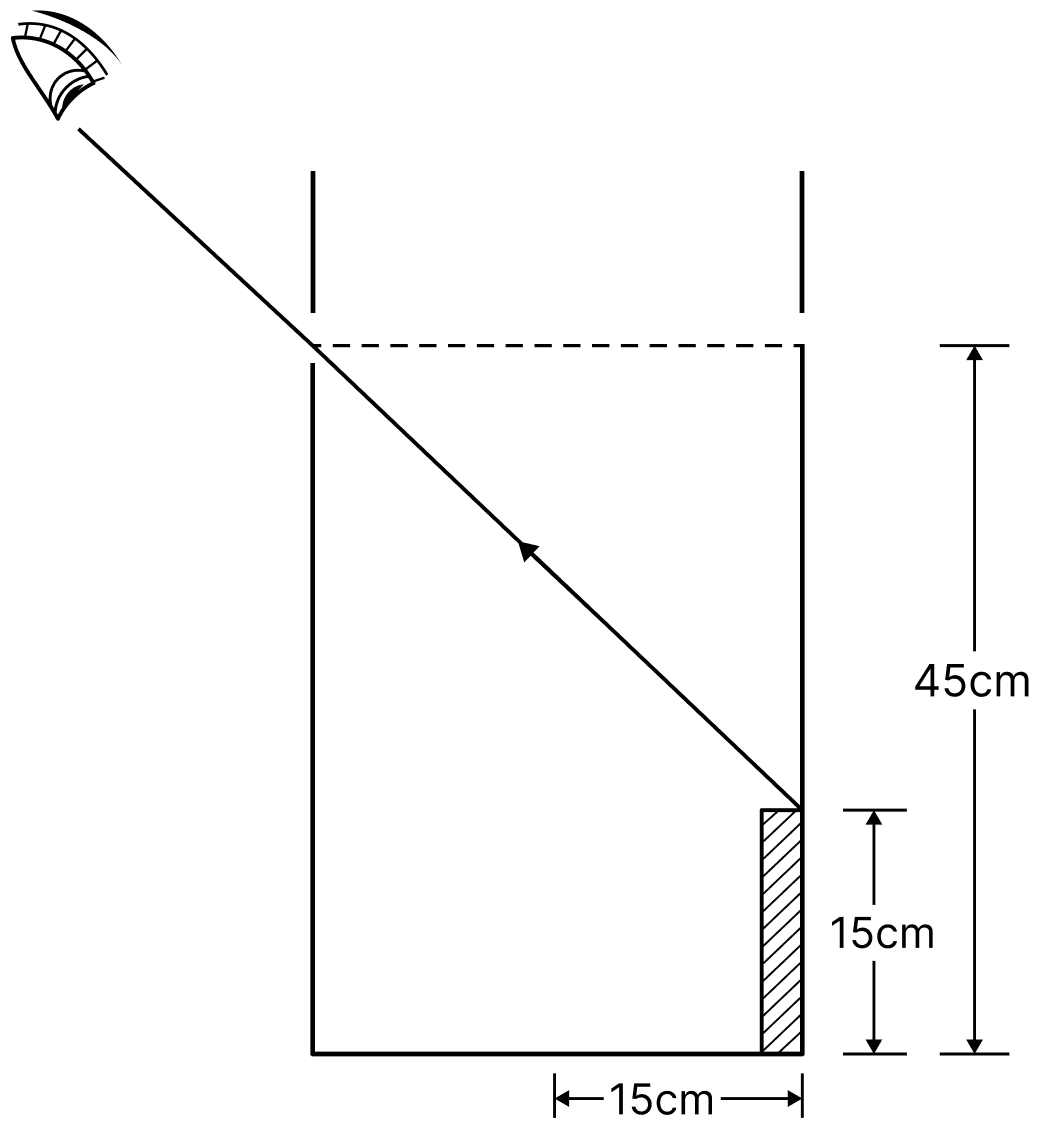
Answer
Given,
- Radius of the jar = 15 cm, so its diameter = 30 cm
- Height of the hole = 45 cm
- Height of the point seen on the opposite wall (empty jar) = 15 cm
- Height of the liquid = 30 cm
- Refractive index of the liquid, n =
Let H be the hole, O the point where the line of sight meets the liquid surface, and E the edge at the bottom of the jar on the opposite side.
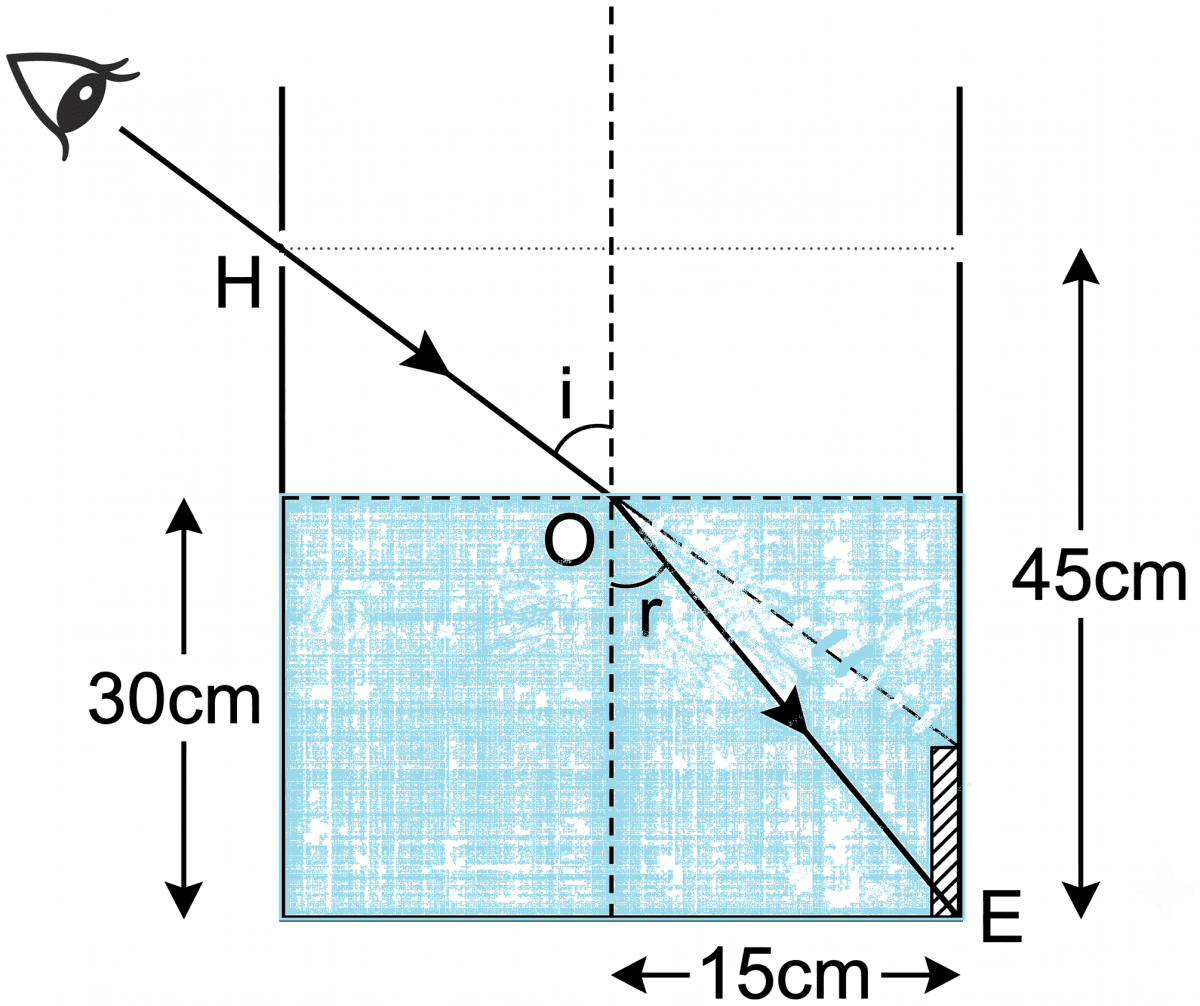
Empty jar : The line of sight from H to the point on the opposite wall falls through 45 − 15 = 30 cm while crossing the full diameter of 30 cm. Hence it makes an angle of 45° with the vertical, so the angle in air is i = 45°.
Jar filled to 30 cm : The eye and the hole are unchanged, so the ray in air still makes 45° with the vertical. Between the heights 45 cm and 30 cm it falls through 15 cm and so moves 15 cm sideways, meeting the liquid surface at O, the middle of the jar. Inside the liquid the ray reaches E, moving the remaining 15 cm sideways while falling through 30 cm. If r is its angle with the vertical in the liquid,
By Snell's law, taking the ray from air (angle i) into the liquid (angle r), which is permitted by the reversibility of light,
Hence, the value of N is 158.
A ray of light is incident at an angle of incidence 60° on the glass slab of refractive index . After refraction the light ray emerges out from other parallel faces and lateral shift between incident ray and emergent ray is cm. The thickness of glass slab is ............... .
Answer
Given,
- Angle of incidence, i = 60°
- Refractive index of the slab, n =
- Lateral shift = cm
By Snell's law at the first face,
The lateral shift produced by a slab of thickness t is
Substituting the values,
Hence, the thickness of the glass slab is 12 cm.
Consider a configuration of n identical units, each consisting of three layers. The first layer is a column of air of height h = cm, and the second and third layers are of equal thickness d = cm, and refractive indices μ1 = and μ2 = , respectively. A light source O is placed on the top of the first unit, as shown in the figure. A ray of light from O is incident on the second layer of the first unit at an angle of θ = 60° to the normal. For a specific value of n, the ray of light emerges from the bottom of the configuration at a distance l = cm, as shown in the figure. The value of n is ............... .
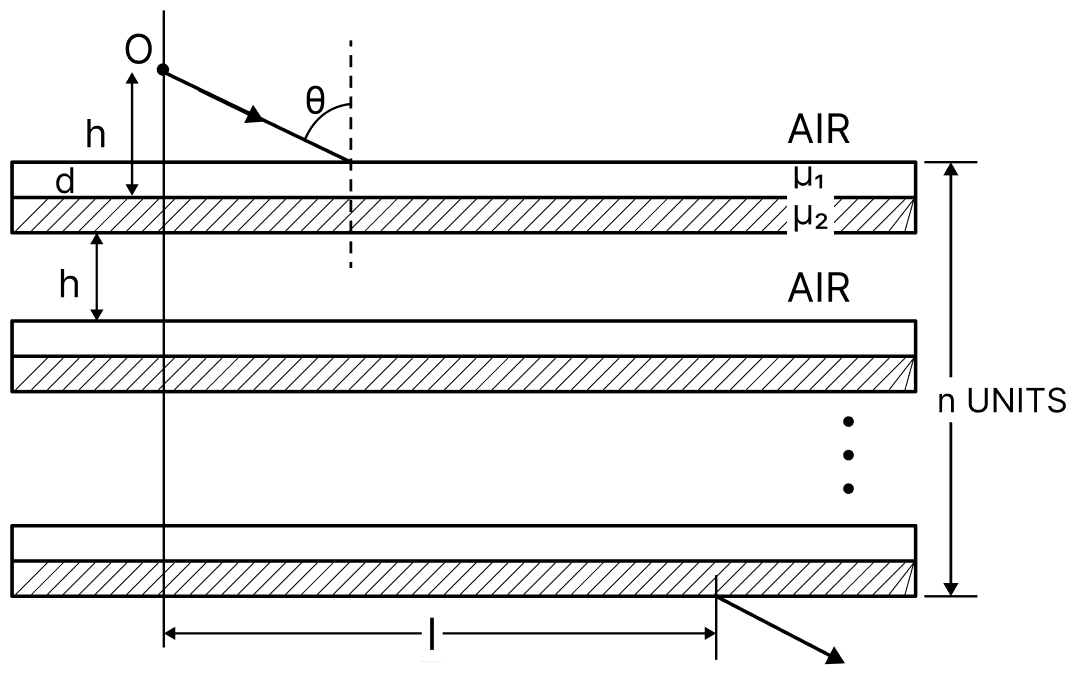
Answer
Given,
- Height of the air layer, h = cm
- Thickness of each glass layer, d = cm
- μ1 = , μ2 =
- Angle of incidence in air, θ = 60°
- Total lateral distance, l = cm
Let x1, x2 and x3 be the horizontal distances moved by the ray in the air layer, the μ1 layer and the μ2 layer of one unit, and θ1, θ2 the angles of refraction in the μ1 and μ2 layers.
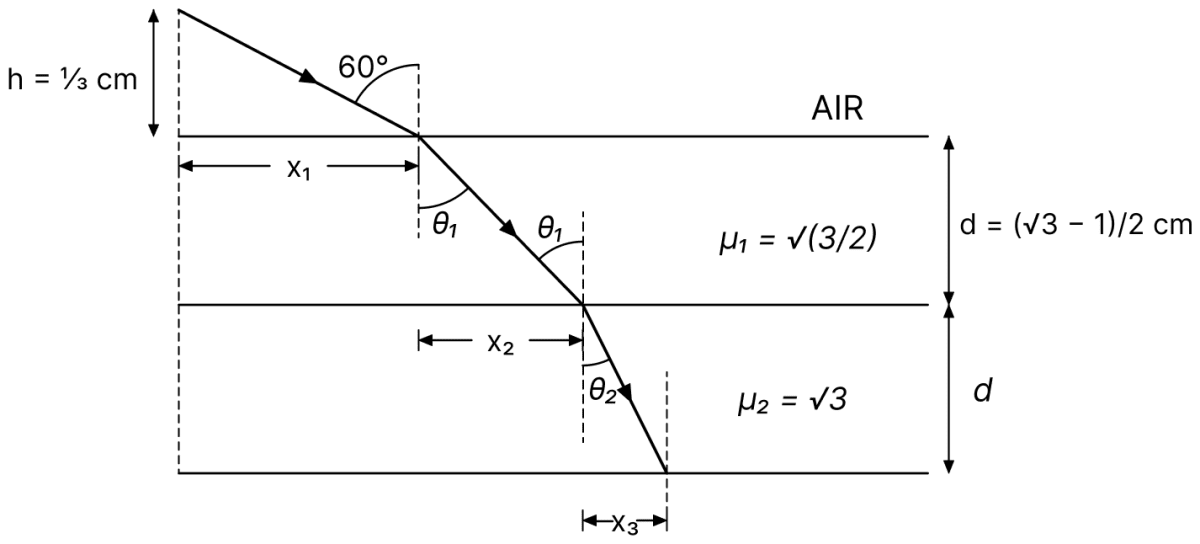
Air layer :
Layer of refractive index μ1 : By Snell's law,
Therefore,
Layer of refractive index μ2 : By Snell's law,
Therefore,
As μ2 sin θ2 = = sin 60°, the ray enters the air layer of the next unit again at 60°, so every unit produces the same lateral shift.
Lateral shift in one unit :
For n units the total lateral shift is cm. Therefore,
Hence, the value of n is 4.