
Write down the relation between the wavelength and momentum of a photon. What do the symbols stand for?
Answer
The momentum of a photon is related to its wavelength by
where p is the momentum of the photon, h is Planck's constant (6.6 × 10⁻³⁴ J s) and λ is the wavelength of the photon (radiation).
Explain work function and threshold frequency in photoelectric emission. Give Einstein's equation for photoelectric emission. What do the symbols stand for?
Answer
Work function : The minimum energy required for the emission of a photoelectron from a metal is called the work function (W) of that metal.
Threshold frequency : The lowest frequency of light which can emit photoelectrons from a material is called the threshold frequency (ν0) of that material. Light of frequency lower than ν0 cannot emit photoelectrons, whatever be its intensity. The two are related by W = hν0.
Einstein's photoelectric equation :
where (= Ek) is the maximum kinetic energy of the emitted photoelectrons, m is the mass of the electron, vmax is their maximum velocity, h is Planck's constant, ν is the frequency of the incident light, W is the work function of the metal and ν0 is its threshold frequency.
Define stopping potential. How is it related to the kinetic energy of photo-electrons?
Answer
Stopping potential : The negative potential of the anode (collector plate) relative to the cathode (emitter plate) at which the photoelectric current becomes zero is called the stopping potential or cut-off potential (V0).
Since the stopping potential just stops the photoelectrons of maximum energy, it is a measure of their maximum kinetic energy,
where e is the charge on the electron.
What is the momentum p of a photon from ultraviolet light of wavelength λ = 332 nm?
Answer
Given,
- Wavelength, λ = 332 nm = 332 × 10-9 m
- h = 6.6 × 10⁻³⁴ J s
The momentum of a photon is
Substituting the values,
Hence, the momentum of the photon is 2 × 10-27 kg m s-1.
Photo-electrons are emitted from a metal surface when UV light of wavelength λ = 300 nm is incident on it. The minimum negative potential required to stop the emission of electrons is 0.54 V. Calculate :
(i) the energy of the incident photons
(ii) the maximum kinetic energy of the photoelectrons emitted
(iii) the work function of the metal.
Express all answers in eV.
Answer
Given,
- Wavelength, λ = 300 nm = 300 × 10-9 m
- Stopping potential, V0 = 0.54 V
- h = 6.6 × 10⁻³⁴ J s, c = 3 × 10⁸ m s-1, e = 1.6 × 10⁻¹⁹ C
(i) Energy of the incident photons :
(ii) Maximum kinetic energy of the photoelectrons :
(iii) Work function of the metal :
From Einstein's photoelectric equation, Ek = E − W,
Hence, (i) E = 4.125 eV, (ii) Ek = 0.54 eV and (iii) W = 3.585 eV.
How can the work function of tungsten be increased?
Answer
The work function of tungsten can be increased by coating its surface with a thin layer of a metal of higher work function, such as platinum.
Explanation:
Photoelectrons are emitted from the surface layer of the metal, so the work function depends on the nature and condition of the surface. A surface layer of a material with a higher work function makes it harder for an electron to leave, and the effective work function rises.
What is photoelectric effect? With the help of a suitable graph show the variation of photoelectric current with :
(i) intensity of incident radiation,
(ii) voltage applied between cathode and anode,
(iii) frequency of incident radiation.
Answer
Photoelectric effect : The phenomenon of emission of electrons from metals under the action of light of suitable frequency is called photoelectric effect. The electrons so emitted are called photoelectrons and the current they produce is called photoelectric current.
(i) Variation with intensity of incident radiation :
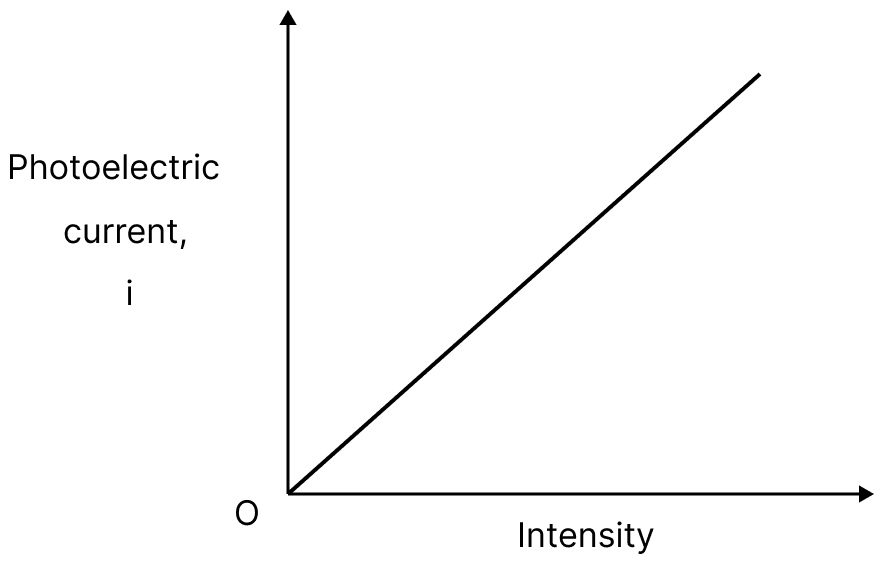
For light of a given frequency (above the threshold frequency) and a fixed accelerating potential, the photoelectric current is directly proportional to the intensity of the incident light. The graph is a straight line passing through the origin.
(ii) Variation with voltage applied between cathode and anode :
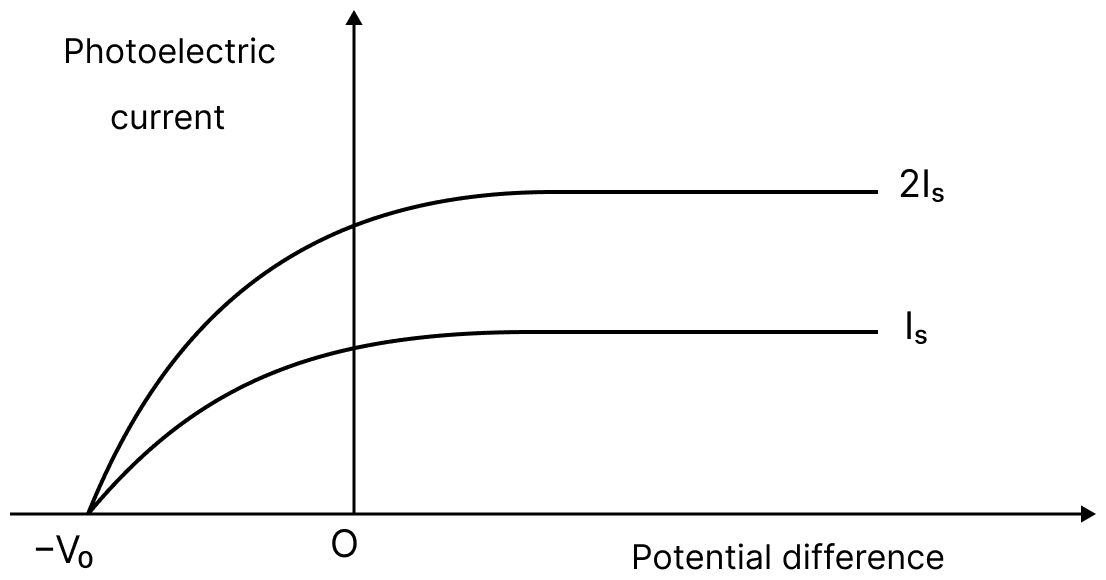
As the positive potential of the anode is increased, the current increases and then becomes constant (saturation current) when all the emitted photoelectrons reach the anode. When the anode is made negative, the current decreases and becomes zero at the stopping potential −V0. For a greater intensity the saturation current is greater, but the stopping potential is the same.
(iii) Variation with frequency of incident radiation :
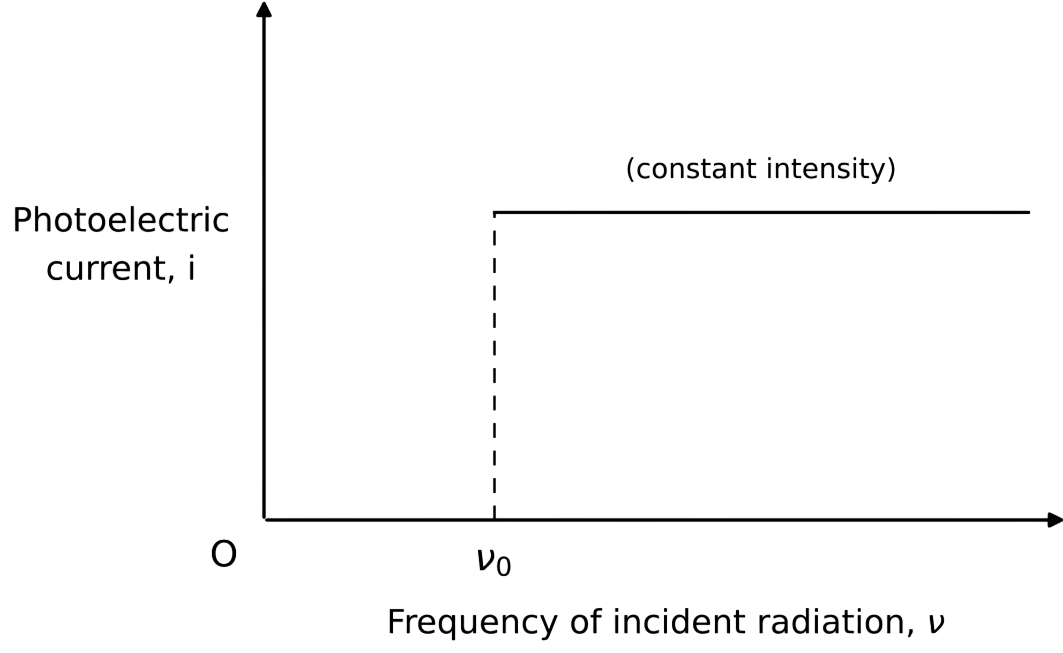
For light of constant intensity, no photoelectric current flows when the frequency is below the threshold frequency ν0. Above ν0, the (saturation) photoelectric current is independent of the frequency of the incident radiation.
The threshold wavelength of tungsten is 2400 Å. When tungsten is illuminated with light of wavelength 1600 Å, find :
(i) work function,
(ii) maximum kinetic energy of the emitted electron,
(iii) stopping potential.
Answer
Given,
- Threshold wavelength, λ0 = 2400 Å = 2400 × 10-10 m
- Wavelength of incident light, λ = 1600 Å = 1600 × 10-10 m
- h = 6.6 × 10⁻³⁴ J s, c = 3 × 10⁸ m s-1, e = 1.6 × 10⁻¹⁹ C
(i) Work function :
(ii) Maximum kinetic energy of the emitted electron :
The energy of the incident photon is
By Einstein's photoelectric equation,
(iii) Stopping potential :
Hence, (i) W = 5.156 eV, (ii) Ek = 2.578 eV and (iii) V0 = 2.578 V.
A radio transmitter operates on a wavelength of 1500 m at a power of 400 kW. Find the energy of the radio photons in joule (h = 6.6 × 10⁻³⁴ J-s, c = 3.0 × 10⁸)
Answer
Given,
- Wavelength, λ = 1500 m
- h = 6.6 × 10⁻³⁴ J s, c = 3.0 × 10⁸ m s-1
The energy of each photon is
Substituting the values,
The power of the transmitter (400 kW) decides only the number of photons emitted per second, not the energy of each photon.
Hence, the energy of each radio photon is 1.32 × 10⁻²⁸ J.
Calculate the momentum of a photon of green light of λ = 500 nm in SI units.
Answer
Given,
- Wavelength, λ = 500 nm = 500 × 10-9 m
- h = 6.6 × 10⁻³⁴ J s
The momentum of a photon is
Substituting the values,
Hence, the momentum of the photon is 1.32 × 10⁻²⁷ kg m s-1.
The work function for sodium is 2.28 eV.
(i) What is the minimum energy for a quantum of radiation to cause photoelectric emission from a sodium surface?
(ii) Calculate the wavelength of this radiation.
Answer
Given,
- Work function of sodium, W = 2.28 eV = 2.28 × 1.6 × 10-19 J
- h = 6.6 × 10⁻³⁴ J s, c = 3 × 10⁸ m s-1
(i) Minimum energy of a quantum :
A photon can eject a photoelectron only if its energy is at least equal to the work function of the metal. Hence the minimum energy of the quantum is
(ii) Wavelength of this radiation :
Hence, (i) the minimum energy is 2.28 eV and (ii) the wavelength is 542.76 nm.
Photoelectric threshold frequency of an alkali metal is 5.0 × 10¹⁴ Hz. Calculate the work function of this metal.
Answer
Given,
- Threshold frequency, ν0 = 5.0 × 10¹⁴ Hz
- h = 6.6 × 10⁻³⁴ J s
The work function is W = hν0.
Hence, the work function of the metal is 3.3 × 10⁻¹⁹ J or 2.06 eV.
In photoelectric effect, what is meant by the terms:
(i) Work function of a metal?
(ii) Stopping potential?
Answer
(i) Work function of a metal : The minimum energy required for the emission of a photoelectron from a metal is called the work function of that metal. It is equal to hν0, where ν0 is the threshold frequency.
(ii) Stopping potential : The negative potential of the anode relative to the cathode at which the photoelectric current becomes zero is called the stopping potential (V0). It is a measure of the maximum kinetic energy of the photoelectrons, Ek = eV0.
Find the momentum of a photon of energy 3.0 eV.
Answer
Given,
- Energy of photon, E = 3.0 eV = 3.0 × 1.6 × 10-19 J
- c = 3 × 10⁸ m s-1
The momentum of a photon is
Substituting the values,
Hence, the momentum of the photon is 1.6 × 10⁻²⁷ kg m s-1.
Threshold wavelength of a certain metal is 792 nm. What is the maximum kinetic energy of photoelectrons emitted by this metal, if it is exposed to ultra violet light of wavelength 396 nm?
Answer
Given,
- Threshold wavelength, λ0 = 792 nm = 792 × 10-9 m
- Wavelength of incident light, λ = 396 nm = 396 × 10-9 m
- h = 6.6 × 10⁻³⁴ J s, c = 3 × 10⁸ m s-1
From Einstein's photoelectric equation,
Substituting the values,
Hence, the maximum kinetic energy of the photoelectrons is 1.56 eV.
What is meant by 'threshold frequency' in photoelectric effect? Does it depend upon the intensity of incident light?
Answer
Threshold frequency : The lowest frequency of light which can emit photoelectrons from a material is called the threshold frequency (ν0) of that material. Light of frequency below ν0 cannot emit photoelectrons, however intense it may be.
No, the threshold frequency does not depend upon the intensity of the incident light. It depends only on the nature of the metal, through its work function, ν0 = .
A monochromatic source of light emits light of wavelength 198 nm. Calculate :
(i) energy of each photon;
(ii) momentum of the photon.
Answer
Given,
- Wavelength, λ = 198 nm = 198 × 10-9 m
- h = 6.6 × 10⁻³⁴ J s, c = 3 × 10⁸ m s-1
(i) Energy of each photon :
(ii) Momentum of the photon :
Hence, (i) E = 1.0 × 10⁻¹⁸ J and (ii) p = 3.3 × 10⁻²⁷ kg m s-1.
Monochromatic light of wavelength 198 nm is incident on the surface of a metal, whose work function is 2.5 eV. Calculate the stopping potential.
Answer
Given,
- Wavelength, λ = 198 nm = 198 × 10-9 m
- Work function, W = 2.5 eV
- h = 6.6 × 10⁻³⁴ J s, c = 3 × 10⁸ m s-1, e = 1.6 × 10⁻¹⁹ C
The energy of the incident photon is
From Einstein's photoelectric equation, eV0 = E − W,
Hence, the stopping potential is 3.75 V.
In a photoelectric cell, a retarding potential of 0.5 V is required to block the movement of electrons from the cathode when monochromatic light of wavelength 400 nm is incident on its surface. Find the work function of the material of the cathode.
Answer
Given,
- Retarding (stopping) potential, V0 = 0.5 V
- Wavelength, λ = 400 nm = 400 × 10-9 m
- h = 6.6 × 10⁻³⁴ J s, c = 3 × 10⁸ m s-1, e = 1.6 × 10⁻¹⁹ C
The energy of the incident photon is
From Einstein's photoelectric equation, W = E − eV0,
Hence, the work function of the material of the cathode is 2.6 eV.
Name a phenomenon or an experiment which proves :
(i) Particle nature of electromagnetic radiations.
(ii) Wave nature of particles.
Description of the phenomenon/experiment is not required.
Answer
(i) Photoelectric effect.
(ii) Davisson-Germer experiment (diffraction of electrons).
Write Einstein's photoelectric equation, giving the meanings of symbols used.
Answer
Einstein's photoelectric equation is
or, since W = hν0,
where is the maximum kinetic energy of the emitted photoelectrons, m is the mass of the electron, vmax is the maximum velocity of the photoelectrons, h is Planck's constant, ν is the frequency of the incident light, W is the work function of the metal and ν0 is its threshold frequency.
Two metals A and B have work functions 4 eV and 6 eV respectively. Which metal has lower threshold wavelength for photoelectric effect?
Answer
Metal B.
Explanation:
The threshold wavelength is related to the work function by , so a larger work function gives a smaller threshold wavelength. Using nm,
Hence, metal B (W = 6 eV) has the lower threshold wavelength.
Calculate the momentum of a photon of energy 6 × 10-19 J.
Answer
Given,
- Energy of photon, E = 6 × 10-19 J
- c = 3 × 10⁸ m s-1
The momentum of a photon is
Substituting the values,
Hence, the momentum of the photon is 2 × 10-27 kg m s-1.
Einstein's photoelectric equation is :
Answer
Reason — The energy of the incident photon is hν = . Part of it, φ0 (the work function), is used in ejecting the electron and the rest appears as its maximum kinetic energy, so Emax = − φ0.
With reference to photoelectric effect, define threshold wavelength.
Answer
Threshold wavelength : The maximum wavelength of the incident light which can emit photoelectrons from a metal is called the threshold wavelength (λ0) of that metal. Light of wavelength longer than λ0 cannot emit photoelectrons, whatever be its intensity. It corresponds to the threshold frequency ν0,
where W is the work function of the metal.
The energy associated with light of which of the following colours is minimum:
- violet
- red
- green
- yellow
Answer
red
Reason — The energy of a photon is E = , so it is least for the longest wavelength. Of the given colours, red light has the longest wavelength (lowest frequency), so its photons carry the minimum energy.
In photoelectric effect experiment, the slope of the graph of the stopping potential versus frequency gives the value of:
- h
Answer
Reason — From Einstein's equation, eV0 = hν − hν0, so
The V0–ν graph is a straight line of slope .
Plot a labelled graph of |Vs| where Vs is stopping potential of photoelectrons versus frequency 'f' of incident radiation. How will you use this graph to determine the value of Planck's constant? Explain.
Answer
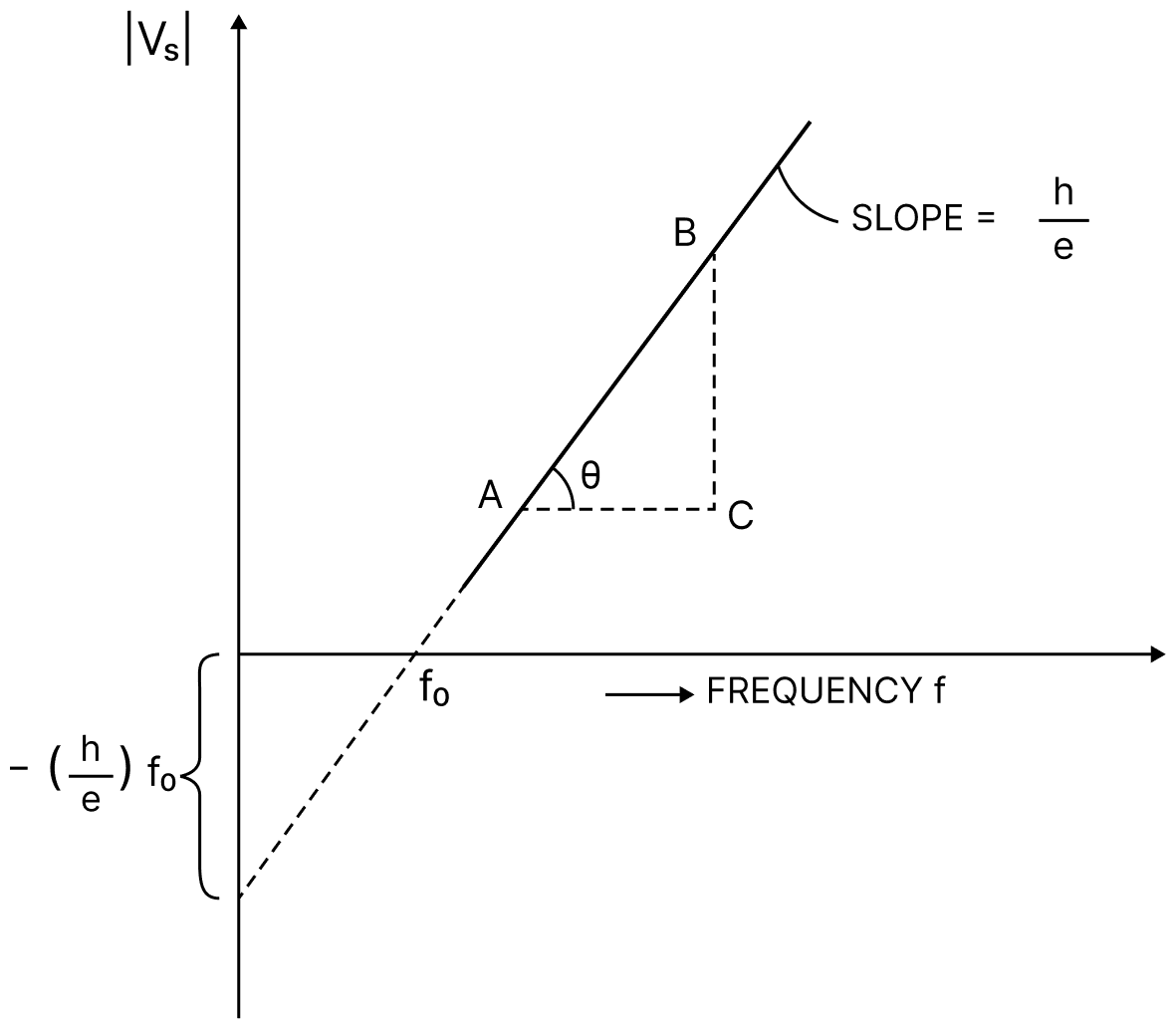
The graph : When the stopping potential |Vs| is plotted against the frequency f of the incident radiation for a given photosensitive surface, a straight line is obtained. It cuts the frequency axis at the threshold frequency f0, and on extending it backwards it cuts the |Vs| axis at .
Equation of the line : By Einstein's photoelectric equation, the maximum kinetic energy of the photoelectrons is
The stopping potential just stops the photoelectrons of maximum energy, so
From Eqs. (i) and (ii),
Since h, e and f0 are constants for the given surface, this is the equation of a straight line of slope .
Determination of h : Take two points A and B on the line and complete the right-angled triangle ACB. The slope of the line is
Therefore,
Hence, multiplying the slope of the |Vs|–f graph by the known electronic charge e gives Planck's constant h.
With reference to photoelectric effect, what is meant by the following terms
(a) Threshold frequency?
(b) Stopping potential?
Answer
(a) Threshold frequency : The lowest frequency of light which can emit photoelectrons from a material is called the threshold frequency (ν0) of that material. Below this frequency no photoelectrons are emitted, whatever be the intensity of light.
(b) Stopping potential : The negative potential of the anode relative to the cathode at which the photoelectric current becomes zero is called the stopping potential (V0). It stops even the most energetic photoelectrons, so Ek = eV0.
In photoelectric effect, the graph of stopping potential 'Vs' versus frequency 'f' of the incident radiation is a straight line. Then, slope 'm' of this line, Planck's constant 'h' and elementary charge 'e' are related as follows :
- h = em
- m = eh
- e = mh
- e = mπh
Answer
h = em
Reason — The equation of the Vs–f line is Vs = f − f0. Its slope is m = , so h = em.
Threshold wavelength for a certain metal for photoelectric effect is 600 nm. Calculate its :
(a) Threshold frequency,
(b) Work function.
(h = 6.6 × 10⁻³⁴ J-s)
Answer
Given,
- Threshold wavelength, λ0 = 600 nm = 600 × 10-9 m
- h = 6.6 × 10⁻³⁴ J s, c = 3 × 10⁸ m s-1, e = 1.6 × 10⁻¹⁹ C
(a) Threshold frequency :
(b) Work function :
Hence, (a) ν0 = 5 × 10¹⁴ Hz and (b) W = 3.3 × 10⁻¹⁹ J or 2.06 eV.
Note: The textbook prints the work function as 3.2 × 10⁻¹⁹ J or 2.0 eV. With h = 6.6 × 10⁻³⁴ J s, hν0 = 3.3 × 10⁻¹⁹ J (≈ 2.06 eV); the printed 3.2 × 10⁻¹⁹ J is incorrect.
Monochromatic light of wavelength 396 nm is incident on the surface of a metal whose work function is 1.125 eV. Calculate :
(a) the energy of an incident photon in eV.
(b) the maximum kinetic energy of photoelectrons in eV.
Answer
Given,
- Wavelength, λ = 396 nm = 396 × 10-9 m
- Work function, W = 1.125 eV
- h = 6.6 × 10⁻³⁴ J s, c = 3 × 10⁸ m s-1, e = 1.6 × 10⁻¹⁹ C
(a) Energy of an incident photon :
(b) Maximum kinetic energy of photoelectrons :
By Einstein's photoelectric equation,
Hence, (a) E = 3.125 eV and (b) Emax = 2.0 eV.
If frequency of ultraviolet radiation incident on the surface of an alkali metal in a photocell is increased, then :
- photocurrent increases
- photocurrent decreases
- maximum kinetic energy (Emax) of photoelectrons decreases
- maximum kinetic energy (Emax) of photoelectrons increases
Answer
maximum kinetic energy (Emax) of photoelectrons increases
Reason — By Einstein's equation, Emax = hν − W0, so the maximum kinetic energy increases linearly with the frequency ν. The photocurrent depends on the intensity of the radiation, not on its frequency, so options 1 and 2 do not follow.
(i) In an experiment on photoelectric effect, how does stopping potential change, if at all, when intensity of incident monochromatic UV radiation is increased?
(ii) Ultraviolet light is incident on metals P, Q and R, having work functions 8 eV, 2 eV and 4 eV respectively.
(a) Which metal has lowest threshold frequency for photoelectric effect?
(b) For which metal is the value of Emax minimum?
[Note : Emax is maximum kinetic energy of the emitted photoelectrons.]
Answer
(i) The stopping potential remains unchanged. It depends only on the frequency of the incident radiation and the work function of the metal (eV0 = hν − W), not on the intensity. Increasing the intensity only increases the photoelectric current.
(ii) (a) Metal Q. The threshold frequency is , so it is lowest for the metal of least work function, Q (2 eV).
(b) Metal P. For the same ultraviolet light, Emax = hν − W is least for the metal of greatest work function, P (8 eV).
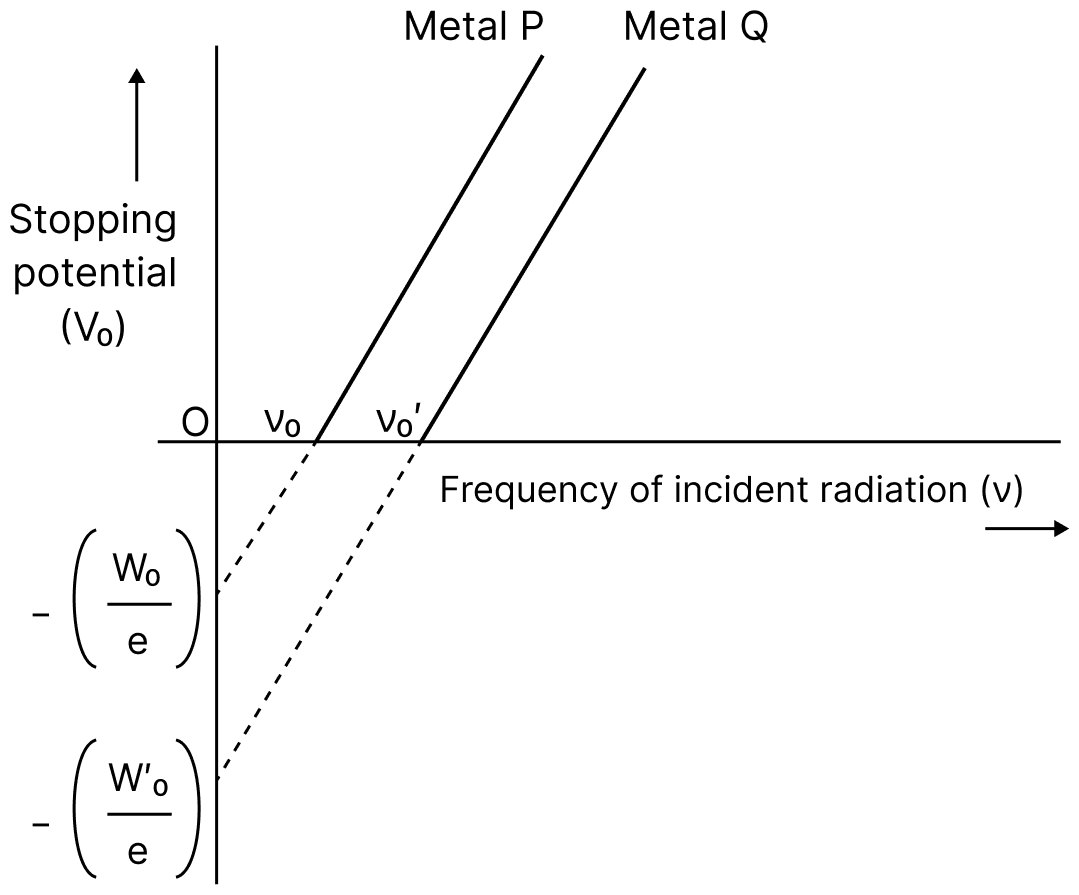
Figure shows the variation of stopping potential (V0) versus frequency of incident radiation (ν) for two metals P and Q.
(i) Which metal has lower threshold wavelength for photoelectric effect?
(ii) On what factor does the intercept of the straight line graph of (V0) versus (ν) depend?
(iii) How will the maximum kinetic energy of photoelectrons change, if at all, when the frequency of incident radiation is increased?
Answer
(i) Metal Q. Its graph cuts the frequency axis at the higher threshold frequency (). Since , the higher threshold frequency means a lower threshold wavelength.
(ii) The intercept depends on the work function W0 of the metal. From , the intercept on the V0 axis is and that on the ν axis is .
(iii) It increases. By Einstein's equation, Emax = hν − W0, so the maximum kinetic energy increases linearly with the frequency of the incident radiation.