
Draw a hysteresis loop with axis labelled and showing retentive and coercive force. What does the area of the loop represent?
Answer
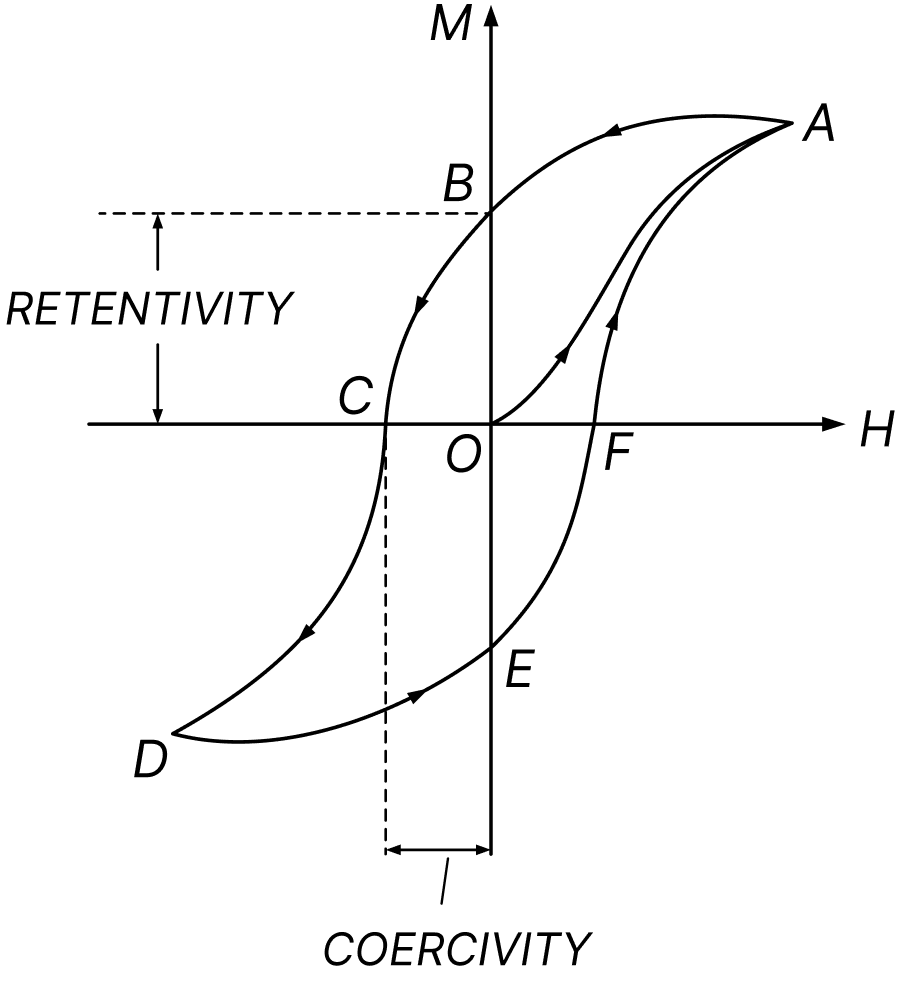
The figure shows the hysteresis loop ABCDEFA of a ferromagnetic substance, with the magnetising field (magnetic intensity) H along the x-axis and the intensity of magnetisation M along the y-axis. Along OA the substance is magnetised from the unmagnetised state and at A it reaches magnetic saturation.
- Retentivity : OB (or OE) is the magnetisation remaining in the substance when the magnetising field H is reduced to zero.
- Coercive force (coercivity) : OC (or OF) is the reverse magnetising field required to reduce the residual magnetisation to zero.
Area of the loop : The area of the hysteresis loop represents the energy lost (as heat) per unit volume of the substance in one complete cycle of magnetisation, called the hysteresis loss.
Distinguish between diamagnetic and paramagnetic substances in terms of its relative permeability (μr) and magnetic susceptibility (χ).
Answer
| Property | Diamagnetic substances | Paramagnetic substances |
|---|---|---|
| Relative permeability (μr) | Slightly less than 1 (μr < 1) | Slightly more than 1 (μr > 1) |
| Magnetic susceptibility (χ) | Small and negative (χ < 0) | Small and positive (χ > 0) |
State how the magnetic susceptibility of a ferromagnetic material changes when it is heated.
Answer
The magnetic susceptibility of a ferromagnetic material decreases when it is heated.
Explanation:
Ferromagnetism decreases with rise in temperature. At the Curie temperature Tc the ferromagnetic property disappears and the material becomes paramagnetic. Above Tc its susceptibility falls with temperature according to the Curie-Weiss law, .
Arrange the three types of magnetic materials i.e., paramagnetic, diamagnetic and ferromagnetic materials in decreasing order of their magnetic susceptibility.
Answer
Ferromagnetic > paramagnetic > diamagnetic.
Explanation:
Ferromagnetic materials have a very large positive susceptibility, paramagnetic materials a small positive susceptibility and diamagnetic materials a small negative susceptibility.
(i) What is meant by a paramagnetic substance? State Curie's law.
(ii) What is the value of magnetic susceptibility of aluminium, if its relative permeability is 1.000022?
Answer
(i) A paramagnetic substance is one which, when placed in a magnetising field, is feebly magnetised in the direction of the field, and so is feebly attracted towards a magnet. Examples : aluminium, platinum, sodium.
Curie's law : The magnetic susceptibility of a paramagnetic substance is inversely proportional to its kelvin temperature T,
where C is the Curie constant.
(ii) Given,
- Relative permeability of aluminium, μr = 1.000022
Using the relation μr = 1 + χ,
Hence, the magnetic susceptibility of aluminium is 0.000022 (= 2.2 × 10⁻⁵).
At a certain temperature, a ferromagnetic material becomes paramagnetic. What is the temperature called?
Answer
Curie temperature.
Explanation:
The temperature above which a ferromagnetic substance loses its ferromagnetic property and becomes paramagnetic is called its Curie temperature. For iron it is 770°C.
Two substances A and B have their relative permeabilities slightly greater and slightly less than 1 respectively. What do you conclude about A and B as far as their magnetic materials are concerned? (dia, para or ferro magnetic)
Answer
A is paramagnetic and B is diamagnetic.
Explanation:
The relative permeability μr is slightly more than 1 for paramagnetic substances and slightly less than 1 for diamagnetic substances. For ferromagnetic substances it is very large, of the order of hundreds and thousands.
State how magnetic susceptibility is different for the three types of magnetic materials, i.e., diamagnetic, paramagnetic and ferromagnetic materials.
Answer
- Diamagnetic materials : χ is small and negative.
- Paramagnetic materials : χ is small and positive.
- Ferromagnetic materials : χ is very large and positive.
(i) Explain the term hysteresis.
(ii) Name three elements of the earth's magnetic field which help in defining earth's magnetic field completely.
Answer
(i) When a ferromagnetic substance is taken through a cycle of magnetisation, its intensity of magnetisation M (and also the magnetic flux density B) always lags behind the magnetising field H. This lagging of M (or B) behind H is called hysteresis.
(ii) The three elements of the earth's magnetic field are :
- angle of declination
- angle of dip (or inclination)
- horizontal component of the earth's magnetic field.
Define Curie temperature.
Answer
The Curie temperature of a ferromagnetic substance is the temperature above which the substance loses its ferromagnetic property and becomes paramagnetic. For example, the Curie temperature of iron is 770°C and that of nickel is 358°C.
Magnetic susceptibility of platinum is 0.0001. Its relative permeability is :
- 1.0000
- 0.9999
- 1.0001
- 0
Answer
1.0001
Reason — Using μr = 1 + χ with χ = 0.0001 gives μr = 1.0001. Platinum is paramagnetic, so its relative permeability is slightly more than 1.
Explain Curie's law for paramagnetic substance.
Answer
Curie's law : The magnetisation M of a paramagnetic substance is directly proportional to the magnetic intensity H of the magnetising field and inversely proportional to its kelvin temperature T,
where C is the Curie constant. Since χ = M/H, the law can also be written as
Physical basis : The atoms of a paramagnetic substance have a net magnetic moment of their own and behave like tiny bar-magnets. The external field tends to align them along its direction, while thermal agitation disturbs this alignment. On cooling, thermal agitation decreases, the alignment improves and the magnetisation (and hence χ) increases; on heating, the reverse happens.
The law holds only so long as H/T is not too large, because M cannot exceed the value corresponding to complete alignment of all the atomic magnets.
Curie temperature is the temperature above which :
- a ferromagnetic substance behaves like a paramagnetic substance.
- a paramagnetic substance behaves like a diamagnetic substance.
- a ferromagnetic substance behaves like a diamagnetic substance.
- a paramagnetic substance behaves like a ferromagnetic substance.
Answer
a ferromagnetic substance behaves like a paramagnetic substance.
Reason — Ferromagnetism decreases with rise in temperature. Above the Curie temperature the ferromagnetic property disappears and the substance becomes paramagnetic.
State the relation between magnetic susceptibility (χ) and relative permeability (μr) of a magnetic substance.
Answer
μr = 1 + χ
Explanation:
Inside a magnetised substance, B = μ0(H + M). Putting M = χH,
Since B = μH, μ = μ0(1 + χ). Dividing by μ0,
(i) Why is the core of a transformer made of soft iron and not of steel?
(ii) Explain the meaning of the following statement :
Curie temperature for soft iron is 770°C.
Answer
(i) The core of a transformer is taken through complete cycles of magnetisation continuously. Its material must therefore have a low hysteresis loss, so that the core is not heated much, and a high permeability, so that a large flux density is obtained at a low magnetising field. The hysteresis loop of soft iron is much narrower than that of steel, so its hysteresis loss per cycle is smaller, and its permeability is greater than that of steel. Hence, the core is made of soft iron and not of steel.
(ii) It means that soft iron is ferromagnetic only below 770°C. When it is heated above 770°C, its ferromagnetic property disappears and it behaves as a paramagnetic substance.