
Name one material whose resistivity decreases with rise in temperature. Explain briefly on the basis of free electron theory why the resistivity decreases.
Answer
Carbon is a material whose resistivity decreases with a rise in temperature.
Carbon is a semiconductor, and in it the number of free electrons per unit volume n is very small at ordinary temperatures. On heating, a large number of additional free electrons are produced, so that n increases greatly. Since the resistivity is , and the increase in n is much larger than the accompanying decrease in the relaxation time τ, the resistivity decreases.
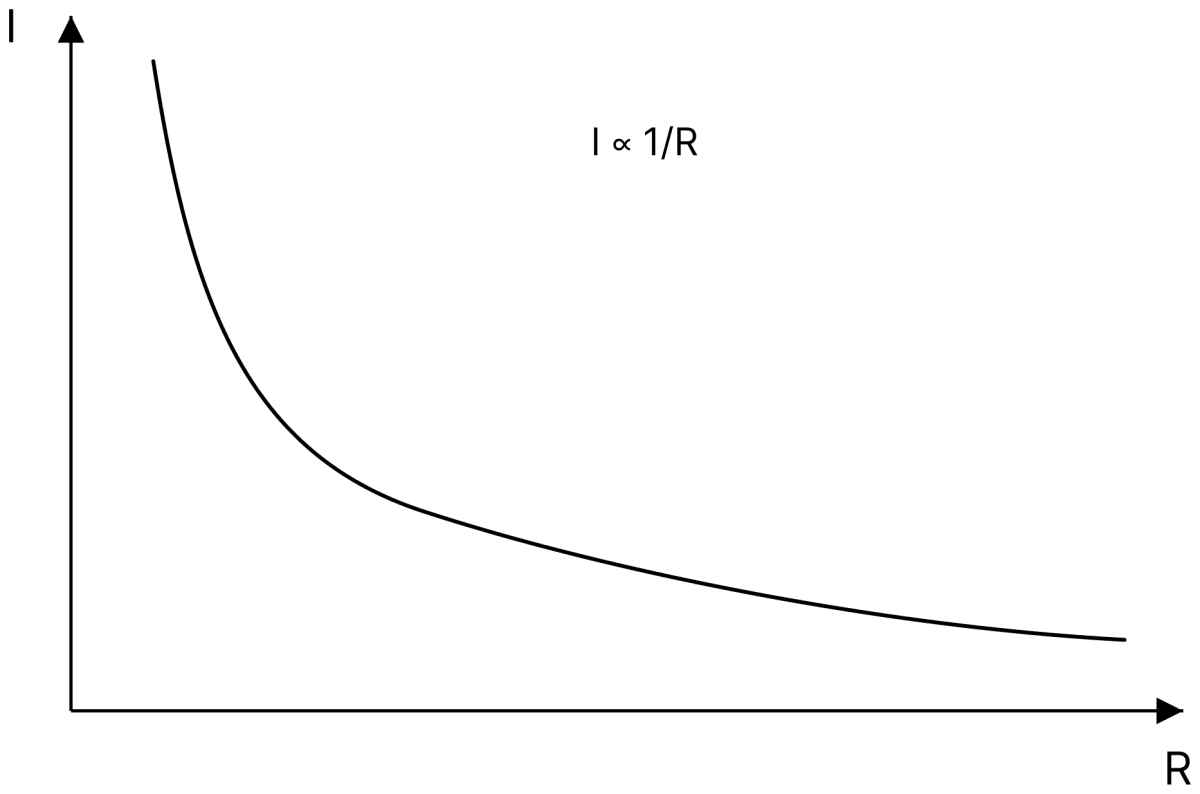
If the potential difference applied across a variable resistor is constant, draw a graph between the current in the resistor and the resistance.
Answer
By Ohm's law, . If the potential difference V is kept constant, then
Hence the graph between the current and the resistance is a rectangular hyperbola.
Write down a simple relationship to show the variation of resistance with temperature. Define temperature coefficient of resistance. In what way the temperature coefficient of carbon is different from that of the common conductors?
Answer
The variation of resistance with temperature is given by
where R0 and Rt are the resistances at 0°C and t°C.
Temperature coefficient of resistance : It is the change in resistance per unit original resistance per degree rise of temperature,
Difference for carbon : For common conductors (metals) α is positive, so their resistance increases with a rise in temperature. Carbon is a semiconductor and its temperature coefficient of resistance is negative, so its resistance decreases with a rise in temperature.
State the physical condition in which Ohm's law is not valid for a conductor.
Answer
Ohm's law is not valid for a conductor when its physical state, in particular its temperature, does not remain constant.
Explanation:
If the temperature of the conductor changes while the current flows through it, its resistance no longer remains constant and the ratio V/I ceases to be a constant.
Two bulbs B1 and B2 are connected in series with an AC source of emf 200 V, as shown. The labels on the bulbs read 200 V-60 W and 200 V-100 W respectively. Calculate the ratio of :
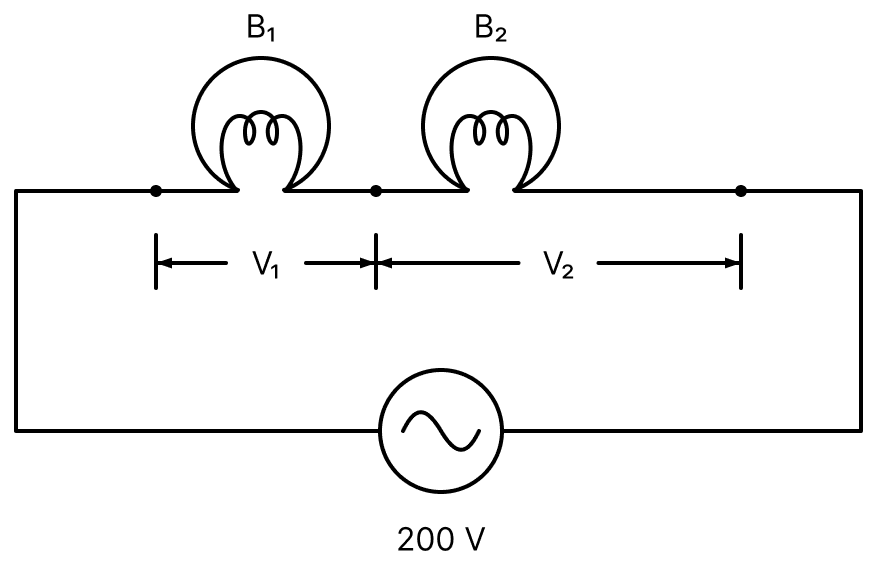
(i) the resistances of the bulbs (R1/R2),
(ii) the power being consumed when connected in series (P1/P2),
(iii) the PD across the bulbs (V1/V2).
Answer
Given,
- The two bulbs are marked 200 V-60 W and 200 V-100 W
- They are joined in series with a 200 V AC source
(i) Ratio of the resistances : From at the same rated voltage
(ii) Ratio of the powers consumed in series : In series the same current I flows through both, and P = I2R,
(iii) Ratio of the potential differences : Since V = I R,
Hence, all the three ratios are 5 : 3.
A potential difference of V volt is applied across a copper wire of length l and diameter d. How will the drift velocity be affected, if
(i) V is doubled
(ii) l is doubled
Answer
The drift velocity in terms of the potential difference applied is
(i) When V is doubled : vd is directly proportional to V, so the drift velocity is doubled.
(ii) When l is doubled : vd is inversely proportional to l, so the drift velocity is halved.
The current flowing through a conductor is given by I = neAvd.
(i) Identify each term in the equation.
(ii) Obtain an expression for Vd, if the current flowing through the conductor of length l has its ends maintained at a potential difference V volt.
Answer
(i) The terms in the equation I = n e A vd are :
- n — the free-electron density, that is, the number of free electrons per unit volume of the conductor
- e — the magnitude of the charge on an electron
- A — the area of cross-section of the conductor
- vd — the drift velocity of the free electrons
(ii) Expression for vd : The electric field set up in the conductor of length l across which a potential difference V is maintained is
Each free electron is accelerated by this field, , and if τ is the relaxation time, the average velocity acquired is
Substituting for E,
Two wires A and B of equal masses and of the same material are taken. The diameter of wire A is half the diameter of wire B. If the resistance of wire A is 24 Ω, calculate the resistance of wire B.
Answer
Given,
- The wires A and B are of equal masses and of the same material
- RA = 24 Ω
Since the wires are of the same material and of equal masses, their volumes V are equal. For such a wire,
Hence
Hence, the resistance of the wire B is 1.5 Ω.
Calculate the electric current density in a uniform wire connected to a battery of emf 3.5 V and negligible internal resistance. The resistance of the wire is 2.0 Ω and its area of cross-section is 0.70 × 10⁻⁶ m2.
Answer
Given,
- Emf of the battery, E = 3.5 V, internal resistance negligible
- Resistance of the wire, R = 2.0 Ω
- Area of cross-section, A = 0.70 × 10⁻⁶ m2
Current in the wire :
Current density :
Hence, the electric current density in the wire is 2.5 × 10⁶ A/m2.
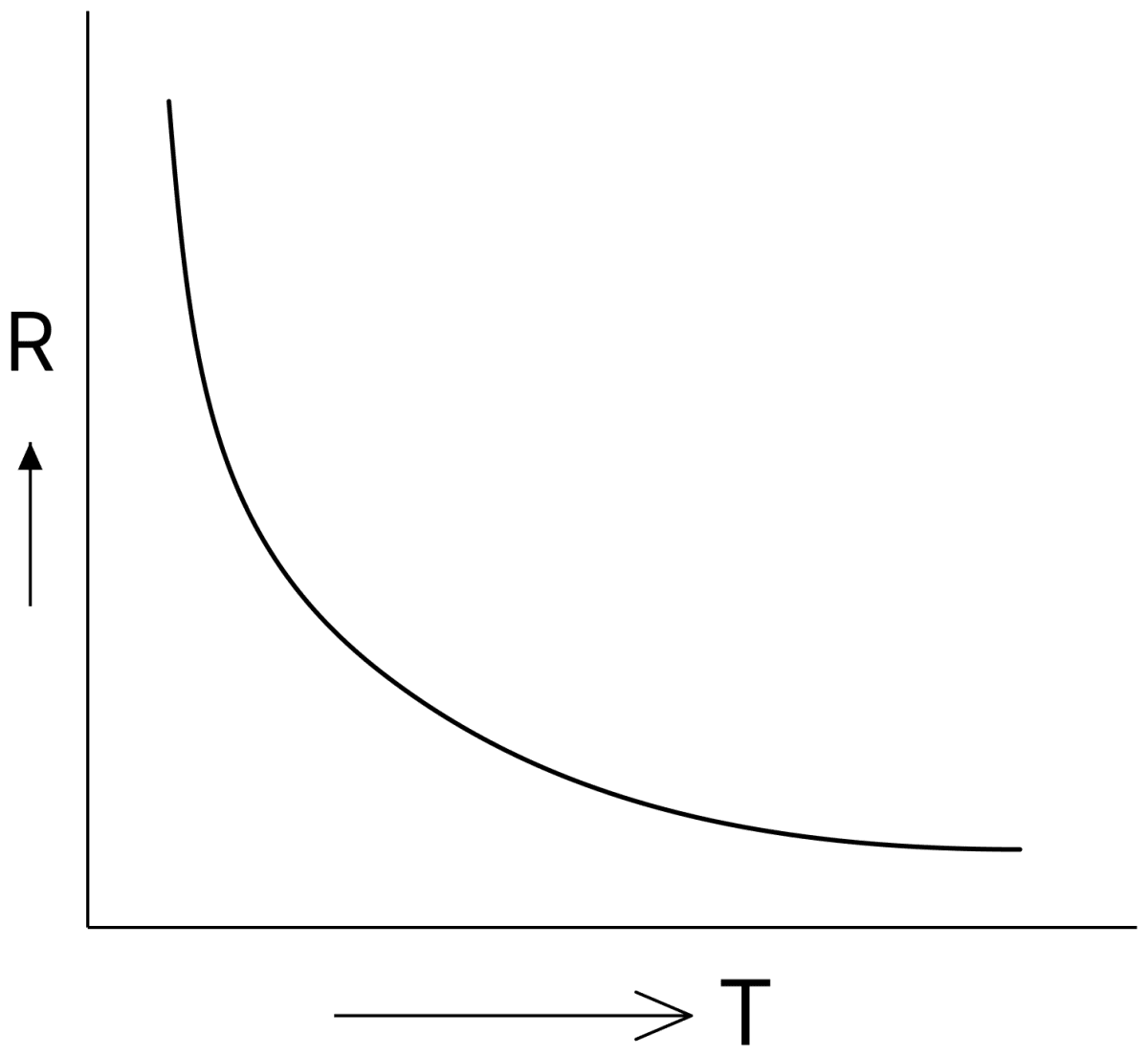
Show graphically how electrical resistance of a piece of silicon or germanium varies when its temperature is varied.
Answer
Silicon and germanium are semiconductors, for which the temperature coefficient of resistance is negative. With a rise in temperature the number of free electrons n increases greatly, so that the resistance decreases.
Hence the graph of resistance R against temperature T is as shown.
A wire of resistivity ρ is stretched uniformly, so that its length becomes four times. What is its new resistivity? (Assume temperature of the wire remains constant during stretching of the wire.)
Answer
The new resistivity remains the same, that is, ρ.
Explanation:
The resistivity is a characteristic property of the material of the wire, . On stretching, only the length and the area of cross-section of the wire change; the material remains the same and, as the temperature is unchanged, n and τ also remain unchanged. Hence the resistivity does not change, although the resistance becomes 16 times.
(i) What is meant by :
(a) drift velocity
(b) relaxation time?
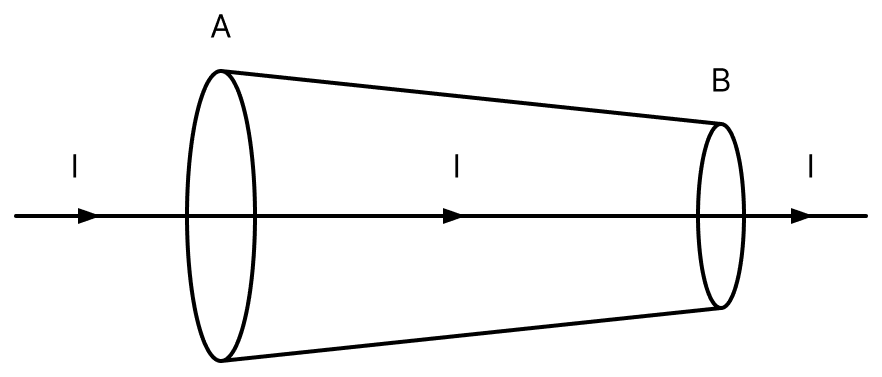
(ii) A metallic plug AB is carrying a current I (see figure). State how the drift velocity of free electrons vary, if at all from the end B to end A.
Answer
(i) (a) Drift velocity : When an electric field is applied across a conductor, its free electrons get drifted towards the positive end of the conductor. The average velocity with which they drift is called the drift velocity, .
(b) Relaxation time : The average time interval that elapses between two successive collisions of a free electron with the metal ions is called the relaxation time. It equals the mean free path of the electron divided by its rms velocity, , and its value is of the order of 10-14 s.
(ii) The current I is the same at every cross-section of the plug.
The drift velocity is
so . From the figure the area of cross-section goes on increasing from the end B to the end A. Hence the drift velocity of the free electrons decreases as they move from B to A.
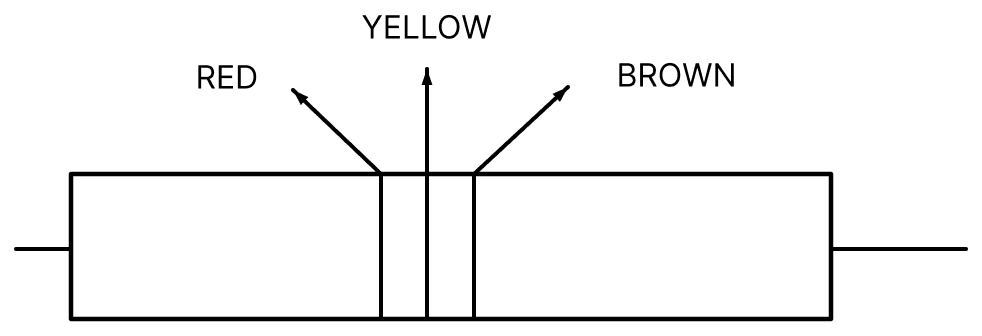
What is the resistance of a carbon resistor whose coloured bands are shown in the given figure?
Answer
From the figure the colour bands of the carbon resistor in order are Red, Yellow, Brown, and there is no fourth band.
Using the colour code, Red corresponds to the figure 2, Yellow to the figure 4 and Brown to the multiplier 101. As the fourth band is absent, the tolerance is 20%.
Hence, the resistance of the carbon resistor is 240 Ω ± 20%.
Explain the statement 'temperature coefficient of resistance of metal is 4 × 10⁻³/°C.'
Answer
The temperature coefficient of resistance is the change in resistance per unit original resistance per degree rise of temperature,
Hence the statement means that when the temperature of the metal wire is raised by 1°C, the fractional change in its resistance is 4 × 10⁻³, that is, its resistance increases by 0.4% of its original value for every 1°C rise of temperature.
What is current density? Write the vector equation connecting current density J with electric field intensity E, for an ohmic conductor.
Answer
Current density : Current density is the current flowing per unit area of cross-section held normal to the direction of flow of charge,
It is a vector quantity, its direction being the direction of flow of positive charge, and its SI unit is A m-2.
Vector equation for an ohmic conductor :
where σ is the specific conductance of the material. This is Ohm's law in vector form.
In current electricity, Ohm's law is obeyed by all :
- solids
- metals
- liquids
- gases
Answer
metals
Explanation:
Ohm's law is not a universal law. It is true only for metallic conductors, and even for them only so long as the temperature and other physical states of the conductor do not change.
When a potential difference of 3 V is applied between the two ends of a 60 cm long metallic wire, current density in it is found to be 1 × 10⁻⁷ Am-2. Find conductivity of the material of the wire in SI system.
Answer
Given,
- Potential difference, V = 3 V
- Length of the wire, l = 60 cm = 0.6 m
- Current density, j = 1 × 10⁻⁷ Am-2
Electric field in the wire :
Conductivity : By Ohm's law in vector form, j = σE, so
Hence, the conductivity of the material of the wire is 2 × 10⁻⁸ Ω-1 m-1.
A current I flows through a metallic wire of radius r and free electrons in it drift with a velocity vd. Calculate the drift velocity of the free electrons through the wire of the same material, having double the radius, when same current flows through it.
Answer
Given,
- Radius of the first wire = r, drift velocity = vd
- Radius of the second wire = 2r, and the same current I flows through it
The current in terms of the drift velocity is
For the same material and the same current, . Hence for the wire of radius 2r,
Hence, the drift velocity through the thicker wire is .
Define temperature coefficient of resistance of the material of a conductor.
Answer
Temperature coefficient of resistance : The temperature coefficient of resistance of the material of a conductor is the change in resistance per unit original resistance per degree rise of temperature,
where R0 and Rt are the resistances of the conductor at 0°C and t°C respectively. Its unit is °C-1.
What is the colour code of a carbon resistor having a resistance of 470Ω and a tolerance of 5%?
Answer
Given,
- R = 470 Ω = 47 × 101 Ω
- Tolerance = 5%
The first significant figure is 4, for which the colour is Yellow.
The second significant figure is 7, for which the colour is Violet.
The multiplier is 101, for which the colour of the third band is Brown.
A tolerance of 5% corresponds to a Gold fourth band.
Hence, the colour code is Yellow, Violet, Brown, Gold.
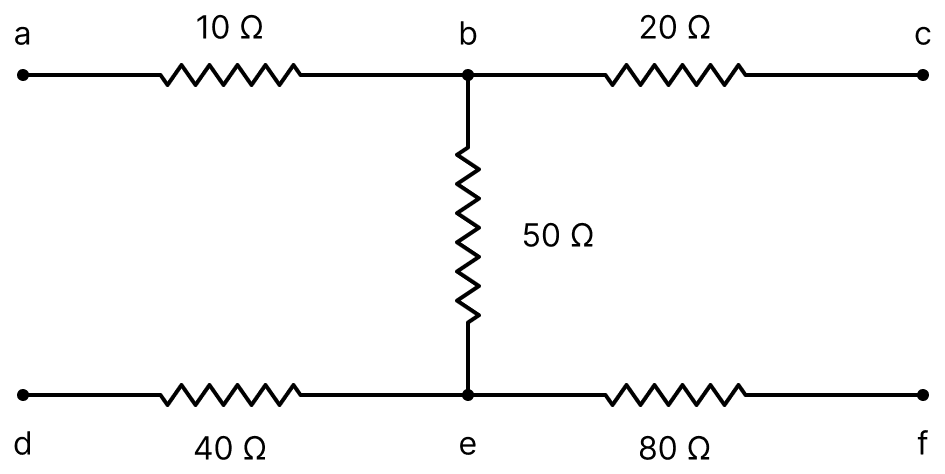
The equivalent resistance between points a and f of the network shown in figure is :
- 24 Ω
- 110 Ω
- 140 Ω
- 200 Ω
Answer
140 Ω
Explanation:
Given,
- Arm ab = 10 Ω
- Arm bc = 20 Ω, where c is a free end
- Arm be = 50 Ω
- Arm de = 40 Ω, where d is a free end
- Arm ef = 80 Ω
The 20 Ω resistance ends at the free point c and the 40 Ω resistance starts from the free point d. Since no closed path can be completed through c or through d, no current can flow in these two resistances and they may be ignored.
Hence the current flows only along the path a → b → e → f, in which the 10 Ω, 50 Ω and 80 Ω resistances are in series,
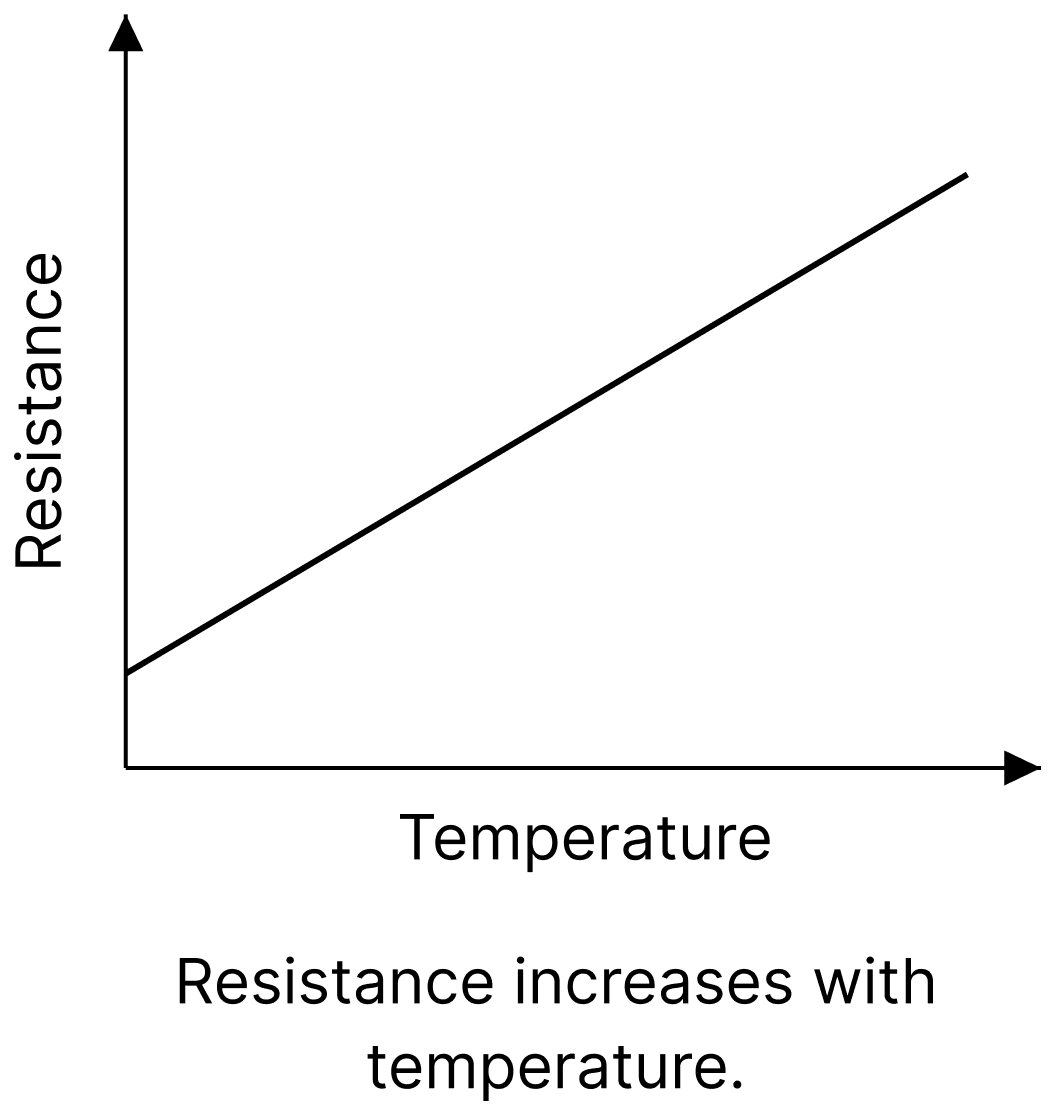
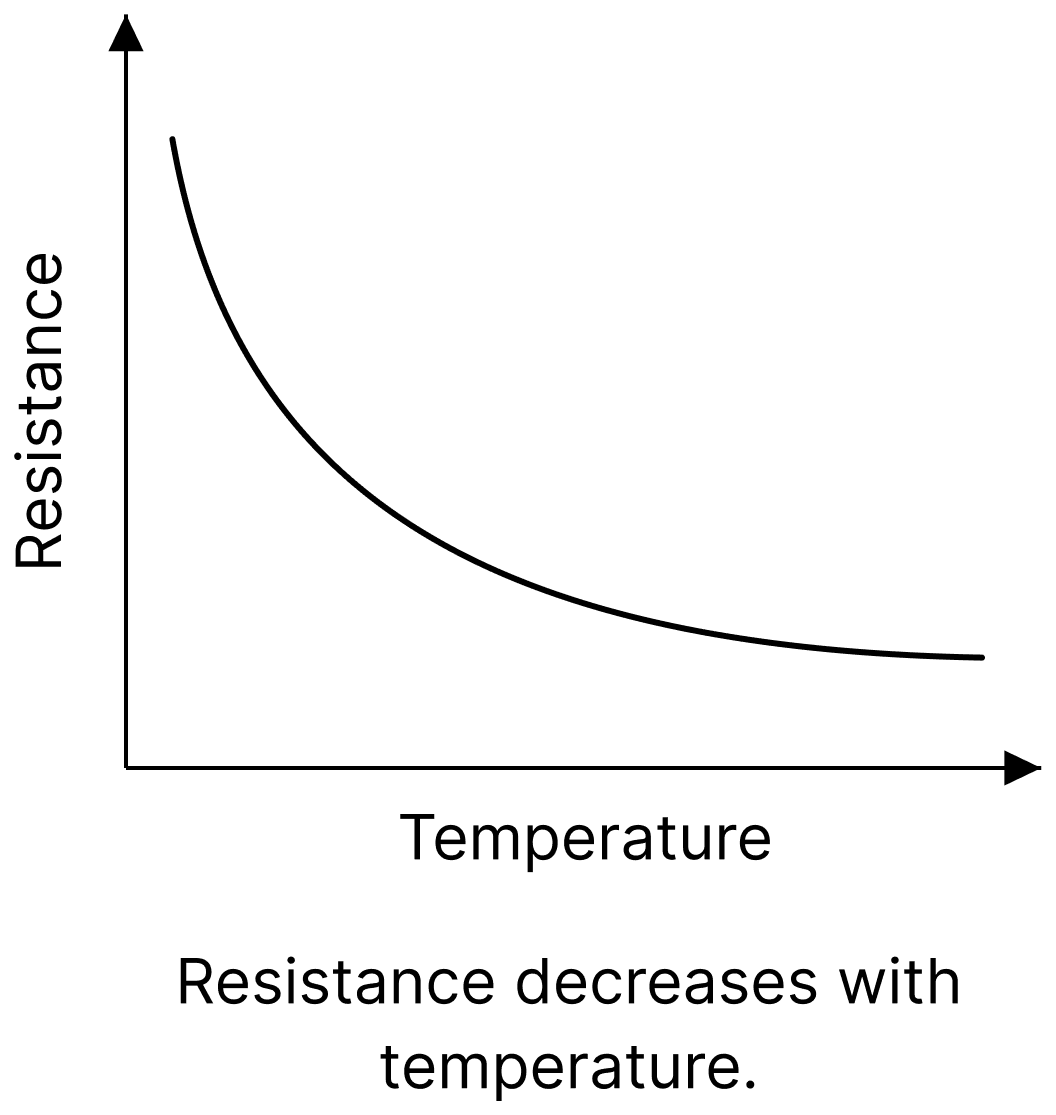
Draw labelled graphs to show how electrical resistance varies with temperature for :
(i) a metallic wire
(ii) a piece of carbon.
Answer
(i) For a metallic wire : The resistance of a metal increases with a rise in temperature, because the relaxation time τ of the free electrons decreases. The variation is nearly linear.
(ii) For a piece of carbon : Carbon is a semiconductor, and its temperature coefficient of resistance is negative. On heating, the number of free electrons n increases greatly, so its resistance decreases rapidly with a rise in temperature.
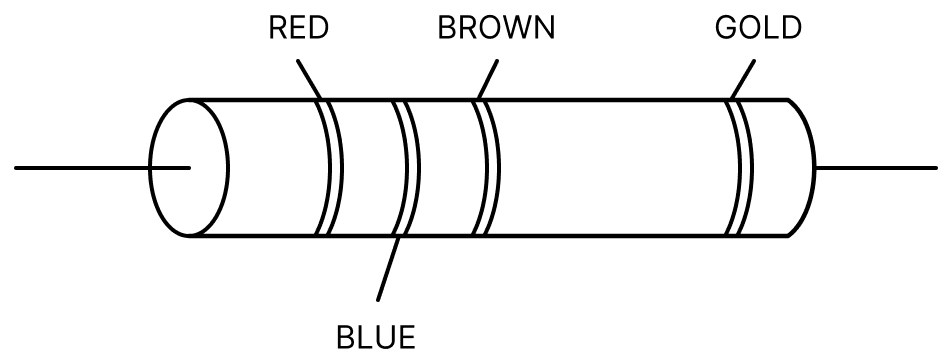
A carbon resistor has coloured bands as shown in figure. The resistance of the resistor is :
- 26 Ω ± 10%
- 26 Ω ± 5%
- 260 Ω ± 5%
- 260 Ω ± 10%
Answer
260 Ω ± 5%
Explanation:
From the figure the colour bands in order are Red, Blue, Brown and Gold.
Using the colour code, Red corresponds to the figure 2, Blue to the figure 6, Brown to the multiplier 101, and Gold to a tolerance of 5%. Hence
A metallic wire has a resistance of 3.0 Ω at 0°C and 4.8 Ω at 150°C. Find the temperature coefficient of resistance of its material.
Answer
Given,
- Resistance at 0°C, R0 = 3.0 Ω
- Resistance at 150°C, Rt = 4.8 Ω
The variation of resistance with temperature is Rt = R0(1 + αt). Substituting the values,
Hence, the temperature coefficient of resistance of the material is 4 × 10⁻³ °C-1.
A wire of resistance R is cut into n equal parts. These parts are then connected in parallel with each other. The equivalent resistance of the combination is :
- nR
Answer
Explanation:
When a wire of resistance R is cut into n equal parts, the length of each part becomes while the area of cross-section is unchanged. Hence the resistance of each part is
These n equal resistances are then joined in parallel, so the equivalent resistance is
What is meant by drift speed of free electrons?
Answer
Drift speed of free electrons : When an electric field is applied across a conductor, its free electrons get drifted towards the positive end of the conductor. The average speed of this drift is called the drift speed.
It is given by . Its value is only of the order of 10-5 m s-1, far smaller than the thermal speeds of the electrons at room temperature, which are of the order of 106 m s-1.
Two resistors R1 = 60 Ω and R2 = 90 Ω are connected in parallel. If electric power consumed by the resistor R1 is 15 W, calculate the power consumed by the resistor R2.
Answer
Given,
- R1 = 60 Ω and R2 = 90 Ω joined in parallel
- Power consumed by R1, P1 = 15 W
In parallel the same potential difference V acts across both the resistors, and
For R1,
For R2, the same V acts, so
Hence, the power consumed by the resistor R2 is 10 W.
The order of coloured rings in a carbon resistor is red, yellow, blue and silver. The resistance of the carbon resistor is :
- 24 × 106 Ω ± 5%
- 24 × 106 Ω ± 10%
- 34 × 104 Ω ± 10%
- 26 × 104 Ω ± 5%
Answer
24 × 106 Ω ± 10%
Explanation:
Using the colour code, Red corresponds to the figure 2, Yellow to the figure 4, Blue to the multiplier 106, and Silver to a tolerance of 10%. Hence
Define current density. Write an expression which connects current density with drift speed.
Answer
Current density : Current density is the current flowing per unit area of cross-section held normal to the direction of flow of charge,
Relation with drift speed : Since I = n e A vd,
where n is the free-electron density and e the electronic charge.
An electric bulb is marked 200 V, 100 W. Calculate electric resistance of its filament. If five such bulbs are connected in series to a 200 V supply, how much current will flow through them?
Answer
Given,
- Rating of the bulb, 200 V, 100 W
- Five such bulbs are joined in series to a 200 V supply
Resistance of the filament :
Current through the series combination : The equivalent resistance of five such bulbs in series is
Hence, the resistance of the filament is 400 Ω and the current flowing through the bulbs is 0.1 A.
A metallic wire having a resistance of 20Ω is bent in order to form a complete circle. Calculate the resistance between any two diametrically opposite points on the circle.
Answer
Given,
- Resistance of the wire, R = 20 Ω
- The wire is bent to form a complete circle
When the wire is bent into a circle, the two diametrically opposite points divide it into two equal halves. The resistance of each half is
These two halves are connected in parallel between the two diametrically opposite points,
Hence, the resistance between the two diametrically opposite points is 5 Ω.
A uniform copper wire having a cross-sectional area of 1 mm2 carries a current of 5A. Calculate the drift speed of free electrons in it. (Free electron number density of copper = 2 × 1028 m-3)
Answer
Given,
- Area of cross-section, A = 1 mm2 = 1 × 10⁻⁶ m2
- Current, I = 5 A
- Free electron number density, n = 2 × 1028 m-3
- Electronic charge, e = 1.6 × 10⁻¹⁹ C
From I = n e A vd,
Substituting the values,
Hence, the drift speed of the free electrons is 1.56 × 10⁻³ m/s.
An electric bulb is rated at 250V, 750W. Calculate the :
(i) electric current flowing through it, when it is operated on a 250 V supply.
(ii) resistance of its filament.
Answer
Given,
- Rating of the bulb, 250 V, 750 W
- Supply voltage, V = 250 V
(i) Electric current flowing through it :
(ii) Resistance of its filament :
Hence, the current flowing is 3 A and the resistance of the filament is 83.3 Ω.
For a metallic conductor, what is the relation between current density (J), conductivity (σ) and electric field intensity (E)?
Answer
For a metallic conductor the current density is directly proportional to the electric field intensity established inside it. This is Ohm's law in vector form,
where σ is the conductivity of the material of the conductor. Since σ is a characteristic property of the material, the ratio J/E is constant and does not depend on the electric field applied.
Choose the correct alternative (a), (b), (c) or (d) for question given below :
If R1 and R2 are filament resistances of a 100 W bulb and a 50 W bulb respectively, designed to operate on the same voltage, then :
- R1 = R2
- R1 = 4R2
- R2 = 4R1
- R2 = 2R1
Answer
R2 = 2R1
Explanation:
Both the bulbs are designed to operate on the same voltage V, and the resistance of a bulb from its rating is
so that . Hence
SI unit of electrical conductivity is :
- Ω m-1
- Ω m-2
- Ω-1 m-1
- Ω-1 m-2
Answer
Ω-1 m-1
Explanation:
The electrical conductivity is the reciprocal of the resistivity, . Since the SI unit of resistivity is ohm-metre (Ω m), the SI unit of conductivity is (Ω m)-1, that is, Ω-1 m-1.
A metallic wire of resistance R is stretched slowly and uniformly (keeping its temperature constant) till its new radius becomes half. Its resistance, then becomes :
- 16R
- 8R
- 4R
- R
Answer
16R
Explanation:
On stretching, the volume of the wire remains constant. When the radius becomes half, the area of cross-section becomes , and hence the length becomes 4l. Therefore
Specific resistance of the material of a wire depends on :
- length of the wire
- area of cross section of the wire
- volume of the wire
- temperature of the wire
Answer
temperature of the wire
Explanation:
The specific resistance is a characteristic property of the material of the wire, . It does not depend on the length, the area of cross-section or the volume of the wire. It depends only on the nature of the material and on its temperature, since a change of temperature changes the relaxation time τ and, in semiconductors, the free-electron density n as well.
Two electric bulbs, whose resistances are in the ratio 1 : 2, are connected in parallel to a constant voltage supply. The powers dissipated in them are in the ratio :
- 1 : 1
- 1 : 2
- 2 : 1
- 1 : 4
Answer
2 : 1
Explanation:
In a parallel combination the same potential difference V acts across both the bulbs, and the power dissipated is
Since the resistances are in the ratio 1 : 2, the powers dissipated are in the inverse ratio, that is, 2 : 1.
When a potential difference of 2V is applied between the two ends of a 1 m long and uniform metallic wire, current density in it is found to be 4 × 10⁶ Am-2. Resistivity of the material of the wire is :
- 5 × 10⁻⁷ Ωm
- 5 × 10⁻⁸ Ωm
- 5 × 10⁶ Ωm
- 5 × 10⁸ Ωm
Answer
5 × 10⁻⁷ Ωm
Explanation:
Given, V = 2 V, l = 1 m and j = 4 × 10⁶ Am-2.
The electric field in the wire is
By Ohm's law in vector form, , so
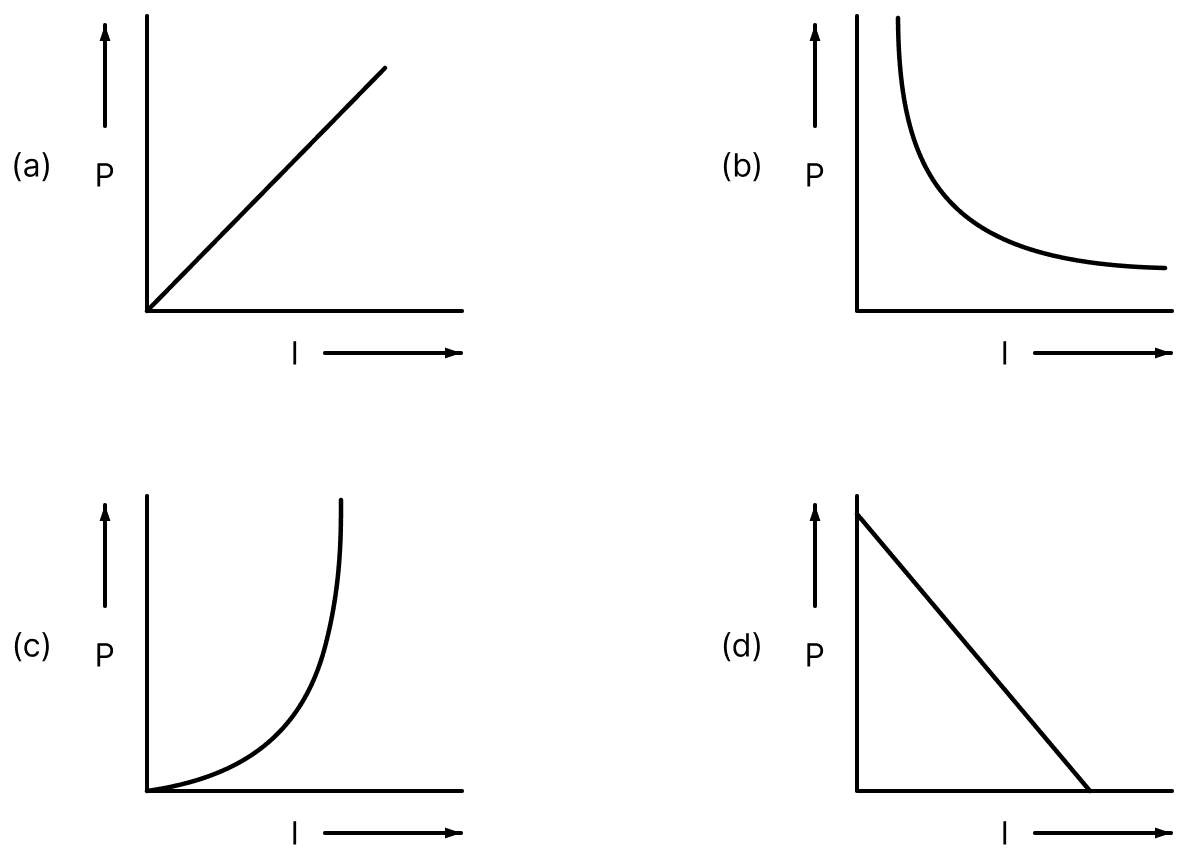
An electric current (I) flowing through a metallic wire is gradually increased. The graph of heating power (P) developed in it versus the current (I) is :
Answer
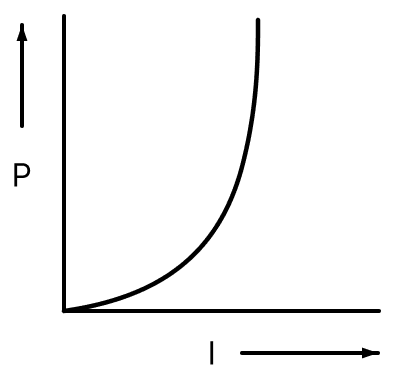
The heating power developed in a wire of resistance R carrying a current I is
so that . The graph of P against I is therefore a parabola passing through the origin, whose slope goes on increasing as I increases.
Hence, the graph shown in option (c) is the correct one.
Current 'I' flowing through a metallic wire is related to drift speed vd of free electrons as follows :
State what the symbol n stands for.
Answer
In the relation I = n e A vd, the symbol n stands for the number of free electrons per unit volume of the wire, that is, the free-electron density.
If electric current flowing through a metallic wire is doubled, heating power developed in it will become :
- 2 times
- 4 times
- 8 times
- 16 times
Answer
4 times
Explanation:
The heating power developed in a wire of resistance R carrying a current I is
so that for a given wire. If the current is doubled, then
Hence the heating power becomes 4 times.
With increase in temperature, electrical conductivity of a semiconductor :
- decreases
- increases
- does not change
- first increases and then decreases
Answer
increases
Explanation:
In a semiconductor the number of free electrons n per unit volume is very small at ordinary temperatures, but on heating a large number of additional free electrons are produced, so that n increases greatly. Although the relaxation time τ decreases, the increase in n is much larger. Hence the resistivity decreases, that is, the electrical conductivity of a semiconductor increases with a rise in temperature.
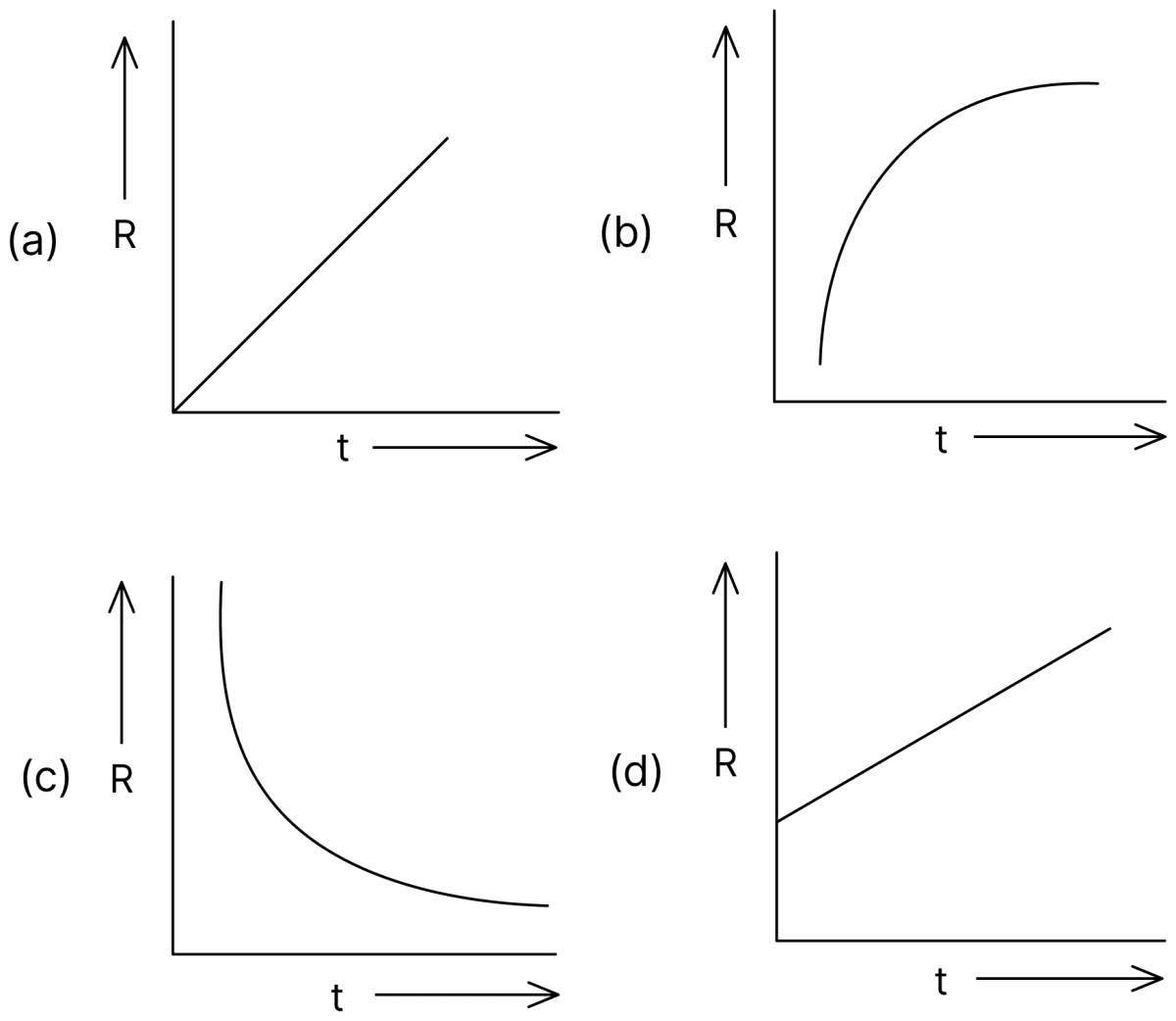
The graph of resistance (R) of a semiconductor crystal versus its temperature (t) is:
Answer
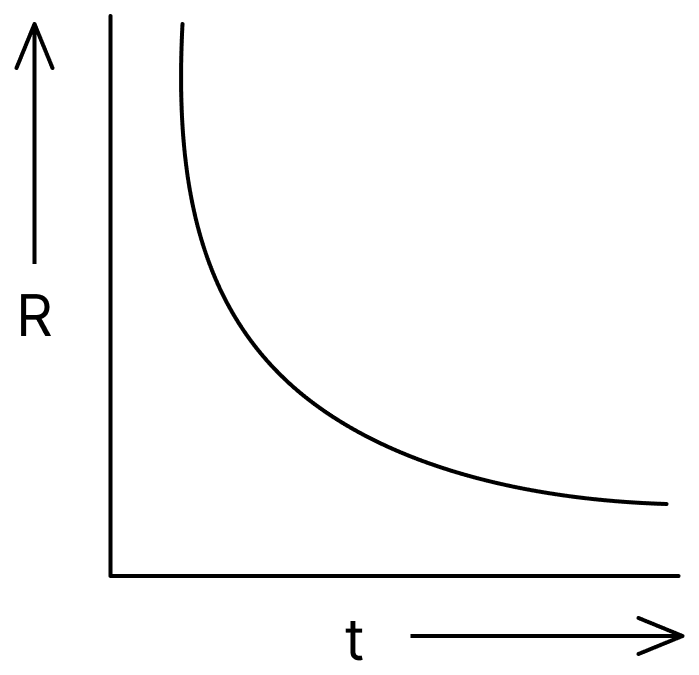
A semiconductor crystal has a negative temperature coefficient of resistance. With a rise in temperature the number of free electrons n increases greatly, so the resistance goes on decreasing, rapidly at first and then more slowly.
Hence, the graph shown in option (c) is the correct one.
If potential difference between the two ends of a metallic wire is doubled, drift speed of free electrons in the wire :
- remains same
- becomes double
- becomes four times
- becomes half
Answer
becomes double
Explanation:
The drift speed of the free electrons in terms of the potential difference applied across the ends of the wire is
Hence for a given wire, and on doubling the potential difference the drift speed becomes double.
Which one of the following copper wires has minimum resistance?
- length = x, area of cross-section = y
- length = 2x, area of cross-section = y
- length = x, area of cross-section = 2y
- length = 2x, area of cross-section = 2y
Answer
length = x, area of cross-section = 2y
Explanation:
The resistance of a wire is
so R is minimum when the length is smallest and the area of cross-section is largest. Among the given wires, the smallest length is x and the largest area of cross-section is 2y.
Three bulbs B1 (230 V, 40 W), B2 (230 V, 60 W) and B3 (230 V, 100 W) are connected in series to a 230 V supply. Which bulb glows the brightest?
Answer
Given,
- B1 (230 V, 40 W), B2 (230 V, 60 W) and B3 (230 V, 100 W)
- The three bulbs are joined in series to a 230 V supply
The resistance of a bulb from its rating is , so . Hence the bulb of the lowest wattage has the highest resistance,
In series the same current I flows through all the three bulbs, and the power actually consumed by a bulb is
so the bulb of the greatest resistance consumes the greatest power and glows the brightest.
Hence, the bulb B1 glows the brightest.
A uniform metallic wire having a cross sectional area of 6 × 10⁻⁶ m2 carries a constant current of 3A. Calculate :
(i) current density in the wire.
(ii) drift speed of free electrons in the wire.
(Free electron number density in the wire = 5 × 1028 m-3).
Answer
Given,
- Area of cross-section, A = 6 × 10⁻⁶ m2
- Current, I = 3 A
- Free electron number density, n = 5 × 1028 m-3
- Electronic charge, e = 1.6 × 10⁻¹⁹ C
(i) Current density :
(ii) Drift speed : Since j = n e vd,
Hence, the current density is 5 × 10⁵ Am-2 and the drift speed of the free electrons is 6.25 × 10⁻⁵ ms-1.