
An electron of mass m with an initial velocity (v0 > 0) enters an electric field (E0 = constant > 0) at t = 0. If λ0 is its de-Broglie wavelength at time t is:
- λ0
- λ0t
Answer
Reason — The force on the electron is , along its initial velocity. So it moves with uniform acceleration a = and its velocity at time t is v = v0 + t. Hence, with ,
Two particles move at right angle to each other. Their de-Broglie wavelengths are λ1 and λ2 respectively. The particles suffer perfectly inelastic collision. The de-Broglie wavelength λ, of the final particle, is given by:
Answer
Reason — The momenta of the particles are and . Momentum is conserved in the collision, so the momentum of the combined particle is , with magnitude
A particle 'P' is formed due to a completely inelastic collision of particles 'x' and 'y' having de-Broglie wavelengths 'λx' and 'λy' respectively. If x and y were moving in opposite directions, then the de-Broglie wavelength of 'P' is:
- λx + λy
- λx − λy
Answer
Reason — As x and y move in opposite directions, by momentum conservation the momentum of P is pP = |px − py|. Using p = ,
A nucleus A, with a finite de-Broglie wavelength λA, undergoes spontaneous fission into two nuclei B and C of equal mass. B flies in the same direction as that of A, while C flies in the opposite direction with a velocity equal to half of that of B. The de-Broglie wavelengths λB and λC of B and C are respectively:
- 2λA, λA
- λA, 2λA
- λA,
- , λA
Answer
, λA
Reason — Let the mass of each of B and C be m, so that the mass of A is 2m. Let A move with velocity v0, B with velocity v and C with velocity in the opposite direction. By momentum conservation,
Hence pA = 2mv0, pB = m(4v0) = 4mv0 and pC = m(2v0) = 2mv0. As λ = , λB = and λC = λA.
If the de-Broglie wavelength of an electron is equal to 10-3 times the wavelength of a photon of frequency 6 × 10¹⁴ Hz, then the speed of electron is equal to:
(Speed of light = 3 × 10⁸ m/s, Planck's constant = 6.63 × 10⁻³⁴ J-s, Mass of electron = 9.1 × 10⁻³¹ kg)
- 1.45 × 10⁶ m/s
- 1.7 × 10⁶ m/s
- 1.8 × 10⁶ m/s
- 1.1 × 10⁶ m/s
Answer
1.45 × 10⁶ m/s
Reason — Wavelength of the photon, = 5 × 10⁻⁷ m. So the de-Broglie wavelength of the electron is 10-3 × 5 × 10-7 = 5 × 10⁻¹⁰ m. Since λe = ,
An electron, a doubly ionized helium ion (He++) and a proton are having the same kinetic energy. The relation among their respective de-Broglie wavelengths λe, λHe++ and λp is:
- λe > λHe++ > λp
- λe < λp < λHe++
- λe > λp > λHe++
- λe < λHe++ = λp
Answer
λe > λp > λHe++
Reason — The de-Broglie wavelength is . For the same kinetic energy K, λ ∝ . Since me < mp < mHe++, the order of the wavelengths is λe > λp > λHe++.
The de-Broglie wavelength of an electron moving with kinetic energy of 144 eV is nearly:
- 102 × 10-2 nm
- 102 × 10-3 nm
- 102 × 10-4 nm
- 102 × 10-5 nm
Answer
102 × 10-3 nm
Reason — For an electron of kinetic energy K (in eV), . Hence,
The wave nature of electrons was experimentally verified by:
- Davisson and Germer
- de-Broglie
- Hertz
- Einstein
Answer
Davisson and Germer
Reason — In 1927, Davisson and Germer showed that a beam of electrons is diffracted by a nickel crystal, which experimentally verified the wave nature of electrons. de-Broglie only proposed the hypothesis of matter waves.
Particle A of mass mA = moving along the X-axis with velocity v0 collides elastically with another particle B at rest having mass mB = . If both particles move along the X-axis after the collision, the change Δλ in de-Broglie wavelength of particle A, in terms of its de-Broglie wavelength (λ0) before collision is:
- Δλ = 2λ0
- Δλ = 4λ0
- Δλ =
- Δλ =
Answer
Δλ = 4λ0
Reason — Initially, . Let v1 and v2 be the velocities of A and B after the collision. By momentum conservation and, for an elastic collision, equality of the relative velocities of approach and separation,
Solving these, . Therefore,
Assuming the nitrogen molecule is moving with r.m.s. velocity at 400 K, the de-Broglie wavelength of nitrogen molecule is close to:
(Given: nitrogen molecule weight: 4.64 × 10⁻²⁶ kg, Boltzman constant: 1.38 × 10⁻²³ J/K, Planck constant: 6.63 × 10⁻³⁴ J-s)
- 0.24 Å
- 0.20 Å
- 0.34 Å
- 0.44 Å
Answer
0.24 Å
Reason — With and ,
An electromagnetic wave of wavelength 'λ' is incident on a photosensitive surface of negligible work function. If 'm' mass is of photoelectron emitted from the surface has de-Broglie wavelength λd, then:
Answer
Reason — As the work function is negligible, the whole energy of the incident photon becomes the kinetic energy of the photoelectron. With p = ,
The de-Broglie wavelength of a particle having kinetic energy E is λ. How much extra energy must be given to this particle, so that the de-Broglie wavelength reduces to 75% of the initial value?
E
Answer
Reason — Since , . Let ΔE be the extra energy given, so that the new wavelength is 0.75λ.
Given here are two statements: One is labelled as Assertion A and the other is labelled as Reason R.
Assertion A: An electron microscope can achieve better resolving power than an optical microscope.
Reason R: The de-Broglie's wavelength of the electrons emitted from an electron gun is much less than wavelength of visible light.
In the light of the above statements, choose the correct answer from the given options.
- A is true but R is false.
- Both A and R are true and R is the correct explanation of A.
- Both A and R are true but R is not the correct explanation of A.
- A is false but R is true.
Answer
Both A and R are true and R is the correct explanation of A.
Reason — The resolving power of a microscope is inversely proportional to the wavelength of the radiation used. The de-Broglie wavelength of the electrons from an electron gun (≈ 0.1 Å) is much less than the wavelength of visible light (380 nm to 700 nm), so an electron microscope has a much higher resolving power. Thus R correctly explains A.
The speed of electrons in a scanning electron microscope is 1 × 10⁷ ms-1. If the protons having the same speed are used instead of electrons, then the resolving power of scanning proton microscope will be changed by a factor of:
- 1837
Answer
1837
Reason — Resolving power RP ∝ and , so RP ∝ . For the same speed v, RP ∝ m. Hence,
Consider two separate ideal gases of electrons and protons having same number of particles. The temperature of both the gases are same. The ratio of the uncertainty in determining the position of an electron to that of a proton is proportional to:
Answer
Reason — At the same temperature the kinetic energies of the electron and the proton are the same, so
The uncertainty in position is Δx ≈ , with Δp of the order of p. Hence .
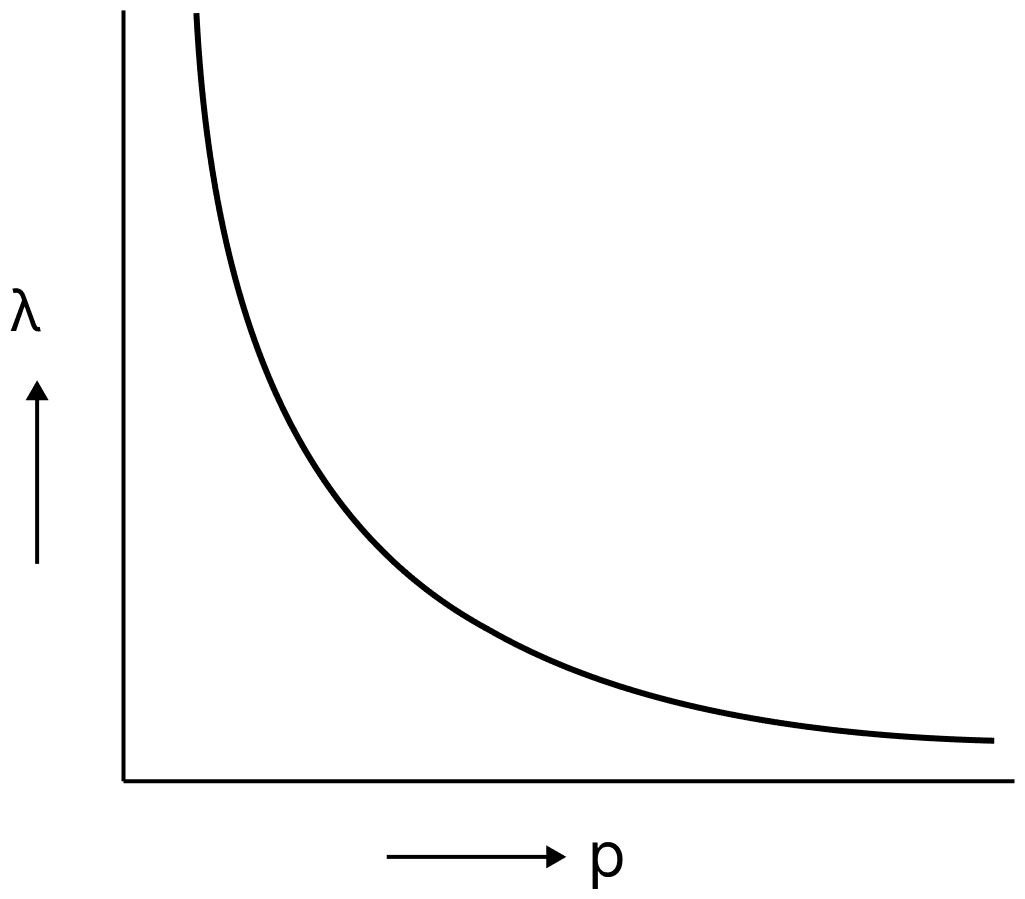
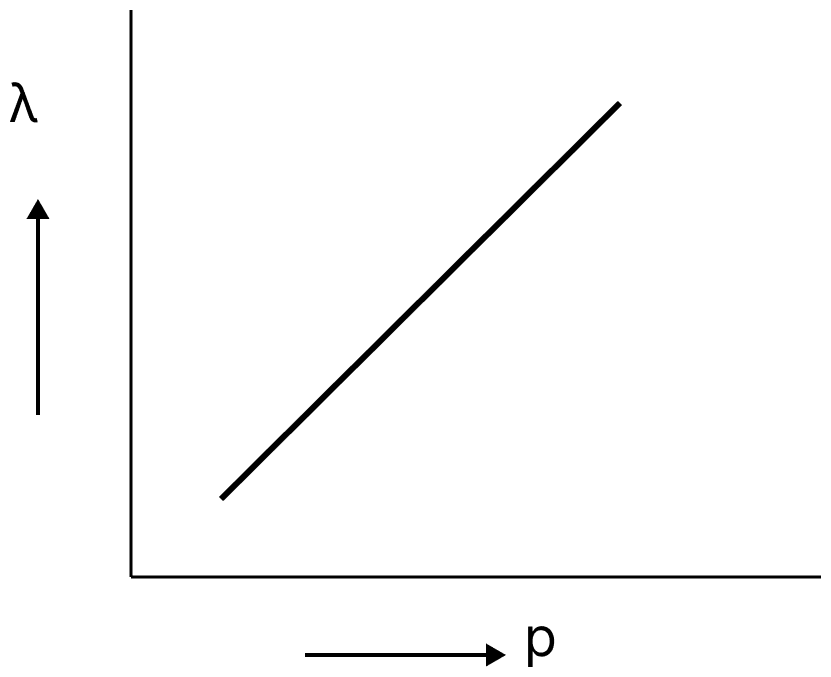
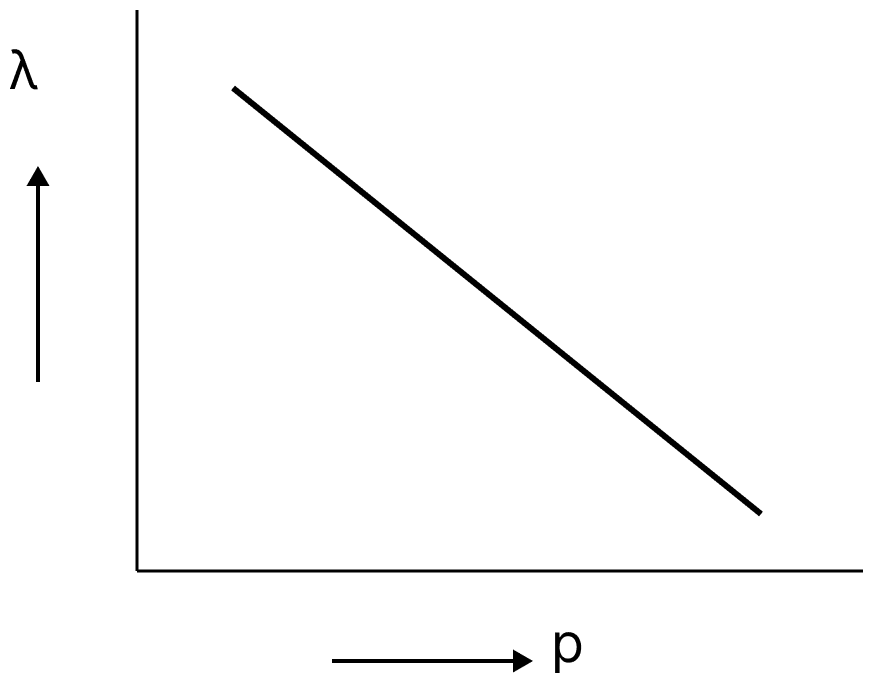
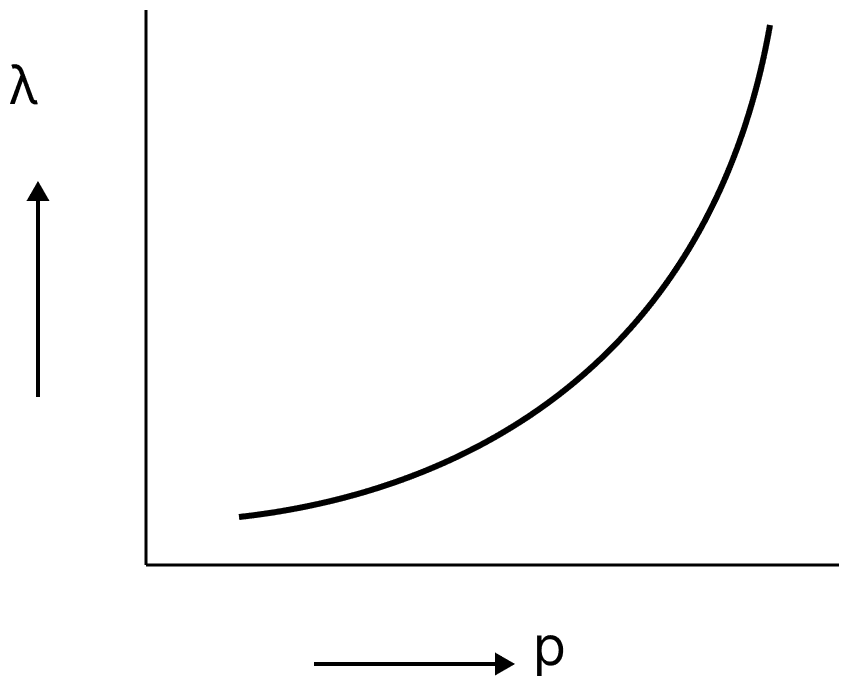
The graph which shows the variation of the de-Broglie wavelength (λ) of a particle and its associated momentum (p) is:
Answer
Reason — From , λ ∝ , i.e., λp = constant. So the graph of λ versus p is a rectangular hyperbola, as shown in graph 1.
Find the ratio of de-Broglie wavelength of an α-particle and carbon 12 for the same K.E.
Answer
Reason — Since , for the same kinetic energy λ ∝ . Hence,
de-Broglie wavelength of photon and electron are same. If v is the speed of electron, then the ratio of their energy is:
- cv
Answer
Reason — Equal de-Broglie wavelengths mean equal momenta, pp = pe = p, where pp is the momentum of the photon and pe that of the electron. The energy of the photon is Ep = ppc and the energy of the electron is . So the ratio of the energy of the photon to that of the electron is
de-Broglie wavelength of proton and deuteron have ratio 1 : . Find the ratio of their potential difference through which they were accelerated.
- 6 : 1
- 3 : 1
- 1 : 1
- 4 : 1
Answer
4 : 1
Reason — For a particle of charge q accelerated through a potential difference V, . The proton and the deuteron carry the same charge and md = 2mp. Hence,
The kinetic energy of an electron, α-particle and a proton are given as 4 K, 2 K and K respectively. The de-Broglie wavelength associated with electron (λe), α-particle (λα) and the proton (λp) are as follows:
- λα = λp < λe
- λα = λp > λe
- λα < λp < λe
- λα > λp > λe
Answer
λα < λp < λe
Reason — Since , λ ∝ . The products m(KE) are 4meK for the electron, 4mp × 2K = 8mpK for the α-particle and mpK for the proton. As me is about of mp, the product is largest for the α-particle and smallest for the electron. Hence λα < λp < λe.
Given here are two statements: One is labelled as Assertion (A) and the other is labelled as Reason (R).
Assertion (A): The beam of electrons show wave nature and exhibit interference and diffraction.
Reason (R): Davisson and Germer experimentally verified the wave nature of electrons.
In the light of the above statement choose the most appropriate answer from the given options.
- (A) is correct but (R) is not correct
- Both (A) and (R) are correct but (R) is not the correct explanation of (A)
- Both (A) and (R) are correct and (R) is correct explanation of (A)
- (A) is not correct but (R) is correct
Answer
Both (A) and (R) are correct and (R) is correct explanation of (A)
Reason — Davisson and Germer showed that a beam of electrons undergoes diffraction when it falls on an atomic crystal. This establishes the wave nature of electrons, and waves can exhibit interference and diffraction. Thus both statements are correct and R explains A.
The de-Broglie wavelength of an electron is the same as that of a photon. If velocity of electron is 25% of the velocity of light, then the ratio of K.E. of electron and K.E. of photon will be:
Answer
Reason — For the photon, . For the electron, , with ve = 0.25 c. Equating the two wavelengths,
A beam of electrons of energy E scatters from a target having atomic spacing of 1 Å. The first maximum intensity occurs at θ = 60°. Then E (in eV) is ............... .
(Planck constant h = 6.64 × 10⁻³⁴ J-s, 1 eV = 1.6 × 10⁻¹⁹ J, electron mass m = 9.1 × 10⁻³¹ kg)
Answer
Given,
- Atomic spacing, d = 1 Å = 10-10 m
- Angle for the first maximum, θ = 60°
- h = 6.64 × 10⁻³⁴ J-s
- m = 9.1 × 10⁻³¹ kg
- 1 eV = 1.6 × 10⁻¹⁹ J
For the first maximum (n = 1), Bragg's equation gives
The de-Broglie wavelength of an electron of kinetic energy E is
Substituting the values,
Hence, E = 50.47 eV.
The wavelength of an X-ray beam is 10 Å. The mass of a fictitious particle having the same energy as that of the X-ray photons is kg. The value of x is ............... .
Answer
Given,
- Wavelength of the X-ray beam, λ = 10 Å = 10 × 10-10 m = 10-9 m
- Speed of light, c = 3 × 10⁸ m s-1
The energy of an X-ray photon is . If m is the mass of a particle having the same energy, then by Einstein's mass-energy relation E = mc2,
Comparing with kg,
Hence, the value of x is 10.
Two particles having masses 4g and 16g, respectively are moving with equal kinetic energies. The ratio of the magnitudes of their linear momentum is n : 2. The value of n will be ............... .
Answer
Given,
- m1 = 4 g, m2 = 16 g
- Kinetic energies are equal, K1 = K2 = K
The relation between kinetic energy and momentum is
For the same kinetic energy,
Comparing with the ratio n : 2,
Hence, the value of n is 1.