
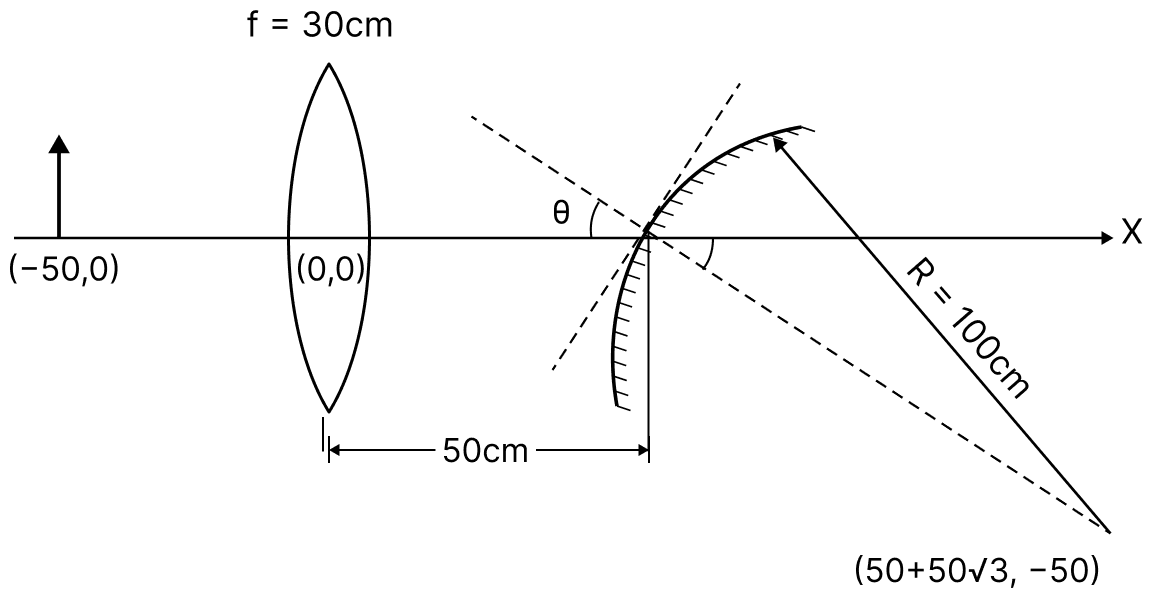
A small object is placed 50 cm to the left of thin convex lens of focal length 30 cm. A convex spherical mirror of radius of curvature 100 cm is placed to the right of the lens at a distance of 50 cm. The mirror is tilted such that the axis of the mirror is at an angle θ = 30° to the axis of the lens, as shown in the figure. If the origin of the coordinate system is taken to be at the centre of the lens, the coordinates (in cm) of the point (x, y) at which the image is formed are :
- (0, 0)
Answer
Reason —
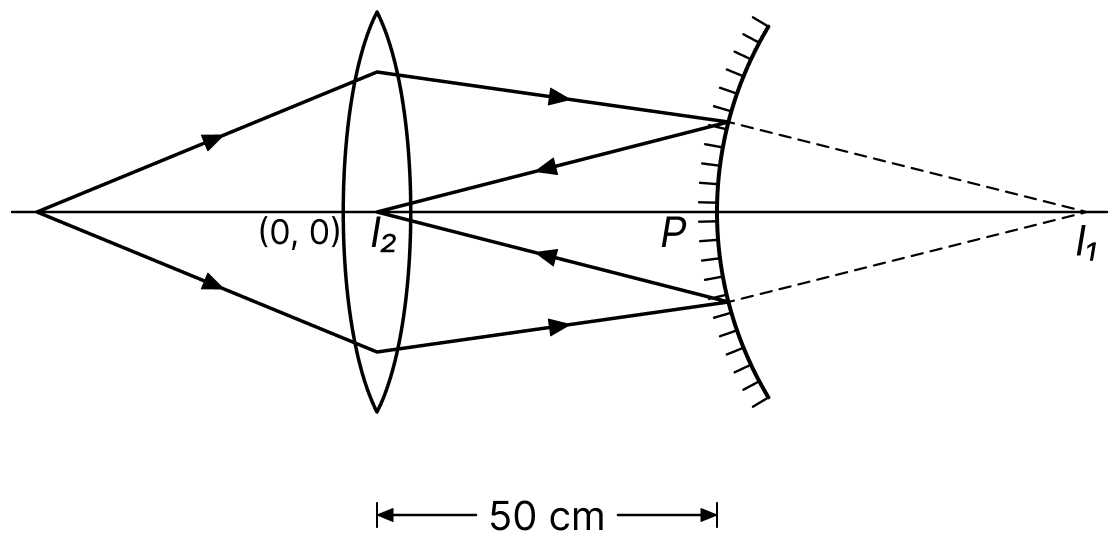
Take the mirror first as aligned with the lens (θ = 0). For the lens, u = -50 cm and f = +30 cm,
This image I1 lies 25 cm behind the convex mirror and acts as a virtual object for it (u = +25 cm, f = +50 cm),
So the image I2 would be 50 cm in front of the mirror, i.e., at (0, 0). Treating the mirror near its pole as a plane mirror, tilting it by θ = 30° turns the reflected image through 2θ = 60° about the pole (50, 0), its distance from the pole remaining 50 cm. Hence,
A person can see clearly object when they lie between 50 cm and 400 cm from his eye. In order to increase the maximum distance of distinct vision to infinity, the type and power of the correcting lens, the person has to use, will be :
- convex, + 0.15 dioptre
- convex, + 2.25 dioptre
- concave, - 0.25 dioptre
- concave, - 0.2 dioptre
Answer
concave, - 0.25 dioptre
Reason — The far point of the person is at 400 cm. To see a distant object (u = -∞), the correcting lens must form its virtual image at the far point, v = -400 cm,
The negative power shows a concave lens.
Two identical glass (ng = ) equiconvex lenses of focal length f each are kept in contact. The space between the two lenses is filled with water (nw = ). The focal length of the combination is :
- f
Answer
Reason — For each equiconvex glass lens of radius R,
The water between them forms a biconcave lens of the same radii,
For the three thin lenses in contact,
A diverging lens with magnitude of focal length 25 cm is placed at a distance of 15 cm from a converging lens of magnitude of focal length 20 cm. A beam of parallel light falls on the diverging lens. The final image formed is :
- real and at a distance of 6 cm from the convergent lens
- real and at a distance of 40 cm from the convergent lens
- virtual and at a distance of 40 cm from convergent lens
- real and at distance of 40 cm from the divergent lens
Answer
real and at a distance of 40 cm from the convergent lens
Reason — The parallel beam, after refraction through the diverging lens, appears to come from its focus I1, 25 cm to its left, i.e., (25 + 15) = 40 cm from the converging lens. For the converging lens, u = -40 cm and f = +20 cm,
The positive v shows a real image, 40 cm to the right of the converging lens.
A plano-convex lens of refractive index n1 and focal length f1 is kept in contact with another plano-concave lens of refractive index n2 and focal length f2. If the radius of curvature of their spherical faces is R each and f1 = 2f2, then n1 and n2 are related as :
- n1 + n2 = 3
- 2n1 - n2 = 1
- 2n2 - n1 = 1
- 3n2 - 2n1 = 1
Answer
2n1 - n2 = 1
Reason — By the lens maker's formula, taking magnitudes of the focal lengths,
Since f1 = 2f2,
Note: The focal length of a plano-concave lens is negative, so f1 = 2f2 can hold only between magnitudes; the question is read in that sense.
The eye can be regarded as a single refracting surface. The radius of curvature of this surface is equal to that of cornea (7.8 mm). This surface separates two media of refractive indices 1 and 1.34. Calculate the distance from the refracting surface at which a parallel beam of light will come to focus :
- 2 cm
- 1 cm
- 3.1 cm
- 4.0 cm
Answer
3.1 cm
Reason — For refraction at the single surface, n1 = 1, n2 = 1.34, R = 7.8 mm and u = -∞,
A convex lens is put 10 cm from a light source and it makes a sharp image on a screen, kept 10 cm from the lens. Now a glass block (refractive index 1.5) of 1.5 cm thickness is placed in contact with the light source. To get the sharp image again, the screen is shifted by a distance d. Then d is :
- 0.55 cm away from the lens
- 1.1 cm away from the lens
- 0.55 cm towards the lens
- 0
Answer
0.55 cm away from the lens
Reason — Initially u = -10 cm and v = +10 cm,
The glass block shifts the source towards the lens by
So the new object distance is u = -9.5 cm,
Hence the screen must be shifted by d = 10.55 - 10 = 0.55 cm, away from the lens.
A plano-convex lens (focal length f2, refractive index n2, radius of curvature R) fits exactly into a plano-concave lens (focal length f1, refractive index n1, radius of curvature R). Their plane surfaces are parallel to each other. Then, the focal length of the combination will be :
- f1 - f2
- f1 + f2
Answer
Reason — For the plano-convex lens (refractive index n2) and the plano-concave lens (refractive index n1), by the lens maker's formula,
For the two lenses in contact,
An object is at a distance of 20 m from a convex lens of focal length 0.3 m. The lens forms an image of the object. If the object moves away from the lens at a speed of 5 m/s, the speed and direction of the image will be :
- 0.92 × 10⁻³ m/s away from the lens
- 2.26 × 10⁻³ m/s away from the lens
- 1.16 × 10⁻³ m/s towards the lens
- 3.22 × 10⁻³ m/s towards the lens
Answer
1.16 × 10⁻³ m/s towards the lens
Reason — With u = -20 m and f = 0.3 m,
Differentiating the lens formula with respect to time,
Here the magnification is
and du/dt = -5 m/s (the object moves away from the lens, to the left),
The image lies to the right of the lens and its velocity is negative (to the left), so it moves towards the lens.
Two similar thin equiconvex lenses, of focal length f each, are kept coaxially in contact with each other such that the focal length of the combination is f1. When the space between the two lenses is filled with glycerine (which has the same refractive index (n = 1.5) as that of glass) then the equivalent focal length is f2. The ratio f1 : f2 will be :
- 2 : 3
- 3 : 4
- 2 : 1
- 1 : 2
Answer
1 : 2
Reason — With air between them, the two lenses are in contact,
The glycerine fills a biconcave space of the same radii and has the same refractive index as glass, so it forms a diverging lens of focal length -f,
Therefore, f1 : f2 = : f = 1 : 2.
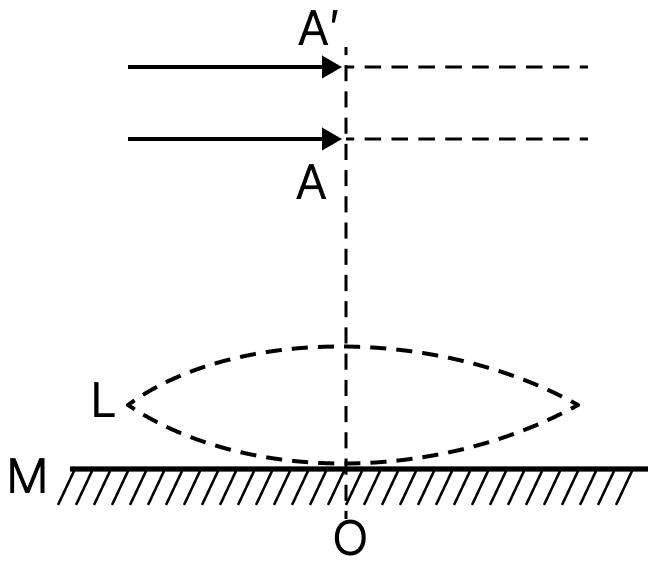
A thin convex lens L (refractive index = 1.5) is placed on a plane mirror M. When a pin is placed at A, such that OA = 18 cm, its real inverted image is formed at A itself, as shown in figure. When a liquid of refractive index n1 is put between the lens and the mirror, the pin has to be moved to A', such that OA' = 27 cm, to get its inverted real image at A' itself. The value of n1 will be :
Answer
Reason — When the image of the pin coincides with the pin, the rays fall normally on the mirror, so the pin is at the focus of the lens system.
Without liquid, f1 = 18 cm. For the equiconvex lens,
With the liquid, the combined focal length is F = 27 cm. The liquid forms a plano-concave lens of focal length f2 in contact with the glass lens,
For the liquid lens, R1 = -18 cm and R2 = ∞,
A convex lens (of focal length 20 cm) and a concave mirror, having their principal axes along the same lines, are kept 80 cm apart from each other. The concave mirror is to the right of the convex lens. When an object is kept at a distance of 30 cm to the left of the convex lens, its image remains at the same position even if the concave mirror is removed. The maximum distance of the object for which this concave mirror, by itself would produce a virtual image would be :
- 20 cm
- 10 cm
- 25 cm
- 30 cm
Answer
10 cm
Reason — For the lens, u = -30 cm and f = +20 cm,
The image stays at the same place with or without the mirror, so the rays must fall normally on the mirror and retrace their path; the image formed by the lens is at the centre of curvature of the mirror. Hence R = 80 - 60 = 20 cm and the focal length of the mirror is 10 cm. A concave mirror forms a virtual image only when the object lies between its pole and focus, so the maximum object distance is 10 cm.
A point like object is placed at a distance of 1 m in front of a convex lens of focal length 0.5 m. A plane mirror is placed at a distance of 2 m behind the lens. The position and nature of the final image formed by the system is :
- 2.6 m from the mirror, real
- 1 m from the mirror, real
- 2.6 m from the mirror, virtual
- 1 m from the mirror, virtual
Answer
2.6 m from the mirror, real
Reason — For the lens, u = -1 m and f = 0.5 m,
This image I1 is 1 m in front of the plane mirror, which forms its image I2 1 m behind the mirror, i.e., 3 m from the lens. The reflected light passes through the lens again with I2 as object at a distance of 3 m,
The final image is real, 0.6 m on the other side of the lens, i.e., (2 + 0.6) = 2.6 m from the mirror.
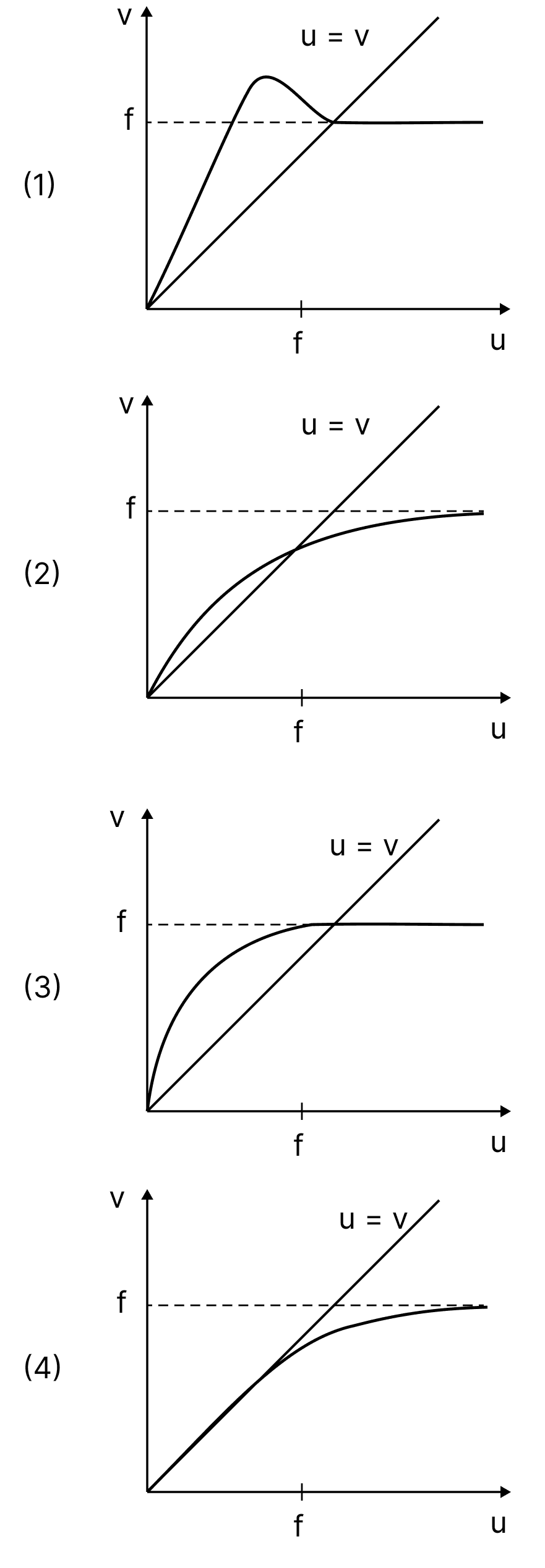
For a concave lens of focal length f, the relation between object and image distances u and v, respectively, from its pole can best be represented by (u = v is the reference line) :
Answer
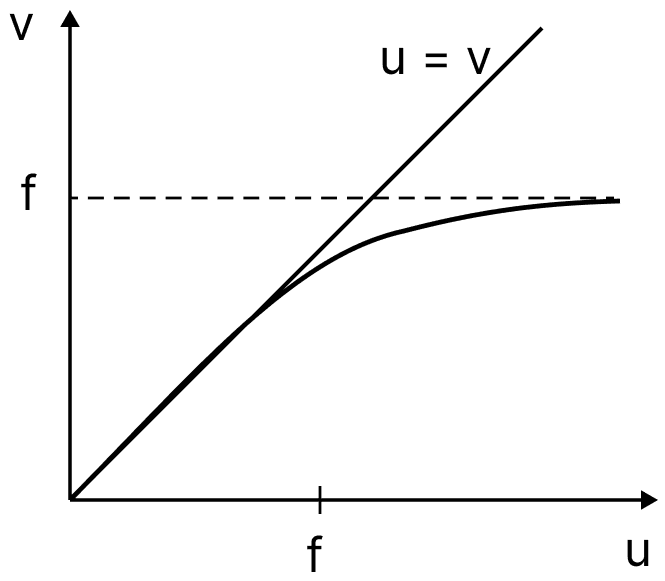
Reason — For a concave lens forming the image of a real object, the lens formula gives, in magnitudes,
So v is always less than u; for small u, v ≈ u, and as u becomes very large, v approaches f. The graph therefore starts along the line u = v, always lies below it, and rises towards the line v = f without reaching it. This is the graph in option 4.
The power of a biconvex lens is 10 dioptre and the radius of curvature of each surface is 10 cm. Then the refractive index of the material of the lens is :
Answer
Reason — Here P = 10 D, R1 = +0.10 m and R2 = -0.10 m,
A plano-convex lens of unknown material and unknown focal length is given. With the help of a spherometer we can measure the :
- refractive index of the material
- focal length of the lens
- radius of curvature of the curved surface
- aperture of the lens
Answer
radius of curvature of the curved surface
Reason — A spherometer is an instrument for measuring the radius of curvature of a spherical surface. The refractive index and the focal length need an optical method, and the aperture is read with an ordinary scale.
A convex lens 'A' of focal length 20 cm and a concave lens 'B' of focal length 5 cm are kept along the same axis with a distance 'd' between them. If a parallel beam of light falling on 'A' leaves 'B' as a parallel beam, then the distance 'd' in cm will be :
- 30
- 25
- 15
- 50
Answer
15
Reason — The parallel beam converges towards the focus F1 of A, 20 cm from it. For the beam to leave B parallel, this point must be the focus F2 of the concave lens B, which lies 5 cm beyond B. Hence F1 and F2 coincide and
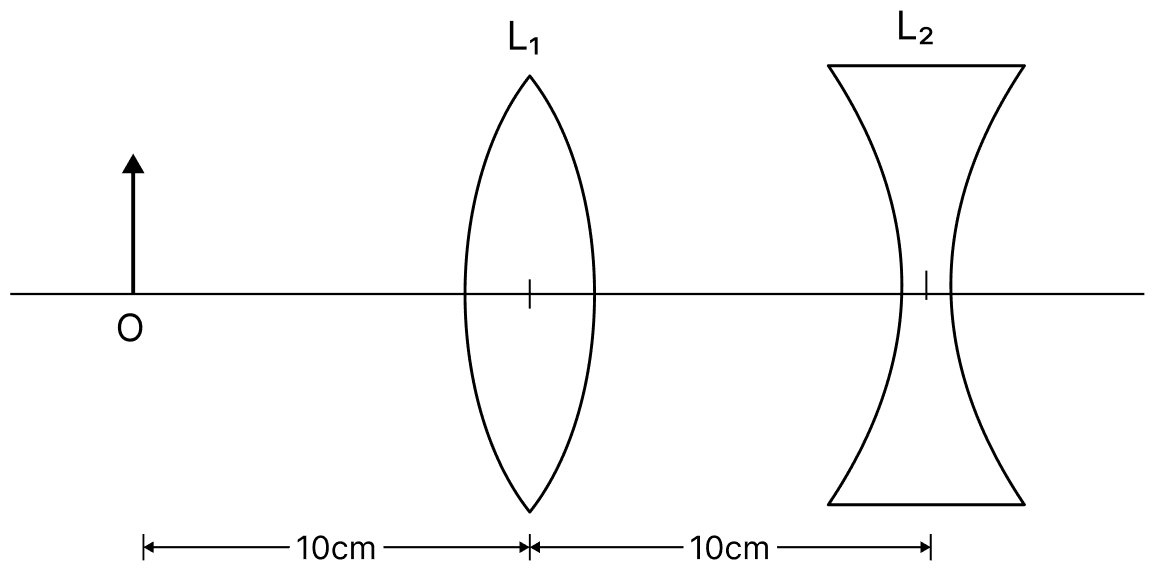
An extended object is placed at point O, 10 cm in front of a convex lens L1 and a concave lens L2 is placed 10 cm behind it, as shown in the figure. The radii of curvature of all the curved surfaces in both the lenses are 20 cm. The refractive index of both the lenses is 1.5. The total magnification of this lens system is :
- 0.4
- 0.8
- 1.3
- 1.6
Answer
0.8
Reason — For both lenses n = 1.5 and |R| = 20 cm.
Lens L1 :
With u1 = -10 cm,
Lens L2 :
f2 = -20 cm. The image of L1 is 20 cm to its left, i.e., 30 cm from L2, so u2 = -30 cm,
Total magnification,
List I contains four combinations of two lenses (1 and 2) whose focal lengths (in cm) are indicated in the figures. In all cases, the object is placed 20 cm from the first lens on the left, and the distance between the two lenses is 5 cm. List II contains the positions of the final images.
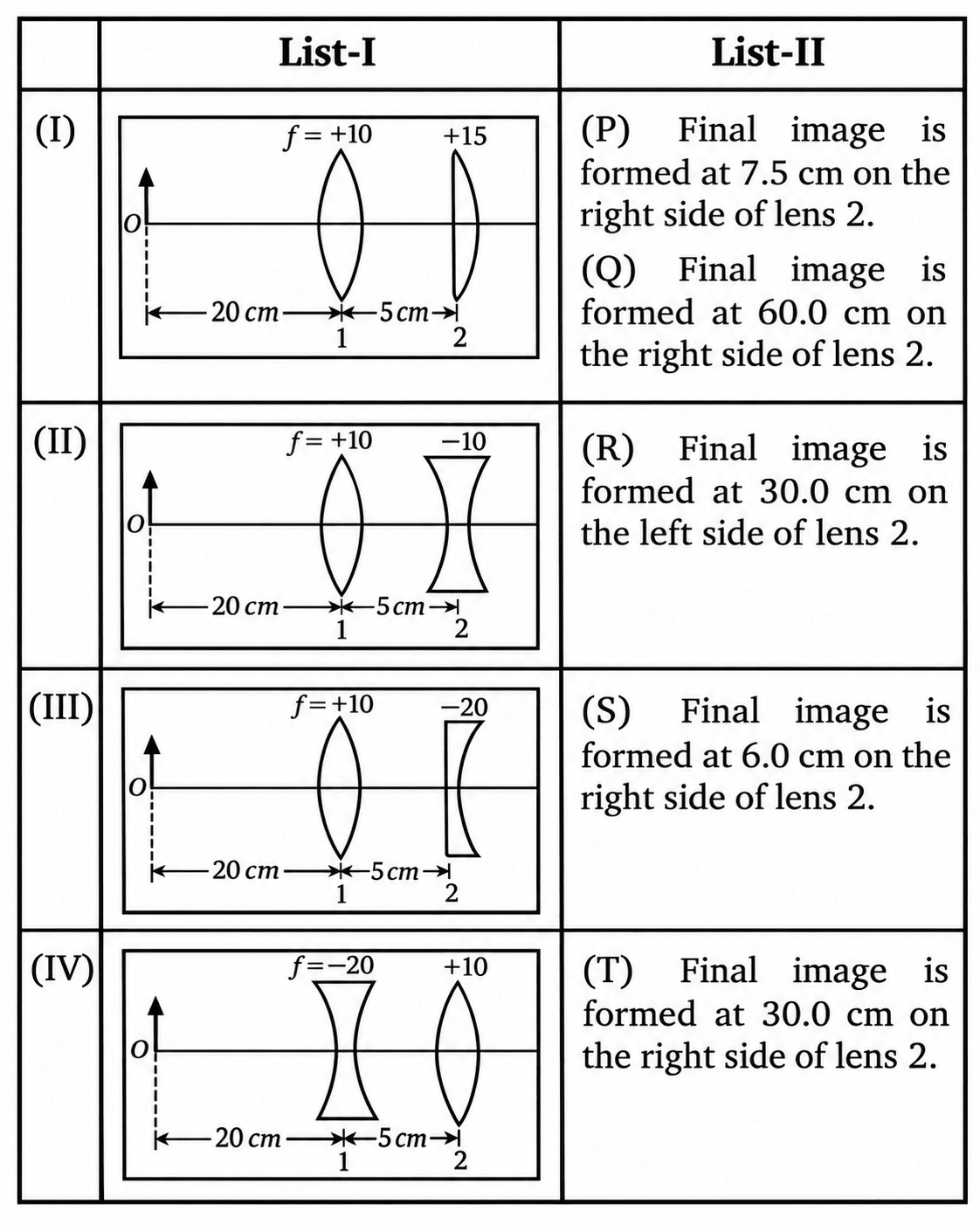
Which one of the following options is correct?
- (I) → P; (II) → R; (III) → Q; (IV) → T
- (I) → Q; (II) → P; (III) → T; (IV) → S
- (I) → P; (II) → T; (III) → R; (IV) → Q
- (I) → T; (II) → S; (III) → Q; (IV) → R
Answer
(I) → P; (II) → R; (III) → Q; (IV) → T
Reason — In each case u = -20 cm for lens 1, and the image of lens 1 acts as the object for lens 2, 5 cm away. The lens formula is used for each lens.
(I) f1 = +10 cm, f2 = +15 cm :
Final image 7.5 cm to the right of lens 2 : (P).
(II) f1 = +10 cm, f2 = -10 cm :
Final image 30 cm to the left of lens 2 : (R).
(III) f1 = +10 cm, f2 = -20 cm :
Final image 60 cm to the right of lens 2 : (Q).
(IV) f1 = -20 cm, f2 = +10 cm :
Final image 30 cm to the right of lens 2 : (T).
A biconvex lens has radii of curvature, 20 cm each. If the refractive index of the material of the lens is 1.5, the power of the lens is :
- Infinity
- +2 D
- +20 D
- +5 D
Answer
+5 D
Reason — Here n = 1.5, R1 = +0.2 m and R2 = -0.2 m,
A person has been using spectacles of power -1.0 dioptre for distant vision and a separate reading glass of power 2.0 dioptres. What is the least distance of distinct vision for this person?
- 10 cm
- 40 cm
- 30 cm
- 50 cm
Answer
50 cm
Reason — The reading glass of power +2.0 D has = 50 cm. It is used to read at the normal distance of 25 cm (u = -25 cm), and must form the virtual image at the person's least distance of distinct vision,
So the least distance of distinct vision is 50 cm. (The -1.0 D spectacles correct only the far point.)
Two thin lenses are of same focal lengths (f), but one is convex and the other one is concave. When they are placed in contact with each other, the equivalent focal length of the combination will be :
- infinite
- zero
Answer
infinite
Reason — With f1 = +f and f2 = -f in contact,
So F is infinite; the combination behaves as a plane glass plate.
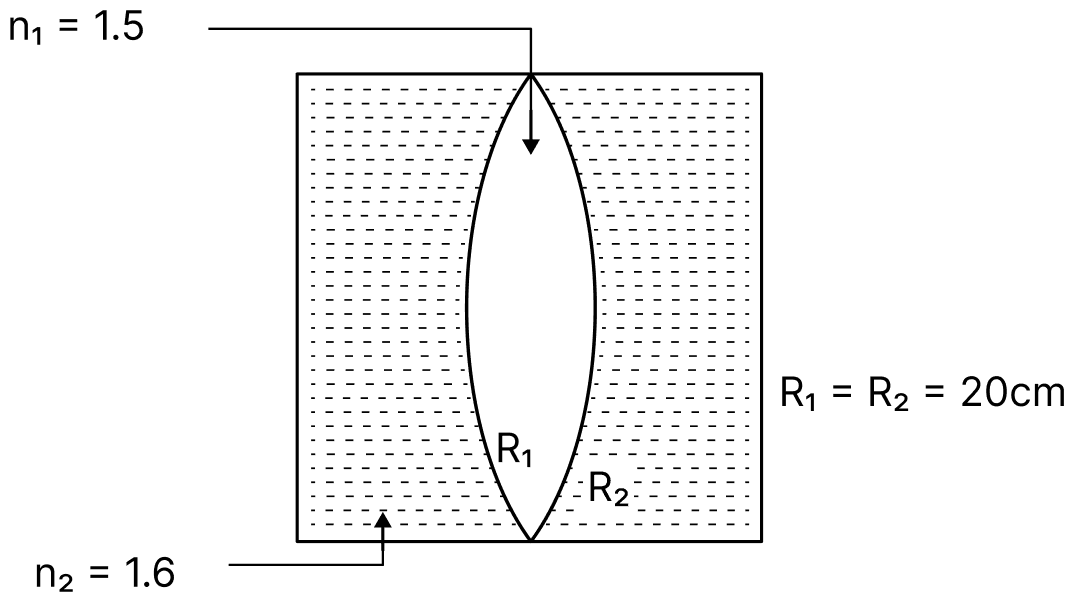
In the figure shown here, what is the equivalent focal length of the combination of lenses (assume that all layers are thin)?
- -100 cm
- -50 cm
- 40 cm
- -40 cm
Answer
-100 cm
Reason — The combination consists of a biconvex lens of n1 = 1.5 between two plano-concave layers of n2 = 1.6, all surfaces having R = 20 cm.
The third layer is identical to the first, f3 = f1. For the thin layers in contact,
Following are two statements :
Statement I : Image formation needs regular reflection and/or refraction.
Statement II : The variety in colour of objects we see around us is due to the constituent colours of the light incident on them.
In the light of the above statements, choose the most appropriate answer from the given options :
- Statement I is correct but statement II is incorrect
- Statement I is incorrect but Statement II is correct
- Both Statement I and Statement II are correct
- Both Statement I and Statement II are incorrect
Answer
Both Statement I and Statement II are correct
Reason — An image is formed only when the rays from a point are regularly reflected or refracted so that they meet, or appear to meet, at a point; that is why we see our image in a mirror but not in a wall. The colour of an object depends on which constituent colours of the incident light it reflects, so the variety in colour of objects is due to the constituent colours of the light falling on them.
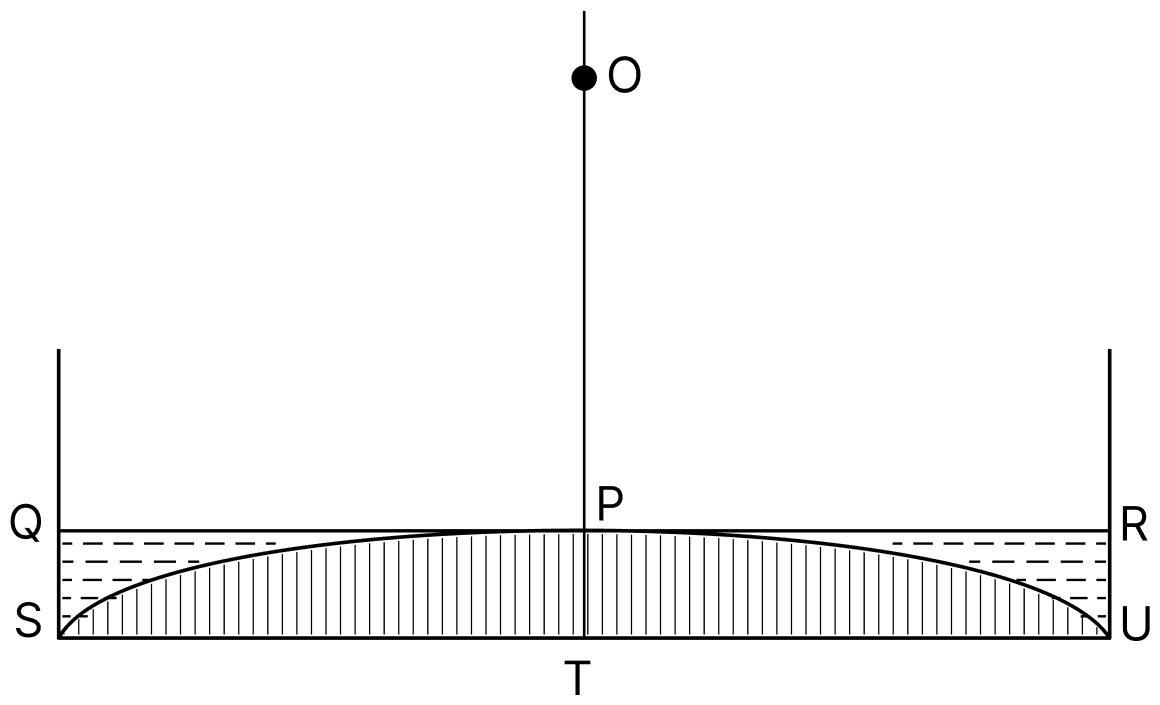
A glass beaker has a solid, plano-convex base of refractive index 1.60, as shown in the figure. The radius of curvature of the convex surface (SPU) is 9 cm, while the planar surface (STU) acts as a mirror. This beaker is filled with a liquid of refractive index n up to the level QPR. If the image of a point object O at a height of h (OT in the figure) is formed onto itself, then, which of the following option(s) is/are correct?
- For n = 1.42, h = 50 cm
- For n = 1.35, h = 36 cm
- For n = 1.45, h = 65 cm
- For n = 1.48, h = 85 cm
Answer
For n = 1.42, h = 50 cm
For n = 1.35, h = 36 cm
Reason — The image of O is formed onto itself only when the rays, after refraction, fall normally on the plane mirror STU and retrace their path. So O must be at the focus of the system formed by the liquid and the glass base.
The liquid between the level QPR and the convex surface SPU forms a plano-concave lens of refractive index n, and the glass base is a plano-convex lens of refractive index 1.60, both with R = 9 cm. For the two thin lenses in contact,
Since O is at the focus, h = F. For n = 1.42, h = = 50 cm and for n = 1.35, h = = 36 cm. For n = 1.45 and 1.48, h comes out 60 cm and 75 cm, not 65 cm and 85 cm. Hence options 1 and 2 are correct.
Following are two statements :
Statement (I) : When an object is placed at the centre of curvature of a concave lens, image is formed at the centre of curvature of the lens on the other side.
Statement (II) : Concave lens always forms a virtual and erect image.
In the light of the above statements, choose the correct answer from the given options :
- Statement I is false but Statement II is true
- Both Statement I and Statement II are false
- Statement I is true but Statement II is false
- Both Statement I and Statement II are true
Answer
Statement I is false but Statement II is true
Reason — For a concave lens and a real object, u and f are both negative, so
is always negative and v is smaller than u in magnitude. The image of a real object is therefore always virtual, erect and diminished, on the same side as the object, between the lens and its focus. An object at the centre of curvature cannot form an image on the other side, so Statement I is false and Statement II is true.
A light ray enters a solid glass sphere of refractive index n = at an angle of incidence 60°. The ray is both reflected and refracted at the farther surface of the sphere. The angle (in degrees) between the reflected and refracted rays at this surface is ............... .
Answer
Given,
- Refractive index of the sphere, n =
- Angle of incidence at the first surface, i = 60°
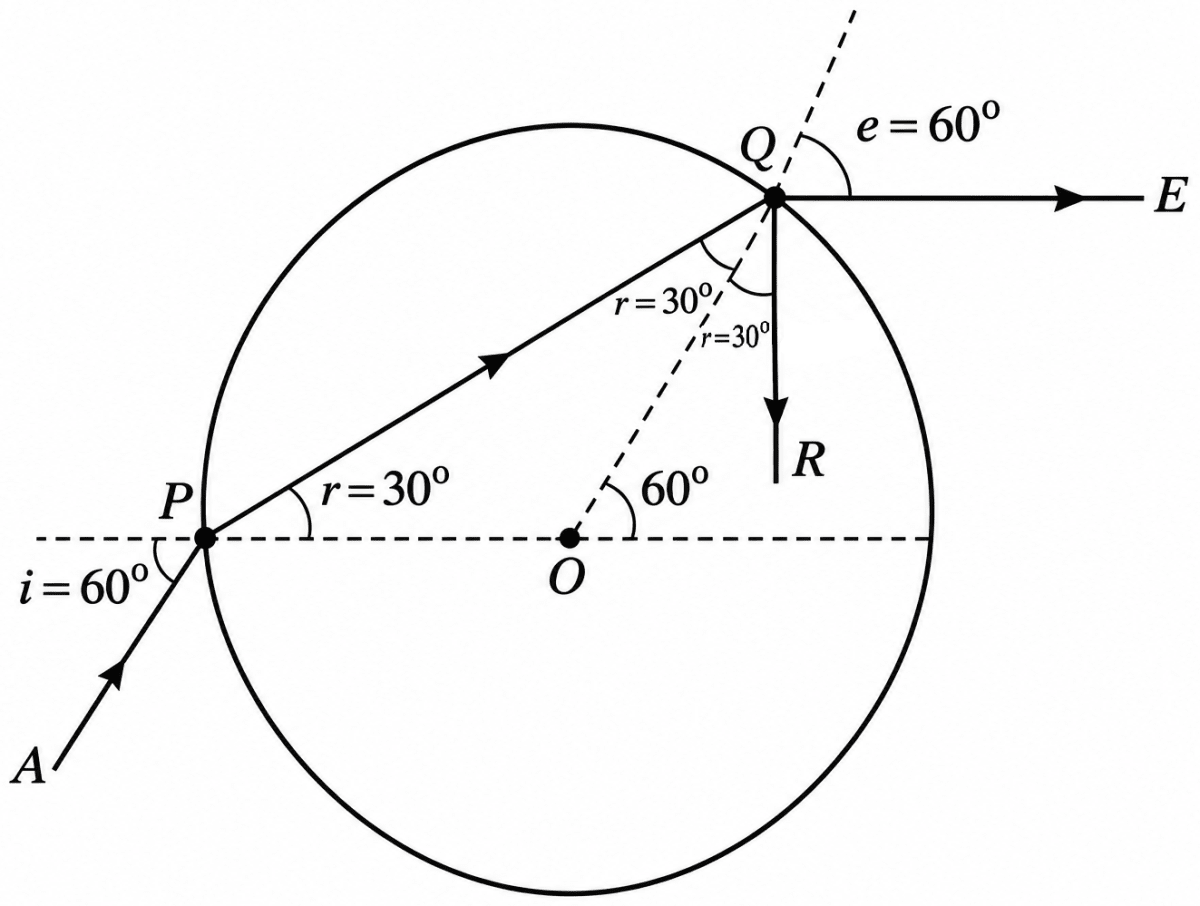
Let the ray enter the sphere at P and meet the farther surface at Q, O being the centre of the sphere. At Q, let QR be the reflected ray and QE the refracted ray.
Refraction at P :
By Snell's law,
At Q :
As OP = OQ, the triangle OPQ is isosceles, so the ray PQ meets the normal OQ at the same angle r = 30°. The reflected ray QR therefore makes 30° with the normal. For the refracted ray,
The reflected ray lies inside the sphere and the refracted ray outside it, on opposite sides of the tangent at Q. The angle between them is
Hence, the angle between the reflected and the refracted rays is 90°.
The distance between an object and a screen is 100 cm. A lens can produce real image of the object on the screen for two different positions between the screen and the object. The distance between these two positions is 40 cm. If the power of the lens is close to D where N is an integer, the value of N is ............... .
Answer
Given,
- Distance between the object and the screen = 100 cm
- Distance between the two positions of the lens = 40 cm
Let x be the distance of the object from the lens in the first position; the image distance is then (100 - x). By the principle of reversibility, in the second position the object and image distances are interchanged. So the separation of the two positions is
So u = -30 cm and v = +70 cm. By the lens formula,
The power of the lens is
Comparing with D,
Hence, the value of N is 476.
The same size images are formed by a convex lens when the object is placed at 20 cm or at 10 cm from the lens. The focal length of the convex lens is ............... cm.
Answer
Given,
- Object distances, u1 = -20 cm and u2 = -10 cm
- The images formed are of the same size
From the lens formula ,
so the magnification is
The two images are of the same size, but one is real (inverted) and the other virtual (erect). Hence m1 = -m2,
Hence, the focal length of the convex lens is 15 cm.
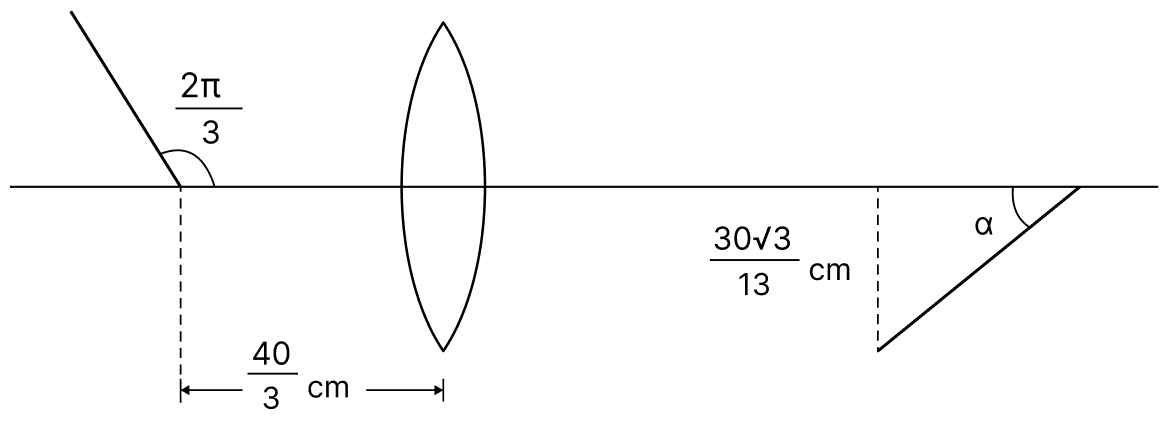
A rod of length 2 cm makes an angle rad with the principal axis of a thin convex lens. The lens has a focal length of 10 cm and is placed at a distance of cm from the object as shown in the figure. The height of the image is cm and the angle made by it with respect to the principal axis is α rad. The value of α is rad, where n is ............... .
Answer
Given,
- Length of the rod = 2 cm, inclined at rad to the principal axis
- Focal length, f = +10 cm
- Distance of the lower end of the rod from the lens = cm
- Height of the image = cm
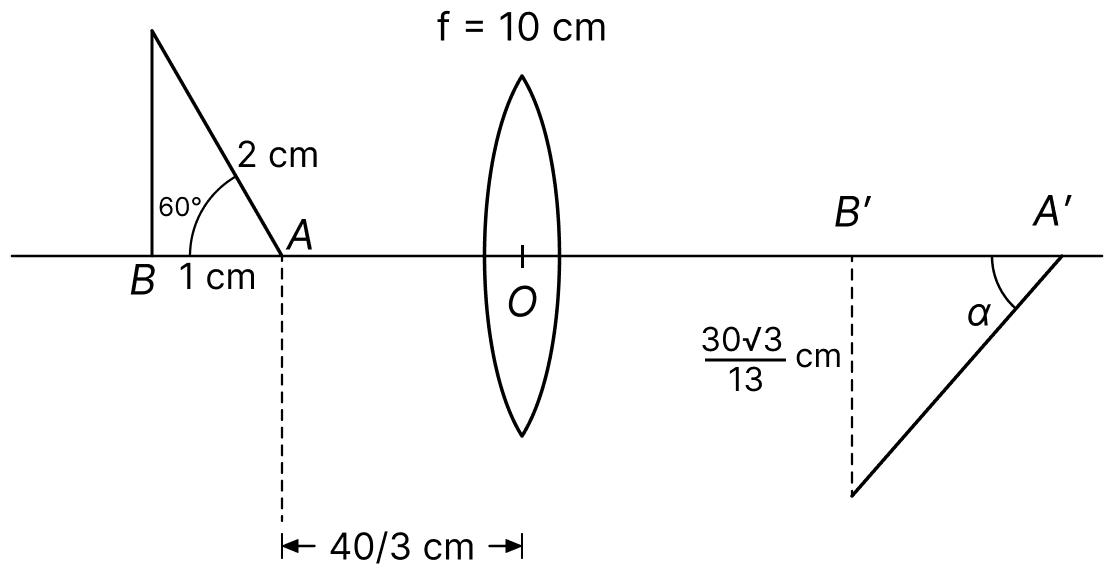
Let A be the end of the rod on the principal axis, and B the foot of the perpendicular from the other end on the axis. Then
so OA = cm and OB = cm, O being the optical centre.
From the lens formula, the image distance is .
Image of A : u = cm,
Image of B : u = cm,
So the horizontal extent of the image is
The image of the upper end lies vertically below B', at a distance equal to the image height cm. The angle α made by the image with the principal axis is given by
Comparing with ,
Hence, the value of n is 6.
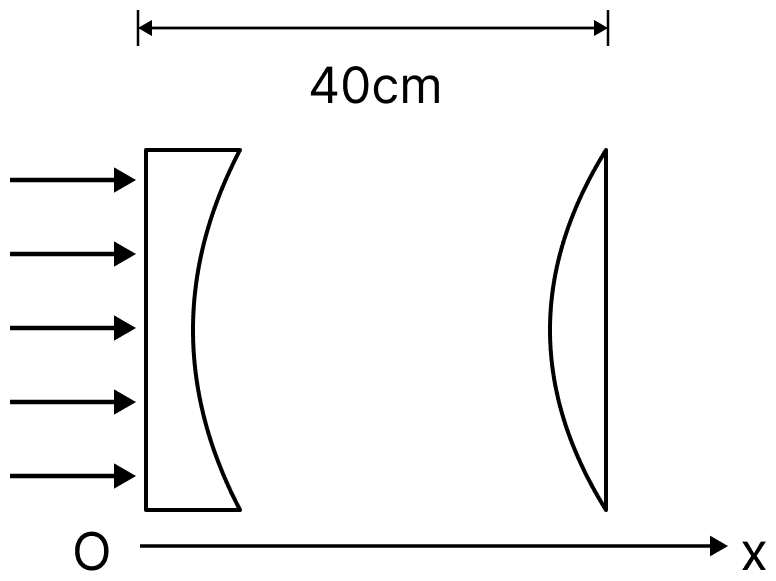
As shown in the figure, a combination of a thin plano-concave lens and a thin plano-convex lens is used to image an object placed at infinity. The radius of curvature of both the lenses is 30 cm and refraction index of the material for both the lenses is 1.75. Both the lenses are placed at distance of 40 cm from each other. Due to the combination, the image of the object is formed at distance x = ............... cm, from concave lens.
Answer
Given,
- Radius of curvature of both lenses, R = 30 cm
- Refractive index of both lenses, μ = 1.75
- Distance between the lenses = 40 cm
- Object at infinity
Plano-concave lens :
Plano-convex lens :
The parallel rays from the object at infinity form a virtual image at the focus of the plano-concave lens, 40 cm to its left. This image is (40 + 40) = 80 cm from the plano-convex lens, i.e., at 2f2. For the plano-convex lens, u = -80 cm,
The final image is 80 cm to the right of the plano-convex lens, so its distance from the concave lens is
Hence, x = 120 cm.
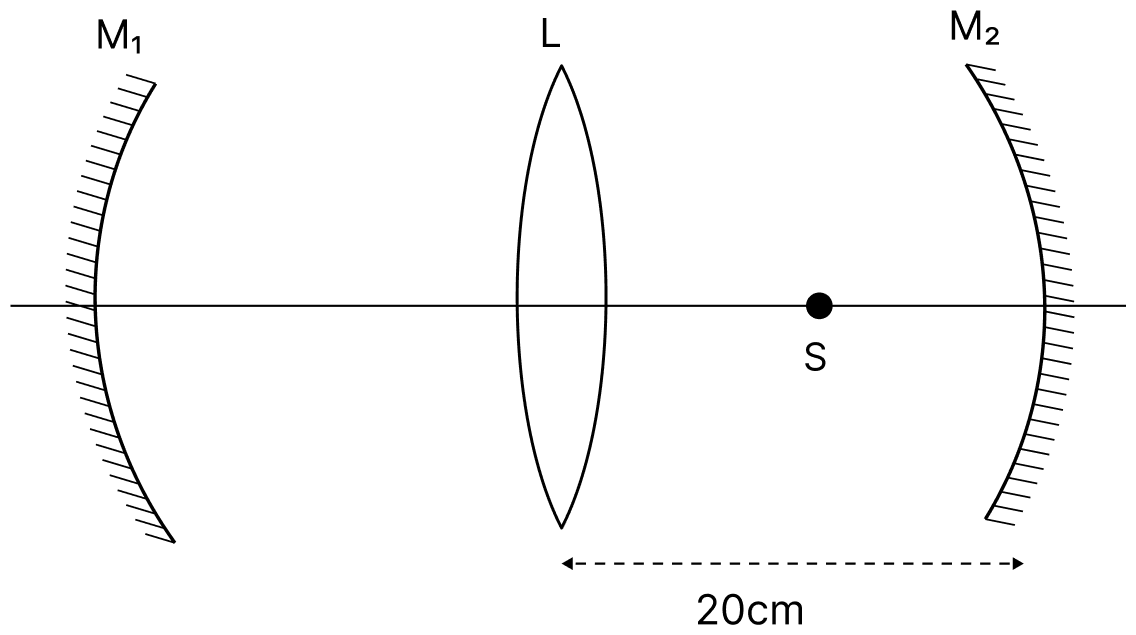
An optical arrangement consists of two concave mirrors M1 and M2, and a convex lens L with a common principal axis, as shown in the figure. The focal length of L is 10 cm. The radii of curvature of M1 and M2 are 20 cm and 24 cm, respectively. The distance between L and M2 is 20 cm. A point object S is placed at the mid-point between L and M2 on the axis. When the distance between L and M1 is cm, one of the images coincides with S. The value of n is ............... .
Answer
Given,
- Focal length of L, f = 10 cm
- R1 = 20 cm for M1, so its focal length is 10 cm; R2 = 24 cm for M2, so its focal length is 12 cm
- Distance between L and M2 = 20 cm; S is 10 cm from each
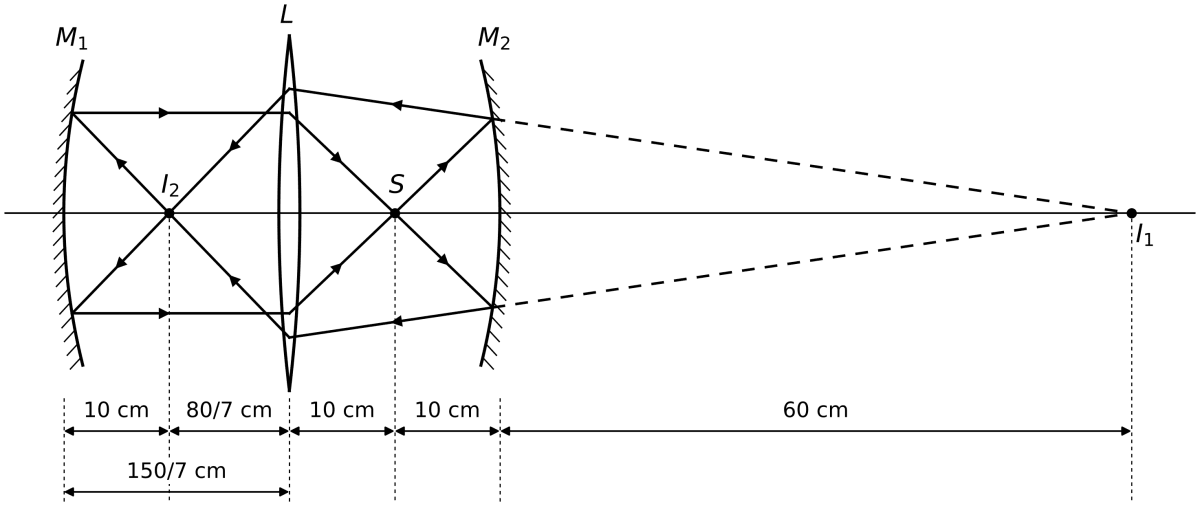
Reflection from M2 :
For the concave mirror M2, u = -10 cm and f = -12 cm,
So the virtual image I1 is 60 cm behind M2, i.e., 80 cm from L.
Refraction through L :
The reflected light passes through L with I1 as object at a distance of 80 cm,
So L forms the image I2 at cm on its left. For an image to coincide with S, M1 must send this light back as follows.
I2 at the focus of M1 : The rays reflected from M1 become parallel to the axis and L brings them to its focus, 10 cm to its right, which is S itself.
I2 at the centre of curvature or the pole of M1 : The light retraces its path through L and M2 back to S. Then
Hence, n = 150; the values 80 and 220 also satisfy the given condition.
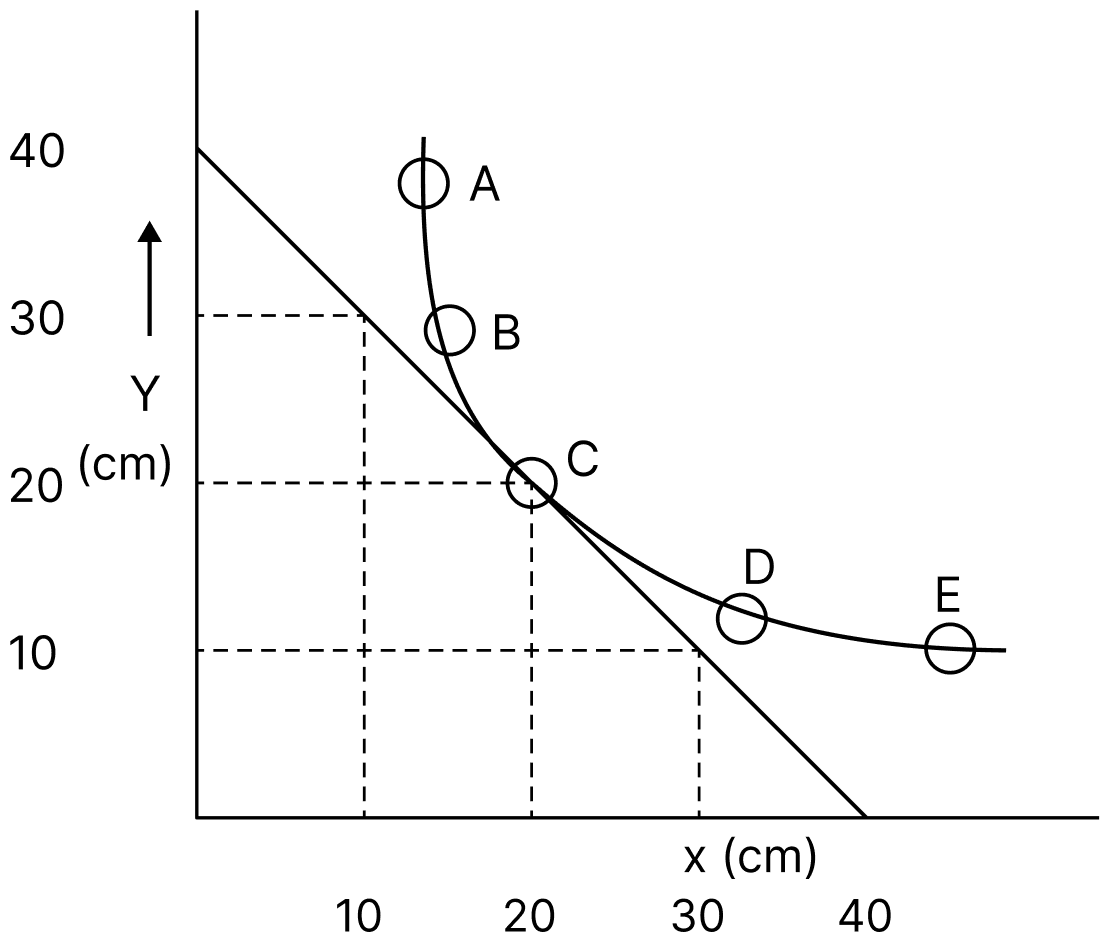
In an experiment to measure the focal length (f) of a convex lens, the magnitude of object distance (x) and the image distance (y) are measured with reference to the focal point of the lens. The y - x plot is shown in figure. The focal length of the lens is ............... cm.
Answer
Given,
- x and y are the object and image distances measured from the two focal points
- From the graph, the point C on the plot has x = 20 cm and y = 20 cm
The object distance from the lens is u = -(f + x) and the image distance is v = (f + y). At the point C,
Hence, the focal length of the lens is 20 cm.