KnowledgeBoat Logo
|
OPEN IN APP

Chapter 7

Moving Charges and Magnetic Field — Competition Zone

Class 12 - Nootan Physics


Competition Zone — Multiple Choice Questions

Question 1

A proton and an alpha particle both enter a region of uniform magnetic field B, moving at right angles to the field B. If the radius of circular orbits for both the particles is equal and the kinetic energy acquired by proton is 1 MeV, the energy acquired by the alpha particle will be :

  1. 0.5 MeV
  2. 1.5 MeV
  3. 1 MeV
  4. 4 MeV

Answer

1 MeV

Reason — Given, the radii of the circular orbits are equal and Kp = 1 MeV.

For a particle entering perpendicular to the field,

r=2mKqB\text r = \dfrac{\sqrt{2\text{mK}}}{\text{qB}}

As the radii are equal,

2mpKpe=2mαKα2e\dfrac{\sqrt{2\text m_\text p \text K_\text p}}{\text e} = \dfrac{\sqrt{2\text m_α \text K_α}}{2\text e}

Putting mα = 4mp,

mpKp=4mpKα2mpKp=mpKαKα=Kp=1 MeV\sqrt{\text m_\text p \text K_\text p} = \dfrac{\sqrt{4\text m_\text p \text K_α}}{2} \\[1em] \sqrt{\text m_\text p \text K_\text p} = \sqrt{\text m_\text p \text K_α} \\[1em] \text K_α = \text K_\text p = 1\ \text{MeV}

Question 2

An electron moving in a circular orbit of radius r makes n revolutions per second. The magnetic field produced at the centre has magnitude :

  1. zero
  2. µ0n2er\dfrac{\text µ_0 \text n^2 \text e}{\text r}
  3. µ0ne2r\dfrac{\text µ_0 \text{ne}}{2\text r}
  4. µ0ne2πr\dfrac{\text µ_0 \text{ne}}{2\text{πr}}

Answer

µ0ne2r\dfrac{\text µ_0 \text{ne}}{2\text r}

Reason — Given, the electron makes n revolutions per second in a circle of radius r.

The revolving electron is equivalent to a current loop, and the equivalent current is

I=eTI=ne\text I = \dfrac{\text e}{\text T} \\[1em] \text I = \text{ne}

The magnetic field at the centre of a circular loop is

B=µ0I2rB=µ0ne2r\text B = \dfrac{\text µ_0 \text I}{2\text r} \\[1em] \text B = \dfrac{\text µ_0 \text{ne}}{2\text r}

Question 3

A wire carrying a current I has the shape as shown in figure. Linear parts of the wire are very long and parallel to the X-axis while semi-circular portion of radius R is lying in Y-Z plane. Magnetic field at point O is :
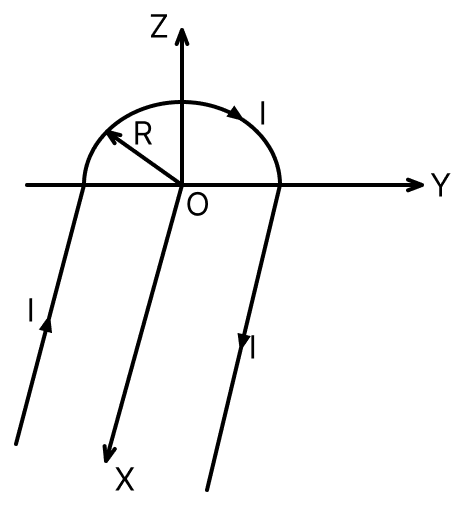
A wire carrying a current I has the shape as shown in figure. Linear parts of the wire are very long and parallel to the X-axis while semi-circular portion of radius R is lying in Y-Z plane. Magnetic field at point O is:. Moving Charges and Magnetic Field, Nootan Physics Solutions ICS Class 12
  1. B⃗=−µ04πIR(πi^−2k^)\vec{\text B} = -\dfrac{\text µ_0}{4\text π}\dfrac{\text I}{\text R}(\text π\hat{\text i} - 2\hat{\text k})
  2. B⃗=−µ04πIR(πi^+2k^)\vec{\text B} = -\dfrac{\text µ_0}{4\text π}\dfrac{\text I}{\text R}(\text π\hat{\text i} + 2\hat{\text k})
  3. B⃗=µ04πIR(πi^−2k^)\vec{\text B} = \dfrac{\text µ_0}{4\text π}\dfrac{\text I}{\text R}(\text π\hat{\text i} - 2\hat{\text k})
  4. B⃗=µ04πIR(πi^+2k^)\vec{\text B} = \dfrac{\text µ_0}{4\text π}\dfrac{\text I}{\text R}(\text π\hat{\text i} + 2\hat{\text k})

Answer

B⃗=−µ04πIR(πi^+2k^)\vec{\text B} = -\dfrac{\text µ_0}{4\text π}\dfrac{\text I}{\text R}(\text π\hat{\text i} + 2\hat{\text k})

Reason — Given, two very long linear parts parallel to the X-axis and a semi-circular portion of radius R lying in the Y-Z plane.

Field due to the linear parts : Each linear part is a semi-infinite conductor whose perpendicular distance from O is R, so each gives

B1=µ04πIR(sin⁡0°+sin⁡90°)B1=µ04πIR\text B_1 = \dfrac{\text µ_0}{4\text π}\dfrac{\text I}{\text R}(\sin 0° + \sin 90°) \\[1em] \text B_1 = \dfrac{\text µ_0}{4\text π}\dfrac{\text I}{\text R}

and by the right-hand thumb rule both are directed along −k^-\hat{\text k}. Their sum is

B⃗1=2(µ04πIR)(−k^)\vec{\text B}_1 = 2\left(\dfrac{\text µ_0}{4\text π}\dfrac{\text I}{\text R}\right)(-\hat{\text k})

Field due to the semi-circular portion : The field at the centre due to a circular arc of radius R subtending an angle θ is

B=µ04πIRθ\text B = \dfrac{\text µ_0}{4\text π}\dfrac{\text I}{\text R}\text θ

For a semi-circle, θ = π, so

B⃗2=µ0I4R(−i^)B⃗2=π(µ04πIR)(−i^)\vec{\text B}_2 = \dfrac{\text µ_0 \text I}{4\text R}(-\hat{\text i}) \\[1em] \vec{\text B}_2 = \text π\left(\dfrac{\text µ_0}{4\text π}\dfrac{\text I}{\text R}\right)(-\hat{\text i})

Resultant field :

B⃗=B⃗1+B⃗2B⃗=−µ04πIR(πi^+2k^)\vec{\text B} = \vec{\text B}_1 + \vec{\text B}_2 \\[1em] \vec{\text B} = -\dfrac{\text µ_0}{4\text π}\dfrac{\text I}{\text R}(\text π\hat{\text i} + 2\hat{\text k})

Question 4

Two coaxial solenoids of different radii carry current I in the same direction. Let F⃗1\vec{\text F}_1 be the magnetic force on the inner solenoid due to the outer one and F⃗2\vec{\text F}_2 be the magnetic force on the outer solenoid due to the inner one. Then :

  1. F⃗1=F⃗2=0\vec{\text F}_1 = \vec{\text F}_2 = 0
  2. F⃗1\vec{\text F}_1 is radially inwards and F⃗2\vec{\text F}_2 is radially outwards
  3. F⃗1\vec{\text F}_1 is radially inwards and F⃗2=0\vec{\text F}_2 = 0
  4. F⃗1\vec{\text F}_1 is radially outwards and F⃗2=0\vec{\text F}_2 = 0

Answer

F⃗1=F⃗2=0\vec{\text F}_1 = \vec{\text F}_2 = 0

Reason — The magnetic field of a long solenoid is confined to its interior; outside the solenoid the field is zero.

The outer solenoid therefore lies in a region where the field of the inner solenoid is zero, so F⃗2=0\vec{\text F}_2 = 0.

The inner solenoid lies inside the outer one, where the field is uniform and directed along the axis. The force on each current-element of a turn is radial, and on going round a complete turn these radial forces cancel in pairs. Hence the total force on the inner solenoid is also zero, F⃗1=0\vec{\text F}_1 = 0.

Question 5

Two long current carrying thin wires, both with current I, are held by insulating threads of length L and are in equilibrium as shown in the figure, with threads making an angle θ with the vertical. If wires have mass λ per unit length then the value of I is (g = gravitational acceleration) :
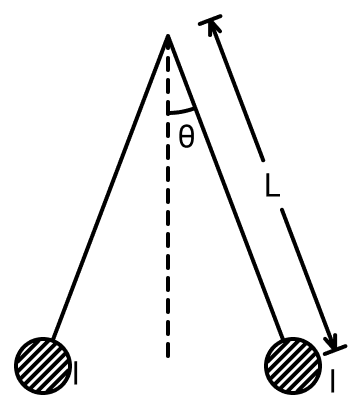
Two long current carrying thin wires, both with current I, are held by insulating threads of length L and are in equilibrium as shown in the figure, with threads making an angle θ with the vertical. If wires have mass λ per unit length then the value of I is (g = gravitational acceleration):. Moving Charges and Magnetic Field, Nootan Physics Solutions ICS Class 12
  1. sin⁡θπλgLµ0cos⁡θ\sin θ\sqrt{\dfrac{\text{πλgL}}{\text µ_0 \cos θ}}
  2. 2sin⁡θπλgLµ0cos⁡θ2\sin θ\sqrt{\dfrac{\text{πλgL}}{\text µ_0 \cos θ}}
  3. 2πgLµ0tan⁡θ2\sqrt{\dfrac{\text{πgL}}{\text µ_0}\tan θ}
  4. πλgLµ0tan⁡θ\sqrt{\dfrac{\text{πλgL}}{\text µ_0}\tan θ}

Answer

2sin⁡θπλgLµ0cos⁡θ2\sin θ\sqrt{\dfrac{\text{πλgL}}{\text µ_0 \cos θ}}

Reason — Given, threads of length L making an angle θ with the vertical, and wires of mass λ per unit length.
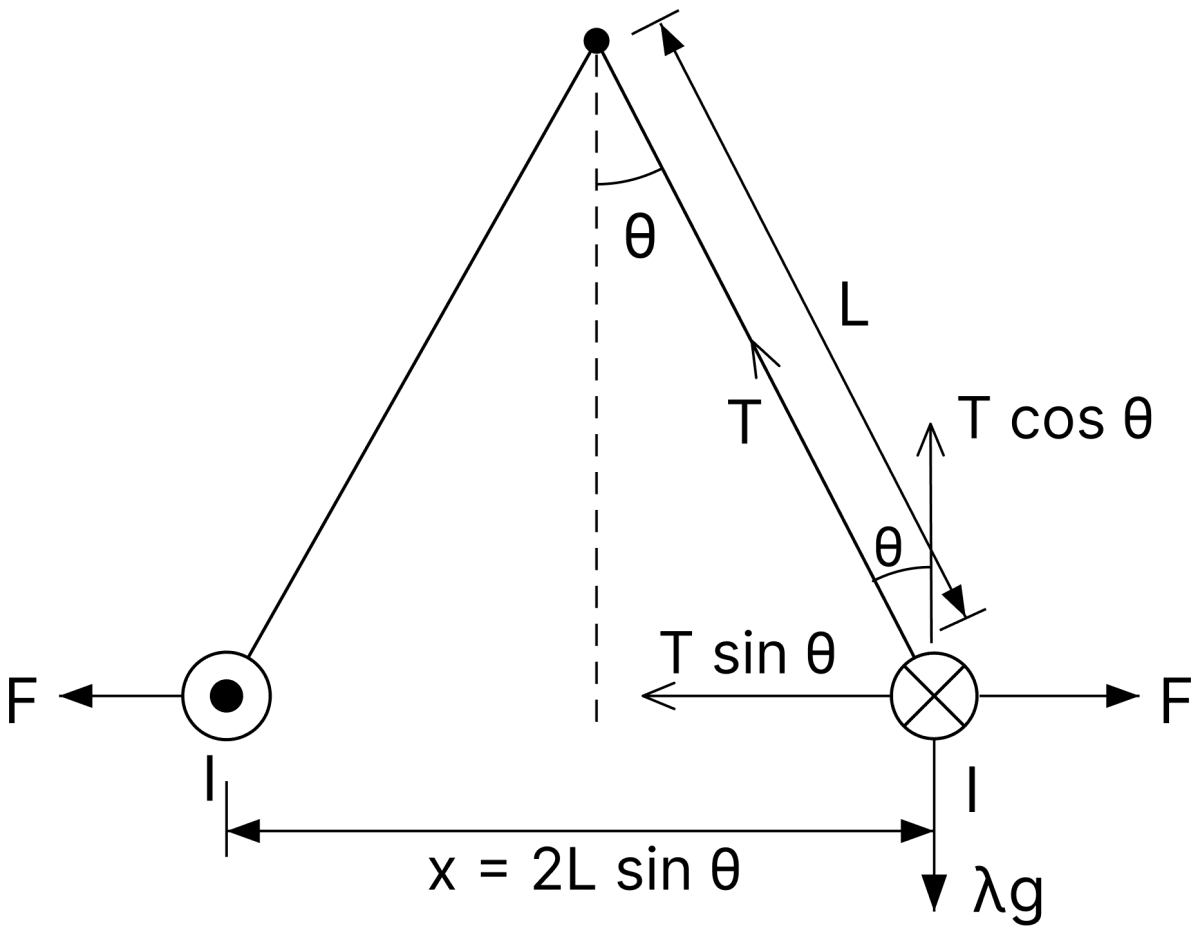
Two long current carrying thin wires, both with current I, are held by insulating threads of length L and are in equilibrium as shown in the figure, with threads making an angle θ with the vertical. If wires have mass λ per unit length then the value of I is (g = gravitational acceleration):. Moving Charges and Magnetic Field, Nootan Physics Solutions ICS Class 12

The separation between the two wires is x = 2L sin θ, and the currents are in opposite directions, so the force per unit length between them is repulsive,

F=µ02πI22Lsin⁡θF=µ0I24πLsin⁡θ\text F = \dfrac{\text µ_0}{2\text π}\dfrac{\text I^2}{2\text L \sin θ} \\[1em] \text F = \dfrac{\text µ_0 \text I^2}{4\text{πL} \sin θ}

For equilibrium of each wire, resolving the tension T in the thread,

Tsin⁡θ=F,Tcos⁡θ=λg\text T \sin θ = \text F, \qquad \text T \cos θ = \text{λg}

Dividing,

tan⁡θ=Fλgµ0I24πLsin⁡θ=λgtan⁡θI2=4πLλgsin⁡2θµ0cos⁡θI=2sin⁡θπλgLµ0cos⁡θ\tan θ = \dfrac{\text F}{\text{λg}} \\[1em] \dfrac{\text µ_0 \text I^2}{4\text{πL} \sin θ} = \text{λg} \tan θ \\[1em] \text I^2 = \dfrac{4\text{πLλg} \sin^2 θ}{\text µ_0 \cos θ} \\[1em] \text I = 2 \sin θ\sqrt{\dfrac{\text{πλgL}}{\text µ_0 \cos θ}}

Question 6

A rectangular loop of sides 10 cm and 5 cm carrying a current I of 12 A is placed in different orientations as shown in the figures :
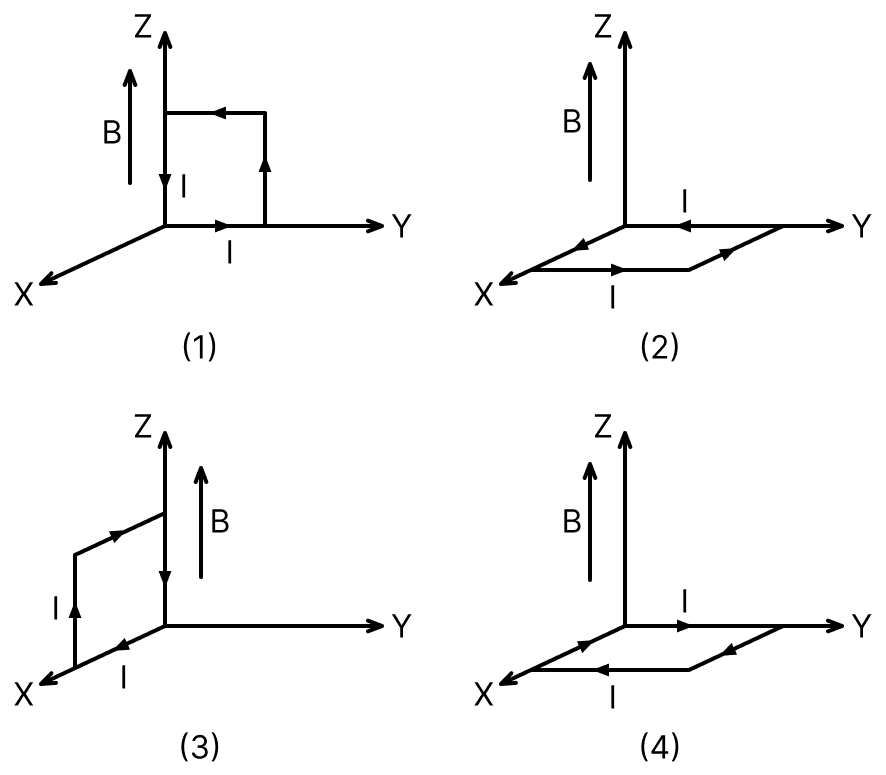
A rectangular loop of sides 10 cm and 5 cm carrying a current I of 12 A is placed in different orientations as shown in the figures: If there is a uniform magnetic field of 0.3 T in the positive Z direction, in which orientations the loop would be in (i) stable equilibrium and (ii) unstable equilibrium? Moving Charges and Magnetic Field, Nootan Physics Solutions ICS Class 12

If there is a uniform magnetic field of 0.3 T in the positive Z direction, in which orientations the loop would be in (i) stable equilibrium and (ii) unstable equilibrium?

  1. (1) and (2) respectively
  2. (1) and (3) respectively
  3. (2) and (4) respectively
  4. (2) and (3) respectively

Answer

(2) and (4) respectively

Reason — A current loop placed in a magnetic field is in stable equilibrium when its magnetic moment M⃗ \vec{\text M} \spaceis parallel to B⃗ \vec{\text B} \space, and in unstable equilibrium when M⃗ \vec{\text M} \spaceis anti-parallel to B⃗ \vec{\text B} \space.

The field is along the positive Z direction. Applying the right-hand palm rule no. 1 to each orientation, the magnetic moment of the loop in orientation (2) points along the positive Z direction, so it is in stable equilibrium, while in orientation (4) it points along the negative Z direction, so it is in unstable equilibrium.

Question 7

A long straight wire of radius a carries a steady current I. The current is uniformly distributed over its cross-section. The ratio of the magnetic fields B1 and B2 at radial distances a/2 and 2a respectively, from the axis of the wire is :

  1. 1/4
  2. 1/2
  3. 1
  4. 4

Answer

1

Reason — Given, a wire of radius a carrying a steady current I distributed uniformly over the cross-section.
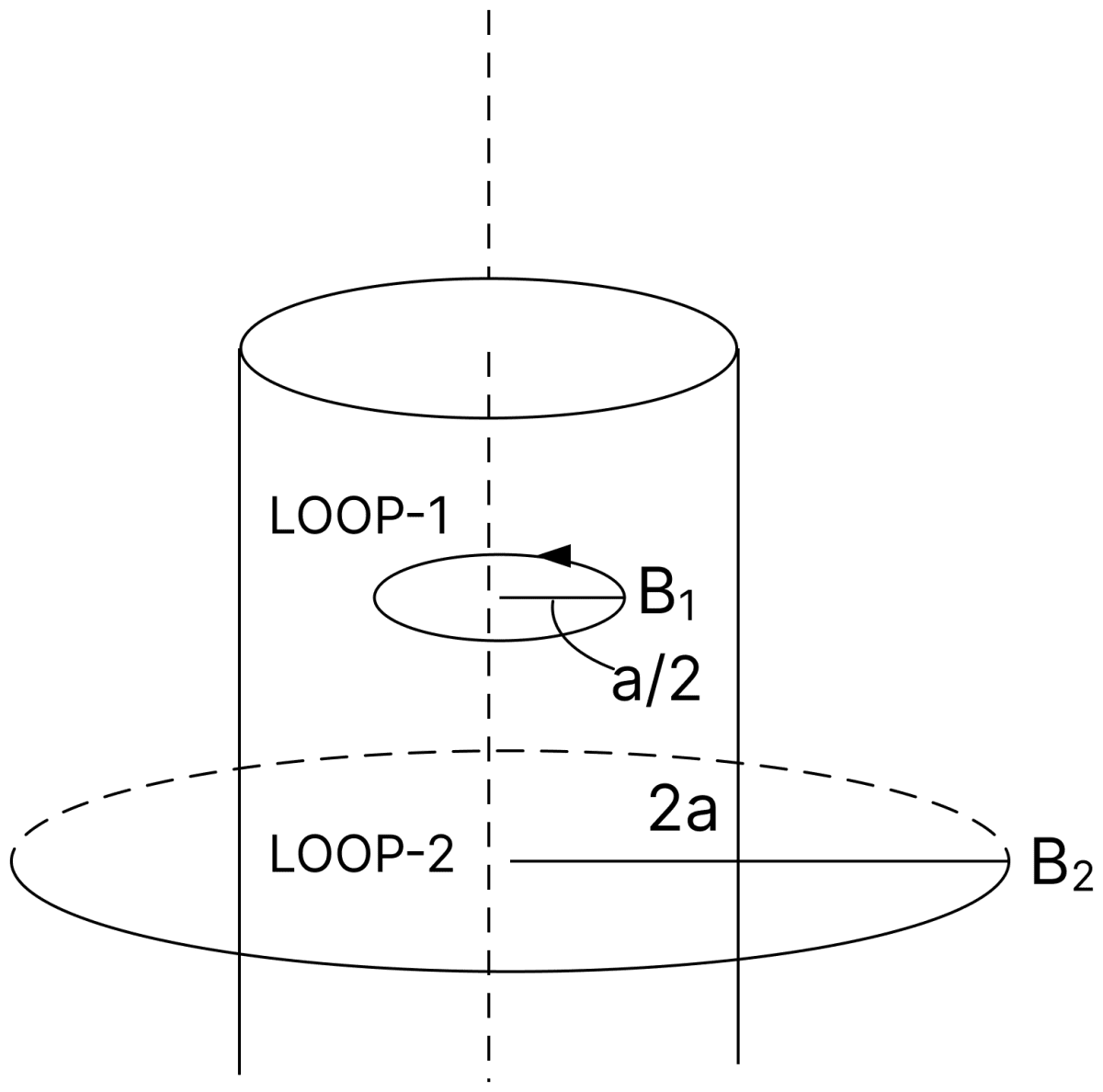
A long straight wire of radius a carries a steady current I. The current is uniformly distributed over its cross-section. The ratio of the magnetic fields B 1 and B 2 at radial distances a/2 and 2a respectively, from the axis of the wire is:. Moving Charges and Magnetic Field, Nootan Physics Solutions ICS Class 12

At the radial distance a/2 (inside the wire) :

B1=µ0I2π(a/2)a2B1=µ0I4πa\text B_1 = \dfrac{\text µ_0 \text I}{2\text π}\dfrac{(\text a/2)}{\text a^2} \\[1em] \text B_1 = \dfrac{\text µ_0 \text I}{4\text{πa}}

At the radial distance 2a (outside the wire) :

B2=µ0I2π(2a)B2=µ0I4πaB1B2=1\text B_2 = \dfrac{\text µ_0 \text I}{2\text π(2\text a)} \\[1em] \text B_2 = \dfrac{\text µ_0 \text I}{4\text{πa}} \\[1em] \dfrac{\text B_1}{\text B_2} = 1

Question 8

A long straight wire of radius 'a' carries a steady current I. The current is uniformly distributed across its cross-section. The ratio of the magnetic field at a/2 and 2a is :

  1. 4
  2. 1
  3. 1/2
  4. 1/4

Answer

1

Reason — Given, a wire of radius a carrying a steady current I distributed uniformly across its cross-section.

Inside the wire, B=µ0Ir2πa2\text B = \dfrac{\text µ_0 \text{Ir}}{2\text{πa}^2}, so at r = a/2,

B1=µ0I2πa2×a2B1=µ0I4πa\text B_1 = \dfrac{\text µ_0 \text I}{2\text{πa}^2} \times \dfrac{\text a}{2} \\[1em] \text B_1 = \dfrac{\text µ_0 \text I}{4\text{πa}}

Outside the wire, B=µ0I2πr\text B = \dfrac{\text µ_0 \text I}{2\text{πr}}, so at r = 2a,

B2=µ0I4πaB1B2=1\text B_2 = \dfrac{\text µ_0 \text I}{4\text{πa}} \\[1em] \dfrac{\text B_1}{\text B_2} = 1

Question 9

A long wire carrying a steady current is bent into a circular loop of one turn. The magnetic field at the centre of the loop is B. It is then bent into a circular coil of n turns. The magnetic field at the centre of this coil of n turns will be :

  1. 2n2B
  2. nB
  3. n2B
  4. 2nB

Answer

n2B

Reason — Let the length of the wire be L.

For one turn : L = 2πr1, so r1=L2π\text r_1 = \dfrac{\text L}{2\text π} and

B=µ0I2r1B=µ0πIL\text B = \dfrac{\text µ_0 \text I}{2\text r_1} \\[1em] \text B = \dfrac{\text µ_0 \text{πI}}{\text L}

For n turns : L = n(2πr2), so r2=L2πn\text r_2 = \dfrac{\text L}{2\text{πn}} and

B′=µ0nI2r2B′=µ0nI×2πn2LB′=µ0πn2ILB′=n2B\text B' = \dfrac{\text µ_0 \text n \text I}{2\text r_2} \\[1em] \text B' = \dfrac{\text µ_0 \text n \text I \times 2\text{πn}}{2\text L} \\[1em] \text B' = \dfrac{\text µ_0 \text{πn}^2 \text I}{\text L} \\[1em] \text B' = \text n^2 \text B

Question 10

Two identical wires A and B, each of length 'l' carry the same current I. Wire A is bent into a circle of radius R and wire B is bent to form a square of side 'a'. If BA and BB are the values of magnetic field at the centres of the circle and square respectively, then the ratio BA/BB is :

  1. π2162\dfrac{\text π^2}{16\sqrt{2}}
  2. π216\dfrac{\text π^2}{16}
  3. π282\dfrac{\text π^2}{8\sqrt{2}}
  4. π28\dfrac{\text π^2}{8}

Answer

π282\dfrac{\text π^2}{8\sqrt{2}}

Reason — Given, each wire has length l and carries the same current I.

Wire A, bent into a circle : l = 2πR, so R=l2π\text R = \dfrac{l}{2\text π} and

BA=µ0I2RBA=µ0πIl\text B_\text A = \dfrac{\text µ_0 \text I}{2\text R} \\[1em] \text B_\text A = \dfrac{\text µ_0 \text{πI}}{l}

Wire B, bent into a square : the side is a=l4\text a = \dfrac{l}{4}, and the perpendicular distance of each side from the centre is a2=l8\dfrac{\text a}{2} = \dfrac{l}{8}. For one side, φ1 = φ2 = 45°, so

Bside=µ04πI(l/8)(sin⁡45°+sin⁡45°)Bside=2µ0Iπl×2\text B_{\text{side}} = \dfrac{\text µ_0}{4\text π}\dfrac{\text I}{(l/8)}(\sin 45° + \sin 45°) \\[1em] \text B_{\text{side}} = \dfrac{2\text µ_0 \text I}{\text π l} \times \sqrt{2}

All the four sides give fields in the same direction, so

BB=4×22µ0IπlBB=82µ0IπlBABB=µ0πI/l82µ0I/πlBABB=π282\text B_\text B = 4 \times \dfrac{2\sqrt{2}\text µ_0 \text I}{\text π l} \\[1em] \text B_\text B = \dfrac{8\sqrt{2}\text µ_0 \text I}{\text π l} \\[1em] \dfrac{\text B_\text A}{\text B_\text B} = \dfrac{\text µ_0 \text{πI}/l}{8\sqrt{2}\text µ_0 \text I/\text π l} \\[1em] \dfrac{\text B_\text A}{\text B_\text B} = \dfrac{\text π^2}{8\sqrt{2}}

Question 11

An electron is moving in a circular path under the influence of a transverse magnetic field 3.57 × 10⁻² T. If the value of e/m is 1.76 × 10¹¹ C/kg, the frequency of revolution of the electron is :

  1. 6.82 MHz
  2. 1 GHz
  3. 100 MHz
  4. 62.8 MHz

Answer

1 GHz

Reason — Given, B = 3.57 × 10⁻² T and em\dfrac{\text e}{\text m} = 1.76 × 10¹¹ C/kg.

The frequency of revolution of a charged particle in a magnetic field is

ν=eB2πmν=12π(em)B\text ν = \dfrac{\text{eB}}{2\text{πm}} \\[1em] \text ν = \dfrac{1}{2\text π}\left(\dfrac{\text e}{\text m}\right)\text B

Substituting the values,

ν=(1.76×10¹¹)(3.57×10⁻²)2×3.14ν=6.283×1096.28ν=1×10⁹ Hz=1 GHz\text ν = \dfrac{(1.76 \times 10^{11})(3.57 \times 10^{-2})}{2 \times 3.14} \\[1em] \text ν = \dfrac{6.283 \times 10^9}{6.28} \\[1em] \text ν = 1 \times 10^9\ \text{Hz} = 1\ \text{GHz}

Question 12

A square loop ABCD carrying a current i (see figure), is placed near and coplanar with a long straight conductor XY carrying a current I, the net force on the loop will be :
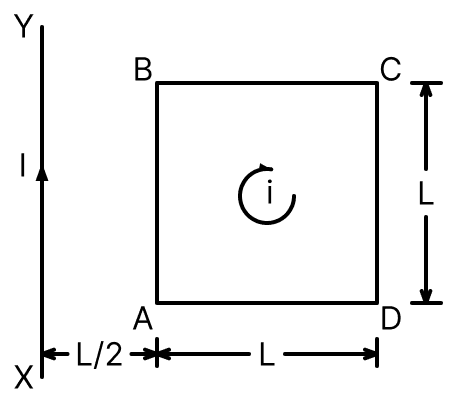
A square loop ABCD carrying a current i (see figure), is placed near and coplanar with a long straight conductor XY carrying a current I, the net force on the loop will be:. Moving Charges and Magnetic Field, Nootan Physics Solutions ICS Class 12
  1. 2µ0Ii3π\dfrac{2\text µ_0 \text{Ii}}{3\text π}
  2. µ0Ii2π\dfrac{\text µ_0 \text{Ii}}{2\text π}
  3. 2µ0IiL3π\dfrac{2\text µ_0 \text{IiL}}{3\text π}
  4. µ0IiL2π\dfrac{\text µ_0 \text{IiL}}{2\text π}

Answer

2µ0Ii3π\dfrac{2\text µ_0 \text{Ii}}{3\text π}

Reason — Given, a square loop ABCD of side L carrying a current i, placed coplanar with a long straight conductor XY carrying a current I, the nearer side being at a distance L2\dfrac{\text L}{2} from XY.

The nearer side AB is at a distance L2\dfrac{\text L}{2} and the farther side DC at a distance L2+L=3L2\dfrac{\text L}{2} + \text L = \dfrac{3\text L}{2}.

Force on the nearer side :

F1=µ02πIi(L/2)×LF1=µ0Iiπ\text F_1 = \dfrac{\text µ_0}{2\text π}\dfrac{\text{Ii}}{(\text L/2)} \times \text L \\[1em] \text F_1 = \dfrac{\text µ_0 \text{Ii}}{\text π}

Force on the farther side :

F2=µ02πIi(3L/2)×LF2=µ0Ii3π\text F_2 = \dfrac{\text µ_0}{2\text π}\dfrac{\text{Ii}}{(3\text L/2)} \times \text L \\[1em] \text F_2 = \dfrac{\text µ_0 \text{Ii}}{3\text π}

The currents in these two sides are oppositely directed, so one force is an attraction and the other a repulsion. The forces on the other two sides are equal and opposite and cancel. Hence the net force is

F=F1−F2F=µ0Iiπ−µ0Ii3πF=2µ0Ii3π\text F = \text F_1 - \text F_2 \\[1em] \text F = \dfrac{\text µ_0 \text{Ii}}{\text π} - \dfrac{\text µ_0 \text{Ii}}{3\text π} \\[1em] \text F = \dfrac{2\text µ_0 \text{Ii}}{3\text π}

Question 13

A symmetric star shaped conducting wire loop is carrying a steady state current I as shown in the figure. The distance between the diametrically opposite vertices of the star is 4a. The magnitude of the magnetic field at the centre of the loop is :
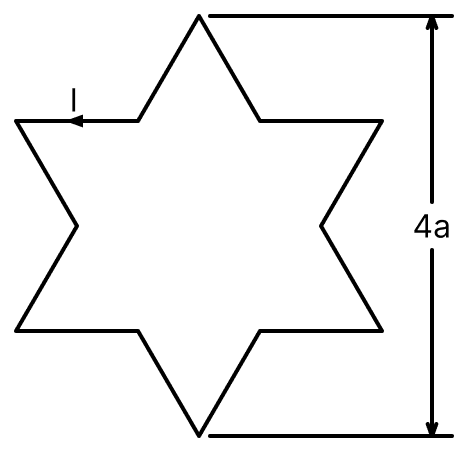
A symmetric star shaped conducting wire loop is carrying a steady state current I as shown in the figure. The distance between the diametrically opposite vertices of the star is 4a. The magnitude of the magnetic field at the centre of the loop is:. Moving Charges and Magnetic Field, Nootan Physics Solutions ICS Class 12
  1. µ0I4πa3[2−3]\dfrac{\text µ_0 \text I}{4\text{πa}}3[2 - \sqrt{3}]
  2. µ0I4πa6[3−1]\dfrac{\text µ_0 \text I}{4\text{πa}}6[\sqrt{3} - 1]
  3. µ0I4πa3[3−1]\dfrac{\text µ_0 \text I}{4\text{πa}}3[\sqrt{3} - 1]
  4. µ0I4πa6[3+1]\dfrac{\text µ_0 \text I}{4\text{πa}}6[\sqrt{3} + 1]

Answer

µ0I4πa6[3−1]\dfrac{\text µ_0 \text I}{4\text{πa}}6[\sqrt{3} - 1]

Reason — Given, a symmetric star shaped loop carrying a current I, the distance between the diametrically opposite vertices being 4a.
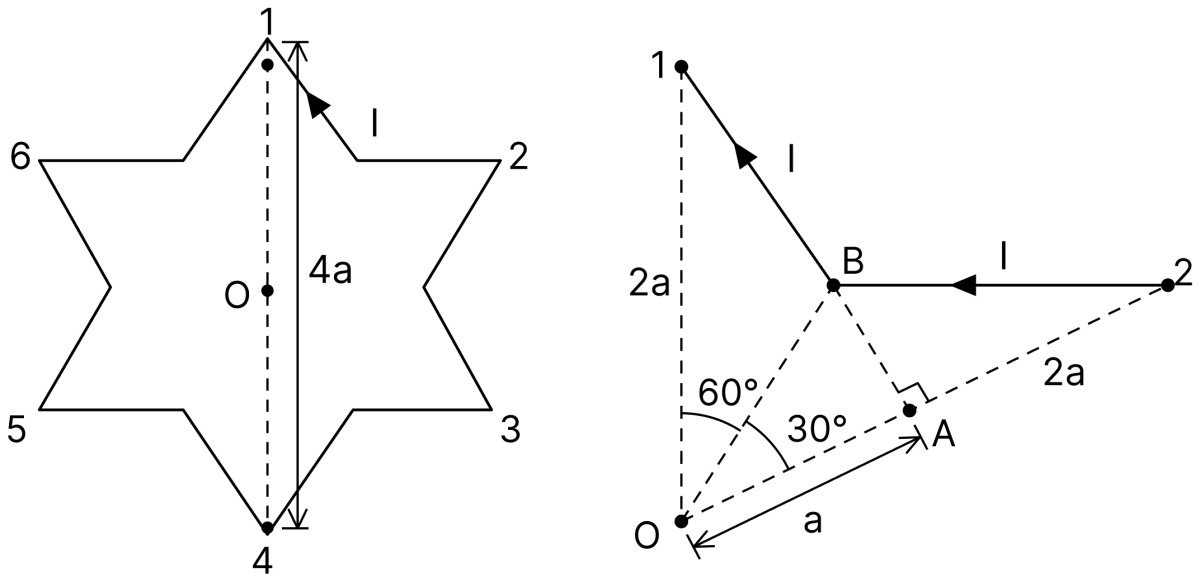
A symmetric star shaped conducting wire loop is carrying a steady state current I as shown in the figure. The distance between the diametrically opposite vertices of the star is 4a. The magnitude of the magnetic field at the centre of the loop is:. Moving Charges and Magnetic Field, Nootan Physics Solutions ICS Class 12

The star is made up of 12 straight segments, and by symmetry each of them produces the same magnitude of field at the centre, all in the same direction.

For each segment the perpendicular distance from the centre is d = OA = a, and its ends subtend 60° and 30° at O on the same side of the normal OA (that is, φ1 = 60°, φ2 = −30°), so

Bseg=µ04πId(sin⁡φ1+sin⁡φ2)\text B_{\text{seg}} = \dfrac{\text µ_0}{4\text π}\dfrac{\text I}{\text d}(\sin \text φ_1 + \sin \text φ_2)

Adding the contributions of all the twelve segments,

B=12×µ04πIa[sin⁡60°+sin⁡(−30°)]B=12×µ0I4πa(32−12)B=µ0I4πa6[3−1]\text B = 12 \times \dfrac{\text µ_0}{4\text π}\dfrac{\text I}{\text a}[\sin 60° + \sin(-30°)] \\[1em] \text B = 12 \times \dfrac{\text µ_0 \text I}{4\text{πa}}\left(\dfrac{\sqrt{3}}{2} - \dfrac{1}{2}\right) \\[1em] \text B = \dfrac{\text µ_0 \text I}{4\text{πa}}6[\sqrt{3} - 1]

Question 14

An arrangement of three parallel straight wires placed perpendicular to plane of paper carrying same current I along the same direction is shown in Fig. Magnitude of force per unit length on the middle wire 'B' is given by :
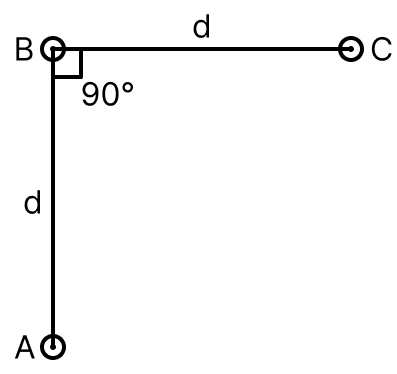
An arrangement of three parallel straight wires placed perpendicular to plane of paper carrying same current I along the same direction is shown in Fig. Magnitude of force per unit length on the middle wire B is given by:. Moving Charges and Magnetic Field, Nootan Physics Solutions ICS Class 12
  1. µ0I22πd\dfrac{\text µ_0 \text I^2}{2\text{πd}}
  2. 2µ0I2πd\dfrac{2\text µ_0 \text I^2}{\text{πd}}
  3. 2µ0I2πd\dfrac{\sqrt{2}\text µ_0 \text I^2}{\text{πd}}
  4. µ0I22πd\dfrac{\text µ_0 \text I^2}{\sqrt{2}\text{πd}}

Answer

µ0I22πd\dfrac{\text µ_0 \text I^2}{\sqrt{2}\text{πd}}

Reason — Given, three parallel wires carrying the same current I along the same direction, the wire B being at a distance d from A and d from C, with AB perpendicular to BC.
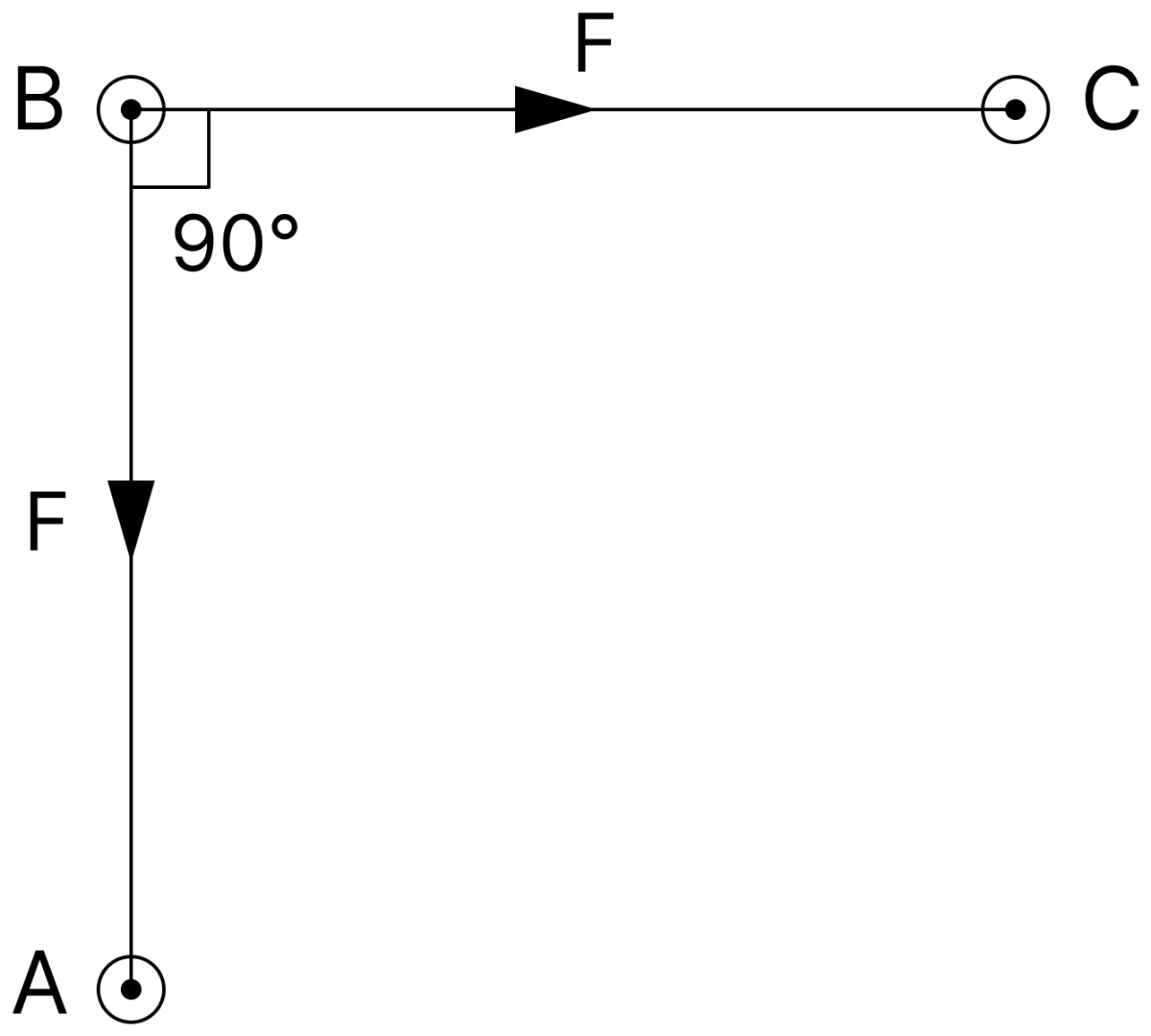
An arrangement of three parallel straight wires placed perpendicular to plane of paper carrying same current I along the same direction is shown in Fig. Magnitude of force per unit length on the middle wire B is given by:. Moving Charges and Magnetic Field, Nootan Physics Solutions ICS Class 12

The force per unit length on B due to A is

F1=µ02πI2d\text F_1 = \dfrac{\text µ_0}{2\text π}\dfrac{\text I^2}{\text d}

and that due to C is

F2=µ02πI2d\text F_2 = \dfrac{\text µ_0}{2\text π}\dfrac{\text I^2}{\text d}

Since all the currents are in the same direction, B is attracted towards A and towards C. The angle between BA and BC is 90°, so the two forces are at right angles and the resultant is

F=F12+F22F=2(µ0I22πd)F=µ0I22 πd\text F = \sqrt{\text F_1^2 + \text F_2^2} \\[1em] \text F = \sqrt{2}\left(\dfrac{\text µ_0 \text I^2}{2\text{πd}}\right) \\[1em] \text F = \dfrac{\text µ_0 \text I^2}{\sqrt{2}\ \text{πd}}

Question 15

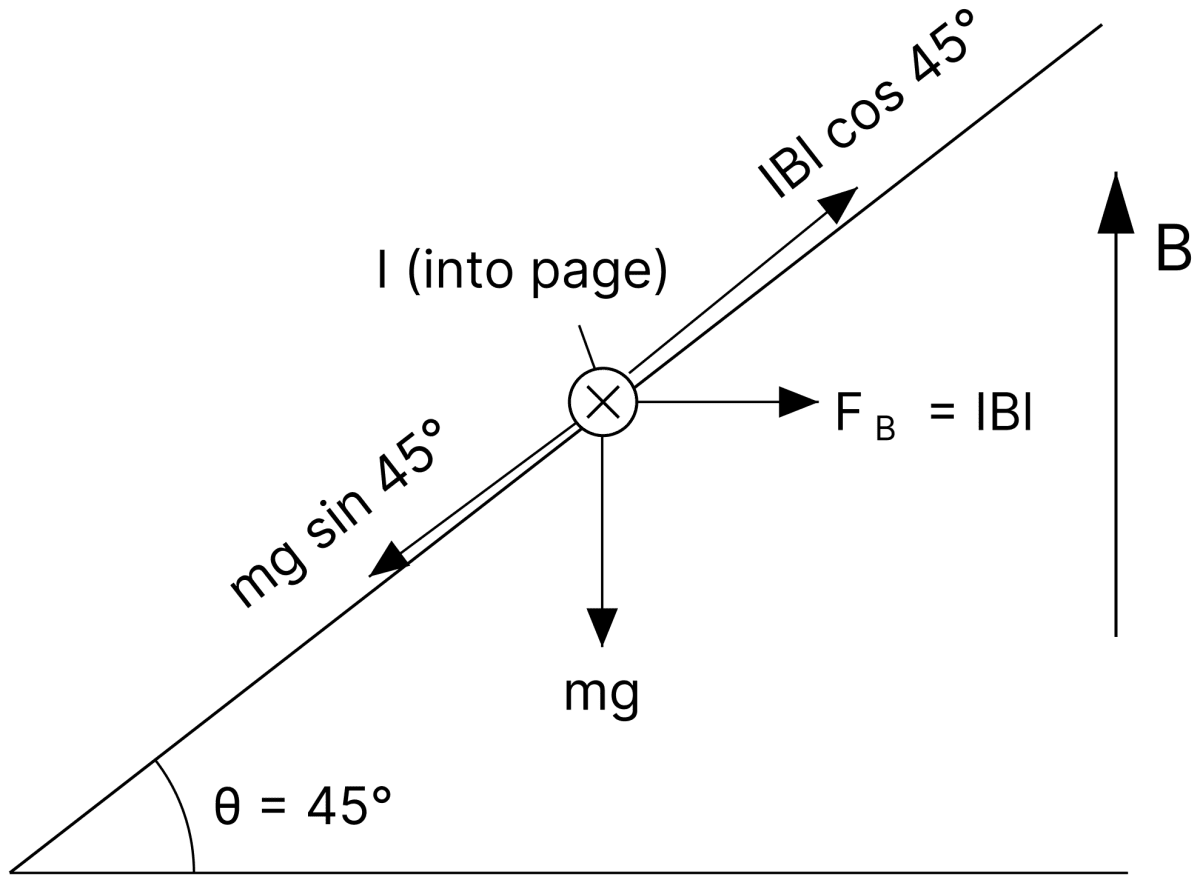
A metallic rod of mass per unit length 0.5 kg m-1 is lying horizontally on a smooth inclined plane which makes an angle of 30° with the horizontal. The rod is not allowed to slide down by flowing current through it when a magnetic field of induction 0.25 T is acting on it in the vertical direction. The current flowing in the rod to keep it stationary is :

  1. 7.14 A
  2. 11.32 A
  3. 14.76 A
  4. 5.98 A

Answer

11.32 A

Reason — Given,

  • mass per unit length, ml\dfrac{\text m}{l} = 0.5 kg m-1
  • θ = 30°, B = 0.25 T, g = 9.8 m s-2
A metallic rod of mass per unit length 0.5 kg m -1 is lying horizontally on a smooth inclined plane which makes an angle of 30° with the horizontal. The rod is not allowed to slide down by flowing current through it when a magnetic field of induction 0.25 T is acting on it in the vertical direction. The current flowing in the rod to keep it stationary is:. Moving Charges and Magnetic Field, Nootan Physics Solutions ICS Class 12

The rod lies horizontally on the smooth inclined plane and the field is vertical, so the magnetic force IBl is horizontal. Balancing the components along the inclined plane,

IBlcos⁡θ=mgsin⁡θI=ml×gtan⁡θBI=0.5×(9.8)(tan⁡30°)0.25I=0.5×(9.8)(0.5774)0.25I=2.8290.25I=11.32 A\text{IB}l \cos θ = \text{mg} \sin θ \\[1em] \text I = \dfrac{\text m}{l} \times \dfrac{\text g \tan θ}{\text B} \\[1em] \text I = 0.5 \times \dfrac{(9.8)(\tan 30°)}{0.25} \\[1em] \text I = 0.5 \times \dfrac{(9.8)(0.5774)}{0.25} \\[1em] \text I = \dfrac{2.829}{0.25} \\[1em] \text I = 11.32\ \text A

Question 16

An electron, a proton and an alpha particle having the same kinetic energy are moving in circular orbits of radii re, rp, rα respectively in uniform magnetic field B. The relation between re, rp, rα is :

  1. re < rp < rα
  2. re < rα < rp
  3. re > rp = rα
  4. re < rp = rα

Answer

re < rp = rα

Reason — Given, the three particles have the same kinetic energy K in the same field B.

r=2mKqB⇒r∝mq\text r = \dfrac{\sqrt{2\text{mK}}}{\text{qB}} \quad \Rightarrow \quad \text r \propto \dfrac{\sqrt{\text m}}{\text q}

Taking the proton mass as m and its charge as e,

  • electron : re∝mee\text r_\text e \propto \dfrac{\sqrt{\text m_\text e}}{\text e}, and me is very much smaller than m
  • proton : rp∝me\text r_\text p \propto \dfrac{\sqrt{\text m}}{\text e}
  • α-particle : rα∝4m2e=me\text r_α \propto \dfrac{\sqrt{4\text m}}{2\text e} = \dfrac{\sqrt{\text m}}{\text e}

Hence rp = rα, and since me < m, re < rp = rα.

Question 17

As shown in the figure, two infinitely long, identical wires are bent by 90° and placed in such a way that the segments LP and QM are along the x-axis, while segments PS and QN are parallel to the y-axis. If OP = OQ = 4 cm, and the magnitude of the magnetic field at O is 10-4 T, and the two wires carry equal currents (see figure), the magnitude of the current in each wire and the direction of the magnetic field at O will be (µ0 = 4π × 10-7 NA-2) :
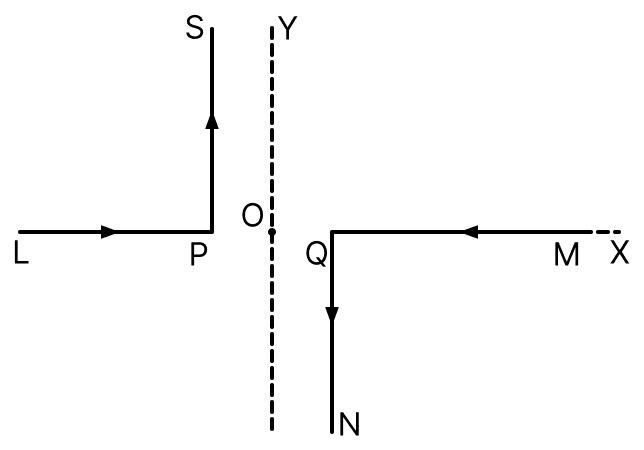
As shown in the figure, two infinitely long, identical wires are bent by 90° and placed in such a way that the segments LP and QM are along the x-axis, while segments PS and QN are parallel to the y-axis. If OP = OQ = 4 cm, and the magnitude of the magnetic field at O is 10 -4 T, and the two wires carry equal currents (see figure), the magnitude of the current in each wire and the direction of the magnetic field at O will be (µ 0 = 4π × 10 -7 NA -2 ):. Moving Charges and Magnetic Field, Nootan Physics Solutions ICS Class 12
  1. 40 A, perpendicular into the page
  2. 40 A, perpendicular out of the page
  3. 20 A, perpendicular out of the page
  4. 20 A, perpendicular into the page

Answer

20 A, perpendicular into the page

Reason — Given, OP = OQ = 4 cm = 0.04 m and B = 10-4 T at O.

The segments LP and QM lie along the x-axis, and O also lies on this axis. For these segments θ = 0 or 180°, so they develop no magnetic field at O.

The segments PS and QN are semi-infinite conductors, each at a perpendicular distance 0.04 m from O. Each therefore gives

B1=µ04πId(sin⁡0°+sin⁡90°)B1=µ04πId\text B_1 = \dfrac{\text µ_0}{4\text π}\dfrac{\text I}{\text d}(\sin 0° + \sin 90°) \\[1em] \text B_1 = \dfrac{\text µ_0}{4\text π}\dfrac{\text I}{\text d}

Applying the right-hand thumb rule, both these fields at O are directed into the page, so

B=2×µ04πIdB=µ0I2πd10−4=(2×10⁻⁷)×I0.04I=(10−4)(0.04)2×10⁻⁷I=20 A\text B = 2 \times \dfrac{\text µ_0}{4\text π}\dfrac{\text I}{\text d} \\[1em] \text B = \dfrac{\text µ_0 \text I}{2\text{πd}} \\[1em] 10^{-4} = (2 \times 10^{-7}) \times \dfrac{\text I}{0.04} \\[1em] \text I = \dfrac{(10^{-4})(0.04)}{2 \times 10^{-7}} \\[1em] \text I = 20\ \text A

Question 18

Two very long, straight, and insulated wires are kept at 90° angle from each other in xy-plane as shown in the figure. These wires carry currents of equal magnitude I, whose directions are shown in the figure. The net magnetic field at point P will be :
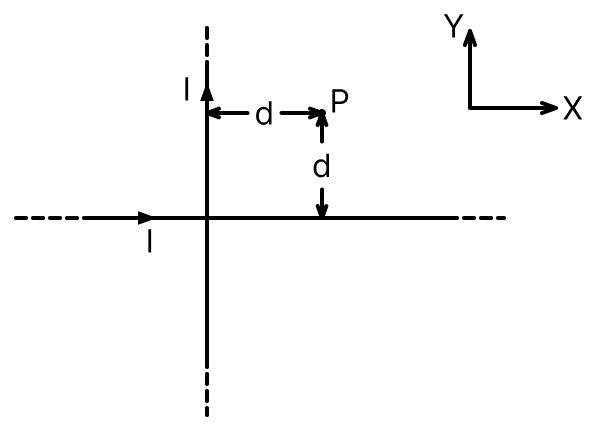
Two very long, straight, and insulated wires are kept at 90° angle from each other in xy-plane as shown in the figure. These wires carry currents of equal magnitude I, whose directions are shown in the figure. The net magnetic field at point P will be:. Moving Charges and Magnetic Field, Nootan Physics Solutions ICS Class 12
  1. zero
  2. +µ0Iπd(z^)\dfrac{+\text µ_0 \text I}{\text{πd}}(\hat{\text z})
  3. −µ0I2πd(x^+y^)-\dfrac{\text µ_0 \text I}{2\text{πd}}(\hat{\text x} + \hat{\text y})
  4. µ0I2πd(x^+y^)\dfrac{\text µ_0 \text I}{2\text{πd}}(\hat{\text x} + \hat{\text y})

Answer

zero

Reason — Given, two mutually perpendicular wires carrying equal currents I, and the point P at a perpendicular distance d from each of them.

The field at P due to each wire has the magnitude

B1=B2=µ0I2πd\text B_1 = \text B_2 = \dfrac{\text µ_0 \text I}{2\text{πd}}

Applying the right-hand thumb rule to the two wires for the directions of current shown, the field due to one wire at P is directed into the plane of the page while that due to the other is directed out of the plane of the page. Being equal in magnitude and opposite in direction, they cancel,

B⃗=B⃗1+B⃗2B⃗=0\vec{\text B} = \vec{\text B}_1 + \vec{\text B}_2 \\[1em] \vec{\text B} = 0

Question 19

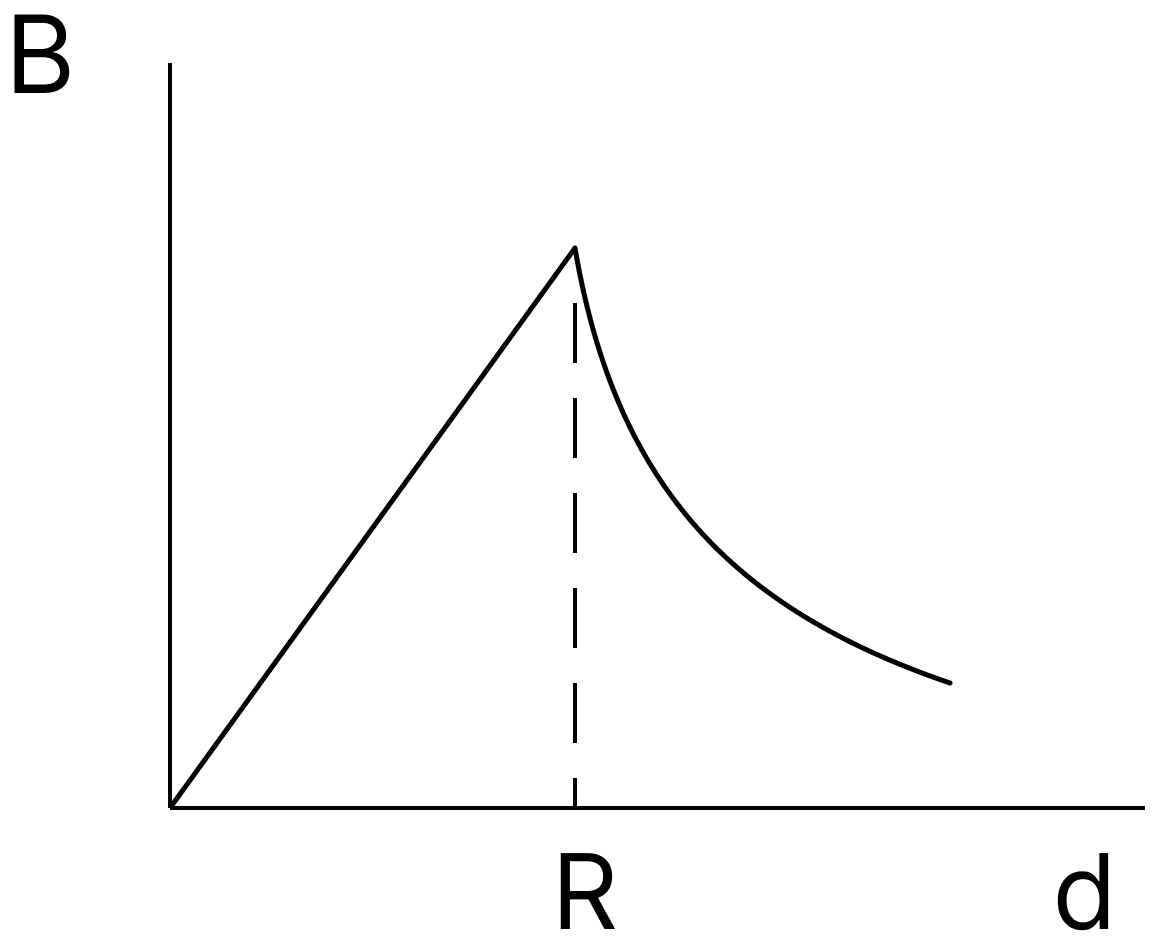
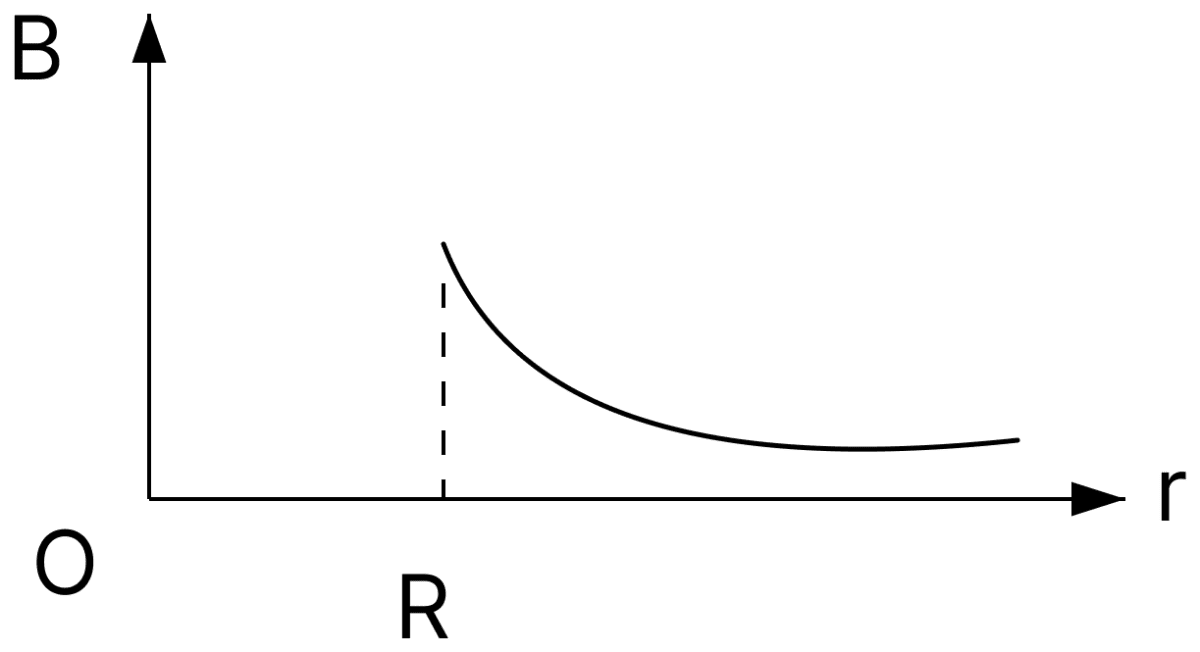
A cylindrical conductor of radius R is carrying a constant current. The plot of the magnitude of the magnetic field. B with the distance d from the centre of the conductor, is correctly represented by the figure :
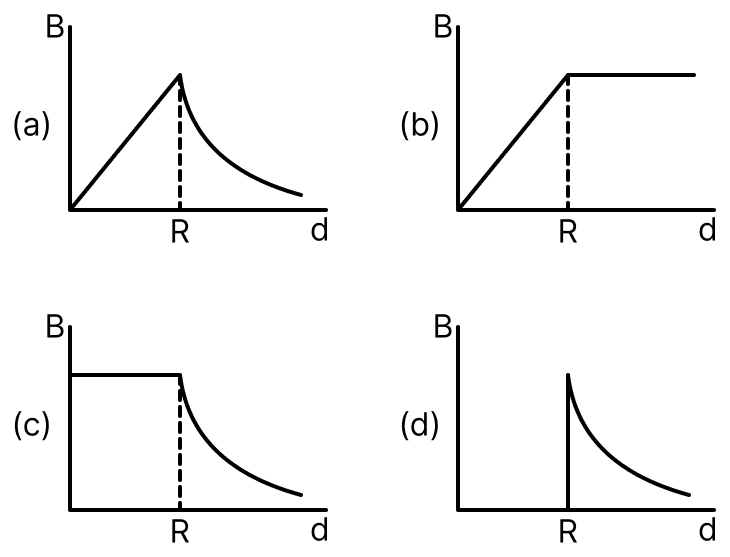
A cylindrical conductor of radius R is carrying a constant current. The plot of the magnitude of the magnetic field. B with the distance d from the centre of the conductor, is correctly represented by the figure:. Moving Charges and Magnetic Field, Nootan Physics Solutions ICS Class 12

Answer

A cylindrical conductor of radius R is carrying a constant current. The plot of the magnitude of the magnetic field. B with the distance d from the centre of the conductor, is correctly represented by the figure:. Moving Charges and Magnetic Field, Nootan Physics Solutions ICS Class 12

Reason — For a cylindrical conductor of radius R carrying a constant current distributed uniformly over its cross-section,

inside the conductor (d < R) :

B=µ0I2πdR2⇒B∝d\text B = \dfrac{\text µ_0 \text I}{2\text π}\dfrac{\text d}{\text R^2} \quad \Rightarrow \quad \text B \propto \text d

so B increases linearly with d, reaching its maximum value µ0I2πR\dfrac{\text µ_0 \text I}{2\text{πR}} at the surface;

outside the conductor (d > R) :

B=µ0I2πd⇒B∝1d\text B = \dfrac{\text µ_0 \text I}{2\text{πd}} \quad \Rightarrow \quad \text B \propto \dfrac{1}{\text d}

so B decreases hyperbolically. This variation is represented by the first graph.

Question 20

A thin ring of 10 cm radius carries a uniformly distributed charge. The ring rotates at a constant angular speed of 40π rads-1 about its axis, perpendicular to its plane. If the magnetic field at its centre is 3.8 × 10⁻⁹ T, then the charge carried by the ring is close to (µ0 = 4π × 10-7 N/A2).

  1. 7 × 10⁻⁶ C
  2. 4 × 10⁻⁵ C
  3. 2 × 10⁻⁶ C
  4. 3 × 10⁻⁵ C

Answer

3 × 10⁻⁵ C

Reason — Given,

  • r = 10 cm = 0.1 m
  • ω = 40π rad s-1
  • B = 3.8 × 10⁻⁹ T

The rotating ring is equivalent to a current loop. If q is the charge on the ring, the equivalent current is

I=qTI=qω2πI=q(40π)2πI=20q\text I = \dfrac{\text q}{\text T} \\[1em] \text I = \dfrac{\text{qω}}{2\text π} \\[1em] \text I = \dfrac{\text q(40\text π)}{2\text π} \\[1em] \text I = 20\text q

The field at the centre of the ring is

B=µ0I2rB=(4π×10−7)(20q)2×0.13.8×10−9=(1.2566×10⁻⁴)qq=3.8×10−91.2566×10−4q=3×10⁻⁵ C\text B = \dfrac{\text µ_0 \text I}{2\text r} \\[1em] \text B = \dfrac{(4\text π \times 10^{-7})(20\text q)}{2 \times 0.1} \\[1em] 3.8 \times 10^{-9} = (1.2566 \times 10^{-4})\text q \\[1em] \text q = \dfrac{3.8 \times 10^{-9}}{1.2566 \times 10^{-4}} \\[1em] \text q = 3 \times 10^{-5}\ \text C

Question 21

One of the two identical conducting wires of length L is bent in the form of a circular loop and the other one into a circular coil of N identical turns. If the same current is passed in both, the ratio of the magnetic field at the central of the loop (BL) to that at the centre of the coil (BC), i.e., RBLBC\text R\dfrac{\text B_\text L}{\text B_\text C} Will be :

  1. 1N\dfrac{1}{\text N}
  2. N2
  3. 1N2\dfrac{1}{\text N^2}
  4. N

Answer

1N2\dfrac{1}{\text N^2}

Reason — Given, both the wires have the same length L and carry the same current.

For the single loop : L = 2πRL, so RL=L2π\text R_\text L = \dfrac{\text L}{2\text π} and

BL=µ0I2RLBL=µ0πIL\text B_\text L = \dfrac{\text µ_0 \text I}{2\text R_\text L} \\[1em] \text B_\text L = \dfrac{\text µ_0 \text{πI}}{\text L}

For the coil of N turns : L = N(2πRC), so RC=L2πN\text R_\text C = \dfrac{\text L}{2\text{πN}} and

BC=µ0NI2RCBC=µ0πN2ILBLBC=1N2\text B_\text C = \dfrac{\text µ_0 \text N \text I}{2\text R_\text C} \\[1em] \text B_\text C = \dfrac{\text µ_0 \text{πN}^2 \text I}{\text L} \\[1em] \dfrac{\text B_\text L}{\text B_\text C} = \dfrac{1}{\text N^2}

Question 22

Find the magnetic field at point P due to a straight line segment AB of length 6 cm carrying a current of 5A. (see figure) (µ0 = 4π × 10-7 N-A-2)
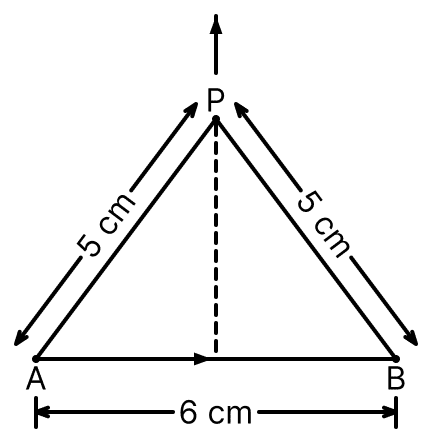
Find the magnetic field at point P due to a straight line segment AB of length 6 cm carrying a current of 5A. (see figure) (µ 0 = 4π × 10 -7 N-A -2 ). Moving Charges and Magnetic Field, Nootan Physics Solutions ICS Class 12
  1. 1.5 × 10⁻⁵ T
  2. 3.0 × 10⁻⁵ T
  3. 2.0 × 10⁻⁵ T
  4. 2.5 × 10⁻⁵ T

Answer

1.5 × 10⁻⁵ T

Reason — Given, AB = 6 cm, PA = PB = 5 cm and I = 5 A.

Find the magnetic field at point P due to a straight line segment AB of length 6 cm carrying a current of 5A. (see figure) (µ 0 = 4π × 10 -7 N-A -2 ). Moving Charges and Magnetic Field, Nootan Physics Solutions ICS Class 12

The perpendicular distance of P from AB is

d=(5)2−(3)2d=25−9d=4 cm=0.04 m\text d = \sqrt{(5)^2 - (3)^2} \\[1em] \text d = \sqrt{25 - 9} \\[1em] \text d = 4\ \text{cm} = 0.04\ \text m

For a straight conductor of finite length,

B=µ04πId(sin⁡φ1+sin⁡φ2)\text B = \dfrac{\text µ_0}{4\text π}\dfrac{\text I}{\text d}(\sin \text φ_1 + \sin \text φ_2)

Here, by symmetry, sin⁡φ1=sin⁡φ2=35=0.6\sin \text φ_1 = \sin \text φ_2 = \dfrac{3}{5} = 0.6. Substituting,

B=(10−7)×50.04×(0.6+0.6)B=(10−7)(125)(1.2)B=1.5×10⁻⁵ T\text B = (10^{-7}) \times \dfrac{5}{0.04} \times (0.6 + 0.6) \\[1em] \text B = (10^{-7})(125)(1.2) \\[1em] \text B = 1.5 \times 10^{-5}\ \text T

Question 23

A particle of mass m and charge q is in an electric and magnetic field given by E⃗=2i^+3j^\vec{\text E} = 2\hat{\text i} + 3\hat{\text j}; B⃗=4j^+6k^\vec{\text B} = 4\hat{\text j} + 6\hat{\text k}. The charged particle is shifted from the origin to the point P(x = 1; y = 1) along a straight path. The magnitude of the total work done is :

  1. (0.35)q
  2. (0.15)q
  3. (2.5)q
  4. 5q

Answer

5q

Reason — Given, E⃗=2i^+3j^\vec{\text E} = 2\hat{\text i} + 3\hat{\text j} and the displacement from the origin to P(1, 1) is d⃗=i^+j^\vec{\text d} = \hat{\text i} + \hat{\text j}.

The magnetic force is always perpendicular to the velocity, so the work done by the magnetic field is zero. Only the electric force does work,

W=qE⃗⋅d⃗W=q(2i^+3j^)⋅(i^+j^)W=q(2+3)W=5q\text W = \text q\vec{\text E} \cdot \vec{\text d} \\[1em] \text W = \text q(2\hat{\text i} + 3\hat{\text j}) \cdot (\hat{\text i} + \hat{\text j}) \\[1em] \text W = \text q(2 + 3) \\[1em] \text W = 5\text q

Question 24

A rigid square loop of side 'a' and carrying current I2 is lying on a horizontal surface near a long current I1 carrying wire in the same plane as shown in figure. The net force on the loop due to wire will be :
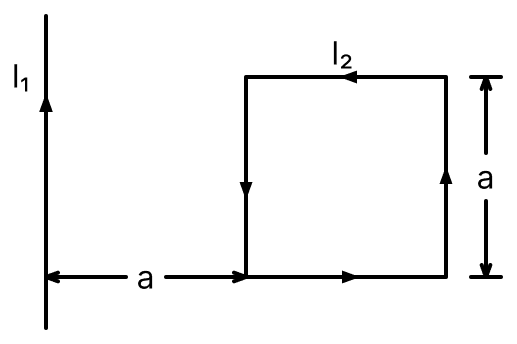
A rigid square loop of side a and carrying current I 2 is lying on a horizontal surface near a long current I 1 carrying wire in the same plane as shown in figure. The net force on the loop due to wire will be:. Moving Charges and Magnetic Field, Nootan Physics Solutions ICS Class 12
  1. attractive and equal to µ0I1I23π\dfrac{\text µ_0 \text I_1 \text I_2}{3\text π}
  2. repulsive and equal to µ0I1I24π\dfrac{\text µ_0 \text I_1 \text I_2}{4\text π}
  3. repulsive and equal to µ0I1I22π\dfrac{\text µ_0 \text I_1 \text I_2}{2\text π}
  4. zero

Answer

repulsive and equal to µ0I1I24π\dfrac{\text µ_0 \text I_1 \text I_2}{4\text π}

Reason — Given, a square loop of side a carrying a current I2, the nearer side being at a distance a from the long wire carrying I1.

Force on the nearer side (at a distance a) :

F1=µ02πI1I2a×aF1=µ0I1I22π\text F_1 = \dfrac{\text µ_0}{2\text π}\dfrac{\text I_1 \text I_2}{\text a} \times \text a \\[1em] \text F_1 = \dfrac{\text µ_0 \text I_1 \text I_2}{2\text π}

Force on the farther side (at a distance 2a) :

F2=µ02πI1I22a×aF2=µ0I1I24π\text F_2 = \dfrac{\text µ_0}{2\text π}\dfrac{\text I_1 \text I_2}{2\text a} \times \text a \\[1em] \text F_2 = \dfrac{\text µ_0 \text I_1 \text I_2}{4\text π}

The forces on the other two sides are equal and opposite and cancel out. The current in the nearer side is opposite to I1, so F1 is a repulsion, while F2 is an attraction. Hence the net force is

F=F1−F2F=µ0I1I22π−µ0I1I24πF=µ0I1I24π\text F = \text F_1 - \text F_2 \\[1em] \text F = \dfrac{\text µ_0 \text I_1 \text I_2}{2\text π} - \dfrac{\text µ_0 \text I_1 \text I_2}{4\text π} \\[1em] \text F = \dfrac{\text µ_0 \text I_1 \text I_2}{4\text π}

and it is repulsive, since the larger force is the repulsive one.

Question 25

An electron, moving along the x-axis with an initial energy of 100 eV, enters a region of magnetic field B⃗=(1.5×10⁻³ T)k^\vec{\text B} = (1.5 \times 10^{-3} \text{ T})\hat{\text k} at S (see figure). The field extends between x = 0 and x = 2 cm. The electron is detected at the point Q on a screen placed 8 cm away from the point S. The distance d between P and Q (on the screen) is :

(Electron's charge = 1.6 × 10⁻¹⁹ C, mass of electron = 9.1 × 10⁻³¹ kg)
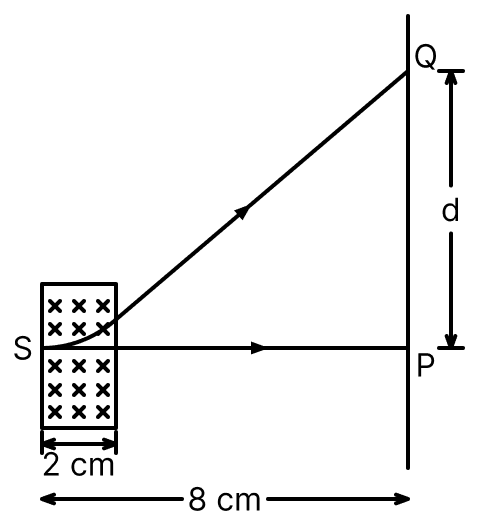
An electron, moving along the x-axis with an initial energy of 100 eV, enters a region of magnetic field vec text B = (1.5 × 10^-3 T) hat text k at S (see figure). The field extends between x = 0 and x = 2 cm. The electron is detected at the point Q on a screen placed 8 cm away from the point S. The distance d between P and Q (on the screen) is: (Electrons charge = 1.6 × 10 -19 C, mass of electron = 9.1 × 10 -31 kg). Moving Charges and Magnetic Field, Nootan Physics Solutions ICS Class 12
  1. 2.25 cm
  2. 12.87 cm
  3. 1.22 cm
  4. 11.65 cm

Answer

12.87 cm

Reason — Given, energy = 100 eV, B = 1.5 × 10⁻³ T, the field extending over x = 2 cm, and the screen 8 cm from S.
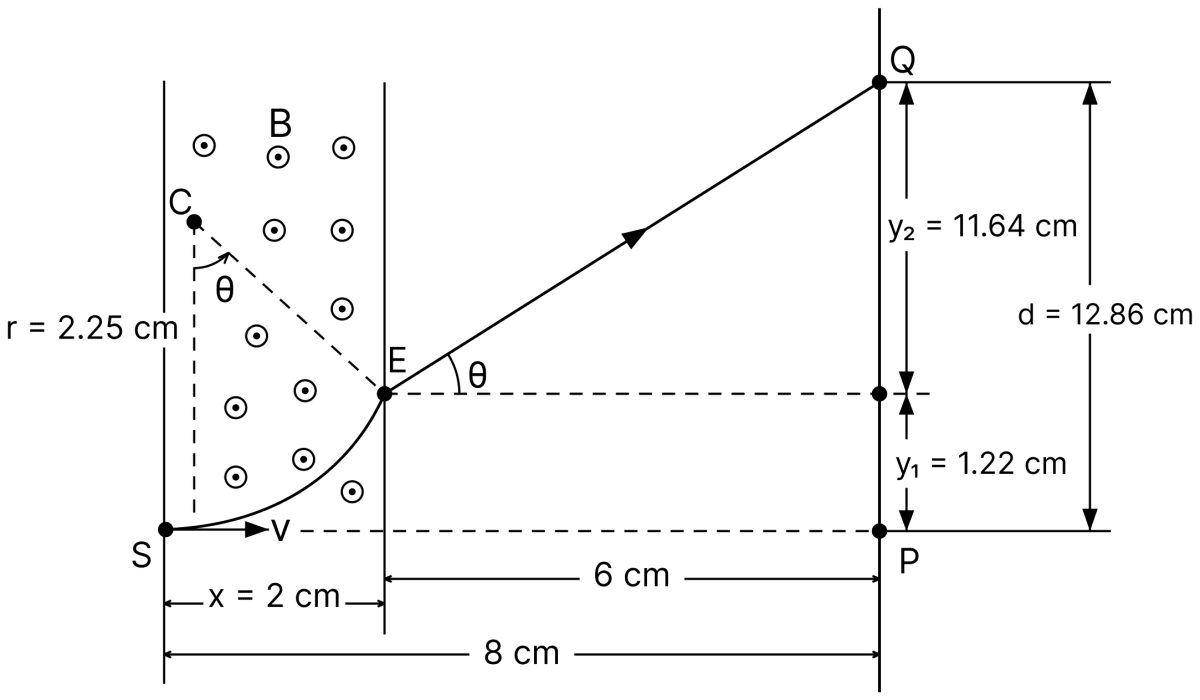
An electron, moving along the x-axis with an initial energy of 100 eV, enters a region of magnetic field vec text B = (1.5 × 10^-3 T) hat text k at S (see figure). The field extends between x = 0 and x = 2 cm. The electron is detected at the point Q on a screen placed 8 cm away from the point S. The distance d between P and Q (on the screen) is: (Electrons charge = 1.6 × 10 -19 C, mass of electron = 9.1 × 10 -31 kg). Moving Charges and Magnetic Field, Nootan Physics Solutions ICS Class 12

Since B⃗ \vec{\text B} \spaceis along +k^+\hat{\text k}, the field points out of the page (the crosses in the question figure do not match the stated k^\hat{\text k}), and the force on the electron, −e(v⃗×B⃗)-\text e(\vec{\text v} \times \vec{\text B}), is along +y, so it bends towards Q.

Speed of the electron :

v=2Kmv=2(100)(1.6×10⁻¹⁹)9.1×10⁻³¹v=5.93×10⁶ ms−1\text v = \sqrt{\dfrac{2\text K}{\text m}} \\[1em] \text v = \sqrt{\dfrac{2(100)(1.6 \times 10^{-19})}{9.1 \times 10^{-31}}} \\[1em] \text v = 5.93 \times 10^6\ \text{ms}^{-1}

Radius of the circular path inside the field :

r=mveBr=(9.1×10⁻³¹)(5.93×10⁶)(1.6×10⁻¹⁹)(1.5×10⁻³)r=2.25 cm\text r = \dfrac{\text{mv}}{\text{eB}} \\[1em] \text r = \dfrac{(9.1 \times 10^{-31})(5.93 \times 10^6)}{(1.6 \times 10^{-19})(1.5 \times 10^{-3})} \\[1em] \text r = 2.25\ \text{cm}

Deflection inside the field region : with x = 2 cm,

y1=r−r2−x2y1=2.25−(2.25)2−(2)2y1=2.25−1.03y1=1.22 cm\text y_1 = \text r - \sqrt{\text r^2 - \text x^2} \\[1em] \text y_1 = 2.25 - \sqrt{(2.25)^2 - (2)^2} \\[1em] \text y_1 = 2.25 - 1.03 \\[1em] \text y_1 = 1.22\ \text{cm}

Deflection outside the field region : the electron leaves the field at an angle θ with

sin⁡θ=xrsin⁡θ=22.25sin⁡θ=0.889cos⁡θ=0.458tan⁡θ=1.94\sin θ = \dfrac{\text x}{\text r} \\[1em] \sin θ = \dfrac{2}{2.25} \\[1em] \sin θ = 0.889 \\[1em] \cos θ = 0.458 \\[1em] \tan θ = 1.94

and then travels in a straight line over the remaining 8 − 2 = 6 cm,

y2=6tan⁡θy2=6×1.94y2=11.64 cm\text y_2 = 6 \tan θ \\[1em] \text y_2 = 6 \times 1.94 \\[1em] \text y_2 = 11.64\ \text{cm}

Total distance :

d=y1+y2d=1.22+11.64d=12.86 cm\text d = \text y_1 + \text y_2 \\[1em] \text d = 1.22 + 11.64 \\[1em] \text d = 12.86\ \text{cm}

This agrees with option 2 (12.87 cm) to within rounding; with the unrounded radius (2.248 cm), d ≈ 12.9 cm.

Question 26

Two wires A and B are carrying currents I1 and I2 as shown in the figure. The separation between them is d. A third wire C carrying a current I is to be kept parallel to them at a distance x from A such that the net force acting on it is zero. The possible values of x are :
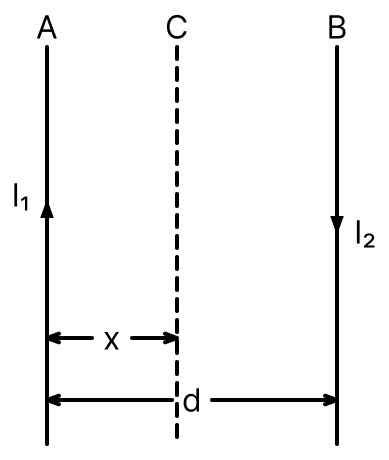
Two wires A and B are carrying currents I 1 and I 2 as shown in the figure. The separation between them is d. A third wire C carrying a current I is to be kept parallel to them at a distance x from A such that the net force acting on it is zero. The possible values of x are:. Moving Charges and Magnetic Field, Nootan Physics Solutions ICS Class 12
  1. x=(I1I1−I2)d\text x = \left(\dfrac{\text I_1}{\text I_1 - \text I_2}\right)\text d and x=I2(I1+I2)d\text x = \dfrac{\text I_2}{(\text I_1 + \text I_2)}\text d
  2. x=±I1d(I1−I2)\text x = \pm\dfrac{\text I_1 \text d}{(\text I_1 - \text I_2)}
  3. x=(I1I1+I2)d\text x = \left(\dfrac{\text I_1}{\text I_1 + \text I_2}\right)\text d and x=I2(I1−I2)d\text x = \dfrac{\text I_2}{(\text I_1 - \text I_2)}\text d
  4. x=(I2I1+I2)d\text x = \left(\dfrac{\text I_2}{\text I_1 + \text I_2}\right)\text d and x=(I2I1−I2)d\text x = \left(\dfrac{\text I_2}{\text I_1 - \text I_2}\right)\text d

Answer

x=±I1d(I1−I2)\text x = \pm\dfrac{\text I_1 \text d}{(\text I_1 - \text I_2)}

Reason — Given, the wires A and B carry currents I1 and I2 in opposite directions, separated by a distance d, and the wire C is at a distance x from A.

The net force on C is zero when the two forces per unit length are equal and opposite. Since the currents in A and B are oppositely directed, the two forces act in the same direction at every point between the wires, so no null point can lie between them; C must lie outside.

C beyond B (distance x − d from B) :

µ02πI1Ix=µ02πI2I(x−d)\dfrac{\text µ_0}{2\text π}\dfrac{\text I_1 \text I}{\text x} = \dfrac{\text µ_0}{2\text π}\dfrac{\text I_2 \text I}{(\text x - \text d)}

Solving,

I1(x−d)=I2xx(I1−I2)=I1dx=I1dI1−I2\text I_1(\text x - \text d) = \text I_2 \text x \\[1em] \text x(\text I_1 - \text I_2) = \text I_1 \text d \\[1em] \text x = \dfrac{\text I_1 \text d}{\text I_1 - \text I_2}

C beyond A (distance x + d from B) :

I1x=I2x+dx=I1dI2−I1x=−I1dI1−I2\dfrac{\text I_1}{\text x} = \dfrac{\text I_2}{\text x + \text d} \\[1em] \text x = \dfrac{\text I_1 \text d}{\text I_2 - \text I_1} \\[1em] \text x = -\dfrac{\text I_1 \text d}{\text I_1 - \text I_2}

Combining the two cases,

x=±I1d(I1−I2)\text x = \pm\dfrac{\text I_1 \text d}{(\text I_1 - \text I_2)}

Question 27

Ionized hydrogen atoms and α-particles with same momenta enters perpendicular to a constant magnetic field B. The ratio of their radii of their paths rH : rα will be :

  1. 4 : 1
  2. 1 : 4
  3. 2 : 1
  4. 1 : 2

Answer

2 : 1

Reason — Given, the ionized hydrogen atoms and the α-particles have the same momentum p and enter the same field B perpendicularly.

r=pqB⇒r∝1q\text r = \dfrac{\text p}{\text{qB}} \quad \Rightarrow \quad \text r \propto \dfrac{1}{\text q}

The charge on an ionized hydrogen atom is e and that on an α-particle is 2e, so

rHrα=qαqHrHrα=2eerHrα=21\dfrac{\text r_\text H}{\text r_α} = \dfrac{\text q_α}{\text q_\text H} \\[1em] \dfrac{\text r_\text H}{\text r_α} = \dfrac{2\text e}{\text e} \\[1em] \dfrac{\text r_\text H}{\text r_α} = \dfrac{2}{1}

Question 28

A proton, an electron and a helium nucleus, have the same energy. They are in circular orbits in a plane due to magnetic field perpendicular to the plane. Let rp, re and rHe be their respective radii, then :

  1. re < rp < rHe
  2. re > rp = rHe
  3. re < rp = rHe
  4. re > rp > rHe

Answer

re < rp = rHe

Reason — Given, the three particles have the same energy K in the same magnetic field B.

r=2mKqB⇒r∝mq\text r = \dfrac{\sqrt{2\text{mK}}}{\text{qB}} \quad \Rightarrow \quad \text r \propto \dfrac{\sqrt{\text m}}{\text q}

Taking the proton mass as m and its charge as e,

  • proton : rp∝me\text r_\text p \propto \dfrac{\sqrt{\text m}}{\text e}
  • helium nucleus : mHe = 4m and qHe = 2e, so rHe∝4m2e=me\text r_{\text{He}} \propto \dfrac{\sqrt{4\text m}}{2\text e} = \dfrac{\sqrt{\text m}}{\text e}
  • electron : re∝mee\text r_\text e \propto \dfrac{\sqrt{\text m_\text e}}{\text e}, and me is very much smaller than m

Hence rp = rHe, while re is much smaller, giving re < rp = rHe.

Question 29

A particle having the same charge as of electron moves in a circular path of radius 0.5 cm under the influence of a magnetic field of 0.5 T. If an electric field of 100 V/m makes it to move in a straight path, then the mass of the particle is : (Given charge of electron = 1.6 × 10⁻¹⁹ C)

  1. 2.0 × 10⁻²⁴ kg
  2. 1.6 × 10⁻¹⁹ kg
  3. 1.6 × 10⁻²⁷ kg
  4. 9.1 × 10⁻³¹ kg

Answer

2.0 × 10⁻²⁴ kg

Reason — Given,

  • r = 0.5 cm = 5 × 10⁻³ m
  • B = 0.5 T
  • E = 100 V/m
  • q = 1.6 × 10⁻¹⁹ C

The particle moves in a straight path when the electric force balances the magnetic force,

qE=qvBv=EBv=1000.5v=200 ms−1\text{qE} = \text{qvB} \\[1em] \text v = \dfrac{\text E}{\text B} \\[1em] \text v = \dfrac{100}{0.5} \\[1em] \text v = 200\ \text{ms}^{-1}

From the radius of the circular path, r=mvqB\text r = \dfrac{\text{mv}}{\text{qB}},

m=qBrvm=(1.6×10⁻¹⁹)(0.5)(5×10⁻³)200m=4×10−22200m=2.0×10⁻²⁴ kg\text m = \dfrac{\text{qBr}}{\text v} \\[1em] \text m = \dfrac{(1.6 \times 10^{-19})(0.5)(5 \times 10^{-3})}{200} \\[1em] \text m = \dfrac{4 \times 10^{-22}}{200} \\[1em] \text m = 2.0 \times 10^{-24}\ \text{kg}

Question 30

A particle of charge q and mass m is moving with a velocity −vi^-\text v\hat{\text i} (v ≠ 0) towards a large screen placed in the Y-Z plane at a distance d. If there is a magnetic field B⃗=B0k^\vec{\text B} = \text B_0\hat{\text k}, the maximum value of v for which the particle will not hit the screen is :

  1. 2qdB0m\dfrac{2\text{qdB}_0}{\text m}
  2. qdB03m\dfrac{\text{qdB}_0}{3\text m}
  3. qdB02m\dfrac{\text{qdB}_0}{2\text m}
  4. qdB0m\dfrac{\text{qdB}_0}{\text m}

Answer

qdB0m\dfrac{\text{qdB}_0}{\text m}

Reason — Given, v⃗=−vi^\vec{\text v} = -\text v\hat{\text i}, B⃗=B0k^\vec{\text B} = \text B_0\hat{\text k} and the screen at a distance d in the Y-Z plane.

The velocity is perpendicular to the field, so the particle describes a circle of radius

r=mvqB0\text r = \dfrac{\text{mv}}{\text{qB}_0}

Starting along the −X direction, the greatest distance the particle can penetrate along its initial direction of motion is equal to the radius r of the circle, after which it turns back.

The particle will not hit the screen so long as

r<d⇒mvqB0<dv<qdB0m\text r \lt \text d \quad \Rightarrow \quad \dfrac{\text{mv}}{\text{qB}_0} \lt \text d \\[1em] \text v \lt \dfrac{\text{qdB}_0}{\text m}

Hence the maximum value of v is qdB0m\dfrac{\text{qdB}_0}{\text m}.

Question 31

The figure shows a region of length 'l' with a uniform magnetic field of 0.3 T in it and a proton entering the region with velocity 4 × 10⁵ ms-1 making an angle 60° with the field. If the proton completes 10 revolutions by the time it cross the region shown, 'l' is close to (mass of proton = 1.67 × 10⁻²⁷ kg, charge of the proton = 1.6 × 10⁻¹⁹ C).
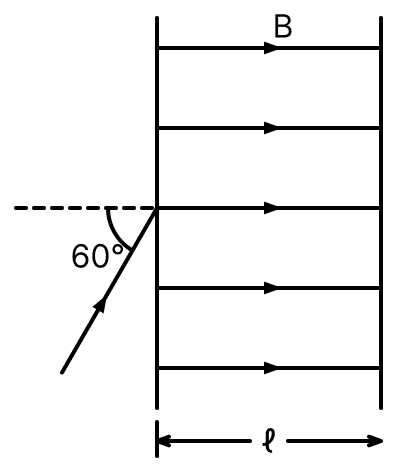
The figure shows a region of length l with a uniform magnetic field of 0.3 T in it and a proton entering the region with velocity 4 × 10 5 ms -1 making an angle 60° with the field. If the proton completes 10 revolutions by the time it cross the region shown, l is close to (mass of proton = 1.67 × 10 -27 kg, charge of the proton = 1.6 × 10 -19 C). Moving Charges and Magnetic Field, Nootan Physics Solutions ICS Class 12
  1. 0.22 m
  2. 0.11 m
  3. 0.88 m
  4. 0.44 m

Answer

0.44 m

Reason — Given, B = 0.3 T, v = 4 × 10⁵ ms-1, θ = 60°, m = 1.67 × 10⁻²⁷ kg and q = 1.6 × 10⁻¹⁹ C.

The pitch of the helical path is the distance advanced along the field in one complete revolution,

P=vcos⁡θ×2πmqBP=(4×10⁵)(cos⁡60°)×2×3.14×1.67×10−27(1.6×10⁻¹⁹)(0.3)P=(2×105)×1.049×10−264.8×10⁻²⁰P=0.0437 m\text P = \text v \cos θ \times \dfrac{2\text{πm}}{\text{qB}} \\[1em] \text P = (4 \times 10^5)(\cos 60°) \times \dfrac{2 \times 3.14 \times 1.67 \times 10^{-27}}{(1.6 \times 10^{-19})(0.3)} \\[1em] \text P = (2 \times 10^5) \times \dfrac{1.049 \times 10^{-26}}{4.8 \times 10^{-20}} \\[1em] \text P = 0.0437\ \text m

The proton completes 10 revolutions while crossing the region, so

l=10×Pl=10×0.0437l=0.44 ml = 10 \times \text P \\[1em] l = 10 \times 0.0437 \\[1em] l = 0.44\ \text m

Question 32

A beam of protons with speed 4 × 10⁵ ms-1 enters a uniform magnetic field of 0.3 T at an angle of 60° to the magnetic field. The pitch of the resulting helical path of protons is close to (Mass of the proton = 1.67 × 10⁻²⁷ kg, charge of the proton = 1.69 × 10⁻¹⁹ C).

  1. 2 cm
  2. 12 cm
  3. 5 cm
  4. 4 cm

Answer

4 cm

Reason — Given, v = 4 × 10⁵ ms-1, B = 0.3 T, θ = 60°, m = 1.67 × 10⁻²⁷ kg and q = 1.69 × 10⁻¹⁹ C.

The pitch of the helical path is

P=vcos⁡θ×2πmqB\text P = \text v \cos θ \times \dfrac{2\text{πm}}{\text{qB}}

Substituting the values,

P=(4×10⁵)(0.5)×2×3.14×1.67×10−27(1.69×10⁻¹⁹)(0.3)P=(2×105)×1.049×10−265.07×10⁻²⁰P=0.0414 mP≈4 cm\text P = (4 \times 10^5)(0.5) \times \dfrac{2 \times 3.14 \times 1.67 \times 10^{-27}}{(1.69 \times 10^{-19})(0.3)} \\[1em] \text P = (2 \times 10^5) \times \dfrac{1.049 \times 10^{-26}}{5.07 \times 10^{-20}} \\[1em] \text P = 0.0414\ \text m \\[1em] \text P \approx 4\ \text{cm}

Question 33

An electron is moving in +X direction with a velocity of 6 × 10⁶ ms-1. It enters a region of uniform electric field of 300 V/cm pointing along +Y direction. The magnitude and direction of the magnetic field set up in this region such that the electron keeps moving along the X direction will be :

  1. 5 × 10⁻³ T, along +Z direction
  2. 5 × 10⁻³ T, along −Z direction
  3. 3 × 10⁻⁴ T, along +Z direction
  4. 3 × 10⁻⁴ T, along −Z direction

Answer

5 × 10⁻³ T, along +Z direction

Reason — Given, v = 6 × 10⁶ ms-1 along +X, and E = 300 V/cm = 3 × 10⁴ V/m along +Y.

The electron keeps moving along X, so the electric and magnetic forces on it balance,

eE=evBB=EvB=3×1046×106B=5×10⁻³ T\text{eE} = \text{evB} \\[1em] \text B = \dfrac{\text E}{\text v} \\[1em] \text B = \dfrac{3 \times 10^4}{6 \times 10^6} \\[1em] \text B = 5 \times 10^{-3}\ \text T

Direction : The electron carries a charge −e, so the electric force on it is along −Y. The magnetic force must therefore be along +Y. Taking B⃗=Bk^\vec{\text B} = \text B\hat{\text k},

F⃗=(−e)(vi^×Bk^)F⃗=(−e)(−vBj^)F⃗=evBj^\vec{\text F} = (-\text e)(\text v\hat{\text i} \times \text B\hat{\text k}) \\[1em] \vec{\text F} = (-\text e)(-\text{vB}\hat{\text j}) \\[1em] \vec{\text F} = \text{evB}\hat{\text j}

which is along +Y, as required. Hence the field is directed along the +Z direction.

Question 34

An infinitely long straight conductor carries a current of 5 A as shown. An electron is moving with a speed of 105 m/s parallel to the conductor. The perpendicular distance between the electron and the conductor is 20 cm at an instant. Calculate the magnitude of the force experienced by the electron at that instant.
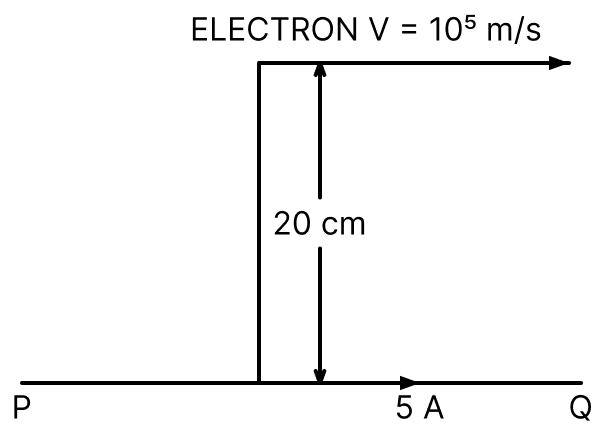
An infinitely long straight conductor carries a current of 5 A as shown. An electron is moving with a speed of 10 5 m/s parallel to the conductor. The perpendicular distance between the electron and the conductor is 20 cm at an instant. Calculate the magnitude of the force experienced by the electron at that instant. Moving Charges and Magnetic Field, Nootan Physics Solutions ICS Class 12
  1. 8 × 10-20 N
  2. 4 × 10-20 N
  3. 8π × 10-20 N
  4. 4π × 10-20 N

Answer

8 × 10-20 N

Reason — Given, I = 5 A, v = 105 m/s and r = 20 cm = 0.2 m.

The field produced by the conductor at the position of the electron is

B=µ04π2IrB=(10−7)×2×50.2B=5×10⁻⁶ T\text B = \dfrac{\text µ_0}{4\text π}\dfrac{2\text I}{\text r} \\[1em] \text B = (10^{-7}) \times \dfrac{2 \times 5}{0.2} \\[1em] \text B = 5 \times 10^{-6}\ \text T

The electron moves parallel to the conductor, so it moves at right angles to this field and

F=evBF=(1.6×10⁻¹⁹)(105)(5×10⁻⁶)F=8×10⁻²⁰ N\text F = \text{evB} \\[1em] \text F = (1.6 \times 10^{-19})(10^5)(5 \times 10^{-6}) \\[1em] \text F = 8 \times 10^{-20}\ \text N

Question 35

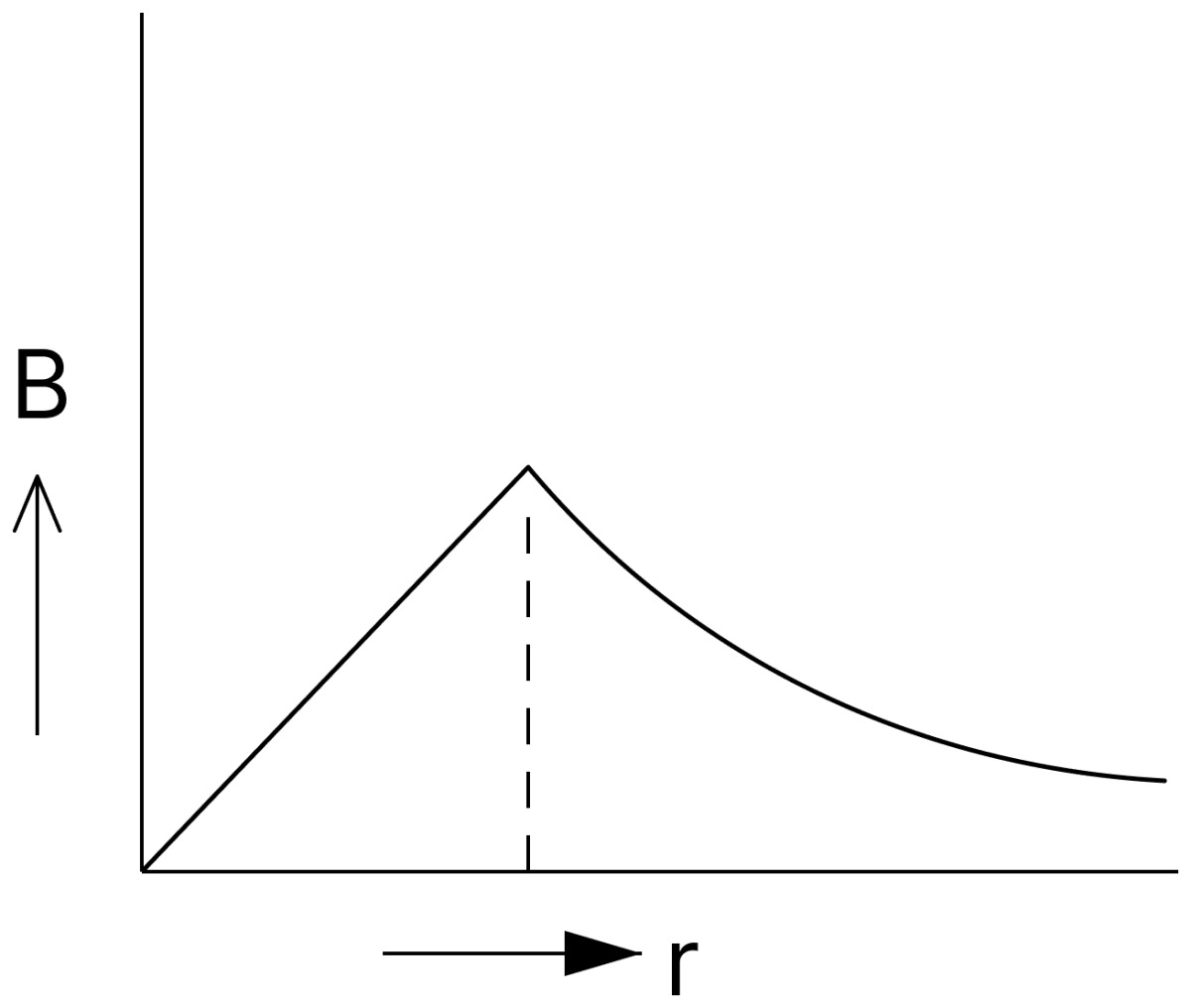
A thick current-carrying cable of radius 'R' carries current 'I' uniformly distributed across its cross-section. The variation of magnetic field B(r) due to the cable with the distance 'r' from the axis of the cable is represented by :
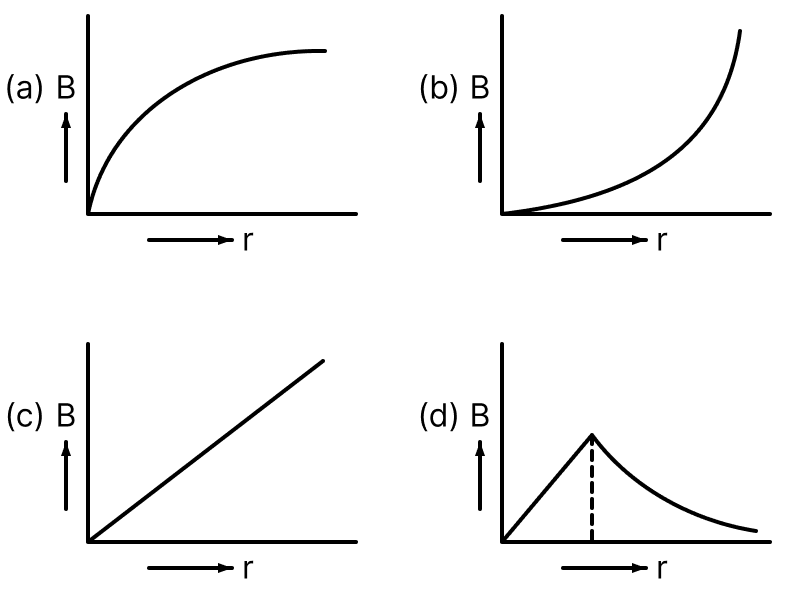
A thick current-carrying cable of radius R carries current I uniformly distributed across its cross-section. The variation of magnetic field B(r) due to the cable with the distance r from the axis of the cable is represented by:. Moving Charges and Magnetic Field, Nootan Physics Solutions ICS Class 12

Answer

A thick current-carrying cable of radius R carries current I uniformly distributed across its cross-section. The variation of magnetic field B(r) due to the cable with the distance r from the axis of the cable is represented by:. Moving Charges and Magnetic Field, Nootan Physics Solutions ICS Class 12

Reason — For a thick cable of radius R carrying a current I uniformly distributed over its cross-section,

inside the cable (r < R) : the current enclosed by a circle of radius r is Ir2R2\text I\dfrac{\text r^2}{\text R^2}, so

B=µ0Ir2πR2⇒B∝r\text B = \dfrac{\text µ_0 \text{Ir}}{2\text{πR}^2} \quad \Rightarrow \quad \text B \propto \text r

outside the cable (r > R) : the whole current is enclosed, so

B=µ0I2πr⇒B∝1r\text B = \dfrac{\text µ_0 \text I}{2\text{πr}} \quad \Rightarrow \quad \text B \propto \dfrac{1}{\text r}

Hence B increases linearly with r up to the surface of the cable, where it reaches its maximum value, and then falls off hyperbolically. This variation is represented by the fourth graph.

Question 36

In the product

F⃗=q(v⃗×B⃗)=qv⃗×(Bi^+Bj^+B0k^)\vec{\text F} = \text q(\vec{\text v} \times \vec{\text B}) = \text q\vec{\text v} \times (\text B\hat{\text i} + \text B\hat{\text j} + \text B_0\hat{\text k})

For q = 1 and v⃗=2i^+4j^+6k^\vec{\text v} = 2\hat{\text i} + 4\hat{\text j} + 6\hat{\text k}

and F⃗=4i^−20j^+12k^\vec{\text F} = 4\hat{\text i} - 20\hat{\text j} + 12\hat{\text k}

What will be the complete expression for B⃗ \vec{\text B} \space?

  1. 6i^+6j^−8k^6\hat{\text i} + 6\hat{\text j} - 8\hat{\text k}
  2. −8i^−8j^−6k^-8\hat{\text i} - 8\hat{\text j} - 6\hat{\text k}
  3. −6i^−6j^−8k^-6\hat{\text i} - 6\hat{\text j} - 8\hat{\text k}
  4. 8i^+8j^−6k^8\hat{\text i} + 8\hat{\text j} - 6\hat{\text k}

Answer

−6i^−6j^−8k^-6\hat{\text i} - 6\hat{\text j} - 8\hat{\text k}

Reason — Given, q = 1, v⃗=2i^+4j^+6k^\vec{\text v} = 2\hat{\text i} + 4\hat{\text j} + 6\hat{\text k}, B⃗=Bi^+Bj^+B0k^\vec{\text B} = \text B\hat{\text i} + \text B\hat{\text j} + \text B_0\hat{\text k} and F⃗=4i^−20j^+12k^\vec{\text F} = 4\hat{\text i} - 20\hat{\text j} + 12\hat{\text k}.

Evaluating the vector product,

v⃗×B⃗=∣i^j^k^246BBB0∣=i^(4B0−6B)−j^(2B0−6B)+k^(2B−4B)\vec{\text v} \times \vec{\text B} = \begin{vmatrix} \hat{\text i} & \hat{\text j} & \hat{\text k} \\ 2 & 4 & 6 \\ \text B & \text B & \text B_0 \end{vmatrix} \\[1em] = \hat{\text i}(4\text B_0 - 6\text B) - \hat{\text j}(2\text B_0 - 6\text B) + \hat{\text k}(2\text B - 4\text B)

Comparing with F⃗ \vec{\text F} \space, from the k^\hat{\text k} component,

−2B=12B=−6-2\text B = 12 \\[1em] \text B = -6

From the i^\hat{\text i} component,

4B0−6(−6)=44B0=4−364B0=−32B0=−84\text B_0 - 6(-6) = 4 \\[1em] 4\text B_0 = 4 - 36 \\[1em] 4\text B_0 = -32 \\[1em] \text B_0 = -8

Checking with the j^\hat{\text j} component, −[2(−8)−6(−6)]=−[−16+36]=−20-[2(-8) - 6(-6)] = -[-16 + 36] = -20, which agrees.

B⃗=−6i^−6j^−8k^\vec{\text B} = -6\hat{\text i} - 6\hat{\text j} - 8\hat{\text k}

Question 37

There are two infinitely long straight current carrying conductors and they are held at right angles to each other so that their common ends meet at the origin as shown in the given figure. The ratio of current in both conductors is 1 : 1. The magnetic field at point P is :
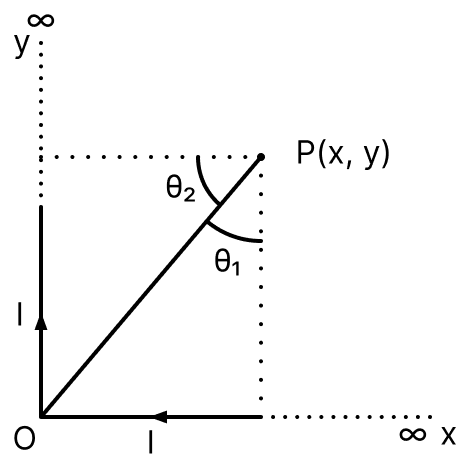
There are two infinitely long straight current carrying conductors and they are held at right angles to each other so that their common ends meet at the origin as shown in the given figure. The ratio of current in both conductors is 1: 1. The magnetic field at point P is:. Moving Charges and Magnetic Field, Nootan Physics Solutions ICS Class 12
  1. µ0I4πxy[x2+y2+(x+y)]\dfrac{\text µ_0 \text I}{4\text{πxy}}[\sqrt{\text x^2 + \text y^2} + (\text x + \text y)]
  2. µ0I4πxy[x2+y2−(x+y)]\dfrac{\text µ_0 \text I}{4\text{πxy}}[\sqrt{\text x^2 + \text y^2} - (\text x + \text y)]
  3. µ0Ixy4π[x2+y2−(x+y)]\dfrac{\text µ_0 \text{Ixy}}{4\text π}[\sqrt{\text x^2 + \text y^2} - (\text x + \text y)]
  4. µ0Ixy4π[x2+y2+(x+y)]\dfrac{\text µ_0 \text{Ixy}}{4\text π}[\sqrt{\text x^2 + \text y^2} + (\text x + \text y)]

Answer

µ0I4πxy[x2+y2+(x+y)]\dfrac{\text µ_0 \text I}{4\text{πxy}}[\sqrt{\text x^2 + \text y^2} + (\text x + \text y)]

Reason — Given, two semi-infinite conductors along the X and the Y axes with their common end at the origin, carrying equal currents I, and P the point (x, y).
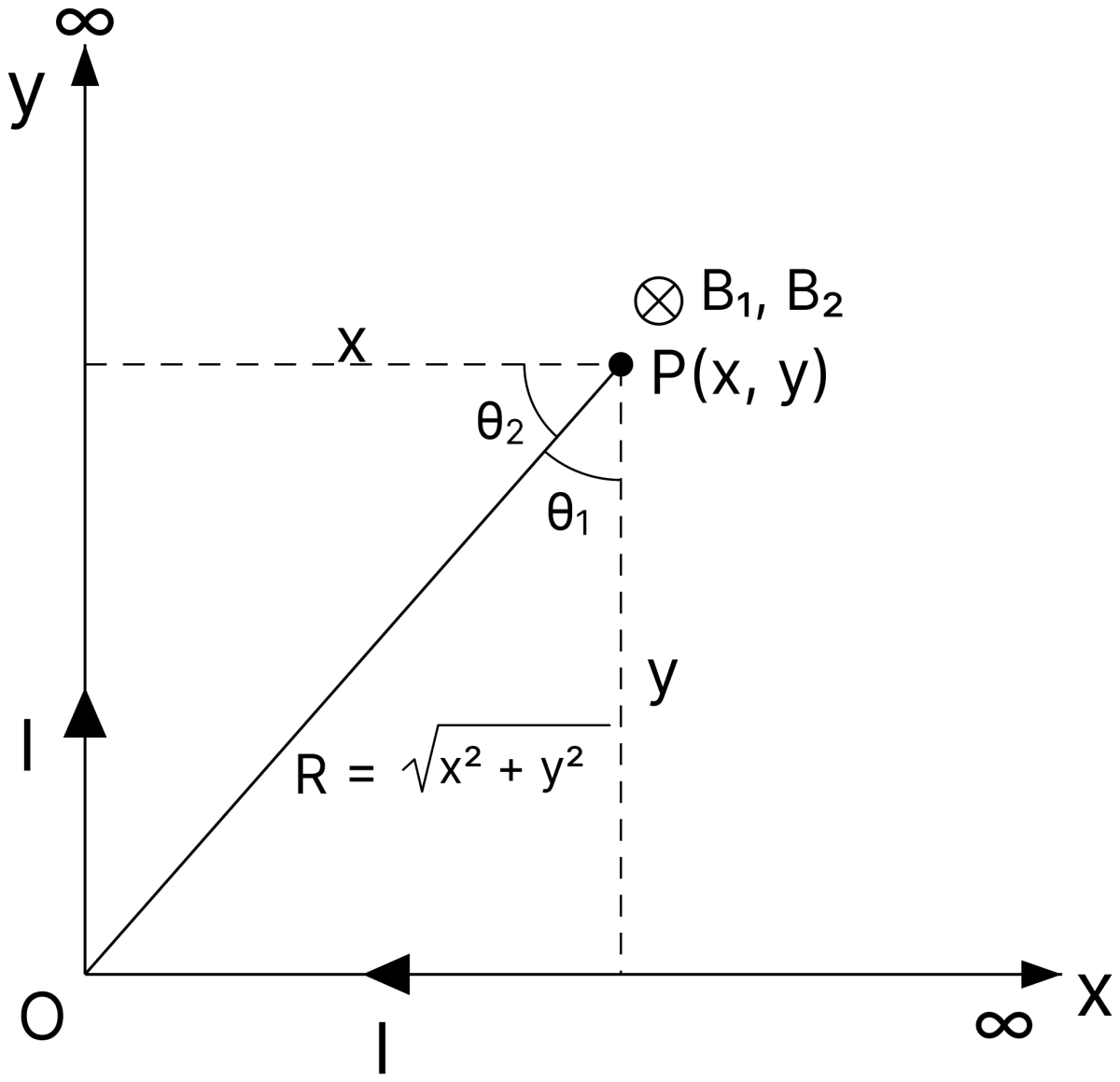
There are two infinitely long straight current carrying conductors and they are held at right angles to each other so that their common ends meet at the origin as shown in the given figure. The ratio of current in both conductors is 1: 1. The magnetic field at point P is:. Moving Charges and Magnetic Field, Nootan Physics Solutions ICS Class 12

For a straight conductor of finite length,

B=µ04πId(sin⁡φ1+sin⁡φ2)\text B = \dfrac{\text µ_0}{4\text π}\dfrac{\text I}{\text d}(\sin \text φ_1 + \sin \text φ_2)

Due to the conductor along the X-axis : the perpendicular distance of P is y; the angles are 90° (end at infinity) and θ1, with sin⁡θ1=xx2+y2\sin \text θ_1 = \dfrac{\text x}{\sqrt{\text x^2 + \text y^2}}. Hence

B1=µ0I4πy[1+xx2+y2]\text B_1 = \dfrac{\text µ_0 \text I}{4\text{πy}}\left[1 + \dfrac{\text x}{\sqrt{\text x^2 + \text y^2}}\right]

Due to the conductor along the Y-axis : the perpendicular distance of P is x; the angles are 90° (end at infinity) and θ2, with sin⁡θ2=yx2+y2\sin \text θ_2 = \dfrac{\text y}{\sqrt{\text x^2 + \text y^2}}. Hence

B2=µ0I4πx[1+yx2+y2]\text B_2 = \dfrac{\text µ_0 \text I}{4\text{πx}}\left[1 + \dfrac{\text y}{\sqrt{\text x^2 + \text y^2}}\right]

Both the fields at P are in the same direction, so writing R=x2+y2\text R = \sqrt{\text x^2 + \text y^2} and adding,

B=µ0I4πxy[x+x2R+y+y2R]B=µ0I4πxy[(x+y)+x2+y2R]B=µ0I4πxy[x2+y2+(x+y)]\text B = \dfrac{\text µ_0 \text I}{4\text{πxy}}\left[\text x + \dfrac{\text x^2}{\text R} + \text y + \dfrac{\text y^2}{\text R}\right] \\[1em] \text B = \dfrac{\text µ_0 \text I}{4\text{πxy}}\left[(\text x + \text y) + \dfrac{\text x^2 + \text y^2}{\text R}\right] \\[1em] \text B = \dfrac{\text µ_0 \text I}{4\text{πxy}}\left[\sqrt{\text x^2 + \text y^2} + (\text x + \text y)\right]

Question 38

A coil having N turns is wound tightly in the form of a spiral with inner and outer radii a and b, respectively. Find the magnetic field at centre, when a current I passes through coil.

  1. µ0IN2(b−a)ln⁡(ba)\dfrac{\text µ_0 \text{IN}}{2(\text b - \text a)}\ln\left(\dfrac{\text b}{\text a}\right)
  2. µ0I8ln⁡[a+ba−b]\dfrac{\text µ_0 \text I}{8}\ln\left[\dfrac{\text a + \text b}{\text a - \text b}\right]
  3. µ0I4(a−b)ln⁡[1a−1b]\dfrac{\text µ_0 \text I}{4(\text a - \text b)}\ln\left[\dfrac{1}{\text a} - \dfrac{1}{\text b}\right]
  4. µ0I8ln⁡(a−ba+b)\dfrac{\text µ_0 \text I}{8}\ln\left(\dfrac{\text a - \text b}{\text a + \text b}\right)

Answer

µ0IN2(b−a)ln⁡(ba)\dfrac{\text µ_0 \text{IN}}{2(\text b - \text a)}\ln\left(\dfrac{\text b}{\text a}\right)

Reason — Given, a spiral of N turns wound tightly between the inner radius a and the outer radius b, carrying a current I.

The N turns are spread uniformly over the radial width (b − a), so the number of turns lying between the radii r and r + dr is

dN=Nb−adr\text{dN} = \dfrac{\text N}{\text b - \text a}\text{dr}

Each of these turns behaves as a circular coil of radius r, so the field it produces at the centre is

dB=µ0I2rdNdB=µ0IN2(b−a)drr\text{dB} = \dfrac{\text µ_0 \text I}{2\text r}\text{dN} \\[1em] \text{dB} = \dfrac{\text µ_0 \text{IN}}{2(\text b - \text a)}\dfrac{\text{dr}}{\text r}

Integrating from r = a to r = b,

B=µ0IN2(b−a)∫abdrrB=µ0IN2(b−a)[ln⁡r]abB=µ0IN2(b−a)(ln⁡b−ln⁡a)B=µ0IN2(b−a)ln⁡(ba)\text B = \dfrac{\text µ_0 \text{IN}}{2(\text b - \text a)}\int_\text a^\text b \dfrac{\text{dr}}{\text r} \\[1em] \text B = \dfrac{\text µ_0 \text{IN}}{2(\text b - \text a)}\left[\ln \text r\right]_\text a^\text b \\[1em] \text B = \dfrac{\text µ_0 \text{IN}}{2(\text b - \text a)}(\ln \text b - \ln \text a) \\[1em] \text B = \dfrac{\text µ_0 \text{IN}}{2(\text b - \text a)}\ln\left(\dfrac{\text b}{\text a}\right)

Question 39

The fractional change in the magnetic field intensity at a distance r from centre on the axis of current carrying coil of radius a to the magnetic field intensity at the centre of the same coil is : (Take, r < a)

  1. 32a2r2\dfrac{3}{2}\dfrac{\text a^2}{\text r^2}
  2. 23a2r2\dfrac{2}{3}\dfrac{\text a^2}{\text r^2}
  3. 23r2a2\dfrac{2}{3}\dfrac{\text r^2}{\text a^2}
  4. 32r2a2\dfrac{3}{2}\dfrac{\text r^2}{\text a^2}

Answer

32r2a2\dfrac{3}{2}\dfrac{\text r^2}{\text a^2}

Reason — Given, a coil of radius a, and a point on its axis at a distance r from the centre, with r < a.

At the centre :

Bc=µ0I2a\text B_\text c = \dfrac{\text µ_0 \text I}{2\text a}

On the axis at a distance r :

Baxis=µ0Ia22(a2+r2)3/2\text B_\text{axis} = \dfrac{\text µ_0 \text I \text a^2}{2(\text a^2 + \text r^2)^{3/2}}

Taking the ratio,

BaxisBc=a3(a2+r2)3/2BaxisBc=(1+r2a2)−3/2\dfrac{\text B_\text{axis}}{\text B_\text c} = \dfrac{\text a^3}{(\text a^2 + \text r^2)^{3/2}} \\[1em] \dfrac{\text B_\text{axis}}{\text B_\text c} = \left(1 + \dfrac{\text r^2}{\text a^2}\right)^{-3/2}

Since r < a, the term r2a2\dfrac{\text r^2}{\text a^2} is small, and expanding by the binomial theorem and retaining only the first order term,

BaxisBc≈1−32r2a2\dfrac{\text B_\text{axis}}{\text B_\text c} \approx 1 - \dfrac{3}{2}\dfrac{\text r^2}{\text a^2}

Hence the fractional change is

Bc−BaxisBc=32r2a2\dfrac{\text B_\text c - \text B_\text{axis}}{\text B_\text c} = \dfrac{3}{2}\dfrac{\text r^2}{\text a^2}

Question 40

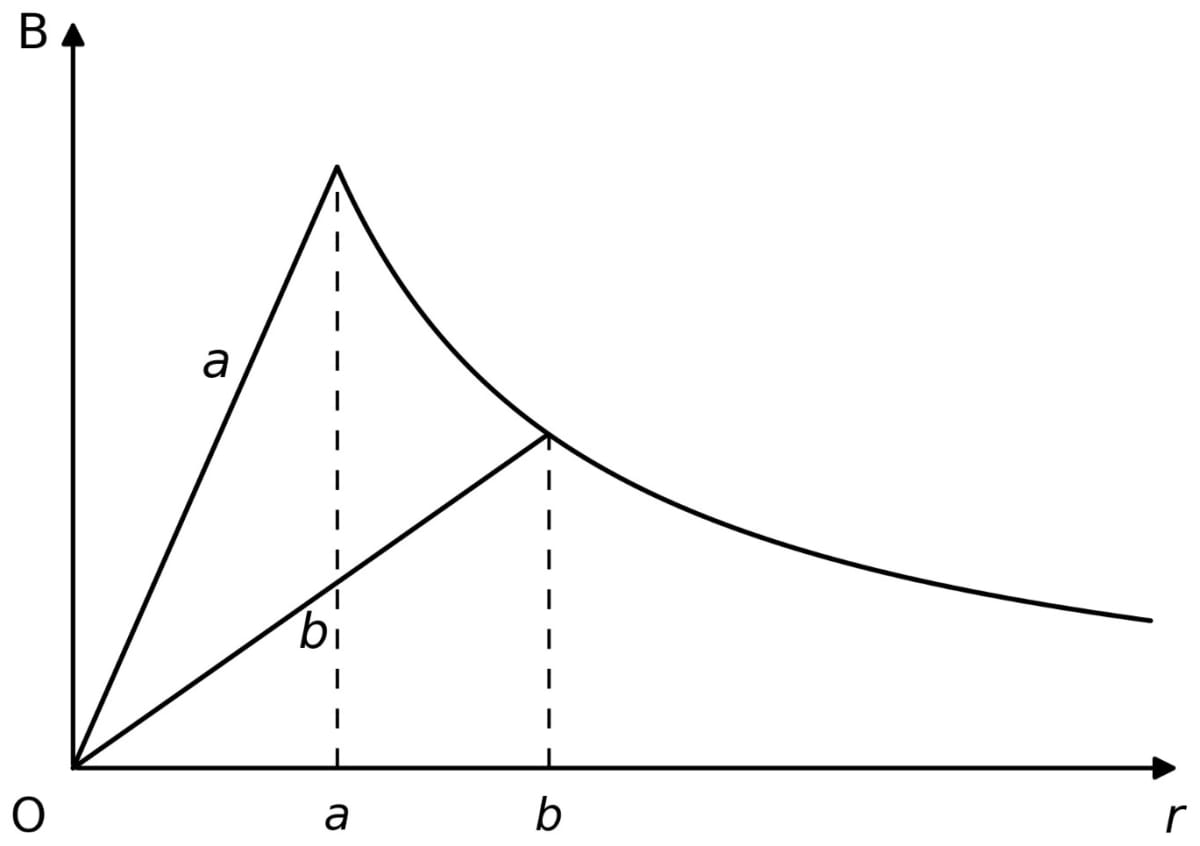
Figures A and B shows two long straight wires of circular cross-section (a and b with a < b), carrying current I which is uniformly distributed across the cross-section. The magnitude of magnetic field B varies with radius r and can be represented as :
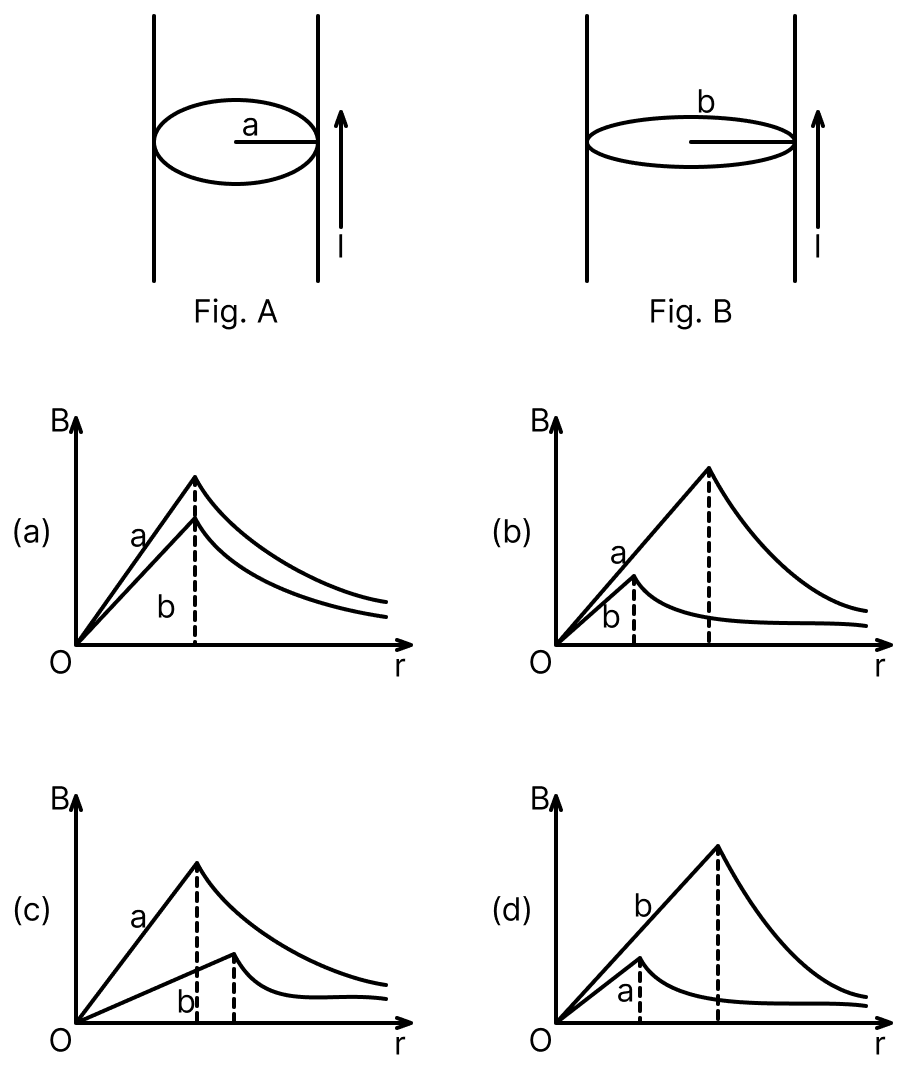
Figures A and B shows two long straight wires of circular cross-section (a and b with a < b), carrying current I which is uniformly distributed across the cross-section. The magnitude of magnetic field B varies with radius r and can be represented as:. Moving Charges and Magnetic Field, Nootan Physics Solutions ICS Class 12

Answer

Figures A and B shows two long straight wires of circular cross-section (a and b with a < b), carrying current I which is uniformly distributed across the cross-section. The magnitude of magnetic field B varies with radius r and can be represented as:. Moving Charges and Magnetic Field, Nootan Physics Solutions ICS Class 12

Reason — For a wire of radius R carrying a current I distributed uniformly over the cross-section,

B=µ0Ir2πR2 (r<R),B=µ0I2πr (r>R)\text B = \dfrac{\text µ_0 \text{Ir}}{2\text{πR}^2}\ (\text r \lt \text R), \qquad \text B = \dfrac{\text µ_0 \text I}{2\text{πr}}\ (\text r \gt \text R)

So each curve rises linearly up to the surface of its own wire and then falls off as 1r\dfrac{1}{\text r}. The maximum value occurs at the surface and is

Bmax=µ0I2πR\text B_\text{max} = \dfrac{\text µ_0 \text I}{2\text{πR}}

Since a < b, the wire a has its peak at a smaller radius and, being inversely proportional to R, a higher peak, while the wire b peaks later and lower. For r greater than b both the wires carry the same enclosed current I, so the two curves coincide beyond that point. The option graphs draw the two tails separately only schematically; the correct choice is the one in which a peaks earlier and higher than b.

This behaviour is represented by the third graph.

Note: In the question figure, all four option graphs draw the curves for a and b as two separate tails beyond r = b. Since both wires enclose the full current I there, B=µ0I2πr\text B = \dfrac{\text µ_0 \text I}{2\text{πr}} for both, so the two curves should coincide.

Question 41

Match List-I with List-II.

List-IList-II
A.Capacitance, CI.M1 L1 T-3 A-1
B.Permittivity of free space, ε0II.M-1 L-3 T4 A2
C.Permeability of free space, µ0III.M-1 L-2 T4 A2
D.Electric field, EIV.M1 L1 T-2 A-2

Choose the correct answer from the options given below.

  1. A-III, B-II, C-IV, D-I
  2. A-III, B-IV, C-II, D-I
  3. A-IV, B-II, C-III, D-I
  4. A-IV, B-III, C-II, D-I

Answer

A-III, B-II, C-IV, D-I

Reason — A. Capacitance, C : C=QV\text C = \dfrac{\text Q}{\text V}, so its dimensions are [AT][ML2T−3A−1]\dfrac{[\text{AT}]}{[\text{ML}^2\text T^{-3}\text A^{-1}]} = M-1 L-2 T4 A2, which is III.

B. Permittivity of free space, ε0 : from F=14πε0q1q2r2\text F = \dfrac{1}{4\text{πε}_0}\dfrac{\text q_1 \text q_2}{\text r^2}, the dimensions are [q1][q2][F][r2]=[A2T2][MLT−2][L2]\dfrac{[\text q_1][\text q_2]}{[\text F][\text r^2]} = \dfrac{[\text A^2\text T^2]}{[\text{MLT}^{-2}][\text L^2]} = M-1 L-3 T4 A2, which is II.

C. Permeability of free space, µ0 : the unit of µ0 is newton/ampere2, so

Dimensions of µ0=[MLT−2][A2]Dimensions of µ0=[MLT−2A−2]\text{Dimensions of } \text µ_0 = \dfrac{[\text M \text L \text T^{-2}]}{[\text A^2]} \\[1em] \text{Dimensions of } \text µ_0 = [\text M \text L \text T^{-2} \text A^{-2}]

which is IV.

D. Electric field, E : E=Fq\text E = \dfrac{\text F}{\text q} has the dimensions [MLT−2][AT]\dfrac{[\text{MLT}^{-2}]}{[\text{AT}]} = M L T-3 A-1, which is I.

Question 42

Two ions of masses 4 amu and 16 amu have charges +2e and +3e, respectively. These ions pass through the region of constant perpendicular magnetic field. The kinetic energy of both ions is same. Then :

  1. lighter ion will be deflected less than heavier ion
  2. lighter ion will be deflected more than heavier ion
  3. both ions will be deflected equally
  4. no ion will be deflected

Answer

lighter ion will be deflected more than heavier ion

Reason — Given, m1 = 4 amu with q1 = 2e, and m2 = 16 amu with q2 = 3e, both having the same kinetic energy K.

r=2mKqB⇒r∝mq\text r = \dfrac{\sqrt{2\text{mK}}}{\text{qB}} \quad \Rightarrow \quad \text r \propto \dfrac{\sqrt{\text m}}{\text q}

For the lighter ion :

r1∝42e=1e\text r_1 \propto \dfrac{\sqrt{4}}{2\text e} = \dfrac{1}{\text e}

For the heavier ion :

r2∝163e=43e\text r_2 \propto \dfrac{\sqrt{16}}{3\text e} = \dfrac{4}{3\text e}

So r1 < r2. The smaller the radius of the circular path, the sharper is the bending, so the lighter ion is deflected more than the heavier ion.

Question 43

A long straight wire carries a current, I = 2 A. A semi-circular conducting rod is placed beside it on two conducting parallel rails of negligible resistance. Both the rails are parallel to the wire. The wire, the rod and the rails lie in the same horizontal plane, as shown in the figure. Two ends of the semi-circular rod are at distances 1 cm and 4 cm from the wire. At time t = 0, the rod starts moving on the rails with a speed v = 3.0 m/s
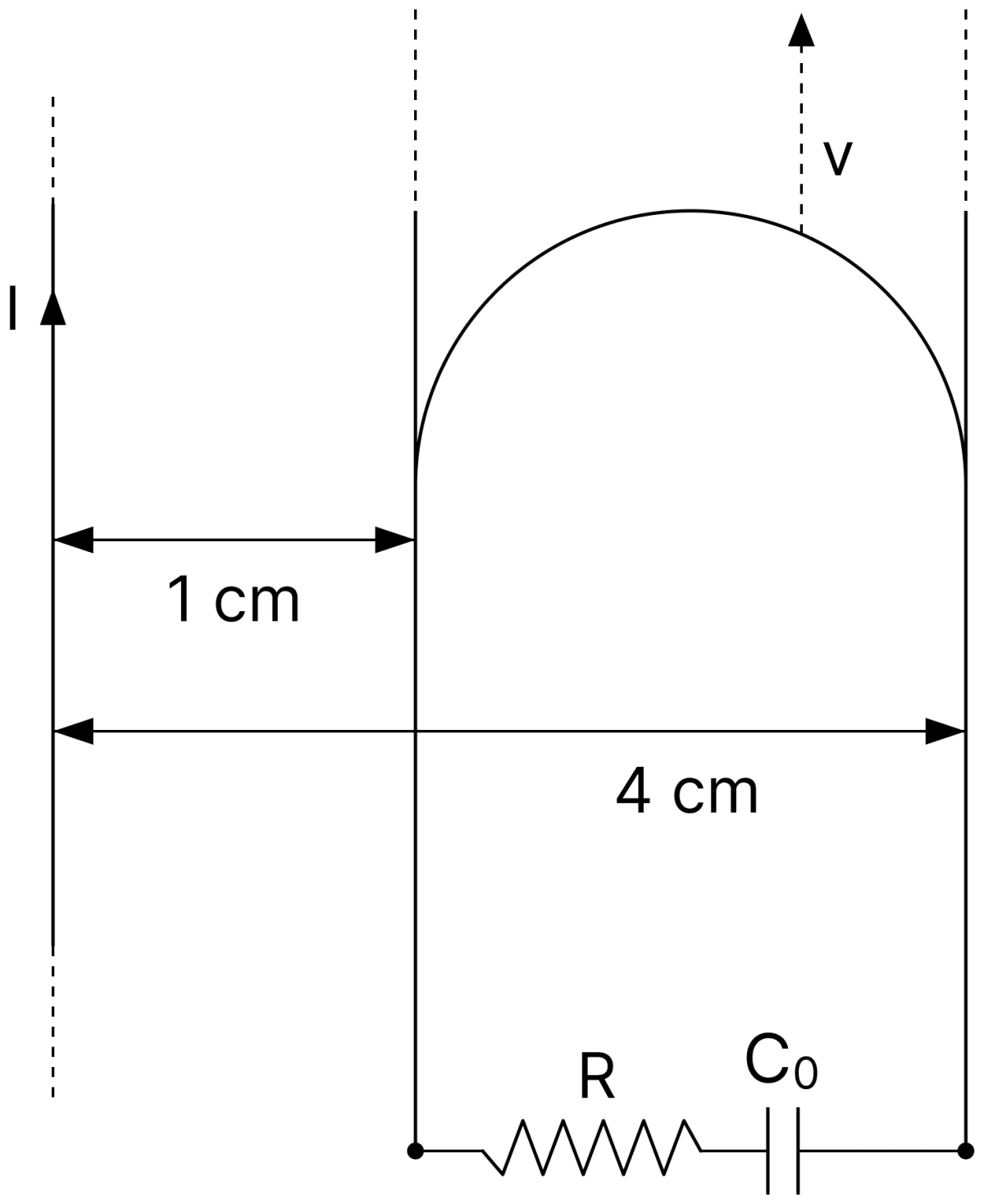
A long straight wire carries a current, I = 2 A. A semi-circular conducting rod is placed beside it on two conducting parallel rails of negligible resistance. Both the rails are parallel to the wire. The wire, the rod and the rails lie in the same horizontal plane, as shown in the figure. Two ends of the semi-circular rod are at distances 1 cm and 4 cm from the wire. At time t = 0, the rod starts moving on the rails with a speed v = 3.0 m/s A resistor R = 1.4 Ω and a capacitor C 0 = 5.0 µF are connected in series between the rails. At time t = 0, C 0 is uncharged. Which of the following statements is(are) correct? (µ 0 = 4π × 10 -7 SI units. Take ln 2 = 0.7). Moving Charges and Magnetic Field, Nootan Physics Solutions ICS Class 12

A resistor R = 1.4 Ω and a capacitor C0 = 5.0 µF are connected in series between the rails. At time t = 0, C0 is uncharged. Which of the following statements is(are) correct?

(µ0 = 4π × 10-7 SI units. Take ln 2 = 0.7)

  1. Maximum current through R is 1.2 × 10⁻⁶ A
  2. Maximum current through R is 3.8 × 10⁻⁶ A
  3. Maximum charge on capacitor C0 is 8.4 × 10⁻¹² C
  4. Maximum charge on capacitor C0 is 2.4 × 10⁻¹² C

Answer

Maximum current through R is 1.2 × 10⁻⁶ A

Maximum charge on capacitor C0 is 8.4 × 10⁻¹² C

Reason — Given, I = 2 A, v = 3.0 m/s, R = 1.4 Ω, C0 = 5.0 µF, the ends of the rod being at 1 cm and 4 cm from the wire, and ln 2 = 0.7.

The rod moves in the non-uniform field of the wire, so the emf is obtained by integrating over its length. At a distance x from the wire the field is B=µ0I2πx\text B = \dfrac{\text µ_0 \text I}{2\text{πx}}, and the element dx contributes Bv dx. Hence

e=∫0.010.04µ0I2πxv dxe=µ0Iv2π[ln⁡x]0.010.04e=µ0Iv2πln⁡(0.040.01)e=(2×10⁻⁷)(2)(3.0)ln⁡4\text e = \int_{0.01}^{0.04} \dfrac{\text µ_0 \text I}{2\text{πx}}\text v\ \text{dx} \\[1em] \text e = \dfrac{\text µ_0 \text{Iv}}{2\text π}\left[\ln \text x\right]_{0.01}^{0.04} \\[1em] \text e = \dfrac{\text µ_0 \text{Iv}}{2\text π}\ln\left(\dfrac{0.04}{0.01}\right) \\[1em] \text e = (2 \times 10^{-7})(2)(3.0)\ln 4

Using ln 4 = 2 ln 2 = 1.4,

e=(1.2×10⁻⁶)(1.4)e=1.68×10⁻⁶ V\text e = (1.2 \times 10^{-6})(1.4) \\[1em] \text e = 1.68 \times 10^{-6}\ \text V

Maximum current flows at t = 0, when the capacitor is still uncharged,

Imax=eRImax=1.68×10−61.4Imax=1.2×10⁻⁶ A\text I_\text{max} = \dfrac{\text e}{\text R} \\[1em] \text I_\text{max} = \dfrac{1.68 \times 10^{-6}}{1.4} \\[1em] \text I_\text{max} = 1.2 \times 10^{-6}\ \text A

Maximum charge is reached when the capacitor is fully charged and the current stops,

Qmax=C0eQmax=(5.0×10⁻⁶)(1.68×10⁻⁶)Qmax=8.4×10⁻¹² C\text Q_\text{max} = \text C_0 \text e \\[1em] \text Q_\text{max} = (5.0 \times 10^{-6})(1.68 \times 10^{-6}) \\[1em] \text Q_\text{max} = 8.4 \times 10^{-12}\ \text C

Hence the first and the third statements are correct.

Question 44

A long straight wire with a circular cross-section having radius R, is carrying a steady current I. The current I is uniformly distributed across this cross-section. Then the variation of magnetic field due to current I with distance r(r < R) from its centre will be :

  1. B ∝ r2
  2. B ∝ r
  3. B ∝ 1r2\dfrac{1}{\text r^2}
  4. B ∝ 1r\dfrac{1}{\text r}

Answer

B ∝ r

Reason — Given, a wire of radius R carrying a current I distributed uniformly over its cross-section, and a point at a distance r with r < R.

Applying Ampere's circuital law to a circle of radius r drawn coaxially inside the wire, the current enclosed is

Ienc=I×πr2πR2Ienc=Ir2R2B(2πr)=µ0Ir2R2B=µ0Ir2πR2\text I_{\text{enc}} = \text I \times \dfrac{\text{πr}^2}{\text{πR}^2} \\[1em] \text I_{\text{enc}} = \dfrac{\text{Ir}^2}{\text R^2} \\[1em] \text B(2\text{πr}) = \text µ_0 \dfrac{\text{Ir}^2}{\text R^2} \\[1em] \text B = \dfrac{\text µ_0 \text{Ir}}{2\text{πR}^2}

Since µ0, I and R are constants, B ∝ r.

Question 45

An infinitely long hollow conducting cylinder with radius R carries a uniform current along its surface. Choose the correct representation of magnetic field (B) as a function of radial distance (r) from the axis of cylinder.

An infinitely long hollow conducting cylinder with radius R carries a uniform current along its surface. Choose the correct representation of magnetic field (B) as a function of radial distance (r) from the axis of cylinder. Moving Charges and Magnetic Field, Nootan Physics Solutions ICS Class 12

Answer

An infinitely long hollow conducting cylinder with radius R carries a uniform current along its surface. Choose the correct representation of magnetic field (B) as a function of radial distance (r) from the axis of cylinder. Moving Charges and Magnetic Field, Nootan Physics Solutions ICS Class 12

Reason — For a hollow conducting cylinder of radius R carrying a uniform current along its surface,

inside the cylinder (r < R) : the circle of radius r encloses no current, so by Ampere's circuital law

B(2πr)=µ0(0)B=0\text B(2\text{πr}) = \text µ_0 (0) \\[1em] \text B = 0

outside the cylinder (r > R) : the whole current I is enclosed, so

B=µ0I2πr⇒B∝1r\text B = \dfrac{\text µ_0 \text I}{2\text{πr}} \quad \Rightarrow \quad \text B \propto \dfrac{1}{\text r}

Hence B is zero everywhere inside, rises abruptly to µ0I2πR\dfrac{\text µ_0 \text I}{2\text{πR}} at the surface, and then falls off hyperbolically. This is represented by the fourth graph.

Question 46

A coaxial cable consists of an inner wire of radius 'a' surrounded by an outer shell of inner and outer radii 'b' and 'c' respectively. The inner wire carries an electric current I0, which is distributed uniformly across cross-sectional area. The outer shell carries an equal current in opposite direction and distributed uniformly. What will be the ratio of the magnetic field at a distance x from the axis when (i) x < a and (ii) a < x < b?

  1. a2x2\dfrac{\text a^2}{\text x^2}
  2. b2−a2x2\dfrac{\text b^2 - \text a^2}{\text x^2}
  3. x2b2−a2\dfrac{\text x^2}{\text b^2 - \text a^2}
  4. x2a2\dfrac{\text x^2}{\text a^2}

Answer

x2a2\dfrac{\text x^2}{\text a^2}

Reason — Given, the inner wire of radius a carrying a current I0 uniformly distributed over its cross-section.

(i) For x < a : the circle of radius x encloses only a part of the current,

Ienc=I0x2a2B1=µ0I0x2πa2\text I_{\text{enc}} = \text I_0\dfrac{\text x^2}{\text a^2} \\[1em] \text B_1 = \dfrac{\text µ_0 \text I_0 \text x}{2\text{πa}^2}

(ii) For a < x < b : the whole current of the inner wire is enclosed and the outer shell is not yet reached, so

B2=µ0I02πx\text B_2 = \dfrac{\text µ_0 \text I_0}{2\text{πx}}

Taking the ratio,

B1B2=µ0I0x2πa2×2πxµ0I0B1B2=x2a2\dfrac{\text B_1}{\text B_2} = \dfrac{\text µ_0 \text I_0 \text x}{2\text{πa}^2} \times \dfrac{2\text{πx}}{\text µ_0 \text I_0} \\[1em] \dfrac{\text B_1}{\text B_2} = \dfrac{\text x^2}{\text a^2}

Question 47

A charge particle is moving in a uniform magnetic field (2i^+3j^)(2\hat{\text i} + 3\hat{\text j})T. If it has an acceleration of (αi^−4j^)(α\hat{\text i} - 4\hat{\text j}) m/s2, then the value of α will be :

  1. 3
  2. 6
  3. 12
  4. 2

Answer

6

Reason — Given, B⃗=2i^+3j^\vec{\text B} = 2\hat{\text i} + 3\hat{\text j} and a⃗=αi^−4j^\vec{\text a} = α\hat{\text i} - 4\hat{\text j}.

The magnetic force, and hence the acceleration, is always perpendicular to the magnetic field, since

F⃗=q(v⃗×B⃗)\vec{\text F} = \text q(\vec{\text v} \times \vec{\text B})

is perpendicular to B⃗ \vec{\text B} \space. Therefore

a⃗⋅B⃗=0(αi^−4j^)⋅(2i^+3j^)=02α−12=0α=6\vec{\text a} \cdot \vec{\text B} = 0 \\[1em] (α\hat{\text i} - 4\hat{\text j}) \cdot (2\hat{\text i} + 3\hat{\text j}) = 0 \\[1em] 2α - 12 = 0 \\[1em] α = 6

Question 48

A velocity selector consists of electric field E⃗=Ek^\vec{\text E} = \text E\hat{\text k} and magnetic field B⃗=Bj^\vec{\text B} = \text B\hat{\text j} with B = 12 mT. The value of E required for an electron of energy 728 eV moving along the positive x-axis to pass undeflected is :

(Given : mass of electron = 9.1 × 10⁻³¹ kg)

  1. 192 kV m-1
  2. 192 mV m-1
  3. 9600 kV m-1
  4. 16 kV m-1

Answer

192 kV m-1

Reason — Given, energy of the electron = 728 eV, B = 12 mT = 12 × 10-3 T and m = 9.1 × 10⁻³¹ kg.

Speed of the electron :

v=2Kmv=2(728)(1.6×10⁻¹⁹)9.1×10⁻³¹v=2.56×10¹⁴v=1.6×10⁷ ms−1\text v = \sqrt{\dfrac{2\text K}{\text m}} \\[1em] \text v = \sqrt{\dfrac{2(728)(1.6 \times 10^{-19})}{9.1 \times 10^{-31}}} \\[1em] \text v = \sqrt{2.56 \times 10^{14}} \\[1em] \text v = 1.6 \times 10^7\ \text{ms}^{-1}

Condition for the electron to pass undeflected : the electric force balances the magnetic force,

eE=evBE=vBE=(1.6×10⁷)(12×10−3)E=1.92×10⁵ V m−1E=192 kV m−1\text{eE} = \text{evB} \\[1em] \text E = \text{vB} \\[1em] \text E = (1.6 \times 10^7)(12 \times 10^{-3}) \\[1em] \text E = 1.92 \times 10^5\ \text{V m}^{-1} \\[1em] \text E = 192\ \text{kV m}^{-1}

Question 49

Given below are two statements : One is labelled as Assertion (A) and the other is labelled as Reason (R).

Assertion (A): In an uniform magnetic field, speed and energy remains the same for a moving charged particle.

Reason (R): Moving charged particle experiences magnetic force perpendicular to its direction of motion.

  1. Both (A) and (R) are true and (R) is the correct explanation of (A).
  2. Both (A) and (R) are true but (R) is NOT the correct explanation of (A).
  3. (A) is true but (R) is false.
  4. (A) is false but (R) is true.

Answer

Both (A) and (R) are true and (R) is the correct explanation of (A).

Reason — Assertion (A) is correct : In a uniform magnetic field the speed of a moving charged particle, and hence its kinetic energy, remains unchanged.

Reason (R) is also correct : The magnetic force F⃗=q(v⃗×B⃗)\vec{\text F} = \text q(\vec{\text v} \times \vec{\text B}) is always perpendicular to the direction of motion of the particle.

Because the force is perpendicular to the displacement, the work done on the particle is zero, and so its speed and energy cannot change. Hence the Reason correctly explains the Assertion.

Question 50

Given below are two statements :

Statement I: The electric force changes the speed of the charged particle and hence changes its kinetic energy; whereas the magnetic force does not change the kinetic energy of the charged particle.

Statement II: The electric force accelerates the positively charged particle perpendicular to the direction of electric field. The magnetic force accelerates the moving charged particle along the direction of magnetic field.

In the light of the above statements, choose the most appropriate answer from the options given below :

  1. Both Statement I and Statement II are correct.
  2. Both Statement I and Statement II are incorrect.
  3. Statement I is correct but Statement II is incorrect.
  4. Statement I is incorrect but Statement II is correct.

Answer

Statement I is correct but Statement II is incorrect.

Reason — Statement I is correct : The electric force qE acts along the direction of the field and does work on the charged particle, so it changes the speed and hence the kinetic energy. The magnetic force is perpendicular to the velocity, does no work, and therefore does not change the kinetic energy.

Statement II is incorrect : The electric force accelerates a positively charged particle along the direction of the electric field, not perpendicular to it. The magnetic force accelerates the moving charged particle perpendicular to the direction of the magnetic field, not along it. Both parts of the statement are wrongly stated.

Question 51

As shown in the figure, a metallic rod of linear density 0.45 kg m-1 is lying horizontally on a smooth inclined plane which makes an angle of 45° with the horizontal. The minimum current flowing in the rod required to keep it stationary, when 0.15 T magnetic field is acting on it in the vertical upward direction, will be : (Use g = 10 m/s2)
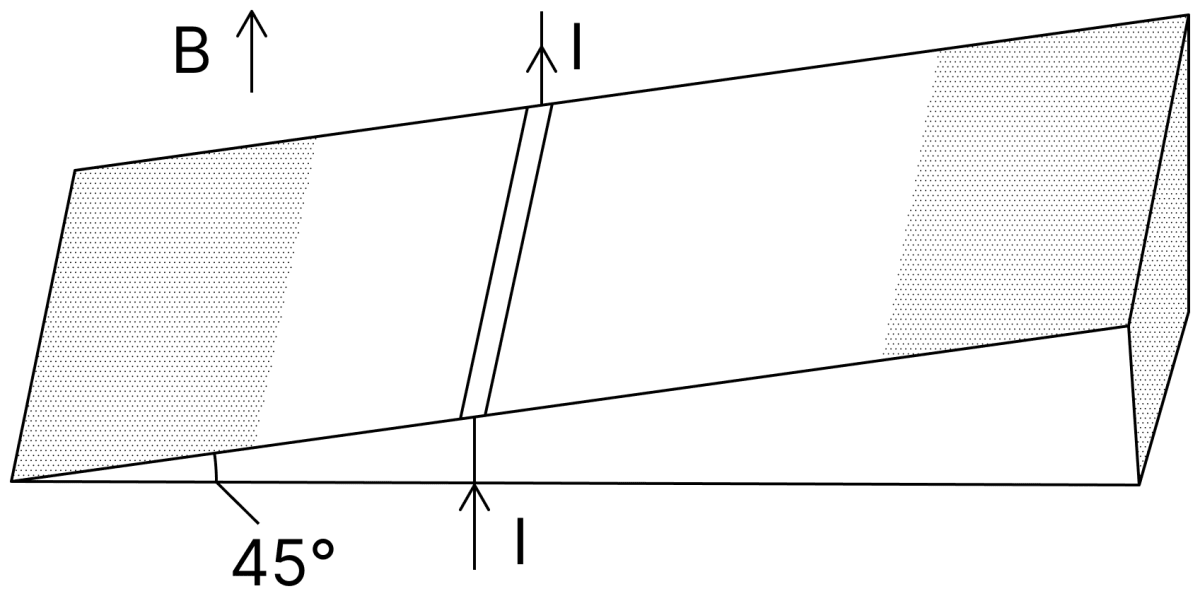
As shown in the figure, a metallic rod of linear density 0.45 kg m -1 is lying horizontally on a smooth inclined plane which makes an angle of 45° with the horizontal. The minimum current flowing in the rod required to keep it stationary, when 0.15 T magnetic field is acting on it in the vertical upward direction, will be: (Use g = 10 m/s 2 ). Moving Charges and Magnetic Field, Nootan Physics Solutions ICS Class 12
  1. 30 A
  2. 15 A
  3. 10 A
  4. 3 A

Answer

30 A

Reason — Given,

  • linear density, ml\dfrac{\text m}{l} = 0.45 kg m-1
  • θ = 45°, B = 0.15 T, g = 10 m/s2
As shown in the figure, a metallic rod of linear density 0.45 kg m -1 is lying horizontally on a smooth inclined plane which makes an angle of 45° with the horizontal. The minimum current flowing in the rod required to keep it stationary, when 0.15 T magnetic field is acting on it in the vertical upward direction, will be: (Use g = 10 m/s 2 ). Moving Charges and Magnetic Field, Nootan Physics Solutions ICS Class 12

The rod rests on a smooth inclined plane and the field is vertically upward, so the magnetic force IBl on the rod is horizontal. Balancing the components along the inclined plane,

IBlcos⁡θ=mgsin⁡θI=ml×gtan⁡θBI=0.45×(10)(tan⁡45°)0.15I=4.50.15I=30 A\text{IB}l \cos θ = \text{mg} \sin θ \\[1em] \text I = \dfrac{\text m}{l} \times \dfrac{\text g \tan θ}{\text B} \\[1em] \text I = 0.45 \times \dfrac{(10)(\tan 45°)}{0.15} \\[1em] \text I = \dfrac{4.5}{0.15} \\[1em] \text I = 30\ \text A

Question 52

Two long parallel conductors S1 and S2 are separated by a distance 10 cm and carrying currents of 4A and 2 A respectively. The conductors are placed along x-axis in X-Y plane.
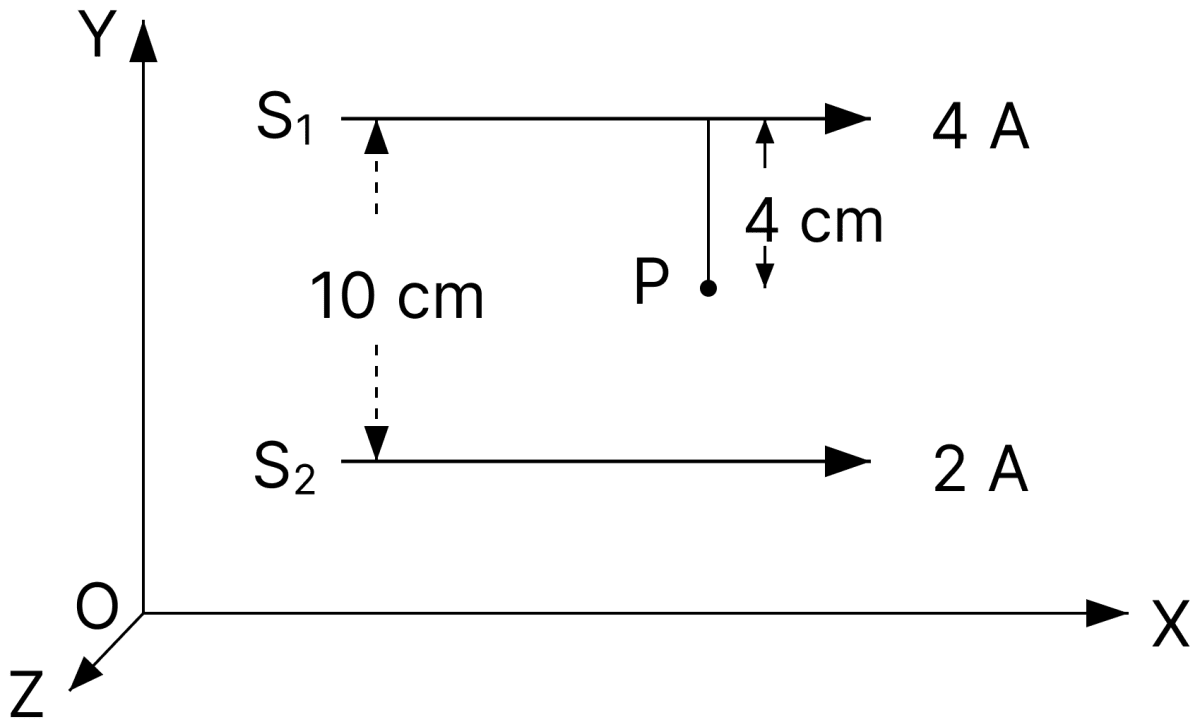
Two long parallel conductors S 1 and S 2 are separated by a distance 10 cm and carrying currents of 4A and 2 A respectively. The conductors are placed along x-axis in X-Y plane. There is a point P located between the conductors (as shown in figure). A charge particle of 3π coulomb is passing through the point P with velocity vec text v = (2 hat text i + 3 hat text j) m/s, where hat text i and hat text j represents unit vector along x and y axis respectively. The force acting on the charge particle is 4 text π × 10^-5(- text x hat text i + 2 hat text j) N. The value of x is:. Moving Charges and Magnetic Field, Nootan Physics Solutions ICS Class 12

There is a point P located between the conductors (as shown in figure). A charge particle of 3π coulomb is passing through the point P with velocity v⃗=(2i^+3j^)\vec{\text v} = (2\hat{\text i} + 3\hat{\text j}) m/s, where i^\hat{\text i} and j^\hat{\text j} represents unit vector along x and y axis respectively. The force acting on the charge particle is 4π×10−5(−xi^+2j^)4\text π \times 10^{-5}(-\text x\hat{\text i} + 2\hat{\text j})N. The value of x is :

  1. 2
  2. 1
  3. 3
  4. −3

Answer

3

Reason — Given, S1 carries 4 A and S2 carries 2 A, the separation being 10 cm, with P at 4 cm from S1 and 6 cm from S2.

Field at P due to S1 :

B1=µ04π2I1r1B1=(10−7)×2×40.04B1=2×10⁻⁵ T\text B_1 = \dfrac{\text µ_0}{4\text π}\dfrac{2\text I_1}{\text r_1} \\[1em] \text B_1 = (10^{-7}) \times \dfrac{2 \times 4}{0.04} \\[1em] \text B_1 = 2 \times 10^{-5}\ \text T

Field at P due to S2 :

B2=(10−7)×2×20.06B2=0.667×10⁻⁵ T\text B_2 = (10^{-7}) \times \dfrac{2 \times 2}{0.06} \\[1em] \text B_2 = 0.667 \times 10^{-5}\ \text T

Applying the right-hand thumb rule, the field due to S1 at P is along −k^-\hat{\text k} and that due to S2 is along +k^+\hat{\text k}, so

B⃗=(−2×10⁻⁵+0.667×10⁻⁵)k^B⃗=−1.333×10⁻⁵ k^ T\vec{\text B} = (-2 \times 10^{-5} + 0.667 \times 10^{-5})\hat{\text k} \\[1em] \vec{\text B} = -1.333 \times 10^{-5}\ \hat{\text k}\ \text T

Force on the charge :

F⃗=q(v⃗×B⃗)F⃗=3π[(2i^+3j^)×(−1.333×10⁻⁵k^)]\vec{\text F} = \text q(\vec{\text v} \times \vec{\text B}) \\[1em] \vec{\text F} = 3\text π\left[(2\hat{\text i} + 3\hat{\text j}) \times (-1.333 \times 10^{-5}\hat{\text k})\right]

Using i^×k^=−j^\hat{\text i} \times \hat{\text k} = -\hat{\text j} and j^×k^=i^\hat{\text j} \times \hat{\text k} = \hat{\text i},

F⃗=3π[−4×10⁻⁵i^+2.667×10⁻⁵j^]F⃗=4π×10−5(−3i^+2j^) N\vec{\text F} = 3\text π\left[-4 \times 10^{-5}\hat{\text i} + 2.667 \times 10^{-5}\hat{\text j}\right] \\[1em] \vec{\text F} = 4\text π \times 10^{-5}(-3\hat{\text i} + 2\hat{\text j})\ \text N

Comparing with 4π×10−5(−xi^+2j^)4\text π \times 10^{-5}(-\text x\hat{\text i} + 2\hat{\text j}), we get x = 3.

Question 53

Which one of the following options represents the magnetic field B⃗ \vec{\text B} \spaceat O due to the current flowing in the given wire segments lying on the XY-plane?
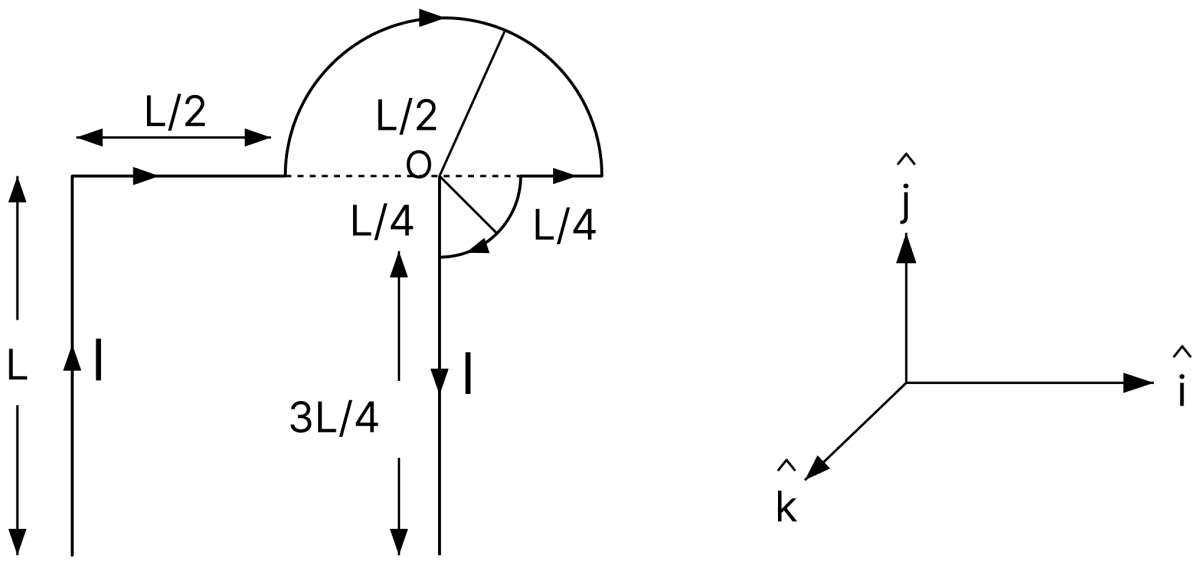
Which one of the following options represents the magnetic field vec text B at O due to the current flowing in the given wire segments lying on the XY-plane? Moving Charges and Magnetic Field, Nootan Physics Solutions ICS Class 12
  1. B⃗=−µ0IL(32+142π)k^\vec{\text B} = \dfrac{-\text µ_0 \text I}{\text L}\left(\dfrac{3}{2} + \dfrac{1}{4\sqrt{2}\text π}\right)\hat{\text k}
  2. B⃗=−µ0IL(32+122π)k^\vec{\text B} = \dfrac{-\text µ_0 \text I}{\text L}\left(\dfrac{3}{2} + \dfrac{1}{2\sqrt{2}\text π}\right)\hat{\text k}
  3. B⃗=−µ0IL(1+142π)k^\vec{\text B} = \dfrac{-\text µ_0 \text I}{\text L}\left(1 + \dfrac{1}{4\sqrt{2}\text π}\right)\hat{\text k}
  4. B⃗=−µ0IL(1+14π)k^\vec{\text B} = \dfrac{-\text µ_0 \text I}{\text L}\left(1 + \dfrac{1}{4\text π}\right)\hat{\text k}

Answer

B⃗=−µ0IL(1+142π)k^\vec{\text B} = \dfrac{-\text µ_0 \text I}{\text L}\left(1 + \dfrac{1}{4\sqrt{2}\text π}\right)\hat{\text k}

Reason — Taking O as the origin, the contributions of the various segments are as follows.

The semi-circular arc of radius L2\dfrac{\text L}{2} : the field at the centre due to a circular arc of radius r subtending an angle θ is

B=µ04πIrθ\text B = \dfrac{\text µ_0}{4\text π}\dfrac{\text I}{\text r}\text θ

For a semi-circle θ = π, so

B1=µ0I4(L/2)B1=µ0I2L\text B_1 = \dfrac{\text µ_0 \text I}{4(\text L/2)} \\[1em] \text B_1 = \dfrac{\text µ_0 \text I}{2\text L}

The quarter-circular arc of radius L4\dfrac{\text L}{4} : here θ=π2\text θ = \dfrac{\text π}{2}, so

B2=µ04πI(L/4)×π2B2=µ0I2L\text B_2 = \dfrac{\text µ_0}{4\text π}\dfrac{\text I}{(\text L/4)} \times \dfrac{\text π}{2} \\[1em] \text B_2 = \dfrac{\text µ_0 \text I}{2\text L}

The straight portions passing through O : the horizontal segments and the vertical segment below O lie along lines through O, so for them θ = 0 or 180° and they develop no field at O.

The vertical segment of length L at a perpendicular distance L from O : its nearer end lies on the perpendicular from O, so φ1 = 0, while for the farther end

sin⁡φ2=LL2+L2sin⁡φ2=12B3=µ04πIL(0+12)B3=µ0I42πL\sin \text φ_2 = \dfrac{\text L}{\sqrt{\text L^2 + \text L^2}} \\[1em] \sin \text φ_2 = \dfrac{1}{\sqrt{2}} \\[1em] \text B_3 = \dfrac{\text µ_0}{4\text π}\dfrac{\text I}{\text L}\left(0 + \dfrac{1}{\sqrt{2}}\right) \\[1em] \text B_3 = \dfrac{\text µ_0 \text I}{4\sqrt{2}\text{πL}}

Applying the right-hand thumb rule, all these fields at O are directed into the plane of the page, that is along −k^-\hat{\text k}. Adding,

B⃗=−µ0IL(12+12+142π)k^B⃗=−µ0IL(1+142π)k^\vec{\text B} = -\dfrac{\text µ_0 \text I}{\text L}\left(\dfrac{1}{2} + \dfrac{1}{2} + \dfrac{1}{4\sqrt{2}\text π}\right)\hat{\text k} \\[1em] \vec{\text B} = \dfrac{-\text µ_0 \text I}{\text L}\left(1 + \dfrac{1}{4\sqrt{2}\text π}\right)\hat{\text k}

Question 54

Given below are two statements :

Statement I: Biot-Savart's law gives us the expression for the magnetic field strength of an infinitesimal current element (Idl) of a current carrying conductor only.

Statement II: Biot-Savart's law is analogous to Coulomb's inverse square law of charge q, with the former being related to the field produced by a scalar source, Idl while the later being produced by a vector source, q.

In light of above statements choose the most appropriate answer from the options given below :

  1. Statement I is incorrect and Statement II is correct
  2. Both Statement I and Statement II are correct
  3. Both Statement I and Statement II are incorrect
  4. Statement I is correct and Statement II is incorrect

Answer

Statement I is correct and Statement II is incorrect

Reason — Statement I is correct : Biot-Savart's law is stated for an infinitesimal current-element I dl of a current-carrying conductor. To apply it to a conductor of finite size, the conductor is divided into a large number of such elements and the law is then integrated over the whole length.

Statement II is incorrect : The sources have been interchanged. The charge q of Coulomb's law is a scalar source, while the current-element Idl⃗ \text I \vec{\text{dl}} \spaceof Biot-Savart's law is a vector source directed along the direction of the current. The statement that Idl is scalar and q is vector is therefore wrong, although the two laws are indeed analogous inverse-square laws.

Question 55

A long solenoid of radius 1 mm has 100 turns per mm. If 1 A current flows in the solenoid, the magnetic field strength at the centre of the solenoid is :

  1. 6.28 × 10⁻⁴ T
  2. 6.28 × 10⁻² T
  3. 12.56 × 10⁻² T
  4. 12.56 × 10⁻⁴ T

Answer

12.56 × 10⁻² T

Reason — Given,

  • n = 100 turns per mm = 100 × 103 = 105 turns per metre
  • I = 1 A

For a long solenoid, the field at the centre is

B=µ0nI\text B = \text µ_0 \text n \text I

Substituting the values,

B=(4π×10−7)(105)(1)B=4π×10−2B=12.56×10⁻² T\text B = (4\text π \times 10^{-7})(10^5)(1) \\[1em] \text B = 4\text π \times 10^{-2} \\[1em] \text B = 12.56 \times 10^{-2}\ \text T

The radius of the solenoid does not enter the expression, so the value 1 mm is not required.

Question 56

From Ampere's circuital law for a long straight wire of circular cross-section carrying a steady current, the variation of magnetic field in the inside and outside region of the wire is :

  1. a linearly decreasing function of distance up to the boundary of the wire and then a linearly increasing one for the outside region.
  2. uniform and remains constant for both the regions.
  3. a linearly increasing function of distance up to the boundary of the wire and then linearly decreasing for the outside region.
  4. a linearly increasing function of distance r up to the boundary of the wire and then decreasing one with 1r\dfrac{1}{\text r} dependence for the outside region.

Answer

a linearly increasing function of distance r up to the boundary of the wire and then decreasing one with 1r\dfrac{1}{\text r} dependence for the outside region.

Reason — Applying Ampere's circuital law to a wire of radius R carrying a current I uniformly distributed over its cross-section,

inside the wire (r < R) : the current enclosed is Ir2R2\text I\dfrac{\text r^2}{\text R^2}, so

B=µ0Ir2πR2⇒B∝r\text B = \dfrac{\text µ_0 \text{Ir}}{2\text{πR}^2} \quad \Rightarrow \quad \text B \propto \text r

that is, B increases linearly with r;

outside the wire (r > R) : the whole current is enclosed, so

B=µ0I2πr⇒B∝1r\text B = \dfrac{\text µ_0 \text I}{2\text{πr}} \quad \Rightarrow \quad \text B \propto \dfrac{1}{\text r}

that is, B decreases with a 1r\dfrac{1}{\text r} dependence.

Question 57

A long straight wire of circular cross-section (radius a) is carrying steady current I. The current I is uniformly distributed across this cross-section. The magnetic field is :

  1. zero in the region r < a and inversely proportional to r in the region r > a.
  2. uniform in the region r < a and inversely proportional to distance r from the axis, in the region r > a.
  3. directly proportional to r in the region r < a and inversely proportional to r in the region r > a.
  4. inversely proportional to r in the region r < a and uniform throughout in the region r > a.

Answer

directly proportional to r in the region r < a and inversely proportional to r in the region r > a.

Reason — Given, a wire of radius a carrying a steady current I uniformly distributed across the cross-section.

For r < a : the circle of radius r encloses only a fraction of the current,

B(2πr)=µ0Ir2a2B=µ0Ir2πa2\text B(2\text{πr}) = \text µ_0 \text I\dfrac{\text r^2}{\text a^2} \\[1em] \text B = \dfrac{\text µ_0 \text{Ir}}{2\text{πa}^2}

so B is directly proportional to r.

For r > a : the whole current is enclosed,

B(2πr)=µ0IB=µ0I2πr\text B(2\text{πr}) = \text µ_0 \text I \\[1em] \text B = \dfrac{\text µ_0 \text I}{2\text{πr}}

so B is inversely proportional to r.

Question 58

A long conducting wire having a current I flowing through it. It is bent into a circular coil of N turns. Then it is bent into a circular coil of n turns. The magnetic field is calculated at the centre of coils in both the cases. The ratio of the magnetic field in first case to the of second case is :

  1. n : N
  2. N : n
  3. N2 : n2
  4. n2 : N2

Answer

N2 : n2

Reason — Let the length of the wire be L, which is the same in both the cases.

For the coil of N turns : L = N(2πR1), so R1=L2πN\text R_1 = \dfrac{\text L}{2\text{πN}} and

B1=µ0NI2R1B1=µ0πN2IL\text B_1 = \dfrac{\text µ_0 \text N \text I}{2\text R_1} \\[1em] \text B_1 = \dfrac{\text µ_0 \text{πN}^2 \text I}{\text L}

For the coil of n turns : similarly,

B2=µ0πn2ILB1B2=N2n2\text B_2 = \dfrac{\text µ_0 \text{πn}^2 \text I}{\text L} \\[1em] \dfrac{\text B_1}{\text B_2} = \dfrac{\text N^2}{\text n^2}

Question 59

A wire carrying a current I along the positive x-axis has length L. It is kept in a magnetic field B⃗=(2i^+3j^−4k^)\vec{\text B} = (2\hat{\text i} + 3\hat{\text j} - 4\hat{\text k}) T. The magnitude of the magnetic force acting on the wire is :

  1. 5IL
  2. 3IL\sqrt{3}\text{IL}
  3. 3IL
  4. 5IL\sqrt{5}\text{IL}

Answer

5IL

Reason — Given, the wire of length L lies along the positive x-axis, so l⃗=Li^\vec{l} = \text L\hat{\text i}, and B⃗=2i^+3j^−4k^\vec{\text B} = 2\hat{\text i} + 3\hat{\text j} - 4\hat{\text k} T.

The force on a current-carrying conductor is

F⃗=I(l⃗×B⃗)l⃗×B⃗=Li^×(2i^+3j^−4k^)\vec{\text F} = \text I(\vec{l} \times \vec{\text B}) \\[1em] \vec{l} \times \vec{\text B} = \text L\hat{\text i} \times (2\hat{\text i} + 3\hat{\text j} - 4\hat{\text k})

Using i^×i^=0\hat{\text i} \times \hat{\text i} = 0, i^×j^=k^\hat{\text i} \times \hat{\text j} = \hat{\text k} and i^×k^=−j^\hat{\text i} \times \hat{\text k} = -\hat{\text j},

l⃗×B⃗=L(3k^+4j^)F⃗=IL(4j^+3k^)∣F⃗∣=IL42+32∣F⃗∣=5IL\vec{l} \times \vec{\text B} = \text L(3\hat{\text k} + 4\hat{\text j}) \\[1em] \vec{\text F} = \text{IL}(4\hat{\text j} + 3\hat{\text k}) \\[1em] |\vec{\text F}| = \text{IL}\sqrt{4^2 + 3^2} \\[1em] |\vec{\text F}| = 5\text{IL}

Question 60

A very long conducting wire is bent in a semi-circular shape from A to B as shown in figure. The magnetic field at point P for steady current configuration is given by :
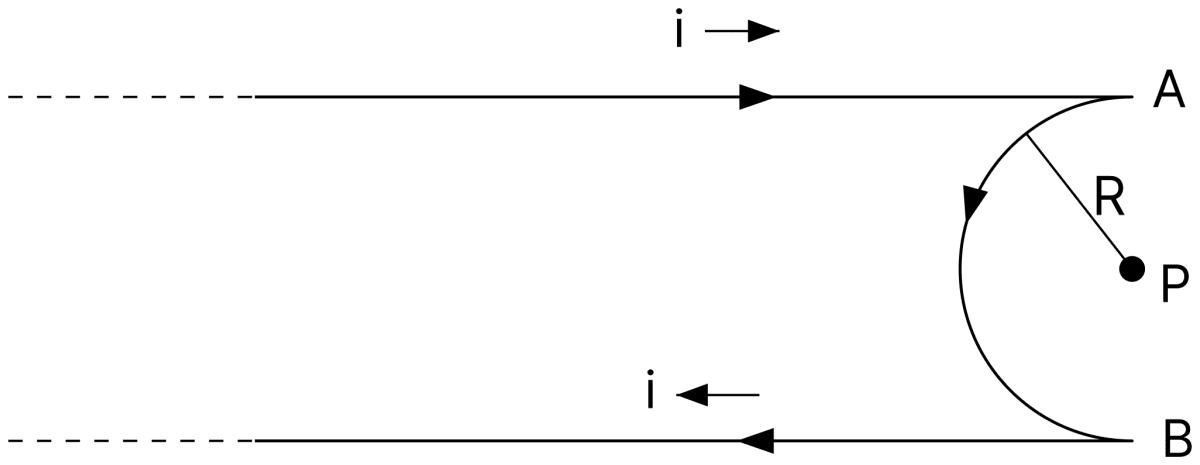
A very long conducting wire is bent in a semi-circular shape from A to B as shown in figure. The magnetic field at point P for steady current configuration is given by:. Moving Charges and Magnetic Field, Nootan Physics Solutions ICS Class 12
  1. µ0i4R[1−2π]\dfrac{\text µ_0 \text i}{4\text R}\left[1 - \dfrac{2}{\text π}\right] pointed away from page
  2. µ0i4R[1−2π]\dfrac{\text µ_0 \text i}{4\text R}\left[1 - \dfrac{2}{\text π}\right] pointed into the page
  3. µ0i4R\dfrac{\text µ_0 \text i}{4\text R} pointed into the page
  4. µ0i4R\dfrac{\text µ_0 \text i}{4\text R} pointed away from page

Answer

µ0i4R[1−2π]\dfrac{\text µ_0 \text i}{4\text R}\left[1 - \dfrac{2}{\text π}\right] pointed away from page

Reason — The configuration consists of a semi-circular portion of radius R with P at its centre, together with two semi-infinite straight portions.

Field due to the semi-circle : the field at the centre due to a circular arc of radius R subtending an angle θ is

B=µ04πiRθ\text B = \dfrac{\text µ_0}{4\text π}\dfrac{\text i}{\text R}\text θ

For a semi-circle θ = π, so

B1=µ0i4R\text B_1 = \dfrac{\text µ_0 \text i}{4\text R}

Applying the right-hand thumb rule to the sense of the current in the arc, this field at P is directed out of the plane of the page.

Field due to the two straight portions : each is a semi-infinite conductor with P lying on the perpendicular drawn at its end, so each gives

B2=µ04πiR(sin⁡0°+sin⁡90°)B2=µ0i4πR\text B_2 = \dfrac{\text µ_0}{4\text π}\dfrac{\text i}{\text R}(\sin 0° + \sin 90°) \\[1em] \text B_2 = \dfrac{\text µ_0 \text i}{4\text{πR}}

and by the right-hand thumb rule both are directed into the plane of the page. Together they give µ0i2πR\dfrac{\text µ_0 \text i}{2\text{πR}} into the page.

Resultant field :

B=µ0i4R−µ0i2πRB=µ0i4R[1−2π]\text B = \dfrac{\text µ_0 \text i}{4\text R} - \dfrac{\text µ_0 \text i}{2\text{πR}} \\[1em] \text B = \dfrac{\text µ_0 \text i}{4\text R}\left[1 - \dfrac{2}{\text π}\right]

Since 2π\dfrac{2}{\text π} = 0.64 is less than 1, the resultant is positive, so the field is directed away from the page.

Question 61

The electrostatic force (F⃗1)(\vec{\text F}_1) and magnetic force (F⃗2)(\vec{\text F}_2) acting on a charge q moving with velocity v can be written :

  1. F⃗1=qv⃗⋅E⃗1\vec{\text F}_1 = \text q\vec{\text v} \cdot \vec{\text E}_1, F⃗2=q(B⃗⋅v⃗)\vec{\text F}_2 = \text q(\vec{\text B} \cdot \vec{\text v})
  2. F⃗1=qB⃗\vec{\text F}_1 = \text q\vec{\text B}, F⃗2=q(B⃗⋅v⃗)\vec{\text F}_2 = \text q(\vec{\text B} \cdot \vec{\text v})
  3. F⃗1=qE⃗1\vec{\text F}_1 = \text q\vec{\text E}_1, F⃗2=q(v⃗×B⃗)\vec{\text F}_2 = \text q(\vec{\text v} \times \vec{\text B})
  4. F⃗1=qE⃗1\vec{\text F}_1 = \text q\vec{\text E}_1, F⃗2=q(B⃗⋅v⃗)\vec{\text F}_2 = \text q(\vec{\text B} \cdot \vec{\text v})

Answer

F⃗1=qE⃗1\vec{\text F}_1 = \text q\vec{\text E}_1, F⃗2=q(v⃗×B⃗)\vec{\text F}_2 = \text q(\vec{\text v} \times \vec{\text B})

Reason — The electrostatic force on a charge q placed in an electric field E⃗1\vec{\text E}_1 is

F⃗1=qE⃗1\vec{\text F}_1 = \text q\vec{\text E}_1

which acts along the direction of the field and is present whether the charge is at rest or in motion.

The magnetic force on the same charge moving with velocity v⃗ \vec{\text v} \spacein a magnetic field B⃗ \vec{\text B} \spaceis

F⃗2=q(v⃗×B⃗)\vec{\text F}_2 = \text q(\vec{\text v} \times \vec{\text B})

which is a vector product, so the force is perpendicular to the plane containing v⃗ \vec{\text v} \spaceand B⃗ \vec{\text B} \space.

Question 62

A long straight wire of radius 'a' carries a steady current I. The current is uniformly distributed across its cross-section. The ratio of magnetic field at a/2 and 2a from the axis of the wire is :

  1. 1 : 4
  2. 4 : 1
  3. 1 : 1
  4. 3 : 4

Answer

1 : 1

Reason — Given, a wire of radius a carrying a steady current I uniformly distributed across its cross-section.

At the distance a2\dfrac{\text a}{2}, which is inside the wire :

B1=µ0I2πa2×a2B1=µ0I4πa\text B_1 = \dfrac{\text µ_0 \text I}{2\text{πa}^2} \times \dfrac{\text a}{2} \\[1em] \text B_1 = \dfrac{\text µ_0 \text I}{4\text{πa}}

At the distance 2a, which is outside the wire :

B2=µ0I2π(2a)B2=µ0I4πaB1B2=11\text B_2 = \dfrac{\text µ_0 \text I}{2\text π(2\text a)} \\[1em] \text B_2 = \dfrac{\text µ_0 \text I}{4\text{πa}} \\[1em] \dfrac{\text B_1}{\text B_2} = \dfrac{1}{1}

Question 63

An infinitely long wire, located on the z-axis, carries a current I along the +z-direction and produces the magnetic field B⃗ \vec{\text B} \space. The magnitude of the line integral ∫B⃗⋅dl⃗\int \vec{\text B} \cdot \vec{\text{dl}}along a straight line from the point (−3a,a,0)(-\sqrt{3}\text a, \text a, 0) to (a, a, 0) is given by : [µ0 is the magnetic permeability of free space.]

  1. 7µ0I/24
  2. 7µ0I/12
  3. µ0I/8
  4. µ0I/6

Answer

7µ0I/24

Reason — Given, an infinitely long wire along the z-axis carrying a current I, and the path from (−3a,a,0)(-\sqrt{3}\text a, \text a, 0) to (a, a, 0).

The field of the wire is B⃗=µ0I2πrφ^\vec{\text B} = \dfrac{\text µ_0 \text I}{2\text{πr}}\hat{\text φ}, which is tangential to the circles drawn about the z-axis. For any path, therefore,

∫B⃗⋅dl⃗=µ0I2πΔφ\int \vec{\text B} \cdot \vec{\text{dl}} = \dfrac{\text µ_0 \text I}{2\text π}\Delta \text φ

where Δφ is the angle subtended at the origin by the two end points.

Angle of the starting point : for (−3a,a)(-\sqrt{3}\text a, \text a),

tan⁡φ1=a−3aφ1=180°−30°φ1=150°\tan \text φ_1 = \dfrac{\text a}{-\sqrt{3}\text a} \\[1em] \text φ_1 = 180° - 30° \\[1em] \text φ_1 = 150°

Angle of the end point : for (a, a),

tan⁡φ2=aatan⁡φ2=1φ2=45°Δφ=150°−45°Δφ=105°∫B⃗⋅dl⃗=µ0I2π×105°360°×2π∫B⃗⋅dl⃗=µ0I×105360=7µ0I24\tan \text φ_2 = \dfrac{\text a}{\text a} \\[1em] \tan \text φ_2 = 1 \\[1em] \text φ_2 = 45° \\[1em] \Delta \text φ = 150° - 45° \\[1em] \Delta \text φ = 105° \\[1em] \int \vec{\text B} \cdot \vec{\text{dl}} = \dfrac{\text µ_0 \text I}{2\text π} \times \dfrac{105°}{360°} \times 2\text π \\[1em] \int \vec{\text B} \cdot \vec{\text{dl}} = \text µ_0 \text I \times \dfrac{105}{360} \\[1em] = \dfrac{7\text µ_0 \text I}{24}

Competition Zone — Numerical Value Type Questions

Question 1

If the maximum value of accelerating potential provided by a radio frequency oscillator is 12 kV. The number of revolution made by a proton in a cyclotron to achieve one sixth of the speed of light is ....... .

[Given, mp = 1.67 × 10⁻²⁷ kg, e = 1.6 × 10⁻¹⁹ C, c = 3 × 10⁸ m/s]

Answer

Given,

  • V = 12 kV = 12 × 103 volt
  • final speed, v=c6=3×1086=5×10⁷\text v = \dfrac{\text c}{6} = \dfrac{3 \times 10^8}{6} = 5 \times 10^7 ms-1
  • mp = 1.67 × 10⁻²⁷ kg, e = 1.6 × 10⁻¹⁹ C

Final kinetic energy of the proton :

K=12mv2K=12(1.67×10⁻²⁷)(5×10⁷)2K=12(1.67×10⁻²⁷)(2.5×10¹⁵)K=2.0875×10⁻¹² J\text K = \dfrac{1}{2}\text m \text v^2 \\[1em] \text K = \dfrac{1}{2}(1.67 \times 10^{-27})(5 \times 10^7)^2 \\[1em] \text K = \dfrac{1}{2}(1.67 \times 10^{-27})(2.5 \times 10^{15}) \\[1em] \text K = 2.0875 \times 10^{-12}\ \text J

Energy gained in one revolution : in each revolution the proton crosses the gap between the dees twice, gaining an energy qV at each crossing,

ΔK=2eVΔK=2(1.6×10⁻¹⁹)(12×103)ΔK=3.84×10⁻¹⁵ J\Delta \text K = 2\text{eV} \\[1em] \Delta \text K = 2(1.6 \times 10^{-19})(12 \times 10^3) \\[1em] \Delta \text K = 3.84 \times 10^{-15}\ \text J

Number of revolutions :

n=KΔKn=2.0875×10−123.84×10⁻¹⁵n=543.6\text n = \dfrac{\text K}{\Delta \text K} \\[1em] \text n = \dfrac{2.0875 \times 10^{-12}}{3.84 \times 10^{-15}} \\[1em] \text n = 543.6

Since n is a number of complete revolutions, it must be an integer, so n = 543.

Hence, the number of revolutions made by the proton is 543.

Question 2

An α-particle (mass 4 amu) and a singly charged sulphur ion (mass 32 amu) are initially at rest. They are accelerated through a potential V and then allowed to pass into a region of uniform magnetic field which is normal to the velocities of the particles. Within this region, the α-particle and the sulphur ion move in circular orbits of radii rα and rs, respectively. The ratio (rsrα)\left(\dfrac{\text r_\text s}{\text r_α}\right) is .......... .

Answer

Given,

  • α-particle : mα = 4 amu, qα = 2e
  • sulphur ion : ms = 32 amu, qs = e (singly charged)
  • both accelerated through the same potential V and entering the same field B normally

The particle starts from rest, so

12mv2=qVv=2qVm\dfrac{1}{2}\text{mv}^2 = \text{qV} \\[1em] \text v = \sqrt{\dfrac{2\text{qV}}{\text m}}

The radius of the circular orbit is

r=mvqBr=mqB2qVmr=1B2mVq\text r = \dfrac{\text{mv}}{\text{qB}} \\[1em] \text r = \dfrac{\text m}{\text{qB}}\sqrt{\dfrac{2\text{qV}}{\text m}} \\[1em] \text r = \dfrac{1}{\text B}\sqrt{\dfrac{2\text{mV}}{\text q}}

Since V and B are the same for both,

r∝mq\text r \propto \sqrt{\dfrac{\text m}{\text q}}

Taking the ratio,

rsrα=msqs×qαmαrsrα=32e×2e4rsrα=16rsrα=4\dfrac{\text r_\text s}{\text r_α} = \sqrt{\dfrac{\text m_\text s}{\text q_\text s} \times \dfrac{\text q_α}{\text m_α}} \\[1em] \dfrac{\text r_\text s}{\text r_α} = \sqrt{\dfrac{32}{\text e} \times \dfrac{2\text e}{4}} \\[1em] \dfrac{\text r_\text s}{\text r_α} = \sqrt{16} \\[1em] \dfrac{\text r_\text s}{\text r_α} = 4

Hence, the ratio rsrα\dfrac{\text r_\text s}{\text r_α} is 4.

Question 3

A closely wounded circular coil of radius 5 cm produces a magnetic field of 37.68 × 10⁻⁴ T at its centre. The current through the coil is .......... A.

[Given, number of turns in the coil is 100 and π = 3.14]

Answer

Given,

  • a = 5 cm = 0.05 m
  • B = 37.68 × 10⁻⁴ T
  • N = 100 turns, π = 3.14

The magnetic field at the centre of a circular coil is

B=µ0NI2a\text B = \dfrac{\text µ_0 \text N \text I}{2\text a}

Solving for the current,

I=2aBµ0N\text I = \dfrac{2\text{aB}}{\text µ_0 \text N}

Substituting the values,

I=2(0.05)(37.68×10⁻⁴)(4×3.14×10−7)(100)I=3.768×10−41.256×10−4I=3 A\text I = \dfrac{2(0.05)(37.68 \times 10^{-4})}{(4 \times 3.14 \times 10^{-7})(100)} \\[1em] \text I = \dfrac{3.768 \times 10^{-4}}{1.256 \times 10^{-4}} \\[1em] \text I = 3\ \text A

Hence, the current through the coil is 3 A.

Question 4

A deuteron and a proton moving with equal kinetic energy enter into the a uniform magnetic field at right angle to the field. If rd and rp are the radii of their circular paths respectively, then the ratio rdrp\dfrac{\text r_\text d}{\text r_\text p} will be x\sqrt{\text x} : 1 where x is .......... .

Answer

Given, a deuteron and a proton having equal kinetic energy K, entering the same field B at right angles.

The radius of the circular path is

r=mvqBr=2mKqB\text r = \dfrac{\text{mv}}{\text{qB}} \\[1em] \text r = \dfrac{\sqrt{2\text{mK}}}{\text{qB}}

Since K and B are the same for both,

r∝mq\text r \propto \dfrac{\sqrt{\text m}}{\text q}

For the proton mp = m and qp = e, while for the deuteron md = 2m and qd = e. Hence

rdrp=2me×emrdrp=2\dfrac{\text r_\text d}{\text r_\text p} = \dfrac{\sqrt{2\text m}}{\text e} \times \dfrac{\text e}{\sqrt{\text m}} \\[1em] \dfrac{\text r_\text d}{\text r_\text p} = \sqrt{2}

So rdrp=2:1\dfrac{\text r_\text d}{\text r_\text p} = \sqrt{2} : 1, and comparing with x:1\sqrt{\text x} : 1,

Hence, x = 2.

Question 5

A singly ionized magnesium atom (A = 24) ion is accelerated to kinetic energy 5 keV, and is projected perpendicularly into a magnetic field B of the magnitude 0.5 T. The radius of path formed will be .......... cm.

Answer

Given,

  • A = 24, so m = 24 × 1.66 × 10-27 = 3.984 × 10⁻²⁶ kg
  • K = 5 keV = 5 × 103 × 1.6 × 10-19 = 8 × 10-16 J
  • q = e = 1.6 × 10⁻¹⁹ C (singly ionized)
  • B = 0.5 T

The radius of the circular path of a particle entering perpendicular to the field is

r=mvqBr=2mKqB\text r = \dfrac{\text{mv}}{\text{qB}} \\[1em] \text r = \dfrac{\sqrt{2\text{mK}}}{\text{qB}}

Evaluating the numerator,

2mK=2(3.984×10⁻²⁶)(8×10⁻¹⁶)2mK=6.374×10−41=7.98×10⁻²¹ kg m s−1\sqrt{2\text{mK}} = \sqrt{2(3.984 \times 10^{-26})(8 \times 10^{-16})} \\[1em] \sqrt{2\text{mK}} = \sqrt{6.374 \times 10^{-41}} \\[1em] = 7.98 \times 10^{-21}\ \text{kg m s}^{-1}

Substituting,

r=7.98×10⁻²¹(1.6×10⁻¹⁹)(0.5)r=7.98×10−218×10−20r=0.0998 m≈10 cm\text r = \dfrac{7.98 \times 10^{-21}}{(1.6 \times 10^{-19})(0.5)} \\[1em] \text r = \dfrac{7.98 \times 10^{-21}}{8 \times 10^{-20}} \\[1em] \text r = 0.0998\ \text m \approx 10\ \text{cm}

Hence, the radius of the path formed is 10 cm.

Question 6

A proton with a kinetic energy of 2.0 e V moves into a region of uniform magnetic field of magnitude π2×10⁻³\dfrac{\text π}{2} \times 10^{-3} T. The angle between the direction of magnetic field and velocity of proton is 60°. The pitch of the helical path taken by the proton is ..........cm. (Take mass of proton = 1.6 × 10⁻¹⁹ C)

Answer

Given,

  • K = 2.0 eV = 2.0 × 1.6 × 10-19 = 3.2 × 10⁻¹⁹ J
  • B=π2×10⁻³\text B = \dfrac{\text π}{2} \times 10^{-3} T
  • θ = 60°
  • m = 1.6 × 10⁻²⁷ kg, q = 1.6 × 10⁻¹⁹ C

Speed of the proton :

v=2Kmv=2(3.2×10⁻¹⁹)1.6×10⁻²⁷v=4×10⁸v=2×10⁴ ms−1\text v = \sqrt{\dfrac{2\text K}{\text m}} \\[1em] \text v = \sqrt{\dfrac{2(3.2 \times 10^{-19})}{1.6 \times 10^{-27}}} \\[1em] \text v = \sqrt{4 \times 10^8} \\[1em] \text v = 2 \times 10^4\ \text{ms}^{-1}

Time-period of the helical motion :

T=2πmqBT=2π(1.6×10⁻²⁷)(1.6×10⁻¹⁹)(π2×10⁻³)T=2π×1.6×10−27×21.6×10−19×π×10−3T=4×10⁻⁵ s\text T = \dfrac{2\text{πm}}{\text{qB}} \\[1em] \text T = \dfrac{2\text π(1.6 \times 10^{-27})}{(1.6 \times 10^{-19})\left(\dfrac{\text π}{2} \times 10^{-3}\right)} \\[1em] \text T = \dfrac{2\text π \times 1.6 \times 10^{-27} \times 2}{1.6 \times 10^{-19} \times \text π \times 10^{-3}} \\[1em] \text T = 4 \times 10^{-5}\ \text s

Pitch of the helical path :

P=vcos⁡θ×TP=(2×10⁴)(cos⁡60°)(4×10⁻⁵)P=(2×10⁴)(0.5)(4×10⁻⁵)P=0.4 m=40 cm\text P = \text v \cos θ \times \text T \\[1em] \text P = (2 \times 10^4)(\cos 60°)(4 \times 10^{-5}) \\[1em] \text P = (2 \times 10^4)(0.5)(4 \times 10^{-5}) \\[1em] \text P = 0.4\ \text m = 40\ \text{cm}

Hence, the pitch of the helical path taken by the proton is 40 cm.

Note: The data given in the question states "mass of proton = 1.6 × 10⁻¹⁹ C", which mixes up the mass with the charge. The value 1.6 × 10⁻²⁷ kg has been taken as the mass of the proton and 1.6 × 10⁻¹⁹ C as its charge.

PrevNext