
An electron is moving vertically upwards in the uniform magnetic field of the earth. The velocity of the electron is 2.0 × 10⁶ ms-1 and the horizontal component of the earth magnetic field is 0.32 × 10⁻⁴ T. Obtain the magnitude and direction of the force on the direction.
Answer
Given,
- v = 2.0 × 10⁶ ms-1, vertically upwards
- BH = 0.32 × 10⁻⁴ T, horizontal and towards the north
- e = 1.6 × 10⁻¹⁹ C
The electron moves vertically while the horizontal component of the earth's field is towards the north, so θ = 90° and
The electron is negatively charged, so the direction of current is vertically downwards. Applying Fleming's left-hand rule with the current directed downwards and the field towards the north, the force on the electron is directed towards the east.
Hence, the force on the electron is 1.024 × 10⁻¹⁷ N, directed towards the east.
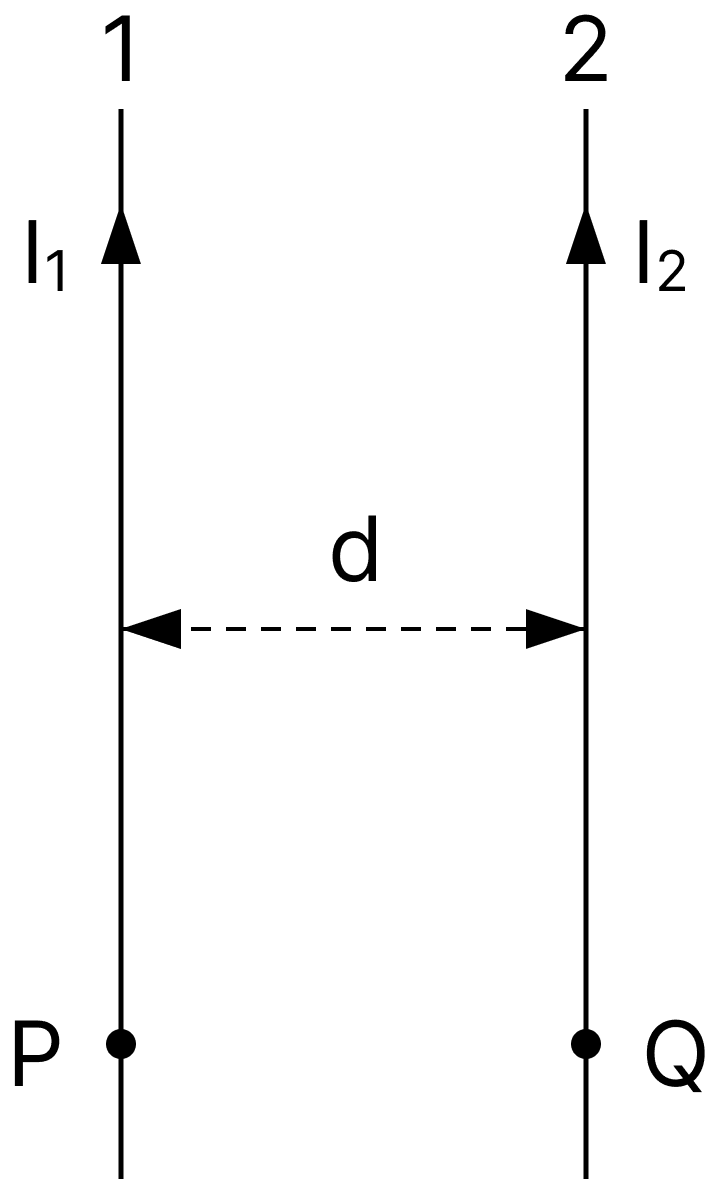
Two very long conductors carrying currents I1 and I2 are separated by a distance d as shown in the figure. Give the expressions (do not derive) for magnetic field and at P and Q, respectively, produced by the electric currents I2 and I1. What are the directions of these fields? Define the S.I. Unit of current using the above set up.
Answer
The magnetic field at P, produced by the current I2 in the conductor 2, is
and the magnetic field at Q, produced by the current I1 in the conductor 1, is
Directions : By the right-hand thumb rule, both the conductors carrying currents in the same direction, at P is perpendicular to the plane of the paper directed outwards, while at Q is perpendicular to the plane of the paper directed inwards.
Definition of the SI unit of current : Each conductor lies in the field of the other and therefore experiences a force. The force per unit length is
Putting I1 = I2 = 1 A and d = 1 m,
Hence, one ampere is that steady current which, when maintained in each of two infinitely long, straight and parallel conductors of negligible cross-section placed in vacuum at a distance of 1 metre from each other, produces a force of 2 × 10⁻⁷ newton per metre length on each conductor.
Show that the radius of the path followed by a charged particle entering perpendicularly in a magnetic field is directly proportional to its momentum.
Answer
Let a particle of mass m and charge q enter a uniform magnetic field with a velocity directed perpendicular to the field.
Since is perpendicular to , the particle is acted upon by a force of magnitude qvB which lies in the plane of the path and is always perpendicular to the velocity. Such a force does not change the magnitude of the velocity, it changes only its direction. Hence the particle moves along a circle of radius r, the magnetic force acting as the centripetal force,
Solving for r,
But mv is the momentum p of the particle, so
For a given particle in a given field, q and B are constants, so
Hence, the radius of the path followed by a charged particle entering perpendicularly in a magnetic field is directly proportional to its momentum.
A wire of length 10 cm carrying 10 A of current is placed at an angle of 53° with respect to a magnetic field of strength 0.1 tesla. Find the force experienced by the wire. [use : sin 53° = 4/5]
Answer
Given,
- l = 10 cm = 0.1 m
- I = 10 A
- θ = 53°, with sin 53° = 4/5
- B = 0.1 tesla
The force experienced by a current-carrying conductor in a magnetic field is
Substituting the values,
Hence, the force experienced by the wire is 0.08 N.
A current I = 1.5 A is flowing through a long solenoid of 500 turns. What is the magnetic force on an electron moving with a velocity of 2.0 × 10⁶ ms-1, along the axis of the solenoid, when it is the middle.
Answer
Given,
- I = 1.5 A in a long solenoid of 500 turns
- v = 2.0 × 10⁶ ms-1, along the axis of the solenoid
Inside a long solenoid the magnetic field is uniform and is directed along the axis of the solenoid. The electron is moving along this very axis, so the angle between and is zero.
Hence, the magnetic force on the electron is zero.
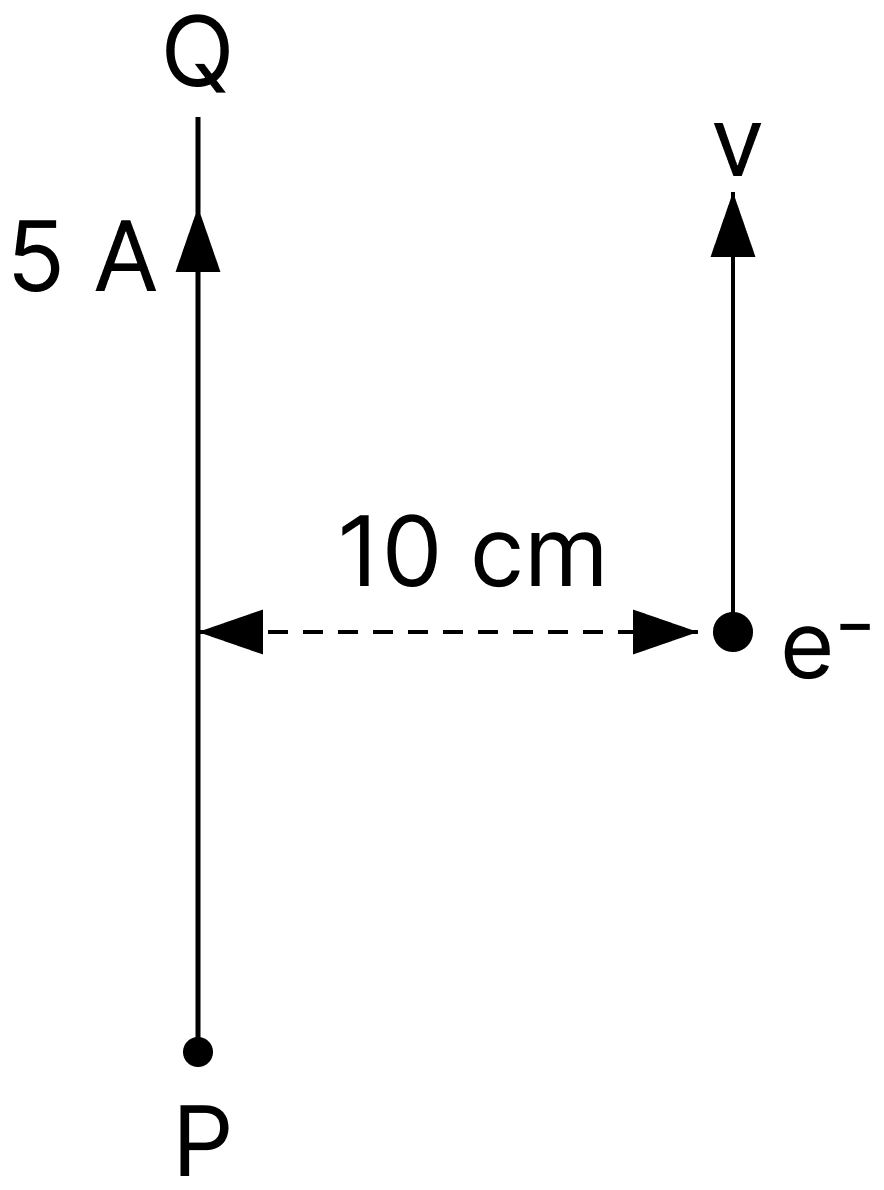
In the figure, PQ is a long straight wire carrying a current of 5A in the direction of the arrow. An electron travels with a velocity of 106 m/s at a distance of 10 cm from the wire in the same direction of the current. Calculate the magnitude and direction of the force experienced by the electron.
Answer
Given,
- I = 5 A in the wire PQ
- v = 106 m/s, in the same direction as the current
- r = 10 cm = 0.1 m
The magnetic field produced by the wire at the position of the electron is
This field is perpendicular to the plane of the paper, so the electron moves at right angles to it and
The electron is negatively charged, so the direction of current is opposite to its motion. Applying Fleming's left-hand rule, the force on the electron is directed towards the right, that is, away from the wire.
Hence, the force experienced by the electron is 1.6 × 10⁻¹⁸ N, towards right (away from the wire).
State Ampere's circuital law.
Answer
Ampere's circuital law : The line integral of the magnetic field (magnetic flux density) around any closed path in free space is equal to µ0 times the net current I threading through the area enclosed by the path,
where µ0 is the permeability of free space and I is the steady current that does not change with time. The law holds for any assembly of currents and for any closed path.
(i) Write an expression of Biot-Savart's law in the vector form. Write an expression for the magnetic field at the centre of a circular coil of radius R, with N turns and carrying a current I.
(ii) A helium nucleus completes one round of a circle of radius 0.8 m in 2 s. Find the magnetic field at the centre of the circle.
Answer
(i) In vector form, Biot-Savart's law states that the magnetic field produced at a point by a current-element is
where is the vector drawn from the current-element to the point.
The magnetic field at the centre of a circular coil of radius R having N turns and carrying a current I is
(ii) Given,
- R = 0.8 m
- time for one round, T = 2 s
- charge of the helium nucleus, q = 2e = 3.2 × 10⁻¹⁹ C
The revolving nucleus is equivalent to a current loop, and the equivalent current is
The magnetic field at the centre of the circle is
Hence, the magnetic field at the centre of the circle is 12.56 × 10⁻²⁶ T.
Write, in vector form, the defining equation for a magnetic field B at a point.
Answer
Explanation:
The magnetic field B at a point is defined through the force experienced by a charge moving at that point, where q is the charge and its velocity. The magnitude of this force is
θ being the angle between and .
An electron beam passes through crossed electric and magnetic fields of 3.4 × 10⁴ Vm-1 and 2 × 10⁻³ Wbm-2, respectively. If the path of the beam remains undeviated, calculate the speed of the electrons.
If the electric field is removed, what will be the radius of the circular path described by the electrons?
Answer
Given,
- E = 3.4 × 10⁴ Vm-1
- B = 2 × 10⁻³ Wbm-2
- me = 9.1 × 10⁻³¹ kg, e = 1.6 × 10⁻¹⁹ C
Speed of the electrons : The path of the beam remains undeviated, so the electric force balances the magnetic force,
Radius of the circular path : When the electric field is removed, only the magnetic force acts and the electrons describe a circle of radius
Hence, the speed of the electrons is 1.7 × 10⁷ m/s and the radius of the circular path is 4.83 × 10⁻² m.
Write an equation of Lorentz force acting on a charged particle having charge q moving in a magnetic field in vector form.
Answer
Explanation:
This is the Lorentz force acting on a charged particle having charge q moving with velocity in a magnetic field . Its magnitude is F = Bqv sin θ, where θ is the angle between and , and its direction is perpendicular to the plane containing and .
When an electric field is also present, the complete Lorentz force is
State Biot-Savart's law. Derive an expression for the magnetic field at the centre of a circular current carrying coil of radius r, with N turn.
Answer
Biot-Savart's law : The magnetic field dB developed at a point due to a small current-element I dl is directly proportional to the current I, to the length dl of the element and to sin θ, where θ is the angle between the element and the line joining it to the point, and inversely proportional to the square of the distance r between them,
Magnetic field at the centre of a circular coil :
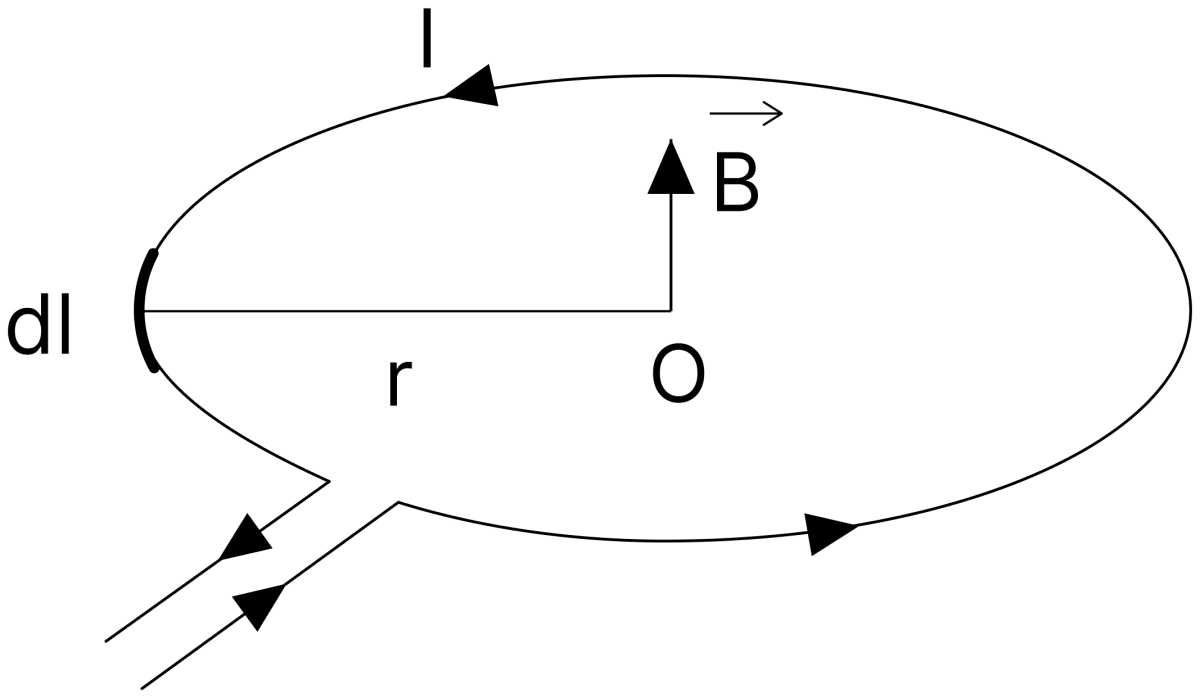
Let a circular coil of radius r carry a current I, and let O be its centre. Consider a small current-element dl of the coil. Every element of a circle is perpendicular to the radius drawn to the centre, so θ = 90° and the field at O due to this element is
The direction of the field is the same for all the elements of the coil, so the fields simply add up. Hence the field at O due to the entire coil is
But , the circumference of the coil, so
If the coil has N turns, each turn contributes equally, so
How should a current-carrying conductor be placed in a magnetic field with respect to the field, so that the force acting upon the conductor is maximum?
Answer
The conductor should be placed perpendicular to the field.
Explanation:
The force acting on a current-carrying conductor placed in a magnetic field is
which is maximum when sin θ = 1, that is when θ = 90°. Then Fmax = IBl.
When a charged particle is projected perpendicular to a uniform magnetic field, it described a circular path in which:
- its speed remains constant
- its velocity remains constant
- its momentum remains constant
- its kinetic energy increases
Answer
its speed remains constant
Reason — The magnetic force on the particle is always perpendicular to its direction of motion, so it does no work on the particle. Hence the speed, and with it the kinetic energy, remains constant.
Using Ampere's circuital law show that the magnetic flux density B at a point P at perpendicular distance 'a' from a long current carrying conductor is given by,
(Statement of law not required.)
Answer
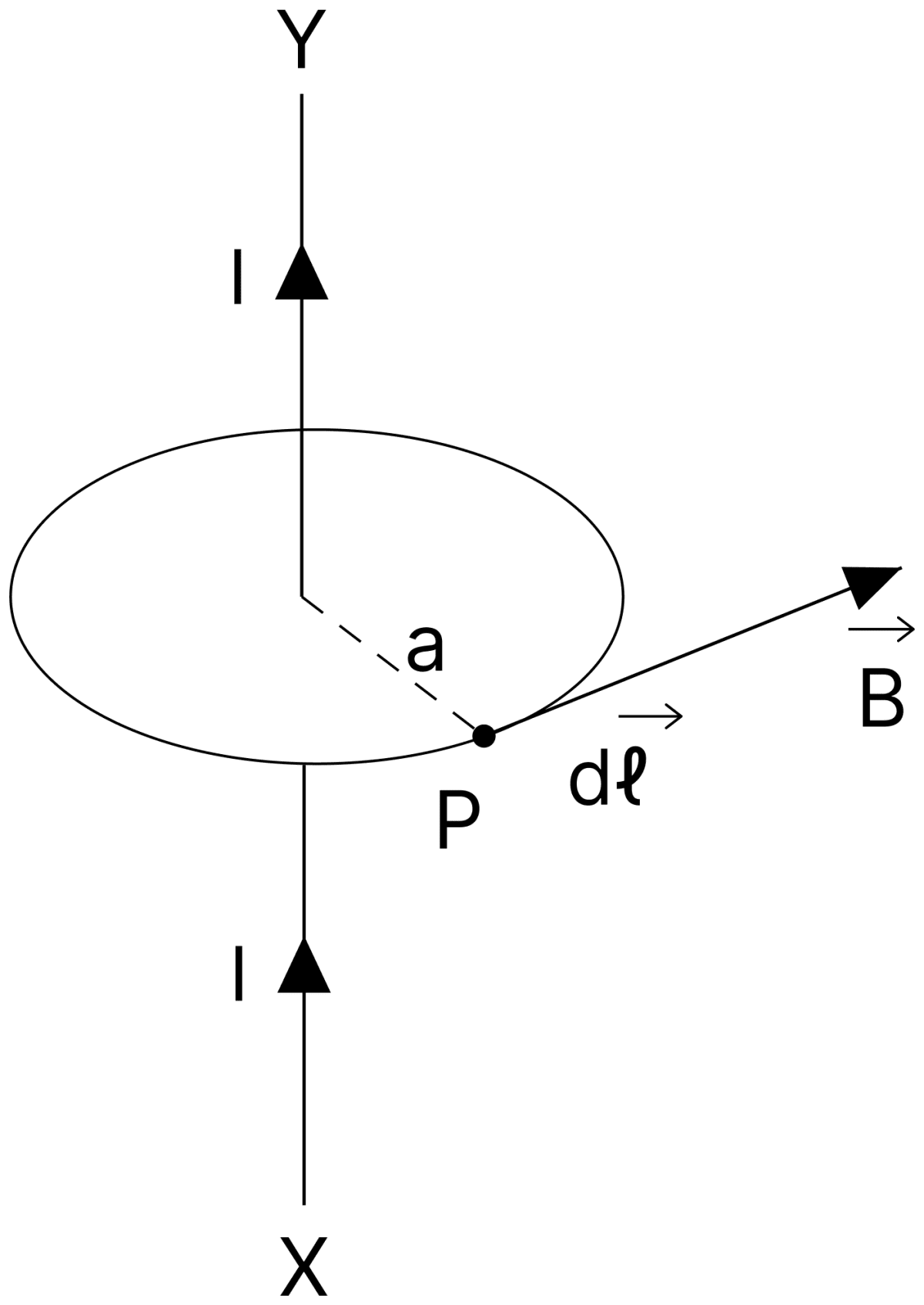
Let the long conductor carry a steady current I, and let P be a point at a perpendicular distance a from it.
Draw a circle of radius a through P, with its centre on the conductor and its plane perpendicular to the conductor. By symmetry, the magnitude of is the same at all points of this circle and its direction is tangential to the circle at each point. Hence and are along the same direction at every element, and
The current enclosed by the circle is I, so applying Ampere's circuital law,
Hence, the magnetic flux density at P is .
How much force per unit length acts on a long current carrying conductor X due to a current flowing through another similar conductor Y, kept parallel to it in vacuum?
Answer
Explanation:
Each conductor lies in the magnetic field produced by the current in the other, and so experiences a force.
If the conductors X and Y carry currents I1 and I2 and are kept parallel at a distance r apart in vacuum, the field produced by Y at the position of X is
The conductor X lies at right angles to this field, so the force on a length L of it is F = I1BL. Dividing by L gives the force per unit length stated above.
This force is one of attraction if the currents are in the same direction, and one of repulsion if they are in opposite directions.
Electrons having a velocity of 2 × 10⁶ ms-1 pass undeviated through a uniform electric field of intensity 5 × 10⁴ Vm-1 and a uniform magnetic field .
(i) Find the magnitude of magnetic flux density B of the magnetic field.
(ii) What is the direction of , if is towards right and is vertically downwards in the plane of this paper?
Answer
Given,
- v = 2 × 10⁶ ms-1
- E = 5 × 10⁴ Vm-1
(i) The electrons pass undeviated, so the electric force balances the magnetic force,
(ii) The three vectors , and are mutually perpendicular. With towards the right and vertically downwards in the plane of the paper, must be perpendicular to the plane of the paper. For the two forces on the electron to be opposite, the field must be directed into the plane of the paper (inwards).
Hence, the magnetic flux density is 2.5 × 10⁻² T, directed perpendicular to the plane of paper and inwards.
Figure shows a point P near a long conductor XY carrying a current I, MN is a short current-carrying conductor, kept at the point P, parallel to the conductor XY.
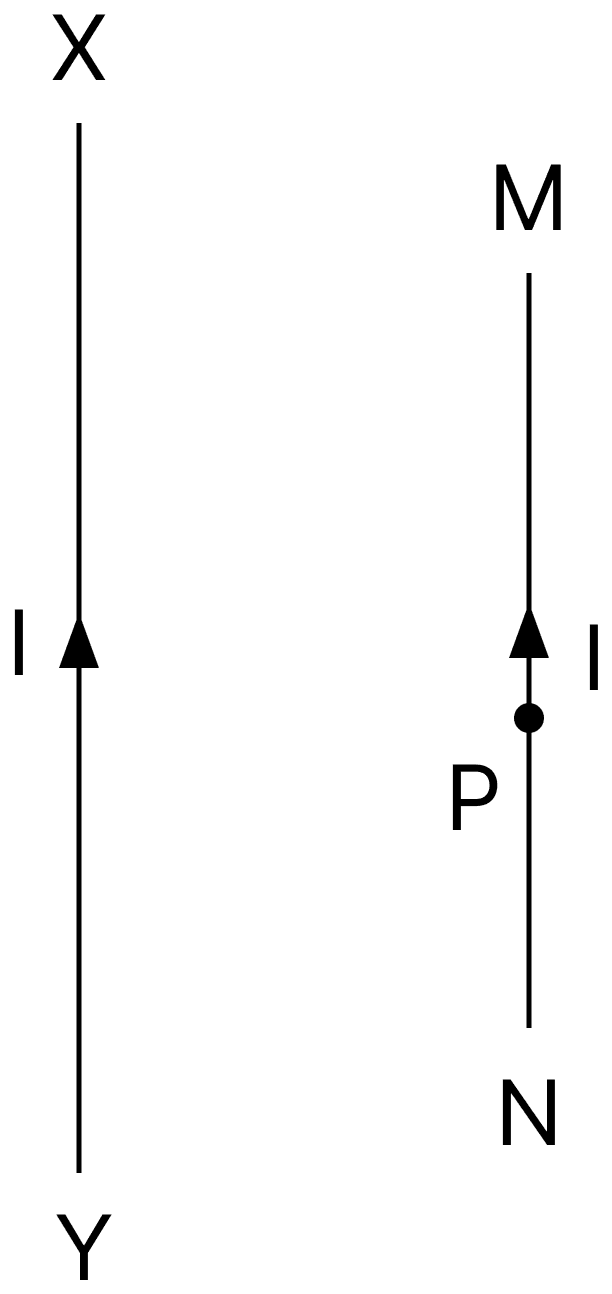
(i) What is the direction of magnetic flux density 'B' at the point P due to the current flowing through XY?
(ii) What is the direction of the force experienced by the conductor MN due to the current flowing through XY?
Answer
(i) The current I in the conductor XY flows upwards, and the point P lies to the right of XY. Applying the right-hand thumb rule, the magnetic flux density B at P is perpendicular to the plane of the paper, directed into the page.
(ii) The short conductor MN at P carries a current I in the same direction as the current in XY, so the two currents are parallel. Parallel currents attract each other, so the force experienced by MN is directed towards the conductor XY.
The same result follows from Fleming's left-hand rule, with the field at P into the page and the current in MN directed upwards.
Figure shows two infinitely long and thin current-carrying conductors X and Y kept in vacuum, parallel to each other, at a distance 'a'.
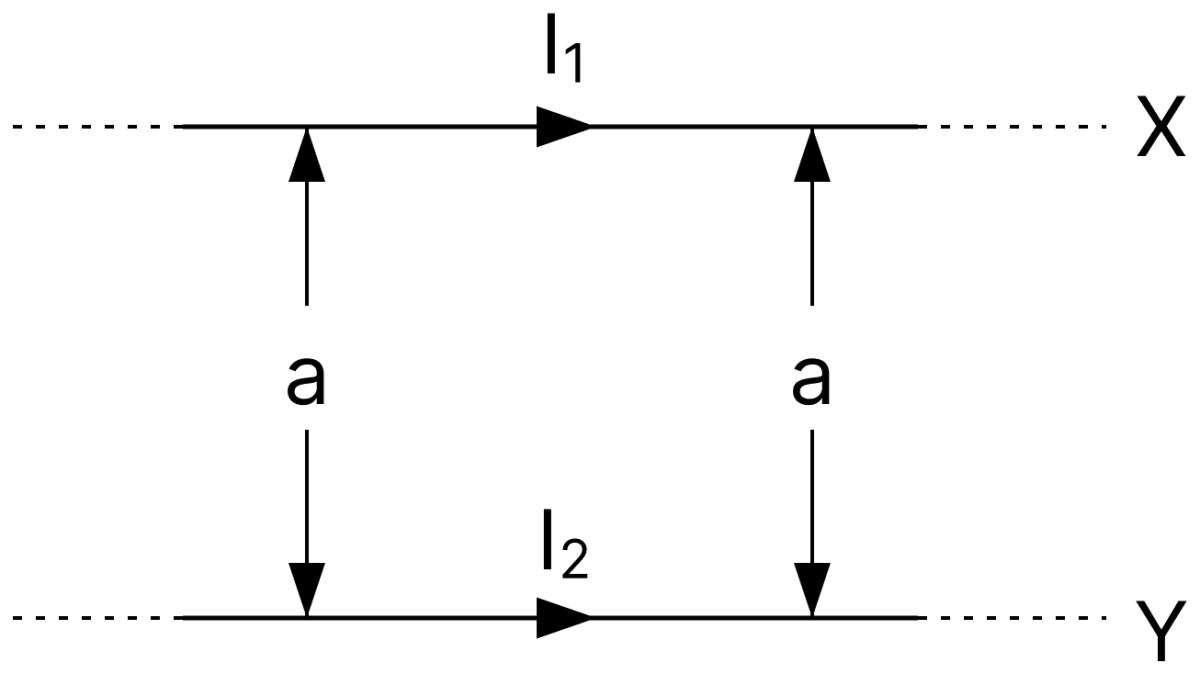
(i) How much force per unit length acts on the conductor Y due to the current flowing through X? Write your answer in terms of , I1, I2 and a. (Derivation of formula is not required).
(ii) Define one ampere, in terms of force between two current-carrying conductors.
Answer
(i) The field produced by the conductor X at the position of the conductor Y is
The conductor Y lies at right angles to this field, so the force on a length L of Y is F = I2BL, and the force per unit length is
(ii) Definition of one ampere : One ampere is that steady current which, when maintained in each of two infinitely long, straight and parallel conductors of negligible cross-section placed in vacuum at a distance of 1 metre from each other, produces a force of 2 × 10⁻⁷ newton per metre length on each conductor.
The Biot-Savart's law in vector form is :
Answer
Reason — In vector form Biot-Savart's law is written with the current-element as the vector , and the field is perpendicular to the plane containing and . Writing , the scalar form
becomes , with r3 in the denominator because the numerator carries one extra factor of r.
The particles which cannot be accelerated by a cyclotron or a van de Graaff generator are :
- alpha particles
- beta particles
- neutrons
- protons
Answer
neutrons
Reason — Both a cyclotron and a van de Graaff generator accelerate a particle by means of an electric field, and the force exerted by an electric field on a particle is F = qE. A neutron carries no charge, so no electric force acts on it and it cannot be accelerated by either machine.
A metallic wire having length of 2 m and weight of 4 × 10⁻³ N is found to remain at rest in a uniform and transverse magnetic field of 2 × 10⁻⁴ T. Current flowing through the wire is :
- 10 A
- 5 A
- 2 A
- 1 A
Answer
10 A
Reason — Given, l = 2 m, weight W = 4 × 10⁻³ N and B = 2 × 10⁻⁴ T.
The wire remains at rest, so the magnetic force balances its weight,
When does a moving charged particle not experience any force while moving through a uniform magnetic field?
Answer
A moving charged particle experiences no force while moving through a uniform magnetic field when it moves parallel or anti-parallel to the direction of the field.
Explanation:
The magnetic force on a charged particle is
where θ is the angle between and . This force is zero when sin θ = 0, that is when θ = 0° or 180°.
A circular coil carrying a current I has radius R and number of turns N. If all the three, i.e., the current I, radius R and number of turns N are doubled, then magnetic field at its centre becomes :
- double
- half
- four times
- one-fourth
Answer
double
Reason — The magnetic field at the centre of a circular coil is
When the current, the radius and the number of turns are all doubled, that is I → 2I, R → 2R and N → 2N,
A moving charged particle q travelling along the positive x-axis enters a uniform magnetic field B. When will the force acting on q be maximum?
Answer
The force acting on q will be maximum when it moves perpendicular to the magnetic field B, that is, when θ = 90°.
Explanation:
The magnetic force on the charge is
which is maximum when sin θ = 1, that is θ = 90°, giving Fmax = Bqv. As the particle travels along the positive x-axis, the force is maximum when the field B is directed at right angles to the x-axis.
A long horizontal wire P carries a current of 50A. It is rigidly fixed. Another wire Q is placed directly above the parallel to P, as shown in figure.
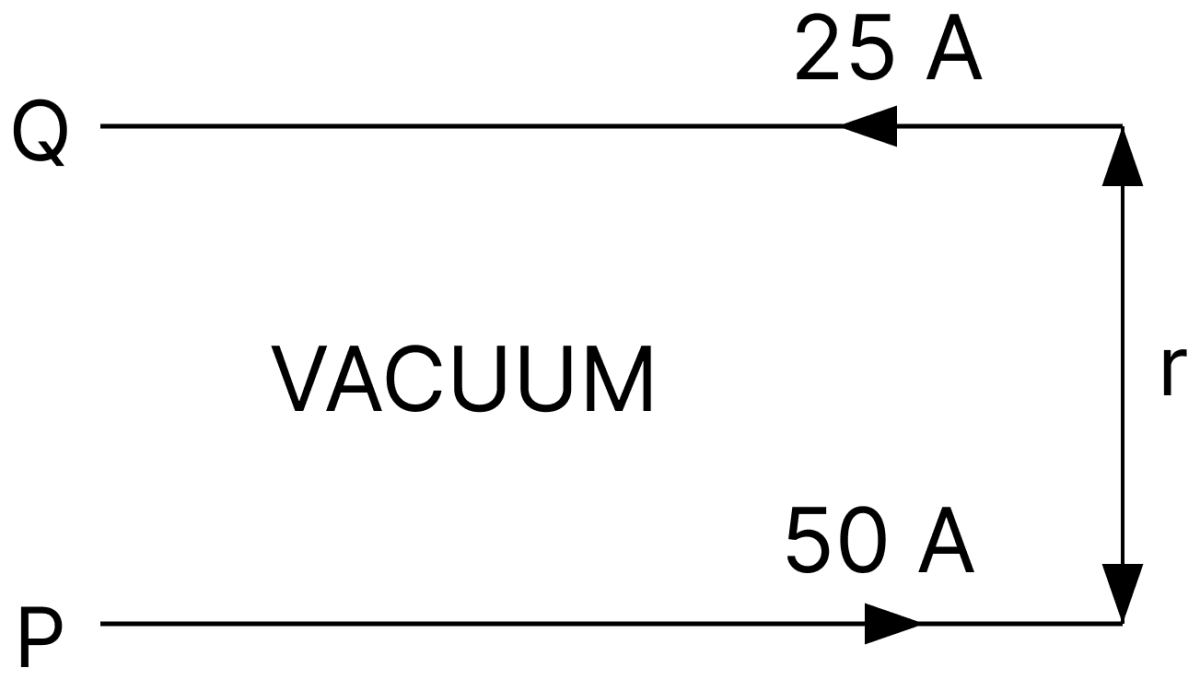
The weight per unit length of the wire Q is 0.025 Nm-1 and it carries a current of 25A. Find the distance 'r' of the wire Q from the wire P so that the wire Q remains at rest.
Answer
Given,
- I1 = 50 A in the wire P
- I2 = 25 A in the wire Q
- weight per unit length of Q = 0.025 Nm-1
The wire Q remains at rest above P, so the magnetic force per unit length on it must be directed upwards and must balance its weight per unit length. From the figure the two currents are in opposite directions, so the wires repel each other and Q is supported.
Hence, the wire Q should be kept at a distance of 1 cm from the wire P.
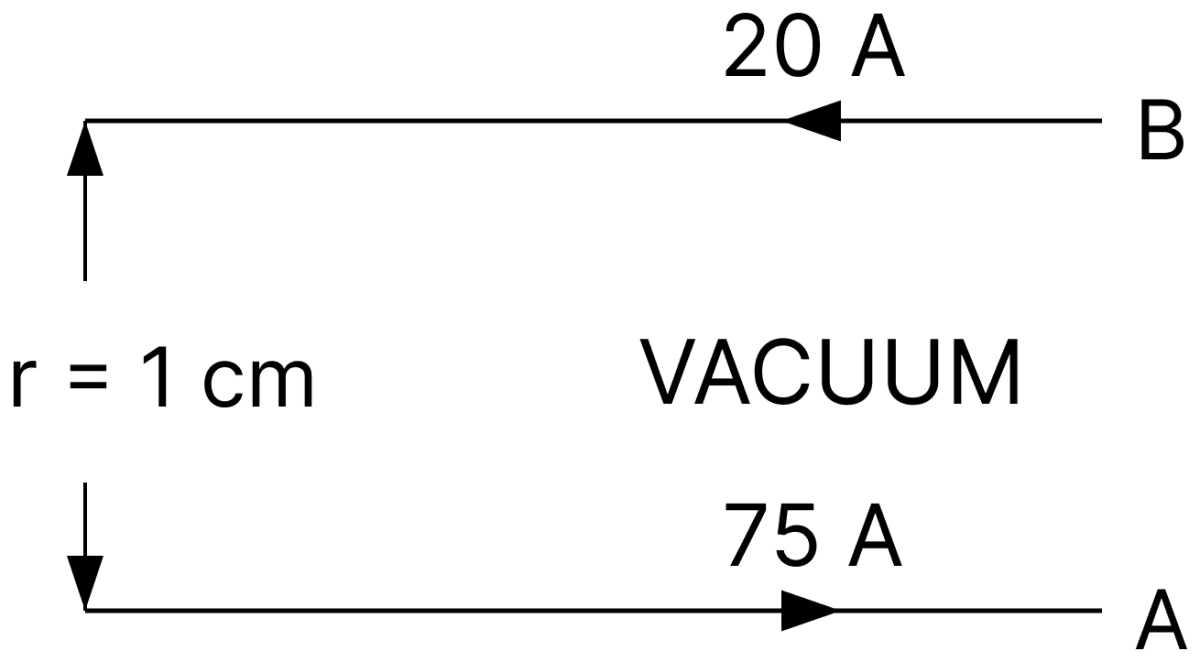
Calculate force per unit length acting on the wire B due to the current flowing in the wire A. (Shown in the figure).
Answer
Given,
- I1 = 75 A in the wire A
- I2 = 20 A in the wire B
- r = 1 cm = 0.01 m
The force per unit length acting on the wire B due to the current in the wire A is
Substituting the values,
The currents in the two wires are in opposite directions, so the force is one of repulsion, directed away from the wire A.
Hence, the force per unit length acting on the wire B is 3 × 10⁻² N/m.
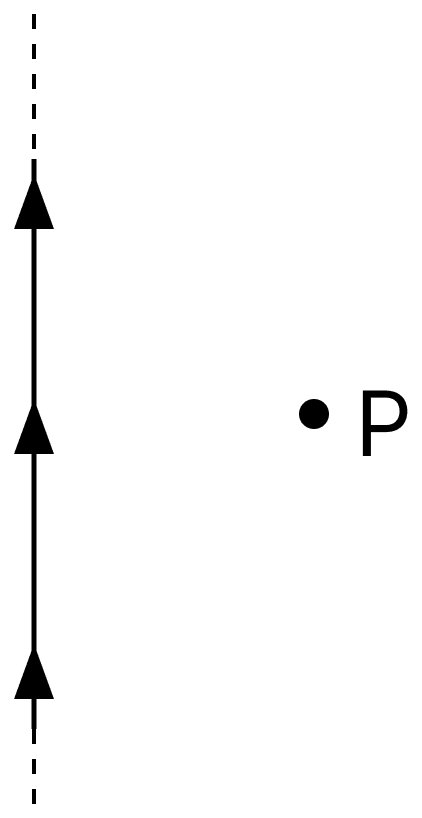
(a) An electric current flows through an infinitely long conductor as shown in figure. Write an expression and direction for the magnetic field at point P.
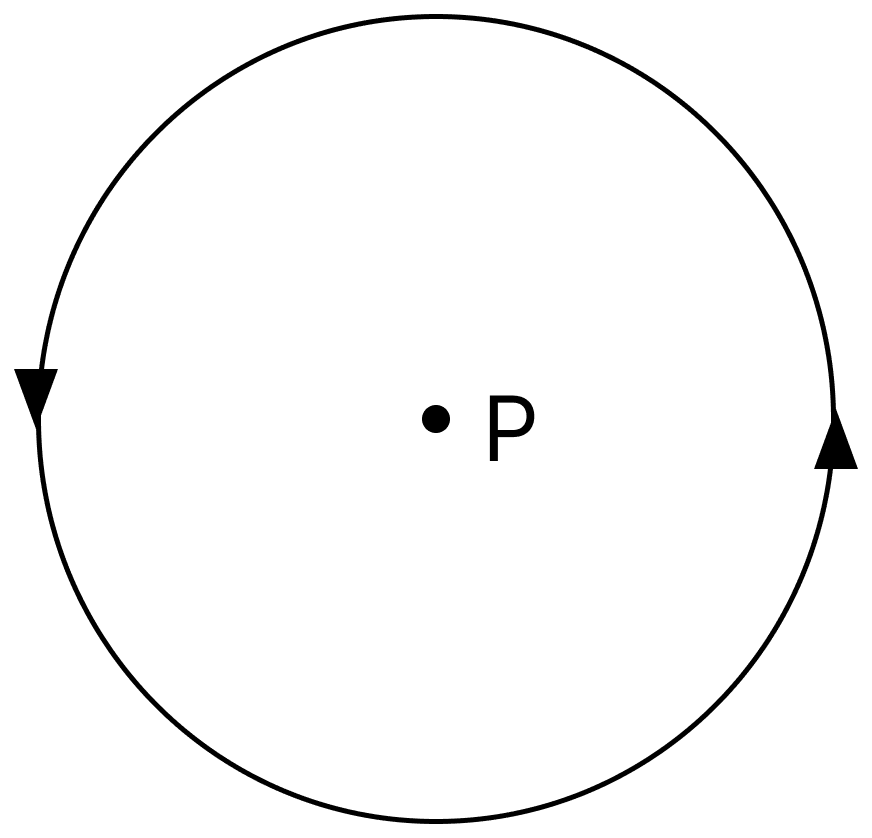
(b) An electric current I flows through a circular loop as shown in figure. Write an expression and direction for the magnetic field at the centre of the loop at point?
Answer
(a)
For an infinitely long straight conductor carrying a current I, the magnetic field at a point P at a perpendicular distance r from it is
The current flows upwards and P lies to the right of the conductor, so by the right-hand thumb rule the field at P is perpendicular to the plane of the paper, directed into the page.
(b)
For a circular loop of radius R carrying a current I, the magnetic field at the centre is
The current flows in the anticlockwise sense, so by the right-hand palm rule no. 1 the field at the centre is perpendicular to the plane of the loop, directed out of the page (towards the observer).
Write Biot-Savart's law in vector form.
Answer
Explanation:
Here is the magnetic field produced at a point by a current-element , is the vector drawn from the current-element to the point at which the field is required, and µ0 is the permeability of free space. The direction of is perpendicular to the plane containing and .
Write an expression for force per unit length between two long current carrying wires, kept parallel to each other in vacuum and hence define an ampere, the SI unit of current.
Answer
If two long conductors carrying currents I1 and I2 are kept parallel to each other at a distance r apart in vacuum, the force per unit length between them is
This force is attractive if the currents are in the same direction and repulsive if they are in opposite directions.
Definition of ampere : Putting I1 = I2 = 1 A and r = 1 m,
Hence, one ampere is that steady current which, when maintained in each of two infinitely long, straight and parallel conductors of negligible cross-section placed in vacuum at a distance of 1 metre from each other, produces a force of 2 × 10⁻⁷ newton per metre length on each conductor.
Magnetic flux density or the magnetic field, at a point on the axis of a long solenoid is given by :
- B = µ0nI
- B = µ0I
Answer
B = µ0nI
Reason — Applying Ampere's circuital law to a rectangular path partly inside and partly outside a long solenoid gives Bx = µ0(nx)I, so
where n is the number of turns per unit length.
Write an equation of Lorentz force in vector form.
Answer
Explanation:
The Lorentz force is the total force acting on a charged particle moving in a region where both an electric field and a magnetic field are present. Here q is the charge on the particle and its velocity. The first term is the electric force, which acts whether the charge is at rest or in motion, and the second term is the magnetic force, which acts only on a moving charge.
A proton is moving in a uniform magnetic field B with a velocity v at an angle θ with the field. The force acting on the proton is minimum when θ is :
- 120°
- 90°
- 60°
- 0°
Answer
0°
Reason — The force on the proton is
which is minimum when sin θ is minimum. Among the given angles sin θ is least at θ = 0°, where sin 0° = 0 and the force becomes zero. At θ = 90° the force is maximum.
Two long straight wires P and Q are parallel to each other. They carry currents in the same direction as shown in the figure.
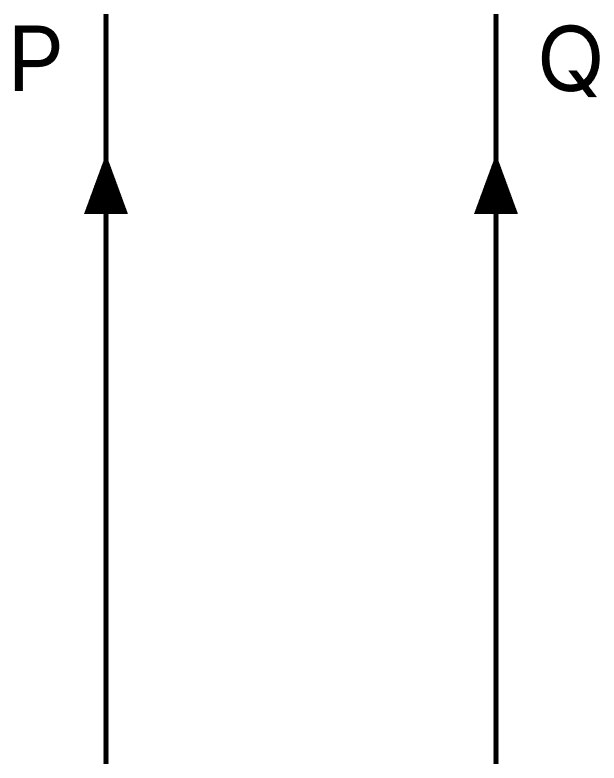
The wire P is kept fixed. Then, the wire Q will :
- also remain at rest
- move towards the wire P
- move away from the wire P
- come out of the plane of this paper
Answer
move towards the wire P
Reason — The two wires carry currents in the same direction, so they attract each other. The force per unit length between them is
directed towards the other wire. As the wire P is kept fixed, the wire Q moves towards P.
A circular coil has radius 'r', number of turns 'N' and carries a current 'I'. Magnetic flux density 'B' at its centre is :
- B = µ0NI
- B = µ0NI/2r
- B = µ0NI/4πr
- B = µ0NI/4r
Answer
B = µ0NI/2r
Reason — Applying Biot-Savart's law to every element of the coil and adding the fields, which are all in the same direction at the centre,
for a single turn. For N turns each turn contributes equally, so .
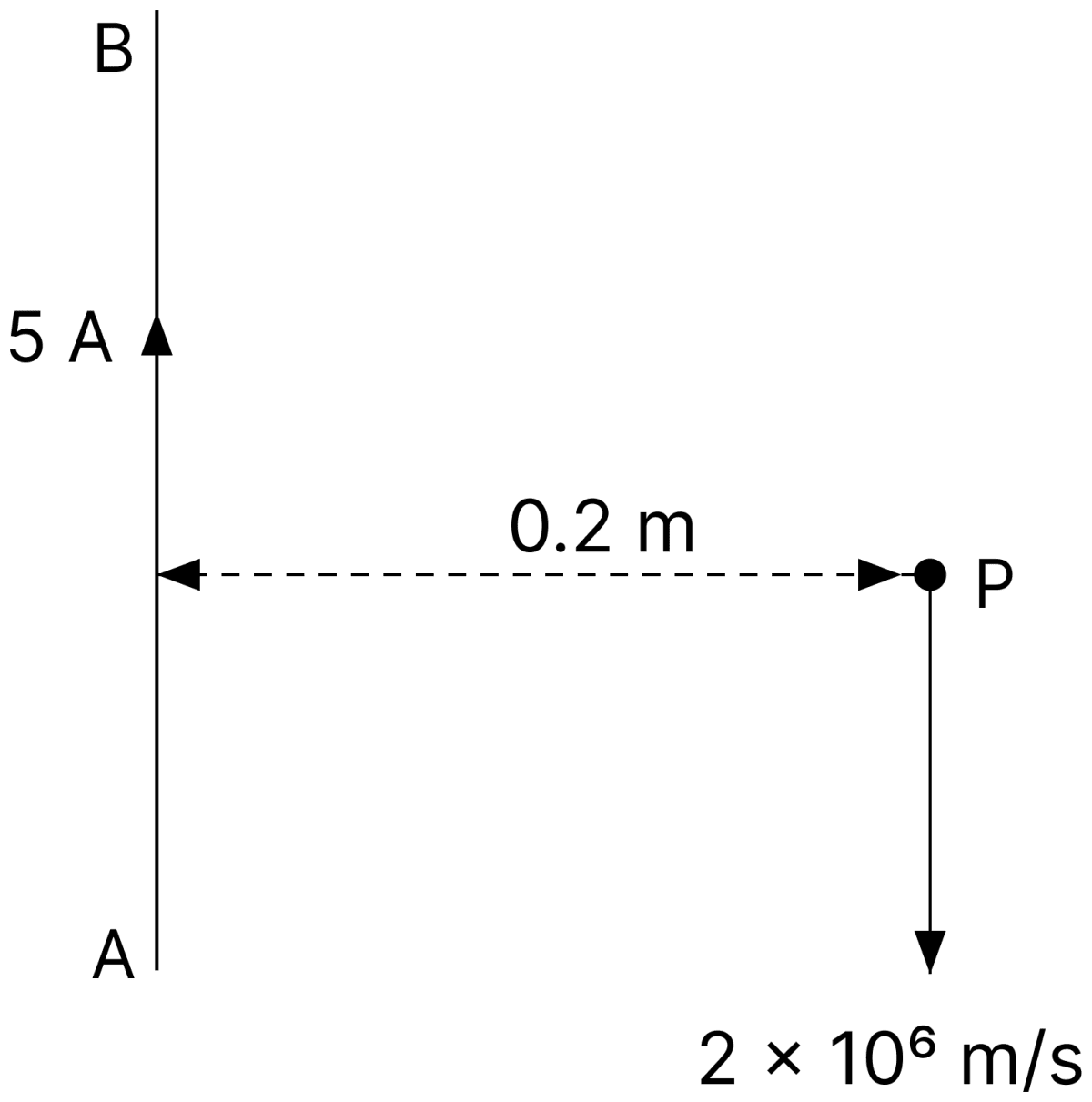
A long straight wire AB carries a current of 5 A. P is a proton travelling with a velocity of 2 × 10⁶ m/s, parallel to the wire, 0.2 m from it and in a direction opposite to the current, as shown in the given figure. Calculate the force which magnetic field of the current-carrying conductor AB exerts on the proton.
Answer
Given,
- I = 5 A in the wire AB
- v = 2 × 10⁶ m/s, parallel to the wire but opposite to the current
- r = 0.2 m
The magnetic field produced by the conductor at the position of the proton is
This field is perpendicular to the plane of the paper, so the proton moves at right angles to it and
Applying Fleming's left-hand rule, this force is directed towards the right hand side, that is, away from the wire.
Hence, the force exerted on the proton is 1.6 × 10⁻¹⁸ N, towards right hand side (away from the wire).
Using Ampere's circuital law, obtain an expression for magnetic flux density 'B' at a point near an infinitely long and straight conductor, carrying a current I.
Answer
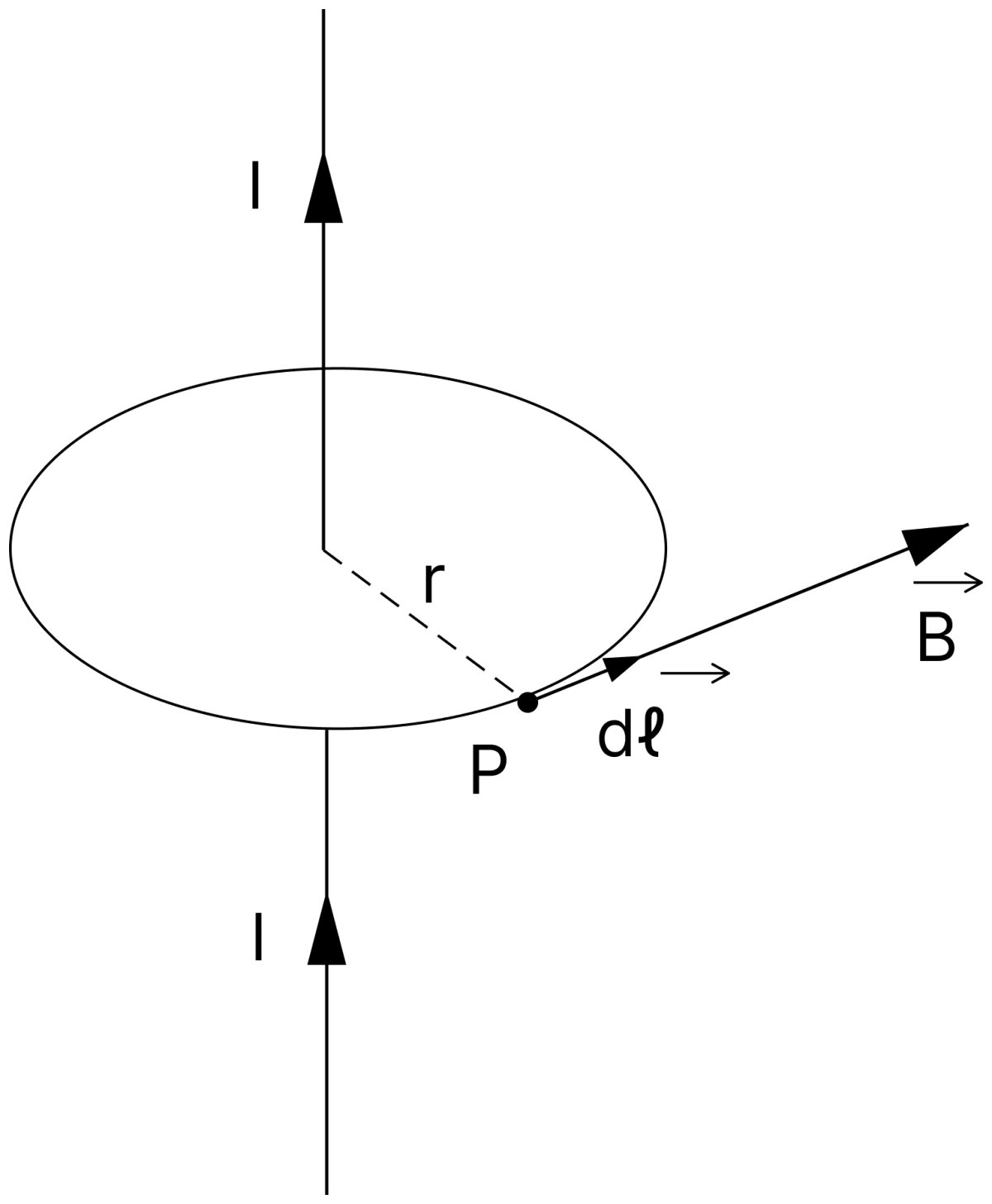
Let an infinitely long straight conductor carry a steady current I, and let P be a point at a perpendicular distance r from it.
Draw a circle of radius r through P, with its centre on the conductor and its plane perpendicular to the conductor. By symmetry, the magnitude of is the same at all points of this circle and its direction is tangential to the circle at each point. Hence and are along the same direction at every element of the circle, and
But , the circumference of the circle, and the current enclosed by the circle is I. Applying Ampere's circuital law,
Hence, the magnetic flux density at a point near an infinitely long straight conductor is .
Biot Savart's law in vector form is : [K = µ0/4π]
Answer
Reason — Biot-Savart's law in scalar form is
Since , writing the numerator as a cross product introduces one extra factor of r, which must be compensated by r3 in the denominator.
A straight metallic wire of length of 20 cm weights 1.2g. It is kept perpendicular to a uniform magnetic field of 0.3 T. How much current should be passed through it so that it does not fall due to the action of gravity?
Answer
Given,
- l = 20 cm = 0.2 m
- m = 1.2 g = 1.2 × 10⁻³ kg
- B = 0.3 T
- g = 9.8 m s-2
The wire does not fall, so the magnetic force on it balances its weight,
Hence, a current of 0.196 A (that is, 196 × 10-3 A) should be passed through the wire.
Note: The printed answer key gives 19.6 × 10⁻³ A. Substituting the given data in BIl = mg yields 196 × 10-3 A, so the printed value appears to be smaller by a factor of ten.
Lorentz force in vector form is :
- F = Bqv sin θ
Answer
Reason — The Lorentz force on a charge q moving with velocity in a magnetic field is the vector product of and multiplied by q, taken in that order.
Which one of the following copper wires has minimum resistance?
- length = x, area of cross section = y
- length = 2x, area of cross section = y
- length = x, area of cross section = 2y
- length = 2x, area of cross section = 2y
Answer
length = x, area of cross section = 2y
Reason — The resistance of a wire is
so R is least when the length is least and the area of cross-section is greatest. Among the four wires, the one with length x and area 2y gives
which is the smallest of the four values , , and .
Note: The printed answer key gives option 1 (length = x, area = y), but that wire has resistance , which is twice the resistance of the wire of option 3. Hence option 3 is the correct choice.
Figure below shows an infinitely long metallic wire YY' which is carrying a current I'. P is a point at a perpendicular distance r from it.
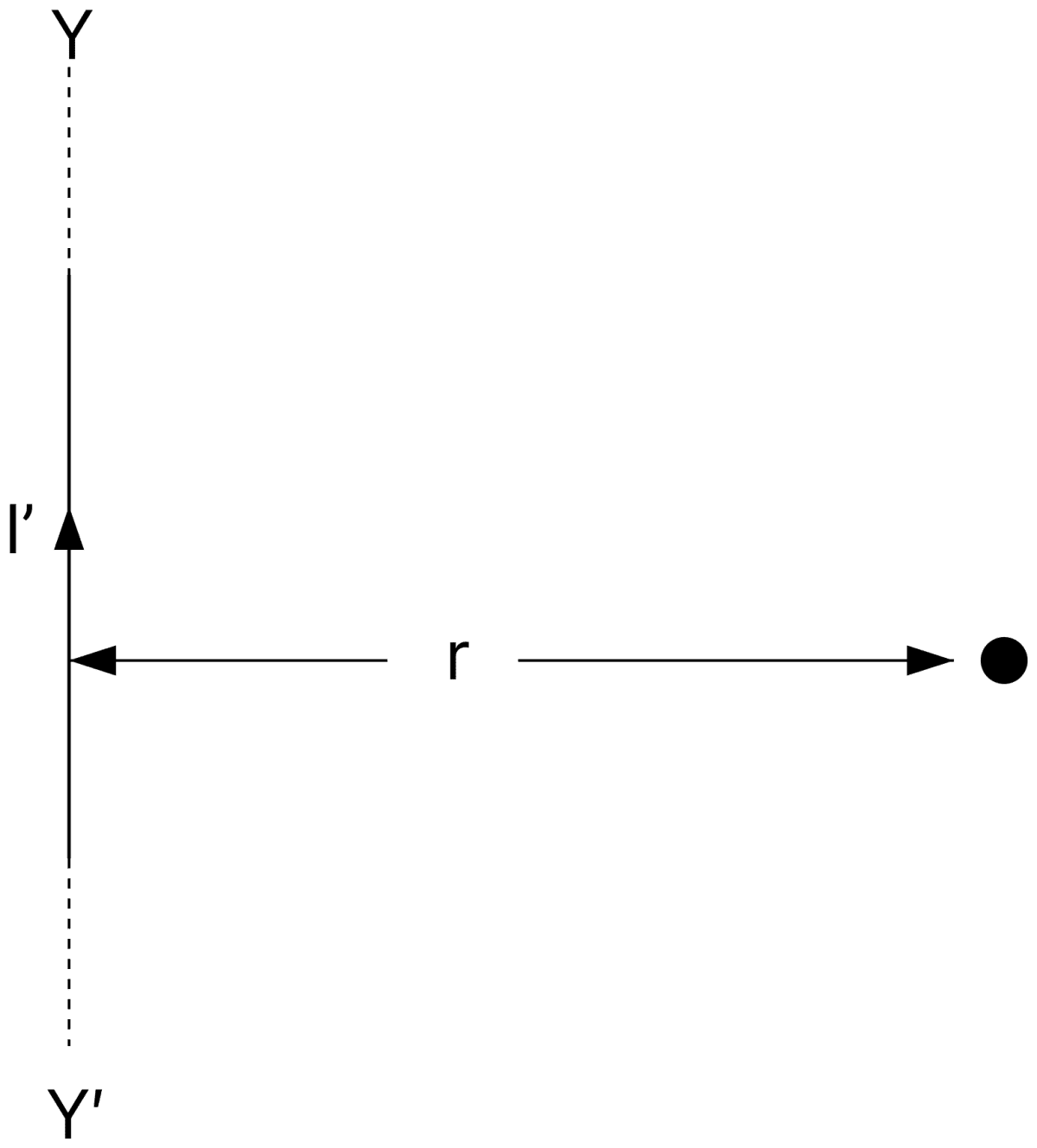
(i) What is the direction of magnetic flux density B of the magnetic field at the point P?
(ii) What is the magnitude of magnetic flux density B of the magnetic field at the point P?
(iii) Another metallic wire MN having length l and carrying a current I is now kept at the point P. If the two wires are in vacuum and parallel to each other, how much force acts on the wire MN due to the current I', flowing in the wire YY'?
Answer
(i) The current I' in the wire YY' flows upwards and the point P lies to the right of the wire. By the right-hand thumb rule, the magnetic flux density B at P is perpendicular to the plane of the paper and directed downwards (into the page).
(ii) For an infinitely long straight conductor, the magnitude of the magnetic flux density at a perpendicular distance r is
(iii) The wire MN of length l carrying a current I is placed at P, parallel to YY', and lies at right angles to the field B. Hence the force on it is
This force is one of attraction if the two currents are in the same direction, and one of repulsion if they are in opposite directions.
Show that force per unit length (F') between two long wires carrying currents I and I' kept parallel to each other in vacuum, is given by :
where the terms have their usual meaning.
Answer
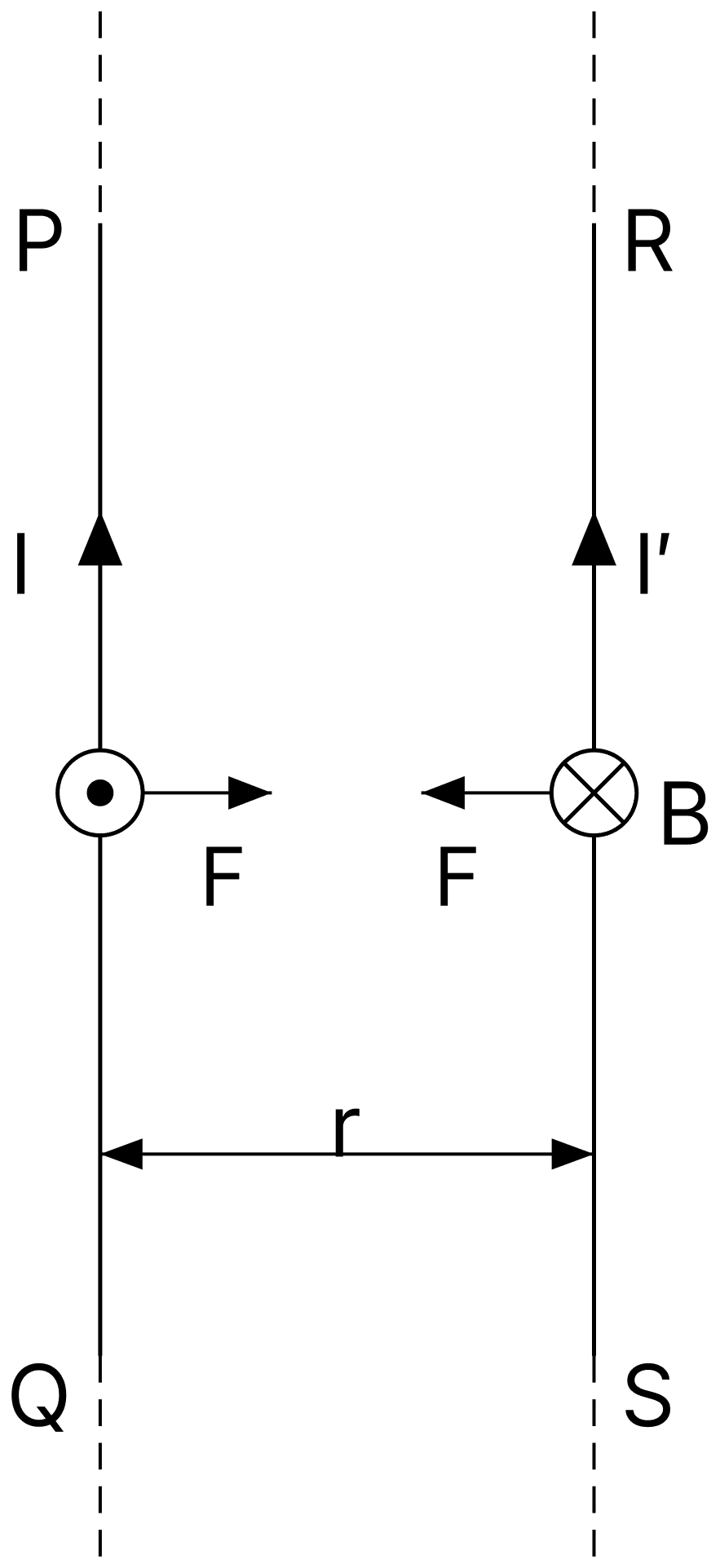
Let two long straight wires be kept parallel to each other in vacuum at a distance r apart, carrying currents I and I' respectively.
The magnitude of the magnetic field produced by the current I at the position of the second wire is
and by the right-hand palm rule no. 1 this field is perpendicular to the plane containing the two wires.
The second wire, carrying the current I', is thus situated in this field at right angles to it, so the force on a length L of it is
Therefore the force per unit length is
Writing ,
Hence, the force per unit length between the two wires is , where the terms have their usual meaning.