KnowledgeBoat Logo
|
OPEN IN APP

Chapter 7

Moving Charges and Magnetic Field — Numericals

Class 12 - Nootan Physics


Numericals

Question 1

A long straight wire in horizontal plane carries a current of 50 A in north to south direction. Find the magnitude and direction of magnetic field at a point 2.5 m east of the wire.

Answer

Given,

  • I = 50 A, flowing from north to south
  • r = 2.5 m

For a long straight current-carrying conductor,

B=μ02πIrB=μ04π2Ir\text B = \dfrac{\text μ_0}{2\text π}\dfrac{\text I}{\text r} \\[1em] \text B = \dfrac{\text μ_0}{4\text π}\dfrac{2\text I}{\text r}

Substituting the values,

B=(10−7)×2×502.5B=10−52.5B=4.0×10⁻⁶ T\text B = (10^{-7}) \times \dfrac{2 \times 50}{2.5} \\[1em] \text B = \dfrac{10^{-5}}{2.5} \\[1em] \text B = 4.0 \times 10^{-6}\ \text T

By the right-hand thumb rule, with the current directed from north to south, the field at a point east of the wire is directed vertically upwards.

Hence, the magnetic field at the point is 4.0 × 10⁻⁶ T, directed vertically upwards.

Question 2

Two infinitely long insulated wires are kept perpendicular to each other. They carry currents I1 = 2 A and I2 = 1.5 A. (i) Find the magnitude and direction of the magnetic field at P. (ii) If the direction of current be reversed in one of the wires, what would be the magnitude of the field?
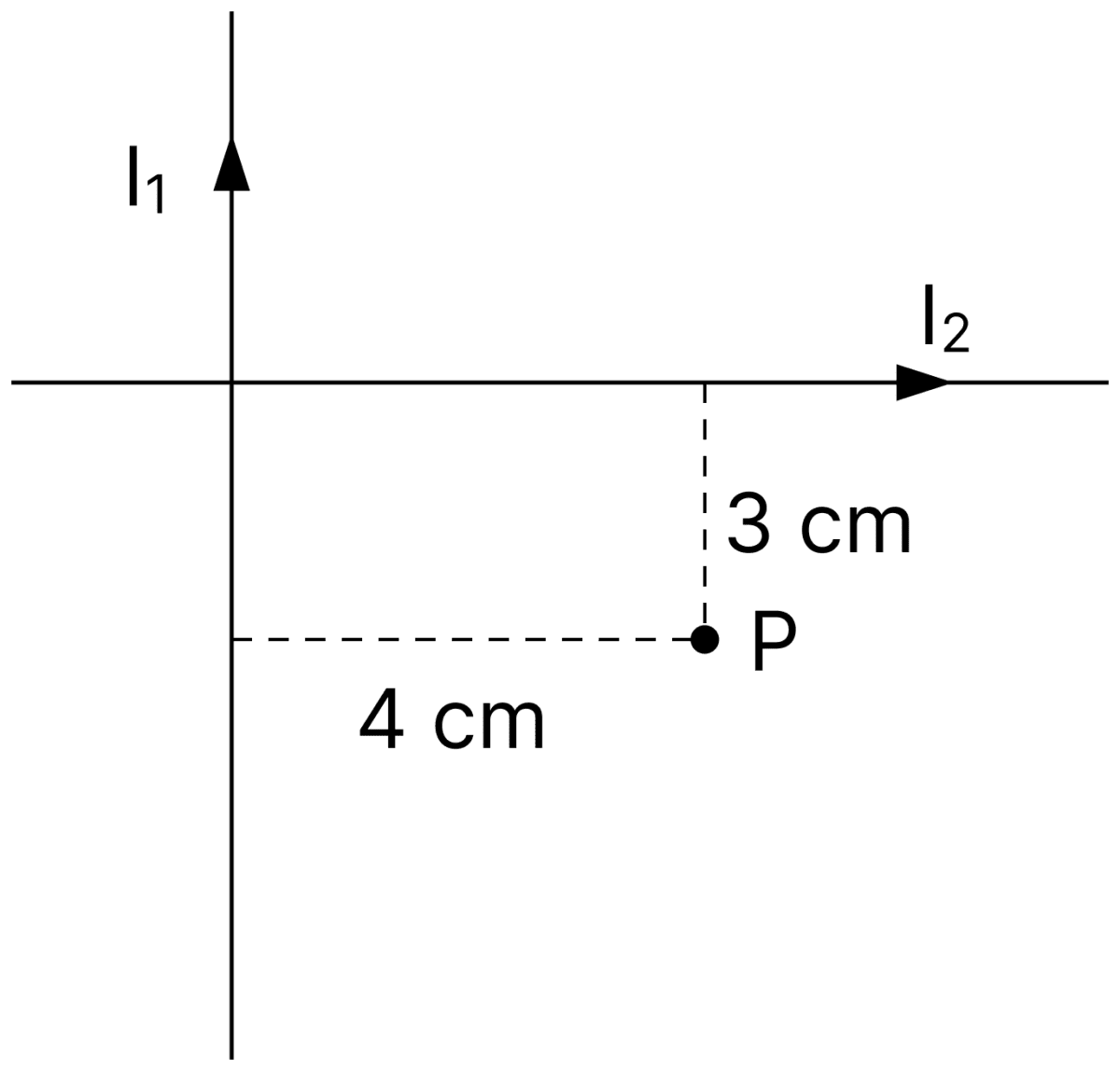
Two infinitely long insulated wires are kept perpendicular to each other. They carry currents I 1 = 2 A and I 2 = 1.5 A. (i) Find the magnitude and direction of the magnetic field at P. (ii) If the direction of current be reversed in one of the wires, what would be the magnitude of the field? Moving Charges and Magnetic Field, Nootan Physics Solutions ICS Class 12

Answer

Given,

  • I1 = 2 A, at a distance r1 = 4 cm = 0.04 m from P
  • I2 = 1.5 A, at a distance r2 = 3 cm = 0.03 m from P

(i) The field at P due to each wire is B=μ04π2Ir\text B = \dfrac{\text μ_0}{4\text π}\dfrac{2\text I}{\text r}.

Due to the current I1,

B1=(10−7)×2×20.04B1=1×10⁻⁵ T\text B_1 = (10^{-7}) \times \dfrac{2 \times 2}{0.04} \\[1em] \text B_1 = 1 \times 10^{-5}\ \text T

Due to the current I2,

B2=(10−7)×2×1.50.03B2=1×10⁻⁵ T\text B_2 = (10^{-7}) \times \dfrac{2 \times 1.5}{0.03} \\[1em] \text B_2 = 1 \times 10^{-5}\ \text T

Applying the right-hand thumb rule to each wire, both the fields at P are perpendicular to the plane of the paper and directed downwards, so they add up,

B=B1+B2B=2×10⁻⁵ T\text B = \text B_1 + \text B_2 \\[1em] \text B = 2 \times 10^{-5}\ \text T

Hence, the magnetic field at P is 2 × 10⁻⁵ T, perpendicular to the plane of paper pointing downwards.

(ii) If the direction of the current in one of the wires is reversed, the field due to that wire at P is also reversed. The two fields are then equal in magnitude but opposite in direction,

B=B1−B2B=0\text B = \text B_1 - \text B_2 \\[1em] \text B = 0

Hence, the magnetic field at P would then be zero.

Question 3

An electron-beam carries a current of 5 microampere. Calculate : (i) number of electrons passing through a point per second, (ii) magnetic field produced at a distance of 50 cm.

Answer

Given,

  • I = 5 microampere = 5 × 10⁻⁶ A
  • r = 50 cm = 0.5 m

(i) If n electrons pass through a point per second, the current is

I=ne⇒n=Ien=5×10−61.6×10−19n=3.125×10¹³\text I = \text{ne} \quad \Rightarrow \quad \text n = \dfrac{\text I}{\text e} \\[1em] \text n = \dfrac{5 \times 10^{-6}}{1.6 \times 10^{-19}} \\[1em] \text n = 3.125 \times 10^{13}

Hence, 3.125 × 10¹³ electrons pass through a point per second.

(ii) The magnetic field produced by the beam at a distance r is

B=μ04π2IrB=(10−7)×2×5×10−60.5B=2.0×10⁻¹² T\text B = \dfrac{\text μ_0}{4\text π}\dfrac{2\text I}{\text r} \\[1em] \text B = (10^{-7}) \times \dfrac{2 \times 5 \times 10^{-6}}{0.5} \\[1em] \text B = 2.0 \times 10^{-12}\ \text T

Hence, the magnetic field produced at a distance of 50 cm is 2.0 × 10⁻¹² T.

Question 4

Two long, parallel wires are placed at a distance of 16 cm from each other in air. Each wire has a current of 4 A. Calculate the field B at mid-point between them when the currents in them are (i) in the same direction, (ii) in opposite directions.

Answer

Given,

  • I1 = I2 = 4 A
  • separation = 16 cm, so the mid-point is at r = 8 cm = 0.08 m from each wire

The field at the mid-point due to each wire is

B1=B2=μ04π2IrB1=B2=(10−7)×2×40.08B1=B2=1×10⁻⁵ T\text B_1 = \text B_2 = \dfrac{\text μ_0}{4\text π}\dfrac{2\text I}{\text r} \\[1em] \text B_1 = \text B_2 = (10^{-7}) \times \dfrac{2 \times 4}{0.08} \\[1em] \text B_1 = \text B_2 = 1 \times 10^{-5}\ \text T

(i) Currents in the same direction : At the mid-point the two fields are equal in magnitude but opposite in direction, so

B=B1−B2B=0\text B = \text B_1 - \text B_2 \\[1em] \text B = 0

Hence, the field at the mid-point is zero.

(ii) Currents in opposite directions : The two fields are now in the same direction, so

B=B1+B2B=2×10⁻⁵ T\text B = \text B_1 + \text B_2 \\[1em] \text B = 2 \times 10^{-5}\ \text T

Hence, the field at the mid-point is 2 × 10⁻⁵ T.

Question 5

A circular coil of wire having 100 turns, each of radius 8.0 cm, carries a current of 0.40 A. Find the magnetic field at the centre of the coil.

Answer

Given,

  • N = 100 turns
  • a = 8.0 cm = 0.08 m
  • I = 0.40 A

The magnetic field at the centre of a circular coil is

B=μ0NI2a\text B = \dfrac{\text μ_0 \text N \text I}{2\text a}

Substituting the values,

B=(4π×10−7)(100)(0.40)2×0.08B=4π×10−7×400.16B=π×10−4B=3.14×10⁻⁴ T\text B = \dfrac{(4\text π \times 10^{-7})(100)(0.40)}{2 \times 0.08} \\[1em] \text B = \dfrac{4\text π \times 10^{-7} \times 40}{0.16} \\[1em] \text B = \text π \times 10^{-4} \\[1em] \text B = 3.14 \times 10^{-4}\ \text T

Hence, the magnetic field at the centre of the coil is 3.14 × 10⁻⁴ T.

Question 6

An alpha-particle (charge 2e) moves along a circular path of radius 1.0 Å with a uniform speed of 2.0 × 10⁶ ms-1. Calculate the magnetic field produced at the centre of the circular path.

Answer

Given,

  • charge, q = 2e = 2 × 1.6 × 10-19 = 3.2 × 10⁻¹⁹ C
  • a = 1.0 Å = 1.0 × 10⁻¹⁰ m
  • v = 2.0 × 10⁶ ms-1

The revolving α-particle is equivalent to a current loop. The time taken for one revolution is T=2πav\text T = \dfrac{2\text{πa}}{\text v}, so the equivalent current is

I=qTI=qv2πaI=(3.2×10⁻¹⁹)(2.0×10⁶)2×3.14×10−10I=6.4×10−136.28×10⁻¹⁰I=1.019×10⁻³ A\text I = \dfrac{\text q}{\text T} \\[1em] \text I = \dfrac{\text{qv}}{2\text{πa}} \\[1em] \text I = \dfrac{(3.2 \times 10^{-19})(2.0 \times 10^6)}{2 \times 3.14 \times 10^{-10}} \\[1em] \text I = \dfrac{6.4 \times 10^{-13}}{6.28 \times 10^{-10}} \\[1em] \text I = 1.019 \times 10^{-3}\ \text A

The magnetic field at the centre of the circular path is

B=μ0I2aB=(4π×10−7)(1.019×10⁻³)2×10⁻¹⁰B=6.4 NA−1m−1\text B = \dfrac{\text μ_0 \text I}{2\text a} \\[1em] \text B = \dfrac{(4\text π \times 10^{-7})(1.019 \times 10^{-3})}{2 \times 10^{-10}} \\[1em] \text B = 6.4\ \text N \text A^{-1} \text m^{-1}

Hence, the magnetic field produced at the centre of the circular path is 6.4 N A-1 m-1.

Question 7

In the Bohr model of hydrogen atom, the electron circulates around the nucleus in a path of radius 5.1 × 10⁻¹¹ m at a frequency 6.8 × 10¹⁵ s-1. Find the magnetic field set up at the centre of the orbit.

Answer

Given,

  • r = 5.1 × 10⁻¹¹ m
  • frequency, ν = 6.8 × 10¹⁵ s-1

The revolving electron is equivalent to a current loop, and the equivalent current is

I=eνI=(1.6×10⁻¹⁹)(6.8×10¹⁵)I=1.088×10⁻³ A\text I = \text{eν} \\[1em] \text I = (1.6 \times 10^{-19})(6.8 \times 10^{15}) \\[1em] \text I = 1.088 \times 10^{-3}\ \text A

The magnetic field at the centre of the orbit is

B=μ0I2rB=(4π×10−7)(1.088×10⁻³)2×5.1×10−11B=1.367×10−91.02×10−10B=13.4 NA−1m−1\text B = \dfrac{\text μ_0 \text I}{2\text r} \\[1em] \text B = \dfrac{(4\text π \times 10^{-7})(1.088 \times 10^{-3})}{2 \times 5.1 \times 10^{-11}} \\[1em] \text B = \dfrac{1.367 \times 10^{-9}}{1.02 \times 10^{-10}} \\[1em] \text B = 13.4\ \text N \text A^{-1} \text m^{-1}

Hence, the magnetic field set up at the centre of the orbit is 13.4 N A-1 m-1.

Question 8

A long, straight wire is turned into a loop of radius R = 10 cm, as shown. If a current of 8 A is passed through the loop, find the magnetic field at the centre C of the loop.
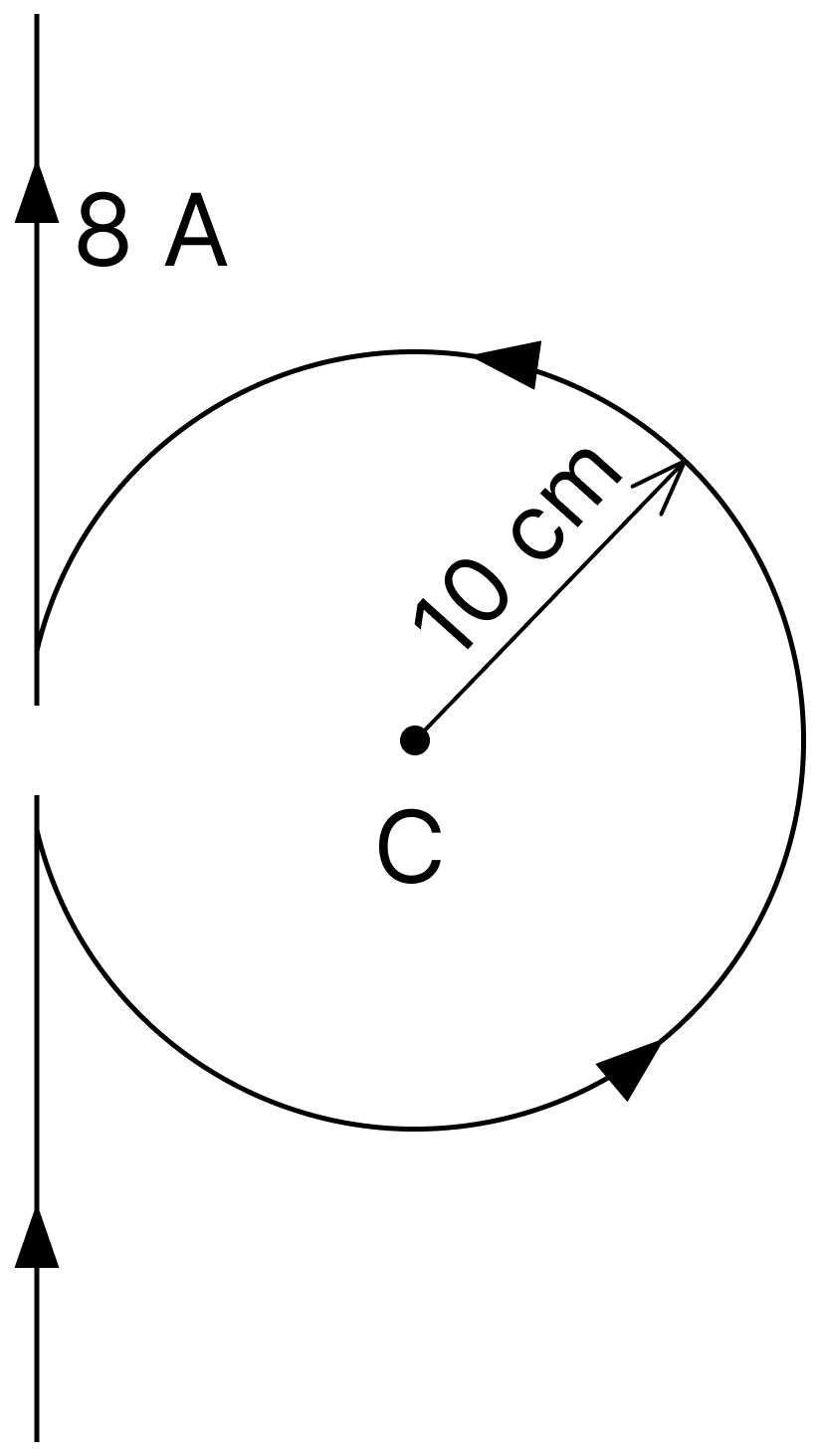
A long, straight wire is turned into a loop of radius R = 10 cm, as shown. If a current of 8 A is passed through the loop, find the magnetic field at the centre C of the loop. Moving Charges and Magnetic Field, Nootan Physics Solutions ICS Class 12

Answer

Given,

  • R = 10 cm = 0.1 m
  • I = 8 A

The field at C is the resultant of the field due to the long straight portion of the wire and that due to the circular loop.

Field due to the straight wire :

B1=μ04π2IRB1=(10−7)×2×80.1B1=1.6×10⁻⁵ T\text B_1 = \dfrac{\text μ_0}{4\text π}\dfrac{2\text I}{\text R} \\[1em] \text B_1 = (10^{-7}) \times \dfrac{2 \times 8}{0.1} \\[1em] \text B_1 = 1.6 \times 10^{-5}\ \text T

By the right-hand thumb rule this field is perpendicular to the plane of the paper, pointing downwards.

Field due to the loop :

B2=μ0I2RB2=(4π×10−7)(8)2×0.1B2=5.03×10⁻⁵ T\text B_2 = \dfrac{\text μ_0 \text I}{2\text R} \\[1em] \text B_2 = \dfrac{(4\text π \times 10^{-7})(8)}{2 \times 0.1} \\[1em] \text B_2 = 5.03 \times 10^{-5}\ \text T

This field is perpendicular to the plane of the paper, pointing upwards, that is, just opposite to B1.

Resultant field :

B=B2−B1B=(5.03−1.6)×10−5B=3.4×10⁻⁵ T\text B = \text B_2 - \text B_1 \\[1em] \text B = (5.03 - 1.6) \times 10^{-5} \\[1em] \text B = 3.4 \times 10^{-5}\ \text T

Hence, the magnetic field at the centre C is 3.4 × 10⁻⁵ T, perpendicular to the plane of paper pointing upwards.

Question 9

The figure shows two semi-circular current-loops of radii a1 and a2. Find the magnitude and direction of the magnetic field at the common centre O.
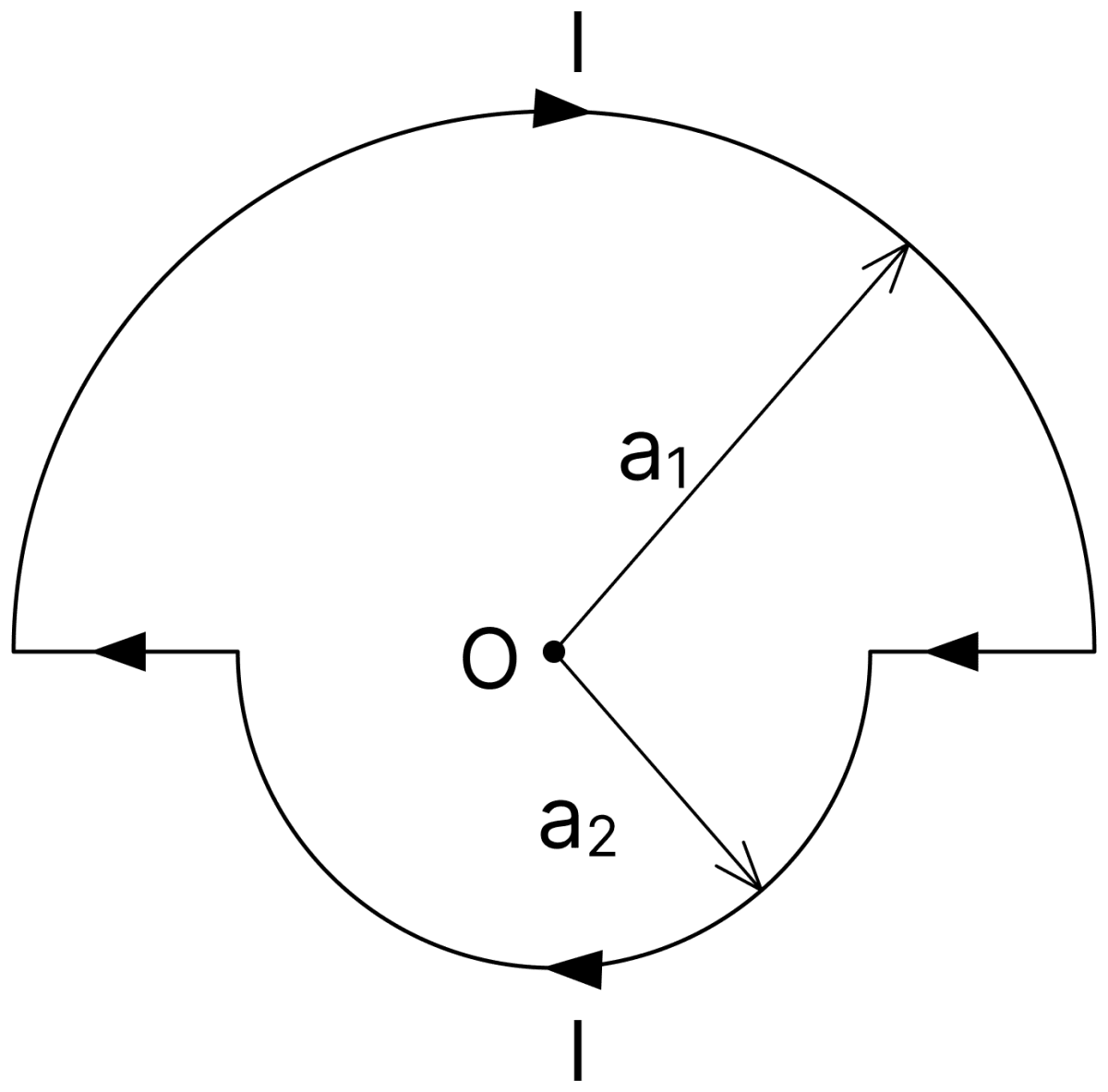
The figure shows two semi-circular current-loops of radii a 1 and a 2. Find the magnitude and direction of the magnetic field at the common centre O. Moving Charges and Magnetic Field, Nootan Physics Solutions ICS Class 12

Answer

Given, two semi-circular current-loops of radii a1 and a2 having the common centre O, each carrying a current I.

The magnetic field at the centre due to a circular arc subtending an angle θ (in radians) at the centre is

Barc=(μ04πIa)θ\text B_{\text{arc}} = \left(\dfrac{\text μ_0}{4\text π}\dfrac{\text I}{\text a}\right)\text θ

For a semi-circle, θ = π, so each loop gives

B1=μ0I4a1,B2=μ0I4a2\text B_1 = \dfrac{\text μ_0 \text I}{4\text a_1}, \qquad \text B_2 = \dfrac{\text μ_0 \text I}{4\text a_2}

The current flows in the same sense in both the semi-circles, so by the right-hand palm rule no. 1 both the fields at O are perpendicular to the plane of the paper, directed downwards, and they add up,

B=μ0I4a1+μ0I4a2B=μ0I4(1a1+1a2)\text B = \dfrac{\text μ_0 \text I}{4\text a_1} + \dfrac{\text μ_0 \text I}{4\text a_2} \\[1em] \text B = \dfrac{\text μ_0 \text I}{4}\left(\dfrac{1}{\text a_1} + \dfrac{1}{\text a_2}\right)

Hence, the magnetic field at the common centre O is μ0I4(1a1+1a2)\dfrac{\text μ_0 \text I}{4}\left(\dfrac{1}{\text a_1} + \dfrac{1}{\text a_2}\right), perpendicular to the plane of paper, directed downwards.

Question 10

A current of I ampere is flowing through the adjoining bent wire. Find the magnitude and direction of the magnetic field at the point O.
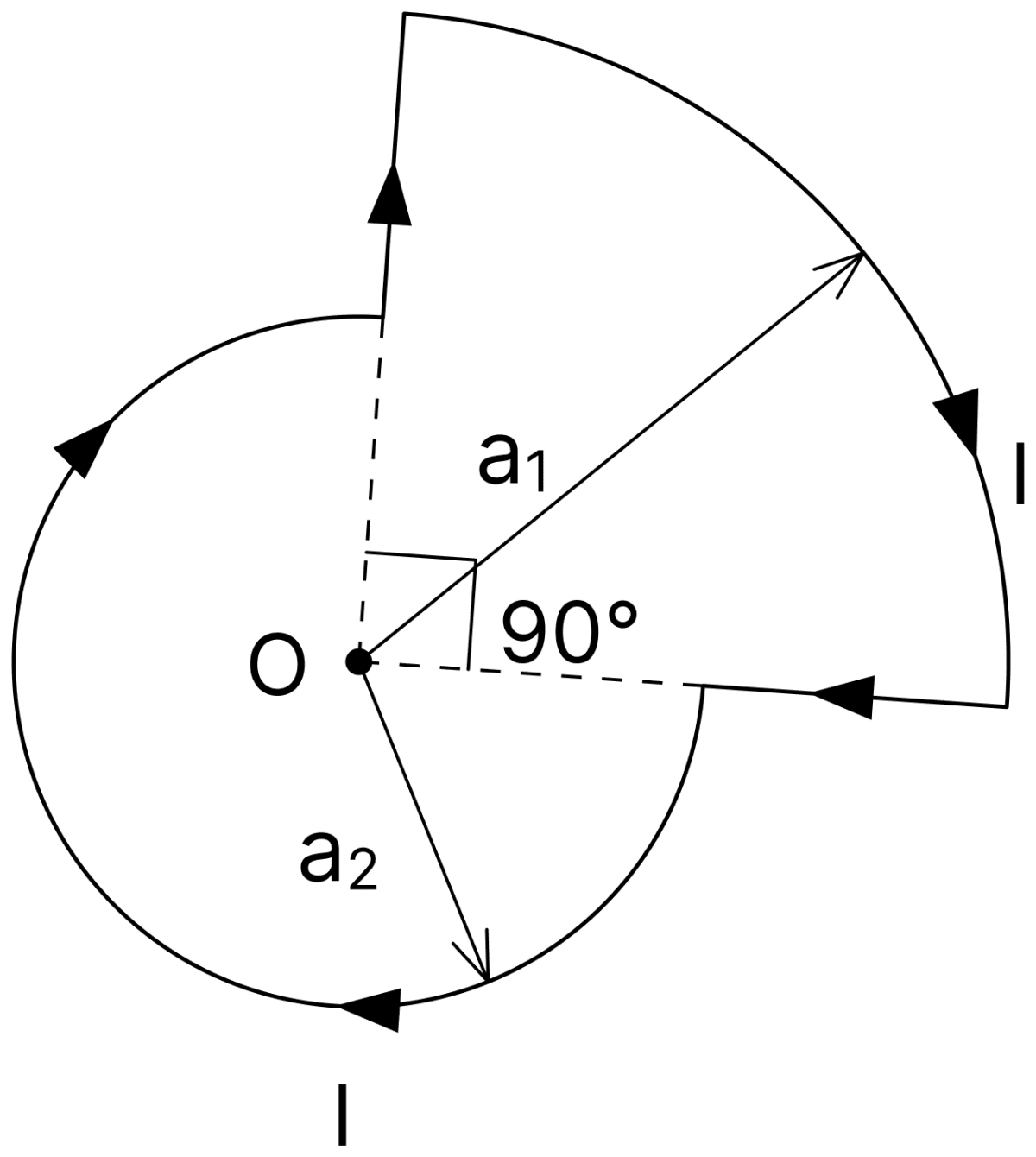
A current of I ampere is flowing through the adjoining bent wire. Find the magnitude and direction of the magnetic field at the point O. Moving Charges and Magnetic Field, Nootan Physics Solutions ICS Class 12

Answer

Given, a bent wire carrying a current I, consisting of an arc of radius a1 subtending 90° at O and an arc of radius a2 subtending 270° at O.

The field at the centre due to a circular arc subtending an angle θ (in radians) is

Barc=(μ04πIa)θ\text B_{\text{arc}} = \left(\dfrac{\text μ_0}{4\text π}\dfrac{\text I}{\text a}\right)\text θ

For the arc of radius a1, θ1=90°=π2\text θ_1 = 90° = \dfrac{\text π}{2},

B1=μ04πIa1×π2B1=μ0I8a1\text B_1 = \dfrac{\text μ_0}{4\text π}\dfrac{\text I}{\text a_1} \times \dfrac{\text π}{2} \\[1em] \text B_1 = \dfrac{\text μ_0 \text I}{8\text a_1}

For the arc of radius a2, θ2=270°=3π2\text θ_2 = 270° = \dfrac{3\text π}{2},

B2=μ04πIa2×3π2B2=3μ0I8a2\text B_2 = \dfrac{\text μ_0}{4\text π}\dfrac{\text I}{\text a_2} \times \dfrac{3\text π}{2} \\[1em] \text B_2 = \dfrac{3\text μ_0 \text I}{8\text a_2}

The straight radial portions pass through O, so for them θ = 0 and they develop no field at O. Both the arc fields are in the same direction, so

B=μ0I8(1a1+3a2)\text B = \dfrac{\text μ_0 \text I}{8}\left(\dfrac{1}{\text a_1} + \dfrac{3}{\text a_2}\right)

Hence, the magnetic field at O is μ0I8(1a1+3a2)\dfrac{\text μ_0 \text I}{8}\left(\dfrac{1}{\text a_1} + \dfrac{3}{\text a_2}\right), perpendicular to the page, directed downwards.

Question 11

Compute the magnitude and direction of the magnetic field at the centre O of the given current-carrying bent wire.
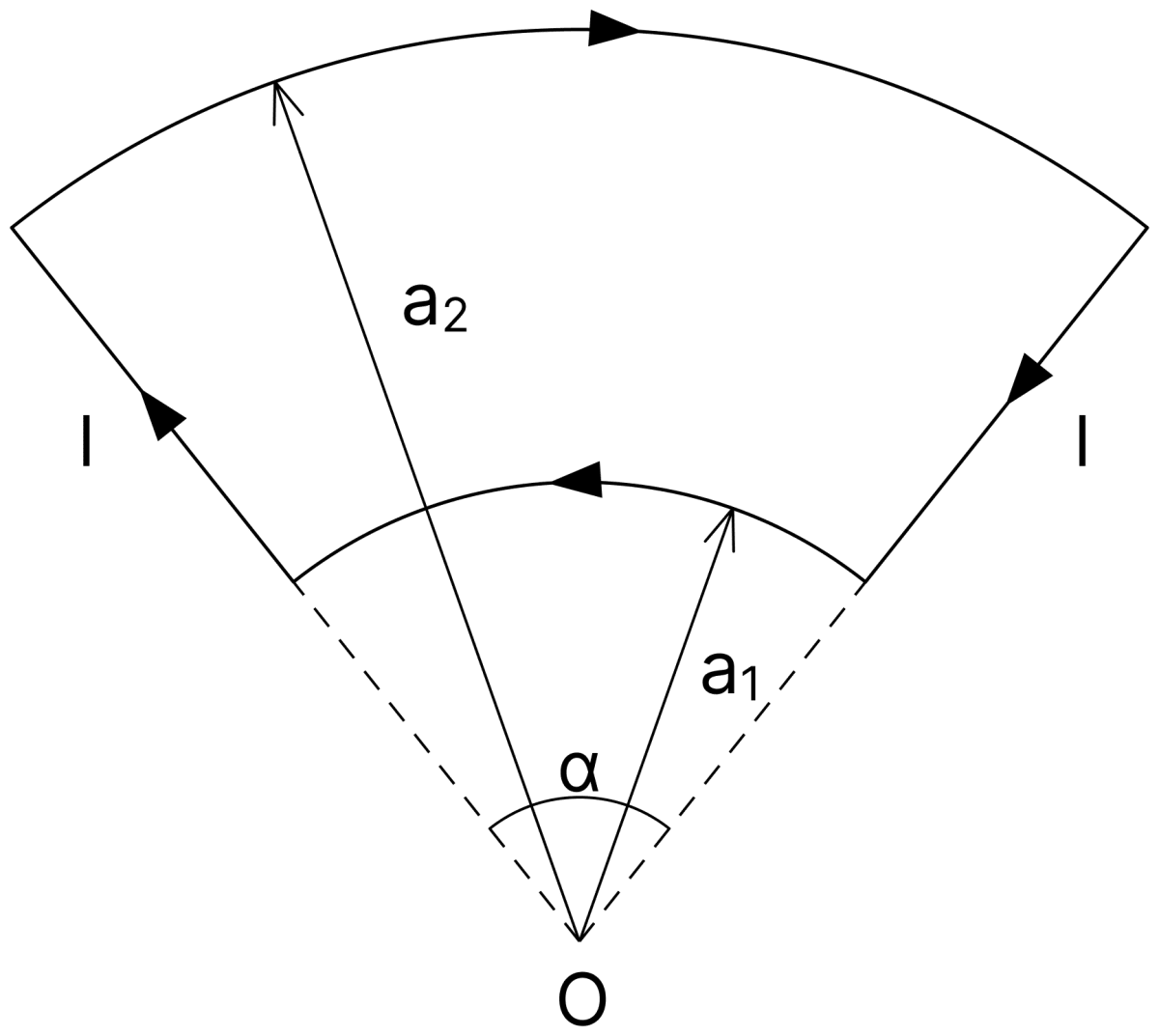
Compute the magnitude and direction of the magnetic field at the centre O of the given current-carrying bent wire. Moving Charges and Magnetic Field, Nootan Physics Solutions ICS Class 12

Answer

Given, two circular arcs of radii a1 and a2, each subtending an angle α at the centre O, joined by radial straight portions and carrying a current I.

The field at the centre due to an arc subtending an angle α at the centre is

Barc=(μ04πIa)α\text B_{\text{arc}} = \left(\dfrac{\text μ_0}{4\text π}\dfrac{\text I}{\text a}\right)\text α

So the two arcs give

B1=μ0Iα4πa1,B2=μ0Iα4πa2\text B_1 = \dfrac{\text μ_0 \text{Iα}}{4\text π \text a_1}, \qquad \text B_2 = \dfrac{\text μ_0 \text{Iα}}{4\text π \text a_2}

The straight portions lie along the radii through O, so for them θ = 0 and they develop no field at O.

The current traverses the inner arc and the outer arc in opposite senses, so the two fields at O are oppositely directed and

B=B1−B2B=μ0Iα4π(1a1−1a2)\text B = \text B_1 - \text B_2 \\[1em] \text B = \dfrac{\text μ_0 \text{Iα}}{4\text π}\left(\dfrac{1}{\text a_1} - \dfrac{1}{\text a_2}\right)

Hence, the magnetic field at O is μ0Iα4π(1a1−1a2)\dfrac{\text μ_0 \text{Iα}}{4\text π}\left(\dfrac{1}{\text a_1} - \dfrac{1}{\text a_2}\right), perpendicular to the plane of paper, directed upwards.
Question 12

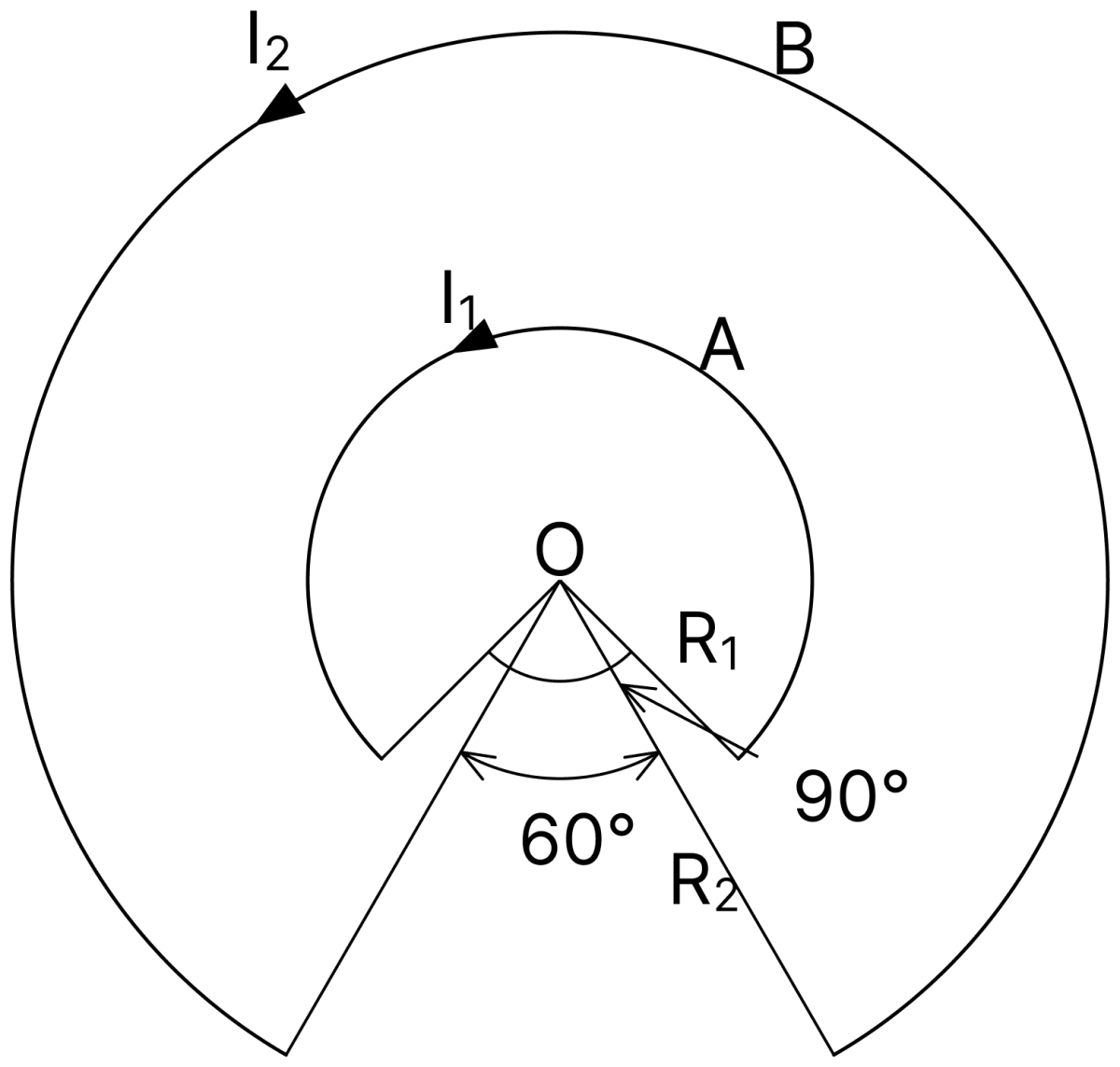
A wire A, bent in the shape of an arc of a circle, carrying a current of 2 A and having radius 3 cm and another wire B, also bent in the shape of an arc of a circle, carrying a current of 3 A and having radius 5 cm are placed as shown in the figure. Find net magnetic field at the common centre O. Moving Charges and Magnetic Field, Nootan Physics Solutions ICS Class 12

A wire A, bent in the shape of an arc of a circle, carrying a current of 2 A and having radius 3 cm and another wire B, also bent in the shape of an arc of a circle, carrying a current of 3 A and having radius 5 cm are placed as shown in the figure. Find net magnetic field at the common centre O.

Answer

Given,

  • wire A : I1 = 2 A, R1 = 3 cm = 0.03 m, the arc subtending 360° − 90° = 270° at O
  • wire B : I2 = 3 A, R2 = 5 cm = 0.05 m, the arc subtending 360° − 60° = 300° at O

The field at the centre due to an arc subtending an angle θ (in radians) is

Barc=(μ04πIR)θ\text B_{\text{arc}} = \left(\dfrac{\text μ_0}{4\text π}\dfrac{\text I}{\text R}\right)\text θ

Due to wire A, θ1=270°=3π2\text θ_1 = 270° = \dfrac{3\text π}{2} rad,

B1=(10−7)×20.03×3π2B1=(10−7)(66.67)(4.712)B1=3.14×10⁻⁵ T\text B_1 = (10^{-7}) \times \dfrac{2}{0.03} \times \dfrac{3\text π}{2} \\[1em] \text B_1 = (10^{-7})(66.67)(4.712) \\[1em] \text B_1 = 3.14 \times 10^{-5}\ \text T

Due to wire B, θ2=300°=5π3\text θ_2 = 300° = \dfrac{5\text π}{3} rad,

B2=(10−7)×30.05×5π3B2=(10−7)(60)(5.236)B2=3.14×10⁻⁵ T\text B_2 = (10^{-7}) \times \dfrac{3}{0.05} \times \dfrac{5\text π}{3} \\[1em] \text B_2 = (10^{-7})(60)(5.236) \\[1em] \text B_2 = 3.14 \times 10^{-5}\ \text T

Both the arcs carry their currents in the same sense, so the two fields at O are in the same direction and add up,

B=B1+B2B=3.14×10⁻⁵+3.14×10⁻⁵B=6.28×10⁻⁵ T\text B = \text B_1 + \text B_2 \\[1em] \text B = 3.14 \times 10^{-5} + 3.14 \times 10^{-5} \\[1em] \text B = 6.28 \times 10^{-5}\ \text T

Hence, the net magnetic field at the common centre O is 6.28 × 10⁻⁵ T.

Question 13

A conductor carrying current i is bent in the form of concentric semicircles as shown in the figure. Find the magnetic field at the centre O.
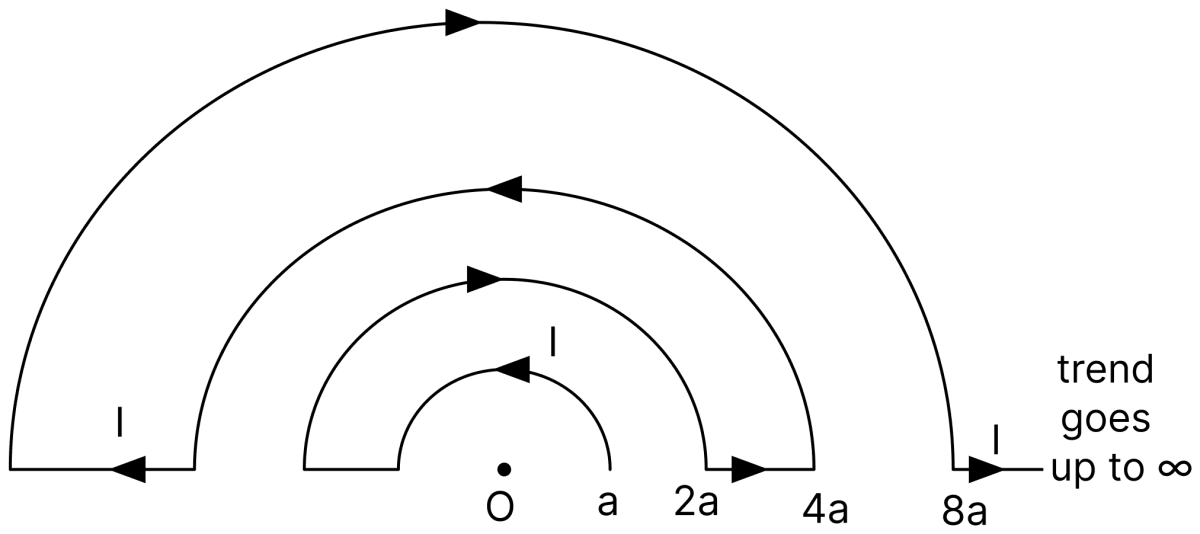
A conductor carrying current i is bent in the form of concentric semicircles as shown in the figure. Find the magnetic field at the centre O. Moving Charges and Magnetic Field, Nootan Physics Solutions ICS Class 12

Answer

Given, a conductor carrying a current i bent into concentric semicircles of radii a, 2a, 4a, 8a, ... , the trend continuing up to infinity.

The field at the centre due to a semicircle of radius a is

B=μ0i4a\text B = \dfrac{\text μ_0 \text i}{4\text a}

The successive semicircles are traversed in opposite senses, so their fields at O are alternately opposite in direction. Hence

B=μ0i4a−μ0i4(2a)+μ0i4(4a)−μ0i4(8a)+…B=μ0i4a[1−12+14−18+… ]\text B = \dfrac{\text μ_0 \text i}{4\text a} - \dfrac{\text μ_0 \text i}{4(2\text a)} + \dfrac{\text μ_0 \text i}{4(4\text a)} - \dfrac{\text μ_0 \text i}{4(8\text a)} + \dots \\[1em] \text B = \dfrac{\text μ_0 \text i}{4\text a}\left[1 - \dfrac{1}{2} + \dfrac{1}{4} - \dfrac{1}{8} + \dots\right]

The series in the bracket is an infinite geometric series with first term 1 and common ratio r=−12\text r = -\dfrac{1}{2}, so its sum is

S=11−(−12)S=132S=23B=μ0i4a×23B=μ0i6a\text S = \dfrac{1}{1 - \left(-\dfrac{1}{2}\right)} \\[1em] \text S = \dfrac{1}{\dfrac{3}{2}} \\[1em] \text S = \dfrac{2}{3} \\[1em] \text B = \dfrac{\text μ_0 \text i}{4\text a} \times \dfrac{2}{3} \\[1em] \text B = \dfrac{\text μ_0 \text i}{6\text a}

Hence, the magnetic field at the centre O is μ0i6a\dfrac{\text μ_0 \text i}{6\text a}.

Question 14

Current i = 2.5 A flows along the circle x2 + y2 = 9 cm2 (here x and y are in cm) as shown. Find magnitude and direction of magnetic field (in Tesla) at point (0, 0, 4 cm).
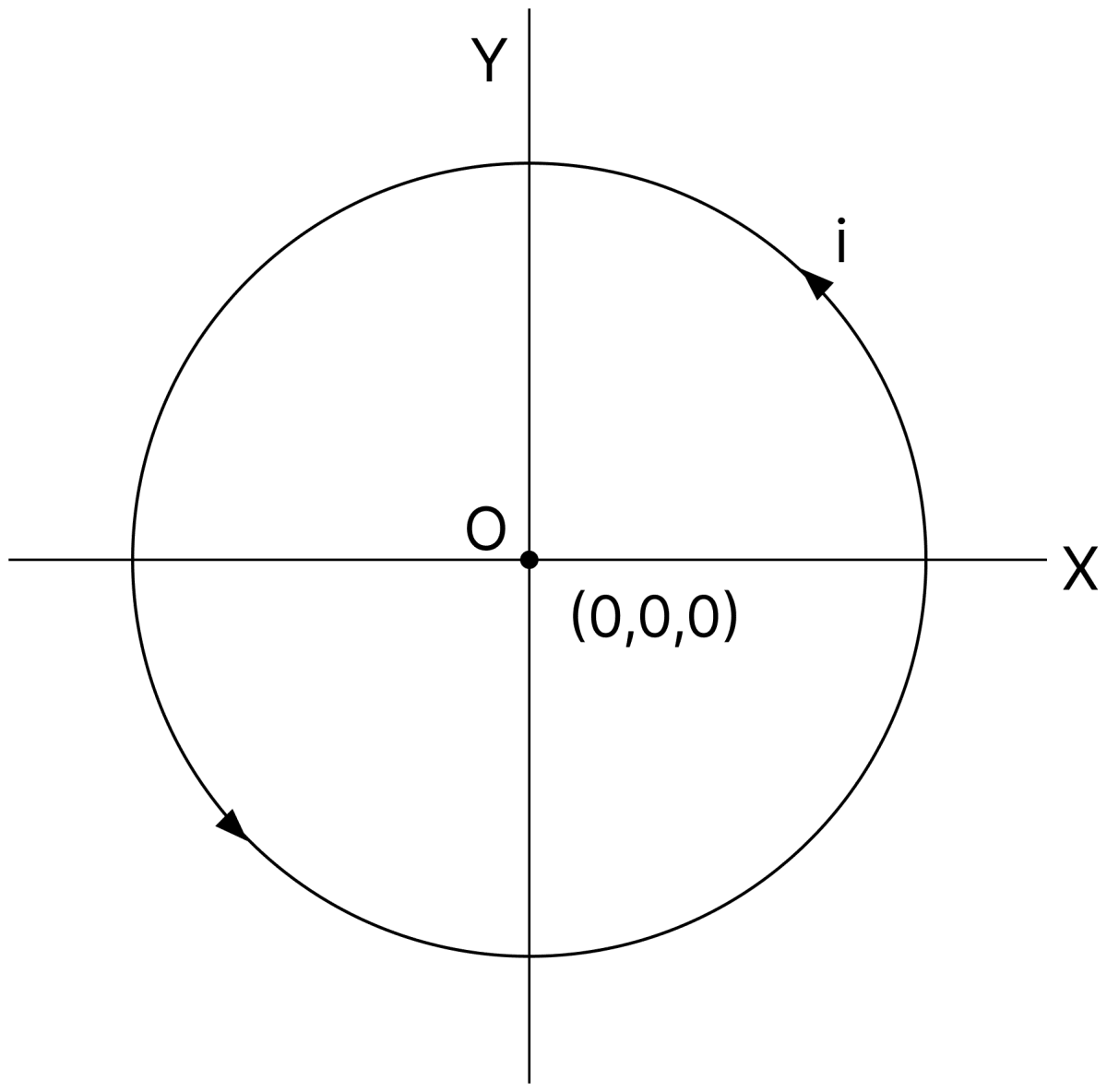
Current i = 2.5 A flows along the circle x 2 + y 2 = 9 cm 2 (here x and y are in cm) as shown. Find magnitude and direction of magnetic field (in Tesla) at point (0, 0, 4 cm). Moving Charges and Magnetic Field, Nootan Physics Solutions ICS Class 12

Answer

Given,

  • i = 2.5 A
  • the circle x2 + y2 = 9 cm2, so a = 3 cm = 0.03 m
  • the point (0, 0, 4 cm), so x = 4 cm = 0.04 m on the axis

The field at a point on the axis of a circular loop is

B=μ04π2πia2(a2+x2)3/2\text B = \dfrac{\text μ_0}{4\text π}\dfrac{2\text{πia}^2}{(\text a^2 + \text x^2)^{3/2}}

Now,

a2+x2=(0.03)2+(0.04)2a2+x2=0.0009+0.0016a2+x2=0.0025(a2+x2)3/2=(0.0025)3/2(a2+x2)3/2=1.25×10−4\text a^2 + \text x^2 = (0.03)^2 + (0.04)^2 \\[1em] \text a^2 + \text x^2 = 0.0009 + 0.0016 \\[1em] \text a^2 + \text x^2 = 0.0025 \\[1em] (\text a^2 + \text x^2)^{3/2} = (0.0025)^{3/2} \\[1em] (\text a^2 + \text x^2)^{3/2} = 1.25 \times 10^{-4}

Substituting,

B=(10−7)×2×3.14×2.5×(0.03)21.25×10⁻⁴B=(10−7)×1.413×10−21.25×10−4B=36π×10−7 T\text B = (10^{-7}) \times \dfrac{2 \times 3.14 \times 2.5 \times (0.03)^2}{1.25 \times 10^{-4}} \\[1em] \text B = (10^{-7}) \times \dfrac{1.413 \times 10^{-2}}{1.25 \times 10^{-4}} \\[1em] \text B = 36\text π \times 10^{-7}\ \text T

The point lies on the positive Z-axis, and by the right-hand palm rule no. 1 the field is directed along the +Z-axis.

Hence, the magnetic field at the point (0, 0, 4 cm) is 36π × 10-7 T, directed along the +ve Z-axis.

Question 15

An air-solenoid has 500 turns of wire in its 40 cm length. If the current in the wire be 1.0 A, find the magnetic field at the axis inside the solenoid.

Answer

Given,

  • N = 500 turns
  • length, l = 40 cm = 0.4 m
  • I = 1.0 A

The number of turns per metre length is

n=Nln=5000.4n=1250 turns m−1\text n = \dfrac{\text N}{l} \\[1em] \text n = \dfrac{500}{0.4} \\[1em] \text n = 1250\ \text{turns m}^{-1}

For a long solenoid, the field at the axis inside is

B=μ0nIB=(4π×10−7)(1250)(1.0)B=1.57×10⁻³ NA−1m−1\text B = \text μ_0 \text n \text I \\[1em] \text B = (4\text π \times 10^{-7})(1250)(1.0) \\[1em] \text B = 1.57 \times 10^{-3}\ \text N \text A^{-1} \text m^{-1}

Hence, the magnetic field at the axis inside the solenoid is 1.57 × 10⁻³ N A-1 m-1.

Question 16

A 80 cm long solenoid of diameter 1.8 cm has 5 layers of windings of 400 turns each and carries a current of 8.0 A. Estimate magnetic field inside the solenoid near the centre.

Answer

Given,

  • length, l = 80 cm = 0.8 m
  • 5 layers of windings of 400 turns each, so N = 5 × 400 = 2000 turns
  • I = 8.0 A

The number of turns per metre length is

n=Nln=20000.8n=2500 turns m−1\text n = \dfrac{\text N}{l} \\[1em] \text n = \dfrac{2000}{0.8} \\[1em] \text n = 2500\ \text{turns m}^{-1}

Near the centre of a long solenoid,

B=μ0nIB=(4π×10−7)(2500)(8.0)B=2.5×10⁻² T\text B = \text μ_0 \text n \text I \\[1em] \text B = (4\text π \times 10^{-7})(2500)(8.0) \\[1em] \text B = 2.5 \times 10^{-2}\ \text T

The field is independent of the diameter of the solenoid, so the value 1.8 cm is not needed.

Hence, the magnetic field inside the solenoid near the centre is 2.5 × 10⁻² T.

Question 17

The magnetic field at the centre of a 50 cm long solenoid is 4.0 × 10⁻² T. When a current of 8.0 A flows through it. What is the number of turns in the solenoid? (π = 3.14).

Answer

Given,

  • B = 4.0 × 10⁻² T
  • length, l = 50 cm = 0.5 m
  • I = 8.0 A, π = 3.14

For a long solenoid, B = μ0nI, so the number of turns per metre is

n=Bμ0In=4.0×10⁻²(4×3.14×10−7)(8.0)n=4.0×10−21.0048×10−5n=3981 turns m−1\text n = \dfrac{\text B}{\text μ_0 \text I} \\[1em] \text n = \dfrac{4.0 \times 10^{-2}}{(4 \times 3.14 \times 10^{-7})(8.0)} \\[1em] \text n = \dfrac{4.0 \times 10^{-2}}{1.0048 \times 10^{-5}} \\[1em] \text n = 3981\ \text{turns m}^{-1}

The total number of turns in the solenoid is

N=n×lN=3981×0.5≈1990\text N = \text n \times l \\[1em] \text N = 3981 \times 0.5 \approx 1990

Hence, the number of turns in the solenoid is 1990.

Question 18

An electron, moving with a velocity of 5 × 10⁷ m s-1, enters a magnetic field of 1 Wb m-2 at an angle of 30°. Calculate the force on the electron.

Answer

Given,

  • v = 5 × 10⁷ m s-1
  • B = 1 Wb m-2
  • θ = 30°
  • q = e = 1.6 × 10⁻¹⁹ C

The force on a charge moving in a magnetic field is

F=Bqvsin⁡θ\text F = \text{Bqv} \sin \text θ

Substituting the values,

F=(1)(1.6×10⁻¹⁹)(5×10⁷)(sin⁡30°)F=(1.6×10⁻¹⁹)(5×10⁷)(0.5)F=4.0×10⁻¹² N\text F = (1)(1.6 \times 10^{-19})(5 \times 10^7)(\sin 30°) \\[1em] \text F = (1.6 \times 10^{-19})(5 \times 10^7)(0.5) \\[1em] \text F = 4.0 \times 10^{-12}\ \text N

Hence, the force on the electron is 4.0 × 10⁻¹² N.

Question 19

An electron is moving vertically upwards with a speed of 2.0 × 10⁸ ms-1. What will be the magnitude and direction of the force on the electron exerted by a horizontal magnetic field of 0.50 NA-1m-1 directed towards west? What will be the acceleration of the electron?

Answer

Given,

  • v = 2.0 × 10⁸ m s-1, vertically upwards
  • B = 0.50 N A-1 m-1, towards west
  • me = 9.1 × 10⁻³¹ kg

The velocity is perpendicular to the field, so θ = 90° and

F=BevF=(0.50)(1.6×10⁻¹⁹)(2.0×10⁸)F=1.6×10⁻¹¹ N\text F = \text{Bev} \\[1em] \text F = (0.50)(1.6 \times 10^{-19})(2.0 \times 10^8) \\[1em] \text F = 1.6 \times 10^{-11}\ \text N

The electron is negatively charged, so the direction of current is vertically downwards. Applying Fleming's left-hand rule with the current downwards and the field towards the west, the force on the electron is directed towards the north.

The acceleration of the electron is

a=Fma=1.6×10−119.1×10⁻³¹a=1.8×10¹⁹ m s−2\text a = \dfrac{\text F}{\text m} \\[1em] \text a = \dfrac{1.6 \times 10^{-11}}{9.1 \times 10^{-31}} \\[1em] \text a = 1.8 \times 10^{19}\ \text m\ \text s^{-2}

Hence, the force on the electron is 1.6 × 10⁻¹¹ N towards north, and its acceleration is 1.8 × 10¹⁹ m s-2.

Question 20

A proton moving towards east in a horizontal plane enters a horizontal magnetic field of 0.34 T directed towards north with a speed of 2.0 × 10⁷ ms-1. Calculate (i) the magnitude and direction of the force on the proton, (ii) radius of proton's path and (iii) the lateral displacement of the proton while moving 0.20 m towards east.

Answer

Given,

  • v = 2.0 × 10⁷ ms-1, towards east
  • B = 0.34 T, towards north
  • mp = 1.7 × 10⁻²⁷ kg, q = 1.6 × 10⁻¹⁹ C

(i) The velocity is perpendicular to the field, so

F=qvBF=(1.6×10⁻¹⁹)(2.0×10⁷)(0.34)F=1.09×10⁻¹² N\text F = \text{qvB} \\[1em] \text F = (1.6 \times 10^{-19})(2.0 \times 10^7)(0.34) \\[1em] \text F = 1.09 \times 10^{-12}\ \text N

Taking east along i^\hat{\text i} and north along j^\hat{\text j}, v⃗×B⃗=vB(i^×j^)=vB k^\vec{\text v} \times \vec{\text B} = \text{vB}(\hat{\text i} \times \hat{\text j}) = \text{vB}\ \hat{\text k}, so the force on the proton is directed vertically upwards.

(ii) The radius of the proton's path is

r=mvqBr=(1.7×10⁻²⁷)(2.0×10⁷)(1.6×10⁻¹⁹)(0.34)r=3.4×10−205.44×10⁻²⁰r=0.625 m\text r = \dfrac{\text{mv}}{\text{qB}} \\[1em] \text r = \dfrac{(1.7 \times 10^{-27})(2.0 \times 10^7)}{(1.6 \times 10^{-19})(0.34)} \\[1em] \text r = \dfrac{3.4 \times 10^{-20}}{5.44 \times 10^{-20}} \\[1em] \text r = 0.625\ \text m

(iii) Let the lateral displacement be y while the proton advances a distance x = 0.20 m along the east. From the geometry of the circular path,

y=r−r2−x2y=0.625−(0.625)2−(0.20)2y=0.625−0.390625−0.04y=0.625−0.350625y=0.625−0.592y=0.033 m\text y = \text r - \sqrt{\text r^2 - \text x^2} \\[1em] \text y = 0.625 - \sqrt{(0.625)^2 - (0.20)^2} \\[1em] \text y = 0.625 - \sqrt{0.390625 - 0.04} \\[1em] \text y = 0.625 - \sqrt{0.350625} \\[1em] \text y = 0.625 - 0.592 \\[1em] \text y = 0.033\ \text m

Hence, the force is 1.09 × 10⁻¹² N vertically upwards, the radius of the path is 0.625 m and the lateral displacement is 0.033 m.

Note: The textbook answer 0.032 m (approx.) results from the approximation y ≈ x2/2r; the exact value is 0.033 m.

Question 21

A 2 MeV proton is moving perpendicular to a uniform magnetic field of 2.5 T. Find the force on the proton. Take mass of proton as 1.65 × 10⁻²⁷ kg.

Answer

Given,

  • kinetic energy, K = 2 MeV = 2 × 106 × 1.6 × 10-19 = 3.2 × 10⁻¹³ J
  • B = 2.5 T
  • mp = 1.65 × 10⁻²⁷ kg, q = 1.6 × 10⁻¹⁹ C

The speed of the proton is obtained from K=12mv2\text K = \dfrac{1}{2}\text{mv}^2,

v=2Kmv=2×3.2×10−131.65×10⁻²⁷v=3.879×10¹⁴v=1.97×10⁷ m s−1\text v = \sqrt{\dfrac{2\text K}{\text m}} \\[1em] \text v = \sqrt{\dfrac{2 \times 3.2 \times 10^{-13}}{1.65 \times 10^{-27}}} \\[1em] \text v = \sqrt{3.879 \times 10^{14}} \\[1em] \text v = 1.97 \times 10^7\ \text m\ \text s^{-1}

The proton moves perpendicular to the field, so

F=qvBF=(1.6×10⁻¹⁹)(1.97×10⁷)(2.5)F=7.88×10⁻¹² N\text F = \text{qvB} \\[1em] \text F = (1.6 \times 10^{-19})(1.97 \times 10^7)(2.5) \\[1em] \text F = 7.88 \times 10^{-12}\ \text N

Hence, the force on the proton is 7.88 × 10⁻¹² N.

Question 22

PQ is a long straight conductor carrying a current of 3A as shown in Fig. A proton moves with a velocity of 2 × 10⁷ ms-1 parallel to it. Find the force acting on the proton.
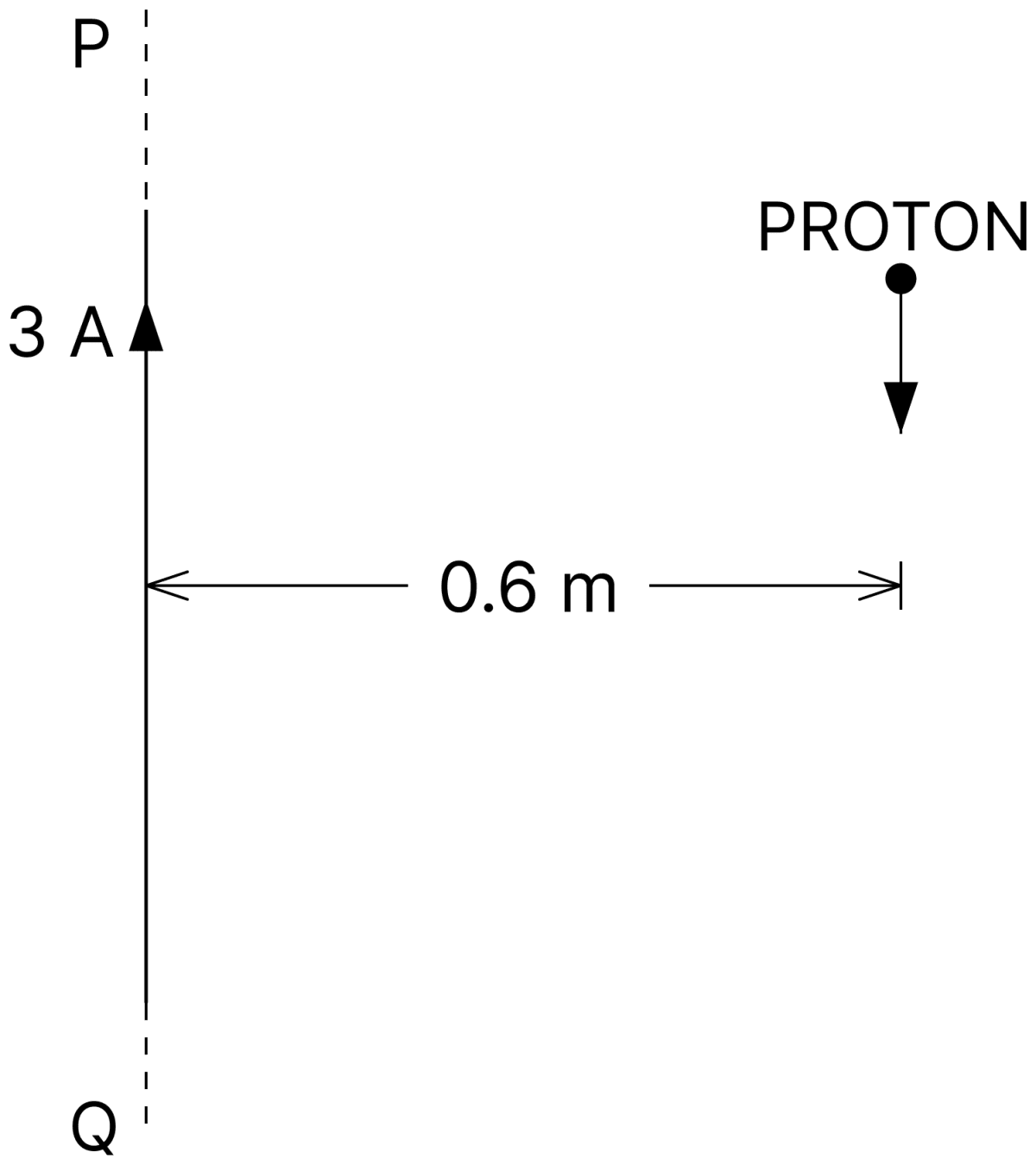
PQ is a long straight conductor carrying a current of 3A as shown in Fig. A proton moves with a velocity of 2 × 10 7 ms -1 parallel to it. Find the force acting on the proton. Moving Charges and Magnetic Field, Nootan Physics Solutions ICS Class 12

Answer

Given,

  • I = 3 A in the conductor PQ
  • v = 2 × 10⁷ ms-1, parallel to the conductor but opposite to the current (downwards)
  • r = 0.6 m

The magnetic field produced by the conductor at the position of the proton is

B=μ04π2IrB=(10−7)×2×30.6B=1×10⁻⁶ T\text B = \dfrac{\text μ_0}{4\text π}\dfrac{2\text I}{\text r} \\[1em] \text B = (10^{-7}) \times \dfrac{2 \times 3}{0.6} \\[1em] \text B = 1 \times 10^{-6}\ \text T

This field is perpendicular to the plane of the paper, directed into it (right-hand thumb rule), so the proton moves at right angles to it and

F=qvBF=(1.6×10⁻¹⁹)(2×10⁷)(1×10⁻⁶)F=3.2×10⁻¹⁸ N\text F = \text{qvB} \\[1em] \text F = (1.6 \times 10^{-19})(2 \times 10^7)(1 \times 10^{-6}) \\[1em] \text F = 3.2 \times 10^{-18}\ \text N

Applying Fleming's left-hand rule, this force on the proton is directed towards the right, that is, away from the wire.

Hence, the force acting on the proton is 3.2 × 10⁻¹⁸ N, towards right away from the wire.

Question 23

An electron accelerated by a potential difference of 300 V, is moving at a distance of 4 mm from a long, straight wire. If a current of 5 A flows through the wire, what will be the force acting on the electron?

Answer

Given,

  • accelerating potential, V = 300 V
  • distance from the wire, r = 4 mm = 4 × 10⁻³ m
  • I = 5 A

The speed acquired by the electron is obtained from 12mv2=eV\dfrac{1}{2}\text{mv}^2 = \text{eV},

v=2eVmv=2(1.6×10⁻¹⁹)(300)9.1×10⁻³¹v=1.055×10¹⁴v=1.03×10⁷ m s−1\text v = \sqrt{\dfrac{2\text{eV}}{\text m}} \\[1em] \text v = \sqrt{\dfrac{2(1.6 \times 10^{-19})(300)}{9.1 \times 10^{-31}}} \\[1em] \text v = \sqrt{1.055 \times 10^{14}} \\[1em] \text v = 1.03 \times 10^7\ \text m\ \text s^{-1}

The magnetic field of the wire at the position of the electron is

B=μ04π2IrB=(10−7)×2×54×10−3B=2.5×10⁻⁴ T\text B = \dfrac{\text μ_0}{4\text π}\dfrac{2\text I}{\text r} \\[1em] \text B = (10^{-7}) \times \dfrac{2 \times 5}{4 \times 10^{-3}} \\[1em] \text B = 2.5 \times 10^{-4}\ \text T

Taking the electron to move parallel to the wire, its velocity is perpendicular to this field, so

F=evBF=(1.6×10⁻¹⁹)(1.03×10⁷)(2.5×10⁻⁴)F=4×10⁻¹⁶ N\text F = \text{evB} \\[1em] \text F = (1.6 \times 10^{-19})(1.03 \times 10^7)(2.5 \times 10^{-4}) \\[1em] \text F = 4 \times 10^{-16}\ \text N

Hence, the force acting on the electron is 4 × 10-16 N.

Question 24

A uniform magnetic field of 6.5 G (1 G = 10-4 T) is maintained in a chamber. An electron is shot into the field with a speed of 4.8 × 10⁶ ms-1 normal to the field. Determine the radius of the circular orbit and the frequency of revolution of the electron in its orbit. Does the frequency depend upon the speed of the electron?

Answer

Given,

  • B = 6.5 G = 6.5 × 10⁻⁴ T
  • v = 4.8 × 10⁶ ms-1, normal to the field
  • me = 9.1 × 10⁻³¹ kg, e = 1.6 × 10⁻¹⁹ C

Radius of the circular orbit :

r=mveBr=(9.1×10⁻³¹)(4.8×10⁶)(1.6×10⁻¹⁹)(6.5×10⁻⁴)r=4.368×10−241.04×10⁻²²r=4.2×10⁻² mr=4.2 cm\text r = \dfrac{\text{mv}}{\text{eB}} \\[1em] \text r = \dfrac{(9.1 \times 10^{-31})(4.8 \times 10^6)}{(1.6 \times 10^{-19})(6.5 \times 10^{-4})} \\[1em] \text r = \dfrac{4.368 \times 10^{-24}}{1.04 \times 10^{-22}} \\[1em] \text r = 4.2 \times 10^{-2}\ \text m \\[1em] \text r = 4.2\ \text{cm}

Frequency of revolution :

n=eB2πmn=(1.6×10⁻¹⁹)(6.5×10⁻⁴)2×3.14×9.1×10−31n=1.04×10−225.71×10⁻³⁰n=1.8×10⁷ Hzn=18 MHz\text n = \dfrac{\text{eB}}{2\text{πm}} \\[1em] \text n = \dfrac{(1.6 \times 10^{-19})(6.5 \times 10^{-4})}{2 \times 3.14 \times 9.1 \times 10^{-31}} \\[1em] \text n = \dfrac{1.04 \times 10^{-22}}{5.71 \times 10^{-30}} \\[1em] \text n = 1.8 \times 10^7\ \text{Hz} \\[1em] \text n = 18\ \text{MHz}

No, the frequency does not depend upon the speed of the electron.

Explanation:
The expression n=eB2πm\text n = \dfrac{\text{eB}}{2\text{πm}} contains only e, B and m. If the speed increases, the radius increases in the same proportion, so the time taken for one revolution remains the same.

Hence, the radius of the orbit is 4.2 cm and the frequency of revolution is 18 MHz, which is independent of the speed.

Question 25

An α-particle is moving along a circle of radius 0.45 m in a magnetic field of 12 T. Find (i) the speed of the particle, (ii) the time-period of the particle. (Mass of α-particle is 6.7 × 10⁻²⁷ kg.)

Answer

Given,

  • r = 0.45 m
  • B = 12 T
  • m = 6.7 × 10⁻²⁷ kg
  • charge of α-particle, q = 2e = 3.2 × 10⁻¹⁹ C

(i) From r=mvqB\text r = \dfrac{\text{mv}}{\text{qB}},

v=qBrmv=(3.2×10⁻¹⁹)(12)(0.45)6.7×10⁻²⁷v=1.728×10−186.7×10⁻²⁷v=2.58×10⁸ ms−1\text v = \dfrac{\text{qBr}}{\text m} \\[1em] \text v = \dfrac{(3.2 \times 10^{-19})(12)(0.45)}{6.7 \times 10^{-27}} \\[1em] \text v = \dfrac{1.728 \times 10^{-18}}{6.7 \times 10^{-27}} \\[1em] \text v = 2.58 \times 10^8\ \text{ms}^{-1}

(ii) The time-period of the particle is

T=2πmqBT=2×3.14×6.7×10−27(3.2×10⁻¹⁹)(12)T=4.21×10−263.84×10⁻¹⁸T=1.10×10⁻⁸ s\text T = \dfrac{2\text{πm}}{\text{qB}} \\[1em] \text T = \dfrac{2 \times 3.14 \times 6.7 \times 10^{-27}}{(3.2 \times 10^{-19})(12)} \\[1em] \text T = \dfrac{4.21 \times 10^{-26}}{3.84 \times 10^{-18}} \\[1em] \text T = 1.10 \times 10^{-8}\ \text s

Hence, the speed of the particle is 2.58 × 10⁸ ms-1 and its time-period is 1.10 × 10⁻⁸ s.

Note: The textbook gives 1.09 × 10⁻⁸ s; 4.21/3.84 = 1.096, which rounds to 1.10.

Question 26

An electron is moving with a speed of 3.0 × 10⁷ ms-1 along a circle in a magnetic field of 0.50 N A-1 m-1. Calculate the radius of the circle and the kinetic energy of the electron.

Answer

Given,

  • v = 3.0 × 10⁷ ms-1
  • B = 0.50 N A-1 m-1
  • me = 9.1 × 10⁻³¹ kg, e = 1.6 × 10⁻¹⁹ C

Radius of the circle :

r=mveBr=(9.1×10⁻³¹)(3.0×10⁷)(1.6×10⁻¹⁹)(0.50)r=2.73×10−238.0×10⁻²⁰r=3.4×10⁻⁴ mr=0.34 mm\text r = \dfrac{\text{mv}}{\text{eB}} \\[1em] \text r = \dfrac{(9.1 \times 10^{-31})(3.0 \times 10^7)}{(1.6 \times 10^{-19})(0.50)} \\[1em] \text r = \dfrac{2.73 \times 10^{-23}}{8.0 \times 10^{-20}} \\[1em] \text r = 3.4 \times 10^{-4}\ \text m \\[1em] \text r = 0.34\ \text{mm}

Kinetic energy of the electron :

K=12mv2K=12(9.1×10⁻³¹)(3.0×10⁷)2K=12(9.1×10⁻³¹)(9.0×10¹⁴)K=4.1×10⁻¹⁶ J\text K = \dfrac{1}{2}\text{mv}^2 \\[1em] \text K = \dfrac{1}{2}(9.1 \times 10^{-31})(3.0 \times 10^7)^2 \\[1em] \text K = \dfrac{1}{2}(9.1 \times 10^{-31})(9.0 \times 10^{14}) \\[1em] \text K = 4.1 \times 10^{-16}\ \text J

Hence, the radius of the circle is 0.34 mm and the kinetic energy of the electron is 4.1 × 10⁻¹⁶ J.

Question 27

An electron of 40 eV energy is revolving in a circular path in a magnetic field of 9 × 10⁻⁵ T. Determine (i) speed of the electron, (ii) radius of the circular path.

Answer

Given,

  • energy of the electron, K = 40 eV = 40 × 1.6 × 10-19 = 6.4 × 10⁻¹⁸ J
  • B = 9 × 10⁻⁵ T

(i) From K=12mv2\text K = \dfrac{1}{2}\text{mv}^2,

v=2Kmv=2×6.4×10−189.1×10⁻³¹v=1.407×10¹³v=3.75×10⁶ ms−1\text v = \sqrt{\dfrac{2\text K}{\text m}} \\[1em] \text v = \sqrt{\dfrac{2 \times 6.4 \times 10^{-18}}{9.1 \times 10^{-31}}} \\[1em] \text v = \sqrt{1.407 \times 10^{13}} \\[1em] \text v = 3.75 \times 10^6\ \text{ms}^{-1}

(ii) The radius of the circular path is

r=mveBr=(9.1×10⁻³¹)(3.75×10⁶)(1.6×10⁻¹⁹)(9×10⁻⁵)r=3.41×10−241.44×10⁻²³r=0.237 mr=23.7 cm\text r = \dfrac{\text{mv}}{\text{eB}} \\[1em] \text r = \dfrac{(9.1 \times 10^{-31})(3.75 \times 10^6)}{(1.6 \times 10^{-19})(9 \times 10^{-5})} \\[1em] \text r = \dfrac{3.41 \times 10^{-24}}{1.44 \times 10^{-23}} \\[1em] \text r = 0.237\ \text m \\[1em] \text r = 23.7\ \text{cm}

Hence, the speed of the electron is 3.75 × 10⁶ ms-1 and the radius of the circular path is 23.7 cm.

Question 28

A mass spectrometer is a device that selects particles of a fixed mass. An ion with electric charge q > 0 and mass m starts at rest at a source S and is accelerated through a potential difference V. It passes through a hole into a region with a constant magnetic field B⃗ \vec{\text B} \spaceperpendicular to the plane as shown in the figure. The particle is deflected by the magnetic field and emerges through the hole in the bottom of the figure that is at distance d from the hole at the top. What is the mass of the particle?
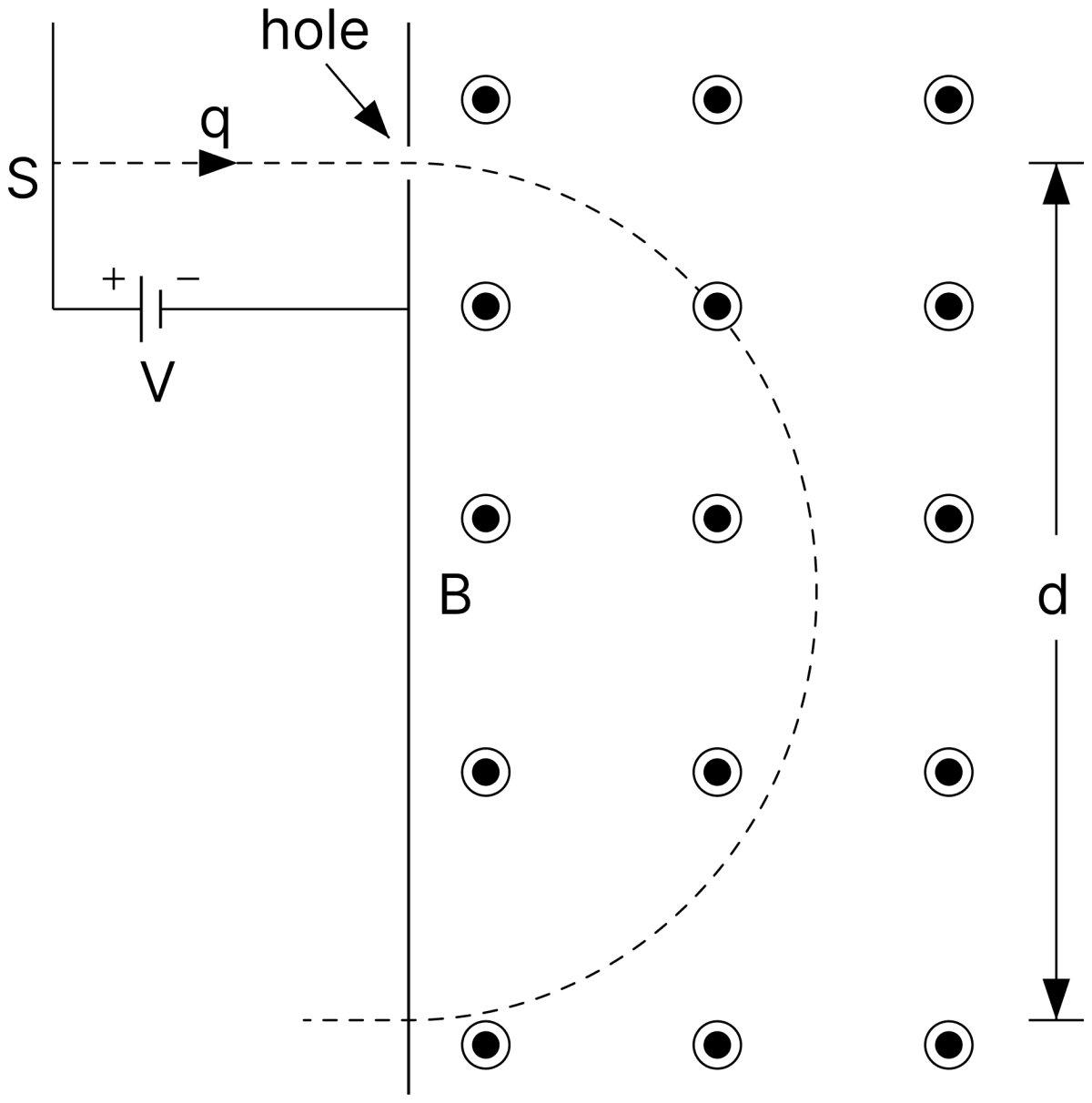
A mass spectrometer is a device that selects particles of a fixed mass. An ion with electric charge q > 0 and mass m starts at rest at a source S and is accelerated through a potential difference V. It passes through a hole into a region with a constant magnetic field vec text B perpendicular to the plane as shown in the figure. The particle is deflected by the magnetic field and emerges through the hole in the bottom of the figure that is at distance d from the hole at the top. What is the mass of the particle? Moving Charges and Magnetic Field, Nootan Physics Solutions ICS Class 12

Answer

Given,

  • charge on the ion = q (mass m to be found)
  • accelerating potential difference = V
  • magnetic field = B, perpendicular to the plane of the figure
  • the ion emerges at a distance d from the entry hole

The ion starts from rest and is accelerated through the potential difference V, so

12mv2=qV⇒v=2qVm…(i)\dfrac{1}{2}\text{mv}^2 = \text{qV} \quad \Rightarrow \quad \text v = \sqrt{\dfrac{2\text{qV}}{\text m}} \qquad \dots(\text i)

Inside the field region the magnetic force provides the centripetal force, so the ion describes a semi-circle of radius

r=mvqB…(ii)\text r = \dfrac{\text{mv}}{\text{qB}} \qquad \dots(\text{ii})

The ion emerges through the hole at the bottom, at a distance d from the hole at the top, and this distance is the diameter of the semi-circle,

d=2r⇒r=d2\text d = 2\text r \quad \Rightarrow \quad \text r = \dfrac{\text d}{2}

Substituting the value of v from (i) in (ii),

d2=mqB2qVmd2=1B2mVq\dfrac{\text d}{2} = \dfrac{\text m}{\text{qB}}\sqrt{\dfrac{2\text{qV}}{\text m}} \\[1em] \dfrac{\text d}{2} = \dfrac{1}{\text B}\sqrt{\dfrac{2\text{mV}}{\text q}}

Squaring both sides,

d24=1B2×2mVqm=qB2d28V\dfrac{\text d^2}{4} = \dfrac{1}{\text B^2} \times \dfrac{2\text{mV}}{\text q} \\[1em] \text m = \dfrac{\text q \text B^2 \text d^2}{8\text V}

Hence, the mass of the particle is m=qB2d28V\text m = \dfrac{\text q \text B^2 \text d^2}{8\text V}.

Question 29

An electron emitted by a heated cathode and accelerated through a potential difference of 2 kV, enters a region with a uniform magnetic field of 0.15 T. Determine the radius and the trajectory of the electron if the field is :

(a) transverse to its initial velocity.

(b) makes an angle of 30° with the initial velocity.

Answer

Given,

  • V = 2 kV = 2000 V
  • B = 0.15 T
  • me = 9.1 × 10⁻³¹ kg, e = 1.6 × 10⁻¹⁹ C

The speed acquired by the electron is obtained from 12mv2=eV\dfrac{1}{2}\text{mv}^2 = \text{eV},

v=2eVmv=2(1.6×10⁻¹⁹)(2000)9.1×10⁻³¹v=7.03×10¹⁴v=2.65×10⁷ ms−1\text v = \sqrt{\dfrac{2\text{eV}}{\text m}} \\[1em] \text v = \sqrt{\dfrac{2(1.6 \times 10^{-19})(2000)}{9.1 \times 10^{-31}}} \\[1em] \text v = \sqrt{7.03 \times 10^{14}} \\[1em] \text v = 2.65 \times 10^7\ \text{ms}^{-1}

(a) When the field is transverse to the initial velocity (θ = 90°) :

The magnetic force provides the centripetal force,

mv2r=qvBsin⁡90°r=mvqBr=(9.1×10⁻³¹)(2.65×10⁷)(1.6×10⁻¹⁹)(0.15)r=2.41×10−232.4×10⁻²⁰r=1.0×10⁻³ mr=1.0 mm\dfrac{\text{mv}^2}{\text r} = \text{qvB} \sin 90° \\[1em] \text r = \dfrac{\text{mv}}{\text{qB}} \\[1em] \text r = \dfrac{(9.1 \times 10^{-31})(2.65 \times 10^7)}{(1.6 \times 10^{-19})(0.15)} \\[1em] \text r = \dfrac{2.41 \times 10^{-23}}{2.4 \times 10^{-20}} \\[1em] \text r = 1.0 \times 10^{-3}\ \text m \\[1em] \text r = 1.0\ \text{mm}

The trajectory is a circular path of radius 1.0 × 10⁻³ m.

Note: The textbook's worked answer 9.95 × 10⁻⁴ m is an arithmetic slip; the substitution gives 1.0 × 10⁻³ m, as in Example 26.

(b) When the field makes an angle of 30° with the initial velocity :
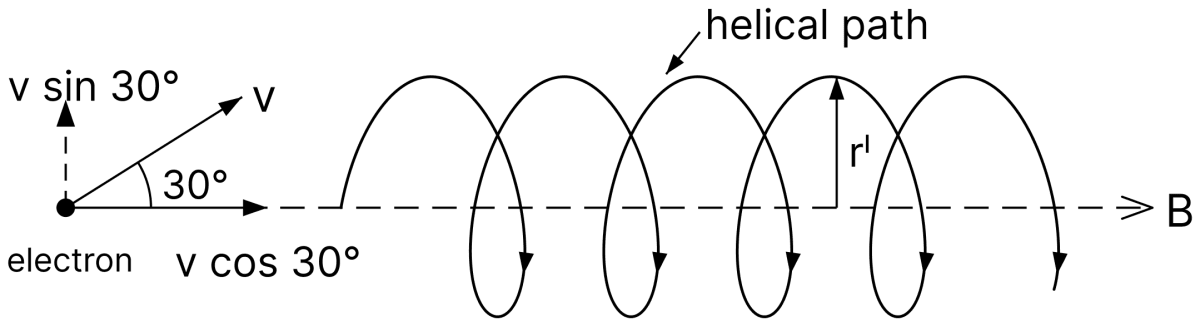
An electron emitted by a heated cathode and accelerated through a potential difference of 2 kV, enters a region with a uniform magnetic field of 0.15 T. Determine the radius and the trajectory of the electron if the field is:. Moving Charges and Magnetic Field, Nootan Physics Solutions ICS Class 12

In the figure, r denotes the radius r′ of the helix.

Only the component v sin θ perpendicular to the field produces the circular motion, so

m(vsin⁡30°)2r′=q(vsin⁡30°)Br′=mvsin⁡30°qBr′=rsin⁡30°r′=1.0×10−3×0.5r′=5.0×10⁻⁴ m\dfrac{\text m(\text v \sin 30°)^2}{\text r'} = \text q(\text v \sin 30°)\text B \\[1em] \text r' = \dfrac{\text{mv} \sin 30°}{\text{qB}} \\[1em] \text r' = \text r \sin 30° \\[1em] \text r' = 1.0 \times 10^{-3} \times 0.5 \\[1em] \text r' = 5.0 \times 10^{-4}\ \text m

The trajectory is now a helical path of radius 5.0 × 10⁻⁴ m (0.5 mm), since the component v cos 30° along the field carries the electron forward along the axis.

Note: The textbook's worked answer takes r′ = 2r; the helix radius is mv sin θ/qB = r/2, as in the chapter's theory and Example 26.

Question 30

The velocity of an electron at a point A is 107 ms-1. Find : (i) direction and magnitude of the magnetic field due to which the electron will go from A to B on the semi-circular path shown, (ii) time taken by the electron in going from A to B.
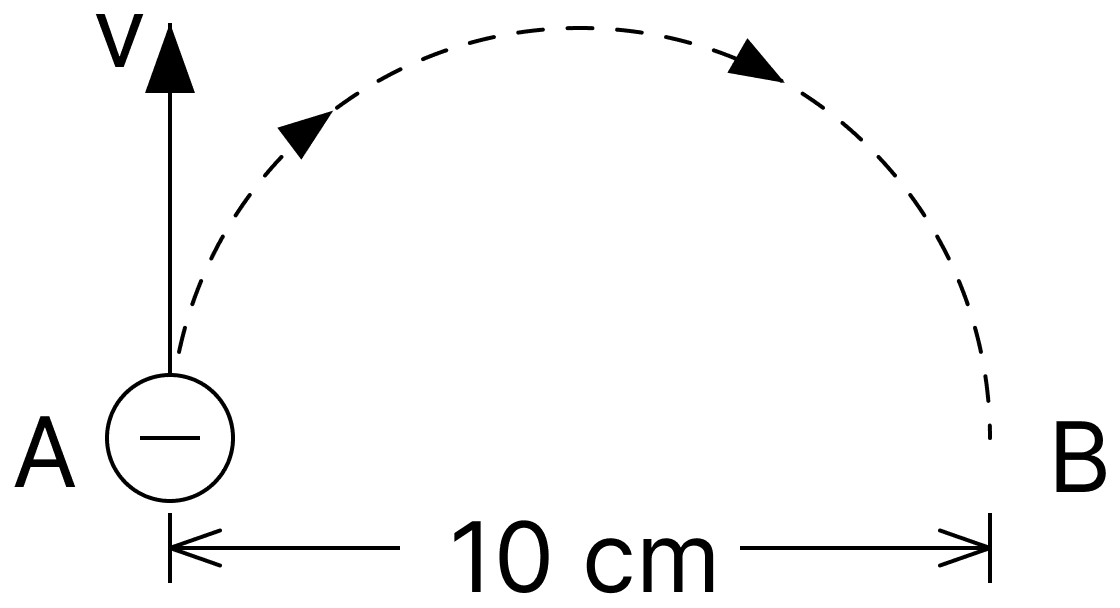
The velocity of an electron at a point A is 10 7 ms -1. Find: (i) direction and magnitude of the magnetic field due to which the electron will go from A to B on the semi-circular path shown, (ii) time taken by the electron in going from A to B. Moving Charges and Magnetic Field, Nootan Physics Solutions ICS Class 12

Answer

Given,

  • v = 107 ms-1
  • AB = 10 cm = 0.1 m, which is the diameter of the semi-circular path, so r = 0.05 m
  • me = 9.1 × 10⁻³¹ kg, e = 1.6 × 10⁻¹⁹ C

(i) From r=mveB\text r = \dfrac{\text{mv}}{\text{eB}},

B=mverB=(9.1×10⁻³¹)(107)(1.6×10⁻¹⁹)(0.05)B=9.1×10−248.0×10⁻²¹B=1.12×10⁻³ T\text B = \dfrac{\text{mv}}{\text{er}} \\[1em] \text B = \dfrac{(9.1 \times 10^{-31})(10^7)}{(1.6 \times 10^{-19})(0.05)} \\[1em] \text B = \dfrac{9.1 \times 10^{-24}}{8.0 \times 10^{-21}} \\[1em] \text B = 1.12 \times 10^{-3}\ \text T

The electron is negatively charged, so the direction of current is opposite to its motion. Applying Fleming's left-hand rule so that the force is directed towards the centre of the semi-circle, the field must be perpendicular to the plane of the paper pointing downwards.

(ii) The electron covers a semi-circle in going from A to B, so the time taken is half the period,

t=T2t=πmeBt=3.14×9.1×10−31(1.6×10⁻¹⁹)(1.12×10⁻³)t=2.86×10−301.79×10⁻²²t=1.57×10⁻⁸ s\text t = \dfrac{\text T}{2} \\[1em] \text t = \dfrac{\text{πm}}{\text{eB}} \\[1em] \text t = \dfrac{3.14 \times 9.1 \times 10^{-31}}{(1.6 \times 10^{-19})(1.12 \times 10^{-3})} \\[1em] \text t = \dfrac{2.86 \times 10^{-30}}{1.79 \times 10^{-22}} \\[1em] \text t = 1.57 \times 10^{-8}\ \text s

Hence, the magnetic field is 1.12 × 10⁻³ T, perpendicular to the plane of paper pointing downwards, and the time taken by the electron in going from A to B is 1.57 × 10⁻⁸ s.

Question 31

A proton, a deuteron and an α-particle, whose kinetic energies are same, enter perpendicularly a magnetic field. Compare the radii of their circular paths.

Answer

Given, a proton, a deuteron and an α-particle having the same kinetic energy K, entering perpendicularly a magnetic field B.

The radius of the circular path is

r=mvqBr=2mKqB\text r = \dfrac{\text{mv}}{\text{qB}} \\[1em] \text r = \dfrac{\sqrt{2\text{mK}}}{\text{qB}}

Since K and B are the same for all the three particles,

r∝mq\text r \propto \dfrac{\sqrt{\text m}}{\text q}

Taking the mass of the proton as m and its charge as e,

  • proton : mp = m, qp = e, so rp∝me\text r_\text p \propto \dfrac{\sqrt{\text m}}{\text e}
  • deuteron : md = 2m, qd = e, so rd∝2me\text r_\text d \propto \dfrac{\sqrt{2\text m}}{\text e}
  • α-particle : mα = 4m, qα = 2e, so rα∝4m2e=me\text r_α \propto \dfrac{\sqrt{4\text m}}{2\text e} = \dfrac{\sqrt{\text m}}{\text e}

Comparing these,

rdrp=2,rαrp=1,rdrα=2\dfrac{\text r_\text d}{\text r_\text p} = \sqrt{2}, \qquad \dfrac{\text r_α}{\text r_\text p} = 1, \qquad \dfrac{\text r_\text d}{\text r_α} = \sqrt{2}

Hence, rd=2 rp\text r_\text d = \sqrt{2}\ \text r_\text p, rα=rp\text r_α = \text r_\text p and rd=2 rα\text r_\text d = \sqrt{2}\ \text r_α.

Question 32

A triangular shaped wire carrying 10 A current is placed in a uniform magnetic field of 0.5 T, as shown in figure. (Given, BC = CD = BD = 5 cm).
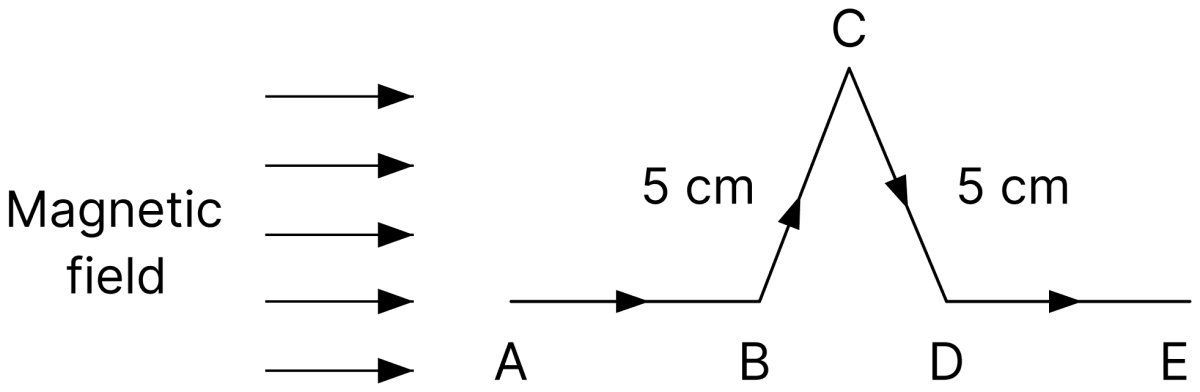
A triangular shaped wire carrying 10 A current is placed in a uniform magnetic field of 0.5 T, as shown in figure. (Given, BC = CD = BD = 5 cm). Find: (i) The magnetic force on segment CD. Moving Charges and Magnetic Field, Nootan Physics Solutions ICS Class 12

Find : (i) The magnetic force on segment CD.

(ii) Net magnetic force on part BCD.

Answer
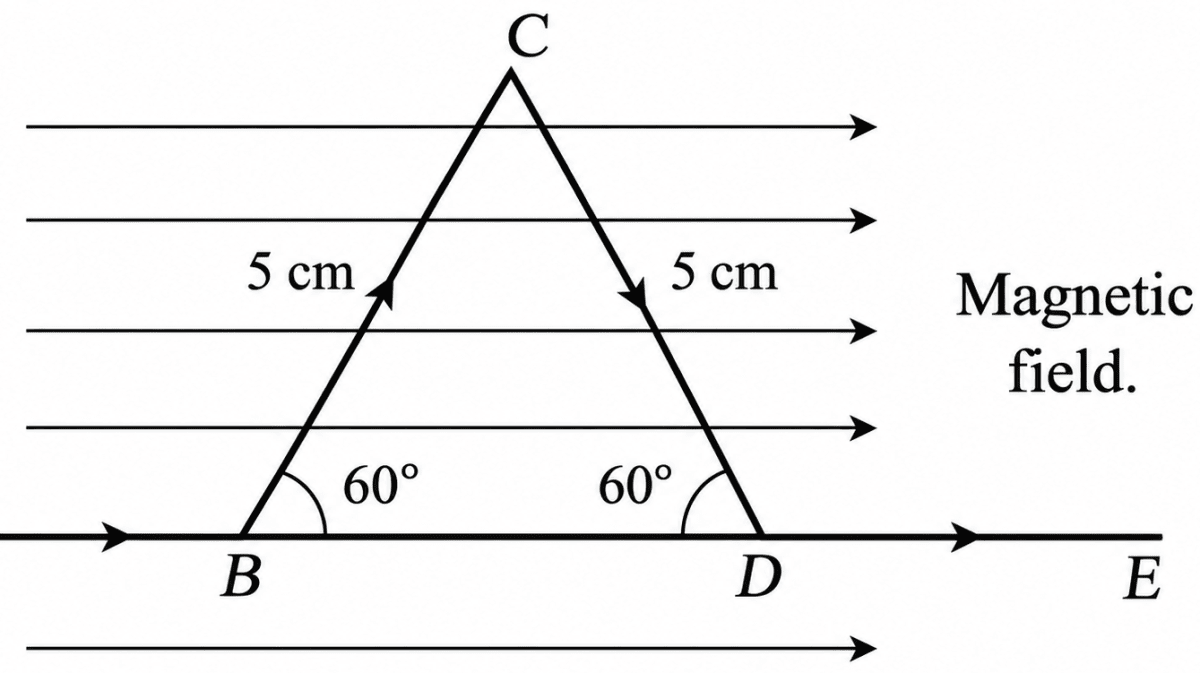
A triangular shaped wire carrying 10 A current is placed in a uniform magnetic field of 0.5 T, as shown in figure. (Given, BC = CD = BD = 5 cm). Find: (i) The magnetic force on segment CD. Moving Charges and Magnetic Field, Nootan Physics Solutions ICS Class 12

Given,

  • I = 10 A
  • B = 0.5 T, in the plane of the figure and directed along AE
  • BC = CD = BD = 5 cm = 0.05 m, so BCD is an equilateral triangle

(i) Force on the segment CD :

Since BCD is an equilateral triangle and BD lies along the direction of the field, the segment CD makes an angle of 60° with the field. Hence

F=IBlsin⁡θF=(10)(0.5)(0.05)(sin⁡60°)F=(10)(0.5)(0.05)(0.866)F=0.216 N\text F = \text{IB}l \sin \text θ \\[1em] \text F = (10)(0.5)(0.05)(\sin 60°) \\[1em] \text F = (10)(0.5)(0.05)(0.866) \\[1em] \text F = 0.216\ \text N

Hence, the magnetic force on the segment CD is 0.216 N.

(ii) Net magnetic force on the part BCD :

For a current-carrying conductor placed in a uniform magnetic field, the force on a bent conductor is the same as the force on a straight conductor joining its two ends. Hence the force on BCD is equal to the force on the straight segment BD.

But BD lies along the direction of the field, so θ = 0 and

F=IBlsin⁡0°F=0\text F = \text{IB}l \sin 0° \\[1em] \text F = 0

Hence, the net magnetic force on the part BCD is zero.

Question 33

Find the force per unit length on a wire carrying a current of 8 A and making 30° angle with the direction of a uniform magnetic field of 0.15 T.

Answer

Given,

  • I = 8 A
  • θ = 30°
  • B = 0.15 T

The force on a current-carrying conductor placed in a magnetic field is

F=IBlsin⁡θ\text F = \text{IB}l \sin \text θ

So the force per unit length is

Fl=IBsin⁡θFl=(8)(0.15)(sin⁡30°)Fl=(8)(0.15)(0.5)Fl=0.6 N m−1\dfrac{\text F}{l} = \text{IB} \sin \text θ \\[1em] \dfrac{\text F}{l} = (8)(0.15)(\sin 30°) \\[1em] \dfrac{\text F}{l} = (8)(0.15)(0.5) \\[1em] \dfrac{\text F}{l} = 0.6\ \text N\ \text m^{-1}

Hence, the force per unit length on the wire is 0.6 N m-1.

Question 34

A current of 5.0 A is flowing upwards in a long vertical wire placed in a uniform horizontal northward magnetic field of 0.020 T. How much force and in what direction will the field exert on 0.06 m length of the wire?

Answer

Given,

  • I = 5.0 A, flowing upwards
  • B = 0.020 T, horizontal and northward
  • l = 0.06 m

The wire is vertical and the field is horizontal, so θ = 90° and

F=IBlsin⁡90°F=(5.0)(0.020)(0.06)F=6×10⁻³ N\text F = \text{IB}l \sin 90° \\[1em] \text F = (5.0)(0.020)(0.06) \\[1em] \text F = 6 \times 10^{-3}\ \text N

Applying Fleming's left-hand rule, with the current directed vertically upwards and the field towards the north, the force on the wire is directed towards the west.

Hence, the field exerts a force of 6 × 10⁻³ N on the wire, directed towards the west.

Question 35

Two parallel rails, distant 2.0 × 10⁻² m, are laid in north-south direction. On these rails is kept a metal cylinder of mass 4.0 × 10⁻² kg. A battery is connected to the rails with its positive terminal joined to the rail on the eastern side. The battery sends a current of 3.0 A in the cylinder. If a uniform magnetic field of 1.2 T directed upwards be there, then find out the magnitude and direction of the magnetic force imposed upon the cylinder. What would be the acceleration in the cylinder?

Answer

Given,

  • l = 2.0 × 10⁻² m (separation of the rails)
  • m = 4.0 × 10⁻² kg
  • I = 3.0 A
  • B = 1.2 T, directed upwards

The cylinder is horizontal and lies in the east-west direction, while the field is vertical, so θ = 90° and

F=BIlF=(1.2)(3.0)(2.0×10⁻²)F=7.2×10⁻² N\text F = \text{BI}l \\[1em] \text F = (1.2)(3.0)(2.0 \times 10^{-2}) \\[1em] \text F = 7.2 \times 10^{-2}\ \text N

The positive terminal of the battery is joined to the rail on the eastern side, so the current in the cylinder flows from east to west. Applying Fleming's left-hand rule with the current towards the west and the field vertically upwards, the force on the cylinder is directed towards the north.

The acceleration of the cylinder is

a=Fma=7.2×10−24.0×10−2a=1.8 ms−2\text a = \dfrac{\text F}{\text m} \\[1em] \text a = \dfrac{7.2 \times 10^{-2}}{4.0 \times 10^{-2}} \\[1em] \text a = 1.8\ \text{ms}^{-2}

Hence, the magnetic force on the cylinder is 7.2 × 10⁻² N towards north, and its acceleration is 1.8 ms-2.

Question 36

On a 30° inclined smooth plane, a thin current-carrying rod is placed parallel to the horizontal ground. The plane is located in a uniform vertical magnetic field of 0.15 T. The mass/length of the rod is 0.30 kg m-1. Find the current required to keep the rod stationary.

Answer

Given,

  • θ = 30° (angle of the inclined plane)
  • B = 0.15 T, vertically directed
  • mass per unit length, ml\dfrac{\text m}{l} = 0.30 kg m-1
  • g = 9.8 m s-2

The rod lies horizontally on the smooth inclined plane and the magnetic field is vertical, so the magnetic force F = IBl on the rod is horizontal. Resolving the forces along the inclined plane, the component of the magnetic force up the plane must balance the component of the weight down the plane,

IBlcos⁡θ=mgsin⁡θI=ml×gtan⁡θB\text{IB}l \cos \text θ = \text{mg} \sin \text θ \\[1em] \text I = \dfrac{\text m}{l} \times \dfrac{\text g \tan \text θ}{\text B}

Substituting the values,

I=0.30×(9.8)(tan⁡30°)0.15I=0.30×(9.8)(0.577)0.15I=1.6970.15I=11.3 A\text I = 0.30 \times \dfrac{(9.8)(\tan 30°)}{0.15} \\[1em] \text I = 0.30 \times \dfrac{(9.8)(0.577)}{0.15} \\[1em] \text I = \dfrac{1.697}{0.15} \\[1em] \text I = 11.3\ \text A

Hence, the current required to keep the rod stationary is 11.3 A.

Question 37

A current-carrying conductor has 8.0 × 10²² free electrons per metre length and their mean drift velocity is 8.0 × 10⁻⁵ ms-1. If a magnetic field of 0.10 T be applied perpendicular to the conductor, then calculate (i) current in the conductor, (ii) force on an electron and (iii) force imposed per metre length of the conductor.

Answer

Given,

  • nA = 8.0 × 10²² free electrons per metre length
  • vd = 8.0 × 10⁻⁵ ms-1
  • B = 0.10 T, perpendicular to the conductor

(i) The current in the conductor is

I=nA vd eI=(8.0×10²²)(8.0×10⁻⁵)(1.6×10⁻¹⁹)I=1.02 A\text I = \text{nA}\ \text v_\text d\ \text e \\[1em] \text I = (8.0 \times 10^{22})(8.0 \times 10^{-5})(1.6 \times 10^{-19}) \\[1em] \text I = 1.02\ \text A

(ii) The force on a single electron drifting in the field is

F′=e vdBF′=(1.6×10⁻¹⁹)(8.0×10⁻⁵)(0.10)F′=1.28×10⁻²⁴ N\text F' = \text e\ \text v_\text d \text B \\[1em] \text F' = (1.6 \times 10^{-19})(8.0 \times 10^{-5})(0.10) \\[1em] \text F' = 1.28 \times 10^{-24}\ \text N

(iii) The force per metre length of the conductor is

Fl=BIsin⁡90°Fl=(0.10)(1.02)Fl=0.1024 N m−1\dfrac{\text F}{l} = \text{BI} \sin 90° \\[1em] \dfrac{\text F}{l} = (0.10)(1.02) \\[1em] \dfrac{\text F}{l} = 0.1024\ \text N\ \text m^{-1}

Hence, the current is 1.02 A, the force on an electron is 1.28 × 10⁻²⁴ N and the force per metre length of the conductor is 0.1024 N m-1.

Question 38

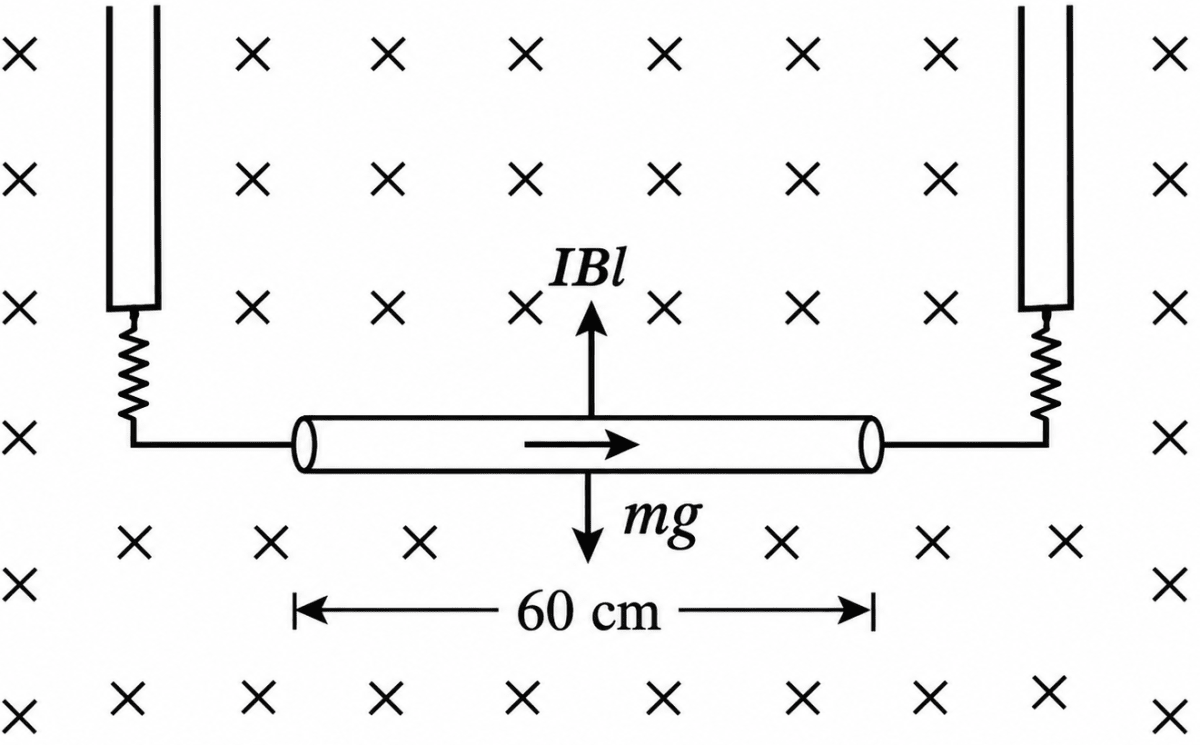
A 60 cm long wire (mass 10 g) is hanged by two flexible wires in a magnetic field of 0.40 T. Find the magnitude and direction of the current required to be flown to neutralize the tension of the hanging wires.
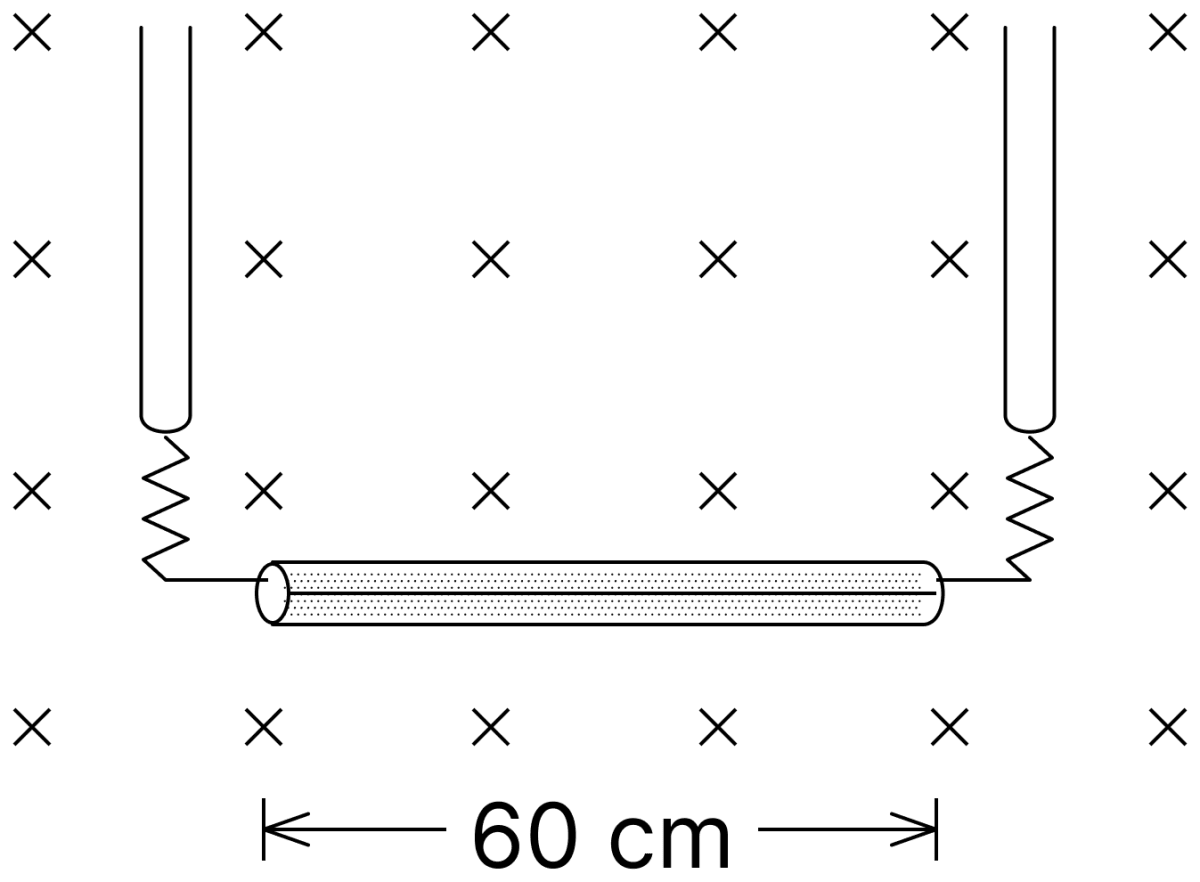
A 60 cm long wire (mass 10 g) is hanged by two flexible wires in a magnetic field of 0.40 T. Find the magnitude and direction of the current required to be flown to neutralize the tension of the hanging wires. Moving Charges and Magnetic Field, Nootan Physics Solutions ICS Class 12

Answer

A 60 cm long wire (mass 10 g) is hanged by two flexible wires in a magnetic field of 0.40 T. Find the magnitude and direction of the current required to be flown to neutralize the tension of the hanging wires. Moving Charges and Magnetic Field, Nootan Physics Solutions ICS Class 12

Given,

  • l = 60 cm = 0.60 m
  • m = 10 g = 0.01 kg
  • B = 0.40 T
  • g = 9.8 m s-2

To neutralise the tension in the hanging wires, the magnetic force on the wire must be directed vertically upwards and must balance its weight,

IBl=mgI=mgBlI=(0.01)(9.8)(0.40)(0.60)I=0.0980.24I=0.41 A\text{IB}l = \text{mg} \\[1em] \text I = \dfrac{\text{mg}}{\text B l} \\[1em] \text I = \dfrac{(0.01)(9.8)}{(0.40)(0.60)} \\[1em] \text I = \dfrac{0.098}{0.24} \\[1em] \text I = 0.41\ \text A

The field is directed into the plane of the paper, so by Fleming's left-hand rule the force is vertically upwards only when the current flows from left to right.

Hence, a current of 0.41 A must be passed from left to right.

Question 39

Two long, parallel, straight wires A and B carrying currents of 8.0 A and 5.0 A in the same direction are placed 4.0 cm apart. Estimate the force on a 10 cm section of wire A.

Answer

Given,

  • I1 = 8.0 A, I2 = 5.0 A, in the same direction
  • r = 4.0 cm = 0.04 m
  • L = 10 cm = 0.10 m

The force per unit length between two parallel current-carrying conductors is

FL=μ02πI1I2r\dfrac{\text F}{\text L} = \dfrac{\text μ_0}{2\text π}\dfrac{\text I_1 \text I_2}{\text r}

So the force on a length L of the wire A is

F=μ02πI1I2r×LF=(2×10−7)×(8.0)(5.0)0.04×0.10F=(2×10⁻⁷)(1000)(0.10)F=2×10⁻⁵ N\text F = \dfrac{\text μ_0}{2\text π}\dfrac{\text I_1 \text I_2}{\text r} \times \text L \\[1em] \text F = (2 \times 10^{-7}) \times \dfrac{(8.0)(5.0)}{0.04} \times 0.10 \\[1em] \text F = (2 \times 10^{-7})(1000)(0.10) \\[1em] \text F = 2 \times 10^{-5}\ \text N

The currents are in the same direction, so the wires attract each other.

Hence, the force on a 10 cm section of wire A is 2 × 10⁻⁵ N, directed towards B.

Question 40

A long horizontal rigidly supported wire carries a current of 100 A. Directly above it and parallel to it is a fine wire that carries a current of 200 A and weighs 0.05 N/m. How far above the lower wire should the fine wire be kept to support it by magnetic repulsion?

Answer

Given,

  • I1 = 100 A (lower wire), I2 = 200 A (fine wire)
  • weight per unit length of the fine wire = 0.05 N/m

The fine wire is supported by magnetic repulsion, so the force per unit length between the wires must balance its weight per unit length,

μ02πI1I2r=0.05(2×10−7)×(100)(200)r=0.054×10⁻³r=0.05r=4×10−30.05r=0.08 mr=8 cm\dfrac{\text μ_0}{2\text π}\dfrac{\text I_1 \text I_2}{\text r} = 0.05 \\[1em] (2 \times 10^{-7}) \times \dfrac{(100)(200)}{\text r} = 0.05 \\[1em] \dfrac{4 \times 10^{-3}}{\text r} = 0.05 \\[1em] \text r = \dfrac{4 \times 10^{-3}}{0.05} \\[1em] \text r = 0.08\ \text m \\[1em] \text r = 8\ \text{cm}

Hence, the fine wire should be kept 8 cm above the lower wire.

Question 41

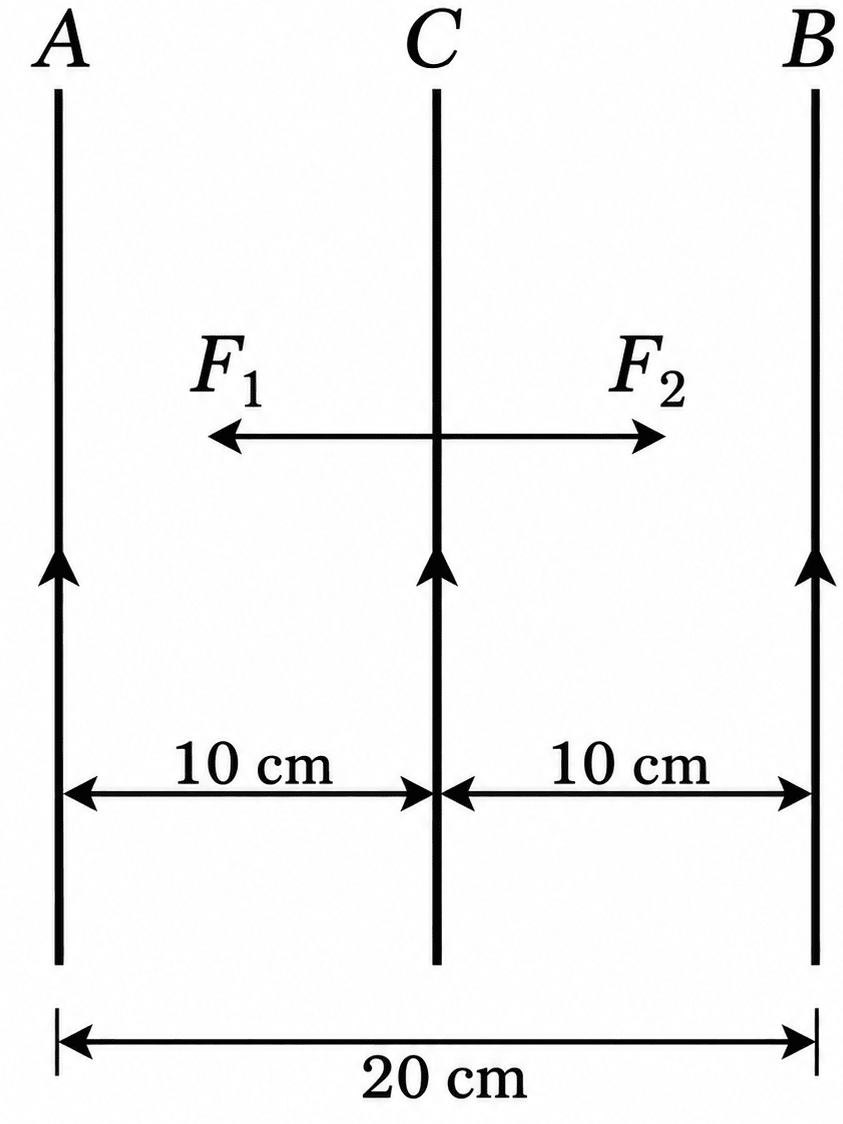
Two very long, straight, parallel wires A and B carry currents of 10 A and 20 A respectively and are at a distance 20 cm apart. If a third wire C (length 15 cm) having a current of 10 A is placed between them, how much force will act on C? The direction of current in all the three wires is same.
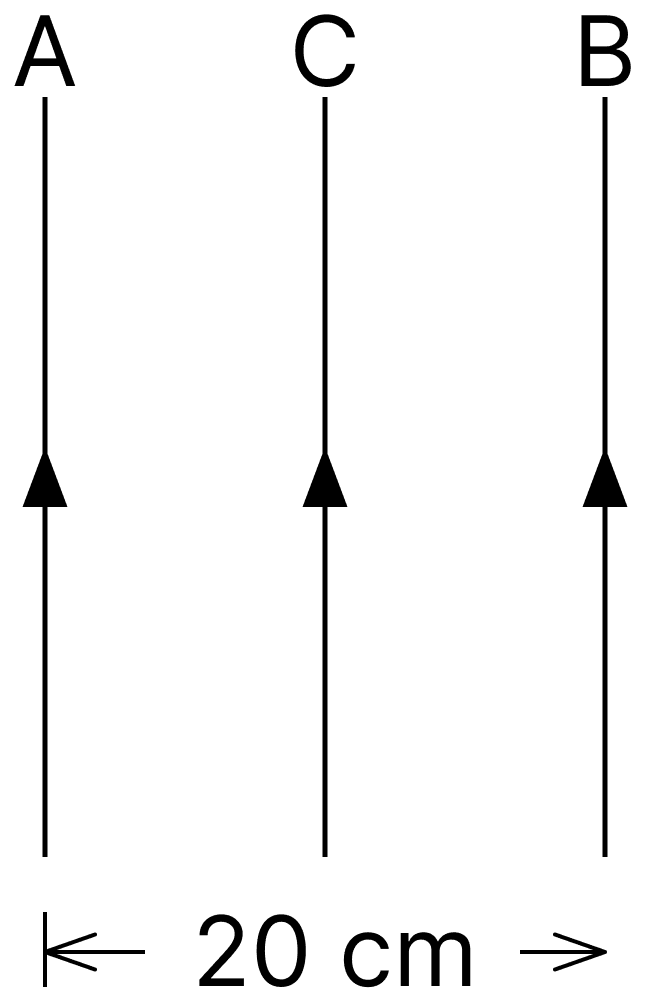
Two very long, straight, parallel wires A and B carry currents of 10 A and 20 A respectively and are at a distance 20 cm apart. If a third wire C (length 15 cm) having a current of 10 A is placed between them, how much force will act on C? The direction of current in all the three wires is same. Moving Charges and Magnetic Field, Nootan Physics Solutions ICS Class 12

Answer

Two very long, straight, parallel wires A and B carry currents of 10 A and 20 A respectively and are at a distance 20 cm apart. If a third wire C (length 15 cm) having a current of 10 A is placed between them, how much force will act on C? The direction of current in all the three wires is same. Moving Charges and Magnetic Field, Nootan Physics Solutions ICS Class 12

Given,

  • IA = 10 A, IB = 20 A, IC = 10 A, all in the same direction
  • separation of A and B = 20 cm; C is placed midway between them (as shown in the figure), so r = 10 cm = 0.10 m from each
  • L = 15 cm = 0.15 m

Force on C due to A :

F1=μ02πIAICrLF1=(2×10−7)×(10)(10)0.10×0.15F1=3×10⁻⁵ N, directed towards A\text F_1 = \dfrac{\text μ_0}{2\text π}\dfrac{\text I_\text A \text I_\text C}{\text r}\text L \\[1em] \text F_1 = (2 \times 10^{-7}) \times \dfrac{(10)(10)}{0.10} \times 0.15 \\[1em] \text F_1 = 3 \times 10^{-5}\ \text N,\ \text{directed towards A}

Force on C due to B :

F2=μ02πIBICrLF2=(2×10−7)×(20)(10)0.10×0.15F2=6×10⁻⁵ N, directed towards B\text F_2 = \dfrac{\text μ_0}{2\text π}\dfrac{\text I_\text B \text I_\text C}{\text r}\text L \\[1em] \text F_2 = (2 \times 10^{-7}) \times \dfrac{(20)(10)}{0.10} \times 0.15 \\[1em] \text F_2 = 6 \times 10^{-5}\ \text N,\ \text{directed towards B}

The currents in all the three wires are in the same direction, so C is attracted by both A and B. The two forces are oppositely directed, so the net force is

F=F2−F1F=(6−3)×10−5F=3.0×10⁻⁵ N\text F = \text F_2 - \text F_1 \\[1em] \text F = (6 - 3) \times 10^{-5} \\[1em] \text F = 3.0 \times 10^{-5}\ \text N

Hence, a force of 3.0 × 10⁻⁵ N acts on C, directed towards B.

Question 42

Calculate the magnetic field in which the cyclotron dees should be placed to accelerate protons. The applied frequency is 8 megacycles/second. Take proton mass 1.67 × 10⁻²⁷ kg.

Answer

Given,

  • applied frequency, ν0 = 8 megacycles/second = 8 × 10⁶ Hz
  • mp = 1.67 × 10⁻²⁷ kg
  • q = 1.6 × 10⁻¹⁹ C

For resonance in a cyclotron, the frequency of the applied potential difference must equal the frequency of revolution of the particle,

ν0=qB2πm⇒B=2πmν0q\text ν_0 = \dfrac{\text{qB}}{2\text{πm}} \quad \Rightarrow \quad \text B = \dfrac{2\text{πm}\text ν_0}{\text q}

Substituting the values,

B=2×3.14×(1.67×10−27)(8×10⁶)1.6×10⁻¹⁹B=8.39×10−201.6×10⁻¹⁹B=0.524 T\text B = \dfrac{2 \times 3.14 \times (1.67 \times 10^{-27})(8 \times 10^6)}{1.6 \times 10^{-19}} \\[1em] \text B = \dfrac{8.39 \times 10^{-20}}{1.6 \times 10^{-19}} \\[1em] \text B = 0.524\ \text T

Hence, the cyclotron dees should be placed in a magnetic field of 0.524 T.

Question 43

A cyclotron accelerating protons has dees of 0.4 m radius and a radio-frequency supply of 12 megacycles/second at 5000 volt maximum value. Calculate the magnitude of the required magnetic field, the energy and velocity acquired by the protons. Take proton mass 1.67 × 10⁻²⁷ kg.

Answer

Given,

  • R = 0.4 m (radius of the dees)
  • ν0 = 12 megacycles/second = 12 × 106 Hz
  • V = 5000 volt (maximum value)
  • mp = 1.67 × 10⁻²⁷ kg, q = 1.6 × 10⁻¹⁹ C

Magnetic field : For resonance,

ν0=qB2πm⇒B=2πmν0qB=2×3.14×(1.67×10−27)(12×106)1.6×10⁻¹⁹B=0.786 T\text ν_0 = \dfrac{\text{qB}}{2\text{πm}} \quad \Rightarrow \quad \text B = \dfrac{2\text{πm}\text ν_0}{\text q} \\[1em] \text B = \dfrac{2 \times 3.14 \times (1.67 \times 10^{-27})(12 \times 10^6)}{1.6 \times 10^{-19}} \\[1em] \text B = 0.786\ \text T

Velocity acquired : At the outer edge of a dee, r = R, so

vmax=qBRmvmax=(1.6×10⁻¹⁹)(0.786)(0.4)1.67×10⁻²⁷vmax=5.03×10−201.67×10⁻²⁷vmax=3×10⁷ ms−1\text v_\text{max} = \dfrac{\text{qBR}}{\text m} \\[1em] \text v_\text{max} = \dfrac{(1.6 \times 10^{-19})(0.786)(0.4)}{1.67 \times 10^{-27}} \\[1em] \text v_\text{max} = \dfrac{5.03 \times 10^{-20}}{1.67 \times 10^{-27}} \\[1em] \text v_\text{max} = 3 \times 10^7\ \text{ms}^{-1}

Energy acquired :

K=12mvmax2K=12(1.67×10⁻²⁷)(3×10⁷)2K=7.56×10⁻¹³ JK=7.56×10−131.6×10⁻¹⁹ eVK=4.73 MeV\text K = \dfrac{1}{2}\text m \text v_\text{max}^2 \\[1em] \text K = \dfrac{1}{2}(1.67 \times 10^{-27})(3 \times 10^7)^2 \\[1em] \text K = 7.56 \times 10^{-13}\ \text J \\[1em] \text K = \dfrac{7.56 \times 10^{-13}}{1.6 \times 10^{-19}}\ \text{eV} \\[1em] \text K = 4.73\ \text{MeV}

Hence, the required magnetic field is 0.786 T, the energy acquired by the protons is 4.73 MeV and their velocity is 3 × 10⁷ ms-1.

PrevNext