
A moving electron enters a uniform magnetic field perpendicularly. Inside the magnetic field, the electron travels along :
- a straight line
- a parabola
- a circle
- a hyperbola
Answer
a circle
Reason — When the electron enters perpendicularly, the angle between and is 90°, so the force F = Bqv sin 90° = Bqv is maximum and is always perpendicular to the velocity. Such a force does not change the speed of the particle, it only changes the direction of motion continuously. Hence it acts as the centripetal force and the electron describes a circular path of radius
Gauss is the unit of :
- magnetic flux density in SI system
- electric field intensity
- magnetic flux density in CGS system
- none of the above
Answer
magnetic flux density in CGS system
Reason — The SI unit of magnetic flux density is the tesla (T), that is, N A-1 m-1 or Wb m-2. The gauss is the corresponding unit in the CGS system, and the two are related as
Magnetic induction vector in terms of base units of SI would be :
- kg s-1 A-1
- kg s-2 A-1
- kg s-2 A-2
- kg2 s-2 A-1
Answer
kg s-2 A-1
Reason — From the defining relation for the magnetic field,
Taking F in newton (kg m s-2), q in coulomb (A s) and v in m s-1,
The period of revolution of a charged particle injected normal to a uniform magnetic field is independent of the :
- mass of the particle
- velocity of the particle
- charge of the particle
- magnetic field strength
Answer
velocity of the particle
Reason — For a charged particle injected normal to a uniform magnetic field, the period of revolution is
This expression contains the mass, the charge and the magnetic field, but not the speed. If the speed increases, the radius also increases in the same proportion, so the time taken to complete one revolution remains the same. Hence the period is independent of the velocity of the particle.
Which of the following cannot be the shape of the path of a charged particle moving in a uniform magnetic field?
- Straight line
- Parabolic
- Circular
- Helical
Answer
Parabolic
Reason — A magnetic force always acts perpendicular to the instantaneous velocity; it cannot act as a constant force in a fixed direction, so it cannot produce a parabolic path.
Which graph represents the variation of magnetic field B with distance 'a' from a long straight current carrying conductor?
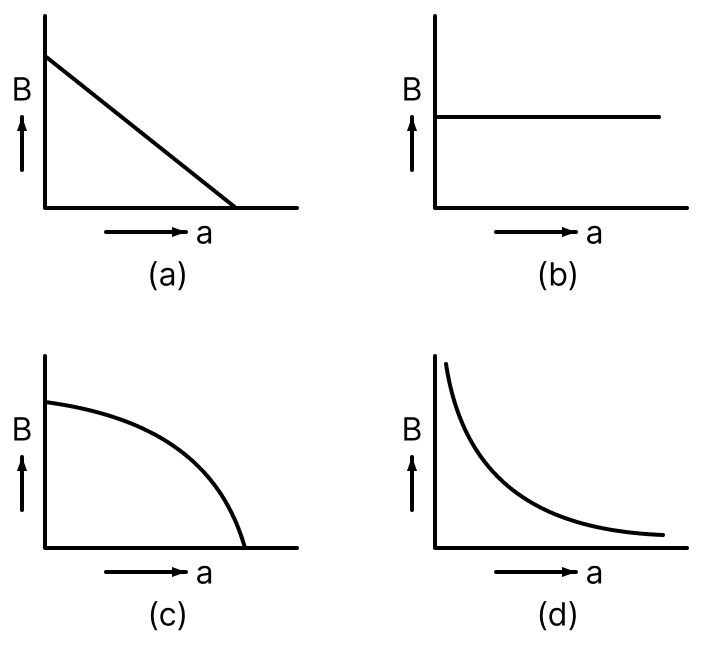
Answer
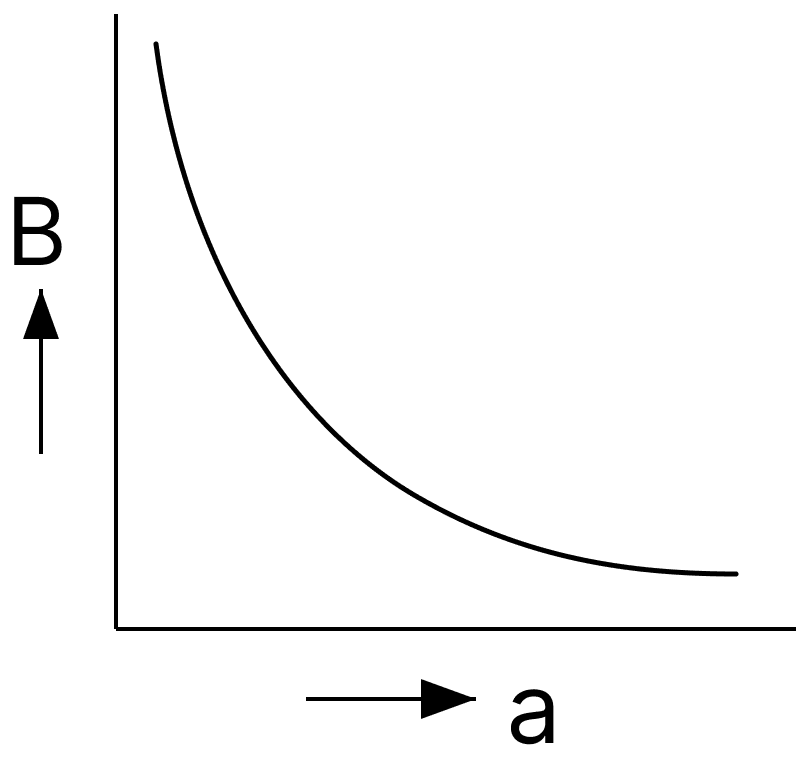
Reason — For a long straight current-carrying conductor,
so B is inversely proportional to the distance a of the point from the conductor. The graph of B against a is therefore a rectangular hyperbola, in which B falls off rapidly at first and then more and more slowly as a increases, never becoming zero. This variation is represented by the fourth graph.
A positive charge projected towards east is deflected towards north by a magnetic field. The field is directed :
- towards west
- towards south
- upwards
- downwards
Answer
downwards
Reason — Take east along , north along and vertically upwards along . For the positive charge,
Here and the deflecting force is along . If the field is directed vertically downwards, , then
which is towards the north, as required. The same result follows from Fleming's left-hand rule.
The force on a charged particle moving in a magnetic field is maximum when the angle between direction of motion and field is :
- zero
- 90°
- 180°
- 45°
Answer
90°
Reason — The magnitude of the magnetic force on a charged particle is
This is maximum when sin θ is maximum, that is when θ = 90°. Thus Fmax = Bqv, obtained when the particle moves perpendicular to the field. At θ = 0 and θ = 180° the force is zero.
Which of the following particles will experience maximum force when projected perpendicular to a magnetic field with same velocity?
- Electron
- Proton
- He+
- Li++
Answer
Li++
Reason — Since all the particles are projected perpendicular to the field with the same velocity,
so the force depends only on the magnitude of the charge. The charges are e for the electron, e for the proton, e for He+ and 2e for Li++. Hence Li++, carrying the largest charge, experiences the maximum force.
The radius of curvature of the path of a charged particle in a uniform magnetic field is directly proportional to :
- the charge on the particle
- the momentum of the particle
- the intensity of the field
- the energy of the particle
Answer
the momentum of the particle
Reason — For a charged particle moving perpendicular to a uniform magnetic field, the magnetic force provides the centripetal force,
Thus the radius of curvature is directly proportional to the momentum p of the particle, and inversely proportional to the charge and to the intensity of the field.
A moving electric charge produces :
- both electric and magnetic fields
- electric field only
- magnetic field only
- neither of these two fields
Answer
both electric and magnetic fields
Reason — Every charge, whether at rest or in motion, produces an electric field around it. Oersted's experiment showed that a magnetic field is established around a current-carrying conductor, and since electric current is nothing but charge in motion, it is concluded that moving charges produce a magnetic field in the surrounding space. Hence a moving electric charge produces both an electric and a magnetic field.
An observer moves past an electron at rest. His instrument measures :
- an electric field only
- a magnetic field only
- both fields
- any of the two fields, depending upon his speed
Answer
both fields
Reason — Relative to the observer who moves past it, the electron is in motion. A charge in motion produces a magnetic field as well as an electric field. Hence the instrument carried by the moving observer measures both the fields. Only an observer at rest with respect to the electron would measure an electric field alone.
A wire of length L carrying a current I is bent into a circular loop of one turn. The magnetic field produced at the centre of the loop is B. When this wire is bent into a loop having 2 turns, then the magnetic field produced at the centre of the loop will be :
- 2B
- 4B
- B/2
- B/4
Answer
4B
Reason — Let the length of the wire be L. For one turn, L = 2πr1, so and
For two turns, L = 2(2πr2), so and
Two identical coils have a common centre but their planes are perpendicular to each other. They carry equal currents. If magnetic field at the centre due to each coil is B, then the resultant field will be :
- zero
- 2B
Answer
Reason — The two coils have a common centre but their planes are perpendicular to each other. The magnetic field of a coil at its centre is perpendicular to the plane of the coil, so the two fields, each of magnitude B, are perpendicular to each other. The resultant is therefore
To produce a magnetic field of 20 millitesla (mT) inside a long solenoid having 20 turns per cm, the current required will be (approximately) :
- 8 A
- 4 A
- 2 A
- 1 A
Answer
8 A
Reason — Given,
- B = 20 mT = 20 × 10-3 T
- n = 20 turns per cm = 2000 turns per metre
For a long solenoid, B = µ0nI, so
Biot-Savart law indicates that the moving electrons (velocity v) produce a magnetic field B such that :
- B ⊥ v
- B || v
- it obeys inverse cube law
- it is along the line joining the electron and point of observation
Answer
B ⊥ v
Reason — According to Biot-Savart law the field due to a current-element is
so that is perpendicular to the plane containing and . As the direction of is the direction of motion of the charges, is always perpendicular to . The law is also an inverse-square law, not an inverse-cube law.
The narrow beam of electrons move undeviated in an electric field E = 3 × 10⁴ volt/metre and magnetic field B = 2 × 10⁻³ weber/metre2 applied at the same place. The speed of electron, the electric field and magnetic field are mutually perpendicular. The speed of electron is :
- 60 ms-1
- 10.3 × 10⁷ ms-1
- 1.5 × 10⁷ ms-1
- 0.67 × 10⁻⁷ ms-1
Answer
1.5 × 10⁷ ms-1
Reason — Given,
- E = 3 × 10⁴ volt/metre
- B = 2 × 10⁻³ weber/metre2
The beam moves undeviated, so the electric force balances the magnetic force,
An electron accelerated through a potential difference V enters a uniform transverse magnetic field in which it experiences a force F. If V be increased to 2V, the electron will experience a force :
- F/2
- 2F
Answer
Reason — The electron accelerated through a potential difference V acquires kinetic energy
so that . Since the field is transverse, F = evB, giving . When V is increased to 2V,
An electron is projected with uniform velocity along the axis of a current carrying long solenoid. Which of the following is true?
- The electron will be accelerated along the axis
- The electron path will be circular about the axis
- The electron will experience a force at 45° to the axis and hence execute a helical path
- The electron will continue to move with uniform velocity along the axis of the solenoid
Answer
The electron will continue to move with uniform velocity along the axis of the solenoid
Reason — Inside a long solenoid the magnetic field is uniform and directed along the axis. The electron is projected along the same axis, so the angle between and is zero and
No force acts on the electron, so it continues to move undeviated with the same uniform velocity along the axis.
A charged particle is released from rest in constant uniform electric and magnetic fields which are parallel to each other. The particle will move in a :
- circle
- helix
- parabola
- straight line
Answer
straight line
Reason — The particle starts from rest, so initially it experiences no magnetic force and is accelerated by the electric field alone, along the direction of . Since is parallel to , the velocity so acquired is also parallel to , and
The magnetic field therefore never exerts a force on it, and the particle continues to move in a straight line along the common direction of the two fields.
Two charged particles traverse identical helical paths in a completely opposite sense in a uniform magnetic field .
- They have equal z-components of momenta.
- They must have equal charges.
- They necessarily represent a particle-antiparticle pair.
- The charge to mass ratio satisfy : .
Answer
The charge to mass ratio satisfy : .
Reason — For a helical path the radius and the pitch are
The two paths are identical, so the two particles must have the same magnitude of the specific charge . As the paths are traced in a completely opposite sense, the two charges must be of opposite sign. Both conditions together give
This requires only equal specific charges of opposite sign, not equal charges or a particle-antiparticle pair.
In a cyclotron, a charged particle :
- undergoes acceleration all the time
- speeds up between the dees because of the magnetic field
- speeds up in a dee
- slows down within a dee and speeds up between dees
Answer
undergoes acceleration all the time
Reason — Inside the dees the particle moves along a circular path, and although its speed is constant its direction changes continuously, so it possesses a centripetal acceleration. While crossing the gap between the dees it is accelerated by the electric field, and its speed increases. Hence the charged particle is under acceleration all the time. Inside a dee the particle is screened from the electric field by the metal walls of the dee, so it neither speeds up nor slows down there.
The electric current in a circular coil of 2 turns produces a magnetic induction B1 at its centre. The coil is unwound and is rewound into a circular coil of 5 turns and the same current produces a magnetic induction B2 at its centre. The ratio of is :
Answer
Reason — Let the length of the wire be L. For the coil of 2 turns, L = 2(2πr1), so and
For the coil of 5 turns, L = 5(2πr2), so and
Ampere's circuital law states that :
- the line integral of a magnetic field along the boundary of the closed loop is equal to µ0 times the total current passing near the surface.
- the line integral of a magnetic field along the boundary of the closed loop is equal to µ0 times the total current passing through the surface.
- the surface integral of the magnetic field over the closed loop is equal to µ0 times the total current passing through the surface.
- the surface integral of the magnetic field over the closed loop is equal to µ0 times the total current passing near the surface.
Answer
the line integral of a magnetic field along the boundary of the closed loop is equal to µ0 times the total current passing through the surface.
Reason — Ampere's circuital law states that the line integral of the magnetic flux density around any closed path in free space is equal to µ0 times the net current I threading through the area enclosed by the path,
It is a line integral and not a surface integral, and only the current passing through the enclosed surface is counted, not a current passing near it.
Consider six wires coming into or out of the page, all with the same current. Rank the line integral of the magnetic field (from most positive to most negative) taken counterclockwise around each loop shown.
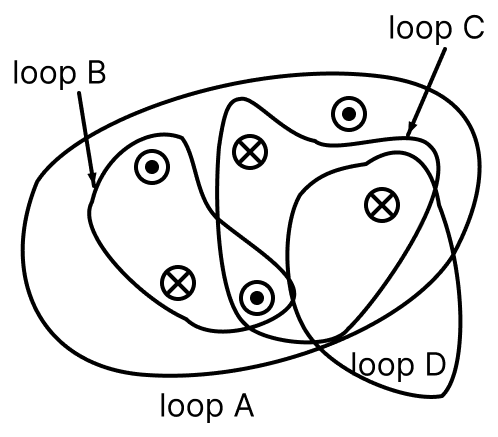
- B > C > D > A
- B > C = D > A
- B > A > C = D
- C > B = D > A
Answer
B > A > C = D
Reason — By Ampere's circuital law,
so the line integral around a loop depends only on the net current threading that loop, and not at all on the shape or size of the loop or on the wires lying outside it. For a counterclockwise traversal, a current coming out of the page is taken as positive and one going into the page as negative.
Adding the enclosed currents with these signs for each loop of the figure, loop B encloses the largest net positive current, loop A the next, while loops C and D enclose equal net currents which are the smallest. Hence the ranking is B > A > C = D.
A long, cylindrical wire of radius b carries a current I distributed uniformly over its cross-section. Find the magnitude of the magnetic field at a point inside the wire at a distance a from the axis.
- zero
Answer
Reason — The current I is distributed uniformly over the cross-section of the wire of radius b. Applying Ampere's circuital law to a circle of radius a (a < b) drawn coaxially inside the wire, the current enclosed is
A tightly-wound, long solenoid carries a current of 2.0 A. An electron is found to execute a uniform circular motion inside the solenoid with a frequency of 1.0 × 10⁸ rev/s. Find the number of turns per metre in the solenoid.
- 500 Turns/m
- 1020 Turns/m
- 1232 Turns/m
- 1420 Turns/m
Answer
1420 Turns/m
Reason — Given,
- I = 2.0 A
- frequency of revolution, n = 1.0 × 10⁸ rev/s
The electron moves in a circle inside the solenoid, so its frequency of revolution is
For the solenoid, B = µ0NI where N is the number of turns per metre,
An electron is moving along positive x-axis. A uniform electric field exists towards negative y-axis. What should be the direction of magnetic field of suitable magnitude so that net force of electron is zero?
- Positive z-axis
- Negative z-axis
- Positive y-axis
- Negative y-axis
Answer
Negative z-axis
Reason — The electron carries a charge −e. The electric field is along the negative y-axis, so the electric force on the electron is
that is, along the positive y-axis. For the net force to be zero the magnetic force must be along the negative y-axis. With and ,
which is along the negative y-axis, as required. Hence the magnetic field must be along the negative z-axis.
An electron having kinetic energy K is moving in a circular orbit of radius R perpendicular to a uniform magnetic induction . If kinetic energy is doubled and magnetic induction tripled, the radius will become :
Answer
Reason — For a charged particle of kinetic energy K moving perpendicular to a magnetic field B,
When the kinetic energy is doubled (K → 2K) and the magnetic induction tripled (B → 3B),
A charged particle moves in a magnetic field with initial velocity . The path of the particle will be :
- straight line
- circle
- helical
- none of these
Answer
helical
Reason — Here and . The velocity has a component parallel to the field and a component perpendicular to it. The parallel component is unaffected by the field and gives uniform motion along the field, while the perpendicular component gives a circular motion about the field direction. The superposition of the two is a helical path whose axis is parallel to .
Four infinitely long wires are placed in the same plane. Each wire carries the same current I in the direction as shown in the figure. The resulting magnetic field at the centre of the square ABCD of length L on each side is :
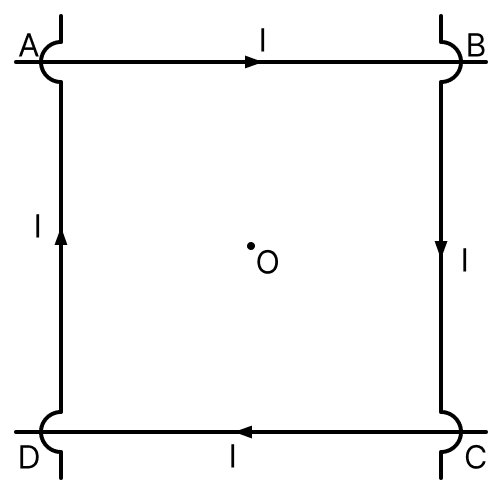
- zero
Answer
Reason —
The centre O of the square is at a perpendicular distance from each of the four infinitely long wires, so each wire produces at O a field of magnitude
Applying the right-hand thumb rule to each wire in turn for the directions of current shown, all the four fields at O are directed perpendicular to the plane of the page, into the page. Hence they simply add up,
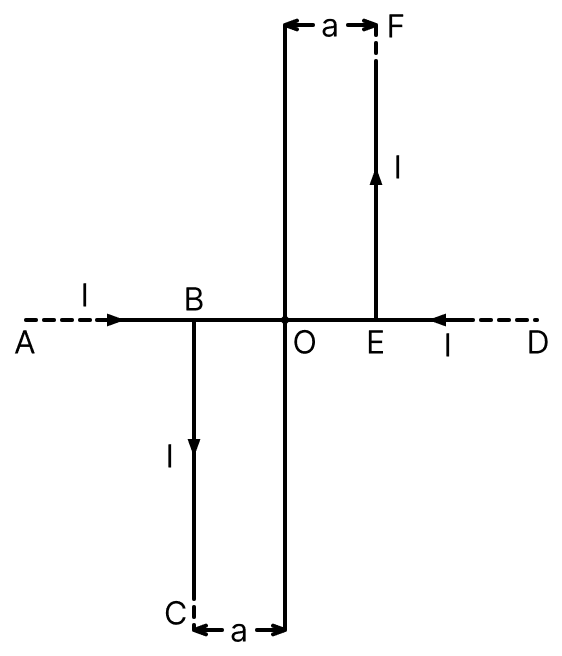
Two long thin wires ABC and DEF are arranged as shown. They carry current I as shown. The magnitude of the magnetic field at O is :
- zero
Answer
Reason —
The point O lies on the line of the segments BO and OE, so for these segments the angle θ between the current-element and the line joining it to O is 0 or 180°, and they develop no magnetic field at O.
The remaining two segments are semi-infinite wires, each lying at a perpendicular distance a from O. For a semi-infinite straight conductor, φ1 = 90° and φ2 = 0, so each gives
By the right-hand thumb rule both these fields at O are in the same direction, so
Anti-parallel currents are directed so that one is out of the page and the other is into the page. Compare the magnitude of the magnetic field B2 at any arbitrary point equidistant from the wires to the magnitude of the field B1 at that point from one wire alone.
- B2 > B1 for all equidistant points
- B2 < B1 for all equidistant points
- B2 > B1 for closer equidistant points only
- B2 < B1 for closer equidistant points only
Answer
B2 > B1 for closer equidistant points only
Reason — Let the two wires be separated by a distance 2d and let P be a point on their perpendicular bisector at a distance R from each wire. Each wire alone gives
For anti-parallel currents the components of the two fields along the line joining the wires cancel, while the components perpendicular to it add. Resolving, the resultant is
Hence B2 > B1 only when R < 2d, that is, only at the equidistant points that are closer to the wires. For distant equidistant points R > 2d and the resultant becomes smaller than the field of a single wire.
What are the dimensions of µ0/4π?
Answer
The dimensions of are [M L T-2 A-2].
Explanation:
The unit of µ0 is newton/ampere2, so
Since 4π is a pure number, has the same dimensions.
What are the dimensions of ?
Answer
The dimensions of are [L T-1].
Explanation:
The permeability and the permittivity of free space are related to the velocity of light in vacuum by
Hence this quantity has the dimensions of velocity, that is [L T-1].
Write an expression for the magnitude of the magnetic field at the centre of a circular coil of N turns.
Answer
The magnitude of the magnetic field at the centre of a circular coil of N turns is
where a is the radius of the coil, I the current in it and µ0 the permeability of free space.
Explanation:
The direction of is perpendicular to the plane of the coil, that is, along the axis of the coil.
Calculate the magnetic flux density of the magnetic field at the centre of a circular coil of 50 turns, having a radius of 0.5 m and carrying a current of 5A.
Answer
Given,
- N = 50 turns
- a = 0.5 m
- I = 5 A
The magnetic flux density at the centre of a circular coil is
Substituting the values,
Hence, the magnetic flux density at the centre of the coil is T.
A charged particle moving in a straight line parallel to a uniform magnetic field enters the field. What will be its path in the field? Will there be any change in its speed or direction of motion?
Answer
The particle will continue to move along a straight line, with no change in its speed or direction of motion.
The particle moves parallel to the field, so θ = 0 and
As no force acts upon it in the field, the particle moves undeviated.
A charged particle moving in a straight line perpendicular to a uniform magnetic field enters the field. What will be its path in the field and why? Will there be any change in its speed?
Answer
The particle will move along a circle in a plane perpendicular to the field, with the same speed as before.
Here θ = 90°, so the particle experiences a maximum force F = Bqv, which is always perpendicular to its velocity. Such a force does no work on the particle, so the speed remains unchanged; it merely changes the direction of motion continuously and acts as the centripetal force.
A charged particle moving in a straight line enters a uniform magnetic field at an arbitrary angle with the field direction. What will be its path?
Answer
The particle will move along a helical path whose axis is parallel to the magnetic field , with a constant speed.
Explanation:
The velocity is resolved into a component v cos θ parallel to and a component v sin θ perpendicular to it. The parallel component is unaffected by the field and gives a uniform linear motion along the field, while the perpendicular component gives a circular motion. The superposition of the two is a helical path.
Write an expression for the force on a conductor carrying a current I placed in a magnetic field . What is the direction of this force?
Answer
The force on a current-element carrying a current I placed in a magnetic field is
The direction of this force is perpendicular to the plane containing and , that is, perpendicular to both of them. It may also be found by the right-hand palm rule no. 2 or by Fleming's left-hand rule.
A charge is at rest in a magnetic field. Does it experience any force? If it were at rest in an electric field, then?
Answer
No, a charge at rest experiences no force in a magnetic field, but it does experience a force in an electric field.
Explanation:
The magnetic force is F = Bqv sin θ, which is zero when v = 0. Only a charge in motion experiences a force in a magnetic field. The electric force, however, is F = qE, which is independent of the velocity, so a static charge does experience a force in an electric field.
The force experienced by a particle of charge q moving with velocity in a uniform magnetic field is given by . (a) Which pairs of vectors are always at right angles? (b) Which may have any angle between them?
Answer
(a) The pairs and are always at right angles.
(b) The pair may have any angle between them.
Since , the force is perpendicular to the plane containing and , and hence perpendicular to each of them. The angle θ between and itself may take any value, and it only decides the magnitude F = Bqv sin θ.
The lines of force in a magnetic field represent the direction at each point which a small magnetic needle placed at the point takes up. Do they also represent the direction of force on a moving charge at each point?
Answer
No, they do not represent the direction of the force on a moving charge.
Explanation:
The lines of force give the direction of at each point. The force on a moving charge is
which is perpendicular to , and hence perpendicular to the line of force at that point.
An electron moving with velocity along +X-axis enters a uniform magnetic field directed along +Y-axis. What is the magnitude and direction of the force on the electron?
Answer
Here is along the +X-axis and along the +Y-axis, so θ = 90° and the magnitude of the force is
For the direction, note that the electron is negatively charged, so the current is along the −X-axis, that is, opposite to the motion of the electron. Applying Fleming's left-hand rule with the current along −X and the field along +Y, the force on the electron is directed along the −Z-axis.
(i) An electron is moving vertically downwards. It passes through a magnetic field directed from south to north in a horizontal plane. In which direction would the electron be deflected? (ii) If the electron is replaced by a proton, then?
Answer
(i) The electron would be deflected towards the west.
(ii) If the electron is replaced by a proton, it would be deflected towards the east.
The electron moves vertically downwards and the field is directed from south to north. Since the electron is negatively charged, the direction of current is taken vertically upwards, and Fleming's left-hand rule then gives the force towards the west. For a proton the direction of current is the same as its direction of motion, so the force is reversed and is directed towards the east.
An electron-beam is moving horizontally towards east. If this beam passes through a uniform magnetic field directed upwards, then in which direction will the beam be deflected?
Answer
The beam will be deflected towards the north.
Explanation:
The electron-beam moves towards the east, so the direction of current is towards the west. With the field directed vertically upwards, Fleming's left-hand rule gives the force, and hence the deflection of the beam, towards the north.
Suppose you are sitting in a room. An electron-beam, moving horizontally from the wall at your back towards the wall in front of you, is deflected to your right. What is the direction of magnetic field in the room?
Answer
The magnetic field in the room is directed vertically downwards.
Explanation:
The beam moves horizontally away from you, so the direction of current is towards you. The beam is deflected to your right. Applying Fleming's left-hand rule with the current directed towards you and the force towards your right, the fore-finger, which gives the direction of the field, points vertically downwards.
You are standing with your face towards north. An electron in front of you, moving horizontally towards north, is deflected to your left. Are you in the northern hemisphere or in the southern hemisphere?
Answer
You are in the southern hemisphere.
Explanation:
The electron moves towards the north, so the direction of current is towards the south. The electron is deflected to your left, that is, towards the west. Applying Fleming's left-hand rule, the earth's magnetic field at that place must be directed vertically upwards. The earth's field points vertically upwards only in the southern hemisphere.
If an electron (or proton) is not deflected while passing through a region, can we be sure that there is no magnetic field in that region?
Answer
No, we cannot be sure that there is no magnetic field in that region.
Explanation:
A magnetic field may well be present, with the electron (or proton) moving parallel to it. In that case θ = 0, so
and the particle passes through undeflected.
If an electron passing through a region is deflected from its path, is it a definite indication of the presence of a magnetic field there?
Answer
No, it is not a definite indication of the presence of a magnetic field.
Explanation:
An electric field present in that region would also deflect the electron, since the electric force F = qE acts on a charge whether it is at rest or in motion. Hence the deflection alone cannot decide whether the field is magnetic or electric.
How should a current-carrying conductor be placed in a magnetic field with respect to the field, so that the force acting upon the conductor is maximum?
Answer
The conductor should be placed perpendicular to the field.
Explanation:
The force on a current-carrying conductor is
which is maximum when sin θ = 1, that is when θ = 90°. Then Fmax = IBl.
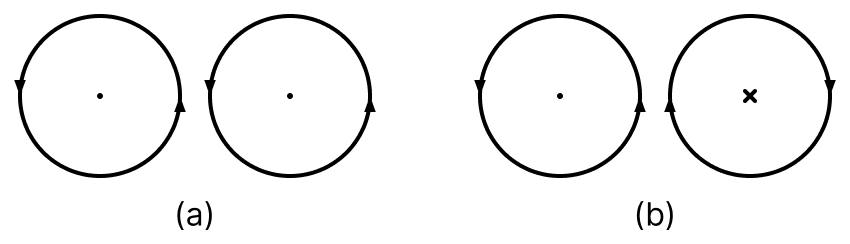
Equal currents I and I are flowing through two infinitely-long parallel wires. What will be the magnetic field at a point mid-way between them, when the currents are (a) in same direction, (b) in opposite directions?
Answer
(a) When the currents are in the same direction, the magnetic field at the mid-point is zero.
(b) When the currents are in opposite directions, the field at the mid-point is twice the field due to either wire.
The mid-point is equidistant from the two wires, so the two fields are equal in magnitude. For currents in the same direction the two fields at the mid-point are opposite in direction and cancel, while for currents in opposite directions they are in the same direction and add up.
An electron is moving in a horizontal circular orbit in the anti-clockwise direction when seen from above. What is the direction of the magnetic field produced by the moving electron at the centre of the orbit?
Answer
The magnetic field produced at the centre of the orbit is directed vertically downwards.
Explanation:
The electron is negatively charged, so the direction of the conventional current is opposite to its motion, that is, clockwise when seen from above. Applying the right-hand palm rule no. 1 to this clockwise current, the field at the centre of the orbit is directed vertically downwards.
We are viewing a proton from a height downwards. The proton is moving horizontally along a circular path in a uniform magnetic field directed vertically upwards. Whether its direction of motion will look to us clockwise or anti-clockwise?
Answer
Its direction of motion will look clockwise to us.
Explanation:
The field is directed vertically upwards and we are viewing from a height downwards, so the field points towards us. For a positive charge moving in a field directed towards the observer, the magnetic force turns the proton clockwise. (An electron in the same field would appear to move anticlockwise.)
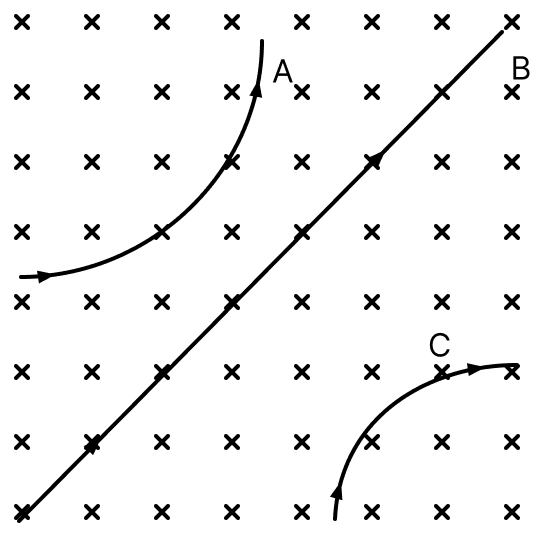
The paths of three particles A, B and C moving in a uniform magnetic field, denoted by crosses (×), are shown in the figure. The field is perpendicular to the plane of paper pointing downwards. State the nature of charge on each particle.
Answer
Particle A is positively-charged, B is neutral and C is negatively-charged.
Explanation:
The field is perpendicular to the plane of the paper, pointing downwards (into the page). Particle B travels along a straight line, so no force acts on it and it must be uncharged. Particles A and C are deflected in opposite senses, so they carry charges of opposite sign; applying Fleming's left-hand rule to the direction of bending shown, A is positively charged and C is negatively charged.
A charged particle enters a (non-uniform) magnetic field which varies in magnitude from point to point but has a constant direction. The particle travels undeflected in a straight line with constant speed. What can you say about the initial velocity of the particle?
Answer
The initial velocity must be either parallel or anti-parallel to .
Explanation:
The particle travels undeflected with a constant speed, so the field exerts no force on it. Since
and neither B nor v is zero, sin θ must be zero, that is θ = 0 or 180°. The variation of the magnitude of the field from point to point does not matter, because the direction of is constant.
An electron and a proton, accelerated by the same potential difference, enter perpendicularly a uniform magnetic field. How many times larger is the radius of proton's path than the electron's?
Answer
The radius of the proton's path is times larger than that of the electron.
For a particle accelerated through a potential difference V and entering the field perpendicularly,
The charges are equal in magnitude and V and B are the same, so . Hence
The velocities of two alpha particles A and B entering Perpendicular to a uniform magnetic field are in the ratio 4 : 1. On entering the field they move in different circular paths. Give the ratio of the radii of their paths.
Answer
The ratio of the radii of their paths is 4 : 1.
Both are α-particles, so they have the same mass and the same charge, and they enter the same field perpendicularly. From
r is directly proportional to v. Hence
State Biot-Savart's law.
Answer
Biot-Savart's law : The magnetic field dB developed at a point P due to a small current-element I dl of a current-carrying conductor is
(i) directly proportional to the current I flowing through the conductor,
(ii) directly proportional to the length dl of the element,
(iii) directly proportional to the sine of the angle θ between the current-element and the line joining the element to the point P, and
(iv) inversely proportional to the square of the distance r between the element and the point P.
Combining these,
In vector form,
where µ0 is the permeability of free space.
Draw magnetic lines of force around a straight, long current-carrying conductor and state right-hand rule.
Answer
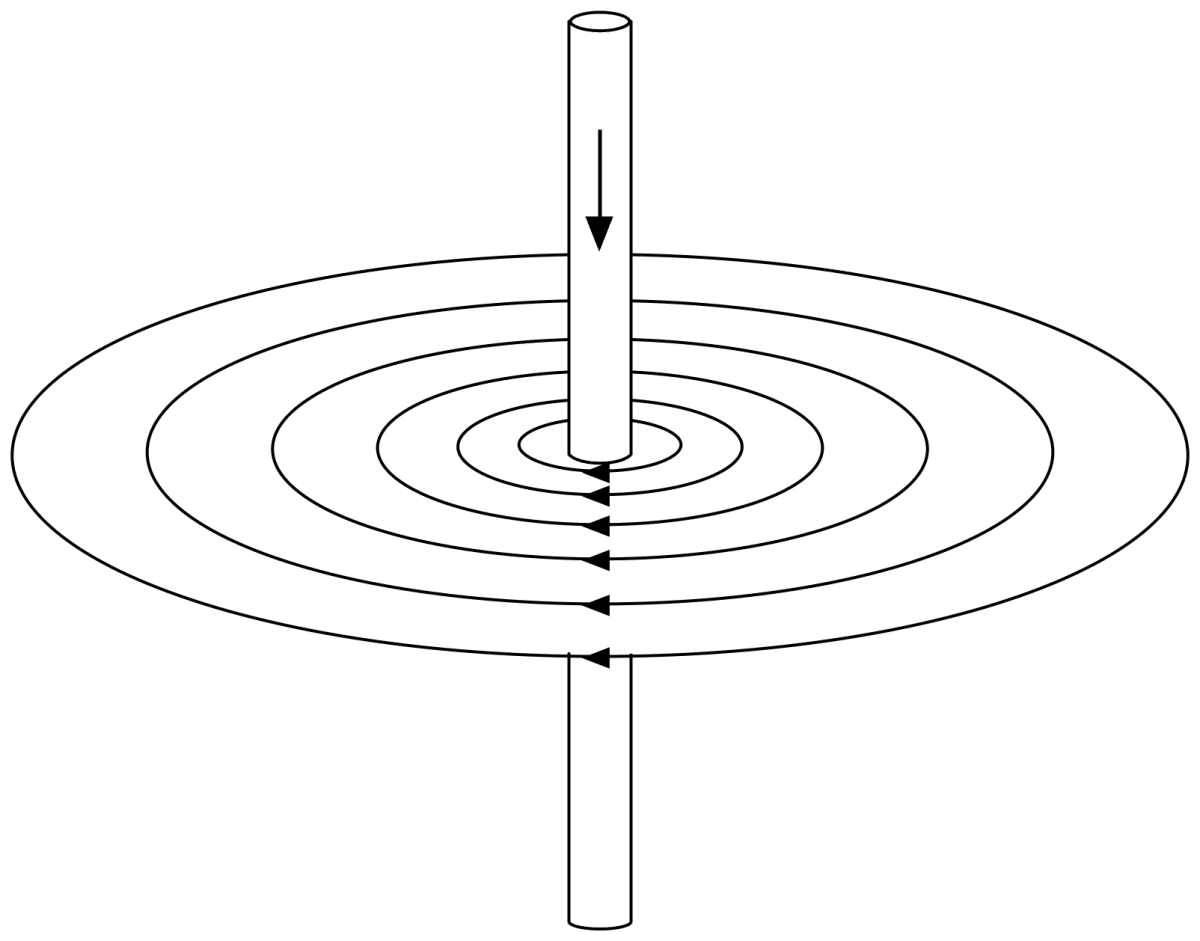
The magnetic lines of force around a straight, long current-carrying conductor are concentric circles lying in a plane perpendicular to the conductor, with their centres on the conductor. The lines are crowded close to the wire and become more widely spaced farther from it, showing that the field weakens with distance.
Right-hand thumb rule : If we grasp the straight conductor in the right hand such that the thumb points in the direction of the current, then the curled fingers give the direction of the magnetic field , with the finger tips pointing along .
What happens if a bar-magnet is cut into two pieces (i) perpendicular to its length, (ii) along its length?
Answer
(i) When the magnet is cut perpendicular to its length : Each piece is a complete magnet with a north and a south pole, having the same pole-strength as before but a reduced length.
(ii) When the magnet is cut along its length : Each piece is again a complete magnet with a north and a south pole, having the same length as before but a reduced pole-strength.
In either case an isolated pole is never obtained, because magnetic monopoles do not exist.
Must every magnetic field configuration necessarily have a north pole and a south pole. What about the magnetic field of a toroid?
Answer
No, it is not necessary for every magnetic field configuration to have a north pole and a south pole.
The poles exist only when the source of the magnetic field has a net magnetic moment. A toroid has zero magnetic moment, so it does not have north and south poles. Its magnetic lines of force lie entirely within the core in the form of concentric circles, closing on themselves, and the field outside the core is zero.
Write the formula for the force on a charge q moving with velocity in a uniform magnetic field . What is the magnitude of this force? When is it zero?
Answer
The force on a charge q moving with velocity in a uniform magnetic field is
Its magnitude is
where θ is the angle between and .
The force is zero when θ = 0 or 180°, that is, when the charge moves parallel or anti-parallel to the field. It is also zero when the charge is at rest (v = 0).
An electron-beam is deflected in a given field. How will you detect whether the given field is a uniform magnetic field or a uniform electric field?
Answer
If the given field is a uniform electric field, the electric force qE on the electrons is constant in magnitude and direction, so the path of the beam will be parabolic.
If it is a uniform magnetic field, the force is always perpendicular to the velocity, so the path will be circular when the beam enters perpendicular to the field, and helical when it enters at some other angle.
Hence the nature of the path traced by the deflected beam tells us which of the two fields is present.
What is a solenoid? Draw the lines of force around it.
Answer
Solenoid : A solenoid is a long, closely wound helical coil of insulated wire, whose length is very large compared with its diameter. When a current is passed through it, it behaves like a bar magnet.
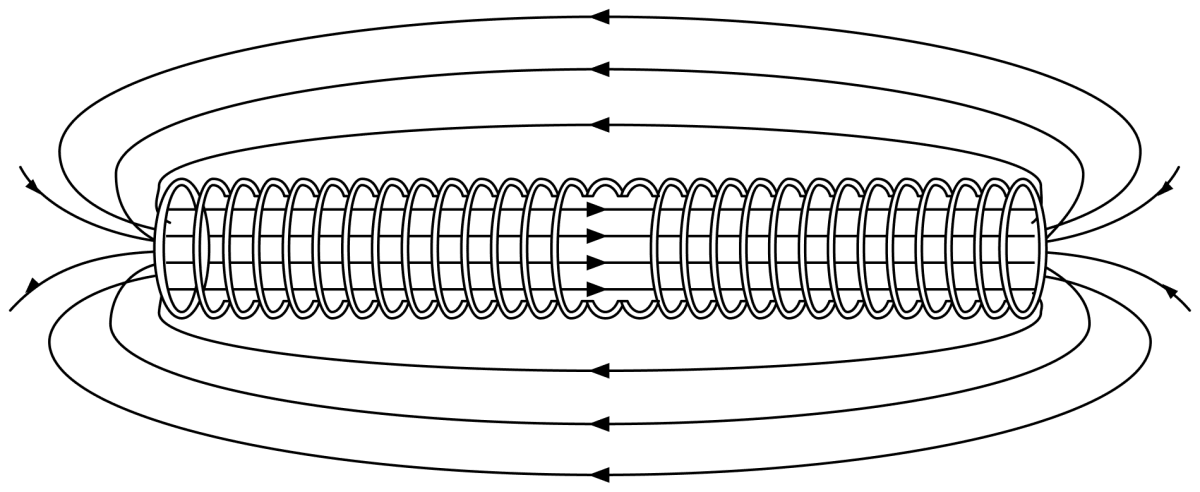
The lines of force inside the solenoid are straight, parallel and equidistant, showing a uniform magnetic field, except near the edges. Outside the solenoid the lines spread out and the field is very small compared with the field inside. One end of the solenoid behaves as a north pole and the other as a south pole.
Write an expression for the magnetic field at axial points inside a long current-carrying solenoid and at one end.
Answer
For a point well inside a long current-carrying solenoid,
and at a point at one end of the solenoid,
where n is the number of turns per metre length of the solenoid and I is the current in it. Thus the field at the end is one half of the field at the middle.
A charge 10 µC enters a region of the uniform magnetic field with a velocity m/s and experiences a force N. Find the value of 'C'.
Answer
Given,
- q = 10 µC
- m/s
- N
The force on a moving charge in a magnetic field is
which is always perpendicular to . Hence
Hence, C = 4.
State Fleming's left-hand rule.
Answer
Fleming's left-hand rule : Stretch the fore-finger, the middle-finger and the thumb of the left hand so that these are perpendicular to one another. If the fore-finger points in the direction of the magnetic field and the middle-finger in the direction of the current, then the thumb indicates the direction of the magnetic force.
For a positively charged particle the direction of motion is taken as the direction of current, while for a negatively charged particle the direction of current is taken opposite to its direction of motion.
Two parallel wires carry currents in (a) same direction, (b) opposite directions. What is the nature of force between them in each case?
Answer
(a) When the currents are in the same direction, the wires attract each other.
(b) When the currents are in opposite directions, the wires repel each other.
Each wire lies in the magnetic field produced by the current in the other, and so experiences a force given by F = I2B1L. The force per unit length between the two wires is
and its direction, found by the right-hand palm rule, is towards the other wire for parallel currents and away from it for anti-parallel currents.
Explain why two straight, parallel wires carrying currents in opposite directions repel each other.
Answer
Each current-carrying wire lies in the magnetic field produced by the current in the other wire.
Consider the wire PQ carrying a current I1. The magnetic field due to it at the position of the second wire RS is perpendicular to the plane of the paper. The wire RS, carrying the current I2 in the opposite direction, is thus placed in this field and experiences a magnetic force
Applying Fleming's left-hand rule, this force is directed away from PQ. By the same argument the force on PQ is directed away from RS. Hence the two wires repel each other.
Define 'ampere' in terms of the force between two long, straight and parallel conductors carrying currents in same direction.
Answer
Definition of ampere : One ampere is that steady current which, when maintained in each of two infinitely long, straight and parallel conductors of negligible cross-section placed in vacuum at a distance of 1 metre from each other, produces a force of 2 × 10⁻⁷ newton per metre length on each conductor.
This follows from the force per unit length between two parallel conductors carrying the same current I,
Putting I = 1 A and r = 1 m gives N m-1. Since the currents are in the same direction, this force is attractive.
An electron-beam is moving south to north just above a magnetic needle. What will be the effect on the needle?
Answer
The needle will point along the north-east direction, instead of north.
The electron-beam moves from south to north, so the direction of the current is from north to south. By the right-hand thumb rule, the magnetic field of this current at a point just below the beam is directed towards the east.
The needle is therefore acted upon by two fields at right angles, the earth's horizontal field towards the north and the field of the beam towards the east. It sets itself along the resultant of the two, that is, towards the north-east.
A straight, current-carrying wire is buried into a wall erected in the north-south direction. The north pole of a horizontal magnetic needle placed near the wall towards its west points towards south (instead of north). What is the direction of the wire buried in the wall and what is the direction of current in it?
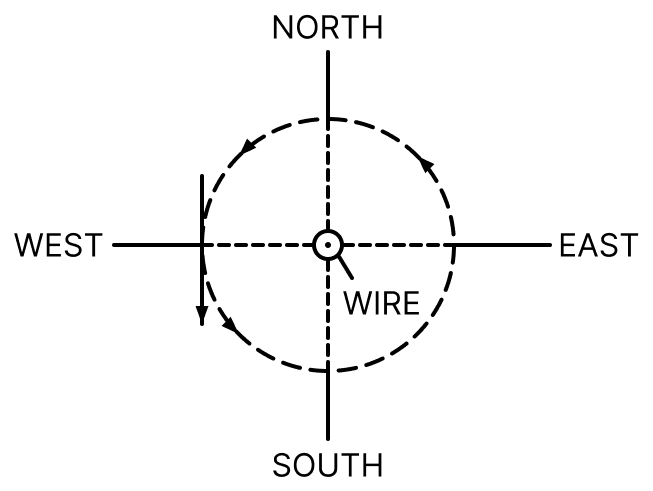
Answer
The wire buried in the wall is vertical, and the current in it flows from bottom to top.
Since the north pole of the needle points towards the south, the magnetic field of the wire at the position of the needle is directed towards the south. As the needle lies in a horizontal plane, the field of the wire must lie in the horizontal plane, and this is possible only if the wire is vertical.
It is clear from the figure that the lines of force due to the current-carrying wire are anti-clockwise. So, by the right-hand thumb rule, the current in the wire should be from bottom to top.
What will be the magnetic field at the centre of the cube made of wires, shown in the figure?
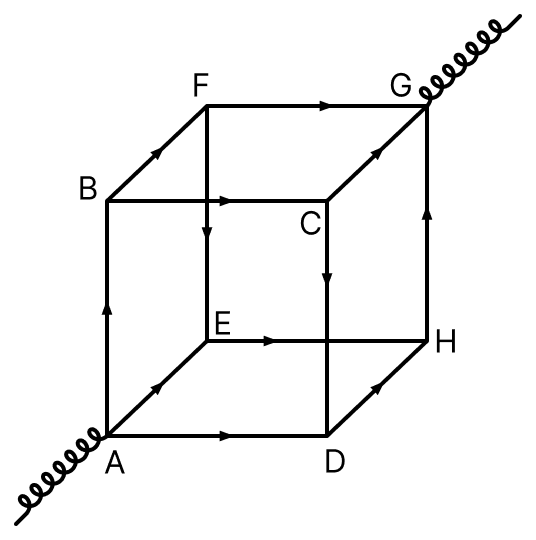
Answer
The magnetic field at the centre of the cube is zero.
The twelve wires of the cube form six pairs of currents, namely AB and HG, AE and CG, AD and FG, BF and DH, FE and CD, and EH and BC. The two currents of each pair are equally inclined and equally distant from the centre but are oppositely directed, so they produce equal and opposite magnetic fields at the centre of the cube. Hence the fields of every pair cancel out and the resultant field at the centre is zero.
(a) Four copper wires of same cross-sectional area are connected in the form of a square ABCD. On passing currents in them, as shown in the figure, will a magnetic field be produced at the centre O of the square? (b) If the wires AB and BC are of copper, and AD and DC of aluminium, then?
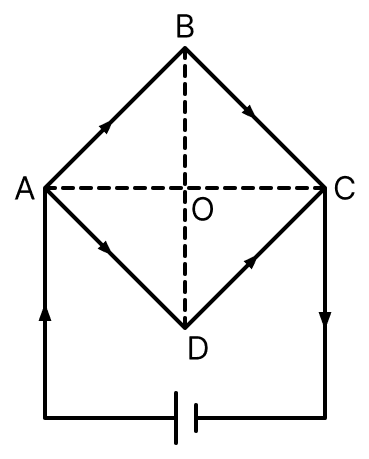
Answer
(a) No magnetic field is produced at the centre O.
All the four wires are of the same material and of the same cross-sectional area, so they have equal resistances and equal currents flow through them. The fields at O due to the currents in AB and DC (and similarly due to those in BC and AD) are equal in magnitude but opposite in direction, so they cancel mutually. Hence there is no magnetic field at O.
(b) A magnetic field is produced at the centre O.
Aluminium has a higher resistivity than copper, so the aluminium wires AD and DC carry smaller currents than the copper wires BC and AB. The cancellation is therefore incomplete, and a magnetic field exists at O due to the excess currents in BC and AB. This field is perpendicular to the plane of the page, directed downwards (right-hand palm rule no. 1).
A current is set up in a long copper wire. Is there a magnetic field (i) inside, (ii) outside the pipe?
Answer
(i) Yes, there is a magnetic field inside. For a point inside the wire at a distance R from the axis,
so the field is directly proportional to the distance R of the point from the centre of the wire.
(ii) Yes, there is a magnetic field outside. For a point outside,
so the field is inversely proportional to R.
Note: The question first speaks of a solid copper wire and then of a pipe. The answer above is for a solid wire, as taken in the textbook. For a hollow pipe the field at an inside point would be zero, since no current would then be enclosed.
A coil placed in the plane of paper has a current in clockwise direction when looking from above. What will be the change in the magnetic field at the centre of the coil if (i) the current through the coil be reduced to half? (ii) the radius of the coil be doubled? (iii) the direction of the magnetic field?
Answer
The magnetic field at the centre of the coil is
(i) If the current is reduced to half, then since B ∝ I, the field will be halved.
(ii) If the radius is doubled, then since , the field will again be halved.
(iii) The current is clockwise when looked at from above, so by the right-hand palm rule no. 1 the field at the centre is perpendicular to the plane of the paper, pointing downwards.
A current is flowing in a long wire. It is first shaped as a circular coil of one turn and then into a coil of two turns of smaller radius. In which case the magnetic field produced at the centre will be stronger? And how much?
Answer
The field will be stronger in the second case, and four times as strong as in the first case.
Let l be the length of the wire. The field at the centre of a coil of N turns is
For one turn, l = 2πa1, so and
For two turns, l = 2(2πa2), so and
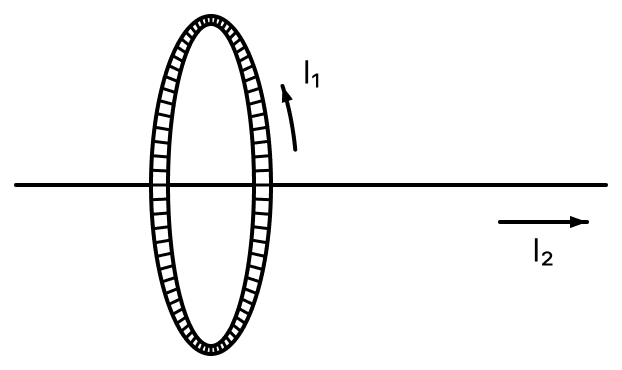
A straight wire carrying a current I2 is situated along the axis of a circular conductor carrying a current I1. What is the force produced due to the interaction between the two currents?
Answer
No force is produced on either conductor.
The wire carrying the current I2 lies along the axis of the circular conductor, and the axial magnetic lines of force due to the current I1 are along this very axis. As the wire coincides with the direction of the field, θ = 0 and it experiences no force due to I1.
Similarly, the circular conductor carrying the current I1 coincides with the circular lines of force produced by I2, so it too experiences no force due to I2.
A positive charge is coming directly towards you. What would be the direction of the magnetic field produced due to its motion? If a negative charge be going directly away from you, then?
Answer
In both the cases the lines of force are circular and anti-clockwise.
By Maxwell's right-hand screw rule, taking the direction of motion of a positive charge as the direction of current, a positive charge coming directly towards you is equivalent to a current directed towards you, and the lines of force around it are anti-clockwise.
A negative charge going directly away from you is equivalent to a current directed towards you as well, so here also the lines of force are circular and anti-clockwise.
Imagine that you are sitting in a room filled with a uniform magnetic field pointing vertically downwards. At the centre of the room, two electrons are released horizontally with the same speed but in opposite directions. (i) Describe their motion. (ii) If one particle be electron and the other positron, then.
Answer
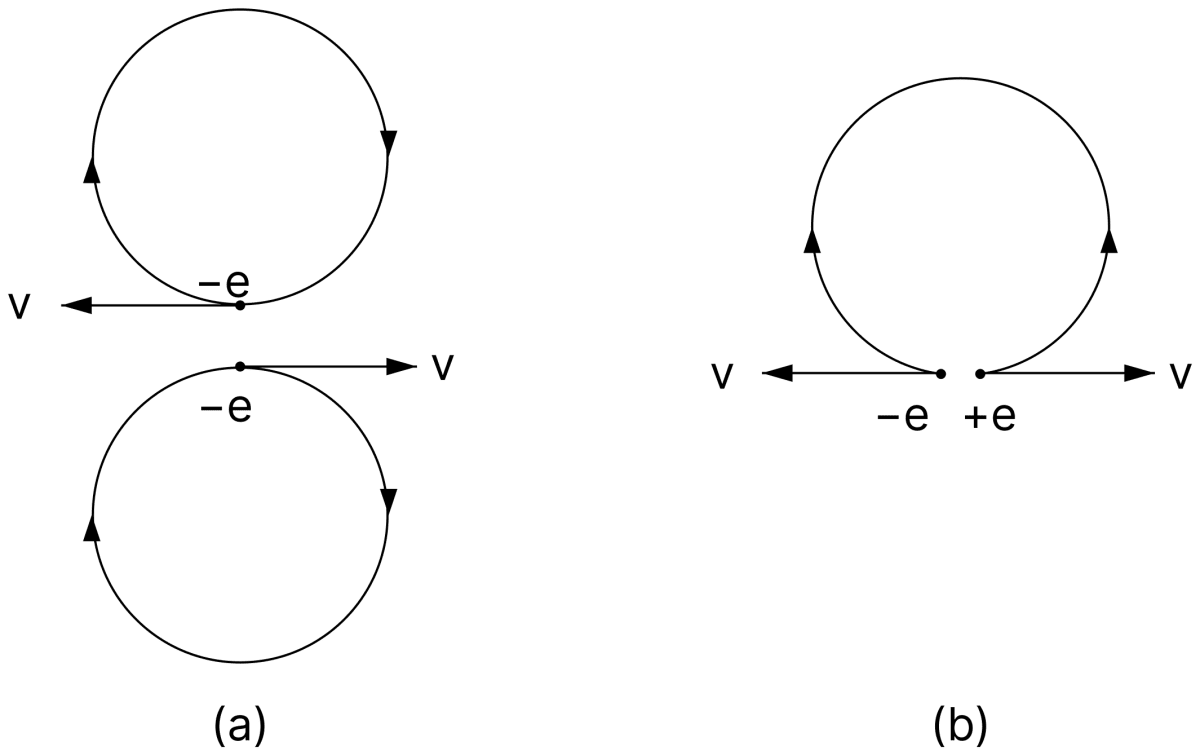
(i) Both the electrons will describe similar circular paths, and both will move clockwise [Fig. (a)]. They have the same charge and the same speed in a field of the same magnitude, so their radii are equal, but since they start in opposite directions their circles lie on opposite sides of the starting point.
(ii) The electron and the positron carry charges of opposite sign, so the magnetic force on them is oppositely directed. They will move on the same circle, the electron clockwise and the positron anti-clockwise. They will therefore meet again and annihilate each other [Fig. (b)].
A similar event, as in last question, photographed in a liquid-hydrogen bubble chamber shows spiral tracks (not circular tracks). Why?
Answer
Because the particles lose energy continuously in the liquid, so the radius of the track goes on decreasing.
A charged particle ionises the medium much more in a liquid than in a gas. The particles therefore progressively lose energy and are slowed down by collisions with the environment.
The radius of the track in a magnetic field is
which is proportional to the speed of the particle. As the speed decreases progressively, the radius also goes on decreasing, and the circular track becomes a spiral track.
Does the speed, or kinetic energy, of a charged particle moving in a uniform magnetic field change? Does the momentum of the particle change? Does the kinetic energy of the particle change when moving in an electric field?
Answer
The speed, and hence the kinetic energy, of the particle does not change; the momentum does change; and in an electric field the kinetic energy does change.
The magnetic force on a charged particle moving in a uniform magnetic field is always perpendicular to its direction of motion, so no work is done by the field on the particle and its speed (or kinetic energy) remains unchanged. The direction of motion, however, changes continuously, so the momentum of the particle changes.
In an electric field the force qE on the charged particle is along the direction of the field and not perpendicular to the velocity. Work is therefore done on the particle and its kinetic energy changes.
A charged particle enters a (non-uniform) magnetic field varying from point-to-point both in magnitude and direction, with a certain initial velocity. What can you say about the final velocity of the particle when it leaves the field?
Answer
The particle leaves the field with its initial speed, but in a different direction.
The magnetic force is always perpendicular to the velocity of the particle, whatever be the magnitude and direction of at each point. Hence the field does no work on the particle and the magnitude of the velocity (that is, the speed) remains unchanged throughout; only the direction of the velocity goes on changing.
The net charge in a current-carrying conductor is zero, even then it experiences force in a magnetic field. Why?
Answer
The magnetic force is related to the motion of charge, and not to the net charge of the conductor.
In a current-carrying conductor the free electrons move with the drift velocity vd, so each of them experiences a magnetic force in the field. The positive ions of the lattice are stationary and so they do not experience any magnetic force, although their charge cancels that of the electrons and makes the net charge of the conductor zero.
The resultant of these microscopic forces on the drifting electrons is the macroscopic force
experienced by the whole conductor.
Free electrons always keep on moving in a conductor. Even then, no magnetic force acts on them in a magnetic field unless a current is passed through it. Why?
Answer
Like the molecules of a gas, the free electrons in a conductor are in a state of continuous random motion. They therefore have no net velocity in any direction, and the magnetic forces on the individual electrons, being in all possible directions, cancel out. Hence there is no net magnetic force on the conductor.
When a current is passed, the electrons acquire a drift velocity vd in a definite direction in addition to their random motion, and the magnetic forces on them now add up to give a resultant force on the conductor.
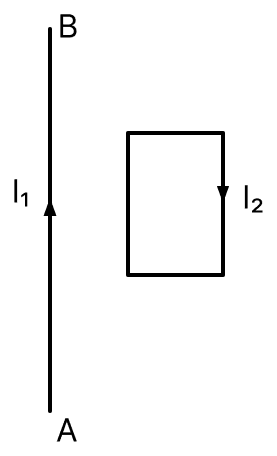
In the given figure, a long, straight current-carrying wire AB is fixed, while the rectangular current-loop is free to move. In which direction would the loop move? Explain with reason.
Answer
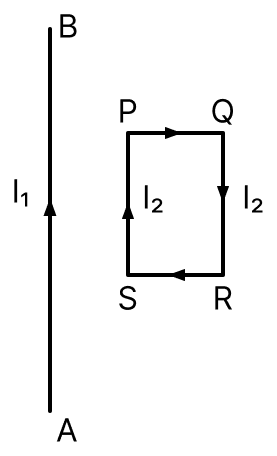
The loop would move towards the wire AB.
Let the rectangular loop be named PQRS, with the arm SP nearer to AB. The currents in AB and SP are parallel, so there is an attraction between them, while the currents in AB and QR are anti-parallel, so there is a repulsion between them.
The force per unit length between two parallel conductors is
which is inversely proportional to the separation r. As SP is nearer to AB than QR, the attraction is larger than the repulsion. Hence there is a net attraction and the loop moves towards AB.
A body is suspended from the lower end of a vertical spring. What shall be the effect on the position of the body when a current is sent through the spring? Does it depend upon the direction of current in the spring?
Answer
The body will be lifted upwards, and this does not depend upon the direction of the current in the spring.
The current in every turn of the spring is in the same direction, so any two neighbouring turns behave like two parallel conductors carrying currents in the same direction, and therefore attract each other. The turns consequently come closer, the spring contracts, and the suspended body is lifted upwards.
On reversing the current the currents in all the turns are reversed together, so they are still parallel and the attraction remains. Hence the effect is the same whatever be the direction of the current.
If the current flowing in the spring be alternating, then?
Answer
The spring will execute vibrations.
With an alternating current the magnitude of the current in the turns changes periodically, and so does the force of attraction between any two turns, which is proportional to the product of the currents. The force therefore varies periodically between zero and a maximum value.
The spring accordingly contracts and expands periodically, that is, it executes vibrations.
An electron-beam moving with uniform velocity is gradually diverging. When it is accelerated to a very high velocity, it starts converging. Why?
Answer
The electrons of the beam repel one another electrically, which makes the beam diverge. But the electrons are also moving charges in the same direction, and so they behave like parallel currents, which attract one another magnetically.
At ordinary velocities the electrical repulsion is much stronger than the magnetic attraction, so the beam diverges. As the velocity is raised, the magnetic attraction becomes more effective. At very high velocities the beam starts converging.
A finite-length movable wire (XY) carrying current i1 is kept parallel to another infinite length fixed wire (PQ) carrying current i2 above it. In this setup, the movable wire (XY) is stationary as depicted in figure.
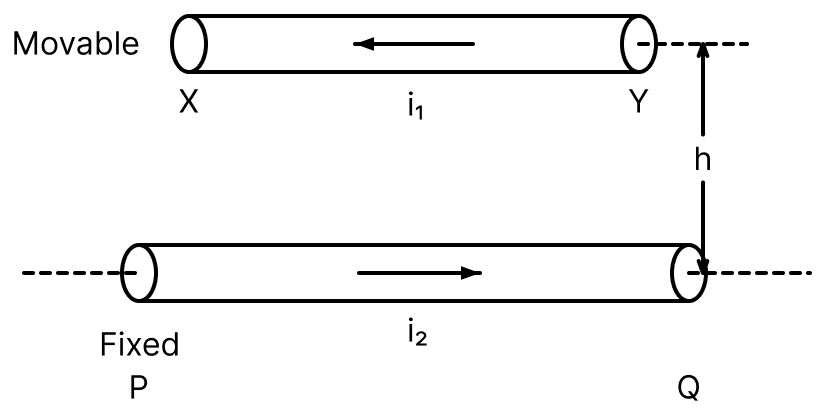
Redraw a new setup such that the movable wire (XY) remains stationary and is placed parallel below the fixed wire (PQ) carrying current i2.
Label the direction of current i1 in the movable wire (XY).
Answer
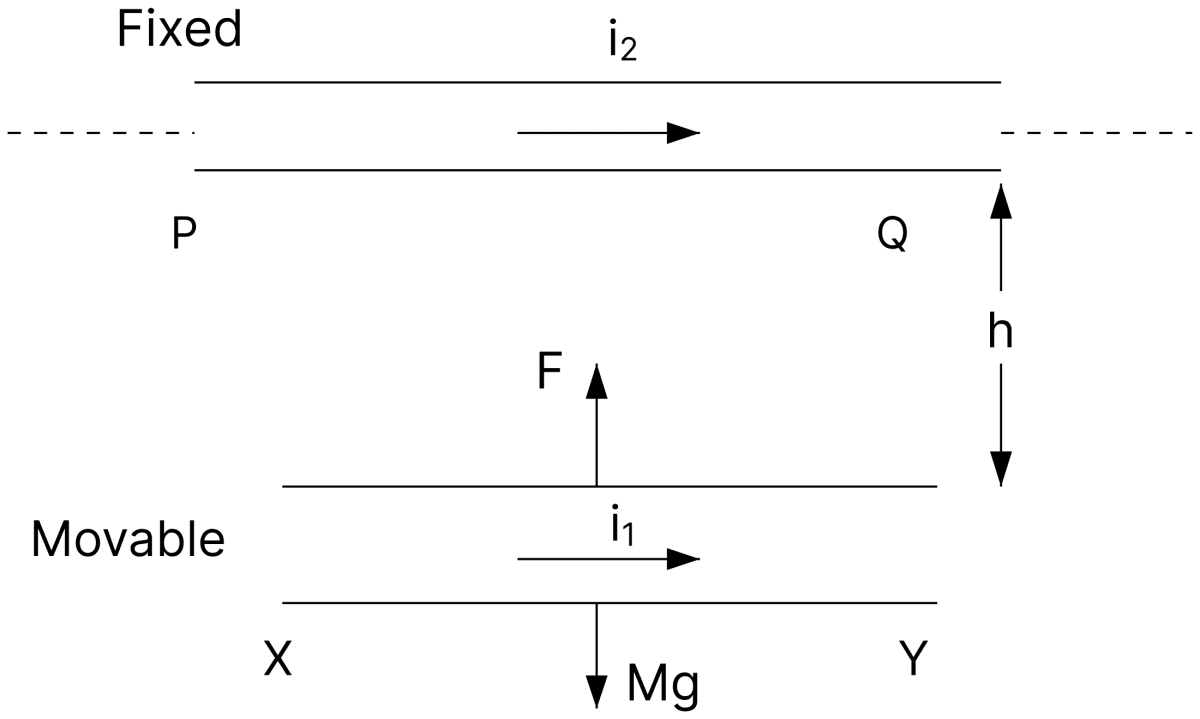
For the movable wire XY to remain stationary, the magnetic force F on it due to the current i2 in the fixed wire PQ must balance its weight Mg,
In the original setup PQ lies below XY. To balance the downward weight, the magnetic force on XY must be upward, away from PQ; therefore it is a force of repulsion, and the two currents i1 and i2 are in opposite directions.
When XY is placed below the fixed wire PQ, the force on XY must again be directed upwards, but this is now towards PQ, so it must be an attraction. Since parallel currents attract, the current i1 in XY must now be in the same direction as i2 in PQ, and the redrawn figure is labelled accordingly.
State Biot-Savart's law for the magnetic field due to a current-carrying element, explaining the symbols. Define 'tesla' on the basis of this law. How is gauss related to tesla?
Answer
Biot-Savart's law : Let XY be a conductor of arbitrary shape carrying a current I, and P a point at which the field is required. Let I dl be a current-element of the conductor and r the distance of this element from P, θ being the angle between the element and the line joining it to P.
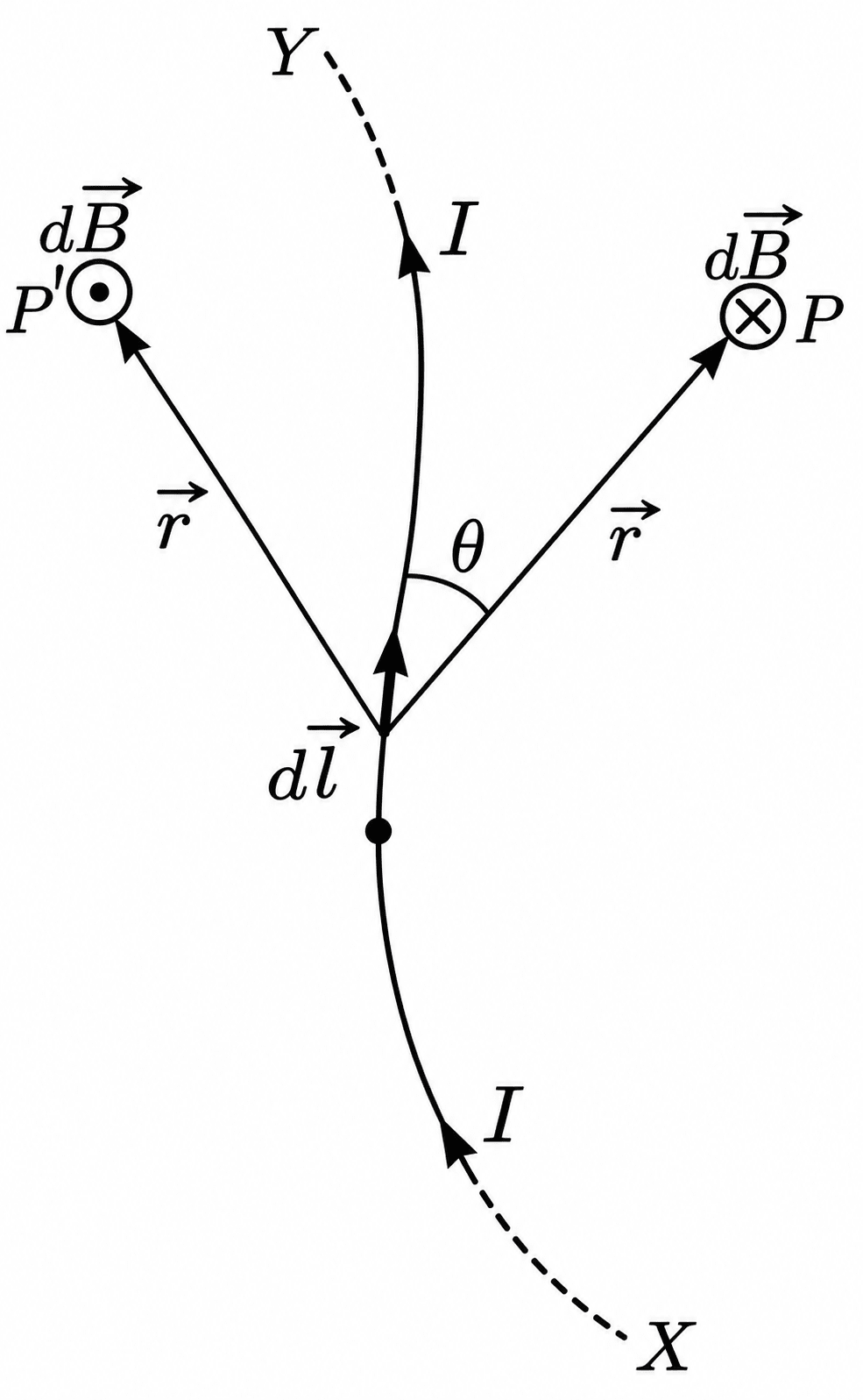
According to Biot-Savart law, the magnetic field dB at the point P due to the current-element I dl is
(i) proportional to the current, dB ∝ I,
(ii) proportional to the length of the element, dB ∝ dl,
(iii) proportional to sin θ, and
(iv) inversely proportional to the square of the distance, dB ∝ 1/r2.
Combining these four rules,
and in vector form
Here I is the current in the conductor, dl the length of the current-element, r the distance of the point from the element, θ the angle between the element and the line joining it to the point, and the proportionality constant, µ0 being the permeability of free space, equal to 4π × 10-7 N A-2.
The field due to the entire conductor is obtained by integrating over its whole length,
Definition of tesla : The unit of magnetic field obtained from this law is newton/(ampere-metre), which is called the tesla (T). One tesla is that magnetic flux density which exerts a force of 1 newton on a conductor of length 1 metre carrying a current of 1 ampere, placed perpendicular to the field.
Relation between gauss and tesla : The gauss is the corresponding unit in the CGS system, and
Discuss analogies and differences between Coulomb's law and Biot-Savart's law.
Answer
Analogies (similarities) :
(i) Coulomb's law gives the electric field due to a distribution of charges, while Biot-Savart's law gives the magnetic field due to a current-element. Biot-Savart's law is thus the magnetic equivalent of Coulomb's law.
(ii) According to Coulomb's law the magnitude of the electric field at a point P due to a charge-element dq is
and according to Biot-Savart law the magnitude of the magnetic field at P due to a current-element I dl is
Both have a constant of proportionality depending on the medium.
(iii) Both are inverse-square laws, the field falling off as in each case.
Differences (dissimilarities) :
(i) The charge-element dq is a scalar, whereas the current-element is a vector whose direction is along the direction of the current.
(ii) According to Coulomb's law the magnitude of the electric field depends only upon the distance of the charge-element from the point P. According to Biot-Savart's law the magnitude of the magnetic field at P depends also upon the angle θ between the current-element and the line joining the element to the point P. The field is zero along the direction of the current (θ = 0 or 180°) and maximum perpendicular to it (θ = 90°).
(iii) According to Coulomb's law the direction of the electric field is along the line joining the charge-element and the point P. According to Biot-Savart's law the direction of the magnetic field is perpendicular to the current-element as well as to the line joining the current-element to the point P.
Using Ampere's circuital law, obtain an expression for the magnetic flux density 'B' at a point 'X' at a perpendicular distance r from a long current-carrying conductor.
Answer
Ampere's circuital law : The line integral of the magnetic flux density around any closed path in free space is equal to µ0 times the net current I threading through the area enclosed by the path,
Magnetic flux density near a long current-carrying conductor :
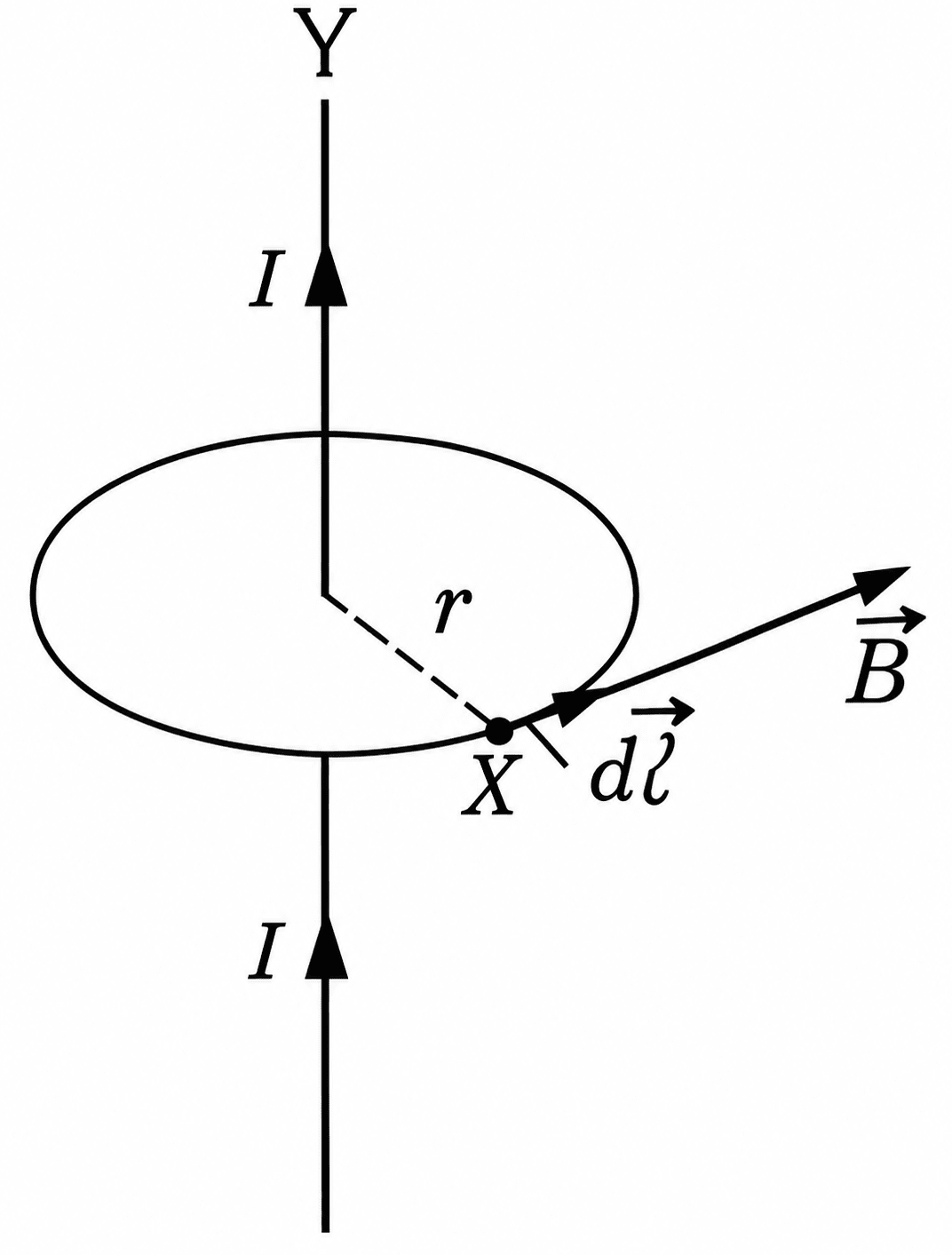
Let a long straight conductor carry a steady current I, and let X be a point at a perpendicular distance r from it, at which the field is required.
By symmetry, the magnitude of is the same at all points of a circle of radius r drawn around the wire in a plane perpendicular to it, and is tangential to this circle at every point. Choosing this circle as the closed path, and are along the same direction at each element, so
But , the circumference of the circle, and the current enclosed by the circle is I. Hence by Ampere's circuital law,
The direction of is tangential to the circle, and is given by the right-hand thumb rule.
State Ampere's circuital law. Use it to obtain magnetic field due to a long, straight solenoid.
Answer
Ampere's circuital law : The line integral of the magnetic flux density around any closed path in free space is equal to µ0 times the net current I threading through the area enclosed by the path,
Magnetic field of a long straight solenoid :
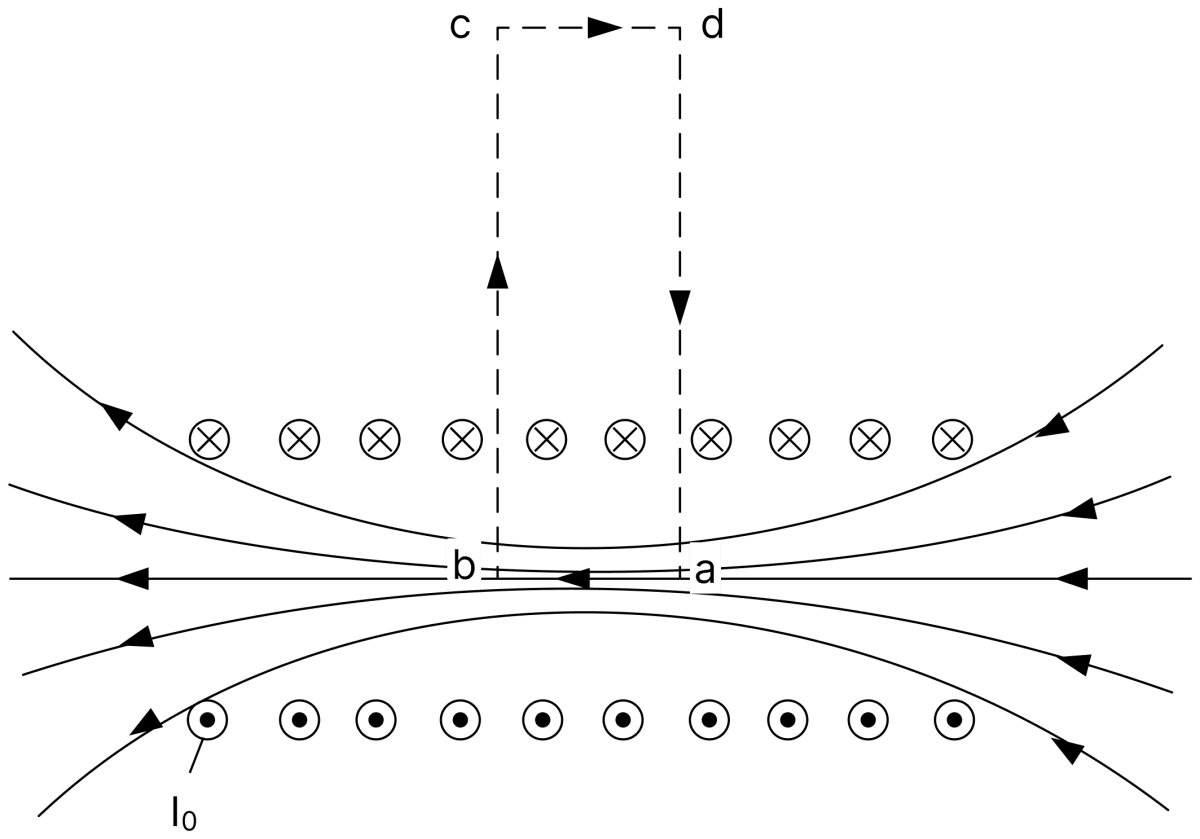
Consider a solenoid very long compared with its diameter, having n turns per unit length and carrying a current I0. The field outside such a solenoid is very small compared with the field inside, and the lines of force inside are straight and parallel, showing a uniform field except near the edges.
Let abcd be a closed rectangular path in which the side ab of length x is parallel to the axis inside the solenoid, and the sides bc and da are very long so that cd is far from the solenoid where the field is negligibly small.
Along bc and da the field is at right angles to , so , and along cd the field itself is zero. Hence
The number of turns passing through the rectangle is nx, and the current in each turn is I0, so the net current enclosed is
Substituting (i) and (ii) in Ampere's circuital law,
Thus the field inside a long solenoid is independent of its length and diameter and is uniform over the cross-section. At the ends of the solenoid the field is one half of this value,
Derive an expression for the magnetic field inside a toroid. Explain how it is different from the result obtained in case of a tightly wound long-solenoid.
Answer
Toroid : A toroid is a hollow circular ring on which a large number of turns of insulated conducting wire are closely wound. It may be viewed as a solenoid bent into a circular shape so as to close on itself.
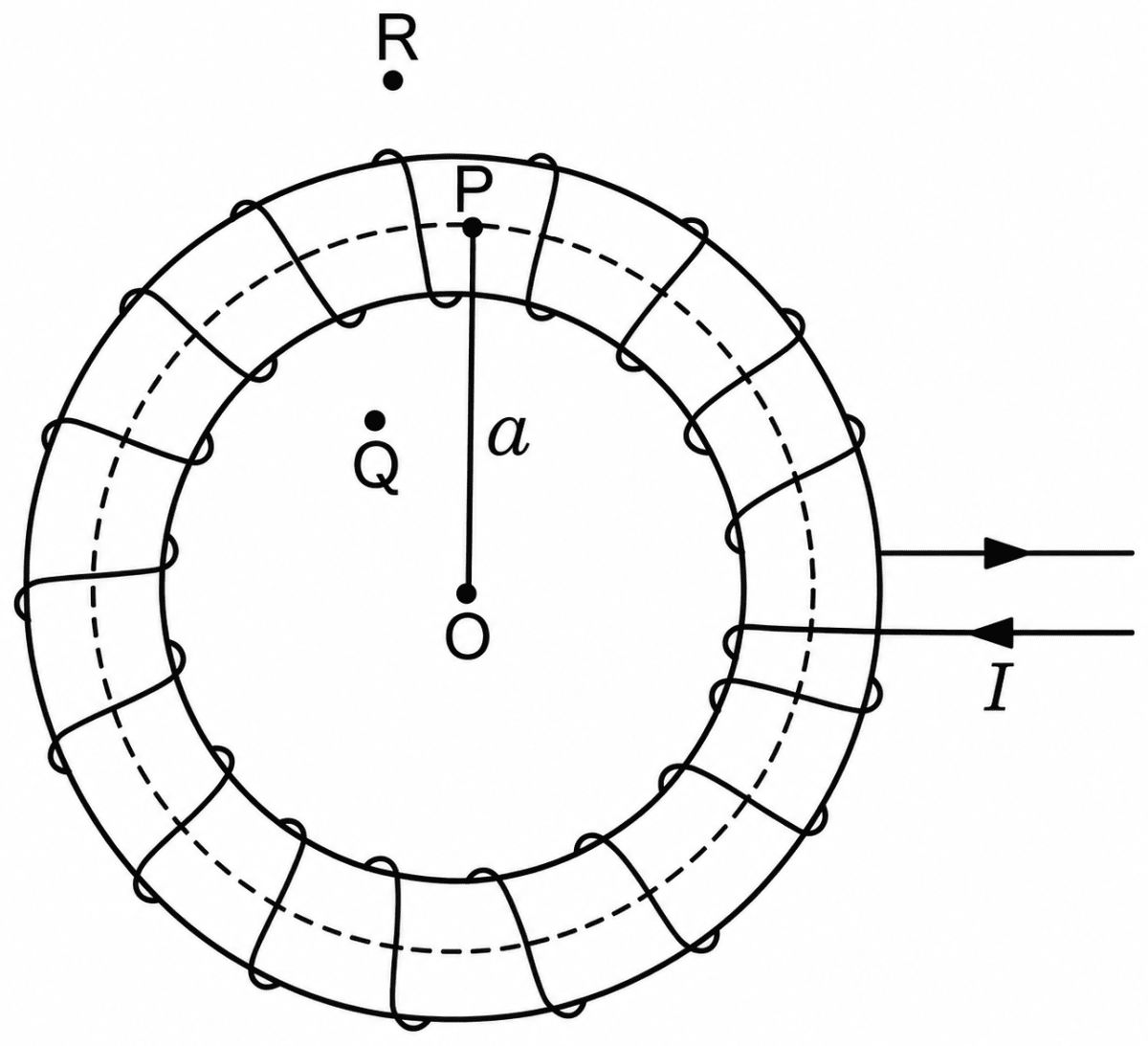
Magnetic field inside the core of a toroid : Let the toroid have N turns in all and carry a current I0. Let P be a point inside the core, and let a circle of radius a be drawn through P, lying within the space enclosed by the windings.
By symmetry the magnitude of is the same at all points of this circle and its direction is tangential at each point. Applying Ampere's circuital law to this circle,
Since and are along the same direction at every element,
The circle through P is threaded by all the N turns, each carrying the current I0, so the net current enclosed is
Substituting in equation (i),
If n is the number of turns per unit length of the toroid, then N = n(2πa) and
Difference from a tightly wound long solenoid : For a long solenoid B = µ0nI0 is the same at every point well inside, so the field is genuinely uniform. In a toroid the field
varies with the radius a of the circle drawn through the point, so the field within the core is not uniform; it is larger near the inner edge and smaller near the outer edge.
Further, the field of a toroid is confined entirely to its core. At a point such as Q in the empty space enclosed by the toroid the field is zero because no current is enclosed, and at a point R outside the toroid it is also zero because the circle through R encloses equal currents in opposite directions.
Give the defining vector equation of magnetic field in terms of the force acting on a charge q moving in the field with a velocity . Using this equation, express the SI unit of in terms of the fundamental (base) SI units.
Answer
Defining vector equation of magnetic field : When a charge q moves with velocity in a magnetic field , the force acting upon it is
whose magnitude is
where θ is the angle between and . This relation defines the magnetic field (magnetic induction) .
SI unit in terms of base units : If F = 1 newton, q = 1 coulomb, v = 1 metre/second and θ = 90°, then
since C s-1 = A. This unit is called the tesla (T).
Expressing the newton in base units, N = kg m s-2,
Thus the SI unit of in terms of the fundamental units is kg s-2 A-1.
Describe the motion of a charged particle in a uniform magnetic field. Show that for a charged particle moving perpendicular to a magnetic field, the radius of the path is proportional to the momentum (mv) and inversely proportional to the specific charge (e/m) of the particle. Also prove that the frequency of revolution of the particle is independent of its speed.
Answer
Motion of a charged particle in a uniform magnetic field : The path traced depends upon the angle θ between and .
(a) θ = 0 : The force F = Bqv sin 0° = 0, so the particle moves undeviated along a straight line.
(b) θ = 90° : The force F = Bqv is maximum and is always perpendicular to the velocity, so it does not change the speed of the particle but only the direction of motion. It therefore acts as the centripetal force and the particle describes a circle with a constant speed.
(c) θ neither 0 nor 90° : The velocity is resolved into v cos θ parallel to and v sin θ perpendicular to it. The parallel component gives a uniform linear motion and the perpendicular component a circular motion, so the resultant path is a helix whose axis is parallel to the field.
Radius of the circular path : For a particle moving perpendicular to the field, the magnetic force provides the centripetal force,
Thus the radius of the path is directly proportional to the momentum (mv) of the particle. Dividing the numerator and the denominator by m,
so the radius is inversely proportional to the specific charge (e/m) of the particle.
Frequency of revolution : The particle traverses a distance 2πr in one revolution, so
The expression for n contains only q, B and m, and not the speed v. Hence the frequency of revolution of the particle is independent of its speed. If the speed increases, the radius increases in the same proportion, so the time taken to complete one revolution remains unaltered.
Derive an expression for the force experienced by a current-carrying straight conductor placed in a uniform magnetic field. State the rule to find the direction of this force.
Answer
Expression for the force on a current-carrying conductor :
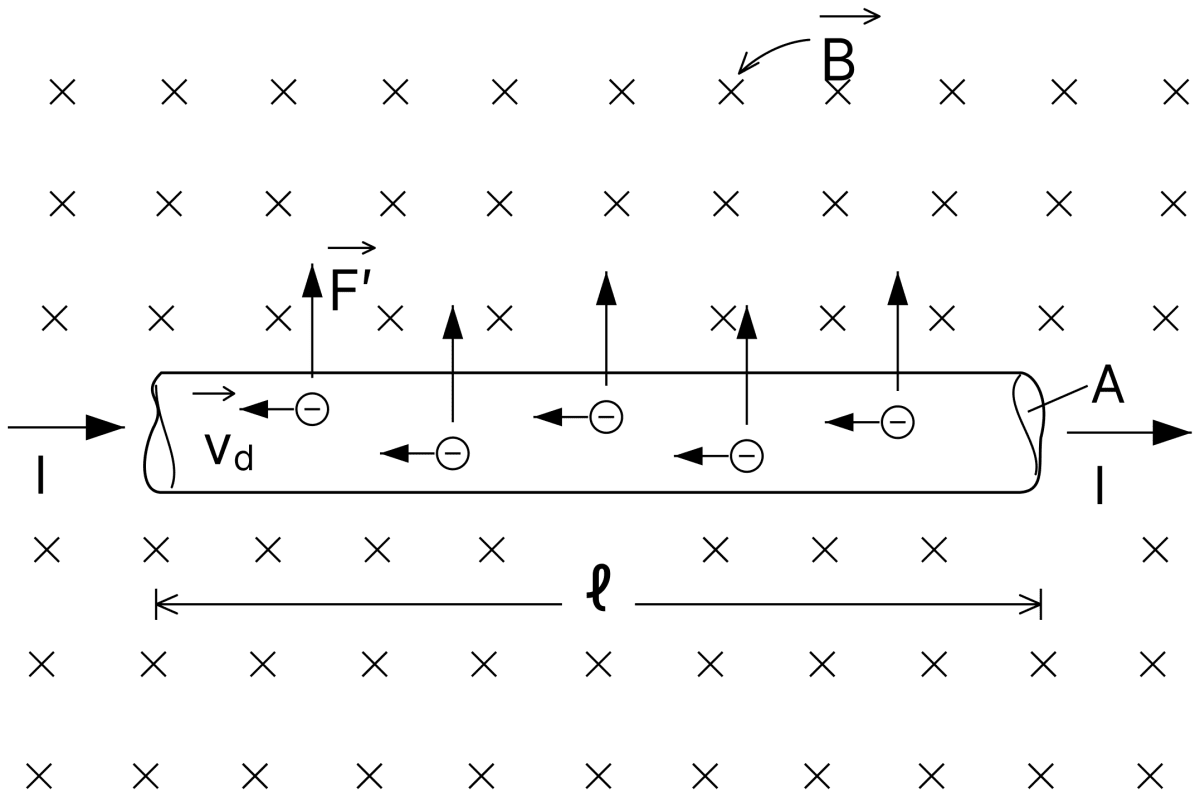
The current in a conductor is the drift of free electrons through it. When the conductor is placed in a magnetic field, magnetic forces are imposed on these drifting electrons, and the resultant of these microscopic forces is the macroscopic force on the whole conductor.
Consider a portion of length l and cross-sectional area A of a conductor carrying a current I, placed in a magnetic field , the conductor making an angle θ with the field. Let n be the number of free electrons per unit volume and vd the drift velocity of the electrons.
From the relation , the magnitude of the force on each electron is
The number of electrons in the length l of the conductor is
Hence the total force on the length l of the conductor is
But neAvd = I, the current in the conductor. Therefore
and in vector form
where is a displacement vector pointing along the conductor in the direction of the current.
Rule for the direction of the force : By Fleming's left-hand rule, if the fore-finger, the middle-finger and the thumb of the left hand are stretched at right angles mutually to one another, with the fore-finger along and the middle-finger in the direction of the current, then the thumb gives the direction of the force on the conductor. The same result is given by the right-hand palm rule no. 2.
Derive the relation for the force per unit length between two infinitely-long, parallel, straight conductors carrying current. Define 1 ampere.
Answer
Force between two parallel current-carrying conductors :
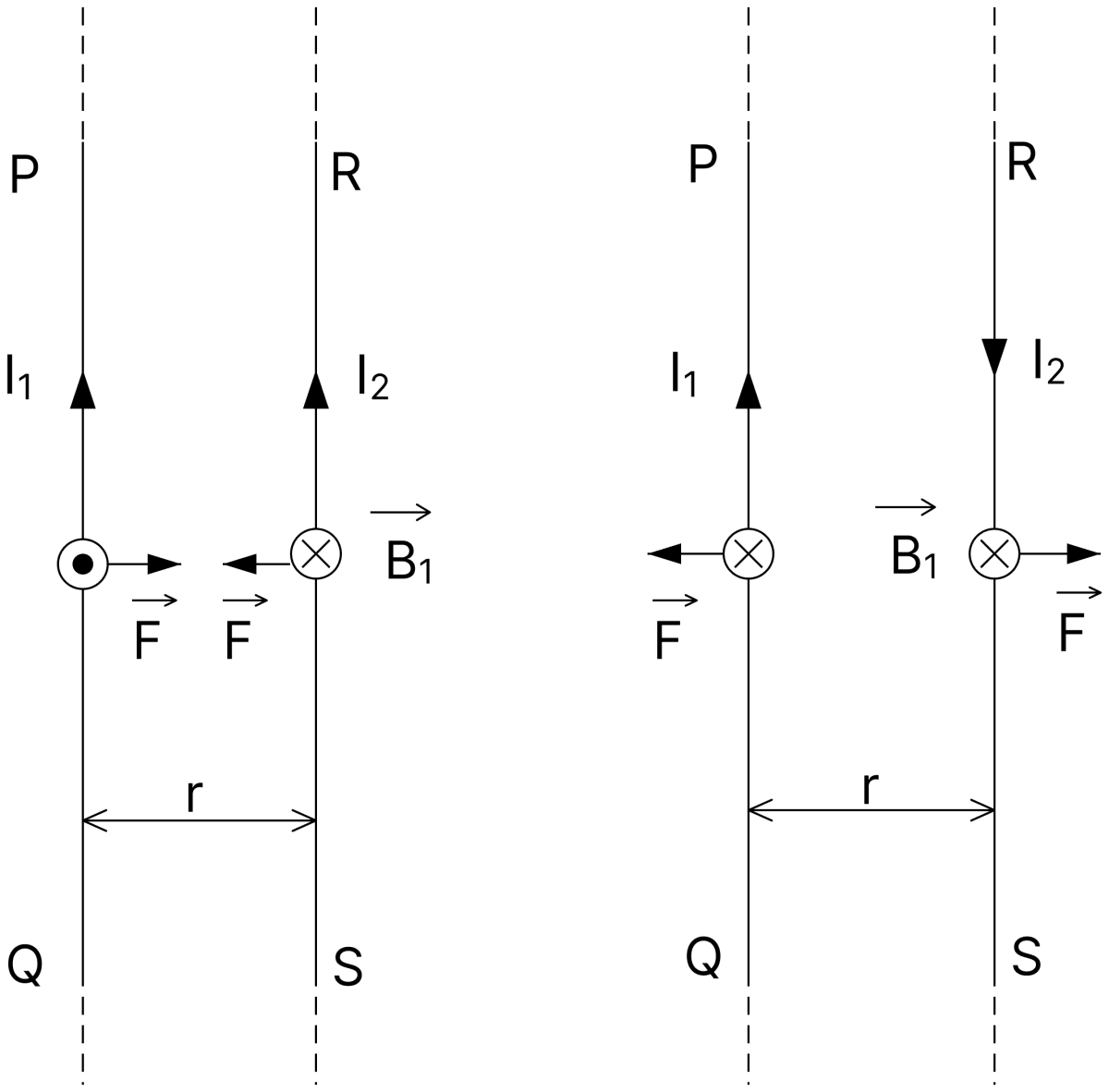
Let PQ and RS be two infinitely long, straight and parallel conductors placed in vacuum at a distance r apart, carrying currents I1 and I2 respectively in the same direction.
The magnitude of the magnetic field produced by the current I1 at the position of the conductor RS is
By the right-hand palm rule no. 1, this field is perpendicular to the plane of the paper directed downward.
The conductor RS, carrying the current I2, is thus situated in this field at right angles to it, so it experiences a magnetic force. For a length L of RS,
Therefore the force per metre length of RS is
The same force per unit length acts on PQ due to the current I2. If the directions of the currents are the same, the wires attract each other; if the directions are opposite, the wires repel each other.
Definition of 1 ampere : If the two currents are equal (I1 = I2 = I),
Putting I = 1 A and r = 1 m,
Hence, one ampere is that steady current which, when maintained in each of two infinitely long, straight and parallel conductors of negligible cross-section placed in vacuum at a distance of 1 metre from each other, produces a force of 2 × 10⁻⁷ newton per metre length on each conductor.
With the help of a diagram, explain the principle and working of a cyclotron. Show that cyclotron frequency does not depend on the speed of the particles.
Answer
Cyclotron : The cyclotron was devised by Lawrence to accelerate positively-charged particles, such as protons and deuterons, to very high energies so that they could be used in disintegration experiments.
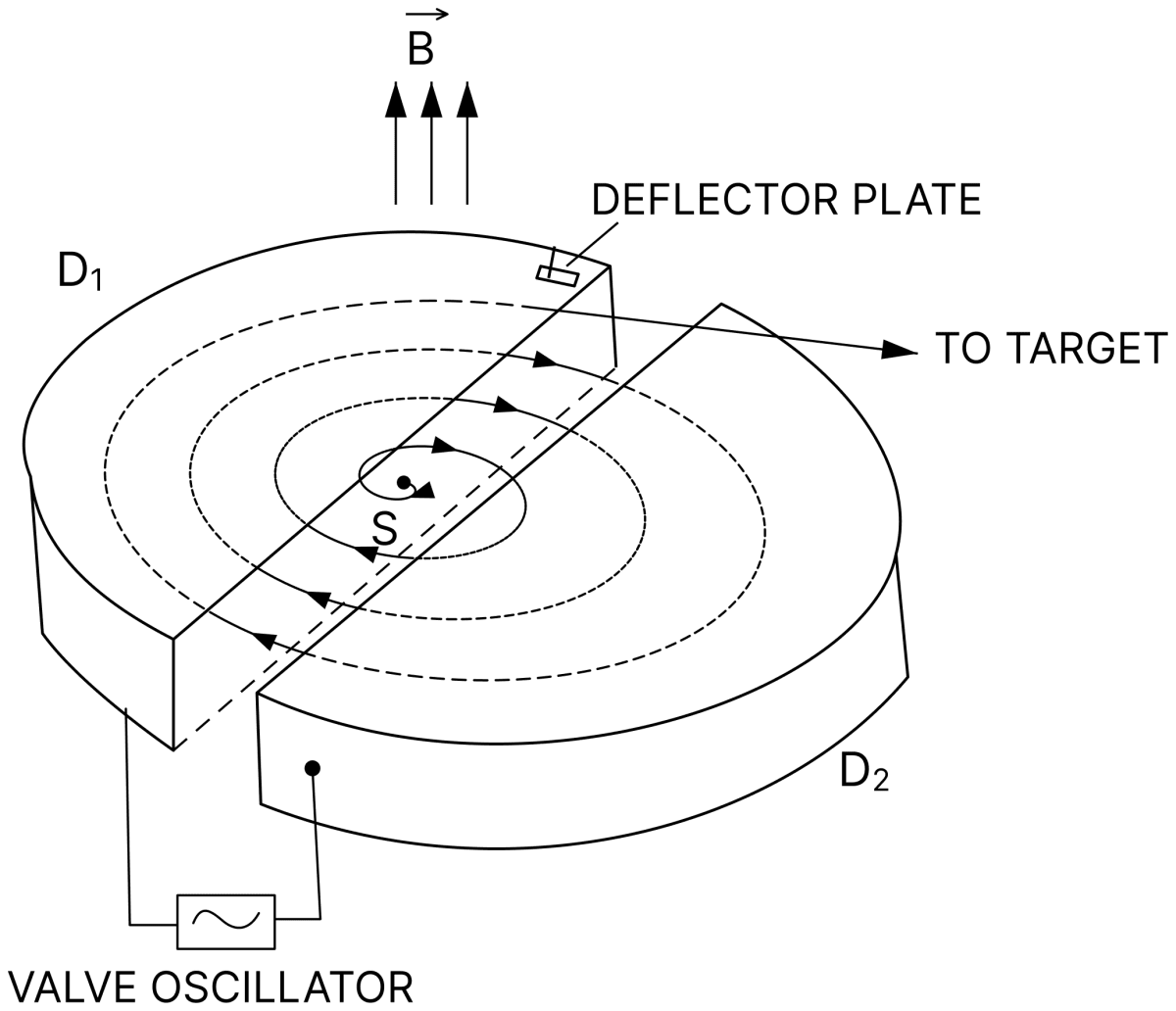
Principle : A charged particle gains kinetic energy equal to qV each time it is suitably subjected to an electric potential difference V. By repeating the process again and again, the particle can be made to acquire a very high energy. The magnetic field is used to bring the charged particle again and again to the situation of acceleration.
Construction : It consists of two horizontal D-shaped hollow metal segments D1 and D2, called the dees, with a small gap between them. An alternating potential difference of the order of 105 volt, at a frequency of 10 to 15 megacycles/sec, is applied across the dees. An intense magnetic field is set up perpendicular to the plane of the dees by a large electromagnet. The whole space inside the dees is evacuated. An ion source is located at the centre S in the gap between the dees.
Working : Suppose an ion of mass m and charge +q emerges from the ion source at an instant when D2 is at a negative potential. It is accelerated towards D2 by the electric field in the gap and enters D2 with a velocity v. Once inside, it is screened from the electric field by the metal walls of the dee, and under the action of the magnetic field it adopts a circular path of radius
The time required by the ion to complete a semi-circle is
which shows that the time of passage of the ion through the dee is independent of the speed of the ion and of the radius of the circle; it depends only on the magnetic field B and the charge-to-mass ratio q/m of the ion.
The frequency of the applied potential difference is so adjusted that the ion emerges into the gap at the instant when the other dee is at a negative potential. It is therefore accelerated again while crossing the gap, and enters D1 with a larger velocity, describing a semi-circle of greater radius, but taking exactly the same time. The process is repeated after every half-cycle, and the ion gains speed each time it passes from one dee to the other. Finally, on becoming energetic enough, it reaches the outer edge of a dee and is pulled out by a negatively-charged deflector plate.
Cyclotron frequency : The frequency ν0 of the applied potential difference must be equal to the frequency ν of the circular revolution of the ion,
This expression contains only q, B and m, and not the speed v of the particle. Hence the cyclotron frequency does not depend on the speed of the particles. If the speed increases, the radius of the path increases in the same proportion, so that the time of one revolution remains unchanged.
Examiner assigned the task to a student to study the behaviour of a current carrying solenoid. He gives the following instructions to student. State whether the responses of student are correct or incorrect. Give a reason for each.
(i) EXAMINER : Increase the strength of magnetic field inside this long solenoid and make it two times of the present value.
STUDENT : Increases the current by two times.
(ii) EXAMINER : Take these three rods of identical shape and size. One is of aluminium, other is of copper and third one is of soft iron. Now, further increase the strength of magnetic field of solenoid.
STUDENT : Inserts the soft iron rod inside the solenoid.
(iii) EXAMINER : What will be the ratio of magnetic flux density at two points on the axis of the solenoid, one in the middle and other at one end of the solenoid.
STUDENT : It will be 1 : 1.
Answer
(i) The response of the student is incorrect.
The magnetic field of a long solenoid is B = µ0nI, so B ∝ I. To make the field strength double, the current should be changed from I to 2I. The student increases the current by two times, that is from I to 3I, which would make the field three times the present value.
(ii) The response of the student is correct.
Soft iron is a ferromagnetic substance. When a rod of such a material is inserted inside the solenoid, the field becomes
and since µr is very large for soft iron, the field strength is greatly increased. Aluminium and copper are not ferromagnetic, so they would not produce this effect.
(iii) The response of the student is incorrect.
The field at the middle of the solenoid is Binside = µ0nI, while at one end only one half of the winding contributes, so
Therefore
that is, the ratio is 2 : 1 and not 1 : 1.
A synchrotron uses a combination of solenoid and toroid to generate high magnetic fields. Charged particles like electrons and protons can be accelerated to very high energies using a synchrotron. A synchrotron adjusts the magnetic field such that the particles are kept in a circular orbit. It is used to study high-energy particle collisions.
(a) If the magnetic field is parallel to the positive Y-axis and the charged particle is moving along the positive X-axis, which way would the Lorentz force be for :
(i) an electron,
(ii) a proton.
(b) An electron does not suffer any deflection while passing through a region of uniform magnetic field. What is the direction of the magnetic field?
Answer
(a) The magnetic field is along the positive Y-axis and the particle moves along the positive X-axis, so
(i) For an electron, the charge is −e, so
The Lorentz force is along the −Z-axis for an electron.
(ii) For a proton, the charge is +e, so
The Lorentz force is along the +Z-axis for a proton.
(b) The electron suffers no deflection, so the magnetic force on it is zero. Since F = Bqv sin θ and neither B nor v is zero, sin θ must be zero. Hence the direction of the magnetic field is parallel (or anti-parallel) to the direction of motion of the electron.
A toroid is a hollow non-conducting circular ring, on which a large number of turns of a conducting wire are closely wound. If a solenoid is bent into a circular shape and the ends are joined, we get a toroid. Consider a toroid having centre O, number of turns N and each carrying a current I.
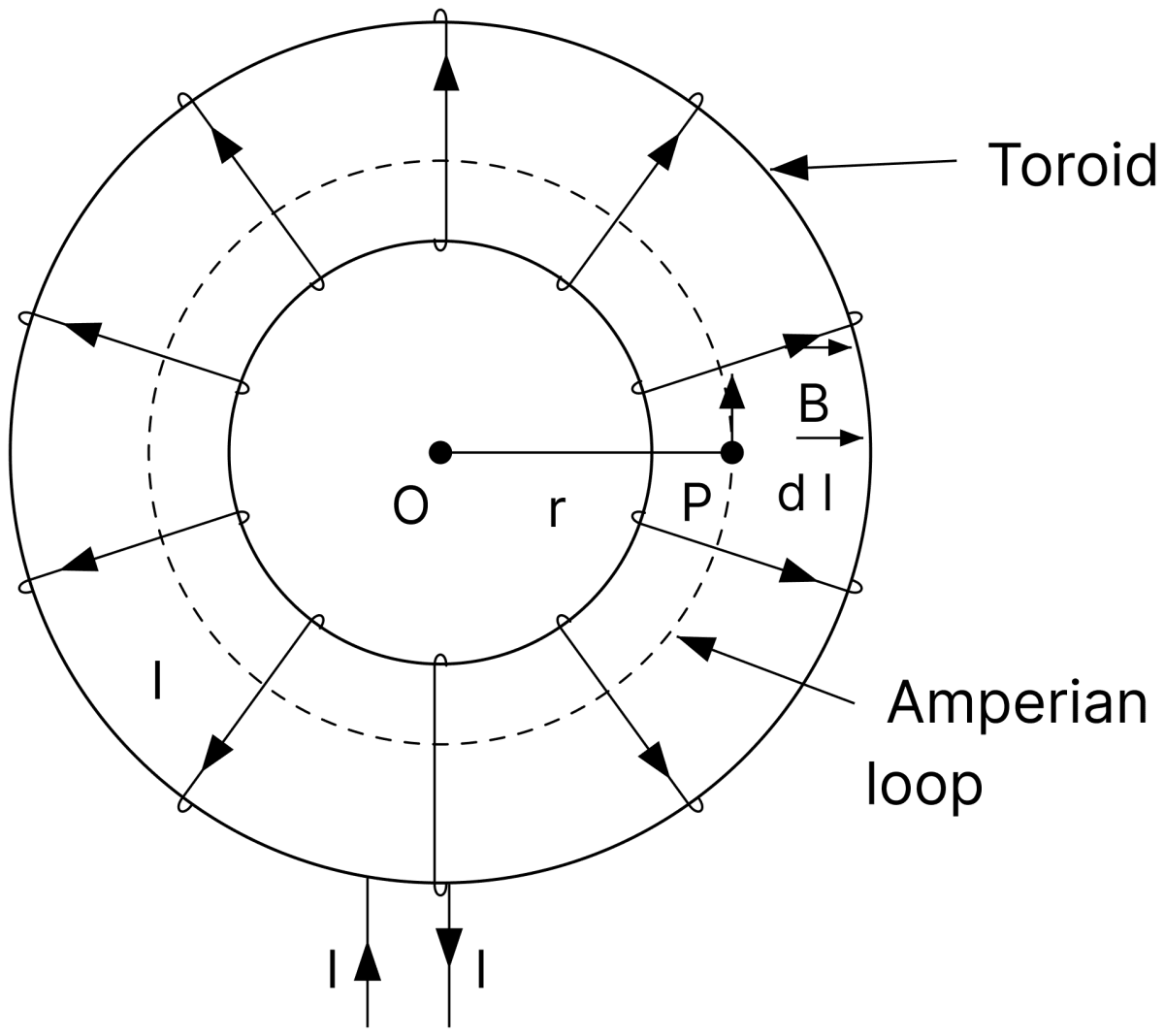
By Ampere's law, in the case of a toroid :
STEP 1 :
(Rewrite STEP 1 and fill in the blank with an appropriate substitution)
STEP 2 : B ........ = µ0NI
(Rewrite STEP 2 and fill in the blank with an appropriate substitution)
STEP 3 : B = µ0 ........ I
(Rewrite STEP 3 and fill in the blank with an appropriate substitution)
Answer
STEP 1 :
The circle drawn through the point inside the core is threaded by all the N turns of the toroid, each carrying the current I, so the total current enclosed is NI.
STEP 2 :
Since and are along the same direction at every point of the circle and B has the same magnitude at all these points, the line integral becomes B times the circumference 2πr of the circle.
STEP 3 :
Dividing by 2πr gives , and writing for the number of turns per unit length of the toroid, this becomes B = µ0nI.
The diagram depicts , and are mutually perpendicular.
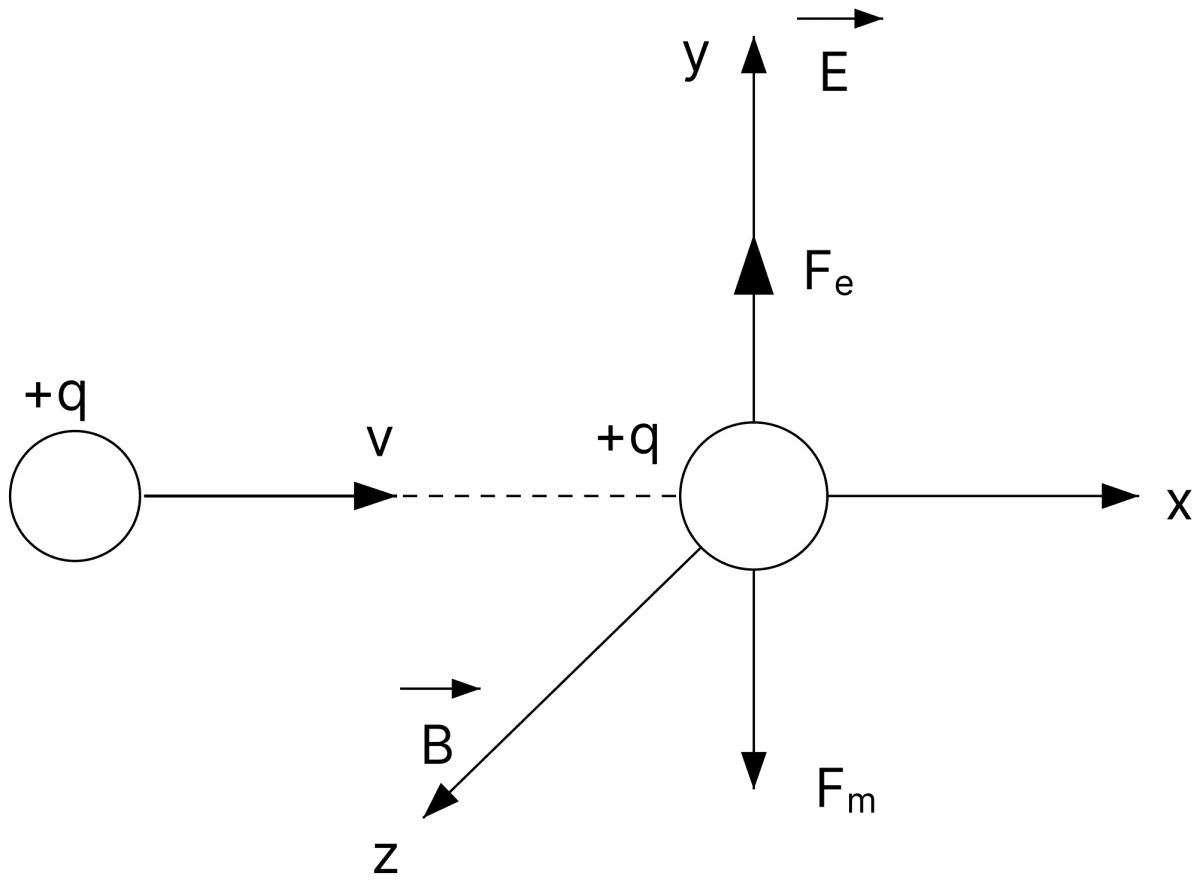
Direction of is indicated with , direction of is indicated with and the direction of is indicated with .
The force value in each case is stated. State the value of E and B as equal to zero or not equal to zero in each case.
(a) The value of resultant F = 0 if E = 0 and B ...... (choose B = 0 OR B ≠ 0)
(b) The value of resultant F may be zero (if θ = 0° or 180°) if B ≠ 0 and E ........ (choose E = 0 OR E ≠ 0)
(c) F = 0 (if and their directions are opposite) if E ≠ 0, B .......... (choose B = 0 OR B ≠ 0)
(d) F ≠ 0 (because ≠ constant) if E ≠ 0, B ....... (choose B = 0 OR B ≠ 0)
Answer
The total force on the charge is the Lorentz force,
(a) B = 0.
If E = 0 the electric force is already zero. The resultant force can be zero only if the magnetic force is also zero. As is perpendicular to here (θ = 90°), the magnetic force qvB sin 90° cannot vanish unless B = 0.
(b) E = 0.
The resultant force may be zero with B ≠ 0 provided the magnetic force itself vanishes, which happens when θ = 0° or 180°, that is, when the charge moves parallel or anti-parallel to . For the total force to be zero the electric force must then also be absent, so E = 0.
(c) B ≠ 0.
Here E ≠ 0, so an electric force acts on the charge. It can be balanced only by an equal and opposite magnetic force , which requires a magnetic field, that is B ≠ 0. This is the condition qE = qvB, giving .
(d) B = 0.
Here the velocity is not constant, so the balance qE = qvB cannot be maintained and the resultant force is not zero. This is the case when the electric field alone acts, that is B = 0; the charge is then continuously accelerated along and its velocity keeps changing.
In the figure, a long straight wire AB is fixed while the square loop PQRS is free to move.
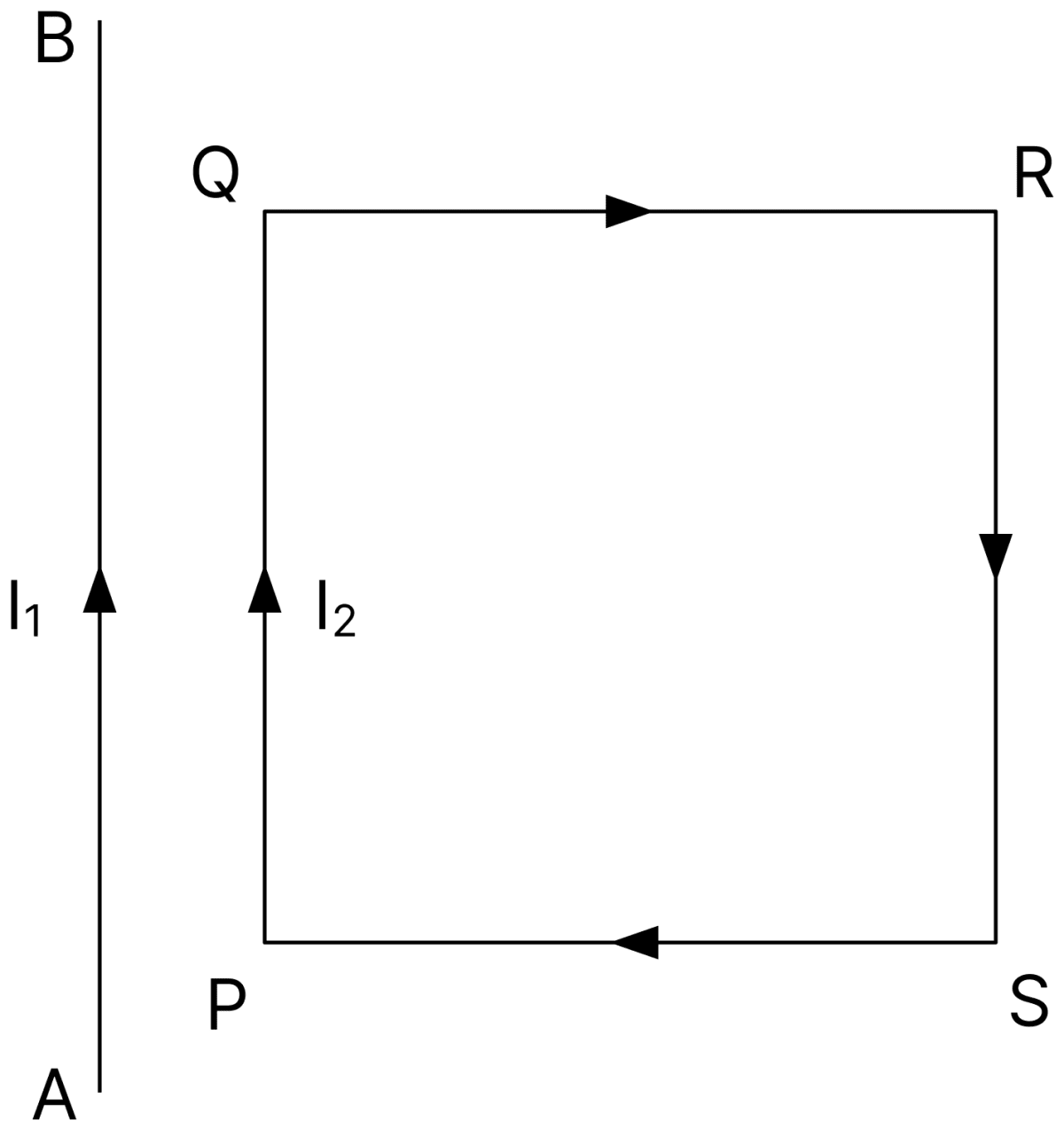
Give a reason for your response in each sub-part.
(a) What is the resultant of forces experienced by arms QR and SP?
(b) What is the nature of force experienced by arms PQ and RS?
(c) In which direction, does the loop begin to move?
Answer
(a) The resultant of the forces experienced by the arms QR and SP is zero.
The arms QR and SP are equally inclined to the wire AB and each of them has one half of its length nearer to AB and the other half farther from it. The magnitudes of the forces on QR and on SP are therefore the same, but the currents in these two arms are oppositely directed, so the two forces are opposite in direction and cancel each other.
(b) There is a force of attraction between AB and PQ, and a force of repulsion between AB and SR.
The current in PQ is parallel to the current in AB, and parallel currents attract. The current in SR is anti-parallel to the current in AB, and anti-parallel currents repel.
(c) The loop begins to move towards the wire AB.
The force per unit length between two parallel conductors is
which is inversely proportional to the separation r. Since PQ is closer to AB than SR is, the force of attraction on PQ is stronger than the force of repulsion on SR. Hence there is a net attraction and the loop moves towards AB.
State Biot-Savart's law. Apply it to derive the expression for magnetic field due a circular current-carrying conductor at
(i) a point on the axis of the coil
(ii) its centre.
Show direction of magnetic field when current flows clockwise and in anticlockwise direction.
Answer
Biot-Savart's law : The magnetic field dB developed at a point due to a small current-element I dl is directly proportional to the current I, to the length dl of the element and to the sine of the angle θ between the element and the line joining it to the point, and inversely proportional to the square of the distance r between them,
(i) Magnetic field at a point on the axis of the coil :
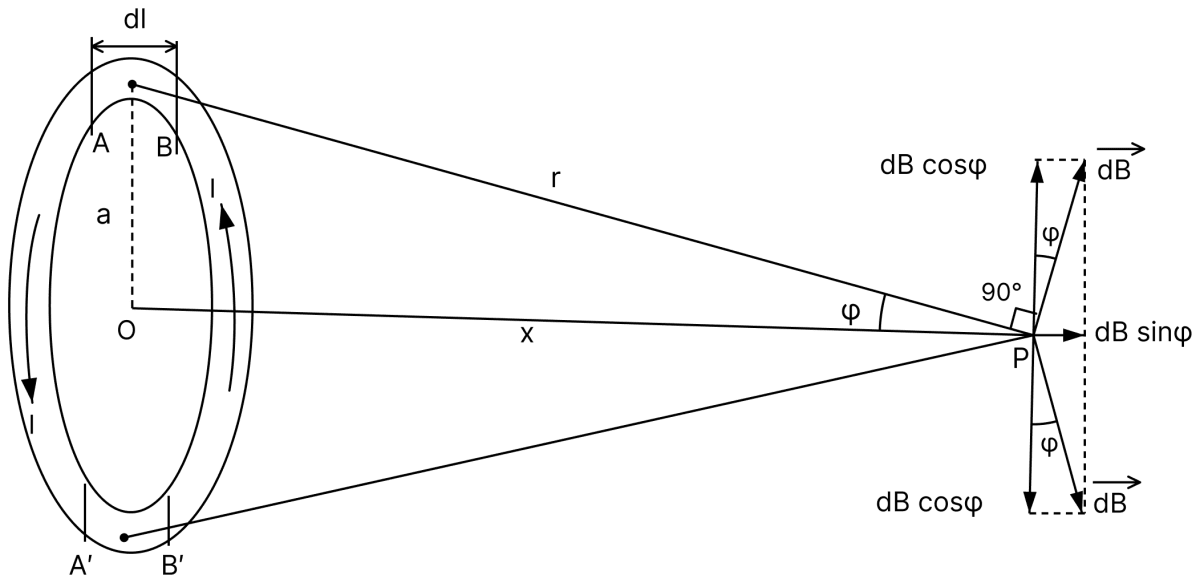
Let a circular loop of radius a carry a current I, and let P be a point on its axis at a distance x from the centre O. Consider a small current-element of length dl at the top of the loop, at right angles to the plane of the page and directed outwards, and let r be its distance from P.
By Biot-Savart law, the field due to this element is
Here the element is perpendicular to the line joining it to P, so θ = 90° and
The direction of is in the plane of the page and at right angles to r. It is resolved into a component dB sin φ along the axis and a component dB cos φ at right angles to the axis.
Now consider the diametrically opposite element at the bottom of the loop, which is at right angles to the plane of the page but directed inwards. The field due to it is equal in magnitude, and its component at right angles to the axis is equal and opposite to that of the first element, so these components cancel, while the components along the axis are in the same direction and add up.
Imagining the whole loop to be divided into such current-elements, the resultant field at P is directed along the axis and its magnitude is
Putting the value of dB from equation (i) and ,
since µ0/4π, I and a are constants and r is the same for all the elements of the loop.
But , the circumference of the loop, and . Hence
If the coil has N turns, each turn contributes equally, so
(ii) Magnetic field at the centre of the coil :
At the centre, x = 0, so
Direction of the field :
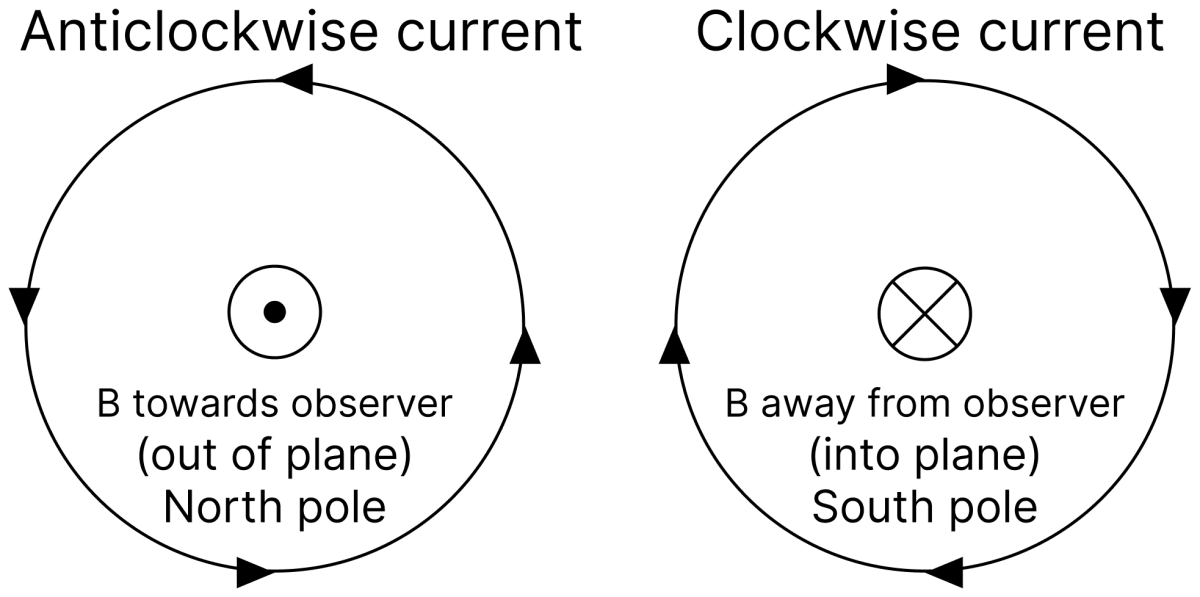
The direction of is perpendicular to the plane of the coil, along its axis, and is given by the right-hand palm rule no. 1. When the current flows anticlockwise as seen by the observer, the field at the centre is directed towards the observer (out of the plane of the coil), and that face of the coil behaves as a north pole. When the current flows clockwise, the field is directed away from the observer (into the plane of the coil), and that face behaves as a south pole.
State Ampere's circuital law connecting the line integral of over a closed path to the net current crossing the area bounded by the path.
Use the law to derive expression for magnetic field due to an infinitely-long straight current-carrying wire.
Why is the above derivation not valid for magnetic field due to a current-carrying wire of finite length?
Answer
Ampere's circuital law : The line integral of the magnetic flux density around any closed path in free space is equal to µ0 times the net current I threading through the area enclosed by the path,
Here I is the steady current that does not change with time, and the law is true for any assembly of currents and for any closed path.
Magnetic field due to an infinitely-long straight current-carrying wire :
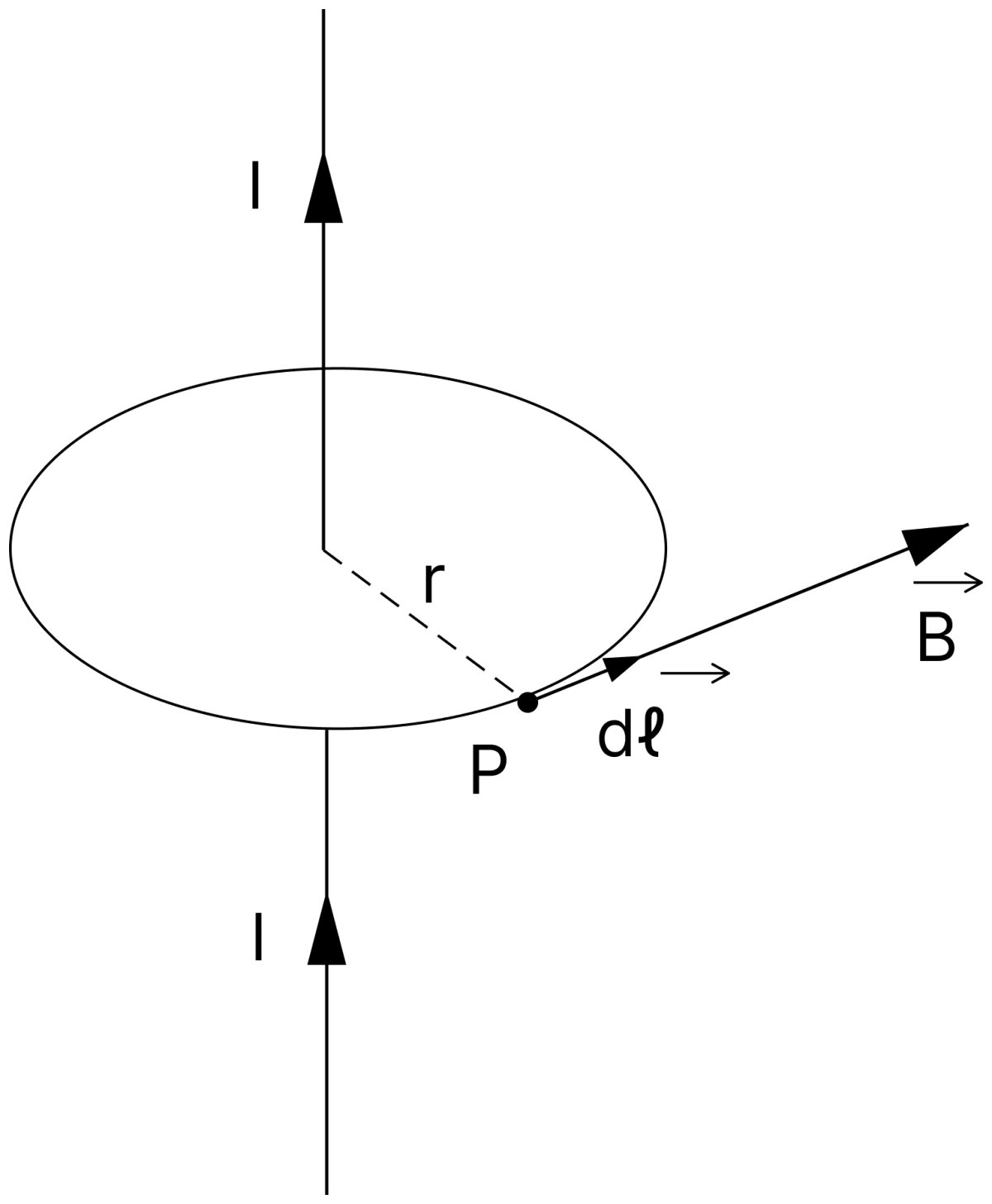
Let a long straight wire carry a steady current I, and let P be a point at a perpendicular distance r from it.
Draw a circle of radius r through P, with its centre on the wire and its plane perpendicular to the wire. By symmetry, the magnitude of is the same at all points of this circle and its direction is tangential to the circle at every point. Choosing this circle as the closed path, and are along the same direction, so
The current enclosed by the circle is I, so by Ampere's circuital law,
Why the derivation is not valid for a wire of finite length :
The derivation rests on the symmetry of the field about the wire. Only for an infinitely long wire is the magnitude of the same at every point of the circle drawn through P, which allows B to be taken outside the integral as .
For a wire of finite length this symmetry no longer holds; the magnitude of differs from point to point on the circle, and the line integral cannot be evaluated so simply. The field of a finite conductor has to be obtained from Biot-Savart law instead, which gives
With the help of schematic sketch of a cyclotron, explain its working principle. Mention its two applications. What is the important limitation encountered in accelerating a light elementary particle such as electron to high energies?
Answer
Cyclotron :
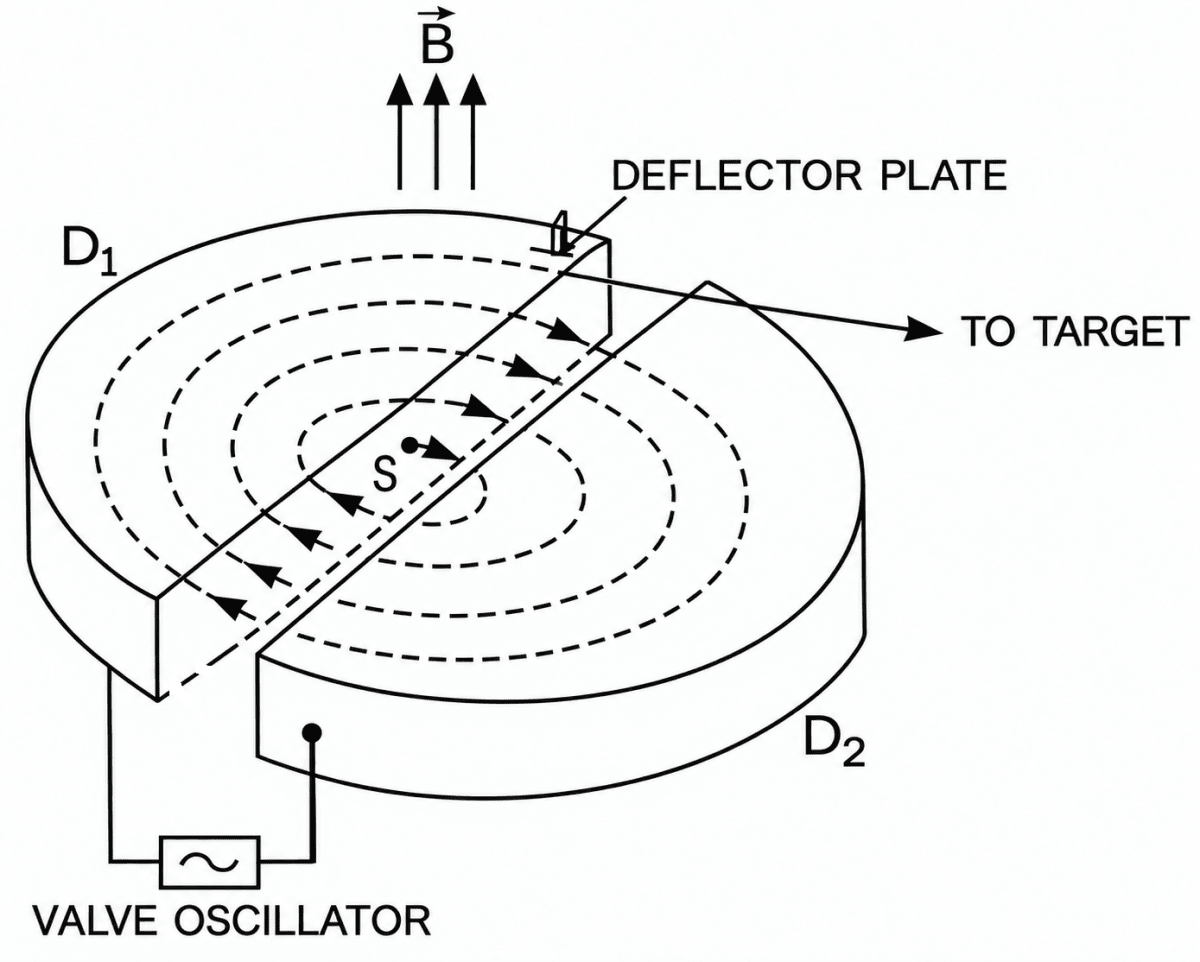
Working principle : A charged particle gains a kinetic energy qV every time it is subjected to a potential difference V. If the particle is made to face such a potential difference again and again, it can be accelerated to a very high energy. In a cyclotron a strong magnetic field, applied perpendicular to the plane of the dees, makes the particle travel along semi-circular paths and brings it back to the gap again and again, where an alternating potential difference accelerates it each time.
Inside a dee the particle moves along a semi-circle of radius
and the time taken to complete it is
which is independent of the speed of the particle. The frequency of the applied potential difference must therefore satisfy the resonance condition
The radius of the path grows at each crossing, but the time of passage through a dee stays the same, so the particle always arrives at the gap in step with the alternating potential difference. It is finally pulled out at the outer edge of a dee by a negatively-charged deflector plate, with a kinetic energy
where R is the outside radius of the dees.
Two applications :
(i) It is used to accelerate positively-charged particles, such as protons and deuterons, to very high energies for bringing about artificial transmutation of nuclei.
(ii) The high-energy particles from a cyclotron are used in nuclear disintegration experiments.
Limitation in accelerating a light particle such as an electron : The cyclotron cannot accelerate particles to velocities as high as that comparable with the velocity of light, because at such velocities the mass of the particle increases with increasing velocity according to
where m0 is the rest mass. As m increases, the time taken to complete a semi-circle also increases, so the particle gets more and more out of step with the applied alternating potential difference and the resonance condition fails.
For a given energy the velocity of an electron is much larger than that of a proton or a deuteron, so this relativistic increase of mass becomes important very quickly. Hence electrons get out of step with the applied potential difference almost at once, and a cyclotron cannot be used to accelerate electrons to high energies.
In the figure, a device is shown to locate the path of the electrons in magnetic field and to determine the specific charge of electrons. In the horizontal tube (region I) accelerated electrons with velocity v are obtained and allowed to enter in region II where there is no electric field but uniform magnetic field developed by two current carrying solenoids connected in series exists. This is shown by a circle. The magnetic field can be changed by changing the solenoid current. The electrons moving on the circular path can be directed (by adjusting properly the solenoid current) to a Faraday cylinder F and a current in the galvanometer G is detected.
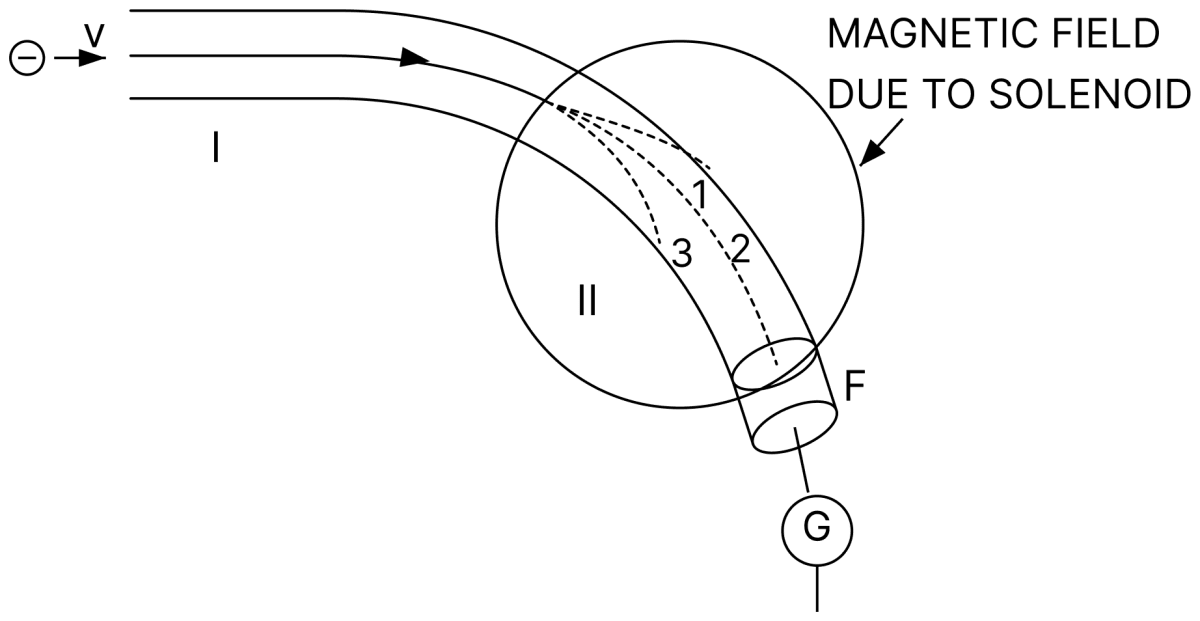
(i) For the bending of electron path as shown in region II, what should be the direction of magnetic field in this region? (Give your answer with respect to the plane of paper)
(ii) For the electrons to move on path 2, the solenoid current is Is. If the solenoid current is increased over Is then which of the path 1/2/3 is expected to be followed by electrons?
(iii) For solenoid current Is, the radius of the path of electrons is r. What will be the radius of the path for solenoid current Is/2?
(iv) If number of turns in a long solenoid are made double, cross-section area is made half while current remains same. What will be the change in the magnitude of magnetic field inside the solenoid at a point on the axis of the solenoid?
(v) If the accelerating potential for the electrons to obtain velocity v is V, then radius of the path followed by electrons in region II is directly proportional to Vn. What is the value of n here?
Answer
(i) The electrons move towards the right in region II and the path bends downwards, so the force on them is directed towards the centre of the circular arc.
The electron is negatively charged, so the direction of current is taken opposite to its direction of motion. Applying Fleming's left-hand rule with the current in this direction and the force towards the centre of the arc, the magnetic field must be directed downwards into the plane of the paper, that is, perpendicular to the plane of the paper.
(ii) The solenoid current controls the magnetic field, and for a solenoid B = µ0nIs, so B ∝ Is. The radius of the path of the electrons is
On increasing Is above its previous value, the radius of the path decreases, so the electrons bend more sharply. Hence the electrons are expected to follow path 3.
(iii) Since , halving the solenoid current doubles the radius. Hence the radius of the path becomes 2r.
(iv) For a long solenoid,
The field does not depend on the area of cross-section of the solenoid. Hence, on making the number of turns double while the current remains the same, the magnitude of the magnetic field inside the solenoid becomes double.
(v) The electrons are accelerated through a potential difference V, so
Hence, n = .
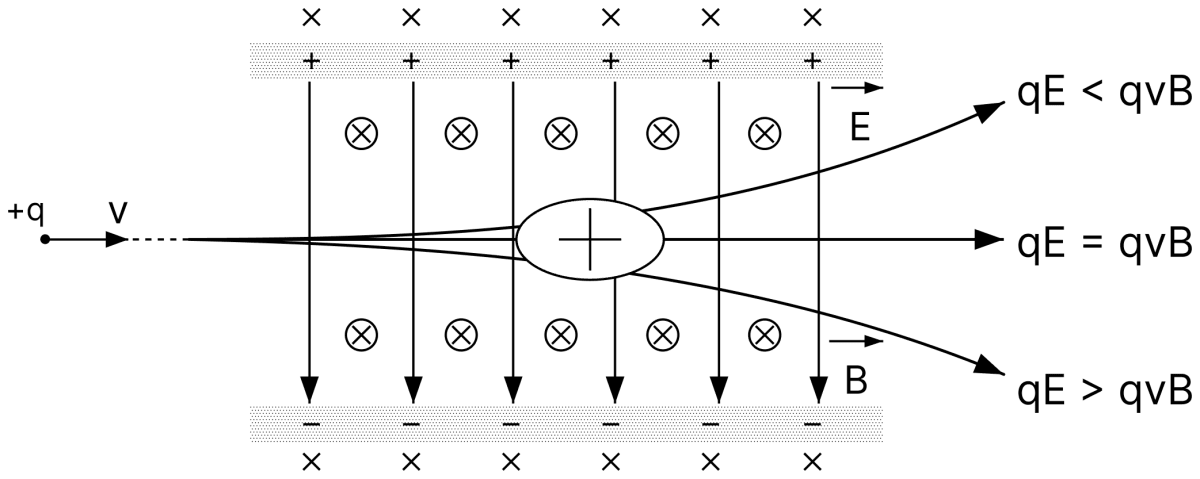
A charge q moving with a velocity in the presence of both electric and magnetic fields, experiences a force . If electric and magnetic fields are perpendicular to each other and also perpendicular to the velocity of the particle, the electric and magnetic forces are in opposite directions. If we adjust the value of electric and magnetic fields such that magnitude of the two forces is equal, the total force on the charge is zero and the charge will move in the fields undeflected.
(i) What will be the value of velocity of the charge particle, when it moves undeflected in a region where the electric field is perpendicular to the magnetic field and the charge particle q enters at right angles to the fields?
(ii) Proton, neutron, alpha particle and electron enter a region of uniform magnetic field with same velocities perpendicular to magnetic field. Which particle will experience maximum force?
(iii) A charge particle moving with a constant velocity is passing through a space without any change in the velocity. Which can be true about the region?
(a) E = 0, B = 0
(b) E ≠ 0, B ≠ 0
(c) E = 0, B ≠ 0
(d) All of these
(iv) Proton, electron and deutron enter a region of uniform magnetic field with same kinetic energy at right angles to the field. Which one follows the curved path of larger radius?
(v) If magnetic field is switched off and only electric field is present, which type of path charge particle will follow?
Answer
(i) When the charge particle passes undeflected, the electric force balances the magnetic force,
Hence, the charge particle moves undeflected when its velocity is equal to .
(ii) The magnetic force on a particle entering perpendicular to the field is
Since all the particles enter with the same velocity in the same field, the force depends only on the magnitude of the charge. The neutron is uncharged and experiences no force; the proton and the electron carry a charge of magnitude e; the α-particle carries a charge 2e, which is the largest here.
Hence, the α-particle will experience the maximum force.
(iii) All of these.
The particle moves with a constant velocity, so the net force on it is zero. This is possible in three ways : both the fields may be absent (E = 0, B = 0); both the fields may be present with the electric and the magnetic forces equal and opposite (E ≠ 0, B ≠ 0); or the electric field may be absent while the particle moves parallel to the magnetic field (E = 0, B ≠ 0). Hence all the three options are possible.
(iv) For a particle entering at right angles to the field with kinetic energy K,
since K, q and B are the same for all the three particles. The deuteron (1H2) has the greatest mass among the proton, the electron and the deuteron.
Hence, the deuteron follows the curved path of larger radius.
(v) With the magnetic field switched off, only the electric force qE acts on the particle. This force is constant in magnitude and direction, and is perpendicular to the initial velocity of the particle.
Hence, the charge particle will follow a parabolic path.