
Assertion (A): The average thermal velocity of the electrons in a conductor is zero.
Reason (R): Direction of motion of electrons is randomly oriented.
- If both assertion and reason are true and reason is the correct explanation of assertion.
- If both assertion and reason are true but reason is not the correct explanation of assertion.
- If assertion is true but reason is false.
- If both assertion and reason are false.
Answer
If both assertion and reason are true and reason is the correct explanation of assertion.
Explanation
Assertion (A) is correct: In the absence of an electric field the free electrons in a conductor move about randomly with thermal velocities. Their velocities are distributed uniformly in all directions, so the vector sum of all of them is zero and the average thermal velocity is zero.
Reason (R) is also correct: The direction of motion of the electrons is indeed randomly oriented, so for every electron moving in one direction there is, on the average, another moving in the opposite direction. This random orientation is precisely the cause of the average velocity being zero, so the Reason explains the Assertion.
Therefore, both assertion and reason are true and reason is the correct explanation of assertion.
Assertion (A): The drift velocity of electrons in a metallic wire will decrease, if the temperature of the wire is increased.
Reason (R): On increasing temperature, conductivity of metallic wire decreases.
- If both assertion and reason are true and reason is the correct explanation of assertion.
- If both assertion and reason are true but reason is not the correct explanation of assertion.
- If assertion is true but reason is false.
- If both assertion and reason are false.
Answer
If both assertion and reason are true but reason is not the correct explanation of assertion.
Explanation
Assertion (A) is correct: On raising the temperature the free electrons collide more frequently with the ions of the lattice, so the relaxation time decreases. Since the drift velocity is proportional to the relaxation time, it decreases.
Reason (R) is also correct: On increasing the temperature the resistivity of a metallic wire increases, and since conductivity is the reciprocal of resistivity, the conductivity decreases.
However, the fall in conductivity is itself a consequence of the decrease in relaxation time, and is not the cause of the decrease in the drift velocity. Hence the Reason does not explain the Assertion.
Therefore, both assertion and reason are true but reason is not the correct explanation of assertion.
Assertion (A): If the length of the conductor is doubled, the drift velocity will become half of the original value (keeping potential difference unchanged).
Reason (R): At constant potential difference, drift velocity is inversely proportional to the length of the conductor.
- If both assertion and reason are true and reason is the correct explanation of assertion.
- If both assertion and reason are true but reason is not the correct explanation of assertion.
- If assertion is true but reason is false.
- If both assertion and reason are false.
Answer
If both assertion and reason are true and reason is the correct explanation of assertion.
Explanation
Assertion (A) is correct: The drift velocity of the free electrons is
For a constant potential difference V, doubling the length l halves the drift velocity.
Reason (R) is also correct: The above expression shows that at constant potential difference the drift velocity is inversely proportional to the length of the conductor, which is exactly why doubling the length halves it. Hence the Reason explains the Assertion.
Therefore, both assertion and reason are true and reason is the correct explanation of assertion.
Assertion (A): An electrical bulb starts glowing instantly as it is switched on.
Reason (R): Drift speed of electrons in a metallic wire is very large.
- If both assertion and reason are true and reason is the correct explanation of assertion.
- If both assertion and reason are true but reason is not the correct explanation of assertion.
- If assertion is true but reason is false.
- If both assertion and reason are false.
Answer
If assertion is true but reason is false.
Explanation
Assertion (A) is correct: The moment the switch is closed, an electric field is set up throughout the conductor almost instantaneously. The free electrons everywhere in the circuit begin to drift at once, so the current is established immediately and the bulb starts glowing without any perceptible delay.
Reason (R) is incorrect: The drift speed of the electrons in a metallic wire is in fact extremely small, of the order of 10-4 m s-1. The bulb glows instantly not because the electrons travel fast, but because the electric field is set up throughout the circuit at once.
Therefore, assertion is true but reason is false.
Assertion (A): A current flows in a conductor only when there is an electric field within the conductor.
Reason (R): The drift velocity of electron in the presence of electric field decreases.
- If both assertion and reason are true and reason is the correct explanation of assertion.
- If both assertion and reason are true but reason is not the correct explanation of assertion.
- If assertion is true but reason is false.
- If both assertion and reason are false.
Answer
If assertion is true but reason is false.
Explanation
Assertion (A) is correct: In the absence of an electric field the free electrons move randomly and their average velocity is zero, so there is no current. When an electric field is applied, each electron experiences a force opposite to the field, the electrons acquire a drift velocity and a current is established.
Reason (R) is incorrect: In the presence of an electric field the drift velocity of the electrons does not decrease; it increases from zero to a steady value given by vd = (eE/m)τ.
Therefore, assertion is true but reason is false.
Assertion (A): The current flowing through a conductor is directly proportional to the drift velocity.
Reason (R): As the drift velocity increases the current flowing through the conductor decreases.
- If both assertion and reason are true and reason is the correct explanation of assertion.
- If both assertion and reason are true but reason is not the correct explanation of assertion.
- If assertion is true but reason is false.
- If both assertion and reason are false.
Answer
If assertion is true but reason is false.
Explanation
Assertion (A) is correct: The current through a conductor is
For a given conductor n, e and A are fixed, so the current is directly proportional to the drift velocity.
Reason (R) is incorrect: The same relation shows that the current increases with the drift velocity. It does not decrease.
Therefore, assertion is true but reason is false.
Assertion (A): Ohm's law is applicable for all conducting elements for any range of temperature.
Reason (R): Ohm's law is a fundamental law.
- If both assertion and reason are true and reason is the correct explanation of assertion.
- If both assertion and reason are true but reason is not the correct explanation of assertion.
- If assertion is true but reason is false.
- If both assertion and reason are false.
Answer
If both assertion and reason are false.
Explanation
Assertion (A) is incorrect: Ohm's law is obeyed by metallic conductors only over a limited range of temperature. It is not obeyed by semi-conductors, diodes, valves and electrolytes, which are non-ohmic conductors.
Reason (R) is also incorrect: Ohm's law is not a fundamental law of nature. It is purely an empirical relation which holds for certain materials under certain conditions.
Therefore, both assertion and reason are false.
Assertion (A): A large dry cell has higher emf.
Reason (R): The emf of a dry cell is proportional to its size.
- If both assertion and reason are true and reason is the correct explanation of assertion.
- If both assertion and reason are true but reason is not the correct explanation of assertion.
- If assertion is true but reason is false.
- If both assertion and reason are false.
Answer
If both assertion and reason are false.
Explanation
Assertion (A) is incorrect: The emf of a cell is determined by the nature of the electrodes and of the electrolyte used in it, and not by its size. A large dry cell and a small one of the same type have the same emf.
Reason (R) is also incorrect: The emf is not proportional to the size of the cell. A larger cell only holds more chemical energy, so it can supply a current for a longer time and has a smaller internal resistance.
Therefore, both assertion and reason are false.
Assertion (A): A current continues to flow in superconducting coil even after switch is off.
Reason (R): Superconducting coils show Meissner effect.
- If both assertion and reason are true and reason is the correct explanation of assertion.
- If both assertion and reason are true but reason is not the correct explanation of assertion.
- If assertion is true but reason is false.
- If both assertion and reason are false.
Answer
If both assertion and reason are true but reason is not the correct explanation of assertion.
Explanation
Assertion (A) is correct: The resistance of a superconductor is zero, so once a current has been established in a superconducting coil there is no dissipation of energy and the current continues to flow even after the source is switched off.
Reason (R) is also correct: Superconductors do show the Meissner effect, that is, they expel the magnetic field lines from their interior.
However, the persistence of the current is due to the zero resistance of the superconductor and not to the Meissner effect. Hence the Reason does not explain the Assertion.
Therefore, both assertion and reason are true but reason is not the correct explanation of assertion.
Assertion (A): Terminal voltage of a cell is greater than emf of the cell, during charging of the cell.
Reason (R): The emf of a cell is always greater than its terminal voltage.
- If both assertion and reason are true and reason is the correct explanation of assertion.
- If both assertion and reason are true but reason is not the correct explanation of assertion.
- If assertion is true but reason is false.
- If both assertion and reason are false.
Answer
If assertion is true but reason is false.
Explanation
Assertion (A) is correct: While the cell is being charged the current is sent into it from an external source, so the potential drop Ir is added to the emf,
Hence the terminal voltage is greater than the emf.
Reason (R) is incorrect: The emf is greater than the terminal potential difference only when current is drawn from the cell. During charging the reverse is true, so the statement that the emf is always greater is wrong.
Therefore, assertion is true but reason is false.
Assertion (A): Capacity of a storage cell is measured in ampere hour.
Reason (R): Ampere hour is the unit of discharging rate.
- If both assertion and reason are true and reason is the correct explanation of assertion.
- If both assertion and reason are true but reason is not the correct explanation of assertion.
- If assertion is true but reason is false.
- If both assertion and reason are false.
Answer
If assertion is true but reason is false.
Explanation
Assertion (A) is correct: The capacity of a storage cell is the total charge it can deliver before being discharged, and it is expressed in ampere hour. One ampere hour is the charge delivered by a current of 1 A flowing for 1 hour.
Reason (R) is incorrect: The ampere hour is a unit of charge, not of the rate of discharging. The rate of discharging is a current and is measured in ampere.
Therefore, assertion is true but reason is false.
Note: The printed key gives option (b), but ampere hour is a unit of charge (capacity), not of discharging rate; so the Reason is false and option (c) is correct.
Assertion (A): The connecting wires are made of copper.
Reason (R): The electrical conductivity of copper is high.
- If both assertion and reason are true and reason is the correct explanation of assertion.
- If both assertion and reason are true but reason is not the correct explanation of assertion.
- If assertion is true but reason is false.
- If both assertion and reason are false.
Answer
If both assertion and reason are true and reason is the correct explanation of assertion.
Explanation
Assertion (A) is correct: Connecting wires in a circuit are made of copper so that they offer a negligible resistance and the potential drop across them is very small.
Reason (R) is also correct: Copper has a high electrical conductivity, that is, a very low specific resistance, so a copper wire of ordinary thickness has a negligible resistance. This is precisely the reason for using copper, so the Reason explains the Assertion.
Therefore, both assertion and reason are true and reason is the correct explanation of assertion.
Assertion (A): The temperature coefficient of resistance is always positive for metals.
Reason (R): On increasing the temperature the resistance of metals and alloys increases.
- If both assertion and reason are true and reason is the correct explanation of assertion.
- If both assertion and reason are true but reason is not the correct explanation of assertion.
- If assertion is true but reason is false.
- If both assertion and reason are false.
Answer
If both assertion and reason are true and reason is the correct explanation of assertion.
Explanation
Assertion (A) is correct: In a metal the number of free electrons is fixed, and a rise in temperature increases the frequency of collisions of the electrons with the lattice ions. The relaxation time therefore decreases and the resistance rises, so the temperature coefficient of resistance of a metal is positive.
Reason (R) is also correct: The resistance of metals and of alloys increases on raising the temperature, and this increase of resistance with temperature is exactly what a positive temperature coefficient means. Hence the Reason explains the Assertion.
Therefore, both assertion and reason are true and reason is the correct explanation of assertion.
Note: The printed key gives option (b). Since an increase of resistance with temperature is exactly what makes the temperature coefficient positive, the Reason explains the Assertion and option (a) is retained.
Assertion (A): In a meter bridge experiment, null point for an unknown resistance is measured. Now, the unknown resistance is put inside an enclosure maintained at a higher temperature. The null point can be obtained at the same point as before by decreasing the value of the standard (known) resistance.
Reason (R): Resistance of a metal decreases with increase in temperature.
- If both assertion and reason are true and reason is the correct explanation of assertion.
- If both assertion and reason are true but reason is not the correct explanation of assertion.
- If assertion is true but reason is false.
- If both assertion and reason are false.
Answer
If both assertion and reason are false.
Explanation
Assertion (A) is incorrect: On heating, the unknown resistance X of a metal increases. The balance condition of the meter bridge is
To keep the balancing length l unchanged when X has increased, the standard resistance R must be increased, not decreased.
Reason (R) is also incorrect: The resistance of a metal increases with increase in temperature, because the temperature coefficient of resistance of a metal is positive.
Therefore, both assertion and reason are false.
Assertion (A): It is advantageous to transmit electric power at high voltage.
Reason (R): High voltage implies high current.
- If both assertion and reason are true and reason is the correct explanation of assertion.
- If both assertion and reason are true but reason is not the correct explanation of assertion.
- If assertion is true but reason is false.
- If both assertion and reason are false.
Answer
If assertion is true but reason is false.
Explanation
Assertion (A) is correct: For a given power P = VI, transmitting at a high voltage means a small current in the line. The power lost as heat in the line wires is I2R, so a smaller current makes this loss very much smaller.
Reason (R) is incorrect: For a given power the current is inversely proportional to the voltage, so a high voltage implies a small current, not a high one.
Therefore, assertion is true but reason is false.
Assertion (A): Material used in the construction of a standard resistance is constantan or manganin.
Reason (R): Temperature coefficient of constantan is very small.
- If both assertion and reason are true and reason is the correct explanation of assertion.
- If both assertion and reason are true but reason is not the correct explanation of assertion.
- If assertion is true but reason is false.
- If both assertion and reason are false.
Answer
If both assertion and reason are true and reason is the correct explanation of assertion.
Explanation
Assertion (A) is correct: A standard resistance must keep a fixed value, so it is wound from a wire of constantan or manganin.
Reason (R) is also correct: The temperature coefficient of resistance of constantan is extremely small, so its resistance hardly changes when the current heats it. This is exactly why it is chosen for a standard resistance, so the Reason explains the Assertion.
Therefore, both assertion and reason are true and reason is the correct explanation of assertion.
Assertion (A): The algebraic sum of currents meeting at junction in a closed circuit is zero.
Reason (R): The Kirchhoff's first law does not obey law of conservation of charge.
- If both assertion and reason are true and reason is the correct explanation of assertion.
- If both assertion and reason are true but reason is not the correct explanation of assertion.
- If assertion is true but reason is false.
- If both assertion and reason are false.
Answer
If assertion is true but reason is false.
Explanation
Assertion (A) is correct: This is the statement of Kirchhoff's first law, or junction rule, ∑I = 0. The total current arriving at a junction is equal to the total current leaving it.
Reason (R) is incorrect: Kirchhoff's first law is in fact a direct consequence of the conservation of charge, since no charge can be accumulated at a junction.
Therefore, assertion is true but reason is false.
Assertion (A): When n cells, each of internal resistance r are arbitrary connected in series, the total internal resistance of cells may be zero.
Reason (R): The internal resistance depends on polarity of cell connected in circuit.
- If both assertion and reason are true and reason is the correct explanation of assertion.
- If both assertion and reason are true but reason is not the correct explanation of assertion.
- If assertion is true but reason is false.
- If both assertion and reason are false.
Answer
If both assertion and reason are false.
Explanation
Assertion (A) is incorrect: When cells are joined in series their internal resistances always add up, giving a total of nr, whichever way round the individual cells are connected. The total internal resistance can therefore never be zero.
Reason (R) is also incorrect: The internal resistance of a cell depends on the separation and the area of its plates and on the nature, concentration and temperature of the electrolyte. It does not depend on the polarity with which the cell is connected.
Therefore, both assertion and reason are false.
Assertion (A): In meter bridge experiment, a high resistance is always connected in series with a galvanometer.
Reason (R): As resistance increases current through the circuit increases.
- If both assertion and reason are true and reason is the correct explanation of assertion.
- If both assertion and reason are true but reason is not the correct explanation of assertion.
- If assertion is true but reason is false.
- If both assertion and reason are false.
Answer
If assertion is true but reason is false.
Explanation
Assertion (A) is correct: A high resistance is connected in series with the galvanometer to protect it from a large current when the bridge is far from balance. Once the null point is nearly reached, this resistance is short-circuited to make the setting more sensitive.
Reason (R) is incorrect: By Ohm's law the current is inversely proportional to the resistance, so on increasing the resistance the current through the circuit decreases.
Therefore, assertion is true but reason is false.
Assertion (A): A potentiometer draws no current in secondary circuit while measuring emf of a cell.
Reason (R): Voltmeter is much better than a potentiometer for measuring emf of cell.
- If both assertion and reason are true and reason is the correct explanation of assertion.
- If both assertion and reason are true but reason is not the correct explanation of assertion.
- If assertion is true but reason is false.
- If both assertion and reason are false.
Answer
If assertion is true but reason is false.
Explanation
Assertion (A) is correct: At the balance point of a potentiometer the galvanometer shows no deflection, so no current is drawn from the cell in the secondary circuit and the potentiometer measures the true emf.
Reason (R) is incorrect: A voltmeter draws some current from the cell, so it reads the terminal potential difference and not the emf. Hence the potentiometer is better than the voltmeter for measuring emf, and not the other way round.
Therefore, assertion is true but reason is false.
Assertion (A): A voltmeter and ammeter can be used together to measure resistance but not power.
Reason (R): Resistance and power both are proportional to voltage and current.
- If both assertion and reason are true and reason is the correct explanation of assertion.
- If both assertion and reason are true but reason is not the correct explanation of assertion.
- If assertion is true but reason is false.
- If both assertion and reason are false.
Answer
If both assertion and reason are false.
Explanation
Assertion (A) is incorrect: A voltmeter and an ammeter used together give both the resistance and the power, since
Reason (R) is also incorrect: The power is proportional to both V and I, but the resistance is the ratio of V to I, so it is proportional to V and inversely proportional to I.
Therefore, both assertion and reason are false.
Assertion (A): In the given circuit, emf is 2 V and internal resistance of the cell is 1 Ω and R = 1 Ω, then reading of the voltmeter is 1 V.
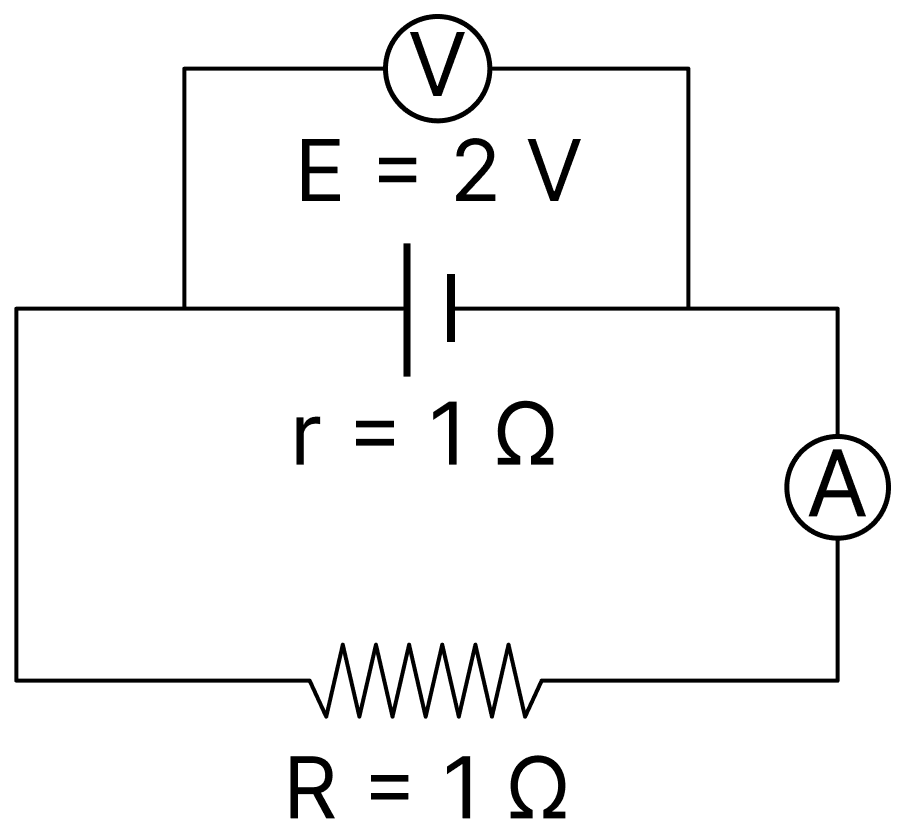
Reason (R): V = E − IR where E = 2 V, I = 2/2 = 1 A.
- If both assertion and reason are true and reason is the correct explanation of assertion.
- If both assertion and reason are true but reason is not the correct explanation of assertion.
- If assertion is true but reason is false.
- If both assertion and reason are false.
Answer
If assertion is true but reason is false.
Explanation
Assertion (A) is correct: The current in the circuit is
The voltmeter reads the terminal potential difference,
Reason (R) is incorrect: The terminal potential difference of a cell is V = E − Ir, where r is the internal resistance of the cell. The Reason writes V = E − IR, using the external resistance R. It gives 1 V here only because R and r are both 1 Ω, so the relation stated in the Reason is not correct.
Therefore, assertion is true but reason is false.
Assertion (A): The given figure does not show a balanced Wheatstone bridge.
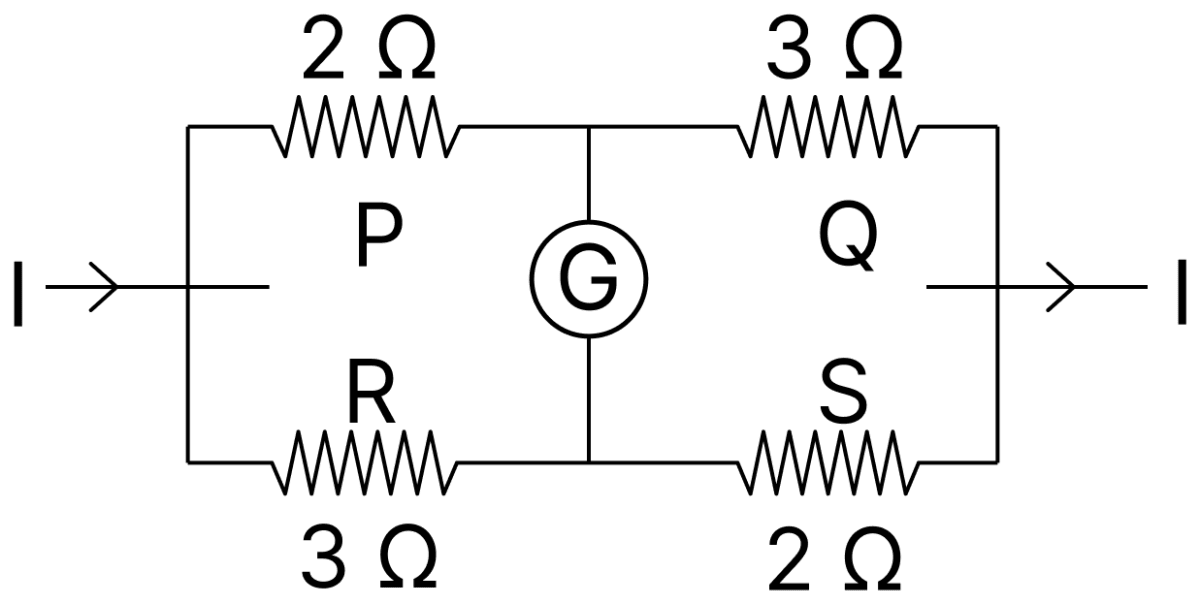
Reason (R): For a balanced bridge, small current should flow through the galvanometer.
- If both assertion and reason are true and reason is the correct explanation of assertion.
- If both assertion and reason are true but reason is not the correct explanation of assertion.
- If assertion is true but reason is false.
- If both assertion and reason are false.
Answer
If assertion is true but reason is false.
Explanation
Assertion (A) is correct: For the arms shown in the figure,
The two ratios are not equal, so the condition of balance P/Q = R/S is not satisfied and the bridge is not balanced.
Reason (R) is incorrect: For a balanced bridge no current at all flows through the galvanometer, not a small current. The two junctions joined by the galvanometer are at exactly the same potential.
Therefore, assertion is true but reason is false.