KnowledgeBoat Logo
|
OPEN IN APP

Chapter 3

Electric Potential — Competition Zone

Class 12 - Nootan Physics


Competition Zone — MCQ

Question 1

If potential (in volts) in a region is expressed as V(x, y, z) = 6xy − y + 2yz, the electric field (in N/C) at point (1, 1, 0) is :

  1. −(6i^+5j^+2k^)-\left(6\hat{\text i} + 5\hat{\text j} + 2\hat{\text k}\right)
  2. −(2i^+3j^+k^)-\left(2\hat{\text i} + 3\hat{\text j} + \hat{\text k}\right)
  3. −(6i^+9j^+k^)-\left(6\hat{\text i} + 9\hat{\text j} + \hat{\text k}\right)
  4. −(3i^+5j^+3k^)-\left(3\hat{\text i} + 5\hat{\text j} + 3\hat{\text k}\right)

Answer

−(6i^+5j^+2k^)-\left(6\hat{\text i} + 5\hat{\text j} + 2\hat{\text k}\right)

Reason —

Given, V(x, y, z) = 6xy − y + 2yz.

The electric field is the negative gradient of the potential,

E⃗=−(∂V∂xi^+∂V∂yj^+∂V∂zk^)\vec{\text E} = -\left(\dfrac{\partial \text V}{\partial \text x}\hat{\text i} + \dfrac{\partial \text V}{\partial \text y}\hat{\text j} + \dfrac{\partial \text V}{\partial \text z}\hat{\text k}\right)

Taking the partial derivatives,

∂V∂x=6y,∂V∂y=6x−1+2z,∂V∂z=2y\dfrac{\partial \text V}{\partial \text x} = 6\text y, \qquad \dfrac{\partial \text V}{\partial \text y} = 6\text x - 1 + 2\text z, \qquad \dfrac{\partial \text V}{\partial \text z} = 2\text y

Therefore

E⃗=−[6y i^+(6x−1+2z)j^+2y k^]\vec{\text E} = -\left[6\text y\ \hat{\text i} + (6\text x - 1 + 2\text z)\hat{\text j} + 2\text y\ \hat{\text k}\right]

At the point (1, 1, 0),

E⃗=−[6(1)i^+(6−1+0)j^+2(1)k^]=−(6i^+5j^+2k^)\vec{\text E} = -\left[6(1)\hat{\text i} + (6 - 1 + 0)\hat{\text j} + 2(1)\hat{\text k}\right] \\[1em] = -\left(6\hat{\text i} + 5\hat{\text j} + 2\hat{\text k}\right)

Question 2

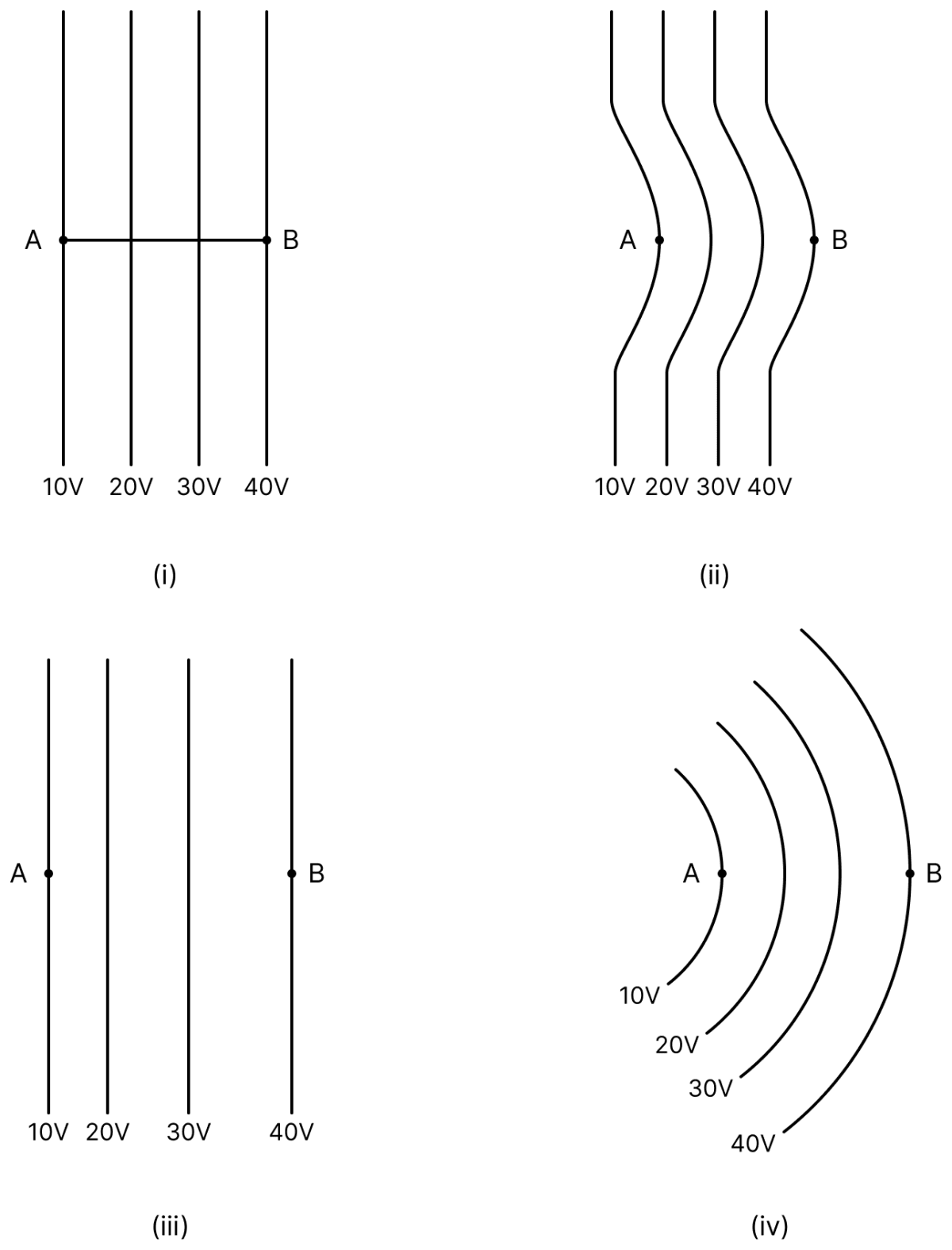
The diagrams below show regions of equipotentials.

The diagrams below show regions of equipotentials. A positive charge q is moved from A to B in each diagram. Electric Potential, Nootan Physics Solutions ICS Class 12

A positive charge q is moved from A to B in each diagram.

  1. Maximum work is required to move the charge q in figure (iii).
  2. In all the four cases the work done is the same.
  3. Minimum work is required to move the charge q in figure (i).
  4. Maximum work is required to move the charge q in figure (ii).

Answer

In all the four cases the work done is the same.

Reason — The work done in moving a charge between two points in an electrostatic field is

W=q ΔV\text W = \text q\ \Delta \text V

and depends only on the potential difference between the two points, not on the shape or spacing of the equipotential surfaces or on the path followed. In each of the four diagrams the point A lies on the 10 V equipotential and the point B on the 40 V equipotential, so ΔV = 30 V in every case. Hence the work done is the same in all four cases.

Question 3

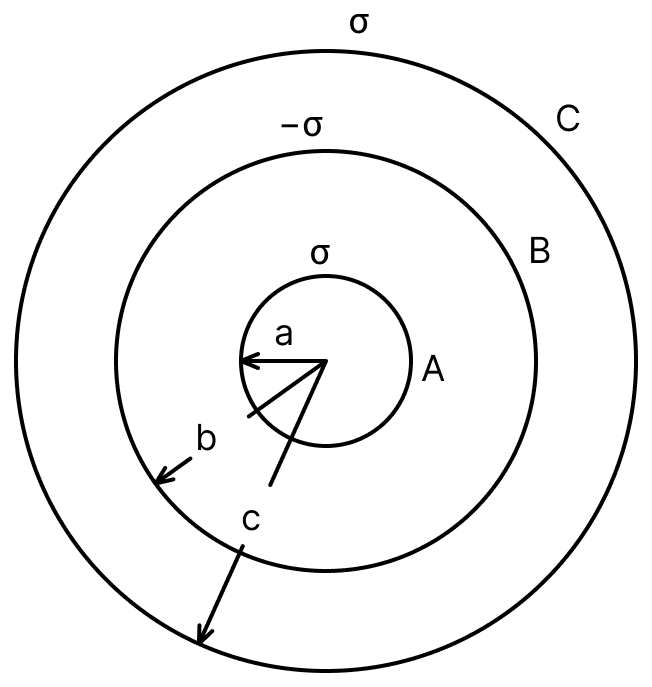
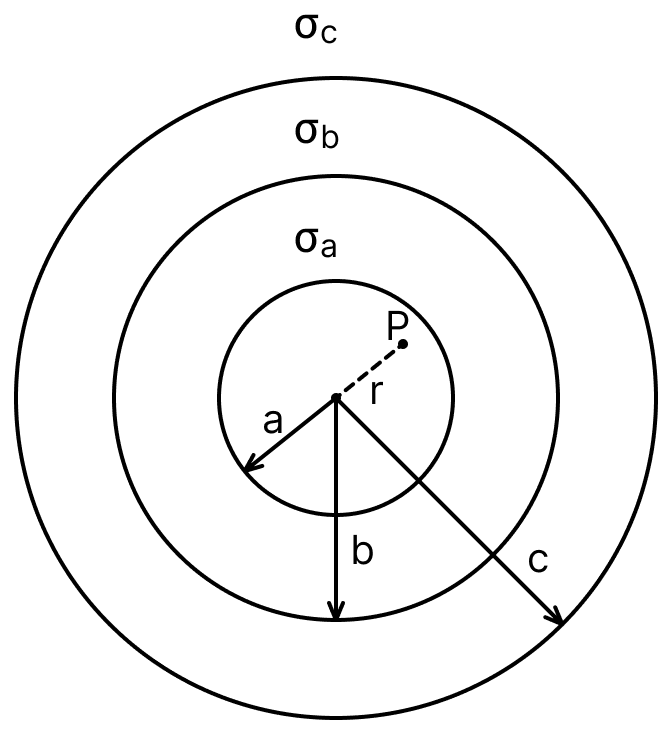
Three concentric metal shells A, B and C of respective radii a, b and c (a < b < c) have surface charge densities +σ, −σ and +σ respectively. The potential of shell B is :

  1. σϵ0[b2−c2b+a]\dfrac{\sigma}{\epsilon_0}\left[\dfrac{\text b^2 - \text c^2}{\text b} + \text a\right]
  2. σϵ0[b2−c2c+a]\dfrac{\sigma}{\epsilon_0}\left[\dfrac{\text b^2 - \text c^2}{\text c} + \text a\right]
  3. σϵ0[a2−b2a+c]\dfrac{\sigma}{\epsilon_0}\left[\dfrac{\text a^2 - \text b^2}{\text a} + \text c\right]
  4. σϵ0[a2−b2b+c]\dfrac{\sigma}{\epsilon_0}\left[\dfrac{\text a^2 - \text b^2}{\text b} + \text c\right]

Answer

σϵ0[a2−b2b+c]\dfrac{\sigma}{\epsilon_0}\left[\dfrac{\text a^2 - \text b^2}{\text b} + \text c\right]

Reason —

Given, three concentric shells of radii a, b and c with surface charge densities + σ, − σ and + σ respectively.

Three concentric metal shells A, B and C of respective radii a, b and c (a < b < c) have surface charge densities +σ, &minus;σ and +σ respectively. The potential of shell B is:. Electric Potential, Nootan Physics Solutions ICS Class 12

The charges on the shells are

QA=σ(4πa2),QB=−σ(4πb2),QC=σ(4πc2)\text Q_\text A = \sigma(4\pi\text a^2), \qquad \text Q_\text B = -\sigma(4\pi\text b^2), \qquad \text Q_\text C = \sigma(4\pi\text c^2)

The potential at the shell B is the sum of the potential due to the inner shell A (which behaves as a point charge at the centre), the potential due to its own charge, and the potential due to the outer shell C (which is the same at all interior points),

VB=14πϵ0[QAb+QBb+QCc]\text V_\text B = \dfrac{1}{4\pi\epsilon_0}\left[\dfrac{\text Q_\text A}{\text b} + \dfrac{\text Q_\text B}{\text b} + \dfrac{\text Q_\text C}{\text c}\right]

Substituting the charges,

=14πϵ0[σ4πa2b−σ4πb2b+σ4πc2c]=σϵ0[a2b−b+c]=σϵ0[a2−b2b+c]= \dfrac{1}{4\pi\epsilon_0}\left[\dfrac{\sigma 4\pi\text a^2}{\text b} - \dfrac{\sigma 4\pi\text b^2}{\text b} + \dfrac{\sigma 4\pi\text c^2}{\text c}\right] \\[1em] = \dfrac{\sigma}{\epsilon_0}\left[\dfrac{\text a^2}{\text b} - \text b + \text c\right] \\[1em] = \dfrac{\sigma}{\epsilon_0}\left[\dfrac{\text a^2 - \text b^2}{\text b} + \text c\right]

Question 4

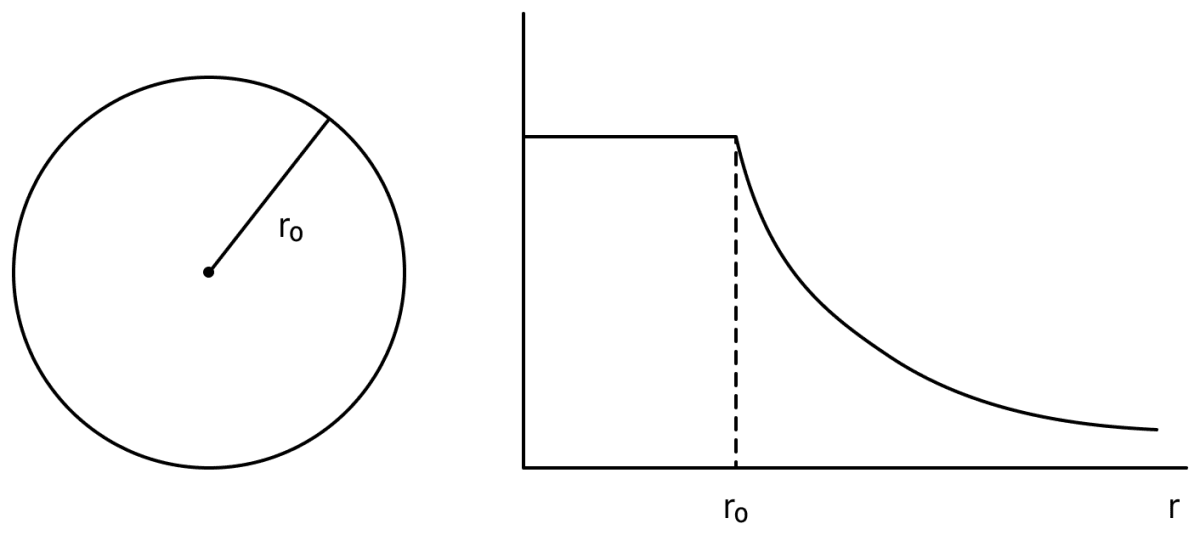
The given graph shows variation (with distance r from centre) of :

The given graph shows variation (with distance r from centre) of:. Electric Potential, Nootan Physics Solutions ICS Class 12
  1. electric field of a uniformly charged spherical shell
  2. potential of a uniformly charged spherical shell
  3. electric field of a uniformly charged sphere
  4. potential of a uniformly charged sphere

Answer

potential of a uniformly charged spherical shell

Reason — The graph is flat from r = 0 up to r = r0 and then falls off smoothly with increasing r.

Due to a charged spherical shell, the potential at any interior point is the same as that at its surface,

Vinside=Vsurface=KQr0\text V_{\text{inside}} = \text V_{\text{surface}} = \dfrac{\text{KQ}}{\text r_0}

which explains the constant portion of the graph. Outside the shell,

Voutside=KQr⇒V∝1r\text V_{\text{outside}} = \dfrac{\text{KQ}}{\text r} \quad \Rightarrow \quad \text V \propto \dfrac{1}{\text r}

which explains the falling portion. The electric field of a shell would be zero inside and then drop as 1r2\dfrac{1}{\text r^2}, while for a uniformly charged solid sphere the potential rises to 32KQR\dfrac{3}{2}\dfrac{\text{KQ}}{\text R} at the centre and is not constant inside. Hence the graph represents the potential of a uniformly charged spherical shell.

Question 5

A uniformly charged ring of radius 3a and total charge q is placed in XY-plane centred at origin. A point charge q is moving towards the ring along the Z-axis and has speed v at z = 4a. The minimum value of v such that it crosses the origin is :

  1. 2m(15q24πϵ0a)1/2\sqrt{\dfrac{2}{\text m}}\left(\dfrac{1}{5}\dfrac{\text q^2}{4\pi\epsilon_0\text a}\right)^{1/2}
  2. 2m(215q24πϵ0a)1/2\sqrt{\dfrac{2}{\text m}}\left(\dfrac{2}{15}\dfrac{\text q^2}{4\pi\epsilon_0\text a}\right)^{1/2}
  3. 2m(115q24πϵ0a)1/2\sqrt{\dfrac{2}{\text m}}\left(\dfrac{1}{15}\dfrac{\text q^2}{4\pi\epsilon_0\text a}\right)^{1/2}
  4. 2m(415q24πϵ0a)1/2\sqrt{\dfrac{2}{\text m}}\left(\dfrac{4}{15}\dfrac{\text q^2}{4\pi\epsilon_0\text a}\right)^{1/2}

Answer

2m(215q24πϵ0a)1/2\sqrt{\dfrac{2}{\text m}}\left(\dfrac{2}{15}\dfrac{\text q^2}{4\pi\epsilon_0\text a}\right)^{1/2}

Reason —

Given, radius of the ring = 3a, charge on the ring = q, moving charge = q of mass m, initial position z = 4a.

The potential on the axis of a charged ring at an axial distance z is

V=14πϵ0qR2+z2\text V = \dfrac{1}{4\pi\epsilon_0}\dfrac{\text q}{\sqrt{\text R^2 + \text z^2}}

At z = 4a :

V1=14πϵ0q(3a)2+(4a)2=14πϵ0q5a\text V_1 = \dfrac{1}{4\pi\epsilon_0}\dfrac{\text q}{\sqrt{(3\text a)^2 + (4\text a)^2}} \\[1em] = \dfrac{1}{4\pi\epsilon_0}\dfrac{\text q}{5\text a}

At the centre (z = 0) :

V2=14πϵ0q3a\text V_2 = \dfrac{1}{4\pi\epsilon_0}\dfrac{\text q}{3\text a}

To just cross the origin, the whole of the kinetic energy must be used up in increasing the potential energy,

12mv2=q(V2−V1)=q24πϵ0(13a−15a)=q24πϵ0⋅215a\dfrac{1}{2}\text m\text v^2 = \text q(\text V_2 - \text V_1) \\[1em] = \dfrac{\text q^2}{4\pi\epsilon_0}\left(\dfrac{1}{3\text a} - \dfrac{1}{5\text a}\right) \\[1em] = \dfrac{\text q^2}{4\pi\epsilon_0}\cdot\dfrac{2}{15\text a}

Therefore

v2=2m(215q24πϵ0a)⇒v=2m(215q24πϵ0a)1/2\text v^2 = \dfrac{2}{\text m}\left(\dfrac{2}{15}\dfrac{\text q^2}{4\pi\epsilon_0\text a}\right) \\[1em] \Rightarrow \quad \text v = \sqrt{\dfrac{2}{\text m}}\left(\dfrac{2}{15}\dfrac{\text q^2}{4\pi\epsilon_0\text a}\right)^{1/2}

Question 6

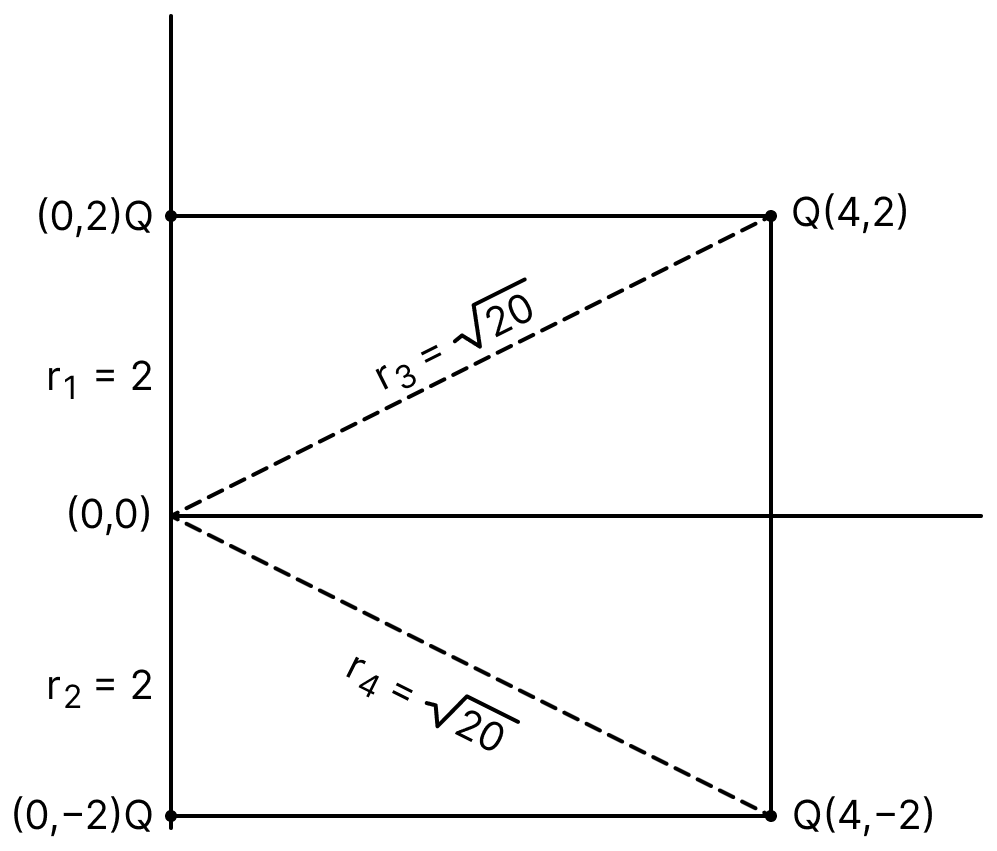
Four equal point charges Q each are placed in the XY-plane at (0, 2), (4, 2), (4, − 2) and (0, − 2). The work required to put a fifth charge Q at the origin of the coordinate system will be :

  1. Q24πϵ0\dfrac{\text Q^2}{4\pi\epsilon_0}
  2. Q24πϵ0(1+13)\dfrac{\text Q^2}{4\pi\epsilon_0}\left(1 + \dfrac{1}{\sqrt3}\right)
  3. Q222πϵ0\dfrac{\text Q^2}{2\sqrt2 \pi\epsilon_0}
  4. Q24πϵ0(1+15)\dfrac{\text Q^2}{4\pi\epsilon_0}\left(1 + \dfrac{1}{\sqrt5}\right)

Answer

Q24πϵ0(1+15)\dfrac{\text Q^2}{4\pi\epsilon_0}\left(1 + \dfrac{1}{\sqrt5}\right)

Reason —

Given, four charges Q at (0, 2), (4, 2), (4, − 2) and (0, − 2).

Four equal point charges Q each are placed in the XY-plane at (0, 2), (4, 2), (4, &minus; 2) and (0, &minus; 2). The work required to put a fifth charge Q at the origin of the coordinate system will be:. Electric Potential, Nootan Physics Solutions ICS Class 12

The distances of these points from the origin are

r1=2,r2=2,r3=42+22=20,r4=20\text r_1 = 2, \qquad \text r_2 = 2, \qquad \text r_3 = \sqrt{4^2 + 2^2} = \sqrt{20}, \qquad \text r_4 = \sqrt{20}

Since potential is a scalar, the potential at the origin is

V=KQ[12+12+120+120]=KQ[1+225]=KQ[1+15]\text V = \text{KQ}\left[\dfrac{1}{2} + \dfrac{1}{2} + \dfrac{1}{\sqrt{20}} + \dfrac{1}{\sqrt{20}}\right] \\[1em] = \text{KQ}\left[1 + \dfrac{2}{2\sqrt5}\right] \\[1em] = \text{KQ}\left[1 + \dfrac{1}{\sqrt5}\right]

The work required to bring the fifth charge Q from infinity to the origin is

W=QV=Q24πϵ0(1+15)\text W = \text Q\text V \\[1em] = \dfrac{\text Q^2}{4\pi\epsilon_0}\left(1 + \dfrac{1}{\sqrt5}\right)

Question 7

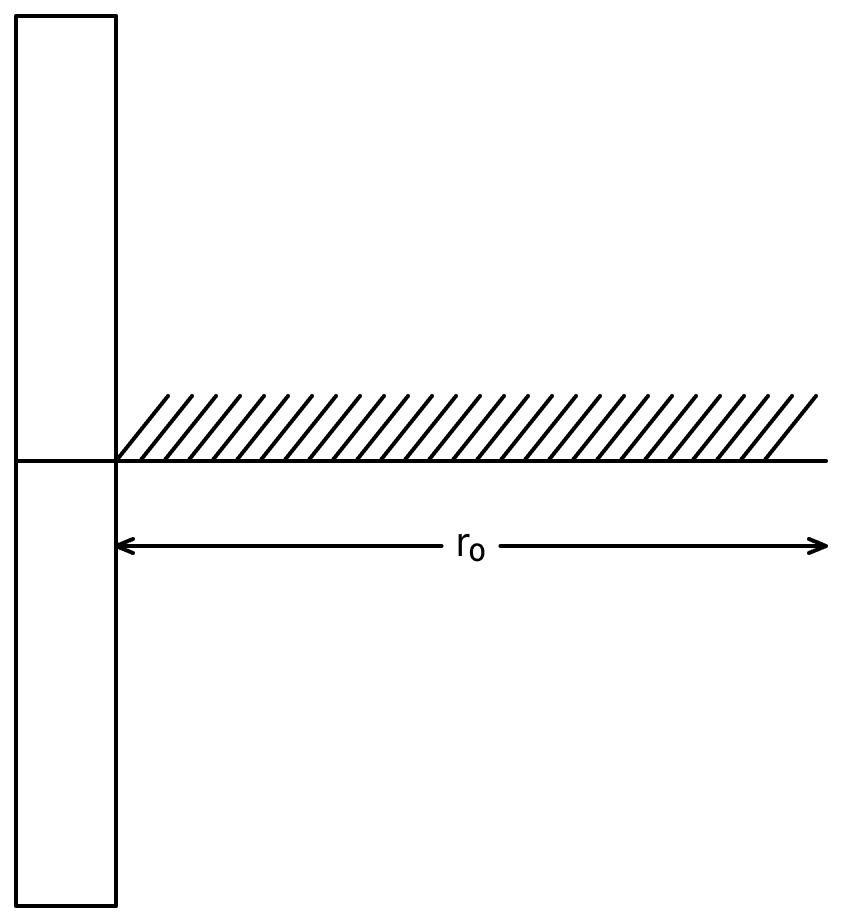
A positive point charge is released from rest at a distance r0 from a positive line charge with uniform density as shown in figure. The speed (v) of the point-charge, as a function of instantaneous distance r from line charge, is proportional to :

A positive point charge is released from rest at a distance r 0 from a positive line charge with uniform density as shown in figure. The speed (v) of the point-charge, as a function of instantaneous distance r from line charge, is proportional to:. Electric Potential, Nootan Physics Solutions ICS Class 12
  1. v∝e+r/r0\text v \propto \text e^{+\text r/\text r_0}
  2. v∝log⁡(rr0)\text v \propto \log\left(\dfrac{\text r}{\text r_0}\right)
  3. v∝(rr0)\text v \propto \left(\dfrac{\text r}{\text r_0}\right)
  4. v∝log⁡(rr0)\text v \propto \sqrt{\log\left(\dfrac{\text r}{\text r_0}\right)}

Answer

v∝log⁡(rr0)\text v \propto \sqrt{\log\left(\dfrac{\text r}{\text r_0}\right)}

Reason —

The electric field due to an infinitely long uniformly charged wire of linear charge density λ at a distance r is

E=λ2πϵ0r=−dVdr\text E = \dfrac{\lambda}{2\pi\epsilon_0\text r} \\[1em] = -\dfrac{\text{dV}}{\text{dr}}

Integrating between r0 and r,

ΔV=−∫r0rλ2πϵ0r dr=−λ2πϵ0log⁡(rr0)\Delta \text V = -\displaystyle\int_{\text r_0}^{\text r}\dfrac{\lambda}{2\pi\epsilon_0\text r}\ \text{dr} \\[1em] = -\dfrac{\lambda}{2\pi\epsilon_0}\log\left(\dfrac{\text r}{\text r_0}\right)

The charge is released from rest, so the loss in potential energy appears as kinetic energy,

12mv2=q(Vr0−Vr)=qλ2πϵ0log⁡(rr0)⇒v2∝log⁡(rr0)⇒v∝log⁡(rr0)\dfrac{1}{2}\text m\text v^2 = \text q(\text V_{\text r_0} - \text V_\text r) \\[1em] = \dfrac{\text q\lambda}{2\pi\epsilon_0}\log\left(\dfrac{\text r}{\text r_0}\right) \\[1em] \Rightarrow \quad \text v^2 \propto \log\left(\dfrac{\text r}{\text r_0}\right) \\[1em] \Rightarrow \quad \text v \propto \sqrt{\log\left(\dfrac{\text r}{\text r_0}\right)}

Question 8

An electric field of 1000 V/m is applied to an electric dipole at angle of 45°. The value of electric dipole moment is 10-29 C-m. What is the potential energy of the electric dipole?

  1. −9 × 10-20 J
  2. −10 × 10-29 J
  3. −20 × 10-18 J
  4. −7 × 10-27 J

Answer

−7 × 10-27 J

Reason —

Given,

  • Electric field, E = 1000 V m-1
  • Angle, θ = 45°
  • Dipole moment, p = 10-29 C-m

The potential energy of a dipole in a uniform electric field is

U=−p⃗⋅E⃗=−pEcos⁡θ\text U = -\vec{\text p}\cdot\vec{\text E} \\[1em] = -\text p\text E\cos\theta

Substituting the values,

U=−(10−29)(1000)cos⁡45°=−(10−26)(0.707)U≈−7×10⁻²⁷ J\text U = -(10^{-29})(1000)\cos 45° \\[1em] = -(10^{-26})(0.707) \\[1em] \text U \approx -7\times10^{-27}\ \text J

Question 9

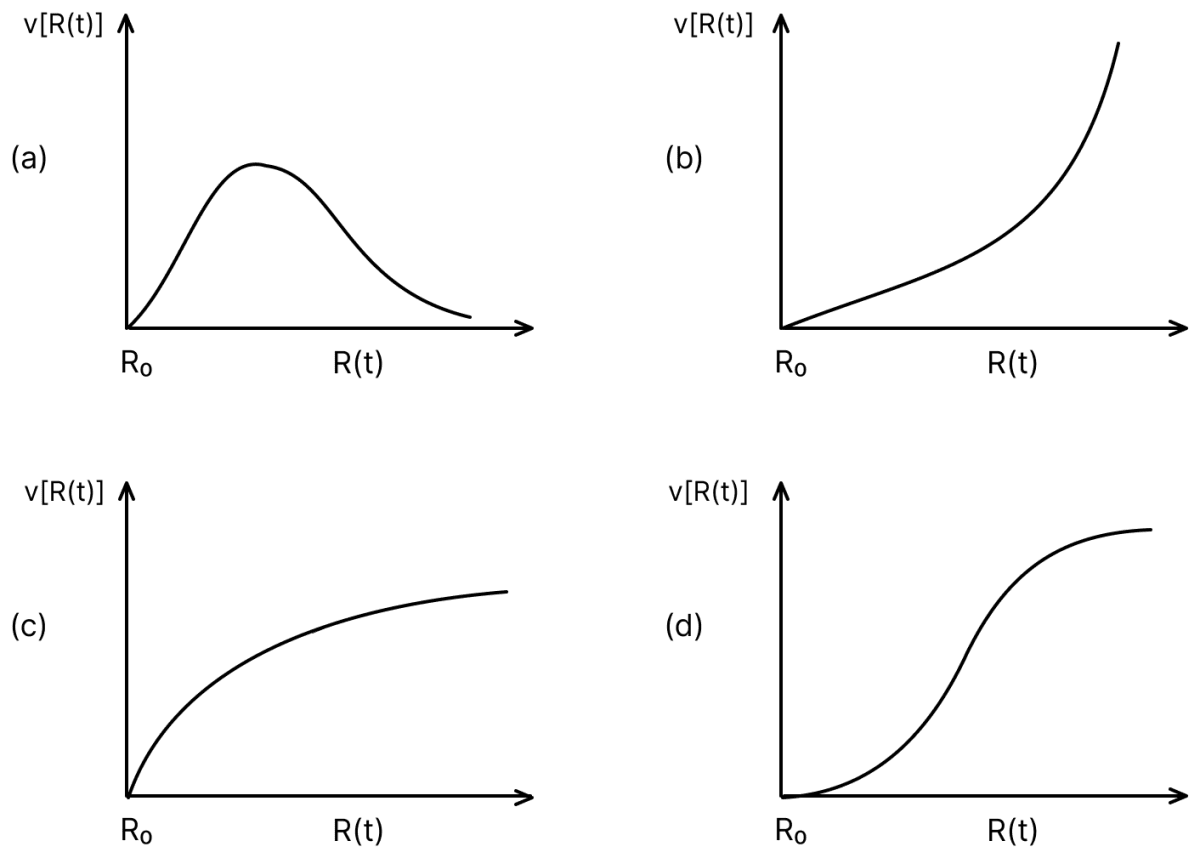
There is uniform spherically symmetric surface charge density at a distance R0 from the origin. The charge distribution is initially at rest and starts expanding because of mutual repulsion. The figure that represents best the speed v[R(t)] of the distribution as a function of its instantaneous radius R(t) is :

There is uniform spherically symmetric surface charge density at a distance R 0 from the origin. The charge distribution is initially at rest and starts expanding because of mutual repulsion. The figure that represents best the speed v[R(t)] of the distribution as a function of its instantaneous radius R(t) is:. Electric Potential, Nootan Physics Solutions ICS Class 12

Answer

The graph in which the speed increases from zero at R0 and then flattens out, approaching a constant value as R(t) becomes large.

Reason —

Let the radius of the distribution at any instant t be R, the initial radius being R0. By the conservation of energy,

0+KQ22R0=12mv2+KQ22R0 + \dfrac{\text{KQ}^2}{2\text R_0} = \dfrac{1}{2}\text m\text v^2 + \dfrac{\text{KQ}^2}{2\text R}

Differentiating this equation with respect to R,

12m(2v)dvdR−KQ22R2=0⇒dvdR=KQ22mvR2\dfrac{1}{2}\text m(2\text v)\dfrac{\text{dv}}{\text{dR}} - \dfrac{\text{KQ}^2}{2\text R^2} = 0 \\[1em] \Rightarrow \quad \dfrac{\text{dv}}{\text{dR}} = \dfrac{\text{KQ}^2}{2\text{mv}\text R^2}

Here dvdR\dfrac{\text{dv}}{\text{dR}} is the slope of the v-R graph. It decreases as both v and R increase, and the slope tends to zero as R → ∞. Hence the curve starts at v = 0 when R = R0, rises steeply at first and then becomes almost horizontal, the speed approaching a limiting value.

Question 10

A charge Q is distributed over three concentric spherical shells of radii a, b, c (a < b < c) such that their surface charge densities are equal to one another. The total potential at a point at distance r from their common centre, where r < a would be :

  1. Q(a2+b2+c2)4πϵ0(a3+b3+c3)\dfrac{\text Q(\text a^2 + \text b^2 + \text c^2)}{4\pi\epsilon_0(\text a^3 + \text b^3 + \text c^3)}
  2. Q(a+b+c)4πϵ0(a2+b2+c2)\dfrac{\text Q(\text a + \text b + \text c)}{4\pi\epsilon_0(\text a^2 + \text b^2 + \text c^2)}
  3. Q4πϵ0(a+b+c)\dfrac{\text Q}{4\pi\epsilon_0(\text a + \text b + \text c)}
  4. Q12πϵ0⋅(ab+bc+ca)abc\dfrac{\text Q}{12\pi\epsilon_0}\cdot\dfrac{(\text{ab} + \text{bc} + \text{ca})}{\text{abc}}

Answer

Q(a+b+c)4πϵ0(a2+b2+c2)\dfrac{\text Q(\text a + \text b + \text c)}{4\pi\epsilon_0(\text a^2 + \text b^2 + \text c^2)}

Reason —

Given, three concentric shells of radii a, b and c with equal surface charge densities, carrying a total charge Q.

A charge Q is distributed over three concentric spherical shells of radii a, b, c (a < b < c) such that their surface charge densities are equal to one another. The total potential at a point at distance r from their common centre, where r < a would be:. Electric Potential, Nootan Physics Solutions ICS Class 12

Since σa=σb=σc\sigma_\text a = \sigma_\text b = \sigma_\text c,

Qa4πa2=Qb4πb2=Qc4πc2⇒Qa:Qb:Qc=a2:b2:c2\dfrac{\text Q_\text a}{4\pi\text a^2} = \dfrac{\text Q_\text b}{4\pi\text b^2} = \dfrac{\text Q_\text c}{4\pi\text c^2} \\[1em] \Rightarrow \quad \text Q_\text a : \text Q_\text b : \text Q_\text c = \text a^2 : \text b^2 : \text c^2

Also Qa + Qb + Qc = Q, so

Qa=a2a2+b2+c2Q,Qb=b2a2+b2+c2Q,Qc=c2a2+b2+c2Q\text Q_\text a = \dfrac{\text a^2}{\text a^2 + \text b^2 + \text c^2}\text Q, \quad \text Q_\text b = \dfrac{\text b^2}{\text a^2 + \text b^2 + \text c^2}\text Q, \quad \text Q_\text c = \dfrac{\text c^2}{\text a^2 + \text b^2 + \text c^2}\text Q

For a point with r < a, the potential due to each shell equals the potential at its own surface. Hence

V=14πϵ0[Qaa+Qbb+Qcc]=14πϵ0⋅Q(a+b+c)a2+b2+c2\text V = \dfrac{1}{4\pi\epsilon_0}\left[\dfrac{\text Q_\text a}{\text a} + \dfrac{\text Q_\text b}{\text b} + \dfrac{\text Q_\text c}{\text c}\right] \\[1em] = \dfrac{1}{4\pi\epsilon_0}\cdot\dfrac{\text Q(\text a + \text b + \text c)}{\text a^2 + \text b^2 + \text c^2}

Question 11

The electric field in a region is given by E⃗=(Ax+B)i^\vec{\text E} = (\text A\text x + \text B)\hat{\text i} where E is in NC-1 and x is in metres. The values of constants are A = 20 SI unit and B = 10 SI unit. If the potential at x = 1 is V1 and that at x = − 5 is V2, then V1 − V2 is :

  1. −48 V
  2. −520 V
  3. 180 V
  4. 320 V

Answer

180 V

Reason —

Given, E⃗=(20x+10)i^\vec{\text E} = (20\text x + 10)\hat{\text i} N C-1.

The potential difference is obtained from

ΔV=−∫r1r2E⃗⋅dr⃗V1−V2=−∫−51(20x+10) dx\Delta \text V = -\displaystyle\int_{\text r_1}^{\text r_2}\vec{\text E}\cdot\text d\vec{\text r} \\[1em] \text V_1 - \text V_2 = -\displaystyle\int_{-5}^{1}(20\text x + 10)\ \text{dx}

Integrating term by term,

=−[20x22+10x]−51=−[10x2+10x]−51= -\left[\dfrac{20\text x^2}{2} + 10\text x\right]_{-5}^{1} \\[1em] = -\left[10\text x^2 + 10\text x\right]_{-5}^{1}

Evaluating the limits,

=−[(10(1)2+10(1))−(10(−5)2+10(−5))]=−[(10+10)−(250−50)]=−[20−200]=180 V= -\left[\left(10(1)^2 + 10(1)\right) - \left(10(-5)^2 + 10(-5)\right)\right] \\[1em] = -\left[(10 + 10) - (250 - 50)\right] \\[1em] = -\left[20 - 200\right] \\[1em] = 180\ \text V

Question 12

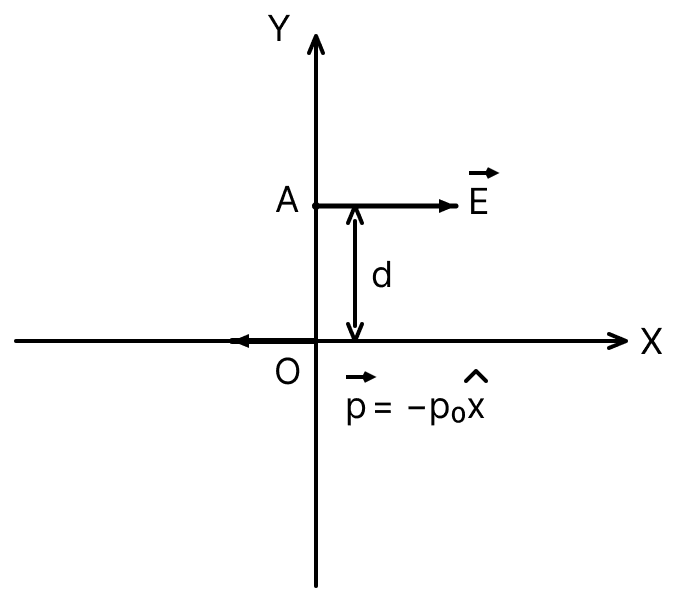
A point dipole p⃗=−p0x^\vec{\text p} = -\text p_0\hat{\text x} is kept at the origin. The potential and electric field due to this dipole on the Y-axis at a distance d are, respectively : (Take V = 0 at infinity)

  1. ∣p⃗∣4πϵ0d2, −p⃗4πϵ0d3\dfrac{\left|\vec{\text p}\right|}{4\pi\epsilon_0\text d^2},\ \dfrac{-\vec{\text p}}{4\pi\epsilon_0\text d^3}
  2. 0, p⃗4πϵ0d30,\ \dfrac{\vec{\text p}}{4\pi\epsilon_0\text d^3}
  3. ∣p⃗∣4πϵ0d2, p⃗4πϵ0d3\dfrac{\left|\vec{\text p}\right|}{4\pi\epsilon_0\text d^2},\ \dfrac{\vec{\text p}}{4\pi\epsilon_0\text d^3}
  4. 0, −p⃗4πϵ0d30,\ \dfrac{-\vec{\text p}}{4\pi\epsilon_0\text d^3}

Answer

0, −p⃗4πϵ0d30,\ \dfrac{-\vec{\text p}}{4\pi\epsilon_0\text d^3}

Reason —

Given, p⃗=−p0x^\vec{\text p} = -\text p_0\hat{\text x} placed at the origin, and the field point A lies on the Y-axis at a distance d.

A point dipole vec text p = - text p_0 hat text x is kept at the origin. The potential and electric field due to this dipole on the Y-axis at a distance d are, respectively: (Take V = 0 at infinity). Electric Potential, Nootan Physics Solutions ICS Class 12

Since the dipole axis is along the X-axis, the point A on the Y-axis lies on the equatorial line of the dipole. Hence

VA=14πϵ0pcos⁡90°d2=0\text V_\text A = \dfrac{1}{4\pi\epsilon_0}\dfrac{\text p\cos 90°}{\text d^2} \\[1em] = 0

The electric field at a point on the equatorial line is directed antiparallel to the dipole moment,

E⃗A=−14πϵ0p⃗d3=−14πϵ0(−p0x^)d3=p04πϵ0d3x^\vec{\text E}_\text A = -\dfrac{1}{4\pi\epsilon_0}\dfrac{\vec{\text p}}{\text d^3} \\[1em] = -\dfrac{1}{4\pi\epsilon_0}\dfrac{(-\text p_0\hat{\text x})}{\text d^3} \\[1em] = \dfrac{\text p_0}{4\pi\epsilon_0\text d^3}\hat{\text x}

Note: The textbook answer key gives option 2 for this question, but the worked hint given in the textbook itself obtains E⃗A=p04πϵ0d3x^\vec{\text E}_\text A = \dfrac{\text p_0}{4\pi\epsilon_0\text d^3}\hat{\text x}, which is option 4. The correct option is therefore 4.

Question 13

A solid conducting sphere, having a charge Q, is surrounded by an uncharged conducting hollow spherical shell. Let the potential difference between the surface of the solid sphere and that of the outer surface of the hollow shell be V. If the shell is now given a charge of −4 Q, the new potential difference between the same two surfaces is :

  1. V
  2. 2V
  3. −2V
  4. 4V

Answer

V

Reason —

Let r1 be the radius of the inner solid sphere and r2 that of the outer surface of the shell, and let k=14πϵ0\text k = \dfrac{1}{4\pi\epsilon_0}.

In the first condition, the outer shell is uncharged, so both potentials are due to the charge Q alone,

ΔV=Vin−Vout=kQr1−kQr2=kQ(1r1−1r2)=V\Delta \text V = \text V_{\text{in}} - \text V_{\text{out}} \\[1em] = \dfrac{\text{kQ}}{\text r_1} - \dfrac{\text{kQ}}{\text r_2} \\[1em] = \text{kQ}\left(\dfrac{1}{\text r_1} - \dfrac{1}{\text r_2}\right) \\[1em] = \text V

In the second condition, the shell carries a charge − 4Q as well, and this charge contributes the same amount −4kQr2-\dfrac{4\text{kQ}}{\text r_2} to both the potentials,

ΔV′=(kQr1−4kQr2)−(kQr2−4kQr2)=kQr1−kQr2=V\Delta \text V' = \left(\dfrac{\text{kQ}}{\text r_1} - \dfrac{4\text{kQ}}{\text r_2}\right) - \left(\dfrac{\text{kQ}}{\text r_2} - \dfrac{4\text{kQ}}{\text r_2}\right) \\[1em] = \dfrac{\text{kQ}}{\text r_1} - \dfrac{\text{kQ}}{\text r_2} \\[1em] = \text V

Hence the potential difference does not depend on the charge given to the outer shell and remains the same.

Question 14

Hydrogen ion and singly ionized helium atom are accelerated, from rest, through the same potential difference. The ratio of final speeds of hydrogen and helium ions is close to :

  1. 2 : 1
  2. 1 : 2
  3. 10 : 7
  4. 5 : 7

Answer

2 : 1

Reason —

For a charge accelerated from rest through a potential difference V,

12mv2=qV⇒v=2qVm\dfrac{1}{2}\text m\text v^2 = \text q\text V \\[1em] \Rightarrow \quad \text v = \sqrt{\dfrac{2\text q\text V}{\text m}}

The hydrogen ion and the singly ionized helium atom carry the same charge, but the mass of the helium ion is four times that of the hydrogen ion. Hence

vHvHe=qHmHemHqHe=4mHmH=2\dfrac{\text v_\text H}{\text v_{\text{He}}} = \sqrt{\dfrac{\text q_\text H \text m_{\text{He}}}{\text m_\text H \text q_{\text{He}}}} \\[1em] = \sqrt{\dfrac{4\text m_\text H}{\text m_\text H}} \\[1em] = 2

that is, the ratio of the final speeds is 2 : 1.

Question 15

Concentric metallic hollow spheres of radii R and 4R hold charges Q1 and Q2 respectively. Given that surface charge densities of the concentric spheres are equal, the potential difference V(R) − V(4R) is :

  1. 3Q24πϵ0R\dfrac{3\text Q_2}{4\pi\epsilon_0\text R}
  2. 3Q116πϵ0R\dfrac{3\text Q_1}{16\pi\epsilon_0\text R}
  3. Q24πϵ0R\dfrac{\text Q_2}{4\pi\epsilon_0\text R}
  4. 3Q14πϵ0R\dfrac{3\text Q_1}{4\pi\epsilon_0\text R}

Answer

3Q116πϵ0R\dfrac{3\text Q_1}{16\pi\epsilon_0\text R}

Reason —

Given, spheres of radii R and 4R with charges Q1 and Q2, having equal surface charge densities.

Q14πR2=Q24π(4R)2⇒Q2=16Q1\dfrac{\text Q_1}{4\pi\text R^2} = \dfrac{\text Q_2}{4\pi(4\text R)^2} \\[1em] \Rightarrow \quad \text Q_2 = 16\text Q_1

Writing k=14πϵ0\text k = \dfrac{1}{4\pi\epsilon_0}, the potentials at the two surfaces are

V(R)=kQ1R+kQ24R,V(4R)=kQ14R+kQ24R\text V(\text R) = \dfrac{\text{kQ}_1}{\text R} + \dfrac{\text{kQ}_2}{4\text R}, \qquad \text V(4\text R) = \dfrac{\text{kQ}_1}{4\text R} + \dfrac{\text{kQ}_2}{4\text R}

Therefore

V(R)−V(4R)=kQ1R−kQ14R=34⋅kQ1R=3Q116πϵ0R\text V(\text R) - \text V(4\text R) = \dfrac{\text{kQ}_1}{\text R} - \dfrac{\text{kQ}_1}{4\text R} \\[1em] = \dfrac{3}{4}\cdot\dfrac{\text{kQ}_1}{\text R} \\[1em] = \dfrac{3\text Q_1}{16\pi\epsilon_0\text R}

Question 16

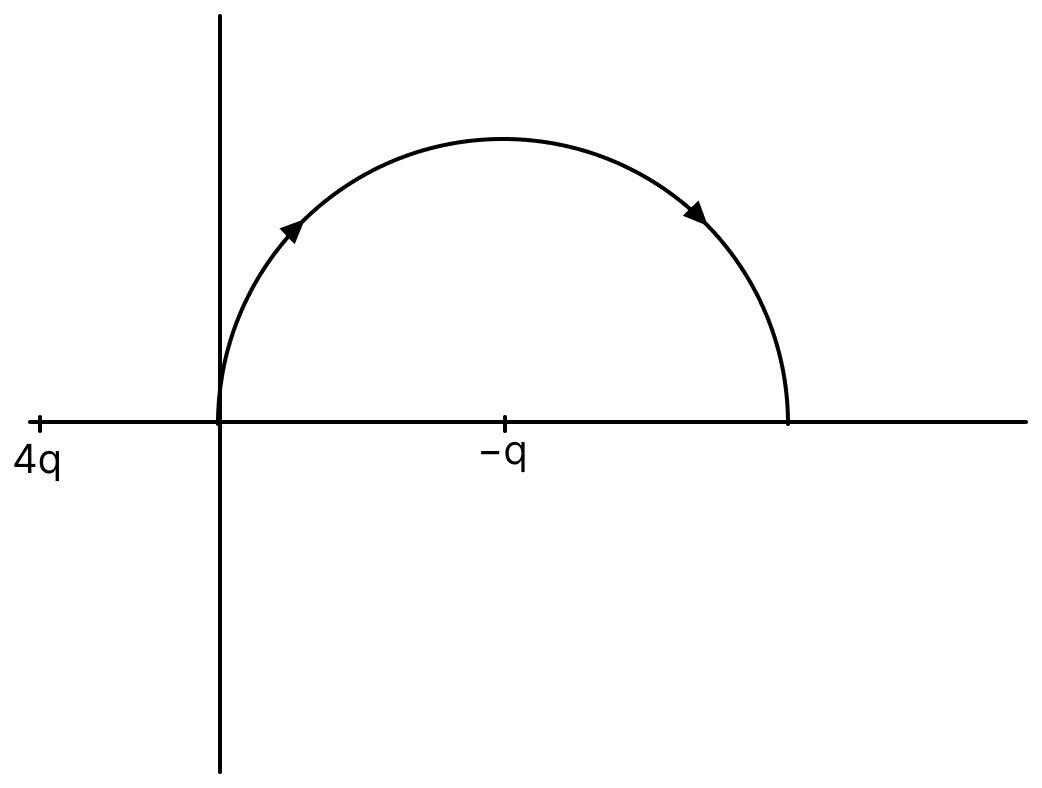
Two point charges 4q and −q are fixed on the x-axis at x=−d2\text x = -\dfrac{\text d}{2} and x=d2\text x = \dfrac{\text d}{2}, respectively. If a third point charge 'q' is taken from the origin to x = d along the semicircle as shown in the figure, the energy of the charge will :

Two point charges 4q and &minus;q are fixed on the x-axis at text x = - text d/2 and text x = text d/2, respectively. If a third point charge q is taken from the origin to x = d along the semicircle as shown in the figure, the energy of the charge will:. Electric Potential, Nootan Physics Solutions ICS Class 12
  1. decrease by q24πϵ0d\dfrac{\text q^2}{4\pi\epsilon_0\text d}
  2. decrease by 4q23πϵ0d\dfrac{4\text q^2}{3\pi\epsilon_0\text d}
  3. increase by 2q23πϵ0d\dfrac{2\text q^2}{3\pi\epsilon_0\text d}
  4. increase by 3q24πϵ0d\dfrac{3\text q^2}{4\pi\epsilon_0\text d}

Answer

decrease by 4q23πϵ0d\dfrac{4\text q^2}{3\pi\epsilon_0\text d}

Reason —

Given, 4q at x=−d2\text x = -\dfrac{\text d}{2} and − q at x=d2\text x = \dfrac{\text d}{2}, and the charge q is taken from the origin to x = d.

Writing k=14πϵ0\text k = \dfrac{1}{4\pi\epsilon_0} :

At the origin, the distance from each fixed charge is d2\dfrac{\text d}{2},

U1=kq[4qd/2−qd/2]=kq2[8d−2d]=6kq2d\text U_1 = \text{kq}\left[\dfrac{4\text q}{\text d/2} - \dfrac{\text q}{\text d/2}\right] \\[1em] = \text{kq}^2\left[\dfrac{8}{\text d} - \dfrac{2}{\text d}\right] \\[1em] = \dfrac{6\text{kq}^2}{\text d}

At x = d, the distance from 4q is 3d2\dfrac{3\text d}{2} and that from − q is d2\dfrac{\text d}{2},

U2=kq[4q3d/2−qd/2]=kq2[83d−2d]=2kq23d\text U_2 = \text{kq}\left[\dfrac{4\text q}{3\text d/2} - \dfrac{\text q}{\text d/2}\right] \\[1em] = \text{kq}^2\left[\dfrac{8}{3\text d} - \dfrac{2}{\text d}\right] \\[1em] = \dfrac{2\text{kq}^2}{3\text d}

The change in the energy of the charge is

ΔU=U2−U1=2kq23d−6kq2d=−16kq23d\Delta \text U = \text U_2 - \text U_1 \\[1em] = \dfrac{2\text{kq}^2}{3\text d} - \dfrac{6\text{kq}^2}{\text d} \\[1em] = -\dfrac{16\text{kq}^2}{3\text d}

Since U1 > U2, there is a decrease, of magnitude

163d⋅q24πϵ0=4q23πϵ0d\dfrac{16}{3\text d}\cdot\dfrac{\text q^2}{4\pi\epsilon_0} = \dfrac{4\text q^2}{3\pi\epsilon_0\text d}

The path being a semicircle does not matter, since the electrostatic field is conservative.

Question 17

Two identical electric point dipoles have dipole moments p⃗1=pi^\vec{\text p}_1 = \text p\hat{\text i} and p⃗2=−pi^\vec{\text p}_2 = -\text p\hat{\text i} and are held on the x-axis at distance 'a' from each other. When released, they move along the x-axis with the direction of their dipole moments remaining unchanged. If the mass of each dipole is 'm', their speed when they are infinitely far apart is :

  1. pa12πϵ0ma\dfrac{\text p}{\text a}\sqrt{\dfrac{1}{2\pi\epsilon_0\text{ma}}}
  2. pa2πϵ0ma\dfrac{\text p}{\text a}\sqrt{\dfrac{2}{\pi\epsilon_0\text{ma}}}
  3. pa1πϵ0ma\dfrac{\text p}{\text a}\sqrt{\dfrac{1}{\pi\epsilon_0\text{ma}}}
  4. pa32πϵ0ma\dfrac{\text p}{\text a}\sqrt{\dfrac{3}{2\pi\epsilon_0\text{ma}}}

Answer

pa12πϵ0ma\dfrac{\text p}{\text a}\sqrt{\dfrac{1}{2\pi\epsilon_0\text{ma}}}

Reason —

The electric field due to the first dipole at an axial distance a is

E⃗=2p⃗4πϵ0a3\vec{\text E} = \dfrac{2\vec{\text p}}{4\pi\epsilon_0\text a^3}

The second dipole is located in this field, so its potential energy is

U=−p⃗2⋅E⃗=−(−p)(2p4πϵ0a3)=2p24πϵ0a3\text U = -\vec{\text p}_2\cdot\vec{\text E} \\[1em] = -(-\text p)\left(\dfrac{2\text p}{4\pi\epsilon_0\text a^3}\right) \\[1em] = \dfrac{2\text p^2}{4\pi\epsilon_0\text a^3}

When the dipoles are infinitely far apart, U' = 0. Hence the loss in potential energy appears as the kinetic energy of the two dipoles,

ΔU=U−U′=2p24πϵ0a3=2×12mv2mv2=2p24πϵ0a3=p22πϵ0a3v2=p22πϵ0ma3⇒v=pa12πϵ0ma\Delta \text U = \text U - \text U' \\[1em] = \dfrac{2\text p^2}{4\pi\epsilon_0\text a^3} \\[1em] = 2 \times \dfrac{1}{2}\text m\text v^2 \\[1em] \text m\text v^2 = \dfrac{2\text p^2}{4\pi\epsilon_0\text a^3} \\[1em] = \dfrac{\text p^2}{2\pi\epsilon_0\text a^3} \\[1em] \text v^2 = \dfrac{\text p^2}{2\pi\epsilon_0\text{ma}^3} \\[1em] \Rightarrow \quad \text v = \dfrac{\text p}{\text a}\sqrt{\dfrac{1}{2\pi\epsilon_0\text{ma}}}

Question 18

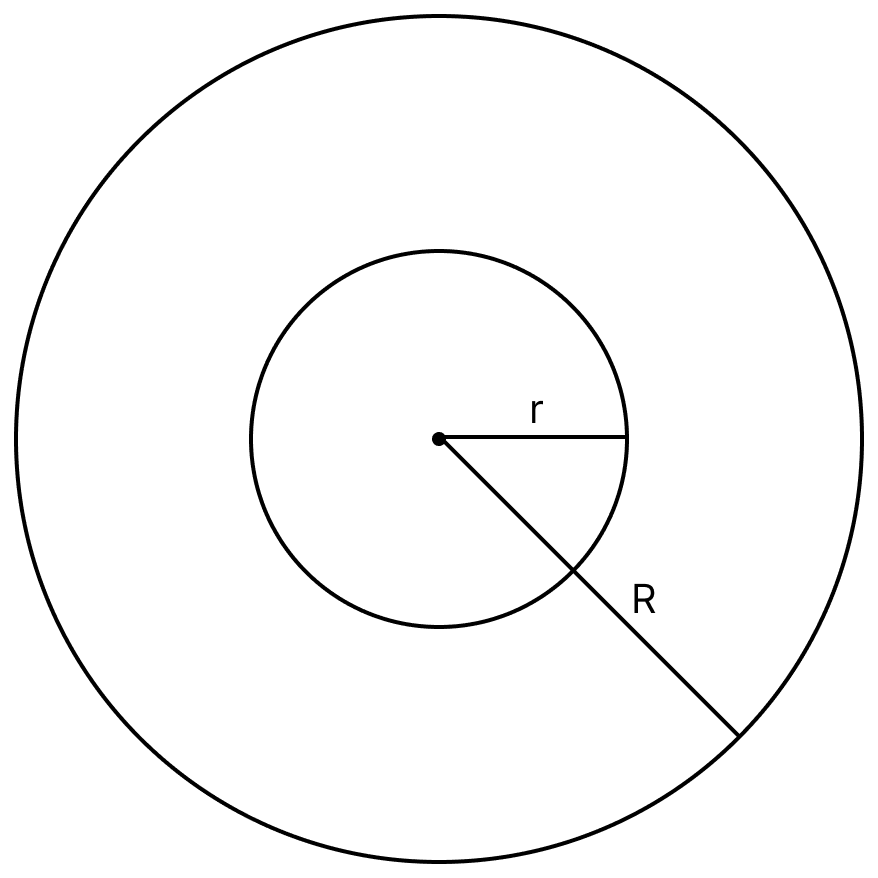
A charge Q is distributed over two concentric conducting thin spherical shells radii r and R (R > r) as shown in figure. If the surface charge densities on the two shells are equal, the electric potential at the common centre is:

A charge Q is distributed over two concentric conducting thin spherical shells radii r and R (R > r) as shown in figure. If the surface charge densities on the two shells are equal, the electric potential at the common centre is:. Electric Potential, Nootan Physics Solutions ICS Class 12
  1. 14πϵ0(R+r)(R2+r2)Q\dfrac{1}{4\pi\epsilon_0}\dfrac{(\text R + \text r)}{(\text R^2 + \text r^2)}\text Q
  2. 14πϵ0(R+2r)Q2(R2+r2)\dfrac{1}{4\pi\epsilon_0}\dfrac{(\text R + 2\text r)\text Q}{2(\text R^2 + \text r^2)}
  3. 14πϵ0(R+r)2(R2+r2)Q\dfrac{1}{4\pi\epsilon_0}\dfrac{(\text R + \text r)}{2(\text R^2 + \text r^2)}\text Q
  4. 14πϵ0(2R+r)(R2+r2)Q\dfrac{1}{4\pi\epsilon_0}\dfrac{(2\text R + \text r)}{(\text R^2 + \text r^2)}\text Q

Answer

14πϵ0(R+r)(R2+r2)Q\dfrac{1}{4\pi\epsilon_0}\dfrac{(\text R + \text r)}{(\text R^2 + \text r^2)}\text Q

Reason —

Given, two concentric shells of radii r and R carrying charges q1 and q2 with equal surface charge densities, and q1 + q2 = Q.

Since the surface charge densities are equal,

q14πr2=q24πR2\dfrac{\text q_1}{4\pi\text r^2} = \dfrac{\text q_2}{4\pi\text R^2}

Solving these two relations together,

q1=r2R2+r2Q,q2=R2R2+r2Q\text q_1 = \dfrac{\text r^2}{\text R^2 + \text r^2}\text Q, \qquad \text q_2 = \dfrac{\text R^2}{\text R^2 + \text r^2}\text Q

The potential inside a shell equals that at its surface, so the potential at the common centre is

V=14πϵ0(q1r+q2R)=14πϵ0(rQR2+r2+RQR2+r2)=14πϵ0⋅(R+r)(R2+r2)Q\text V = \dfrac{1}{4\pi\epsilon_0}\left(\dfrac{\text q_1}{\text r} + \dfrac{\text q_2}{\text R}\right) \\[1em] = \dfrac{1}{4\pi\epsilon_0}\left(\dfrac{\text r\text Q}{\text R^2 + \text r^2} + \dfrac{\text R\text Q}{\text R^2 + \text r^2}\right) \\[1em] = \dfrac{1}{4\pi\epsilon_0}\cdot\dfrac{(\text R + \text r)}{(\text R^2 + \text r^2)}\text Q

Question 19

Twenty seven drops of same size are charged at 220 V each. They combine to form a bigger drop. Calculate the potential of the bigger drop.

  1. 1980 V
  2. 660 V
  3. 1320 V
  4. 1520 V

Answer

1980 V

Reason —

Given, n = 27 and the potential of each small drop is 220 V.

If r and q are the radius and charge of a small drop, and R and 27q those of the bigger drop, then from the conservation of volume,

43πR3=27×43πr3⇒R=3r\dfrac{4}{3}\pi\text R^3 = 27 \times \dfrac{4}{3}\pi\text r^3 \\[1em] \Rightarrow \quad \text R = 3\text r

For each small drop,

220=14πϵ0qr220 = \dfrac{1}{4\pi\epsilon_0}\dfrac{\text q}{\text r}

For the bigger drop,

V=14πϵ027q3r=9×14πϵ0qr=9×220=1980 V\text V = \dfrac{1}{4\pi\epsilon_0}\dfrac{27\text q}{3\text r} \\[1em] = 9 \times \dfrac{1}{4\pi\epsilon_0}\dfrac{\text q}{\text r} \\[1em] = 9 \times 220 \\[1em] = 1980\ \text V

Question 20

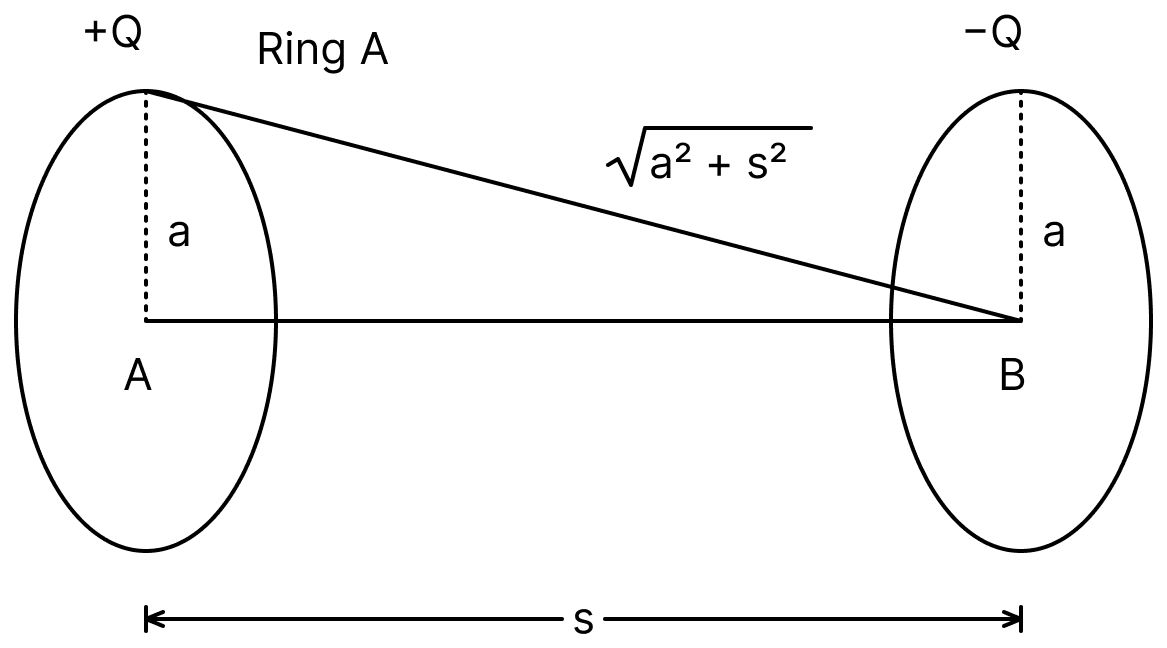
The two thin coaxial rings, each of radius a and having charges +Q and −Q respectively are separated by a distance of s. The potential difference between the centres of the two rings is :

  1. Q2πϵ0[1a−1s2+a2]\dfrac{\text Q}{2\pi\epsilon_0}\left[\dfrac{1}{\text a} - \dfrac{1}{\sqrt{\text s^2 + \text a^2}}\right]
  2. Q4πϵ0[1a−1s2+a2]\dfrac{\text Q}{4\pi\epsilon_0}\left[\dfrac{1}{\text a} - \dfrac{1}{\sqrt{\text s^2 + \text a^2}}\right]
  3. Q4πϵ0[1a+1s2+a2]\dfrac{\text Q}{4\pi\epsilon_0}\left[\dfrac{1}{\text a} + \dfrac{1}{\sqrt{\text s^2 + \text a^2}}\right]
  4. Q2πϵ0[1a+1s2+a2]\dfrac{\text Q}{2\pi\epsilon_0}\left[\dfrac{1}{\text a} + \dfrac{1}{\sqrt{\text s^2 + \text a^2}}\right]

Answer

Q2πϵ0[1a−1s2+a2]\dfrac{\text Q}{2\pi\epsilon_0}\left[\dfrac{1}{\text a} - \dfrac{1}{\sqrt{\text s^2 + \text a^2}}\right]

Reason —

Given, two coaxial rings A and B, each of radius a, carrying charges + Q and − Q, separated by a distance s.

The two thin coaxial rings, each of radius a and having charges +Q and &minus;Q respectively are separated by a distance of s. The potential difference between the centres of the two rings is:. Electric Potential, Nootan Physics Solutions ICS Class 12

Every point of a ring is at a distance a from its own centre and at a distance s2+a2\sqrt{\text s^2 + \text a^2} from the centre of the other ring. Writing K=14πϵ0\text K = \dfrac{1}{4\pi\epsilon_0},

VA=KQa−KQa2+s2VB=−KQa+KQa2+s2\text V_\text A = \dfrac{\text{KQ}}{\text a} - \dfrac{\text{KQ}}{\sqrt{\text a^2 + \text s^2}} \\[1em] \text V_\text B = -\dfrac{\text{KQ}}{\text a} + \dfrac{\text{KQ}}{\sqrt{\text a^2 + \text s^2}}

Therefore

VA−VB=2KQa−2KQa2+s2=Q2πϵ0[1a−1s2+a2]\text V_\text A - \text V_\text B = \dfrac{2\text{KQ}}{\text a} - \dfrac{2\text{KQ}}{\sqrt{\text a^2 + \text s^2}} \\[1em] = \dfrac{\text Q}{2\pi\epsilon_0}\left[\dfrac{1}{\text a} - \dfrac{1}{\sqrt{\text s^2 + \text a^2}}\right]

Question 21

Two uniformly charged spherical conductors A and B of radii 5 mm and 10 mm are separated by a distance of 2 cm. If the spheres are connected by a conducting wire, then in equilibrium condition, the ratio of the magnitudes of the electric fields at the surface of the sphere A and B will be :

  1. 1 : 2
  2. 2 : 1
  3. 1 : 1
  4. 1 : 4

Answer

2 : 1

Reason —

Given, rA = 5 mm and rB = 10 mm.

When two conducting spheres are connected by a conducting wire, charge flows from the sphere at the higher potential to the one at the lower potential till both acquire the same potential,

VA=VB⇒14πϵ0qArA=14πϵ0qBrB⇒qAqB=rArB=510=12\text V_\text A = \text V_\text B \\[1em] \Rightarrow \quad \dfrac{1}{4\pi\epsilon_0}\dfrac{\text q_\text A}{\text r_\text A} = \dfrac{1}{4\pi\epsilon_0}\dfrac{\text q_\text B}{\text r_\text B} \\[1em] \Rightarrow \quad \dfrac{\text q_\text A}{\text q_\text B} = \dfrac{\text r_\text A}{\text r_\text B} \\[1em] = \dfrac{5}{10} \\[1em] = \dfrac{1}{2}

The ratio of the electric fields at the surfaces is

EAEB=KqArA2KqBrB2=qAqB×rB2rA2=12(105)2=12×4=21\dfrac{\text E_\text A}{\text E_\text B} = \dfrac{\text K\dfrac{\text q_\text A}{\text r_\text A^2}}{\text K\dfrac{\text q_\text B}{\text r_\text B^2}} \\[1em] = \dfrac{\text q_\text A}{\text q_\text B} \times \dfrac{\text r_\text B^2}{\text r_\text A^2} \\[1em] = \dfrac{1}{2}\left(\dfrac{10}{5}\right)^2 \\[1em] = \dfrac{1}{2} \times 4 \\[1em] = \dfrac{2}{1}

Hence the ratio is 2 : 1.

Question 22

Given below are two statements :

Statement I : Electric potential is constant within and at the surface of each conductor.

Statement II : Electric field just outside a charged conductor is perpendicular to the surface of the conductor at every point.

In the light of the above statements, choose the most appropriate answer from the options given below.

  1. Both statement I and statement II are correct.
  2. Both statement I and statement II are incorrect.
  3. Statement I is correct but statement II is incorrect.
  4. Statement I is incorrect but statement II is correct.

Answer

Both statement I and statement II are correct.

Reason — The electric field is zero at every point inside a conductor, so

E=−dVdr=0\text E = -\dfrac{\text{dV}}{\text{dr}} \\[1em] = 0

there is no potential gradient within the conductor and the potential is constant throughout its volume and over its surface. Hence Statement I is correct.

The surface of a conductor is therefore an equipotential surface. Since the electric field is always at right angles to an equipotential surface, the field just outside a charged conductor is perpendicular to the surface at every point. Hence Statement II is also correct.

Question 23

Sixty four conducting drops each of radius 0.02 m and each carrying a charge of 5 μC are combined to form a bigger drop. The ratio of surface density of bigger drop to the smaller drop will be :

  1. 1 : 4
  2. 4 : 1
  3. 1 : 8
  4. 8 : 1

Answer

4 : 1

Reason —

Given, n = 64, r = 0.02 m and q = 5 μC.

From the conservation of volume,

n(43πr3)=43πR3⇒R=(64)1/3r=4×0.02=0.08 m\text n\left(\dfrac{4}{3}\pi\text r^3\right) = \dfrac{4}{3}\pi\text R^3 \\[1em] \Rightarrow \quad \text R = (64)^{1/3}\text r \\[1em] = 4 \times 0.02 \\[1em] = 0.08\ \text m

The surface charge densities of the small and the big drop are

σr=q4πr2,σR=nq4πR2\sigma_\text r = \dfrac{\text q}{4\pi\text r^2}, \qquad \sigma_\text R = \dfrac{\text{nq}}{4\pi\text R^2}

Therefore

σRσr=nq4πR2×4πr2q=nr2R2=64×(0.02)2(0.08)2=64×116=41\dfrac{\sigma_\text R}{\sigma_\text r} = \dfrac{\text{nq}}{4\pi\text R^2} \times \dfrac{4\pi\text r^2}{\text q} \\[1em] = \text n\dfrac{\text r^2}{\text R^2} \\[1em] = 64 \times \dfrac{(0.02)^2}{(0.08)^2} \\[1em] = 64 \times \dfrac{1}{16} \\[1em] = \dfrac{4}{1}

Hence the ratio is 4 : 1.

Question 24

If the electric potential at any point (x, y, z) m in space is given by V = 3x2 volt. The electric field at the point (1, 0, 3) m will be :

  1. 3 V m-1, directed along positive x-axis
  2. 3 V m-1, directed along negative x-axis
  3. 6 V m-1, directed along positive x-axis
  4. 6 V m-1, directed along negative x-axis

Answer

6 V m-1, directed along negative x-axis

Reason —

Given, V = 3x2 volt.

The potential depends only on x, so the field has only an x-component,

E⃗=−dVdxi^=−ddx(3x2)i^=−3(2x)i^=−6x i^\vec{\text E} = -\dfrac{\text{dV}}{\text{dx}}\hat{\text i} \\[1em] = -\dfrac{\text d}{\text{dx}}(3\text x^2)\hat{\text i} \\[1em] = -3(2\text x)\hat{\text i} \\[1em] = -6\text x\ \hat{\text i}

At the point (1, 0, 3), x = 1 m,

E⃗=−6 i^ Vm−1\vec{\text E} = -6\ \hat{\text i}\ \text V\text m^{-1}

The magnitude is 6 V m-1 and the negative sign shows that it is directed along the negative x-axis.

Question 25

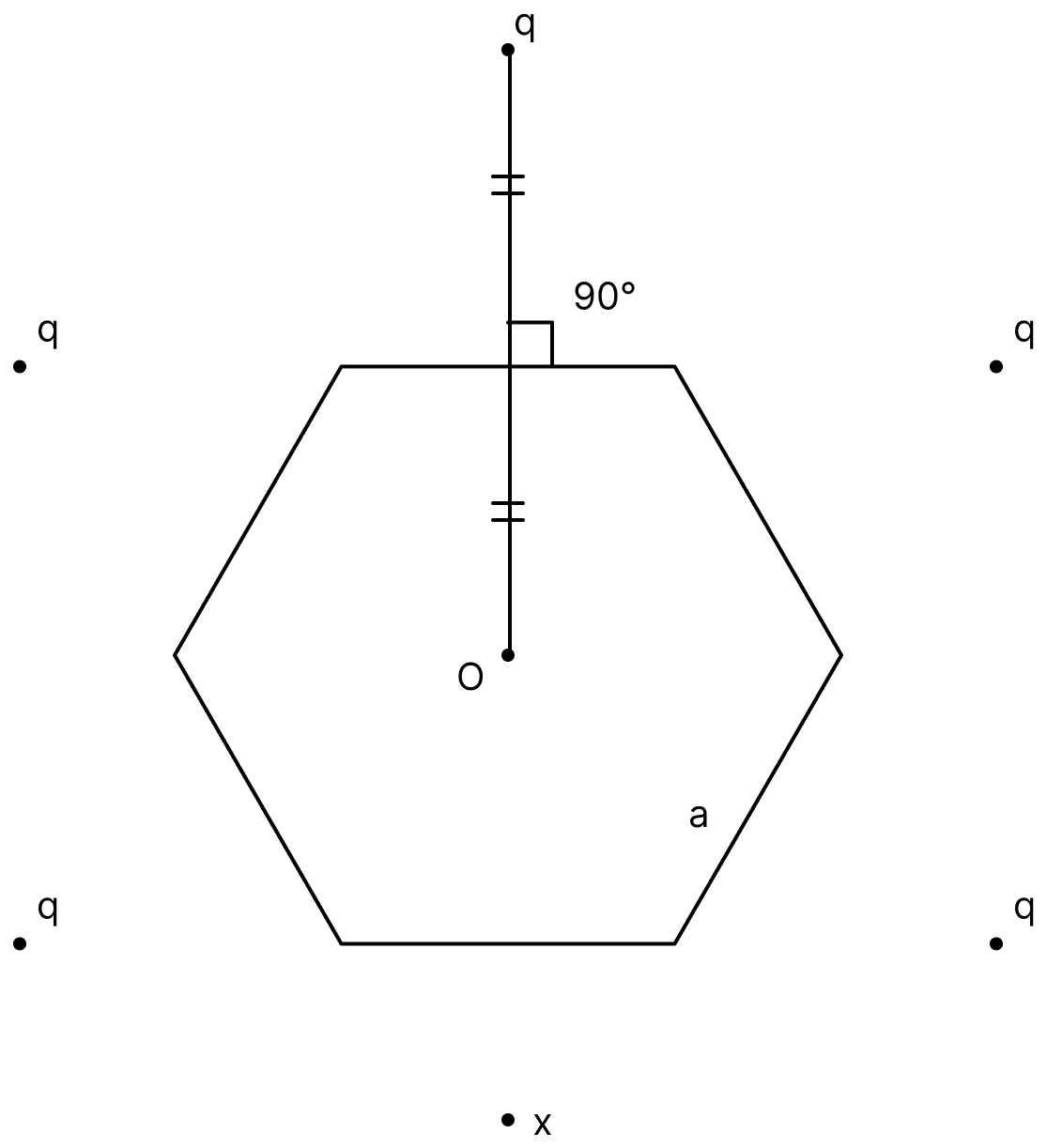
Six charges are placed around a regular hexagon of side length a as shown in the figure. Five of them have charge q, and the remaining one has charge x. The perpendicular from each charge to the nearest hexagon side passes through the centre O of the hexagon and is bisected by the side. Which of the following statement(s) is(are) correct in SI units?

Six charges are placed around a regular hexagon of side length a as shown in the figure. Five of them have charge q, and the remaining one has charge x. The perpendicular from each charge to the nearest hexagon side passes through the centre O of the hexagon and is bisected by the side. Which of the following statement(s) is(are) correct in SI units? Electric Potential, Nootan Physics Solutions ICS Class 12
  1. When x = q, the magnitude of the electric field at O is zero.
  2. When x = −q, the magnitude of the electric field at O is q6πϵ0a2\dfrac{\text q}{6\pi\epsilon_0\text a^2}.
  3. When x = 2q, the potential at O is 7q43πϵ0a\dfrac{7\text q}{4\sqrt3 \pi\epsilon_0\text a}.
  4. When x = − 3q, the potential at O is −3q43πϵ0a-\dfrac{3\text q}{4\sqrt3 \pi\epsilon_0\text a}.

Answer

Options 1, 2 and 3 are correct.

Reason —

The distance of the centre O of a regular hexagon of side a from any of its sides (the apothem) is 32a\dfrac{\sqrt3}{2}\text a. Since the perpendicular drawn from each charge to the nearest side passes through O and is bisected by that side, the distance of each charge from O is

d=2×32a=3 a\text d = 2 \times \dfrac{\sqrt3}{2}\text a \\[1em] = \sqrt3\ \text a

Option 1 : When x = q, all the six charges are equal and are symmetrically placed about O. The fields due to diametrically opposite charges cancel in pairs, so the resultant electric field at O is zero. Correct.

Option 2 : When x = − q, we may write the sixth charge as q + (− 2q). The six equal charges q give zero field at O, so only the extra charge − 2q contributes,

E=14πϵ02q(3a)2=14πϵ02q3a2=q6πϵ0a2\text E = \dfrac{1}{4\pi\epsilon_0}\dfrac{2\text q}{(\sqrt3 \text a)^2} \\[1em] = \dfrac{1}{4\pi\epsilon_0}\dfrac{2\text q}{3\text a^2} \\[1em] = \dfrac{\text q}{6\pi\epsilon_0\text a^2}

Correct.

Option 3 : When x = 2q, the total charge is 5q + 2q = 7q, and every charge is at the same distance 3a\sqrt3 \text a from O. Since potential is a scalar,

VO=14πϵ07q3a=7q43πϵ0a\text V_\text O = \dfrac{1}{4\pi\epsilon_0}\dfrac{7\text q}{\sqrt3 \text a} \\[1em] = \dfrac{7\text q}{4\sqrt3 \pi\epsilon_0\text a}

Correct.

Option 4 : When x = − 3q, the total charge is 5q − 3q = 2q, so

VO=14πϵ02q3a=q23πϵ0a\text V_\text O = \dfrac{1}{4\pi\epsilon_0}\dfrac{2\text q}{\sqrt3 \text a} \\[1em] = \dfrac{\text q}{2\sqrt3 \pi\epsilon_0\text a}

which is positive and not equal to the value stated. Not correct.

Question 26

The angle between the electric lines of force and the equipotential surface is :

  1. 180°
  2. 0°
  3. 45°
  4. 90°

Answer

90°

Reason — There is no potential gradient along any direction parallel to an equipotential surface, so the electric field can have no component parallel to the surface,

Eparallel=−dVdr=0\text E_{\text{parallel}} = -\dfrac{\text{dV}}{\text{dr}} \\[1em] = 0

Hence the electric field, and with it the lines of force, are always at right angles to the equipotential surface.

Question 27

Two hollow conducting spheres of radii R1 and R2 (R1 >> R2) have equal charges. The potential would be :

  1. dependent on the material property of the sphere
  2. more on bigger sphere
  3. more on smaller sphere
  4. equal on both the spheres

Answer

more on smaller sphere

Reason — The potential of a charged conducting sphere is

V=14πϵ0qR⇒V∝1R\text V = \dfrac{1}{4\pi\epsilon_0}\dfrac{\text q}{\text R} \quad \Rightarrow \quad \text V \propto \dfrac{1}{\text R}

for a given charge q. Since R1 >> R2, we get V2 >> V1, that is, the potential is more on the smaller sphere. The potential does not depend on the material of the sphere.

Question 28

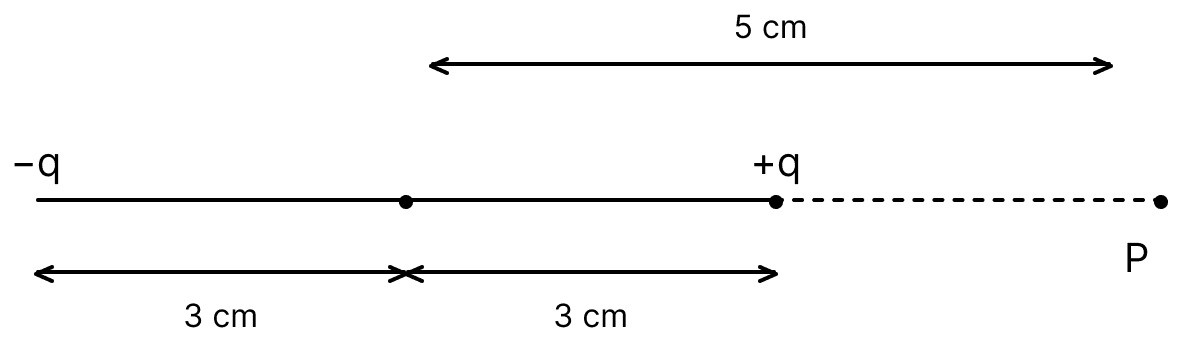
An electric dipole is placed as shown in the figure. The electric potential (in 102 V) at point P due to the electric dipole is (14πϵ0=K)\left(\dfrac{1}{4\pi\epsilon_0} = \text K\right) :

An electric dipole is placed as shown in the figure. The electric potential (in 10 2 V) at point P due to the electric dipole is (1/4 pi epsilon_0 = text K ):. Electric Potential, Nootan Physics Solutions ICS Class 12
  1. 85qK\dfrac{8}{5}\text q\text K
  2. 83qK\dfrac{8}{3}\text q\text K
  3. 38qK\dfrac{3}{8}\text q\text K
  4. 58qK\dfrac{5}{8}\text q\text K

Answer

38qK\dfrac{3}{8}\text q\text K

Reason —

From the figure, the two charges − q and + q are 3 cm on either side of the centre O, so the half-length of the dipole is l = 3 cm = 3 × 10⁻² m, and the point P lies on the axis at r = 5 cm = 5 × 10⁻² m from O.

The potential at an axial point of a dipole is

V=Kpr2−l2=Kq(2l)r2−l2\text V = \text K\dfrac{\text p}{\text r^2 - \text l^2} \\[1em] = \text K\dfrac{\text q(2\text l)}{\text r^2 - \text l^2}

Substituting the values,

=Kq(6×10⁻²)(52−32)×10−4=6Kq×10−216×10−4=6Kq×10216=38qK×102 V= \dfrac{\text{Kq}(6\times10^{-2})}{(5^2 - 3^2)\times10^{-4}} \\[1em] = \dfrac{6\text{Kq}\times10^{-2}}{16\times10^{-4}} \\[1em] = \dfrac{6\text{Kq}\times10^2}{16} \\[1em] = \dfrac{3}{8}\text q\text K \times 10^2\ \text V

Hence, in units of 102 V, the potential at P is 38qK\dfrac{3}{8}\text q\text K.

Question 29

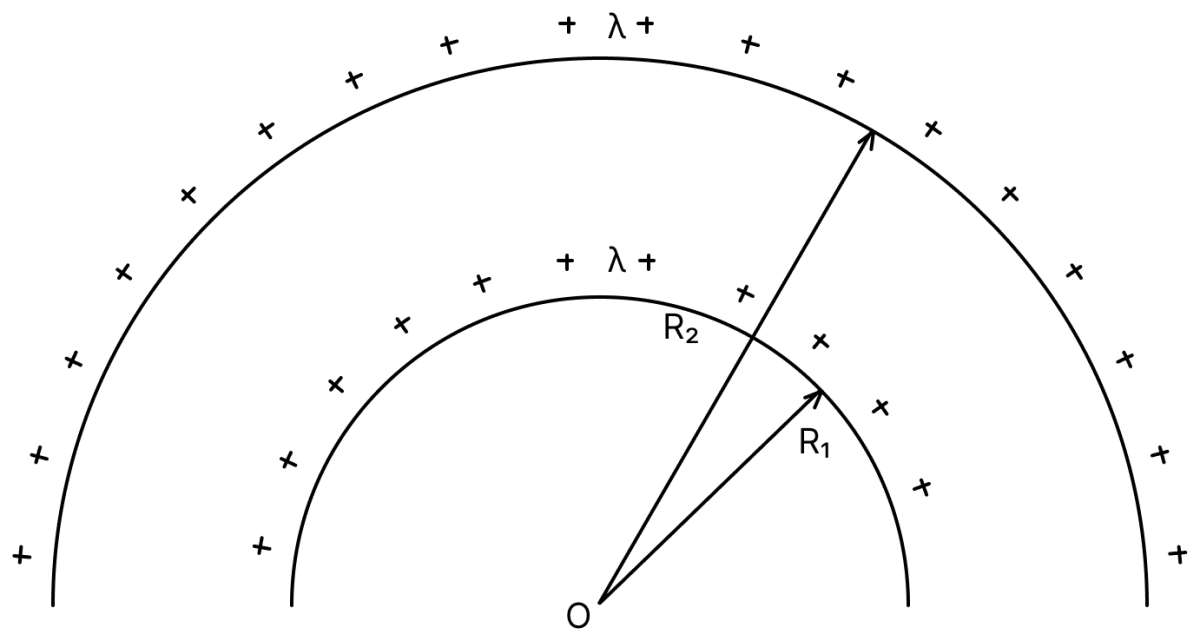
The electric potential at the centre of two concentric half rings of radii R1 and R2, having same linear charge density λ is :

The electric potential at the centre of two concentric half rings of radii R 1 and R 2, having same linear charge density λ is:. Electric Potential, Nootan Physics Solutions ICS Class 12
  1. 2λϵ0\dfrac{2\lambda}{\epsilon_0}
  2. λ2ϵ0\dfrac{\lambda}{2\epsilon_0}
  3. λ4ϵ0\dfrac{\lambda}{4\epsilon_0}
  4. λϵ0\dfrac{\lambda}{\epsilon_0}

Answer

λ2ϵ0\dfrac{\lambda}{2\epsilon_0}

Reason —

Given, two concentric half rings of radii R1 and R2 having the same linear charge density λ.

The length of a half ring of radius R is πR, so the charges on the two half rings are

Q1=λ(πR1),Q2=λ(πR2)\text Q_1 = \lambda(\pi\text R_1), \qquad \text Q_2 = \lambda(\pi\text R_2)

Every element of a half ring is at the same distance from its centre, so the potential at O is

V=14πϵ0Q1R1+14πϵ0Q2R2=14πϵ0λπR1R1+14πϵ0λπR2R2=λπ4πϵ0(1+1)=λ2ϵ0\text V = \dfrac{1}{4\pi\epsilon_0}\dfrac{\text Q_1}{\text R_1} + \dfrac{1}{4\pi\epsilon_0}\dfrac{\text Q_2}{\text R_2} \\[1em] = \dfrac{1}{4\pi\epsilon_0}\dfrac{\lambda\pi\text R_1}{\text R_1} + \dfrac{1}{4\pi\epsilon_0}\dfrac{\lambda\pi\text R_2}{\text R_2} \\[1em] = \dfrac{\lambda\pi}{4\pi\epsilon_0}(1 + 1) \\[1em] = \dfrac{\lambda}{2\epsilon_0}

Question 30

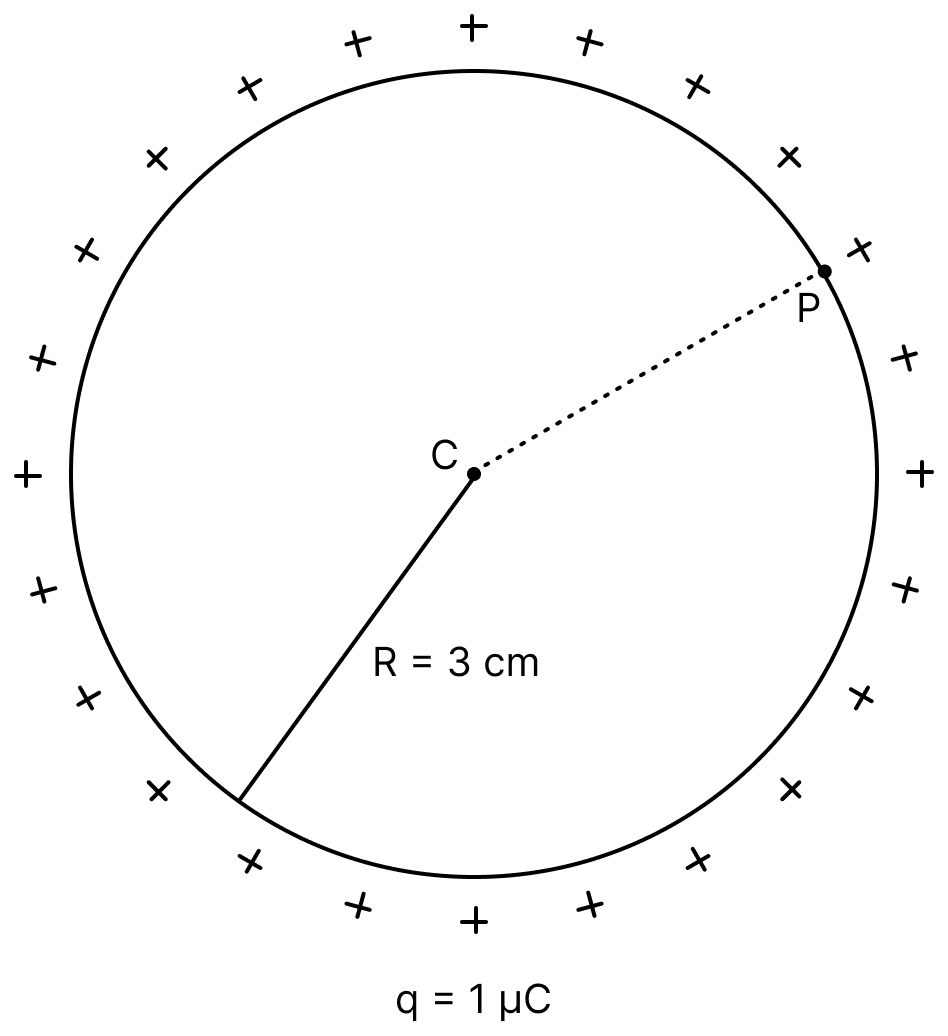
A thin spherical shell is charged by some source. The potential difference between the two points C and P (in V) shown in the figure is : (Take 14πϵ0=9×10⁹ SI units)\left(\text{Take}\ \dfrac{1}{4\pi\epsilon_0} = 9\times10^9\ \text{SI units}\right)

A thin spherical shell is charged by some source. The potential difference between the two points C and P (in V) shown in the figure is: (Take 1/4 pi epsilon_0 = 9 times10^9 SI units ). Electric Potential, Nootan Physics Solutions ICS Class 12
  1. 3 × 10⁵
  2. 1 × 10⁵
  3. 0.5 × 10⁵
  4. zero

Answer

zero

Reason —

Given, a thin charged spherical shell of radius 3 cm carrying a charge of 1 μC, with C at the centre and P on the surface.

The electric field is zero at every point inside a charged spherical shell, so there is no potential gradient inside it. Hence the potential at every interior point is the same as that at the surface,

VC=VP=14πϵ0qR⇒VC−VP=0\text V_\text C = \text V_\text P = \dfrac{1}{4\pi\epsilon_0}\dfrac{\text q}{\text R} \\[1em] \Rightarrow \quad \text V_\text C - \text V_\text P = 0

Question 31

Given below are two statements : one is labelled as Assertion (A) and the other is labelled as Reason (R).

Assertion (A): The potential (V) at any axial point, at 2 m distance (r) from the centre of the dipole of dipole moment vector P⃗ \vec{\text P} \spaceof magnitude, 4 × 10⁻⁶ C-m, is ± 9 × 10³ V. (Take 14πϵ0=9×10⁹ SI units)\left(\text{Take}\ \dfrac{1}{4\pi\epsilon_0} = 9\times10^9\ \text{SI units}\right)

Reason (R): V=±2P4πϵ0 r2\text V = \pm\dfrac{2\text P}{4\pi\epsilon_0\ \text r^2}, where r is the distance of any axial point, situated at 2 m from the centre of the dipole.

In the light of the above statements, choose the correct answer from the options given below :

  1. Both A and R are true and R is the correct explanation of A.
  2. Both A and R are true, but R is not the correct explanation of A.
  3. A is true, but R is false.
  4. A is false, but R is true.

Answer

A is true, but R is false.

Reason —

Explanation

Assertion (A) is correct : The potential at any point on the axis of a short dipole is

V=±14πϵ0∣P⃗∣r2\text V = \pm\dfrac{1}{4\pi\epsilon_0}\dfrac{|\vec{\text P}|}{\text r^2}

Substituting P = 4 × 10⁻⁶ C-m and r = 2 m,

V=±(9×10⁹)(4×10⁻⁶)(2)2=±3.6×1044=±9×10³ V\text V = \pm\dfrac{(9\times10^9)(4\times10^{-6})}{(2)^2} \\[1em] = \pm\dfrac{3.6\times10^4}{4} \\[1em] = \pm 9\times10^3\ \text V

which is exactly the value stated.

Reason (R) is incorrect : The expression given carries an extra factor of 2. The correct relation for the potential at an axial point of a short dipole is V=±P4πϵ0r2\text V = \pm\dfrac{\text P}{4\pi\epsilon_0\text r^2}, without the factor 2. The factor 2 belongs to the expression for the electric intensity at an axial point, E=2P4πϵ0r3\text E = \dfrac{2\text P}{4\pi\epsilon_0\text r^3}.

Therefore, Assertion is true but Reason is false.

Competition Zone — Numerical Value Type Questions

Question 1

The average translational kinetic energy of N2 gas molecules at ...... °C becomes equal to the KE of an electron accelerated from rest through a potential difference of 0.1 V.

[Given, KB = 1.38 × 10⁻²³ J/K]

Answer

Given,

  • Potential difference, V = 0.1 V
  • Charge on the electron, e = 1.6 × 10⁻¹⁹ C
  • Boltzmann constant, KB = 1.38 × 10⁻²³ J/K

The average translational kinetic energy of a gas molecule is

KE=32KBT\text{KE} = \dfrac{3}{2}\text K_\text B\text T

and the kinetic energy of the electron accelerated through a potential difference V is eV. Equating the two,

32KBT=eV\dfrac{3}{2}\text K_\text B\text T = \text e\text V

Substituting the values,

32(1.38×10⁻²³)T=(1.6×10⁻¹⁹)(0.1)2.07×10⁻²³ T=1.6×10⁻²⁰T=1.6×10−202.07×10−23=773 K\dfrac{3}{2}(1.38\times10^{-23})\text T = (1.6\times10^{-19})(0.1) \\[1em] 2.07\times10^{-23}\ \text T = 1.6\times10^{-20} \\[1em] \text T = \dfrac{1.6\times10^{-20}}{2.07\times10^{-23}} \\[1em] = 773\ \text K

Converting to the Celsius scale,

t=773−273=500 °C\text t = 773 - 273 \\[1em] = 500\ °\text C

Hence, the required temperature is 500 °C.

Question 2

27 similar drops of mercury are maintained at 10 V each. All these spherical drops combine into a single big drop. The potential energy of the bigger drop is ...... times that of a smaller drop.

Answer

Given,

  • Number of drops, n = 27
  • Potential of each small drop, V1 = 10 V

Let q1 and r1 be the charge and radius of a small drop, and Q and R those of the bigger drop. Since the volume remains constant,

43πR3=27×43πr13⇒R=3r1\dfrac{4}{3}\pi\text R^3 = 27 \times \dfrac{4}{3}\pi\text r_1^3 \\[1em] \Rightarrow \quad \text R = 3\text r_1

Also, the charge is conserved, so Q = 27q1.

The electrostatic potential energy of a charged spherical drop is

U=35kq2r\text U = \dfrac{3}{5}\dfrac{\text{kq}^2}{\text r}

For a small drop :

Us=35kq12r1…(i)\text U_\text s = \dfrac{3}{5}\dfrac{\text{kq}_1^2}{\text r_1} \qquad \dots(\text i)

For the bigger drop :

UB=35k(27q1)23r1=35k(27)2q123r1…(ii)\text U_\text B = \dfrac{3}{5}\dfrac{\text k(27\text q_1)^2}{3\text r_1} \\[1em] = \dfrac{3}{5}\dfrac{\text k(27)^2\text q_1^2}{3\text r_1} \qquad \dots(\text{ii})

Dividing Eq. (ii) by Eq. (i),

UBUs=(27)23=7293=243\dfrac{\text U_\text B}{\text U_\text s} = \dfrac{(27)^2}{3} \\[1em] = \dfrac{729}{3} \\[1em] = 243

Hence, the potential energy of the bigger drop is 243 times that of a smaller drop.

Question 3

512 identical drops of mercury are charged to a potential of 2 V each. The drops are joined to form a single drop. The potential of this drop is ...... V.

Answer

Given,

  • Number of drops, n = 512
  • Potential of each drop, V = 2 V

Let q and r be the charge and radius of a small drop, and Q and R those of the single big drop. Since the volume remains constant when the drops join,

512×43πr3=43πR3⇒R=(512)1/3r=8r512 \times \dfrac{4}{3}\pi\text r^3 = \dfrac{4}{3}\pi\text R^3 \\[1em] \Rightarrow \quad \text R = (512)^{1/3}\text r \\[1em] = 8\text r

For a small drop,

V=kqr=2…(i)\text V = \dfrac{\text{kq}}{\text r} \\[1em] = 2 \qquad \dots(\text i)

For the big drop, whose charge is Q = 512q,

Vnet=k(512q)8r…(ii)\text V_{\text{net}} = \dfrac{\text k(512\text q)}{8\text r} \qquad \dots(\text{ii})

Dividing Eq. (ii) by Eq. (i),

VnetV=5128=64Vnet=64×2=128 V\dfrac{\text V_{\text{net}}}{\text V} = \dfrac{512}{8} \\[1em] = 64 \\[1em] \text V_{\text{net}} = 64 \times 2 \\[1em] = 128\ \text V

Hence, the potential of the single big drop is 128 V.

Question 4

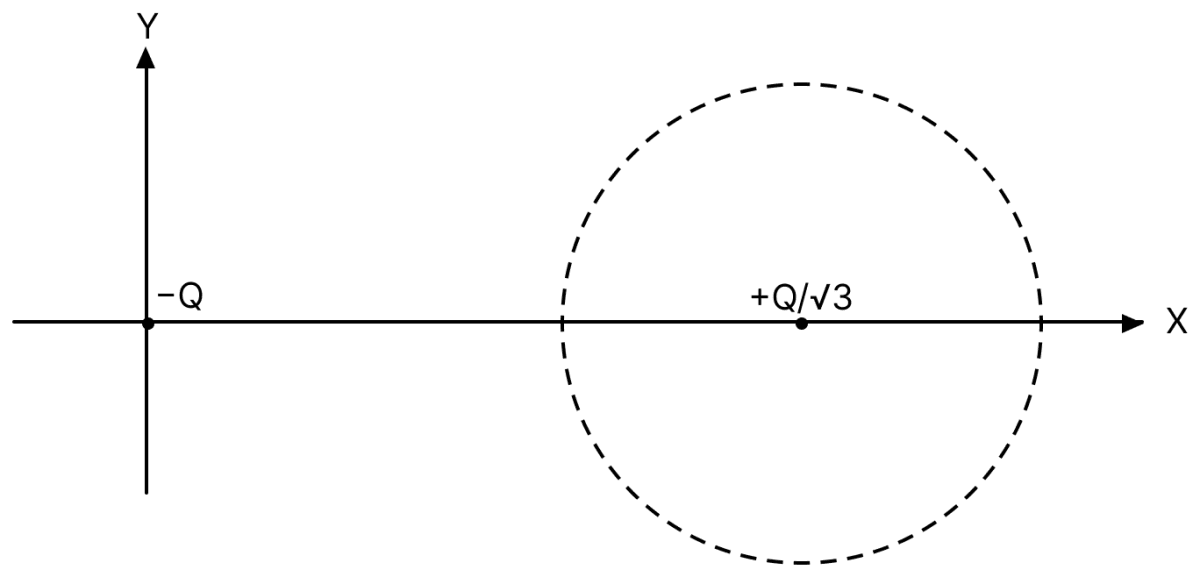
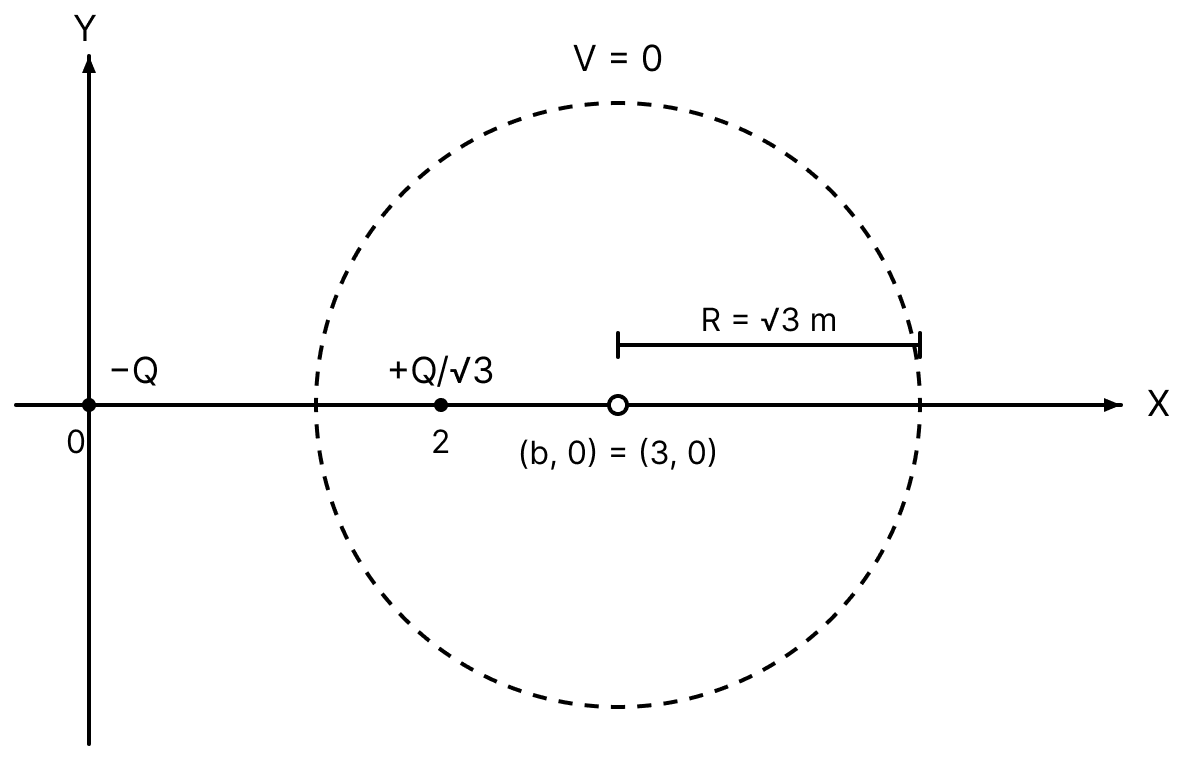
Two point charges −Q and +Q3+\dfrac{\text Q}{\sqrt3} are placed in the xy-plane at the origin (0, 0) and a point (2, 0) respectively, as shown in the figure. This results in an equipotential circle of radius R and potential V = 0 in the xy-plane with its centre at (b, 0). All lengths are measured in metres.

Two point charges &minus;Q and + text Q/ sqrt3 are placed in the xy-plane at the origin (0, 0) and a point (2, 0) respectively, as shown in the figure. This results in an equipotential circle of radius R and potential V = 0 in the xy-plane with its centre at (b, 0). All lengths are measured in metres. The value of R is............ metre. Electric Potential, Nootan Physics Solutions ICS Class 12

The value of R is ............ metre.

Answer

Given,

  • Charge − Q at the origin (0, 0)
  • Charge +Q3+\dfrac{\text Q}{\sqrt3} at the point (2, 0)

Let (x, y) be any point of the zero-potential circle. Since potential is a scalar,

V(x,y)=14πϵ0(−Qx2+y2+Q3(x−2)2+y2)=0⇒13(x−2)2+y2=1x2+y2\text V(\text x, \text y) = \dfrac{1}{4\pi\epsilon_0}\left(-\dfrac{\text Q}{\sqrt{\text x^2 + \text y^2}} + \dfrac{\text Q}{\sqrt3 \sqrt{(\text x - 2)^2 + \text y^2}}\right) \\[1em] = 0 \\[1em] \Rightarrow \quad \dfrac{1}{\sqrt3 \sqrt{(\text x - 2)^2 + \text y^2}} = \dfrac{1}{\sqrt{\text x^2 + \text y^2}}

Squaring both sides and cross-multiplying,

x2+y2=3[(x−2)2+y2]x2+y2=3x2−12x+12+3y22x2+2y2−12x+12=0\text x^2 + \text y^2 = 3\left[(\text x - 2)^2 + \text y^2\right] \\[1em] \text x^2 + \text y^2 = 3\text x^2 - 12\text x + 12 + 3\text y^2 \\[1em] 2\text x^2 + 2\text y^2 - 12\text x + 12 = 0

Dividing throughout by 2,

x2+y2−6x+6=0\text x^2 + \text y^2 - 6\text x + 6 = 0

Completing the square in x,

(x−3)2+y2=9−6=3(x−3)2+y2=(3)2(\text x - 3)^2 + \text y^2 = 9 - 6 \\[1em] = 3 \\[1em] (\text x - 3)^2 + \text y^2 = \left(\sqrt3\right)^2

Comparing with the standard form (x − h)2 + (y − k)2 = R2,

R=3=1.73 m\text R = \sqrt3 \\[1em] = 1.73\ \text m

Hence, the value of R is 1.73 metre.

Question 5

Two point charges −Q and +Q3+\dfrac{\text Q}{\sqrt3} are placed in the xy-plane at the origin (0, 0) and a point (2, 0) respectively, as shown in the figure. This results in an equipotential circle of radius R and potential V = 0 in the xy-plane with its centre at (b, 0). All lengths are measured in metres.

Two point charges &minus;Q and + text Q/ sqrt3 are placed in the xy-plane at the origin (0, 0) and a point (2, 0) respectively, as shown in the figure. This results in an equipotential circle of radius R and potential V = 0 in the xy-plane with its centre at (b, 0). All lengths are measured in metres. The value of R is............ metre. Electric Potential, Nootan Physics Solutions ICS Class 12

The value of b is ............ metre.

Answer

Given,

  • Charge − Q at the origin (0, 0)
  • Charge +Q3+\dfrac{\text Q}{\sqrt3} at the point (2, 0)
  • The zero-potential circle has its centre at (b, 0)
Two point charges &minus;Q and + text Q/ sqrt3 are placed in the xy-plane at the origin (0, 0) and a point (2, 0) respectively, as shown in the figure. This results in an equipotential circle of radius R and potential V = 0 in the xy-plane with its centre at (b, 0). All lengths are measured in metres. The value of b is............ metre. Electric Potential, Nootan Physics Solutions ICS Class 12

Let (x, y) be any point lying on the circle of zero potential. Its distances from the two charges are

r1=x2+y2,r2=(x−2)2+y2\text r_1 = \sqrt{\text x^2 + \text y^2}, \qquad \text r_2 = \sqrt{(\text x - 2)^2 + \text y^2}

Since potential is a scalar quantity, the potentials due to the two charges add algebraically,

V(x,y)=14πϵ0(−Qx2+y2+Q3(x−2)2+y2)=0\text V(\text x, \text y) = \dfrac{1}{4\pi\epsilon_0}\left(-\dfrac{\text Q}{\sqrt{\text x^2 + \text y^2}} + \dfrac{\text Q}{\sqrt3 \sqrt{(\text x - 2)^2 + \text y^2}}\right) \\[1em] = 0

Cancelling Q4πϵ0\dfrac{\text Q}{4\pi\epsilon_0} and transposing,

13(x−2)2+y2=1x2+y2⇒x2+y2=3(x−2)2+y2\dfrac{1}{\sqrt3 \sqrt{(\text x - 2)^2 + \text y^2}} = \dfrac{1}{\sqrt{\text x^2 + \text y^2}} \\[1em] \Rightarrow \quad \sqrt{\text x^2 + \text y^2} = \sqrt3 \sqrt{(\text x - 2)^2 + \text y^2}

Squaring both sides,

x2+y2=3[(x−2)2+y2]\text x^2 + \text y^2 = 3\left[(\text x - 2)^2 + \text y^2\right]

Expanding the right-hand side,

x2+y2=3x2−12x+12+3y2\text x^2 + \text y^2 = 3\text x^2 - 12\text x + 12 + 3\text y^2

Bringing all the terms to one side,

2x2+2y2−12x+12=02\text x^2 + 2\text y^2 - 12\text x + 12 = 0

Dividing throughout by 2,

x2+y2−6x+6=0\text x^2 + \text y^2 - 6\text x + 6 = 0

Completing the square in x,

(x2−6x+9)+y2=9−6(x−3)2+y2=(3)2(\text x^2 - 6\text x + 9) + \text y^2 = 9 - 6 \\[1em] (\text x - 3)^2 + \text y^2 = \left(\sqrt3\right)^2

Comparing this with the standard equation of a circle (x − h)2 + (y − k)2 = R2, the centre of the circle is (3, 0).

Since the centre is given as (b, 0),

b=3.00 m\text b = 3.00\ \text m

Hence, the value of b is 3.00 metre.

Question 6

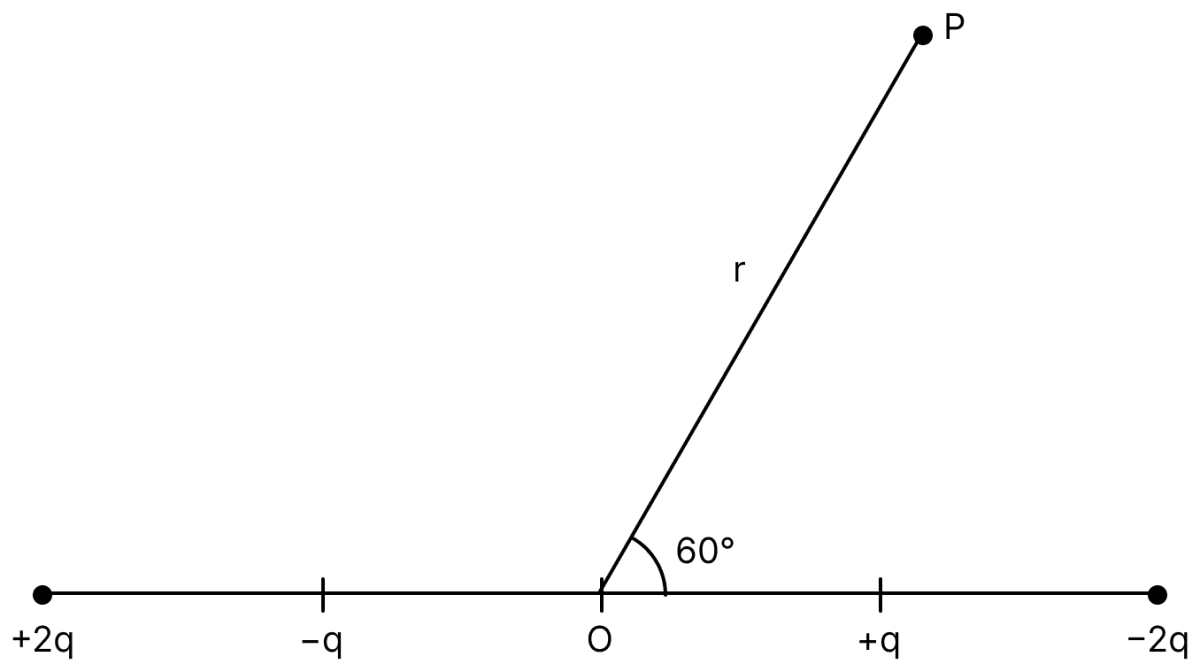
The distance between charges +q and −q is 2l and between +2q and −2q is 4l. The electrostatic potential at point P at a distance r from centre O is −α[qlr2]×109-\alpha\left[\dfrac{\text q\text l}{\text r^2}\right]\times10^9 V where the value of α is ............ .

(Use 12πϵ0=9×10⁹ Nm2C−2)\left(\text{Use}\ \dfrac{1}{2\pi\epsilon_0} = 9\times10^9\ \text{Nm}^2\text C^{-2}\right) (r >> dipole length)

The distance between charges +q and &minus;q is 2l and between +2q and &minus;2q is 4l. The electrostatic potential at point P at a distance r from centre O is - alpha [ text q text l/ text r^2 ] times10^9 V where the value of α is............. (Use 1/2 pi epsilon_0 = 9 times10^9 Nm^2 text C^-2 ) (r >> dipole length). Electric Potential, Nootan Physics Solutions ICS Class 12

Answer

Given,

  • The charges − q and + q are separated by 2l, forming a dipole of moment p1 = q(2l)
  • The charges + 2q and − 2q are separated by 4l, forming a dipole of moment p2 = 2q(4l) = 8ql
  • The point P is at a distance r from the centre O, and the line OP makes an angle of 60° with the dipole axis

From the figure, the two dipole moments are oppositely directed. Hence the net dipole moment is

p=p2−p1=8ql−2ql=6ql\text p = \text p_2 - \text p_1 \\[1em] = 8\text q\text l - 2\text q\text l \\[1em] = 6\text q\text l

directed along the direction of p⃗2\vec{\text p}_2, that is, opposite to p⃗1\vec{\text p}_1. Therefore the angle between the net dipole moment and the line OP is

θ=180°−60°=120°\theta = 180° - 60° \\[1em] = 120°

The potential at a general point due to a short dipole is

V=14πϵ0pcos⁡θr2\text V = \dfrac{1}{4\pi\epsilon_0}\dfrac{\text p\cos\theta}{\text r^2}

Substituting the values,

V=(9×10⁹)(6ql)cos⁡120°r2=(9×10⁹)(6ql)(−12)r2=−27[qlr2]×109 V\text V = (9\times10^9)\dfrac{(6\text q\text l)\cos 120°}{\text r^2} \\[1em] = (9\times10^9)\dfrac{(6\text q\text l)\left(-\dfrac{1}{2}\right)}{\text r^2} \\[1em] = -27\left[\dfrac{\text q\text l}{\text r^2}\right]\times10^9\ \text V

Comparing with V=−α[qlr2]×109\text V = -\alpha\left[\dfrac{\text q\text l}{\text r^2}\right]\times10^9 V,

α=27\alpha = 27

Hence, the value of α is 27.

Note: The value 9 × 10⁹ N m2 C-2 is the standard value of 14πϵ0\dfrac{1}{4\pi\epsilon_0}, and it is this constant that has been used above to obtain the printed answer α = 27. The constant printed in the question as 12πϵ0\dfrac{1}{2\pi\epsilon_0} appears to be a misprint for 14πϵ0\dfrac{1}{4\pi\epsilon_0}.

Question 7

At the centre of a half ring of radius R = 10 cm and linear charge density 4n Cm-1, the potential is xπ V. The value of x is ............ .

Answer

Given,

  • Radius of the half ring, R = 10 cm = 0.1 m
  • Linear charge density, λ = 4 n C m-1 = 4 × 10⁻⁹ C m-1

Every element of the half ring is at the same distance R from the centre. Hence

V=∫KdQR=KQR\text V = \displaystyle\int \text K\dfrac{\text{dQ}}{\text R} \\[1em] = \text K\dfrac{\text Q}{\text R}

The total charge on the half ring of length πR is

Q=λ(πR)\text Q = \lambda(\pi\text R)

Therefore

V=KλπRR=Kλπ\text V = \text K\dfrac{\lambda\pi\text R}{\text R} \\[1em] = \text K\lambda\pi

Substituting the values,

V=(9×10⁹)(4×10⁻⁹)π=36π volt\text V = (9\times10^9)(4\times10^{-9})\pi \\[1em] = 36\pi\ \text{volt}

Comparing with V = xπ volt,

x=36\text x = 36

Hence, the value of x is 36.

Question 8

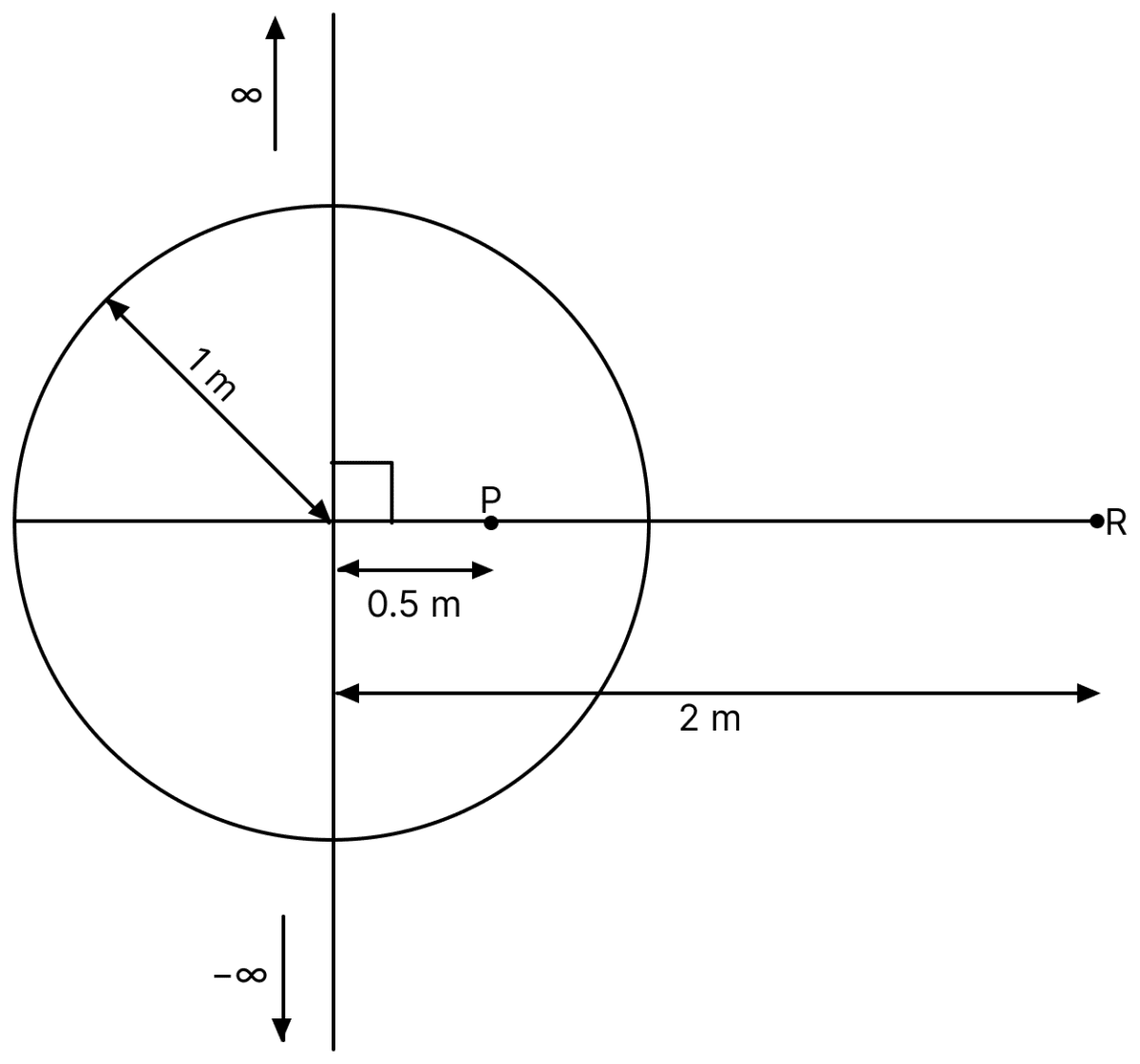
An infinitely long thin wire, having a uniform charge density per unit length of 5 n C/m, is passing through a spherical shell of radius 1 m, as shown in the figure. A 10 nC charge is distributed uniformly over the spherical shell. If the configuration of the charges remains static, the magnitude of the potential difference between points P and R, in volt, is .............. .

An infinitely long thin wire, having a uniform charge density per unit length of 5 n C/m, is passing through a spherical shell of radius 1 m, as shown in the figure. A 10 nC charge is distributed uniformly over the spherical shell. If the configuration of the charges remains static, the magnitude of the potential difference between points P and R, in volt, is............... [Given: In SI units 1/4 pi epsilon_0 = 9 times10^9, ln 2 = 0.7. Ignore the area pierced by the wire.]. Electric Potential, Nootan Physics Solutions ICS Class 12

[Given : In SI units 14πϵ0=9×10⁹\dfrac{1}{4\pi\epsilon_0} = 9\times10^9, ln 2 = 0.7. Ignore the area pierced by the wire.]

Answer

Given,

  • Linear charge density of the wire, λ = 5 n C/m = 5 × 10⁻⁹ C/m
  • Charge on the shell, Q = 10 nC = 10 × 10-9 C, radius of the shell = 1 m
  • P is at 0.5 m from the centre and R is at 2 m from the centre
  • ln 2 = 0.7

Contribution of the wire : The field of an infinitely long wire is E=2kλx\text E = \dfrac{2\text k\lambda}{\text x}, so

∫VPVRdV=−∫0.522kλx dxVR−VP=−2kλln⁡20.5=−2kλln⁡4=−2kλ(2ln⁡2)\displaystyle\int_{\text V_\text P}^{\text V_\text R}\text{dV} = -\displaystyle\int_{0.5}^{2}\dfrac{2\text k\lambda}{\text x}\ \text{dx} \\[1em] \text V_\text R - \text V_\text P = -2\text k\lambda\ln\dfrac{2}{0.5} \\[1em] = -2\text k\lambda\ln 4 \\[1em] = -2\text k\lambda(2\ln 2)

Substituting the values,

=−2(9×10⁹)(5×10⁻⁹)(2×0.7)=−90×1.4=−126 V= -2(9\times10^9)(5\times10^{-9})(2 \times 0.7) \\[1em] = -90 \times 1.4 \\[1em] = -126\ \text V

Contribution of the shell : The point P lies inside the shell, so the potential there equals that at the surface; the point R lies outside at 2 m,

VR−VP=kQ2−kQ1=−kQ2=−(9×10⁹)(10×10−9)2=−45 V\text V_\text R - \text V_\text P = \dfrac{\text{kQ}}{2} - \dfrac{\text{kQ}}{1} \\[1em] = -\dfrac{\text{kQ}}{2} \\[1em] = -\dfrac{(9\times10^9)(10\times10^{-9})}{2} \\[1em] = -45\ \text V

Total :

VR−VP=−126−45=−171 V⇒VP−VR=171 V\text V_\text R - \text V_\text P = -126 - 45 \\[1em] = -171\ \text V \\[1em] \Rightarrow \quad \text V_\text P - \text V_\text R = 171\ \text V

Hence, the magnitude of the potential difference between P and R is 171 V.

PrevNext