
In current electricity, Ohm's law is obeyed by all :
- solids
- metals
- liquids
- gases
Answer
metals
Reason — Ohm's law is not a universal law; it is true for metallic conductors only. In a metal the free electrons drift under the applied electric field and the ratio V/I remains constant so long as the temperature and other physical states of the conductor do not change.
If an electric current is passed through the nerve, the man :
- laughs
- weeps
- is excited
- becomes insensitive to pain
Answer
is excited
Reason — A nerve carries signals in the form of a flow of charge. When an external electric current is passed through it, the charge flow stimulates the nerve, that is, the nerve gets excited.
The drift velocity of the free electrons in a conducting wire carrying a current I is v. If in a wire of the same metal, but of double the radius, the current be 2I, then the drift velocity of the electrons will be :
- v
- 4v
Answer
Reason — The current in a wire in terms of the drift velocity is
so that .
For the first wire, .
For the second wire of the same metal (same n) the radius is doubled, so its area of cross-section becomes 4 times, and the current is 2I. Hence
A steady current flows in a metallic conductor of non-uniform cross-section. The quantity/quantities constant along the length of the conductor is/are :
- current, electric field and drift-speed
- drift speed only
- current, current density and drift speed
- current only
Answer
current only
Reason — For a steady current, the same charge crosses every cross-section of the conductor in a given time, so the current I is constant along the length of the conductor. The current density and the drift speed both depend on the area of cross-section A, which is not uniform. The electric field therefore also varies. Hence only the current remains constant.
A piece of copper is to be shaped so as to have a minimum resistance. Its length and cross-sectional area should be :
- l and A
- 2l and
- and 2A
- do not matter, since volume remains same
Answer
and 2A
Reason — The resistance of a conductor is
R is directly proportional to the length and inversely proportional to the area of cross-section. Hence the resistance is minimum when the length is made smallest and the area of cross-section largest, that is, for the length and the area 2A.
P and Q are two square plates of copper having the same thickness. The current is flowing through them, as shown. The side of Q is twice the side of P. Then :
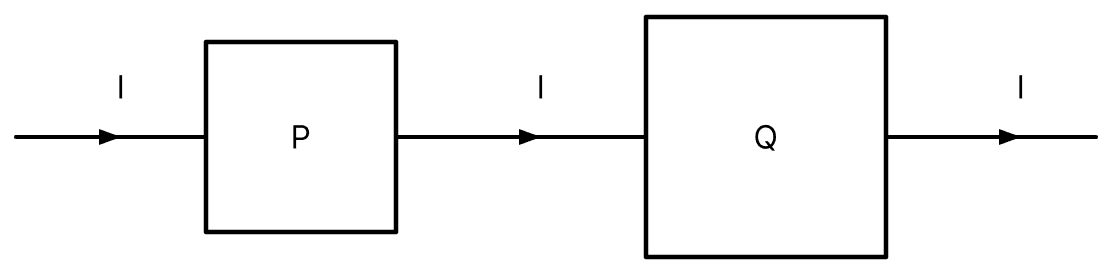
- the resistance of P is twice that of Q
- the resistance of P is half that of Q
- both have equal resistances
- the resistance of P is one-fourth that of Q
Answer
both have equal resistances
Reason — Let the side of the plate P be s and its thickness be t. The current flows along the side, so the length is s and the area of cross-section is s × t. Therefore
For Q the side is 2s and the thickness is the same t, so
The resistance depends only on the resistivity and the thickness, and not on the side. Hence both plates have equal resistances.
The ratio of the resistances of 100 W and 40 W bulbs of the same rated voltage is :
- 2 : 5
- 5 : 2
- 25 : 4
- 4 : 25
Answer
2 : 5
Reason — For a bulb of rated power P at the rated voltage V,
Since both bulbs have the same rated voltage, R is inversely proportional to P. Hence
The filaments of 60 W and 100 W bulbs are of the same length. Then :
- 60 W filament is thicker
- 100 W filament is thicker
- both are of same thickness
- both cannot have same length
Answer
100 W filament is thicker
Reason — At the same supply voltage, , so the 100 W bulb has the smaller resistance. For filaments of the same length and the same material,
A smaller resistance therefore means a larger area of cross-section. Hence the filament of the 100 W bulb is thicker.
When a 100 W-240 V bulb is operated at 200 V, the current in it is :
- 0.35 A
- 0.42 A
- 0.50 A
- 0.58 A
Answer
0.35 A
Reason — The resistance of the filament from its rating is
When the bulb is operated at 200 V, the current is
Of the two bulbs in a house one glows brighter than the other. Which of the two has a large resistance?
- The dim bulb
- The bright bulb
- Both have the same resistance
- The brightness does not depend upon the resistance
Answer
The dim bulb
Reason — The bulbs in a house are connected in parallel, so the same potential difference V acts across both. The power consumed is
that is, . The bulb which glows dimly consumes less power and therefore has the larger resistance.
Ohm's law is obeyed by many substances, but it is not a fundamental law of nature. It fails :
- if V depends on I non-linearly
- if the relation between V and I is non-unique
- both 1 and 2
- none of the above
Answer
both 1 and 2
Reason — Ohm's law fails whenever the V–I graph of the substance is not a straight line passing through the origin. This happens in two ways : the potential difference V may vary with the current I in a non-linear manner, or the relation between V and I may not be unique, that is, for the same current there may be more than one value of V. A GaAs semiconductor or a tunnel diode shows the second of these features. Hence Ohm's law fails in both the situations.
Two resistances R1 and R2 (> R1) connected in parallel have an equivalent resistance R . Then :
- R > (R1 + R2)
- R1 < R < R2
- R2 < R < (R1 + R2)
- R < R1 and R2
Answer
R < R1 and R2
Reason — For two resistances joined in parallel,
Since is greater than as well as , the equivalent resistance R is smaller than each of R1 and R2. In parallel combination the equivalent resistance is always less than the least of the resistances joined.
A beam of electrons moving at a speed of 106 m/s along a line develops a current of 1.6 × 10⁻⁶ A. The number of electrons in 1 metre of the beam is :
- 106
- 107
- 1013
- 1019
Answer
107
Reason — Let n' be the number of electrons per unit length of the beam. In one second, the electrons contained in a length v pass a given point, so the current is
Substituting I = 1.6 × 10⁻⁶ A, e = 1.6 × 10⁻¹⁹ C and v = 106 m/s,
Hence 1 metre of the beam contains 107 electrons.
In the Bohr's model of hydrogen atom, the electron moves around the nucleus in a circular orbit of a radius 5 × 10-11 metre. Its time period is 1.5 × 10⁻¹⁶ sec. The current associated is :
- zero
- 1.6 × 10⁻¹⁹ A
- 0.17 A
- 1.07 × 10⁻³ A
Answer
1.07 × 10⁻³ A
Reason — The revolving electron crosses any point of its orbit once in each period T. Hence the charge flowing past that point per second, that is, the current, is
Substituting e = 1.6 × 10⁻¹⁹ C and T = 1.5 × 10⁻¹⁶ s,
A potential difference V is applied across the ends of a copper wire of length l metre and radius r metre. The drift velocity of electrons is vd. If the diameter of wire is doubled, the drift velocity of electrons will become :
- 2vd
- vd
Answer
vd
Reason — The drift velocity of free electrons in terms of the potential difference and the length of the wire is
This expression contains only V and l, and does not contain the area of cross-section. Since V and l are unchanged, doubling the diameter leaves the drift velocity unaltered.
Which of the following dependences of drift velocity vd on electric field E obeys Ohm's law?
- vd = constant
- vd ∝ E
- vd ∝ E1/2
- vd ∝ E2
Answer
vd ∝ E
Reason — The drift velocity acquired by the free electrons in an electric field E is
where is the mobility of electrons, a constant if the temperature remains constant. Thus vd is directly proportional to E. This linear dependence leads to , which is Ohm's law in vector form.
In a wire of circular cross-section with radius r, free electrons travel with a drift velocity v, when a current I flows through the wire. What is the current in another wire of half the radius and of the same material when the drift velocity is 2v?
- 2I
- I
Answer
Reason — The current in terms of the drift velocity is
For the second wire of the same material, the radius is , so the area of cross-section becomes , and the drift velocity is 2v. Hence
A conductor of length L is connected to a DC source of emf E. If the length of the conductor is tripled by stretching it, keeping E constant, the drift velocity of free electrons in the conductor :
- increases 3 times
- increases 9 times
- reduces to of initial value
- reduces to of its initial value
Answer
reduces to of initial value
Reason — The drift velocity of free electrons in terms of the emf applied and the length of the conductor is
so that when E is kept constant. On stretching, the length becomes 3L, hence the drift velocity reduces to of its initial value.
Which of the following characteristics of electrons determines the current in a conductor?
- Drift velocity alone
- Thermal velocity alone
- Both drift velocity and thermal velocity
- Neither drift nor thermal velocity
Answer
Drift velocity alone
Reason — In the absence of an electric field the free electrons move randomly with large thermal velocities, but the average of these velocities over all the electrons is zero, so they carry no net current. When a potential difference is applied, the electrons acquire a small additional average velocity, the drift velocity, in a direction opposite to the field, and this alone gives the current .
A metal rod of length 10 cm and a rectangular cross-section of 1cm × cm is connected to a battery across opposite faces. The resistance will be :
- maximum when the battery is connected across 1 cm × cm faces
- maximum when the battery is connected across 10 cm × 1 cm faces
- maximum when the battery is connected across 10 cm × cm faces
- same irrespective of the three faces
Answer
maximum when the battery is connected across 1 cm × cm faces
Reason — For a given rod,
so the resistance is greatest when the length along the current is largest and the area of cross-section is smallest. When the battery is connected across the 1 cm × cm faces, the current flows along the 10 cm length through the smallest area of cross-section cm2. Hence the resistance is maximum in this case.
If a copper wire is stretched to make it 1% longer, then the percentage change in resistance will be :
- increased by 4%
- increased by 2%
- increased by 1%
- decreased by 2%
Answer
increased by 2%
Reason — On stretching a wire, its volume remains constant, so the resistance varies as
Taking the fractional change,
Hence the resistance increases by 2%.
A current I is flowing through a wire of non-uniform cross-section as shown in the figure. Which of the following options gives the correct variation of current (I), drift velocity (v) and current density (j) across the wire?
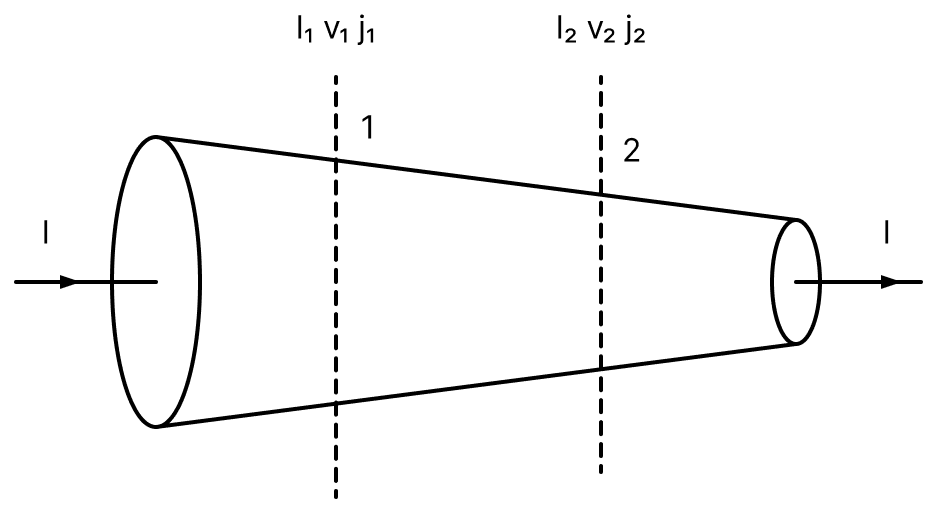
| S.No. | Current | Current density | Drift velocity |
|---|---|---|---|
| 1. | I1 > I2 | j2 = j1 | v2 < v1 |
| 2. | I1 = I2 | j2 > j1 | v2 > v1 |
| 3. | I1 < I2 | j2 < j1 | v2 = v1 |
| 4. | I1 = I2 | j2 = j1 | v2 = v1 |
Answer
I1 = I2, j2 > j1, v2 > v1
Reason — For a steady current the same charge crosses every cross-section in a given time, so the current is the same at the sections 1 and 2, that is, I1 = I2.
From the figure the wire tapers, so the area of cross-section at 2 is smaller than that at 1. Since
both the current density and the drift velocity are inversely proportional to the area of cross-section. Hence j2 > j1 and v2 > v1.
Each of the batteries connected in the circuit is of electromotive force (emf) 4V and internal resistance of 1 ohm. What is the potential difference across the battery B2?
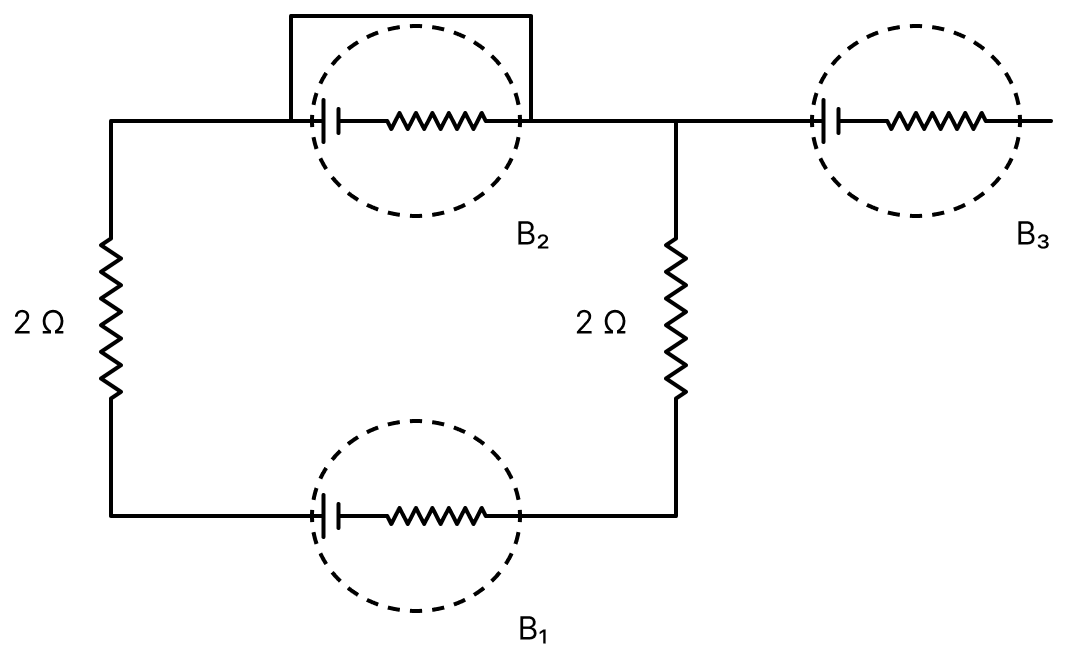
- 0 V
- 2.67 V
- 4 V
- 1.33 V
Answer
0 V
Reason — As seen in the figure, the battery B2 has a plain connecting wire joined directly across its two terminals, that is, B2 is short-circuited.
The whole current sent out by B2 passes through this wire of zero resistance, and the potential difference between the two ends of a wire of zero resistance is
Hence the potential difference across the battery B2 is zero.
Ratio of current density and electric field is called :
- resistivity
- conductivity
- drift velocity
- mobility
Answer
conductivity
Reason — According to Ohm's law in vector form, the current density at a point is directly proportional to the electric field at that point,
The constant of proportionality σ is the electrical conductivity (specific conductance) of the material, and it is independent of the electric field producing the current.
Two wires of same dimensions but resistivities ρ1 and ρ2 are connected in series. The equivalent resistivity of the combination is :
- ρ1 + ρ2
Answer
Reason — Let each wire be of length l and area of cross-section A. In series the equivalent resistance is
The combination is a single conductor of total length 2l and the same area A. If ρ is its equivalent resistivity,
The resistance of the series combination of two resistances is S and when joined in parallel, the equivalent resistance is P. If S = nP, then the minimum possible value of n is :
- 4
- 3
- 2
- 1
Answer
4
Reason — Let the two resistances be R1 and R2. Then
Hence
Writing ,
The first term is never negative, so n is least when R1 = R2. Hence the minimum possible value of n is 4.
Two electric bulbs marked 25 W–220 V and 100 W–220 V are connected in series to a 440 V supply. Which of the bulb will fuse?
- Both
- 100 W
- 25 W
- None of these
Answer
25 W
Reason — The resistances of the two bulbs are
The current in the series circuit is
The potential difference across the 25 W bulb is
This exceeds its rated 220 V, while the 100 W bulb gets only 88 V. Hence the 25 W bulb fuses.
The V–I graph for a conductor at temperature T1 and T2 are as shown in the figure. (T2 − T1) is proportional to:
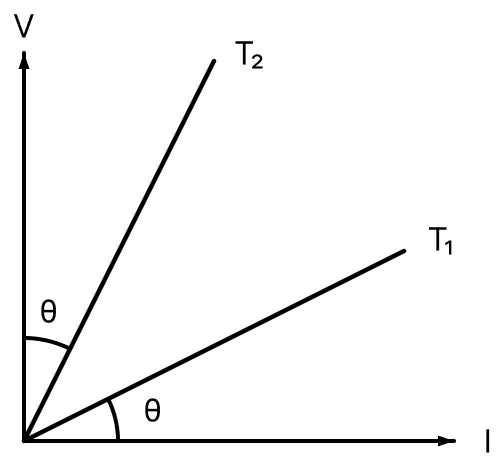
- cos 2θ
- sin θ
- cot 2θ
- tan θ
Answer
cot 2θ
Reason — For a V–I graph, the resistance is the slope of V with respect to I.
From the figure the line for T2 makes an angle θ with the V-axis and the line for T1 makes an angle θ with the I-axis. Hence
The change in resistance is proportional to the change in temperature, so
Hence (T2 − T1) is proportional to cot 2θ.
What is the order of the number of free electrons in metals?
Answer
The number of free electrons in metals is of the order of 1029 per metre3.
Explanation:
It is this very large free-electron density that enables a metal to carry a large current even though the charge and the drift speed of an electron are both extremely small.
Write the relation between current I in a wire and the drift velocity vd of free electrons in the wire.
Answer
The relation is
where A is the area of cross-section of the wire, n is the free-electron density, that is, the number of free electrons per unit volume, and e is the magnitude of the electronic charge.
Write the dimensions of resistance.
Answer
The dimensions of resistance are [M L2 T-3 A-2].
Explanation:
This follows from
Define electric conductivity of a material. Give its SI unit.
Answer
Electric conductivity : The electric conductivity (specific conductance) of a material is the reciprocal of its resistivity, that is, .
Its SI unit is 'mho metre-1' or ohm-1 m-1 (Ω-1 m-1), also called siemens per metre.
Note: The textbook's answer (reciprocal of resistance, unit mho) describes conductance, not conductivity.
Write down silver, aluminium, copper and iron in increasing order of electrical conductivity.
Answer
In increasing order of electrical conductivity the metals are :
Iron, aluminium, copper, silver.
Explanation:
Silver has the lowest resistivity and therefore the highest conductivity, while iron has the highest resistivity among the four.
Write down the relation between drift velocity vd and potential difference V.
Answer
The relation is
where m is the mass of the electron, τ the relaxation time and l the length of the wire. Thus the drift velocity is directly proportional to the potential difference applied across the ends of the wire.
What is the effect of the increase of the electric field upon the drift velocity of electron?
Answer
The drift velocity increases.
Explanation:
The drift velocity is related to the electric field by , so vd is directly proportional to E. Hence an increase in the electric field increases the drift velocity of the electrons.
What are the factors on which the resistance of a conductor depends? Write the relation.
Answer
The resistance of a conductor depends upon the nature of the material, its length, its area of cross-section and its temperature. The relation is
that is, the resistance is directly proportional to the length and inversely proportional to the area of cross-section.
The specific resistance depends upon which properties of a conductor; length, cross-sectional area, material, resistance?
Answer
The specific resistance depends on the material only.
Explanation:
It is a characteristic property of the material of the conductor, , and it does not depend upon the length, the area of cross-section or the resistance of the particular specimen.
Name two physical conditions on which the resistivity of a metal depends.
Answer
The resistivity of a metal depends upon its temperature and strain.
Explanation:
The resistivity of a metal increases with a rise in temperature, and it also changes when the metal is strained.
Write the dimensions of specific resistance.
Answer
The dimensions of specific resistance are [M L3 T-3 A-2].
Explanation:
They follow from , since the dimensions of resistance are [M L2 T-3 A-2].
Specific resistances of copper, silver and constantan are 1.18 × 10⁻⁶ Ω-cm, 1.0 × 10⁻⁶ Ω-cm and 48 × 10-6 Ω-cm respectively. Which one is best electrical conductor and why?
Answer
Silver is the best electrical conductor, because its specific resistance is the lowest of the three.
For a wire of given length and area of cross-section, , so the material of the least specific resistance offers the least resistance to the flow of current.
Out of metals and metal alloys, which has greater temperature coefficient of resistance?
Answer
Metals have the greater temperature coefficient of resistance.
Explanation:
Alloys such as manganin and constantan have a very small temperature coefficient of resistance, so that their resistance is hardly affected by a change of temperature. This is why they are used for making standard resistances.
Whether pure germanium at absolute zero temperature is a good conductor or a semiconductor or an insulator of electricity.
Answer
At absolute zero temperature pure germanium behaves as an insulator.
Explanation:
Germanium is a semiconductor and its free electrons are produced by thermal energy. At absolute zero no free electrons are available in it, so it cannot conduct electricity.
Is a wire carrying current charged?
Answer
No, a wire carrying current is not charged.
Explanation:
An electric current is only a flow of electrons through the wire. As many electrons enter the wire at one end, the same number leave it at the other end. Hence the wire as a whole remains electrically neutral.
Although both the electron's drift speed and the electron's charge are very small, we can still obtain a large current in a metal. Why?
Answer
A large current is obtained because the number of free electrons in a metal is extremely large, being of the order of 1028 per m3.
Since , the very large value of n compensates for the small values of e and vd, and the current comes out to be large.
A steady current is flowing in a cylindrical conductor. Is there any electric field within the conductor?
Answer
Yes, an electric field exists within the conductor.
Explanation:
A current flows in a conductor only when an electric field is established inside it, because it is this field which exerts a force on the free electrons and makes them drift. The field is related to the current density by .
Find out the change in the resistance of an Eureka wire when its radius is halved and the length is reduced to one-fourth of its original length.
Answer
There is no change in the resistance.
Explanation:
The resistance of the wire is .
When the radius is halved, the area of cross-section becomes one-fourth, and the length is also reduced to one-fourth. Hence
The ratio of the diameters of two copper wires of the same length is 1 : 2. What is the ratio of their resistances?
Answer
The ratio of their resistances is 4 : 1.
Explanation:
For wires of the same material and the same length, . Hence
There are two wires of the same metal of same area of cross-section but having lengths in the ratio 2 : 1. If same PD is applied across their ends, what will be the ratio of currents in them?
Answer
The ratio of the currents is 1 : 2.
Explanation:
For the same material and the same area of cross-section, , so the resistances are in the ratio 2 : 1. Since the same potential difference is applied, , and hence the currents are in the ratio 1 : 2.
In question 20 above, if the lengths be same but the ratio of cross-sectional areas be 2 : 1, then?
Answer
The ratio of the currents is 2 : 1.
Explanation:
For the same material and the same length, , so the resistances are in the ratio 1 : 2. For the same potential difference , and hence the currents are in the ratio 2 : 1.
What would be the resistance of a resistor colour coded brown-red-orange?
Answer
12 × 103 Ω ± 20%
Explanation:
For the colour code, brown corresponds to the figure 1, red to the figure 2 and orange to the multiplier 103. As there is no fourth band, the tolerance is 20%.
What is kilowatt-hour (kW-h)? What is it commonly known as?
Answer
Kilowatt-hour is the practical unit of electrical energy. It is the electrical energy consumed when an appliance of 1 kilowatt power works for 1 hour.
It is commonly known as 1 unit of electricity.
What is the meaning of 1 unit of electricity in domestic consumption?
Answer
One unit of electricity means that an electric appliance of 1000 watt power has been operated for 1 hour, that is, the electrical energy consumed is 1 kilowatt-hour.
Express 1 kilowatt-hour energy in joules.
Answer
1 kW-h = 3.6 × 10⁶ J
Explanation:
Two electric bulbs A and B are marked 220 V-40 W and 220 V-60 W. Which one has a higher resistance?
Answer
Bulb A has the higher resistance.
Explanation:
Both bulbs are marked for the same voltage 220 V, and , so R is inversely proportional to the rated power. Bulb A is of the lower wattage (40 W), hence it has the higher resistance.
What highest voltage can you safely put across a 98 Ω – 0.5 W resistor?
Answer
The maximum safe voltage is 7 V.
Explanation:
For a resistor of resistance R which can safely dissipate a power P,
How much energy will be liberated from a 1 kW electric heater in 30 seconds?
Answer
3 × 10⁴ J
Explanation:
The energy liberated is
Is Ohm's law true for all conductors?
Answer
No, Ohm's law is not true for all conductors.
Explanation:
It is true only for metallic conductors, and even for them only so long as the temperature and other physical states of the conductor do not change. Substances such as the vacuum diode and the semiconductor diode do not obey Ohm's law.
Which of the followings are examples of linear resistors? Copper wire, carbon resistance, diode, tungsten wire.
Answer
Copper wire and tungsten wire are examples of linear resistors.
Explanation:
Both are metallic conductors and give a straight-line V–I graph, that is, they obey Ohm's law. Carbon resistance and diode are non-ohmic.
Give examples of conducting elements which do not obey Ohm's law.
Answer
Vacuum diode and semiconductor diode are conducting elements which do not obey Ohm's law.
Explanation:
For such elements the V–I graph is not a straight line, so the ratio V/I is not constant.
Is the formula V = I R true for non-ohmic resistance also?
Answer
Yes, the formula V = I R is true for non-ohmic resistance also.
Explanation:
The relation V/I = R is merely the definition of the resistance of a conductor, whether the conductor obeys Ohm's law or not. Ohm's law is the additional statement that this ratio remains constant, which is true only for ohmic conductors.
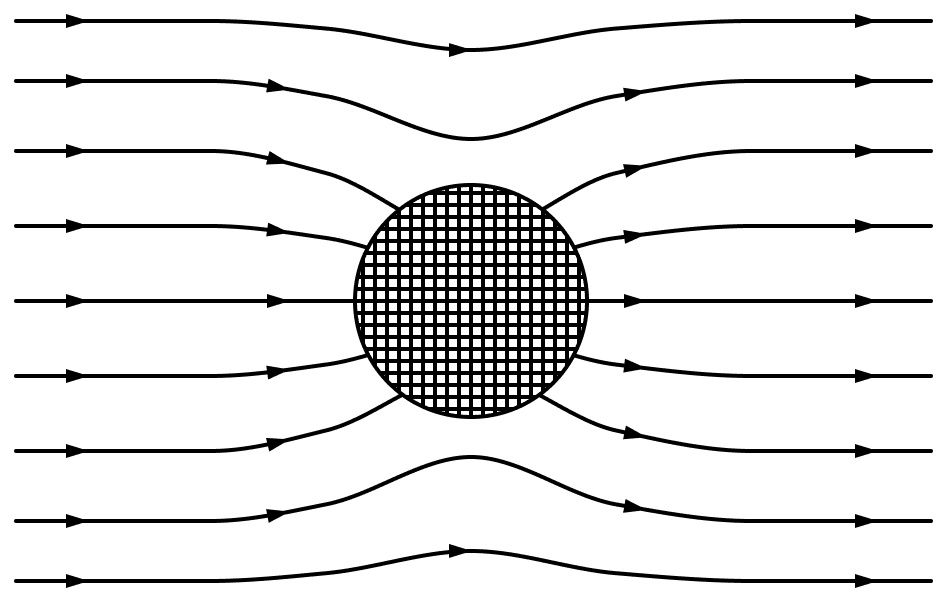
A hollow sphere made of material 'X' is placed in a region of electric field. The pattern of electric field lines around the sphere is observed to be like the figure shown.
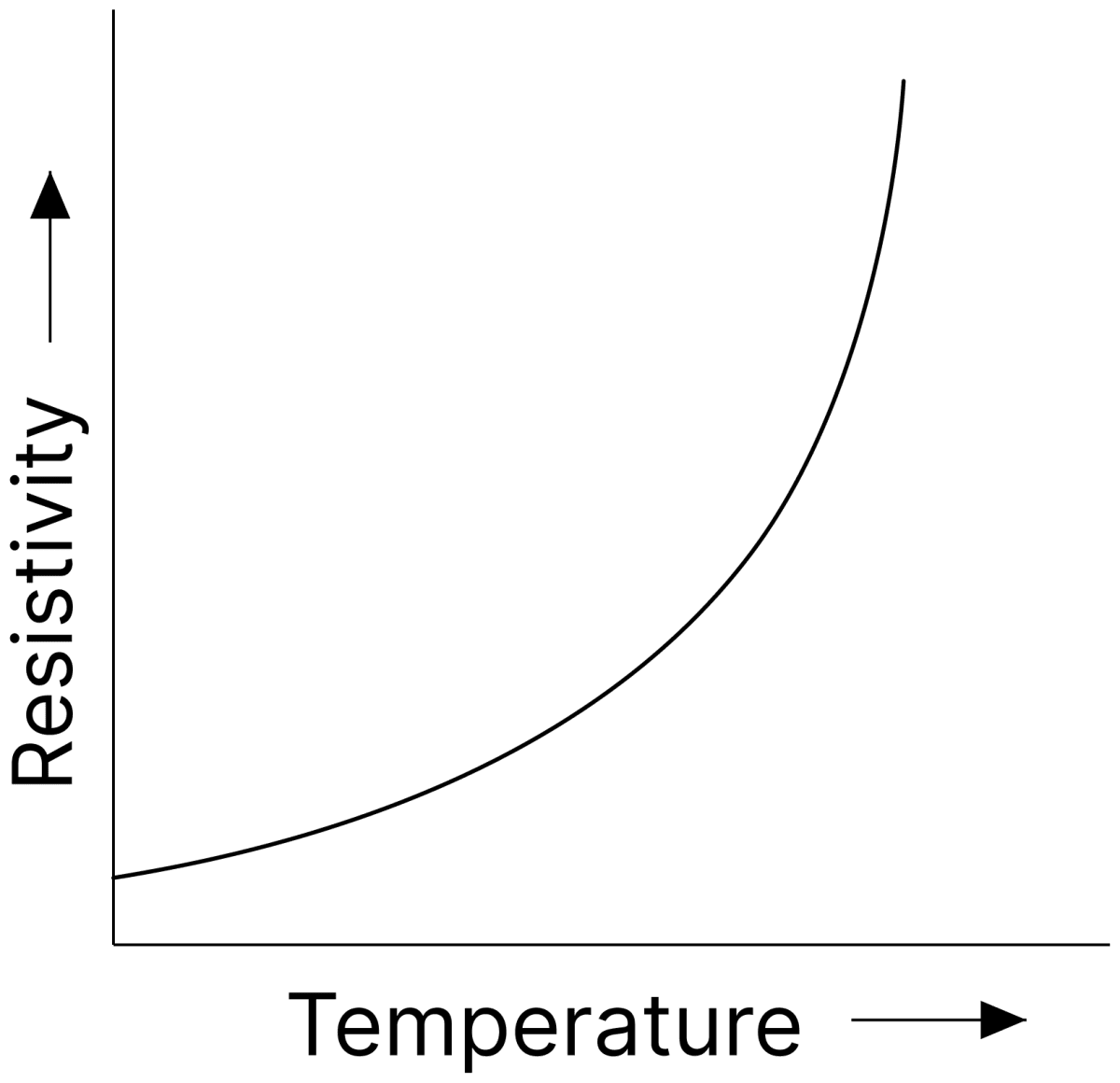
Plot the resistivity versus temperature graph for the material of the sphere.
Answer
The electric field lines are perpendicular to the surface of the sphere and there is no field inside it. This is the property of a conductor, so the material 'X' is a conductor.
For a conductor the resistivity increases with a rise in temperature, so the graph of resistivity versus temperature is as shown.
Name the carriers of electric current in (a) a metallic rod, (b) an electrolytic cell, (c) a hydrogen discharge tube, (d) a semiconductor, (e) a superconductor.
Answer
The carriers of electric current are :
(a) A metallic rod — free electrons.
(b) An electrolytic cell — positive and negative ions of the electrolyte.
(c) A hydrogen discharge tube — electrons and positive ions (protons) of hydrogen.
(d) A semiconductor — electrons and holes.
(e) A superconductor — electron pairs.
What is free-electron model of electric conduction?
Answer
Free-electron model : According to this model, the valence electrons of the atoms of a metal are not bound to any particular atom but are free to move about within the whole volume of the metal. These are called free electrons and their number is of the order of 1029 per m3.
In the absence of an electric field these free electrons move randomly in all directions with large thermal velocities, colliding with the positive metal ions. The average of their velocities is zero, so there is no net current.
When a potential difference is applied, an electric field is set up inside the conductor and each free electron acquires a small additional average velocity, the drift velocity, opposite to the field. This ordered drift of free electrons constitutes the electric current in the conductor.
Write, in terms of n, e, vd for a current-carrying wire of cross-section A (i) number of free electrons passing through a cross-section of the wire in a time-interval Δt, (ii) current in the wire, (iii) current density in the wire.
Answer
(i) The number of free electrons passing through a cross-section of the wire in a time-interval Δt is
(ii) The current in the wire is
(iii) The current density in the wire is
Define electrical resistivity of a material.
Answer
Electrical resistivity : The resistance of a wire is . If l = 1 m and A = 1 m2, then R = ρ.
Thus the electrical resistivity (specific resistance) of a material is the resistance of a wire of that material of unit length and unit area of cross-section.
It is a characteristic property of the material, , and its SI unit is ohm-metre (Ω-m).
The specific resistance of manganin is 44 × 10-8 Ω-m. Explain this statement.
Answer
The resistivity of a material is the resistance of a block of that material of length 1 metre and area of cross-section 1 metre2.
Hence the statement means that a block of manganin of length 1 metre and area of cross-section 1 metre2 has a resistance of 44 × 10-8 Ω.
What is specific conductance? Give its unit and dimensions.
Answer
Specific conductance : The reciprocal of the specific resistance of a material is called its specific conductance (electrical conductivity),
Its unit is (ohm-metre)-1, that is, mho m-1 or Ω-1 m-1.
Its dimensional formula is [M-1 L-3 T3 A2].
How does the resistivity of a conductor vary with temperature?
Answer
For a metallic conductor the resistivity increases with a rise in temperature.
The resistivity is . On heating, the metal ions vibrate more vigorously, so the free electrons collide with them more frequently and the relaxation time τ decreases. Since ρ is inversely proportional to τ, the resistivity increases.
For a semiconductor the resistivity decreases rapidly with a rise in temperature, because the number of free electrons n increases greatly and this increase outweighs the decrease in τ.
If the temperature of a good conductor increases, how does the relaxation time of electrons in the conductor change?
Answer
The relaxation time decreases.
Explanation:
The resistance of a conductor is
so that . When the temperature of a good conductor increases, its resistance increases, and hence the relaxation time τ of the electrons decreases. Physically, the metal ions vibrate more vigorously and the electrons suffer collisions more frequently.
State whether the temperature coefficient of resistance α is positive or negative for (i) Cu, (ii) Si, (iii) Ag, (iv) Ge and (v) C.
Answer
(i) Cu — positive
(ii) Si — negative
(iii) Ag — positive
(iv) Ge — negative
(v) C — negative
For metals (Cu, Ag) the resistance increases with a rise in temperature, so α is positive. For semiconductors and carbon (Si, Ge, C) the resistance decreases with a rise in temperature, so α is negative.
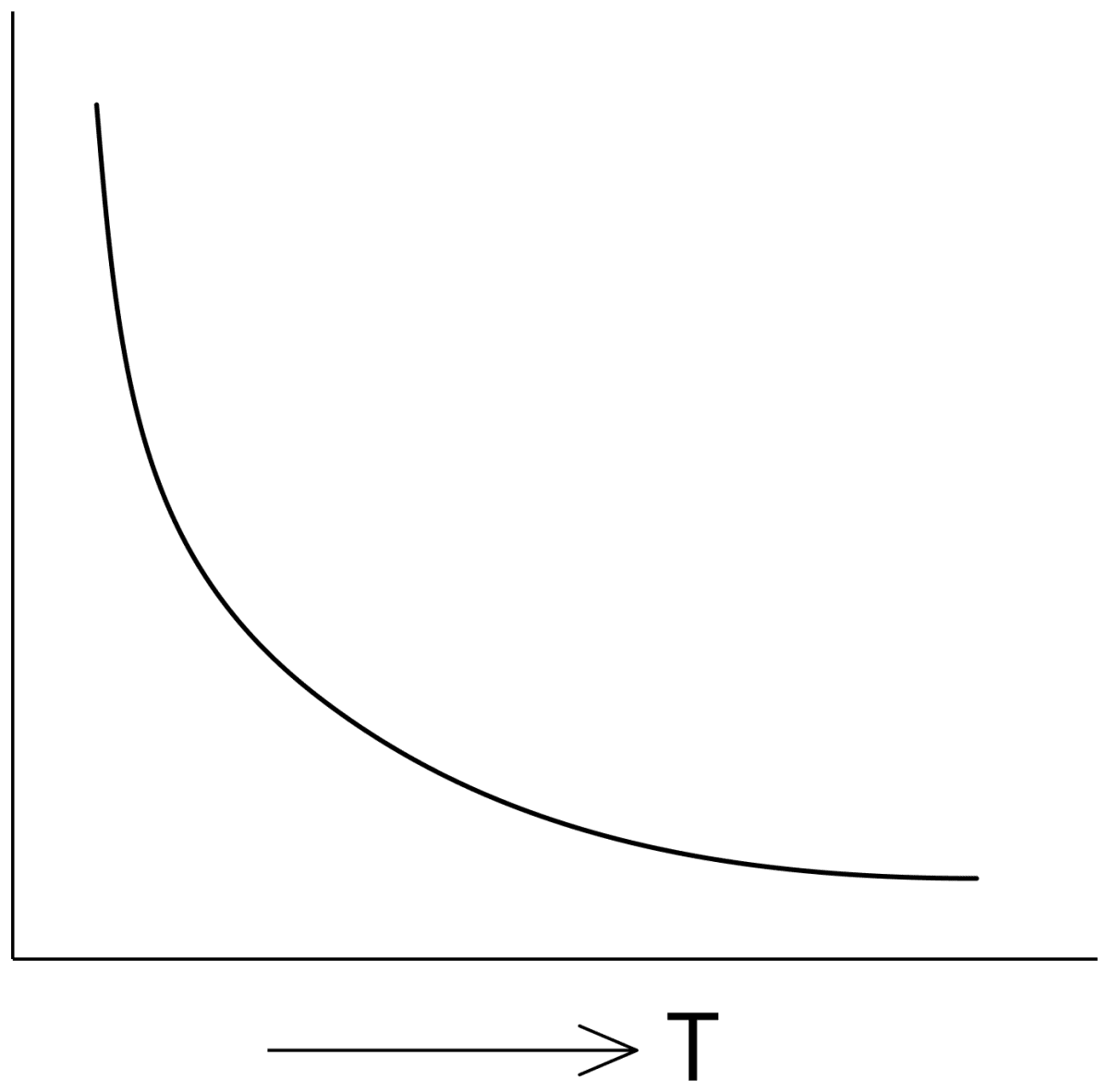
Show graphically how electrical resistance of a piece of Silicon or Germanium varies when its temperature is varied.
Answer
Silicon and germanium are semiconductors, and for a semiconductor the temperature coefficient of resistance is negative. With a rise in temperature the number of free electrons n increases greatly, so the resistance goes on decreasing.
Hence the graph of resistance R against temperature T is as shown.
Electrons are constantly in motion within metals, but there is no current until a PD is established across it, why?
Answer
In the absence of a potential difference the motion of the free electrons in a metal is purely random. They move in all directions with large thermal velocities, so the average of their velocities is zero and there is no net motion in any direction. Hence no charge is transported across any cross-section and there is no current.
When a potential difference (or electric field) is established across the conductor, each free electron acquires a drift velocity in a direction opposite to the field. This ordered drift of the free electrons constitutes the electric current.
(i) A current flowing in a copper wire is sent in another copper wire of double the radius. How will the drift velocity of free electrons be affected? (ii) If sent in an iron wire of same radius, then?
Answer
(i) The drift velocity is . When the radius is doubled, the area of cross-section becomes 4 times. For the same current in the same material, the drift velocity is reduced to one-fourth.
(ii) In iron the free-electron density n is smaller than that in copper. Since for the same current and the same radius, the drift velocity in the iron wire will increase.
When electrons drift in a metal from lower to higher potential, does it mean that all the free electrons of the metal are moving in the same direction?
Answer
No, it does not mean that all the free electrons are moving in the same direction.
Explanation:
The free electrons continue their random thermal motion in all directions with very large speeds. The drift velocity produced by the electric field is extremely small, of the order of 10-5 m s-1, and is merely superposed on these large random thermal velocities. It is only the average velocity of all the free electrons which is directed from the lower to the higher potential.
Electrons in metals drift due to the force exerted on them by the electric field. Then, why do they acquire an unaccelerated (steady) velocity?
Answer
The electric field accelerates an electron only between two successive collisions. The electron frequently collides with the positive ions of the metal, and in each collision it loses the velocity it had gained since the previous collision.
Hence the velocity gained between two collisions is lost in the next collision, and the net acceleration averages out to zero. The result is that the electrons move with a small steady average velocity, the drift velocity, given by .
Are the paths of electrons in metals straight lines between successive collisions (with the positive ions in the metal) in the (i) absence of electric field, (ii) presence of electric field?
Answer
(i) In the absence of an electric field — yes. The free electrons move with uniform velocity between two successive collisions, so their paths are straight lines.
(ii) In the presence of an electric field — no. Each electron is acted upon by a constant force between two collisions, so it moves with a constant acceleration and its path is in general curved.
Although the drift velocity of electrons is very small, yet an electric bulb lights up almost instantly when switched on, whatever be the distance of the bulb from the switch. Why?
Answer
When the switch is put into the 'ON' position, an electric impulse travels through the circuit with the speed of light, 3 × 10⁸ m s-1. Hence an electric field is established almost instantly at every point of the circuit, however far the bulb may be from the switch.
As a result, the free electrons at every point of the circuit, including those already present in the filament, begin to drift at practically the same instant. So the current begins to flow and the bulb lights up almost immediately, even though the drift velocity of the electrons is very small.
A PD V exists across a conductor of length l and diameter d. How are the electric field E and the resistance R of the conductor affected when (i) V is halved, (ii) l is halved and (iii) d is doubled?
Answer
(i) When V is halved : , so E is also halved. The resistance remains unaffected, because the current I is also halved.
(ii) When l is halved : , so E is doubled, and is halved.
(iii) When d is doubled : E remains unaffected, since it does not depend on the diameter. The area of cross-section becomes 4 times, so becomes .
A PD V exists across a copper wire of length l and diameter d. How will be the drift velocity affected if : (i) V is doubled, (ii) l is doubled, (iii) d is doubled?
Answer
The drift velocity is .
(i) When V is doubled : vd is directly proportional to V, so the drift velocity is doubled.
(ii) When l is doubled : vd is inversely proportional to l, so the drift velocity is halved.
(iii) When d is doubled : the area of cross-section becomes 4 times, so the resistance becomes one-fourth and the current becomes 4 times. Since , with both I and A becoming 4 times, the drift velocity remains unchanged.
A conductor of length l is connected to a DC source of potential V. The conductor is stretched to a length 3l keeping V constant. How do (i) resistance of the conductor, (ii) resistivity of the material of the conductor, (iii) the drift speed of free electrons in the conductor change?
Answer
On stretching l to 3l the volume remains constant, so the area of cross-section is reduced to .
(i) Resistance : becomes , that is, the resistance becomes 9 times.
(ii) Resistivity : ρ is a property of the material only, and the material is unchanged. Hence the resistivity remains unchanged.
(iii) Drift speed : Since R becomes 9 times and V is constant, the current reduces to of its value. Now , and A is reduced to , so the drift speed becomes one-third of its initial value.
A wire of resistance R is stretched until its radius is halved. What is its new resistance?
Answer
On stretching, the volume of the wire remains constant. If l and A are the initial and l' and A' the final length and area of cross-section, then
When the radius is halved, the area of cross-section becomes one-fourth, so and therefore .
If R' is the new resistance, then
Hence, the new resistance is R' = 16 R.
When the ends of a wire are connected to a battery, initially the current is slightly larger, but soon it decreases and becomes steady at a lower value. Why?
Answer
As soon as the current flows, heat is produced in the wire and its temperature rises. For a metallic wire the resistance increases with a rise in temperature, so the current decreases.
As the temperature of the wire rises, the rate of loss of heat by radiation also increases. When the rate of heat radiated becomes equal to the rate at which electrical energy is dissipated in the wire, the temperature of the wire becomes constant. Hence the resistance and the current also become steady at a lower value.
A current-carrying wire is heated. What happens to the drift velocity of free-electrons in the wire?
Answer
The drift velocity of the free electrons decreases.
Explanation:
On being heated the resistance of the wire increases, so for the same applied potential difference the current decreases. Since
a decrease in the current decreases the drift velocity of the free electrons.
The sequence of bands marked on carbon resistors are as follows. Find, in each case, the value of the resistance with tolerance.
(i) Yellow, Violet, Brown, Gold.
(ii) Yellow, Red, Orange, Silver.
(iii) Green, Violet, Red.
(iv) Red, Yellow, Orange.
Answer
Using the colour code, the first two bands give the significant figures, the third band gives the multiplier and the fourth band gives the tolerance (gold 5%, silver 10%, no fourth band 20%).
(i) Yellow, Violet, Brown, Gold — 4, 7, multiplier 101, tolerance 5%
(ii) Yellow, Red, Orange, Silver — 4, 2, multiplier 103, tolerance 10%
(iii) Green, Violet, Red — 5, 7, multiplier 102, no fourth band so tolerance 20%
(iv) Red, Yellow, Orange — 2, 4, multiplier 103, no fourth band so tolerance 20%
Carbon resistors of (i) 47 kΩ and (ii) 74 kΩ are to be marked with rings of different colours for their identification. Write the colour sequences.
Answer
(i) 47 kΩ = 47 × 103 Ω
The significant figures are 4 and 7, so the first two bands are Yellow and Violet, and the multiplier 103 is Orange.
Colour sequence : Yellow, Violet, Orange.
(ii) 74 kΩ = 74 × 103 Ω
The significant figures are 7 and 4, so the first two bands are Violet and Yellow, and the multiplier 103 is Orange.
Colour sequence : Violet, Yellow, Orange.
Three bulbs of 40 W, 60 W and 100 W are connected in series across the mains. Across which bulb is the PD highest? Across which lowest?
Answer
In series the same current I flows through all the three bulbs, so the potential difference across a bulb is proportional to its resistance,
The resistance of a bulb is , so the bulb of the lowest wattage has the highest resistance.
Hence the PD is highest across the 40 W bulb and lowest across the 100 W bulb.
A nichrome heating element across 230 V supply consumes 1.5 kW of power and heats up to 750°C. A tungsten bulb across the same supply heats up to 1600°C. Does the bulb necessarily consumes greater power?
Answer
No, the bulb does not necessarily consume greater power.
Explanation:
The steady temperature attained by a resistor does not depend upon the power consumed alone. It also depends upon its surface area, emittivity and similar factors, which decide the rate at which the resistor loses energy by radiation.
The tungsten filament of the bulb has a very small surface area, so it loses heat slowly and attains a much higher temperature even while consuming less power than the nichrome element.
Two wires of same length and same material, but of cross-sectional areas in the ratio 1 : 4, are given same voltage. What would be the ratio of heat produced in them in a given time?
Answer
Both wires are given the same voltage V, so the heat produced in time t is
that is, .
For wires of the same length and same material, , so .
Since the areas of cross-section are in the ratio 1 : 4, the ratio of the heat produced is 1 : 4.
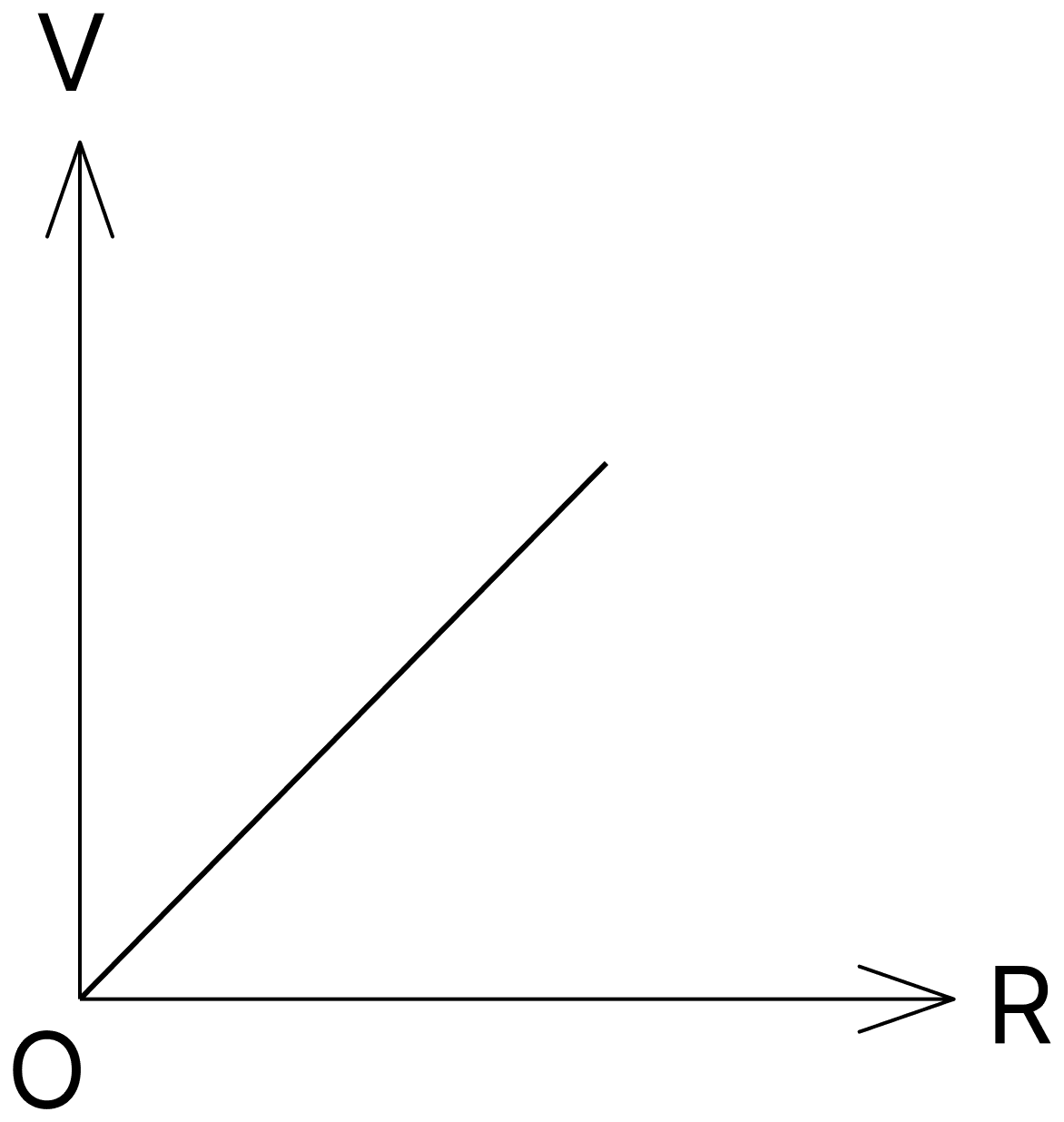
If the current supplied to a variable resistor is constant, draw a graph between voltage and resistance.
Answer
By Ohm's law, V = I R. If the current I is kept constant, then
Hence the graph between voltage and resistance is a straight line passing through the origin.
Explain the difference between ohmic and non-ohmic resistances. Give examples.
Answer
Ohmic resistance : If the temperature and other physical states of a conductor remain unchanged, and its resistance remains constant whatever be the potential difference applied between its ends, then it is called ohmic resistance. Its V–I graph is a straight line.
Examples : metallic wires, mercury.
Non-ohmic resistance : If the resistance changes with a change in the potential difference applied, then it is called non-ohmic resistance. Its V–I graph is not a straight line.
Examples : diode valve, thermistor.
Is a light bulb an ohmic resistor, explain.
Answer
No, a light bulb is not an ohmic resistor.
An ohmic resistor is one whose resistance does not change over a fairly wide range of applied voltages and currents. In a light bulb the filament becomes very hot as the voltage is raised, and since the resistance of a metal increases with a rise in temperature, the resistance of the filament changes considerably between zero voltage and its rated voltage. Hence the bulb is non-ohmic.
Nichrome and copper wires of same length and same radius are connected first in series and then in parallel and same current is passed in them in both cases. Which wire will glow first in each case?
Answer
The resistivity of copper is less than that of nichrome, so for the same length and same radius the copper wire has the smaller resistance.
In series : the same current flows through both wires, and the rate of production of heat is P = I2R. The nichrome wire, having the larger resistance, generates heat at a higher rate and hence the nichrome wire glows first.
In parallel : the same voltage acts across both wires, and the rate of production of heat is . The copper wire, having the lower resistance, generates heat at a higher rate and hence the copper wire glows first.
Two 100 W-220 V bulbs, one having a carbon filament and the other having a metallic filament, are connected in series. Which one will glow more?
Answer
If connected separately to the same line, the two bulbs would glow equally because they are of equal wattage.
When they are joined in series, the resistance of the circuit increases and so the current in each bulb decreases. Hence both glow less brightly than before and the temperature of their filaments is lowered.
Due to this lowering of temperature, the resistance of the carbon filament slightly increases (carbon has a negative temperature coefficient of resistance) while that of the metallic filament decreases. Since the same current flows through both and P = I2R, the carbon filament will glow more.
Water boils in an electric-kettle in 15 minutes after being switched on. Using the same mains supply, should the length of the heating element be increased or decreased if the water is to boil in 10 minutes? How much?
Answer
The length of the element should be decreased to of its initial value.
With a given DC supply of V volt, the heat produced in the element of resistance R in time t is
The same quantity of heat is needed to boil the water, so for a smaller time t the resistance R must be reduced in the same ratio. To reduce the time from 15 min to 10 min, the resistance must become of its initial value.
Since for the same wire, the length of the heating element should be decreased to of its initial value.
A heater joined 'in series' with a 60-W bulb is connected to the mains. If the 60 W bulb be replaced by a 100 W bulb, will the heat produced by the heater be more, less or remain the same?
What if the heater be joined 'in parallel' with the bulb?
Answer
In series : The 100 W bulb has a lower resistance than the 60 W bulb. On replacing the 60 W bulb by the 100 W bulb, the total resistance of the series circuit decreases and so the current increases. The heat produced by the heater of resistance R is , so the heater will produce more heat.
In parallel : When the heater and the bulb are joined in parallel, the potential difference across each is equal to the mains voltage, whatever be the resistance of the bulb. Hence on replacing the bulb the current through the heater remains unchanged and it will produce the same heat as before.
An accumulator of emf E and internal resistance r is first connected to an external resistance R1 and then to an external resistance R2 for the same time. For what value of r the heat dissipated in R1 and R2 will be same?
Answer
When the accumulator of emf E and internal resistance r is connected to R1 and then to R2, the currents are
The heat dissipated in time t is . For the heat to be the same in both cases,
Taking the square root of both sides,
Hence, .
(i) Two bulbs are marked 60 W 220 V and 100 W 220 V. They are connected in parallel to the 220 V mains. Which bulb will glow brighter? If one of the two bulbs be switched off (or removed), will the light in the room increase or decrease?
(ii) What would happen if the two bulbs 60 W 220 V and 100 W 220 V be connected in series?
Answer
(i) In parallel : The potential difference V across both the bulbs is the same. The rate of energy production is
so P is higher for the bulb of lower resistance. The bulb of higher wattage has the lower resistance, hence the 100 W bulb glows brighter.
On switching off one bulb, the potential difference across the other is unchanged, so its brightness is unaffected. Since one source of light has been removed, the total light in the room will decrease.
(ii) In series : The same current I flows through both the bulbs, and the rate of energy production is
so P is higher for the bulb of higher resistance. The bulb of lower wattage has the higher resistance, hence the 60 W bulb will glow brighter.
If one bulb is taken out and the other is left across the mains, the total resistance falls, the current rises, and the light in the room increases.
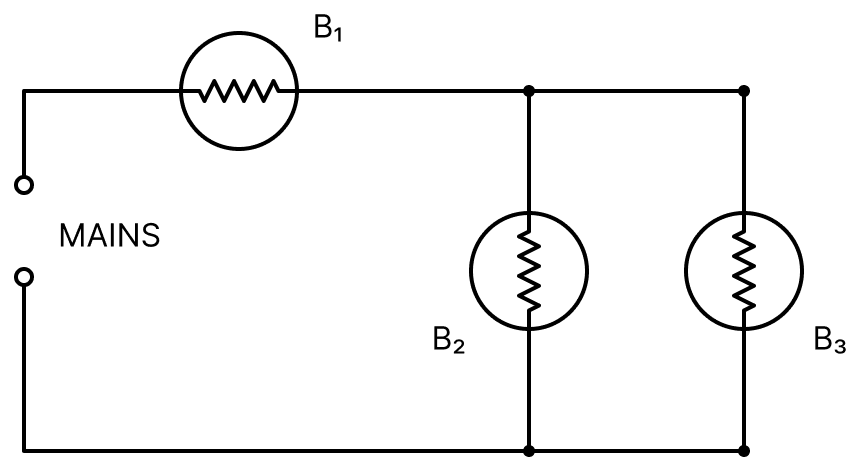
Three bulbs B1, B2 and B3 of equal resistances are connected to an electric mains, as shown. If the bulb B3 is removed from the circuit, then what will be the effect on the brightness of the bulbs B1 and B2?
Answer
In the given circuit the bulb B1 is in series with the parallel combination of B2 and B3.
On removing B3, the parallel combination is lost and the equivalent resistance of the circuit increases. Hence the main current, which flows through B1, decreases, and so B1 becomes dim.
Earlier the current through the parallel combination was shared between B2 and B3. Now the whole of the current passes through B2 alone, so the current in B2 increases and B2 glows more bright.
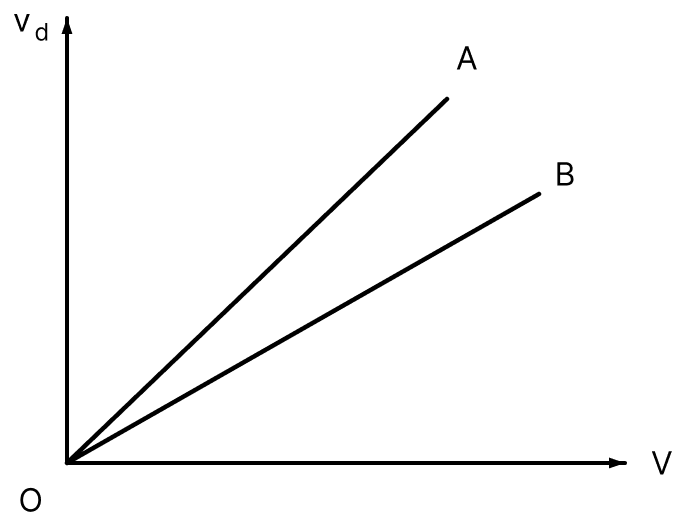
Figure shows variation of the drift velocity (vd) of electrons in two copper wires A and B of different lengths versus the potential difference (V) applied across their ends.
(i) What does the slope of the line represent?
(ii) Which one of the two wires is longer?
Answer
(i) The drift velocity in terms of the applied potential difference is
Hence the slope of the line represents , that is, the drift velocity acquired per unit potential difference.
(ii) From the above, the slope is inversely proportional to the length of the wire,
From the figure the line B has the smaller slope, hence the wire B is longer.
The following table gives the length of three copper rods, their diameter and the potential differences between their ends. Rank these rods according to :
(a) the magnitude of the electric field within them,
(b) the current density within them and
(c) the drift speed of electrons through them, greatest first.
| Rod | Length | Diameter | Potential difference |
|---|---|---|---|
| 1 | L | 3d | V |
| 2 | 2L | d | V |
| 3 | 3L | 2d | 2V |
Answer
(a) Magnitude of the electric field : The field within a rod is . Hence
so that E1 > E3 > E2.
(b) Current density : By Ohm's law in vector form, j = σE, and all the rods are of copper, so σ is the same for all. Hence j is proportional to E, and
j1 > j3 > j2.
(c) Drift speed : Since , the drift speed is also proportional to E. Hence
> > .
In each case the diameter does not enter the result, because the electric field, the current density and the drift speed all depend only on the potential difference and the length of the rod.
Obtain an expression showing the relation between the current-density j in a current-carrying conductor, the drift velocity vd, the number of free electrons per unit volume n and the electronic charge e.
Answer
Consider a conductor of area of cross-section A in which the free-electron density is n, that is, there are n free electrons per unit volume. Let each electron have a charge e and let the free electrons drift with a drift velocity vd.
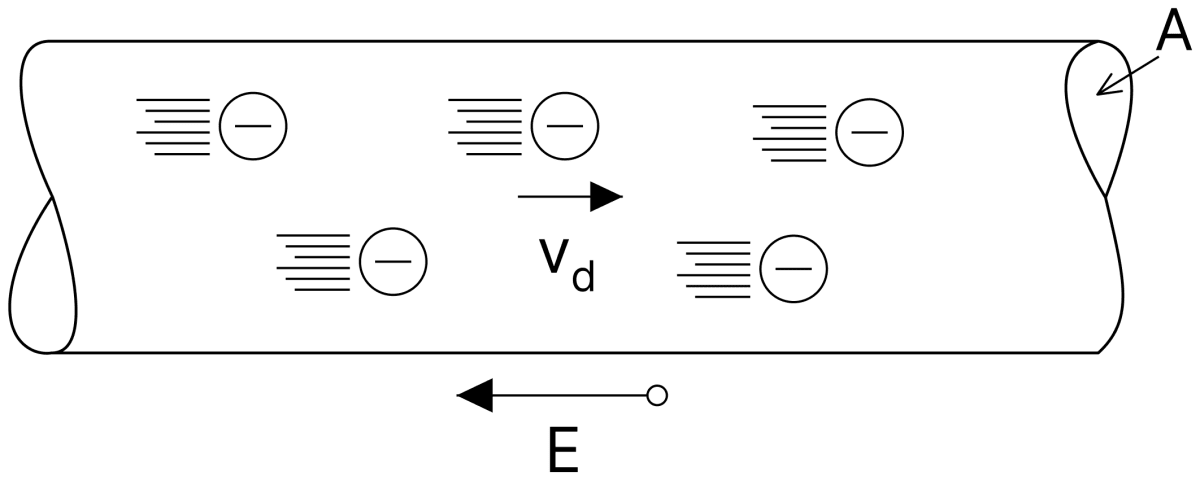
In a small time-interval Δt every free electron covers a distance vdΔt. Hence all the free electrons contained in a cylinder of length vdΔt and area of cross-section A cross the given cross-section in this interval.
Volume of this cylinder = A vd Δt
Number of free electrons in it, N = n A vd Δt
Charge crossing the cross-section in time Δt is
Therefore the current in the conductor is
The current density is defined as the current per unit area of cross-section,
Hence
Thus, the current density in a current-carrying conductor is j = n e vd.
What is meant by specific resistance (resistivity) of a conductor? Write its unit. Show how the electric resistance of a wire depends on the resistivity of its material, its length and area of cross-section.
Answer
Specific resistance (resistivity) : The resistance of a wire of a given material is directly proportional to its length l and inversely proportional to its area of cross-section A,
The constant of proportionality ρ is called the specific resistance or resistivity of the material.
If l = 1 m and A = 1 m2, then R = ρ. Hence the specific resistance of a material is the resistance of a wire of that material of unit length and unit area of cross-section.
Unit : From , the SI unit of resistivity is ohm-metre (Ω-m).
Dependence of resistance on the dimensions : From the proof of Ohm's law, the resistance of a wire of length l and area of cross-section A is
In this expression is the resistivity ρ, which is a characteristic property of the material and does not depend on the dimensions of the specimen. Hence for a conductor made of a given material
that is, the resistance of a conductor is directly proportional to its length and inversely proportional to its area of cross-section.
Ohm's law may also be stated by the equation . What do the symbols , σ and stand for? Show that the combination of units on the two sides are identical.
Answer
In the equation :
- is the current density, that is, the current flowing per unit area of cross-section held normal to the direction of flow of charge. Its SI unit is A m-2.
- σ is the specific conductance (electrical conductivity) of the material, the reciprocal of its resistivity. Its SI unit is (Ω m)-1.
- is the electric field intensity established inside the conductor. Its SI unit is V m-1.
Equality of units :
Unit of the left-hand side = A m-2
Unit of the right-hand side
But by Ohm's law . Hence
Thus the combination of units on the two sides is identical.
Define resistivity of a conductor. Explain the variation of resistance with temperature in (i) metallic wire, (ii) a piece of carbon.
Answer
Resistivity : The resistivity of a conductor is the resistance of a wire of that material of unit length and unit area of cross-section, . In terms of the free-electron model,
(i) Variation for a metallic wire : When a metallic wire is heated, the positive metal ions vibrate more vigorously about their mean positions. The free electrons therefore collide with them more frequently and the relaxation time τ decreases. In a metal the free-electron density n is already very large and does not change appreciably with temperature. Since , the resistivity and hence the resistance of the metallic wire increases with a rise in temperature. The temperature coefficient of resistance of a metal is therefore positive.
(ii) Variation for a piece of carbon : Carbon is a semiconductor. In it the number of free electrons n is very small at ordinary temperatures, but on heating a large number of additional free electrons are produced, so that n increases greatly. Although the relaxation time τ also decreases, the increase in n is much larger than the decrease in τ. Hence the net effect is that the resistivity, and so the resistance, of carbon decreases with a rise in temperature. The temperature coefficient of resistance of carbon is therefore negative.
Explain energy transfer in electric circuits. Prove that the energy liberated from an electric circuit is given by W = VI t = I2 Rt = , where symbols have usual meanings.
Answer
Energy transfer in an electric circuit : When a potential difference V is applied across the ends of a conductor, the free electrons drift through it. In this drift the electrons repeatedly collide with the positive ions of the conductor and give up to them the kinetic energy gained from the electric field. Hence the electrical energy supplied by the source is transferred to the conductor and appears as heat in it.
Derivation : Let a charge q be carried through the conductor across which a potential difference V is maintained. Since the potential difference is the work done per unit charge, the work done by the source is
If a steady current I flows for a time t, then the charge transferred is
Therefore
By Ohm's law, V = I R. Substituting for V,
Again, substituting ,
Hence, W = VI t = I2Rt = , where W is in joule when V is in volt, I in ampere, R in ohm and t in second.
What do you mean by electric power? Obtain various expressions for electric power in a circuit.
Answer
Electric power : The rate at which electrical energy is consumed in an electric circuit is called electric power.
Expressions for electric power : If a steady current I flows for a time t across a potential difference V, the electrical energy consumed is W = VI t. Hence
Using Ohm's law V = I R,
and substituting ,
Thus, P = VI = I2R = .
The SI unit of electric power is the watt (W), where 1 watt = 1 volt × 1 ampere = 1 joule per second. Its bigger unit is the kilowatt, 1 kW = 1000 W.
What are ohmic and non-ohmic conductors, explain? Give one example of each and draw their V-I characteristics.
Answer
Ohmic conductors : Those conductors whose resistance remains constant whatever be the potential difference applied between their ends, the temperature and other physical states remaining unchanged, are called ohmic conductors. They obey Ohm's law and their V–I graph is a straight line passing through the origin.
Example : a metallic wire such as a manganin wire.
Non-ohmic conductors : Those conductors whose resistance changes with a change in the potential difference applied are called non-ohmic conductors. They do not obey Ohm's law and their V–I graph is not a straight line.
Example : a diode valve (vacuum-tube diode).
V–I characteristics :
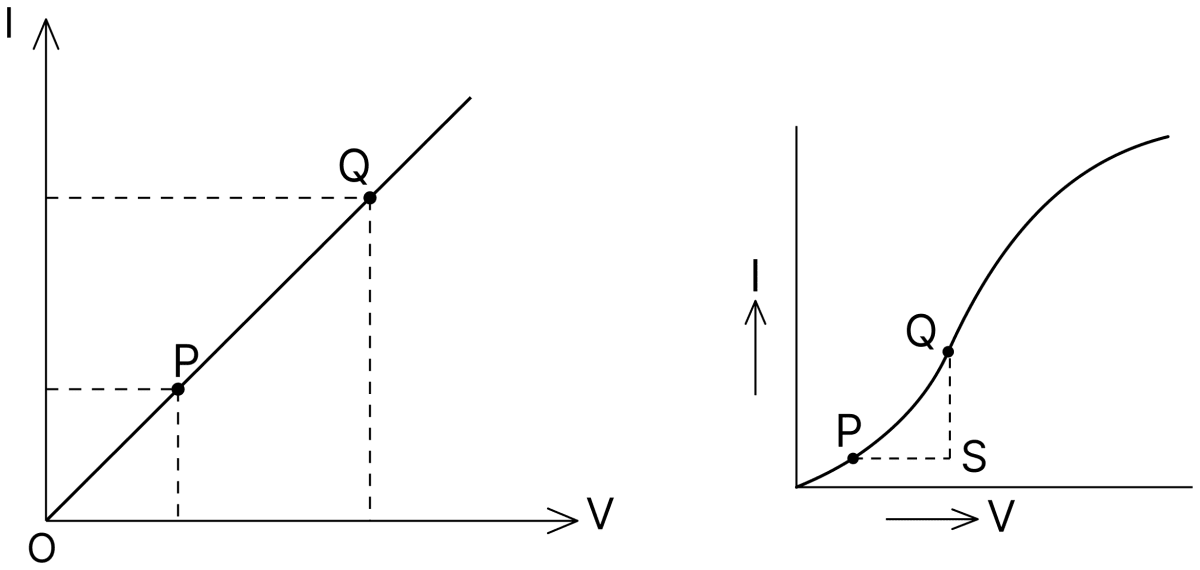
For the ohmic conductor the graph is a straight line, showing that the ratio V/I is constant. For the non-ohmic conductor the graph is curved, showing that the ratio V/I changes with the applied potential difference.
A student is performing an experiment on current electricity. The examiner gives the requisite instructions and asks some questions to the student. State whether the response of the student in each case is correct or incorrect.
Give a reason for your answer.
(i) EXAMINER : The potential difference across the circuit is too low. Increase its value.
STUDENT : Connects additional identical cell in parallel with existing cell.
(ii) EXAMINER : Current in the circuit is too high. Decrease its value without changing the applied voltage.
STUDENT : Increases the resistance through rheostat.
(iii) EXAMINER : Resistance of the bench wire is high, decrease its value.
STUDENT : Replace the existing wire by a thick wire of same material and of same length.
Answer
(i) The student's response is incorrect.
The additional cell should have been connected in series with the existing cell. When an identical cell is connected in parallel with the existing cell, the equivalent emf of the combination remains the same as that of a single cell. Hence the potential difference across the circuit is not increased.
(ii) The student's response is correct.
The examiner wants the current to be decreased without changing the applied voltage. By Ohm's law , so at constant V the current can be decreased only by increasing the resistance. Increasing the resistance through the rheostat does exactly this.
(iii) The student's response is correct.
The resistance of a wire is , so for a wire of the same material and the same length. A thick wire has a larger area of cross-section, hence a smaller resistance.
Define drift velocity, time of relaxation and current density. Current density is a vector quantity but current has both magnitude and direction still it is considered as scalar. Why?
Answer
Drift velocity : Drift velocity is the average velocity with which the free electrons get drifted towards the positive end of the conductor under the influence of an externally applied electric field. It is given by
and is of the order of 10-5 m s-1.
Time of relaxation : Relaxation time is the average time interval between two successive collisions of a free electron with the metal ions. It is the ratio of the mean free path of an electron to the rms velocity of the electron,
Its value is of the order of 10-14 s.
Current density : Current density is the current flowing per unit area of cross-section held normal to the direction of flow of charge,
Its SI unit is A m-2.
Why current is a scalar : Although an electric current has both magnitude and direction, it is treated as a scalar because currents do not add according to the law of vector addition. When two currents I1 and I2 meet at a point at any angle θ, the resulting current is simply I1 + I2, whatever the value of θ; currents add as scalars, not by the parallelogram law. Current density, on the other hand, is a true vector, its direction being the direction of flow of positive charge at a point, and it obeys the laws of vector addition.
State Ohm's law. Derive it on the basis of drift velocity, time of relaxation and collisions of free electrons with ions of a metallic substance.
Answer
Ohm's law : If there is no change in the physical state of a conductor (such as temperature etc.), then the ratio of the potential difference applied at its ends and the current flowing through it is constant.
Derivation on the basis of drift velocity : Consider a conductor of length l and area of cross-section A having n free electrons per unit volume. Let a potential difference V be applied across its ends.
The electric field set up inside the conductor is
Each free electron of charge e and mass m experiences a force eE, so its acceleration is
The free electrons are repeatedly accelerated by this field and then suffer collisions with the ions of the metallic substance, losing in each collision the velocity gained since the previous collision. If τ is the relaxation time, that is, the average time between two successive collisions, then the average velocity acquired, the drift velocity, is
The current in the conductor is
Therefore
For a given conductor at a constant temperature, m, n, e, τ, l and A are all constants. Hence
which is Ohm's law, and
Write vector form of Ohm's law. Is this law universal? Show graphically ohmic and non-ohmic nature of the conductors, giving examples of each.
Answer
Vector form of Ohm's law : The current density in a conductor is directly proportional to the electric field established inside it,
where σ is the specific conductance of the material. Thus the ratio of the current density to the electric field is a constant σ, which is independent of the electric field producing the current, and the direction of coincides with that of .
Is the law universal? No, Ohm's law is not a universal law. It holds only for metallic conductors, and even for them only so long as the temperature and other physical states of the conductor remain unchanged. Many substances such as the vacuum diode, the semiconductor diode and the thermistor do not obey it.
Ohmic and non-ohmic nature :
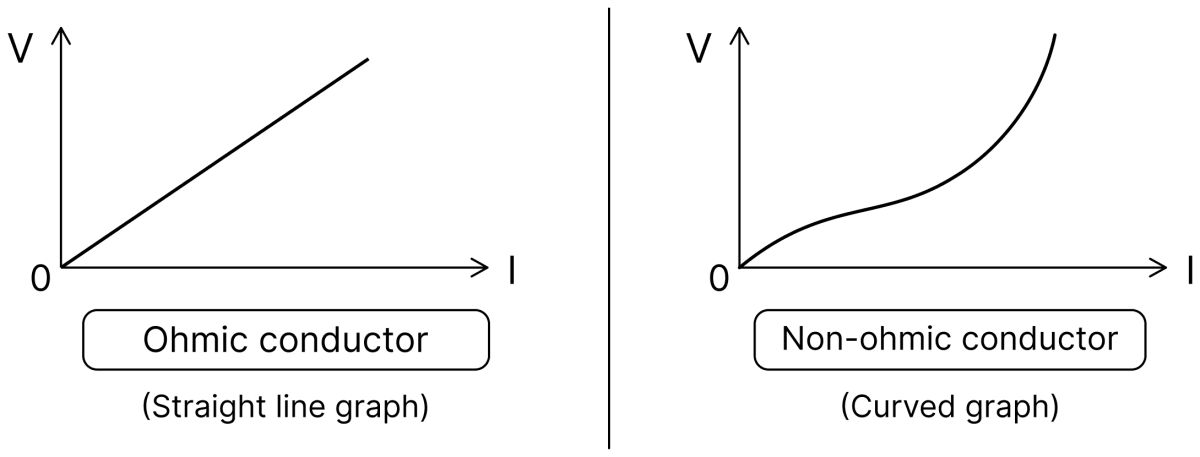
For an ohmic conductor, for example a metallic wire of manganin or constantan, the V–I graph is a straight line passing through the origin, showing that the resistance is constant.
For a non-ohmic conductor, for example a semiconductor diode or a thermistor, the V–I graph is not a straight line, showing that the resistance changes with the applied potential difference.
Explain resistivity. Show its variation with temperature for : (i) conductors (ii) semi-conductors (iii) alloys.
Answer
Resistivity : The resistivity (specific resistance) of a material is the resistance of a wire of that material of unit length and unit area of cross-section,
where n is the free-electron density and τ the relaxation time.
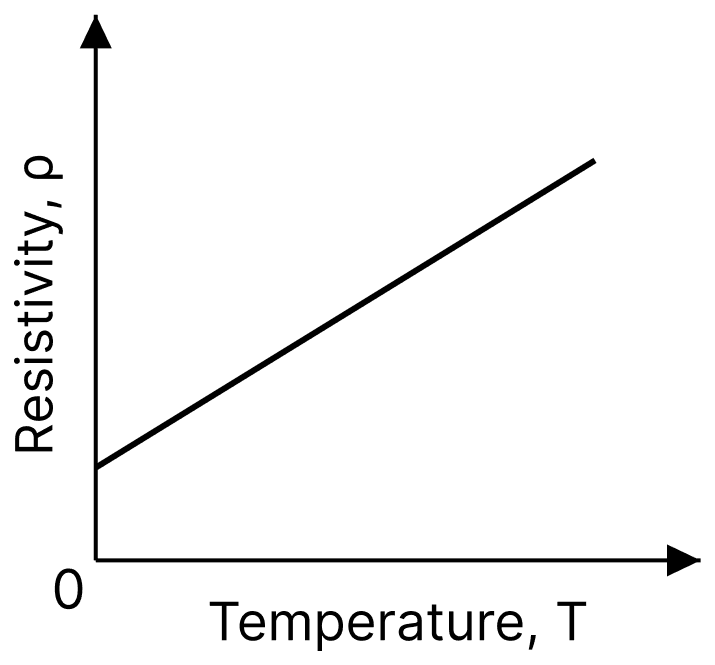
(i) Conductors : When the temperature of a metal is raised, its ions vibrate more vigorously, so the free electrons collide with them more frequently and the relaxation time τ decreases. The free-electron density n is very large and remains practically unchanged. Since , the resistivity of a conductor increases with a rise in temperature, that is, its temperature coefficient of resistance is positive. The variation is nearly linear over a moderate range of temperature.
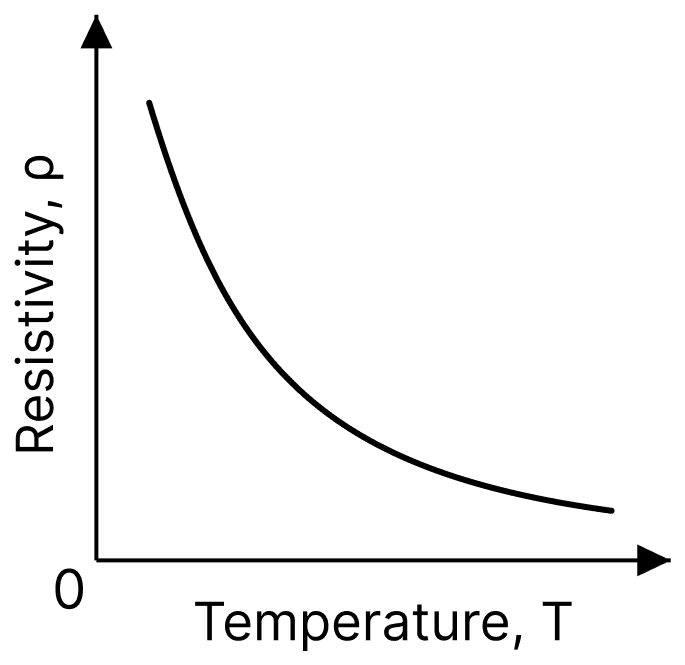
(ii) Semi-conductors : In semiconductors such as silicon, germanium and carbon, the value of n is very small compared to that in metals, but with a rise in temperature the number of free electrons increases greatly. Although τ also decreases, the increase in n is much larger than the decrease in τ. Hence the resistivity of a semiconductor decreases rapidly with a rise in temperature, that is, its temperature coefficient of resistance is negative.
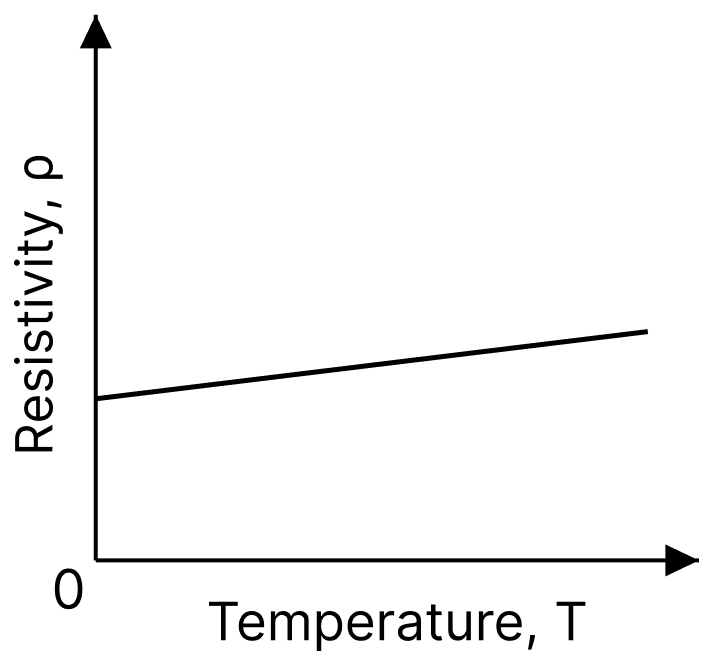
(iii) Alloys : Alloys such as nichrome, manganin and constantan have a high resistivity and a very small temperature coefficient of resistance. Their resistivity increases only very slightly with a rise in temperature, so their resistance is not much affected by a change of temperature. For this reason they are used for making standard resistances and heating elements.
Show that effective resistance in series combination increases. While that in parallel combination decreases. Two wires of iron and copper of same dimensions are connected in series. The iron wire burns out but the copper wire does not even visible glow. Explain.
Answer
Series combination : Let three resistances R1, R2 and R3 be joined end to end and let the same current I flow through all of them. If V1, V2 and V3 are the potential differences across them, then
The total potential difference is
If R is the equivalent resistance, then V = I R. Comparing,
Since each of R1, R2, R3 is positive, R is greater than even the greatest of the resistances connected. Hence the effective resistance in series combination increases.
Parallel combination : Let the same three resistances be joined between two points across which the potential difference is V. The currents in them are
The main current is
If R is the equivalent resistance, then . Comparing,
Here is greater than each of , and , so R is less than the least of the resistances joined. Hence the effective resistance in parallel combination decreases.
Iron and copper wires in series : The two wires have the same length and the same area of cross-section, but the resistivity of iron is much greater than that of copper. Hence, from , the iron wire has a much larger resistance than the copper wire.
In series the same current I flows through both, and the rate of production of heat is P = I2R. Therefore heat is produced at a far greater rate in the iron wire than in the copper wire. The iron wire becomes white hot and burns out, while the copper wire produces so little heat that it does not even glow visibly.
Read the passage(s) and answer the following questions :
Figure shows an electric circuit consisting of a battery connected to the terminals A and B of a 'black box' through a key K. The black box contains an electrical device, say, a resistor or an electric motor or a storage battery on charging.
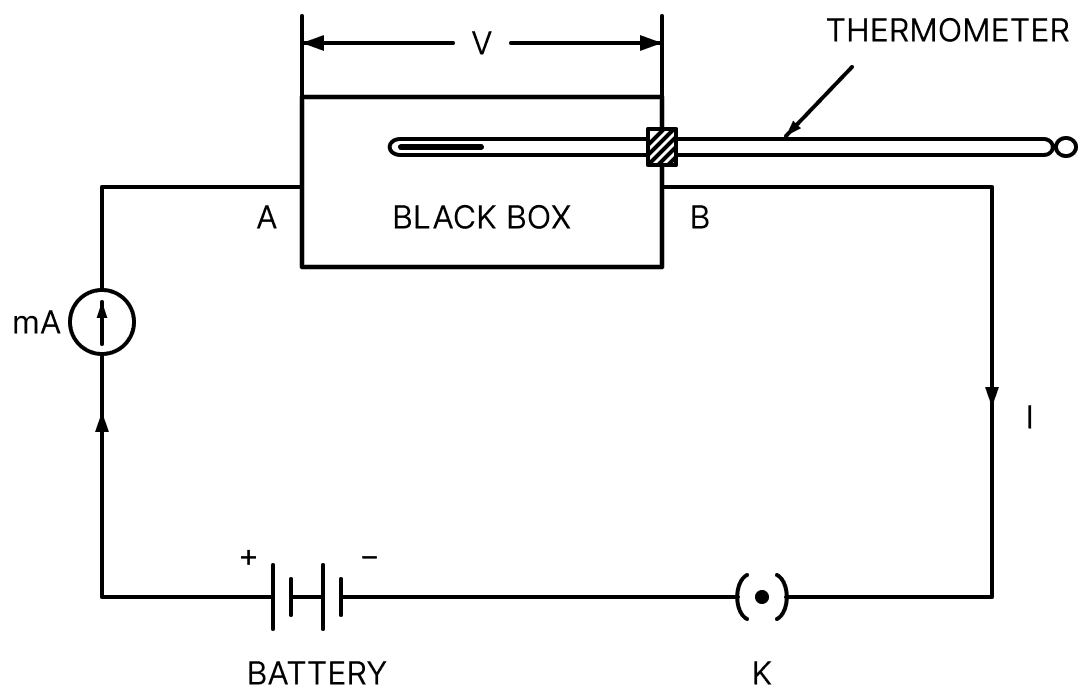
A steady current flows through the box from A to B and a steady potential difference exists between the terminals. Current I flows in the circuit which is being measured by a very sensitive milliammeter. The temperature of the inside of the black box is being observed by a thermometer.
(i) Why the current observed by milliammeter first increases and after sometime decreases to a constant value, if device in the black box is an electric motor?
(ii) In what form the electrical energy is stored in the storage battery?
(iii) What is the commercial unit of electrical energy?
(iv) If black box is a resistor of resistance R, how much heat will be produced in the resistance in time t when current I flows through the circuit?
(v) A battery of 3.0 V is connected to a resistor dissipating 0.5 W power. If the terminal voltage of the battery is 2.5 V, find current in the circuit.
Answer
(i) When the motor starts, its coil is at rest and no back emf is developed in it, so the resistance offered to the source is only the small resistance of the coil and the motor takes a large current. As the motor picks up speed, a back emf is developed in its coil which opposes the applied potential difference. Hence the current decreases and finally becomes steady when the motor attains its constant speed.
(ii) In a storage battery on charging, the electrical energy is stored in the form of chemical energy.
(iii) The commercial unit of electrical energy is the kilowatt-hour (kW-h), commonly called 1 unit, where 1 kW-h = 3.6 × 10⁶ J.
(iv) The heat produced in a resistance R in time t when a current I flows through it is
(v)
Given,
- Emf of the battery, E = 3.0 V
- Power dissipated in the resistor, P = 0.5 W
- Terminal voltage of the battery, V = I R = 2.5 V
The power dissipated in the resistor is
and the terminal voltage is
Dividing Eq. (i) by Eq. (ii),
Hence, the current in the circuit is 0.2 A.
When potential difference V is applied across the two ends of a given conductor, the free electrons in the conductor experiences a force and are accelerated towards the positive end of the conductor.
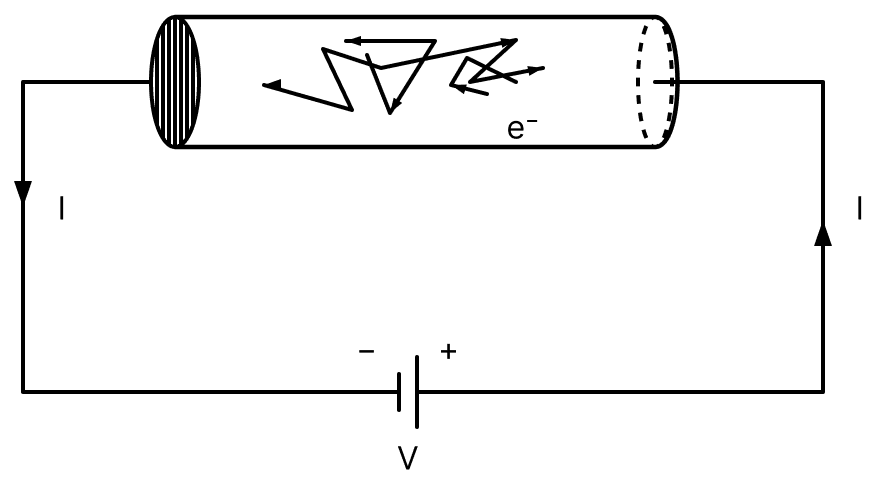
On their way, they suffer frequent collisions with the ions/atoms of the conductor and lose their gained kinetic energy. After each collision, the free electrons are again accelerated due to electric field, towards the positive end of the conductor and lose their gained kinetic energy in the next collision with the ions/atoms of the conductor. The average speed of the free electrons with which they drift towards the positive end of the conductor under the effect of applied electric field is called drift speed of the electrons.
(i) Name the two factors on which drift speed of the electrons depend.
(ii) Why we get large current in conductor?
(iii) Drift speed of electrons in a conductor is very small, i.e., vd = 10-4 ms-1. The electric bulb glows immediately, when the switch is closed. Why?
(iv) A steady current flows in a metallic conductor of non-uniform cross-section. Which of these quantities is constant along the conductor : current, current density, electric field, drift speed?
(v) Write the relation between current density and drift velocity .
Answer
(i) The drift speed of the electrons is . Hence it depends upon
(a) the electric field established in the conductor, that is, the potential difference applied across its ends, and
(b) the relaxation time of the free electrons, which depends upon the material of the conductor and its temperature.
(ii) The current in a conductor is I = n e A vd. Although the charge e and the drift speed vd of an electron are both extremely small, the number of free electrons per unit volume n in a conductor is very large, being of the order of 1028 per m3. This very large value of n compensates for the small values of e and vd, and hence we get a large current in a conductor.
(iii) When the switch is closed, an electric impulse travels through the whole circuit with the speed of light, 3 × 10⁸ m s-1. Hence an electric field is established almost instantly at every point of the circuit, and the free electrons already present everywhere in the circuit, including those in the filament of the bulb, start drifting at practically the same instant. So the current is set up throughout the circuit at once and the bulb glows immediately, in spite of the very small drift speed.
(iv) Only the current is constant along the conductor. For a steady current the same charge crosses every cross-section in a given time. The current density , the electric field and the drift speed all depend on the area of cross-section, which is not uniform.
(v) The relation between the current density and the drift velocity is
where n is the free-electron density in the conductor. The negative sign shows that the current density is directed opposite to the drift velocity of the electrons, because the electrons carry a negative charge.